
A English
LC Oscillations Questions in English
Class 12 Physics · Alternating Current · LC Oscillations
108+
Questions
English
Language
100%
With Solutions
Showing 50 of 108 questions in English
51
Medium
Compare $LC$ oscillations and forced damped oscillations in mechanics.
Solution
(N/A) The equation of motion for a forced damped mechanical oscillator is given by:
$m \frac{d^{2} x}{d t^{2}} + b \frac{d x}{d t} + k x = F_{0} \cos \omega_{d} t$
The equation for a driven $LCR$ circuit is given by:
$L \frac{d^{2} q}{d t^{2}} + R \frac{d q}{d t} + \frac{q}{C} = V_{m} \sin \omega t$
By comparing these two differential equations, we can establish an analogy between mechanical and electrical systems as follows:
$m \frac{d^{2} x}{d t^{2}} + b \frac{d x}{d t} + k x = F_{0} \cos \omega_{d} t$
The equation for a driven $LCR$ circuit is given by:
$L \frac{d^{2} q}{d t^{2}} + R \frac{d q}{d t} + \frac{q}{C} = V_{m} \sin \omega t$
By comparing these two differential equations, we can establish an analogy between mechanical and electrical systems as follows:
| Mechanical System (Forced Oscillations) | Electrical System (Driven $LCR$ Circuit) |
| Displacement $x$ | Charge $q$ |
| Mass $m$ | Inductance $L$ |
| Damping constant $b$ | Resistance $R$ |
| Spring constant $k$ | Inverse capacitance $1/C$ |
| Driving force $F_{0} \cos \omega_{d} t$ | Driving voltage $V_{m} \sin \omega t$ |
| Natural frequency $\omega_{0} = \sqrt{k/m}$ | Natural frequency $\omega_{0} = 1/\sqrt{LC}$ |
0 likes
View Solution52
MediumMCQ
What is an $LC$ circuit?
A
$A$ circuit containing only a resistor and a capacitor.
B
$A$ circuit containing an inductor and a capacitor connected in series or parallel.
C
$A$ circuit containing only an inductor and a resistor.
D
$A$ circuit containing a resistor,an inductor,and a capacitor.
Solution
(B) An $LC$ circuit,also called a resonant circuit,tank circuit,or tuned circuit,is an electrical circuit consisting of an inductor,represented by the letter $L$,and a capacitor,represented by the letter $C$,connected together.
These circuits are used either for generating signals at a particular frequency or for picking out a signal at a particular frequency from a more complex signal.
In an ideal $LC$ circuit,the energy oscillates between the electric field of the capacitor and the magnetic field of the inductor at the resonant frequency $f = \frac{1}{2\pi\sqrt{LC}}$.
These circuits are used either for generating signals at a particular frequency or for picking out a signal at a particular frequency from a more complex signal.
In an ideal $LC$ circuit,the energy oscillates between the electric field of the capacitor and the magnetic field of the inductor at the resonant frequency $f = \frac{1}{2\pi\sqrt{LC}}$.
0 likes
View Solution53
MediumMCQ
What are $LC$ oscillations?
A
$A$ process where energy oscillates between a capacitor and an inductor.
B
$A$ process where energy is dissipated as heat in a resistor.
C
$A$ process where current remains constant in a circuit.
D
$A$ process where voltage remains constant in a circuit.
Solution
(A) An $LC$ oscillation is the flow of electric current that oscillates back and forth between a capacitor and an inductor in an $LC$ circuit.
When a charged capacitor is connected to an inductor,the energy stored in the electric field of the capacitor is transferred to the magnetic field of the inductor as current flows.
This process continues as the energy oscillates between the electric field of the capacitor and the magnetic field of the inductor.
In an ideal $LC$ circuit with no resistance,these oscillations continue indefinitely with a constant frequency given by $f = \frac{1}{2\pi\sqrt{LC}}$.
When a charged capacitor is connected to an inductor,the energy stored in the electric field of the capacitor is transferred to the magnetic field of the inductor as current flows.
This process continues as the energy oscillates between the electric field of the capacitor and the magnetic field of the inductor.
In an ideal $LC$ circuit with no resistance,these oscillations continue indefinitely with a constant frequency given by $f = \frac{1}{2\pi\sqrt{LC}}$.
0 likes
View Solution54
Difficult
Write the differential equation for an $LC$ circuit.
Solution
(N/A) In an $LC$ circuit consisting of an inductor $L$ and a capacitor $C$,the sum of the potential drops across the inductor and the capacitor must be zero according to Kirchhoff's voltage law.
Let $q$ be the charge on the capacitor at any time $t$.
The potential difference across the capacitor is $V_C = \frac{q}{C}$.
The potential difference across the inductor is $V_L = L \frac{di}{dt}$.
Since $i = \frac{dq}{dt}$,the current is the rate of change of charge.
Thus,$V_L = L \frac{d^2q}{dt^2}$.
Applying Kirchhoff's loop rule: $V_L + V_C = 0$.
Substituting the expressions: $L \frac{d^2q}{dt^2} + \frac{q}{C} = 0$.
This is the differential equation for the $LC$ circuit,which can also be written as $\frac{d^2q}{dt^2} + \frac{1}{LC} q = 0$.
Let $q$ be the charge on the capacitor at any time $t$.
The potential difference across the capacitor is $V_C = \frac{q}{C}$.
The potential difference across the inductor is $V_L = L \frac{di}{dt}$.
Since $i = \frac{dq}{dt}$,the current is the rate of change of charge.
Thus,$V_L = L \frac{d^2q}{dt^2}$.
Applying Kirchhoff's loop rule: $V_L + V_C = 0$.
Substituting the expressions: $L \frac{d^2q}{dt^2} + \frac{q}{C} = 0$.
This is the differential equation for the $LC$ circuit,which can also be written as $\frac{d^2q}{dt^2} + \frac{1}{LC} q = 0$.
0 likes
View Solution55
Easy
Write the expression for the frequency of oscillation of an $LC$ circuit.
Solution
(N/A) In an $LC$ circuit consisting of an inductor $L$ and a capacitor $C$,the energy oscillates between the magnetic field of the inductor and the electric field of the capacitor.
The angular frequency of oscillation $\omega$ is given by the formula:
$\omega = \frac{1}{\sqrt{LC}}$
The frequency of oscillation $f$ is related to the angular frequency by $f = \frac{\omega}{2\pi}$.
Substituting the value of $\omega$,we get:
$f = \frac{1}{2\pi\sqrt{LC}}$
Here,$f$ is the frequency in Hertz $(Hz)$,$L$ is the inductance in Henry $(H)$,and $C$ is the capacitance in Farad $(F)$.
The angular frequency of oscillation $\omega$ is given by the formula:
$\omega = \frac{1}{\sqrt{LC}}$
The frequency of oscillation $f$ is related to the angular frequency by $f = \frac{\omega}{2\pi}$.
Substituting the value of $\omega$,we get:
$f = \frac{1}{2\pi\sqrt{LC}}$
Here,$f$ is the frequency in Hertz $(Hz)$,$L$ is the inductance in Henry $(H)$,and $C$ is the capacitance in Farad $(F)$.
0 likes
View Solution56
MediumMCQ
Give the name of the physical quantity in an $LCR$ circuit that corresponds to the spring constant $k$ in forced oscillations.
A
Resistance $R$
B
Inductance $L$
C
Reciprocal of capacitance $1/C$
D
Capacitance $C$
Solution
(C) In forced oscillations of a mechanical system,the equation of motion is $m(d^2x/dt^2) + b(dx/dt) + kx = F(t)$.
In an $LCR$ series circuit,the equation for charge $q$ is $L(d^2q/dt^2) + R(dq/dt) + (1/C)q = V(t)$.
Comparing these two equations:
$1$. Mass $m$ corresponds to Inductance $L$.
$2$. Damping constant $b$ corresponds to Resistance $R$.
$3$. Spring constant $k$ corresponds to the reciprocal of capacitance $1/C$.
$4$. Displacement $x$ corresponds to charge $q$.
Therefore,the physical quantity corresponding to the spring constant $k$ is $1/C$.
In an $LCR$ series circuit,the equation for charge $q$ is $L(d^2q/dt^2) + R(dq/dt) + (1/C)q = V(t)$.
Comparing these two equations:
$1$. Mass $m$ corresponds to Inductance $L$.
$2$. Damping constant $b$ corresponds to Resistance $R$.
$3$. Spring constant $k$ corresponds to the reciprocal of capacitance $1/C$.
$4$. Displacement $x$ corresponds to charge $q$.
Therefore,the physical quantity corresponding to the spring constant $k$ is $1/C$.
0 likes
View Solution57
MediumMCQ
If a $LC$ circuit is considered analogous to a harmonically oscillating spring-block system,which energy of the $LC$ circuit would be analogous to potential energy and which one analogous to kinetic energy?
A
Electrostatic energy to potential energy and magnetic energy to kinetic energy.
B
Magnetic energy to potential energy and electrostatic energy to kinetic energy.
C
Both are analogous to potential energy.
D
Both are analogous to kinetic energy.
Solution
(A) In a harmonically oscillating spring-block system,the total energy is the sum of potential energy $\left(\frac{1}{2} kx^{2}\right)$ and kinetic energy $\left(\frac{1}{2} mv^{2}\right)$.
In an $LC$ circuit,the total energy is the sum of electrostatic energy stored in the capacitor $\left(\frac{1}{2} \frac{q^{2}}{C}\right)$ and magnetic energy stored in the inductor $\left(\frac{1}{2} LI^{2}\right)$.
Comparing these,the electrostatic energy $\left(\frac{1}{2} \frac{q^{2}}{C}\right)$ is analogous to the potential energy of the spring $\left(\frac{1}{2} kx^{2}\right)$,as both depend on the displacement/charge.
The magnetic energy $\left(\frac{1}{2} LI^{2}\right)$ is analogous to the kinetic energy of the block $\left(\frac{1}{2} mv^{2}\right)$,as both depend on the velocity/current.
In an $LC$ circuit,the total energy is the sum of electrostatic energy stored in the capacitor $\left(\frac{1}{2} \frac{q^{2}}{C}\right)$ and magnetic energy stored in the inductor $\left(\frac{1}{2} LI^{2}\right)$.
Comparing these,the electrostatic energy $\left(\frac{1}{2} \frac{q^{2}}{C}\right)$ is analogous to the potential energy of the spring $\left(\frac{1}{2} kx^{2}\right)$,as both depend on the displacement/charge.
The magnetic energy $\left(\frac{1}{2} LI^{2}\right)$ is analogous to the kinetic energy of the block $\left(\frac{1}{2} mv^{2}\right)$,as both depend on the velocity/current.
0 likes
View Solution58
Medium
In the $LCR$ circuit shown in the figure,the ac driving voltage is $V = V_m \sin \omega t$.
$(a)$ Write down the equation of motion for $q(t)$.
$(b)$ At $t = t_0$,the voltage source is removed and $R$ is short-circuited. Write down the energy stored in each of $L$ and $C$ at this instant.
$(c)$ Describe the subsequent motion of charges.
$(a)$ Write down the equation of motion for $q(t)$.
$(b)$ At $t = t_0$,the voltage source is removed and $R$ is short-circuited. Write down the energy stored in each of $L$ and $C$ at this instant.
$(c)$ Describe the subsequent motion of charges.
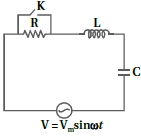
Solution
(N/A) Applying Kirchhoff's voltage law to the $LCR$ circuit:
$L \frac{d^2q}{dt^2} + R \frac{dq}{dt} + \frac{q}{C} = V_m \sin \omega t$
$(b)$ At $t = t_0$,the current is $i(t_0) = \frac{dq}{dt}|_{t=t_0}$ and the charge on the capacitor is $q(t_0)$.
The energy stored in the inductor is $U_L = \frac{1}{2} L [i(t_0)]^2$.
The energy stored in the capacitor is $U_C = \frac{1}{2} \frac{[q(t_0)]^2}{C}$.
$(c)$ After $t = t_0$,the circuit becomes an $LC$ circuit with $R=0$. The total energy $U = U_L + U_C$ is conserved. The charge $q(t)$ will oscillate sinusoidally with an angular frequency $\omega_0 = \frac{1}{\sqrt{LC}}$.
$L \frac{d^2q}{dt^2} + R \frac{dq}{dt} + \frac{q}{C} = V_m \sin \omega t$
$(b)$ At $t = t_0$,the current is $i(t_0) = \frac{dq}{dt}|_{t=t_0}$ and the charge on the capacitor is $q(t_0)$.
The energy stored in the inductor is $U_L = \frac{1}{2} L [i(t_0)]^2$.
The energy stored in the capacitor is $U_C = \frac{1}{2} \frac{[q(t_0)]^2}{C}$.
$(c)$ After $t = t_0$,the circuit becomes an $LC$ circuit with $R=0$. The total energy $U = U_L + U_C$ is conserved. The charge $q(t)$ will oscillate sinusoidally with an angular frequency $\omega_0 = \frac{1}{\sqrt{LC}}$.
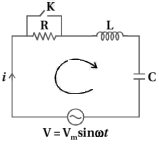
0 likes
View Solution59
MediumMCQ
The frequency of an $L-C$ circuit is $f_{1}$. If a resistance $R$ is also added to it,the frequency becomes $f_{2}$. The ratio $\frac{f_{2}}{f_{1}}$ will be:
A
$\sqrt{1+\frac{R^{2}C}{4L}}$
B
$\sqrt{1-\frac{R^{2}C}{4L}}$
C
$\sqrt{1+\frac{R^{2}C}{L}}$
D
$\sqrt{1-\frac{R^{2}C}{L}}$
Solution
(B) The frequency of an ideal $L-C$ circuit is given by $f_{1} = \frac{1}{2\pi\sqrt{LC}}$.
When a resistance $R$ is added in series,the circuit becomes a damped $L-C-R$ circuit. The damped angular frequency is given by $\omega_{d} = \sqrt{\omega_{0}^{2} - \beta^{2}}$,where $\omega_{0} = \frac{1}{\sqrt{LC}}$ and $\beta = \frac{R}{2L}$.
Thus,the damped frequency $f_{2}$ is given by:
$f_{2} = \frac{1}{2\pi} \sqrt{\left(\frac{1}{\sqrt{LC}}\right)^{2} - \left(\frac{R}{2L}\right)^{2}}$
Taking the ratio $\frac{f_{2}}{f_{1}}$:
$\frac{f_{2}}{f_{1}} = \frac{\frac{1}{2\pi} \sqrt{\frac{1}{LC} - \frac{R^{2}}{4L^{2}}}}{\frac{1}{2\pi\sqrt{LC}}}$
$= \sqrt{\frac{\frac{1}{LC} - \frac{R^{2}}{4L^{2}}}{\frac{1}{LC}}}$
$= \sqrt{1 - \frac{R^{2}C}{4L}}$
When a resistance $R$ is added in series,the circuit becomes a damped $L-C-R$ circuit. The damped angular frequency is given by $\omega_{d} = \sqrt{\omega_{0}^{2} - \beta^{2}}$,where $\omega_{0} = \frac{1}{\sqrt{LC}}$ and $\beta = \frac{R}{2L}$.
Thus,the damped frequency $f_{2}$ is given by:
$f_{2} = \frac{1}{2\pi} \sqrt{\left(\frac{1}{\sqrt{LC}}\right)^{2} - \left(\frac{R}{2L}\right)^{2}}$
Taking the ratio $\frac{f_{2}}{f_{1}}$:
$\frac{f_{2}}{f_{1}} = \frac{\frac{1}{2\pi} \sqrt{\frac{1}{LC} - \frac{R^{2}}{4L^{2}}}}{\frac{1}{2\pi\sqrt{LC}}}$
$= \sqrt{\frac{\frac{1}{LC} - \frac{R^{2}}{4L^{2}}}{\frac{1}{LC}}}$
$= \sqrt{1 - \frac{R^{2}C}{4L}}$
0 likes
View Solution60
EasyMCQ
An oscillator circuit consists of an inductance of $0.5 \, mH$ and a capacitor of $20 \, \mu F$. The resonant frequency of the circuit is nearly (in $Hz$)
A
$15.92$
B
$159.2$
C
$1592$
D
$15912$
Solution
(C) The resonant frequency of an $LC$ oscillator circuit is given by the formula:
$v_{0} = \frac{1}{2 \pi \sqrt{LC}}$
Given values are:
Inductance $L = 0.5 \, mH = 0.5 \times 10^{-3} \, H = 5 \times 10^{-4} \, H$
Capacitance $C = 20 \, \mu F = 20 \times 10^{-6} \, F$
Substituting these values into the formula:
$v_{0} = \frac{1}{2 \times 3.14 \times \sqrt{5 \times 10^{-4} \times 20 \times 10^{-6}}}$
$v_{0} = \frac{1}{6.28 \times \sqrt{100 \times 10^{-10}}}$
$v_{0} = \frac{1}{6.28 \times \sqrt{10^{-8}}}$
$v_{0} = \frac{1}{6.28 \times 10^{-4}}$
$v_{0} = \frac{10^{4}}{6.28} \approx 1592 \, Hz$
$v_{0} = \frac{1}{2 \pi \sqrt{LC}}$
Given values are:
Inductance $L = 0.5 \, mH = 0.5 \times 10^{-3} \, H = 5 \times 10^{-4} \, H$
Capacitance $C = 20 \, \mu F = 20 \times 10^{-6} \, F$
Substituting these values into the formula:
$v_{0} = \frac{1}{2 \times 3.14 \times \sqrt{5 \times 10^{-4} \times 20 \times 10^{-6}}}$
$v_{0} = \frac{1}{6.28 \times \sqrt{100 \times 10^{-10}}}$
$v_{0} = \frac{1}{6.28 \times \sqrt{10^{-8}}}$
$v_{0} = \frac{1}{6.28 \times 10^{-4}}$
$v_{0} = \frac{10^{4}}{6.28} \approx 1592 \, Hz$
0 likes
View Solution61
MediumMCQ
If maximum energy is stored in the capacitor at $t = 0$,find the time after which the current in the circuit will be maximum. Given $L = 25 \, mH$ and $C = 10 \, \mu F$.
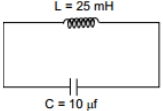
A
$\frac{\pi}{2} \, ms$
B
$\frac{\pi}{4} \, ms$
C
$\pi \, ms$
D
$2 \, ms$
Solution
(B) In an $L-C$ oscillation circuit,the total time period $T$ for one complete cycle is given by:
$T = 2\pi \sqrt{LC}$
Given $L = 25 \, mH = 25 \times 10^{-3} \, H$ and $C = 10 \, \mu F = 10 \times 10^{-6} \, F$.
Substituting the values:
$T = 2\pi \sqrt{25 \times 10^{-3} \times 10 \times 10^{-6}}$
$T = 2\pi \sqrt{250 \times 10^{-9}} = 2\pi \sqrt{25 \times 10^{-8}}$
$T = 2\pi \times 5 \times 10^{-4} = 10\pi \times 10^{-4} = \pi \times 10^{-3} \, s = \pi \, ms$.
The energy in the capacitor is maximum at $t = 0$. The current in the circuit becomes maximum when the energy is fully transferred from the capacitor to the inductor,which occurs at $t = \frac{T}{4}$.
Therefore,the time required is:
$t = \frac{T}{4} = \frac{\pi \, ms}{4} = \frac{\pi}{4} \, ms$.
$T = 2\pi \sqrt{LC}$
Given $L = 25 \, mH = 25 \times 10^{-3} \, H$ and $C = 10 \, \mu F = 10 \times 10^{-6} \, F$.
Substituting the values:
$T = 2\pi \sqrt{25 \times 10^{-3} \times 10 \times 10^{-6}}$
$T = 2\pi \sqrt{250 \times 10^{-9}} = 2\pi \sqrt{25 \times 10^{-8}}$
$T = 2\pi \times 5 \times 10^{-4} = 10\pi \times 10^{-4} = \pi \times 10^{-3} \, s = \pi \, ms$.
The energy in the capacitor is maximum at $t = 0$. The current in the circuit becomes maximum when the energy is fully transferred from the capacitor to the inductor,which occurs at $t = \frac{T}{4}$.
Therefore,the time required is:
$t = \frac{T}{4} = \frac{\pi \, ms}{4} = \frac{\pi}{4} \, ms$.
0 likes
View Solution62
MediumMCQ
The positive feedback is required by an amplifier to act as an oscillator. The feedback here means ...........
A
External input is necessary to sustain $AC$ signal in output.
B
$A$ portion of the output power is returned back to the input.
C
Feedback can be achieved by $LR$ network.
D
The base-collector junction must be forward biased.
Solution
(B) An oscillator is a circuit that produces a continuous periodic waveform without any external input signal.
For an amplifier to act as an oscillator,it requires positive feedback.
Positive feedback means that a portion of the output signal (voltage or power) is fed back to the input in phase with the original input signal.
This feedback reinforces the input,allowing the circuit to sustain oscillations independently.
For an amplifier to act as an oscillator,it requires positive feedback.
Positive feedback means that a portion of the output signal (voltage or power) is fed back to the input in phase with the original input signal.
This feedback reinforces the input,allowing the circuit to sustain oscillations independently.
0 likes
View Solution63
MediumMCQ
$A$ capacitor of capacitance $500\,\mu F$ is charged completely using a dc supply of $100\,V$. It is now connected to an inductor of inductance $50\,mH$ to form an $LC$ circuit. The maximum current in $LC$ circuit will be $.........A$.
A
$10$
B
$1$
C
$0$
D
$100$
Solution
(A) The energy stored in the capacitor is given by $U = \frac{1}{2} CV^2$.
Substituting the given values,$U = \frac{1}{2} \times (500 \times 10^{-6} \, F) \times (100 \, V)^2 = \frac{1}{2} \times 500 \times 10^{-6} \times 10^4 = 2.5 \, J$.
In an $LC$ circuit,the total energy is conserved. The maximum current $I_{max}$ occurs when the entire energy of the capacitor is transferred to the inductor.
Thus,$\frac{1}{2} LI_{max}^2 = U_{total}$.
$\frac{1}{2} \times (50 \times 10^{-3} \, H) \times I_{max}^2 = 2.5 \, J$.
$I_{max}^2 = \frac{2.5 \times 2}{50 \times 10^{-3}} = \frac{5}{0.05} = 100$.
$I_{max} = \sqrt{100} = 10 \, A$.
Substituting the given values,$U = \frac{1}{2} \times (500 \times 10^{-6} \, F) \times (100 \, V)^2 = \frac{1}{2} \times 500 \times 10^{-6} \times 10^4 = 2.5 \, J$.
In an $LC$ circuit,the total energy is conserved. The maximum current $I_{max}$ occurs when the entire energy of the capacitor is transferred to the inductor.
Thus,$\frac{1}{2} LI_{max}^2 = U_{total}$.
$\frac{1}{2} \times (50 \times 10^{-3} \, H) \times I_{max}^2 = 2.5 \, J$.
$I_{max}^2 = \frac{2.5 \times 2}{50 \times 10^{-3}} = \frac{5}{0.05} = 100$.
$I_{max} = \sqrt{100} = 10 \, A$.
0 likes
View Solution64
AdvancedMCQ
$A$ circuit consists of a coil with inductance $L$ and an uncharged capacitor of capacitance $C$. The coil is in a constant uniform magnetic field such that the flux through the coil is $\phi$. At time $t=0$,the magnetic field is abruptly switched $OFF$. Let $\omega_{0}=1 / \sqrt{L C}$ and ignore the resistance of the circuit. Then,
A
current in the circuit is $I(t)=(\phi / L) \cos \omega_{0} t$
B
magnitude of the charge on the capacitor is $|Q(t)|=2 C \omega_{0}\left|\sin \omega_{0} t\right|$
C
initial current in the circuit is infinite
D
initial charge on the capacitor is $C \omega_{0} \phi$
Solution
(A) At $t=0$,the capacitor is uncharged and the flux through the inductor is $\phi$.
Using the relation $\phi = L I$,the initial current in the circuit at $t=0$ is $I_{0} = \phi / L$.
The circuit forms an $LC$ oscillator. The differential equation for the charge $q$ on the capacitor is $L \frac{d^{2} q}{d t^{2}} + \frac{q}{C} = 0$,which simplifies to $\frac{d^{2} q}{d t^{2}} + \omega_{0}^{2} q = 0$,where $\omega_{0} = 1 / \sqrt{LC}$.
The general solution for the charge is $q(t) = A \sin(\omega_{0} t + \delta)$.
Since $q(0) = 0$,we have $\delta = 0$,so $q(t) = A \sin(\omega_{0} t)$.
The current is $I(t) = \frac{dq}{dt} = A \omega_{0} \cos(\omega_{0} t)$.
At $t=0$,$I(0) = A \omega_{0} = I_{0} = \phi / L$.
Therefore,$A = \phi / (L \omega_{0})$.
Substituting $A$ back,the current is $I(t) = (\phi / L) \cos(\omega_{0} t)$.
Thus,option $A$ is correct.
Using the relation $\phi = L I$,the initial current in the circuit at $t=0$ is $I_{0} = \phi / L$.
The circuit forms an $LC$ oscillator. The differential equation for the charge $q$ on the capacitor is $L \frac{d^{2} q}{d t^{2}} + \frac{q}{C} = 0$,which simplifies to $\frac{d^{2} q}{d t^{2}} + \omega_{0}^{2} q = 0$,where $\omega_{0} = 1 / \sqrt{LC}$.
The general solution for the charge is $q(t) = A \sin(\omega_{0} t + \delta)$.
Since $q(0) = 0$,we have $\delta = 0$,so $q(t) = A \sin(\omega_{0} t)$.
The current is $I(t) = \frac{dq}{dt} = A \omega_{0} \cos(\omega_{0} t)$.
At $t=0$,$I(0) = A \omega_{0} = I_{0} = \phi / L$.
Therefore,$A = \phi / (L \omega_{0})$.
Substituting $A$ back,the current is $I(t) = (\phi / L) \cos(\omega_{0} t)$.
Thus,option $A$ is correct.
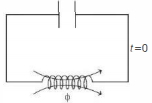
0 likes
View Solution65
MediumMCQ
The switch is in position $A$ for a long time. At time $t=0$,it is shifted to position $B$. Find the maximum charge that will accumulate on the capacitor.
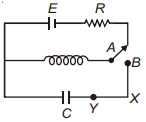
A
$(\sqrt{L C}) \frac{E}{R}$
B
$\frac{E}{(\sqrt{L C}) R}$
C
$\left(\sqrt{\frac{L}{C}}\right) \frac{E}{R}$
D
$\left(\sqrt{\frac{C}{L}}\right) \frac{E}{R}$
Solution
(A) When the switch is in position $A$ for a long time,the inductor acts as a short circuit (steady state). The current flowing through the inductor is $I_0 = \frac{E}{R}$.
At $t=0$,the switch is moved to position $B$. The circuit now consists of an inductor $L$ and a capacitor $C$ in series,forming an $LC$ oscillator circuit. The initial current in the inductor is $I_0 = \frac{E}{R}$ and the initial charge on the capacitor is $q_0 = 0$.
The energy stored in the inductor is converted into the energy stored in the capacitor. According to the conservation of energy:
$\frac{1}{2} L I_0^2 = \frac{1}{2} \frac{q_{\max}^2}{C}$
Substituting $I_0 = \frac{E}{R}$:
$L \left(\frac{E}{R}\right)^2 = \frac{q_{\max}^2}{C}$
$q_{\max}^2 = L C \frac{E^2}{R^2}$
$q_{\max} = \sqrt{L C} \frac{E}{R}$
At $t=0$,the switch is moved to position $B$. The circuit now consists of an inductor $L$ and a capacitor $C$ in series,forming an $LC$ oscillator circuit. The initial current in the inductor is $I_0 = \frac{E}{R}$ and the initial charge on the capacitor is $q_0 = 0$.
The energy stored in the inductor is converted into the energy stored in the capacitor. According to the conservation of energy:
$\frac{1}{2} L I_0^2 = \frac{1}{2} \frac{q_{\max}^2}{C}$
Substituting $I_0 = \frac{E}{R}$:
$L \left(\frac{E}{R}\right)^2 = \frac{q_{\max}^2}{C}$
$q_{\max}^2 = L C \frac{E^2}{R^2}$
$q_{\max} = \sqrt{L C} \frac{E}{R}$
0 likes
View Solution66
MediumMCQ
In an oscillating $LC$ circuit,the total stored energy is $U$ and the maximum charge on the capacitor is $Q$. When the charge on the capacitor is $\frac{Q}{2}$,the energy stored in the inductor is:
A
$\frac{U}{2}$
B
$\frac{U}{4}$
C
$\frac{4}{3} U$
D
$\frac{3U}{4}$
Solution
(D) The total energy $U$ in an $LC$ circuit is constant and is given by the maximum energy stored in the capacitor: $U = \frac{Q^2}{2C}$.
When the charge on the capacitor is $Q' = \frac{Q}{2}$,the energy stored in the capacitor $U_C$ is given by:
$U_C = \frac{(Q')^2}{2C} = \frac{(Q/2)^2}{2C} = \frac{Q^2/4}{2C} = \frac{Q^2}{8C}$.
Since the total energy $U$ is the sum of the energy in the capacitor $U_C$ and the energy in the inductor $U_L$,we have $U = U_C + U_L$.
Therefore,the energy stored in the inductor $U_L$ is:
$U_L = U - U_C = \frac{Q^2}{2C} - \frac{Q^2}{8C}$.
Taking the common denominator:
$U_L = \frac{4Q^2 - Q^2}{8C} = \frac{3Q^2}{8C}$.
Since $U = \frac{Q^2}{2C}$,we can write $\frac{Q^2}{8C} = \frac{1}{4} U$.
Thus,$U_L = \frac{3}{4} U$.
When the charge on the capacitor is $Q' = \frac{Q}{2}$,the energy stored in the capacitor $U_C$ is given by:
$U_C = \frac{(Q')^2}{2C} = \frac{(Q/2)^2}{2C} = \frac{Q^2/4}{2C} = \frac{Q^2}{8C}$.
Since the total energy $U$ is the sum of the energy in the capacitor $U_C$ and the energy in the inductor $U_L$,we have $U = U_C + U_L$.
Therefore,the energy stored in the inductor $U_L$ is:
$U_L = U - U_C = \frac{Q^2}{2C} - \frac{Q^2}{8C}$.
Taking the common denominator:
$U_L = \frac{4Q^2 - Q^2}{8C} = \frac{3Q^2}{8C}$.
Since $U = \frac{Q^2}{2C}$,we can write $\frac{Q^2}{8C} = \frac{1}{4} U$.
Thus,$U_L = \frac{3}{4} U$.
0 likes
View Solution67
MediumMCQ
In $L-C$ oscillation,the maximum charge on the capacitor is $Q$. If at any instant,the electric energy and magnetic energy associated with the circuit are equal,then the charge on the capacitor at that instant is:
A
$\frac{Q}{\sqrt{2}}$
B
$\frac{Q}{2}$
C
$\frac{\sqrt{3} Q}{2}$
D
$\frac{3 Q}{2}$
Solution
(A) The total energy in an $L-C$ circuit is constant and is given by $U_{total} = \frac{Q^2}{2C}$.
At any instant,the total energy is the sum of electric energy $(U_E)$ and magnetic energy $(U_B)$: $U_{total} = U_E + U_B$.
Given that at a certain instant,$U_E = U_B$,we can write $U_{total} = U_E + U_E = 2U_E$.
Substituting the expressions for energy,we have $\frac{Q^2}{2C} = 2 \left( \frac{(Q')^2}{2C} \right)$,where $Q'$ is the charge on the capacitor at that instant.
Simplifying the equation: $Q^2 = 2(Q')^2$.
Therefore,$(Q')^2 = \frac{Q^2}{2}$,which gives $Q' = \frac{Q}{\sqrt{2}}$.
At any instant,the total energy is the sum of electric energy $(U_E)$ and magnetic energy $(U_B)$: $U_{total} = U_E + U_B$.
Given that at a certain instant,$U_E = U_B$,we can write $U_{total} = U_E + U_E = 2U_E$.
Substituting the expressions for energy,we have $\frac{Q^2}{2C} = 2 \left( \frac{(Q')^2}{2C} \right)$,where $Q'$ is the charge on the capacitor at that instant.
Simplifying the equation: $Q^2 = 2(Q')^2$.
Therefore,$(Q')^2 = \frac{Q^2}{2}$,which gives $Q' = \frac{Q}{\sqrt{2}}$.
0 likes
View Solution68
MediumMCQ
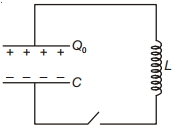
$A$ capacitor of capacitance $C$ has initial charge $Q_0$ and is connected to an inductor of inductance $L$ as shown. At $t=0$,the switch $S$ is closed. Find the current through the inductor when the energy in the capacitor is three times the energy of the inductor.
A
$\frac{Q_0}{2 \sqrt{L C}}$
B
$\frac{Q_0}{\sqrt{L C}}$
C
$\frac{2 Q_0}{\sqrt{L C}}$
D
$\frac{4 Q_0}{\sqrt{L C}}$
Solution
(A) The total energy in the $LC$ circuit is constant and is equal to the initial energy stored in the capacitor: $E_{\text{total}} = \frac{Q_0^2}{2C}$.
Let $E_c$ be the energy in the capacitor and $E_i$ be the energy in the inductor at any time $t$.
We are given that $E_c = 3 E_i$.
Since $E_{\text{total}} = E_c + E_i$,we can write $E_{\text{total}} = 3 E_i + E_i = 4 E_i$.
Substituting the total energy: $4 E_i = \frac{Q_0^2}{2C}$.
Therefore,$E_i = \frac{Q_0^2}{8C}$.
Since the energy in the inductor is given by $E_i = \frac{1}{2} L i^2$,we have $\frac{1}{2} L i^2 = \frac{Q_0^2}{8C}$.
Solving for $i$: $i^2 = \frac{Q_0^2}{4LC}$.
Taking the square root: $i = \frac{Q_0}{2 \sqrt{LC}}$.
Let $E_c$ be the energy in the capacitor and $E_i$ be the energy in the inductor at any time $t$.
We are given that $E_c = 3 E_i$.
Since $E_{\text{total}} = E_c + E_i$,we can write $E_{\text{total}} = 3 E_i + E_i = 4 E_i$.
Substituting the total energy: $4 E_i = \frac{Q_0^2}{2C}$.
Therefore,$E_i = \frac{Q_0^2}{8C}$.
Since the energy in the inductor is given by $E_i = \frac{1}{2} L i^2$,we have $\frac{1}{2} L i^2 = \frac{Q_0^2}{8C}$.
Solving for $i$: $i^2 = \frac{Q_0^2}{4LC}$.
Taking the square root: $i = \frac{Q_0}{2 \sqrt{LC}}$.
0 likes
View Solution69
EasyMCQ
In an $LC$ oscillator,if values of inductance and capacitance become twice and eight times,respectively,then the resonant frequency of the oscillator becomes $x$ times its initial resonant frequency $\omega_0$. The value of $x$ is:
A
$\frac{1}{4}$
B
$16$
C
$\frac{1}{16}$
D
$4$
Solution
(A) The resonant frequency of an $LC$ oscillator circuit is given by $\omega_0 = \frac{1}{\sqrt{LC}}$.
Given that the new inductance $L' = 2L$ and the new capacitance $C' = 8C$.
The new resonant frequency $\omega$ is given by $\omega = \frac{1}{\sqrt{L'C'}} = \frac{1}{\sqrt{(2L)(8C)}} = \frac{1}{\sqrt{16LC}}$.
Simplifying this,we get $\omega = \frac{1}{4\sqrt{LC}}$.
Since $\omega_0 = \frac{1}{\sqrt{LC}}$,we can substitute this into the expression for $\omega$ to get $\omega = \frac{\omega_0}{4}$.
Comparing this with $\omega = x\omega_0$,we find that $x = \frac{1}{4}$.
Given that the new inductance $L' = 2L$ and the new capacitance $C' = 8C$.
The new resonant frequency $\omega$ is given by $\omega = \frac{1}{\sqrt{L'C'}} = \frac{1}{\sqrt{(2L)(8C)}} = \frac{1}{\sqrt{16LC}}$.
Simplifying this,we get $\omega = \frac{1}{4\sqrt{LC}}$.
Since $\omega_0 = \frac{1}{\sqrt{LC}}$,we can substitute this into the expression for $\omega$ to get $\omega = \frac{\omega_0}{4}$.
Comparing this with $\omega = x\omega_0$,we find that $x = \frac{1}{4}$.
0 likes
View Solution70
MediumMCQ
An oscillating $LC$ circuit consists of a $75\,mH$ inductor and a $1.2\,\mu F$ capacitor. If the maximum charge on the capacitor is $2.7\,\mu C$,the maximum current in the circuit will be $...........\,mA$.
A
$8$
B
$9$
C
$6$
D
$5$
Solution
(B) In an oscillating $LC$ circuit,the total energy is conserved,oscillating between the electric field of the capacitor and the magnetic field of the inductor.
The maximum energy stored in the capacitor is equal to the maximum energy stored in the inductor:
$\frac{1}{2} L I_{\max}^2 = \frac{1}{2} \frac{Q_{\max}^2}{C}$
Rearranging for the maximum current $I_{\max}$:
$I_{\max} = Q_{\max} \sqrt{\frac{1}{LC}}$
Given values:
$L = 75 \times 10^{-3} \, H$
$C = 1.2 \times 10^{-6} \, F$
$Q_{\max} = 2.7 \times 10^{-6} \, C$
Calculating the angular frequency $\omega = \frac{1}{\sqrt{LC}}$:
$\omega = \frac{1}{\sqrt{75 \times 10^{-3} \times 1.2 \times 10^{-6}}} = \frac{1}{\sqrt{90 \times 10^{-9}}} = \frac{1}{\sqrt{9 \times 10^{-8}}} = \frac{1}{3 \times 10^{-4}} = \frac{10^4}{3} \, rad/s$
Now,$I_{\max} = Q_{\max} \times \omega$:
$I_{\max} = (2.7 \times 10^{-6}) \times \frac{10^4}{3} = 0.9 \times 10^{-2} \, A = 9 \times 10^{-3} \, A = 9 \, mA$.
The maximum energy stored in the capacitor is equal to the maximum energy stored in the inductor:
$\frac{1}{2} L I_{\max}^2 = \frac{1}{2} \frac{Q_{\max}^2}{C}$
Rearranging for the maximum current $I_{\max}$:
$I_{\max} = Q_{\max} \sqrt{\frac{1}{LC}}$
Given values:
$L = 75 \times 10^{-3} \, H$
$C = 1.2 \times 10^{-6} \, F$
$Q_{\max} = 2.7 \times 10^{-6} \, C$
Calculating the angular frequency $\omega = \frac{1}{\sqrt{LC}}$:
$\omega = \frac{1}{\sqrt{75 \times 10^{-3} \times 1.2 \times 10^{-6}}} = \frac{1}{\sqrt{90 \times 10^{-9}}} = \frac{1}{\sqrt{9 \times 10^{-8}}} = \frac{1}{3 \times 10^{-4}} = \frac{10^4}{3} \, rad/s$
Now,$I_{\max} = Q_{\max} \times \omega$:
$I_{\max} = (2.7 \times 10^{-6}) \times \frac{10^4}{3} = 0.9 \times 10^{-2} \, A = 9 \times 10^{-3} \, A = 9 \, mA$.
0 likes
View Solution71
DifficultMCQ
$A$ capacitor of capacitance $100 \ \mu F$ is charged to a potential of $12 \ V$ and connected to a $6.4 \ mH$ inductor to produce oscillations. The maximum current in the circuit would be: (in $A$)
A
$3.2$
B
$1.5$
C
$2.0$
D
$1.2$
Solution
(B) By the principle of conservation of energy in an $LC$ circuit,the maximum electrostatic energy stored in the capacitor is equal to the maximum magnetic energy stored in the inductor.
$\frac{1}{2} CV^2 = \frac{1}{2} LI_{\max}^2$
Rearranging the formula to solve for the maximum current $I_{\max}$:
$I_{\max} = V \sqrt{\frac{C}{L}}$
Given values:
$C = 100 \ \mu F = 100 \times 10^{-6} \ F = 10^{-4} \ F$
$L = 6.4 \ mH = 6.4 \times 10^{-3} \ H$
$V = 12 \ V$
Substituting the values:
$I_{\max} = 12 \times \sqrt{\frac{100 \times 10^{-6}}{6.4 \times 10^{-3}}}$
$I_{\max} = 12 \times \sqrt{\frac{10^{-4}}{6.4 \times 10^{-3}}} = 12 \times \sqrt{\frac{10^{-1}}{6.4}} = 12 \times \sqrt{\frac{0.1}{6.4}} = 12 \times \sqrt{\frac{1}{64}}$
$I_{\max} = 12 \times \frac{1}{8} = 1.5 \ A$
$\frac{1}{2} CV^2 = \frac{1}{2} LI_{\max}^2$
Rearranging the formula to solve for the maximum current $I_{\max}$:
$I_{\max} = V \sqrt{\frac{C}{L}}$
Given values:
$C = 100 \ \mu F = 100 \times 10^{-6} \ F = 10^{-4} \ F$
$L = 6.4 \ mH = 6.4 \times 10^{-3} \ H$
$V = 12 \ V$
Substituting the values:
$I_{\max} = 12 \times \sqrt{\frac{100 \times 10^{-6}}{6.4 \times 10^{-3}}}$
$I_{\max} = 12 \times \sqrt{\frac{10^{-4}}{6.4 \times 10^{-3}}} = 12 \times \sqrt{\frac{10^{-1}}{6.4}} = 12 \times \sqrt{\frac{0.1}{6.4}} = 12 \times \sqrt{\frac{1}{64}}$
$I_{\max} = 12 \times \frac{1}{8} = 1.5 \ A$
0 likes
View Solution72
DifficultMCQ
Consider an $LC$ circuit,with inductance $L = 0.1 \ H$ and capacitance $C = 10^{-3} \ F$,kept on a plane. The area of the circuit is $1 \ m^2$. It is placed in a constant magnetic field of strength $B_0$ which is perpendicular to the plane of the circuit. At time $t = 0$,the magnetic field strength starts increasing linearly as $B = B_0 + \beta t$ with $\beta = 0.04 \ T \ s^{-1}$. The maximum magnitude of the current in the circuit is . . . . $mA$.
A
$4$
B
$8$
C
$9$
D
$10$
Solution
(A) The induced electromotive force $(emf)$ in the circuit due to the changing magnetic field is given by Faraday's law: $\varepsilon = -\frac{d\Phi}{dt} = -A \frac{dB}{dt}$.
Given $A = 1 \ m^2$ and $\frac{dB}{dt} = \beta = 0.04 \ T \ s^{-1}$,the magnitude of the induced $emf$ is $\varepsilon = 1 \times 0.04 = 0.04 \ V$.
This $emf$ acts as a voltage source in the $LC$ circuit. The current in an $LC$ circuit oscillates as $I(t) = I_0 \sin(\omega t)$,where $\omega = \frac{1}{\sqrt{LC}}$.
The maximum current $I_0$ in an $LC$ circuit driven by a constant $emf$ $\varepsilon$ is given by $I_0 = \varepsilon \sqrt{\frac{C}{L}}$.
Substituting the values: $I_0 = 0.04 \times \sqrt{\frac{10^{-3}}{0.1}} = 0.04 \times \sqrt{10^{-2}} = 0.04 \times 0.1 = 0.004 \ A$.
Converting to milliamperes: $I_0 = 0.004 \times 1000 \ mA = 4 \ mA$.
Given $A = 1 \ m^2$ and $\frac{dB}{dt} = \beta = 0.04 \ T \ s^{-1}$,the magnitude of the induced $emf$ is $\varepsilon = 1 \times 0.04 = 0.04 \ V$.
This $emf$ acts as a voltage source in the $LC$ circuit. The current in an $LC$ circuit oscillates as $I(t) = I_0 \sin(\omega t)$,where $\omega = \frac{1}{\sqrt{LC}}$.
The maximum current $I_0$ in an $LC$ circuit driven by a constant $emf$ $\varepsilon$ is given by $I_0 = \varepsilon \sqrt{\frac{C}{L}}$.
Substituting the values: $I_0 = 0.04 \times \sqrt{\frac{10^{-3}}{0.1}} = 0.04 \times \sqrt{10^{-2}} = 0.04 \times 0.1 = 0.004 \ A$.
Converting to milliamperes: $I_0 = 0.004 \times 1000 \ mA = 4 \ mA$.
0 likes
View Solution73
MediumMCQ
If maximum energy is stored in a capacitor at $t=0$,then the time after which the current in the circuit will be maximum is:
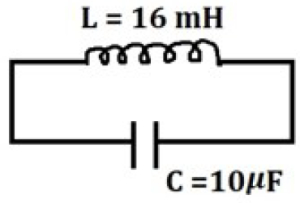
A
$\pi \times 10^{-3} \ s$
B
$2 \pi \times 10^{-3} \ s$
C
$2 \pi \times 10^{-4} \ s$
D
$\pi \times 10^{-4} \ s$
Solution
(C) In an $LC$ circuit,the charge on the capacitor varies as $q(t) = q_0 \cos(\omega t)$,where $\omega = \frac{1}{\sqrt{LC}}$.
At $t=0$,the energy is maximum,meaning the charge is maximum $(q = q_0)$.
The current in the circuit is given by $i(t) = -\frac{dq}{dt} = q_0 \omega \sin(\omega t)$.
The current is maximum when $\sin(\omega t) = 1$,which occurs at $\omega t = \frac{\pi}{2}$,or $t = \frac{\pi}{2\omega}$.
Given $L = 16 \text{ mH} = 16 \times 10^{-3} \text{ H}$ and $C = 10 \mu\text{F} = 10 \times 10^{-6} \text{ F} = 10^{-5} \text{ F}$.
Calculate $\omega = \frac{1}{\sqrt{16 \times 10^{-3} \times 10^{-5}}} = \frac{1}{\sqrt{16 \times 10^{-8}}} = \frac{1}{4 \times 10^{-4}} = 0.25 \times 10^4 = 2500 \text{ rad/s}$.
Now,$t = \frac{\pi}{2 \times 2500} = \frac{\pi}{5000} = \pi \times 2 \times 10^{-4} \text{ s} = 2 \pi \times 10^{-4} \text{ s}$.
At $t=0$,the energy is maximum,meaning the charge is maximum $(q = q_0)$.
The current in the circuit is given by $i(t) = -\frac{dq}{dt} = q_0 \omega \sin(\omega t)$.
The current is maximum when $\sin(\omega t) = 1$,which occurs at $\omega t = \frac{\pi}{2}$,or $t = \frac{\pi}{2\omega}$.
Given $L = 16 \text{ mH} = 16 \times 10^{-3} \text{ H}$ and $C = 10 \mu\text{F} = 10 \times 10^{-6} \text{ F} = 10^{-5} \text{ F}$.
Calculate $\omega = \frac{1}{\sqrt{16 \times 10^{-3} \times 10^{-5}}} = \frac{1}{\sqrt{16 \times 10^{-8}}} = \frac{1}{4 \times 10^{-4}} = 0.25 \times 10^4 = 2500 \text{ rad/s}$.
Now,$t = \frac{\pi}{2 \times 2500} = \frac{\pi}{5000} = \pi \times 2 \times 10^{-4} \text{ s} = 2 \pi \times 10^{-4} \text{ s}$.
0 likes
View Solution74
MediumMCQ
In an $LC$ circuit,the angular frequency at resonance is $\omega$. What will be the new angular frequency when the inductor's inductance is made two times and the capacitor's capacitance is made four times?
A
$\frac{\omega}{2 \sqrt{2}}$
B
$\frac{\omega}{\sqrt{2}}$
C
$2 \omega$
D
$\frac{2 \omega}{\sqrt{2}}$
Solution
(A) The resonant angular frequency of an $LC$ circuit is given by the formula: $\omega = \frac{1}{\sqrt{LC}}$.
Let the initial inductance be $L$ and the initial capacitance be $C$. The initial angular frequency is $\omega = \frac{1}{\sqrt{LC}}$.
According to the problem,the new inductance $L' = 2L$ and the new capacitance $C' = 4C$.
The new angular frequency $\omega'$ is given by: $\omega' = \frac{1}{\sqrt{L'C'}} = \frac{1}{\sqrt{(2L)(4C)}} = \frac{1}{\sqrt{8LC}}$.
We can simplify this as: $\omega' = \frac{1}{\sqrt{8} \sqrt{LC}} = \frac{1}{2\sqrt{2} \sqrt{LC}}$.
Since $\omega = \frac{1}{\sqrt{LC}}$,we substitute this into the expression for $\omega'$:
$\omega' = \frac{\omega}{2\sqrt{2}}$.
Therefore,the correct option is $A$.
Let the initial inductance be $L$ and the initial capacitance be $C$. The initial angular frequency is $\omega = \frac{1}{\sqrt{LC}}$.
According to the problem,the new inductance $L' = 2L$ and the new capacitance $C' = 4C$.
The new angular frequency $\omega'$ is given by: $\omega' = \frac{1}{\sqrt{L'C'}} = \frac{1}{\sqrt{(2L)(4C)}} = \frac{1}{\sqrt{8LC}}$.
We can simplify this as: $\omega' = \frac{1}{\sqrt{8} \sqrt{LC}} = \frac{1}{2\sqrt{2} \sqrt{LC}}$.
Since $\omega = \frac{1}{\sqrt{LC}}$,we substitute this into the expression for $\omega'$:
$\omega' = \frac{\omega}{2\sqrt{2}}$.
Therefore,the correct option is $A$.
0 likes
View Solution75
EasyMCQ
In an $LC$ circuit,the angular frequency at resonance is $\omega$. What is the new angular frequency when the inductance is made four times and the capacitance is made eight times its original value?
A
$\frac{\omega}{2 \sqrt{2}}$
B
$\frac{\omega}{4 \sqrt{2}}$
C
$\frac{\omega}{4}$
D
$\frac{\omega}{\sqrt{2}}$
Solution
(B) The resonant angular frequency of an $LC$ circuit is given by the formula $\omega = \frac{1}{\sqrt{LC}}$.
Let the initial inductance be $L$ and capacitance be $C$. Then,$\omega = \frac{1}{\sqrt{LC}}$.
According to the problem,the new inductance $L' = 4L$ and the new capacitance $C' = 8C$.
The new resonant angular frequency $\omega'$ is given by $\omega' = \frac{1}{\sqrt{L'C'}} = \frac{1}{\sqrt{(4L)(8C)}} = \frac{1}{\sqrt{32LC}}$.
Simplifying this,we get $\omega' = \frac{1}{\sqrt{16 \times 2 \times LC}} = \frac{1}{4 \sqrt{2} \sqrt{LC}}$.
Since $\omega = \frac{1}{\sqrt{LC}}$,we can substitute this into the equation to get $\omega' = \frac{\omega}{4 \sqrt{2}}$.
Let the initial inductance be $L$ and capacitance be $C$. Then,$\omega = \frac{1}{\sqrt{LC}}$.
According to the problem,the new inductance $L' = 4L$ and the new capacitance $C' = 8C$.
The new resonant angular frequency $\omega'$ is given by $\omega' = \frac{1}{\sqrt{L'C'}} = \frac{1}{\sqrt{(4L)(8C)}} = \frac{1}{\sqrt{32LC}}$.
Simplifying this,we get $\omega' = \frac{1}{\sqrt{16 \times 2 \times LC}} = \frac{1}{4 \sqrt{2} \sqrt{LC}}$.
Since $\omega = \frac{1}{\sqrt{LC}}$,we can substitute this into the equation to get $\omega' = \frac{\omega}{4 \sqrt{2}}$.
0 likes
View Solution76
DifficultMCQ
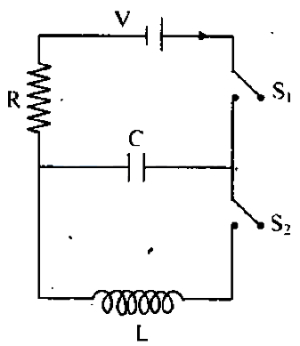
In the given circuit,when $S_1$ is closed,the capacitor gets fully charged. Now $S_1$ is opened and $S_2$ is closed. Then
A
there is no exchange of energy between $L$ and $C$.
B
the current in the circuit is in the same direction.
C
the instantaneous current in the circuit may be $V\sqrt{\frac{C}{L}}$.
D
the energy stored in the circuit is purely in the form of magnetic energy.
Solution
(C) When $S_1$ is closed,the capacitor $C$ is charged to a potential difference $V$. The energy stored in the capacitor is $U_E = \frac{1}{2}CV^2$.
When $S_1$ is opened and $S_2$ is closed,the capacitor $C$ and inductor $L$ form an $LC$ oscillating circuit.
The energy oscillates between the electric field of the capacitor and the magnetic field of the inductor.
The maximum current $I_{max}$ in the circuit occurs when all the electric energy is converted into magnetic energy.
By the law of conservation of energy:
$\frac{1}{2}CV^2 = \frac{1}{2}LI_{max}^2$
$I_{max}^2 = \frac{C}{L}V^2$
$I_{max} = V\sqrt{\frac{C}{L}}$
Thus,the instantaneous current in the circuit can reach this maximum value.
When $S_1$ is opened and $S_2$ is closed,the capacitor $C$ and inductor $L$ form an $LC$ oscillating circuit.
The energy oscillates between the electric field of the capacitor and the magnetic field of the inductor.
The maximum current $I_{max}$ in the circuit occurs when all the electric energy is converted into magnetic energy.
By the law of conservation of energy:
$\frac{1}{2}CV^2 = \frac{1}{2}LI_{max}^2$
$I_{max}^2 = \frac{C}{L}V^2$
$I_{max} = V\sqrt{\frac{C}{L}}$
Thus,the instantaneous current in the circuit can reach this maximum value.
0 likes
View Solution77
MediumMCQ
In an oscillating $LC$ circuit, the maximum charge on the capacitor is $Q$. When the energy is stored equally between the electric and magnetic fields, the charge on the capacitor becomes:
A
$\frac{Q}{4}$
B
$\frac{Q}{2}$
C
$\frac{Q}{\sqrt{2}}$
D
$\frac{Q}{\sqrt{3}}$
Solution
(C) The maximum energy stored in the capacitor is given by $E_{max} = \frac{Q^2}{2C}$.
When the energy is stored equally between the electric and magnetic fields, the energy in the capacitor is half of the maximum energy, i.e., $E_{cap} = \frac{1}{2} E_{max}$.
Let $Q'$ be the charge on the capacitor at this instant. Then, $E_{cap} = \frac{Q'^2}{2C}$.
Equating the two expressions for $E_{cap}$:
$\frac{Q'^2}{2C} = \frac{1}{2} \left( \frac{Q^2}{2C} \right)$
$Q'^2 = \frac{Q^2}{2}$
$Q' = \frac{Q}{\sqrt{2}}$.
When the energy is stored equally between the electric and magnetic fields, the energy in the capacitor is half of the maximum energy, i.e., $E_{cap} = \frac{1}{2} E_{max}$.
Let $Q'$ be the charge on the capacitor at this instant. Then, $E_{cap} = \frac{Q'^2}{2C}$.
Equating the two expressions for $E_{cap}$:
$\frac{Q'^2}{2C} = \frac{1}{2} \left( \frac{Q^2}{2C} \right)$
$Q'^2 = \frac{Q^2}{2}$
$Q' = \frac{Q}{\sqrt{2}}$.
0 likes
View Solution78
DifficultMCQ
$A$ capacitor of capacity '$C$' is charged to a potential difference of '$V_1$'. The plates of the capacitor are then connected to an ideal inductor of inductance '$L$'. The current through the inductor when the potential difference across the capacitor reduces to '$V_2$' is:
A
$\sqrt{\frac{C(V_1^2 - V_2^2)}{L}}$
B
$\sqrt{\frac{C(V_1^2 + V_2^2)}{L}}$
C
$\sqrt{\frac{C}{L}}(V_1^2 - V_2^2)^{1/2}$
D
$\sqrt{\frac{C}{L}}(V_1 - V_2)$
Solution
(C) The total energy in an $LC$ circuit is conserved.
Initially,the energy stored in the capacitor is $U_i = \frac{1}{2}CV_1^2$.
When the potential difference across the capacitor becomes $V_2$,the energy stored in the capacitor is $U_c = \frac{1}{2}CV_2^2$.
The energy stored in the inductor at this instant is $U_L = \frac{1}{2}LI^2$.
By the law of conservation of energy: $U_i = U_c + U_L$.
$\frac{1}{2}CV_1^2 = \frac{1}{2}CV_2^2 + \frac{1}{2}LI^2$.
$LI^2 = C(V_1^2 - V_2^2)$.
$I^2 = \frac{C}{L}(V_1^2 - V_2^2)$.
$I = \sqrt{\frac{C}{L}(V_1^2 - V_2^2)}$.
Thus,the correct option is $C$.
Initially,the energy stored in the capacitor is $U_i = \frac{1}{2}CV_1^2$.
When the potential difference across the capacitor becomes $V_2$,the energy stored in the capacitor is $U_c = \frac{1}{2}CV_2^2$.
The energy stored in the inductor at this instant is $U_L = \frac{1}{2}LI^2$.
By the law of conservation of energy: $U_i = U_c + U_L$.
$\frac{1}{2}CV_1^2 = \frac{1}{2}CV_2^2 + \frac{1}{2}LI^2$.
$LI^2 = C(V_1^2 - V_2^2)$.
$I^2 = \frac{C}{L}(V_1^2 - V_2^2)$.
$I = \sqrt{\frac{C}{L}(V_1^2 - V_2^2)}$.
Thus,the correct option is $C$.
0 likes
View Solution79
MediumMCQ
$A$ capacitor of capacity $20 \mu F$ is charged to a potential of $35 \text{ V}$. The battery is then disconnected. $A$ pure inductor coil of $200 \text{ mH}$ is connected across the capacitor so that $LC$ oscillations are set up. The maximum current in the coil is: (in $\text{ A}$)
A
$0.025$
B
$0.25$
C
$0.035$
D
$0.35$
Solution
(D) Given: Capacitance $C = 20 \mu F = 20 \times 10^{-6} \text{ F}$, Voltage $V = 35 \text{ V}$, Inductance $L = 200 \text{ mH} = 200 \times 10^{-3} \text{ H}$.
In an $LC$ circuit, the energy stored in the capacitor is converted into the energy stored in the inductor.
The maximum energy in the capacitor is $U_E = \frac{1}{2} C V^2$.
The maximum energy in the inductor is $U_B = \frac{1}{2} L I_{\text{max}}^2$.
By conservation of energy, $U_E = U_B$, so $\frac{1}{2} C V^2 = \frac{1}{2} L I_{\text{max}}^2$.
Solving for $I_{\text{max}}$: $I_{\text{max}} = V \sqrt{\frac{C}{L}}$.
Substituting the values: $I_{\text{max}} = 35 \times \sqrt{\frac{20 \times 10^{-6}}{200 \times 10^{-3}}} = 35 \times \sqrt{\frac{1}{10000}} = 35 \times \frac{1}{100} = 0.35 \text{ A}$.
In an $LC$ circuit, the energy stored in the capacitor is converted into the energy stored in the inductor.
The maximum energy in the capacitor is $U_E = \frac{1}{2} C V^2$.
The maximum energy in the inductor is $U_B = \frac{1}{2} L I_{\text{max}}^2$.
By conservation of energy, $U_E = U_B$, so $\frac{1}{2} C V^2 = \frac{1}{2} L I_{\text{max}}^2$.
Solving for $I_{\text{max}}$: $I_{\text{max}} = V \sqrt{\frac{C}{L}}$.
Substituting the values: $I_{\text{max}} = 35 \times \sqrt{\frac{20 \times 10^{-6}}{200 \times 10^{-3}}} = 35 \times \sqrt{\frac{1}{10000}} = 35 \times \frac{1}{100} = 0.35 \text{ A}$.
0 likes
View Solution80
DifficultMCQ
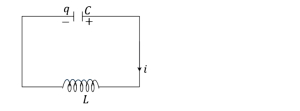
$A$ $1 \, \mu F$ capacitor is charged to $50 \, V$. The charging battery is then disconnected and a $10 \, mH$ coil is connected across the capacitor so that $LC$ oscillations occur. What is the maximum current in the coil (in $, A$)? Assume that the circuit contains no resistance.
A
$0.75$
B
$0.25$
C
$0.50$
D
$1.00$
Solution
(C) In an $LC$ circuit, the total energy is conserved. The initial energy stored in the capacitor is $U_E = \frac{1}{2} C V^2$.
When the current in the coil is maximum $(I_{max})$, the energy stored in the inductor is $U_B = \frac{1}{2} L I_{max}^2$.
Since there is no resistance, the total energy remains constant, so the initial electrical energy is converted into maximum magnetic energy:
$\frac{1}{2} C V^2 = \frac{1}{2} L I_{max}^2$
$I_{max}^2 = \frac{C V^2}{L}$
$I_{max} = V \sqrt{\frac{C}{L}}$
Given: $C = 1 \, \mu F = 1 \times 10^{-6} \, F$, $V = 50 \, V$, $L = 10 \, mH = 10 \times 10^{-3} \, H = 10^{-2} \, H$.
$I_{max} = 50 \times \sqrt{\frac{1 \times 10^{-6}}{10^{-2}}}$
$I_{max} = 50 \times \sqrt{10^{-4}}$
$I_{max} = 50 \times 10^{-2} \, A = 0.5 \, A$.
When the current in the coil is maximum $(I_{max})$, the energy stored in the inductor is $U_B = \frac{1}{2} L I_{max}^2$.
Since there is no resistance, the total energy remains constant, so the initial electrical energy is converted into maximum magnetic energy:
$\frac{1}{2} C V^2 = \frac{1}{2} L I_{max}^2$
$I_{max}^2 = \frac{C V^2}{L}$
$I_{max} = V \sqrt{\frac{C}{L}}$
Given: $C = 1 \, \mu F = 1 \times 10^{-6} \, F$, $V = 50 \, V$, $L = 10 \, mH = 10 \times 10^{-3} \, H = 10^{-2} \, H$.
$I_{max} = 50 \times \sqrt{\frac{1 \times 10^{-6}}{10^{-2}}}$
$I_{max} = 50 \times \sqrt{10^{-4}}$
$I_{max} = 50 \times 10^{-2} \, A = 0.5 \, A$.
0 likes
View Solution81
EasyMCQ
$A$ capacitor of capacity $C$ is charged to a potential $V$. It is connected in parallel to an inductor of inductance $L$. The maximum current that will flow in the circuit is
A
$V \sqrt{\frac{L}{C}}$
B
$V \sqrt{LC}$
C
$V \sqrt{\frac{C}{L}}$
D
$\frac{VC^2}{L}$
Solution
(C) The energy stored in the capacitor is $U_E = \frac{1}{2}CV^2$.
When the capacitor is connected to the inductor,the energy oscillates between the electric field of the capacitor and the magnetic field of the inductor.
At the moment of maximum current $i_0$,all the energy is stored in the inductor as magnetic energy $U_B = \frac{1}{2}Li_0^2$.
By the law of conservation of energy: $\frac{1}{2}CV^2 = \frac{1}{2}Li_0^2$.
Solving for $i_0$: $i_0^2 = \frac{CV^2}{L} \implies i_0 = V \sqrt{\frac{C}{L}}$.
When the capacitor is connected to the inductor,the energy oscillates between the electric field of the capacitor and the magnetic field of the inductor.
At the moment of maximum current $i_0$,all the energy is stored in the inductor as magnetic energy $U_B = \frac{1}{2}Li_0^2$.
By the law of conservation of energy: $\frac{1}{2}CV^2 = \frac{1}{2}Li_0^2$.
Solving for $i_0$: $i_0^2 = \frac{CV^2}{L} \implies i_0 = V \sqrt{\frac{C}{L}}$.
0 likes
View Solution82
MediumMCQ
The frequency of the output signal of an $LC$ oscillator circuit is $F \ Hz$ with a capacitance of $0.1 \ \mu F$. If the value of the capacitor is increased to $0.2 \ \mu F$,then the frequency of the output signal will be
A
$\frac{F}{\sqrt{2}} \ Hz$
B
$\frac{F}{\sqrt{3}} \ Hz$
C
$\frac{F}{2} \ Hz$
D
$2 F \ Hz$
Solution
(A) The frequency of an $LC$ oscillator is given by the formula:
$F = \frac{1}{2 \pi \sqrt{LC}}$
From this relation,we can see that the frequency $F$ is inversely proportional to the square root of the capacitance $C$ (i.e.,$F \propto \frac{1}{\sqrt{C}}$).
Let $F_1 = F$ and $C_1 = 0.1 \ \mu F$.
Let $F_2$ be the new frequency and $C_2 = 0.2 \ \mu F$.
Using the ratio method:
$\frac{F_2}{F_1} = \sqrt{\frac{C_1}{C_2}}$
$\frac{F_2}{F} = \sqrt{\frac{0.1}{0.2}} = \sqrt{\frac{1}{2}} = \frac{1}{\sqrt{2}}$
Therefore,$F_2 = \frac{F}{\sqrt{2}} \ Hz$.
$F = \frac{1}{2 \pi \sqrt{LC}}$
From this relation,we can see that the frequency $F$ is inversely proportional to the square root of the capacitance $C$ (i.e.,$F \propto \frac{1}{\sqrt{C}}$).
Let $F_1 = F$ and $C_1 = 0.1 \ \mu F$.
Let $F_2$ be the new frequency and $C_2 = 0.2 \ \mu F$.
Using the ratio method:
$\frac{F_2}{F_1} = \sqrt{\frac{C_1}{C_2}}$
$\frac{F_2}{F} = \sqrt{\frac{0.1}{0.2}} = \sqrt{\frac{1}{2}} = \frac{1}{\sqrt{2}}$
Therefore,$F_2 = \frac{F}{\sqrt{2}} \ Hz$.
0 likes
View Solution83
MediumMCQ
$A$ $4 \mu F$ capacitor is charged to $10 \ V$. The battery is then disconnected and a pure $10 \ mH$ coil is connected across the capacitor so that $LC$ oscillations are set up. The maximum current in the coil is (in $A$)
A
$0.2$
B
$0.1$
C
$0.4$
D
$0.25$
Solution
(A) The energy stored in the capacitor is given by $U = \frac{1}{2} C V^2$.
Given $C = 4 \mu F = 4 \times 10^{-6} \ F$ and $V = 10 \ V$,the energy is $U = \frac{1}{2} \times 4 \times 10^{-6} \times (10)^2 = 2 \times 10^{-4} \ J$.
When the capacitor is connected to the inductor,the total energy is conserved and oscillates between the electric field of the capacitor and the magnetic field of the inductor.
The maximum energy in the inductor is given by $U_{max} = \frac{1}{2} L I_{max}^2$.
Equating the energies: $\frac{1}{2} L I_{max}^2 = \frac{1}{2} C V^2$.
$I_{max}^2 = \frac{C V^2}{L} = \frac{4 \times 10^{-6} \times 100}{10 \times 10^{-3}} = \frac{4 \times 10^{-4}}{10^{-2}} = 4 \times 10^{-2} = 0.04$.
Therefore,$I_{max} = \sqrt{0.04} = 0.2 \ A$.
Given $C = 4 \mu F = 4 \times 10^{-6} \ F$ and $V = 10 \ V$,the energy is $U = \frac{1}{2} \times 4 \times 10^{-6} \times (10)^2 = 2 \times 10^{-4} \ J$.
When the capacitor is connected to the inductor,the total energy is conserved and oscillates between the electric field of the capacitor and the magnetic field of the inductor.
The maximum energy in the inductor is given by $U_{max} = \frac{1}{2} L I_{max}^2$.
Equating the energies: $\frac{1}{2} L I_{max}^2 = \frac{1}{2} C V^2$.
$I_{max}^2 = \frac{C V^2}{L} = \frac{4 \times 10^{-6} \times 100}{10 \times 10^{-3}} = \frac{4 \times 10^{-4}}{10^{-2}} = 4 \times 10^{-2} = 0.04$.
Therefore,$I_{max} = \sqrt{0.04} = 0.2 \ A$.
0 likes
View Solution84
MediumMCQ
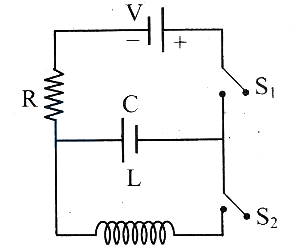
Consider the following circuit. By keeping $S_1$ closed,the capacitor is fully charged and then $S_1$ is opened and $S_2$ is closed,then
A
At time $t = 0$,the energy stored in the circuit is purely in the form of magnetic energy.
B
At $t > 0$,there is no exchange of energy between $L$ and $C$.
C
At any time $t > 0$,the current in the circuit is in the same direction.
D
At any time $t > 0$,the instantaneous current in the circuit may be $V \sqrt{\frac{C}{L}}$.
Solution
(D) When $S_1$ is closed,the capacitor $C$ charges to a potential $V$. The energy stored in the capacitor is $U_E = \frac{1}{2} CV^2$.
When $S_1$ is opened and $S_2$ is closed,the capacitor discharges through the inductor $L$,forming an $LC$ oscillation circuit.
At $t = 0$ (the moment $S_2$ is closed),the energy is entirely electric (stored in the capacitor).
As the capacitor discharges,the energy oscillates between the electric field of the capacitor and the magnetic field of the inductor.
By the law of conservation of energy,the maximum electric energy equals the maximum magnetic energy:
$\frac{1}{2} CV^2 = \frac{1}{2} LI_{max}^2$
$I_{max}^2 = \frac{C}{L} V^2$
$I_{max} = V \sqrt{\frac{C}{L}}$
Thus,the instantaneous current in the circuit can reach a maximum value of $V \sqrt{\frac{C}{L}}$.
When $S_1$ is opened and $S_2$ is closed,the capacitor discharges through the inductor $L$,forming an $LC$ oscillation circuit.
At $t = 0$ (the moment $S_2$ is closed),the energy is entirely electric (stored in the capacitor).
As the capacitor discharges,the energy oscillates between the electric field of the capacitor and the magnetic field of the inductor.
By the law of conservation of energy,the maximum electric energy equals the maximum magnetic energy:
$\frac{1}{2} CV^2 = \frac{1}{2} LI_{max}^2$
$I_{max}^2 = \frac{C}{L} V^2$
$I_{max} = V \sqrt{\frac{C}{L}}$
Thus,the instantaneous current in the circuit can reach a maximum value of $V \sqrt{\frac{C}{L}}$.
0 likes
View Solution85
EasyMCQ
$A$ $1 \mu F$ capacitor is charged to $50 \ V$ and is then discharged through a $10 \ mH$ inductor of negligible resistance. The maximum current in the inductor is (in $A$)
A
$0.5$
B
$1.5$
C
$1$
D
$0.15$
Solution
(A) The energy stored in a charged capacitor is given by $U = \frac{1}{2} CV^2$.
When the capacitor discharges through an inductor,the energy is transferred from the electric field of the capacitor to the magnetic field of the inductor.
At the moment of maximum current $(I_0)$,all the energy is stored in the inductor as magnetic energy,given by $U = \frac{1}{2} LI_0^2$.
By the law of conservation of energy: $\frac{1}{2} CV^2 = \frac{1}{2} LI_0^2$.
Solving for $I_0$: $I_0^2 = \frac{CV^2}{L}$.
Given: $C = 1 \mu F = 10^{-6} \ F$,$V = 50 \ V$,$L = 10 \ mH = 10 \times 10^{-3} \ H = 10^{-2} \ H$.
Substituting the values: $I_0^2 = \frac{10^{-6} \times (50)^2}{10^{-2}} = \frac{10^{-6} \times 2500}{10^{-2}} = 2500 \times 10^{-4} = 0.25$.
Therefore,$I_0 = \sqrt{0.25} = 0.5 \ A$.
When the capacitor discharges through an inductor,the energy is transferred from the electric field of the capacitor to the magnetic field of the inductor.
At the moment of maximum current $(I_0)$,all the energy is stored in the inductor as magnetic energy,given by $U = \frac{1}{2} LI_0^2$.
By the law of conservation of energy: $\frac{1}{2} CV^2 = \frac{1}{2} LI_0^2$.
Solving for $I_0$: $I_0^2 = \frac{CV^2}{L}$.
Given: $C = 1 \mu F = 10^{-6} \ F$,$V = 50 \ V$,$L = 10 \ mH = 10 \times 10^{-3} \ H = 10^{-2} \ H$.
Substituting the values: $I_0^2 = \frac{10^{-6} \times (50)^2}{10^{-2}} = \frac{10^{-6} \times 2500}{10^{-2}} = 2500 \times 10^{-4} = 0.25$.
Therefore,$I_0 = \sqrt{0.25} = 0.5 \ A$.
0 likes
View Solution86
EasyMCQ
The magnetic energy in an inductor changes from maximum value to minimum value in $5 \ ms$. When connected to an $A.C.$ source,the frequency of the source is (in $Hz$)
A
$50$
B
$200$
C
$500$
D
$20$
Solution
(A) The magnetic energy $U_B$ in an inductor is given by $U_B = \frac{1}{2} L I^2$. Since the current $I$ in an $A.C.$ circuit varies as $I = I_0 \sin(\omega t)$,the energy varies as $U_B \propto \sin^2(\omega t)$.
Energy changes from maximum to minimum in $\frac{1}{4}$ of a time period $T$.
Given,$\frac{T}{4} = 5 \ ms = 5 \times 10^{-3} \ s$.
Therefore,$T = 20 \times 10^{-3} \ s = 0.02 \ s$.
The frequency $f$ is given by $f = \frac{1}{T} = \frac{1}{0.02} = 50 \ Hz$.
Energy changes from maximum to minimum in $\frac{1}{4}$ of a time period $T$.
Given,$\frac{T}{4} = 5 \ ms = 5 \times 10^{-3} \ s$.
Therefore,$T = 20 \times 10^{-3} \ s = 0.02 \ s$.
The frequency $f$ is given by $f = \frac{1}{T} = \frac{1}{0.02} = 50 \ Hz$.
0 likes
View Solution87
DifficultMCQ
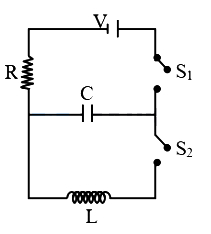
In the given circuit,when $S_1$ is closed,the capacitor $C$ gets fully charged. Then $S_1$ is kept open and $S_2$ is closed. Hence
A
The current in the circuit is in the same direction.
B
The instantaneous current in the circuit may be $V \sqrt{\frac{C}{L}}$.
C
The energy stored in the circuit is purely in the form of magnetic energy.
D
There is no exchange of energy between inductor $L$ and capacitor $C$.
Solution
(B) When $S_1$ is closed,the capacitor $C$ charges to a potential difference $V$.
When $S_1$ is opened and $S_2$ is closed,the capacitor $C$ and inductor $L$ form an $LC$ oscillating circuit.
The energy initially stored in the capacitor is $U_E = \frac{1}{2} C V^2$.
As the capacitor discharges,the energy is transferred to the inductor as magnetic energy $U_B = \frac{1}{2} L I^2$.
By the law of conservation of energy,the maximum current $I_{max}$ occurs when all electrostatic energy is converted to magnetic energy:
$\frac{1}{2} C V^2 = \frac{1}{2} L I_{max}^2$
$I_{max}^2 = \frac{C V^2}{L}$
$I_{max} = V \sqrt{\frac{C}{L}}$.
Thus,the instantaneous current in the circuit can reach this maximum value.
When $S_1$ is opened and $S_2$ is closed,the capacitor $C$ and inductor $L$ form an $LC$ oscillating circuit.
The energy initially stored in the capacitor is $U_E = \frac{1}{2} C V^2$.
As the capacitor discharges,the energy is transferred to the inductor as magnetic energy $U_B = \frac{1}{2} L I^2$.
By the law of conservation of energy,the maximum current $I_{max}$ occurs when all electrostatic energy is converted to magnetic energy:
$\frac{1}{2} C V^2 = \frac{1}{2} L I_{max}^2$
$I_{max}^2 = \frac{C V^2}{L}$
$I_{max} = V \sqrt{\frac{C}{L}}$.
Thus,the instantaneous current in the circuit can reach this maximum value.
0 likes
View Solution88
EasyMCQ
The charge of the capacitor in an $LC$ oscillatory circuit,when the energy associated with the inductor and capacitor are equal,is . . . . . . . ($Q_{0}$ is the initial charge on the capacitor.)
A
$\frac{Q_{0}}{2}$
B
$Q_{0}$
C
$\frac{Q_{0}}{\sqrt{3}}$
D
$\frac{Q_{0}}{\sqrt{2}}$
Solution
(D) The total energy $U$ in an $LC$ circuit is constant and is given by $U = \frac{1}{2} \frac{Q_{0}^{2}}{C}$.
When the energy stored in the inductor $(U_L)$ and the capacitor $(U_C)$ are equal,each must be half of the total energy.
So,$U_C = \frac{U}{2}$.
Substituting the expressions for energy: $\frac{1}{2} \frac{q^2}{C} = \frac{1}{2} \left( \frac{1}{2} \frac{Q_{0}^{2}}{C} \right)$.
Simplifying the equation: $\frac{q^2}{C} = \frac{Q_{0}^{2}}{2C}$.
$q^2 = \frac{Q_{0}^{2}}{2}$.
Taking the square root on both sides,we get $q = \frac{Q_{0}}{\sqrt{2}}$.
When the energy stored in the inductor $(U_L)$ and the capacitor $(U_C)$ are equal,each must be half of the total energy.
So,$U_C = \frac{U}{2}$.
Substituting the expressions for energy: $\frac{1}{2} \frac{q^2}{C} = \frac{1}{2} \left( \frac{1}{2} \frac{Q_{0}^{2}}{C} \right)$.
Simplifying the equation: $\frac{q^2}{C} = \frac{Q_{0}^{2}}{2C}$.
$q^2 = \frac{Q_{0}^{2}}{2}$.
Taking the square root on both sides,we get $q = \frac{Q_{0}}{\sqrt{2}}$.
0 likes
View Solution89
EasyMCQ
$A$ charged $10 \mu F$ capacitor is connected to a $16 \text{ mH}$ inductor. What is the angular frequency of free oscillations of the circuit?
A
$250 \text{ rad s}^{-1}$
B
$25 \text{ rad s}^{-1}$
C
$1111 \text{ rad s}^{-1}$
D
$2500 \text{ rad s}^{-1}$
Solution
(D) The angular frequency of free oscillations for an $LC$ circuit is given by the formula $\omega_{0} = \frac{1}{\sqrt{LC}}$.
Given values are $L = 16 \text{ mH} = 16 \times 10^{-3} \text{ H}$ and $C = 10 \mu F = 10 \times 10^{-6} \text{ F}$.
Substituting these values into the formula:
$\omega_{0} = \frac{1}{\sqrt{16 \times 10^{-3} \times 10 \times 10^{-6}}}$
$\omega_{0} = \frac{1}{\sqrt{16 \times 10^{-8}}}$
$\omega_{0} = \frac{1}{4 \times 10^{-4}}$
$\omega_{0} = \frac{10^{4}}{4} = 2500 \text{ rad s}^{-1}$.
Given values are $L = 16 \text{ mH} = 16 \times 10^{-3} \text{ H}$ and $C = 10 \mu F = 10 \times 10^{-6} \text{ F}$.
Substituting these values into the formula:
$\omega_{0} = \frac{1}{\sqrt{16 \times 10^{-3} \times 10 \times 10^{-6}}}$
$\omega_{0} = \frac{1}{\sqrt{16 \times 10^{-8}}}$
$\omega_{0} = \frac{1}{4 \times 10^{-4}}$
$\omega_{0} = \frac{10^{4}}{4} = 2500 \text{ rad s}^{-1}$.
0 likes
View Solution90
EasyMCQ
$A$ series resonant $AC$ circuit contains a capacitance $10^{-6} \,F$ and an inductor of $10^{-4} \,H$. The frequency of electrical oscillations will be
A
$10 \,Hz$
B
$\frac{10^5}{2 \pi} \,Hz$
C
$\frac{10}{2 \pi} \,Hz$
D
$10^5 \,Hz$
Solution
(B) Given, capacitance, $C = 10^{-6} \,F$.
Inductance, $L = 10^{-4} \,H$.
The frequency of electrical oscillations in an $L-C$ circuit is given by the formula:
$f = \frac{1}{2 \pi \sqrt{LC}}$
Substituting the values:
$f = \frac{1}{2 \pi \sqrt{10^{-4} \times 10^{-6}}}$
$f = \frac{1}{2 \pi \sqrt{10^{-10}}}$
$f = \frac{1}{2 \pi \times 10^{-5}}$
$f = \frac{10^5}{2 \pi} \,Hz$
Inductance, $L = 10^{-4} \,H$.
The frequency of electrical oscillations in an $L-C$ circuit is given by the formula:
$f = \frac{1}{2 \pi \sqrt{LC}}$
Substituting the values:
$f = \frac{1}{2 \pi \sqrt{10^{-4} \times 10^{-6}}}$
$f = \frac{1}{2 \pi \sqrt{10^{-10}}}$
$f = \frac{1}{2 \pi \times 10^{-5}}$
$f = \frac{10^5}{2 \pi} \,Hz$
0 likes
View Solution91
MediumMCQ
In an oscillating $LC$-circuit,$L = 3 \ mH$ and $C = 2.7 \ \mu F$. At $t = 0$,the charge on the capacitor is zero and the current is $2 \ A$. The maximum charge that will appear on the capacitor will be
A
$1.8 \times 10^{-5} \ C$
B
$18 \times 10^{-5} \ C$
C
$9 \times 10^{-5} \ C$
D
$90 \times 10^{-5} \ C$
Solution
(B) The charge $q$ as a function of time $t$ is given by $q = q_0 \sin(\omega t)$,where $q_0$ is the maximum charge and $\omega$ is the angular frequency.
Differentiating with respect to $t$,the current $I$ is given by $I = \frac{dq}{dt} = \omega q_0 \cos(\omega t)$.
At $t = 0$,the current is $I = \omega q_0 \cos(0) = \omega q_0$.
Given $I = 2 \ A$ at $t = 0$,we have $2 = \omega q_0$.
Since $\omega = \frac{1}{\sqrt{LC}}$,we substitute this into the equation: $q_0 = I \sqrt{LC}$.
Given $L = 3 \times 10^{-3} \ H$ and $C = 2.7 \times 10^{-6} \ F$,we calculate:
$q_0 = 2 \times \sqrt{3 \times 10^{-3} \times 2.7 \times 10^{-6}}$
$q_0 = 2 \times \sqrt{8.1 \times 10^{-9}} = 2 \times \sqrt{81 \times 10^{-10}}$
$q_0 = 2 \times 9 \times 10^{-5} = 18 \times 10^{-5} \ C$.
Differentiating with respect to $t$,the current $I$ is given by $I = \frac{dq}{dt} = \omega q_0 \cos(\omega t)$.
At $t = 0$,the current is $I = \omega q_0 \cos(0) = \omega q_0$.
Given $I = 2 \ A$ at $t = 0$,we have $2 = \omega q_0$.
Since $\omega = \frac{1}{\sqrt{LC}}$,we substitute this into the equation: $q_0 = I \sqrt{LC}$.
Given $L = 3 \times 10^{-3} \ H$ and $C = 2.7 \times 10^{-6} \ F$,we calculate:
$q_0 = 2 \times \sqrt{3 \times 10^{-3} \times 2.7 \times 10^{-6}}$
$q_0 = 2 \times \sqrt{8.1 \times 10^{-9}} = 2 \times \sqrt{81 \times 10^{-10}}$
$q_0 = 2 \times 9 \times 10^{-5} = 18 \times 10^{-5} \ C$.
0 likes
View Solution92
MediumMCQ
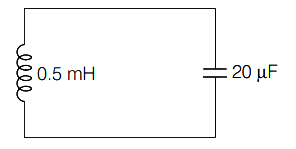
In the given circuit, the resonant frequency is (in $ Hz$)
A
$15.92$
B
$159.2$
C
$1592$
D
$15910$
Solution
(C) Given, $L = 0.5 \, mH = 0.5 \times 10^{-3} \, H$ and $C = 20 \, \mu F = 20 \times 10^{-6} \, F$.
The resonant frequency of an $L-C$ circuit is given by the formula:
$f = \frac{1}{2 \pi \sqrt{L C}}$
Substituting the values:
$f = \frac{1}{2 \pi \sqrt{0.5 \times 10^{-3} \times 20 \times 10^{-6}}}$
$f = \frac{1}{2 \pi \sqrt{10 \times 10^{-9}}} = \frac{1}{2 \pi \sqrt{10^{-8}}}$
$f = \frac{1}{2 \pi \times 10^{-4}} = \frac{10^4}{2 \pi} \approx \frac{10000}{6.283} \approx 1592.3 \, Hz$
Thus, the resonant frequency is approximately $1592 \, Hz$.
The resonant frequency of an $L-C$ circuit is given by the formula:
$f = \frac{1}{2 \pi \sqrt{L C}}$
Substituting the values:
$f = \frac{1}{2 \pi \sqrt{0.5 \times 10^{-3} \times 20 \times 10^{-6}}}$
$f = \frac{1}{2 \pi \sqrt{10 \times 10^{-9}}} = \frac{1}{2 \pi \sqrt{10^{-8}}}$
$f = \frac{1}{2 \pi \times 10^{-4}} = \frac{10^4}{2 \pi} \approx \frac{10000}{6.283} \approx 1592.3 \, Hz$
Thus, the resonant frequency is approximately $1592 \, Hz$.
0 likes
View Solution93
DifficultMCQ
$LC$-oscillations are similar and analogous to the mechanical oscillations of a block attached to a spring. The electrical equivalent of the force constant of the spring is
A
reciprocal of capacitive reactance
B
capacitive reactance
C
reciprocal of capacitance
D
capacitance
Solution
(C) For $LC$-oscillations,the differential equation is given by $L \frac{di}{dt} + \frac{q}{C} = 0$.
Differentiating with respect to time $t$,we get $L \frac{d^2i}{dt^2} + \frac{1}{C} \frac{dq}{dt} = 0$. Since $i = \frac{dq}{dt}$,this becomes $L \frac{d^2i}{dt^2} + \frac{1}{C} i = 0$ ... $(i)$.
For a mechanical spring-block system,the equation of motion is $m \frac{d^2x}{dt^2} + kx = 0$ ... $(ii)$.
Comparing equation $(i)$ and $(ii)$,we observe that the mass $m$ is analogous to inductance $L$,and the force constant $k$ is analogous to the reciprocal of capacitance,i.e.,$k \propto \frac{1}{C}$.
Differentiating with respect to time $t$,we get $L \frac{d^2i}{dt^2} + \frac{1}{C} \frac{dq}{dt} = 0$. Since $i = \frac{dq}{dt}$,this becomes $L \frac{d^2i}{dt^2} + \frac{1}{C} i = 0$ ... $(i)$.
For a mechanical spring-block system,the equation of motion is $m \frac{d^2x}{dt^2} + kx = 0$ ... $(ii)$.
Comparing equation $(i)$ and $(ii)$,we observe that the mass $m$ is analogous to inductance $L$,and the force constant $k$ is analogous to the reciprocal of capacitance,i.e.,$k \propto \frac{1}{C}$.
0 likes
View Solution94
MediumMCQ
The resonant frequency of an $LC$ circuit is $f_0$. If a dielectric slab of constant $K = 16$ is inserted completely between the plates of the capacitor,then the new resonant frequency is:
A
$f_0 / 2$
B
$2 f_0$
C
$f_0 / 4$
D
$4 f_0$
Solution
(C) The resonant frequency of an $LC$ circuit is given by $f_0 = \frac{1}{2\pi\sqrt{LC}}$.
When a dielectric slab of constant $K$ is inserted between the plates of the capacitor,the new capacitance becomes $C' = KC$.
The new resonant frequency $f'$ is given by $f' = \frac{1}{2\pi\sqrt{LC'}} = \frac{1}{2\pi\sqrt{L(KC)}} = \frac{1}{\sqrt{K}} \times \frac{1}{2\pi\sqrt{LC}}$.
Substituting the given values,$K = 16$ and $f_0 = \frac{1}{2\pi\sqrt{LC}}$,we get $f' = \frac{f_0}{\sqrt{16}} = \frac{f_0}{4}$.
Therefore,the correct option is $C$.
When a dielectric slab of constant $K$ is inserted between the plates of the capacitor,the new capacitance becomes $C' = KC$.
The new resonant frequency $f'$ is given by $f' = \frac{1}{2\pi\sqrt{LC'}} = \frac{1}{2\pi\sqrt{L(KC)}} = \frac{1}{\sqrt{K}} \times \frac{1}{2\pi\sqrt{LC}}$.
Substituting the given values,$K = 16$ and $f_0 = \frac{1}{2\pi\sqrt{LC}}$,we get $f' = \frac{f_0}{\sqrt{16}} = \frac{f_0}{4}$.
Therefore,the correct option is $C$.
0 likes
View Solution95
MediumMCQ
An $L-C$ circuit contains a $196 \text{ pF}$ capacitor and a $441 \text{ } \mu\text{H}$ inductor. The frequency of electromagnetic radiation emitted by an antenna coupled to the $L-C$ circuit is:
A
$7.96 \times 10^5 \text{ Hz}$
B
$54.1 \times 10^5 \text{ Hz}$
C
$79.6 \times 10^5 \text{ Hz}$
D
$5.41 \times 10^5 \text{ Hz}$
Solution
(D) Given: Capacitance $C = 196 \text{ pF} = 196 \times 10^{-12} \text{ F}$.
Inductance $L = 441 \text{ } \mu\text{H} = 441 \times 10^{-6} \text{ H}$.
The resonant frequency $f$ of an $L-C$ circuit is given by the formula $f = \frac{1}{2 \pi \sqrt{LC}}$.
Substituting the values:
$f = \frac{1}{2 \pi \sqrt{441 \times 10^{-6} \times 196 \times 10^{-12}}}$
$f = \frac{1}{2 \pi \sqrt{(21^2 \times 14^2) \times 10^{-18}}}$
$f = \frac{1}{2 \pi \times 21 \times 14 \times 10^{-9}}$
$f = \frac{1}{2 \times 3.14159 \times 294 \times 10^{-9}}$
$f \approx \frac{1}{1847.25 \times 10^{-9}} \approx 0.5413 \times 10^6 \text{ Hz} = 5.41 \times 10^5 \text{ Hz}$.
Inductance $L = 441 \text{ } \mu\text{H} = 441 \times 10^{-6} \text{ H}$.
The resonant frequency $f$ of an $L-C$ circuit is given by the formula $f = \frac{1}{2 \pi \sqrt{LC}}$.
Substituting the values:
$f = \frac{1}{2 \pi \sqrt{441 \times 10^{-6} \times 196 \times 10^{-12}}}$
$f = \frac{1}{2 \pi \sqrt{(21^2 \times 14^2) \times 10^{-18}}}$
$f = \frac{1}{2 \pi \times 21 \times 14 \times 10^{-9}}$
$f = \frac{1}{2 \times 3.14159 \times 294 \times 10^{-9}}$
$f \approx \frac{1}{1847.25 \times 10^{-9}} \approx 0.5413 \times 10^6 \text{ Hz} = 5.41 \times 10^5 \text{ Hz}$.
0 likes
View Solution96
MediumMCQ
An $L-C$ resonant circuit contains a $400 \ pF$ capacitor and an inductor of $400 \ \mu H$. It is coupled to an antenna. The wavelength of the radiated electromagnetic wave is:
A
$754 \ m$
B
$377 \ m$
C
$377 \ cm$
D
$796 \ m$
Solution
(A) Given: Capacitance,$C = 400 \ pF = 400 \times 10^{-12} \ F$.
Inductance,$L = 400 \ \mu H = 400 \times 10^{-6} \ H$.
The frequency of the resonating $L-C$ circuit is given by $f = \frac{1}{2 \pi \sqrt{LC}}$.
The wavelength $\lambda$ of the radiated electromagnetic wave is related to the frequency by $\lambda = \frac{c}{f}$,where $c = 3 \times 10^8 \ m/s$ is the speed of light.
Substituting the expression for $f$,we get $\lambda = c \times 2 \pi \sqrt{LC}$.
Substituting the values: $\lambda = 3 \times 10^8 \times 2 \times 3.14 \times \sqrt{400 \times 10^{-12} \times 400 \times 10^{-6}}$.
$\lambda = 3 \times 10^8 \times 6.28 \times \sqrt{160000 \times 10^{-18}}$.
$\lambda = 3 \times 10^8 \times 6.28 \times 400 \times 10^{-9}$.
$\lambda = 3 \times 6.28 \times 400 \times 10^{-1} = 753.6 \ m \approx 754 \ m$.
Inductance,$L = 400 \ \mu H = 400 \times 10^{-6} \ H$.
The frequency of the resonating $L-C$ circuit is given by $f = \frac{1}{2 \pi \sqrt{LC}}$.
The wavelength $\lambda$ of the radiated electromagnetic wave is related to the frequency by $\lambda = \frac{c}{f}$,where $c = 3 \times 10^8 \ m/s$ is the speed of light.
Substituting the expression for $f$,we get $\lambda = c \times 2 \pi \sqrt{LC}$.
Substituting the values: $\lambda = 3 \times 10^8 \times 2 \times 3.14 \times \sqrt{400 \times 10^{-12} \times 400 \times 10^{-6}}$.
$\lambda = 3 \times 10^8 \times 6.28 \times \sqrt{160000 \times 10^{-18}}$.
$\lambda = 3 \times 10^8 \times 6.28 \times 400 \times 10^{-9}$.
$\lambda = 3 \times 6.28 \times 400 \times 10^{-1} = 753.6 \ m \approx 754 \ m$.
0 likes
View Solution97
MediumMCQ
In the given $L-C$ circuit,inductance is $80 \mu H$ and capacitance is $20 \mu F$. The maximum potential difference across the capacitor is $80 \ V$. The maximum current is (in $A$)
A
$200$
B
$40$
C
$800$
D
$100$
Solution
(B) In an $L-C$ circuit,the total energy is conserved and oscillates between the magnetic field of the inductor and the electric field of the capacitor.
The maximum energy stored in the capacitor is $U_{max} = \frac{1}{2} C V_{max}^2$.
The maximum energy stored in the inductor is $U_{max} = \frac{1}{2} L I_{max}^2$.
Equating these two,we get $\frac{1}{2} C V_{max}^2 = \frac{1}{2} L I_{max}^2$.
Therefore,$I_{max} = V_{max} \sqrt{\frac{C}{L}}$.
Given: $C = 20 \mu F = 20 \times 10^{-6} \ F$,$L = 80 \mu H = 80 \times 10^{-6} \ H$,and $V_{max} = 80 \ V$.
Substituting the values: $I_{max} = 80 \times \sqrt{\frac{20 \times 10^{-6}}{80 \times 10^{-6}}} = 80 \times \sqrt{\frac{1}{4}} = 80 \times \frac{1}{2} = 40 \ A$.
The maximum energy stored in the capacitor is $U_{max} = \frac{1}{2} C V_{max}^2$.
The maximum energy stored in the inductor is $U_{max} = \frac{1}{2} L I_{max}^2$.
Equating these two,we get $\frac{1}{2} C V_{max}^2 = \frac{1}{2} L I_{max}^2$.
Therefore,$I_{max} = V_{max} \sqrt{\frac{C}{L}}$.
Given: $C = 20 \mu F = 20 \times 10^{-6} \ F$,$L = 80 \mu H = 80 \times 10^{-6} \ H$,and $V_{max} = 80 \ V$.
Substituting the values: $I_{max} = 80 \times \sqrt{\frac{20 \times 10^{-6}}{80 \times 10^{-6}}} = 80 \times \sqrt{\frac{1}{4}} = 80 \times \frac{1}{2} = 40 \ A$.
0 likes
View Solution98
MediumMCQ
The natural frequency of an $L-C$ circuit is $125 \ kHz$. When the capacitor is totally filled with a dielectric material,the natural frequency decreases by $25 \ kHz$. The dielectric constant of the material is nearly
A
$3.33$
B
$2.12$
C
$1.56$
D
$1.91$
Solution
(C) The natural frequency of an $L-C$ circuit is given by $f = \frac{1}{2 \pi \sqrt{LC}}$.
When the capacitor is filled with a dielectric material of constant $K$,the new capacitance becomes $C' = KC$.
The new frequency is $f' = \frac{1}{2 \pi \sqrt{L(KC)}} = \frac{1}{\sqrt{K}} f$.
Given $f = 125 \ kHz$ and the frequency decreases by $25 \ kHz$,the new frequency is $f' = 125 \ kHz - 25 \ kHz = 100 \ kHz$.
Substituting these values: $\frac{100}{125} = \frac{1}{\sqrt{K}}$.
$\frac{4}{5} = \frac{1}{\sqrt{K}} \Rightarrow \sqrt{K} = \frac{5}{4} = 1.25$.
Therefore,$K = (1.25)^2 = 1.5625 \approx 1.56$.
When the capacitor is filled with a dielectric material of constant $K$,the new capacitance becomes $C' = KC$.
The new frequency is $f' = \frac{1}{2 \pi \sqrt{L(KC)}} = \frac{1}{\sqrt{K}} f$.
Given $f = 125 \ kHz$ and the frequency decreases by $25 \ kHz$,the new frequency is $f' = 125 \ kHz - 25 \ kHz = 100 \ kHz$.
Substituting these values: $\frac{100}{125} = \frac{1}{\sqrt{K}}$.
$\frac{4}{5} = \frac{1}{\sqrt{K}} \Rightarrow \sqrt{K} = \frac{5}{4} = 1.25$.
Therefore,$K = (1.25)^2 = 1.5625 \approx 1.56$.
0 likes
View Solution99
EasyMCQ
In an oscillating $LC$ circuit,the maximum charge on the capacitor is $Q$. The charge on the capacitor when the energy is stored equally between the electric and magnetic fields is
A
$\frac{Q}{2}$
B
$\frac{Q}{\sqrt{3}}$
C
$Q$
D
$\frac{Q}{\sqrt{2}}$
Solution
(D) In an oscillating $LC$ circuit,the total energy $U$ is constant and is given by the maximum energy stored in the capacitor: $U = \frac{1}{2} \frac{Q^2}{C}$.
When the energy is stored equally between the electric field (capacitor) and the magnetic field (inductor),the energy in the capacitor $U_E$ is half of the total energy $U$.
$U_E = \frac{1}{2} U$
Substituting the expressions for energy: $\frac{1}{2} \frac{q^2}{C} = \frac{1}{2} \left( \frac{1}{2} \frac{Q^2}{C} \right)$
Simplifying the equation: $\frac{q^2}{C} = \frac{1}{2} \frac{Q^2}{C}$
$q^2 = \frac{Q^2}{2}$
$q = \frac{Q}{\sqrt{2}}$
Therefore,the charge on the capacitor when the energy is shared equally is $\frac{Q}{\sqrt{2}}$.
When the energy is stored equally between the electric field (capacitor) and the magnetic field (inductor),the energy in the capacitor $U_E$ is half of the total energy $U$.
$U_E = \frac{1}{2} U$
Substituting the expressions for energy: $\frac{1}{2} \frac{q^2}{C} = \frac{1}{2} \left( \frac{1}{2} \frac{Q^2}{C} \right)$
Simplifying the equation: $\frac{q^2}{C} = \frac{1}{2} \frac{Q^2}{C}$
$q^2 = \frac{Q^2}{2}$
$q = \frac{Q}{\sqrt{2}}$
Therefore,the charge on the capacitor when the energy is shared equally is $\frac{Q}{\sqrt{2}}$.
0 likes
View Solution100
EasyMCQ
$A$ tuned circuit of a transistor oscillator unit has an inductance of $5 mH$ and a capacitance of $5 pF$. The natural frequency of the oscillator is
A
$100 kHz$
B
$1 GHz$
C
$10 MHz$
D
$1 MHz$
Solution
(D) For a tuned circuit of a transistor oscillator unit,the given values are:
$L = 5 mH = 5 \times 10^{-3} H$
$C = 5 pF = 5 \times 10^{-12} F$
The natural frequency $f$ of the oscillator is given by the formula:
$f = \frac{1}{2 \pi \sqrt{LC}}$
Substituting the values:
$f = \frac{1}{2 \pi \sqrt{5 \times 10^{-3} \times 5 \times 10^{-12}}}$
$f = \frac{1}{2 \pi \sqrt{25 \times 10^{-15}}}$
$f = \frac{1}{2 \pi \times 5 \times 10^{-7.5}}$
Wait,correcting the calculation:
$f = \frac{1}{2 \pi \sqrt{25 \times 10^{-15}}} = \frac{1}{2 \pi \times 5 \times 10^{-7} \times \sqrt{10^{-1}}} = \frac{1}{10 \pi \times 10^{-7} \times 0.316}$
Actually,using $LC = 25 \times 10^{-15} = 2.5 \times 10^{-14}$:
$f = \frac{1}{2 \pi \sqrt{2.5 \times 10^{-14}}} = \frac{1}{2 \pi \times 1.581 \times 10^{-7}}$
$f = \frac{10^7}{9.93} \approx 1.006 \times 10^6 Hz = 1 MHz$.
$L = 5 mH = 5 \times 10^{-3} H$
$C = 5 pF = 5 \times 10^{-12} F$
The natural frequency $f$ of the oscillator is given by the formula:
$f = \frac{1}{2 \pi \sqrt{LC}}$
Substituting the values:
$f = \frac{1}{2 \pi \sqrt{5 \times 10^{-3} \times 5 \times 10^{-12}}}$
$f = \frac{1}{2 \pi \sqrt{25 \times 10^{-15}}}$
$f = \frac{1}{2 \pi \times 5 \times 10^{-7.5}}$
Wait,correcting the calculation:
$f = \frac{1}{2 \pi \sqrt{25 \times 10^{-15}}} = \frac{1}{2 \pi \times 5 \times 10^{-7} \times \sqrt{10^{-1}}} = \frac{1}{10 \pi \times 10^{-7} \times 0.316}$
Actually,using $LC = 25 \times 10^{-15} = 2.5 \times 10^{-14}$:
$f = \frac{1}{2 \pi \sqrt{2.5 \times 10^{-14}}} = \frac{1}{2 \pi \times 1.581 \times 10^{-7}}$
$f = \frac{10^7}{9.93} \approx 1.006 \times 10^6 Hz = 1 MHz$.
0 likes
View SolutionAlternating Current — LC Oscillations · Frequently Asked Questions
1Are these Alternating Current questions useful for JEE and NEET?
Yes. All questions in this section are mapped to JEE Main and NEET exam patterns. Previous year questions from JEE Main, NEET, GUJCET and state-level exams are included with full solutions.
2Can I switch to Hindi or Gujarati for these questions?
Yes. Use the language tabs in the hero section or the sidebar to view the same questions and solutions in English, Hindi or Gujarati.
3How do I generate a question paper from this subtopic?
Use the Vedclass Exam Paper Generator — select the chapter and subtopic, set difficulty, and generate Sets A, B, C, D automatically. First 3 chapters of every subject are free.
Vedclass Products
For Students
Vedclass Test Series
Mock tests in real JEE/NEET style with performance analysis. 5-day free trial.
Start Free TrialFor Teachers
Exam Paper Generator
Generate Set A/B/C/D papers from this chapter in 2 minutes. 3 chapters free.
Try FreeFor Institutes
Online Exam Module
Live online exams with unlimited students, 360° analytics & white-label branding.
See DemoFor Teachers & Institutes
Generate a Alternating Current Exam Paper in 2 Minutes
Select subtopic & difficulty — Sets A, B, C, D auto-generated with No Repeat logic.
First 3 chapters of every subject are free — no payment required.