
A English
LC Oscillations Questions in English
Class 12 Physics · Alternating Current · LC Oscillations
108+
Questions
English
Language
100%
With Solutions
Showing 7 of 108 questions in English
101
EasyMCQ
The natural frequency of an $LC$ circuit is $120 \ kHz$. When the capacitor in the circuit is totally filled with a dielectric material,the natural frequency of the circuit decreases by $20 \ kHz$. The dielectric constant of the material is:
A
$3.33$
B
$1.44$
C
$2.12$
D
$1.91$
Solution
(B) The natural frequency of an $LC$ circuit is given by $f = \frac{1}{2 \pi \sqrt{LC}}$.
Given,initial frequency $f = 120 \ kHz$.
When a dielectric material of constant $K$ is introduced,the capacitance becomes $C' = KC$.
The new frequency is $f' = f - 20 \ kHz = 120 - 20 = 100 \ kHz$.
The new frequency is $f' = \frac{1}{2 \pi \sqrt{L(KC)}} = \frac{1}{\sqrt{K}} \times \frac{1}{2 \pi \sqrt{LC}} = \frac{f}{\sqrt{K}}$.
Therefore,$\frac{f}{f'} = \sqrt{K}$.
Substituting the values: $\frac{120}{100} = \sqrt{K} \Rightarrow 1.2 = \sqrt{K}$.
Squaring both sides: $K = (1.2)^2 = 1.44$.
Given,initial frequency $f = 120 \ kHz$.
When a dielectric material of constant $K$ is introduced,the capacitance becomes $C' = KC$.
The new frequency is $f' = f - 20 \ kHz = 120 - 20 = 100 \ kHz$.
The new frequency is $f' = \frac{1}{2 \pi \sqrt{L(KC)}} = \frac{1}{\sqrt{K}} \times \frac{1}{2 \pi \sqrt{LC}} = \frac{f}{\sqrt{K}}$.
Therefore,$\frac{f}{f'} = \sqrt{K}$.
Substituting the values: $\frac{120}{100} = \sqrt{K} \Rightarrow 1.2 = \sqrt{K}$.
Squaring both sides: $K = (1.2)^2 = 1.44$.
0 likes
View Solution102
DifficultMCQ
The natural frequency of an $L-C$ circuit is $1,25,000 \text{ cycle/s}$. Then the capacitor $C$ is replaced by another capacitor with a dielectric medium of dielectric constant $K$. In this case,the frequency decreases by $25 \text{ kHz}$. The value of $K$ is
A
$3.0$
B
$2.1$
C
$1.56$
D
$1.7$
Solution
(C) The natural frequency of an $L-C$ circuit is given by $f = \frac{1}{2 \pi \sqrt{LC}}$.
This implies $f \propto \frac{1}{\sqrt{C}}$.
When the capacitor $C$ is replaced by a capacitor $C'$ with a dielectric medium of constant $K$,the new capacitance becomes $C' = KC$.
The new frequency $f'$ is given as $f' = f - 25 \text{ kHz} = 125 \text{ kHz} - 25 \text{ kHz} = 100 \text{ kHz}$.
Taking the ratio of the frequencies:
$\frac{f'}{f} = \sqrt{\frac{C}{C'}} = \sqrt{\frac{C}{KC}} = \frac{1}{\sqrt{K}}$.
Substituting the values:
$\frac{100}{125} = \frac{1}{\sqrt{K}}$.
$\frac{4}{5} = \frac{1}{\sqrt{K}} \implies \sqrt{K} = \frac{5}{4} = 1.25$.
Therefore,$K = (1.25)^2 = 1.5625 \approx 1.56$.
This implies $f \propto \frac{1}{\sqrt{C}}$.
When the capacitor $C$ is replaced by a capacitor $C'$ with a dielectric medium of constant $K$,the new capacitance becomes $C' = KC$.
The new frequency $f'$ is given as $f' = f - 25 \text{ kHz} = 125 \text{ kHz} - 25 \text{ kHz} = 100 \text{ kHz}$.
Taking the ratio of the frequencies:
$\frac{f'}{f} = \sqrt{\frac{C}{C'}} = \sqrt{\frac{C}{KC}} = \frac{1}{\sqrt{K}}$.
Substituting the values:
$\frac{100}{125} = \frac{1}{\sqrt{K}}$.
$\frac{4}{5} = \frac{1}{\sqrt{K}} \implies \sqrt{K} = \frac{5}{4} = 1.25$.
Therefore,$K = (1.25)^2 = 1.5625 \approx 1.56$.
0 likes
View Solution103
EasyMCQ
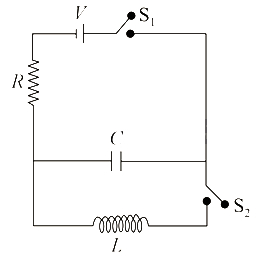
In the circuit given below,the capacitor $C$ is charged by closing the switch $S_1$ and opening the switch $S_2$. After charging,the switch $S_1$ is opened and $S_2$ is closed. Find the maximum current in the circuit.
A
$V \sqrt{\frac{L}{C}}$
B
$V \sqrt{\frac{C}{L}}$
C
$\frac{V}{2 \pi} \sqrt{\frac{L}{C}}$
D
$2 \pi V \sqrt{\frac{L}{C}}$
Solution
(B) $1$. Initially,the switch $S_1$ is closed and $S_2$ is open. The capacitor $C$ charges to the potential $V$ of the battery.
$2$. The energy stored in the capacitor is $U_C = \frac{1}{2} C V^2$.
$3$. When $S_1$ is opened and $S_2$ is closed,the capacitor discharges through the inductor $L$,forming an $LC$ oscillation circuit.
$4$. According to the law of conservation of energy,the maximum energy stored in the capacitor is transferred to the inductor as magnetic energy when the current is maximum $(i_{max})$.
$5$. $\frac{1}{2} C V^2 = \frac{1}{2} L i_{max}^2$
$6$. Solving for $i_{max}$,we get $i_{max}^2 = \frac{C V^2}{L}$,which implies $i_{max} = V \sqrt{\frac{C}{L}}$.
$2$. The energy stored in the capacitor is $U_C = \frac{1}{2} C V^2$.
$3$. When $S_1$ is opened and $S_2$ is closed,the capacitor discharges through the inductor $L$,forming an $LC$ oscillation circuit.
$4$. According to the law of conservation of energy,the maximum energy stored in the capacitor is transferred to the inductor as magnetic energy when the current is maximum $(i_{max})$.
$5$. $\frac{1}{2} C V^2 = \frac{1}{2} L i_{max}^2$
$6$. Solving for $i_{max}$,we get $i_{max}^2 = \frac{C V^2}{L}$,which implies $i_{max} = V \sqrt{\frac{C}{L}}$.
0 likes
View Solution104
EasyMCQ
$A$ $2 \mu F$ capacitor is charged to $50 V$ by a battery. The battery is removed after the capacitor is fully charged. At time $t=0$,a $10 mH$ coil is connected in series with the capacitor. The maximum rate at which the current changes in the circuit is (in $A s^{-1}$)
A
$2000$
B
$5000$
C
$2500$
D
$10000$
Solution
(B) The capacitor is charged to a potential difference of $V = 50 \ V$. When the battery is removed and the capacitor is connected to the inductor,the circuit forms an $LC$ oscillator.
At $t=0$,the charge on the capacitor is maximum,so the potential difference across it is $V_{max} = 50 \ V$.
The voltage across the inductor is given by $V_L = L \frac{dI}{dt}$.
In an $LC$ circuit,the sum of potential differences is zero: $V_C + V_L = 0$,which implies $|V_L| = |V_C|$.
At $t=0$,the current $I=0$,so the entire potential of the capacitor appears across the inductor.
Thus,$L \left( \frac{dI}{dt} \right)_{max} = V_{max}$.
Given $L = 10 \ mH = 10 \times 10^{-3} \ H$ and $V_{max} = 50 \ V$.
$\left( \frac{dI}{dt} \right)_{max} = \frac{50}{10 \times 10^{-3}} = \frac{50}{0.01} = 5000 \ A s^{-1}$.
At $t=0$,the charge on the capacitor is maximum,so the potential difference across it is $V_{max} = 50 \ V$.
The voltage across the inductor is given by $V_L = L \frac{dI}{dt}$.
In an $LC$ circuit,the sum of potential differences is zero: $V_C + V_L = 0$,which implies $|V_L| = |V_C|$.
At $t=0$,the current $I=0$,so the entire potential of the capacitor appears across the inductor.
Thus,$L \left( \frac{dI}{dt} \right)_{max} = V_{max}$.
Given $L = 10 \ mH = 10 \times 10^{-3} \ H$ and $V_{max} = 50 \ V$.
$\left( \frac{dI}{dt} \right)_{max} = \frac{50}{10 \times 10^{-3}} = \frac{50}{0.01} = 5000 \ A s^{-1}$.
0 likes
View Solution105
MediumMCQ
If $L$ and $C$ are inductance and capacitance respectively,then the dimensional formula of $(LC)^{-\frac{1}{2}}$ is
A
$[M^0 L^0 T^{-1}]$
B
$[M^1 L^1 T^{-1}]$
C
$[M^0 L^1 T^1]$
D
$[M^0 L^0 T^{-2}]$
Solution
(A) The resonant frequency of an $LC$ circuit is given by the formula $\omega = \frac{1}{\sqrt{LC}}$.
Here,$\omega$ represents the angular frequency,which has the dimensions of $[T^{-1}]$.
Therefore,$(LC)^{-\frac{1}{2}} = \frac{1}{\sqrt{LC}} = \omega$.
The dimensional formula for angular frequency is $[M^0 L^0 T^{-1}]$.
Thus,the correct option is $A$.
Here,$\omega$ represents the angular frequency,which has the dimensions of $[T^{-1}]$.
Therefore,$(LC)^{-\frac{1}{2}} = \frac{1}{\sqrt{LC}} = \omega$.
The dimensional formula for angular frequency is $[M^0 L^0 T^{-1}]$.
Thus,the correct option is $A$.
0 likes
View Solution106
MediumMCQ
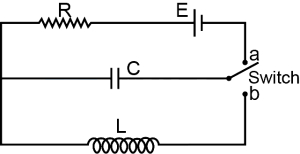
In the circuit shown below,the switch is kept in position $a$ for a long time and is then thrown to position $b$. The amplitude of the resulting oscillating current is given by
A
$E \sqrt{L/C}$
B
$E / R$
C
infinity
D
$E \sqrt{C/L}$
Solution
(D) When the switch is in position $a$,the capacitor is charged to a potential $E$. The charge on the capacitor is $q = CE$.
The energy stored in the capacitor is $U = \frac{q^2}{2C} = \frac{(CE)^2}{2C} = \frac{1}{2} CE^2$.
When the switch is thrown to position $b$,the circuit becomes an $LC$ oscillator. The total energy is conserved,oscillating between the electric field of the capacitor and the magnetic field of the inductor.
Let $I_0$ be the amplitude of the oscillating current. The maximum magnetic energy in the inductor is $\frac{1}{2} L I_0^2$.
By the law of conservation of energy,the maximum electrical energy equals the maximum magnetic energy:
$\frac{1}{2} CE^2 = \frac{1}{2} L I_0^2$
$CE^2 = L I_0^2$
$I_0^2 = \frac{C}{L} E^2$
$I_0 = E \sqrt{\frac{C}{L}}$
The energy stored in the capacitor is $U = \frac{q^2}{2C} = \frac{(CE)^2}{2C} = \frac{1}{2} CE^2$.
When the switch is thrown to position $b$,the circuit becomes an $LC$ oscillator. The total energy is conserved,oscillating between the electric field of the capacitor and the magnetic field of the inductor.
Let $I_0$ be the amplitude of the oscillating current. The maximum magnetic energy in the inductor is $\frac{1}{2} L I_0^2$.
By the law of conservation of energy,the maximum electrical energy equals the maximum magnetic energy:
$\frac{1}{2} CE^2 = \frac{1}{2} L I_0^2$
$CE^2 = L I_0^2$
$I_0^2 = \frac{C}{L} E^2$
$I_0 = E \sqrt{\frac{C}{L}}$
0 likes
View Solution107
DifficultMCQ
$A$ charged $30 \mu\text{F}$ capacitor is connected to a $27 \text{ mH}$ inductor. What is the angular frequency of free oscillations of the circuit (in $\text{ rad/s}$)?
A
$11$
B
$1100$
C
$110$
D
$11000$
Solution
(B) The angular frequency $\omega$ of free oscillations in an $LC$ circuit is given by the formula $\omega = \frac{1}{\sqrt{LC}}$.
Given values are $L = 27 \text{ mH} = 27 \times 10^{-3} \text{ H}$ and $C = 30 \mu\text{F} = 30 \times 10^{-6} \text{ F}$.
Substituting these values into the formula:
$\omega = \frac{1}{\sqrt{27 \times 10^{-3} \times 30 \times 10^{-6}}}$
$\omega = \frac{1}{\sqrt{810 \times 10^{-9}}}$
$\omega = \frac{1}{\sqrt{81 \times 10^{-8}}}$
$\omega = \frac{1}{9 \times 10^{-4}}$
$\omega = \frac{10^4}{9} \approx 1111.11 \text{ rad/s}$.
The closest option is $1100 \text{ rad/s}$.
Given values are $L = 27 \text{ mH} = 27 \times 10^{-3} \text{ H}$ and $C = 30 \mu\text{F} = 30 \times 10^{-6} \text{ F}$.
Substituting these values into the formula:
$\omega = \frac{1}{\sqrt{27 \times 10^{-3} \times 30 \times 10^{-6}}}$
$\omega = \frac{1}{\sqrt{810 \times 10^{-9}}}$
$\omega = \frac{1}{\sqrt{81 \times 10^{-8}}}$
$\omega = \frac{1}{9 \times 10^{-4}}$
$\omega = \frac{10^4}{9} \approx 1111.11 \text{ rad/s}$.
The closest option is $1100 \text{ rad/s}$.
0 likes
View SolutionAlternating Current — LC Oscillations · Frequently Asked Questions
1Are these Alternating Current questions useful for JEE and NEET?
Yes. All questions in this section are mapped to JEE Main and NEET exam patterns. Previous year questions from JEE Main, NEET, GUJCET and state-level exams are included with full solutions.
2Can I switch to Hindi or Gujarati for these questions?
Yes. Use the language tabs in the hero section or the sidebar to view the same questions and solutions in English, Hindi or Gujarati.
3How do I generate a question paper from this subtopic?
Use the Vedclass Exam Paper Generator — select the chapter and subtopic, set difficulty, and generate Sets A, B, C, D automatically. First 3 chapters of every subject are free.
Vedclass Products
For Students
Vedclass Test Series
Mock tests in real JEE/NEET style with performance analysis. 5-day free trial.
Start Free TrialFor Teachers
Exam Paper Generator
Generate Set A/B/C/D papers from this chapter in 2 minutes. 3 chapters free.
Try FreeFor Institutes
Online Exam Module
Live online exams with unlimited students, 360° analytics & white-label branding.
See DemoFor Teachers & Institutes
Generate a Alternating Current Exam Paper in 2 Minutes
Select subtopic & difficulty — Sets A, B, C, D auto-generated with No Repeat logic.
First 3 chapters of every subject are free — no payment required.