
A English
Introduction of Halogen containing compounds Questions in English
Class 12 Chemistry · Haloalkanes and Haloarenes · Introduction of Halogen containing compounds
130+
Questions
English
Language
100%
With Solutions
Showing 49 of 130 questions in English
51
Medium
Explain the classification of halogen compounds.
Solution
(N/A) Halogen compounds are classified based on the number of halogen atoms and the hybridization of the carbon atom to which the halogen is attached:
$1$. Based on the number of halogen atoms:
$(i)$ Monohalides: Contain one halogen atom.
(ii) Dihalides: Contain two halogen atoms.
(iii) Trihalides: Contain three halogen atoms.
(iv) Polyhalides: Contain more than three halogen atoms.
$2$. Based on the hybridization of the carbon atom ($sp^3$ $C-X$ bond):
$(a)$ Alkyl halides: Classified as primary $(1^\circ)$,secondary $(2^\circ)$,or tertiary $(3^\circ)$ based on the carbon atom attached to the halogen.
$(b)$ Allylic halides: The halogen is attached to an $sp^3$ hybridized carbon atom next to a carbon-carbon double bond $(C=C-C-X)$.
$(c)$ Benzylic halides: The halogen is attached to an $sp^3$ hybridized carbon atom next to an aromatic ring $(Ar-CH_2-X)$.
$3$. Based on the hybridization of the carbon atom ($sp^2$ $C-X$ bond):
$(a)$ Vinylic halides: The halogen is attached directly to an $sp^2$ hybridized carbon atom of a double bond $(C=C-X)$.
$(b)$ Aryl halides: The halogen is attached directly to an $sp^2$ hybridized carbon atom of an aromatic ring $(Ar-X)$.
$1$. Based on the number of halogen atoms:
$(i)$ Monohalides: Contain one halogen atom.
(ii) Dihalides: Contain two halogen atoms.
(iii) Trihalides: Contain three halogen atoms.
(iv) Polyhalides: Contain more than three halogen atoms.
$2$. Based on the hybridization of the carbon atom ($sp^3$ $C-X$ bond):
$(a)$ Alkyl halides: Classified as primary $(1^\circ)$,secondary $(2^\circ)$,or tertiary $(3^\circ)$ based on the carbon atom attached to the halogen.
$(b)$ Allylic halides: The halogen is attached to an $sp^3$ hybridized carbon atom next to a carbon-carbon double bond $(C=C-C-X)$.
$(c)$ Benzylic halides: The halogen is attached to an $sp^3$ hybridized carbon atom next to an aromatic ring $(Ar-CH_2-X)$.
$3$. Based on the hybridization of the carbon atom ($sp^2$ $C-X$ bond):
$(a)$ Vinylic halides: The halogen is attached directly to an $sp^2$ hybridized carbon atom of a double bond $(C=C-X)$.
$(b)$ Aryl halides: The halogen is attached directly to an $sp^2$ hybridized carbon atom of an aromatic ring $(Ar-X)$.
0 likes
View Solution52
Difficult
How are the common and $IUPAC$ names of alkyl halides assigned? Give examples.
Solution
(N/A) The naming of alkyl halides is done as follows:
$1$. Common Names: These are named by naming the alkyl group followed by the name of the halide (e.g.,$n$-propyl bromide).
$2$. $IUPAC$ Names: These are named as halo-substituted alkanes. The halogen atom is treated as a substituent on the longest carbon chain,and its position is indicated by a number.
| Structural Formula | Common Name | $IUPAC$ Name |
| :--- | :--- | :--- |
| $CH_3CH_2CH_2Br$ | $n$-propyl bromide | $1$-bromopropane |
| $CH_3CH(Cl)CH_3$ | isopropyl chloride | $2$-chloropropane |
| $(CH_3)_2CHCH_2Cl$ | isobutyl chloride | $1$-chloro-$2$-methylpropane |
| $(CH_3)_3CCH_2Cl$ | neopentyl chloride | $1$-chloro-$2,2$-dimethylpropane |
| $CH_3CH(Br)CH_3$ | isopropyl bromide | $2$-bromopropane |
$1$. Common Names: These are named by naming the alkyl group followed by the name of the halide (e.g.,$n$-propyl bromide).
$2$. $IUPAC$ Names: These are named as halo-substituted alkanes. The halogen atom is treated as a substituent on the longest carbon chain,and its position is indicated by a number.
| Structural Formula | Common Name | $IUPAC$ Name |
| :--- | :--- | :--- |
| $CH_3CH_2CH_2Br$ | $n$-propyl bromide | $1$-bromopropane |
| $CH_3CH(Cl)CH_3$ | isopropyl chloride | $2$-chloropropane |
| $(CH_3)_2CHCH_2Cl$ | isobutyl chloride | $1$-chloro-$2$-methylpropane |
| $(CH_3)_3CCH_2Cl$ | neopentyl chloride | $1$-chloro-$2,2$-dimethylpropane |
| $CH_3CH(Br)CH_3$ | isopropyl bromide | $2$-bromopropane |
0 likes
View Solution53
Difficult
Explain the nomenclature of aryl halides.
Solution
(N/A) Rules for nomenclature of aryl halides:
$(i)$ For monohalogen derivatives of benzene,the common and $IUPAC$ names are the same. In the $IUPAC$ system,prefixes $ortho- (o-)$,$meta- (m-)$,and $para- (p-)$ are replaced by $1,2-$,$1,3-$,and $1,4-$ respectively.
$(ii)$ If more than two halogen atoms are present in the ring,the $IUPAC$ system is used by numbering the ring positions $1, 2, 3, 4, 5, 6$ and using prefixes like $tri-$,$tetra-$,etc.
$(b)$ Examples:
| Structure | Common Name | $IUPAC$ Name |
| :--- | :--- | :--- |
| $C_6H_5Br$ | Bromobenzene | Bromobenzene |
| $C_6H_4Br_2$ $(o-)$ | $o$-Dibromobenzene | $1,2$-Dibromobenzene |
| $C_6H_4Br_2$ $(m-)$ | $m$-Dibromobenzene | $1,3$-Dibromobenzene |
| $C_6H_4Br_2$ $(p-)$ | $p$-Dibromobenzene | $1,4$-Dibromobenzene |
| $C_6H_3Br_3$ $(1,3,5-)$ | sym-Tribromobenzene | $1,3,5$-Tribromobenzene |
| $C_6H_3Br_3$ $(1,2,4-)$ | - | $1,2,4$-Tribromobenzene |
$(i)$ For monohalogen derivatives of benzene,the common and $IUPAC$ names are the same. In the $IUPAC$ system,prefixes $ortho- (o-)$,$meta- (m-)$,and $para- (p-)$ are replaced by $1,2-$,$1,3-$,and $1,4-$ respectively.
$(ii)$ If more than two halogen atoms are present in the ring,the $IUPAC$ system is used by numbering the ring positions $1, 2, 3, 4, 5, 6$ and using prefixes like $tri-$,$tetra-$,etc.
$(b)$ Examples:
| Structure | Common Name | $IUPAC$ Name |
| :--- | :--- | :--- |
| $C_6H_5Br$ | Bromobenzene | Bromobenzene |
| $C_6H_4Br_2$ $(o-)$ | $o$-Dibromobenzene | $1,2$-Dibromobenzene |
| $C_6H_4Br_2$ $(m-)$ | $m$-Dibromobenzene | $1,3$-Dibromobenzene |
| $C_6H_4Br_2$ $(p-)$ | $p$-Dibromobenzene | $1,4$-Dibromobenzene |
| $C_6H_3Br_3$ $(1,3,5-)$ | sym-Tribromobenzene | $1,3,5$-Tribromobenzene |
| $C_6H_3Br_3$ $(1,2,4-)$ | - | $1,2,4$-Tribromobenzene |
0 likes
View Solution54
Difficult
Explain the common and $IUPAC$ nomenclature of haloarenes where the halogen is attached to the carbon of the benzene ring,with examples.
Solution
(N/A) Rules for naming aryl halides:
$(i)$ For monohaloarenes,the common and $IUPAC$ names are the same. In the $IUPAC$ system,the positions of substituents are indicated by numbering the carbon atoms of the ring starting from the carbon bearing the halogen atom.
$(ii)$ For dihaloarenes,the prefixes $ortho$ $(o-)$,$meta$ $(m-)$,and $para$ $(p-)$ are used in common names,while $1,2-$,$1,3-$,and $1,4-$ are used in the $IUPAC$ system.
$(iii)$ If more than two halogen atoms are present in the ring,the $IUPAC$ system is used by numbering the ring and using prefixes like $1,2,3-$,$1,3,5-$,etc.
$(b)$ Examples:
$(i)$ For monohaloarenes,the common and $IUPAC$ names are the same. In the $IUPAC$ system,the positions of substituents are indicated by numbering the carbon atoms of the ring starting from the carbon bearing the halogen atom.
$(ii)$ For dihaloarenes,the prefixes $ortho$ $(o-)$,$meta$ $(m-)$,and $para$ $(p-)$ are used in common names,while $1,2-$,$1,3-$,and $1,4-$ are used in the $IUPAC$ system.
$(iii)$ If more than two halogen atoms are present in the ring,the $IUPAC$ system is used by numbering the ring and using prefixes like $1,2,3-$,$1,3,5-$,etc.
$(b)$ Examples:
| Structure | Common Name | $IUPAC$ Name |
|---|---|---|
| $C_6H_5Br$ | Bromobenzene | Bromobenzene |
| $o-C_6H_4Br_2$ | $o$-Dibromobenzene | $1,2$-Dibromobenzene |
| $m-C_6H_4Br_2$ | $m$-Dibromobenzene | $1,3$-Dibromobenzene |
| $p-C_6H_4Br_2$ | $p$-Dibromobenzene | $1,4$-Dibromobenzene |
| $C_6H_3Br_3$ | Symmetrical tribromobenzene | $1,3,5$-Tribromobenzene |
| $C_6H_3Br_3$ | - | $1,2,4$-Tribromobenzene |
0 likes
View Solution55
Medium
Explain the nomenclature of haloalkanes containing two identical halogen atoms with examples,or state their differences.
Solution
(N/A) Haloalkanes containing two identical halogen atoms are classified into two types based on the position of the halogen atoms:
$1$. Geminal Dihalides (Alkylidene dihalides):
- In these compounds,two halogen atoms are attached to the same carbon atom.
- Example: $CH_3-CHCl_2$ is named as Ethylidene chloride (common name) and $1,1-dichloroethane$ ($IUPAC$ name).
$2$. Vicinal Dihalides (Alkylene dihalides):
- In these compounds,two halogen atoms are attached to adjacent carbon atoms.
- Example: $Cl-CH_2-CH_2-Cl$ is named as Ethylene dichloride (common name) and $1,2-dichloroethane$ ($IUPAC$ name).
$1$. Geminal Dihalides (Alkylidene dihalides):
- In these compounds,two halogen atoms are attached to the same carbon atom.
- Example: $CH_3-CHCl_2$ is named as Ethylidene chloride (common name) and $1,1-dichloroethane$ ($IUPAC$ name).
$2$. Vicinal Dihalides (Alkylene dihalides):
- In these compounds,two halogen atoms are attached to adjacent carbon atoms.
- Example: $Cl-CH_2-CH_2-Cl$ is named as Ethylene dichloride (common name) and $1,2-dichloroethane$ ($IUPAC$ name).
0 likes
View Solution56
Medium
Provide the common and $IUPAC$ names for some halide compounds.
Solution
(N/A)
| Structure | Common Name | $IUPAC$ Name |
|---|---|---|
| $CH_3CH_2CH(Cl)CH_3$ | sec-Butyl chloride | $2$-Chlorobutane |
| $(CH_3)_3CCH_2Br$ | Neopentyl bromide | $1$-Bromo-$2,2$-dimethylpropane |
| $(CH_3)_3CBr$ | tert-Butyl bromide | $2$-Bromo-$2$-methylpropane |
| $CH_2=CHCl$ | Vinyl chloride | Chloroethene |
| $CH_2=CHCH_2Br$ | Allyl bromide | $3$-Bromopropene |
| $C_6H_4(Cl)(CH_3)$ (ortho) | $o$-Chlorotoluene | $1$-Chloro-$2$-methylbenzene or $2$-Chlorotoluene |
| $C_6H_5CH_2Cl$ | Benzyl chloride | Chlorophenylmethane |
| $CH_2Cl_2$ | Methylene chloride | Dichloromethane |
| $CHCl_3$ | Chloroform | Trichloromethane |
| $CHBr_3$ | Bromoform | Tribromomethane |
| $CCl_4$ | Carbon tetrachloride | Tetrachloromethane |
| $CH_3CH_2CH_2F$ | $n$-Propyl fluoride | $1$-Fluoropropane |
0 likes
View Solution57
Medium
Discuss the nature of the $C-X$ bond in halogen compounds.
Solution
(N/A) In halogen compounds, the carbon-halogen bond is polar: Halogen atoms are located on the right side of the periodic table. The electronegativity of all halogen atoms $(F, Cl, Br, I)$ is higher than that of the carbon atom. Due to this, the electrons of the carbon-halogen $(C-X)$ bond are shifted towards the halogen, causing the carbon to acquire a partial positive charge and the halogen to acquire a partial negative charge, making the $C-X$ bond polar.
$(b)$ Trends in polarity, bond length, and bond enthalpy from $C-F$ to $C-I$: As we move down the group in the periodic table, the size of the halogen atoms $(F, Cl, Br, I)$ increases. Fluorine is the smallest and iodine is the largest.
Therefore, the carbon-halogen bond length increases from $C-F$ to $C-I$. The bond length, bond enthalpy, and dipole moment of $C-X$ bonds in methyl halides $(CH_3X)$ are given in the table below:
Order of bond length: $CH_3-F$ < $CH_3-Cl$ < $CH_3-Br$ < $CH_3-I$
Order of dipole moment: $CH_3-Cl$ > $CH_3-F$ > $CH_3-Br$ > $CH_3-I$
$(b)$ Trends in polarity, bond length, and bond enthalpy from $C-F$ to $C-I$: As we move down the group in the periodic table, the size of the halogen atoms $(F, Cl, Br, I)$ increases. Fluorine is the smallest and iodine is the largest.
Therefore, the carbon-halogen bond length increases from $C-F$ to $C-I$. The bond length, bond enthalpy, and dipole moment of $C-X$ bonds in methyl halides $(CH_3X)$ are given in the table below:
| Bond | Bond Length $(pm)$ | $C-X$ Bond Enthalpy $(kJ \ mol^{-1})$ | Dipole Moment $(Debye)$ |
| $CH_3-F$ | $139$ | $452$ | $1.847$ |
| $CH_3-Cl$ | $178$ | $351$ | $1.860$ |
| $CH_3-Br$ | $193$ | $293$ | $1.830$ |
| $CH_3-I$ | $214$ | $234$ | $1.636$ |
Order of bond length: $CH_3-F$ < $CH_3-Cl$ < $CH_3-Br$ < $CH_3-I$
Order of dipole moment: $CH_3-Cl$ > $CH_3-F$ > $CH_3-Br$ > $CH_3-I$
0 likes
View Solution58
Medium
Classify the following compounds as primary,secondary,and tertiary halides.
$(i)$ $1-$Bromobut$-2-$ene
$(ii)$ $4-$Bromopent$-2-$ene
$(iii)$ $2-$Bromo$-2-$methylpropane
$(i)$ $1-$Bromobut$-2-$ene
$(ii)$ $4-$Bromopent$-2-$ene
$(iii)$ $2-$Bromo$-2-$methylpropane
Solution
(N/A) The classification of alkyl halides is based on the nature of the carbon atom to which the halogen is attached.
$(i)$ $CH_3-CH=CH-CH_2Br$: The $Br$ atom is attached to a primary $(1^{\circ})$ carbon atom. Hence,it is a primary $(1^{\circ})$ halide.
$(ii)$ $CH_3-CH=CH-CH(Br)-CH_3$: The $Br$ atom is attached to a secondary $(2^{\circ})$ carbon atom. Hence,it is a secondary $(2^{\circ})$ halide.
$(iii)$ $(CH_3)_3C-Br$: The $Br$ atom is attached to a tertiary $(3^{\circ})$ carbon atom. Hence,it is a tertiary $(3^{\circ})$ halide.
$(i)$ $CH_3-CH=CH-CH_2Br$: The $Br$ atom is attached to a primary $(1^{\circ})$ carbon atom. Hence,it is a primary $(1^{\circ})$ halide.
$(ii)$ $CH_3-CH=CH-CH(Br)-CH_3$: The $Br$ atom is attached to a secondary $(2^{\circ})$ carbon atom. Hence,it is a secondary $(2^{\circ})$ halide.
$(iii)$ $(CH_3)_3C-Br$: The $Br$ atom is attached to a tertiary $(3^{\circ})$ carbon atom. Hence,it is a tertiary $(3^{\circ})$ halide.
0 likes
View Solution59
Medium
Match the structures of compounds given in Column-$I$ with the classes of compounds given in Column-$II$.
| Column-$I$ | Column-$II$ |
|---|---|
| $A$. $CH_3-CH(X)-CH_3$ | $1$. Aryl halide |
| $B$. $CH_2=CH-CH_2-X$ | $2$. Alkyl halide |
| $C$. $C_6H_5-X$ | $3$. Vinyl halide |
| $D$. $CH_2=CH-X$ | $4$. Allyl halide |
Solution
(A-2, B-4, C-1, D-3) The classification of the given compounds is as follows:
$A$. $CH_3-CH(X)-CH_3$ is an alkyl halide (specifically,a secondary alkyl halide).
$B$. $CH_2=CH-CH_2-X$ is an allyl halide because the halogen is attached to an $sp^3$ hybridized carbon atom next to a carbon-carbon double bond.
$C$. $C_6H_5-X$ is an aryl halide because the halogen is directly attached to an aromatic ring.
$D$. $CH_2=CH-X$ is a vinyl halide because the halogen is directly attached to an $sp^2$ hybridized carbon atom of a double bond.
Therefore,the correct matching is: $A-2, B-4, C-1, D-3$.
$A$. $CH_3-CH(X)-CH_3$ is an alkyl halide (specifically,a secondary alkyl halide).
$B$. $CH_2=CH-CH_2-X$ is an allyl halide because the halogen is attached to an $sp^3$ hybridized carbon atom next to a carbon-carbon double bond.
$C$. $C_6H_5-X$ is an aryl halide because the halogen is directly attached to an aromatic ring.
$D$. $CH_2=CH-X$ is a vinyl halide because the halogen is directly attached to an $sp^2$ hybridized carbon atom of a double bond.
Therefore,the correct matching is: $A-2, B-4, C-1, D-3$.
0 likes
View Solution60
Medium
What are vicinal dihalides? Give examples.
Solution
(N/A) Vicinal dihalides are compounds in which two halogen atoms are attached to adjacent (neighboring) carbon atoms in the carbon chain.
Examples include:
$1$. $1,2-dibromopropane$ $(CH_3-CHBr-CH_2Br)$
$2$. $1,2-dichloroethane$ $(CH_2Cl-CH_2Cl)$
Examples include:
$1$. $1,2-dibromopropane$ $(CH_3-CHBr-CH_2Br)$
$2$. $1,2-dichloroethane$ $(CH_2Cl-CH_2Cl)$
0 likes
View Solution61
Medium
Column-$(I)$ contains the structure and Column-$(II)$ contains its type. Match Column-$(I)$ with Column-$(II)$.
| Column-$(I)$ | Column-$(II)$ |
| $(A)$ ${C_2}{H_5}X$ | $(1)$ Dihaloalkane |
| $(B)$ $C{H_2}X - C{H_2}X$ | $(2)$ Trihaloalkane |
| $(C)$ $C{H_2}X - CHX - C{H_2}X$ | $(3)$ Monohaloalkane |
| $(D)$ $C{X_4}$ | $(4)$ Tetrahaloalkane |
Solution
(A-3, B-1, C-2, D-4) The classification is based on the number of halogen atoms present in the molecule:
$(A)$ ${C_2}{H_5}X$ contains one halogen atom,so it is a Monohaloalkane $(3)$.
$(B)$ $C{H_2}X - C{H_2}X$ contains two halogen atoms,so it is a Dihaloalkane $(1)$.
$(C)$ $C{H_2}X - CHX - C{H_2}X$ contains three halogen atoms,so it is a Trihaloalkane $(2)$.
$(D)$ $C{X_4}$ contains four halogen atoms,so it is a Tetrahaloalkane $(4)$.
Therefore,the correct matching is: $(A-3, B-1, C-2, D-4)$.
$(A)$ ${C_2}{H_5}X$ contains one halogen atom,so it is a Monohaloalkane $(3)$.
$(B)$ $C{H_2}X - C{H_2}X$ contains two halogen atoms,so it is a Dihaloalkane $(1)$.
$(C)$ $C{H_2}X - CHX - C{H_2}X$ contains three halogen atoms,so it is a Trihaloalkane $(2)$.
$(D)$ $C{X_4}$ contains four halogen atoms,so it is a Tetrahaloalkane $(4)$.
Therefore,the correct matching is: $(A-3, B-1, C-2, D-4)$.
0 likes
View Solution62
Medium
Match the structures given in Column-$(I)$ with their types in Column-$(II)$.
| Column-$(I)$ (Structure) | Column-$(II)$ (Type) |
|---|---|
| $(A)$ Cyclohexadiene with $-X$ | $(i)$ Dihaloarene |
| $(B)$ $p$-Dihalobenzene | $(ii)$ Trihaloarene |
| $(C)$ $1,3,5$-Trihalobenzene | $(iii)$ Tetrahaloarene |
| $(D)$ Chlorobenzene | $(iv)$ Monohaloarene |
| $(v)$ Monochloroarene | |
| $(vi)$ Dichloroarene |
Solution
(A) The classification is based on the number of halogen atoms attached to the aromatic ring:
$(A)$ The structure is a monohalo-substituted cyclic diene (monohaloarene): $(A \rightarrow iv)$.
$(B)$ The structure is a benzene ring with two halogen atoms at para positions (dihaloarene): $(B \rightarrow i)$.
$(C)$ The structure is a benzene ring with three halogen atoms (trihaloarene): $(C \rightarrow ii)$.
$(D)$ The structure is a benzene ring with one chlorine atom (monochloroarene): $(D \rightarrow v)$.
$(A)$ The structure is a monohalo-substituted cyclic diene (monohaloarene): $(A \rightarrow iv)$.
$(B)$ The structure is a benzene ring with two halogen atoms at para positions (dihaloarene): $(B \rightarrow i)$.
$(C)$ The structure is a benzene ring with three halogen atoms (trihaloarene): $(C \rightarrow ii)$.
$(D)$ The structure is a benzene ring with one chlorine atom (monochloroarene): $(D \rightarrow v)$.
0 likes
View Solution63
Medium
Match the type of halide given in Column-$(I)$ with the structures in Column-$(II)$.
| Column-$(I)$ (Structure) | Column-$(II)$ (Type) |
|---|---|
| $(A)$ $C_6H_5CH_2X$ | $(i)$ $4^{\circ}$ Benzylic halide |
| $(B)$ $C_6H_5CH(CH_3)X$ | $(ii)$ $3^{\circ}$ Benzylic halide |
| $(C)$ $C_6H_5C(CH_3)_2X$ | $(iii)$ $2^{\circ}$ Benzylic halide |
| $(D)$ $C_6H_5X$ | $(iv)$ $1^{\circ}$ Benzylic halide |
| $(v)$ Aryl halide |
Solution
(A-IV, B-III, C-II, D-V) The classification is based on the carbon atom to which the halogen atom is attached:
$(A)$ $C_6H_5CH_2X$: The halogen is attached to a primary carbon atom adjacent to the benzene ring,which is a $1^{\circ}$ benzylic halide $(iv)$.
$(B)$ $C_6H_5CH(CH_3)X$: The halogen is attached to a secondary carbon atom adjacent to the benzene ring,which is a $2^{\circ}$ benzylic halide $(iii)$.
$(C)$ $C_6H_5C(CH_3)_2X$: The halogen is attached to a tertiary carbon atom adjacent to the benzene ring,which is a $3^{\circ}$ benzylic halide $(ii)$.
$(D)$ $C_6H_5X$: The halogen is directly attached to the benzene ring,which is an aryl halide $(v)$.
Therefore,the correct matching is: $(A$ $\rightarrow iv), (B$ $\rightarrow iii), (C$ $\rightarrow ii), (D$ $\rightarrow v)$.
$(A)$ $C_6H_5CH_2X$: The halogen is attached to a primary carbon atom adjacent to the benzene ring,which is a $1^{\circ}$ benzylic halide $(iv)$.
$(B)$ $C_6H_5CH(CH_3)X$: The halogen is attached to a secondary carbon atom adjacent to the benzene ring,which is a $2^{\circ}$ benzylic halide $(iii)$.
$(C)$ $C_6H_5C(CH_3)_2X$: The halogen is attached to a tertiary carbon atom adjacent to the benzene ring,which is a $3^{\circ}$ benzylic halide $(ii)$.
$(D)$ $C_6H_5X$: The halogen is directly attached to the benzene ring,which is an aryl halide $(v)$.
Therefore,the correct matching is: $(A$ $\rightarrow iv), (B$ $\rightarrow iii), (C$ $\rightarrow ii), (D$ $\rightarrow v)$.
0 likes
View Solution64
Medium
Column-$(I)$ contains the formula of an alkyl halide and Column-$(II)$ contains its type. Match Column-$(I)$ with Column-$(II)$.
| Column-$(I)$ | Column-$(II)$ |
| $(A)$ $CH_3CH_2X$ | $(1)$ $4^{\circ}$ halide |
| $(B)$ $R'CH_2X$ | $(2)$ $3^{\circ}$ halide |
| $(C)$ $R'R''CHX$ | $(3)$ $2^{\circ}$ halide |
| $(D)$ $R'R''CR'''X$ | $(4)$ $1^{\circ}$ halide |
Solution
(D) The classification of alkyl halides is based on the number of alkyl groups attached to the carbon atom bearing the halogen atom:
- $(A)$ $CH_3CH_2X$ is a primary $(1^{\circ})$ halide.
- $(B)$ $R'CH_2X$ is a primary $(1^{\circ})$ halide.
- $(C)$ $R'R''CHX$ is a secondary $(2^{\circ})$ halide.
- $(D)$ $R'R''CR'''X$ is a tertiary $(3^{\circ})$ halide.
Therefore,the correct matching is: $(A-4, B-4, C-3, D-2)$.
- $(A)$ $CH_3CH_2X$ is a primary $(1^{\circ})$ halide.
- $(B)$ $R'CH_2X$ is a primary $(1^{\circ})$ halide.
- $(C)$ $R'R''CHX$ is a secondary $(2^{\circ})$ halide.
- $(D)$ $R'R''CR'''X$ is a tertiary $(3^{\circ})$ halide.
Therefore,the correct matching is: $(A-4, B-4, C-3, D-2)$.
0 likes
View Solution65
Medium
Identify the type of halide given in Column-$I$ from Column-$II$.
| Column-$I$ | Column-$II$ |
| $A$. $CH_2=CHCH_2X$ | $i$. Aryl halide |
| $B$. $CH_2=CHX$ | $ii$. Benzylic halide |
| $C$. $C_6H_5CH_2X$ | $iii$. Allylic halide |
| $D$. $C_6H_5X$ | $iv$. Vinylic halide |
Solution
(A-III, B-IV, C-II, D-I) The classification of halides is based on the hybridization of the carbon atom attached to the halogen atom:
$A$. $CH_2=CHCH_2X$: The halogen is attached to an $sp^3$ hybridized carbon atom next to a carbon-carbon double bond,which is an allylic halide $(iii)$.
$B$. $CH_2=CHX$: The halogen is attached directly to an $sp^2$ hybridized carbon atom of a double bond,which is a vinylic halide $(iv)$.
$C$. $C_6H_5CH_2X$: The halogen is attached to an $sp^3$ hybridized carbon atom bonded to an aromatic ring,which is a benzylic halide $(ii)$.
$D$. $C_6H_5X$: The halogen is attached directly to an $sp^2$ hybridized carbon atom of an aromatic ring,which is an aryl halide $(i)$.
Therefore,the correct matching is: $(A-iii, B-iv, C-ii, D-i)$.
$A$. $CH_2=CHCH_2X$: The halogen is attached to an $sp^3$ hybridized carbon atom next to a carbon-carbon double bond,which is an allylic halide $(iii)$.
$B$. $CH_2=CHX$: The halogen is attached directly to an $sp^2$ hybridized carbon atom of a double bond,which is a vinylic halide $(iv)$.
$C$. $C_6H_5CH_2X$: The halogen is attached to an $sp^3$ hybridized carbon atom bonded to an aromatic ring,which is a benzylic halide $(ii)$.
$D$. $C_6H_5X$: The halogen is attached directly to an $sp^2$ hybridized carbon atom of an aromatic ring,which is an aryl halide $(i)$.
Therefore,the correct matching is: $(A-iii, B-iv, C-ii, D-i)$.
0 likes
View Solution66
Medium
Match the type of hybridization of the carbon atom attached to the halogen in Column-$I$ with the hybridization type in Column-$II$.
| Column-$I$ (Structure) | Column-$II$ (Hybridization) |
| $A$. $CH_3CH_2Cl$ | $i$. $sp$ |
| $B$. $CH_2=CHCl$ | $ii$. $sp^2$ |
| $C$. $CH_2=CH-CH_2Cl$ | $iii$. $sp^3$ |
| $D$. Chlorobenzene | $iv$. $sp^3d$ |
Solution
(A-III, B-II, C-III, D-II) To determine the hybridization of the carbon atom attached to the halogen:
$A$. $CH_3-CH_2-Cl$: The carbon attached to $Cl$ is bonded to one $C$ and two $H$ atoms (single bonds). It has $4$ sigma bonds,so it is $sp^3$ hybridized.
$B$. $CH_2=CH-Cl$: The carbon attached to $Cl$ is part of a double bond. It has $3$ sigma bonds,so it is $sp^2$ hybridized.
$C$. $CH_2=CH-CH_2-Cl$: The carbon attached to $Cl$ is bonded to one $C$ and two $H$ atoms (single bonds). It has $4$ sigma bonds,so it is $sp^3$ hybridized.
$D$. Chlorobenzene: The carbon attached to $Cl$ is part of the aromatic ring (double bond). It has $3$ sigma bonds,so it is $sp^2$ hybridized.
Therefore,the correct matching is: $(A-iii, B-ii, C-iii, D-ii)$.
$A$. $CH_3-CH_2-Cl$: The carbon attached to $Cl$ is bonded to one $C$ and two $H$ atoms (single bonds). It has $4$ sigma bonds,so it is $sp^3$ hybridized.
$B$. $CH_2=CH-Cl$: The carbon attached to $Cl$ is part of a double bond. It has $3$ sigma bonds,so it is $sp^2$ hybridized.
$C$. $CH_2=CH-CH_2-Cl$: The carbon attached to $Cl$ is bonded to one $C$ and two $H$ atoms (single bonds). It has $4$ sigma bonds,so it is $sp^3$ hybridized.
$D$. Chlorobenzene: The carbon attached to $Cl$ is part of the aromatic ring (double bond). It has $3$ sigma bonds,so it is $sp^2$ hybridized.
Therefore,the correct matching is: $(A-iii, B-ii, C-iii, D-ii)$.
0 likes
View Solution67
Medium
Match the structures in Column-$I$ with their types in Column-$II$.
| Column-$I$ (Structure) | Column-$II$ (Type) |
| $A$. $H_3C-CH_2Cl$ | $i$. Geminal dihalide |
| $B$. $ClCH_2-CH_2Cl$ | $ii$. Vicinal dihalide |
| $C$. $C_6H_5-CHCl_2$ | $iii$. Alkylidene halide |
| $D$. $C_6H_5-CHCl-CH_2Cl$ | $iv$. Alkylene dihalide |
Solution
(B-(II, IV), C-(I, III), D-(II, IV)) The classification of dihalides is as follows:
$1$. Geminal dihalides (or alkylidene halides) have two halogen atoms on the same carbon atom.
$2$. Vicinal dihalides (or alkylene dihalides) have two halogen atoms on adjacent carbon atoms.
Matching:
$A$. $H_3C-CH_2Cl$ is a mono-haloalkane (not a dihalide).
$B$. $ClCH_2-CH_2Cl$ has two $Cl$ atoms on adjacent carbons,so it is a vicinal dihalide $(ii)$ and an alkylene dihalide $(iv)$.
$C$. $C_6H_5-CHCl_2$ has two $Cl$ atoms on the same carbon,so it is a geminal dihalide $(i)$ and an alkylidene halide $(iii)$.
$D$. $C_6H_5-CHCl-CH_2Cl$ has two $Cl$ atoms on adjacent carbons,so it is a vicinal dihalide $(ii)$ and an alkylene dihalide $(iv)$.
$1$. Geminal dihalides (or alkylidene halides) have two halogen atoms on the same carbon atom.
$2$. Vicinal dihalides (or alkylene dihalides) have two halogen atoms on adjacent carbon atoms.
Matching:
$A$. $H_3C-CH_2Cl$ is a mono-haloalkane (not a dihalide).
$B$. $ClCH_2-CH_2Cl$ has two $Cl$ atoms on adjacent carbons,so it is a vicinal dihalide $(ii)$ and an alkylene dihalide $(iv)$.
$C$. $C_6H_5-CHCl_2$ has two $Cl$ atoms on the same carbon,so it is a geminal dihalide $(i)$ and an alkylidene halide $(iii)$.
$D$. $C_6H_5-CHCl-CH_2Cl$ has two $Cl$ atoms on adjacent carbons,so it is a vicinal dihalide $(ii)$ and an alkylene dihalide $(iv)$.
0 likes
View Solution68
Difficult
Match the structure in Column-$I$ with its common name in Column-$II$ and $IUPAC$ name in Column-$III$.
| Column-$I$ (Structure) | Column-$II$ (Common Name) and Column-$III$ ($IUPAC$ Name) |
| $(A)$ $CH_3CH_2CH_2Cl$ | $(iv)$ $n$-Propyl chloride,$(q)$ $1$-Chloropropane |
| $(B)$ $CH_3CHClCH_3$ | $(ii)$ Isopropyl chloride,$(p)$ $2$-Chloropropane |
| $(C)$ $CH_3CH(CH_3)CH_2Cl$ | $(iii)$ Isobutyl chloride,$(s)$ $1$-Chloro-$2$-methylpropane |
| $(D)$ $(CH_3)_3CCH_2Cl$ | $(i)$ Neopentyl chloride,$(r)$ $1$-Chloro-$2,2$-dimethylpropane |
Solution
(A) $(A) \rightarrow (iv, q)$: $CH_3CH_2CH_2Cl$ is $n$-propyl chloride ($IUPAC$: $1$-chloropropane).
$(B) \rightarrow (ii, p)$: $CH_3CHClCH_3$ is isopropyl chloride ($IUPAC$: $2$-chloropropane).
$(C) \rightarrow (iii, s)$: $CH_3CH(CH_3)CH_2Cl$ is isobutyl chloride ($IUPAC$: $1$-chloro-$2$-methylpropane).
$(D) \rightarrow (i, r)$: $(CH_3)_3CCH_2Cl$ is neopentyl chloride ($IUPAC$: $1$-chloro-$2,2$-dimethylpropane).
$(B) \rightarrow (ii, p)$: $CH_3CHClCH_3$ is isopropyl chloride ($IUPAC$: $2$-chloropropane).
$(C) \rightarrow (iii, s)$: $CH_3CH(CH_3)CH_2Cl$ is isobutyl chloride ($IUPAC$: $1$-chloro-$2$-methylpropane).
$(D) \rightarrow (i, r)$: $(CH_3)_3CCH_2Cl$ is neopentyl chloride ($IUPAC$: $1$-chloro-$2,2$-dimethylpropane).
0 likes
View Solution69
Medium
Match the structures in Column-$I$ with their common names in Column-$II$ and $IUPAC$ names in Column-$III$.
| Column-$I$ (Structure) | Column-$II$ (Common Name) | Column-$III$ ($IUPAC$ Name) |
| $A$. $o$-Chlorotoluene | $i$. Bromoform | $p$. Chlorophenylmethane |
| $B$. Benzyl chloride | $ii$. Benzyl chloride | $q$. $2$-Chlorotoluene |
| $C$. $CH_3CH_2CHClCH_3$ | $iii$. sec-Butyl chloride | $r$. Tribromomethane |
| $D$. $CHBr_3$ | $iv$. $o$-Chlorotoluene | $s$. $2$-Chlorobutane |
Solution
(A) The matching is as follows:
$A$ ($o$-Chlorotoluene) matches with $iv$ ($o$-Chlorotoluene) and $q$ ($2$-Chlorotoluene).
$B$ (Benzyl chloride) matches with $ii$ (Benzyl chloride) and $p$ (Chlorophenylmethane).
$C$ $(CH_3CH_2CHClCH_3)$ matches with $iii$ (sec-Butyl chloride) and $s$ ($2$-Chlorobutane).
$D$ $(CHBr_3)$ matches with $i$ (Bromoform) and $r$ (Tribromomethane).
Therefore,the correct matching is: $(A$ $\rightarrow iv, q), (B$ $\rightarrow ii, p), (C$ $\rightarrow iii, s), (D$ $\rightarrow i, r)$.
$A$ ($o$-Chlorotoluene) matches with $iv$ ($o$-Chlorotoluene) and $q$ ($2$-Chlorotoluene).
$B$ (Benzyl chloride) matches with $ii$ (Benzyl chloride) and $p$ (Chlorophenylmethane).
$C$ $(CH_3CH_2CHClCH_3)$ matches with $iii$ (sec-Butyl chloride) and $s$ ($2$-Chlorobutane).
$D$ $(CHBr_3)$ matches with $i$ (Bromoform) and $r$ (Tribromomethane).
Therefore,the correct matching is: $(A$ $\rightarrow iv, q), (B$ $\rightarrow ii, p), (C$ $\rightarrow iii, s), (D$ $\rightarrow i, r)$.
0 likes
View Solution70
Difficult
Match the structures in Column-$I$ with their $IUPAC$ names in Column-$II$ and common names in Column-$III$.
| Column-$I$ (Structure) | Column-$II$ ($IUPAC$ Name) and Column-$III$ (Common Name) |
| $A$. $CH_3CHCl_2$ | $i$. $1,1$-Dichloroethane and $r$. Ethylidene chloride |
| $B$. $CH_2Cl-CH_2Cl$ | $ii$. $1,2$-Dichloroethane and $s$. Ethylene dichloride |
| $C$. $CH_2=CHCl$ | $iv$. Chloroethene and $q$. Vinyl chloride |
| $D$. $CH_2=CHCH_2Cl$ | $iii$. $3$-Chloropropene and $p$. Allyl chloride |
Solution
(A) The correct matches are:
$A \rightarrow i, r$
$B \rightarrow ii, s$
$C \rightarrow iv, q$
$D \rightarrow iii, p$
$A \rightarrow i, r$
$B \rightarrow ii, s$
$C \rightarrow iv, q$
$D \rightarrow iii, p$
0 likes
View Solution71
Medium
Explain $IUPAC$ nomenclature for halo-substituted hydrocarbons.
Solution
(N/A) The general scheme for $IUPAC$ nomenclature is: $2^{\circ} \text{ prefix} - 1^{\circ} \text{ prefix} - \text{Rootword} - 1^{\circ} \text{ suffix} - 2^{\circ} \text{ suffix}$.
For halo-substituted hydrocarbons:
$1$. $\text{Rootword} \Rightarrow$ Based on the total number of carbon atoms in the parent chain (e.g.,$Meth-, Eth-, Prop-, etc.$).
$2$. $1^{\circ} \text{ Prefix} \Rightarrow$ $Cyclo-$ (for aliphatic cyclic compounds).
$3$. $2^{\circ} \text{ Prefix} \Rightarrow$ $Halo-$ (e.g.,$Fluoro-, Chloro-, Bromo-, Iodo-$) and alkyl groups.
$4$. $1^{\circ} \text{ Suffix} \Rightarrow$ Indicates saturation or unsaturation:
$-ane$ (for $C-C$ single bonds)
$-ene$ (for $C=C$ double bonds)
$-yne$ (for $C \equiv C$ triple bonds)
$5$. $2^{\circ} \text{ Suffix} \Rightarrow$ Suffix of the most senior functional group (not applicable in simple alkyl halides).
For halo-substituted hydrocarbons:
$1$. $\text{Rootword} \Rightarrow$ Based on the total number of carbon atoms in the parent chain (e.g.,$Meth-, Eth-, Prop-, etc.$).
$2$. $1^{\circ} \text{ Prefix} \Rightarrow$ $Cyclo-$ (for aliphatic cyclic compounds).
$3$. $2^{\circ} \text{ Prefix} \Rightarrow$ $Halo-$ (e.g.,$Fluoro-, Chloro-, Bromo-, Iodo-$) and alkyl groups.
$4$. $1^{\circ} \text{ Suffix} \Rightarrow$ Indicates saturation or unsaturation:
$-ane$ (for $C-C$ single bonds)
$-ene$ (for $C=C$ double bonds)
$-yne$ (for $C \equiv C$ triple bonds)
$5$. $2^{\circ} \text{ Suffix} \Rightarrow$ Suffix of the most senior functional group (not applicable in simple alkyl halides).
0 likes
View Solution72
Medium
Explain the nature of the $C-X$ bond in alkyl halides.
Solution
Halogen atoms are more electronegative than carbon; therefore,the carbon-halogen bond of an alkyl halide is polarized. The carbon atom bears a partial positive charge $(\delta+)$ whereas the halogen atom bears a partial negative charge $(\delta-)$. The bond is represented as $C^{\delta+}-X^{\delta-}$.
As we go down the group in the periodic table,the size of the halogen atom increases. The fluorine atom is the smallest and the iodine atom is the largest. Consequently,the carbon-halogen bond length increases from $C-F$ to $C-I$.
Carbon-Halogen $(C-X)$ Bond Lengths,Bond Enthalpies,and Dipole Moments:
Order of dipole moment: $CH_3Cl$ > $CH_3F$ > $CH_3Br$ > $CH_3I$
Order of bond enthalpies: $CH_3F$ > $CH_3Cl$ > $CH_3Br$ > $CH_3I$
As we go down the group in the periodic table,the size of the halogen atom increases. The fluorine atom is the smallest and the iodine atom is the largest. Consequently,the carbon-halogen bond length increases from $C-F$ to $C-I$.
Carbon-Halogen $(C-X)$ Bond Lengths,Bond Enthalpies,and Dipole Moments:
| Bond | Bond length $/ pm$ | $C-X$ Bond enthalpies $/ (kJ \ mol^{-1})$ | Dipole moment $/$ Debye |
| $CH_3F$ | $139$ | $452$ | $1.847$ |
| $CH_3Cl$ | $178$ | $351$ | $1.860$ |
| $CH_3Br$ | $193$ | $293$ | $1.830$ |
| $CH_3I$ | $214$ | $234$ | $1.636$ |
Order of dipole moment: $CH_3Cl$ > $CH_3F$ > $CH_3Br$ > $CH_3I$
Order of bond enthalpies: $CH_3F$ > $CH_3Cl$ > $CH_3Br$ > $CH_3I$
0 likes
View Solution73
EasyMCQ
The $IUPAC$ name of ethylidene chloride is $.....$ .
A
$1-$Chloroethene
B
$1-$Chloroethyne
C
$1,2-$Dichloroethane
D
$1,1-$Dichloroethane
Solution
(D) Ethylidene chloride is a geminal dihalide where two chlorine atoms are attached to the same carbon atom.
Its chemical structure is $CH_3CHCl_2$.
The $IUPAC$ name for $CH_3CHCl_2$ is $1,1-$Dichloroethane.
Its chemical structure is $CH_3CHCl_2$.
The $IUPAC$ name for $CH_3CHCl_2$ is $1,1-$Dichloroethane.
1 likes
View Solution74
MediumMCQ
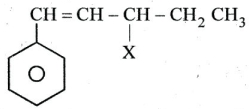
The given compound is an example of $..........$
A
vinylic halide
B
benzylic halide
C
aryl halide
D
allylic halide
Solution
(D) The given structure is $C_6H_5-CH=CH-CH(X)-CH_2-CH_3$.
In this compound,the halogen atom $(X)$ is attached to an $sp^3$ hybridized carbon atom,which is adjacent to a carbon-carbon double bond $(C=C)$.
Such compounds,where the halogen is attached to an $sp^3$ hybridized carbon next to a double bond,are classified as allylic halides.
Therefore,the correct option is $D$.
In this compound,the halogen atom $(X)$ is attached to an $sp^3$ hybridized carbon atom,which is adjacent to a carbon-carbon double bond $(C=C)$.
Such compounds,where the halogen is attached to an $sp^3$ hybridized carbon next to a double bond,are classified as allylic halides.
Therefore,the correct option is $D$.
0 likes
View Solution75
DifficultMCQ
Which of the following is an example of a vinylic halide?
A
$A$ cyclohexylidene-methyl halide structure.
B
$A$ cyclohex$-1-$en$-1-$yl-methyl halide structure.
C
$A$ halobenzene structure.
D
$A$ $3-$halocyclohex$-1-$ene structure.
Solution
(A) vinylic halide is a compound in which the halogen atom is directly attached to a carbon atom that is part of a carbon-carbon double bond $(C=C)$.
In the structure provided in option $A$,the halogen $X$ is attached to a carbon atom that is $sp^2$ hybridized and part of a double bond,which defines it as a vinylic halide.
Option $B$ represents an allylic halide.
Option $C$ represents an aryl halide.
Option $D$ represents an allylic halide.
In the structure provided in option $A$,the halogen $X$ is attached to a carbon atom that is $sp^2$ hybridized and part of a double bond,which defines it as a vinylic halide.
Option $B$ represents an allylic halide.
Option $C$ represents an aryl halide.
Option $D$ represents an allylic halide.
0 likes
View Solution76
DifficultMCQ
Given below are two statements,one is labeled as Assertion $(A)$ and the other is labeled as Reason $(R)$.
Assertion $(A)$: $CH_2=CH-CH_2-Cl$ is an example of an allyl halide.
Reason $(R)$: Allyl halides are the compounds in which the halogen atom is attached to an $sp^3$ hybridized carbon atom,which is adjacent to a carbon-carbon double bond.
In the light of the two above statements,choose the most appropriate answer from the options given below:
Assertion $(A)$: $CH_2=CH-CH_2-Cl$ is an example of an allyl halide.
Reason $(R)$: Allyl halides are the compounds in which the halogen atom is attached to an $sp^3$ hybridized carbon atom,which is adjacent to a carbon-carbon double bond.
In the light of the two above statements,choose the most appropriate answer from the options given below:
A
$(A)$ is true but $(R)$ is false.
B
Both $(A)$ and $(R)$ are true but $(R)$ is not the correct explanation of $(A)$.
C
$(A)$ is false but $(R)$ is true.
D
Both $(A)$ and $(R)$ are true and $(R)$ is the correct explanation of $(A)$.
Solution
(A) Assertion $(A)$: The structure $CH_2=CH-CH_2-Cl$ contains a halogen atom attached to a carbon atom that is adjacent to a $C=C$ double bond. This is the definition of an allyl halide. Thus,Assertion $(A)$ is true.
Reason $(R)$: Allyl halides are defined as compounds where the halogen atom is attached to an $sp^3$ hybridized carbon atom,which is further bonded to a $C=C$ double bond. The statement provided in the original question incorrectly stated that the halogen is attached to an $sp^2$ carbon. Therefore,Reason $(R)$ is false.
Conclusion: $(A)$ is true but $(R)$ is false.
Reason $(R)$: Allyl halides are defined as compounds where the halogen atom is attached to an $sp^3$ hybridized carbon atom,which is further bonded to a $C=C$ double bond. The statement provided in the original question incorrectly stated that the halogen is attached to an $sp^2$ carbon. Therefore,Reason $(R)$ is false.
Conclusion: $(A)$ is true but $(R)$ is false.
0 likes
View Solution77
EasyMCQ
Which among the following compounds is a vinylic halide?
A
$1-$chloroethene
B
$2-$Bromo$-2-$methylpropane
C
$2-$chloropropane
D
Bromoethane
Solution
(A) vinylic halide is a compound in which the halogen atom is directly attached to a carbon atom that is part of a carbon-carbon double bond $(C=C-X)$.
In $1-$chloroethene $(CH_2=CHCl)$,the chlorine atom is attached to a carbon atom involved in a double bond,which satisfies the definition of a vinylic halide.
Therefore,the correct option is $A$.
In $1-$chloroethene $(CH_2=CHCl)$,the chlorine atom is attached to a carbon atom involved in a double bond,which satisfies the definition of a vinylic halide.
Therefore,the correct option is $A$.
0 likes
View Solution78
MediumMCQ
Identify the tertiary alkyl halide from the following.
A
$ (CH_3)_2CH-CH_2-Br $
B
$ (CH_3)_3C-Br $
C
$ CH_3-(CH_2)_4-CH_2-Br $
D
$ (CH_3)_3C-CH_2-Br $
Solution
(B) tertiary $(3^{\circ})$ alkyl halide is one in which the halogen atom is attached to a carbon atom that is further bonded to three other carbon atoms.
In option $B$,$(CH_3)_3C-Br$,the carbon atom bonded to the bromine atom is attached to three methyl groups,making it a tertiary carbon.
Thus,$(CH_3)_3C-Br$ is a tertiary alkyl halide.
In option $B$,$(CH_3)_3C-Br$,the carbon atom bonded to the bromine atom is attached to three methyl groups,making it a tertiary carbon.
Thus,$(CH_3)_3C-Br$ is a tertiary alkyl halide.
0 likes
View Solution79
MediumMCQ
Which among the following examples of halogen derivatives does $NOT$ correctly match with its type of compound?
A
Haloalkane $\quad : \quad$ Methyl chloride
B
Allylic halide $\quad : \quad$ $1-$chloroethene
C
Haloarene $\quad : \quad$ Chlorobenzene
D
Benzylic halide $\quad : \quad$ Benzyl chloride
Solution
(B) $1-$chloroethene $(CH_2=CHCl)$ is a vinylic halide because the halogen atom is attached to a carbon atom that is part of a carbon-carbon double bond. $\newline$ An allylic halide has the halogen atom attached to a carbon atom next to a carbon-carbon double bond. $\newline$ Therefore,the example $1-$chloroethene for an allylic halide is incorrect.
0 likes
View Solution80
EasyMCQ
What is the molecular formula of allyl chloride?
A
$C_{3}H_{3}Cl$
B
$C_{3}H_{5}Cl$
C
$C_{3}H_{7}Cl$
D
$C_{3}H_{6}Cl$
Solution
(B) The structure of allyl chloride is $CH_{2}=CH-CH_{2}Cl$.
Counting the atoms in the structure:
There are $3$ carbon atoms $(C_{3})$.
There are $5$ hydrogen atoms $(H_{5})$.
There is $1$ chlorine atom $(Cl)$.
Therefore,the molecular formula is $C_{3}H_{5}Cl$.
Counting the atoms in the structure:
There are $3$ carbon atoms $(C_{3})$.
There are $5$ hydrogen atoms $(H_{5})$.
There is $1$ chlorine atom $(Cl)$.
Therefore,the molecular formula is $C_{3}H_{5}Cl$.
0 likes
View Solution81
MediumMCQ
Identify the neohexyl chloride from the following:
A
$(CH_{3})_{3}C-CH_{2}-CH_{2}-Cl$
B
$CH_{3}-(CH_{2})_{4}-CH_{2}-Cl$
C
$(CH_{3})_{2}CH-CH_{2}-CH_{2}-CH_{2}-Cl$
D
$(CH_{3})_{3}C-CH(Cl)-CH_{3}$
Solution
(A) Neohexyl chloride is the common name for $3,3-$dimethylbutyl chloride,which has the structure $(CH_{3})_{3}C-CH_{2}-CH_{2}-Cl$.
Option $A$ represents $3,3-$dimethylbutyl chloride (neohexyl chloride).
Option $B$ represents $n-$hexyl chloride.
Option $C$ represents $5-$methylhexyl chloride.
Option $D$ represents $3,3-$dimethyl$-2-$chlorobutane.
Option $A$ represents $3,3-$dimethylbutyl chloride (neohexyl chloride).
Option $B$ represents $n-$hexyl chloride.
Option $C$ represents $5-$methylhexyl chloride.
Option $D$ represents $3,3-$dimethyl$-2-$chlorobutane.
0 likes
View Solution82
MediumMCQ
The common name of $1-$chloro$-2,2-$dimethylpropane is
A
neo-pentyl chloride
B
isopropyl chloride
C
n-pentyl chloride
D
isopentyl chloride
Solution
(A) The structure of $1-$chloro$-2,2-$dimethylpropane is $(CH_3)_3C-CH_2Cl$.
In this molecule,the carbon atom attached to the chlorine is a primary carbon,which is bonded to a quaternary carbon atom (a carbon bonded to four other carbons).
This structural arrangement,where a central carbon is bonded to three methyl groups and one $-CH_2Cl$ group,is commonly referred to as the $neo-$pentyl group.
Therefore,the common name for this compound is $neo-$pentyl chloride.
In this molecule,the carbon atom attached to the chlorine is a primary carbon,which is bonded to a quaternary carbon atom (a carbon bonded to four other carbons).
This structural arrangement,where a central carbon is bonded to three methyl groups and one $-CH_2Cl$ group,is commonly referred to as the $neo-$pentyl group.
Therefore,the common name for this compound is $neo-$pentyl chloride.
0 likes
View Solution83
EasyMCQ
Which among the following is $NOT$ an allylic halide?
A
$CH_2=CH-CH_2-X$
B
$CH_3-CH=CH-CH_2-X$
C
$CH_3-CH_2-CH=CH-CH_2-X$
D
$CH_3-CH=CH-CH_2-CH_2-X$
Solution
(D) An allylic halide is a compound in which the halogen atom is attached to an $sp^3$ hybridized carbon atom next to a carbon-carbon double bond $(C=C-C-X)$.
In option $A$,$B$,and $C$,the halogen atom $(X)$ is attached to the carbon atom directly adjacent to the double bond.
In option $D$,the structure is $CH_3-CH=CH-CH_2-CH_2-X$. Here,the halogen atom is attached to a carbon atom that is two positions away from the double bond,making it a homoallylic halide,not an allylic halide.
Therefore,the correct option is $D$.
In option $A$,$B$,and $C$,the halogen atom $(X)$ is attached to the carbon atom directly adjacent to the double bond.
In option $D$,the structure is $CH_3-CH=CH-CH_2-CH_2-X$. Here,the halogen atom is attached to a carbon atom that is two positions away from the double bond,making it a homoallylic halide,not an allylic halide.
Therefore,the correct option is $D$.
0 likes
View Solution84
EasyMCQ
Which among the following is an allylic halide?
A
$CH_3-CH_2-CH_2-X$
B
$C_6H_5-CH_2-X$
C
$CH_2=CH-CH_2-X$
D
$CH_3-CH=CH-X$
Solution
(C) In allylic halides,the halogen atom is bonded to an $sp^3$ hybridized carbon atom that is directly attached to a carbon-carbon double bond.
The general structure is $CH_2=CH-CH_2-X$.
Therefore,$CH_2=CH-CH_2-X$ is an allylic halide.
The general structure is $CH_2=CH-CH_2-X$.
Therefore,$CH_2=CH-CH_2-X$ is an allylic halide.
0 likes
View Solution85
EasyMCQ
Which of the following is the general representation of a Grignard reagent?
A
$R-O-Na$
B
$R-COO-Ag$
C
$R-Mg-X$
D
$R-COOK$
Solution
(C) The general representation of a Grignard reagent is $R-Mg-X$,where $R$ is an alkyl or aryl group and $X$ is a halogen atom (such as $Cl$,$Br$,or $I$).
0 likes
View Solution86
EasyMCQ
Which among the following is a vinylic halide?
A
$CH_2=CH-CH_2-X$
B
$CH_3-CH=CH-X$
C
$CH_3-C \equiv C-X$
D
$C_6H_5-CH_2-X$
Solution
(B) In vinylic halides,the halogen atom is directly bonded to an $sp^2$ hybridized carbon atom of a carbon-carbon double bond.
In $CH_3-CH=CH-X$,the halogen atom $X$ is attached to the $sp^2$ hybridized carbon atom involved in the double bond,which satisfies the definition of a vinylic halide.
In $CH_3-CH=CH-X$,the halogen atom $X$ is attached to the $sp^2$ hybridized carbon atom involved in the double bond,which satisfies the definition of a vinylic halide.
0 likes
View Solution87
EasyMCQ
Which among the following is a benzylic halide?
A
$4-$Iodotoluene
B
$1-$Iodo$-2-$phenylethane
C
Iodobenzene
D
Iodophenylmethane
Solution
(D) benzylic halide is a compound in which the halogen atom is bonded to an $sp^3$ hybridized carbon atom that is directly attached to an aromatic ring.
In $4-$Iodotoluene,the iodine is attached directly to the benzene ring (aryl halide).
In $1-$Iodo$-2-$phenylethane,the iodine is attached to a carbon atom that is separated from the ring by another $CH_2$ group.
In Iodobenzene,the iodine is attached directly to the benzene ring (aryl halide).
In Iodophenylmethane (also known as benzyl iodide),the iodine is attached to a $CH_2$ group which is directly attached to the benzene ring. Thus,it is a benzylic halide.
In $4-$Iodotoluene,the iodine is attached directly to the benzene ring (aryl halide).
In $1-$Iodo$-2-$phenylethane,the iodine is attached to a carbon atom that is separated from the ring by another $CH_2$ group.
In Iodobenzene,the iodine is attached directly to the benzene ring (aryl halide).
In Iodophenylmethane (also known as benzyl iodide),the iodine is attached to a $CH_2$ group which is directly attached to the benzene ring. Thus,it is a benzylic halide.
0 likes
View Solution88
EasyMCQ
Which among the following is $NOT$ a benzylic halide?
A
$2-$Chloro$-2-$phenylpropane
B
$1-$Chloro$-2-$phenylbutane
C
Chlorophenylmethane
D
$1-$Chloro$-1-$phenylethane
Solution
(B) benzylic halide is a compound in which the halogen atom is bonded to an $sp^3$ hybridized carbon atom that is directly attached to an aromatic ring (benzene ring).
In $1-$chloro$-2-$phenylbutane $(CH_3-CH_2-CH(C_6H_5)-CH_2Cl)$,the chlorine atom is attached to a carbon atom that is not directly bonded to the benzene ring.
Therefore,it is not a benzylic halide.
In $1-$chloro$-2-$phenylbutane $(CH_3-CH_2-CH(C_6H_5)-CH_2Cl)$,the chlorine atom is attached to a carbon atom that is not directly bonded to the benzene ring.
Therefore,it is not a benzylic halide.
0 likes
View Solution89
EasyMCQ
Which among the following is a haloalkyne?
A
Halogen atom is bonded to $sp^2$ hybridized carbon atom of an aromatic ring.
B
Halogen atom is bonded to $sp^3$ hybridized carbon atom next to a $C=C$ double bond in an aliphatic chain.
C
Halogen atom is bonded to $sp$ hybridized carbon atom in an aliphatic chain.
D
Halogen atom is bonded to $sp^2$ hybridized carbon atom in an aliphatic chain.
Solution
(C) haloalkyne is an organic compound where a halogen atom is directly bonded to an $sp$ hybridized carbon atom of an alkyne group.
Example: $CH \equiv C-Cl$ (chloroethyne).
In this structure,the carbon atom bonded to the chlorine is $sp$ hybridized.
Example: $CH \equiv C-Cl$ (chloroethyne).
In this structure,the carbon atom bonded to the chlorine is $sp$ hybridized.
0 likes
View Solution90
EasyMCQ
Which among the following is an allylic halide?
A
$1$-Chloropropene
B
$2$-Chloropropene
C
$3$-Chloropropene
D
$2$-Bromopropane
Solution
(C) An allylic halide is a compound in which the halogen atom is bonded to an $sp^3$ hybridized carbon atom next to a carbon-carbon double bond $(C=C-C-X)$.
In $3$-chloropropene $(CH_2=CH-CH_2Cl)$,the chlorine atom is attached to the $sp^3$ hybridized carbon atom which is adjacent to the $C=C$ double bond.
Therefore,$3$-chloropropene is an allylic halide.
In $3$-chloropropene $(CH_2=CH-CH_2Cl)$,the chlorine atom is attached to the $sp^3$ hybridized carbon atom which is adjacent to the $C=C$ double bond.
Therefore,$3$-chloropropene is an allylic halide.
0 likes
View Solution91
MediumMCQ
Which of the following statements is true for a vinylic halide?
A
Halogen atom is bonded to an $sp$ hybridized carbon atom.
B
Halogen atom is bonded to an $sp^2$ hybridized carbon atom of an aromatic ring.
C
Halogen atom is bonded to an $sp^3$ hybridized carbon atom next to a carbon-carbon double bond.
D
Halogen atom is bonded to an $sp^2$ hybridized carbon atom of an aliphatic chain.
Solution
(D) vinylic halide is defined as a compound in which the halogen atom is directly bonded to a carbon atom that is part of a carbon-carbon double bond $(C=C)$.
This carbon atom is $sp^2$ hybridized.
For example,in vinyl chloride $(CH_2=CHCl)$,the chlorine atom is attached to an $sp^2$ hybridized carbon atom of an aliphatic chain.
This carbon atom is $sp^2$ hybridized.
For example,in vinyl chloride $(CH_2=CHCl)$,the chlorine atom is attached to an $sp^2$ hybridized carbon atom of an aliphatic chain.
0 likes
View Solution92
DifficultMCQ
The number of possible monohalogen derivatives for the alkyl halide having molecular formula $C_4H_9X$ is
A
$3$
B
$2$
C
$4$
D
$1$
Solution
(C) The molecular formula $C_4H_9X$ corresponds to the alkyl group derived from butane $(C_4H_{10})$.
There are two isomeric alkanes with the formula $C_4H_{10}$: $n$-butane $(CH_3-CH_2-CH_2-CH_3)$ and isobutane $(CH_3-CH(CH_3)-CH_3)$.
For $n$-butane,there are two non-equivalent sets of hydrogen atoms,leading to two isomers: $1$-halobutane and $2$-halobutane.
For isobutane,there are two non-equivalent sets of hydrogen atoms,leading to two isomers: $1$-halo-$2$-methylpropane and $2$-halo-$2$-methylpropane.
Thus,the total number of possible monohalogen derivatives is $2 + 2 = 4$.
There are two isomeric alkanes with the formula $C_4H_{10}$: $n$-butane $(CH_3-CH_2-CH_2-CH_3)$ and isobutane $(CH_3-CH(CH_3)-CH_3)$.
For $n$-butane,there are two non-equivalent sets of hydrogen atoms,leading to two isomers: $1$-halobutane and $2$-halobutane.
For isobutane,there are two non-equivalent sets of hydrogen atoms,leading to two isomers: $1$-halo-$2$-methylpropane and $2$-halo-$2$-methylpropane.
Thus,the total number of possible monohalogen derivatives is $2 + 2 = 4$.
0 likes
View Solution93
EasyMCQ
Which among the following is an allylic halide?
A
$1-$Bromopropene
B
$2-$Bromopropene
C
$3-$Bromopropene
D
$4-$Bromobut$-1-$ene
Solution
(C) An allylic halide is a compound in which the halogen atom is bonded to an $sp^3$ hybridized carbon atom next to a carbon-carbon double bond $(C=C)$.
In $3-$bromopropene $(CH_2=CH-CH_2Br)$,the bromine atom is attached to a carbon atom that is adjacent to the double bond,which satisfies the definition of an allylic halide.
$1-$Bromopropene and $2-$bromopropene are vinylic halides because the halogen is attached directly to the double-bonded carbon atom.
In $3-$bromopropene $(CH_2=CH-CH_2Br)$,the bromine atom is attached to a carbon atom that is adjacent to the double bond,which satisfies the definition of an allylic halide.
$1-$Bromopropene and $2-$bromopropene are vinylic halides because the halogen is attached directly to the double-bonded carbon atom.
0 likes
View Solution94
MediumMCQ
Which among the following is $NOT$ a benzylic halide?
A
Bromophenylmethane
B
$1-$Bromo$-1-$phenylpropane
C
$2-$Bromo$-2-$phenylpropane
D
$1-$Bromo$-2-$phenylbutane
Solution
(D) benzylic halide is a compound in which the halogen atom is bonded to a carbon atom that is directly attached to an aromatic ring (specifically,a $sp^3$ hybridized carbon atom adjacent to the benzene ring).
$1.$ Bromophenylmethane $(C_6H_5CH_2Br)$ is a benzylic halide.
$2.$ $1-$Bromo$-1-$phenylpropane $(C_6H_5CH(Br)CH_2CH_3)$ is a benzylic halide.
$3.$ $2-$Bromo$-2-$phenylpropane $(C_6H_5C(Br)(CH_3)_2)$ is a benzylic halide.
$4.$ $1-$Bromo$-2-$phenylbutane $(C_6H_5CH_2CH(Br)CH_2CH_3)$ has the bromine atom attached to a carbon that is not directly bonded to the benzene ring. The carbon attached to the benzene ring is a $CH_2$ group,and the bromine is on the second carbon of the alkyl chain. Therefore,it is not a benzylic halide.
$1.$ Bromophenylmethane $(C_6H_5CH_2Br)$ is a benzylic halide.
$2.$ $1-$Bromo$-1-$phenylpropane $(C_6H_5CH(Br)CH_2CH_3)$ is a benzylic halide.
$3.$ $2-$Bromo$-2-$phenylpropane $(C_6H_5C(Br)(CH_3)_2)$ is a benzylic halide.
$4.$ $1-$Bromo$-2-$phenylbutane $(C_6H_5CH_2CH(Br)CH_2CH_3)$ has the bromine atom attached to a carbon that is not directly bonded to the benzene ring. The carbon attached to the benzene ring is a $CH_2$ group,and the bromine is on the second carbon of the alkyl chain. Therefore,it is not a benzylic halide.
0 likes
View Solution95
EasyMCQ
Which among the following is $NOT$ an allylic halide?
A
$CH_2=CH-CH_2-X$
B
$CH_3-CH=CH-CH_2-X$
C
$CH_3-CH_2-CH=CH-CH_2-X$
D
$CH_3-CH=CH-CH_2-CH_2-X$
Solution
(D) An allylic halide is a compound in which the halogen atom is bonded to an $sp^3$ hybridized carbon atom that is adjacent to a carbon-carbon double bond $(C=C-C-X)$.
In option $A$,$CH_2=CH-CH_2-X$,the halogen is attached to an allylic carbon.
In option $B$,$CH_3-CH=CH-CH_2-X$,the halogen is attached to an allylic carbon.
In option $C$,$CH_3-CH_2-CH=CH-CH_2-X$,the halogen is attached to an allylic carbon.
In option $D$,$CH_3-CH=CH-CH_2-CH_2-X$,the halogen is attached to a carbon atom that is two positions away from the double bond,making it a homoallylic halide,not an allylic halide.
In option $A$,$CH_2=CH-CH_2-X$,the halogen is attached to an allylic carbon.
In option $B$,$CH_3-CH=CH-CH_2-X$,the halogen is attached to an allylic carbon.
In option $C$,$CH_3-CH_2-CH=CH-CH_2-X$,the halogen is attached to an allylic carbon.
In option $D$,$CH_3-CH=CH-CH_2-CH_2-X$,the halogen is attached to a carbon atom that is two positions away from the double bond,making it a homoallylic halide,not an allylic halide.
0 likes
View Solution96
EasyMCQ
Which among the following statements is true for a haloalkyne?
A
Halogen atom is bonded to an $sp$ hybridized carbon atom.
B
Halogen atom is bonded to an $sp^2$ hybridized carbon atom of an aliphatic chain.
C
Halogen atom is bonded to an $sp^3$ hybridized carbon atom next to a carbon-carbon double bond.
D
Halogen atom is bonded to an $sp^2$ hybridized carbon atom of an aromatic ring.
Solution
(A) haloalkyne is a compound in which a halogen atom is directly attached to a carbon atom that is part of a carbon-carbon triple bond $(C \equiv C)$.
In a carbon-carbon triple bond,the carbon atom is $sp$ hybridized.
Therefore,the halogen atom is bonded to an $sp$ hybridized carbon atom.
In a carbon-carbon triple bond,the carbon atom is $sp$ hybridized.
Therefore,the halogen atom is bonded to an $sp$ hybridized carbon atom.
0 likes
View Solution97
EasyMCQ
Which among the following is a haloalkyne?
A
$CH_3-CH_2-CH=CH-X$
B
$CH_3-C \equiv C-CH_2-X$
C
$CH \equiv C-CH_2-CH_2-X$
D
$CH_3-CH_2-C \equiv C-X$
Solution
(B) haloalkyne is an organic compound that contains both a halogen atom $(X)$ and a carbon-carbon triple bond $(C \equiv C)$.
- Option $(A)$ $CH_3-CH_2-CH=CH-X$ is a haloalkene because it contains a double bond $(C=C)$.
- Option $(B)$ $CH_3-C \equiv C-CH_2-X$ is a haloalkyne as it contains a triple bond $(C \equiv C)$ and a halogen atom $(X)$.
- Option $(C)$ $CH \equiv C-CH_2-CH_2-X$ is also a haloalkyne.
- Option $(D)$ $CH_3-CH_2-C \equiv C-X$ is also a haloalkyne.
Given the standard nomenclature and structure,options $(B)$,$(C)$,and $(D)$ all represent haloalkynes. However,in many textbook contexts,the simplest representation or specific structural isomer is sought. Since multiple options are technically correct,we identify the structure containing the functional group as requested.
- Option $(A)$ $CH_3-CH_2-CH=CH-X$ is a haloalkene because it contains a double bond $(C=C)$.
- Option $(B)$ $CH_3-C \equiv C-CH_2-X$ is a haloalkyne as it contains a triple bond $(C \equiv C)$ and a halogen atom $(X)$.
- Option $(C)$ $CH \equiv C-CH_2-CH_2-X$ is also a haloalkyne.
- Option $(D)$ $CH_3-CH_2-C \equiv C-X$ is also a haloalkyne.
Given the standard nomenclature and structure,options $(B)$,$(C)$,and $(D)$ all represent haloalkynes. However,in many textbook contexts,the simplest representation or specific structural isomer is sought. Since multiple options are technically correct,we identify the structure containing the functional group as requested.
0 likes
View Solution98
MediumMCQ
Which of the following is a vinylic halide?
A
Haloalkane
B
Haloalkyne
C
Haloalkene
D
Haloarene
Solution
(C) In vinylic halides,the halogen atom is bonded to a $sp^{2}$ hybridized carbon atom of an aliphatic chain.
Since a vinylic halide contains a carbon-carbon double bond,it is classified as a haloalkene.
Since a vinylic halide contains a carbon-carbon double bond,it is classified as a haloalkene.
0 likes
View Solution99
EasyMCQ
Which among the following is a haloalkyne?
A
Chloroethyne
B
$3-$Chlorobut$-1-$yne
C
$1-$Chloropent$-2-$yne
D
$4-$Chloropent$-2-$yne
Solution
(A) In a haloalkyne,the halogen atom is directly bonded to an $sp$ hybridized carbon atom of the triple bond.
In $Chloroethyne$ $(CH \equiv C-Cl)$,the chlorine atom is attached to the $sp$ hybridized carbon atom.
In the other options,the chlorine atom is attached to $sp^3$ hybridized carbon atoms.
Therefore,chloroethyne is a haloalkyne.
In $Chloroethyne$ $(CH \equiv C-Cl)$,the chlorine atom is attached to the $sp$ hybridized carbon atom.
In the other options,the chlorine atom is attached to $sp^3$ hybridized carbon atoms.
Therefore,chloroethyne is a haloalkyne.
0 likes
View SolutionHaloalkanes and Haloarenes — Introduction of Halogen containing compounds · Frequently Asked Questions
1Are these Haloalkanes and Haloarenes questions useful for JEE and NEET?
Yes. All questions in this section are mapped to JEE Main and NEET exam patterns. Previous year questions from JEE Main, NEET, GUJCET and state-level exams are included with full solutions.
2Can I switch to Hindi or Gujarati for these questions?
Yes. Use the language tabs in the hero section or the sidebar to view the same questions and solutions in English, Hindi or Gujarati.
3How do I generate a question paper from this subtopic?
Use the Vedclass Exam Paper Generator — select the chapter and subtopic, set difficulty, and generate Sets A, B, C, D automatically. First 3 chapters of every subject are free.
Vedclass Products
For Students
Vedclass Test Series
Mock tests in real JEE/NEET style with performance analysis. 5-day free trial.
Start Free TrialFor Teachers
Exam Paper Generator
Generate Set A/B/C/D papers from this chapter in 2 minutes. 3 chapters free.
Try FreeFor Institutes
Online Exam Module
Live online exams with unlimited students, 360° analytics & white-label branding.
See DemoFor Teachers & Institutes
Generate a Haloalkanes and Haloarenes Exam Paper in 2 Minutes
Select subtopic & difficulty — Sets A, B, C, D auto-generated with No Repeat logic.
First 3 chapters of every subject are free — no payment required.