
A English
Conductor and Conductance and Cell constant Questions in English
Class 12 Chemistry · Electrochemistry · Conductor and Conductance and Cell constant
419+
Questions
English
Language
100%
With Solutions
Showing 48 of 419 questions in English
351
EasyMCQ
Conductivity of a conductor is
A
equal to resistivity
B
inverse of resistance
C
inverse of conductance
D
inverse of resistivity
Solution
(D) Conductivity $(\kappa)$ is defined as the reciprocal of resistivity $(\rho)$.
$\kappa = \frac{1}{\rho}$
$\kappa = \frac{1}{\rho}$
0 likes
View Solution352
DifficultMCQ
The molar conductivities at infinite dilution for sodium acetate,$HCl$ and $NaCl$ are $91 \ S \ cm^2 \ mol^{-1}$,$425.9 \ S \ cm^2 \ mol^{-1}$ and $126.4 \ S \ cm^2 \ mol^{-1}$ respectively. The molar conductivity of acetic acid at infinite dilution is
A
$39.05 \ S \ cm^2 \ mol^{-1}$
B
$530.9 \ S \ cm^2 \ mol^{-1}$
C
$390.5 \ S \ cm^2 \ mol^{-1}$
D
$930.5 \ S \ cm^2 \ mol^{-1}$
Solution
(C) Key Idea: Kohlrausch law of independent migration of ions can be used to calculate $\Delta_m^o$ for weak electrolytes such as acetic acid.
Given:
$\Delta_{m(NaAc)}^o = 91 \ S \ cm^2 \ mol^{-1}$
$\Delta_{m(HCl)}^o = 425.9 \ S \ cm^2 \ mol^{-1}$
$\Delta_{m(NaCl)}^o = 126.4 \ S \ cm^2 \ mol^{-1}$
Using Kohlrausch law,the molar conductivity of acetic acid is calculated as:
$\Delta_{m(CH_3COOH)}^o = \Delta_{m(CH_3COONa)}^o + \Delta_{m(HCl)}^o - \Delta_{m(NaCl)}^o$
$= (91.0 + 425.9 - 126.4) \ S \ cm^2 \ mol^{-1}$
$= 390.5 \ S \ cm^2 \ mol^{-1}$
Given:
$\Delta_{m(NaAc)}^o = 91 \ S \ cm^2 \ mol^{-1}$
$\Delta_{m(HCl)}^o = 425.9 \ S \ cm^2 \ mol^{-1}$
$\Delta_{m(NaCl)}^o = 126.4 \ S \ cm^2 \ mol^{-1}$
Using Kohlrausch law,the molar conductivity of acetic acid is calculated as:
$\Delta_{m(CH_3COOH)}^o = \Delta_{m(CH_3COONa)}^o + \Delta_{m(HCl)}^o - \Delta_{m(NaCl)}^o$
$= (91.0 + 425.9 - 126.4) \ S \ cm^2 \ mol^{-1}$
$= 390.5 \ S \ cm^2 \ mol^{-1}$
0 likes
View Solution353
DifficultMCQ
The resistance of $\frac{1}{10} \ M$ solution is $2.5 \times 10^3 \ \Omega$. What is the molar conductivity of the solution? (Cell constant $= 1.25 \ cm^{-1}$)
A
$3.5 \ \Omega^{-1} \ cm^2 \ mol^{-1}$
B
$5.0 \ \Omega^{-1} \ cm^2 \ mol^{-1}$
C
$2.5 \ \Omega^{-1} \ cm^2 \ mol^{-1}$
D
$2.0 \ \Omega^{-1} \ cm^2 \ mol^{-1}$
Solution
(B) Given: Cell constant,$\frac{l}{A} = 1.25 \ cm^{-1}$,Resistance,$R = 2.5 \times 10^3 \ \Omega$,Molarity,$M = 0.1 \ M$.
Conductivity,$\kappa = \frac{\text{Cell constant}}{R} = \frac{1.25}{2.5 \times 10^3} = 0.5 \times 10^{-3} = 5 \times 10^{-4} \ S \ cm^{-1}$.
Molar conductivity,$\Lambda_m = \frac{\kappa \times 1000}{M} = \frac{5 \times 10^{-4} \times 1000}{0.1} = \frac{0.5}{0.1} = 5.0 \ \Omega^{-1} \ cm^2 \ mol^{-1}$.
Conductivity,$\kappa = \frac{\text{Cell constant}}{R} = \frac{1.25}{2.5 \times 10^3} = 0.5 \times 10^{-3} = 5 \times 10^{-4} \ S \ cm^{-1}$.
Molar conductivity,$\Lambda_m = \frac{\kappa \times 1000}{M} = \frac{5 \times 10^{-4} \times 1000}{0.1} = \frac{0.5}{0.1} = 5.0 \ \Omega^{-1} \ cm^2 \ mol^{-1}$.
0 likes
View Solution354
EasyMCQ
The conductivity of an electrolytic solution decreases on dilution due to
A
decrease in number of ions per unit volume
B
increase in ionic mobility of ions
C
increase in percentage ionisation
D
increase in number of ions per unit volume
Solution
(A) Conductivity $(\kappa)$ is defined as the conductance of a solution contained between two electrodes of unit area of cross-section separated by a unit distance.
On dilution,the total number of ions in the solution remains the same,but the number of ions per unit volume decreases.
Since conductivity is directly proportional to the number of ions per unit volume,it decreases upon dilution.
On dilution,the total number of ions in the solution remains the same,but the number of ions per unit volume decreases.
Since conductivity is directly proportional to the number of ions per unit volume,it decreases upon dilution.
0 likes
View Solution355
EasyMCQ
What is the $SI$ unit of conductivity?
A
$S \ m$
B
$S \ m^{-1}$
C
$S \ m^2$
D
$S \ m^{-2}$
Solution
(B) Conductivity $(\kappa)$ is defined as the reciprocal of resistivity $(\rho)$.
Since the $SI$ unit of resistivity is $\Omega \ m$,the unit of conductivity is $\Omega^{-1} \ m^{-1}$.
Since $\Omega^{-1}$ is represented as Siemens $(S)$,the $SI$ unit of conductivity is $S \ m^{-1}$.
Since the $SI$ unit of resistivity is $\Omega \ m$,the unit of conductivity is $\Omega^{-1} \ m^{-1}$.
Since $\Omega^{-1}$ is represented as Siemens $(S)$,the $SI$ unit of conductivity is $S \ m^{-1}$.
0 likes
View Solution356
MediumMCQ
Molar conductivity of $0.02 \ M$ weak acid is $7.92 \ \Omega^{-1} \ cm^2 \ mol^{-1}$ and its molar conductivity at infinite dilution is $232.7 \ \Omega^{-1} \ cm^2 \ mol^{-1}$. Calculate the degree of dissociation of the weak acid.
A
$0.0112$
B
$0.0341$
C
$0.0694$
D
$0.292$
Solution
(B) The degree of dissociation $(\alpha)$ is given by the formula: $\alpha = \frac{\wedge_m^c}{\wedge_m^0}$
Given: $\wedge_m^c = 7.92 \ \Omega^{-1} \ cm^2 \ mol^{-1}$ and $\wedge_m^0 = 232.7 \ \Omega^{-1} \ cm^2 \ mol^{-1}$
Substituting the values: $\alpha = \frac{7.92}{232.7} = 0.034035... \approx 0.0341$
Given: $\wedge_m^c = 7.92 \ \Omega^{-1} \ cm^2 \ mol^{-1}$ and $\wedge_m^0 = 232.7 \ \Omega^{-1} \ cm^2 \ mol^{-1}$
Substituting the values: $\alpha = \frac{7.92}{232.7} = 0.034035... \approx 0.0341$
0 likes
View Solution357
EasyMCQ
Which of the following statements regarding the solution of an electrolyte is not correct?
A
Conductivity of the solution depends on the concentration of the electrolyte.
B
Conductivity of the solution depends on the nature of the electrolyte.
C
Conductivity of the solution does not depend upon temperature.
D
Conductivity of the solution depends on the nature of the solvent and its viscosity.
Solution
(C) The conductivity of an electrolytic solution depends on the nature of the electrolyte,the concentration of the electrolyte,the nature of the solvent and its viscosity,and the temperature.
As the temperature increases,the kinetic energy of the ions increases and the viscosity of the solvent decreases,which leads to an increase in the conductivity of the solution.
Therefore,the statement that conductivity does not depend upon temperature is incorrect.
As the temperature increases,the kinetic energy of the ions increases and the viscosity of the solvent decreases,which leads to an increase in the conductivity of the solution.
Therefore,the statement that conductivity does not depend upon temperature is incorrect.
0 likes
View Solution358
EasyMCQ
Resistance of a conductivity cell filled with $0.1 \ M$ $KCl$ solution is $100 \ \Omega$ and conductivity of the solution is $1.29 \ S/m$. What will be the value of the cell constant (in $m^{-1}$)?
A
$129$
B
$1.29$
C
$12.9$
D
$0.129$
Solution
(A) The formula for conductivity $(\kappa)$ is given by: $\kappa = G^* \times G$,where $G^*$ is the cell constant and $G$ is the conductance.
Conductance $(G)$ is the reciprocal of resistance $(R)$: $G = \frac{1}{R} = \frac{1}{100 \ \Omega} = 0.01 \ S$.
Given conductivity $\kappa = 1.29 \ S/m$.
Substituting the values into the formula: $1.29 \ S/m = G^* \times 0.01 \ S$.
Therefore,$G^* = \frac{1.29}{0.01} \ m^{-1} = 129 \ m^{-1}$.
Conductance $(G)$ is the reciprocal of resistance $(R)$: $G = \frac{1}{R} = \frac{1}{100 \ \Omega} = 0.01 \ S$.
Given conductivity $\kappa = 1.29 \ S/m$.
Substituting the values into the formula: $1.29 \ S/m = G^* \times 0.01 \ S$.
Therefore,$G^* = \frac{1.29}{0.01} \ m^{-1} = 129 \ m^{-1}$.
0 likes
View Solution359
EasyMCQ
For which of the following electrolytes does the graph of $\Lambda_m$ vs $\sqrt{C}$ give a negative slope?
A
Ammonium hydroxide
B
Sodium acetate
C
Acetic acid
D
Water
Solution
(B) The variation of molar conductivity $(\Lambda_m)$ with concentration $(C)$ for strong electrolytes is given by the Kohlrausch equation: $\Lambda_m = \Lambda_m^0 - A\sqrt{C}$.
In this equation,$A$ is a constant,and the slope of the graph of $\Lambda_m$ versus $\sqrt{C}$ is $-A$,which is negative.
Among the given options,$CH_3COONa$ (Sodium acetate) is a strong electrolyte,whereas $NH_4OH$,$CH_3COOH$,and $H_2O$ are weak electrolytes.
Therefore,the graph for Sodium acetate shows a negative slope.
In this equation,$A$ is a constant,and the slope of the graph of $\Lambda_m$ versus $\sqrt{C}$ is $-A$,which is negative.
Among the given options,$CH_3COONa$ (Sodium acetate) is a strong electrolyte,whereas $NH_4OH$,$CH_3COOH$,and $H_2O$ are weak electrolytes.
Therefore,the graph for Sodium acetate shows a negative slope.
0 likes
View Solution360
EasyMCQ
The graph of $\sqrt{C} \rightarrow \Lambda_{m}$ for an aqueous solution of which substance is not obtained as a straight line?
A
$HCl$
B
$NaCN$
C
$NaCl$
D
$HCN$
Solution
(D) The graph of $\sqrt{C}$ versus $\Lambda_{m}$ is a straight line for strong electrolytes,as they dissociate completely in solution and follow the Kohlrausch equation: $\Lambda_{m} = \Lambda_{m}^{\circ} - A\sqrt{C}$.
$HCl$,$NaCN$,and $NaCl$ are strong electrolytes,so they yield a straight line.
$HCN$ is a weak electrolyte,which does not dissociate completely at all concentrations. Therefore,its graph of $\sqrt{C}$ versus $\Lambda_{m}$ is not a straight line,but a curve that approaches $\Lambda_{m}^{\circ}$ asymptotically as $C \rightarrow 0$.
$HCl$,$NaCN$,and $NaCl$ are strong electrolytes,so they yield a straight line.
$HCN$ is a weak electrolyte,which does not dissociate completely at all concentrations. Therefore,its graph of $\sqrt{C}$ versus $\Lambda_{m}$ is not a straight line,but a curve that approaches $\Lambda_{m}^{\circ}$ asymptotically as $C \rightarrow 0$.
0 likes
View Solution361
EasyMCQ
Which of the following statements is incorrect with respect to metallic or electronic conductivity?
A
Metallic conductivity depends on the structure of the metal and its characteristics.
B
Metallic conductivity depends on the number of electrons in the valence shell of the metal atom.
C
The electrical conductivity of a metal increases with an increase in temperature.
D
There is no change in the structure of the metal during electrical conduction.
Solution
(C) The correct answer is $C$.
Metallic conductivity (or electronic conductivity) is due to the movement of electrons through the metal lattice.
As the temperature of a metal increases,the positive ions (kernels) in the lattice begin to vibrate more vigorously.
This increased vibration causes more collisions between the moving electrons and the vibrating ions,which increases the resistance of the metal.
Therefore,the electrical conductivity of a metal decreases,not increases,with an increase in temperature.
Metallic conductivity (or electronic conductivity) is due to the movement of electrons through the metal lattice.
As the temperature of a metal increases,the positive ions (kernels) in the lattice begin to vibrate more vigorously.
This increased vibration causes more collisions between the moving electrons and the vibrating ions,which increases the resistance of the metal.
Therefore,the electrical conductivity of a metal decreases,not increases,with an increase in temperature.
0 likes
View Solution362
EasyMCQ
The electronic conductance does not depend on . . . . . . .
A
concentration of the electrolyte
B
the number of valence electrons per atom
C
temperature
D
the nature and structure of the metal
Solution
(A) Electronic conductance (metallic conductance) depends on the nature and structure of the metal,the number of valence electrons per atom,and temperature.
It does not depend on the concentration of the electrolyte,as electronic conductance is a property of metals,not electrolytic solutions.
Therefore,the correct option is $A$.
It does not depend on the concentration of the electrolyte,as electronic conductance is a property of metals,not electrolytic solutions.
Therefore,the correct option is $A$.
0 likes
View Solution363
EasyMCQ
$\Lambda_{m}^0$ for $NaCl$,$HCl$ and $NaAc$ are $126.4 \ S \ cm^2 \ mol^{-1}$,$425.9 \ S \ cm^2 \ mol^{-1}$ and $91.0 \ S \ cm^2 \ mol^{-1}$ respectively. Calculate $\Lambda^0$ for $HAc$.
A
$461.3 \ S \ cm^2 \ mol^{-1}$
B
$208.5 \ S \ cm^2 \ mol^{-1}$
C
$643.3 \ S \ cm^2 \ mol^{-1}$
D
$390.5 \ S \ cm^2 \ mol^{-1}$
Solution
(D) According to Kohlrausch's law of independent migration of ions,the molar conductivity of an electrolyte at infinite dilution is the sum of the molar conductivities of its constituent ions.
We are given:
$\Lambda_{m}^0(NaCl) = 126.4 \ S \ cm^2 \ mol^{-1}$
$\Lambda_{m}^0(HCl) = 425.9 \ S \ cm^2 \ mol^{-1}$
$\Lambda_{m}^0(NaAc) = 91.0 \ S \ cm^2 \ mol^{-1}$
We need to find $\Lambda_{m}^0(HAc)$,which is given by:
$\Lambda_{m}^0(HAc) = \Lambda_{m}^0(H^+) + \Lambda_{m}^0(Ac^-)$
Using the given values:
$\Lambda_{m}^0(HAc) = \Lambda_{m}^0(HCl) + \Lambda_{m}^0(NaAc) - \Lambda_{m}^0(NaCl)$
$\Lambda_{m}^0(HAc) = 425.9 + 91.0 - 126.4$
$\Lambda_{m}^0(HAc) = 516.9 - 126.4 = 390.5 \ S \ cm^2 \ mol^{-1}$
Therefore,the correct option is $D$.
We are given:
$\Lambda_{m}^0(NaCl) = 126.4 \ S \ cm^2 \ mol^{-1}$
$\Lambda_{m}^0(HCl) = 425.9 \ S \ cm^2 \ mol^{-1}$
$\Lambda_{m}^0(NaAc) = 91.0 \ S \ cm^2 \ mol^{-1}$
We need to find $\Lambda_{m}^0(HAc)$,which is given by:
$\Lambda_{m}^0(HAc) = \Lambda_{m}^0(H^+) + \Lambda_{m}^0(Ac^-)$
Using the given values:
$\Lambda_{m}^0(HAc) = \Lambda_{m}^0(HCl) + \Lambda_{m}^0(NaAc) - \Lambda_{m}^0(NaCl)$
$\Lambda_{m}^0(HAc) = 425.9 + 91.0 - 126.4$
$\Lambda_{m}^0(HAc) = 516.9 - 126.4 = 390.5 \ S \ cm^2 \ mol^{-1}$
Therefore,the correct option is $D$.
0 likes
View Solution364
EasyMCQ
The molar conductivity of $0.025 \ M$ methanoic acid is $46.1 \ S \ cm^2 \ mol^{-1}$. Calculate its degree of dissociation. Given: $\lambda^0(H^{+}) = 349.6 \ S \ cm^2 \ mol^{-1}$ and $\lambda^0(HCOO^{-}) = 54.6 \ S \ cm^2 \ mol^{-1}$.
A
$0.414$
B
$0.114$
C
$8.767$
D
$7.867$
Solution
(B) The molar conductivity at infinite dilution for methanoic acid $(HCOOH)$ is calculated using Kohlrausch's law: $\Lambda_m^0(HCOOH) = \lambda^0(H^+) + \lambda^0(HCOO^-)$.
Substituting the given values: $\Lambda_m^0(HCOOH) = 349.6 + 54.6 = 404.2 \ S \ cm^2 \ mol^{-1}$.
The degree of dissociation $(\alpha)$ is given by the ratio of molar conductivity at a given concentration $(\Lambda_m)$ to the molar conductivity at infinite dilution $(\Lambda_m^0)$: $\alpha = \frac{\Lambda_m}{\Lambda_m^0}$.
$\alpha = \frac{46.1}{404.2} \approx 0.114$.
Substituting the given values: $\Lambda_m^0(HCOOH) = 349.6 + 54.6 = 404.2 \ S \ cm^2 \ mol^{-1}$.
The degree of dissociation $(\alpha)$ is given by the ratio of molar conductivity at a given concentration $(\Lambda_m)$ to the molar conductivity at infinite dilution $(\Lambda_m^0)$: $\alpha = \frac{\Lambda_m}{\Lambda_m^0}$.
$\alpha = \frac{46.1}{404.2} \approx 0.114$.
0 likes
View Solution365
EasyMCQ
On which of the following factors does electronic conductance $NOT$ depend?
A
The number of valence electrons per atom
B
The nature and structure of metal
C
Temperature
D
Pressure
Solution
(D) Electronic conductance in metals is primarily determined by the number of valence electrons per atom,the nature and structure of the metal,and temperature (as temperature increases,the vibration of metal ions increases,causing more scattering of electrons and thus decreasing conductance). Pressure has a negligible effect on the electronic conductance of metals. Therefore,the correct option is $D$.
0 likes
View Solution366
EasyMCQ
$\Lambda_{m(HAc)}^0$ is equal to . . . . . . .
A
$\Lambda_{m(KCl)}^0 + \Lambda_{m(KAc)}^0 - \Lambda_{m(HCl)}^0$
B
$\Lambda_{m(HCl)}^0 + \Lambda_{m(NaAc)}^0 - \Lambda_{m(NaCl)}^0$
C
$\Lambda_{m(AcH)}^0 + \Lambda_{m(KAc)}^0 - \Lambda_{m(NaAc)}^0$
D
$\Lambda_{m(KCl)}^0 + \Lambda_{m(NaAc)}^0 - \Lambda_{m(NaCl)}^0$
Solution
(B) According to Kohlrausch's law of independent migration of ions,the molar conductivity of a weak electrolyte at infinite dilution can be calculated using the molar conductivities of strong electrolytes.
For acetic acid $(HAc)$,the expression is:
$\Lambda_{m(HAc)}^0 = \lambda_{H^+} + \lambda_{Ac^-}$
Using strong electrolytes $HCl$,$NaAc$,and $NaCl$:
$\Lambda_{m(HCl)}^0 = \lambda_{H^+} + \lambda_{Cl^-}$
$\Lambda_{m(NaAc)}^0 = \lambda_{Na^+} + \lambda_{Ac^-}$
$\Lambda_{m(NaCl)}^0 = \lambda_{Na^+} + \lambda_{Cl^-}$
Therefore,$\Lambda_{m(HCl)}^0 + \Lambda_{m(NaAc)}^0 - \Lambda_{m(NaCl)}^0 = (\lambda_{H^+} + \lambda_{Cl^-}) + (\lambda_{Na^+} + \lambda_{Ac^-}) - (\lambda_{Na^+} + \lambda_{Cl^-}) = \lambda_{H^+} + \lambda_{Ac^-} = \Lambda_{m(HAc)}^0$.
Thus,the correct option is $B$.
For acetic acid $(HAc)$,the expression is:
$\Lambda_{m(HAc)}^0 = \lambda_{H^+} + \lambda_{Ac^-}$
Using strong electrolytes $HCl$,$NaAc$,and $NaCl$:
$\Lambda_{m(HCl)}^0 = \lambda_{H^+} + \lambda_{Cl^-}$
$\Lambda_{m(NaAc)}^0 = \lambda_{Na^+} + \lambda_{Ac^-}$
$\Lambda_{m(NaCl)}^0 = \lambda_{Na^+} + \lambda_{Cl^-}$
Therefore,$\Lambda_{m(HCl)}^0 + \Lambda_{m(NaAc)}^0 - \Lambda_{m(NaCl)}^0 = (\lambda_{H^+} + \lambda_{Cl^-}) + (\lambda_{Na^+} + \lambda_{Ac^-}) - (\lambda_{Na^+} + \lambda_{Cl^-}) = \lambda_{H^+} + \lambda_{Ac^-} = \Lambda_{m(HAc)}^0$.
Thus,the correct option is $B$.
0 likes
View Solution367
EasyMCQ
If $l = \text{length}$,$R = \text{Resistance}$,and $A = \text{Area of cross-section}$,then which of the following relations is correct?
A
$R \propto \frac{1}{A l}$
B
$R \propto \frac{A}{l}$
C
$R \propto \frac{l}{A}$
D
$R \propto l A$
Solution
(C) The resistance $R$ of a conductor is directly proportional to its length $l$ and inversely proportional to its area of cross-section $A$.
Mathematically,this is expressed as $R \propto \frac{l}{A}$.
Therefore,the correct relation is $R \propto \frac{l}{A}$.
Mathematically,this is expressed as $R \propto \frac{l}{A}$.
Therefore,the correct relation is $R \propto \frac{l}{A}$.
0 likes
View Solution368
EasyMCQ
The electronic conductance depends on
A
Nature of electrolyte added
B
The number of valence electrons per atom
C
Concentration of the electrolyte
D
Size of the ions
Solution
(B) Electronic conductance is the property of metallic conductors. It depends on the number of valence electrons per atom,the structure of the metal,and the temperature.
Electronic conductance $\propto \frac{\text{number of valence electrons per atom}}{\text{Temperature}}$.
Electronic conductance $\propto \frac{\text{number of valence electrons per atom}}{\text{Temperature}}$.
0 likes
View Solution369
MediumMCQ
The value of '$A$' in the equation $\lambda_{m} = \lambda_{m}^{\circ} - A \sqrt{C}$ is the same for which of the following pairs?
A
$NaCl$ and $CaCl_2$
B
$CaCl_2$ and $MgSO_4$
C
$NaCl$ and $KBr$
D
$MgCl_2$ and $NaCl$
Solution
(C) The equation $\lambda_{m} = \lambda_{m}^{\circ} - A \sqrt{C}$ is the Debye-Huckel-Onsager equation.
In this equation,'$A$' is a constant that depends on the nature of the solvent and the temperature,but it also depends on the type of electrolyte (i.e.,the charges on the ions,such as $1:1$,$1:2$,$2:1$,or $2:2$ electrolytes).
$NaCl$ and $KBr$ are both $1:1$ electrolytes.
Since they are of the same type,they will have the same value of '$A$'.
In this equation,'$A$' is a constant that depends on the nature of the solvent and the temperature,but it also depends on the type of electrolyte (i.e.,the charges on the ions,such as $1:1$,$1:2$,$2:1$,or $2:2$ electrolytes).
$NaCl$ and $KBr$ are both $1:1$ electrolytes.
Since they are of the same type,they will have the same value of '$A$'.
0 likes
View Solution370
DifficultMCQ
The resistance of $0.1 \ M$ weak acid $HA$ in a conductivity cell is $2 \times 10^3 \ \Omega$. The cell constant of the cell is $0.78 \ cm^{-1}$ and $\lambda_{m}^{\circ}$ of acid $HA$ is $390 \ S \ cm^2 \ mol^{-1}$. The $pH$ of the solution is
A
$3.3$
B
$4.2$
C
$5$
D
$3$
Solution
(D) Given: Concentration $C = 0.1 \ M$,Molar conductivity at infinite dilution $\Lambda_{m}^{\circ} = 390 \ S \ cm^2 \ mol^{-1}$,Resistance $R = 2 \times 10^3 \ \Omega$,Cell constant $G^* = 0.78 \ cm^{-1}$.
First,calculate the conductivity $K$:
$K = \frac{G^*}{R} = \frac{0.78}{2 \times 10^3} = 3.9 \times 10^{-4} \ S \ cm^{-1}$.
Next,calculate the molar conductivity $\Lambda_{m}$:
$\Lambda_{m} = \frac{K \times 1000}{C} = \frac{3.9 \times 10^{-4} \times 1000}{0.1} = 3.9 \ S \ cm^2 \ mol^{-1}$.
Calculate the degree of dissociation $\alpha$:
$\alpha = \frac{\Lambda_{m}}{\Lambda_{m}^{\circ}} = \frac{3.9}{390} = 0.01 = 10^{-2}$.
Calculate the concentration of $H^{+}$ ions:
$[H^{+}] = C \times \alpha = 0.1 \times 10^{-2} = 10^{-3} \ M$.
Finally,calculate the $pH$:
$pH = -\log[H^{+}] = -\log(10^{-3}) = 3$.
First,calculate the conductivity $K$:
$K = \frac{G^*}{R} = \frac{0.78}{2 \times 10^3} = 3.9 \times 10^{-4} \ S \ cm^{-1}$.
Next,calculate the molar conductivity $\Lambda_{m}$:
$\Lambda_{m} = \frac{K \times 1000}{C} = \frac{3.9 \times 10^{-4} \times 1000}{0.1} = 3.9 \ S \ cm^2 \ mol^{-1}$.
Calculate the degree of dissociation $\alpha$:
$\alpha = \frac{\Lambda_{m}}{\Lambda_{m}^{\circ}} = \frac{3.9}{390} = 0.01 = 10^{-2}$.
Calculate the concentration of $H^{+}$ ions:
$[H^{+}] = C \times \alpha = 0.1 \times 10^{-2} = 10^{-3} \ M$.
Finally,calculate the $pH$:
$pH = -\log[H^{+}] = -\log(10^{-3}) = 3$.
0 likes
View Solution371
MediumMCQ
The molar conductivity is maximum for the solution of concentration (in $M$)
A
$0.002$
B
$0.005$
C
$0.001$
D
$0.004$
Solution
(C) We know that,molar conductivity,$\Lambda_{m} = \frac{\kappa \times 1000}{M}$.
This implies that $\Lambda_{m}$ is inversely proportional to the molarity $(M)$.
The solution with the lowest concentration will have the maximum molar conductivity.
Comparing the given concentrations,$0.001 \ M$ is the lowest concentration.
Therefore,the solution with $0.001 \ M$ concentration has the maximum molar conductivity.
This implies that $\Lambda_{m}$ is inversely proportional to the molarity $(M)$.
The solution with the lowest concentration will have the maximum molar conductivity.
Comparing the given concentrations,$0.001 \ M$ is the lowest concentration.
Therefore,the solution with $0.001 \ M$ concentration has the maximum molar conductivity.
0 likes
View Solution372
MediumMCQ
Specific conductance of $0.1 \ M \ HNO_3$ is $6.3 \times 10^{-2} \ \Omega^{-1} \ cm^{-1}$. The molar conductance of the solution is
A
$315 \ \Omega^{-1} \ cm^2 \ mol^{-1}$
B
$6300 \ \Omega^{-1} \ cm^2 \ mol^{-1}$
C
$63.0 \ \Omega^{-1} \ cm^2 \ mol^{-1}$
D
$630 \ \Omega^{-1} \ cm^2 \ mol^{-1}$
Solution
(D) Given,specific conductance,$\kappa = 6.3 \times 10^{-2} \ \Omega^{-1} \ cm^{-1}$.
$HNO_3$ concentration,$c = 0.1 \ M$.
Molar conductance formula is $\Lambda_m = \frac{\kappa \times 1000}{c}$.
Substituting the values: $\Lambda_m = \frac{6.3 \times 10^{-2} \times 1000}{0.1} = \frac{63}{0.1} = 630 \ \Omega^{-1} \ cm^2 \ mol^{-1}$.
$HNO_3$ concentration,$c = 0.1 \ M$.
Molar conductance formula is $\Lambda_m = \frac{\kappa \times 1000}{c}$.
Substituting the values: $\Lambda_m = \frac{6.3 \times 10^{-2} \times 1000}{0.1} = \frac{63}{0.1} = 630 \ \Omega^{-1} \ cm^2 \ mol^{-1}$.
0 likes
View Solution373
DifficultMCQ
The resistance of $0.01 \ M$ $KCl$ solution at $298 \ K$ is $1500 \ \Omega$. If the conductivity of $0.01 \ M$ $KCl$ solution at $298 \ K$ is $0.1466 \times 10^{-3} \ S \ cm^{-1}$,the cell constant of the conductivity cell in $cm^{-1}$ is:
A
$0.219$
B
$0.291$
C
$0.301$
D
$0.194$
Solution
(A) Given: Resistance $(R) = 1500 \ \Omega$
Conductivity $(\kappa) = 0.1466 \times 10^{-3} \ S \ cm^{-1}$
The formula for cell constant $(G^*)$ is:
$G^* = \kappa \times R$
Substituting the values:
$G^* = (0.1466 \times 10^{-3} \ S \ cm^{-1}) \times (1500 \ \Omega)$
$G^* = 0.2199 \ \approx 0.219 \ cm^{-1}$
Conductivity $(\kappa) = 0.1466 \times 10^{-3} \ S \ cm^{-1}$
The formula for cell constant $(G^*)$ is:
$G^* = \kappa \times R$
Substituting the values:
$G^* = (0.1466 \times 10^{-3} \ S \ cm^{-1}) \times (1500 \ \Omega)$
$G^* = 0.2199 \ \approx 0.219 \ cm^{-1}$
0 likes
View Solution374
DifficultMCQ
The pair of electrolytes that possess the same value for the constant $(A)$ in the Debye-Huckel-Onsager equation,$\Lambda_{m} = \Lambda_{m}^{\circ} - A \sqrt{C}$ is
A
$MgSO_{4}, Na_{2}SO_{4}$
B
$NH_{4}Cl, NaBr$
C
$NaBr, MgSO_{4}$
D
$NaCl, CaCl_{2}$
Solution
(B) The Debye-Huckel-Onsager equation is given by $\Lambda_{m} = \Lambda_{m}^{\circ} - A \sqrt{C}$.
In this equation,the constant $A$ depends on the stoichiometry of the electrolyte,which determines the charge type (e.g.,$1:1, 1:2, 2:2$ electrolytes).
Electrolytes with the same charge type (e.g.,both are $1:1$ electrolytes) will have the same value for the constant $A$.
$NH_{4}Cl$ dissociates into $NH_{4}^{+}$ and $Cl^{-}$ ($1:1$ electrolyte).
$NaBr$ dissociates into $Na^{+}$ and $Br^{-}$ ($1:1$ electrolyte).
Since both are $1:1$ electrolytes,they possess the same value for the constant $A$.
In this equation,the constant $A$ depends on the stoichiometry of the electrolyte,which determines the charge type (e.g.,$1:1, 1:2, 2:2$ electrolytes).
Electrolytes with the same charge type (e.g.,both are $1:1$ electrolytes) will have the same value for the constant $A$.
$NH_{4}Cl$ dissociates into $NH_{4}^{+}$ and $Cl^{-}$ ($1:1$ electrolyte).
$NaBr$ dissociates into $Na^{+}$ and $Br^{-}$ ($1:1$ electrolyte).
Since both are $1:1$ electrolytes,they possess the same value for the constant $A$.
0 likes
View Solution375
MediumMCQ
At a particular temperature,the ratio of molar conductance to specific conductance of $0.01 \ M$ $NaCl$ solution is
A
$10^{5} \ cm^{3} \ mol^{-1}$
B
$10^{3} \ cm^{3} \ mol^{-1}$
C
$10 \ cm^{3} \ mol^{-1}$
D
$10^{5} \ cm^{2} \ mol^{-1}$
Solution
(A) The molar conductance $(\Lambda_{m})$ is related to specific conductance $(K)$ by the formula: $\Lambda_{m} = \frac{K \times 1000}{C}$.
Rearranging the formula to find the ratio of molar conductance to specific conductance: $\frac{\Lambda_{m}}{K} = \frac{1000}{C}$.
Given the concentration $C = 0.01 \ M$,we substitute the value into the equation:
$\frac{\Lambda_{m}}{K} = \frac{1000}{0.01} = 10^{5} \ cm^{3} \ mol^{-1}$.
Rearranging the formula to find the ratio of molar conductance to specific conductance: $\frac{\Lambda_{m}}{K} = \frac{1000}{C}$.
Given the concentration $C = 0.01 \ M$,we substitute the value into the equation:
$\frac{\Lambda_{m}}{K} = \frac{1000}{0.01} = 10^{5} \ cm^{3} \ mol^{-1}$.
0 likes
View Solution376
MediumMCQ
The property which decreases with dilution is:
A
Molar conductance
B
Conductance
C
Specific conductance (conductivity)
D
Equivalent conductance
Solution
(C) Specific conductance (or conductivity,$\kappa$) is defined as the conductance of $1 \ cm^3$ of the solution.
As the solution is diluted,the number of ions present per unit volume $(1 \ cm^3)$ decreases.
Since the number of charge carriers per unit volume decreases,the specific conductance decreases with dilution.
As the solution is diluted,the number of ions present per unit volume $(1 \ cm^3)$ decreases.
Since the number of charge carriers per unit volume decreases,the specific conductance decreases with dilution.
0 likes
View Solution377
EasyMCQ
Which of the following electrolytic solutions has the least specific conductance (in $N$)?
A
$0.02$
B
$0.2$
C
$2$
D
$0.002$
Solution
(D) Specific conductance (also known as conductivity,$\kappa$) is defined as the conductance of $1 \ cm^3$ of an electrolytic solution.
Upon dilution,the number of ions per unit volume $(1 \ cm^3)$ decreases,which leads to a decrease in specific conductance.
Therefore,specific conductance is directly proportional to the concentration of the electrolyte.
Among the given options,$0.002 \ N$ is the lowest concentration,so it will have the least specific conductance.
Upon dilution,the number of ions per unit volume $(1 \ cm^3)$ decreases,which leads to a decrease in specific conductance.
Therefore,specific conductance is directly proportional to the concentration of the electrolyte.
Among the given options,$0.002 \ N$ is the lowest concentration,so it will have the least specific conductance.
0 likes
View Solution378
EasyMCQ
Conductivity of a saturated solution of a sparingly soluble salt $AB$ at $298 \ K$ is $1.85 \times 10^{-5} \ S \ m^{-1}$. Solubility product of the salt $AB$ at $298 \ K$ is. Given $\Lambda_{m}^{\circ}(AB) = 140 \times 10^{-4} \ S \ m^{2} \ mol^{-1}$.
A
$1.32 \times 10^{-12}$
B
$1.74 \times 10^{-12}$
C
$5.7 \times 10^{-12}$
D
$7.5 \times 10^{-12}$
Solution
(B) Given,$\Lambda_{m}^{\circ} = 140 \times 10^{-4} \ S \ m^{2} \ mol^{-1}$,$K = 1.85 \times 10^{-5} \ S \ m^{-1}$.
For a sparingly soluble salt,the molar conductivity $\Lambda_{m}^{\circ}$ is related to solubility $S$ (in $mol \ m^{-3}$) by the formula $\Lambda_{m}^{\circ} = \frac{K}{S}$.
$S = \frac{K}{\Lambda_{m}^{\circ}} = \frac{1.85 \times 10^{-5} \ S \ m^{-1}}{140 \times 10^{-4} \ S \ m^{2} \ mol^{-1}} = 1.32 \times 10^{-3} \ mol \ m^{-3}$.
Since $1 \ m^{3} = 1000 \ L$,the solubility in $mol \ L^{-1}$ is $S = \frac{1.32 \times 10^{-3}}{1000} = 1.32 \times 10^{-6} \ mol \ L^{-1}$.
For the salt $AB$,$K_{sp} = S^{2} = (1.32 \times 10^{-6})^{2} = 1.74 \times 10^{-12}$.
For a sparingly soluble salt,the molar conductivity $\Lambda_{m}^{\circ}$ is related to solubility $S$ (in $mol \ m^{-3}$) by the formula $\Lambda_{m}^{\circ} = \frac{K}{S}$.
$S = \frac{K}{\Lambda_{m}^{\circ}} = \frac{1.85 \times 10^{-5} \ S \ m^{-1}}{140 \times 10^{-4} \ S \ m^{2} \ mol^{-1}} = 1.32 \times 10^{-3} \ mol \ m^{-3}$.
Since $1 \ m^{3} = 1000 \ L$,the solubility in $mol \ L^{-1}$ is $S = \frac{1.32 \times 10^{-3}}{1000} = 1.32 \times 10^{-6} \ mol \ L^{-1}$.
For the salt $AB$,$K_{sp} = S^{2} = (1.32 \times 10^{-6})^{2} = 1.74 \times 10^{-12}$.
0 likes
View Solution379
EasyMCQ
The specific conductance of $0.05 \ M$ $NaOH$ solution is $0.0115 \ S \ cm^{-1}$. What is its molar conductance $(\Lambda_{m})$ in $S \ cm^2 \ mol^{-1}$?
A
$23$
B
$5.75 \times 10^{-7}$
C
$2300$
D
$230$
Solution
(D) The formula for molar conductance $(\Lambda_{m})$ is given by: $\Lambda_{m} = \frac{\kappa \times 1000}{M}$
Here,$\kappa$ (specific conductance) = $0.0115 \ S \ cm^{-1}$
$M$ (molarity) = $0.05 \ M$
Substituting the values:
$\Lambda_{m} = \frac{0.0115 \times 1000}{0.05}$
$\Lambda_{m} = \frac{11.5}{0.05}$
$\Lambda_{m} = 230 \ S \ cm^2 \ mol^{-1}$
Therefore,the correct option is $D$.
Here,$\kappa$ (specific conductance) = $0.0115 \ S \ cm^{-1}$
$M$ (molarity) = $0.05 \ M$
Substituting the values:
$\Lambda_{m} = \frac{0.0115 \times 1000}{0.05}$
$\Lambda_{m} = \frac{11.5}{0.05}$
$\Lambda_{m} = 230 \ S \ cm^2 \ mol^{-1}$
Therefore,the correct option is $D$.
0 likes
View Solution380
MediumMCQ
The resistance of a conductivity cell filled with $0.1 \ M$ $KCl$ solution is $100 \ \Omega$. If the resistance of the same cell when filled with $0.02 \ M$ $KCl$ solution is $520 \ \Omega$,the molar conductivity of $0.02 \ M$ solution (in $S \ cm^2 \ mol^{-1}$) is (Given: conductivity of $0.1 \ M$ $KCl$ solution $= 1.29 \ S \ m^{-1}$)
A
$124$
B
$186$
C
$248$
D
$104$
Solution
(A) Step $1$: Calculate the cell constant $(G^*)$.
Conductivity $(\kappa) = G^* \times \text{Conductance} = G^* / R$.
For $0.1 \ M$ $KCl$: $\kappa = 1.29 \ S \ m^{-1} = 1.29 \times 10^{-2} \ S \ cm^{-1}$.
$G^* = \kappa \times R = (1.29 \times 10^{-2} \ S \ cm^{-1}) \times (100 \ \Omega) = 1.29 \ cm^{-1}$.
Step $2$: Calculate the conductivity of $0.02 \ M$ $KCl$ solution.
$\kappa = G^* / R = 1.29 \ cm^{-1} / 520 \ \Omega \approx 0.00248 \ S \ cm^{-1}$.
Step $3$: Calculate molar conductivity $(\Lambda_m)$.
$\Lambda_m = (\kappa \times 1000) / M = (0.00248 \times 1000) / 0.02 = 2.48 / 0.02 = 124 \ S \ cm^2 \ mol^{-1}$.
Conductivity $(\kappa) = G^* \times \text{Conductance} = G^* / R$.
For $0.1 \ M$ $KCl$: $\kappa = 1.29 \ S \ m^{-1} = 1.29 \times 10^{-2} \ S \ cm^{-1}$.
$G^* = \kappa \times R = (1.29 \times 10^{-2} \ S \ cm^{-1}) \times (100 \ \Omega) = 1.29 \ cm^{-1}$.
Step $2$: Calculate the conductivity of $0.02 \ M$ $KCl$ solution.
$\kappa = G^* / R = 1.29 \ cm^{-1} / 520 \ \Omega \approx 0.00248 \ S \ cm^{-1}$.
Step $3$: Calculate molar conductivity $(\Lambda_m)$.
$\Lambda_m = (\kappa \times 1000) / M = (0.00248 \times 1000) / 0.02 = 2.48 / 0.02 = 124 \ S \ cm^2 \ mol^{-1}$.
0 likes
View Solution381
EasyMCQ
Match the following:
The correct answer is
| List-$I$ (Symbol of electrical property) | List-$II$ (Units) |
|---|---|
| $A.$ $\wedge_m$ | $I.$ $S\,cm^2\,mol^{-1}$ |
| $B.$ $G$ | $II.$ $S$ |
| $C.$ $\kappa$ | $III.$ $S\,cm^{-1}$ |
| $D.$ $G^*$ | $IV.$ $cm^{-1}$ |
The correct answer is
A
$A-I, B-II, C-III, D-IV$
B
$A-III, B-IV, C-I, D-II$
C
$A-I, B-II, C-IV, D-III$
D
$A-II, B-I, C-III, D-IV$
Solution
(A) The electrical properties and their corresponding $SI$/common units are as follows:
$1.$ Molar conductivity $(\wedge_m)$ is measured in $S\,cm^2\,mol^{-1}$. Thus,$A-I$.
$2.$ Conductance $(G)$ is the reciprocal of resistance,measured in Siemens $(S)$. Thus,$B-II$.
$3.$ Conductivity $(\kappa)$ is measured in $S\,cm^{-1}$. Thus,$C-III$.
$4.$ Cell constant $(G^*)$ is defined as $l/A$,measured in $cm^{-1}$. Thus,$D-IV$.
Therefore,the correct matching is $A-I, B-II, C-III, D-IV$.
$1.$ Molar conductivity $(\wedge_m)$ is measured in $S\,cm^2\,mol^{-1}$. Thus,$A-I$.
$2.$ Conductance $(G)$ is the reciprocal of resistance,measured in Siemens $(S)$. Thus,$B-II$.
$3.$ Conductivity $(\kappa)$ is measured in $S\,cm^{-1}$. Thus,$C-III$.
$4.$ Cell constant $(G^*)$ is defined as $l/A$,measured in $cm^{-1}$. Thus,$D-IV$.
Therefore,the correct matching is $A-I, B-II, C-III, D-IV$.
0 likes
View Solution382
MediumMCQ
The conductivity of a solution containing $2.08 \ g$ of anhydrous barium chloride in $200 \ mL$ solution is $6 \times 10^{-3} \ \Omega^{-1} \ cm^{-1}$. The molar conductivity of the solution (in $\Omega^{-1} \ cm^2 \ mol^{-1}$) is $\underline{x} \times 10^2$. The value of $\underline{x}$ is (Atomic mass of $Ba=137, Cl=35.5$)
A
$1.2$
B
$2.4$
C
$3.6$
D
$3$
Solution
(A) Molar mass of $BaCl_2 = 137 + 2 \times 35.5 = 208 \ g \ mol^{-1}$.
Number of moles of $BaCl_2 = \frac{2.08 \ g}{208 \ g \ mol^{-1}} = 0.01 \ mol$.
Molarity $(C) = \frac{\text{moles}}{\text{Volume in } L} = \frac{0.01 \ mol}{0.2 \ L} = 0.05 \ M$.
Molar conductivity $(\Lambda_m) = \frac{\kappa \times 1000}{C} = \frac{6 \times 10^{-3} \ \Omega^{-1} \ cm^{-1} \times 1000}{0.05 \ mol \ L^{-1}} = \frac{6}{0.05} = 120 \ \Omega^{-1} \ cm^2 \ mol^{-1}$.
Given $\Lambda_m = x \times 10^2$,so $120 = x \times 100$,which gives $x = 1.2$.
Number of moles of $BaCl_2 = \frac{2.08 \ g}{208 \ g \ mol^{-1}} = 0.01 \ mol$.
Molarity $(C) = \frac{\text{moles}}{\text{Volume in } L} = \frac{0.01 \ mol}{0.2 \ L} = 0.05 \ M$.
Molar conductivity $(\Lambda_m) = \frac{\kappa \times 1000}{C} = \frac{6 \times 10^{-3} \ \Omega^{-1} \ cm^{-1} \times 1000}{0.05 \ mol \ L^{-1}} = \frac{6}{0.05} = 120 \ \Omega^{-1} \ cm^2 \ mol^{-1}$.
Given $\Lambda_m = x \times 10^2$,so $120 = x \times 100$,which gives $x = 1.2$.
0 likes
View Solution383
MediumMCQ
Molar conductivities at infinite dilution $\wedge_{m}^{\circ}$ for $Ba(OH)_2$,$BaCl_2$ and $NH_4Cl$ are $457.0$,$240.6$ and $213.0 \ S \ cm^2 \ mol^{-1}$ respectively. The $\wedge_{m}^{\circ}$ for ammonium hydroxide (in $S \ cm^2 \ mol^{-1}$) is (in $.2$)
A
$1683$
B
$1080$
C
$321$
D
$2238$
Solution
(C) According to Kohlrausch's law of independent migration of ions:
$\wedge_{m}^{\circ}(NH_4OH) = \wedge_{m}^{\circ}(NH_4^+) + \wedge_{m}^{\circ}(OH^{-})$
We can express this using the given values:
$\wedge_{m}^{\circ}(NH_4OH) = \wedge_{m}^{\circ}(NH_4Cl) + \frac{1}{2} \wedge_{m}^{\circ}(Ba(OH)_2) - \frac{1}{2} \wedge_{m}^{\circ}(BaCl_2)$
Substituting the given values:
$\wedge_{m}^{\circ}(NH_4OH) = 213.0 + (\frac{1}{2} \times 457.0) - (\frac{1}{2} \times 240.6)$
$\wedge_{m}^{\circ}(NH_4OH) = 213.0 + 228.5 - 120.3 = 321.2 \ S \ cm^2 \ mol^{-1}$
$\wedge_{m}^{\circ}(NH_4OH) = \wedge_{m}^{\circ}(NH_4^+) + \wedge_{m}^{\circ}(OH^{-})$
We can express this using the given values:
$\wedge_{m}^{\circ}(NH_4OH) = \wedge_{m}^{\circ}(NH_4Cl) + \frac{1}{2} \wedge_{m}^{\circ}(Ba(OH)_2) - \frac{1}{2} \wedge_{m}^{\circ}(BaCl_2)$
Substituting the given values:
$\wedge_{m}^{\circ}(NH_4OH) = 213.0 + (\frac{1}{2} \times 457.0) - (\frac{1}{2} \times 240.6)$
$\wedge_{m}^{\circ}(NH_4OH) = 213.0 + 228.5 - 120.3 = 321.2 \ S \ cm^2 \ mol^{-1}$
0 likes
View Solution384
EasyMCQ
Given below are two statements:
Assertion $(A)$: Conductivity of an electrolyte decreases on dilution.
Reason $(R)$: On dilution,the number of ions per unit volume increases.
The correct answer is:
Assertion $(A)$: Conductivity of an electrolyte decreases on dilution.
Reason $(R)$: On dilution,the number of ions per unit volume increases.
The correct answer is:
A
Both $(A)$ and $(R)$ are correct and $(R)$ is the correct explanation of $(A)$
B
Both $(A)$ and $(R)$ are correct and $(R)$ is not the correct explanation of $(A)$
C
$(A)$ is correct but $(R)$ is not correct
D
$(A)$ is not correct but $(R)$ is correct
Solution
(C) Conductivity $(K)$ is defined as the conductance of ions present in a unit volume of the solution.
Upon dilution,the total number of ions remains the same,but the volume of the solution increases.
Therefore,the number of ions per unit volume decreases,which leads to a decrease in conductivity.
Thus,Assertion $(A)$ is correct,but Reason $(R)$ is incorrect because the number of ions per unit volume decreases,not increases.
Upon dilution,the total number of ions remains the same,but the volume of the solution increases.
Therefore,the number of ions per unit volume decreases,which leads to a decrease in conductivity.
Thus,Assertion $(A)$ is correct,but Reason $(R)$ is incorrect because the number of ions per unit volume decreases,not increases.
0 likes
View Solution385
MediumMCQ
At $298 \ K$,the conductivity of $KCl$ solutions of molarity $0.1 \ M, 0.01 \ M$ and $1.0 \ M$ are recorded as $X, Y$ and $Z \ S \ cm^{-1}$ respectively. The correct relation between $X, Y$ and $Z$ is
A
$X > Y > Z$
B
$Z > X > Y$
C
$Y > X > Z$
D
$X > Z > Y$
Solution
(B) Conductivity $(\kappa)$ is defined as the conductance of a solution of $1 \ cm^3$ volume.
It depends on the number of ions present per unit volume of the solution.
As the concentration of the electrolyte increases,the number of ions per unit volume increases,leading to an increase in conductivity.
Given molarities are $0.01 \ M$ $(Y)$,$0.1 \ M$ $(X)$,and $1.0 \ M$ $(Z)$.
Since $1.0 \ M > 0.1 \ M > 0.01 \ M$,the order of conductivity is $Z > X > Y$.
It depends on the number of ions present per unit volume of the solution.
As the concentration of the electrolyte increases,the number of ions per unit volume increases,leading to an increase in conductivity.
Given molarities are $0.01 \ M$ $(Y)$,$0.1 \ M$ $(X)$,and $1.0 \ M$ $(Z)$.
Since $1.0 \ M > 0.1 \ M > 0.01 \ M$,the order of conductivity is $Z > X > Y$.
0 likes
View Solution386
MediumMCQ
Resistance of a conductivity cell filled with $0.1 \ mol \ L^{-1}$ $NaCl$ is $100 \ \Omega$. If the resistance of the same cell when filled with $0.02 \ mol \ L^{-1}$ $NaCl$ solution is $258 \ \Omega$,the conductivity of $0.02 \ mol \ L^{-1}$ $NaCl$ solution is (Conductivity of $0.1 \ mol \ L^{-1}$ $NaCl$ is $1.29 \ S \ m^{-1}$) (in $S \ m^{-1}$)
A
$1.0$
B
$0.2$
C
$2.0$
D
$0.5$
Solution
(D) The cell constant $G^*$ is given by $G^* = \kappa \times R$.
For the first solution: $G^* = 1.29 \ S \ m^{-1} \times 100 \ \Omega = 129 \ m^{-1}$.
For the second solution: $\kappa_2 = \frac{G^*}{R_2} = \frac{129 \ m^{-1}}{258 \ \Omega} = 0.5 \ S \ m^{-1}$.
Thus,the conductivity of the $0.02 \ mol \ L^{-1}$ $NaCl$ solution is $0.5 \ S \ m^{-1}$.
For the first solution: $G^* = 1.29 \ S \ m^{-1} \times 100 \ \Omega = 129 \ m^{-1}$.
For the second solution: $\kappa_2 = \frac{G^*}{R_2} = \frac{129 \ m^{-1}}{258 \ \Omega} = 0.5 \ S \ m^{-1}$.
Thus,the conductivity of the $0.02 \ mol \ L^{-1}$ $NaCl$ solution is $0.5 \ S \ m^{-1}$.
0 likes
View Solution387
EasyMCQ
The molar conductivities $(\lambda_{m}^0)$ at infinite dilution of $KBr$,$HBr$,and $KNH_2$ are $120.5$,$420.6$,and $90.48 \ S \ cm^2 \ mol^{-1}$ respectively. Find the value of $\lambda_{m}^0$ for $NH_3$.
A
$511.0 \ S \ cm^2 \ mol^{-1}$
B
$390.5 \ S \ cm^2 \ mol^{-1}$
C
$256.2 \ S \ cm^2 \ mol^{-1}$
D
$240.9 \ S \ cm^2 \ mol^{-1}$
Solution
(B) According to Kohlrausch's law of independent migration of ions:
$\lambda_{m}^0(KBr) = \lambda_{K^+} + \lambda_{Br^-} = 120.5 \ S \ cm^2 \ mol^{-1}$
$\lambda_{m}^0(HBr) = \lambda_{H^+} + \lambda_{Br^-} = 420.6 \ S \ cm^2 \ mol^{-1}$
$\lambda_{m}^0(KNH_2) = \lambda_{K^+} + \lambda_{NH_2^-} = 90.48 \ S \ cm^2 \ mol^{-1}$
We need to find $\lambda_{m}^0(NH_3) = \lambda_{H^+} + \lambda_{NH_2^-}$.
Using the given values:
$\lambda_{m}^0(NH_3) = \lambda_{m}^0(HBr) + \lambda_{m}^0(KNH_2) - \lambda_{m}^0(KBr)$
$\lambda_{m}^0(NH_3) = 420.6 + 90.48 - 120.5 = 390.58 \ S \ cm^2 \ mol^{-1}$.
Rounding to the nearest provided option,the value is $390.5 \ S \ cm^2 \ mol^{-1}$.
$\lambda_{m}^0(KBr) = \lambda_{K^+} + \lambda_{Br^-} = 120.5 \ S \ cm^2 \ mol^{-1}$
$\lambda_{m}^0(HBr) = \lambda_{H^+} + \lambda_{Br^-} = 420.6 \ S \ cm^2 \ mol^{-1}$
$\lambda_{m}^0(KNH_2) = \lambda_{K^+} + \lambda_{NH_2^-} = 90.48 \ S \ cm^2 \ mol^{-1}$
We need to find $\lambda_{m}^0(NH_3) = \lambda_{H^+} + \lambda_{NH_2^-}$.
Using the given values:
$\lambda_{m}^0(NH_3) = \lambda_{m}^0(HBr) + \lambda_{m}^0(KNH_2) - \lambda_{m}^0(KBr)$
$\lambda_{m}^0(NH_3) = 420.6 + 90.48 - 120.5 = 390.58 \ S \ cm^2 \ mol^{-1}$.
Rounding to the nearest provided option,the value is $390.5 \ S \ cm^2 \ mol^{-1}$.
0 likes
View Solution388
MediumMCQ
At $291 \ K$,a saturated solution of $BaSO_4$ was found to have a specific conductivity of $3.648 \times 10^{-6} \ \Omega^{-1} \ cm^{-1}$ and that of the water used is $1.25 \times 10^{-6} \ \Omega^{-1} \ cm^{-1}$. If the ionic conductances of $Ba^{2+}$ and $SO_4^{2-}$ are $110$ and $136.6 \ \Omega^{-1} \ cm^2 \ mol^{-1}$ respectively,the solubility of $BaSO_4$ at $291 \ K$ will be (Atomic masses: $Ba=137, S=32, O=16$)
A
$1.435 \times 10^{-3} \ g \ L^{-1}$
B
$2.266 \times 10^{-3} \ g \ L^{-1}$
C
$2.843 \times 10^{-3} \ g \ L^{-1}$
D
$1.768 \times 10^{-3} \ g \ L^{-1}$
Solution
(B) According to Kohlrausch's law:
$\lambda_{m}^{\circ}(BaSO_4) = \lambda_{m}^{\circ}(Ba^{2+}) + \lambda_{m}^{\circ}(SO_4^{2-})$
$\lambda_{m}^{\circ}(BaSO_4) = 110 + 136.6 = 246.6 \ \Omega^{-1} \ cm^2 \ mol^{-1}$
The conductivity of $BaSO_4$ is:
$\kappa_{BaSO_4} = \kappa_{\text{solution}} - \kappa_{\text{water}}$
$\kappa_{BaSO_4} = (3.648 \times 10^{-6}) - (1.25 \times 10^{-6}) = 2.398 \times 10^{-6} \ S \ cm^{-1}$
Solubility in $mol \ L^{-1}$ is given by:
$\text{Solubility} = \frac{\kappa \times 1000}{\lambda^{\circ}_{m}} = \frac{2.398 \times 10^{-6} \times 1000}{246.6} \approx 9.724 \times 10^{-6} \ mol \ L^{-1}$
Molar mass of $BaSO_4 = 137 + 32 + (4 \times 16) = 233 \ g \ mol^{-1}$
Solubility in $g \ L^{-1} = 9.724 \times 10^{-6} \ mol \ L^{-1} \times 233 \ g \ mol^{-1} \approx 2.266 \times 10^{-3} \ g \ L^{-1}$
$\lambda_{m}^{\circ}(BaSO_4) = \lambda_{m}^{\circ}(Ba^{2+}) + \lambda_{m}^{\circ}(SO_4^{2-})$
$\lambda_{m}^{\circ}(BaSO_4) = 110 + 136.6 = 246.6 \ \Omega^{-1} \ cm^2 \ mol^{-1}$
The conductivity of $BaSO_4$ is:
$\kappa_{BaSO_4} = \kappa_{\text{solution}} - \kappa_{\text{water}}$
$\kappa_{BaSO_4} = (3.648 \times 10^{-6}) - (1.25 \times 10^{-6}) = 2.398 \times 10^{-6} \ S \ cm^{-1}$
Solubility in $mol \ L^{-1}$ is given by:
$\text{Solubility} = \frac{\kappa \times 1000}{\lambda^{\circ}_{m}} = \frac{2.398 \times 10^{-6} \times 1000}{246.6} \approx 9.724 \times 10^{-6} \ mol \ L^{-1}$
Molar mass of $BaSO_4 = 137 + 32 + (4 \times 16) = 233 \ g \ mol^{-1}$
Solubility in $g \ L^{-1} = 9.724 \times 10^{-6} \ mol \ L^{-1} \times 233 \ g \ mol^{-1} \approx 2.266 \times 10^{-3} \ g \ L^{-1}$
0 likes
View Solution389
MediumMCQ
If the resistance of $0.1 \ M \ KCl$ solution in a conductance cell is $300 \ \Omega$ and conductivity is $0.013 \ S \ cm^{-1}$,then the value of cell constant is
A
$3.9 \ cm^{-1}$
B
$39 \ m^{-1}$
C
$3.9 \ m^{-1}$
D
$0.39 \ cm^{-1}$
Solution
(A) The relationship between conductivity $(\kappa)$,resistance $(R)$,and cell constant $(G^*)$ is given by: $\kappa = \frac{1}{R} \times G^*$
Therefore,$G^* = \kappa \times R$
Given values are: $\kappa = 0.013 \ S \ cm^{-1}$ and $R = 300 \ \Omega$
Substituting these values: $G^* = 0.013 \ S \ cm^{-1} \times 300 \ \Omega = 3.9 \ cm^{-1}$.
Therefore,$G^* = \kappa \times R$
Given values are: $\kappa = 0.013 \ S \ cm^{-1}$ and $R = 300 \ \Omega$
Substituting these values: $G^* = 0.013 \ S \ cm^{-1} \times 300 \ \Omega = 3.9 \ cm^{-1}$.
0 likes
View Solution390
MediumMCQ
If the conductivity of a $0.5 \ M \ KCl$ solution at $298 \ K$ is $0.024 \ S \ cm^{-1}$,then the molar conductivity of the solution would be $S \ cm^2 \ mol^{-1}$.
A
$150$
B
$48$
C
$24$
D
$121.4$
Solution
(B) The formula for molar conductivity is $\Lambda_m = \frac{\kappa \times 1000}{M}$.
Given,conductivity $\kappa = 0.024 \ S \ cm^{-1}$ and molar concentration $M = 0.5 \ M$.
Substituting the values: $\Lambda_m = \frac{0.024 \times 1000}{0.5} = \frac{24}{0.5} = 48 \ S \ cm^2 \ mol^{-1}$.
Given,conductivity $\kappa = 0.024 \ S \ cm^{-1}$ and molar concentration $M = 0.5 \ M$.
Substituting the values: $\Lambda_m = \frac{0.024 \times 1000}{0.5} = \frac{24}{0.5} = 48 \ S \ cm^2 \ mol^{-1}$.
0 likes
View Solution391
EasyMCQ
The molar conductivities of $KCl$,$NaCl$ and $KNO_3$ are $100$,$120$ and $90 \ S \ cm^2 \ mol^{-1}$ respectively. The molar conductivity of $NaNO_3$ would be .......... $S \ cm^2 \ mol^{-1}$.
A
$110$
B
$290$
C
$310$
D
$120$
Solution
(A) According to Kohlrausch law,the molar conductivity of an electrolyte can be expressed as the sum of the molar conductivities of its constituent ions.
$\Lambda_{m}^{\circ}(NaNO_3) = \lambda^{\circ}(Na^+) + \lambda^{\circ}(NO_3^-)$
We can express this in terms of the given electrolytes:
$\Lambda_{m}^{\circ}(NaNO_3) = \Lambda_{m}^{\circ}(NaCl) + \Lambda_{m}^{\circ}(KNO_3) - \Lambda_{m}^{\circ}(KCl)$
Substituting the given values:
$\Lambda_{m}^{\circ}(NaNO_3) = 120 + 90 - 100$
$\Lambda_{m}^{\circ}(NaNO_3) = 210 - 100 = 110 \ S \ cm^2 \ mol^{-1}$.
$\Lambda_{m}^{\circ}(NaNO_3) = \lambda^{\circ}(Na^+) + \lambda^{\circ}(NO_3^-)$
We can express this in terms of the given electrolytes:
$\Lambda_{m}^{\circ}(NaNO_3) = \Lambda_{m}^{\circ}(NaCl) + \Lambda_{m}^{\circ}(KNO_3) - \Lambda_{m}^{\circ}(KCl)$
Substituting the given values:
$\Lambda_{m}^{\circ}(NaNO_3) = 120 + 90 - 100$
$\Lambda_{m}^{\circ}(NaNO_3) = 210 - 100 = 110 \ S \ cm^2 \ mol^{-1}$.
0 likes
View Solution392
MediumMCQ
The conductivity of $0.001 \ M$ acetic acid at a certain temperature is $5.07 \times 10^{-5} \ S \ cm^{-1}$. If $\wedge_m^0$ of acetic acid at the same temperature is $390 \ S \ cm^2 \ mol^{-1}$,the dissociation constant of acetic acid at that temperature is:
A
$1.94 \times 10^{-5}$
B
$1.94 \times 10^{-3}$
C
$1.94 \times 10^{-4}$
D
$1.94 \times 10^{-6}$
Solution
(A) $1$. Calculate the molar conductivity $(\wedge_m)$ using the formula: $\wedge_m = \frac{\kappa \times 1000}{C} = \frac{5.07 \times 10^{-5} \times 1000}{0.001} = 50.7 \ S \ cm^2 \ mol^{-1}$.
$2$. Calculate the degree of dissociation $(\alpha)$: $\alpha = \frac{\wedge_m}{\wedge_m^0} = \frac{50.7}{390} = 0.13$.
$3$. Calculate the dissociation constant $(K_a)$ using the formula: $K_a = \frac{C \alpha^2}{1 - \alpha}$.
$4$. Substituting the values: $K_a = \frac{0.001 \times (0.13)^2}{1 - 0.13} = \frac{0.001 \times 0.0169}{0.87} \approx 1.94 \times 10^{-5}$.
$2$. Calculate the degree of dissociation $(\alpha)$: $\alpha = \frac{\wedge_m}{\wedge_m^0} = \frac{50.7}{390} = 0.13$.
$3$. Calculate the dissociation constant $(K_a)$ using the formula: $K_a = \frac{C \alpha^2}{1 - \alpha}$.
$4$. Substituting the values: $K_a = \frac{0.001 \times (0.13)^2}{1 - 0.13} = \frac{0.001 \times 0.0169}{0.87} \approx 1.94 \times 10^{-5}$.
0 likes
View Solution393
MediumMCQ
The molar conductivity of a $0.02 \ M$ solution of an electrolyte is $124 \times 10^{-4} \ S \ m^2 \ mol^{-1}$. What is the resistance of the same solution (in ohms),kept in a cell with a cell constant of $129 \ m^{-1}$?
A
$390$
B
$130$
C
$260$
D
$520$
Solution
(D) Given: Concentration $C = 0.02 \ M = 0.02 \ mol \ L^{-1} = 0.02 \times 1000 \ mol \ m^{-3} = 20 \ mol \ m^{-3}$.
Cell constant $G^* = 129 \ m^{-1}$.
Molar conductivity $\Lambda_m = 124 \times 10^{-4} \ S \ m^2 \ mol^{-1}$.
Formula: $\Lambda_m = \frac{\kappa}{C}$,where $\kappa$ is conductivity.
$\kappa = \Lambda_m \times C = (124 \times 10^{-4} \ S \ m^2 \ mol^{-1}) \times (20 \ mol \ m^{-3}) = 2480 \times 10^{-4} \ S \ m^{-1} = 0.248 \ S \ m^{-1}$.
Resistance $R = \frac{G^*}{\kappa} = \frac{129 \ m^{-1}}{0.248 \ S \ m^{-1}} \approx 520.16 \ \Omega$.
Rounding to the nearest integer,$R = 520 \ \Omega$.
Cell constant $G^* = 129 \ m^{-1}$.
Molar conductivity $\Lambda_m = 124 \times 10^{-4} \ S \ m^2 \ mol^{-1}$.
Formula: $\Lambda_m = \frac{\kappa}{C}$,where $\kappa$ is conductivity.
$\kappa = \Lambda_m \times C = (124 \times 10^{-4} \ S \ m^2 \ mol^{-1}) \times (20 \ mol \ m^{-3}) = 2480 \times 10^{-4} \ S \ m^{-1} = 0.248 \ S \ m^{-1}$.
Resistance $R = \frac{G^*}{\kappa} = \frac{129 \ m^{-1}}{0.248 \ S \ m^{-1}} \approx 520.16 \ \Omega$.
Rounding to the nearest integer,$R = 520 \ \Omega$.
0 likes
View Solution394
MediumMCQ
The conductivity of a solution of concentration $0.1 \ mol \ L^{-1}$ of a weak monobasic acid $(HA)$ (in $S \ cm^{-1}$) is (Given $\Lambda_{HA}^{\circ}=400 \ S \ cm^2 \ mol^{-1}$ and degree of dissociation $(\alpha)$ of $HA=0.02$)
A
$32 \times 10^{-4}$
B
$16 \times 10^{-4}$
C
$4 \times 10^{-4}$
D
$8 \times 10^{-4}$
Solution
(D) The molar conductivity $\Lambda_{m}$ is related to the degree of dissociation $\alpha$ and limiting molar conductivity $\Lambda_{m}^{\circ}$ by the formula: $\Lambda_{m} = \alpha \times \Lambda_{m}^{\circ}$.
Substituting the given values: $\Lambda_{m} = 0.02 \times 400 = 8.0 \ S \ cm^2 \ mol^{-1}$.
The conductivity $\kappa$ is related to molar conductivity $\Lambda_{m}$ and concentration $C$ (in $mol \ L^{-1}$) by: $\kappa = \frac{\Lambda_{m} \times C}{1000}$.
Substituting the values: $\kappa = \frac{8.0 \times 0.1}{1000} = 0.8 \times 10^{-3} = 8 \times 10^{-4} \ S \ cm^{-1}$.
Substituting the given values: $\Lambda_{m} = 0.02 \times 400 = 8.0 \ S \ cm^2 \ mol^{-1}$.
The conductivity $\kappa$ is related to molar conductivity $\Lambda_{m}$ and concentration $C$ (in $mol \ L^{-1}$) by: $\kappa = \frac{\Lambda_{m} \times C}{1000}$.
Substituting the values: $\kappa = \frac{8.0 \times 0.1}{1000} = 0.8 \times 10^{-3} = 8 \times 10^{-4} \ S \ cm^{-1}$.
0 likes
View Solution395
MediumMCQ
The variation of $\lambda_{m}$ of acetic acid with concentration is correctly represented as:
A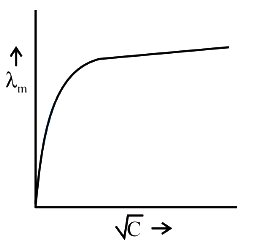
B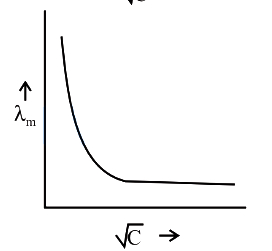
C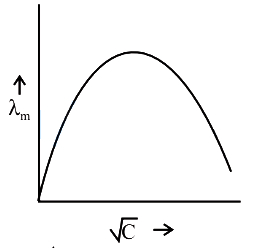
D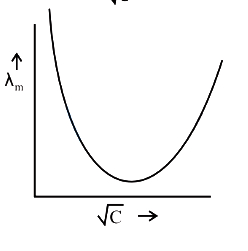
Solution
(B) Acetic acid $(CH_3COOH)$ is a weak electrolyte.
For weak electrolytes,the degree of dissociation increases with dilution (decrease in concentration).
As a result,the molar conductivity $(\lambda_{m})$ increases sharply as the concentration $(C)$ approaches zero.
The plot of $\lambda_{m}$ versus $\sqrt{C}$ for a weak electrolyte shows a steep increase as $\sqrt{C}$ decreases,and it does not intersect the y-axis at finite concentration.
Graph $B$ correctly represents this behavior,where $\lambda_{m}$ increases as $\sqrt{C}$ decreases.
For weak electrolytes,the degree of dissociation increases with dilution (decrease in concentration).
As a result,the molar conductivity $(\lambda_{m})$ increases sharply as the concentration $(C)$ approaches zero.
The plot of $\lambda_{m}$ versus $\sqrt{C}$ for a weak electrolyte shows a steep increase as $\sqrt{C}$ decreases,and it does not intersect the y-axis at finite concentration.
Graph $B$ correctly represents this behavior,where $\lambda_{m}$ increases as $\sqrt{C}$ decreases.
0 likes
View Solution396
EasyMCQ
At $298 \ K$ the molar conductivities at infinite dilution $(\Lambda_m^{\circ})$ of $NH_4Cl, KOH$ and $KCl$ are $152.8, 272.6$ and $149.8 \ S \ cm^2 \ mol^{-1}$ respectively. The $\Lambda_m^{\circ}$ of $NH_4OH$ in $S \ cm^2 \ mol^{-1}$ and $\%$ dissociation of $0.01 \ M \ NH_4OH$ with $\Lambda_m = 25.1 \ S \ cm^2 \ mol^{-1}$ at the same temperature are
A
$275.6, 0.91$
B
$275.6, 9.1$
C
$266.6, 9.6$
D
$30, 84$
Solution
(B) According to Kohlrausch's law of independent migration of ions:
$\Lambda_m^{\circ}(NH_4OH) = \Lambda_m^{\circ}(NH_4Cl) + \Lambda_m^{\circ}(KOH) - \Lambda_m^{\circ}(KCl)$
$= 152.8 + 272.6 - 149.8 = 275.6 \ S \ cm^2 \ mol^{-1}$
Degree of dissociation $(\alpha)$ is given by:
$\alpha = \frac{\Lambda_m}{\Lambda_m^{\circ}} = \frac{25.1}{275.6} \approx 0.091$
Percentage dissociation $= \alpha \times 100 = 0.091 \times 100 = 9.1 \%$
$\Lambda_m^{\circ}(NH_4OH) = \Lambda_m^{\circ}(NH_4Cl) + \Lambda_m^{\circ}(KOH) - \Lambda_m^{\circ}(KCl)$
$= 152.8 + 272.6 - 149.8 = 275.6 \ S \ cm^2 \ mol^{-1}$
Degree of dissociation $(\alpha)$ is given by:
$\alpha = \frac{\Lambda_m}{\Lambda_m^{\circ}} = \frac{25.1}{275.6} \approx 0.091$
Percentage dissociation $= \alpha \times 100 = 0.091 \times 100 = 9.1 \%$
0 likes
View Solution397
MediumMCQ
If the values of $\Lambda_{\infty}$ of $NH_4Cl$,$NaOH$ and $NaCl$ are $130$,$217$ and $109 \ ohm^{-1} \ cm^2 \ equiv^{-1}$ respectively,the $\Lambda_{\infty}$ of $NH_4OH$ in $ohm^{-1} \ cm^2 \ equiv^{-1}$ is:
A
$238$
B
$196$
C
$22$
D
$456$
Solution
(A) According to Kohlrausch's law of independent migration of ions:
$\Lambda_{\infty}(NH_4Cl) = \Lambda_{\infty}(NH_4^+) + \Lambda_{\infty}(Cl^-) = 130 \ ohm^{-1} \ cm^2 \ equiv^{-1}$ $(i)$
$\Lambda_{\infty}(NaOH) = \Lambda_{\infty}(Na^+) + \Lambda_{\infty}(OH^-) = 217 \ ohm^{-1} \ cm^2 \ equiv^{-1}$ $(ii)$
$\Lambda_{\infty}(NaCl) = \Lambda_{\infty}(Na^+) + \Lambda_{\infty}(Cl^-) = 109 \ ohm^{-1} \ cm^2 \ equiv^{-1}$ $(iii)$
To find $\Lambda_{\infty}(NH_4OH)$,we perform the operation: $(i) + (ii) - (iii)$
$\Lambda_{\infty}(NH_4OH) = \Lambda_{\infty}(NH_4^+) + \Lambda_{\infty}(OH^-) = \Lambda_{\infty}(NH_4Cl) + \Lambda_{\infty}(NaOH) - \Lambda_{\infty}(NaCl)$
$\Lambda_{\infty}(NH_4OH) = 130 + 217 - 109 = 238 \ ohm^{-1} \ cm^2 \ equiv^{-1}$
$\Lambda_{\infty}(NH_4Cl) = \Lambda_{\infty}(NH_4^+) + \Lambda_{\infty}(Cl^-) = 130 \ ohm^{-1} \ cm^2 \ equiv^{-1}$ $(i)$
$\Lambda_{\infty}(NaOH) = \Lambda_{\infty}(Na^+) + \Lambda_{\infty}(OH^-) = 217 \ ohm^{-1} \ cm^2 \ equiv^{-1}$ $(ii)$
$\Lambda_{\infty}(NaCl) = \Lambda_{\infty}(Na^+) + \Lambda_{\infty}(Cl^-) = 109 \ ohm^{-1} \ cm^2 \ equiv^{-1}$ $(iii)$
To find $\Lambda_{\infty}(NH_4OH)$,we perform the operation: $(i) + (ii) - (iii)$
$\Lambda_{\infty}(NH_4OH) = \Lambda_{\infty}(NH_4^+) + \Lambda_{\infty}(OH^-) = \Lambda_{\infty}(NH_4Cl) + \Lambda_{\infty}(NaOH) - \Lambda_{\infty}(NaCl)$
$\Lambda_{\infty}(NH_4OH) = 130 + 217 - 109 = 238 \ ohm^{-1} \ cm^2 \ equiv^{-1}$
0 likes
View Solution398
EasyMCQ
At a certain temperature and at infinite dilution,the equivalent conductances of sodium benzoate,hydrochloric acid,and sodium chloride are $240$,$349$,and $229 \ \Omega^{-1} \ cm^2 \ equiv^{-1}$ respectively. The equivalent conductance of benzoic acid in $\Omega^{-1} \ cm^2 \ equiv^{-1}$ at the same conditions is
A
$80$
B
$328$
C
$360$
D
$408$
Solution
(C) According to Kohlrausch's law of independent migration of ions,the equivalent conductance at infinite dilution for benzoic acid $(C_6H_5COOH)$ can be calculated as follows:
$\wedge_{C_6H_5COOH}^{\infty} = \wedge_{C_6H_5COONa}^{\infty} + \wedge_{HCl}^{\infty} - \wedge_{NaCl}^{\infty}$
Given values:
$\wedge_{C_6H_5COONa}^{\infty} = 240 \ \Omega^{-1} \ cm^2 \ equiv^{-1}$
$\wedge_{HCl}^{\infty} = 349 \ \Omega^{-1} \ cm^2 \ equiv^{-1}$
$\wedge_{NaCl}^{\infty} = 229 \ \Omega^{-1} \ cm^2 \ equiv^{-1}$
Substituting the values:
$\wedge_{C_6H_5COOH}^{\infty} = 240 + 349 - 229$
$= 589 - 229$
$= 360 \ \Omega^{-1} \ cm^2 \ equiv^{-1}$
$\wedge_{C_6H_5COOH}^{\infty} = \wedge_{C_6H_5COONa}^{\infty} + \wedge_{HCl}^{\infty} - \wedge_{NaCl}^{\infty}$
Given values:
$\wedge_{C_6H_5COONa}^{\infty} = 240 \ \Omega^{-1} \ cm^2 \ equiv^{-1}$
$\wedge_{HCl}^{\infty} = 349 \ \Omega^{-1} \ cm^2 \ equiv^{-1}$
$\wedge_{NaCl}^{\infty} = 229 \ \Omega^{-1} \ cm^2 \ equiv^{-1}$
Substituting the values:
$\wedge_{C_6H_5COOH}^{\infty} = 240 + 349 - 229$
$= 589 - 229$
$= 360 \ \Omega^{-1} \ cm^2 \ equiv^{-1}$
0 likes
View SolutionElectrochemistry — Conductor and Conductance and Cell constant · Frequently Asked Questions
1Are these Electrochemistry questions useful for JEE and NEET?
Yes. All questions in this section are mapped to JEE Main and NEET exam patterns. Previous year questions from JEE Main, NEET, GUJCET and state-level exams are included with full solutions.
2Can I switch to Hindi or Gujarati for these questions?
Yes. Use the language tabs in the hero section or the sidebar to view the same questions and solutions in English, Hindi or Gujarati.
3How do I generate a question paper from this subtopic?
Use the Vedclass Exam Paper Generator — select the chapter and subtopic, set difficulty, and generate Sets A, B, C, D automatically. First 3 chapters of every subject are free.
Vedclass Products
For Students
Vedclass Test Series
Mock tests in real JEE/NEET style with performance analysis. 5-day free trial.
Start Free TrialFor Teachers
Exam Paper Generator
Generate Set A/B/C/D papers from this chapter in 2 minutes. 3 chapters free.
Try FreeFor Institutes
Online Exam Module
Live online exams with unlimited students, 360° analytics & white-label branding.
See DemoFor Teachers & Institutes
Generate a Electrochemistry Exam Paper in 2 Minutes
Select subtopic & difficulty — Sets A, B, C, D auto-generated with No Repeat logic.
First 3 chapters of every subject are free — no payment required.