
A English
Isomerism and Magnetic properties Questions in English
Class 12 Chemistry · Coordination Compounds · Isomerism and Magnetic properties
800+
Questions
English
Language
100%
With Solutions
Showing 47 of 800 questions in English
751
MediumMCQ
The magnetic moment of $[CoF_6]^{3-}$ as per spin only formula (in $BM$) is
A
$3.87$
B
$5.92$
C
$2.84$
D
$4.9$
Solution
(D) In the complex $[CoF_6]^{3-}$,the oxidation state of $Co$ is $x + 6(-1) = -3$,which gives $x = +3$.
The electronic configuration of $Co^{3+}$ is $[Ar] 3d^6$.
Since $F^-$ is a weak field ligand,it does not cause pairing of electrons.
Thus,the $3d$ orbitals have $4$ unpaired electrons $(n = 4)$.
The spin-only magnetic moment is calculated using the formula $\mu = \sqrt{n(n+2)} \ BM$.
Substituting $n = 4$,we get $\mu = \sqrt{4(4+2)} = \sqrt{24} \approx 4.90 \ BM$.
The electronic configuration of $Co^{3+}$ is $[Ar] 3d^6$.
Since $F^-$ is a weak field ligand,it does not cause pairing of electrons.
Thus,the $3d$ orbitals have $4$ unpaired electrons $(n = 4)$.
The spin-only magnetic moment is calculated using the formula $\mu = \sqrt{n(n+2)} \ BM$.
Substituting $n = 4$,we get $\mu = \sqrt{4(4+2)} = \sqrt{24} \approx 4.90 \ BM$.
0 likes
View Solution752
MediumMCQ
Identify the ion (hydrated in solution) which is not correctly matched with its spin only magnetic moment (in $BM$) given in brackets.
A
$Cr^{3+} (3.87)$
B
$Cu^{2+} (1.73)$
C
$Co^{3+} (0)$
D
$Fe^{2+} (4.90)$
Solution
(C) The spin-only magnetic moment is calculated using the formula $\mu = \sqrt{n(n+2)} \ BM$,where $n$ is the number of unpaired electrons.
$1$. For $Cr^{3+}$ $(3d^3)$: $n = 3$,$\mu = \sqrt{3(3+2)} = \sqrt{15} \approx 3.87 \ BM$. (Correct)
$2$. For $Cu^{2+}$ $(3d^9)$: $n = 1$,$\mu = \sqrt{1(1+2)} = \sqrt{3} \approx 1.73 \ BM$. (Correct)
$3$. For $Co^{3+}$ (hydrated,i.e.,$[Co(H_2O)_6]^{3+}$): $H_2O$ is a weak field ligand. The configuration is $t_{2g}^4 e_g^2$,so $n = 4$. $\mu = \sqrt{4(4+2)} = \sqrt{24} \approx 4.90 \ BM$. The given value $0$ is incorrect.
$4$. For $Fe^{2+}$ $(3d^6)$: In aqueous solution,$[Fe(H_2O)_6]^{2+}$ has $n = 4$,$\mu = \sqrt{4(4+2)} = \sqrt{24} \approx 4.90 \ BM$. (Correct)
Thus,$Co^{3+}$ is not correctly matched.
$1$. For $Cr^{3+}$ $(3d^3)$: $n = 3$,$\mu = \sqrt{3(3+2)} = \sqrt{15} \approx 3.87 \ BM$. (Correct)
$2$. For $Cu^{2+}$ $(3d^9)$: $n = 1$,$\mu = \sqrt{1(1+2)} = \sqrt{3} \approx 1.73 \ BM$. (Correct)
$3$. For $Co^{3+}$ (hydrated,i.e.,$[Co(H_2O)_6]^{3+}$): $H_2O$ is a weak field ligand. The configuration is $t_{2g}^4 e_g^2$,so $n = 4$. $\mu = \sqrt{4(4+2)} = \sqrt{24} \approx 4.90 \ BM$. The given value $0$ is incorrect.
$4$. For $Fe^{2+}$ $(3d^6)$: In aqueous solution,$[Fe(H_2O)_6]^{2+}$ has $n = 4$,$\mu = \sqrt{4(4+2)} = \sqrt{24} \approx 4.90 \ BM$. (Correct)
Thus,$Co^{3+}$ is not correctly matched.
0 likes
View Solution753
EasyMCQ
Arrange the following in the increasing order of the number of unpaired electrons present in the central metal ion:
$I.$ $[MnCl_6]^{3-}$
$II.$ $[FeF_6]^{3-}$
$III.$ $[Mn(CN)_6]^{3-}$
$IV.$ $[Fe(CN)_6]^{3-}$
$I.$ $[MnCl_6]^{3-}$
$II.$ $[FeF_6]^{3-}$
$III.$ $[Mn(CN)_6]^{3-}$
$IV.$ $[Fe(CN)_6]^{3-}$
A
$IV < I < III < II$
B
$I < III < II < IV$
C
$IV < III < I < II$
D
$I < II < III < IV$
Solution
(C) To determine the number of unpaired electrons,we analyze the oxidation state of the metal and the nature of the ligand:
$I.$ $[MnCl_6]^{3-}$: $Mn^{3+}$ $(3d^4)$,$Cl^-$ is a weak field ligand. Unpaired electrons = $4$.
$II.$ $[FeF_6]^{3-}$: $Fe^{3+}$ $(3d^5)$,$F^-$ is a weak field ligand. Unpaired electrons = $5$.
$III.$ $[Mn(CN)_6]^{3-}$: $Mn^{3+}$ $(3d^4)$,$CN^-$ is a strong field ligand. Unpaired electrons = $2$.
$IV.$ $[Fe(CN)_6]^{3-}$: $Fe^{3+}$ $(3d^5)$,$CN^-$ is a strong field ligand. Unpaired electrons = $1$.
Comparing the number of unpaired electrons: $IV (1) < III (2) < I (4) < II (5)$.
Thus,the increasing order is $IV < III < I < II$.
$I.$ $[MnCl_6]^{3-}$: $Mn^{3+}$ $(3d^4)$,$Cl^-$ is a weak field ligand. Unpaired electrons = $4$.
$II.$ $[FeF_6]^{3-}$: $Fe^{3+}$ $(3d^5)$,$F^-$ is a weak field ligand. Unpaired electrons = $5$.
$III.$ $[Mn(CN)_6]^{3-}$: $Mn^{3+}$ $(3d^4)$,$CN^-$ is a strong field ligand. Unpaired electrons = $2$.
$IV.$ $[Fe(CN)_6]^{3-}$: $Fe^{3+}$ $(3d^5)$,$CN^-$ is a strong field ligand. Unpaired electrons = $1$.
Comparing the number of unpaired electrons: $IV (1) < III (2) < I (4) < II (5)$.
Thus,the increasing order is $IV < III < I < II$.
0 likes
View Solution754
MediumMCQ
Arrange the following in the increasing order of their magnetic moments:
$I.$ $[Mn(CN)_6]^{3-}$
$II.$ $[MnCl_6]^{3-}$
$III.$ $[Fe(CN)_6]^{3-}$
$IV.$ $[FeF_6]^{3-}$
$I.$ $[Mn(CN)_6]^{3-}$
$II.$ $[MnCl_6]^{3-}$
$III.$ $[Fe(CN)_6]^{3-}$
$IV.$ $[FeF_6]^{3-}$
A
$III < I < IV < II$
B
$III < IV < II < I$
C
$IV < II < I < III$
D
$III < I < II < IV$
Solution
(D) To determine the magnetic moment,we calculate the number of unpaired electrons $(n)$ in each complex:
$I.$ $[Mn(CN)_6]^{3-}$: $Mn^{3+}$ is $3d^4$. $CN^-$ is a strong field ligand,causing pairing. $n = 2$. Magnetic moment $\mu = \sqrt{2(2+2)} = \sqrt{8} \approx 2.83 \ BM$.
$II.$ $[MnCl_6]^{3-}$: $Mn^{3+}$ is $3d^4$. $Cl^-$ is a weak field ligand,no pairing. $n = 4$. Magnetic moment $\mu = \sqrt{4(4+2)} = \sqrt{24} \approx 4.90 \ BM$.
$III.$ $[Fe(CN)_6]^{3-}$: $Fe^{3+}$ is $3d^5$. $CN^-$ is a strong field ligand,causing pairing. $n = 1$. Magnetic moment $\mu = \sqrt{1(1+2)} = \sqrt{3} \approx 1.73 \ BM$.
$IV.$ $[FeF_6]^{3-}$: $Fe^{3+}$ is $3d^5$. $F^-$ is a weak field ligand,no pairing. $n = 5$. Magnetic moment $\mu = \sqrt{5(5+2)} = \sqrt{35} \approx 5.92 \ BM$.
Comparing the values: $1.73 (III) < 2.83 (I) < 4.90 (II) < 5.92 (IV)$.
Thus,the increasing order is $III < I < II < IV$.
$I.$ $[Mn(CN)_6]^{3-}$: $Mn^{3+}$ is $3d^4$. $CN^-$ is a strong field ligand,causing pairing. $n = 2$. Magnetic moment $\mu = \sqrt{2(2+2)} = \sqrt{8} \approx 2.83 \ BM$.
$II.$ $[MnCl_6]^{3-}$: $Mn^{3+}$ is $3d^4$. $Cl^-$ is a weak field ligand,no pairing. $n = 4$. Magnetic moment $\mu = \sqrt{4(4+2)} = \sqrt{24} \approx 4.90 \ BM$.
$III.$ $[Fe(CN)_6]^{3-}$: $Fe^{3+}$ is $3d^5$. $CN^-$ is a strong field ligand,causing pairing. $n = 1$. Magnetic moment $\mu = \sqrt{1(1+2)} = \sqrt{3} \approx 1.73 \ BM$.
$IV.$ $[FeF_6]^{3-}$: $Fe^{3+}$ is $3d^5$. $F^-$ is a weak field ligand,no pairing. $n = 5$. Magnetic moment $\mu = \sqrt{5(5+2)} = \sqrt{35} \approx 5.92 \ BM$.
Comparing the values: $1.73 (III) < 2.83 (I) < 4.90 (II) < 5.92 (IV)$.
Thus,the increasing order is $III < I < II < IV$.
0 likes
View Solution755
MediumMCQ
The calculated magnetic moment value for the $Fe^{2+}$ ion in $BM$ is:
A
$3.87$
B
$4.90$
C
$2.84$
D
$1.73$
Solution
(B) The electronic configuration of $Fe$ $(Z=26)$ is $[Ar] 3d^6 4s^2$.
For $Fe^{2+}$ ion,the configuration is $[Ar] 3d^6$.
In the $3d^6$ configuration,there are $4$ unpaired electrons $(n=4)$.
The spin-only magnetic moment is calculated using the formula $\mu = \sqrt{n(n+2)} \ BM$.
Substituting $n=4$,we get $\mu = \sqrt{4(4+2)} = \sqrt{24} \approx 4.90 \ BM$.
For $Fe^{2+}$ ion,the configuration is $[Ar] 3d^6$.
In the $3d^6$ configuration,there are $4$ unpaired electrons $(n=4)$.
The spin-only magnetic moment is calculated using the formula $\mu = \sqrt{n(n+2)} \ BM$.
Substituting $n=4$,we get $\mu = \sqrt{4(4+2)} = \sqrt{24} \approx 4.90 \ BM$.
0 likes
View Solution756
EasyMCQ
The magnetic moment of $Fe^{2+}$ is $B.M$.
A
$3.87$
B
$0$
C
$4.9$
D
$1.73$
Solution
(C) The magnetic moment $\mu$ is calculated using the formula $\mu = \sqrt{n(n + 2)} \text{ B.M. }$,where $n$ is the number of unpaired electrons.
The atomic number of $Fe$ is $26$,and its electronic configuration is $[Ar] 3d^6 4s^2$.
For $Fe^{2+}$,the configuration is $[Ar] 3d^6$.
In the $3d$ subshell,there are $5$ orbitals. According to Hund's rule,the $6$ electrons occupy these orbitals as follows: one orbital has $2$ electrons (paired),and the remaining $4$ orbitals have $1$ electron each (unpaired).
Thus,the number of unpaired electrons $n = 4$.
Substituting $n = 4$ into the formula: $\mu = \sqrt{4(4 + 2)} = \sqrt{24} \approx 4.9 \text{ B.M. }$
The atomic number of $Fe$ is $26$,and its electronic configuration is $[Ar] 3d^6 4s^2$.
For $Fe^{2+}$,the configuration is $[Ar] 3d^6$.
In the $3d$ subshell,there are $5$ orbitals. According to Hund's rule,the $6$ electrons occupy these orbitals as follows: one orbital has $2$ electrons (paired),and the remaining $4$ orbitals have $1$ electron each (unpaired).
Thus,the number of unpaired electrons $n = 4$.
Substituting $n = 4$ into the formula: $\mu = \sqrt{4(4 + 2)} = \sqrt{24} \approx 4.9 \text{ B.M. }$
0 likes
View Solution757
EasyMCQ
The formula for calculating 'spin only' magnetic moment is
A
$n(n+2)$
B
$\sqrt{n(n-2)}$
C
$\sqrt{n(n+2)}$
D
$n(n-2)$
Solution
(C) The 'spin only' magnetic moment $(\mu_{so})$ is calculated using the number of unpaired electrons $(n)$ in an atom or ion. The formula is given by:
$\mu_{so} = \sqrt{n(n+2)} \ BM$
where $BM$ stands for Bohr Magneton.
Hence,the correct option is $(C)$.
$\mu_{so} = \sqrt{n(n+2)} \ BM$
where $BM$ stands for Bohr Magneton.
Hence,the correct option is $(C)$.
0 likes
View Solution758
MediumMCQ
The pair in which both the species have the same magnetic moment (spin only) is
A
$[CoCl_4]^{2-}, [Fe(H_2O)_6]^{2+}$
B
$[Mn(H_2O)_6]^{2+}, [Cr(H_2O)_6]^{2+}$
C
$[Cr(H_2O)_6]^{2+}, [Fe(H_2O)_6]^{2+}$
D
$[Cr(H_2O)_6]^{2+}, [CoCl_4]^{2-}$
Solution
(C) The magnetic moment (spin only) is given by $\mu = \sqrt{n(n+2)} \text{ BM}$,where $n$ is the number of unpaired electrons.
$1. [CoCl_4]^{2-}: Co^{2+} (d^7)$ is a tetrahedral complex. The configuration is $e^4 t_2^3$,so $n = 3$.
$2. [Fe(H_2O)_6]^{2+}: Fe^{2+} (d^6)$ is an octahedral complex. The configuration is $t_{2g}^4 e_g^2$,so $n = 4$.
$3. [Mn(H_2O)_6]^{2+}: Mn^{2+} (d^5)$ is an octahedral complex. The configuration is $t_{2g}^3 e_g^2$,so $n = 5$.
$4. [Cr(H_2O)_6]^{2+}: Cr^{2+} (d^4)$ is an octahedral complex. The configuration is $t_{2g}^3 e_g^1$,so $n = 4$.
Comparing the number of unpaired electrons,both $[Fe(H_2O)_6]^{2+}$ and $[Cr(H_2O)_6]^{2+}$ have $n = 4$,thus they have the same magnetic moment.
$1. [CoCl_4]^{2-}: Co^{2+} (d^7)$ is a tetrahedral complex. The configuration is $e^4 t_2^3$,so $n = 3$.
$2. [Fe(H_2O)_6]^{2+}: Fe^{2+} (d^6)$ is an octahedral complex. The configuration is $t_{2g}^4 e_g^2$,so $n = 4$.
$3. [Mn(H_2O)_6]^{2+}: Mn^{2+} (d^5)$ is an octahedral complex. The configuration is $t_{2g}^3 e_g^2$,so $n = 5$.
$4. [Cr(H_2O)_6]^{2+}: Cr^{2+} (d^4)$ is an octahedral complex. The configuration is $t_{2g}^3 e_g^1$,so $n = 4$.
Comparing the number of unpaired electrons,both $[Fe(H_2O)_6]^{2+}$ and $[Cr(H_2O)_6]^{2+}$ have $n = 4$,thus they have the same magnetic moment.
0 likes
View Solution759
MediumMCQ
Total number of geometrical isomers possible for the complexes $[NiCl_4]^{2-}$,$[CoCl_2(NH_3)_4]^{+}$,$[Co(NH_3)_3(NO_2)_3]$ and $[Co(NH_3)_5Cl]^{2+}$ is
A
$2$
B
$3$
C
$4$
D
$5$
Solution
(C) $1$. $[NiCl_4]^{2-}$: This is a tetrahedral complex ($sp^3$ hybridization). Tetrahedral complexes do not exhibit geometrical isomerism. Number of isomers = $0$.
$2$. $[CoCl_2(NH_3)_4]^{+}$: This is an octahedral complex of the type $[MA_4B_2]$. It shows $2$ geometrical isomers ($cis$ and $trans$).
$3$. $[Co(NH_3)_3(NO_2)_3]$: This is an octahedral complex of the type $[MA_3B_3]$. It shows $2$ geometrical isomers ($fac$ and $mer$).
$4$. $[Co(NH_3)_5Cl]^{2+}$: This is an octahedral complex of the type $[MA_5B]$. It does not show geometrical isomerism. Number of isomers = $0$.
Total number of geometrical isomers = $0 + 2 + 2 + 0 = 4$.
$2$. $[CoCl_2(NH_3)_4]^{+}$: This is an octahedral complex of the type $[MA_4B_2]$. It shows $2$ geometrical isomers ($cis$ and $trans$).
$3$. $[Co(NH_3)_3(NO_2)_3]$: This is an octahedral complex of the type $[MA_3B_3]$. It shows $2$ geometrical isomers ($fac$ and $mer$).
$4$. $[Co(NH_3)_5Cl]^{2+}$: This is an octahedral complex of the type $[MA_5B]$. It does not show geometrical isomerism. Number of isomers = $0$.
Total number of geometrical isomers = $0 + 2 + 2 + 0 = 4$.
0 likes
View Solution760
MediumMCQ
Which one of the following complex ions has geometrical isomers?
A
$\left[ Co(Cl)_2(en)_2 \right]^{+}$
B
$\left[ Cr(NH_3)_4(en) \right]^{3+}$
C
$\left[ Co(en)_3 \right]^{3+}$
D
$\left[ Ni(NH_3)_5 Br \right]^{+}$
Solution
(A) Geometrical isomerism in coordination complexes occurs when ligands can be arranged in different spatial positions relative to each other.
For the complex $\left[ Co(Cl)_2(en)_2 \right]^{+}$,the two $Cl^-$ ligands can be either adjacent to each other (cis-isomer) or opposite to each other (trans-isomer).
Therefore,$\left[ Co(Cl)_2(en)_2 \right]^{+}$ exhibits geometrical isomerism.
For the complex $\left[ Co(Cl)_2(en)_2 \right]^{+}$,the two $Cl^-$ ligands can be either adjacent to each other (cis-isomer) or opposite to each other (trans-isomer).
Therefore,$\left[ Co(Cl)_2(en)_2 \right]^{+}$ exhibits geometrical isomerism.
0 likes
View Solution761
DifficultMCQ
Consider the complexes:
$I$. $[Pd(NH_3)_2 ClBr]$
$II$. $[Pd(NH_3)_2 Cl_2]$
$III$. $[Pd(en) Cl_2]$
$IV$. $[Pd(en) ClBr]$
$V$. $[Pd(en)_2 Cl_2]$
(en = ethylenediamine)
The total number of geometrical isomers of $(I)$ is the same as the total number of geometrical isomers of:
$I$. $[Pd(NH_3)_2 ClBr]$
$II$. $[Pd(NH_3)_2 Cl_2]$
$III$. $[Pd(en) Cl_2]$
$IV$. $[Pd(en) ClBr]$
$V$. $[Pd(en)_2 Cl_2]$
(en = ethylenediamine)
The total number of geometrical isomers of $(I)$ is the same as the total number of geometrical isomers of:
A
$II$
B
$III$
C
$IV$
D
$V$
Solution
(A) $Pd(II)$ complexes are square planar.
$I$. $[Pd(NH_3)_2 ClBr]$ is of the type $[M(a)_2bc]$,which shows $2$ geometrical isomers (cis and trans).
$II$. $[Pd(NH_3)_2 Cl_2]$ is of the type $[M(a)_2b_2]$,which shows $2$ geometrical isomers (cis and trans).
$III$. $[Pd(en) Cl_2]$ is of the type $[M(AA)b_2]$,which shows $0$ geometrical isomers.
$IV$. $[Pd(en) ClBr]$ is of the type $[M(AA)bc]$,which shows $0$ geometrical isomers.
$V$. $[Pd(en)_2 Cl_2]$ is of the type $[M(AA)_2b_2]$,which shows $0$ geometrical isomers.
Thus,the number of geometrical isomers of $(I)$ is the same as that of $(II)$.
$I$. $[Pd(NH_3)_2 ClBr]$ is of the type $[M(a)_2bc]$,which shows $2$ geometrical isomers (cis and trans).
$II$. $[Pd(NH_3)_2 Cl_2]$ is of the type $[M(a)_2b_2]$,which shows $2$ geometrical isomers (cis and trans).
$III$. $[Pd(en) Cl_2]$ is of the type $[M(AA)b_2]$,which shows $0$ geometrical isomers.
$IV$. $[Pd(en) ClBr]$ is of the type $[M(AA)bc]$,which shows $0$ geometrical isomers.
$V$. $[Pd(en)_2 Cl_2]$ is of the type $[M(AA)_2b_2]$,which shows $0$ geometrical isomers.
Thus,the number of geometrical isomers of $(I)$ is the same as that of $(II)$.
0 likes
View Solution762
DifficultMCQ
Identify the number of complexes that are optically active:
$[Co(en)_3]^{3+}$; $[Co(NH_3)_4Cl_2]^{+}$; $[CoCl_2(en)_2]^{+}$; $[Co(NH_3)_3(NO_2)_3]$
$[Co(en)_3]^{3+}$; $[Co(NH_3)_4Cl_2]^{+}$; $[CoCl_2(en)_2]^{+}$; $[Co(NH_3)_3(NO_2)_3]$
A
$0$
B
$1$
C
$2$
D
$3$
Solution
(C) The complexes are evaluated for optical activity:
$1$. $[Co(en)_3]^{3+}$: Optically active (contains $en$ ligand,no plane of symmetry).
$2$. $[Co(NH_3)_4Cl_2]^{+}$: Optically inactive ($cis$-form has a plane of symmetry; $trans$-form has a plane of symmetry).
$3$. $[CoCl_2(en)_2]^{+}$: Optically active ($cis$-form is chiral; $trans$-form is achiral).
$4$. $[Co(NH_3)_3(NO_2)_3]$: Optically inactive ($fac$ and $mer$ isomers are achiral).
Thus,there are $2$ optically active complexes.
$1$. $[Co(en)_3]^{3+}$: Optically active (contains $en$ ligand,no plane of symmetry).
$2$. $[Co(NH_3)_4Cl_2]^{+}$: Optically inactive ($cis$-form has a plane of symmetry; $trans$-form has a plane of symmetry).
$3$. $[CoCl_2(en)_2]^{+}$: Optically active ($cis$-form is chiral; $trans$-form is achiral).
$4$. $[Co(NH_3)_3(NO_2)_3]$: Optically inactive ($fac$ and $mer$ isomers are achiral).
Thus,there are $2$ optically active complexes.
0 likes
View Solution763
DifficultMCQ
Which one of the following does not exhibit geometrical isomerism?
A
Octahedral complex with formula $[MX_2L_4]$
B
Square planar complex with formula $[MX_2L_2]$
C
Tetrahedral complex with formula $[MABXL]$
D
Octahedral complex with formula $[MX_2(L^{-}L)_2]$
Solution
(C) Geometrical isomerism is observed in complexes where the relative positions of ligands around the central metal atom can change.
$1$. Octahedral complexes of the type $[MX_2L_4]$ exhibit geometrical isomerism (cis and trans forms).
$2$. Square planar complexes of the type $[MX_2L_2]$ exhibit geometrical isomerism (cis and trans forms).
$3$. Tetrahedral complexes of the type $[MABXL]$ do not exhibit geometrical isomerism because all four positions in a tetrahedron are adjacent to each other,making the relative positions of ligands identical.
$4$. Octahedral complexes of the type $[MX_2(L^{-}L)_2]$ exhibit geometrical isomerism due to the arrangement of $X$ ligands.
Therefore,the correct answer is the tetrahedral complex.
$1$. Octahedral complexes of the type $[MX_2L_4]$ exhibit geometrical isomerism (cis and trans forms).
$2$. Square planar complexes of the type $[MX_2L_2]$ exhibit geometrical isomerism (cis and trans forms).
$3$. Tetrahedral complexes of the type $[MABXL]$ do not exhibit geometrical isomerism because all four positions in a tetrahedron are adjacent to each other,making the relative positions of ligands identical.
$4$. Octahedral complexes of the type $[MX_2(L^{-}L)_2]$ exhibit geometrical isomerism due to the arrangement of $X$ ligands.
Therefore,the correct answer is the tetrahedral complex.
0 likes
View Solution764
MediumMCQ
$[Co(NH_3)_5SO_4]Br$ and $[Co(NH_3)_5Br]SO_4$ are a pair of isomers.
A
ionisation
B
ligand
C
coordination
D
hydrate
Solution
(A) The given compounds are:
$1. [Co(NH_3)_5SO_4]Br \rightleftharpoons [Co(NH_3)_5SO_4]^+ + Br^-$
$2. [Co(NH_3)_5Br]SO_4 \rightleftharpoons [Co(NH_3)_5Br]^{2+} + SO_4^{2-}$
Since both compounds have the same molecular formula but produce different ions in an aqueous solution,they exhibit ionisation isomerism.
$1. [Co(NH_3)_5SO_4]Br \rightleftharpoons [Co(NH_3)_5SO_4]^+ + Br^-$
$2. [Co(NH_3)_5Br]SO_4 \rightleftharpoons [Co(NH_3)_5Br]^{2+} + SO_4^{2-}$
Since both compounds have the same molecular formula but produce different ions in an aqueous solution,they exhibit ionisation isomerism.
0 likes
View Solution765
MediumMCQ
Arrange the following complexes in the increasing order of their spin only magnetic moment (in $B.M$):
$I$. $[Fe(CN)_6]^{4-}$
$II$. $[MnCl_4]^{2-}$
$III$. $[Mn(CN)_6]^{4-}$
$IV$. $[Cr(NH_3)_6]^{3+}$
$I$. $[Fe(CN)_6]^{4-}$
$II$. $[MnCl_4]^{2-}$
$III$. $[Mn(CN)_6]^{4-}$
$IV$. $[Cr(NH_3)_6]^{3+}$
A
$II < IV < I < III$
B
$III < II < I < IV$
C
$I < IV < II < III$
D
$I < III < IV < II$
Solution
(D) The spin-only magnetic moment is calculated using the formula $\mu = \sqrt{n(n+2)} \ B.M.$,where $n$ is the number of unpaired electrons.
$I$. $[Fe(CN)_6]^{4-}$: $Fe^{2+}$ is $3d^6$. $CN^-$ is a strong field ligand,so electrons pair up. $n = 0$,$\mu = 0 \ B.M.$
$II$. $[MnCl_4]^{2-}$: $Mn^{2+}$ is $3d^5$. $Cl^-$ is a weak field ligand,so electrons do not pair. $n = 5$,$\mu = \sqrt{5(7)} = \sqrt{35} \approx 5.92 \ B.M.$
$III$. $[Mn(CN)_6]^{4-}$: $Mn^{2+}$ is $3d^5$. $CN^-$ is a strong field ligand,so electrons pair up. $n = 1$,$\mu = \sqrt{1(3)} = \sqrt{3} \approx 1.73 \ B.M.$
$IV$. $[Cr(NH_3)_6]^{3+}$: $Cr^{3+}$ is $3d^3$. $n = 3$,$\mu = \sqrt{3(5)} = \sqrt{15} \approx 3.87 \ B.M.$
Comparing the values: $0 (I) < 1.73 (III) < 3.87 (IV) < 5.92 (II)$.
Thus,the increasing order is $I < III < IV < II$.
$I$. $[Fe(CN)_6]^{4-}$: $Fe^{2+}$ is $3d^6$. $CN^-$ is a strong field ligand,so electrons pair up. $n = 0$,$\mu = 0 \ B.M.$
$II$. $[MnCl_4]^{2-}$: $Mn^{2+}$ is $3d^5$. $Cl^-$ is a weak field ligand,so electrons do not pair. $n = 5$,$\mu = \sqrt{5(7)} = \sqrt{35} \approx 5.92 \ B.M.$
$III$. $[Mn(CN)_6]^{4-}$: $Mn^{2+}$ is $3d^5$. $CN^-$ is a strong field ligand,so electrons pair up. $n = 1$,$\mu = \sqrt{1(3)} = \sqrt{3} \approx 1.73 \ B.M.$
$IV$. $[Cr(NH_3)_6]^{3+}$: $Cr^{3+}$ is $3d^3$. $n = 3$,$\mu = \sqrt{3(5)} = \sqrt{15} \approx 3.87 \ B.M.$
Comparing the values: $0 (I) < 1.73 (III) < 3.87 (IV) < 5.92 (II)$.
Thus,the increasing order is $I < III < IV < II$.
0 likes
View Solution766
MediumMCQ
Which one of the following complex ions is diamagnetic in nature?
A
$[CoF_6]^{3-}$
B
$[Co(ox)_3]^{3-}$
C
$[Mn(CN)_6]^{3-}$
D
$[Fe(CN)_6]^{3-}$
Solution
(B) To determine the magnetic nature,we analyze the electronic configuration of the central metal ion in each complex:
$1$. In $[CoF_6]^{3-}$,$Co$ is in $+3$ oxidation state $(3d^6)$. $F^-$ is a weak field ligand,so electrons remain unpaired. It is paramagnetic.
$2$. In $[Co(ox)_3]^{3-}$,$Co$ is in $+3$ oxidation state $(3d^6)$. $ox^{2-}$ (oxalate) is a strong field ligand,causing pairing of electrons in $t_{2g}$ orbitals. The configuration becomes $t_{2g}^6 e_g^0$,meaning all electrons are paired. Thus,it is diamagnetic.
$3$. In $[Mn(CN)_6]^{3-}$,$Mn$ is in $+3$ oxidation state $(3d^4)$. It has unpaired electrons. It is paramagnetic.
$4$. In $[Fe(CN)_6]^{3-}$,$Fe$ is in $+3$ oxidation state $(3d^5)$. It has one unpaired electron. It is paramagnetic.
Therefore,the correct option is $B$.
$1$. In $[CoF_6]^{3-}$,$Co$ is in $+3$ oxidation state $(3d^6)$. $F^-$ is a weak field ligand,so electrons remain unpaired. It is paramagnetic.
$2$. In $[Co(ox)_3]^{3-}$,$Co$ is in $+3$ oxidation state $(3d^6)$. $ox^{2-}$ (oxalate) is a strong field ligand,causing pairing of electrons in $t_{2g}$ orbitals. The configuration becomes $t_{2g}^6 e_g^0$,meaning all electrons are paired. Thus,it is diamagnetic.
$3$. In $[Mn(CN)_6]^{3-}$,$Mn$ is in $+3$ oxidation state $(3d^4)$. It has unpaired electrons. It is paramagnetic.
$4$. In $[Fe(CN)_6]^{3-}$,$Fe$ is in $+3$ oxidation state $(3d^5)$. It has one unpaired electron. It is paramagnetic.
Therefore,the correct option is $B$.
0 likes
View Solution767
MediumMCQ
Observe the following complex ions:
Identify the option in which the unpaired electrons in the complex ions are in correct increasing order.
| Complex Ion | Label |
|---|---|
| $[Mn(CN)_6]^{3-}$ | $A$ |
| $[Fe(CN)_6]^{3-}$ | $B$ |
| $[CoF_6]^{3-}$ | $C$ |
| $[Co(C_2O_4)_3]^{3-}$ | $D$ |
Identify the option in which the unpaired electrons in the complex ions are in correct increasing order.
A
$C < A < B < D$
B
$B < A < C < D$
C
$D < A < B < C$
D
$D < B < A < C$
Solution
(D) To determine the number of unpaired electrons,we analyze the electronic configuration of the central metal ion in each complex:
$1$. $[Mn(CN)_6]^{3-}$ $(A)$: $Mn^{3+}$ is $3d^4$. $CN^-$ is a strong field ligand,causing pairing. Configuration: $t_{2g}^4 e_g^0$. Unpaired electrons = $2$.
$2$. $[Fe(CN)_6]^{3-}$ $(B)$: $Fe^{3+}$ is $3d^5$. $CN^-$ is a strong field ligand. Configuration: $t_{2g}^5 e_g^0$. Unpaired electrons = $1$.
$3$. $[CoF_6]^{3-}$ $(C)$: $Co^{3+}$ is $3d^6$. $F^-$ is a weak field ligand. Configuration: $t_{2g}^4 e_g^2$. Unpaired electrons = $4$.
$4$. $[Co(C_2O_4)_3]^{3-}$ $(D)$: $Co^{3+}$ is $3d^6$. $C_2O_4^{2-}$ is a strong field ligand. Configuration: $t_{2g}^6 e_g^0$. Unpaired electrons = $0$.
Comparing the number of unpaired electrons: $D (0) < B (1) < A (2) < C (4)$.
The correct increasing order is $D < B < A < C$.
$1$. $[Mn(CN)_6]^{3-}$ $(A)$: $Mn^{3+}$ is $3d^4$. $CN^-$ is a strong field ligand,causing pairing. Configuration: $t_{2g}^4 e_g^0$. Unpaired electrons = $2$.
$2$. $[Fe(CN)_6]^{3-}$ $(B)$: $Fe^{3+}$ is $3d^5$. $CN^-$ is a strong field ligand. Configuration: $t_{2g}^5 e_g^0$. Unpaired electrons = $1$.
$3$. $[CoF_6]^{3-}$ $(C)$: $Co^{3+}$ is $3d^6$. $F^-$ is a weak field ligand. Configuration: $t_{2g}^4 e_g^2$. Unpaired electrons = $4$.
$4$. $[Co(C_2O_4)_3]^{3-}$ $(D)$: $Co^{3+}$ is $3d^6$. $C_2O_4^{2-}$ is a strong field ligand. Configuration: $t_{2g}^6 e_g^0$. Unpaired electrons = $0$.
Comparing the number of unpaired electrons: $D (0) < B (1) < A (2) < C (4)$.
The correct increasing order is $D < B < A < C$.
0 likes
View Solution768
MediumMCQ
Identify the incorrect match from the following:
A
$[Cr(H_2O)_6]Br_2$ - Paramagnetic
B
$Na_4[Fe(CN)_6]$ - Diamagnetic
C
$[Ni(CO)_4]$ - Paramagnetic
D
$Na_2[NiCl_4]$ - Paramagnetic
Solution
(C) In $[Cr(H_2O)_6]Br_2$,$Cr$ is in $+2$ oxidation state $(3d^4)$,which has $4$ unpaired electrons,so it is paramagnetic.
In $Na_4[Fe(CN)_6]$,$Fe$ is in $+2$ oxidation state $(3d^6)$. $CN^-$ is a strong field ligand,causing pairing of electrons,resulting in $0$ unpaired electrons,so it is diamagnetic.
In $[Ni(CO)_4]$,$Ni$ is in $0$ oxidation state $(3d^8 4s^2)$. $CO$ is a strong field ligand,causing pairing of all electrons,resulting in $0$ unpaired electrons,so it is diamagnetic.
In $Na_2[NiCl_4]$,$Ni$ is in $+2$ oxidation state $(3d^8)$. $Cl^-$ is a weak field ligand,resulting in $2$ unpaired electrons,so it is paramagnetic.
Therefore,the incorrect match is $[Ni(CO)_4]$ - Paramagnetic.
In $Na_4[Fe(CN)_6]$,$Fe$ is in $+2$ oxidation state $(3d^6)$. $CN^-$ is a strong field ligand,causing pairing of electrons,resulting in $0$ unpaired electrons,so it is diamagnetic.
In $[Ni(CO)_4]$,$Ni$ is in $0$ oxidation state $(3d^8 4s^2)$. $CO$ is a strong field ligand,causing pairing of all electrons,resulting in $0$ unpaired electrons,so it is diamagnetic.
In $Na_2[NiCl_4]$,$Ni$ is in $+2$ oxidation state $(3d^8)$. $Cl^-$ is a weak field ligand,resulting in $2$ unpaired electrons,so it is paramagnetic.
Therefore,the incorrect match is $[Ni(CO)_4]$ - Paramagnetic.
0 likes
View Solution769
MediumMCQ
In which of the following ions is the spin-only magnetic moment the lowest?
A
$[Ti(H_2O)_6]^{3+}$
B
$[Mn(H_2O)_6]^{2+}$
C
$[Ni(H_2O)_6]^{2+}$
D
$[Co(H_2O)_6]^{2+}$
Solution
(A) The spin-only magnetic moment is calculated using the formula $\mu = \sqrt{n(n+2)} \ BM$,where $n$ is the number of unpaired electrons. The lower the number of unpaired electrons,the lower the magnetic moment.
Since $[Ti(H_2O)_6]^{3+}$ has the lowest number of unpaired electrons $(n=1)$,it has the lowest spin-only magnetic moment.
| Ion | Electronic Configuration | Number of Unpaired Electrons $(n)$ |
|---|---|---|
| $[Ti(H_2O)_6]^{3+}$ | $3d^1$ | $1$ |
| $[Mn(H_2O)_6]^{2+}$ | $3d^5$ | $5$ |
| $[Ni(H_2O)_6]^{2+}$ | $3d^8$ | $2$ |
| $[Co(H_2O)_6]^{2+}$ | $3d^7$ | $3$ |
Since $[Ti(H_2O)_6]^{3+}$ has the lowest number of unpaired electrons $(n=1)$,it has the lowest spin-only magnetic moment.
0 likes
View Solution770
DifficultMCQ
Which of the following molecules/ions can exhibit isomerism:
Here,$en = 1,2-\text{diaminoethane}$.
| $A$. Tetrahedral $NiCl_2Br_2^{2-}$ | $B$. Square planar $Pt(NH_3)_2Cl_2$ |
| $C$. Octahedral $Co(NH_3)_3Cl_3$ | $D$. Square planar $Pd(NH_3)_3Br^{+}$ |
| $E$. Octahedral $Co(en)_3^{3+}$ |
Here,$en = 1,2-\text{diaminoethane}$.
A
$A, B, C, D$
B
$B, C, E$
C
$B, C, D$
D
$A, B, C, E$
Solution
(B) . Tetrahedral $NiCl_2Br_2^{2-}$: Tetrahedral complexes do not exhibit geometric isomerism because all positions are equivalent.
$B$. Square planar $Pt(NH_3)_2Cl_2$: This is of the type $Ma_2b_2$,which exhibits cis-trans geometric isomerism.
$C$. Octahedral $Co(NH_3)_3Cl_3$: This is of the type $Ma_3b_3$,which exhibits facial (fac) and meridional (mer) geometric isomerism.
$D$. Square planar $Pd(NH_3)_3Br^{+}$: This is of the type $Ma_3b$,which does not exhibit geometric isomerism.
$E$. Octahedral $Co(en)_3^{3+}$: This is of the type $M(AA)_3$,which exhibits optical isomerism (enantiomers).
Therefore,$B, C,$ and $E$ exhibit isomerism.
$B$. Square planar $Pt(NH_3)_2Cl_2$: This is of the type $Ma_2b_2$,which exhibits cis-trans geometric isomerism.
$C$. Octahedral $Co(NH_3)_3Cl_3$: This is of the type $Ma_3b_3$,which exhibits facial (fac) and meridional (mer) geometric isomerism.
$D$. Square planar $Pd(NH_3)_3Br^{+}$: This is of the type $Ma_3b$,which does not exhibit geometric isomerism.
$E$. Octahedral $Co(en)_3^{3+}$: This is of the type $M(AA)_3$,which exhibits optical isomerism (enantiomers).
Therefore,$B, C,$ and $E$ exhibit isomerism.
0 likes
View Solution771
MediumMCQ
$A$ compound absorbs light in the wavelength region $490-500 \,nm$. Its complementary colour is
A
red
B
blue
C
orange
D
blue-green
Solution
(A) The colour observed is the complementary colour of the light absorbed by the compound.
According to the colour wheel, the wavelength range $490-500 \,nm$ corresponds to the blue-green region of the visible spectrum.
The complementary colour of blue-green is red.
Therefore, the compound will appear red.
According to the colour wheel, the wavelength range $490-500 \,nm$ corresponds to the blue-green region of the visible spectrum.
The complementary colour of blue-green is red.
Therefore, the compound will appear red.
0 likes
View Solution772
EasyMCQ
Which of the following will have a spin-only magnetic moment of $2.86 \ BM$?
A
$[CoF_6]^{3-}$
B
$[Co(NH_3)_6]^{3+}$
C
$[NiCl_4]^{2-}$
D
$[Ni(CN)_4]^{2-}$
Solution
(C) The spin-only magnetic moment $\mu$ is given by the formula $\mu = \sqrt{n(n+2)} \ BM$,where $n$ is the number of unpaired electrons.
For $\mu = 2.86 \ BM$,we have $\sqrt{n(n+2)} \approx 2.86$,which implies $n(n+2) \approx 8$,so $n = 2$.
In $[NiCl_4]^{2-}$,$Ni$ is in the $+2$ oxidation state ($3d^8$ configuration).
For $Ni^{2+}$ $(3d^8)$,the electrons are arranged as $t_{2g}^6 e_g^2$ in a tetrahedral field,resulting in $n = 2$ unpaired electrons.
Thus,$\mu = \sqrt{2(2+2)} = \sqrt{8} \approx 2.83 \ BM$,which matches the given value.
For $\mu = 2.86 \ BM$,we have $\sqrt{n(n+2)} \approx 2.86$,which implies $n(n+2) \approx 8$,so $n = 2$.
In $[NiCl_4]^{2-}$,$Ni$ is in the $+2$ oxidation state ($3d^8$ configuration).
For $Ni^{2+}$ $(3d^8)$,the electrons are arranged as $t_{2g}^6 e_g^2$ in a tetrahedral field,resulting in $n = 2$ unpaired electrons.
Thus,$\mu = \sqrt{2(2+2)} = \sqrt{8} \approx 2.83 \ BM$,which matches the given value.
0 likes
View Solution773
MediumMCQ
The correct match for the complex with its magnetic behavior is:
A
$[Zn(OH_2)_6]^{2+}$; paramagnetic
B
$[Co(NH_3)_6]^{3+}$; diamagnetic
C
$[CoF_6]^{3-}$; diamagnetic
D
$[V(OH_2)_6]^{2+}$; diamagnetic
Solution
(B) $1$. For $[Zn(OH_2)_6]^{2+}$: $Zn^{2+}$ is $3d^{10}$,which has no unpaired electrons,so it is diamagnetic.
$2$. For $[Co(NH_3)_6]^{3+}$: $Co^{3+}$ is $3d^6$. $NH_3$ is a strong field ligand,causing pairing of electrons. It forms $d^2sp^3$ hybridization with no unpaired electrons,making it diamagnetic.
$3$. For $[CoF_6]^{3-}$: $Co^{3+}$ is $3d^6$. $F^-$ is a weak field ligand,so no pairing occurs. It has $4$ unpaired electrons,making it paramagnetic.
$4$. For $[V(OH_2)_6]^{2+}$: $V^{2+}$ is $3d^3$,which has $3$ unpaired electrons,making it paramagnetic.
Therefore,the correct match is $[Co(NH_3)_6]^{3+}$; diamagnetic.
$2$. For $[Co(NH_3)_6]^{3+}$: $Co^{3+}$ is $3d^6$. $NH_3$ is a strong field ligand,causing pairing of electrons. It forms $d^2sp^3$ hybridization with no unpaired electrons,making it diamagnetic.
$3$. For $[CoF_6]^{3-}$: $Co^{3+}$ is $3d^6$. $F^-$ is a weak field ligand,so no pairing occurs. It has $4$ unpaired electrons,making it paramagnetic.
$4$. For $[V(OH_2)_6]^{2+}$: $V^{2+}$ is $3d^3$,which has $3$ unpaired electrons,making it paramagnetic.
Therefore,the correct match is $[Co(NH_3)_6]^{3+}$; diamagnetic.
0 likes
View Solution774
EasyMCQ
The correct order of the increasing magnetic moments for the following ions is $NiCl_4^{2-}$,$Fe(H_2O)_6^{2+}$,$Ni(CN)_4^{2-}$,and $Cu(H_2O)_6^{2+}$.
A
$Ni(CN)_4^{2-} < Cu(H_2O)_6^{2+} < NiCl_4^{2-} < Fe(H_2O)_6^{2+}$
B
$NiCl_4^{2-} < Ni(CN)_4^{2-} < Fe(H_2O)_6^{2+} < Cu(H_2O)_6^{2+}$
C
$Ni(CN)_4^{2-} < NiCl_4^{2-} < Cu(H_2O)_6^{2+} < Fe(H_2O)_6^{2+}$
D
$Ni(CN)_4^{2-} < Cu(H_2O)_6^{2+} < Fe(H_2O)_6^{2+} < NiCl_4^{2-}$
Solution
(A) To determine the magnetic moment,we calculate the number of unpaired electrons $(n)$ using the formula $\mu = \sqrt{n(n+2)} \ BM$.
$1$. $Ni(CN)_4^{2-}$: $Ni^{2+}$ is $d^8$. $CN^-$ is a strong field ligand,causing pairing. $n = 0$,$\mu = 0 \ BM$.
$2$. $Cu(H_2O)_6^{2+}$: $Cu^{2+}$ is $d^9$. $n = 1$,$\mu = \sqrt{1(1+2)} = \sqrt{3} \approx 1.73 \ BM$.
$3$. $NiCl_4^{2-}$: $Ni^{2+}$ is $d^8$. $Cl^-$ is a weak field ligand,no pairing. $n = 2$,$\mu = \sqrt{2(2+2)} = \sqrt{8} \approx 2.83 \ BM$.
$4$. $Fe(H_2O)_6^{2+}$: $Fe^{2+}$ is $d^6$. $H_2O$ is a weak field ligand. $n = 4$,$\mu = \sqrt{4(4+2)} = \sqrt{24} \approx 4.90 \ BM$.
The increasing order of magnetic moments is $Ni(CN)_4^{2-} < Cu(H_2O)_6^{2+} < NiCl_4^{2-} < Fe(H_2O)_6^{2+}$.
$1$. $Ni(CN)_4^{2-}$: $Ni^{2+}$ is $d^8$. $CN^-$ is a strong field ligand,causing pairing. $n = 0$,$\mu = 0 \ BM$.
$2$. $Cu(H_2O)_6^{2+}$: $Cu^{2+}$ is $d^9$. $n = 1$,$\mu = \sqrt{1(1+2)} = \sqrt{3} \approx 1.73 \ BM$.
$3$. $NiCl_4^{2-}$: $Ni^{2+}$ is $d^8$. $Cl^-$ is a weak field ligand,no pairing. $n = 2$,$\mu = \sqrt{2(2+2)} = \sqrt{8} \approx 2.83 \ BM$.
$4$. $Fe(H_2O)_6^{2+}$: $Fe^{2+}$ is $d^6$. $H_2O$ is a weak field ligand. $n = 4$,$\mu = \sqrt{4(4+2)} = \sqrt{24} \approx 4.90 \ BM$.
The increasing order of magnetic moments is $Ni(CN)_4^{2-} < Cu(H_2O)_6^{2+} < NiCl_4^{2-} < Fe(H_2O)_6^{2+}$.
0 likes
View Solution775
MediumMCQ
Which of the following pairs of transition metal ions have the same calculated values of magnetic moment?
A
$Ti^{2+}$ and $V^{2+}$
B
$Fe^{2+}$ and $Cu^{2+}$
C
$Cr^{2+}$ and $Fe^{2+}$
D
$Co^{2+}$ and $Ti^{2+}$
Solution
(C) The magnetic moment is calculated using the formula $\mu = \sqrt{n(n+2)} \text{ BM}$,where $n$ is the number of unpaired electrons.
$Cr^{2+} (Z=24): [Ar] 3d^4 4s^0$; $n = 4$ unpaired electrons.
$Fe^{2+} (Z=26): [Ar] 3d^6 4s^0$; $n = 4$ unpaired electrons.
Since $Cr^{2+}$ and $Fe^{2+}$ have the same number of unpaired electrons $(n=4)$,they have the same calculated value of magnetic moment.
$Cr^{2+} (Z=24): [Ar] 3d^4 4s^0$; $n = 4$ unpaired electrons.
$Fe^{2+} (Z=26): [Ar] 3d^6 4s^0$; $n = 4$ unpaired electrons.
Since $Cr^{2+}$ and $Fe^{2+}$ have the same number of unpaired electrons $(n=4)$,they have the same calculated value of magnetic moment.
0 likes
View Solution776
MediumMCQ
Match the following:
| List-$I$ (Complex) | List-$II$ (Spin only Magnetic moment) |
| $A$. $[CoF_6]^{3-}$ | $I$. $0$ |
| $B$. $[Co(C_2O_4)_3]^{3-}$ | $II$. $\sqrt{24}$ |
| $C$. $[FeF_6]^{3-}$ | $III$. $\sqrt{8}$ |
| $D$. $[Mn(CN)_6]^{3-}$ | $IV$. $\sqrt{35}$ |
| $V$. $\sqrt{15}$ |
A
$A-II, B-I, C-IV, D-III$
B
$A-II, B-I, C-IV, D-III$
C
$A-II, B-I, C-V, D-III$
D
$A-III, B-II, C-I, D-V$
Solution
(A) $[CoF_6]^{3-}: Co$ is in $+3$ oxidation state $(3d^6)$. $F^-$ is a weak-field ligand,so electrons remain unpaired $(n=4)$. $\mu = \sqrt{4(4+2)} = \sqrt{24} \ B.M.$
$[Co(C_2O_4)_3]^{3-}: Co$ is in $+3$ oxidation state $(3d^6)$. $C_2O_4^{2-}$ is a strong-field ligand,so electrons pair up $(n=0)$. $\mu = 0 \ B.M.$
$[FeF_6]^{3-}: Fe$ is in $+3$ oxidation state $(3d^5)$. $F^-$ is a weak-field ligand,so electrons remain unpaired $(n=5)$. $\mu = \sqrt{5(5+2)} = \sqrt{35} \ B.M.$
$[Mn(CN)_6]^{3-}: Mn$ is in $+3$ oxidation state $(3d^4)$. $CN^-$ is a strong-field ligand,causing pairing $(n=2)$. $\mu = \sqrt{2(2+2)} = \sqrt{8} \ B.M.$
Thus,the correct match is $A-II, B-I, C-IV, D-III$.
$[Co(C_2O_4)_3]^{3-}: Co$ is in $+3$ oxidation state $(3d^6)$. $C_2O_4^{2-}$ is a strong-field ligand,so electrons pair up $(n=0)$. $\mu = 0 \ B.M.$
$[FeF_6]^{3-}: Fe$ is in $+3$ oxidation state $(3d^5)$. $F^-$ is a weak-field ligand,so electrons remain unpaired $(n=5)$. $\mu = \sqrt{5(5+2)} = \sqrt{35} \ B.M.$
$[Mn(CN)_6]^{3-}: Mn$ is in $+3$ oxidation state $(3d^4)$. $CN^-$ is a strong-field ligand,causing pairing $(n=2)$. $\mu = \sqrt{2(2+2)} = \sqrt{8} \ B.M.$
Thus,the correct match is $A-II, B-I, C-IV, D-III$.
0 likes
View Solution777
EasyMCQ
Which of the following compounds does not exhibit optical isomerism? $(en = \text{ethylenediamine})$
A
$cis-[CrCl_2(ox)_2]^{3-}$
B
$[Co(en)_3]^{3+}$
C
$trans-[CrCl_2(ox)_2]^{3-}$
D
$[Co(ox)(en)_2]^{+}$
Solution
(C) Optical isomerism is exhibited by coordination compounds that lack a plane of symmetry and a center of symmetry.
$trans-[CrCl_2(ox)_2]^{3-}$ has a plane of symmetry,making it superimposable on its mirror image,and thus it is optically inactive.
$cis-[CrCl_2(ox)_2]^{3-}$,$[Co(en)_3]^{3+}$,and $[Co(ox)(en)_2]^{+}$ lack a plane of symmetry and exhibit optical isomerism.
$trans-[CrCl_2(ox)_2]^{3-}$ has a plane of symmetry,making it superimposable on its mirror image,and thus it is optically inactive.
$cis-[CrCl_2(ox)_2]^{3-}$,$[Co(en)_3]^{3+}$,and $[Co(ox)(en)_2]^{+}$ lack a plane of symmetry and exhibit optical isomerism.
0 likes
View Solution778
MediumMCQ
Which of the following ion/ions is/are diamagnetic?
A
$[CoF_6]^{3-}$
B
$[Co(NH_3)_6]^{3+}$
C
$[Fe(OH_2)_6]^{2+}$
D
$[Fe(CN)_6]^{4-}$
Solution
(B, D) To determine if a complex is diamagnetic,we check for the presence of unpaired electrons in the metal ion's $d$-orbitals.
$1$. $[CoF_6]^{3-}$: $Co^{3+}$ is a $d^6$ ion. $F^-$ is a weak field ligand,resulting in a high-spin complex with $4$ unpaired electrons. It is paramagnetic.
$2$. $[Co(NH_3)_6]^{3+}$: $Co^{3+}$ is a $d^6$ ion. $NH_3$ is a strong field ligand,causing pairing of electrons. The configuration is $t_{2g}^6 e_g^0$,meaning $0$ unpaired electrons. It is diamagnetic.
$3$. $[Fe(OH_2)_6]^{2+}$: $Fe^{2+}$ is a $d^6$ ion. $H_2O$ is a weak field ligand,resulting in a high-spin complex with $4$ unpaired electrons. It is paramagnetic.
$4$. $[Fe(CN)_6]^{4-}$: $Fe^{2+}$ is a $d^6$ ion. $CN^-$ is a strong field ligand,causing pairing of electrons. The configuration is $t_{2g}^6 e_g^0$,meaning $0$ unpaired electrons. It is diamagnetic.
Thus,both $[Co(NH_3)_6]^{3+}$ and $[Fe(CN)_6]^{4-}$ are diamagnetic.
$1$. $[CoF_6]^{3-}$: $Co^{3+}$ is a $d^6$ ion. $F^-$ is a weak field ligand,resulting in a high-spin complex with $4$ unpaired electrons. It is paramagnetic.
$2$. $[Co(NH_3)_6]^{3+}$: $Co^{3+}$ is a $d^6$ ion. $NH_3$ is a strong field ligand,causing pairing of electrons. The configuration is $t_{2g}^6 e_g^0$,meaning $0$ unpaired electrons. It is diamagnetic.
$3$. $[Fe(OH_2)_6]^{2+}$: $Fe^{2+}$ is a $d^6$ ion. $H_2O$ is a weak field ligand,resulting in a high-spin complex with $4$ unpaired electrons. It is paramagnetic.
$4$. $[Fe(CN)_6]^{4-}$: $Fe^{2+}$ is a $d^6$ ion. $CN^-$ is a strong field ligand,causing pairing of electrons. The configuration is $t_{2g}^6 e_g^0$,meaning $0$ unpaired electrons. It is diamagnetic.
Thus,both $[Co(NH_3)_6]^{3+}$ and $[Fe(CN)_6]^{4-}$ are diamagnetic.
0 likes
View Solution779
MediumMCQ
The correct statement about the magnetic properties of $[Fe(CN)_6]^{3-}$ and $[FeF_6]^{3-}$ is
A
Both are paramagnetic
B
Both are diamagnetic
C
$[Fe(CN)_6]^{3-}$ is diamagnetic,$[FeF_6]^{3-}$ is paramagnetic
D
$[Fe(CN)_6]^{3-}$ is paramagnetic,$[FeF_6]^{3-}$ is diamagnetic
Solution
(A) In both complexes,the central metal ion is $Fe^{3+}$. The electronic configuration of $Fe^{3+}$ is $[Ar] 3d^5$.
For $[Fe(CN)_6]^{3-}$: $CN^-$ is a strong field ligand,which causes pairing of electrons in the $3d$ orbitals. This results in one unpaired electron $(t_{2g}^5 e_g^0)$,making it paramagnetic.
For $[FeF_6]^{3-}$: $F^-$ is a weak field ligand,which does not cause pairing of electrons. This results in five unpaired electrons $(t_{2g}^3 e_g^2)$,making it paramagnetic.
Therefore,both complexes are paramagnetic.
For $[Fe(CN)_6]^{3-}$: $CN^-$ is a strong field ligand,which causes pairing of electrons in the $3d$ orbitals. This results in one unpaired electron $(t_{2g}^5 e_g^0)$,making it paramagnetic.
For $[FeF_6]^{3-}$: $F^-$ is a weak field ligand,which does not cause pairing of electrons. This results in five unpaired electrons $(t_{2g}^3 e_g^2)$,making it paramagnetic.
Therefore,both complexes are paramagnetic.
0 likes
View Solution780
MediumMCQ
Which of the following statements is incorrect?
A
$[VF_6]^{3-}$ is paramagnetic with $2$ unpaired electrons.
B
$[CuCl_4]^{2-}$ is paramagnetic with $1$ unpaired electron.
C
$[Co(NH_3)_6]^{3+}$ is diamagnetic.
D
$[CoF_6]^{3-}$ is paramagnetic with $2$ unpaired electrons.
Solution
(D) Let us analyze each complex:
$1$. In $[VF_6]^{3-}$,$V$ is in $+3$ oxidation state. $V^{3+}$ is $3d^2$. It has $2$ unpaired electrons,so it is paramagnetic. This statement is correct.
$2$. In $[CuCl_4]^{2-}$,$Cu$ is in $+2$ oxidation state. $Cu^{2+}$ is $3d^9$. It has $1$ unpaired electron,so it is paramagnetic. This statement is correct.
$3$. In $[Co(NH_3)_6]^{3+}$,$Co$ is in $+3$ oxidation state. $Co^{3+}$ is $3d^6$. $NH_3$ is a strong field ligand,causing pairing of electrons. All $6$ electrons are paired,so it is diamagnetic. This statement is correct.
$4$. In $[CoF_6]^{3-}$,$Co$ is in $+3$ oxidation state. $Co^{3+}$ is $3d^6$. $F^-$ is a weak field ligand,so no pairing occurs. The $3d$ orbitals have $4$ unpaired electrons. Thus,it is paramagnetic with $4$ unpaired electrons. The statement claiming $2$ unpaired electrons is incorrect.
$1$. In $[VF_6]^{3-}$,$V$ is in $+3$ oxidation state. $V^{3+}$ is $3d^2$. It has $2$ unpaired electrons,so it is paramagnetic. This statement is correct.
$2$. In $[CuCl_4]^{2-}$,$Cu$ is in $+2$ oxidation state. $Cu^{2+}$ is $3d^9$. It has $1$ unpaired electron,so it is paramagnetic. This statement is correct.
$3$. In $[Co(NH_3)_6]^{3+}$,$Co$ is in $+3$ oxidation state. $Co^{3+}$ is $3d^6$. $NH_3$ is a strong field ligand,causing pairing of electrons. All $6$ electrons are paired,so it is diamagnetic. This statement is correct.
$4$. In $[CoF_6]^{3-}$,$Co$ is in $+3$ oxidation state. $Co^{3+}$ is $3d^6$. $F^-$ is a weak field ligand,so no pairing occurs. The $3d$ orbitals have $4$ unpaired electrons. Thus,it is paramagnetic with $4$ unpaired electrons. The statement claiming $2$ unpaired electrons is incorrect.
0 likes
View Solution781
MediumMCQ
Indicate the number of unpaired electrons in $K_3[Fe(CN)_6]$ and $K_4[Fe(CN)_6]$.
A
$1, 0$
B
$5, 6$
C
$6, 5$
D
$0, 1$
Solution
(A) In $K_3[Fe(CN)_6]$,the oxidation state of $Fe$ is $+3$.
Electronic configuration of $Fe^{3+}$ is $[Ar] 3d^5$.
Since $CN^-$ is a strong field ligand,pairing occurs,resulting in $t_{2g}^5 e_g^0$ configuration with $1$ unpaired electron.
In $K_4[Fe(CN)_6]$,the oxidation state of $Fe$ is $+2$.
Electronic configuration of $Fe^{2+}$ is $[Ar] 3d^6$.
Due to the strong field ligand $CN^-$,pairing occurs,resulting in $t_{2g}^6 e_g^0$ configuration with $0$ unpaired electrons.
Electronic configuration of $Fe^{3+}$ is $[Ar] 3d^5$.
Since $CN^-$ is a strong field ligand,pairing occurs,resulting in $t_{2g}^5 e_g^0$ configuration with $1$ unpaired electron.
In $K_4[Fe(CN)_6]$,the oxidation state of $Fe$ is $+2$.
Electronic configuration of $Fe^{2+}$ is $[Ar] 3d^6$.
Due to the strong field ligand $CN^-$,pairing occurs,resulting in $t_{2g}^6 e_g^0$ configuration with $0$ unpaired electrons.
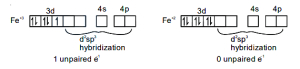
0 likes
View Solution782
DifficultMCQ
Which of the following compounds has a magnetic moment identical to $[Cr(H_{2}O)_{6}]^{3+}$?
A
$[Cu(H_{2}O)_{6}]^{2+}$
B
$[Mn(H_{2}O)_{6}]^{3+}$
C
$[Fe(H_{2}O)_{6}]^{3+}$
D
$[Mn(H_{2}O)_{6}]^{4+}$
Solution
(D) The magnetic moment depends on the number of unpaired electrons $(n)$. The formula is $\mu = \sqrt{n(n+2)} \ BM$.
For $[Cr(H_{2}O)_{6}]^{3+}$: $Cr$ is in $+3$ oxidation state. Electronic configuration of $Cr^{3+}$ is $[Ar] 3d^{3}$. Number of unpaired electrons $(n)$ = $3$.
Now,let us check the number of unpaired electrons for each option:
$A$) $[Cu(H_{2}O)_{6}]^{2+}$: $Cu^{2+}$ is $[Ar] 3d^{9}$,$n = 1$.
$B$) $[Mn(H_{2}O)_{6}]^{3+}$: $Mn^{3+}$ is $[Ar] 3d^{4}$,$n = 4$.
$C$) $[Fe(H_{2}O)_{6}]^{3+}$: $Fe^{3+}$ is $[Ar] 3d^{5}$,$n = 5$.
$D$) $[Mn(H_{2}O)_{6}]^{4+}$: $Mn^{4+}$ is $[Ar] 3d^{3}$,$n = 3$.
Since $[Mn(H_{2}O)_{6}]^{4+}$ has $3$ unpaired electrons,it has the same magnetic moment as $[Cr(H_{2}O)_{6}]^{3+}$.
For $[Cr(H_{2}O)_{6}]^{3+}$: $Cr$ is in $+3$ oxidation state. Electronic configuration of $Cr^{3+}$ is $[Ar] 3d^{3}$. Number of unpaired electrons $(n)$ = $3$.
Now,let us check the number of unpaired electrons for each option:
$A$) $[Cu(H_{2}O)_{6}]^{2+}$: $Cu^{2+}$ is $[Ar] 3d^{9}$,$n = 1$.
$B$) $[Mn(H_{2}O)_{6}]^{3+}$: $Mn^{3+}$ is $[Ar] 3d^{4}$,$n = 4$.
$C$) $[Fe(H_{2}O)_{6}]^{3+}$: $Fe^{3+}$ is $[Ar] 3d^{5}$,$n = 5$.
$D$) $[Mn(H_{2}O)_{6}]^{4+}$: $Mn^{4+}$ is $[Ar] 3d^{3}$,$n = 3$.
Since $[Mn(H_{2}O)_{6}]^{4+}$ has $3$ unpaired electrons,it has the same magnetic moment as $[Cr(H_{2}O)_{6}]^{3+}$.
0 likes
View Solution783
MediumMCQ
Compounds with spin-only magnetic moment equivalent to five unpaired electrons are
A
$K_{4}[Mn(CN)_{6}]$
B
$[Fe(H_{2}O)_{6}]Cl_{3}$
C
$K_{3}[FeF_{6}]$
D
$K_{4}[MnF_{6}]$
Solution
(B, C, D) The spin-only magnetic moment is given by $\mu = \sqrt{n(n+2)} \text{ BM}$,where $n$ is the number of unpaired electrons. For $n=5$,$\mu = \sqrt{5(5+2)} = \sqrt{35} \approx 5.92 \text{ BM}$.
$(A)$ In $K_{4}[Mn(CN)_{6}]$,$Mn$ is in $+2$ oxidation state $(3d^{5})$. $CN^{-}$ is a strong field ligand,causing pairing of electrons. Thus,$n=1$.
$(B)$ In $[Fe(H_{2}O)_{6}]Cl_{3}$,$Fe$ is in $+3$ oxidation state $(3d^{5})$. $H_{2}O$ is a weak field ligand,so no pairing occurs. Thus,$n=5$.
$(C)$ In $K_{3}[FeF_{6}]$,$Fe$ is in $+3$ oxidation state $(3d^{5})$. $F^{-}$ is a weak field ligand,so no pairing occurs. Thus,$n=5$.
$(D)$ In $K_{4}[MnF_{6}]$,$Mn$ is in $+2$ oxidation state $(3d^{5})$. $F^{-}$ is a weak field ligand,so no pairing occurs. Thus,$n=5$.
Therefore,the compounds with five unpaired electrons are $(B)$,$(C)$,and $(D)$.
$(A)$ In $K_{4}[Mn(CN)_{6}]$,$Mn$ is in $+2$ oxidation state $(3d^{5})$. $CN^{-}$ is a strong field ligand,causing pairing of electrons. Thus,$n=1$.
$(B)$ In $[Fe(H_{2}O)_{6}]Cl_{3}$,$Fe$ is in $+3$ oxidation state $(3d^{5})$. $H_{2}O$ is a weak field ligand,so no pairing occurs. Thus,$n=5$.
$(C)$ In $K_{3}[FeF_{6}]$,$Fe$ is in $+3$ oxidation state $(3d^{5})$. $F^{-}$ is a weak field ligand,so no pairing occurs. Thus,$n=5$.
$(D)$ In $K_{4}[MnF_{6}]$,$Mn$ is in $+2$ oxidation state $(3d^{5})$. $F^{-}$ is a weak field ligand,so no pairing occurs. Thus,$n=5$.
Therefore,the compounds with five unpaired electrons are $(B)$,$(C)$,and $(D)$.
0 likes
View Solution784
MediumMCQ
Amongst $[Ni(H_{2}O)_{6}]^{2+}$,$[Ni(PPh_{3})_{2}Cl_{2}]$,$[Ni(CO)_{4}]$ and $[Ni(CN)_{4}]^{2-}$,the paramagnetic species are
A
$[Ni(H_{2}O)_{6}]^{2+}$ and $[Ni(PPh_{3})_{2}Cl_{2}]$
B
$[Ni(CO)_{4}]$ and $[Ni(CN)_{4}]^{2-}$
C
$[Ni(H_{2}O)_{6}]^{2+}$ and $[Ni(CN)_{4}]^{2-}$
D
$[Ni(PPh_{3})_{2}Cl_{2}]$ and $[Ni(CO)_{4}]$
Solution
(A) Species having unpaired electrons are paramagnetic.
$Ni$ has atomic number $28$,electronic configuration $[Ar] 3d^{8} 4s^{2}$.
$1$. $[Ni(H_{2}O)_{6}]^{2+}$: $Ni$ is in $+2$ oxidation state $(3d^{8})$. $H_{2}O$ is a weak field ligand,so no pairing occurs. It has $2$ unpaired electrons (Paramagnetic).
$2$. $[Ni(PPh_{3})_{2}Cl_{2}]$: $Ni$ is in $+2$ oxidation state $(3d^{8})$. It is a tetrahedral complex. Due to the presence of $Cl^{-}$ ligands,it remains high spin with $2$ unpaired electrons (Paramagnetic).
$3$. $[Ni(CO)_{4}]$: $Ni$ is in $0$ oxidation state $(3d^{8} 4s^{2})$. $CO$ is a strong field ligand,causing pairing of all electrons. It has $0$ unpaired electrons (Diamagnetic).
$4$. $[Ni(CN)_{4}]^{2-}$: $Ni$ is in $+2$ oxidation state $(3d^{8})$. $CN^{-}$ is a strong field ligand,causing pairing of electrons. It has $0$ unpaired electrons (Diamagnetic).
Thus,$[Ni(H_{2}O)_{6}]^{2+}$ and $[Ni(PPh_{3})_{2}Cl_{2}]$ are paramagnetic.
$Ni$ has atomic number $28$,electronic configuration $[Ar] 3d^{8} 4s^{2}$.
$1$. $[Ni(H_{2}O)_{6}]^{2+}$: $Ni$ is in $+2$ oxidation state $(3d^{8})$. $H_{2}O$ is a weak field ligand,so no pairing occurs. It has $2$ unpaired electrons (Paramagnetic).
$2$. $[Ni(PPh_{3})_{2}Cl_{2}]$: $Ni$ is in $+2$ oxidation state $(3d^{8})$. It is a tetrahedral complex. Due to the presence of $Cl^{-}$ ligands,it remains high spin with $2$ unpaired electrons (Paramagnetic).
$3$. $[Ni(CO)_{4}]$: $Ni$ is in $0$ oxidation state $(3d^{8} 4s^{2})$. $CO$ is a strong field ligand,causing pairing of all electrons. It has $0$ unpaired electrons (Diamagnetic).
$4$. $[Ni(CN)_{4}]^{2-}$: $Ni$ is in $+2$ oxidation state $(3d^{8})$. $CN^{-}$ is a strong field ligand,causing pairing of electrons. It has $0$ unpaired electrons (Diamagnetic).
Thus,$[Ni(H_{2}O)_{6}]^{2+}$ and $[Ni(PPh_{3})_{2}Cl_{2}]$ are paramagnetic.
0 likes
View Solution785
EasyMCQ
The calculated spin-only magnetic moment values in $BM$ for $[FeCl_4]^-$ and $[Fe(CN)_6]^{3-}$ are
A
$5.9 \ BM, 1.732 \ BM$
B
$4.89 \ BM, 1.732 \ BM$
C
$3.87 \ BM, 1.732 \ BM$
D
$1.732 \ BM, 2.82 \ BM$
Solution
(A) For both complexes,the central metal ion is $Fe^{3+}$.
Electronic configuration of $Fe^{3+}$ is $[Ar] 3d^5$.
In $[FeCl_4]^-$,$Cl^-$ is a weak field ligand,so no pairing of electrons occurs. The number of unpaired electrons $(n)$ is $5$.
The spin-only magnetic moment is $\mu = \sqrt{n(n+2)} = \sqrt{5(5+2)} = \sqrt{35} \approx 5.9 \ BM$.
In $[Fe(CN)_6]^{3-}$,$CN^-$ is a strong field ligand,causing pairing of electrons. The configuration becomes $t_{2g}^5 e_g^0$,leaving $n = 1$ unpaired electron.
The spin-only magnetic moment is $\mu = \sqrt{1(1+2)} = \sqrt{3} \approx 1.732 \ BM$.
Thus,the values are $5.9 \ BM$ and $1.732 \ BM$.
Electronic configuration of $Fe^{3+}$ is $[Ar] 3d^5$.
In $[FeCl_4]^-$,$Cl^-$ is a weak field ligand,so no pairing of electrons occurs. The number of unpaired electrons $(n)$ is $5$.
The spin-only magnetic moment is $\mu = \sqrt{n(n+2)} = \sqrt{5(5+2)} = \sqrt{35} \approx 5.9 \ BM$.
In $[Fe(CN)_6]^{3-}$,$CN^-$ is a strong field ligand,causing pairing of electrons. The configuration becomes $t_{2g}^5 e_g^0$,leaving $n = 1$ unpaired electron.
The spin-only magnetic moment is $\mu = \sqrt{1(1+2)} = \sqrt{3} \approx 1.732 \ BM$.
Thus,the values are $5.9 \ BM$ and $1.732 \ BM$.
0 likes
View Solution786
DifficultMCQ
Total number of unpaired electrons present in the central metal atoms/ions of $[Ni(CO)_{4}]$,$[NiCl_{4}]^{2-}$,$[PtCl_{2}(NH_{3})_{2}]$,$[Ni(CN)_{4}]^{2-}$ and $[Pt(CN)_{4}]^{2-}$ is . . . . . . .
A
$0$
B
$2$
C
$4$
D
$6$
Solution
(B) $1$. In $[Ni(CO)_{4}]$,$Ni$ is in $0$ oxidation state $(3d^{8} 4s^{2})$. $CO$ is a strong field ligand,causing pairing of electrons. Hybridisation is $sp^{3}$,unpaired electrons $= 0$.
$2$. In $[NiCl_{4}]^{2-}$,$Ni^{2+}$ is $3d^{8}$. $Cl^{-}$ is a weak field ligand,no pairing occurs. Hybridisation is $sp^{3}$,unpaired electrons $= 2$.
$3$. In $[PtCl_{2}(NH_{3})_{2}]$,$Pt^{2+}$ is $5d^{8}$. $Pt$ is a $5d$ series metal,so pairing occurs even with weak ligands. Hybridisation is $dsp^{2}$,unpaired electrons $= 0$.
$4$. In $[Ni(CN)_{4}]^{2-}$,$Ni^{2+}$ is $3d^{8}$. $CN^{-}$ is a strong field ligand,causing pairing. Hybridisation is $dsp^{2}$,unpaired electrons $= 0$.
$5$. In $[Pt(CN)_{4}]^{2-}$,$Pt^{2+}$ is $5d^{8}$. $CN^{-}$ is a strong field ligand. Hybridisation is $dsp^{2}$,unpaired electrons $= 0$.
Total unpaired electrons $= 0 + 2 + 0 + 0 + 0 = 2$.
$2$. In $[NiCl_{4}]^{2-}$,$Ni^{2+}$ is $3d^{8}$. $Cl^{-}$ is a weak field ligand,no pairing occurs. Hybridisation is $sp^{3}$,unpaired electrons $= 2$.
$3$. In $[PtCl_{2}(NH_{3})_{2}]$,$Pt^{2+}$ is $5d^{8}$. $Pt$ is a $5d$ series metal,so pairing occurs even with weak ligands. Hybridisation is $dsp^{2}$,unpaired electrons $= 0$.
$4$. In $[Ni(CN)_{4}]^{2-}$,$Ni^{2+}$ is $3d^{8}$. $CN^{-}$ is a strong field ligand,causing pairing. Hybridisation is $dsp^{2}$,unpaired electrons $= 0$.
$5$. In $[Pt(CN)_{4}]^{2-}$,$Pt^{2+}$ is $5d^{8}$. $CN^{-}$ is a strong field ligand. Hybridisation is $dsp^{2}$,unpaired electrons $= 0$.
Total unpaired electrons $= 0 + 2 + 0 + 0 + 0 = 2$.
0 likes
View Solution787
DifficultMCQ
$A$ chromium complex with a formula $CrCl_3 \cdot 6H_2O$ has a spin-only magnetic moment value of $3.87 \ BM$ and its solution conductivity corresponds to a $1:2$ electrolyte. $2.75 \ g$ of the complex was dissolved and passed through a cation exchanger. The solution obtained after the process was reacted with excess $AgNO_3$. The amount of $AgCl$ formed in the above process is . . . . . . $g$. (Nearest integer) [Given: Molar mass in $g \ mol^{-1}$: $Cr = 52, Cl = 35.5, Ag = 108, O = 16, H = 1$]
A
$3$
B
$1$
C
$6$
D
$10$
Solution
(A) The spin-only magnetic moment of $3.87 \ BM$ corresponds to $3$ unpaired electrons,indicating $Cr^{3+}$ in an octahedral field. The $1:2$ electrolyte behavior implies the formula is $[Cr(H_2O)_5Cl]Cl_2 \cdot H_2O$.
When passed through a cation exchanger,the complex cation $[Cr(H_2O)_5Cl]^{2+}$ is retained,and the $2Cl^-$ ions are released into the solution.
The molar mass of $[Cr(H_2O)_5Cl]Cl_2 \cdot H_2O = 52 + (5 \times 18) + (3 \times 35.5) + 18 = 266.5 \ g \ mol^{-1}$.
Moles of complex = $\frac{2.75 \ g}{266.5 \ g \ mol^{-1}} \approx 0.0103 \ mol$.
Since each mole of complex releases $2$ moles of $Cl^-$,moles of $AgCl$ formed = $2 \times 0.0103 = 0.0206 \ mol$.
Mass of $AgCl = 0.0206 \ mol \times 143.5 \ g \ mol^{-1} = 2.956 \ g \approx 3 \ g$.
When passed through a cation exchanger,the complex cation $[Cr(H_2O)_5Cl]^{2+}$ is retained,and the $2Cl^-$ ions are released into the solution.
The molar mass of $[Cr(H_2O)_5Cl]Cl_2 \cdot H_2O = 52 + (5 \times 18) + (3 \times 35.5) + 18 = 266.5 \ g \ mol^{-1}$.
Moles of complex = $\frac{2.75 \ g}{266.5 \ g \ mol^{-1}} \approx 0.0103 \ mol$.
Since each mole of complex releases $2$ moles of $Cl^-$,moles of $AgCl$ formed = $2 \times 0.0103 = 0.0206 \ mol$.
Mass of $AgCl = 0.0206 \ mol \times 143.5 \ g \ mol^{-1} = 2.956 \ g \approx 3 \ g$.
0 likes
View Solution788
DifficultMCQ
The correct increasing order of spin-only magnetic moment values of the complex ions $[MnBr_{4}]^{2-}$ $(A)$, $[Cu(H_{2}O)_{6}]^{2+}$ $(B)$, $[Ni(CN)_{4}]^{2-}$ $(C)$ and $[Ni(H_{2}O)_{6}]^{2+}$ $(D)$ is:
A
$C < B < D < A$
B
$C < D < B < A$
C
$A < B < D < C$
D
$D < B < A < C$
Solution
(A) To determine the spin-only magnetic moment $(\mu = \sqrt{n(n+2)} \ BM)$, we calculate the number of unpaired electrons $(n)$ for each complex:
$1$. $[MnBr_{4}]^{2-}$: $Mn^{2+}$ is $3d^{5}$. Since $Br^{-}$ is a weak field ligand, it forms a high-spin tetrahedral complex with $n = 5$.
$2$. $[Cu(H_{2}O)_{6}]^{2+}$: $Cu^{2+}$ is $3d^{9}$. It has $n = 1$ unpaired electron.
$3$. $[Ni(CN)_{4}]^{2-}$: $Ni^{2+}$ is $3d^{8}$. Since $CN^{-}$ is a strong field ligand, it forms a square planar complex with $n = 0$.
$4$. $[Ni(H_{2}O)_{6}]^{2+}$: $Ni^{2+}$ is $3d^{8}$. It forms an octahedral complex with $n = 2$ unpaired electrons.
Comparing the number of unpaired electrons: $C (n=0) < B (n=1) < D (n=2) < A (n=5)$.
Thus, the increasing order of magnetic moments is $C < B < D < A$.
$1$. $[MnBr_{4}]^{2-}$: $Mn^{2+}$ is $3d^{5}$. Since $Br^{-}$ is a weak field ligand, it forms a high-spin tetrahedral complex with $n = 5$.
$2$. $[Cu(H_{2}O)_{6}]^{2+}$: $Cu^{2+}$ is $3d^{9}$. It has $n = 1$ unpaired electron.
$3$. $[Ni(CN)_{4}]^{2-}$: $Ni^{2+}$ is $3d^{8}$. Since $CN^{-}$ is a strong field ligand, it forms a square planar complex with $n = 0$.
$4$. $[Ni(H_{2}O)_{6}]^{2+}$: $Ni^{2+}$ is $3d^{8}$. It forms an octahedral complex with $n = 2$ unpaired electrons.
Comparing the number of unpaired electrons: $C (n=0) < B (n=1) < D (n=2) < A (n=5)$.
Thus, the increasing order of magnetic moments is $C < B < D < A$.
0 likes
View Solution789
DifficultMCQ
$X$ is the number of geometrical isomers exhibited by $[Pt(NH_3)(H_2O)BrCl]$.
$Y$ is the number of optically inactive isomer$(s)$ exhibited by $[CrCl_2(ox)_2]^{3-}$.
$Z$ is the number of geometrical isomers exhibited by $[Co(NH_3)_3(NO_2)_3]$.
The value of $X+Y+Z$ is . . . . . . .
$Y$ is the number of optically inactive isomer$(s)$ exhibited by $[CrCl_2(ox)_2]^{3-}$.
$Z$ is the number of geometrical isomers exhibited by $[Co(NH_3)_3(NO_2)_3]$.
The value of $X+Y+Z$ is . . . . . . .
A
$4$
B
$5$
C
$6$
D
$7$
Solution
(C) $X$: For square planar complex $[M(abcd)]$,the number of geometrical isomers is $3$ (three pairs of trans ligands).
$Y$: For octahedral complex $[M(aa)_2b_2]$,the $cis$-isomer is optically active (chiral) and the $trans$-isomer is optically inactive (achiral). Thus,$Y = 1$.
$Z$: For octahedral complex $[Ma_3b_3]$,the geometrical isomers are $fac$ (facial) and $mer$ (meridional). Thus,$Z = 2$.
$X+Y+Z = 3+1+2 = 6$.
$Y$: For octahedral complex $[M(aa)_2b_2]$,the $cis$-isomer is optically active (chiral) and the $trans$-isomer is optically inactive (achiral). Thus,$Y = 1$.
$Z$: For octahedral complex $[Ma_3b_3]$,the geometrical isomers are $fac$ (facial) and $mer$ (meridional). Thus,$Z = 2$.
$X+Y+Z = 3+1+2 = 6$.
0 likes
View Solution790
DifficultMCQ
Given below are two statements:
Statement-$I$ : The number of paramagnetic species among $[CoF_6]^{3-}$,$[TiF_6]^{3-}$,$V_2O_5$ and $[Fe(CN)_6]^{3-}$ is $3$.
Statement-$II$ : $K_4[Fe(CN)_6] < K_3[Fe(CN)_6] < [Fe(H_2O)_6]SO_4 \cdot H_2O < [Fe(H_2O)_6]Cl_3$ is the correct order in terms of number of unpaired electron$(s)$ in the complexes.
In the light of the above statements,choose the correct answer from the options given below.
Statement-$I$ : The number of paramagnetic species among $[CoF_6]^{3-}$,$[TiF_6]^{3-}$,$V_2O_5$ and $[Fe(CN)_6]^{3-}$ is $3$.
Statement-$II$ : $K_4[Fe(CN)_6] < K_3[Fe(CN)_6] < [Fe(H_2O)_6]SO_4 \cdot H_2O < [Fe(H_2O)_6]Cl_3$ is the correct order in terms of number of unpaired electron$(s)$ in the complexes.
In the light of the above statements,choose the correct answer from the options given below.
A
Both statement-$I$ and statement-$II$ are true
B
Both statement-$I$ and statement-$II$ are false
C
Statement-$I$ is true but statement-$II$ is false
D
Statement-$I$ is false but statement-$II$ is true
Solution
(A) Statement-$I$:
$1$. $[CoF_6]^{3-}$: $Co^{3+}$ $(d^6)$,$F^-$ is a weak field ligand,configuration is $t_{2g}^4 e_g^2$,$4$ unpaired electrons (Paramagnetic).
$2$. $[TiF_6]^{3-}$: $Ti^{3+}$ $(d^1)$,$1$ unpaired electron (Paramagnetic).
$3$. $V_2O_5$: $V^{5+}$ $(d^0)$,$0$ unpaired electrons (Diamagnetic).
$4$. $[Fe(CN)_6]^{3-}$: $Fe^{3+}$ $(d^5)$,$CN^-$ is a strong field ligand,configuration is $t_{2g}^5 e_g^0$,$1$ unpaired electron (Paramagnetic).
Total paramagnetic species = $3$. Statement-$I$ is true.
Statement-$II$:
$1$. $K_4[Fe(CN)_6]$: $Fe^{2+}$ $(d^6)$,strong field,$0$ unpaired electrons.
$2$. $K_3[Fe(CN)_6]$: $Fe^{3+}$ $(d^5)$,strong field,$1$ unpaired electron.
$3$. $[Fe(H_2O)_6]SO_4 \cdot H_2O$: $Fe^{2+}$ $(d^6)$,weak field,$4$ unpaired electrons.
$4$. $[Fe(H_2O)_6]Cl_3$: $Fe^{3+}$ $(d^5)$,weak field,$5$ unpaired electrons.
Order: $0 < 1 < 4 < 5$. Statement-$II$ is true.
$1$. $[CoF_6]^{3-}$: $Co^{3+}$ $(d^6)$,$F^-$ is a weak field ligand,configuration is $t_{2g}^4 e_g^2$,$4$ unpaired electrons (Paramagnetic).
$2$. $[TiF_6]^{3-}$: $Ti^{3+}$ $(d^1)$,$1$ unpaired electron (Paramagnetic).
$3$. $V_2O_5$: $V^{5+}$ $(d^0)$,$0$ unpaired electrons (Diamagnetic).
$4$. $[Fe(CN)_6]^{3-}$: $Fe^{3+}$ $(d^5)$,$CN^-$ is a strong field ligand,configuration is $t_{2g}^5 e_g^0$,$1$ unpaired electron (Paramagnetic).
Total paramagnetic species = $3$. Statement-$I$ is true.
Statement-$II$:
$1$. $K_4[Fe(CN)_6]$: $Fe^{2+}$ $(d^6)$,strong field,$0$ unpaired electrons.
$2$. $K_3[Fe(CN)_6]$: $Fe^{3+}$ $(d^5)$,strong field,$1$ unpaired electron.
$3$. $[Fe(H_2O)_6]SO_4 \cdot H_2O$: $Fe^{2+}$ $(d^6)$,weak field,$4$ unpaired electrons.
$4$. $[Fe(H_2O)_6]Cl_3$: $Fe^{3+}$ $(d^5)$,weak field,$5$ unpaired electrons.
Order: $0 < 1 < 4 < 5$. Statement-$II$ is true.
0 likes
View Solution791
DifficultMCQ
Identify the metal ions among $Co^{2+}, Ni^{2+}, Fe^{2+}, V^{3+}$ and $Ti^{2+}$ having a spin-only magnetic moment value more than $3.0 \ BM$. The sum of unpaired electrons present in the high spin octahedral complexes formed by those metal ions is . . . . . . .
A
$7$
B
$5$
C
$9$
D
$4$
Solution
(A) The spin-only magnetic moment is given by $\mu = \sqrt{n(n+2)} \ BM$,where $n$ is the number of unpaired electrons.
For $\mu > 3.0 \ BM$,we need $\sqrt{n(n+2)} > 3.0$,which implies $n(n+2) > 9$. This holds for $n \geq 3$.
Electronic configurations:
$V^{3+} (3d^2): n = 2, \mu = \sqrt{2(4)} = 2.83 \ BM$
$Ti^{2+} (3d^2): n = 2, \mu = \sqrt{2(4)} = 2.83 \ BM$
$Ni^{2+} (3d^8): n = 2, \mu = \sqrt{2(4)} = 2.83 \ BM$
$Fe^{2+} (3d^6): n = 4, \mu = \sqrt{4(6)} = 4.90 \ BM$
$Co^{2+} (3d^7): n = 3, \mu = \sqrt{3(5)} = 3.87 \ BM$
Thus,$Fe^{2+}$ and $Co^{2+}$ have $\mu > 3.0 \ BM$.
In high spin octahedral complexes:
$Fe^{2+} (3d^6)$ has $4$ unpaired electrons.
$Co^{2+} (3d^7)$ has $3$ unpaired electrons.
Sum of unpaired electrons = $4 + 3 = 7$.
For $\mu > 3.0 \ BM$,we need $\sqrt{n(n+2)} > 3.0$,which implies $n(n+2) > 9$. This holds for $n \geq 3$.
Electronic configurations:
$V^{3+} (3d^2): n = 2, \mu = \sqrt{2(4)} = 2.83 \ BM$
$Ti^{2+} (3d^2): n = 2, \mu = \sqrt{2(4)} = 2.83 \ BM$
$Ni^{2+} (3d^8): n = 2, \mu = \sqrt{2(4)} = 2.83 \ BM$
$Fe^{2+} (3d^6): n = 4, \mu = \sqrt{4(6)} = 4.90 \ BM$
$Co^{2+} (3d^7): n = 3, \mu = \sqrt{3(5)} = 3.87 \ BM$
Thus,$Fe^{2+}$ and $Co^{2+}$ have $\mu > 3.0 \ BM$.
In high spin octahedral complexes:
$Fe^{2+} (3d^6)$ has $4$ unpaired electrons.
$Co^{2+} (3d^7)$ has $3$ unpaired electrons.
Sum of unpaired electrons = $4 + 3 = 7$.
0 likes
View Solution792
MediumMCQ
If $[Co(NH_3)_x(NO_2)_y]$ shows facial and meridional isomers,identify the values of $x$ and $y$.
A
$x = 4, y = 2$
B
$x = 2, y = 2$
C
$x = 2, y = 4$
D
$x = 3, y = 3$
Solution
(D) Facial $(fac)$ and meridional $(mer)$ isomerism is a specific type of geometric isomerism observed in octahedral complexes with the general formula $MA_3B_3$.
In this type of isomerism,three identical ligands occupy either one face of the octahedron ($fac$-isomer) or a plane passing through the metal atom ($mer$-isomer).
For the given complex $[Co(NH_3)_x(NO_2)_y]$,to exhibit $fac$ and $mer$ isomerism,the coordination number must be $6$ and the stoichiometry must match the $MA_3B_3$ pattern.
Therefore,$x$ must be $3$ and $y$ must be $3$,resulting in the complex $[Co(NH_3)_3(NO_2)_3]$.
In this type of isomerism,three identical ligands occupy either one face of the octahedron ($fac$-isomer) or a plane passing through the metal atom ($mer$-isomer).
For the given complex $[Co(NH_3)_x(NO_2)_y]$,to exhibit $fac$ and $mer$ isomerism,the coordination number must be $6$ and the stoichiometry must match the $MA_3B_3$ pattern.
Therefore,$x$ must be $3$ and $y$ must be $3$,resulting in the complex $[Co(NH_3)_3(NO_2)_3]$.
0 likes
View Solution793
DifficultMCQ
Match the List-$I$ with List-$II$:
Choose the correct answer from the options given below:
| List-$I$ (Complex ion) | List-$II$ (Calculated spin only magnetic moment $(BM)$) |
| $A$. $[Cr(H_2O)_6]^{2+}$ | $I$. $3.87$ |
| $B$. $[Co(H_2O)_6]^{2+}$ | $II$. $5.92$ |
| $C$. $[Cu(H_2O)_6]^{2+}$ | $III$. $4.90$ |
| $D$. $[Mn(H_2O)_6]^{2+}$ | $IV$. $1.73$ |
Choose the correct answer from the options given below:
A
$A-I, B-III, C-IV, D-II$
B
$A-II, B-I, C-III, D-IV$
C
$A-IV, B-II, C-I, D-III$
D
$A-III, B-I, C-IV, D-II$
Solution
(D) The spin-only magnetic moment $(mu)$ is calculated using the formula $\mu = \sqrt{n(n+2)} \text{ BM}$,where $n$ is the number of unpaired electrons.
$A$. $[Cr(H_2O)_6]^{2+}$: $Cr^{2+}$ has a $d^4$ configuration. Number of unpaired electrons $(n)$ = $4$. $\mu = \sqrt{4(4+2)} = \sqrt{24} \approx 4.90 \text{ BM}$ $(III)$.
$B$. $[Co(H_2O)_6]^{2+}$: $Co^{2+}$ has a $d^7$ configuration. Number of unpaired electrons $(n)$ = $3$. $\mu = \sqrt{3(3+2)} = \sqrt{15} \approx 3.87 \text{ BM}$ $(I)$.
$C$. $[Cu(H_2O)_6]^{2+}$: $Cu^{2+}$ has a $d^9$ configuration. Number of unpaired electrons $(n)$ = $1$. $\mu = \sqrt{1(1+2)} = \sqrt{3} \approx 1.73 \text{ BM}$ $(IV)$.
$D$. $[Mn(H_2O)_6]^{2+}$: $Mn^{2+}$ has a $d^5$ configuration. Number of unpaired electrons $(n)$ = $5$. $\mu = \sqrt{5(5+2)} = \sqrt{35} \approx 5.92 \text{ BM}$ $(II)$.
Therefore,the correct matching is $A-III, B-I, C-IV, D-II$.
$A$. $[Cr(H_2O)_6]^{2+}$: $Cr^{2+}$ has a $d^4$ configuration. Number of unpaired electrons $(n)$ = $4$. $\mu = \sqrt{4(4+2)} = \sqrt{24} \approx 4.90 \text{ BM}$ $(III)$.
$B$. $[Co(H_2O)_6]^{2+}$: $Co^{2+}$ has a $d^7$ configuration. Number of unpaired electrons $(n)$ = $3$. $\mu = \sqrt{3(3+2)} = \sqrt{15} \approx 3.87 \text{ BM}$ $(I)$.
$C$. $[Cu(H_2O)_6]^{2+}$: $Cu^{2+}$ has a $d^9$ configuration. Number of unpaired electrons $(n)$ = $1$. $\mu = \sqrt{1(1+2)} = \sqrt{3} \approx 1.73 \text{ BM}$ $(IV)$.
$D$. $[Mn(H_2O)_6]^{2+}$: $Mn^{2+}$ has a $d^5$ configuration. Number of unpaired electrons $(n)$ = $5$. $\mu = \sqrt{5(5+2)} = \sqrt{35} \approx 5.92 \text{ BM}$ $(II)$.
Therefore,the correct matching is $A-III, B-I, C-IV, D-II$.
0 likes
View Solution794
DifficultMCQ
Which of the following complexes will show coordination isomerism?
$A. [Ag(NH_3)_2][Ag(CN)_2]$
$B. [Co(NH_3)_6][Cr(CN)_6]$
$C. [Co(NH_3)_6][Co(CN)_6]$
$D. [Fe(NH_3)_6][Co(CN)_6]$
$E. [Co(NH_3)_6][Fe(CN)_6]$
Choose the correct answer from the options given below:
$A. [Ag(NH_3)_2][Ag(CN)_2]$
$B. [Co(NH_3)_6][Cr(CN)_6]$
$C. [Co(NH_3)_6][Co(CN)_6]$
$D. [Fe(NH_3)_6][Co(CN)_6]$
$E. [Co(NH_3)_6][Fe(CN)_6]$
Choose the correct answer from the options given below:
A
$B, C$ and $D$ Only
B
$B, D$ and $E$ Only
C
$A, C$ and $D$ Only
D
$C, D$ and $E$ Only
Solution
(D) Coordination isomerism occurs in coordination compounds where both the cation and the anion are complex ions,and the ligands can be exchanged between the metal centers.
For coordination isomerism to occur,both the metal ions must be different or the ligands must be different,allowing for the formation of isomers like $[M_1(L_1)_n][M_2(L_2)_m] \rightleftharpoons [M_1(L_2)_m][M_2(L_1)_n]$.
In option $A$,the metal ions are the same $(Ag^+)$,so exchanging ligands does not result in a new isomer.
In options $B, C, D,$ and $E$,the complexes consist of two different metal centers (or different combinations of ligands),which allows for the exchange of ligands between the coordination spheres.
Specifically,complexes $B, C, D,$ and $E$ all satisfy the condition of having complex cations and complex anions with different metal centers or ligand sets,thus exhibiting coordination isomerism.
Therefore,the correct set is $B, C, D,$ and $E$. However,based on the provided options,the most appropriate choice is $D$ ($C, D$ and $E$ Only) as it includes the valid complexes.
For coordination isomerism to occur,both the metal ions must be different or the ligands must be different,allowing for the formation of isomers like $[M_1(L_1)_n][M_2(L_2)_m] \rightleftharpoons [M_1(L_2)_m][M_2(L_1)_n]$.
In option $A$,the metal ions are the same $(Ag^+)$,so exchanging ligands does not result in a new isomer.
In options $B, C, D,$ and $E$,the complexes consist of two different metal centers (or different combinations of ligands),which allows for the exchange of ligands between the coordination spheres.
Specifically,complexes $B, C, D,$ and $E$ all satisfy the condition of having complex cations and complex anions with different metal centers or ligand sets,thus exhibiting coordination isomerism.
Therefore,the correct set is $B, C, D,$ and $E$. However,based on the provided options,the most appropriate choice is $D$ ($C, D$ and $E$ Only) as it includes the valid complexes.
0 likes
View Solution795
DifficultMCQ
Number of paramagnetic complexes among the following is . . . . . . . $[MnBr_4]^{2-}$,$[NiCl_4]^{2-}$,$[Ni(CN)_4]^{2-}$,$[Ni(CO)_4]$,$[CoF_6]^{3-}$,$[Fe(CN)_6]^{4-}$,$[Mn(CN)_6]^{3-}$,$[Ti(CN)_6]^{3-}$,$[Cu(H_2O)_6]^{2+}$,$[Co(C_2O_4)_3]^{3-}$
A
$4$
B
$5$
C
$6$
D
$7$
Solution
(C) To determine the number of paramagnetic complexes,we analyze the electronic configuration of the central metal ion in each complex:
$1$. $[MnBr_4]^{2-}$: $Mn^{2+}$ $(d^5)$,weak field ligand,$5$ unpaired electrons. (Paramagnetic)
$2$. $[NiCl_4]^{2-}$: $Ni^{2+}$ $(d^8)$,weak field ligand,$2$ unpaired electrons. (Paramagnetic)
$3$. $[Ni(CN)_4]^{2-}$: $Ni^{2+}$ $(d^8)$,strong field ligand,$dsp^2$ hybridization,$0$ unpaired electrons. (Diamagnetic)
$4$. $[Ni(CO)_4]$: $Ni^0$ $(d^{10})$,strong field ligand,$sp^3$ hybridization,$0$ unpaired electrons. (Diamagnetic)
$5$. $[CoF_6]^{3-}$: $Co^{3+}$ $(d^6)$,weak field ligand,$4$ unpaired electrons. (Paramagnetic)
$6$. $[Fe(CN)_6]^{4-}$: $Fe^{2+}$ $(d^6)$,strong field ligand,$t_{2g}^6 e_g^0$,$0$ unpaired electrons. (Diamagnetic)
$7$. $[Mn(CN)_6]^{3-}$: $Mn^{3+}$ $(d^4)$,strong field ligand,$t_{2g}^3 e_g^1$,$2$ unpaired electrons. (Paramagnetic)
$8$. $[Ti(CN)_6]^{3-}$: $Ti^{3+}$ $(d^1)$,$1$ unpaired electron. (Paramagnetic)
$9$. $[Cu(H_2O)_6]^{2+}$: $Cu^{2+}$ $(d^9)$,$1$ unpaired electron. (Paramagnetic)
$10$. $[Co(C_2O_4)_3]^{3-}$: $Co^{3+}$ $(d^6)$,strong field ligand,$t_{2g}^6 e_g^0$,$0$ unpaired electrons. (Diamagnetic)
Total paramagnetic complexes = $6$.
$1$. $[MnBr_4]^{2-}$: $Mn^{2+}$ $(d^5)$,weak field ligand,$5$ unpaired electrons. (Paramagnetic)
$2$. $[NiCl_4]^{2-}$: $Ni^{2+}$ $(d^8)$,weak field ligand,$2$ unpaired electrons. (Paramagnetic)
$3$. $[Ni(CN)_4]^{2-}$: $Ni^{2+}$ $(d^8)$,strong field ligand,$dsp^2$ hybridization,$0$ unpaired electrons. (Diamagnetic)
$4$. $[Ni(CO)_4]$: $Ni^0$ $(d^{10})$,strong field ligand,$sp^3$ hybridization,$0$ unpaired electrons. (Diamagnetic)
$5$. $[CoF_6]^{3-}$: $Co^{3+}$ $(d^6)$,weak field ligand,$4$ unpaired electrons. (Paramagnetic)
$6$. $[Fe(CN)_6]^{4-}$: $Fe^{2+}$ $(d^6)$,strong field ligand,$t_{2g}^6 e_g^0$,$0$ unpaired electrons. (Diamagnetic)
$7$. $[Mn(CN)_6]^{3-}$: $Mn^{3+}$ $(d^4)$,strong field ligand,$t_{2g}^3 e_g^1$,$2$ unpaired electrons. (Paramagnetic)
$8$. $[Ti(CN)_6]^{3-}$: $Ti^{3+}$ $(d^1)$,$1$ unpaired electron. (Paramagnetic)
$9$. $[Cu(H_2O)_6]^{2+}$: $Cu^{2+}$ $(d^9)$,$1$ unpaired electron. (Paramagnetic)
$10$. $[Co(C_2O_4)_3]^{3-}$: $Co^{3+}$ $(d^6)$,strong field ligand,$t_{2g}^6 e_g^0$,$0$ unpaired electrons. (Diamagnetic)
Total paramagnetic complexes = $6$.
0 likes
View Solution796
MediumMCQ
Match List $I$ with List $II$ :
Choose the correct answer from the options given below :
| List $I$ (Complex) | List $II$ (Type of isomerism) |
| $A$. $[Pt(NH_3)_2Cl_2]$ | $I$. Optical |
| $B$. $[Co(en)_3]^{3+}$ | $II$. Solvate |
| $C$. $[Co(NH_3)_5NO_2]Cl_2$ | $III$. Geometrical |
| $D$. $[Cr(H_2O)_6]Cl_3$ | $IV$. Linkage |
Choose the correct answer from the options given below :
A
$A-I, B-III, C-II, D-IV$
B
$A-II, B-IV, C-III, D-I$
C
$A-III, B-I, C-IV, D-II$
D
$A-III, B-I, C-II, D-IV$
Solution
(C) . $[Pt(NH_3)_2Cl_2]$ shows geometrical isomerism (cis-trans).
$B$. $[Co(en)_3]^{3+}$ shows optical isomerism due to the lack of a plane of symmetry.
$C$. $[Co(NH_3)_5NO_2]Cl_2$ exhibits linkage isomerism because of the ambidentate $NO_2^-$ ligand.
$D$. $[Cr(H_2O)_6]Cl_3$ exhibits solvate (hydrate) isomerism.
Therefore,the correct matching is $A-III, B-I, C-IV, D-II$.
$B$. $[Co(en)_3]^{3+}$ shows optical isomerism due to the lack of a plane of symmetry.
$C$. $[Co(NH_3)_5NO_2]Cl_2$ exhibits linkage isomerism because of the ambidentate $NO_2^-$ ligand.
$D$. $[Cr(H_2O)_6]Cl_3$ exhibits solvate (hydrate) isomerism.
Therefore,the correct matching is $A-III, B-I, C-IV, D-II$.
0 likes
View Solution797
MediumMCQ
The calculated 'spin-only' magnetic moment of $Ti^{2+}$ $(3d^2)$ is: (in $BM$)
A
$3.87$
B
$4.90$
C
$2.84$
D
$5.92$
Solution
(C) The formula for the spin-only magnetic moment is $\mu = \sqrt{n(n+2)}$ $BM$,where $n$ is the number of unpaired electrons.
For the $Ti^{2+}$ ion with electronic configuration $3d^2$,the number of unpaired electrons $n = 2$.
Substituting the value of $n$ into the formula:
$\mu = \sqrt{2(2+2)} = \sqrt{2 \times 4} = \sqrt{8} \approx 2.83$ $BM$.
Rounding to two decimal places,we get $2.84$ $BM$.
Thus,the correct option is $C$.
For the $Ti^{2+}$ ion with electronic configuration $3d^2$,the number of unpaired electrons $n = 2$.
Substituting the value of $n$ into the formula:
$\mu = \sqrt{2(2+2)} = \sqrt{2 \times 4} = \sqrt{8} \approx 2.83$ $BM$.
Rounding to two decimal places,we get $2.84$ $BM$.
Thus,the correct option is $C$.
0 likes
View SolutionCoordination Compounds — Isomerism and Magnetic properties · Frequently Asked Questions
1Are these Coordination Compounds questions useful for JEE and NEET?
Yes. All questions in this section are mapped to JEE Main and NEET exam patterns. Previous year questions from JEE Main, NEET, GUJCET and state-level exams are included with full solutions.
2Can I switch to Hindi or Gujarati for these questions?
Yes. Use the language tabs in the hero section or the sidebar to view the same questions and solutions in English, Hindi or Gujarati.
3How do I generate a question paper from this subtopic?
Use the Vedclass Exam Paper Generator — select the chapter and subtopic, set difficulty, and generate Sets A, B, C, D automatically. First 3 chapters of every subject are free.
Vedclass Products
For Students
Vedclass Test Series
Mock tests in real JEE/NEET style with performance analysis. 5-day free trial.
Start Free TrialFor Teachers
Exam Paper Generator
Generate Set A/B/C/D papers from this chapter in 2 minutes. 3 chapters free.
Try FreeFor Institutes
Online Exam Module
Live online exams with unlimited students, 360° analytics & white-label branding.
See DemoFor Teachers & Institutes
Generate a Coordination Compounds Exam Paper in 2 Minutes
Select subtopic & difficulty — Sets A, B, C, D auto-generated with No Repeat logic.
First 3 chapters of every subject are free — no payment required.