
A English
Hybridisation and Geometry Questions in English
Class 12 Chemistry · Coordination Compounds · Hybridisation and Geometry
436+
Questions
English
Language
100%
With Solutions
Showing 50 of 436 questions in English
301
MediumMCQ
The hybridisation of $Ni$ centre in $[Ni(PPh_3)_2Cl_2]$ and $[NiCl_4]^{2-}$,respectively are
A
$dsp^2$ and $sp^3$
B
$dsp^2$ and $sp^2d$
C
$sp^3$ and $sp^3$
D
$sp^3$ and $dsp^2$
Solution
(A) The oxidation number of $Ni$ in both $[Ni(PPh_3)_2Cl_2]$ and $[NiCl_4]^{2-}$ is $+2$. The electronic configuration of $Ni(II)$ is $[Ar] 3d^8 4s^0$.
In $[Ni(PPh_3)_2Cl_2]$,$PPh_3$ is a strong field ligand,which forces the electrons in the $3d$ orbital to pair up,leaving one $3d$ orbital vacant. This allows for $dsp^2$ hybridisation,resulting in a square planar geometry.
In $[NiCl_4]^{2-}$,$Cl^-$ is a weak field ligand,which does not cause pairing of electrons in the $3d$ orbital. Thus,the $4s$ and $4p$ orbitals are used for $sp^3$ hybridisation,resulting in a tetrahedral geometry.
Therefore,the hybridisation of $Ni$ in $[Ni(PPh_3)_2Cl_2]$ and $[NiCl_4]^{2-}$ are $dsp^2$ and $sp^3$ respectively.
In $[Ni(PPh_3)_2Cl_2]$,$PPh_3$ is a strong field ligand,which forces the electrons in the $3d$ orbital to pair up,leaving one $3d$ orbital vacant. This allows for $dsp^2$ hybridisation,resulting in a square planar geometry.
In $[NiCl_4]^{2-}$,$Cl^-$ is a weak field ligand,which does not cause pairing of electrons in the $3d$ orbital. Thus,the $4s$ and $4p$ orbitals are used for $sp^3$ hybridisation,resulting in a tetrahedral geometry.
Therefore,the hybridisation of $Ni$ in $[Ni(PPh_3)_2Cl_2]$ and $[NiCl_4]^{2-}$ are $dsp^2$ and $sp^3$ respectively.
0 likes
View Solution302
MediumMCQ
Hybridizations of the central atom in $[Fe(H_2O)_6]^{3+}$ and $[Co(NH_3)_6]^{3+}$,respectively,are
A
$sp^3d^2$ and $sp^3d^2$
B
$sp^3d^2$ and $d^2sp^3$
C
$d^2sp^3$ and $d^2sp^3$
D
$d^2sp^3$ and $sp^3d^2$
Solution
(B) For $[Fe(H_2O)_6]^{3+}$:
$Fe$ is in $+3$ oxidation state,$Fe^{3+} = [Ar] 3d^5$.
$H_2O$ is a weak field ligand $(WFL)$,so it does not cause pairing of electrons.
Thus,the hybridization is $sp^3d^2$ (outer orbital complex).
For $[Co(NH_3)_6]^{3+}$:
$Co$ is in $+3$ oxidation state,$Co^{3+} = [Ar] 3d^6$.
$NH_3$ is a strong field ligand $(SFL)$,which causes pairing of electrons in the $3d$ orbitals.
Thus,the hybridization is $d^2sp^3$ (inner orbital complex).
Therefore,the hybridizations are $sp^3d^2$ and $d^2sp^3$ respectively.
$Fe$ is in $+3$ oxidation state,$Fe^{3+} = [Ar] 3d^5$.
$H_2O$ is a weak field ligand $(WFL)$,so it does not cause pairing of electrons.
Thus,the hybridization is $sp^3d^2$ (outer orbital complex).
For $[Co(NH_3)_6]^{3+}$:
$Co$ is in $+3$ oxidation state,$Co^{3+} = [Ar] 3d^6$.
$NH_3$ is a strong field ligand $(SFL)$,which causes pairing of electrons in the $3d$ orbitals.
Thus,the hybridization is $d^2sp^3$ (inner orbital complex).
Therefore,the hybridizations are $sp^3d^2$ and $d^2sp^3$ respectively.
0 likes
View Solution303
MediumMCQ
The $d$-electronic configuration of $[CoCl_4]^{2-}$ in a tetrahedral crystal field is $e^m t_2^n$. The sum of '$m$' and the number of unpaired electrons is $.............$.
A
$6$
B
$5$
C
$7$
D
$8$
Solution
(C) The central metal ion is $Co^{2+}$,which has a $3d^7$ electronic configuration.
$Cl^-$ is a weak field ligand $(WFL)$,so pairing does not occur.
In a tetrahedral crystal field,the $d$-orbitals split into $e$ (lower energy) and $t_2$ (higher energy) sets.
According to Hund's rule,the $7$ electrons are filled as follows: $e^4 t_2^3$.
Here,$m = 4$ and $n = 3$.
The number of unpaired electrons is $3$.
Sum of '$m$' and the number of unpaired electrons $= 4 + 3 = 7$.
$Cl^-$ is a weak field ligand $(WFL)$,so pairing does not occur.
In a tetrahedral crystal field,the $d$-orbitals split into $e$ (lower energy) and $t_2$ (higher energy) sets.
According to Hund's rule,the $7$ electrons are filled as follows: $e^4 t_2^3$.
Here,$m = 4$ and $n = 3$.
The number of unpaired electrons is $3$.
Sum of '$m$' and the number of unpaired electrons $= 4 + 3 = 7$.
0 likes
View Solution304
MediumMCQ
The hybridization and magnetic behaviour of the cobalt ion in the $[Co(NH_3)_6]^{3+}$ complex,respectively,are:
A
$sp^3d^2$ and diamagnetic
B
$d^2sp^3$ and paramagnetic
C
$d^2sp^3$ and diamagnetic
D
$sp^3d^2$ and paramagnetic
Solution
(C) $1$. The oxidation state of $Co$ in $[Co(NH_3)_6]^{3+}$ is $+3$.
$2$. The electronic configuration of $Co^{3+}$ is $[Ar] 3d^6$.
$3$. $NH_3$ is a strong field ligand,which causes pairing of electrons in the $3d$ orbitals.
$4$. After pairing,the $3d$ orbitals have two vacant $d$-orbitals,one $4s$ orbital,and three $4p$ orbitals available for hybridization.
$5$. This results in $d^2sp^3$ hybridization,which is inner orbital octahedral geometry.
$6$. Since all electrons are paired in the $3d$ orbitals,the complex is diamagnetic.
$2$. The electronic configuration of $Co^{3+}$ is $[Ar] 3d^6$.
$3$. $NH_3$ is a strong field ligand,which causes pairing of electrons in the $3d$ orbitals.
$4$. After pairing,the $3d$ orbitals have two vacant $d$-orbitals,one $4s$ orbital,and three $4p$ orbitals available for hybridization.
$5$. This results in $d^2sp^3$ hybridization,which is inner orbital octahedral geometry.
$6$. Since all electrons are paired in the $3d$ orbitals,the complex is diamagnetic.
0 likes
View Solution305
MediumMCQ
Match List-$I$ with List-$II$:
| List-$I$ (Complexes) | List-$II$ (Hybridisation) |
|---|---|
| $A$. $[Ni(CO)_4]$ | $I$. $sp^3$ |
| $B$. $[Cu(NH_3)_4]^{2+}$ | $II$. $dsp^2$ |
| $C$. $[Fe(NH_3)_6]^{2+}$ | $III$. $sp^3d^2$ |
| $D$. $[Fe(H_2O)_6]^{2+}$ | $IV$. $d^2sp^3$ |
A
$A-II, B-I, C-III, D-IV$
B
$A-I, B-II, C-III, D-IV$
C
$A-II, B-I, C-IV, D-III$
D
$A-I, B-II, C-IV, D-III$
Solution
(D) $1$. $[Ni(CO)_4]$: $Ni$ is in $0$ oxidation state $(3d^8 4s^2)$. $CO$ is a strong field ligand,causing pairing. Hybridisation is $sp^3$ $(I)$.
$2$. $[Cu(NH_3)_4]^{2+}$: $Cu^{2+}$ is $3d^9$. The unpaired electron is in $4p_z$,and the hybridisation is $dsp^2$ $(II)$.
$3$. $[Fe(NH_3)_6]^{2+}$: $Fe^{2+}$ is $3d^6$. $NH_3$ is a strong field ligand,causing pairing. Hybridisation is $d^2sp^3$ $(IV)$.
$4$. $[Fe(H_2O)_6]^{2+}$: $Fe^{2+}$ is $3d^6$. $H_2O$ is a weak field ligand,no pairing. Hybridisation is $sp^3d^2$ $(III)$.
Thus,the correct match is $A-I, B-II, C-IV, D-III$.
$2$. $[Cu(NH_3)_4]^{2+}$: $Cu^{2+}$ is $3d^9$. The unpaired electron is in $4p_z$,and the hybridisation is $dsp^2$ $(II)$.
$3$. $[Fe(NH_3)_6]^{2+}$: $Fe^{2+}$ is $3d^6$. $NH_3$ is a strong field ligand,causing pairing. Hybridisation is $d^2sp^3$ $(IV)$.
$4$. $[Fe(H_2O)_6]^{2+}$: $Fe^{2+}$ is $3d^6$. $H_2O$ is a weak field ligand,no pairing. Hybridisation is $sp^3d^2$ $(III)$.
Thus,the correct match is $A-I, B-II, C-IV, D-III$.
0 likes
View Solution306
MediumMCQ
The $Cl-Co-Cl$ bond angle values in a $fac-[Co(NH_3)_3Cl_3]$ complex is/are:
A
$90^{\circ}$ and $180^{\circ}$
B
$90^{\circ}$
C
$180^{\circ}$
D
$90^{\circ}$ and $120^{\circ}$
Solution
(B) In a $fac-[Co(NH_3)_3Cl_3]$ complex,the three $Cl^-$ ligands occupy one face of the octahedral geometry.
This means the three $Cl^-$ ligands are at the corners of a triangular face.
In this arrangement,each $Cl^-$ ligand is adjacent to the other two $Cl^-$ ligands.
The bond angle between any two adjacent $Cl^-$ ligands in an octahedral geometry is $90^{\circ}$.
Therefore,the only $Cl-Co-Cl$ bond angle present is $90^{\circ}$.
This means the three $Cl^-$ ligands are at the corners of a triangular face.
In this arrangement,each $Cl^-$ ligand is adjacent to the other two $Cl^-$ ligands.
The bond angle between any two adjacent $Cl^-$ ligands in an octahedral geometry is $90^{\circ}$.
Therefore,the only $Cl-Co-Cl$ bond angle present is $90^{\circ}$.
0 likes
View Solution307
MediumMCQ
Cobalt chloride when dissolved in water forms a pink-colored complex $X$ which has an octahedral geometry. This solution,upon treatment with concentrated $HCl$,forms a deep blue complex $Y$ which has a $Z$ geometry. $X$,$Y$,and $Z$,respectively,are:
A
$X = [Co(H_2O)_6]^{2+}, Y = [CoCl_4]^{2-}, Z = \text{Tetrahedral}$
B
$X = [Co(H_2O)_6]^{2+}, Y = [CoCl_6]^{3-}, Z = \text{Octahedral}$
C
$X = [Co(H_2O)_6]^{3+}, Y = [CoCl_6]^{3-}, Z = \text{Octahedral}$
D
$X = [Co(H_2O)_4Cl_2]^{+}, Y = [CoCl_4]^{2-}, Z = \text{Tetrahedral}$
Solution
(A) When $CoCl_2$ is dissolved in water,it forms the pink-colored hexaaquacobalt$(II)$ ion,$[Co(H_2O)_6]^{2+}$,which has an octahedral geometry $(X)$.
Upon adding concentrated $HCl$,the water ligands are replaced by chloride ions to form the deep blue tetrachlorocobaltate$(II)$ ion,$[CoCl_4]^{2-}$ $(Y)$,which has a tetrahedral geometry $(Z)$.
Upon adding concentrated $HCl$,the water ligands are replaced by chloride ions to form the deep blue tetrachlorocobaltate$(II)$ ion,$[CoCl_4]^{2-}$ $(Y)$,which has a tetrahedral geometry $(Z)$.
0 likes
View Solution308
MediumMCQ
The octahedral diamagnetic low spin complex among the following is
A
$[NiCl_4]^{2-}$
B
$[CoCl_6]^{3-}$
C
$[CoF_6]^{3-}$
D
$[Co(NH_3)_6]^{3+}$
Solution
(D) $(A) [NiCl_4]^{2-}$: $Ni^{2+} = [Ar] 3d^8$. $Cl^-$ is a weak field ligand,so it is paramagnetic,high spin,and tetrahedral.
$(B) [CoCl_6]^{3-}$: $Co^{3+} = [Ar] 3d^6$. $Cl^-$ is a weak field ligand,so it is paramagnetic,high spin,and octahedral.
$(C) [CoF_6]^{3-}$: $Co^{3+} = [Ar] 3d^6$. $F^-$ is a weak field ligand,so it is paramagnetic,high spin,and octahedral.
$(D) [Co(NH_3)_6]^{3+}$: $Co^{3+} = [Ar] 3d^6$. $NH_3$ is a strong field ligand,which causes pairing of electrons in $3d$ orbitals. Thus,it is diamagnetic,low spin,and octahedral.
$(B) [CoCl_6]^{3-}$: $Co^{3+} = [Ar] 3d^6$. $Cl^-$ is a weak field ligand,so it is paramagnetic,high spin,and octahedral.
$(C) [CoF_6]^{3-}$: $Co^{3+} = [Ar] 3d^6$. $F^-$ is a weak field ligand,so it is paramagnetic,high spin,and octahedral.
$(D) [Co(NH_3)_6]^{3+}$: $Co^{3+} = [Ar] 3d^6$. $NH_3$ is a strong field ligand,which causes pairing of electrons in $3d$ orbitals. Thus,it is diamagnetic,low spin,and octahedral.
0 likes
View Solution309
MediumMCQ
If $Ni^{2+}$ is replaced by $Pt^{2+}$ in the complex $[NiCl_2Br_2]^{2-}$,which of the following properties are expected to change?
$A.$ Geometry
$B.$ Geometrical isomerism
$C.$ Optical isomerism
$D.$ Magnetic properties
$A.$ Geometry
$B.$ Geometrical isomerism
$C.$ Optical isomerism
$D.$ Magnetic properties
A
$A, B$ and $C$
B
$A, B$ and $D$
C
$A$ and $D$
D
$B$ and $C$
Solution
(B) The complex $[NiCl_2Br_2]^{2-}$ involves a $3d$ metal ion with weak field ligands,resulting in a tetrahedral geometry,which is paramagnetic and does not exhibit geometrical isomerism.
The complex $[PtCl_2Br_2]^{2-}$ involves a $5d$ metal ion,which forces pairing of electrons,resulting in a square planar geometry,which is diamagnetic and exhibits geometrical isomerism (cis and trans forms).
Therefore,the properties that change are:
$1.$ Geometry (Tetrahedral to Square Planar)
$2.$ Geometrical isomerism (Absent to Present)
$3.$ Magnetic properties (Paramagnetic to Diamagnetic)
Thus,$A, B,$ and $D$ are expected to change.
The complex $[PtCl_2Br_2]^{2-}$ involves a $5d$ metal ion,which forces pairing of electrons,resulting in a square planar geometry,which is diamagnetic and exhibits geometrical isomerism (cis and trans forms).
Therefore,the properties that change are:
$1.$ Geometry (Tetrahedral to Square Planar)
$2.$ Geometrical isomerism (Absent to Present)
$3.$ Magnetic properties (Paramagnetic to Diamagnetic)
Thus,$A, B,$ and $D$ are expected to change.
0 likes
View Solution310
DifficultMCQ
Identify from the following species in which $d^2 sp^3$ hybridization is shown by the central atom:
A
$[Co(NH_3)_6]^{3+}$
B
$BrF_5$
C
$[PtCl_4]^{2-}$
D
$SF_6$
Solution
(A) $[Co(NH_3)_6]^{3+}$: The central metal ion $Co^{3+}$ has a $d^6$ configuration. In the presence of strong field ligand $NH_3$,electrons pair up,providing two vacant $3d$ orbitals for $d^2 sp^3$ hybridization.
$BrF_5$: The central atom $Br$ undergoes $sp^3 d^2$ hybridization.
$[PtCl_4]^{2-}$: The central metal ion $Pt^{2+}$ undergoes $dsp^2$ hybridization.
$SF_6$: The central atom $S$ undergoes $sp^3 d^2$ hybridization.
$BrF_5$: The central atom $Br$ undergoes $sp^3 d^2$ hybridization.
$[PtCl_4]^{2-}$: The central metal ion $Pt^{2+}$ undergoes $dsp^2$ hybridization.
$SF_6$: The central atom $S$ undergoes $sp^3 d^2$ hybridization.
0 likes
View Solution311
DifficultMCQ
Aluminium chloride in acidified aqueous solution forms an ion having which geometry?
A
Octahedral
B
Square Planar
C
Tetrahedral
D
Trigonal bipyramidal
Solution
(A) In an acidified aqueous solution,$AlCl_3$ undergoes hydrolysis to form the hexaaquaaluminium$(III)$ ion,$[Al(H_2O)_6]^{3+}$.
This complex ion exhibits an octahedral geometry.
This complex ion exhibits an octahedral geometry.
0 likes
View Solution312
DifficultMCQ
What is the coordination geometry around the manganese atom in decacarbonyldimanganese$(0)$?
A
Octahedral
B
Trigonal bipyramidal
C
Square pyramidal
D
Square planar
Solution
(A) In the molecule $Mn_2(CO)_{10}$,each manganese atom is bonded to five carbonyl $(CO)$ ligands and one other manganese atom.
This results in a total of six coordination sites around each $Mn$ atom.
The arrangement of these six ligands around the central $Mn$ atom corresponds to an octahedral geometry.
This results in a total of six coordination sites around each $Mn$ atom.
The arrangement of these six ligands around the central $Mn$ atom corresponds to an octahedral geometry.
0 likes
View Solution313
DifficultMCQ
Select the option with the correct property -
A
$[Ni(CO)_4]$ and $[NiCl_4]^{2-}$ both diamagnetic
B
$[Ni(CO)_4]$ and $[NiCl_4]^{2-}$ both paramagnetic
C
$[NiCl_4]^{2-}$ diamagnetic,$[Ni(CO)_4]$ paramagnetic
D
$[Ni(CO)_4]$ diamagnetic,$[NiCl_4]^{2-}$ paramagnetic
Solution
(D) For $[Ni(CO)_4]$: The oxidation state of $Ni$ is $0$. The electronic configuration is $[Ar] 3d^8 4s^2$. Since $CO$ is a strong field ligand,it causes pairing of electrons,resulting in $sp^3$ hybridization with $0$ unpaired electrons,making it diamagnetic.
For $[NiCl_4]^{2-}$: The oxidation state of $Ni$ is $+2$. The electronic configuration is $[Ar] 3d^8$. Since $Cl^-$ is a weak field ligand,it does not cause pairing of electrons,resulting in $sp^3$ hybridization with $2$ unpaired electrons,making it paramagnetic.
For $[NiCl_4]^{2-}$: The oxidation state of $Ni$ is $+2$. The electronic configuration is $[Ar] 3d^8$. Since $Cl^-$ is a weak field ligand,it does not cause pairing of electrons,resulting in $sp^3$ hybridization with $2$ unpaired electrons,making it paramagnetic.
0 likes
View Solution314
DifficultMCQ
$[Co(NH_3)_6]^{3+}$ and $[CoF_6]^{3-}$ are respectively known as:
A
Spin free Complex,Spin paired Complex
B
Spin paired Complex,Spin free Complex
C
Outer orbital Complex,Inner orbital Complex
D
Inner orbital Complex,Spin paired Complex
Solution
(B) For $[Co(NH_3)_6]^{3+}$: The central metal ion is $Co^{3+}$ ($3d^6$ configuration). $NH_3$ is a strong field ligand,which causes pairing of electrons in the $d$-orbitals. This results in a $d^2sp^3$ hybridization,forming an inner orbital complex (spin-paired complex).
For $[CoF_6]^{3-}$: The central metal ion is $Co^{3+}$ ($3d^6$ configuration). $F^-$ is a weak field ligand,which does not cause pairing of electrons. This results in an $sp^3d^2$ hybridization,forming an outer orbital complex (spin-free complex).
Therefore,the correct sequence is spin-paired complex and spin-free complex.
For $[CoF_6]^{3-}$: The central metal ion is $Co^{3+}$ ($3d^6$ configuration). $F^-$ is a weak field ligand,which does not cause pairing of electrons. This results in an $sp^3d^2$ hybridization,forming an outer orbital complex (spin-free complex).
Therefore,the correct sequence is spin-paired complex and spin-free complex.
0 likes
View Solution315
MediumMCQ
If an iron $(III)$ complex with the formula $[Fe(NH_3)_{x}(CN)_{y}]^{-}$ has no electron in its $e_g$ orbital, then the value of $x+y$ is
A
$5$
B
$6$
C
$3$
D
$4$
Solution
(B) The complex is $[Fe(NH_3)_{x}(CN)_{y}]^{-}$.
The oxidation state of $Fe$ is $+3$, so the electronic configuration of $Fe^{3+}$ is $3d^5$.
For the $e_g$ orbital to have no electrons, all $5$ electrons must occupy the $t_{2g}$ orbitals.
This requires a strong field ligand environment to cause large crystal field splitting $(\Delta_o > P)$.
$CN^-$ is a strong field ligand, while $NH_3$ is a moderate field ligand.
For the complex to be low-spin with $t_{2g}^5 e_g^0$, the coordination number must be $6$ to satisfy the geometry of an octahedral complex.
Thus, $x+y = 6$.
For example, in $[Fe(CN)_6]^{3-}$, $x=0$ and $y=6$, which satisfies the condition.
The oxidation state of $Fe$ is $+3$, so the electronic configuration of $Fe^{3+}$ is $3d^5$.
For the $e_g$ orbital to have no electrons, all $5$ electrons must occupy the $t_{2g}$ orbitals.
This requires a strong field ligand environment to cause large crystal field splitting $(\Delta_o > P)$.
$CN^-$ is a strong field ligand, while $NH_3$ is a moderate field ligand.
For the complex to be low-spin with $t_{2g}^5 e_g^0$, the coordination number must be $6$ to satisfy the geometry of an octahedral complex.
Thus, $x+y = 6$.
For example, in $[Fe(CN)_6]^{3-}$, $x=0$ and $y=6$, which satisfies the condition.
0 likes
View Solution316
MediumMCQ
Match List-$I$ with List-$II$:
Choose the correct answer from the options given below:
| List-$I$ (Tetrahedral Complex) | List-$II$ (Electronic configuration) |
|---|---|
| $A$. $TiCl_4$ | $I$. $e^2, t_2^0$ |
| $B$. $[FeO_4]^{2-}$ | $II$. $e^4, t_2^3$ |
| $C$. $[FeCl_4]^{-}$ | $III$. $e^0, t_2^0$ |
| $D$. $[CoCl_4]^{2-}$ | $IV$. $e^2, t_2^3$ |
Choose the correct answer from the options given below:
A
$A-I, B-III, C-IV, D-II$
B
$A-IV, B-III, C-I, D-II$
C
$A-III, B-IV, C-II, D-I$
D
$A-III, B-I, C-IV, D-II$
Solution
(D) To determine the electronic configuration in tetrahedral complexes,we first find the oxidation state of the central metal ion:
$1$. $TiCl_4$: $Ti$ is in $+4$ state $(3d^0)$. Configuration: $e^0, t_2^0$ $(III)$.
$2$. $[FeO_4]^{2-}$: $Fe$ is in $+6$ state $(3d^2)$. Configuration: $e^2, t_2^0$ $(I)$.
$3$. $[FeCl_4]^{-}$: $Fe$ is in $+3$ state $(3d^5)$. Configuration: $e^2, t_2^3$ $(IV)$.
$4$. $[CoCl_4]^{2-}$: $Co$ is in $+2$ state $(3d^7)$. Configuration: $e^4, t_2^3$ $(II)$.
Thus,the correct matching is $A-III, B-I, C-IV, D-II$.
$1$. $TiCl_4$: $Ti$ is in $+4$ state $(3d^0)$. Configuration: $e^0, t_2^0$ $(III)$.
$2$. $[FeO_4]^{2-}$: $Fe$ is in $+6$ state $(3d^2)$. Configuration: $e^2, t_2^0$ $(I)$.
$3$. $[FeCl_4]^{-}$: $Fe$ is in $+3$ state $(3d^5)$. Configuration: $e^2, t_2^3$ $(IV)$.
$4$. $[CoCl_4]^{2-}$: $Co$ is in $+2$ state $(3d^7)$. Configuration: $e^4, t_2^3$ $(II)$.
Thus,the correct matching is $A-III, B-I, C-IV, D-II$.
0 likes
View Solution317
MediumMCQ
Match List-$I$ with List-$II$:
Choose the correct answer from the options given below:
| List-$I$ | List-$II$ |
| $A. K_2[Ni(CN)_4]$ | $I. sp^3$ |
| $B. [Ni(CO)_4]$ | $II. sp^3d^2$ |
| $C. [Co(NH_3)_6]Cl_3$ | $III. dsp^2$ |
| $D. Na_3[CoF_6]$ | $IV. d^2sp^3$ |
Choose the correct answer from the options given below:
A
$A-III, B-I, C-II, D-IV$
B
$A-III, B-II, C-IV, D-I$
C
$A-I, B-III, C-II, D-IV$
D
$A-III, B-I, C-IV, D-II$
Solution
(D) To determine the hybridization,we analyze the electronic configuration of the central metal ion and the nature of the ligand:
$A. K_2[Ni(CN)_4]$: $Ni^{2+}$ is $[Ar] 3d^8$. $CN^-$ is a strong field ligand $(SFL)$,causing pairing of electrons in $3d$ orbitals,resulting in $dsp^2$ hybridization.
$B. [Ni(CO)_4]$: $Ni$ is $[Ar] 3d^8 4s^2$. $CO$ is a strong field ligand,causing pairing,resulting in $sp^3$ hybridization.
$C. [Co(NH_3)_6]Cl_3$: $Co^{3+}$ is $[Ar] 3d^6$. $NH_3$ is a strong field ligand for $Co^{3+}$,causing pairing,resulting in $d^2sp^3$ hybridization.
$D. Na_3[CoF_6]$: $Co^{3+}$ is $[Ar] 3d^6$. $F^-$ is a weak field ligand $(WFL)$,so no pairing occurs,resulting in $sp^3d^2$ hybridization.
Matching the results: $A-III, B-I, C-IV, D-II$.
$A. K_2[Ni(CN)_4]$: $Ni^{2+}$ is $[Ar] 3d^8$. $CN^-$ is a strong field ligand $(SFL)$,causing pairing of electrons in $3d$ orbitals,resulting in $dsp^2$ hybridization.
$B. [Ni(CO)_4]$: $Ni$ is $[Ar] 3d^8 4s^2$. $CO$ is a strong field ligand,causing pairing,resulting in $sp^3$ hybridization.
$C. [Co(NH_3)_6]Cl_3$: $Co^{3+}$ is $[Ar] 3d^6$. $NH_3$ is a strong field ligand for $Co^{3+}$,causing pairing,resulting in $d^2sp^3$ hybridization.
$D. Na_3[CoF_6]$: $Co^{3+}$ is $[Ar] 3d^6$. $F^-$ is a weak field ligand $(WFL)$,so no pairing occurs,resulting in $sp^3d^2$ hybridization.
Matching the results: $A-III, B-I, C-IV, D-II$.
0 likes
View Solution318
MediumMCQ
The coordination environment of $Ca^{2+}$ ion in its complex with $EDTA^{4-}$ is:
A
tetrahedral
B
octahedral
C
square planar
D
trigonal prismatic
Solution
(B) $EDTA^{4-}$ is a hexadentate ligand,meaning it forms $6$ coordinate bonds with the central metal ion.
In the complex $[Ca(EDTA)]^{2-}$,the $Ca^{2+}$ ion is surrounded by $6$ donor atoms from the $EDTA^{4-}$ ligand.
Therefore,the coordination number is $6$,which corresponds to an octahedral geometry.
In the complex $[Ca(EDTA)]^{2-}$,the $Ca^{2+}$ ion is surrounded by $6$ donor atoms from the $EDTA^{4-}$ ligand.
Therefore,the coordination number is $6$,which corresponds to an octahedral geometry.
0 likes
View Solution319
DifficultMCQ
Consider the following test for a group-$IV$ cation.
$M^{2+} + H_2S \rightarrow A$ (Black precipitate) $+$ byproduct
$A + \text{aqua regia} \rightarrow B + NOCl + S + H_2O$
$B + KNO_2 + CH_3COOH \rightarrow C + \text{byproduct}$
The spin only magnetic moment value of the metal complex $C$ is $BM$. (Nearest integer)
$M^{2+} + H_2S \rightarrow A$ (Black precipitate) $+$ byproduct
$A + \text{aqua regia} \rightarrow B + NOCl + S + H_2O$
$B + KNO_2 + CH_3COOH \rightarrow C + \text{byproduct}$
The spin only magnetic moment value of the metal complex $C$ is $BM$. (Nearest integer)
A
$5$
B
$8$
C
$9$
D
$0$
Solution
(D) The group-$IV$ cation forming a black precipitate with $H_2S$ is $Co^{2+}$.
$Co^{2+} + H_2S \rightarrow CoS \downarrow$ (Black precipitate,$A$)
$CoS + \text{aqua regia} \rightarrow Co^{2+} + NOCl + S + H_2O$ ($B$ is $Co^{2+}$)
$Co^{2+} + KNO_2 + CH_3COOH \rightarrow K_3[Co(NO_2)_6] + NO + H_2O$ ($C$ is $K_3[Co(NO_2)_6]$)
In $K_3[Co(NO_2)_6]$,the oxidation state of $Co$ is $+3$.
Electronic configuration of $Co^{3+}$ is $3d^6$.
Since $NO_2^-$ is a strong field ligand,it causes pairing of electrons,resulting in $d^2sp^3$ hybridization.
Number of unpaired electrons $(n)$ = $0$.
Magnetic moment = $\sqrt{n(n+2)} = \sqrt{0(0+2)} = 0 \ BM$.
$Co^{2+} + H_2S \rightarrow CoS \downarrow$ (Black precipitate,$A$)
$CoS + \text{aqua regia} \rightarrow Co^{2+} + NOCl + S + H_2O$ ($B$ is $Co^{2+}$)
$Co^{2+} + KNO_2 + CH_3COOH \rightarrow K_3[Co(NO_2)_6] + NO + H_2O$ ($C$ is $K_3[Co(NO_2)_6]$)
In $K_3[Co(NO_2)_6]$,the oxidation state of $Co$ is $+3$.
Electronic configuration of $Co^{3+}$ is $3d^6$.
Since $NO_2^-$ is a strong field ligand,it causes pairing of electrons,resulting in $d^2sp^3$ hybridization.
Number of unpaired electrons $(n)$ = $0$.
Magnetic moment = $\sqrt{n(n+2)} = \sqrt{0(0+2)} = 0 \ BM$.
0 likes
View Solution320
EasyMCQ
Both $[Ni(CO)_4]$ and $[Ni(CN)_4]^{2-}$ are diamagnetic. The hybridization of nickel in these complexes,respectively,are
A
$sp^3, sp^3$
B
$dsp^2, sp^3$
C
$sp^3, dsp^2$
D
$dsp^2, dsp^2$
Solution
(C) In $[Ni(CO)_4]$,$Ni$ is in $0$ oxidation state. The electronic configuration is $[Ar] 3d^8 4s^2$. Since $CO$ is a strong field ligand,it causes pairing of electrons,leading to $sp^3$ hybridization and tetrahedral geometry.
In $[Ni(CN)_4]^{2-}$,$Ni$ is in $+2$ oxidation state. The electronic configuration is $[Ar] 3d^8$. $CN^-$ is a strong field ligand,which forces the $3d$ electrons to pair up,resulting in $dsp^2$ hybridization and square planar geometry.
In $[Ni(CN)_4]^{2-}$,$Ni$ is in $+2$ oxidation state. The electronic configuration is $[Ar] 3d^8$. $CN^-$ is a strong field ligand,which forces the $3d$ electrons to pair up,resulting in $dsp^2$ hybridization and square planar geometry.
0 likes
View Solution321
AdvancedMCQ
$STATEMENT-1$: $[Fe(H_2O)_5NO]SO_4$ is paramagnetic.
$STATEMENT-2$: The $Fe$ in $[Fe(H_2O)_5NO]SO_4$ has three unpaired electrons.
$STATEMENT-2$: The $Fe$ in $[Fe(H_2O)_5NO]SO_4$ has three unpaired electrons.
A
$STATEMENT-1$ is True,$STATEMENT-2$ is True; $STATEMENT-2$ is correct explanation for $STATEMENT-1$
B
$STATEMENT-1$ is True,$STATEMENT-2$ is True; $STATEMENT-2$ is $NOT$ a correct explanation for $STATEMENT-1$
C
$STATEMENT-1$ is True,$STATEMENT-2$ is False
D
$STATEMENT-1$ is False,$STATEMENT-2$ is True
Solution
(A) In the complex $[Fe(H_2O)_5NO]SO_4$,the $NO$ ligand exists as $NO^+$.
Thus,the oxidation state of $Fe$ is calculated as: $x + 5(0) + 1 = +2$ (since $SO_4$ is $-2$,the complex ion is $[Fe(H_2O)_5NO]^{2+}$). Wait,for $[Fe(H_2O)_5NO]SO_4$,$x + 0 + 1 = 2$,so $x = +1$.
The electronic configuration of $Fe^+$ $(Z=26)$ is $[Ar] 3d^6 4s^1$.
In the presence of the strong field ligand $NO^+$,the $4s$ electron pairs up into the $3d$ orbital.
The configuration becomes $3d^7$,which has $3$ unpaired electrons as shown in the orbital diagram.
Since it has unpaired electrons,the complex is paramagnetic.
Therefore,$STATEMENT-1$ is True and $STATEMENT-2$ is True,and $STATEMENT-2$ correctly explains $STATEMENT-1$.
Thus,the oxidation state of $Fe$ is calculated as: $x + 5(0) + 1 = +2$ (since $SO_4$ is $-2$,the complex ion is $[Fe(H_2O)_5NO]^{2+}$). Wait,for $[Fe(H_2O)_5NO]SO_4$,$x + 0 + 1 = 2$,so $x = +1$.
The electronic configuration of $Fe^+$ $(Z=26)$ is $[Ar] 3d^6 4s^1$.
In the presence of the strong field ligand $NO^+$,the $4s$ electron pairs up into the $3d$ orbital.
The configuration becomes $3d^7$,which has $3$ unpaired electrons as shown in the orbital diagram.
Since it has unpaired electrons,the complex is paramagnetic.
Therefore,$STATEMENT-1$ is True and $STATEMENT-2$ is True,and $STATEMENT-2$ correctly explains $STATEMENT-1$.
0 likes
View Solution322
EasyMCQ
The geometries of the ammonia complexes of $Ni^{2+}$,$Pt^{2+}$ and $Zn^{2+}$,respectively,are
A
octahedral,square planar and tetrahedral
B
square planar,octahedral and tetrahedral
C
tetrahedral,square planar and octahedral
D
octahedral,tetrahedral and square planar
Solution
(A) The ammonia complexes of the given metal ions are:
$1$. $Ni^{2+}$ forms $[Ni(NH_3)_6]^{2+}$,which has an octahedral geometry.
$2$. $Pt^{2+}$ forms $[Pt(NH_3)_4]^{2+}$,which has a square planar geometry.
$3$. $Zn^{2+}$ forms $[Zn(NH_3)_4]^{2+}$,which has a tetrahedral geometry.
Therefore,the geometries are octahedral,square planar,and tetrahedral,respectively.
Thus,the correct option is $A$.
$1$. $Ni^{2+}$ forms $[Ni(NH_3)_6]^{2+}$,which has an octahedral geometry.
$2$. $Pt^{2+}$ forms $[Pt(NH_3)_4]^{2+}$,which has a square planar geometry.
$3$. $Zn^{2+}$ forms $[Zn(NH_3)_4]^{2+}$,which has a tetrahedral geometry.
Therefore,the geometries are octahedral,square planar,and tetrahedral,respectively.
Thus,the correct option is $A$.
0 likes
View Solution323
MediumMCQ
Addition of excess aqueous ammonia to a pink coloured aqueous solution of $MCl_2 \cdot 6H_2O (X)$ and $NH_4Cl$ gives an octahedral complex $Y$ in the presence of air. In aqueous solution,complex $Y$ behaves as a $1:3$ electrolyte. The reaction of $X$ with excess $HCl$ at room temperature results in the formation of a blue coloured complex $Z$. The calculated spin-only magnetic moment of $X$ and $Z$ is $3.87 \ B.M.$,whereas it is zero for complex $Y$.
Among the following options,which statement$(s)$ is(are) correct?
$[A]$ The hybridization of the central metal ion in $Y$ is $d^2sp^3$
$[B]$ $Z$ is a tetrahedral complex
$[C]$ Addition of silver nitrate to $Y$ gives only two equivalents of silver chloride
$[D]$ When $X$ and $Z$ are in equilibrium at $0^{\circ}C$,the colour of the solution is pink
Among the following options,which statement$(s)$ is(are) correct?
$[A]$ The hybridization of the central metal ion in $Y$ is $d^2sp^3$
$[B]$ $Z$ is a tetrahedral complex
$[C]$ Addition of silver nitrate to $Y$ gives only two equivalents of silver chloride
$[D]$ When $X$ and $Z$ are in equilibrium at $0^{\circ}C$,the colour of the solution is pink
A
$B, C, D$
B
$C, D$
C
$A, B, D$
D
$B, C$
Solution
(C) $1$. Identification of complexes: $X$ is $[Co(H_2O)_6]Cl_2$ (pink,octahedral,$d^7$ high spin,$\mu = 3.87 \ B.M.$).
$2$. Formation of $Y$: $[Co(H_2O)_6]Cl_2 + NH_3(aq) + NH_4Cl + air \rightarrow [Co(NH_3)_6]Cl_3 (Y)$. $Y$ is $[Co(NH_3)_6]Cl_3$,which is a $1:3$ electrolyte. The $Co^{3+}$ ion in $Y$ is $d^6$ low spin,so hybridization is $d^2sp^3$ and magnetic moment is $0 \ B.M$.
$3$. Formation of $Z$: $[Co(H_2O)_6]^{2+} + 4Cl^- \rightleftharpoons [CoCl_4]^{2-} (Z) + 6H_2O$. $Z$ is $[CoCl_4]^{2-}$,which is tetrahedral and blue.
$4$. Evaluating options:
$[A]$ Correct: $Co^{3+}$ in $[Co(NH_3)_6]^{3+}$ is $d^2sp^3$ hybridized.
$[B]$ Correct: $[CoCl_4]^{2-}$ is a tetrahedral complex.
$[C]$ Incorrect: $[Co(NH_3)_6]Cl_3$ gives $3$ equivalents of $AgCl$ with $AgNO_3$,not $2$.
$[D]$ Correct: The reaction $[Co(H_2O)_6]^{2+} + 4Cl^- \rightleftharpoons [CoCl_4]^{2-} + 6H_2O$ is endothermic $(\Delta H > 0)$. At $0^{\circ}C$ (low temperature),the equilibrium shifts to the left (towards $X$),making the solution pink.
Thus,statements $A, B, D$ are correct.
$2$. Formation of $Y$: $[Co(H_2O)_6]Cl_2 + NH_3(aq) + NH_4Cl + air \rightarrow [Co(NH_3)_6]Cl_3 (Y)$. $Y$ is $[Co(NH_3)_6]Cl_3$,which is a $1:3$ electrolyte. The $Co^{3+}$ ion in $Y$ is $d^6$ low spin,so hybridization is $d^2sp^3$ and magnetic moment is $0 \ B.M$.
$3$. Formation of $Z$: $[Co(H_2O)_6]^{2+} + 4Cl^- \rightleftharpoons [CoCl_4]^{2-} (Z) + 6H_2O$. $Z$ is $[CoCl_4]^{2-}$,which is tetrahedral and blue.
$4$. Evaluating options:
$[A]$ Correct: $Co^{3+}$ in $[Co(NH_3)_6]^{3+}$ is $d^2sp^3$ hybridized.
$[B]$ Correct: $[CoCl_4]^{2-}$ is a tetrahedral complex.
$[C]$ Incorrect: $[Co(NH_3)_6]Cl_3$ gives $3$ equivalents of $AgCl$ with $AgNO_3$,not $2$.
$[D]$ Correct: The reaction $[Co(H_2O)_6]^{2+} + 4Cl^- \rightleftharpoons [CoCl_4]^{2-} + 6H_2O$ is endothermic $(\Delta H > 0)$. At $0^{\circ}C$ (low temperature),the equilibrium shifts to the left (towards $X$),making the solution pink.
Thus,statements $A, B, D$ are correct.
0 likes
View Solution324
DifficultMCQ
Geometrical shapes of the complexes formed by the reaction of $Ni^{2+}$ with $Cl^{-}$,$CN^{-}$,and $H_2O$,respectively,are
A
octahedral,tetrahedral and square planar
B
tetrahedral,square planar and octahedral
C
square planar,tetrahedral and octahedral
D
octahedral,square planar and octahedral
Solution
(B) $Ni^{2+}$ has a $3d^8$ electronic configuration.
$1$. For $[NiCl_4]^{2-}$,$Cl^{-}$ is a weak field ligand,so it does not cause pairing of electrons. The hybridization is $sp^3$,resulting in a tetrahedral geometry.
$2$. For $[Ni(CN)_4]^{2-}$,$CN^{-}$ is a strong field ligand,which causes pairing of $3d$ electrons. The hybridization is $dsp^2$,resulting in a square planar geometry.
$3$. For $[Ni(H_2O)_6]^{2+}$,$H_2O$ is a ligand that forms an octahedral complex with $Ni^{2+}$ involving $sp^3d^2$ hybridization.
Thus,the shapes are tetrahedral,square planar,and octahedral,respectively. Therefore,option $B$ is correct.
$1$. For $[NiCl_4]^{2-}$,$Cl^{-}$ is a weak field ligand,so it does not cause pairing of electrons. The hybridization is $sp^3$,resulting in a tetrahedral geometry.
$2$. For $[Ni(CN)_4]^{2-}$,$CN^{-}$ is a strong field ligand,which causes pairing of $3d$ electrons. The hybridization is $dsp^2$,resulting in a square planar geometry.
$3$. For $[Ni(H_2O)_6]^{2+}$,$H_2O$ is a ligand that forms an octahedral complex with $Ni^{2+}$ involving $sp^3d^2$ hybridization.
Thus,the shapes are tetrahedral,square planar,and octahedral,respectively. Therefore,option $B$ is correct.
0 likes
View Solution325
MediumMCQ
Match each set of hybrid orbitals from $LIST-I$ with complex(es) given in $LIST-II$. The correct option is
| $LIST-I$ | $LIST-II$ |
| $P. dsp^2$ | $1. [FeF_6]^{4-}$ |
| $Q. sp^3$ | $2. [Ti(H_2O)_3Cl_3]$ |
| $R. sp^3d^2$ | $3. [Cr(NH_3)_6]^{3+}$ |
| $S. d^2sp^3$ | $4. [FeCl_4]^{2-}$ |
| $5. Ni(CO)_4$ | |
| $6. [Ni(CN)_4]^{2-}$ |
A
$P$ $\rightarrow 5; Q$ $\rightarrow 4,6; R$ $\rightarrow 2,3; S$ $\rightarrow 1$
B
$P$ $\rightarrow 5,6; Q$ $\rightarrow 4; R$ $\rightarrow 3; S$ $\rightarrow 1,2$
C
$P$ $\rightarrow 6; Q$ $\rightarrow 4,5; R$ $\rightarrow 1; S$ $\rightarrow 2,3$
D
$P$ $\rightarrow 4,6; Q$ $\rightarrow 5,6; R$ $\rightarrow 1,2; S$ $\rightarrow 3$
Solution
(C) $P: dsp^2 - (6) \ [Ni(CN)_4]^{2-}$. $Ni^{2+}$ has $3d^8$ configuration. $CN^-$ is a strong field ligand,causing pairing of electrons. Hybridization is $dsp^2$ (square planar).
$Q: sp^3 - (4), (5)$.
$(4) [FeCl_4]^{2-}: Fe^{2+}$ is $3d^6$. $Cl^-$ is a weak field ligand,no pairing. Hybridization is $sp^3$ (tetrahedral).
$(5) Ni(CO)_4: Ni$ is $3d^8 4s^2$. $CO$ is a strong field ligand,forcing $4s$ electrons into $3d$. Hybridization is $sp^3$ (tetrahedral).
$R: sp^3d^2 - (1)$.
$(1) [FeF_6]^{4-}: Fe^{2+}$ is $3d^6$. $F^-$ is a weak field ligand,no pairing. Hybridization is $sp^3d^2$ (octahedral).
$S: d^2sp^3 - (2), (3)$.
$(2) [Ti(H_2O)_3Cl_3]: Ti^{3+}$ is $3d^1$. Hybridization is $d^2sp^3$ (octahedral).
$(3) [Cr(NH_3)_6]^{3+}: Cr^{3+}$ is $3d^3$. Hybridization is $d^2sp^3$ (octahedral).
Thus,the correct match is $P$ $\rightarrow 6; Q$ $\rightarrow 4,5; R$ $\rightarrow 1; S$ $\rightarrow 2,3$.
$Q: sp^3 - (4), (5)$.
$(4) [FeCl_4]^{2-}: Fe^{2+}$ is $3d^6$. $Cl^-$ is a weak field ligand,no pairing. Hybridization is $sp^3$ (tetrahedral).
$(5) Ni(CO)_4: Ni$ is $3d^8 4s^2$. $CO$ is a strong field ligand,forcing $4s$ electrons into $3d$. Hybridization is $sp^3$ (tetrahedral).
$R: sp^3d^2 - (1)$.
$(1) [FeF_6]^{4-}: Fe^{2+}$ is $3d^6$. $F^-$ is a weak field ligand,no pairing. Hybridization is $sp^3d^2$ (octahedral).
$S: d^2sp^3 - (2), (3)$.
$(2) [Ti(H_2O)_3Cl_3]: Ti^{3+}$ is $3d^1$. Hybridization is $d^2sp^3$ (octahedral).
$(3) [Cr(NH_3)_6]^{3+}: Cr^{3+}$ is $3d^3$. Hybridization is $d^2sp^3$ (octahedral).
Thus,the correct match is $P$ $\rightarrow 6; Q$ $\rightarrow 4,5; R$ $\rightarrow 1; S$ $\rightarrow 2,3$.
0 likes
View Solution326
MediumMCQ
The pair$(s)$ of complexes wherein both exhibit tetrahedral geometry is(are):
Note: $py = \text{pyridine}$
Given: Atomic numbers of $Fe, Co, Ni$ and $Cu$ are $26, 27, 28$ and $29$,respectively.
$(A)$ $[FeCl_4]^-$ and $[Fe(CO)_4]^{2-}$
$(B)$ $[Co(CO)_4]^-$ and $[CoCl_4]^{2-}$
$(C)$ $[Ni(CO)_4]$ and $[Ni(CN)_4]^{2-}$
$(D)$ $[Cu(py)_4]^+$ and $[Cu(CN)_4]^{3-}$
Note: $py = \text{pyridine}$
Given: Atomic numbers of $Fe, Co, Ni$ and $Cu$ are $26, 27, 28$ and $29$,respectively.
$(A)$ $[FeCl_4]^-$ and $[Fe(CO)_4]^{2-}$
$(B)$ $[Co(CO)_4]^-$ and $[CoCl_4]^{2-}$
$(C)$ $[Ni(CO)_4]$ and $[Ni(CN)_4]^{2-}$
$(D)$ $[Cu(py)_4]^+$ and $[Cu(CN)_4]^{3-}$
A
$A, B, D$
B
$A, B, C$
C
$A, B$
D
$A, C$
Solution
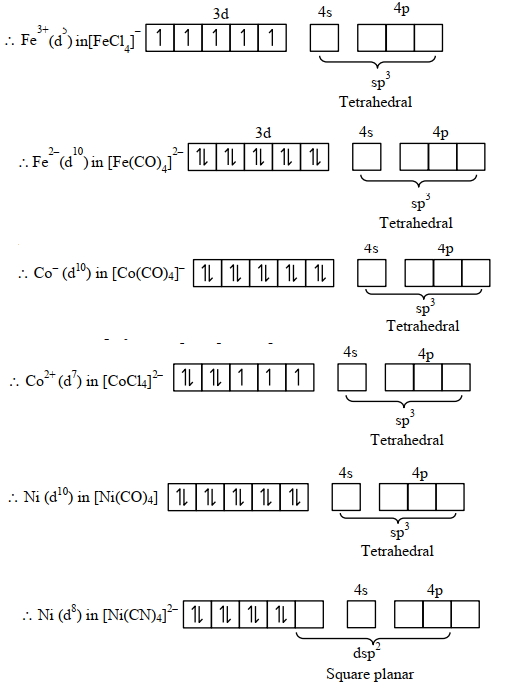
(A) $[FeCl_4]^-$: $Fe^{3+}$ is $d^5$ system. $Cl^-$ is a weak field ligand,so hybridization is $sp^3$ (Tetrahedral).
$[Fe(CO)_4]^{2-}$: $Fe^{2-}$ is $d^{10}$ system. Hybridization is $sp^3$ (Tetrahedral).
$(B)$ $[Co(CO)_4]^-$: $Co^-$ is $d^{10}$ system. Hybridization is $sp^3$ (Tetrahedral).
$[CoCl_4]^{2-}$: $Co^{2+}$ is $d^7$ system. $Cl^-$ is a weak field ligand,so hybridization is $sp^3$ (Tetrahedral).
$(C)$ $[Ni(CO)_4]$: $Ni^0$ is $d^{10}$ system. Hybridization is $sp^3$ (Tetrahedral).
$[Ni(CN)_4]^{2-}$: $Ni^{2+}$ is $d^8$ system. $CN^-$ is a strong field ligand,so hybridization is $dsp^2$ (Square planar).
$(D)$ $[Cu(py)_4]^+$: $Cu^+$ is $d^{10}$ system. Hybridization is $sp^3$ (Tetrahedral).
$[Cu(CN)_4]^{3-}$: $Cu^+$ is $d^{10}$ system. Hybridization is $sp^3$ (Tetrahedral).
Therefore,pairs $(A), (B),$ and $(D)$ exhibit tetrahedral geometry.
$[Fe(CO)_4]^{2-}$: $Fe^{2-}$ is $d^{10}$ system. Hybridization is $sp^3$ (Tetrahedral).
$(B)$ $[Co(CO)_4]^-$: $Co^-$ is $d^{10}$ system. Hybridization is $sp^3$ (Tetrahedral).
$[CoCl_4]^{2-}$: $Co^{2+}$ is $d^7$ system. $Cl^-$ is a weak field ligand,so hybridization is $sp^3$ (Tetrahedral).
$(C)$ $[Ni(CO)_4]$: $Ni^0$ is $d^{10}$ system. Hybridization is $sp^3$ (Tetrahedral).
$[Ni(CN)_4]^{2-}$: $Ni^{2+}$ is $d^8$ system. $CN^-$ is a strong field ligand,so hybridization is $dsp^2$ (Square planar).
$(D)$ $[Cu(py)_4]^+$: $Cu^+$ is $d^{10}$ system. Hybridization is $sp^3$ (Tetrahedral).
$[Cu(CN)_4]^{3-}$: $Cu^+$ is $d^{10}$ system. Hybridization is $sp^3$ (Tetrahedral).
Therefore,pairs $(A), (B),$ and $(D)$ exhibit tetrahedral geometry.
0 likes
View Solution327
AdvancedMCQ
$NiCl_2\{P(C_2H_5)_2(C_6H_5)\}_2$ exhibits temperature-dependent magnetic behaviour (paramagnetic/diamagnetic). The coordination geometries of $Ni^{2+}$ in the paramagnetic and diamagnetic states are respectively
A
tetrahedral and tetrahedral
B
square planar and square planar
C
tetrahedral and square planar
D
square planar and tetrahedral
Solution
(C) The complex $[NiCl_2\{P(C_2H_5)_2(C_6H_5)\}_2]$ contains $Ni^{2+}$ with the electronic configuration $[Ar] 3d^8$.
In the paramagnetic state,the complex adopts a tetrahedral geometry with $sp^3$ hybridization,where the two unpaired electrons in the $3d$ orbitals result in paramagnetism.
In the diamagnetic state,the complex adopts a square planar geometry with $dsp^2$ hybridization,where all electrons are paired,resulting in diamagnetism.
Therefore,the coordination geometries in the paramagnetic and diamagnetic states are tetrahedral and square planar,respectively.
In the paramagnetic state,the complex adopts a tetrahedral geometry with $sp^3$ hybridization,where the two unpaired electrons in the $3d$ orbitals result in paramagnetism.
In the diamagnetic state,the complex adopts a square planar geometry with $dsp^2$ hybridization,where all electrons are paired,resulting in diamagnetism.
Therefore,the coordination geometries in the paramagnetic and diamagnetic states are tetrahedral and square planar,respectively.
0 likes
View Solution328
MediumMCQ
$EDTA^{4-}$ is the ethylenediaminetetraacetate ion. The total number of $N-Co-O$ bond angles in the $[Co(EDTA)]^{-}$ complex ion is:
A
$4$
B
$8$
C
$2$
D
$6$
Solution
(B) $EDTA^{4-}$ is a hexadentate ligand that forms a complex with $Co^{3+}$ ion.
In the $[Co(EDTA)]^{-}$ complex,the $Co^{3+}$ ion is octahedrally coordinated by two nitrogen atoms and four oxygen atoms from the $EDTA^{4-}$ ligand.
To find the number of $N-Co-O$ bond angles,we look at the coordination geometry.
Each nitrogen atom is bonded to the cobalt center and is part of three five-membered chelate rings.
Specifically,each $N$ atom is involved in $N-Co-O$ angles with the oxygen atoms of the acetate groups.
By analyzing the structure,each of the two $N$ atoms forms $4$ such $N-Co-O$ angles (where the $O$ atom is one of the four coordinated oxygen atoms).
Therefore,the total number of $N-Co-O$ bond angles is $2 \times 4 = 8$.
In the $[Co(EDTA)]^{-}$ complex,the $Co^{3+}$ ion is octahedrally coordinated by two nitrogen atoms and four oxygen atoms from the $EDTA^{4-}$ ligand.
To find the number of $N-Co-O$ bond angles,we look at the coordination geometry.
Each nitrogen atom is bonded to the cobalt center and is part of three five-membered chelate rings.
Specifically,each $N$ atom is involved in $N-Co-O$ angles with the oxygen atoms of the acetate groups.
By analyzing the structure,each of the two $N$ atoms forms $4$ such $N-Co-O$ angles (where the $O$ atom is one of the four coordinated oxygen atoms).
Therefore,the total number of $N-Co-O$ bond angles is $2 \times 4 = 8$.
0 likes
View Solution329
MediumMCQ
$A$ list of species having the formula $XZ_4$ is given below.
$XeF_4, SF_4, SiF_4, BF_4^-, BrF_4^-, [Cu(NH_3)_4]^{2+}, [FeCl_4]^{2-}, [CoCl_4]^{2-}$ and $[PtCl_4]^{2-}$.
Defining shape on the basis of the location of $X$ and $Z$ atoms,the total number of species having a square planar shape is
$XeF_4, SF_4, SiF_4, BF_4^-, BrF_4^-, [Cu(NH_3)_4]^{2+}, [FeCl_4]^{2-}, [CoCl_4]^{2-}$ and $[PtCl_4]^{2-}$.
Defining shape on the basis of the location of $X$ and $Z$ atoms,the total number of species having a square planar shape is
A
$1$
B
$2$
C
$3$
D
$4$
Solution
(D) To determine the number of square planar species,we analyze the geometry of each:
$1$. $XeF_4$: $sp^3d^2$ hybridization with $2$ lone pairs,resulting in a square planar shape.
$2$. $SF_4$: $sp^3d$ hybridization with $1$ lone pair,resulting in a see-saw shape.
$3$. $SiF_4$: $sp^3$ hybridization,resulting in a tetrahedral shape.
$4$. $BF_4^-$: $sp^3$ hybridization,resulting in a tetrahedral shape.
$5$. $BrF_4^-$: $sp^3d^2$ hybridization with $2$ lone pairs,resulting in a square planar shape.
$6$. $[Cu(NH_3)_4]^{2+}$: $dsp^2$ hybridization,resulting in a square planar shape.
$7$. $[FeCl_4]^{2-}$: $sp^3$ hybridization,resulting in a tetrahedral shape.
$8$. $[CoCl_4]^{2-}$: $sp^3$ hybridization,resulting in a tetrahedral shape.
$9$. $[PtCl_4]^{2-}$: $dsp^2$ hybridization,resulting in a square planar shape.
The species with a square planar shape are $XeF_4, BrF_4^-, [Cu(NH_3)_4]^{2+},$ and $[PtCl_4]^{2-}$.
Therefore,the total number of square planar species is $4$.
$1$. $XeF_4$: $sp^3d^2$ hybridization with $2$ lone pairs,resulting in a square planar shape.
$2$. $SF_4$: $sp^3d$ hybridization with $1$ lone pair,resulting in a see-saw shape.
$3$. $SiF_4$: $sp^3$ hybridization,resulting in a tetrahedral shape.
$4$. $BF_4^-$: $sp^3$ hybridization,resulting in a tetrahedral shape.
$5$. $BrF_4^-$: $sp^3d^2$ hybridization with $2$ lone pairs,resulting in a square planar shape.
$6$. $[Cu(NH_3)_4]^{2+}$: $dsp^2$ hybridization,resulting in a square planar shape.
$7$. $[FeCl_4]^{2-}$: $sp^3$ hybridization,resulting in a tetrahedral shape.
$8$. $[CoCl_4]^{2-}$: $sp^3$ hybridization,resulting in a tetrahedral shape.
$9$. $[PtCl_4]^{2-}$: $dsp^2$ hybridization,resulting in a square planar shape.
The species with a square planar shape are $XeF_4, BrF_4^-, [Cu(NH_3)_4]^{2+},$ and $[PtCl_4]^{2-}$.
Therefore,the total number of square planar species is $4$.
0 likes
View Solution330
AdvancedMCQ
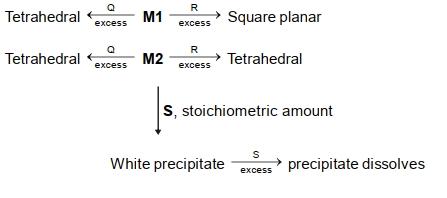
An aqueous solution of metal ion $M1$ reacts separately with reagents $Q$ and $R$ in excess to give tetrahedral and square planar complexes,respectively. An aqueous solution of another metal ion $M2$ always forms tetrahedral complexes with these reagents. Aqueous solution of $M2$ on reaction with reagent $S$ gives a white precipitate which dissolves in excess of $S$. The reactions are summarized in the scheme given below:
$1.$ $M1$,$Q$ and $R$,respectively are :
$(A)$ $Zn^{2+}, KCN$ and $HCl$
$(B)$ $Ni^{2+}, HCl$ and $KCN$
$(C)$ $Cd^{2+}, KCN$ and $HCl$
$(D)$ $Co^{2+}, HCl$ and $KCN$
$2.$ Reagent $S$ is :
$(A)$ $K_4[Fe(CN)_6]$
$(B)$ $Na_2HPO_4$
$(C)$ $K_2CrO_4$
$(D)$ $KOH$
Give the answer for question $1$ and $2$.
$1.$ $M1$,$Q$ and $R$,respectively are :
$(A)$ $Zn^{2+}, KCN$ and $HCl$
$(B)$ $Ni^{2+}, HCl$ and $KCN$
$(C)$ $Cd^{2+}, KCN$ and $HCl$
$(D)$ $Co^{2+}, HCl$ and $KCN$
$2.$ Reagent $S$ is :
$(A)$ $K_4[Fe(CN)_6]$
$(B)$ $Na_2HPO_4$
$(C)$ $K_2CrO_4$
$(D)$ $KOH$
Give the answer for question $1$ and $2$.
A
$(A, D)$
B
$(B, D)$
C
$(B, C)$
D
$(C, D)$
Solution
(B) For $M1$: $Ni^{2+}$ is known to form tetrahedral complexes with $Cl^-$ (e.g.,$[NiCl_4]^{2-}$) and square planar complexes with $CN^-$ (e.g.,$[Ni(CN)_4]^{2-}$). Thus,$M1 = Ni^{2+}$,$Q = HCl$,and $R = KCN$.
For $M2$: $Zn^{2+}$ is a metal ion that forms tetrahedral complexes and is amphoteric. When $Zn^{2+}$ reacts with $KOH$ $(S)$,it forms a white precipitate of $Zn(OH)_2$,which dissolves in excess $KOH$ to form the soluble complex $[Zn(OH)_4]^{2-}$.
Therefore,$M1 = Ni^{2+}$,$Q = HCl$,$R = KCN$,and $S = KOH$.
Matching with the options:
Question $1$: $M1=Ni^{2+}$,$Q=HCl$,$R=KCN$ corresponds to option $(B)$.
Question $2$: $S=KOH$ corresponds to option $(D)$.
The correct answer is $(B, D)$.
For $M2$: $Zn^{2+}$ is a metal ion that forms tetrahedral complexes and is amphoteric. When $Zn^{2+}$ reacts with $KOH$ $(S)$,it forms a white precipitate of $Zn(OH)_2$,which dissolves in excess $KOH$ to form the soluble complex $[Zn(OH)_4]^{2-}$.
Therefore,$M1 = Ni^{2+}$,$Q = HCl$,$R = KCN$,and $S = KOH$.
Matching with the options:
Question $1$: $M1=Ni^{2+}$,$Q=HCl$,$R=KCN$ corresponds to option $(B)$.
Question $2$: $S=KOH$ corresponds to option $(D)$.
The correct answer is $(B, D)$.
0 likes
View Solution331
MediumMCQ
Among $[Co(CN)_4]^{4-}, [Co(CO)_3(NO)], XeF_4, [PCl_4]^{+}, [PdCl_4]^{2-}, [ICl_4]^{-}, [Cu(CN)_4]^{3-}$ and $P_4$,the total number of species with tetrahedral geometry is:
A
$2$
B
$3$
C
$4$
D
$5$
Solution
(D) $1$. $[Co(CN)_4]^{4-}$: $Co^{0}$ $(d^9 s^2)$ in $CN^-$ field is tetrahedral.
$2$. $[Co(CO)_3(NO)]$: $Co$ is $d^9 s^2$,$CO$ and $NO$ are strong field ligands,geometry is tetrahedral.
$3$. $XeF_4$: $sp^3d^2$ hybridization,square planar geometry.
$4$. $[PCl_4]^{+}$: $sp^3$ hybridization,tetrahedral geometry.
$5$. $[PdCl_4]^{2-}$: $Pd^{2+}$ $(d^8)$ is square planar.
$6$. $[ICl_4]^{-}$: $sp^3d^2$ hybridization,square planar geometry.
$7$. $[Cu(CN)_4]^{3-}$: $Cu^{+}$ $(d^{10})$ is tetrahedral.
$8$. $P_4$: $P$ atoms are $sp^3$ hybridized,tetrahedral structure.
Thus,the species with tetrahedral geometry are $[Co(CN)_4]^{4-}, [Co(CO)_3(NO)], [PCl_4]^{+}, [Cu(CN)_4]^{3-}$,and $P_4$. The total count is $5$.
$2$. $[Co(CO)_3(NO)]$: $Co$ is $d^9 s^2$,$CO$ and $NO$ are strong field ligands,geometry is tetrahedral.
$3$. $XeF_4$: $sp^3d^2$ hybridization,square planar geometry.
$4$. $[PCl_4]^{+}$: $sp^3$ hybridization,tetrahedral geometry.
$5$. $[PdCl_4]^{2-}$: $Pd^{2+}$ $(d^8)$ is square planar.
$6$. $[ICl_4]^{-}$: $sp^3d^2$ hybridization,square planar geometry.
$7$. $[Cu(CN)_4]^{3-}$: $Cu^{+}$ $(d^{10})$ is tetrahedral.
$8$. $P_4$: $P$ atoms are $sp^3$ hybridized,tetrahedral structure.
Thus,the species with tetrahedral geometry are $[Co(CN)_4]^{4-}, [Co(CO)_3(NO)], [PCl_4]^{+}, [Cu(CN)_4]^{3-}$,and $P_4$. The total count is $5$.
0 likes
View Solution332
DifficultMCQ
From the magnetic behaviour of $[NiCl_4]^{2-}$ (paramagnetic) and $[Ni(CO)_4]$ (diamagnetic),choose the correct geometry and oxidation state.
A
$[NiCl_4]^{2-}: Ni^{II}$,square planar; $[Ni(CO)_4]: Ni(0)$,square planar
B
$[NiCl_4]^{2-}: Ni^{II}$,tetrahedral; $[Ni(CO)_4]: Ni(0)$,tetrahedral
C
$[NiCl_4]^{2-}: Ni^{II}$,tetrahedral; $[Ni(CO)_4]: Ni^{II}$,square planar
D
$[NiCl_4]^{2-}: Ni(0)$,tetrahedral; $[Ni(CO)_4]: Ni(0)$,square planar
Solution
(B) For $[NiCl_4]^{2-}$: The oxidation state of $Ni$ is $+2$. The electronic configuration is $[Ar] 3d^8$. Due to the weak field ligand $Cl^-$,it undergoes $sp^3$ hybridization,resulting in a tetrahedral geometry with $2$ unpaired electrons,making it paramagnetic.
For $[Ni(CO)_4]$: The oxidation state of $Ni$ is $0$. The electronic configuration is $[Ar] 3d^8 4s^2$. In the presence of the strong field ligand $CO$,the electrons pair up to form $[Ar] 3d^{10} 4s^0$. It undergoes $sp^3$ hybridization,resulting in a tetrahedral geometry with $0$ unpaired electrons,making it diamagnetic.
For $[Ni(CO)_4]$: The oxidation state of $Ni$ is $0$. The electronic configuration is $[Ar] 3d^8 4s^2$. In the presence of the strong field ligand $CO$,the electrons pair up to form $[Ar] 3d^{10} 4s^0$. It undergoes $sp^3$ hybridization,resulting in a tetrahedral geometry with $0$ unpaired electrons,making it diamagnetic.
0 likes
View Solution333
MediumMCQ
The $d$-electronic configuration of an octahedral $Co(II)$ complex having magnetic moment of $3.95 \ BM$ is :
A
$t_{2g}^6 e_g^1$
B
$t_{2g}^3 e_g^0$
C
$t_{2g}^5 e_g^2$
D
$e^4 t_2^3$
Solution
(C) The magnetic moment $\mu$ is given by the formula $\mu = \sqrt{n(n+2)} \ BM$,where $n$ is the number of unpaired electrons.
Given $\mu = 3.95 \ BM$,we have $\sqrt{n(n+2)} \approx 3.95$,which implies $n(n+2) \approx 15.6$,so $n \approx 3$.
$Co(II)$ has a $3d^7$ configuration.
In an octahedral field,the $d$-orbitals split into $t_{2g}$ and $e_g$ sets.
For a $d^7$ system with $3$ unpaired electrons,the configuration is $t_{2g}^5 e_g^2$ (high spin).
This corresponds to $5$ electrons in $t_{2g}$ (with $1$ unpaired) and $2$ electrons in $e_g$ (with $2$ unpaired),totaling $3$ unpaired electrons.
Given $\mu = 3.95 \ BM$,we have $\sqrt{n(n+2)} \approx 3.95$,which implies $n(n+2) \approx 15.6$,so $n \approx 3$.
$Co(II)$ has a $3d^7$ configuration.
In an octahedral field,the $d$-orbitals split into $t_{2g}$ and $e_g$ sets.
For a $d^7$ system with $3$ unpaired electrons,the configuration is $t_{2g}^5 e_g^2$ (high spin).
This corresponds to $5$ electrons in $t_{2g}$ (with $1$ unpaired) and $2$ electrons in $e_g$ (with $2$ unpaired),totaling $3$ unpaired electrons.
0 likes
View Solution334
DifficultMCQ
Identify the coordination complexes in which the central metal ion has $d^4$ configuration.
$(A)$ $[FeO_4]^{2-}$
$(B)$ $[Mn(CN)_6]^{3-}$
$(C)$ $[Fe(CN)_6]^{3-}$
$(D)$ $[Cr(H_2O)_6]^{2+}$
$(E)$ $[NiF_6]^{2-}$
Choose the correct answer from the options given below:
$(A)$ $[FeO_4]^{2-}$
$(B)$ $[Mn(CN)_6]^{3-}$
$(C)$ $[Fe(CN)_6]^{3-}$
$(D)$ $[Cr(H_2O)_6]^{2+}$
$(E)$ $[NiF_6]^{2-}$
Choose the correct answer from the options given below:
A
$(C)$ and $(E)$ only
B
$(B)$, $(C)$ and $(D)$ only
C
$(B)$ and $(D)$ only
D
$(A)$, $(B)$ and $(E)$ only
Solution
(C) To find the $d$-configuration of the central metal ion, we determine the oxidation state of the metal in each complex:
$(A)$ In $[FeO_4]^{2-}$, $Fe + 4(-2) = -2 \implies Fe = +6$. $Fe^{6+} = [Ar] 3d^2$.
$(B)$ In $[Mn(CN)_6]^{3-}$, $Mn + 6(-1) = -3 \implies Mn = +3$. $Mn^{3+} = [Ar] 3d^4$.
$(C)$ In $[Fe(CN)_6]^{3-}$, $Fe + 6(-1) = -3 \implies Fe = +3$. $Fe^{3+} = [Ar] 3d^5$.
$(D)$ In $[Cr(H_2O)_6]^{2+}$, $Cr + 6(0) = +2 \implies Cr = +2$. $Cr^{2+} = [Ar] 3d^4$.
$(E)$ In $[NiF_6]^{2-}$, $Ni + 6(-1) = -2 \implies Ni = +4$. $Ni^{4+} = [Ar] 3d^6$.
The complexes with $d^4$ configuration are $(B)$ and $(D)$.
$(A)$ In $[FeO_4]^{2-}$, $Fe + 4(-2) = -2 \implies Fe = +6$. $Fe^{6+} = [Ar] 3d^2$.
$(B)$ In $[Mn(CN)_6]^{3-}$, $Mn + 6(-1) = -3 \implies Mn = +3$. $Mn^{3+} = [Ar] 3d^4$.
$(C)$ In $[Fe(CN)_6]^{3-}$, $Fe + 6(-1) = -3 \implies Fe = +3$. $Fe^{3+} = [Ar] 3d^5$.
$(D)$ In $[Cr(H_2O)_6]^{2+}$, $Cr + 6(0) = +2 \implies Cr = +2$. $Cr^{2+} = [Ar] 3d^4$.
$(E)$ In $[NiF_6]^{2-}$, $Ni + 6(-1) = -2 \implies Ni = +4$. $Ni^{4+} = [Ar] 3d^6$.
The complexes with $d^4$ configuration are $(B)$ and $(D)$.
0 likes
View Solution335
MediumMCQ
Match List-$I$ with List-$II$.
Choose the correct answer from the options given below:
| List-$I$ (Complex) | List-$II$ (Hybridisation of central metal ion) |
|---|---|
| $A$. $[CoF_6]^{3-}$ | $I$. $d^2sp^3$ |
| $B$. $[NiCl_4]^{2-}$ | $II$. $sp^3$ |
| $C$. $[Co(NH_3)_6]^{3+}$ | $III$. $sp^3d^2$ |
| $D$. $[Ni(CN)_4]^{2-}$ | $IV$. $dsp^2$ |
A
$A-I, B-IV, C-III, D-II$
B
$A-III, B-II, C-I, D-IV$
C
$A-I, B-II, C-III, D-IV$
D
$A-III, B-IV, C-I, D-II$
Solution
(B) . $[CoF_6]^{3-}$: $Co^{3+}$ is $3d^6$. $F^-$ is a weak field ligand,so it forms outer orbital complex with $sp^3d^2$ hybridisation.
$B$. $[NiCl_4]^{2-}$: $Ni^{2+}$ is $3d^8$. $Cl^-$ is a weak field ligand,so it forms tetrahedral complex with $sp^3$ hybridisation.
$C$. $[Co(NH_3)_6]^{3+}$: $Co^{3+}$ is $3d^6$. $NH_3$ is a strong field ligand,so it causes pairing of electrons,forming inner orbital complex with $d^2sp^3$ hybridisation.
$D$. $[Ni(CN)_4]^{2-}$: $Ni^{2+}$ is $3d^8$. $CN^-$ is a strong field ligand,so it causes pairing of electrons,forming square planar complex with $dsp^2$ hybridisation.
Therefore,the correct matching is $A-III, B-II, C-I, D-IV$.
$B$. $[NiCl_4]^{2-}$: $Ni^{2+}$ is $3d^8$. $Cl^-$ is a weak field ligand,so it forms tetrahedral complex with $sp^3$ hybridisation.
$C$. $[Co(NH_3)_6]^{3+}$: $Co^{3+}$ is $3d^6$. $NH_3$ is a strong field ligand,so it causes pairing of electrons,forming inner orbital complex with $d^2sp^3$ hybridisation.
$D$. $[Ni(CN)_4]^{2-}$: $Ni^{2+}$ is $3d^8$. $CN^-$ is a strong field ligand,so it causes pairing of electrons,forming square planar complex with $dsp^2$ hybridisation.
Therefore,the correct matching is $A-III, B-II, C-I, D-IV$.
0 likes
View Solution336
MediumMCQ
Match List-$I$ with List-$II$.
Choose the correct answer from the options given below:
| List-$I$ | List-$II$ |
|---|---|
| $A$. $[MnBr_4]^{2-}$ | $I$. $d^2sp^3$ and diamagnetic |
| $B$. $[FeF_6]^{3-}$ | $II$. $sp^3d^2$ and paramagnetic |
| $C$. $[Co(C_2O_4)_3]^{3-}$ | $III$. $sp^3$ and diamagnetic |
| $D$. $[Ni(CO)_4]$ | $IV$. $sp^3$ and paramagnetic |
Choose the correct answer from the options given below:
A
$A-III, B-II, C-I, D-IV$
B
$A-III, B-I, C-II, D-IV$
C
$A-IV, B-I, C-II, D-III$
D
$A-IV, B-II, C-I, D-III$
Solution
(D) $(A) [MnBr_4]^{2-}$: $Mn^{2+}$ is $[Ar] 3d^5$. $Br^-$ is a weak field ligand,so it undergoes $sp^3$ hybridization and is paramagnetic.
$(B) [FeF_6]^{3-}$: $Fe^{3+}$ is $[Ar] 3d^5$. $F^-$ is a weak field ligand,so it undergoes $sp^3d^2$ hybridization and is paramagnetic.
$(C) [Co(C_2O_4)_3]^{3-}$: $Co^{3+}$ is $[Ar] 3d^6$. $C_2O_4^{2-}$ is a strong field ligand,so it undergoes $d^2sp^3$ hybridization and is diamagnetic.
$(D) [Ni(CO)_4]$: $Ni^0$ is $[Ar] 3d^8 4s^2$. $CO$ is a strong field ligand,so it undergoes $sp^3$ hybridization and is diamagnetic.
Therefore,the correct matching is $A-IV, B-II, C-I, D-III$.
$(B) [FeF_6]^{3-}$: $Fe^{3+}$ is $[Ar] 3d^5$. $F^-$ is a weak field ligand,so it undergoes $sp^3d^2$ hybridization and is paramagnetic.
$(C) [Co(C_2O_4)_3]^{3-}$: $Co^{3+}$ is $[Ar] 3d^6$. $C_2O_4^{2-}$ is a strong field ligand,so it undergoes $d^2sp^3$ hybridization and is diamagnetic.
$(D) [Ni(CO)_4]$: $Ni^0$ is $[Ar] 3d^8 4s^2$. $CO$ is a strong field ligand,so it undergoes $sp^3$ hybridization and is diamagnetic.
Therefore,the correct matching is $A-IV, B-II, C-I, D-III$.
0 likes
View Solution337
MediumMCQ
The type of hybridization and the magnetic property of $[MnCl_6]^{3-}$ are $:$
A
$d^2sp^3$,paramagnetic with four unpaired electrons
B
$sp^3d^2$,paramagnetic with four unpaired electrons
C
$d^2sp^3$,paramagnetic with two unpaired electrons
D
$sp^3d^2$,paramagnetic with two unpaired electrons
Solution
(B) In $[MnCl_6]^{3-}$,the oxidation state of $Mn$ is $+3$.
The electronic configuration of $Mn^{3+}$ is $[Ar] 3d^4$.
Since $Cl^-$ is a weak field ligand $(WFL)$,it does not cause pairing of electrons in the $3d$ orbitals.
Therefore,the hybridization involved is $sp^3d^2$ (outer orbital complex).
The $3d^4$ configuration has $4$ unpaired electrons,making it paramagnetic.
The electronic configuration of $Mn^{3+}$ is $[Ar] 3d^4$.
Since $Cl^-$ is a weak field ligand $(WFL)$,it does not cause pairing of electrons in the $3d$ orbitals.
Therefore,the hybridization involved is $sp^3d^2$ (outer orbital complex).
The $3d^4$ configuration has $4$ unpaired electrons,making it paramagnetic.
0 likes
View Solution338
MediumMCQ
Match the List-$I$ with List-$II$
Choose the correct answer from the options given below $:$
| List-$I$ (Molecules/ion) | List-$II$ (Hybridisation of central atom) |
| $A. PF_5$ | $I. dsp^2$ |
| $B. SF_6$ | $II. sp^3d$ |
| $C. Ni(CO)_4$ | $III. sp^3d^2$ |
| $D. [PtCl_4]^{2-}$ | $IV. sp^3$ |
A
$A-II, B-III, C-IV, D-I$
B
$A-IV, B-I, C-II, D-III$
C
$A-I, B-II, C-III, D-IV$
D
$A-III, B-I, C-IV, D-II$
Solution
(A) $PF_5$: The central atom $P$ has $5$ bonding pairs and $0$ lone pairs,so steric number is $5$,which corresponds to $sp^3d$ hybridisation.
$SF_6$: The central atom $S$ has $6$ bonding pairs and $0$ lone pairs,so steric number is $6$,which corresponds to $sp^3d^2$ hybridisation.
$Ni(CO)_4$: $Ni$ is in $0$ oxidation state. The $CO$ ligand is a strong field ligand,causing pairing of electrons in $3d$ orbitals. The hybridisation is $sp^3$.
$[PtCl_4]^{2-}$: $Pt$ is in $+2$ oxidation state. The $Cl^-$ ligand is a weak field ligand,but due to the high crystal field splitting energy of $5d$ series elements,it undergoes $dsp^2$ hybridisation.
$SF_6$: The central atom $S$ has $6$ bonding pairs and $0$ lone pairs,so steric number is $6$,which corresponds to $sp^3d^2$ hybridisation.
$Ni(CO)_4$: $Ni$ is in $0$ oxidation state. The $CO$ ligand is a strong field ligand,causing pairing of electrons in $3d$ orbitals. The hybridisation is $sp^3$.
$[PtCl_4]^{2-}$: $Pt$ is in $+2$ oxidation state. The $Cl^-$ ligand is a weak field ligand,but due to the high crystal field splitting energy of $5d$ series elements,it undergoes $dsp^2$ hybridisation.
0 likes
View Solution339
MediumMCQ
The correct order of $[FeF_6]^{3-}, [CoF_6]^{3-}, [Ni(CO)_4]$ and $[Ni(CN)_4]^{2-}$ complex species based on the number of unpaired electrons present is $:$
A
$[FeF_6]^{3-} > [CoF_6]^{3-} > [Ni(CN)_4]^{2-} = [Ni(CO)_4]$
B
$[Ni(CN)_4]^{2-} > [FeF_6]^{3-} > [CoF_6]^{3-} > [Ni(CO)_4]$
C
$[CoF_6]^{3-} > [FeF_6]^{3-} > [Ni(CO)_4] > [Ni(CN)_4]^{2-}$
D
$[FeF_6]^{3-} > [CoF_6]^{3-} > [Ni(CN)_4]^{2-} > [Ni(CO)_4]$
Solution
(A) To determine the number of unpaired electrons,we analyze the electronic configuration of the metal ion in each complex:
$1$. $[FeF_6]^{3-}$: $Fe^{3+}$ is $3d^5$. Since $F^-$ is a weak field ligand,electrons remain unpaired. Number of unpaired electrons = $5$.
$2$. $[CoF_6]^{3-}$: $Co^{3+}$ is $3d^6$. Since $F^-$ is a weak field ligand,it forms a high-spin complex. Number of unpaired electrons = $4$.
$3$. $[Ni(CN)_4]^{2-}$: $Ni^{2+}$ is $3d^8$. $CN^-$ is a strong field ligand,causing pairing of electrons. Number of unpaired electrons = $0$.
$4$. $[Ni(CO)_4]$: $Ni$ is $3d^8 4s^2$. $CO$ is a strong field ligand,causing pairing of all electrons in $3d$ orbital. Number of unpaired electrons = $0$.
Thus,the order is $[FeF_6]^{3-} (5) > [CoF_6]^{3-} (4) > [Ni(CN)_4]^{2-} (0) = [Ni(CO)_4] (0)$.
$1$. $[FeF_6]^{3-}$: $Fe^{3+}$ is $3d^5$. Since $F^-$ is a weak field ligand,electrons remain unpaired. Number of unpaired electrons = $5$.
$2$. $[CoF_6]^{3-}$: $Co^{3+}$ is $3d^6$. Since $F^-$ is a weak field ligand,it forms a high-spin complex. Number of unpaired electrons = $4$.
$3$. $[Ni(CN)_4]^{2-}$: $Ni^{2+}$ is $3d^8$. $CN^-$ is a strong field ligand,causing pairing of electrons. Number of unpaired electrons = $0$.
$4$. $[Ni(CO)_4]$: $Ni$ is $3d^8 4s^2$. $CO$ is a strong field ligand,causing pairing of all electrons in $3d$ orbital. Number of unpaired electrons = $0$.
Thus,the order is $[FeF_6]^{3-} (5) > [CoF_6]^{3-} (4) > [Ni(CN)_4]^{2-} (0) = [Ni(CO)_4] (0)$.
0 likes
View Solution340
MediumMCQ
The number of paramagnetic complexes among $[FeF_6]^{3-}, [Fe(CN)_6]^{3-}, [Mn(CN)_6]^{3-}, [Co(C_2O_4)_3]^{3-}, [MnCl_6]^{3-}$,and $[CoF_6]^{3-}$ that involve $d^2sp^3$ hybridization is ....................
A
$2$
B
$4$
C
$6$
D
$8$
Solution
(A) To determine the hybridization and magnetic nature,we analyze the oxidation state of the metal and the nature of the ligand:
From the table,the complexes that involve $d^2sp^3$ hybridization are $[Fe(CN)_6]^{3-}, [Mn(CN)_6]^{3-}$,and $[Co(C_2O_4)_3]^{3-}$.
Among these,$[Fe(CN)_6]^{3-}$ and $[Mn(CN)_6]^{3-}$ are paramagnetic.
Therefore,the number of such complexes is $2$.
| Complex | Hybridization | Magnetic Nature |
| $[FeF_6]^{3-}$ | $sp^3d^2$ | Paramagnetic |
| $[Fe(CN)_6]^{3-}$ | $d^2sp^3$ | Paramagnetic |
| $[Mn(CN)_6]^{3-}$ | $d^2sp^3$ | Paramagnetic |
| $[Co(C_2O_4)_3]^{3-}$ | $d^2sp^3$ | Diamagnetic |
| $[MnCl_6]^{3-}$ | $sp^3d^2$ | Paramagnetic |
| $[CoF_6]^{3-}$ | $sp^3d^2$ | Paramagnetic |
From the table,the complexes that involve $d^2sp^3$ hybridization are $[Fe(CN)_6]^{3-}, [Mn(CN)_6]^{3-}$,and $[Co(C_2O_4)_3]^{3-}$.
Among these,$[Fe(CN)_6]^{3-}$ and $[Mn(CN)_6]^{3-}$ are paramagnetic.
Therefore,the number of such complexes is $2$.
0 likes
View Solution341
DifficultMCQ
The number of unpaired electrons responsible for the paramagnetic nature of the following complex species are respectively $:$
$[Fe(CN)_6]^{3-}, [FeF_6]^{3-}, [CoF_6]^{3-}, [Mn(CN)_6]^{3-}$
$[Fe(CN)_6]^{3-}, [FeF_6]^{3-}, [CoF_6]^{3-}, [Mn(CN)_6]^{3-}$
A
$1, 5, 4, 2$
B
$1, 5, 5, 2$
C
$1, 1, 4, 2$
D
$1, 4, 4, 2$
Solution
(A) $[Fe(CN)_6]^{3-}$: $Fe^{3+}$ is $3d^5$. $CN^-$ is a strong field ligand,so pairing occurs. $t_{2g}^5, e_g^0$. Unpaired electrons = $1$.
$[FeF_6]^{3-}$: $Fe^{3+}$ is $3d^5$. $F^-$ is a weak field ligand,so no pairing. $t_{2g}^3, e_g^2$. Unpaired electrons = $5$.
$[CoF_6]^{3-}$: $Co^{3+}$ is $3d^6$. $F^-$ is a weak field ligand. $t_{2g}^4, e_g^2$. Unpaired electrons = $4$.
$[Mn(CN)_6]^{3-}$: $Mn^{3+}$ is $3d^4$. $CN^-$ is a strong field ligand. $t_{2g}^4, e_g^0$. Unpaired electrons = $2$.
$[FeF_6]^{3-}$: $Fe^{3+}$ is $3d^5$. $F^-$ is a weak field ligand,so no pairing. $t_{2g}^3, e_g^2$. Unpaired electrons = $5$.
$[CoF_6]^{3-}$: $Co^{3+}$ is $3d^6$. $F^-$ is a weak field ligand. $t_{2g}^4, e_g^2$. Unpaired electrons = $4$.
$[Mn(CN)_6]^{3-}$: $Mn^{3+}$ is $3d^4$. $CN^-$ is a strong field ligand. $t_{2g}^4, e_g^0$. Unpaired electrons = $2$.
0 likes
View Solution342
MediumMCQ
The number of species from the following that are involved in $sp^3 d^2$ hybridization is $[Co(NH_3)_6]^{3+}, SF_6, [CrF_6]^{3-}, [CoF_6]^{3-}, [Mn(CN)_6]^{3-}$ and $[MnCl_6]^{3-}$.
A
$5$
B
$6$
C
$4$
D
$3$
Solution
(D) $1$. $[Co(NH_3)_6]^{3+}$: $Co^{3+}$ is $[Ar] 3d^6$. $NH_3$ is a Strong Field Ligand $(SFL)$,causing pairing. Hybridization is $d^2 sp^3$.
$2$. $SF_6$: Sulphur has $6$ valence electrons and forms $6$ bonds. Hybridization is $sp^3 d^2$.
$3$. $[CrF_6]^{3-}$: $Cr^{3+}$ is $[Ar] 3d^3$. Hybridization is $d^2 sp^3$.
$4$. $[CoF_6]^{3-}$: $Co^{3+}$ is $[Ar] 3d^6$. $F^-$ is a Weak Field Ligand $(WFL)$,no pairing. Hybridization is $sp^3 d^2$.
$5$. $[Mn(CN)_6]^{3-}$: $Mn^{3+}$ is $[Ar] 3d^4$. $CN^-$ is $SFL$. Hybridization is $d^2 sp^3$.
$6$. $[MnCl_6]^{3-}$: $Mn^{3+}$ is $[Ar] 3d^4$. $Cl^-$ is $WFL$. Hybridization is $sp^3 d^2$.
Species with $sp^3 d^2$ hybridization are $SF_6, [CoF_6]^{3-}$,and $[MnCl_6]^{3-}$.
Total count is $3$.
$2$. $SF_6$: Sulphur has $6$ valence electrons and forms $6$ bonds. Hybridization is $sp^3 d^2$.
$3$. $[CrF_6]^{3-}$: $Cr^{3+}$ is $[Ar] 3d^3$. Hybridization is $d^2 sp^3$.
$4$. $[CoF_6]^{3-}$: $Co^{3+}$ is $[Ar] 3d^6$. $F^-$ is a Weak Field Ligand $(WFL)$,no pairing. Hybridization is $sp^3 d^2$.
$5$. $[Mn(CN)_6]^{3-}$: $Mn^{3+}$ is $[Ar] 3d^4$. $CN^-$ is $SFL$. Hybridization is $d^2 sp^3$.
$6$. $[MnCl_6]^{3-}$: $Mn^{3+}$ is $[Ar] 3d^4$. $Cl^-$ is $WFL$. Hybridization is $sp^3 d^2$.
Species with $sp^3 d^2$ hybridization are $SF_6, [CoF_6]^{3-}$,and $[MnCl_6]^{3-}$.
Total count is $3$.
0 likes
View Solution343
MediumMCQ
Match the List-$I$ with List-$II$:
Choose the correct answer from the options given below:
| List-$I$ (Complex/Species) | List-$II$ (Shape and magnetic moment) |
|---|---|
| $A$. $[Ni(CO)_4]$ | $I$. Tetrahedral,$2.8 \ BM$ |
| $B$. $[Ni(CN)_4]^{2-}$ | $II$. Square planar,$0 \ BM$ |
| $C$. $[NiCl_4]^{2-}$ | $III$. Tetrahedral,$0 \ BM$ |
| $D$. $[MnBr_4]^{2-}$ | $IV$. Tetrahedral,$5.9 \ BM$ |
Choose the correct answer from the options given below:
A
$A-III, B-II, C-I, D-IV$
B
$A-I, B-II, C-III, D-IV$
C
$A-III, B-IV, C-II, D-I$
D
$A-IV, B-I, C-III, D-II$
Solution
(A) $[Ni(CO)_4]$: $Ni$ is in $0$ oxidation state. Configuration: $[Ar] 3d^8 4s^2$. Due to strong field ligand $CO$,electrons pair up. Hybridization: $sp^3$. Shape: Tetrahedral. Magnetic moment: $0 \ BM$ (Diamagnetic). Matches $III$.
$(B)$ $[Ni(CN)_4]^{2-}$: $Ni$ is in $+2$ oxidation state. Configuration: $[Ar] 3d^8$. Due to strong field ligand $CN^-$,electrons pair up. Hybridization: $dsp^2$. Shape: Square planar. Magnetic moment: $0 \ BM$ (Diamagnetic). Matches $II$.
$(C)$ $[NiCl_4]^{2-}$: $Ni$ is in $+2$ oxidation state. Configuration: $[Ar] 3d^8$. Weak field ligand $Cl^-$. Hybridization: $sp^3$. Shape: Tetrahedral. Two unpaired electrons,$\mu = \sqrt{n(n+2)} = \sqrt{2(4)} = \sqrt{8} \approx 2.8 \ BM$. Matches $I$.
$(D)$ $[MnBr_4]^{2-}$: $Mn$ is in $+2$ oxidation state. Configuration: $[Ar] 3d^5$. Weak field ligand $Br^-$. Hybridization: $sp^3$. Shape: Tetrahedral. Five unpaired electrons,$\mu = \sqrt{5(7)} = \sqrt{35} \approx 5.9 \ BM$. Matches $IV$.
Therefore,the correct matching is $A-III, B-II, C-I, D-IV$.
$(B)$ $[Ni(CN)_4]^{2-}$: $Ni$ is in $+2$ oxidation state. Configuration: $[Ar] 3d^8$. Due to strong field ligand $CN^-$,electrons pair up. Hybridization: $dsp^2$. Shape: Square planar. Magnetic moment: $0 \ BM$ (Diamagnetic). Matches $II$.
$(C)$ $[NiCl_4]^{2-}$: $Ni$ is in $+2$ oxidation state. Configuration: $[Ar] 3d^8$. Weak field ligand $Cl^-$. Hybridization: $sp^3$. Shape: Tetrahedral. Two unpaired electrons,$\mu = \sqrt{n(n+2)} = \sqrt{2(4)} = \sqrt{8} \approx 2.8 \ BM$. Matches $I$.
$(D)$ $[MnBr_4]^{2-}$: $Mn$ is in $+2$ oxidation state. Configuration: $[Ar] 3d^5$. Weak field ligand $Br^-$. Hybridization: $sp^3$. Shape: Tetrahedral. Five unpaired electrons,$\mu = \sqrt{5(7)} = \sqrt{35} \approx 5.9 \ BM$. Matches $IV$.
Therefore,the correct matching is $A-III, B-II, C-I, D-IV$.
0 likes
View Solution344
MediumMCQ
Assertion $:$ Complex ion $[Co(NH_3)_6]^{2+}$ is readily oxidized to $[Co(NH_3)_6]^{3+}$.
Reason $:$ Unpaired electron in complex ion $[Co(NH_3)_6]^{2+}$ is present in $4p$ orbital.
Reason $:$ Unpaired electron in complex ion $[Co(NH_3)_6]^{2+}$ is present in $4p$ orbital.
A
Both Assertion and Reason are true but Reason is $NOT$ the correct explanation of Assertion.
B
Assertion is true but Reason is false.
C
Assertion is false but Reason is true.
D
Both Assertion and Reason are true and Reason is the correct explanation of Assertion.
Solution
(B) The electronic configuration of $Co$ $(Z=27)$ is $[Ar] 3d^7 4s^2$.
In $[Co(NH_3)_6]^{2+}$,the oxidation state of $Co$ is $+2$,so the configuration is $3d^7$.
$NH_3$ is a strong field ligand,but in $Co^{2+}$ complexes,it does not force pairing of all electrons to form an inner orbital complex because the resulting configuration would be highly unstable. Instead,one electron is promoted to the $4d$ orbital to allow for $d^2sp^3$ hybridization,making the complex $[Co(NH_3)_6]^{2+}$ unstable and easily oxidized to the more stable $d^6$ $[Co(NH_3)_6]^{3+}$ complex.
The unpaired electron in $[Co(NH_3)_6]^{2+}$ is promoted to the $4d$ orbital,not the $4p$ orbital. Thus,the Assertion is true,but the Reason is false.
In $[Co(NH_3)_6]^{2+}$,the oxidation state of $Co$ is $+2$,so the configuration is $3d^7$.
$NH_3$ is a strong field ligand,but in $Co^{2+}$ complexes,it does not force pairing of all electrons to form an inner orbital complex because the resulting configuration would be highly unstable. Instead,one electron is promoted to the $4d$ orbital to allow for $d^2sp^3$ hybridization,making the complex $[Co(NH_3)_6]^{2+}$ unstable and easily oxidized to the more stable $d^6$ $[Co(NH_3)_6]^{3+}$ complex.
The unpaired electron in $[Co(NH_3)_6]^{2+}$ is promoted to the $4d$ orbital,not the $4p$ orbital. Thus,the Assertion is true,but the Reason is false.
0 likes
View Solution345
MediumMCQ
In which of the following configurations will there be the possibility of both paramagnetism and diamagnetism,depending on the nature of the ligands?
A
$d^7$
B
$d^3$
C
$d^6$
D
$d^5$
Solution
(C) For a metal ion with a $d^6$ configuration in an octahedral complex:
$1$. With a strong field ligand (e.g.,$CN^-$),the electrons pair up in the $t_{2g}$ orbitals,resulting in a low-spin complex $(t_{2g}^6 e_g^0)$ which is diamagnetic.
$2$. With a weak field ligand (e.g.,$F^-$),the electrons occupy all orbitals according to Hund's rule $(t_{2g}^4 e_g^2)$,resulting in a high-spin complex which is paramagnetic.
Therefore,the $d^6$ configuration allows for both possibilities depending on the ligand strength.
$1$. With a strong field ligand (e.g.,$CN^-$),the electrons pair up in the $t_{2g}$ orbitals,resulting in a low-spin complex $(t_{2g}^6 e_g^0)$ which is diamagnetic.
$2$. With a weak field ligand (e.g.,$F^-$),the electrons occupy all orbitals according to Hund's rule $(t_{2g}^4 e_g^2)$,resulting in a high-spin complex which is paramagnetic.
Therefore,the $d^6$ configuration allows for both possibilities depending on the ligand strength.
0 likes
View Solution346
MediumMCQ
Match the coordination number and type of hybridisation with distribution of hybrid orbitals in space based on Valence bond theory.
Select the correct option $:$
| Coordination number and type of hybridisation | Distribution of hybrid orbitals in space |
|---|---|
| $(a)$. $4, sp^3$ | $(i)$. trigonal bipyramidal |
| $(b)$. $3, sp^2$ | $(ii)$. octahedral |
| $(c)$. $5, sp^3 d$ | $(iii)$. tetrahedral |
| $(d)$. $6, sp^3 d^2$ | $(iv)$. trigonal planar |
Select the correct option $:$
A
$a-ii, b-iii, c-iv, d-i$
B
$a-iii, b-iv, c-i, d-ii$
C
$a-iv, b-i, c-ii, d-iii$
D
$a-iii, b-i, c-iv, d-ii$
Solution
(B) The distribution of hybrid orbitals is determined by the hybridisation type:
$1$. $sp^3$ hybridisation corresponds to a tetrahedral geometry.
$2$. $sp^2$ hybridisation corresponds to a trigonal planar geometry.
$3$. $sp^3 d$ hybridisation corresponds to a trigonal bipyramidal geometry.
$4$. $sp^3 d^2$ (or $d^2 sp^3$) hybridisation corresponds to an octahedral geometry.
Therefore,the correct matching is: $(a-iii, b-iv, c-i, d-ii)$.
$1$. $sp^3$ hybridisation corresponds to a tetrahedral geometry.
$2$. $sp^2$ hybridisation corresponds to a trigonal planar geometry.
$3$. $sp^3 d$ hybridisation corresponds to a trigonal bipyramidal geometry.
$4$. $sp^3 d^2$ (or $d^2 sp^3$) hybridisation corresponds to an octahedral geometry.
Therefore,the correct matching is: $(a-iii, b-iv, c-i, d-ii)$.
0 likes
View Solution347
MediumMCQ
Match List-$I$ with List-$II$ and select the correct answer using the codes given below the lists $:$
| List-$I$ $(Compounds)$ | List-$II$ $(Hybridization)$ |
| $(a)$ $[Ni(NH_3)_6]^{+2}$ | $(i)$ $sp^3 d^2$ |
| $(b)$ $[PtCl_4]^{-2}$ | $(ii)$ $dsp^2$ |
| $(c)$ $[Ni(CO)_4]$ | $(iii)$ $sp^3$ |
| $(d)$ $[Co(OX)_3]^{-3}$ | $(iv)$ $d^2 sp^3$ |
A
$a-i, b-ii, c-iii, d-iv$
B
$a-ii, b-iii, c-i, d-iv$
C
$a-iv, b-i, c-iii, d-ii$
D
$a-iv, b-iii, c-i, d-ii$
Solution
(A) The hybridization of the given complexes is determined as follows:
$(a)$ $[Ni(NH_3)_6]^{+2}$: $Ni^{+2}$ is $3d^8$. $NH_3$ is a weak field ligand,so it forms an outer orbital complex with $sp^3 d^2$ hybridization.
$(b)$ $[PtCl_4]^{-2}$: $Pt^{+2}$ is a $5d^8$ metal ion. $Cl^-$ is a ligand that forces pairing in $5d$ series,resulting in $dsp^2$ hybridization.
$(c)$ $[Ni(CO)_4]$: $Ni$ is $3d^8 4s^2$. $CO$ is a strong field ligand,forcing pairing to form $sp^3$ hybridization.
$(d)$ $[Co(OX)_3]^{-3}$: $Co^{+3}$ is $3d^6$. $OX^{-2}$ (oxalate) is a strong field ligand,resulting in $d^2 sp^3$ hybridization.
Thus,the correct matching is $a-i, b-ii, c-iii, d-iv$.
$(a)$ $[Ni(NH_3)_6]^{+2}$: $Ni^{+2}$ is $3d^8$. $NH_3$ is a weak field ligand,so it forms an outer orbital complex with $sp^3 d^2$ hybridization.
$(b)$ $[PtCl_4]^{-2}$: $Pt^{+2}$ is a $5d^8$ metal ion. $Cl^-$ is a ligand that forces pairing in $5d$ series,resulting in $dsp^2$ hybridization.
$(c)$ $[Ni(CO)_4]$: $Ni$ is $3d^8 4s^2$. $CO$ is a strong field ligand,forcing pairing to form $sp^3$ hybridization.
$(d)$ $[Co(OX)_3]^{-3}$: $Co^{+3}$ is $3d^6$. $OX^{-2}$ (oxalate) is a strong field ligand,resulting in $d^2 sp^3$ hybridization.
Thus,the correct matching is $a-i, b-ii, c-iii, d-iv$.
0 likes
View Solution348
MediumMCQ
Match the correct option.
| $A$. $[CoF_6]^{3-}$ | $M$. $sp^3d^2$,paramagnetic |
| $B$. $[Mn(CN)_6]^{3-}$ | $N$. $sp^3d^2$,diamagnetic |
| $C$. $[Co(C_2O_4)_3]^{3-}$ | $O$. $d^2sp^3$,paramagnetic |
| $D$. $[Zn(H_2O)_6]^{2+}$ | $P$. $d^2sp^3$,diamagnetic |
A
$A$ $\rightarrow M, B$ $\rightarrow O, C$ $\rightarrow P, D$ $\rightarrow N$
B
$A$ $\rightarrow M, B$ $\rightarrow P, C$ $\rightarrow N, D$ $\rightarrow O$
C
$A$ $\rightarrow M, B$ $\rightarrow O, C$ $\rightarrow N, D$ $\rightarrow P$
D
$A$ $\rightarrow N, B$ $\rightarrow M, C$ $\rightarrow O, D$ $\rightarrow P$
Solution
(A) . $[CoF_6]^{3-}$: $Co^{3+}$ is $3d^6$. $F^{-}$ is a weak field ligand,so hybridization is $sp^3d^2$ (outer orbital complex) with $4$ unpaired electrons,making it paramagnetic. Matches $M$.
$B$. $[Mn(CN)_6]^{3-}$: $Mn^{3+}$ is $3d^4$. $CN^{-}$ is a strong field ligand,so hybridization is $d^2sp^3$ (inner orbital complex) with $2$ unpaired electrons,making it paramagnetic. Matches $O$.
$C$. $[Co(C_2O_4)_3]^{3-}$: $Co^{3+}$ is $3d^6$. $C_2O_4^{2-}$ is a strong field ligand,so hybridization is $d^2sp^3$ (inner orbital complex) with $0$ unpaired electrons,making it diamagnetic. Matches $P$.
$D$. $[Zn(H_2O)_6]^{2+}$: $Zn^{2+}$ is $3d^{10}$. Hybridization is $sp^3d^2$ with $0$ unpaired electrons,making it diamagnetic. Matches $N$.
Therefore,the correct match is $A$ $\rightarrow M, B$ $\rightarrow O, C$ $\rightarrow P, D$ $\rightarrow N$.
$B$. $[Mn(CN)_6]^{3-}$: $Mn^{3+}$ is $3d^4$. $CN^{-}$ is a strong field ligand,so hybridization is $d^2sp^3$ (inner orbital complex) with $2$ unpaired electrons,making it paramagnetic. Matches $O$.
$C$. $[Co(C_2O_4)_3]^{3-}$: $Co^{3+}$ is $3d^6$. $C_2O_4^{2-}$ is a strong field ligand,so hybridization is $d^2sp^3$ (inner orbital complex) with $0$ unpaired electrons,making it diamagnetic. Matches $P$.
$D$. $[Zn(H_2O)_6]^{2+}$: $Zn^{2+}$ is $3d^{10}$. Hybridization is $sp^3d^2$ with $0$ unpaired electrons,making it diamagnetic. Matches $N$.
Therefore,the correct match is $A$ $\rightarrow M, B$ $\rightarrow O, C$ $\rightarrow P, D$ $\rightarrow N$.
0 likes
View Solution349
MediumMCQ
Statement $1$: $[Ti(H_2O)_6]^{4+}$ is coloured while $[Sc(H_2O)_6]^{3+}$ is colourless.
Statement $2$: $d-d$ transition is not possible in $[Sc(H_2O)_6]^{3+}$.
Statement $2$: $d-d$ transition is not possible in $[Sc(H_2O)_6]^{3+}$.
A
Statement-$1$ is True,Statement-$2$ is True; Statement-$2$ is a correct explanation for Statement-$1$.
B
Statement-$1$ is True,Statement-$2$ is True; Statement-$2$ is $NOT$ a correct explanation for Statement-$1$.
C
Statement-$1$ is True,Statement-$2$ is False.
D
Statement-$1$ is False,Statement-$2$ is True.
Solution
(D) In $[Ti(H_2O)_6]^{4+}$,the oxidation state of $Ti$ is $+4$. The electronic configuration of $Ti^{4+}$ is $[Ar]3d^0$. Since there are no $d$-electrons,$d-d$ transition is not possible,and it is colourless. Thus,Statement-$1$ is False.
In $[Sc(H_2O)_6]^{3+}$,the oxidation state of $Sc$ is $+3$. The electronic configuration of $Sc^{3+}$ is $[Ar]3d^0$. Since there are no $d$-electrons,$d-d$ transition is not possible,and it is colourless. Thus,Statement-$2$ is True.
Therefore,Statement-$1$ is False and Statement-$2$ is True.
In $[Sc(H_2O)_6]^{3+}$,the oxidation state of $Sc$ is $+3$. The electronic configuration of $Sc^{3+}$ is $[Ar]3d^0$. Since there are no $d$-electrons,$d-d$ transition is not possible,and it is colourless. Thus,Statement-$2$ is True.
Therefore,Statement-$1$ is False and Statement-$2$ is True.
0 likes
View Solution350
MediumMCQ
Which of the following statements is incorrect regarding $[Ni(dmg)_2]$?
A
$Ni^{2+}$ gives a rosy red precipitate with $dmg^-$
B
It is $dsp^2$ hybridized
C
Total number of chelating rings is $4$
D
All rings are $6$-membered
Solution
(D) The complex $[Ni(dmg)_2]$ (bis(dimethylglyoximato)nickel$(II)$) is a square planar complex.
$1$. $Ni^{2+}$ reacts with dimethylglyoxime $(dmgH)$ in the presence of a base to form a rosy red precipitate,which is a standard test for $Ni^{2+}$.
$2$. The hybridization of $Ni$ in this complex is $dsp^2$,resulting in a square planar geometry.
$3$. The structure contains $2$ chelating rings formed by the ligand and the metal,and $2$ additional hydrogen-bonded rings,totaling $4$ rings.
$4$. Each of the $2$ metal-ligand chelating rings is $5$-membered,not $6$-membered. Therefore,the statement that all rings are $6$-membered is incorrect.
$1$. $Ni^{2+}$ reacts with dimethylglyoxime $(dmgH)$ in the presence of a base to form a rosy red precipitate,which is a standard test for $Ni^{2+}$.
$2$. The hybridization of $Ni$ in this complex is $dsp^2$,resulting in a square planar geometry.
$3$. The structure contains $2$ chelating rings formed by the ligand and the metal,and $2$ additional hydrogen-bonded rings,totaling $4$ rings.
$4$. Each of the $2$ metal-ligand chelating rings is $5$-membered,not $6$-membered. Therefore,the statement that all rings are $6$-membered is incorrect.
0 likes
View SolutionCoordination Compounds — Hybridisation and Geometry · Frequently Asked Questions
1Are these Coordination Compounds questions useful for JEE and NEET?
Yes. All questions in this section are mapped to JEE Main and NEET exam patterns. Previous year questions from JEE Main, NEET, GUJCET and state-level exams are included with full solutions.
2Can I switch to Hindi or Gujarati for these questions?
Yes. Use the language tabs in the hero section or the sidebar to view the same questions and solutions in English, Hindi or Gujarati.
3How do I generate a question paper from this subtopic?
Use the Vedclass Exam Paper Generator — select the chapter and subtopic, set difficulty, and generate Sets A, B, C, D automatically. First 3 chapters of every subject are free.
Vedclass Products
For Students
Vedclass Test Series
Mock tests in real JEE/NEET style with performance analysis. 5-day free trial.
Start Free TrialFor Teachers
Exam Paper Generator
Generate Set A/B/C/D papers from this chapter in 2 minutes. 3 chapters free.
Try FreeFor Institutes
Online Exam Module
Live online exams with unlimited students, 360° analytics & white-label branding.
See DemoFor Teachers & Institutes
Generate a Coordination Compounds Exam Paper in 2 Minutes
Select subtopic & difficulty — Sets A, B, C, D auto-generated with No Repeat logic.
First 3 chapters of every subject are free — no payment required.