
A English
Hybridisation and Geometry Questions in English
Class 12 Chemistry · Coordination Compounds · Hybridisation and Geometry
436+
Questions
English
Language
100%
With Solutions
Showing 50 of 436 questions in English
351
DifficultMCQ
What type of hybridization is exhibited by $[CoF_6]^{3-}$?
A
$sp^3$
B
$sp^3 d^2$
C
$dsp^2$
D
$d^2 sp^3$
Solution
(B) In $[CoF_6]^{3-}$,the oxidation state of $Co$ is $+3$. The electronic configuration of $Co^{3+}$ is $[Ar] 3d^6$.
Since $F^-$ is a weak field ligand,it does not cause pairing of electrons in the $3d$ orbitals.
Therefore,the $4s$,$4p$,and $4d$ orbitals hybridize to form six equivalent $sp^3 d^2$ hybrid orbitals.
This results in an outer orbital octahedral complex.
Since $F^-$ is a weak field ligand,it does not cause pairing of electrons in the $3d$ orbitals.
Therefore,the $4s$,$4p$,and $4d$ orbitals hybridize to form six equivalent $sp^3 d^2$ hybrid orbitals.
This results in an outer orbital octahedral complex.
0 likes
View Solution352
EasyMCQ
What is the coordination number of the central metal ion if it forms an octahedral complex?
A
$4$
B
$6$
C
$8$
D
$12$
Solution
(B) An octahedral complex is formed when the central metal ion is surrounded by $6$ ligands in an octahedral geometry. Therefore,the coordination number of the central metal ion in an octahedral complex is $6$.
0 likes
View Solution353
MediumMCQ
Which among the following statements about $[Ni(CN)_4]^{2-}$ is $NOT$ true?
A
In this,electrons are paired prior to hybridization
B
Oxidation state of $Ni$ is $+6$
C
$Ni$ undergoes $dsp^2$ hybridization
D
It is a square planar complex
Solution
(B) For the complex $[Ni(CN)_4]^{2-}$:
$1$. Let the oxidation state of $Ni$ be $x$.
$x + 4(-1) = -2 \Rightarrow x = +2$.
Thus,the oxidation state of $Ni$ is $+2$,not $+6$.
$2$. $CN^-$ is a strong field ligand,which causes the pairing of electrons in the $3d$ orbitals.
$3$. The electronic configuration of $Ni^{2+}$ is $[Ar] 3d^8$.
$4$. Due to the pairing,the complex undergoes $dsp^2$ hybridization,resulting in a square planar geometry.
$1$. Let the oxidation state of $Ni$ be $x$.
$x + 4(-1) = -2 \Rightarrow x = +2$.
Thus,the oxidation state of $Ni$ is $+2$,not $+6$.
$2$. $CN^-$ is a strong field ligand,which causes the pairing of electrons in the $3d$ orbitals.
$3$. The electronic configuration of $Ni^{2+}$ is $[Ar] 3d^8$.
$4$. Due to the pairing,the complex undergoes $dsp^2$ hybridization,resulting in a square planar geometry.
0 likes
View Solution354
EasyMCQ
What type of hybridisation is present in square planar geometry of complex $[Ni(CN)_4]^{2-}$?
A
$sp^3$
B
$dsp^2$
C
$sp^3d$
D
$sp^3d^2$
Solution
(B) In the complex $[Ni(CN)_4]^{2-}$,the central metal ion is $Ni^{2+}$.
The atomic number of $Ni$ is $28$,so the electronic configuration of $Ni^{2+}$ is $[Ar] 3d^8$.
$CN^-$ is a strong field ligand,which causes pairing of electrons in the $3d$ orbitals.
This results in one empty $3d$ orbital,one $4s$ orbital,and two $4p$ orbitals being available for hybridisation.
Thus,the hybridisation involved is $dsp^2$,which corresponds to a square planar geometry.
The atomic number of $Ni$ is $28$,so the electronic configuration of $Ni^{2+}$ is $[Ar] 3d^8$.
$CN^-$ is a strong field ligand,which causes pairing of electrons in the $3d$ orbitals.
This results in one empty $3d$ orbital,one $4s$ orbital,and two $4p$ orbitals being available for hybridisation.
Thus,the hybridisation involved is $dsp^2$,which corresponds to a square planar geometry.
0 likes
View Solution355
MediumMCQ
What is the number of unpaired electrons in $[Co(NH_3)_6]^{3+}$ complex?
A
$4$
B
$3$
C
$2$
D
Zero
Solution
(D) The central metal ion is $Co^{3+}$. The atomic number of $Co$ is $27$,so the electronic configuration of $Co^{3+}$ is $[Ar] 3d^6$.
$NH_3$ is a strong field ligand,which causes pairing of electrons in the $3d$ orbitals.
In the presence of $NH_3$,the $6$ electrons in the $3d$ subshell pair up in the first three orbitals ($t_{2g}$ set).
Thus,all $3d$ electrons are paired,and there are no unpaired electrons in the $[Co(NH_3)_6]^{3+}$ complex.
$NH_3$ is a strong field ligand,which causes pairing of electrons in the $3d$ orbitals.
In the presence of $NH_3$,the $6$ electrons in the $3d$ subshell pair up in the first three orbitals ($t_{2g}$ set).
Thus,all $3d$ electrons are paired,and there are no unpaired electrons in the $[Co(NH_3)_6]^{3+}$ complex.
0 likes
View Solution356
EasyMCQ
What is the number of unpaired electrons present in $[CoF_6]^{3-}$?
A
$4$
B
$3$
C
$2$
D
$1$
Solution
(A) The atomic number of $Co$ is $27$. The electronic configuration of $Co$ is $[Ar] 3d^7 4s^2$.
In $[CoF_6]^{3-}$,the oxidation state of $Co$ is $x + 6(-1) = -3$,so $x = +3$.
The electronic configuration of $Co^{3+}$ is $[Ar] 3d^6$.
$F^-$ is a weak field ligand,so it does not cause pairing of electrons in the $3d$ orbitals.
Therefore,the $3d^6$ configuration remains as $t_{2g}^4 e_g^2$,which corresponds to $4$ unpaired electrons.
In $[CoF_6]^{3-}$,the oxidation state of $Co$ is $x + 6(-1) = -3$,so $x = +3$.
The electronic configuration of $Co^{3+}$ is $[Ar] 3d^6$.
$F^-$ is a weak field ligand,so it does not cause pairing of electrons in the $3d$ orbitals.
Therefore,the $3d^6$ configuration remains as $t_{2g}^4 e_g^2$,which corresponds to $4$ unpaired electrons.
0 likes
View Solution357
EasyMCQ
Identify the type of hybridization present in $[Ni(CN)_4]^{2-}$.
A
$sp^3 d^2$
B
$dsp^2$
C
$sp^3$
D
$d^2 sp^3$
Solution
(B) In $[Ni(CN)_4]^{2-}$,the oxidation state of nickel is $+2$.
The valence shell electronic configuration of $Ni^{2+}$ is $[Ar] 3d^8$.
Since $CN^-$ is a strong field ligand,the $3d$ electrons are paired prior to hybridization.
This results in one vacant $3d$ orbital,one $4s$ orbital,and two $4p$ orbitals,which undergo $dsp^2$ hybridization to accommodate the four electron pairs donated by the four $CN^-$ ligands.
The valence shell electronic configuration of $Ni^{2+}$ is $[Ar] 3d^8$.
Since $CN^-$ is a strong field ligand,the $3d$ electrons are paired prior to hybridization.
This results in one vacant $3d$ orbital,one $4s$ orbital,and two $4p$ orbitals,which undergo $dsp^2$ hybridization to accommodate the four electron pairs donated by the four $CN^-$ ligands.
0 likes
View Solution358
MediumMCQ
What type of hybridization is present in $[Co(NH_3)_6]^{3+}$ complex?
A
$d^2sp^3$
B
$sp^3$
C
$sp^3d^2$
D
$dsp^3$
Solution
(A) The atomic number of Cobalt $(Co)$ is $27$. The electronic configuration of $Co$ is $[Ar] 3d^7 4s^2$.
In the complex $[Co(NH_3)_6]^{3+}$,the oxidation state of $Co$ is $+3$. Thus,the configuration of $Co^{3+}$ is $[Ar] 3d^6$.
$NH_3$ is a strong field ligand,which causes the pairing of electrons in the $3d$ orbitals.
After pairing,two $3d$ orbitals,one $4s$ orbital,and three $4p$ orbitals become available for hybridization.
Therefore,the hybridization involved is $d^2sp^3$.
In the complex $[Co(NH_3)_6]^{3+}$,the oxidation state of $Co$ is $+3$. Thus,the configuration of $Co^{3+}$ is $[Ar] 3d^6$.
$NH_3$ is a strong field ligand,which causes the pairing of electrons in the $3d$ orbitals.
After pairing,two $3d$ orbitals,one $4s$ orbital,and three $4p$ orbitals become available for hybridization.
Therefore,the hybridization involved is $d^2sp^3$.
0 likes
View Solution359
MediumMCQ
How many hybrid orbitals of cobalt ion are involved in the formation of the hexaamminecobalt$(III)$ chloride complex?
A
$6$
B
$3$
C
$2$
D
$4$
Solution
(A) The complex is $[Co(NH_3)_6]^{3+}$.
In this complex,the central metal ion is $Co^{3+}$.
The electronic configuration of $Co^{3+}$ is $[Ar] 3d^6$.
Since $NH_3$ is a strong field ligand,it causes pairing of electrons in the $3d$ orbitals.
This results in two empty $3d$ orbitals,one $4s$ orbital,and three $4p$ orbitals being available for hybridization.
Thus,the hybridization is $d^2sp^3$.
This involves a total of $6$ hybrid orbitals to accommodate the $6$ lone pairs donated by the $6$ $NH_3$ ligands.
In this complex,the central metal ion is $Co^{3+}$.
The electronic configuration of $Co^{3+}$ is $[Ar] 3d^6$.
Since $NH_3$ is a strong field ligand,it causes pairing of electrons in the $3d$ orbitals.
This results in two empty $3d$ orbitals,one $4s$ orbital,and three $4p$ orbitals being available for hybridization.
Thus,the hybridization is $d^2sp^3$.
This involves a total of $6$ hybrid orbitals to accommodate the $6$ lone pairs donated by the $6$ $NH_3$ ligands.
0 likes
View Solution360
MediumMCQ
Identify the geometry of the complex formed when cobalt chloride is dissolved in water.
A
Tetrahedral
B
Square planar
C
Trigonal bipyramidal
D
Octahedral
Solution
(D) When cobalt chloride $(CoCl_2)$ is dissolved in water,it forms the hexaaquacobalt$(II)$ chloride complex.
The chemical reaction is as follows:
$CoCl_2 + 6H_2O \rightarrow [Co(H_2O)_6]Cl_2$
In the complex $[Co(H_2O)_6]^{2+}$,the coordination number of the central metal ion $Co^{2+}$ is $6$,which corresponds to an octahedral geometry.
The chemical reaction is as follows:
$CoCl_2 + 6H_2O \rightarrow [Co(H_2O)_6]Cl_2$
In the complex $[Co(H_2O)_6]^{2+}$,the coordination number of the central metal ion $Co^{2+}$ is $6$,which corresponds to an octahedral geometry.
0 likes
View Solution361
MediumMCQ
Identify the number of unpaired electrons present and the geometry,respectively,of the complex $[CoF_6]^{3-}$ (given atomic number of $Co = 27$).
A
$4$,Octahedral
B
$2$,Trigonal bipyramidal
C
$0$,Octahedral
D
$0$,Trigonal bipyramidal
Solution
(A) The atomic number of $Co$ is $27$. The electronic configuration of $Co$ is $[Ar] 3d^7 4s^2$.
In the complex $[CoF_6]^{3-}$,the oxidation state of $Co$ is $x + 6(-1) = -3$,so $x = +3$.
The electronic configuration of $Co^{3+}$ is $[Ar] 3d^6$.
$F^-$ is a weak field ligand,so it does not cause pairing of electrons in the $3d$ orbitals.
The $3d$ orbitals have $4$ unpaired electrons.
The complex undergoes $sp^3d^2$ hybridization,which corresponds to an octahedral geometry.
In the complex $[CoF_6]^{3-}$,the oxidation state of $Co$ is $x + 6(-1) = -3$,so $x = +3$.
The electronic configuration of $Co^{3+}$ is $[Ar] 3d^6$.
$F^-$ is a weak field ligand,so it does not cause pairing of electrons in the $3d$ orbitals.
The $3d$ orbitals have $4$ unpaired electrons.
The complex undergoes $sp^3d^2$ hybridization,which corresponds to an octahedral geometry.
0 likes
View Solution362
EasyMCQ
How many unpaired electrons are present in the cobalt ion in the $+3$ oxidation state prior to hybridization in the $[CoF_6]^{3-}$ complex ion?
A
$0$
B
$3$
C
$4$
D
$2$
Solution
(C) The atomic number of cobalt $(Co)$ is $27$. The electronic configuration of $Co$ is $[Ar] 3d^7 4s^2$.
In the $[CoF_6]^{3-}$ complex,the oxidation state of $Co$ is $x + 6(-1) = -3$,so $x = +3$.
The electronic configuration of $Co^{3+}$ is $[Ar] 3d^6$.
In the $3d$ subshell,the $6$ electrons are distributed as follows: one orbital is doubly occupied,and the remaining four orbitals are singly occupied.
Therefore,there are $4$ unpaired electrons present in the $Co^{3+}$ ion prior to hybridization.
In the $[CoF_6]^{3-}$ complex,the oxidation state of $Co$ is $x + 6(-1) = -3$,so $x = +3$.
The electronic configuration of $Co^{3+}$ is $[Ar] 3d^6$.
In the $3d$ subshell,the $6$ electrons are distributed as follows: one orbital is doubly occupied,and the remaining four orbitals are singly occupied.
Therefore,there are $4$ unpaired electrons present in the $Co^{3+}$ ion prior to hybridization.
0 likes
View Solution363
EasyMCQ
What type of geometry and magnetic nature is present in the complex $[NiCl_4]^{2-}$?
A
Square planar,diamagnetic
B
Square planar,Paramagnetic
C
Tetrahedral,Paramagnetic
D
Tetrahedral,diamagnetic
Solution
(C) $1$. The central metal ion is $Ni^{2+}$. The atomic number of $Ni$ is $28$,so its electronic configuration is $[Ar] 3d^8 4s^2$.
$2$. In $[NiCl_4]^{2-}$,the oxidation state of $Ni$ is $+2$,so the configuration of $Ni^{2+}$ is $[Ar] 3d^8$.
$3$. $Cl^-$ is a weak field ligand,so it does not cause pairing of electrons in the $3d$ orbitals.
$4$. The $Ni^{2+}$ ion undergoes $sp^3$ hybridization using one $4s$ and three $4p$ orbitals.
$5$. This results in a tetrahedral geometry.
$6$. Since there are two unpaired electrons in the $3d$ orbitals,the complex is paramagnetic.
$2$. In $[NiCl_4]^{2-}$,the oxidation state of $Ni$ is $+2$,so the configuration of $Ni^{2+}$ is $[Ar] 3d^8$.
$3$. $Cl^-$ is a weak field ligand,so it does not cause pairing of electrons in the $3d$ orbitals.
$4$. The $Ni^{2+}$ ion undergoes $sp^3$ hybridization using one $4s$ and three $4p$ orbitals.
$5$. This results in a tetrahedral geometry.
$6$. Since there are two unpaired electrons in the $3d$ orbitals,the complex is paramagnetic.
0 likes
View Solution364
EasyMCQ
Which of the following pairs of structure and magnetic properties is correct for the tetracyanonickelate$(II)$ ion?
A
Square planar,paramagnetic
B
Tetrahedral,diamagnetic
C
Square planar,diamagnetic
D
Tetrahedral,paramagnetic
Solution
(C) The central metal ion is $Ni^{2+}$,which has an electronic configuration of $[Ar] 3d^8$.
$CN^-$ is a strong field ligand,which causes the pairing of electrons in the $3d$ orbitals.
After pairing,the configuration becomes $d^8$ with no unpaired electrons,leading to $dsp^2$ hybridization.
This results in a square planar geometry and diamagnetic behavior due to the absence of unpaired electrons.
$CN^-$ is a strong field ligand,which causes the pairing of electrons in the $3d$ orbitals.
After pairing,the configuration becomes $d^8$ with no unpaired electrons,leading to $dsp^2$ hybridization.
This results in a square planar geometry and diamagnetic behavior due to the absence of unpaired electrons.
0 likes
View Solution365
EasyMCQ
What is the number of unpaired electrons in $[Co(NH_3)_6]^{3+}$ complex?
A
Zero
B
Two
C
Four
D
Six
Solution
(A) The central metal ion is $Co^{3+}$. The atomic number of $Co$ is $27$. The electronic configuration of $Co$ is $[Ar] 3d^7 4s^2$.
For $Co^{3+}$,the configuration is $[Ar] 3d^6$.
In the presence of the strong field ligand $NH_3$,the electrons in the $3d$ orbitals pair up.
The $3d^6$ configuration becomes $t_{2g}^6 e_g^0$,meaning all six electrons are paired in the $3d$ orbitals.
Therefore,the number of unpaired electrons is $0$.
For $Co^{3+}$,the configuration is $[Ar] 3d^6$.
In the presence of the strong field ligand $NH_3$,the electrons in the $3d$ orbitals pair up.
The $3d^6$ configuration becomes $t_{2g}^6 e_g^0$,meaning all six electrons are paired in the $3d$ orbitals.
Therefore,the number of unpaired electrons is $0$.
0 likes
View Solution366
EasyMCQ
Identify the type of hybridization involved in the hexaamminecobalt$(III)$ complex ion.
A
$dsp^2$
B
$d^2sp^3$
C
$sp^3d^2$
D
$sp^3$
Solution
(B) In the hexaamminecobalt$(III)$ complex ion,$[Co(NH_3)_6]^{3+}$,the central metal ion is $Co^{3+}$.
The electronic configuration of $Co$ $(Z=27)$ is $[Ar] 3d^7 4s^2$.
The electronic configuration of $Co^{3+}$ is $[Ar] 3d^6$.
Since $NH_3$ is a strong field ligand,it causes pairing of electrons in the $3d$ orbitals.
This results in two empty $3d$ orbitals,one $4s$ orbital,and three $4p$ orbitals,which undergo $d^2sp^3$ hybridization to form an octahedral complex.
The electronic configuration of $Co$ $(Z=27)$ is $[Ar] 3d^7 4s^2$.
The electronic configuration of $Co^{3+}$ is $[Ar] 3d^6$.
Since $NH_3$ is a strong field ligand,it causes pairing of electrons in the $3d$ orbitals.
This results in two empty $3d$ orbitals,one $4s$ orbital,and three $4p$ orbitals,which undergo $d^2sp^3$ hybridization to form an octahedral complex.
0 likes
View Solution367
EasyMCQ
What type of hybridization is present in $Ni$ of $[Ni(Cl)_4]^{2-}$ and $[Ni(CN)_4]^{2-}$ respectively?
A
$dsp^2$ and $dsp^2$
B
$sp^3$ and $dsp^2$
C
$dsp^2$ and $sp^3$
D
$sp^3$ and $sp^3$
Solution
(B) In $[NiCl_4]^{2-}$,$Ni$ is in $+2$ oxidation state: $Ni^{2+} \rightarrow [Ar] 3d^8$.
Since $Cl^-$ is a weak field ligand,it does not cause pairing of $3d$ electrons.
Thus,the hybridization involved is $sp^3$ using $4s$ and $4p$ orbitals.
In $[Ni(CN)_4]^{2-}$,$Ni$ is in $+2$ oxidation state: $Ni^{2+} \rightarrow [Ar] 3d^8$.
$CN^-$ is a strong field ligand,which causes pairing of $3d$ electrons.
This leaves one $3d$ orbital vacant,resulting in $dsp^2$ hybridization using one $3d$,one $4s$,and two $4p$ orbitals.
Since $Cl^-$ is a weak field ligand,it does not cause pairing of $3d$ electrons.
Thus,the hybridization involved is $sp^3$ using $4s$ and $4p$ orbitals.
In $[Ni(CN)_4]^{2-}$,$Ni$ is in $+2$ oxidation state: $Ni^{2+} \rightarrow [Ar] 3d^8$.
$CN^-$ is a strong field ligand,which causes pairing of $3d$ electrons.
This leaves one $3d$ orbital vacant,resulting in $dsp^2$ hybridization using one $3d$,one $4s$,and two $4p$ orbitals.
0 likes
View Solution368
MediumMCQ
Which of the following complexes is diamagnetic and square planar?
A
$[CoF_6]^{3-}$
B
$[Co(NH_3)_6]^{3+}$
C
$[NiCl_4]^{2-}$
D
$[Ni(CN)_4]^{2-}$
Solution
(D) For $[CoF_6]^{3-}$,$Co^{3+}$ is $3d^6$. It undergoes $sp^3d^2$ hybridization,resulting in an octahedral geometry and it is paramagnetic.
For $[Co(NH_3)_6]^{3+}$,$Co^{3+}$ is $3d^6$. It undergoes $d^2sp^3$ hybridization due to the strong field ligand $NH_3$,resulting in an octahedral geometry and it is diamagnetic.
For $[NiCl_4]^{2-}$,$Ni^{2+}$ is $3d^8$. It undergoes $sp^3$ hybridization,resulting in a tetrahedral geometry and it is paramagnetic.
For $[Ni(CN)_4]^{2-}$,$Ni^{2+}$ is $3d^8$. The strong field ligand $CN^-$ causes pairing of $3d$ electrons,leading to $dsp^2$ hybridization,a square planar geometry,and it is diamagnetic.
For $[Co(NH_3)_6]^{3+}$,$Co^{3+}$ is $3d^6$. It undergoes $d^2sp^3$ hybridization due to the strong field ligand $NH_3$,resulting in an octahedral geometry and it is diamagnetic.
For $[NiCl_4]^{2-}$,$Ni^{2+}$ is $3d^8$. It undergoes $sp^3$ hybridization,resulting in a tetrahedral geometry and it is paramagnetic.
For $[Ni(CN)_4]^{2-}$,$Ni^{2+}$ is $3d^8$. The strong field ligand $CN^-$ causes pairing of $3d$ electrons,leading to $dsp^2$ hybridization,a square planar geometry,and it is diamagnetic.
0 likes
View Solution369
EasyMCQ
Identify the number of unpaired electrons present and the geometry of the $[Co(NH_3)_6]^{3+}$ complex,respectively.
A
$0$,square planar
B
$2$,square planar
C
$4$,octahedral
D
$0$,octahedral
Solution
(D) For the complex $[Co(NH_3)_6]^{3+}$:
$1$. The oxidation state of $Co$ is $+3$.
$2$. The electronic configuration of $Co^{3+}$ is $[Ar] 3d^6 4s^0$.
$3$. $NH_3$ is a strong field ligand,which causes pairing of electrons in the $3d$ orbitals.
$4$. After pairing,all $6$ electrons occupy the first three $3d$ orbitals,leaving no unpaired electrons $(n = 0)$.
$5$. The complex undergoes $d^2sp^3$ hybridization,resulting in an octahedral geometry.
$1$. The oxidation state of $Co$ is $+3$.
$2$. The electronic configuration of $Co^{3+}$ is $[Ar] 3d^6 4s^0$.
$3$. $NH_3$ is a strong field ligand,which causes pairing of electrons in the $3d$ orbitals.
$4$. After pairing,all $6$ electrons occupy the first three $3d$ orbitals,leaving no unpaired electrons $(n = 0)$.
$5$. The complex undergoes $d^2sp^3$ hybridization,resulting in an octahedral geometry.
0 likes
View Solution370
MediumMCQ
What is the type of hybridisation and the geometry respectively found in $[CoF_{6}]^{3-}$?
A
$d^{3}sp^{3}$ and pentagonal bipyramidal
B
$sp^{3}d^{2}$ and octahedral
C
$dsp^{3}$ and trigonal bipyramidal
D
$dsp^{2}$ and pentagonal bipyramidal
Solution
(B) In $[CoF_{6}]^{3-}$,the oxidation state of $Co$ is $+3$.
The electronic configuration of $Co^{3+}$ is $[Ar] 3d^{6}$.
Since $F^{-}$ is a weak field ligand $(WFL)$,it does not cause pairing of electrons in the $3d$ orbitals.
Therefore,the $Co^{3+}$ ion uses one $4s$,three $4p$,and two $4d$ orbitals to form six hybrid orbitals.
This results in $sp^{3}d^{2}$ hybridisation.
The geometry associated with $sp^{3}d^{2}$ hybridisation is octahedral.
The electronic configuration of $Co^{3+}$ is $[Ar] 3d^{6}$.
Since $F^{-}$ is a weak field ligand $(WFL)$,it does not cause pairing of electrons in the $3d$ orbitals.
Therefore,the $Co^{3+}$ ion uses one $4s$,three $4p$,and two $4d$ orbitals to form six hybrid orbitals.
This results in $sp^{3}d^{2}$ hybridisation.
The geometry associated with $sp^{3}d^{2}$ hybridisation is octahedral.
0 likes
View Solution371
MediumMCQ
What is the type of magnetic behavior and geometry respectively in Cuproammonium sulphate (Atomic no. of $Cu=29$)?
A
Paramagnetic and tetrahedral
B
Diamagnetic and pyramidal
C
Diamagnetic and tetrahedral
D
Paramagnetic and square planar
Solution
(D) The chemical formula for Cuproammonium sulphate is $[Cu(NH_{3})_{4}]SO_{4} \cdot H_{2}O$.
In the complex ion $[Cu(NH_{3})_{4}]^{2+}$,the oxidation state of $Cu$ is $+2$.
The electronic configuration of $Cu^{2+}$ is $[Ar] 3d^{9}$.
Due to the presence of $NH_{3}$ (a strong field ligand),the complex undergoes $dsp^{2}$ hybridization,resulting in a square planar geometry.
Since there is one unpaired electron in the $3d$ orbital,the complex is paramagnetic.
In the complex ion $[Cu(NH_{3})_{4}]^{2+}$,the oxidation state of $Cu$ is $+2$.
The electronic configuration of $Cu^{2+}$ is $[Ar] 3d^{9}$.
Due to the presence of $NH_{3}$ (a strong field ligand),the complex undergoes $dsp^{2}$ hybridization,resulting in a square planar geometry.
Since there is one unpaired electron in the $3d$ orbital,the complex is paramagnetic.
0 likes
View Solution372
MediumMCQ
What is the shape and magnetic nature of the permanganate ion $(MnO_4^-)$?
A
Pyramidal,diamagnetic
B
Tetrahedral,diamagnetic
C
Tetrahedral,paramagnetic
D
Planar,paramagnetic
Solution
(B) The permanganate ion $(MnO_4^-)$ has a tetrahedral geometry.
In this ion,the manganese atom is in the $+7$ oxidation state,meaning it has a $d^0$ electronic configuration.
The $\pi -$ bonding occurs due to the overlap of $p-$ orbitals of oxygen with $d-$ orbitals of manganese.
Since there are no unpaired electrons in the $d^0$ configuration,the ion is diamagnetic.
The structure is shown below:
$Mn$ is at the center bonded to four oxygen atoms in a tetrahedral arrangement.
In this ion,the manganese atom is in the $+7$ oxidation state,meaning it has a $d^0$ electronic configuration.
The $\pi -$ bonding occurs due to the overlap of $p-$ orbitals of oxygen with $d-$ orbitals of manganese.
Since there are no unpaired electrons in the $d^0$ configuration,the ion is diamagnetic.
The structure is shown below:
$Mn$ is at the center bonded to four oxygen atoms in a tetrahedral arrangement.
0 likes
View Solution373
MediumMCQ
According to Werner’s theory,the geometry of the complex is determined by:
A
Only from the primary valence in space
B
Number and position of the primary valences in space
C
Number and position of the secondary valences in space
D
Only from the position of secondary valence in space
Solution
(C) Werner’s theory was used to describe the structure and formation of complex compounds or coordination compounds.
According to this theory,the primary valency corresponds to the oxidation number,while the secondary valency corresponds to the coordination number.
The geometry of the complex is determined by the number and position of the secondary valences in space,as the ligands satisfying the secondary valencies are always directed towards fixed positions in space.
According to this theory,the primary valency corresponds to the oxidation number,while the secondary valency corresponds to the coordination number.
The geometry of the complex is determined by the number and position of the secondary valences in space,as the ligands satisfying the secondary valencies are always directed towards fixed positions in space.
0 likes
View Solution374
MediumMCQ
$[Cu(NH_3)_4]^{2+}$ shows the following hybridization:
A
$dsp^2$
B
$sp^3d$
C
$dsp^3$
D
$sp^3$
Solution
(A) The atomic number of $Cu$ is $29$. The electronic configuration is $[Ar] 3d^{10} 4s^1$.
In $[Cu(NH_3)_4]^{2+}$,the oxidation state of $Cu$ is $+2$. The electronic configuration of $Cu^{2+}$ is $[Ar] 3d^9$.
In the presence of $4$ $NH_3$ ligands,one electron from the $3d$ orbital is promoted to the $4p$ orbital to facilitate $dsp^2$ hybridization.
Thus,the hybridization is $dsp^2$.
In $[Cu(NH_3)_4]^{2+}$,the oxidation state of $Cu$ is $+2$. The electronic configuration of $Cu^{2+}$ is $[Ar] 3d^9$.
In the presence of $4$ $NH_3$ ligands,one electron from the $3d$ orbital is promoted to the $4p$ orbital to facilitate $dsp^2$ hybridization.
Thus,the hybridization is $dsp^2$.
0 likes
View Solution375
DifficultMCQ
Which from the following statements about $[Co(NH_3)_6]^{3+}$ complex is $NOT$ correct?
A
Prior to hybridization $Co^{3+}$ possesses four unpaired electrons.
B
This complex has all electrons paired.
C
It is a high spin complex.
D
It is a diamagnetic complex.
Solution
(C) In $[Co(NH_3)_6]^{3+}$,the oxidation state of cobalt is $+3$. The valence shell electronic configuration of $Co^{3+}$ $(3d^6)$ is represented as: $3d$ ($4$ unpaired electrons),$4s$ (empty),$4p$ (empty).
Since $NH_3$ is a strong field ligand,it causes pairing of electrons in the $3d$ orbitals.
After pairing,the configuration becomes $t_{2g}^6 e_g^0$,meaning all electrons are paired.
This makes the complex diamagnetic and a low spin complex.
Therefore,the statement that it is a high spin complex is incorrect.
Since $NH_3$ is a strong field ligand,it causes pairing of electrons in the $3d$ orbitals.
After pairing,the configuration becomes $t_{2g}^6 e_g^0$,meaning all electrons are paired.
This makes the complex diamagnetic and a low spin complex.
Therefore,the statement that it is a high spin complex is incorrect.
0 likes
View Solution376
EasyMCQ
What is the number of unpaired electrons of nickel observed in $[Ni(CN)_4]^{-2}$?
A
$6$
B
$2$
C
$4$
D
zero
Solution
(D) The oxidation state of $Ni$ in $[Ni(CN)_4]^{-2}$ is $+2$.
The electronic configuration of $Ni$ is $[Ar] 3d^8 4s^2$.
The electronic configuration of $Ni^{+2}$ is $[Ar] 3d^8$.
Since $CN^-$ is a strong field ligand,it causes the pairing of electrons in the $3d$ orbitals.
After pairing,all $8$ electrons in the $3d$ subshell are paired,leaving zero unpaired electrons.
The electronic configuration of $Ni$ is $[Ar] 3d^8 4s^2$.
The electronic configuration of $Ni^{+2}$ is $[Ar] 3d^8$.
Since $CN^-$ is a strong field ligand,it causes the pairing of electrons in the $3d$ orbitals.
After pairing,all $8$ electrons in the $3d$ subshell are paired,leaving zero unpaired electrons.
0 likes
View Solution377
EasyMCQ
Hybridization in $[Ni(CO)_4]$ and $[Ni(CN)_4]^{2-}$ are respectively . . . . . . .
A
$sp^3$ and $dsp^2$
B
$sp^3$ and $sp^3$
C
$dsp^2$ and $sp^3$
D
$dsp^2$ and $dsp^2$
Solution
(A) In $[Ni(CO)_4]$,the oxidation state of $Ni$ is $0$. The electronic configuration of $Ni$ $(Z=28)$ is $[Ar] 3d^8 4s^2$. Since $CO$ is a strong field ligand,it causes pairing of electrons,resulting in $3d^{10} 4s^0 4p^0$. Thus,the hybridization is $sp^3$.
In $[Ni(CN)_4]^{2-}$,the oxidation state of $Ni$ is $+2$. The electronic configuration of $Ni^{2+}$ is $[Ar] 3d^8$. $CN^-$ is a strong field ligand,forcing the two unpaired electrons in the $3d$ orbitals to pair up,creating one empty $3d$ orbital. This leads to $dsp^2$ hybridization.
In $[Ni(CN)_4]^{2-}$,the oxidation state of $Ni$ is $+2$. The electronic configuration of $Ni^{2+}$ is $[Ar] 3d^8$. $CN^-$ is a strong field ligand,forcing the two unpaired electrons in the $3d$ orbitals to pair up,creating one empty $3d$ orbital. This leads to $dsp^2$ hybridization.
0 likes
View Solution378
EasyMCQ
Which of the following statements is incorrect?
A
$K_4[Ni(CN)_4]$ is square planar while $K_2[Ni(CN)_4]$ is paramagnetic.
B
$K_2[Ni(CN)_4]$ is diamagnetic while $K_2[NiCl_4]$ is paramagnetic.
C
$K_4[Ni(CN)_4]$ and $K_2[Ni(CN)_4]$ both have same magnetic moment.
D
$K_2[NiCl_4]$ and $K_4[Ni(CN)_4]$ both have same geometrical shapes.
Solution
(A) $1$. In $K_4[Ni(CN)_4]$,the oxidation state of $Ni$ is $0$. The configuration is $[Ar] 3d^8 4s^2$. Due to the strong field ligand $CN^-$,the $4s$ electrons pair up in the $3d$ orbital,resulting in a $d^{10}$ configuration. It is tetrahedral and diamagnetic.
$2$. In $K_2[Ni(CN)_4]$,the oxidation state of $Ni$ is $+2$. The configuration is $[Ar] 3d^8$. $CN^-$ is a strong field ligand,causing pairing of electrons,resulting in $dsp^2$ hybridization (square planar) and it is diamagnetic.
$3$. In $K_2[NiCl_4]$,the oxidation state of $Ni$ is $+2$. The configuration is $[Ar] 3d^8$. $Cl^-$ is a weak field ligand,resulting in $sp^3$ hybridization (tetrahedral) and it is paramagnetic.
$4$. Evaluating the options: Option $A$ is incorrect because $K_4[Ni(CN)_4]$ is tetrahedral,not square planar,and $K_2[Ni(CN)_4]$ is diamagnetic,not paramagnetic. Option $C$ is also incorrect as one is diamagnetic and the other is diamagnetic (both have $\mu = 0$),but the statement implies they are the same,which is true,yet $A$ is fundamentally incorrect regarding geometry and magnetism.
$2$. In $K_2[Ni(CN)_4]$,the oxidation state of $Ni$ is $+2$. The configuration is $[Ar] 3d^8$. $CN^-$ is a strong field ligand,causing pairing of electrons,resulting in $dsp^2$ hybridization (square planar) and it is diamagnetic.
$3$. In $K_2[NiCl_4]$,the oxidation state of $Ni$ is $+2$. The configuration is $[Ar] 3d^8$. $Cl^-$ is a weak field ligand,resulting in $sp^3$ hybridization (tetrahedral) and it is paramagnetic.
$4$. Evaluating the options: Option $A$ is incorrect because $K_4[Ni(CN)_4]$ is tetrahedral,not square planar,and $K_2[Ni(CN)_4]$ is diamagnetic,not paramagnetic. Option $C$ is also incorrect as one is diamagnetic and the other is diamagnetic (both have $\mu = 0$),but the statement implies they are the same,which is true,yet $A$ is fundamentally incorrect regarding geometry and magnetism.
0 likes
View Solution379
EasyMCQ
Both $[Ni(CO)_4]$ and $[Ni(CN)_4]^{2-}$ are diamagnetic. The types of hybridisation of $Ni$ in these complexes are . . . . . . and . . . . . . respectively.
A
$sp^3, dsp^2$
B
$sp^3, sp^3$
C
$dsp^2, sp^3$
D
$dsp^2, ds^2p$
Solution
(A) In $[Ni(CO)_4]$,the oxidation state of $Ni$ is $0$. The electronic configuration of $Ni$ $(Z=28)$ is $[Ar] 3d^8 4s^2$. Since $CO$ is a strong field ligand,it causes pairing of electrons,resulting in $3d^{10}$ configuration. The hybridisation is $sp^3$ (tetrahedral geometry).
In $[Ni(CN)_4]^{2-}$,the oxidation state of $Ni$ is $+2$. The electronic configuration of $Ni^{2+}$ is $[Ar] 3d^8$. $CN^-$ is a strong field ligand,which forces the two unpaired electrons in the $3d$ orbitals to pair up. This creates one empty $3d$ orbital,which is used for $dsp^2$ hybridisation (square planar geometry).
Therefore,the hybridisation types are $sp^3$ and $dsp^2$ respectively.
In $[Ni(CN)_4]^{2-}$,the oxidation state of $Ni$ is $+2$. The electronic configuration of $Ni^{2+}$ is $[Ar] 3d^8$. $CN^-$ is a strong field ligand,which forces the two unpaired electrons in the $3d$ orbitals to pair up. This creates one empty $3d$ orbital,which is used for $dsp^2$ hybridisation (square planar geometry).
Therefore,the hybridisation types are $sp^3$ and $dsp^2$ respectively.
0 likes
View Solution380
EasyMCQ
How many electrons are present in the $3d$ orbital of the tetrahedral $K_2[NiCl_4]$ complex?
A
$10$ electrons
B
$8$ electrons
C
$6$ electrons
D
$7$ electrons
Solution
(B) In the complex $K_2[NiCl_4]$,let the oxidation state of $Ni$ be $x$.
$2(+1) + x + 4(-1) = 0$ $\Rightarrow 2 + x - 4 = 0$ $\Rightarrow x = +2$.
The atomic number of $Ni$ is $28$.
The electronic configuration of $Ni$ is $[Ar] 3d^8 4s^2$.
The electronic configuration of $Ni^{2+}$ is $[Ar] 3d^8$.
Thus,the number of electrons in the $3d$ orbital is $8$.
$2(+1) + x + 4(-1) = 0$ $\Rightarrow 2 + x - 4 = 0$ $\Rightarrow x = +2$.
The atomic number of $Ni$ is $28$.
The electronic configuration of $Ni$ is $[Ar] 3d^8 4s^2$.
The electronic configuration of $Ni^{2+}$ is $[Ar] 3d^8$.
Thus,the number of electrons in the $3d$ orbital is $8$.
0 likes
View Solution381
EasyMCQ
Which complex compound possesses $sp^3d^2$ hybridisation?
A
$[Fe(Cl)_6]^{3-}$
B
$[Fe(CN)_6]^{3-}$
C
$[Fe(CN)_6]^{4-}$
D
$[Fe(NH_3)_6]^{3+}$
Solution
(A) In $[Fe(Cl)_6]^{3-}$,the oxidation state of $Fe$ is $+3$. The electronic configuration of $Fe^{3+}$ is $[Ar] 3d^5$.
Since $Cl^-$ is a weak field ligand,it does not cause pairing of electrons in the $3d$ orbitals.
Therefore,the $3d$ electrons remain unpaired,and the complex utilizes the $4s$,$4p$,and $4d$ orbitals for hybridization,resulting in $sp^3d^2$ hybridization.
This is an outer orbital complex.
In contrast,$[Fe(CN)_6]^{3-}$,$[Fe(CN)_6]^{4-}$,and $[Fe(NH_3)_6]^{3+}$ involve strong field ligands (or specific electronic conditions) that lead to $d^2sp^3$ hybridization (inner orbital complexes).
Since $Cl^-$ is a weak field ligand,it does not cause pairing of electrons in the $3d$ orbitals.
Therefore,the $3d$ electrons remain unpaired,and the complex utilizes the $4s$,$4p$,and $4d$ orbitals for hybridization,resulting in $sp^3d^2$ hybridization.
This is an outer orbital complex.
In contrast,$[Fe(CN)_6]^{3-}$,$[Fe(CN)_6]^{4-}$,and $[Fe(NH_3)_6]^{3+}$ involve strong field ligands (or specific electronic conditions) that lead to $d^2sp^3$ hybridization (inner orbital complexes).
0 likes
View Solution382
EasyMCQ
Which of the following compounds is diamagnetic and tetrahedral?
A
$K_2[NiF_4]$
B
$K_2[Ni(CN)_4]$
C
$[Ni(CO)_4]$
D
$K_2[NiCl_4]$
Solution
(C) The complex $[Ni(CO)_4]$ involves $Ni$ in the $0$ oxidation state. The electronic configuration of $Ni$ is $[Ar] 3d^8 4s^2$. In the presence of strong field ligand $CO$,the $4s$ electrons pair up into the $3d$ orbitals,resulting in a $3d^{10}$ configuration. This leads to $sp^3$ hybridization,which corresponds to a tetrahedral geometry. Since all electrons are paired,it is diamagnetic. The other options like $[NiCl_4]^{2-}$ are tetrahedral but paramagnetic due to the presence of unpaired electrons in the $3d$ orbitals.
0 likes
View Solution383
EasyMCQ
How many number of unpaired electrons are there in the complex ion $[Ni(CN)_4]^{2-}$?
A
$4$
B
$3$
C
$2$
D
$0$
Solution
(D) The central metal atom is $Ni$ with atomic number $28$. The electronic configuration of $Ni$ is $[Ar] 3d^8 4s^2$.
In the complex ion $[Ni(CN)_4]^{2-}$,the oxidation state of $Ni$ is $x + 4(-1) = -2$,which gives $x = +2$.
Thus,$Ni^{2+}$ has the configuration $[Ar] 3d^8$.
$CN^-$ is a strong field ligand,which causes pairing of electrons in the $3d$ orbitals.
After pairing,all $8$ electrons occupy the $d_{xy}, d_{yz}, d_{xz},$ and $d_{z^2}$ orbitals in pairs,leaving no unpaired electrons.
Therefore,the number of unpaired electrons is $0$.
In the complex ion $[Ni(CN)_4]^{2-}$,the oxidation state of $Ni$ is $x + 4(-1) = -2$,which gives $x = +2$.
Thus,$Ni^{2+}$ has the configuration $[Ar] 3d^8$.
$CN^-$ is a strong field ligand,which causes pairing of electrons in the $3d$ orbitals.
After pairing,all $8$ electrons occupy the $d_{xy}, d_{yz}, d_{xz},$ and $d_{z^2}$ orbitals in pairs,leaving no unpaired electrons.
Therefore,the number of unpaired electrons is $0$.
0 likes
View Solution384
EasyMCQ
The shape of the manganate ion $(MnO_4^{2-})$ is . . . . . . .
A
Pyramidal
B
Tetrahedral
C
Square planar
D
Square pyramidal
Solution
(B) The manganate ion $(MnO_4^{2-})$ has a central manganese atom in the $+6$ oxidation state. The electronic configuration of $Mn^{6+}$ is $[Ar] 3d^1$. The ion involves $sp^3$ hybridization,which results in a tetrahedral geometry. Therefore,the correct shape is tetrahedral.
0 likes
View Solution385
EasyMCQ
$d^{2}sp^{3}$ hybridisation of the atomic orbitals gives
A
square planar structure
B
triangular structure
C
tetrahedral structure
D
octahedral structure
Solution
(D) When $1$ $s$,$3$ $p$ and $2$ $d$-orbitals belonging to the same shell of an atom mix together to form six new equivalent orbitals,the type of hybridisation is called $d^{2}sp^{3}$ or octahedral hybridisation.
The new orbitals are called $d^{2}sp^{3}$ or octahedral orbitals.
These orbitals are directed towards the corners of an octahedron,resulting in an octahedral geometry.
The new orbitals are called $d^{2}sp^{3}$ or octahedral orbitals.
These orbitals are directed towards the corners of an octahedron,resulting in an octahedral geometry.
0 likes
View Solution386
EasyMCQ
An octahedral complex is formed when hybrid orbitals of the following type are involved:
A
$sp^3$
B
$dsp^2$
C
$d^2sp^3$
D
$sp^2d^2$
Solution
(C) The geometry of a coordination complex is determined by the hybridization of the central metal atom. The relationship is as follows:
Thus,$d^2sp^3$ hybridization results in an octahedral geometry.
| Hybridization | Geometry of Complex |
|---|---|
| $sp^3$ | Tetrahedral |
| $dsp^2$ | Square planar |
| $d^2sp^3$ | Octahedral |
| $sp^3d^2$ | Octahedral |
Thus,$d^2sp^3$ hybridization results in an octahedral geometry.
0 likes
View Solution387
MediumMCQ
Which of the following statements are true about $[NiCl_4]^{2-}$?
$(a)$ The complex has tetrahedral geometry
$(b)$ Coordination number of $Ni$ is $2$ and oxidation state is $+4$
$(c)$ The complex is $sp^3$ hybridised
$(d)$ It is a high spin complex
$(e)$ The complex is paramagnetic
$(a)$ The complex has tetrahedral geometry
$(b)$ Coordination number of $Ni$ is $2$ and oxidation state is $+4$
$(c)$ The complex is $sp^3$ hybridised
$(d)$ It is a high spin complex
$(e)$ The complex is paramagnetic
A
$a, c, d$ and $e$
B
$a, b, d$ and $e$
C
$b, c, d$ and $e$
D
$a, b, c$ and $d$
Solution
(A) For $[NiCl_4]^{2-}$:
$1$. Oxidation state of $Ni$: $x + 4(-1) = -2 \implies x = +2$.
$2$. Coordination number of $Ni$ is $4$.
$3$. Electronic configuration of $Ni^{2+}$ is $[Ar]3d^8$.
$4$. $Cl^-$ is a weak field ligand,so no pairing of electrons occurs in the $3d$ orbitals.
$5$. The complex undergoes $sp^3$ hybridisation,resulting in a tetrahedral geometry.
$6$. Since there are two unpaired electrons,the complex is paramagnetic.
$7$. It is a high spin complex because the electrons remain unpaired.
Therefore,statements $(a), (c), (d),$ and $(e)$ are true.
$1$. Oxidation state of $Ni$: $x + 4(-1) = -2 \implies x = +2$.
$2$. Coordination number of $Ni$ is $4$.
$3$. Electronic configuration of $Ni^{2+}$ is $[Ar]3d^8$.
$4$. $Cl^-$ is a weak field ligand,so no pairing of electrons occurs in the $3d$ orbitals.
$5$. The complex undergoes $sp^3$ hybridisation,resulting in a tetrahedral geometry.
$6$. Since there are two unpaired electrons,the complex is paramagnetic.
$7$. It is a high spin complex because the electrons remain unpaired.
Therefore,statements $(a), (c), (d),$ and $(e)$ are true.
0 likes
View Solution388
EasyMCQ
Which one of the following is wrongly matched?
A
$[Cu(NH_{3})_{4}]^{2+} - \text{Square planar}$
B
$[Ni(CO)_{4}] - \text{Neutral ligand}$
C
$[Fe(CN)_{6}]^{3-} - sp^{3}d^{2}$
D
$[Co(en)_{3}]^{3+} - \text{Follows EAN rule}$
Solution
(C) $(a): \text{In } [Cu(NH_{3})_{4}]^{2+}, Cu \text{ is present as } Cu^{2+}. \ Cu^{2+} = [Ar] 3d^{9} 4s^{0}. \text{ The } NH_{3} \text{ ligand causes } dsp^{2} \text{ hybridisation, resulting in a square planar geometry.}$
$(b): \text{In } [Ni(CO)_{4}], CO \text{ is a neutral ligand.}$
$(c): \text{In } [Fe(CN)_{6}]^{3-}, Fe \text{ is present as } Fe^{3+}. \ Fe^{3+} = [Ar] 3d^{5} 4s^{0}. \text{ Since } CN^{-} \text{ is a strong field ligand, it causes pairing of electrons. Thus, its hybridisation is } d^{2}sp^{3}, \text{ not } sp^{3}d^{2}. \text{ It is an inner orbital complex.}$
$(d): \text{In } [Co(en)_{3}]^{3+}, \text{ the central metal } Co^{3+} \text{ has } 24 \text{ electrons and } 6 \text{ ligands donate } 12 \text{ electrons, total } = 36 \text{ electrons, which follows the EAN rule.}$
$(b): \text{In } [Ni(CO)_{4}], CO \text{ is a neutral ligand.}$
$(c): \text{In } [Fe(CN)_{6}]^{3-}, Fe \text{ is present as } Fe^{3+}. \ Fe^{3+} = [Ar] 3d^{5} 4s^{0}. \text{ Since } CN^{-} \text{ is a strong field ligand, it causes pairing of electrons. Thus, its hybridisation is } d^{2}sp^{3}, \text{ not } sp^{3}d^{2}. \text{ It is an inner orbital complex.}$
$(d): \text{In } [Co(en)_{3}]^{3+}, \text{ the central metal } Co^{3+} \text{ has } 24 \text{ electrons and } 6 \text{ ligands donate } 12 \text{ electrons, total } = 36 \text{ electrons, which follows the EAN rule.}$
0 likes
View Solution389
DifficultMCQ
Which of the following statements are true about $[CoF_6]^{3-}$ ion?
$I$. The complex has octahedral geometry.
$II$. Coordination number of $Co$ is $3$ and oxidation state is $+6$.
$III$. The complex is $sp^3d^2$ hybridised.
$IV$. It is a high spin complex.
$I$. The complex has octahedral geometry.
$II$. Coordination number of $Co$ is $3$ and oxidation state is $+6$.
$III$. The complex is $sp^3d^2$ hybridised.
$IV$. It is a high spin complex.
A
$I$,$II$ and $IV$
B
$I$,$III$ and $IV$
C
$II$ and $IV$
D
$II$,$III$ and $IV$
Solution
(B) For the complex $[CoF_6]^{3-}$:
$1$. The coordination number is $6$,so it has an octahedral geometry. Statement $I$ is true.
$2$. The oxidation state of $Co$ is $x + 6(-1) = -3$,which gives $x = +3$. The coordination number is $6$. Statement $II$ is false.
$3$. $F^-$ is a weak field ligand,so it forms an outer orbital complex with $sp^3d^2$ hybridization. Statement $III$ is true.
$4$. Since it is an outer orbital complex with weak field ligands,it remains a high spin complex. Statement $IV$ is true.
Therefore,statements $I$,$III$,and $IV$ are correct.
$1$. The coordination number is $6$,so it has an octahedral geometry. Statement $I$ is true.
$2$. The oxidation state of $Co$ is $x + 6(-1) = -3$,which gives $x = +3$. The coordination number is $6$. Statement $II$ is false.
$3$. $F^-$ is a weak field ligand,so it forms an outer orbital complex with $sp^3d^2$ hybridization. Statement $III$ is true.
$4$. Since it is an outer orbital complex with weak field ligands,it remains a high spin complex. Statement $IV$ is true.
Therefore,statements $I$,$III$,and $IV$ are correct.
0 likes
View Solution390
MediumMCQ
Which of the following systems in an octahedral complex has the maximum number of unpaired electrons?
A
$d^9$ (high spin)
B
$d^6$ (low spin)
C
$d^4$ (low spin)
D
$d^7$ (high spin)
Solution
(D) In an octahedral complex,the $d$-orbitals split into $t_{2g}$ and $e_g$ levels.
For $d^9$ (high spin): $t_{2g}^6 e_g^3$,number of unpaired electrons $(n)$ = $1$.
For $d^6$ (low spin): $t_{2g}^6 e_g^0$,$n = 0$.
For $d^4$ (low spin): $t_{2g}^4 e_g^0$,$n = 2$.
For $d^7$ (high spin): $t_{2g}^5 e_g^2$,$n = 3$.
Therefore,the $d^7$ (high spin) system has the maximum number of unpaired electrons.
For $d^9$ (high spin): $t_{2g}^6 e_g^3$,number of unpaired electrons $(n)$ = $1$.
For $d^6$ (low spin): $t_{2g}^6 e_g^0$,$n = 0$.
For $d^4$ (low spin): $t_{2g}^4 e_g^0$,$n = 2$.
For $d^7$ (high spin): $t_{2g}^5 e_g^2$,$n = 3$.
Therefore,the $d^7$ (high spin) system has the maximum number of unpaired electrons.
0 likes
View Solution391
EasyMCQ
Which of the following statements is correct?
A
$[ZnBr_{4}]^{2-}$ is tetrahedral.
B
$[Ni(NH_{3})_{6}]^{2+}$ is an inner orbital complex.
C
$[Co(NH_{3})_{6}]^{2+}$ is paramagnetic.
D
$[CoBr_{2}(en)_{2}]^{-}$ exhibits linkage isomerism.
Solution
(A) Let us analyze each option:
$A$. $[ZnBr_{4}]^{2-}$: $Br^{-}$ is a weak field ligand and does not cause pairing of electrons. $Zn^{2+}$ has a $d^{10}$ configuration. The hybridization is $sp^3$,resulting in a tetrahedral geometry. This statement is correct.
$B$. $[Ni(NH_{3})_{6}]^{2+}$: $Ni^{2+}$ is $3d^8$. In the presence of $NH_{3}$,it forms an outer orbital complex with $sp^3d^2$ hybridization. It is not an inner orbital complex.
$C$. $[Co(NH_{3})_{6}]^{2+}$: $Co^{2+}$ is $3d^7$. In the presence of $NH_{3}$,it forms a low-spin complex,but it is typically oxidized to $Co^{3+}$ in the presence of air/ligands. However,strictly considering $[Co(NH_{3})_{6}]^{2+}$,it has one unpaired electron and is paramagnetic. Note: The question asks for the correct statement,and $A$ is definitively correct.
$D$. $[CoBr_{2}(en)_{2}]^{-}$: This complex does not contain ambidentate ligands (like $NO_{2}^{-}$ or $SCN^{-}$),so it cannot exhibit linkage isomerism.
Therefore,the most accurate statement is $A$.
$A$. $[ZnBr_{4}]^{2-}$: $Br^{-}$ is a weak field ligand and does not cause pairing of electrons. $Zn^{2+}$ has a $d^{10}$ configuration. The hybridization is $sp^3$,resulting in a tetrahedral geometry. This statement is correct.
$B$. $[Ni(NH_{3})_{6}]^{2+}$: $Ni^{2+}$ is $3d^8$. In the presence of $NH_{3}$,it forms an outer orbital complex with $sp^3d^2$ hybridization. It is not an inner orbital complex.
$C$. $[Co(NH_{3})_{6}]^{2+}$: $Co^{2+}$ is $3d^7$. In the presence of $NH_{3}$,it forms a low-spin complex,but it is typically oxidized to $Co^{3+}$ in the presence of air/ligands. However,strictly considering $[Co(NH_{3})_{6}]^{2+}$,it has one unpaired electron and is paramagnetic. Note: The question asks for the correct statement,and $A$ is definitively correct.
$D$. $[CoBr_{2}(en)_{2}]^{-}$: This complex does not contain ambidentate ligands (like $NO_{2}^{-}$ or $SCN^{-}$),so it cannot exhibit linkage isomerism.
Therefore,the most accurate statement is $A$.
0 likes
View Solution392
EasyMCQ
Aluminium chloride in acidified aqueous solution gives a complex ion '$X$'. The hybridisation of the central atom in $X$ is
A
$sp^3$
B
$sp^2d$
C
$d^2sp^3$
D
$sp^3d^2$
Solution
(D) When aluminium chloride is dissolved in an acidified aqueous solution,it forms the hexa-aquaaluminium$(III)$ complex ion,$[Al(H_2O)_6]^{3+}$.
In this complex,the central $Al^{3+}$ ion has an electronic configuration of $[Ne] 3s^0 3p^0 3d^0$.
To accommodate six lone pairs from six water molecules,the $Al^{3+}$ ion undergoes $sp^3d^2$ hybridisation,utilizing one $3s$,three $3p$,and two $3d$ orbitals.
The reaction is: $AlCl_3 + 6H_2O \longrightarrow [Al(H_2O)_6]^{3+} + 3Cl^-$.
In this complex,the central $Al^{3+}$ ion has an electronic configuration of $[Ne] 3s^0 3p^0 3d^0$.
To accommodate six lone pairs from six water molecules,the $Al^{3+}$ ion undergoes $sp^3d^2$ hybridisation,utilizing one $3s$,three $3p$,and two $3d$ orbitals.
The reaction is: $AlCl_3 + 6H_2O \longrightarrow [Al(H_2O)_6]^{3+} + 3Cl^-$.
0 likes
View Solution393
EasyMCQ
The hybridisation of atom '$X$' with atomic number $27$ in $[X F_6]^{3-}$ is
A
$d s p^2$
B
$d^2 s p^3$
C
$s p^3 d^2$
D
$s p^3$
Solution
(C) The atomic number of $Co$ is $27$. Its ground state electronic configuration is $[Ar] 3d^7 4s^2$.
In the complex $[CoF_6]^{3-}$,the oxidation state of $Co$ is $x + 6(-1) = -3$,so $x = +3$.
The electronic configuration of $Co^{3+}$ is $[Ar] 3d^6$.
Since $F^-$ is a weak field ligand,it does not cause pairing of electrons in the $3d$ orbitals.
Therefore,the $Co^{3+}$ ion uses one $4s$,three $4p$,and two $4d$ orbitals to form six $sp^3d^2$ hybrid orbitals to accommodate six pairs of electrons from six $F^-$ ions.
Thus,the hybridisation is $sp^3d^2$.
In the complex $[CoF_6]^{3-}$,the oxidation state of $Co$ is $x + 6(-1) = -3$,so $x = +3$.
The electronic configuration of $Co^{3+}$ is $[Ar] 3d^6$.
Since $F^-$ is a weak field ligand,it does not cause pairing of electrons in the $3d$ orbitals.
Therefore,the $Co^{3+}$ ion uses one $4s$,three $4p$,and two $4d$ orbitals to form six $sp^3d^2$ hybrid orbitals to accommodate six pairs of electrons from six $F^-$ ions.
Thus,the hybridisation is $sp^3d^2$.
0 likes
View Solution394
EasyMCQ
$A$ coordination compound is made of $Co^{3+}$,$NH_3$,and $Cl^{-}$. $A$ $0.1 \ M$ solution of this complex when treated with excess silver nitrate gave no precipitate. The formula of the complex and secondary valency of metal are respectively.
A
$[Co(NH_3)_3 Cl_3], 6$
B
$[Co(NH_3)_5 Cl]Cl_2, 6$
C
$[Co(NH_3)_3 Cl_3], 3$
D
$[Co(NH_3)_4 Cl_2]Cl, 6$
Solution
(A) Since no precipitate of $AgCl$ is obtained on treating the compound with silver nitrate,it means no $Cl^{-}$ ions are available outside the coordination sphere.
Thus,all $Cl^{-}$ ions must be present inside the coordination sphere.
The correct formula of the coordination compound is $[Co(NH_3)_3 Cl_3]$.
Since the central metal $Co^{3+}$ forms six coordination bonds with the ligands,the secondary valency is $6$.
Thus,all $Cl^{-}$ ions must be present inside the coordination sphere.
The correct formula of the coordination compound is $[Co(NH_3)_3 Cl_3]$.
Since the central metal $Co^{3+}$ forms six coordination bonds with the ligands,the secondary valency is $6$.
0 likes
View Solution395
EasyMCQ
Match the complexes in List-$I$ with their hybridization in List-$II$.
| List-$I$ (Complex) | List-$II$ (Hybridization) |
|---|---|
| $A. Ni(CO)_4$ | $I. sp^3d^2$ |
| $B. [Ni(CN)_4]^{2-}$ | $II. d^2sp^3$ |
| $C. [Co(NH_3)_6]^{3+}$ | $III. dsp^2$ |
| $D. [CoF_6]^{3-}$ | $IV. sp^3$ |
A
$I-C, II-D, III-A, IV-B$
B
$I-D, II-C, III-A, IV-B$
C
$I-D, II-C, III-B, IV-A$
D
$I-C, II-D, III-B, IV-A$
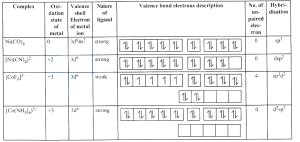
Solution
(C) $A. Ni(CO)_4$: $Ni$ is in $0$ oxidation state. $CO$ is a strong field ligand. $Ni(0) = [Ar] 3d^8 4s^2$. Due to $CO$,electrons pair up to give $3d^{10}$. Hybridization is $sp^3$ $(IV)$.
$B. [Ni(CN)_4]^{2-}$: $Ni$ is in $+2$ oxidation state. $CN^{-}$ is a strong field ligand. $Ni^{2+} = [Ar] 3d^8$. Electrons pair up,leaving one $3d$ orbital vacant. Hybridization is $dsp^2$ $(III)$.
$C. [Co(NH_3)_6]^{3+}$: $Co$ is in $+3$ oxidation state. $NH_3$ is a strong field ligand. $Co^{3+} = [Ar] 3d^6$. Electrons pair up,leaving two $3d$ orbitals vacant. Hybridization is $d^2sp^3$ $(II)$.
$D. [CoF_6]^{3-}$: $Co$ is in $+3$ oxidation state. $F^{-}$ is a weak field ligand. $Co^{3+} = [Ar] 3d^6$. No pairing occurs. Hybridization is $sp^3d^2$ $(I)$.
Therefore,the correct match is $A-IV, B-III, C-II, D-I$,which corresponds to option $C$ $(I-D, II-C, III-B, IV-A)$.
$B. [Ni(CN)_4]^{2-}$: $Ni$ is in $+2$ oxidation state. $CN^{-}$ is a strong field ligand. $Ni^{2+} = [Ar] 3d^8$. Electrons pair up,leaving one $3d$ orbital vacant. Hybridization is $dsp^2$ $(III)$.
$C. [Co(NH_3)_6]^{3+}$: $Co$ is in $+3$ oxidation state. $NH_3$ is a strong field ligand. $Co^{3+} = [Ar] 3d^6$. Electrons pair up,leaving two $3d$ orbitals vacant. Hybridization is $d^2sp^3$ $(II)$.
$D. [CoF_6]^{3-}$: $Co$ is in $+3$ oxidation state. $F^{-}$ is a weak field ligand. $Co^{3+} = [Ar] 3d^6$. No pairing occurs. Hybridization is $sp^3d^2$ $(I)$.
Therefore,the correct match is $A-IV, B-III, C-II, D-I$,which corresponds to option $C$ $(I-D, II-C, III-B, IV-A)$.
0 likes
View Solution396
MediumMCQ
Which of the following statements are correct?
$i$. $[Mn(CN)_6]^{3-}, [MnCl_6]^{3-}$ both are paramagnetic
$ii$. Both $[NiCl_4]^{2-}, [Ni(CO)_4]$ are tetrahedral and diamagnetic
$iii$. $[Co(NH_3)_6]^{3+}$ is an inner orbital complex,but $[Ni(NH_3)_6]^{2+}$ is an outer orbital complex
$i$. $[Mn(CN)_6]^{3-}, [MnCl_6]^{3-}$ both are paramagnetic
$ii$. Both $[NiCl_4]^{2-}, [Ni(CO)_4]$ are tetrahedral and diamagnetic
$iii$. $[Co(NH_3)_6]^{3+}$ is an inner orbital complex,but $[Ni(NH_3)_6]^{2+}$ is an outer orbital complex
A
$i, ii$ only
B
$i, iii$ only
C
$ii, iii$ only
D
$i, ii, iii$
Solution
(B) $i$. In $[Mn(CN)_6]^{3-}$,$Mn^{3+}$ is $3d^4$. $CN^-$ is a strong field ligand,so it is $d^2sp^3$ (inner orbital) with $2$ unpaired electrons (paramagnetic). In $[MnCl_6]^{3-}$,$Mn^{3+}$ is $3d^4$. $Cl^-$ is a weak field ligand,so it is $sp^3d^2$ (outer orbital) with $4$ unpaired electrons (paramagnetic). Thus,$i$ is correct.
$ii$. $[NiCl_4]^{2-}$ is $sp^3$ tetrahedral and paramagnetic ($2$ unpaired electrons). $[Ni(CO)_4]$ is $sp^3$ tetrahedral and diamagnetic. Thus,$ii$ is incorrect.
$iii$. $[Co(NH_3)_6]^{3+}$ involves $d^2sp^3$ hybridization (inner orbital). $[Ni(NH_3)_6]^{2+}$ involves $sp^3d^2$ hybridization (outer orbital). Thus,$iii$ is correct.
Therefore,the correct statements are $i$ and $iii$.
$ii$. $[NiCl_4]^{2-}$ is $sp^3$ tetrahedral and paramagnetic ($2$ unpaired electrons). $[Ni(CO)_4]$ is $sp^3$ tetrahedral and diamagnetic. Thus,$ii$ is incorrect.
$iii$. $[Co(NH_3)_6]^{3+}$ involves $d^2sp^3$ hybridization (inner orbital). $[Ni(NH_3)_6]^{2+}$ involves $sp^3d^2$ hybridization (outer orbital). Thus,$iii$ is correct.
Therefore,the correct statements are $i$ and $iii$.
0 likes
View Solution397
MediumMCQ
Observe the following complexes: $[Mn(CN)_6]^{3-}, [Fe(CN)_6]^{3-}, [Co(C_2O_4)_3]^{3-}, [MnCl_6]^{3-}, [Fe(CN)_6]^{4-}, [CoF_6]^{3-}$. From the above,the number of inner orbital complexes with paramagnetic nature is
A
$2$
B
$1$
C
$3$
D
$4$
Solution
(A) Let us analyze each complex:
$1$. $[Mn(CN)_6]^{3-}$: $Mn^{3+}$ is $3d^4$. $CN^-$ is a strong-field ligand,causing pairing. The configuration becomes $t_{2g}^4 e_g^0$. It is an inner-orbital complex $(d^2sp^3)$ and is paramagnetic ($2$ unpaired electrons).
$2$. $[Fe(CN)_6]^{3-}$: $Fe^{3+}$ is $3d^5$. $CN^-$ is a strong-field ligand. The configuration becomes $t_{2g}^5 e_g^0$. It is an inner-orbital complex $(d^2sp^3)$ and is paramagnetic ($1$ unpaired electron).
$3$. $[Co(C_2O_4)_3]^{3-}$: $Co^{3+}$ is $3d^6$. $C_2O_4^{2-}$ is a weak-field ligand. It forms an outer-orbital complex $(sp^3d^2)$ and is diamagnetic.
$4$. $[MnCl_6]^{3-}$: $Mn^{3+}$ is $3d^4$. $Cl^-$ is a weak-field ligand. It forms an outer-orbital complex $(sp^3d^2)$ and is paramagnetic.
$5$. $[Fe(CN)_6]^{4-}$: $Fe^{2+}$ is $3d^6$. $CN^-$ is a strong-field ligand. The configuration becomes $t_{2g}^6 e_g^0$. It is an inner-orbital complex $(d^2sp^3)$ and is diamagnetic.
$6$. $[CoF_6]^{3-}$: $Co^{3+}$ is $3d^6$. $F^-$ is a weak-field ligand. It forms an outer-orbital complex $(sp^3d^2)$ and is paramagnetic.
Inner-orbital complexes are those using $(n-1)d$ orbitals. These are $[Mn(CN)_6]^{3-}, [Fe(CN)_6]^{3-}, [Fe(CN)_6]^{4-}$.
Among these,the paramagnetic ones are $[Mn(CN)_6]^{3-}$ and $[Fe(CN)_6]^{3-}$.
Thus,the total number is $2$.
$1$. $[Mn(CN)_6]^{3-}$: $Mn^{3+}$ is $3d^4$. $CN^-$ is a strong-field ligand,causing pairing. The configuration becomes $t_{2g}^4 e_g^0$. It is an inner-orbital complex $(d^2sp^3)$ and is paramagnetic ($2$ unpaired electrons).
$2$. $[Fe(CN)_6]^{3-}$: $Fe^{3+}$ is $3d^5$. $CN^-$ is a strong-field ligand. The configuration becomes $t_{2g}^5 e_g^0$. It is an inner-orbital complex $(d^2sp^3)$ and is paramagnetic ($1$ unpaired electron).
$3$. $[Co(C_2O_4)_3]^{3-}$: $Co^{3+}$ is $3d^6$. $C_2O_4^{2-}$ is a weak-field ligand. It forms an outer-orbital complex $(sp^3d^2)$ and is diamagnetic.
$4$. $[MnCl_6]^{3-}$: $Mn^{3+}$ is $3d^4$. $Cl^-$ is a weak-field ligand. It forms an outer-orbital complex $(sp^3d^2)$ and is paramagnetic.
$5$. $[Fe(CN)_6]^{4-}$: $Fe^{2+}$ is $3d^6$. $CN^-$ is a strong-field ligand. The configuration becomes $t_{2g}^6 e_g^0$. It is an inner-orbital complex $(d^2sp^3)$ and is diamagnetic.
$6$. $[CoF_6]^{3-}$: $Co^{3+}$ is $3d^6$. $F^-$ is a weak-field ligand. It forms an outer-orbital complex $(sp^3d^2)$ and is paramagnetic.
Inner-orbital complexes are those using $(n-1)d$ orbitals. These are $[Mn(CN)_6]^{3-}, [Fe(CN)_6]^{3-}, [Fe(CN)_6]^{4-}$.
Among these,the paramagnetic ones are $[Mn(CN)_6]^{3-}$ and $[Fe(CN)_6]^{3-}$.
Thus,the total number is $2$.
0 likes
View Solution398
MediumMCQ
The spin-only magnetic moment of $[MnBr_4]^{x-}$ is $5.9 \ BM$. The geometry of the complex and $x$ respectively are
A
tetrahedral,$1$
B
square planar,$1$
C
square planar,$2$
D
tetrahedral,$2$
Solution
(D) The spin-only magnetic moment is given by the formula $\mu_{s} = \sqrt{n(n+2)} \ BM$,where $n$ is the number of unpaired electrons.
Given $\mu_{s} = 5.9 \ BM$,we have $\sqrt{n(n+2)} = 5.9$.
Squaring both sides,$n(n+2) \approx 34.81$,which gives $n = 5$.
Since $Mn$ $(Z=25)$ has the electronic configuration $[Ar] 3d^5 4s^2$,to have $5$ unpaired electrons,$Mn$ must be in the $+2$ oxidation state $(Mn^{2+}: [Ar] 3d^5)$.
$Br^-$ is a weak-field ligand,so it does not cause pairing of electrons,resulting in $sp^3$ hybridization.
For the complex $[MnBr_4]^{x-}$,the oxidation state of $Mn$ is $x-4 = -2$,so $x = 2$.
The geometry of $sp^3$ hybridized complexes is tetrahedral.
Given $\mu_{s} = 5.9 \ BM$,we have $\sqrt{n(n+2)} = 5.9$.
Squaring both sides,$n(n+2) \approx 34.81$,which gives $n = 5$.
Since $Mn$ $(Z=25)$ has the electronic configuration $[Ar] 3d^5 4s^2$,to have $5$ unpaired electrons,$Mn$ must be in the $+2$ oxidation state $(Mn^{2+}: [Ar] 3d^5)$.
$Br^-$ is a weak-field ligand,so it does not cause pairing of electrons,resulting in $sp^3$ hybridization.
For the complex $[MnBr_4]^{x-}$,the oxidation state of $Mn$ is $x-4 = -2$,so $x = 2$.
The geometry of $sp^3$ hybridized complexes is tetrahedral.
0 likes
View Solution399
EasyMCQ
The hybridisation of metals involved in the following complexes,$[Mn(CN)_6]^{3-}$ and $[CoF_6]^{3-}$,are respectively:
A
$sp^3d^2, sp^3d^2$
B
$sp^3d^2, d^2sp^3$
C
$d^2sp^3, d^2sp^3$
D
$d^2sp^3, sp^3d^2$
Solution
(D) In $[Mn(CN)_6]^{3-}$,$Mn$ is in $+3$ oxidation state ($3d^4$ configuration).
Since $CN^-$ is a strong field ligand,it causes the pairing of $3d$ electrons,making two $3d$-orbitals vacant. These two $3d$,one $4s$,and three $4p$-orbitals hybridise to give $d^2sp^3$ hybridisation.
In $[CoF_6]^{3-}$,$Co$ is in $+3$ oxidation state ($3d^6$ configuration).
Since $F^-$ is a weak field ligand,it cannot cause the pairing of unpaired $3d$ electrons. Thus,one $4s$,three $4p$,and two $4d$-orbitals hybridise to give $sp^3d^2$ hybridisation.
Since $CN^-$ is a strong field ligand,it causes the pairing of $3d$ electrons,making two $3d$-orbitals vacant. These two $3d$,one $4s$,and three $4p$-orbitals hybridise to give $d^2sp^3$ hybridisation.
In $[CoF_6]^{3-}$,$Co$ is in $+3$ oxidation state ($3d^6$ configuration).
Since $F^-$ is a weak field ligand,it cannot cause the pairing of unpaired $3d$ electrons. Thus,one $4s$,three $4p$,and two $4d$-orbitals hybridise to give $sp^3d^2$ hybridisation.
0 likes
View Solution400
MediumMCQ
According to valence bond theory,the metal atom or ion can make use of which of the following orbitals to yield hybrid orbitals that can form bonds with ligands?
A
$(n-1)d, (n-1)s, np$
B
$(n-1)d, ns, np$
C
$(n-1)d, ns, (n-1)p$
D
$nd, (n-1)s, (n-1)p$
Solution
(B) According to valence bond theory,the central metal atom or ion makes available a number of empty orbitals equal to its coordination number for the formation of coordinate bonds with ligands.
These empty orbitals are hybridized to form a set of equivalent hybrid orbitals of definite geometry.
For transition metals,the orbitals involved in hybridization are $(n-1)d$,$ns$,and $np$ orbitals.
These empty orbitals are hybridized to form a set of equivalent hybrid orbitals of definite geometry.
For transition metals,the orbitals involved in hybridization are $(n-1)d$,$ns$,and $np$ orbitals.
0 likes
View SolutionCoordination Compounds — Hybridisation and Geometry · Frequently Asked Questions
1Are these Coordination Compounds questions useful for JEE and NEET?
Yes. All questions in this section are mapped to JEE Main and NEET exam patterns. Previous year questions from JEE Main, NEET, GUJCET and state-level exams are included with full solutions.
2Can I switch to Hindi or Gujarati for these questions?
Yes. Use the language tabs in the hero section or the sidebar to view the same questions and solutions in English, Hindi or Gujarati.
3How do I generate a question paper from this subtopic?
Use the Vedclass Exam Paper Generator — select the chapter and subtopic, set difficulty, and generate Sets A, B, C, D automatically. First 3 chapters of every subject are free.
Vedclass Products
For Students
Vedclass Test Series
Mock tests in real JEE/NEET style with performance analysis. 5-day free trial.
Start Free TrialFor Teachers
Exam Paper Generator
Generate Set A/B/C/D papers from this chapter in 2 minutes. 3 chapters free.
Try FreeFor Institutes
Online Exam Module
Live online exams with unlimited students, 360° analytics & white-label branding.
See DemoFor Teachers & Institutes
Generate a Coordination Compounds Exam Paper in 2 Minutes
Select subtopic & difficulty — Sets A, B, C, D auto-generated with No Repeat logic.
First 3 chapters of every subject are free — no payment required.