
A English
Hybridisation and Geometry Questions in English
Class 12 Chemistry · Coordination Compounds · Hybridisation and Geometry
436+
Questions
English
Language
100%
With Solutions
Showing 50 of 436 questions in English
251
Medium
Briefly explain the Valence Bond Theory $(VBT)$.
Solution
(N/A) According to this theory,the metal atom or ion under the influence of ligands uses its $(n-1)d, ns, np$ or $ns, np, nd$ orbitals for hybridization to produce a set of equivalent orbitals of definite geometry such as octahedral,square planar,and others (as shown in the table below).
These hybrid orbitals are allowed to overlap with ligand orbitals that can donate electron pairs for bonding.
| Coordination Number | Type of Hybridization | Distribution of Hybrid Orbitals in Space |
|---|---|---|
| $4$ | $sp^3$ | Tetrahedral |
| $4$ | $dsp^2$ | Square planar |
| $5$ | $sp^3d$ | Trigonal bipyramidal |
| $6$ | $sp^3d^2$ | Octahedral |
| $6$ | $d^2sp^3$ | Octahedral |
These hybrid orbitals are allowed to overlap with ligand orbitals that can donate electron pairs for bonding.
0 likes
View Solution252
Difficult
Discuss the complex species $[Co(NH_3)_6]^{3+}$ based on Valence Bond Theory.
Solution
(N/A) $1$. The central metal ion $Co^{3+}$ has an electronic configuration of $[Ar]3d^6$.
$2$. In the presence of the strong field ligand $NH_3$,the electrons in the $3d$ orbitals pair up,leaving two $3d$ orbitals vacant.
$3$. These two $3d$ orbitals,along with one $4s$ and three $4p$ orbitals,undergo $d^2sp^3$ hybridization to form six equivalent hybrid orbitals.
$4$. Six pairs of electrons from six $NH_3$ ligands occupy these hybrid orbitals,resulting in an octahedral geometry.
$5$. Since there are no unpaired electrons,the complex is diamagnetic.
$6$. Because the inner $3d$ orbitals are involved in hybridization,it is called an inner orbital complex or a low-spin complex.
$2$. In the presence of the strong field ligand $NH_3$,the electrons in the $3d$ orbitals pair up,leaving two $3d$ orbitals vacant.
$3$. These two $3d$ orbitals,along with one $4s$ and three $4p$ orbitals,undergo $d^2sp^3$ hybridization to form six equivalent hybrid orbitals.
$4$. Six pairs of electrons from six $NH_3$ ligands occupy these hybrid orbitals,resulting in an octahedral geometry.
$5$. Since there are no unpaired electrons,the complex is diamagnetic.
$6$. Because the inner $3d$ orbitals are involved in hybridization,it is called an inner orbital complex or a low-spin complex.
0 likes
View Solution253
Difficult
Discuss the $[CoF_6]^{3-}$ complex species based on Valence Bond Theory $(VBT)$.
Solution
(N/A) $1$. The central metal ion is $Co^{3+}$,which has an electronic configuration of $[Ar] 3d^6$.
$2$. In the presence of the weak field ligand $F^-$,the $d$-electrons do not pair up.
$3$. The $Co^{3+}$ ion uses one $4s$,three $4p$,and two $4d$ orbitals to undergo $sp^3d^2$ hybridization.
$4$. Six pairs of electrons from six $F^-$ ions occupy these six $sp^3d^2$ hybrid orbitals.
$5$. Since the outer $4d$ orbitals are used,it is an outer orbital complex (high spin complex).
$6$. Due to the presence of four unpaired electrons in the $3d$ orbitals,the complex is paramagnetic.
$2$. In the presence of the weak field ligand $F^-$,the $d$-electrons do not pair up.
$3$. The $Co^{3+}$ ion uses one $4s$,three $4p$,and two $4d$ orbitals to undergo $sp^3d^2$ hybridization.
$4$. Six pairs of electrons from six $F^-$ ions occupy these six $sp^3d^2$ hybrid orbitals.
$5$. Since the outer $4d$ orbitals are used,it is an outer orbital complex (high spin complex).
$6$. Due to the presence of four unpaired electrons in the $3d$ orbitals,the complex is paramagnetic.
0 likes
View Solution254
Difficult
Discuss the $[NiCl_4]^{2-}$ complex species based on Valence Bond Theory.
Solution
(N/A) In the $[NiCl_4]^{2-}$ complex,the oxidation state of $Ni$ is $+2$. The electronic configuration of $Ni^{2+}$ is $[Ar] 3d^8$.
Since $Cl^-$ is a weak field ligand,it does not cause pairing of electrons in the $3d$ orbitals. Therefore,the $3d$ electrons remain unpaired.
To accommodate four $Cl^-$ ligands,one $4s$ and three $4p$ orbitals undergo $sp^3$ hybridization,resulting in four equivalent $sp^3$ hybrid orbitals directed towards the corners of a tetrahedron.
Four pairs of electrons from four $Cl^-$ ions are donated into these four $sp^3$ hybrid orbitals. Thus,the complex has a tetrahedral geometry.
Due to the presence of two unpaired electrons in the $3d$ orbitals,the complex is paramagnetic.
Since $Cl^-$ is a weak field ligand,it does not cause pairing of electrons in the $3d$ orbitals. Therefore,the $3d$ electrons remain unpaired.
To accommodate four $Cl^-$ ligands,one $4s$ and three $4p$ orbitals undergo $sp^3$ hybridization,resulting in four equivalent $sp^3$ hybrid orbitals directed towards the corners of a tetrahedron.
Four pairs of electrons from four $Cl^-$ ions are donated into these four $sp^3$ hybrid orbitals. Thus,the complex has a tetrahedral geometry.
Due to the presence of two unpaired electrons in the $3d$ orbitals,the complex is paramagnetic.
0 likes
View Solution255
Difficult
Explain the complex species $[Ni(CN)_4]^{2-}$ on the basis of Valence Bond Theory $(VBT)$.
Solution
(N/A) In the complex $[Ni(CN)_4]^{2-}$,the central metal ion $Ni$ is in the $+2$ oxidation state. The electronic configuration of $Ni^{2+}$ is $3d^8$.
Since $CN^-$ is a strong field ligand,it causes the pairing of electrons in the $3d$ orbitals.
This results in one empty $3d$ orbital,one $4s$ orbital,and two $4p$ orbitals,which undergo $dsp^2$ hybridization to form four equivalent $dsp^2$ hybrid orbitals.
These four hybrid orbitals accept electron pairs from four $CN^-$ ligands.
Due to the presence of all paired electrons,the complex is diamagnetic.
Since it involves the inner $3d$ orbital,it is a low-spin or inner-orbital complex with a square planar geometry.
Since $CN^-$ is a strong field ligand,it causes the pairing of electrons in the $3d$ orbitals.
This results in one empty $3d$ orbital,one $4s$ orbital,and two $4p$ orbitals,which undergo $dsp^2$ hybridization to form four equivalent $dsp^2$ hybrid orbitals.
These four hybrid orbitals accept electron pairs from four $CN^-$ ligands.
Due to the presence of all paired electrons,the complex is diamagnetic.
Since it involves the inner $3d$ orbital,it is a low-spin or inner-orbital complex with a square planar geometry.
0 likes
View Solution256
Medium
Write the limitations of Valence Bond Theory $(VBT)$.
Solution
(N/A) $VBT$ can explain the formation,structure,and magnetic behavior of coordination compounds. However,it has the following limitations:
$(i)$ It involves a number of assumptions.
$(ii)$ It does not give a quantitative interpretation of magnetic data.
$(iii)$ It cannot explain the color exhibited by coordination compounds.
$(iv)$ It does not give a quantitative interpretation of the thermodynamic or kinetic stability of coordination compounds.
$(v)$ It does not make exact predictions regarding the tetrahedral and square planar structures of $4$-coordinate complexes.
$(vi)$ It does not distinguish between weak and strong ligands.
$(i)$ It involves a number of assumptions.
$(ii)$ It does not give a quantitative interpretation of magnetic data.
$(iii)$ It cannot explain the color exhibited by coordination compounds.
$(iv)$ It does not give a quantitative interpretation of the thermodynamic or kinetic stability of coordination compounds.
$(v)$ It does not make exact predictions regarding the tetrahedral and square planar structures of $4$-coordinate complexes.
$(vi)$ It does not distinguish between weak and strong ligands.
0 likes
View Solution257
EasyMCQ
What is the geometry of the $[Ni(CO)_4]$ complex?
A
Square planar
B
Tetrahedral
C
Octahedral
D
Trigonal bipyramidal
Solution
(B) In $[Ni(CO)_4]$,the oxidation state of $Ni$ is $0$.
The electronic configuration of $Ni$ $(Z=28)$ is $[Ar] 3d^8 4s^2$.
Since $CO$ is a strong field ligand,it causes pairing of electrons.
The $4s$ electrons shift to the $3d$ orbital,resulting in $3d^{10}$ configuration.
The hybridization involved is $sp^3$,which corresponds to a tetrahedral geometry.
The electronic configuration of $Ni$ $(Z=28)$ is $[Ar] 3d^8 4s^2$.
Since $CO$ is a strong field ligand,it causes pairing of electrons.
The $4s$ electrons shift to the $3d$ orbital,resulting in $3d^{10}$ configuration.
The hybridization involved is $sp^3$,which corresponds to a tetrahedral geometry.
0 likes
View Solution258
MediumMCQ
What is the hybridization of the complex $[Mn(CN)_6]^{3-}$?
A
$sp^3d^2$
B
$d^2sp^3$
C
$dsp^2$
D
$sp^3$
Solution
(B) $1$. In the complex $[Mn(CN)_6]^{3-}$,the central metal ion is $Mn^{3+}$.
$2$. The atomic number of $Mn$ is $25$,so the electronic configuration of $Mn^{3+}$ is $[Ar] 3d^4$.
$3$. $CN^-$ is a strong field ligand,which causes pairing of electrons in the $3d$ orbitals.
$4$. The $4$ electrons in the $3d$ orbitals pair up to occupy two $3d$ orbitals,leaving two $3d$ orbitals vacant.
$5$. These two $3d$ orbitals,one $4s$ orbital,and three $4p$ orbitals hybridize to form six $d^2sp^3$ hybrid orbitals.
$6$. Thus,the hybridization of $[Mn(CN)_6]^{3-}$ is $d^2sp^3$.
$2$. The atomic number of $Mn$ is $25$,so the electronic configuration of $Mn^{3+}$ is $[Ar] 3d^4$.
$3$. $CN^-$ is a strong field ligand,which causes pairing of electrons in the $3d$ orbitals.
$4$. The $4$ electrons in the $3d$ orbitals pair up to occupy two $3d$ orbitals,leaving two $3d$ orbitals vacant.
$5$. These two $3d$ orbitals,one $4s$ orbital,and three $4p$ orbitals hybridize to form six $d^2sp^3$ hybrid orbitals.
$6$. Thus,the hybridization of $[Mn(CN)_6]^{3-}$ is $d^2sp^3$.
0 likes
View Solution259
MediumMCQ
Why is $[CoF_6]^{3-}$ considered an outer orbital complex?
A
It involves $sp^3d^2$ hybridization.
B
It involves $d^2sp^3$ hybridization.
C
It is a low spin complex.
D
It has no unpaired electrons.
Solution
(A) In the complex $[CoF_6]^{3-}$,the oxidation state of $Co$ is $+3$. The electronic configuration of $Co^{3+}$ is $[Ar] 3d^6$.
$F^-$ is a weak field ligand,which does not cause pairing of electrons in the $3d$ orbitals.
Therefore,the complex utilizes the outer $4d$ orbitals for hybridization,resulting in $sp^3d^2$ hybridization.
Since the outer $d$-orbitals are involved,it is classified as an outer orbital complex.
$F^-$ is a weak field ligand,which does not cause pairing of electrons in the $3d$ orbitals.
Therefore,the complex utilizes the outer $4d$ orbitals for hybridization,resulting in $sp^3d^2$ hybridization.
Since the outer $d$-orbitals are involved,it is classified as an outer orbital complex.
0 likes
View Solution260
MediumMCQ
What is the geometry of the $[Fe(CO)_5]$ complex?
A
Octahedral
B
Square pyramidal
C
Trigonal bipyramidal
D
Tetrahedral
Solution
(C) The central metal atom is $Fe$ in the oxidation state $0$. The electronic configuration of $Fe$ is $[Ar] 3d^6 4s^2$. In the presence of strong field ligand $CO$,the electrons pair up,and the hybridization involved is $dsp^3$. The geometry corresponding to $dsp^3$ hybridization is trigonal bipyramidal.
0 likes
View Solution261
Difficult
Draw the structure of the $[Cr(CO)_6]$ complex.
Solution
(N/A) The central metal atom is Chromium $(Cr)$ with an atomic number of $24$. The electronic configuration of $Cr$ is $[Ar] 3d^5 4s^1$.
In the $[Cr(CO)_6]$ complex,the oxidation state of $Cr$ is $0$.
$CO$ is a strong field ligand,which causes pairing of electrons in the $3d$ orbitals.
The hybridization involved is $d^2sp^3$,which corresponds to an octahedral geometry.
The structure consists of a central $Cr$ atom surrounded by six $CO$ ligands arranged at the corners of an octahedron.
In the $[Cr(CO)_6]$ complex,the oxidation state of $Cr$ is $0$.
$CO$ is a strong field ligand,which causes pairing of electrons in the $3d$ orbitals.
The hybridization involved is $d^2sp^3$,which corresponds to an octahedral geometry.
The structure consists of a central $Cr$ atom surrounded by six $CO$ ligands arranged at the corners of an octahedron.
0 likes
View Solution262
Medium
The magnetic moment of $[MnCl_{4}]^{2-}$ is $5.92 \ BM$. Explain the reason for this value.
Solution
(N/A) In $[MnCl_{4}]^{2-}$,the oxidation state of $Mn$ is $+2$. The electronic configuration of $Mn^{2+}$ is $[Ar] 3d^{5}$.
Since $Cl^{-}$ is a weak field ligand,it does not cause pairing of electrons in the $3d$ subshell.
Thus,there are $5$ unpaired electrons $(n=5)$.
The magnetic moment is calculated as $\mu = \sqrt{n(n+2)} = \sqrt{5(5+2)} = \sqrt{35} \approx 5.92 \ BM$.
This confirms the high spin $sp^{3}$ hybridized tetrahedral complex.
Since $Cl^{-}$ is a weak field ligand,it does not cause pairing of electrons in the $3d$ subshell.
Thus,there are $5$ unpaired electrons $(n=5)$.
The magnetic moment is calculated as $\mu = \sqrt{n(n+2)} = \sqrt{5(5+2)} = \sqrt{35} \approx 5.92 \ BM$.
This confirms the high spin $sp^{3}$ hybridized tetrahedral complex.
0 likes
View Solution263
Medium
Using valence bond theory,explain the following in relation to the complexes given below: $[Mn(CN)_{6}]^{3-}, [Co(NH_{3})_{6}]^{3+}, [Cr(H_{2}O)_{6}]^{3+}, [FeCl_{6}]^{4-}$
$(i)$ Type of hybridisation.
$(ii)$ Inner or outer orbital complex.
$(iii)$ Magnetic behaviour.
$(iv)$ Spin only magnetic moment value.
$(i)$ Type of hybridisation.
$(ii)$ Inner or outer orbital complex.
$(iii)$ Magnetic behaviour.
$(iv)$ Spin only magnetic moment value.
Solution
(N/A) $(i)$ $[Mn(CN)_{6}]^{3-}$: $Mn^{3+}$ is $3d^{4}$. $CN^-$ is a strong field ligand,causing pairing. Hybridization: $d^{2}sp^{3}$. Inner orbital complex. Paramagnetic (two unpaired electrons). Magnetic moment,$\mu = \sqrt{2(2+2)} = 2.83 \ B.M.$
$(ii)$ $[Co(NH_{3})_{6}]^{3+}$: $Co^{3+}$ is $3d^{6}$. $NH_{3}$ is a strong field ligand,causing pairing. Hybridization: $d^{2}sp^{3}$. Inner orbital complex. Diamagnetic. Magnetic moment,$\mu = 0 \ B.M.$
$(iii)$ $[Cr(H_{2}O)_{6}]^{3+}$: $Cr^{3+}$ is $3d^{3}$. Hybridization: $d^{2}sp^{3}$. Inner orbital complex. Paramagnetic (three unpaired electrons). Magnetic moment,$\mu = \sqrt{3(3+2)} = 3.87 \ B.M.$
$(iv)$ $[FeCl_{6}]^{4-}$: $Fe^{2+}$ is $3d^{6}$. $Cl^-$ is a weak field ligand,no pairing. Hybridization: $sp^{3}d^{2}$. Outer orbital complex. Paramagnetic (four unpaired electrons). Magnetic moment,$\mu = \sqrt{4(4+2)} = 4.90 \ B.M.$
$(ii)$ $[Co(NH_{3})_{6}]^{3+}$: $Co^{3+}$ is $3d^{6}$. $NH_{3}$ is a strong field ligand,causing pairing. Hybridization: $d^{2}sp^{3}$. Inner orbital complex. Diamagnetic. Magnetic moment,$\mu = 0 \ B.M.$
$(iii)$ $[Cr(H_{2}O)_{6}]^{3+}$: $Cr^{3+}$ is $3d^{3}$. Hybridization: $d^{2}sp^{3}$. Inner orbital complex. Paramagnetic (three unpaired electrons). Magnetic moment,$\mu = \sqrt{3(3+2)} = 3.87 \ B.M.$
$(iv)$ $[FeCl_{6}]^{4-}$: $Fe^{2+}$ is $3d^{6}$. $Cl^-$ is a weak field ligand,no pairing. Hybridization: $sp^{3}d^{2}$. Outer orbital complex. Paramagnetic (four unpaired electrons). Magnetic moment,$\mu = \sqrt{4(4+2)} = 4.90 \ B.M.$
0 likes
View Solution264
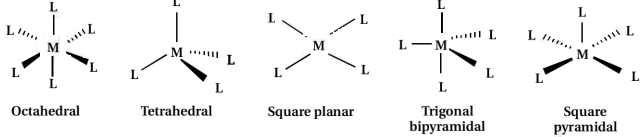
Medium
Define the following term: Coordination polyhedron.
Solution
(N/A) Coordination polyhedron: The spatial arrangement of the ligands which are directly attached to the central ion/atom defines a coordination polyhedron about the central atom.
The most common coordination polyhedra are octahedral,square planar,and tetrahedral.
The most common coordination polyhedra are octahedral,square planar,and tetrahedral.
| $Coordination \ Entity$ | $Shape \ of \ Polyhedron$ |
| $(i) \ [Co(NH_3)_6]^{3+}$ | $Octahedral$ |
| $(ii) \ [Ni(CO)_4]$ | $Tetrahedral$ |
| $(iii) \ [PtCl_4]^{2-}$ | $Square \ planar$ |
0 likes
View Solution265
EasyMCQ
What will be the type of hybridization if the shapes are square planar,octahedral,and linear,respectively?
A
$sp^{3}d^{2}, dsp^{2}, sp$
B
$dsp^{2}, sp^{3}d^{2}, sp$
C
$sp^{3}d^{2}, sp, dsp^{2}$
D
$sp, dsp^{2}, sp^{3}d^{2}$
Solution
(B) The hybridization for square planar geometry is $dsp^{2}$.
The hybridization for octahedral geometry is $sp^{3}d^{2}$ or $d^{2}sp^{3}$.
The hybridization for linear geometry is $sp$.
Therefore,the correct sequence is $dsp^{2}, sp^{3}d^{2}, sp$.
The hybridization for octahedral geometry is $sp^{3}d^{2}$ or $d^{2}sp^{3}$.
The hybridization for linear geometry is $sp$.
Therefore,the correct sequence is $dsp^{2}, sp^{3}d^{2}, sp$.
0 likes
View Solution266
MediumMCQ
Match the type of hybridization given in List-$I$ with the molecules/ions given in List-$II$.
| List-$I$ | List-$II$ |
| $(1)$ $dsp^2$ | $(A)$ $BrF_5$ |
| $(2)$ $sp^3d^2$ | $(B)$ $[Co(NH_3)_6]^{3+}$ |
| $(3)$ $sp^3d$ | $(C)$ $[PtCl_4]^{2-}$ |
| $(4)$ $d^2sp^3$ | $(D)$ $PCl_5$ |
A
$1-C, 2-A, 3-D, 4-B$
B
$1-B, 2-A, 3-D, 4-C$
C
$1-C, 2-D, 3-A, 4-B$
D
$1-B, 2-C, 3-D, 4-A$
Solution
(A) The hybridization of the given species is as follows:
$(1)$ $[PtCl_4]^{2-}$ involves $dsp^2$ hybridization (square planar).
$(2)$ $BrF_5$ involves $sp^3d^2$ hybridization (square pyramidal).
$(3)$ $PCl_5$ involves $sp^3d$ hybridization (trigonal bipyramidal).
$(4)$ $[Co(NH_3)_6]^{3+}$ involves $d^2sp^3$ hybridization (octahedral).
Therefore,the correct matching is $1-C, 2-A, 3-D, 4-B$.
$(1)$ $[PtCl_4]^{2-}$ involves $dsp^2$ hybridization (square planar).
$(2)$ $BrF_5$ involves $sp^3d^2$ hybridization (square pyramidal).
$(3)$ $PCl_5$ involves $sp^3d$ hybridization (trigonal bipyramidal).
$(4)$ $[Co(NH_3)_6]^{3+}$ involves $d^2sp^3$ hybridization (octahedral).
Therefore,the correct matching is $1-C, 2-A, 3-D, 4-B$.
0 likes
View Solution267
MediumMCQ
For octahedral $Mn(II)$ and tetrahedral $Ni(II)$ complexes,consider the following statements:
$(I)$ Both the complexes can be high spin.
$(II)$ $Ni(II)$ complex can very rarely be low spin.
$(III)$ With strong field ligands,$Mn(II)$ complexes can be low spin.
$(IV)$ Aqueous solution of $Mn(II)$ ions is yellow in color.
$(I)$ Both the complexes can be high spin.
$(II)$ $Ni(II)$ complex can very rarely be low spin.
$(III)$ With strong field ligands,$Mn(II)$ complexes can be low spin.
$(IV)$ Aqueous solution of $Mn(II)$ ions is yellow in color.
A
$(I), (III)$ and $(IV)$ only
B
$(II), (III)$ and $(IV)$ only
C
$(I), (II)$ and $(III)$ only
D
$(I)$ and $(II)$ only
Solution
(C) $(I)$ Under weak field ligands,octahedral $Mn(II)$ and tetrahedral $Ni(II)$ complexes are both high spin.
$(II)$ Tetrahedral $Ni(II)$ complexes are rarely low spin because $Ni(II)$ prefers square planar geometry with strong field ligands,which are low spin.
$(III)$ With strong field ligands,$Mn(II)$ $(d^5)$ complexes can be low spin (unpaired electrons $= 1$).
$(IV)$ Aqueous solution of $Mn(II)$ ions is pink in color,not yellow. Therefore,statement $(IV)$ is incorrect.
$(II)$ Tetrahedral $Ni(II)$ complexes are rarely low spin because $Ni(II)$ prefers square planar geometry with strong field ligands,which are low spin.
$(III)$ With strong field ligands,$Mn(II)$ $(d^5)$ complexes can be low spin (unpaired electrons $= 1$).
$(IV)$ Aqueous solution of $Mn(II)$ ions is pink in color,not yellow. Therefore,statement $(IV)$ is incorrect.
0 likes
View Solution268
MediumMCQ
Consider that a $d^{6}$ metal ion $(M^{2+})$ forms a complex with aqua ligands,and the spin-only magnetic moment of the complex is $4.90 \ BM.$ The geometry and the crystal field stabilization energy $(CFSE)$ of the complex are:
A
tetrahedral and $-1.6 \Delta_{t} + P$
B
tetrahedral and $-0.6 \Delta_{t}$
C
octahedral and $-1.6 \Delta_{0}$
D
octahedral and $-2.4 \Delta_{0} + 2P$
Solution
(B) The spin-only magnetic moment is given by $\mu = \sqrt{n(n+2)} \ BM.$ For $\mu = 4.90 \ BM,$ $n = 4$ unpaired electrons.
For a $d^{6}$ ion,$4$ unpaired electrons are possible in a high-spin tetrahedral complex $(e^{3}t_{2}^{3})$ or a high-spin octahedral complex $(t_{2g}^{4}e_{g}^{2})$.
In a tetrahedral complex $[M(H_{2}O)_{4}]^{2+}$,the configuration is $e^{3}t_{2}^{3}$.
$CFSE = (3 \times -0.6 \Delta_{t}) + (3 \times 0.4 \Delta_{t}) = -1.8 \Delta_{t} + 1.2 \Delta_{t} = -0.6 \Delta_{t}.$
In an octahedral complex $[M(H_{2}O)_{6}]^{2+}$,the configuration is $t_{2g}^{4}e_{g}^{2}$.
$CFSE = (4 \times -0.4 \Delta_{0}) + (2 \times 0.6 \Delta_{0}) = -1.6 \Delta_{0} + 1.2 \Delta_{0} = -0.4 \Delta_{0}.$
Comparing with the given options,option $B$ matches the tetrahedral geometry and calculated $CFSE$.
For a $d^{6}$ ion,$4$ unpaired electrons are possible in a high-spin tetrahedral complex $(e^{3}t_{2}^{3})$ or a high-spin octahedral complex $(t_{2g}^{4}e_{g}^{2})$.
In a tetrahedral complex $[M(H_{2}O)_{4}]^{2+}$,the configuration is $e^{3}t_{2}^{3}$.
$CFSE = (3 \times -0.6 \Delta_{t}) + (3 \times 0.4 \Delta_{t}) = -1.8 \Delta_{t} + 1.2 \Delta_{t} = -0.6 \Delta_{t}.$
In an octahedral complex $[M(H_{2}O)_{6}]^{2+}$,the configuration is $t_{2g}^{4}e_{g}^{2}$.
$CFSE = (4 \times -0.4 \Delta_{0}) + (2 \times 0.6 \Delta_{0}) = -1.6 \Delta_{0} + 1.2 \Delta_{0} = -0.4 \Delta_{0}.$
Comparing with the given options,option $B$ matches the tetrahedral geometry and calculated $CFSE$.
0 likes
View Solution269
MediumMCQ
The one that can exhibit the highest paramagnetic behaviour among the following is:-
$gly = \text{glycinato}$; $bpy = 2,2'-\text{bipyridine}$
$gly = \text{glycinato}$; $bpy = 2,2'-\text{bipyridine}$
A
$[Pd(gly)_2]$
B
$[Ti(NH_3)_6]^{3+}$
C
$[Co(OX)_2(OH)_2]^{-}$ $(\Delta_0 > P)$
D
$[Fe(en)(bpy)(NH_3)_2]^{2+}$
Solution
(B) To determine the highest paramagnetic behaviour,we calculate the number of unpaired electrons $(n)$ for each complex:
$A) [Pd(gly)_2]$: $Pd^{2+}$ is a $4d^8$ metal ion. $Pd$ is a $4d$ series element,so it always forms low-spin square planar complexes. $n = 0$.
$B) [Ti(NH_3)_6]^{3+}$: $Ti^{3+}$ is a $3d^1$ ion. $n = 1$.
$C) [Co(OX)_2(OH)_2]^{-}$: $Co^{3+}$ is a $3d^6$ ion. Given $\Delta_0 > P$,it forms a low-spin complex. $t_{2g}^6 e_g^0$. $n = 0$.
$D) [Fe(en)(bpy)(NH_3)_2]^{2+}$: $Fe^{2+}$ is a $3d^6$ ion. $en$ and $bpy$ are strong field ligands. This forms a low-spin complex. $t_{2g}^6 e_g^0$. $n = 0$.
Wait,re-evaluating the question options. If we consider $[Fe(en)(bpy)(NH_3)_2]^{2+}$,$Fe^{2+}$ is $3d^6$. With strong field ligands,it is $t_{2g}^6$,$n=0$.
Let's re-check $[Ti(NH_3)_6]^{3+}$. $Ti^{3+}$ is $3d^1$,$n=1$.
Since $1 > 0$,$[Ti(NH_3)_6]^{3+}$ has the highest number of unpaired electrons among the choices provided.
$A) [Pd(gly)_2]$: $Pd^{2+}$ is a $4d^8$ metal ion. $Pd$ is a $4d$ series element,so it always forms low-spin square planar complexes. $n = 0$.
$B) [Ti(NH_3)_6]^{3+}$: $Ti^{3+}$ is a $3d^1$ ion. $n = 1$.
$C) [Co(OX)_2(OH)_2]^{-}$: $Co^{3+}$ is a $3d^6$ ion. Given $\Delta_0 > P$,it forms a low-spin complex. $t_{2g}^6 e_g^0$. $n = 0$.
$D) [Fe(en)(bpy)(NH_3)_2]^{2+}$: $Fe^{2+}$ is a $3d^6$ ion. $en$ and $bpy$ are strong field ligands. This forms a low-spin complex. $t_{2g}^6 e_g^0$. $n = 0$.
Wait,re-evaluating the question options. If we consider $[Fe(en)(bpy)(NH_3)_2]^{2+}$,$Fe^{2+}$ is $3d^6$. With strong field ligands,it is $t_{2g}^6$,$n=0$.
Let's re-check $[Ti(NH_3)_6]^{3+}$. $Ti^{3+}$ is $3d^1$,$n=1$.
Since $1 > 0$,$[Ti(NH_3)_6]^{3+}$ has the highest number of unpaired electrons among the choices provided.
0 likes
View Solution270
AdvancedMCQ
The molecule in which hybrid $MOs$ involve only one $d-$orbital of the central atom is:
A
$[Ni(CN)_{4}]^{2-}$
B
$[CrF_{6}]^{3-}$
C
$BrF_{5}$
D
$XeF_{4}$
Solution
(A) $1$. $[Ni(CN)_{4}]^{2-}$ involves $dsp^{2}$ hybridization,which uses one $d-$orbital $(d_{x^2-y^2})$.
$2$. $[CrF_{6}]^{3-}$ involves $d^{2}sp^{3}$ hybridization,which uses two $d-$orbitals.
$3$. $BrF_{5}$ involves $sp^{3}d^{2}$ hybridization,which uses two $d-$orbitals.
$4$. $XeF_{4}$ involves $sp^{3}d^{2}$ hybridization,which uses two $d-$orbitals.
Therefore,the correct option is $A$.
$2$. $[CrF_{6}]^{3-}$ involves $d^{2}sp^{3}$ hybridization,which uses two $d-$orbitals.
$3$. $BrF_{5}$ involves $sp^{3}d^{2}$ hybridization,which uses two $d-$orbitals.
$4$. $XeF_{4}$ involves $sp^{3}d^{2}$ hybridization,which uses two $d-$orbitals.
Therefore,the correct option is $A$.
0 likes
View Solution271
MediumMCQ
Considering that $\Delta_{0} > P$,the magnetic moment (in $BM$) of $[Ru(H_{2}O)_{6}]^{2+}$ would be
A
$0$
B
$3$
C
$6$
D
$9$
Solution
(A) The electronic configuration of $Ru$ $(Z=44)$ is $[Kr] 4d^{7} 5s^{1}$.
For $Ru^{2+}$,the configuration is $4d^{6}$.
Given that $\Delta_{0} > P$,the complex is a low-spin complex.
In an octahedral field,the $6$ electrons in the $4d$ orbital will occupy the $t_{2g}$ orbitals as $(t_{2g})^{6} (e_{g})^{0}$.
Since all electrons are paired,the number of unpaired electrons $(n)$ is $0$.
The magnetic moment $\mu = \sqrt{n(n+2)} \ BM = \sqrt{0(0+2)} \ BM = 0 \ BM$.
For $Ru^{2+}$,the configuration is $4d^{6}$.
Given that $\Delta_{0} > P$,the complex is a low-spin complex.
In an octahedral field,the $6$ electrons in the $4d$ orbital will occupy the $t_{2g}$ orbitals as $(t_{2g})^{6} (e_{g})^{0}$.
Since all electrons are paired,the number of unpaired electrons $(n)$ is $0$.
The magnetic moment $\mu = \sqrt{n(n+2)} \ BM = \sqrt{0(0+2)} \ BM = 0 \ BM$.
0 likes
View Solution272
MediumMCQ
Match the coordination number and type of hybridisation with the distribution of hybrid orbitals in space based on Valence Bond Theory.
Select the correct option.
| Coordination number and type of hybridisation | Distribution of hybrid orbitals in space |
|---|---|
| $a. 4, sp^3$ | $i. \text{trigonal bipyramidal}$ |
| $b. 4, dsp^2$ | $ii. \text{octahedral}$ |
| $c. 5, sp^3d$ | $iii. \text{tetrahedral}$ |
| $d. 6, d^2sp^3$ | $iv. \text{square planar}$ |
Select the correct option.
A
$a-iii, b-i, c-iv, d-ii$
B
$a-ii, b-iii, c-iv, d-i$
C
$a-iii, b-iv, c-i, d-ii$
D
$a-iv, b-i, c-ii, d-iii$
Solution
(C) According to Valence Bond Theory:
$1. 4, sp^3$ hybridisation results in a $tetrahedral$ geometry $(a-iii)$.
$2. 4, dsp^2$ hybridisation results in a $square planar$ geometry $(b-iv)$.
$3. 5, sp^3d$ hybridisation results in a $trigonal bipyramidal$ geometry $(c-i)$.
$4. 6, d^2sp^3$ hybridisation results in an $octahedral$ geometry $(d-ii)$.
Therefore,the correct matching is $a-iii, b-iv, c-i, d-ii$.
$1. 4, sp^3$ hybridisation results in a $tetrahedral$ geometry $(a-iii)$.
$2. 4, dsp^2$ hybridisation results in a $square planar$ geometry $(b-iv)$.
$3. 5, sp^3d$ hybridisation results in a $trigonal bipyramidal$ geometry $(c-i)$.
$4. 6, d^2sp^3$ hybridisation results in an $octahedral$ geometry $(d-ii)$.
Therefore,the correct matching is $a-iii, b-iv, c-i, d-ii$.
0 likes
View Solution273
MediumMCQ
The spin only magnetic moment of $[MnBr_{4}]^{2-}$ is $5.9 \ BM$. The geometry of this complex ion is
A
Tetrahedral
B
Octahedral
C
Trigonal pyramidal
D
Square planar
Solution
(A) The coordination number of the $Mn^{2+}$ ion in the complex ion $[MnBr_{4}]^{2-}$ is $4$.
This implies it can have either tetrahedral ($sp^{3}$ hybridization) or square planar ($dsp^{2}$ hybridization) geometry.
The given spin-only magnetic moment is $5.9 \ BM$.
Using the formula $\mu = \sqrt{n(n+2)}$,where $n$ is the number of unpaired electrons:
$5.9 \approx \sqrt{n(n+2)} \implies n \approx 5$.
Since $Mn^{2+}$ has a $d^{5}$ configuration,having $5$ unpaired electrons indicates a high-spin tetrahedral complex where the $d$-orbitals are not forced to pair up.
Therefore,the geometry is tetrahedral.
This implies it can have either tetrahedral ($sp^{3}$ hybridization) or square planar ($dsp^{2}$ hybridization) geometry.
The given spin-only magnetic moment is $5.9 \ BM$.
Using the formula $\mu = \sqrt{n(n+2)}$,where $n$ is the number of unpaired electrons:
$5.9 \approx \sqrt{n(n+2)} \implies n \approx 5$.
Since $Mn^{2+}$ has a $d^{5}$ configuration,having $5$ unpaired electrons indicates a high-spin tetrahedral complex where the $d$-orbitals are not forced to pair up.
Therefore,the geometry is tetrahedral.
0 likes
View Solution274
MediumMCQ
When $Ag^{+}$ reacts with excess of sodium thiosulphate,the obtained species having charge and geometry respectively will be?
A
$-3$,Linear
B
$-2$,tetrahedral
C
$-1$,square planar
D
$-3$,square planar
Solution
(A) The reaction of $Ag^{+}$ with excess of sodium thiosulphate is given below:
$Ag^{+} + 2S_{2}O_{3}^{2-} \rightarrow [Ag(S_{2}O_{3})_{2}]^{3-}$.
This complex possesses a $-3$ charge.
The coordination number for $Ag$ is $2$,which corresponds to $sp$ hybridization and linear geometry.
$Ag^{+} + 2S_{2}O_{3}^{2-} \rightarrow [Ag(S_{2}O_{3})_{2}]^{3-}$.
This complex possesses a $-3$ charge.
The coordination number for $Ag$ is $2$,which corresponds to $sp$ hybridization and linear geometry.
0 likes
View Solution275
MediumMCQ
The hybridisation and magnetic behavior of the complex $[Ni(CO)_4]$ are
A
$dsp^2$,paramagnetic
B
$dsp^2$,diamagnetic
C
$sp^3$,paramagnetic
D
$sp^3$,diamagnetic
Solution
(D) The oxidation state of $Ni$ in the complex $[Ni(CO)_4]$ is calculated as follows:
$x + 4(0) = 0 \implies x = 0$
The ground state electronic configuration of $Ni$ $(Z=28)$ is $[Ar] 3d^8 4s^2$.
In the presence of the strong field ligand $CO$,the two $4s$ electrons pair up with the $3d$ electrons,resulting in a fully filled $3d$ subshell $(3d^{10})$.
The $4s$ and $4p$ orbitals hybridize to form four $sp^3$ hybrid orbitals,which accept electron pairs from four $CO$ ligands.
Since all electrons are paired,the complex is diamagnetic and exhibits $sp^3$ hybridisation.
$x + 4(0) = 0 \implies x = 0$
The ground state electronic configuration of $Ni$ $(Z=28)$ is $[Ar] 3d^8 4s^2$.
In the presence of the strong field ligand $CO$,the two $4s$ electrons pair up with the $3d$ electrons,resulting in a fully filled $3d$ subshell $(3d^{10})$.
The $4s$ and $4p$ orbitals hybridize to form four $sp^3$ hybrid orbitals,which accept electron pairs from four $CO$ ligands.
Since all electrons are paired,the complex is diamagnetic and exhibits $sp^3$ hybridisation.
0 likes
View Solution276
MediumMCQ
$[Co(C_2O_4)_3]^{3-}$ is a :
A
Low spin complex
B
Paramagnetic
C
High spin
D
$sp^3d^2$ hybridized
Solution
(A) In the coordination complex $[Co(C_2O_4)_3]^{3-}$,the central metal ion is $Co^{3+}$.
The electronic configuration of $Co^{3+}$ is $[Ar] 3d^6$.
$C_2O_4^{2-}$ (oxalate) is a strong field ligand,which causes pairing of electrons in the $3d$ orbitals.
This results in $d^2sp^3$ hybridization,making it an inner orbital complex.
Since all electrons are paired,it is diamagnetic and a low spin complex.
The electronic configuration of $Co^{3+}$ is $[Ar] 3d^6$.
$C_2O_4^{2-}$ (oxalate) is a strong field ligand,which causes pairing of electrons in the $3d$ orbitals.
This results in $d^2sp^3$ hybridization,making it an inner orbital complex.
Since all electrons are paired,it is diamagnetic and a low spin complex.
0 likes
View Solution277
EasyMCQ
The hybridization and magnetic nature of $[Mn(CN)_6]^{4-}$ and $[Fe(CN)_6]^{3-}$,respectively are
A
$d^2sp^3$ and diamagnetic
B
$sp^3d^2$ and diamagnetic
C
$d^2sp^3$ and paramagnetic
D
$sp^3d^2$ and paramagnetic
Solution
(C) For $[Mn(CN)_6]^{4-}$:
$Mn$ is in $+2$ oxidation state ($3d^5$ configuration).
$CN^-$ is a strong field ligand $(SFL)$,so it causes pairing of electrons.
Thus,the configuration becomes $t_{2g}^5 e_g^0$,leaving one unpaired electron.
The hybridization is $d^2sp^3$ and it is paramagnetic.
For $[Fe(CN)_6]^{3-}$:
$Fe$ is in $+3$ oxidation state ($3d^5$ configuration).
$CN^-$ is a strong field ligand $(SFL)$,causing pairing of electrons.
Thus,the configuration becomes $t_{2g}^5 e_g^0$,leaving one unpaired electron.
The hybridization is $d^2sp^3$ and it is paramagnetic.
Therefore,both complexes have $d^2sp^3$ hybridization and are paramagnetic.
$Mn$ is in $+2$ oxidation state ($3d^5$ configuration).
$CN^-$ is a strong field ligand $(SFL)$,so it causes pairing of electrons.
Thus,the configuration becomes $t_{2g}^5 e_g^0$,leaving one unpaired electron.
The hybridization is $d^2sp^3$ and it is paramagnetic.
For $[Fe(CN)_6]^{3-}$:
$Fe$ is in $+3$ oxidation state ($3d^5$ configuration).
$CN^-$ is a strong field ligand $(SFL)$,causing pairing of electrons.
Thus,the configuration becomes $t_{2g}^5 e_g^0$,leaving one unpaired electron.
The hybridization is $d^2sp^3$ and it is paramagnetic.
Therefore,both complexes have $d^2sp^3$ hybridization and are paramagnetic.
0 likes
View Solution278
DifficultMCQ
According to the valence bond theory,the hybridization of the central metal atom is $dsp^{2}$ for which one of the following compounds?
A
$Na_{2}[NiCl_{4}]$
B
$NiCl_{2} \cdot 6 H_{2}O$
C
$K_{2}[Ni(CN)_{4}]$
D
$[Ni(CO)_{4}]$
Solution
(C) To determine the hybridization of the central metal atom,we analyze the coordination number and the nature of the ligands:
$1$. In $Na_{2}[NiCl_{4}]$,$Ni$ is in the $+2$ oxidation state ($3d^{8}$ configuration). $Cl^-$ is a weak field ligand,leading to $sp^{3}$ hybridization (tetrahedral geometry).
$2$. In $NiCl_{2} \cdot 6 H_{2}O$,the complex is $[Ni(H_{2}O)_{6}]^{2+}$. $Ni^{2+}$ is in an octahedral environment with $sp^{3}d^{2}$ hybridization.
$3$. In $K_{2}[Ni(CN)_{4}]$,$Ni$ is in the $+2$ oxidation state ($3d^{8}$ configuration). $CN^-$ is a strong field ligand,which causes pairing of electrons in the $3d$ orbitals. This leaves one $3d$ orbital,one $4s$ orbital,and two $4p$ orbitals available for hybridization,resulting in $dsp^{2}$ hybridization (square planar geometry).
$4$. In $[Ni(CO)_{4}]$,$Ni$ is in the $0$ oxidation state ($3d^{8} 4s^{2}$ configuration). $CO$ is a strong field ligand,causing the $4s$ electrons to pair into the $3d$ orbitals,resulting in $sp^{3}$ hybridization (tetrahedral geometry).
Therefore,the correct compound is $K_{2}[Ni(CN)_{4}]$.
$1$. In $Na_{2}[NiCl_{4}]$,$Ni$ is in the $+2$ oxidation state ($3d^{8}$ configuration). $Cl^-$ is a weak field ligand,leading to $sp^{3}$ hybridization (tetrahedral geometry).
$2$. In $NiCl_{2} \cdot 6 H_{2}O$,the complex is $[Ni(H_{2}O)_{6}]^{2+}$. $Ni^{2+}$ is in an octahedral environment with $sp^{3}d^{2}$ hybridization.
$3$. In $K_{2}[Ni(CN)_{4}]$,$Ni$ is in the $+2$ oxidation state ($3d^{8}$ configuration). $CN^-$ is a strong field ligand,which causes pairing of electrons in the $3d$ orbitals. This leaves one $3d$ orbital,one $4s$ orbital,and two $4p$ orbitals available for hybridization,resulting in $dsp^{2}$ hybridization (square planar geometry).
$4$. In $[Ni(CO)_{4}]$,$Ni$ is in the $0$ oxidation state ($3d^{8} 4s^{2}$ configuration). $CO$ is a strong field ligand,causing the $4s$ electrons to pair into the $3d$ orbitals,resulting in $sp^{3}$ hybridization (tetrahedral geometry).
Therefore,the correct compound is $K_{2}[Ni(CN)_{4}]$.
0 likes
View Solution279
DifficultMCQ
An aqueous solution of $NiCl_{2}$ was heated with excess sodium cyanide in the presence of a strong oxidizing agent to form $[Ni(CN)_{6}]^{2-}$. The total change in the number of unpaired electrons on the metal centre is $.....$
A
$1$
B
$3$
C
$2$
D
$4$
Solution
(C) In $NiCl_{2}$,the oxidation state of $Ni$ is $+2$. The electronic configuration of $Ni^{2+}$ is $[Ar] 3d^{8}$.
In the $3d^{8}$ configuration,there are $2$ unpaired electrons.
When $NiCl_{2}$ is heated with excess $NaCN$ in the presence of a strong oxidizing agent,$Ni^{2+}$ is oxidized to $Ni^{4+}$.
The electronic configuration of $Ni^{4+}$ is $[Ar] 3d^{6}$.
$CN^-$ is a strong field ligand,which causes pairing of electrons in the $3d$ orbitals.
For $d^{6}$ in a strong field,all $6$ electrons pair up in the $t_{2g}$ orbitals,resulting in $0$ unpaired electrons.
The change in the number of unpaired electrons = $|0 - 2| = 2$.
In the $3d^{8}$ configuration,there are $2$ unpaired electrons.
When $NiCl_{2}$ is heated with excess $NaCN$ in the presence of a strong oxidizing agent,$Ni^{2+}$ is oxidized to $Ni^{4+}$.
The electronic configuration of $Ni^{4+}$ is $[Ar] 3d^{6}$.
$CN^-$ is a strong field ligand,which causes pairing of electrons in the $3d$ orbitals.
For $d^{6}$ in a strong field,all $6$ electrons pair up in the $t_{2g}$ orbitals,resulting in $0$ unpaired electrons.
The change in the number of unpaired electrons = $|0 - 2| = 2$.
0 likes
View Solution280
MediumMCQ
The total number of unpaired electrons present in $[Co(NH_3)_6]Cl_2$ and $[Co(NH_3)_6]Cl_3$ is $......$
A
$1$
B
$3$
C
$5$
D
$7$
Solution
(B) For $[Co(NH_3)_6]Cl_2$:
$Co$ is in $+2$ oxidation state. The electronic configuration of $Co^{2+}$ is $[Ar] 3d^7$.
Since $NH_3$ is a weak field ligand for $Co^{2+}$,no pairing occurs.
The configuration is $t_{2g}^5 e_g^2$,resulting in $3$ unpaired electrons.
For $[Co(NH_3)_6]Cl_3$:
$Co$ is in $+3$ oxidation state. The electronic configuration of $Co^{3+}$ is $[Ar] 3d^6$.
Since $NH_3$ is a strong field ligand for $Co^{3+}$,pairing occurs.
The configuration is $t_{2g}^6 e_g^0$,resulting in $0$ unpaired electrons.
Total number of unpaired electrons = $3 + 0 = 3$.
$Co$ is in $+2$ oxidation state. The electronic configuration of $Co^{2+}$ is $[Ar] 3d^7$.
Since $NH_3$ is a weak field ligand for $Co^{2+}$,no pairing occurs.
The configuration is $t_{2g}^5 e_g^2$,resulting in $3$ unpaired electrons.
For $[Co(NH_3)_6]Cl_3$:
$Co$ is in $+3$ oxidation state. The electronic configuration of $Co^{3+}$ is $[Ar] 3d^6$.
Since $NH_3$ is a strong field ligand for $Co^{3+}$,pairing occurs.
The configuration is $t_{2g}^6 e_g^0$,resulting in $0$ unpaired electrons.
Total number of unpaired electrons = $3 + 0 = 3$.
0 likes
View Solution281
MediumMCQ
The type of hybridisation and magnetic property of the complex $[MnCl_6]^{3-}$,respectively,are :
A
$d^{2}sp^{3}$ and paramagnetic
B
$d^{2}sp^{3}$ and diamagnetic
C
$sp^{3}d^{2}$ and paramagnetic
D
$sp^{3}d^{2}$ and diamagnetic
Solution
(C) In the complex $[MnCl_6]^{3-}$,the oxidation state of $Mn$ is $+3$.
The electronic configuration of $Mn^{3+}$ is $[Ar] 3d^4$.
Since $Cl^-$ is a weak field ligand,it does not cause pairing of electrons.
Therefore,the $3d$ electrons remain unpaired,and the complex uses outer $4d$ orbitals for hybridisation.
The hybridisation is $sp^3d^2$,which corresponds to an outer orbital complex.
Due to the presence of $4$ unpaired electrons in the $3d$ orbitals,the complex is paramagnetic.
The electronic configuration of $Mn^{3+}$ is $[Ar] 3d^4$.
Since $Cl^-$ is a weak field ligand,it does not cause pairing of electrons.
Therefore,the $3d$ electrons remain unpaired,and the complex uses outer $4d$ orbitals for hybridisation.
The hybridisation is $sp^3d^2$,which corresponds to an outer orbital complex.
Due to the presence of $4$ unpaired electrons in the $3d$ orbitals,the complex is paramagnetic.
0 likes
View Solution282
DifficultMCQ
Given below are two statements:
Statement $I$: $[Mn(CN)_6]^{3-}$,$[Fe(CN)_6]^{3-}$ and $[Co(C_2O_4)_3]^{3-}$ are $d^2sp^3$ hybridized.
Statement $II$: $[MnCl_6]^{3-}$ and $[FeF_6]^{3-}$ are paramagnetic and have $4$ and $5$ unpaired electrons,respectively.
In the light of the above statements,choose the correct answer from the options given below:
Statement $I$: $[Mn(CN)_6]^{3-}$,$[Fe(CN)_6]^{3-}$ and $[Co(C_2O_4)_3]^{3-}$ are $d^2sp^3$ hybridized.
Statement $II$: $[MnCl_6]^{3-}$ and $[FeF_6]^{3-}$ are paramagnetic and have $4$ and $5$ unpaired electrons,respectively.
In the light of the above statements,choose the correct answer from the options given below:
A
Both statement $I$ and statement $II$ are false
B
Statement $I$ is incorrect but statement $II$ is true
C
Statement $I$ is correct but statement $II$ is false
D
Both statement $I$ and statement $II$ are true
Solution
(D) Statement $I$:
$1.$ $[Mn(CN)_6]^{3-}: Mn^{3+} = [Ar] 3d^4$. $CN^{-}$ is a strong field ligand. Configuration: $t_{2g}^4 e_g^0$. Hybridization: $d^2sp^3$.
$2.$ $[Fe(CN)_6]^{3-}: Fe^{3+} = [Ar] 3d^5$. $CN^{-}$ is a strong field ligand. Configuration: $t_{2g}^5 e_g^0$. Hybridization: $d^2sp^3$.
$3.$ $[Co(C_2O_4)_3]^{3-}: Co^{3+} = [Ar] 3d^6$. $C_2O_4^{2-}$ is a strong field ligand for $Co^{3+}$. Configuration: $t_{2g}^6 e_g^0$. Hybridization: $d^2sp^3$.
Statement $I$ is correct.
Statement $II$:
$1.$ $[MnCl_6]^{3-}: Mn^{3+} = [Ar] 3d^4$. $Cl^{-}$ is a weak field ligand. Configuration: $t_{2g}^3 e_g^1$. Unpaired electrons = $4$. Paramagnetic.
$2.$ $[FeF_6]^{3-}: Fe^{3+} = [Ar] 3d^5$. $F^{-}$ is a weak field ligand. Configuration: $t_{2g}^3 e_g^2$. Unpaired electrons = $5$. Paramagnetic.
Statement $II$ is correct.
$1.$ $[Mn(CN)_6]^{3-}: Mn^{3+} = [Ar] 3d^4$. $CN^{-}$ is a strong field ligand. Configuration: $t_{2g}^4 e_g^0$. Hybridization: $d^2sp^3$.
$2.$ $[Fe(CN)_6]^{3-}: Fe^{3+} = [Ar] 3d^5$. $CN^{-}$ is a strong field ligand. Configuration: $t_{2g}^5 e_g^0$. Hybridization: $d^2sp^3$.
$3.$ $[Co(C_2O_4)_3]^{3-}: Co^{3+} = [Ar] 3d^6$. $C_2O_4^{2-}$ is a strong field ligand for $Co^{3+}$. Configuration: $t_{2g}^6 e_g^0$. Hybridization: $d^2sp^3$.
Statement $I$ is correct.
Statement $II$:
$1.$ $[MnCl_6]^{3-}: Mn^{3+} = [Ar] 3d^4$. $Cl^{-}$ is a weak field ligand. Configuration: $t_{2g}^3 e_g^1$. Unpaired electrons = $4$. Paramagnetic.
$2.$ $[FeF_6]^{3-}: Fe^{3+} = [Ar] 3d^5$. $F^{-}$ is a weak field ligand. Configuration: $t_{2g}^3 e_g^2$. Unpaired electrons = $5$. Paramagnetic.
Statement $II$ is correct.
0 likes
View Solution283
MediumMCQ
Which one of the following ions is not tetrahedral in shape?
A
$NH_4^+$
B
$BF_4^-$
C
$[Cu(NH_3)_4]^{2+}$
D
$[NiCl_4]^{2-}$
Solution
(C) In $[Cu(NH_3)_4]^{2+}$,the $Cu^{2+}$ ion undergoes $dsp^2$ hybridization,which results in a square planar geometry.
In contrast,the ions $NH_4^+$,$BF_4^-$,and $[NiCl_4]^{2-}$ all exhibit $sp^3$ hybridization,which corresponds to a tetrahedral geometry.
In contrast,the ions $NH_4^+$,$BF_4^-$,and $[NiCl_4]^{2-}$ all exhibit $sp^3$ hybridization,which corresponds to a tetrahedral geometry.
0 likes
View Solution284
MediumMCQ
The $[Co(H_2O)_6]^{2+}$ ion has three unpaired electrons. The hybridization of $Co$ in $[Co(H_2O)_6]^{2+}$ is
A
$sp^3$
B
$dsp^2$
C
$sp^3d^2$
D
$d^2sp^3$
Solution
(C) The atomic number of $Co$ is $27$. The electronic configuration of $Co^{2+}$ is $[Ar] 3d^7$.
Since $H_2O$ is a weak field ligand,it does not cause pairing of electrons in the $3d$ orbitals.
Thus,the $3d$ orbitals have $3$ unpaired electrons.
The hybridization involves the use of one $4s$,three $4p$,and two $4d$ orbitals to accommodate the six ligands.
Therefore,the hybridization is $sp^3d^2$.
Since $H_2O$ is a weak field ligand,it does not cause pairing of electrons in the $3d$ orbitals.
Thus,the $3d$ orbitals have $3$ unpaired electrons.
The hybridization involves the use of one $4s$,three $4p$,and two $4d$ orbitals to accommodate the six ligands.
Therefore,the hybridization is $sp^3d^2$.
0 likes
View Solution285
Medium
Explain Valence Bond Theory.
Solution
(N/A) The metal atom or ion,under the influence of ligands,makes available $(n-1)d, ns, np$ or $ns, np, nd$ orbitals for hybridisation to yield a set of equivalent orbitals of definite geometry such as octahedral,tetrahedral,square planar,etc. The number of available metal ion orbitals is equal to its coordination number.
Table: Number of Orbitals and Types of Hybridisations
| Coordination number | Type of hybridisation | Distribution of hybrid orbitals in space |
| :--- | :--- | :--- |
| $4$ | $sp^3$ | Tetrahedral |
| $4$ | $dsp^2$ | Square planar |
| $5$ | $sp^3d$ | Trigonal bipyramidal |
| $6$ | $sp^3d^2$ | Octahedral |
| $6$ | $d^2sp^3$ | Octahedral |
The hybrid orbitals are allowed to overlap with ligand orbitals that can donate electron pairs for bonding.
Each hybrid orbital of the metal ion receives an electron pair from a ligand.
The complex is said to be inner orbital or low spin if $(n-1)d, ns, np$ orbitals participate in hybridisation and is said to be outer orbital or high spin if $ns, np, nd$ orbitals participate in hybridisation.
It is possible to predict the geometry of a complex from the knowledge of its magnetic behaviour on the basis of valence bond theory. If all the electrons are paired,the complex is diamagnetic and if electrons are unpaired,it is paramagnetic.
It is important to note that the hybrid orbitals do not actually exist. In fact,hybridisation is a mathematical manipulation of the wave equation for the atomic orbitals involved.
Table: Number of Orbitals and Types of Hybridisations
| Coordination number | Type of hybridisation | Distribution of hybrid orbitals in space |
| :--- | :--- | :--- |
| $4$ | $sp^3$ | Tetrahedral |
| $4$ | $dsp^2$ | Square planar |
| $5$ | $sp^3d$ | Trigonal bipyramidal |
| $6$ | $sp^3d^2$ | Octahedral |
| $6$ | $d^2sp^3$ | Octahedral |
The hybrid orbitals are allowed to overlap with ligand orbitals that can donate electron pairs for bonding.
Each hybrid orbital of the metal ion receives an electron pair from a ligand.
The complex is said to be inner orbital or low spin if $(n-1)d, ns, np$ orbitals participate in hybridisation and is said to be outer orbital or high spin if $ns, np, nd$ orbitals participate in hybridisation.
It is possible to predict the geometry of a complex from the knowledge of its magnetic behaviour on the basis of valence bond theory. If all the electrons are paired,the complex is diamagnetic and if electrons are unpaired,it is paramagnetic.
It is important to note that the hybrid orbitals do not actually exist. In fact,hybridisation is a mathematical manipulation of the wave equation for the atomic orbitals involved.
0 likes
View Solution286
Medium
On the basis of valence bond theory,discuss the geometrical shapes and magnetic properties of the following $4$-coordinated complexes:
$(i)$ $[NiCl_{4}]^{2-}$
$(ii)$ $[Ni(CN)_{4}]^{2-}$
$(iii)$ $[Ni(CO)_{4}]$
$(iv)$ $MnO_{4}^{-}$
$(i)$ $[NiCl_{4}]^{2-}$
$(ii)$ $[Ni(CN)_{4}]^{2-}$
$(iii)$ $[Ni(CO)_{4}]$
$(iv)$ $MnO_{4}^{-}$
Solution
(N/A) $(i)$ $[NiCl_{4}]^{2-}$: $Ni$ is in $+2$ oxidation state. $Ni^{2+}$ has $3d^{8}$ configuration. $Cl^-$ is a weak field ligand,so no pairing occurs. It undergoes $sp^3$ hybridization. Geometry: Tetrahedral. Magnetic property: Paramagnetic ($n=2$,$\mu = 2.82 \ B.M.$).
$(ii)$ $[Ni(CN)_{4}]^{2-}$: $Ni$ is in $+2$ oxidation state. $Ni^{2+}$ has $3d^{8}$ configuration. $CN^-$ is a strong field ligand,causing pairing of $3d$ electrons. It undergoes $dsp^2$ hybridization. Geometry: Square planar. Magnetic property: Diamagnetic ($n=0$,$\mu = 0 \ B.M.$).
$(iii)$ $[Ni(CO)_{4}]$: $Ni$ is in $0$ oxidation state. $Ni$ has $3d^{8} 4s^{2}$ configuration. $CO$ is a strong field ligand,causing pairing of $4s$ electrons into $3d$ orbitals. It undergoes $sp^3$ hybridization. Geometry: Tetrahedral. Magnetic property: Diamagnetic ($n=0$,$\mu = 0 \ B.M.$).
$(iv)$ $MnO_{4}^{-}$: $Mn$ is in $+7$ oxidation state. $Mn^{7+}$ has $3d^{0}$ configuration. It undergoes $sd^3$ (or $d^3s$) hybridization. Geometry: Tetrahedral. Magnetic property: Diamagnetic $(n=0)$.
$(ii)$ $[Ni(CN)_{4}]^{2-}$: $Ni$ is in $+2$ oxidation state. $Ni^{2+}$ has $3d^{8}$ configuration. $CN^-$ is a strong field ligand,causing pairing of $3d$ electrons. It undergoes $dsp^2$ hybridization. Geometry: Square planar. Magnetic property: Diamagnetic ($n=0$,$\mu = 0 \ B.M.$).
$(iii)$ $[Ni(CO)_{4}]$: $Ni$ is in $0$ oxidation state. $Ni$ has $3d^{8} 4s^{2}$ configuration. $CO$ is a strong field ligand,causing pairing of $4s$ electrons into $3d$ orbitals. It undergoes $sp^3$ hybridization. Geometry: Tetrahedral. Magnetic property: Diamagnetic ($n=0$,$\mu = 0 \ B.M.$).
$(iv)$ $MnO_{4}^{-}$: $Mn$ is in $+7$ oxidation state. $Mn^{7+}$ has $3d^{0}$ configuration. It undergoes $sd^3$ (or $d^3s$) hybridization. Geometry: Tetrahedral. Magnetic property: Diamagnetic $(n=0)$.
0 likes
View Solution287
Medium
State the limitations of valence bond theory.
Solution
(N/A) The limitations of valence bond theory are:
$1$. It involves a number of assumptions.
$2$. It does not give quantitative interpretation of magnetic data.
$3$. It does not explain the colour exhibited by coordination compounds.
$4$. It does not give a quantitative interpretation of the thermodynamic or kinetic stabilities of coordination compounds.
$5$. It does not make exact predictions regarding the tetrahedral and square planar structures of $4$-coordinate complexes.
$6$. It does not distinguish between weak and strong ligands.
$1$. It involves a number of assumptions.
$2$. It does not give quantitative interpretation of magnetic data.
$3$. It does not explain the colour exhibited by coordination compounds.
$4$. It does not give a quantitative interpretation of the thermodynamic or kinetic stabilities of coordination compounds.
$5$. It does not make exact predictions regarding the tetrahedral and square planar structures of $4$-coordinate complexes.
$6$. It does not distinguish between weak and strong ligands.
0 likes
View Solution288
MediumMCQ
Match List $-I$ with List $-II$:
| List $-I$ | List $-II$ |
| $A$. $[PtCl_4]^{2-}$ | $I$. $sp^3d$ |
| $B$. $BrF_5$ | $II$. $d^2sp^3$ |
| $C$. $PCl_5$ | $III$. $dsp^2$ |
| $D$. $[Co(NH_3)_6]^{3+}$ | $IV$. $sp^3d^2$ |
A
$A-II, B-IV, C-I, D-III$
B
$A-III, B-IV, C-I, D-II$
C
$A-III, B-I, C-IV, D-II$
D
$A-II, B-I, C-IV, D-III$
Solution
(B) The hybridization of the given species is as follows:
$1$. $[PtCl_4]^{2-}$: $Pt^{2+}$ has a $d^8$ configuration. It forms a square planar complex with $dsp^2$ hybridization. $(A-III)$
$2$. $BrF_5$: The central atom $Br$ has $7$ valence electrons. It forms $5$ bonds and has $1$ lone pair,resulting in $sp^3d^2$ hybridization. $(B-IV)$
$3$. $PCl_5$: The central atom $P$ has $5$ valence electrons. It forms $5$ bonds with no lone pairs,resulting in $sp^3d$ hybridization. $(C-I)$
$4$. $[Co(NH_3)_6]^{3+}$: $Co^{3+}$ has a $d^6$ configuration. $NH_3$ is a strong field ligand,forcing pairing of electrons,resulting in $d^2sp^3$ hybridization. $(D-II)$
Thus,the correct match is $A-III, B-IV, C-I, D-II$.
$1$. $[PtCl_4]^{2-}$: $Pt^{2+}$ has a $d^8$ configuration. It forms a square planar complex with $dsp^2$ hybridization. $(A-III)$
$2$. $BrF_5$: The central atom $Br$ has $7$ valence electrons. It forms $5$ bonds and has $1$ lone pair,resulting in $sp^3d^2$ hybridization. $(B-IV)$
$3$. $PCl_5$: The central atom $P$ has $5$ valence electrons. It forms $5$ bonds with no lone pairs,resulting in $sp^3d$ hybridization. $(C-I)$
$4$. $[Co(NH_3)_6]^{3+}$: $Co^{3+}$ has a $d^6$ configuration. $NH_3$ is a strong field ligand,forcing pairing of electrons,resulting in $d^2sp^3$ hybridization. $(D-II)$
Thus,the correct match is $A-III, B-IV, C-I, D-II$.
0 likes
View Solution289
MediumMCQ
Reaction of $[Co(H_2O)_6]^{2+}$ with excess ammonia and in the presence of oxygen results into a diamagnetic product. Number of electrons present in $t_{2g}$-orbitals of the product is $.....$ .
A
$4$
B
$6$
C
$3$
D
$2$
Solution
(B) The reaction of $[Co(H_2O)_6]^{2+}$ with excess $NH_3$ in the presence of oxygen leads to the oxidation of $Co^{2+}$ to $Co^{3+}$,forming the complex $[Co(NH_3)_6]^{3+}$.
$NH_3$ is a strong field ligand,which causes pairing of electrons,resulting in a low-spin octahedral complex.
The electronic configuration of $Co^{3+}$ is $3d^6$.
In an octahedral field,the $d$-orbitals split into $t_{2g}$ and $e_g$ sets.
For a $d^6$ low-spin complex,all $6$ electrons occupy the $t_{2g}$ orbitals,giving the configuration $t_{2g}^6 e_g^0$.
Thus,the number of electrons in the $t_{2g}$ orbitals is $6$.
$NH_3$ is a strong field ligand,which causes pairing of electrons,resulting in a low-spin octahedral complex.
The electronic configuration of $Co^{3+}$ is $3d^6$.
In an octahedral field,the $d$-orbitals split into $t_{2g}$ and $e_g$ sets.
For a $d^6$ low-spin complex,all $6$ electrons occupy the $t_{2g}$ orbitals,giving the configuration $t_{2g}^6 e_g^0$.
Thus,the number of electrons in the $t_{2g}$ orbitals is $6$.
0 likes
View Solution290
DifficultMCQ
Given below are two statements :
Statement $I$: $[Ni(CN)_4]^{2-}$ is square planar and diamagnetic complex with $dsp^2$ hybridization for $Ni$ but $[Ni(CO)_4]$ is tetrahedral,diamagnetic and with $sp^3$ hybridization for $Ni$.
Statement $II$: $[NiCl_4]^{2-}$ and $[Ni(CO)_4]$ both have same $d$-electron configuration,have same geometry and are paramagnetic.
In light of the above statements,choose the correct answer from the options given below:
Statement $I$: $[Ni(CN)_4]^{2-}$ is square planar and diamagnetic complex with $dsp^2$ hybridization for $Ni$ but $[Ni(CO)_4]$ is tetrahedral,diamagnetic and with $sp^3$ hybridization for $Ni$.
Statement $II$: $[NiCl_4]^{2-}$ and $[Ni(CO)_4]$ both have same $d$-electron configuration,have same geometry and are paramagnetic.
In light of the above statements,choose the correct answer from the options given below:
A
Both Statement $I$ and Statement $II$ are true.
B
Both Statement $I$ and Statement $II$ are false.
C
Statement $I$ is correct but statement $II$ is false.
D
Statement $I$ is incorrect but statement $II$ is true.
Solution
(C) $[Ni(CN)_4]^{2-}$: $Ni^{2+}$ is $3d^8$. $CN^-$ is a strong field ligand $(SFL)$,causing pairing,resulting in $dsp^2$ hybridization (square planar) and diamagnetic behavior.
$[Ni(CO)_4]$: $Ni$ is $3d^8 4s^2$. $CO$ is a strong field ligand,causing $4s$ electrons to pair into $3d$,resulting in $3d^{10}$ configuration,$sp^3$ hybridization (tetrahedral) and diamagnetic behavior.
$[NiCl_4]^{2-}$: $Ni^{2+}$ is $3d^8$. $Cl^-$ is a weak field ligand $(WFL)$,resulting in $sp^3$ hybridization (tetrahedral) and paramagnetic behavior due to $2$ unpaired electrons.
Thus,Statement $I$ is true and Statement $II$ is false.
$[Ni(CO)_4]$: $Ni$ is $3d^8 4s^2$. $CO$ is a strong field ligand,causing $4s$ electrons to pair into $3d$,resulting in $3d^{10}$ configuration,$sp^3$ hybridization (tetrahedral) and diamagnetic behavior.
$[NiCl_4]^{2-}$: $Ni^{2+}$ is $3d^8$. $Cl^-$ is a weak field ligand $(WFL)$,resulting in $sp^3$ hybridization (tetrahedral) and paramagnetic behavior due to $2$ unpaired electrons.
Thus,Statement $I$ is true and Statement $II$ is false.
0 likes
View Solution291
MediumMCQ
Match List-$I$ with List-$II$.
Choose the correct answer from the options given below.
| List-$I$ | List-$II$ |
| $A. Ni(CO)_4$ | $I. sp^3$ |
| $B. [Ni(CN)_4]^{2-}$ | $II. sp^3d^2$ |
| $C. [Co(CN)_6]^{3-}$ | $III. d^2sp^3$ |
| $D. [CoF_6]^{3-}$ | $IV. dsp^2$ |
Choose the correct answer from the options given below.
A
$A-IV, B-I, C-III, D-II$
B
$A-I, B-IV, C-III, D-II$
C
$A-I, B-IV, C-II, D-III$
D
$A-IV, B-I, C-II, D-III$
Solution
(B) $Ni(CO)_4$: The oxidation state of $Ni$ is $0$. The configuration is $3d^8 4s^2$. Due to the strong field ligand $CO$,electrons pair up,resulting in $sp^3$ hybridization.
$[Ni(CN)_4]^{2-}$: The oxidation state of $Ni$ is $+2$. The configuration is $3d^8$. Due to the strong field ligand $CN^-$,the electrons pair up,resulting in $dsp^2$ hybridization.
$[Co(CN)_6]^{3-}$: The oxidation state of $Co$ is $+3$. The configuration is $3d^6$. Due to the strong field ligand $CN^-$,the electrons pair up,resulting in $d^2sp^3$ hybridization.
$[CoF_6]^{3-}$: The oxidation state of $Co$ is $+3$. The configuration is $3d^6$. Due to the weak field ligand $F^-$,the electrons do not pair up,resulting in $sp^3d^2$ hybridization.
Therefore,the correct matching is $A-I, B-IV, C-III, D-II$.
$[Ni(CN)_4]^{2-}$: The oxidation state of $Ni$ is $+2$. The configuration is $3d^8$. Due to the strong field ligand $CN^-$,the electrons pair up,resulting in $dsp^2$ hybridization.
$[Co(CN)_6]^{3-}$: The oxidation state of $Co$ is $+3$. The configuration is $3d^6$. Due to the strong field ligand $CN^-$,the electrons pair up,resulting in $d^2sp^3$ hybridization.
$[CoF_6]^{3-}$: The oxidation state of $Co$ is $+3$. The configuration is $3d^6$. Due to the weak field ligand $F^-$,the electrons do not pair up,resulting in $sp^3d^2$ hybridization.
Therefore,the correct matching is $A-I, B-IV, C-III, D-II$.
0 likes
View Solution292
MediumMCQ
Octahedral complexes of copper $(II)$ undergo structural distortion (Jahn-Teller). Which one of the given copper $(II)$ complexes will show the maximum structural distortion?
($en = \text{ethylenediamine}$; $H_2N-CH_2-CH_2-NH_2$)
($en = \text{ethylenediamine}$; $H_2N-CH_2-CH_2-NH_2$)
A
$[Cu(H_2O)_6]SO_4$
B
$[Cu(en)(H_2O)_4]SO_4$
C
$cis-[Cu(en)_2Cl_2]$
D
$trans-[Cu(en)_2Cl_2]$
Solution
(D) $Cu^{2+}$ has a $d^9$ electronic configuration,which leads to an unsymmetrical filling of the $e_g$ orbitals $(t_{2g}^6 e_g^3)$.
This causes Jahn-Teller distortion in octahedral complexes.
The magnitude of structural distortion is directly proportional to the difference in the field strength of the ligands present in the coordination sphere.
In $[Cu(en)_2Cl_2]$,the ligands are $en$ (a strong field ligand) and $Cl^-$ (a weak field ligand).
Because $en$ and $Cl^-$ have the largest difference in their ligand field strengths compared to the other options,$[Cu(en)_2Cl_2]$ exhibits the maximum structural distortion.
Specifically,for $trans-[Cu(en)_2Cl_2]$,the axial ligands $(Cl^-)$ are significantly different from the equatorial ligands $(en)$,leading to maximum elongation.
This causes Jahn-Teller distortion in octahedral complexes.
The magnitude of structural distortion is directly proportional to the difference in the field strength of the ligands present in the coordination sphere.
In $[Cu(en)_2Cl_2]$,the ligands are $en$ (a strong field ligand) and $Cl^-$ (a weak field ligand).
Because $en$ and $Cl^-$ have the largest difference in their ligand field strengths compared to the other options,$[Cu(en)_2Cl_2]$ exhibits the maximum structural distortion.
Specifically,for $trans-[Cu(en)_2Cl_2]$,the axial ligands $(Cl^-)$ are significantly different from the equatorial ligands $(en)$,leading to maximum elongation.
0 likes
View Solution293
DifficultMCQ
Among the following,the square planar geometry is exhibited by:
A
$CdCl_{4}^{2-}$
B
$Zn(CN)_{4}^{2-}$
C
$PdCl_{4}^{2-}$
D
$Cu(CN)_{4}^{3-}$
Solution
(C) The correct option is $(C)$. Among the given options,$PdCl_{4}^{2-}$ exhibits square planar geometry.
The $Pd^{2+}$ ion has a $4d^{8}$ configuration. In the presence of $Cl^{-}$ ligands,it undergoes $dsp^{2}$ hybridisation,which results in a square planar geometry.
| Complex | Hybridisation |
| $CdCl_{4}^{2-}$ | $sp^{3}$ |
| $Zn(CN)_{4}^{2-}$ | $sp^{3}$ |
| $PdCl_{4}^{2-}$ | $dsp^{2}$ |
| $Cu(CN)_{4}^{3-}$ | $sp^{3}$ |
The $Pd^{2+}$ ion has a $4d^{8}$ configuration. In the presence of $Cl^{-}$ ligands,it undergoes $dsp^{2}$ hybridisation,which results in a square planar geometry.
0 likes
View Solution294
MediumMCQ
The hybridisation and geometry of $[Ni(CN)_4]^{2-}$ are:
A
$sp^2d$ and tetrahedral
B
$sd^3$ and square planar
C
$sp^3$ and tetrahedral
D
$dsp^2$ and square planar
Solution
(D) The oxidation state of $Ni$ in $[Ni(CN)_4]^{2-}$ is $+2$.
The electronic configuration of $Ni^{2+}$ is $[Ar] 3d^8 4s^0$.
Since $CN^-$ is a strong field ligand,it causes the pairing of electrons in the $3d$ orbitals.
This results in the availability of one $3d$,one $4s$,and two $4p$ orbitals for hybridisation,leading to $dsp^2$ hybridisation.
Therefore,the complex $[Ni(CN)_4]^{2-}$ exhibits a square planar geometry.
The electronic configuration of $Ni^{2+}$ is $[Ar] 3d^8 4s^0$.
Since $CN^-$ is a strong field ligand,it causes the pairing of electrons in the $3d$ orbitals.
This results in the availability of one $3d$,one $4s$,and two $4p$ orbitals for hybridisation,leading to $dsp^2$ hybridisation.
Therefore,the complex $[Ni(CN)_4]^{2-}$ exhibits a square planar geometry.
0 likes
View Solution295
MediumMCQ
The geometry and magnetic property of $[NiCl_4]^{2-}$,respectively are
A
tetrahedral,paramagnetic
B
tetrahedral,diamagnetic
C
square planar,paramagnetic
D
square planar,diamagnetic
Solution
(A) The oxidation state of $Ni$ in $[NiCl_4]^{2-}$ is $+2$. The electronic configuration of $Ni^{2+}$ is $[Ar] 3d^8 4s^0$.
As $Cl^{-}$ is a weak field ligand,pairing of electrons will not occur.
The $Ni^{2+}$ ion in the complex undergoes $sp^3$ hybridisation using one $4s$ and three $4p$ orbitals.
Thus,the geometry is tetrahedral.
Since there are $2$ unpaired electrons in the $3d$ orbitals,the complex is paramagnetic.
As $Cl^{-}$ is a weak field ligand,pairing of electrons will not occur.
The $Ni^{2+}$ ion in the complex undergoes $sp^3$ hybridisation using one $4s$ and three $4p$ orbitals.
Thus,the geometry is tetrahedral.
Since there are $2$ unpaired electrons in the $3d$ orbitals,the complex is paramagnetic.
0 likes
View Solution296
MediumMCQ
The geometry and the number of unpaired electron$(s)$ of $[MnBr_4]^{2-}$,respectively,are
A
tetrahedral and $1$
B
square planar and $1$
C
tetrahedral and $5$
D
square planar and $5$
Solution
(C) The oxidation state of $Mn$ in $[MnBr_4]^{2-}$ is $+2$.
The electronic configuration of $Mn^{2+}$ is $[Ar] 3d^{5} 4s^{0}$.
Since $Br^{-}$ is a weak field ligand,pairing of electrons will not occur.
As the hybridisation of $Mn$ in $[MnBr_4]^{2-}$ is $sp^{3}$,its geometry is tetrahedral and it contains $5$ unpaired electrons.
$Mn^{2+}$ (Ground state): $3d$ $(1|1|1|1|1)$ $4s$ ( ) $4p$ ( ) ( )
$[MnBr_4]^{2-}$: $3d$ $(1|1|1|1|1)$ $4s$ ( ) $4p$ ( ) ( ) ( ) $\rightarrow sp^{3}$ hybridisation
The electronic configuration of $Mn^{2+}$ is $[Ar] 3d^{5} 4s^{0}$.
Since $Br^{-}$ is a weak field ligand,pairing of electrons will not occur.
As the hybridisation of $Mn$ in $[MnBr_4]^{2-}$ is $sp^{3}$,its geometry is tetrahedral and it contains $5$ unpaired electrons.
$Mn^{2+}$ (Ground state): $3d$ $(1|1|1|1|1)$ $4s$ ( ) $4p$ ( ) ( )
$[MnBr_4]^{2-}$: $3d$ $(1|1|1|1|1)$ $4s$ ( ) $4p$ ( ) ( ) ( ) $\rightarrow sp^{3}$ hybridisation
0 likes
View Solution297
MediumMCQ
$Ni(CO)_4$ is
A
tetrahedral and paramagnetic
B
square planar and diamagnetic
C
tetrahedral and diamagnetic
D
square planar and paramagnetic
Solution
(C) The oxidation state of $Ni$ in $Ni(CO)_4$ is $0$.
Thus,the electronic configuration of $Ni(0)$ is $[Ar] 3d^8 4s^2$.
In the presence of the strong field ligand $CO$,the $4s$ electrons pair up with the $3d$ electrons.
This results in a fully filled $3d$ subshell and the use of one $4s$ and three $4p$ orbitals for $sp^3$ hybridisation.
$Ni(CO)_4$ has tetrahedral geometry ($sp^3$ hybridisation) and is diamagnetic due to the absence of unpaired electrons.
Thus,the electronic configuration of $Ni(0)$ is $[Ar] 3d^8 4s^2$.
In the presence of the strong field ligand $CO$,the $4s$ electrons pair up with the $3d$ electrons.
This results in a fully filled $3d$ subshell and the use of one $4s$ and three $4p$ orbitals for $sp^3$ hybridisation.
$Ni(CO)_4$ has tetrahedral geometry ($sp^3$ hybridisation) and is diamagnetic due to the absence of unpaired electrons.
0 likes
View Solution298
DifficultMCQ
In aqueous solution,$[Co(H_2O)_6]^{2+} (X)$ reacts with molecular oxygen in the presence of excess liquor $NH_3$ to give a new complex $Y$. The number of unpaired electrons in $X$ and $Y$ are,respectively:
A
$3, 1$
B
$3, 0$
C
$3, 3$
D
$7, 0$
Solution
(B) The reaction is: $[Co(H_2O)_6]^{2+} + 6 NH_3 \xrightarrow{O_2} [Co(NH_3)_6]^{3+} + 6 H_2O$.
In complex $X$,$[Co(H_2O)_6]^{2+}$,the oxidation state of $Co$ is $+2$ ($d^7$ configuration).
Since $H_2O$ is a weak field ligand,the electrons do not pair up,resulting in $t_{2g}^5 e_g^2$ configuration,which gives $3$ unpaired electrons.
In complex $Y$,$[Co(NH_3)_6]^{3+}$,the oxidation state of $Co$ is $+3$ ($d^6$ configuration).
Since $NH_3$ is a strong field ligand,it causes pairing of electrons,resulting in $t_{2g}^6 e_g^0$ configuration,which gives $0$ unpaired electrons.
Thus,the number of unpaired electrons in $X$ and $Y$ are $3$ and $0$ respectively.
In complex $X$,$[Co(H_2O)_6]^{2+}$,the oxidation state of $Co$ is $+2$ ($d^7$ configuration).
Since $H_2O$ is a weak field ligand,the electrons do not pair up,resulting in $t_{2g}^5 e_g^2$ configuration,which gives $3$ unpaired electrons.
In complex $Y$,$[Co(NH_3)_6]^{3+}$,the oxidation state of $Co$ is $+3$ ($d^6$ configuration).
Since $NH_3$ is a strong field ligand,it causes pairing of electrons,resulting in $t_{2g}^6 e_g^0$ configuration,which gives $0$ unpaired electrons.
Thus,the number of unpaired electrons in $X$ and $Y$ are $3$ and $0$ respectively.
0 likes
View Solution299
MediumMCQ
Among the following,the species that is both tetrahedral and diamagnetic is:
A
$\left[ NiCl_4 \right]^{2-}$
B
$\left[ Ni(CN)_4 \right]^{2-}$
C
$Ni(CO)_4$
D
$\left[ Ni(H_2O)_6 \right]^{2+}$
Solution
(C) The correct option is $C$.
In $Ni(CO)_4$,the oxidation state of $Ni$ is $0$. Thus,its electronic configuration is $3d^8 4s^2$.
In the ground state,$Ni$ has two unpaired electrons in the $3d$ orbital.
$CO$ is a strong field ligand,which causes the pairing of electrons. The two $4s$ electrons are promoted to the $3d$ orbital,resulting in a $3d^{10} 4s^0$ configuration.
Since $Ni(CO)_4$ undergoes $sp^3$ hybridization,its geometry is tetrahedral.
Furthermore,all electrons are paired,making it diamagnetic in nature.
In $Ni(CO)_4$,the oxidation state of $Ni$ is $0$. Thus,its electronic configuration is $3d^8 4s^2$.
In the ground state,$Ni$ has two unpaired electrons in the $3d$ orbital.
$CO$ is a strong field ligand,which causes the pairing of electrons. The two $4s$ electrons are promoted to the $3d$ orbital,resulting in a $3d^{10} 4s^0$ configuration.
Since $Ni(CO)_4$ undergoes $sp^3$ hybridization,its geometry is tetrahedral.
Furthermore,all electrons are paired,making it diamagnetic in nature.
0 likes
View Solution300
MediumMCQ
The hybridisations of $Ni(CO)_4$ and $[Cr(H_2O)_6]^{2+}$ respectively,are
A
$sp^3$ and $d^2sp^3$
B
$dsp^2$ and $d^2sp^3$
C
$sp^3$ and $sp^3d^2$
D
$dsp^2$ and $sp^3d^2$
Solution
(C) The oxidation state of $Ni$ in $Ni(CO)_4$ is $0$. Its electronic configuration is $[Ar] 3d^8 4s^2$. Since $CO$ is a strong field ligand,the $4s$ electrons pair up in the $3d$ orbitals,resulting in $sp^3$ hybridisation.
The oxidation state of $Cr$ in $[Cr(H_2O)_6]^{2+}$ is $+2$. Its electronic configuration is $[Ar] 3d^4$. Since $H_2O$ is a weak field ligand,it does not cause pairing of electrons. However,the complex $[Cr(H_2O)_6]^{2+}$ involves $sp^3d^2$ hybridisation (outer orbital complex).
The oxidation state of $Cr$ in $[Cr(H_2O)_6]^{2+}$ is $+2$. Its electronic configuration is $[Ar] 3d^4$. Since $H_2O$ is a weak field ligand,it does not cause pairing of electrons. However,the complex $[Cr(H_2O)_6]^{2+}$ involves $sp^3d^2$ hybridisation (outer orbital complex).
0 likes
View SolutionCoordination Compounds — Hybridisation and Geometry · Frequently Asked Questions
1Are these Coordination Compounds questions useful for JEE and NEET?
Yes. All questions in this section are mapped to JEE Main and NEET exam patterns. Previous year questions from JEE Main, NEET, GUJCET and state-level exams are included with full solutions.
2Can I switch to Hindi or Gujarati for these questions?
Yes. Use the language tabs in the hero section or the sidebar to view the same questions and solutions in English, Hindi or Gujarati.
3How do I generate a question paper from this subtopic?
Use the Vedclass Exam Paper Generator — select the chapter and subtopic, set difficulty, and generate Sets A, B, C, D automatically. First 3 chapters of every subject are free.
Vedclass Products
For Students
Vedclass Test Series
Mock tests in real JEE/NEET style with performance analysis. 5-day free trial.
Start Free TrialFor Teachers
Exam Paper Generator
Generate Set A/B/C/D papers from this chapter in 2 minutes. 3 chapters free.
Try FreeFor Institutes
Online Exam Module
Live online exams with unlimited students, 360° analytics & white-label branding.
See DemoFor Teachers & Institutes
Generate a Coordination Compounds Exam Paper in 2 Minutes
Select subtopic & difficulty — Sets A, B, C, D auto-generated with No Repeat logic.
First 3 chapters of every subject are free — no payment required.