
A English
Zero order reaction Questions in English
Class 12 Chemistry · Chemical Kinetics · Zero order reaction
147+
Questions
English
Language
100%
With Solutions
Showing 42 of 147 questions in English
101
MediumMCQ
What is the correct relation between rate constant and half-life for a zero order reaction?
A
$k = [A]_0 / (2 \cdot t_{1/2})$
B
$k = 2[A]_0 / t_{1/2}$
C
$k = [A]_0 / t_{1/2}$
D
$k = [A]_0 / (4 \cdot t_{1/2})$
Solution
(A) For a zero order reaction,the integrated rate equation is: $[A] = [A]_0 - kt$.
At half-life $(t = t_{1/2})$,the concentration of reactant is $[A] = [A]_0 / 2$.
Substituting these values: $\frac{[A]_0}{2} = [A]_0 - k \cdot t_{1/2}$.
Rearranging the terms: $k \cdot t_{1/2} = \frac{[A]_0}{2}$.
Therefore,the rate constant is $k = \frac{[A]_0}{2 \cdot t_{1/2}}$.
At half-life $(t = t_{1/2})$,the concentration of reactant is $[A] = [A]_0 / 2$.
Substituting these values: $\frac{[A]_0}{2} = [A]_0 - k \cdot t_{1/2}$.
Rearranging the terms: $k \cdot t_{1/2} = \frac{[A]_0}{2}$.
Therefore,the rate constant is $k = \frac{[A]_0}{2 \cdot t_{1/2}}$.
0 likes
View Solution102
MediumMCQ
Which of the following equations represents the integrated rate law for a zero order reaction?
A
$k = \frac{[A]_t - [A]_0}{t}$
B
$k = \frac{1}{t} \log_{10} \frac{[A]_0}{[A]_t}$
C
$k = \frac{[A]_0 - [A]_t}{t}$
D
$k = \frac{t}{2.303} \times \log_{10} \frac{[A]_0}{[A]_t}$
Solution
(C) For a zero order reaction,the rate of reaction is independent of the concentration of the reactant.
Rate $= -\frac{d[A]}{dt} = k[A]^0 = k$
Integrating this expression:
$-\int d[A] = \int k dt$
$-[A] = kt + C$
At $t = 0$,$[A] = [A]_0$,so $C = -[A]_0$.
Substituting $C$ back into the equation:
$-[A]_t = kt - [A]_0$
$[A]_t = [A]_0 - kt$
Rearranging for $k$:
$kt = [A]_0 - [A]_t$
$k = \frac{[A]_0 - [A]_t}{t}$
Rate $= -\frac{d[A]}{dt} = k[A]^0 = k$
Integrating this expression:
$-\int d[A] = \int k dt$
$-[A] = kt + C$
At $t = 0$,$[A] = [A]_0$,so $C = -[A]_0$.
Substituting $C$ back into the equation:
$-[A]_t = kt - [A]_0$
$[A]_t = [A]_0 - kt$
Rearranging for $k$:
$kt = [A]_0 - [A]_t$
$k = \frac{[A]_0 - [A]_t}{t}$
0 likes
View Solution103
EasyMCQ
Which among the following is an example of a zero order reaction?
A
Decomposition of $N_{2}O$ in the presence of a catalyst
B
Inversion of $C_{12}H_{22}O_{11}$
C
Hydrolysis of $CH_{3}COOCH_{3}$
D
Decomposition of $N_{2}O_{5}$
Solution
(A) The decomposition of $N_{2}O$ on a hot platinum surface is a classic example of a zero order reaction.
Because the catalyst surface becomes saturated with $N_{2}O$ molecules,the reaction rate becomes independent of the concentration of $N_{2}O$.
Therefore,the rate law is $Rate = k[N_{2}O]^0 = k$,which follows zero order kinetics.
Because the catalyst surface becomes saturated with $N_{2}O$ molecules,the reaction rate becomes independent of the concentration of $N_{2}O$.
Therefore,the rate law is $Rate = k[N_{2}O]^0 = k$,which follows zero order kinetics.
0 likes
View Solution104
EasyMCQ
What is the unit of rate constant for the zero order reaction?
A
$mol \ dm^{-3} \ t^{-1}$
B
$mol \ dm^3 \ t^{-1}$
C
$t^{-1}$
D
$mol \ dm^{-3} \ t$
Solution
(A) For a zero order reaction,the rate law is given by $Rate = k[A]^0 = k$.
Since $Rate = \frac{d[A]}{dt}$,the unit of rate is $mol \ dm^{-3} \ t^{-1}$.
Therefore,the unit of the rate constant $k$ for a zero order reaction is $mol \ dm^{-3} \ t^{-1}$.
Since $Rate = \frac{d[A]}{dt}$,the unit of rate is $mol \ dm^{-3} \ t^{-1}$.
Therefore,the unit of the rate constant $k$ for a zero order reaction is $mol \ dm^{-3} \ t^{-1}$.
0 likes
View Solution105
MediumMCQ
Which among the following reactions is an example of a zero-order reaction?
A
$C_{12}H_{22}O_{11(aq)} + H_2O_{(l)} \rightarrow C_6H_{12}O_{6(aq)} + C_6H_{12}O_{6(aq)}$
B
$2NH_{3(g)} \xrightarrow{Pt} N_{2(g)} + 3H_{2(g)}$
C
$2H_2O_{2(aq)} \rightarrow 2H_2O_{(l)} + O_{2(g)}$
D
$H_{2(g)} + I_{2(g)} \rightarrow 2HI_{(g)}$
Solution
(B) zero-order reaction is one where the rate of reaction is independent of the concentration of the reactants.
The decomposition of ammonia $(NH_3)$ on a hot platinum $(Pt)$ surface is a classic example of a zero-order reaction because the metal surface becomes saturated with ammonia molecules,making the rate independent of the concentration of $NH_3$.
The decomposition of ammonia $(NH_3)$ on a hot platinum $(Pt)$ surface is a classic example of a zero-order reaction because the metal surface becomes saturated with ammonia molecules,making the rate independent of the concentration of $NH_3$.
0 likes
View Solution106
EasyMCQ
For the zero order reaction $2A \rightarrow B + 3C$,if the rate constant $K = 3.5 \times 10^{-4} \ mol \ L^{-1} \ s^{-1}$,what will be the rate of production of $C$?
A
$1.167 \times 10^{-4} \ mol \ L^{-1} \ s^{-1}$
B
$10.5 \times 10^{-4} \ mol \ L^{-1} \ s^{-1}$
C
$3.5 \times 10^{-4} \ mol \ L^{-1} \ s^{-1}$
D
$7.0 \times 10^{-4} \ mol \ L^{-1} \ s^{-1}$
Solution
(B) For a reaction $aA \rightarrow bB + cC$,the rate of reaction is given by:
$Rate = -\frac{1}{a} \frac{d[A]}{dt} = \frac{1}{b} \frac{d[B]}{dt} = \frac{1}{c} \frac{d[C]}{dt} = K$
Given the reaction $2A \rightarrow B + 3C$,the rate expression is:
$Rate = \frac{1}{3} \frac{d[C]}{dt} = K$
Therefore,the rate of production of $C$ is:
$\frac{d[C]}{dt} = 3 \times K$
$\frac{d[C]}{dt} = 3 \times (3.5 \times 10^{-4} \ mol \ L^{-1} \ s^{-1}) = 10.5 \times 10^{-4} \ mol \ L^{-1} \ s^{-1}$
Thus,the correct option is $B$.
$Rate = -\frac{1}{a} \frac{d[A]}{dt} = \frac{1}{b} \frac{d[B]}{dt} = \frac{1}{c} \frac{d[C]}{dt} = K$
Given the reaction $2A \rightarrow B + 3C$,the rate expression is:
$Rate = \frac{1}{3} \frac{d[C]}{dt} = K$
Therefore,the rate of production of $C$ is:
$\frac{d[C]}{dt} = 3 \times K$
$\frac{d[C]}{dt} = 3 \times (3.5 \times 10^{-4} \ mol \ L^{-1} \ s^{-1}) = 10.5 \times 10^{-4} \ mol \ L^{-1} \ s^{-1}$
Thus,the correct option is $B$.
0 likes
View Solution107
EasyMCQ
What is the formula to find the value of $t_{1/2}$ for a Zero Order Reaction?
A
$\frac{0.693}{k}$
B
$\frac{[R]_0}{2k}$
C
$\frac{2k}{[R]_0}$
D
$\frac{k}{[R]_0}$
Solution
(B) For a zero order reaction,the integrated rate equation is $[R] = [R]_0 - kt$.
At half-life,$t = t_{1/2}$ and $[R] = \frac{[R]_0}{2}$.
Substituting these values into the equation: $\frac{[R]_0}{2} = [R]_0 - kt_{1/2}$.
Rearranging for $t_{1/2}$: $kt_{1/2} = [R]_0 - \frac{[R]_0}{2} = \frac{[R]_0}{2}$.
Therefore,$t_{1/2} = \frac{[R]_0}{2k}$.
The correct option is $B$.
At half-life,$t = t_{1/2}$ and $[R] = \frac{[R]_0}{2}$.
Substituting these values into the equation: $\frac{[R]_0}{2} = [R]_0 - kt_{1/2}$.
Rearranging for $t_{1/2}$: $kt_{1/2} = [R]_0 - \frac{[R]_0}{2} = \frac{[R]_0}{2}$.
Therefore,$t_{1/2} = \frac{[R]_0}{2k}$.
The correct option is $B$.
0 likes
View Solution108
EasyMCQ
When a graph of concentration $\rightarrow$ Time is plotted for a zero order reaction,the value of the slope is . . . . . . .
A
$-2.303 \times k$
B
$-\frac{k}{2.303}$
C
$-\frac{E_a}{2.303R}$
D
$-k$
Solution
(D) For a zero order reaction,the integrated rate equation is given by: $[A] = [A]_0 - kt$.
Comparing this with the equation of a straight line,$y = mx + c$,where $y = [A]$,$x = t$,$m = -k$,and $c = [A]_0$.
Thus,the slope of the graph of concentration $[A]$ versus time $t$ is equal to $-k$.
Comparing this with the equation of a straight line,$y = mx + c$,where $y = [A]$,$x = t$,$m = -k$,and $c = [A]_0$.
Thus,the slope of the graph of concentration $[A]$ versus time $t$ is equal to $-k$.
0 likes
View Solution109
EasyMCQ
Which of the following relations is correct for a zero order reaction?
A
$t_{1/2} \propto [R]_0^2$
B
$t_{1/2} \propto \frac{1}{[R]_0^2}$
C
$t_{1/2} \propto \frac{1}{[R]_0}$
D
$t_{1/2} \propto [R]_0$
Solution
(D) For a zero order reaction,the rate law is given by $Rate = k[R]^0 = k$.
Integrating this,we get $[R]_t = [R]_0 - kt$.
At half-life $(t = t_{1/2})$,the concentration $[R]_t = \frac{[R]_0}{2}$.
Substituting this into the integrated rate equation: $\frac{[R]_0}{2} = [R]_0 - kt_{1/2}$.
Rearranging for $t_{1/2}$,we get $kt_{1/2} = \frac{[R]_0}{2}$,which simplifies to $t_{1/2} = \frac{[R]_0}{2k}$.
Since $k$ is a constant,$t_{1/2} \propto [R]_0$.
Therefore,the correct relation is $t_{1/2} \propto [R]_0$.
Integrating this,we get $[R]_t = [R]_0 - kt$.
At half-life $(t = t_{1/2})$,the concentration $[R]_t = \frac{[R]_0}{2}$.
Substituting this into the integrated rate equation: $\frac{[R]_0}{2} = [R]_0 - kt_{1/2}$.
Rearranging for $t_{1/2}$,we get $kt_{1/2} = \frac{[R]_0}{2}$,which simplifies to $t_{1/2} = \frac{[R]_0}{2k}$.
Since $k$ is a constant,$t_{1/2} \propto [R]_0$.
Therefore,the correct relation is $t_{1/2} \propto [R]_0$.
0 likes
View Solution110
EasyMCQ
Time taken to complete a zero order reaction is . . . . . . .
A
$\frac{[R]_0}{k}$
B
$\frac{2k}{[R]_0}$
C
$\frac{[R]_0}{2k}$
D
$\frac{k}{[R]_0}$
Solution
(A) For a zero order reaction,the integrated rate equation is $[R] = [R]_0 - kt$.
At the completion of the reaction,the concentration of the reactant $[R]$ becomes $0$.
Substituting this in the equation: $0 = [R]_0 - kt$.
Rearranging for time $t$: $t = \frac{[R]_0}{k}$.
Therefore,the time taken to complete a zero order reaction is $\frac{[R]_0}{k}$.
At the completion of the reaction,the concentration of the reactant $[R]$ becomes $0$.
Substituting this in the equation: $0 = [R]_0 - kt$.
Rearranging for time $t$: $t = \frac{[R]_0}{k}$.
Therefore,the time taken to complete a zero order reaction is $\frac{[R]_0}{k}$.
0 likes
View Solution111
EasyMCQ
Which of the following is the incorrect equation for the rate constant of a zero-order reaction?
A
$K = \frac{[R]_0 - [R]}{t}$
B
$[R] = -Kt + [R]_0$
C
$-K = \frac{[R] - [R]_0}{t}$
D
$[R]_0 + [R] = -Kt$
Solution
(D) For a zero-order reaction,the integrated rate equation is given by $[R] = -Kt + [R]_0$.
Rearranging this,we get $Kt = [R]_0 - [R]$,which implies $K = \frac{[R]_0 - [R]}{t}$.
Also,$-K = \frac{[R] - [R]_0}{t}$ is a valid rearrangement of the same equation.
However,the equation $[R]_0 + [R] = -Kt$ is mathematically incorrect as it does not represent the relationship between concentration and time for a zero-order reaction.
Therefore,option $D$ is the incorrect equation.
Rearranging this,we get $Kt = [R]_0 - [R]$,which implies $K = \frac{[R]_0 - [R]}{t}$.
Also,$-K = \frac{[R] - [R]_0}{t}$ is a valid rearrangement of the same equation.
However,the equation $[R]_0 + [R] = -Kt$ is mathematically incorrect as it does not represent the relationship between concentration and time for a zero-order reaction.
Therefore,option $D$ is the incorrect equation.
0 likes
View Solution112
EasyMCQ
The decomposition of $NH_3$ on a platinum surface is a zero-order reaction. What is the rate of production of $N_2$ if $k = 2.5 \times 10^{-4} \ mol \ L^{-1} \ s^{-1}$?
A
$7.5 \times 10^{-4} \ mol \ L^{-1} \ s^{-1}$
B
$8.3 \times 10^{-5} \ mol \ L^{-1} \ s^{-1}$
C
$2.5 \times 10^{-4} \ mol \ L^{-1} \ s^{-1}$
D
$5 \times 10^{-4} \ mol \ L^{-1} \ s^{-1}$
Solution
(C) The decomposition reaction is: $2NH_{3(g)} \rightarrow N_{2(g)} + 3H_{2(g)}$
For a zero-order reaction,the rate of reaction is equal to the rate constant $k$.
$\text{Rate} = k = 2.5 \times 10^{-4} \ mol \ L^{-1} \ s^{-1}$.
The rate of reaction is expressed as: $\text{Rate} = -\frac{1}{2} \frac{d[NH_3]}{dt} = \frac{d[N_2]}{dt} = \frac{1}{3} \frac{d[H_2]}{dt}$.
Therefore,the rate of production of $N_2$ is equal to the rate of the reaction.
$\frac{d[N_2]}{dt} = \text{Rate} = 2.5 \times 10^{-4} \ mol \ L^{-1} \ s^{-1}$.
For a zero-order reaction,the rate of reaction is equal to the rate constant $k$.
$\text{Rate} = k = 2.5 \times 10^{-4} \ mol \ L^{-1} \ s^{-1}$.
The rate of reaction is expressed as: $\text{Rate} = -\frac{1}{2} \frac{d[NH_3]}{dt} = \frac{d[N_2]}{dt} = \frac{1}{3} \frac{d[H_2]}{dt}$.
Therefore,the rate of production of $N_2$ is equal to the rate of the reaction.
$\frac{d[N_2]}{dt} = \text{Rate} = 2.5 \times 10^{-4} \ mol \ L^{-1} \ s^{-1}$.
0 likes
View Solution113
EasyMCQ
The decomposition of $NH_3$ on the platinum surface is a zero-order reaction. If $K = 2.5 \times 10^{-4} \ mol \ L^{-1} \ s^{-1}$,what will be the rate of production of $H_2$ in $mol \ L^{-1} \ s^{-1}$ unit?
A
$2.5 \times 10^{-4}$
B
$7.5 \times 10^{-4}$
C
$5.0 \times 10^{-5}$
D
$0.5 \times 10^{-6}$
Solution
(B) The balanced chemical equation for the decomposition of ammonia is: $2NH_{3(g)} \rightarrow N_{2(g)} + 3H_{2(g)}$
For a zero-order reaction,the rate of reaction is equal to the rate constant $K$.
Rate $= K = 2.5 \times 10^{-4} \ mol \ L^{-1} \ s^{-1}$
From the stoichiometry of the reaction,the rate of reaction is related to the rate of production of $H_2$ as: $\text{Rate} = \frac{1}{3} \frac{d[H_2]}{dt}$
Therefore,$\frac{d[H_2]}{dt} = 3 \times \text{Rate} = 3 \times (2.5 \times 10^{-4} \ mol \ L^{-1} \ s^{-1}) = 7.5 \times 10^{-4} \ mol \ L^{-1} \ s^{-1}$
For a zero-order reaction,the rate of reaction is equal to the rate constant $K$.
Rate $= K = 2.5 \times 10^{-4} \ mol \ L^{-1} \ s^{-1}$
From the stoichiometry of the reaction,the rate of reaction is related to the rate of production of $H_2$ as: $\text{Rate} = \frac{1}{3} \frac{d[H_2]}{dt}$
Therefore,$\frac{d[H_2]}{dt} = 3 \times \text{Rate} = 3 \times (2.5 \times 10^{-4} \ mol \ L^{-1} \ s^{-1}) = 7.5 \times 10^{-4} \ mol \ L^{-1} \ s^{-1}$
0 likes
View Solution114
DifficultMCQ
In which one of the following reactions,the rate constant has the unit $mol \ L^{-1} \ s^{-1}$?
A
Acid catalysed hydrolysis of $CH_3COOCH_3$
B
$CHCl_3 + Cl_2 \longrightarrow CCl_4 + HCl$
C
$2 \ NO_{(g)} + O_{2(g)} \longrightarrow 2 \ NO_{2(g)}$
D
Decomposition of $HI$ on the surface of gold
Solution
(D) The unit of the rate constant $k$ is given by $(mol \ L^{-1})^{1-n} \ s^{-1}$,where $n$ is the order of the reaction.
For a zero order reaction $(n = 0)$,the unit is $(mol \ L^{-1})^{1-0} \ s^{-1} = mol \ L^{-1} \ s^{-1}$.
Among the given options,the decomposition of $HI$ on the surface of gold is a zero order reaction because it is a heterogeneous catalytic reaction where the rate is independent of the concentration of the reactant.
For a zero order reaction $(n = 0)$,the unit is $(mol \ L^{-1})^{1-0} \ s^{-1} = mol \ L^{-1} \ s^{-1}$.
Among the given options,the decomposition of $HI$ on the surface of gold is a zero order reaction because it is a heterogeneous catalytic reaction where the rate is independent of the concentration of the reactant.
0 likes
View Solution115
MediumMCQ
The time required for $100 \%$ completion of a zero order reaction is
A
$a k$
B
$\frac{a}{2 k}$
C
$\frac{a}{k}$
D
$\frac{2 k}{a}$
Solution
(C) For a zero order reaction,the integrated rate equation is $[A] = [A]_0 - kt$.
At $100 \%$ completion,the final concentration $[A] = 0$.
Given initial concentration $[A]_0 = a$.
Substituting these values: $0 = a - kt$.
Therefore,$kt = a$,which gives $t = \frac{a}{k}$.
At $100 \%$ completion,the final concentration $[A] = 0$.
Given initial concentration $[A]_0 = a$.
Substituting these values: $0 = a - kt$.
Therefore,$kt = a$,which gives $t = \frac{a}{k}$.
0 likes
View Solution116
MediumMCQ
Time required for $100\%$ completion of a zero order reaction is
A
$\frac{2k}{a}$
B
$\frac{a}{2k}$
C
$\frac{a}{k}$
D
$ak$
Solution
(C) For a zero order reaction,the integrated rate equation is given by:
$[A] = -kt + [A]_0$
Where $[A]_0$ is the initial concentration $(a)$ and $[A]$ is the concentration at time $t$.
For $100\%$ completion,the remaining concentration $[A] = 0$.
Substituting these values into the equation:
$0 = -kt + a$
$kt = a$
$t = \frac{a}{k}$
$[A] = -kt + [A]_0$
Where $[A]_0$ is the initial concentration $(a)$ and $[A]$ is the concentration at time $t$.
For $100\%$ completion,the remaining concentration $[A] = 0$.
Substituting these values into the equation:
$0 = -kt + a$
$kt = a$
$t = \frac{a}{k}$
0 likes
View Solution117
EasyMCQ
The rate equation for a reaction $A \rightarrow B$ is $r=k[A]^{0}$. If the initial concentration of the reactant is $a \ mol \ dm^{-3}$,the half-life period of the reaction is
A
$\frac{a}{2k}$
B
$\frac{k}{a}$
C
$\frac{a}{k}$
D
$\frac{2a}{k}$
Solution
(A) For a zero order reaction,the rate law is given by $r = k[A]^0 = k$.
Integrating the rate equation,we get $[A]_t = [A]_0 - kt$.
At half-life $(t = t_{1/2})$,the concentration of reactant $[A]_t = \frac{[A]_0}{2} = \frac{a}{2}$.
Substituting these values: $\frac{a}{2} = a - kt_{1/2}$.
$kt_{1/2} = a - \frac{a}{2} = \frac{a}{2}$.
Therefore,$t_{1/2} = \frac{a}{2k}$.
Integrating the rate equation,we get $[A]_t = [A]_0 - kt$.
At half-life $(t = t_{1/2})$,the concentration of reactant $[A]_t = \frac{[A]_0}{2} = \frac{a}{2}$.
Substituting these values: $\frac{a}{2} = a - kt_{1/2}$.
$kt_{1/2} = a - \frac{a}{2} = \frac{a}{2}$.
Therefore,$t_{1/2} = \frac{a}{2k}$.
0 likes
View Solution118
MediumMCQ
Which of the following is correct with respect to the graph given?
$\begin{aligned} & [R]=\text{Concentration at time } t \\ & [R]_0=\text{Initial concentration} \end{aligned}$
$\begin{aligned} & [R]=\text{Concentration at time } t \\ & [R]_0=\text{Initial concentration} \end{aligned}$
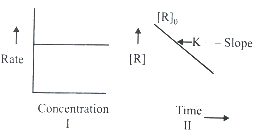
A
$I$ and $II$ represent zero order reaction.
B
$I$ represents first order and $II$ represents zero order reaction.
C
$I$ represents zero order and $II$ represents first order reaction.
D
$I$ and $II$ represent first order reaction.
Solution
(A) For a zero order reaction:
Rate $= k[R]^0 = k$. Thus,the rate is independent of concentration. Graph $I$ shows rate vs concentration as a constant line,which represents a zero order reaction.
For the integrated rate law of a zero order reaction:
$[R] = -kt + [R]_0$. This is in the form of $y = mx + c$,where $y = [R]$,$x = t$,$m = -k$,and $c = [R]_0$. Thus,graph $II$ represents a zero order reaction.
Therefore,both $I$ and $II$ represent zero order reactions.
Rate $= k[R]^0 = k$. Thus,the rate is independent of concentration. Graph $I$ shows rate vs concentration as a constant line,which represents a zero order reaction.
For the integrated rate law of a zero order reaction:
$[R] = -kt + [R]_0$. This is in the form of $y = mx + c$,where $y = [R]$,$x = t$,$m = -k$,and $c = [R]_0$. Thus,graph $II$ represents a zero order reaction.
Therefore,both $I$ and $II$ represent zero order reactions.
0 likes
View Solution119
DifficultMCQ
What is the concentration (in $mol \ L^{-1}$) of the product $B$ after $20 \ s$ in the following reaction? Given that $A \longrightarrow 3B$,rate $= k[A]^0$. The data is provided in the table below:
| Time $(s)$ | Concentration of reactant $A$ $(mol \ L^{-1})$ |
| :--- | :--- |
| $0$ | $0.1$ |
| $15$ | $0.05$ |
| $20$ | $0.1 - x$ |
| Time $(s)$ | Concentration of reactant $A$ $(mol \ L^{-1})$ |
| :--- | :--- |
| $0$ | $0.1$ |
| $15$ | $0.05$ |
| $20$ | $0.1 - x$ |
A
$6.6 \times 10^{-2}$
B
$1.32 \times 10^{-1}$
C
$1.98 \times 10^{-1}$
D
$2.2 \times 10^{-2}$
Solution
(C) For a zero-order reaction,$A \longrightarrow 3B$,the rate law is $[A] = [A]_0 - kt$.
From the table,at $t = 15 \ s$,$[A] = 0.05 \ mol \ L^{-1}$ and $[A]_0 = 0.1 \ mol \ L^{-1}$.
Substituting these values: $0.05 = 0.1 - k(15) \implies 15k = 0.05 \implies k = \frac{0.05}{15} = \frac{1}{300} \ mol \ L^{-1} \ s^{-1}$.
Now,at $t = 20 \ s$,the concentration of $A$ is $[A] = [A]_0 - kt = 0.1 - (\frac{1}{300}) \times 20 = 0.1 - \frac{20}{300} = 0.1 - 0.0667 = 0.0333 \ mol \ L^{-1}$.
The amount of $A$ reacted is $\Delta[A] = [A]_0 - [A] = 0.1 - 0.0333 = 0.0667 \ mol \ L^{-1}$.
According to the stoichiometry $A \longrightarrow 3B$,the concentration of product $B$ formed is $3 \times \Delta[A] = 3 \times 0.0667 = 0.2001 \ mol \ L^{-1}$.
Rounding to the nearest option,we get $0.198 \ mol \ L^{-1}$ or $1.98 \times 10^{-1} \ mol \ L^{-1}$.
From the table,at $t = 15 \ s$,$[A] = 0.05 \ mol \ L^{-1}$ and $[A]_0 = 0.1 \ mol \ L^{-1}$.
Substituting these values: $0.05 = 0.1 - k(15) \implies 15k = 0.05 \implies k = \frac{0.05}{15} = \frac{1}{300} \ mol \ L^{-1} \ s^{-1}$.
Now,at $t = 20 \ s$,the concentration of $A$ is $[A] = [A]_0 - kt = 0.1 - (\frac{1}{300}) \times 20 = 0.1 - \frac{20}{300} = 0.1 - 0.0667 = 0.0333 \ mol \ L^{-1}$.
The amount of $A$ reacted is $\Delta[A] = [A]_0 - [A] = 0.1 - 0.0333 = 0.0667 \ mol \ L^{-1}$.
According to the stoichiometry $A \longrightarrow 3B$,the concentration of product $B$ formed is $3 \times \Delta[A] = 3 \times 0.0667 = 0.2001 \ mol \ L^{-1}$.
Rounding to the nearest option,we get $0.198 \ mol \ L^{-1}$ or $1.98 \times 10^{-1} \ mol \ L^{-1}$.
0 likes
View Solution120
MediumMCQ
Which of the following is correct with respect to the graph given?
$[R] = \text{Concentration at time } 't'$
$[R]_0 = \text{Initial concentration}$
$[R] = \text{Concentration at time } 't'$
$[R]_0 = \text{Initial concentration}$
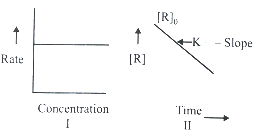
A
$I$ represents zero order and $II$ represents zero order reaction
B
$I$ represents zero order and $II$ represents zero order reaction
C
$I$ represents first order and $II$ represents zero order reaction
D
$I$ represents zero order and $II$ represents first order reaction
Solution
$(A)$ For a zero order reaction:
Rate $= K[A]^0 = K$
Thus, the rate does not change with concentration. Therefore, graph $I$ represents a zero order reaction.
For the integrated rate law of a zero order reaction:
$[R] = -Kt + [R]_0$
Comparing this with $y = mx + c$, the graph of $[R]$ vs $t$ is a straight line with a negative slope equal to $-K$. Thus, graph $II$ also represents a zero order reaction.
Rate $= K[A]^0 = K$
Thus, the rate does not change with concentration. Therefore, graph $I$ represents a zero order reaction.
For the integrated rate law of a zero order reaction:
$[R] = -Kt + [R]_0$
Comparing this with $y = mx + c$, the graph of $[R]$ vs $t$ is a straight line with a negative slope equal to $-K$. Thus, graph $II$ also represents a zero order reaction.
0 likes
View Solution121
DifficultMCQ
For the reaction $A \longrightarrow 3 B$,the rate is given by $rate = k[A]^0$. Based on the data provided in the table,what is the concentration of the product $B$ (in $mol \ L^{-1}$) after $20 \ s$?
| Time $(s)$ | Concentration of the reactant $(mol \ L^{-1})$ |
| $0$ | $0.1$ |
| $15$ | $0.05$ |
| $20$ | $0.1 - x$ |
A
$6.6 \times 10^{-2}$
B
$1.32 \times 10^{-1}$
C
$1.98 \times 10^{-1}$
D
$2.2 \times 10^{-2}$
Solution
(C) For a zero-order reaction $A \longrightarrow 3 B$,the rate law is $[A] = [A_0] - kt$.
From the table,at $t = 0$,$[A_0] = 0.1 \ mol \ L^{-1}$.
At $t = 15 \ s$,$[A] = 0.05 \ mol \ L^{-1}$.
Substituting these values: $0.05 = 0.1 - k(15)$,which gives $k = 0.05 / 15 = 1/300 \ mol \ L^{-1} \ s^{-1}$.
At $t = 20 \ s$,the concentration of $A$ remaining is $[A] = 0.1 - (1/300) \times 20 = 0.1 - 0.0667 = 0.0333 \ mol \ L^{-1}$.
The amount of $A$ reacted is $0.1 - 0.0333 = 0.0667 \ mol \ L^{-1}$.
According to the stoichiometry,$1 \ mol$ of $A$ produces $3 \ mol$ of $B$.
Therefore,concentration of $B = 3 \times 0.0667 = 0.2001 \ mol \ L^{-1} \approx 1.98 \times 10^{-1} \ mol \ L^{-1}$.
From the table,at $t = 0$,$[A_0] = 0.1 \ mol \ L^{-1}$.
At $t = 15 \ s$,$[A] = 0.05 \ mol \ L^{-1}$.
Substituting these values: $0.05 = 0.1 - k(15)$,which gives $k = 0.05 / 15 = 1/300 \ mol \ L^{-1} \ s^{-1}$.
At $t = 20 \ s$,the concentration of $A$ remaining is $[A] = 0.1 - (1/300) \times 20 = 0.1 - 0.0667 = 0.0333 \ mol \ L^{-1}$.
The amount of $A$ reacted is $0.1 - 0.0333 = 0.0667 \ mol \ L^{-1}$.
According to the stoichiometry,$1 \ mol$ of $A$ produces $3 \ mol$ of $B$.
Therefore,concentration of $B = 3 \times 0.0667 = 0.2001 \ mol \ L^{-1} \approx 1.98 \times 10^{-1} \ mol \ L^{-1}$.
0 likes
View Solution122
EasyMCQ
The rate constant,$k$ of a zero order reaction $2 NH_{3(g)} \xrightarrow[1130 \ K]{Pt} N_{2(g)} + 3 H_{2(g)}$ is $y \times 10^{-4} \ mol \ L^{-1} \ s^{-1}$. The rate of formation of hydrogen (in $mol \ L^{-1} \ s^{-1}$) is
A
$y \times 10^{-4}$
B
$2 y \times 10^{-4}$
C
$3 y \times 10^{-4}$
D
$\frac{y}{3} \times 10^{-4}$
Solution
(C) For a zero order reaction,the rate of reaction $r$ is equal to the rate constant $k$.
Given $r = k = y \times 10^{-4} \ mol \ L^{-1} \ s^{-1}$.
The stoichiometric equation is $2 NH_{3(g)} \rightarrow N_{2(g)} + 3 H_{2(g)}$.
The rate of reaction is expressed as $r = -\frac{1}{2} \frac{d[NH_3]}{dt} = \frac{d[N_2]}{dt} = \frac{1}{3} \frac{d[H_2]}{dt}$.
Therefore,the rate of formation of hydrogen is $\frac{d[H_2]}{dt} = 3 \times r$.
Substituting the value of $r$,we get $\frac{d[H_2]}{dt} = 3 \times (y \times 10^{-4}) = 3y \times 10^{-4} \ mol \ L^{-1} \ s^{-1}$.
Given $r = k = y \times 10^{-4} \ mol \ L^{-1} \ s^{-1}$.
The stoichiometric equation is $2 NH_{3(g)} \rightarrow N_{2(g)} + 3 H_{2(g)}$.
The rate of reaction is expressed as $r = -\frac{1}{2} \frac{d[NH_3]}{dt} = \frac{d[N_2]}{dt} = \frac{1}{3} \frac{d[H_2]}{dt}$.
Therefore,the rate of formation of hydrogen is $\frac{d[H_2]}{dt} = 3 \times r$.
Substituting the value of $r$,we get $\frac{d[H_2]}{dt} = 3 \times (y \times 10^{-4}) = 3y \times 10^{-4} \ mol \ L^{-1} \ s^{-1}$.
0 likes
View Solution123
EasyMCQ
At $T \ K$,if the rate constant for a zero order reaction is $2.5 \times 10^{-3} \ M \ s^{-1}$,the time required for the initial concentration of reactant $R$ to fall from $0.10 \ M$ to $0.075 \ M$ at the same temperature in seconds is:
A
$25$
B
$5$
C
$10$
D
$20$
Solution
(C) For a zero order reaction,the integrated rate equation is given by:
$[R]_t = -kt + [R]_0$
Rearranging for time $t$:
$t = \frac{[R]_0 - [R]_t}{k}$
Given:
$[R]_0 = 0.10 \ M$
$[R]_t = 0.075 \ M$
$k = 2.5 \times 10^{-3} \ M \ s^{-1}$
Substituting the values:
$t = \frac{0.10 - 0.075}{2.5 \times 10^{-3}}$
$t = \frac{0.025}{2.5 \times 10^{-3}}$
$t = 0.01 \times 10^{3} = 10 \ s$
$[R]_t = -kt + [R]_0$
Rearranging for time $t$:
$t = \frac{[R]_0 - [R]_t}{k}$
Given:
$[R]_0 = 0.10 \ M$
$[R]_t = 0.075 \ M$
$k = 2.5 \times 10^{-3} \ M \ s^{-1}$
Substituting the values:
$t = \frac{0.10 - 0.075}{2.5 \times 10^{-3}}$
$t = \frac{0.025}{2.5 \times 10^{-3}}$
$t = 0.01 \times 10^{3} = 10 \ s$
0 likes
View Solution124
EasyMCQ
Which of the following plots is correct for a zero-order reaction?
A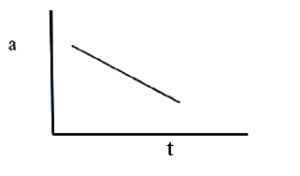
B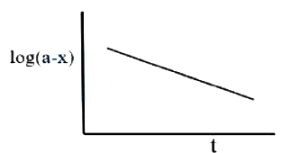
C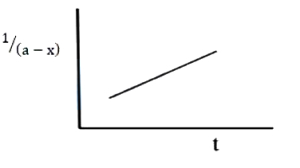
D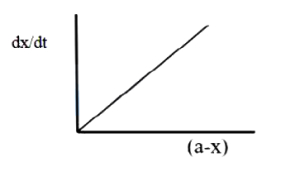
Solution
(A) For a zero-order reaction,the rate law is given by: $dx/dt = k[A]^0 = k$.
This means the rate of reaction is independent of the concentration of the reactant.
Therefore,the plot of $dx/dt$ versus $(a-x)$ should be a horizontal line parallel to the $(a-x)$ axis.
However,looking at the standard integrated rate equation for a zero-order reaction: $[A] = [A]_0 - kt$,where $[A] = (a-x)$ and $[A]_0 = a$.
This gives $(a-x) = a - kt$,or $(a-x) = -kt + a$.
Comparing this with the equation of a straight line $y = mx + c$,a plot of $(a-x)$ versus $t$ is a straight line with a negative slope $(-k)$ and an intercept $(a)$.
Among the given options,the plot of $(a-x)$ versus $t$ (which is represented by option $A$ where $a$ is the initial concentration and the y-axis represents the concentration at time $t$) is the correct representation for a zero-order reaction.
This means the rate of reaction is independent of the concentration of the reactant.
Therefore,the plot of $dx/dt$ versus $(a-x)$ should be a horizontal line parallel to the $(a-x)$ axis.
However,looking at the standard integrated rate equation for a zero-order reaction: $[A] = [A]_0 - kt$,where $[A] = (a-x)$ and $[A]_0 = a$.
This gives $(a-x) = a - kt$,or $(a-x) = -kt + a$.
Comparing this with the equation of a straight line $y = mx + c$,a plot of $(a-x)$ versus $t$ is a straight line with a negative slope $(-k)$ and an intercept $(a)$.
Among the given options,the plot of $(a-x)$ versus $t$ (which is represented by option $A$ where $a$ is the initial concentration and the y-axis represents the concentration at time $t$) is the correct representation for a zero-order reaction.
0 likes
View Solution125
EasyMCQ
$A \rightarrow P$ is a zero order reaction. At $298 \ K$ the rate constant of the reaction is $1 \times 10^{-3} \ mol \ L^{-1} \ s^{-1}$. Initial concentration of '$A$' is $0.1 \ mol \ L^{-1}$. What is the concentration of '$A$' after $10 \ s$?
A
$0.09 \ mol \ L^{-1}$
B
$0.099 \ mol \ L^{-1}$
C
$0.087 \ mol \ L^{-1}$
D
$0.011 \ mol \ L^{-1}$
Solution
(A) For a zero order reaction,the integrated rate equation is given by:
$[A]_t = [A]_0 - kt$
Given:
Rate constant,$k = 1 \times 10^{-3} \ mol \ L^{-1} \ s^{-1}$
Initial concentration,$[A]_0 = 0.1 \ mol \ L^{-1}$
Time,$t = 10 \ s$
Substituting the values into the equation:
$[A]_t = 0.1 - (1 \times 10^{-3} \times 10)$
$[A]_t = 0.1 - 10^{-2}$
$[A]_t = 0.1 - 0.01$
$[A]_t = 0.09 \ mol \ L^{-1}$
$[A]_t = [A]_0 - kt$
Given:
Rate constant,$k = 1 \times 10^{-3} \ mol \ L^{-1} \ s^{-1}$
Initial concentration,$[A]_0 = 0.1 \ mol \ L^{-1}$
Time,$t = 10 \ s$
Substituting the values into the equation:
$[A]_t = 0.1 - (1 \times 10^{-3} \times 10)$
$[A]_t = 0.1 - 10^{-2}$
$[A]_t = 0.1 - 0.01$
$[A]_t = 0.09 \ mol \ L^{-1}$
0 likes
View Solution126
MediumMCQ
The rate constant for a zero order reaction $A \rightarrow$ products is $0.0030 \ mol \ L^{-1} \ s^{-1}$. How long will it take for the initial concentration of $A$ to fall from $0.10 \ M$ to $0.075 \ M$ (in $s$)?
A
$10$
B
$20$
C
$8.33$
D
$1.33$
Solution
(C) For a zero order reaction,the integrated rate equation is given by:
$k = \frac{[R]_0 - [R]_t}{t}$
Where:
$k = 0.0030 \ mol \ L^{-1} \ s^{-1}$ (rate constant)
$[R]_0 = 0.10 \ M$ (initial concentration)
$[R]_t = 0.075 \ M$ (concentration at time $t$)
Rearranging the formula to solve for time $t$:
$t = \frac{[R]_0 - [R]_t}{k}$
$t = \frac{0.10 \ M - 0.075 \ M}{0.0030 \ mol \ L^{-1} \ s^{-1}}$
$t = \frac{0.025}{0.0030} \ s = 8.33 \ s$
$k = \frac{[R]_0 - [R]_t}{t}$
Where:
$k = 0.0030 \ mol \ L^{-1} \ s^{-1}$ (rate constant)
$[R]_0 = 0.10 \ M$ (initial concentration)
$[R]_t = 0.075 \ M$ (concentration at time $t$)
Rearranging the formula to solve for time $t$:
$t = \frac{[R]_0 - [R]_t}{k}$
$t = \frac{0.10 \ M - 0.075 \ M}{0.0030 \ mol \ L^{-1} \ s^{-1}}$
$t = \frac{0.025}{0.0030} \ s = 8.33 \ s$
0 likes
View Solution127
MediumMCQ
For a zero order reaction,a plot of $t_{1/2}$ versus $[A]_0$ will be
A
$A$ straight line passing through the origin and slope $= K$
B
$A$ horizontal line (parallel to $x$-axis)
C
$A$ straight line with slope $-K$
D
$A$ straight line passing through the origin and slope $= 1/(2K)$
Solution
(D) For a zero order reaction:
Rate $= K[A]^0 = K$
Integrating the rate law,$[A]_t = [A]_0 - Kt$.
At half-life $(t = t_{1/2})$,the concentration $[A]_t = [A]_0/2$.
Substituting these values: $[A]_0/2 = [A]_0 - K t_{1/2}$.
Rearranging gives $K t_{1/2} = [A]_0/2$,or $t_{1/2} = \frac{[A]_0}{2K}$.
Comparing this with the equation of a straight line $y = mx + c$,where $y = t_{1/2}$,$x = [A]_0$,and $m = 1/(2K)$,the plot of $t_{1/2}$ versus $[A]_0$ is a straight line passing through the origin with a slope of $1/(2K)$.
Rate $= K[A]^0 = K$
Integrating the rate law,$[A]_t = [A]_0 - Kt$.
At half-life $(t = t_{1/2})$,the concentration $[A]_t = [A]_0/2$.
Substituting these values: $[A]_0/2 = [A]_0 - K t_{1/2}$.
Rearranging gives $K t_{1/2} = [A]_0/2$,or $t_{1/2} = \frac{[A]_0}{2K}$.
Comparing this with the equation of a straight line $y = mx + c$,where $y = t_{1/2}$,$x = [A]_0$,and $m = 1/(2K)$,the plot of $t_{1/2}$ versus $[A]_0$ is a straight line passing through the origin with a slope of $1/(2K)$.
0 likes
View Solution128
MediumMCQ
In the reaction,$A \rightarrow$ products,if the concentration of the reactant is doubled,the rate of the reaction remains unchanged. The order of the reaction with respect to $A$ is
A
$1$
B
$2$
C
$0.5$
D
$0$
Solution
(D) The rate law for the reaction is given by $r = k[A]^n$,where $n$ is the order of the reaction.
If the concentration of $A$ is doubled,the new rate $r'$ is $r' = k[2A]^n$.
Given that the rate remains unchanged,$r = r'$,so $k[A]^n = k[2A]^n$.
Dividing both sides by $k[A]^n$,we get $1 = 2^n$.
Since $2^0 = 1$,it follows that $n = 0$.
Therefore,the reaction is a zero-order reaction.
If the concentration of $A$ is doubled,the new rate $r'$ is $r' = k[2A]^n$.
Given that the rate remains unchanged,$r = r'$,so $k[A]^n = k[2A]^n$.
Dividing both sides by $k[A]^n$,we get $1 = 2^n$.
Since $2^0 = 1$,it follows that $n = 0$.
Therefore,the reaction is a zero-order reaction.
0 likes
View Solution129
MediumMCQ
For the reaction,$A \rightarrow$ products,if the graph of $[A]$ vs time gives a straight line,predict the order of the reaction.
A
Pseudo first order
B
First order
C
Second order
D
Zero order
Solution
(D) For a zero-order reaction,the integrated rate law is given by $[A] = -kt + [A]_0$.
This equation is in the form of a linear equation $y = mx + c$,where $y = [A]$,$x = t$,$m = -k$ (slope),and $c = [A]_0$ ($y$-intercept).
Therefore,a plot of $[A]$ versus time $(t)$ results in a straight line for a zero-order reaction.
Hence,the correct option is $(D)$.
This equation is in the form of a linear equation $y = mx + c$,where $y = [A]$,$x = t$,$m = -k$ (slope),and $c = [A]_0$ ($y$-intercept).
Therefore,a plot of $[A]$ versus time $(t)$ results in a straight line for a zero-order reaction.
Hence,the correct option is $(D)$.
0 likes
View Solution130
MediumMCQ
For a zero order reaction $A \rightarrow \text{product}$,a plot of $[A]$ (on $y$-axis) and time (on $x$-axis) gave a straight line with slope equal to $-3 \times 10^{-3} \ M \ min^{-1}$ and intercept equal to $2 \times 10^{-2} \ M$ (on $y$-axis). What is the rate constant (in $M \ min^{-1}$) of this reaction?
A
$3 \times 10^{-3}$
B
$5 \times 10^{-5}$
C
$3 \times 10^{-4}$
D
$5 \times 10^{-4}$
Solution
(A) For a zero order reaction,the integrated rate equation is given by: $[A] = -kt + [A]_0$.
Comparing this with the equation of a straight line,$y = mx + c$,where $y = [A]$,$x = t$,$m = -k$,and $c = [A]_0$.
The slope of the plot is $-k$.
Given,slope $= -3 \times 10^{-3} \ M \ min^{-1}$.
Therefore,$-k = -3 \times 10^{-3} \ M \ min^{-1}$,which implies $k = 3 \times 10^{-3} \ M \ min^{-1}$.
Comparing this with the equation of a straight line,$y = mx + c$,where $y = [A]$,$x = t$,$m = -k$,and $c = [A]_0$.
The slope of the plot is $-k$.
Given,slope $= -3 \times 10^{-3} \ M \ min^{-1}$.
Therefore,$-k = -3 \times 10^{-3} \ M \ min^{-1}$,which implies $k = 3 \times 10^{-3} \ M \ min^{-1}$.
0 likes
View Solution131
EasyMCQ
What is the unit for the zero order rate constant?
A
$mol \,L^{-1} \,s^{-1}$
B
$L \,mol^{-1} \,s^{-1}$
C
$s^{-1}$
D
$mol \,L \,s^{-1}$
Solution
$(A)$ The rate law for a reaction is given by: $r = k[conc.]^n$, where $n$ is the order of reaction.
Rearranging for the rate constant $k$: $k = \frac{r}{[conc.]^n} = \frac{mol \,L^{-1} \,s^{-1}}{(mol \,L^{-1})^n} = mol^{1-n} \,L^{n-1} \,s^{-1}$.
For a zero order reaction, $n = 0$.
Substituting $n = 0$ into the expression: $k = mol^{1-0} \,L^{0-1} \,s^{-1} = mol \,L^{-1} \,s^{-1}$.
Rearranging for the rate constant $k$: $k = \frac{r}{[conc.]^n} = \frac{mol \,L^{-1} \,s^{-1}}{(mol \,L^{-1})^n} = mol^{1-n} \,L^{n-1} \,s^{-1}$.
For a zero order reaction, $n = 0$.
Substituting $n = 0$ into the expression: $k = mol^{1-0} \,L^{0-1} \,s^{-1} = mol \,L^{-1} \,s^{-1}$.
0 likes
View Solution132
MediumMCQ
The half-life of a zero order reaction $A \rightarrow \text{products}$ is $0.5 \ hr$. The initial concentration of $A$ is $4 \ mol \ L^{-1}$. How much time (in $hr$) does it take for its concentration to come from $2.0 \ mol \ L^{-1}$ to $1.0 \ mol \ L^{-1}$?
A
$1/4$
B
$1/8$
C
$1/2$
D
$1/6$
Solution
(A) For a zero order reaction,the rate constant $k$ is given by the formula $k = \frac{[A]_0 - [A]_t}{t}$.
First,calculate $k$ using the half-life formula $t_{1/2} = \frac{[A]_0}{2k}$.
Given $t_{1/2} = 0.5 \ hr$ and $[A]_0 = 4 \ mol \ L^{-1}$,we have $0.5 = \frac{4}{2k}$,which gives $k = \frac{4}{1} = 4 \ mol \ L^{-1} \ hr^{-1}$.
Now,to find the time $t$ for the concentration to change from $[A]_1 = 2.0 \ mol \ L^{-1}$ to $[A]_2 = 1.0 \ mol \ L^{-1}$,use the integrated rate law: $t = \frac{[A]_1 - [A]_2}{k}$.
Substituting the values: $t = \frac{2.0 - 1.0}{4} = \frac{1.0}{4} = 0.25 \ hr$.
Thus,$t = 1/4 \ hr$.
First,calculate $k$ using the half-life formula $t_{1/2} = \frac{[A]_0}{2k}$.
Given $t_{1/2} = 0.5 \ hr$ and $[A]_0 = 4 \ mol \ L^{-1}$,we have $0.5 = \frac{4}{2k}$,which gives $k = \frac{4}{1} = 4 \ mol \ L^{-1} \ hr^{-1}$.
Now,to find the time $t$ for the concentration to change from $[A]_1 = 2.0 \ mol \ L^{-1}$ to $[A]_2 = 1.0 \ mol \ L^{-1}$,use the integrated rate law: $t = \frac{[A]_1 - [A]_2}{k}$.
Substituting the values: $t = \frac{2.0 - 1.0}{4} = \frac{1.0}{4} = 0.25 \ hr$.
Thus,$t = 1/4 \ hr$.
0 likes
View Solution133
EasyMCQ
For a zero order reaction,the plot of concentration of reactant $vs$ time is (Hint: Consider the intercept on the concentration axis)
A
linear with $+ve$ slope and non zero $+ve$ intercept
B
linear with $-ve$ slope and non zero $+ve$ intercept
C
linear with $-ve$ slope and zero intercept
D
linear with $+ve$ slope and zero intercept
Solution
(B) For a zero order reaction,the rate law is given by: $Rate = k[A]^0 = k$.
Integrating this with respect to time,we get the integrated rate equation: $[A] = -kt + [A]_0$.
This equation follows the form of a straight line equation $y = mx + c$,where $y = [A]$,$x = t$,$m = -k$ (slope),and $c = [A]_0$ (intercept).
Therefore,the plot of concentration $[A]$ versus time $t$ is a straight line with a negative slope equal to $-k$ and a non-zero positive intercept equal to $[A]_0$ on the concentration axis.
Integrating this with respect to time,we get the integrated rate equation: $[A] = -kt + [A]_0$.
This equation follows the form of a straight line equation $y = mx + c$,where $y = [A]$,$x = t$,$m = -k$ (slope),and $c = [A]_0$ (intercept).
Therefore,the plot of concentration $[A]$ versus time $t$ is a straight line with a negative slope equal to $-k$ and a non-zero positive intercept equal to $[A]_0$ on the concentration axis.
0 likes
View Solution134
EasyMCQ
For a zero-order reaction,the correct expression for rate constant $(k)$ at half-life time $(t_{1/2})$ is ($[R_0] =$ initial concentration of reactant).
A
$k = \frac{2.303}{t_{1/2}} \log \frac{[R_0]}{\frac{[R_0]}{2}}$
B
$k = \frac{2.303}{t} \log \frac{[R_0]}{[R_0]}$
C
$k = \frac{[R_0] - \frac{1}{2}[R_0]}{t_{1/2}}$
D
$k = \frac{2.303}{(t_2 - t_1)} \log [R_0]$
Solution
(C) For a zero-order reaction,the integrated rate equation is given as:
$k = \frac{[R_0] - [R]}{t}$
where $k$ is the rate constant,$[R_0]$ is the initial concentration,and $[R]$ is the concentration at time $t$.
At half-life time,$t = t_{1/2}$,the concentration of the reactant is $[R] = \frac{[R_0]}{2}$.
Substituting these values into the rate equation:
$k = \frac{[R_0] - \frac{[R_0]}{2}}{t_{1/2}}$
Thus,the correct expression is $k = \frac{[R_0] - \frac{1}{2}[R_0]}{t_{1/2}}$.
Hence,option $(C)$ is the correct answer.
$k = \frac{[R_0] - [R]}{t}$
where $k$ is the rate constant,$[R_0]$ is the initial concentration,and $[R]$ is the concentration at time $t$.
At half-life time,$t = t_{1/2}$,the concentration of the reactant is $[R] = \frac{[R_0]}{2}$.
Substituting these values into the rate equation:
$k = \frac{[R_0] - \frac{[R_0]}{2}}{t_{1/2}}$
Thus,the correct expression is $k = \frac{[R_0] - \frac{1}{2}[R_0]}{t_{1/2}}$.
Hence,option $(C)$ is the correct answer.
0 likes
View Solution135
EasyMCQ
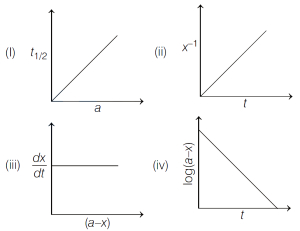
Which of the following graphs represents a zero order reaction?
($a = $ initial concentration of reactant,
$x = $ concentration of reactant consumed,
$t = $ time)
($a = $ initial concentration of reactant,
$x = $ concentration of reactant consumed,
$t = $ time)
A
$i, iii, iv$
B
$i, iii$
C
$ii, iii, iv$
D
$i, iv$
Solution
(B) For a zero order reaction,the rate is constant and independent of the concentration of the reactant. Thus,$\frac{dx}{dt} = k$ (constant),which matches graph $(iii)$.
Also,the half-life period is given by $t_{1/2} = \frac{a}{2k}$,which shows that $t_{1/2}$ is directly proportional to the initial concentration $a$. This matches graph $(i)$.
Graph $(ii)$ represents a second order reaction ($1/x$ vs $t$ is linear for second order).
Graph $(iv)$ represents a first order reaction ($log(a-x)$ vs $t$ is linear for first order).
Therefore,graphs $(i)$ and $(iii)$ represent a zero order reaction.
Also,the half-life period is given by $t_{1/2} = \frac{a}{2k}$,which shows that $t_{1/2}$ is directly proportional to the initial concentration $a$. This matches graph $(i)$.
Graph $(ii)$ represents a second order reaction ($1/x$ vs $t$ is linear for second order).
Graph $(iv)$ represents a first order reaction ($log(a-x)$ vs $t$ is linear for first order).
Therefore,graphs $(i)$ and $(iii)$ represent a zero order reaction.
0 likes
View Solution136
DifficultMCQ
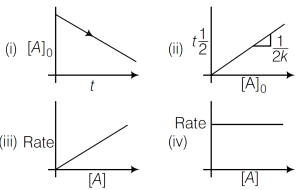
Which of the following are the correct representations of a zero order reaction,where $[A]$ represents the reactant concentration and $[A]_0$ represents the initial concentration?
A
$(i), (ii), (iii)$
B
$(i), (ii), (iv)$
C
$(ii), (iii), (iv)$
D
$(i), (iii), (iv)$
Solution
(B) For a zero order reaction:
$1$. The integrated rate law is $[A] = [A]_0 - kt$. Thus,a plot of $[A]$ versus $t$ is a straight line with a negative slope $(-k)$,which matches graph $(i)$.
$2$. The half-life is $t_{1/2} = \frac{[A]_0}{2k}$. Thus,a plot of $t_{1/2}$ versus $[A]_0$ is a straight line passing through the origin with a slope of $\frac{1}{2k}$,which matches graph $(ii)$.
$3$. The rate law is $\text{Rate} = k[A]^0 = k$. The rate is independent of the reactant concentration. Thus,a plot of $\text{Rate}$ versus $[A]$ is a horizontal line,which matches graph $(iv)$.
Graph $(iii)$ shows $\text{Rate} \propto [A]$,which is characteristic of a first order reaction.
Therefore,the correct representations are $(i), (ii),$ and $(iv)$.
$1$. The integrated rate law is $[A] = [A]_0 - kt$. Thus,a plot of $[A]$ versus $t$ is a straight line with a negative slope $(-k)$,which matches graph $(i)$.
$2$. The half-life is $t_{1/2} = \frac{[A]_0}{2k}$. Thus,a plot of $t_{1/2}$ versus $[A]_0$ is a straight line passing through the origin with a slope of $\frac{1}{2k}$,which matches graph $(ii)$.
$3$. The rate law is $\text{Rate} = k[A]^0 = k$. The rate is independent of the reactant concentration. Thus,a plot of $\text{Rate}$ versus $[A]$ is a horizontal line,which matches graph $(iv)$.
Graph $(iii)$ shows $\text{Rate} \propto [A]$,which is characteristic of a first order reaction.
Therefore,the correct representations are $(i), (ii),$ and $(iv)$.
0 likes
View Solution137
EasyMCQ
Which of the following is a zero order reaction?
A
$2 \ HI \rightarrow H_2 + I_2$
B
$H_2 + Br_2 \xrightarrow{\Delta} 2 \ HBr$
C
$2 \ N_2O_5 \rightarrow 4 \ NO_2 + O_2$
D
$H_2 + Cl_2 \xrightarrow{hv} 2 \ HCl$
Solution
(D) The reaction $H_2 + Cl_2 \xrightarrow{hv} 2 \ HCl$ is a photochemical reaction.
Photochemical reactions involving the absorption of light are typically zero order reactions because the rate depends on the intensity of light absorbed rather than the concentration of the reactants.
Photochemical reactions involving the absorption of light are typically zero order reactions because the rate depends on the intensity of light absorbed rather than the concentration of the reactants.
0 likes
View Solution138
DifficultMCQ
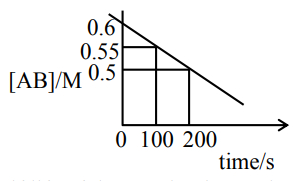
For the thermal decomposition of reaction $AB_{(g)}$,the following graph is provided. The half-life of the reaction is $x \ min$. Find $x$. (Nearest integer)
A
$5$
B
$10$
C
$15$
D
$20$
Solution
(B) The graph shows a linear plot of $[AB]$ versus $time$,which indicates a zero-order reaction.
For a zero-order reaction,the rate law is $[AB]_0 - [AB]_t = kt$.
From the graph,at $t = 0 \ s$,$[AB]_0 = 0.6 \ M$.
At $t = 100 \ s$,$[AB]_t = 0.55 \ M$.
Substituting these values: $0.6 - 0.55 = k(100) \implies 0.05 = 100k \implies k = 5 \times 10^{-4} \ M \ s^{-1}$.
The half-life for a zero-order reaction is given by $t_{1/2} = \frac{[AB]_0}{2k}$.
$t_{1/2} = \frac{0.6}{2 \times 5 \times 10^{-4}} = \frac{0.6}{10^{-3}} = 600 \ s$.
Converting to minutes: $t_{1/2} = \frac{600}{60} = 10 \ min$.
Therefore,$x = 10$.
For a zero-order reaction,the rate law is $[AB]_0 - [AB]_t = kt$.
From the graph,at $t = 0 \ s$,$[AB]_0 = 0.6 \ M$.
At $t = 100 \ s$,$[AB]_t = 0.55 \ M$.
Substituting these values: $0.6 - 0.55 = k(100) \implies 0.05 = 100k \implies k = 5 \times 10^{-4} \ M \ s^{-1}$.
The half-life for a zero-order reaction is given by $t_{1/2} = \frac{[AB]_0}{2k}$.
$t_{1/2} = \frac{0.6}{2 \times 5 \times 10^{-4}} = \frac{0.6}{10^{-3}} = 600 \ s$.
Converting to minutes: $t_{1/2} = \frac{600}{60} = 10 \ min$.
Therefore,$x = 10$.
0 likes
View Solution139
DifficultMCQ
The half-life period for a certain zero-order reaction is $10 \text{ min}$. How much time is required for this reaction to complete $100\%$ (in $\text{ min}$)?
A
$20$
B
$30$
C
$60$
D
$40$
Solution
(A) For a zero-order reaction, the rate constant $k$ is related to the half-life $t_{1/2}$ by the formula $t_{1/2} = \frac{[A]_0}{2k}$.
Given $t_{1/2} = 10 \text{ min}$, we can find the initial concentration in terms of $k$: $[A]_0 = 2k \times t_{1/2} = 2k \times 10 = 20k$.
The time required to complete the reaction $(100\%)$ is given by the formula $t_{100\%} = \frac{[A]_0}{k}$.
Substituting the value of $[A]_0$, we get $t_{100\%} = \frac{20k}{k} = 20 \text{ min}$.
Therefore, the reaction completes in $20 \text{ minutes}$.
Given $t_{1/2} = 10 \text{ min}$, we can find the initial concentration in terms of $k$: $[A]_0 = 2k \times t_{1/2} = 2k \times 10 = 20k$.
The time required to complete the reaction $(100\%)$ is given by the formula $t_{100\%} = \frac{[A]_0}{k}$.
Substituting the value of $[A]_0$, we get $t_{100\%} = \frac{20k}{k} = 20 \text{ min}$.
Therefore, the reaction completes in $20 \text{ minutes}$.
0 likes
View Solution140
MediumMCQ
Consider the reaction $aX \to bY$,for which the rate constant at $30^\circ C$ is $1 \times 10^{-3} \text{ mol L}^{-1} \text{ s}^{-1}$. Which of the following statements are true?
$A$. When concentration of $X$ is increased to four times,the rate of reaction becomes $16$ times.
$B$. The reaction is a second order reaction.
$C$. The half-life period is independent of the concentration of $X$.
$D$. Decomposition of $N_2O_5$ is an example of the above reaction.
$E$. $\ln \frac{[R]_0}{[R]}$ vs time is valid for the above reaction.
$A$. When concentration of $X$ is increased to four times,the rate of reaction becomes $16$ times.
$B$. The reaction is a second order reaction.
$C$. The half-life period is independent of the concentration of $X$.
$D$. Decomposition of $N_2O_5$ is an example of the above reaction.
$E$. $\ln \frac{[R]_0}{[R]}$ vs time is valid for the above reaction.
A
$A$ and $B$ Only
B
$A, B$ and $C$ Only
C
$A, B, D$ and $E$ Only
D
None of the above
Solution
(D) $1$. The unit of the rate constant is $\text{mol L}^{-1} \text{ s}^{-1}$,which is the characteristic unit for a zero-order reaction.
$2$. For a zero-order reaction,the rate is given by $\text{Rate} = k[X]^0 = k$. Thus,the rate is independent of the concentration of the reactant $X$.
$3$. Statement $A$ is false because the rate remains constant regardless of the concentration of $X$.
$4$. Statement $B$ is false because the reaction is zero-order,not second-order.
$5$. Statement $C$ is false because for a zero-order reaction,the half-life $t_{1/2} = \frac{[R]_0}{2k}$,which depends on the initial concentration.
$6$. Statement $D$ is false because the decomposition of $N_2O_5$ is a first-order reaction.
$7$. Statement $E$ is false because the plot of $\ln \frac{[R]_0}{[R]}$ vs time is linear only for first-order reactions. For zero-order,$[R]$ vs time is linear.
$8$. Since none of the statements $A, B, C, D,$ or $E$ are true,the correct choice is 'None of the above'.
$2$. For a zero-order reaction,the rate is given by $\text{Rate} = k[X]^0 = k$. Thus,the rate is independent of the concentration of the reactant $X$.
$3$. Statement $A$ is false because the rate remains constant regardless of the concentration of $X$.
$4$. Statement $B$ is false because the reaction is zero-order,not second-order.
$5$. Statement $C$ is false because for a zero-order reaction,the half-life $t_{1/2} = \frac{[R]_0}{2k}$,which depends on the initial concentration.
$6$. Statement $D$ is false because the decomposition of $N_2O_5$ is a first-order reaction.
$7$. Statement $E$ is false because the plot of $\ln \frac{[R]_0}{[R]}$ vs time is linear only for first-order reactions. For zero-order,$[R]$ vs time is linear.
$8$. Since none of the statements $A, B, C, D,$ or $E$ are true,the correct choice is 'None of the above'.
0 likes
View Solution141
DifficultMCQ
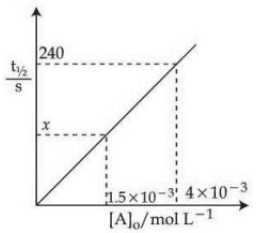
For a reaction A $\rightarrow$ P at T K, the half life ($t_{1/2}$) is plotted as a function of initial concentration $[A]_0$ of A as given below. The value of x in the given figure is _______ s (Nearest integer)
A
60
B
80
C
100
D
120
Solution
1. The plot is linear, $t_{1/2} \propto [A]_0$, characteristic of zero-order reaction. $t_{1/2} = [A]_0 / 2k$. 2. Slope = $240 / (4 \times 10^{-3}) = 60000$. 3. $x$ corresponds to $t_{1/2}$ at $1.5 \times 10^{-3}$. $x = 60000 \times 1.5 \times 10^{-3} = 90$ s. Closest integer 90.
0 likes
View Solution142
MediumMCQ
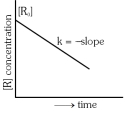
For a certain reaction $R \to \text{Product}$,the plot of concentration $[R]$ vs time has a negative slope as shown. The order of reaction is:
A
$1$
B
$2.5$
C
$2$
D
$0$
Solution
(D) For a zero-order reaction,the rate of reaction is independent of the concentration of the reactant.
The integrated rate equation for a zero-order reaction is given by $[R]_t = -kt + [R]_0$.
Comparing this with the equation of a straight line $y = mx + c$,where $y = [R]_t$,$x = t$,$m = -k$ (slope),and $c = [R]_0$ (intercept).
$A$ linear plot of concentration $[R]$ vs time with a constant negative slope signifies a zero-order reaction.
The integrated rate equation for a zero-order reaction is given by $[R]_t = -kt + [R]_0$.
Comparing this with the equation of a straight line $y = mx + c$,where $y = [R]_t$,$x = t$,$m = -k$ (slope),and $c = [R]_0$ (intercept).
$A$ linear plot of concentration $[R]$ vs time with a constant negative slope signifies a zero-order reaction.
0 likes
View SolutionChemical Kinetics — Zero order reaction · Frequently Asked Questions
1Are these Chemical Kinetics questions useful for JEE and NEET?
Yes. All questions in this section are mapped to JEE Main and NEET exam patterns. Previous year questions from JEE Main, NEET, GUJCET and state-level exams are included with full solutions.
2Can I switch to Hindi or Gujarati for these questions?
Yes. Use the language tabs in the hero section or the sidebar to view the same questions and solutions in English, Hindi or Gujarati.
3How do I generate a question paper from this subtopic?
Use the Vedclass Exam Paper Generator — select the chapter and subtopic, set difficulty, and generate Sets A, B, C, D automatically. First 3 chapters of every subject are free.
Vedclass Products
For Students
Vedclass Test Series
Mock tests in real JEE/NEET style with performance analysis. 5-day free trial.
Start Free TrialFor Teachers
Exam Paper Generator
Generate Set A/B/C/D papers from this chapter in 2 minutes. 3 chapters free.
Try FreeFor Institutes
Online Exam Module
Live online exams with unlimited students, 360° analytics & white-label branding.
See DemoFor Teachers & Institutes
Generate a Chemical Kinetics Exam Paper in 2 Minutes
Select subtopic & difficulty — Sets A, B, C, D auto-generated with No Repeat logic.
First 3 chapters of every subject are free — no payment required.