
A English
Rate law , Rate constant , Order of Reaction and Molecularity Questions in English
Class 12 Chemistry · Chemical Kinetics · Rate law , Rate constant , Order of Reaction and Molecularity
607+
Questions
English
Language
100%
With Solutions
Showing 44 of 607 questions in English
551
EasyMCQ
In the reaction $A \rightarrow B$,if the concentration of $A$ is doubled,then the reaction rate increases by $1.59$ times. What will be the order of the reaction?
A
$(1.59)^2$
B
$\frac{3}{2}$
C
$\frac{2}{3}$
D
$1.59$
Solution
(C) The rate law for the reaction is given by: $\text{Rate} = k[A]^x$ ...$(1)$
When the concentration of $A$ is doubled,the rate increases by $1.59$ times:
$1.59 \times \text{Rate} = k[2A]^x$ ...$(2)$
Dividing equation $(2)$ by equation $(1)$:
$\frac{1.59 \times \text{Rate}}{\text{Rate}} = \frac{k[2A]^x}{k[A]^x}$
$1.59 = (2)^x$
Taking $\log$ on both sides:
$\log(1.59) = x \log(2)$
$0.2014 = x \times 0.3010$
$x = \frac{0.2014}{0.3010} \approx 0.669$
Since $0.669 \approx \frac{2}{3}$,the order of the reaction is $\frac{2}{3}$.
When the concentration of $A$ is doubled,the rate increases by $1.59$ times:
$1.59 \times \text{Rate} = k[2A]^x$ ...$(2)$
Dividing equation $(2)$ by equation $(1)$:
$\frac{1.59 \times \text{Rate}}{\text{Rate}} = \frac{k[2A]^x}{k[A]^x}$
$1.59 = (2)^x$
Taking $\log$ on both sides:
$\log(1.59) = x \log(2)$
$0.2014 = x \times 0.3010$
$x = \frac{0.2014}{0.3010} \approx 0.669$
Since $0.669 \approx \frac{2}{3}$,the order of the reaction is $\frac{2}{3}$.
0 likes
View Solution552
EasyMCQ
The following results are obtained for the reaction $S + Nu \rightarrow \text{product}$. By which reaction mechanism does this reaction occur?
| Experiment | $[S]$ | $[Nu]$ | Rate |
|---|---|---|---|
| $1$ | $0.1$ | $0.1$ | $2.2 \times 10^{-3}$ |
| $2$ | $0.2$ | $0.1$ | $4.4 \times 10^{-3}$ |
| $3$ | $0.1$ | $0.2$ | $4.4 \times 10^{-3}$ |
A
$S_{N}1$
B
Electrophilic addition
C
$S_{N}2$
D
Electrophilic substitution
Solution
(C) To determine the reaction mechanism,we analyze the rate law based on the experimental data.
Let the rate law be $\text{Rate} = k[S]^x[Nu]^y$.
From experiment $1$ and $2$,when $[S]$ is doubled and $[Nu]$ is constant,the rate doubles ($2.2 \times 10^{-3}$ to $4.4 \times 10^{-3}$),so $x = 1$.
From experiment $1$ and $3$,when $[Nu]$ is doubled and $[S]$ is constant,the rate doubles ($2.2 \times 10^{-3}$ to $4.4 \times 10^{-3}$),so $y = 1$.
The overall rate law is $\text{Rate} = k[S]^1[Nu]^1$.
Since the reaction is first order with respect to both the substrate and the nucleophile,the total order is $2$.
This indicates a bimolecular nucleophilic substitution reaction,which is the $S_{N}2$ mechanism.
Let the rate law be $\text{Rate} = k[S]^x[Nu]^y$.
From experiment $1$ and $2$,when $[S]$ is doubled and $[Nu]$ is constant,the rate doubles ($2.2 \times 10^{-3}$ to $4.4 \times 10^{-3}$),so $x = 1$.
From experiment $1$ and $3$,when $[Nu]$ is doubled and $[S]$ is constant,the rate doubles ($2.2 \times 10^{-3}$ to $4.4 \times 10^{-3}$),so $y = 1$.
The overall rate law is $\text{Rate} = k[S]^1[Nu]^1$.
Since the reaction is first order with respect to both the substrate and the nucleophile,the total order is $2$.
This indicates a bimolecular nucleophilic substitution reaction,which is the $S_{N}2$ mechanism.
0 likes
View Solution553
EasyMCQ
Higher order $(>3)$ reactions are rare due to
A
shifting of equilibrium towards reactants due to elastic collisions
B
loss of active species on collision
C
low probability of simultaneous collision of all reacting species
D
increase in entropy as more molecules are involved
Solution
(C) Higher order reactions $(>3)$ are rare because the probability of simultaneous collision of more than three reacting species is extremely low,making the frequency of such effective collisions negligible.
0 likes
View Solution554
DifficultMCQ
$1 \ L$ of $2 \ M$ $CH_3COOH$ is mixed with $1 \ L$ of $3 \ M$ $C_2H_5OH$ to form an ester. The rate of the reaction with respect to the initial rate when each solution is diluted with an equal volume of water will be (in times).
A
$0.5$
B
$4$
C
$0.25$
D
$2$
Solution
(C) Esterification is a second-order reaction.
$CH_3COOH + C_2H_5OH \rightarrow CH_3COOC_2H_5 + H_2O$
The rate law for this reaction is $r = k[CH_3COOH][C_2H_5OH]$.
When each solution is diluted with an equal volume of water,the total volume doubles,so the concentration of each reactant is reduced to half of its initial value.
Let the initial concentrations be $[A]_0$ and $[B]_0$. The initial rate is $r = k[A]_0[B]_0$.
After dilution,the new concentrations are $[A]' = \frac{[A]_0}{2}$ and $[B]' = \frac{[B]_0}{2}$.
The new rate is $r' = k \times (\frac{[A]_0}{2}) \times (\frac{[B]_0}{2}) = \frac{1}{4} \times k[A]_0[B]_0 = \frac{1}{4}r$.
Thus,the rate of reaction becomes $0.25$ times the initial rate.
$CH_3COOH + C_2H_5OH \rightarrow CH_3COOC_2H_5 + H_2O$
The rate law for this reaction is $r = k[CH_3COOH][C_2H_5OH]$.
When each solution is diluted with an equal volume of water,the total volume doubles,so the concentration of each reactant is reduced to half of its initial value.
Let the initial concentrations be $[A]_0$ and $[B]_0$. The initial rate is $r = k[A]_0[B]_0$.
After dilution,the new concentrations are $[A]' = \frac{[A]_0}{2}$ and $[B]' = \frac{[B]_0}{2}$.
The new rate is $r' = k \times (\frac{[A]_0}{2}) \times (\frac{[B]_0}{2}) = \frac{1}{4} \times k[A]_0[B]_0 = \frac{1}{4}r$.
Thus,the rate of reaction becomes $0.25$ times the initial rate.
0 likes
View Solution555
MediumMCQ
For the reaction,$PCl_5 \longrightarrow PCl_3 + Cl_2$,the rate and rate constant are $1.02 \times 10^{-4} \ mol \ L^{-1} \ s^{-1}$ and $3.4 \times 10^{-5} \ s^{-1}$ respectively at a given instant. The molar concentration of $PCl_5$ at that instant is
A
$8.0 \ mol \ L^{-1}$
B
$3.0 \ mol \ L^{-1}$
C
$0.2 \ mol \ L^{-1}$
D
$2.0 \ mol \ L^{-1}$
Solution
(B) Given,
The reaction is $PCl_5 \longrightarrow PCl_3 + Cl_2$.
Rate $= 1.02 \times 10^{-4} \ mol \ L^{-1} \ s^{-1}$.
Rate constant $(k) = 3.4 \times 10^{-5} \ s^{-1}$.
The rate law for this first-order reaction is:
$\text{Rate} = k [PCl_5]$
Substituting the given values:
$1.02 \times 10^{-4} = 3.4 \times 10^{-5} \times [PCl_5]$
$[PCl_5] = \frac{1.02 \times 10^{-4}}{3.4 \times 10^{-5}}$
$[PCl_5] = 3 \ mol \ L^{-1}$.
The reaction is $PCl_5 \longrightarrow PCl_3 + Cl_2$.
Rate $= 1.02 \times 10^{-4} \ mol \ L^{-1} \ s^{-1}$.
Rate constant $(k) = 3.4 \times 10^{-5} \ s^{-1}$.
The rate law for this first-order reaction is:
$\text{Rate} = k [PCl_5]$
Substituting the given values:
$1.02 \times 10^{-4} = 3.4 \times 10^{-5} \times [PCl_5]$
$[PCl_5] = \frac{1.02 \times 10^{-4}}{3.4 \times 10^{-5}}$
$[PCl_5] = 3 \ mol \ L^{-1}$.
0 likes
View Solution556
EasyMCQ
The rate of the reaction,$CH_3COOC_2H_5 + NaOH \longrightarrow CH_3COONa + C_2H_5OH$ is given by the equation,$\text{rate} = k[CH_3COOC_2H_5][NaOH]$. If concentration is expressed in $mol \ L^{-1}$,the unit of $k$ is
A
$mol \ L^{-1} \ s^{-1}$
B
$L \ mol^{-1} \ s^{-1}$
C
$s^{-1}$
D
$mol^{-2} \ L^2 \ s^{-1}$
Solution
(B) The given rate law is $\text{rate} = k[CH_3COOC_2H_5][NaOH]$.
Since the sum of the powers of the concentration terms is $1 + 1 = 2$,the reaction is of second order.
The unit of the rate constant $k$ for a reaction of order $n$ is given by $(mol \ L^{-1})^{1-n} \ s^{-1}$.
For $n = 2$,the unit is $(mol \ L^{-1})^{1-2} \ s^{-1} = (mol \ L^{-1})^{-1} \ s^{-1} = L \ mol^{-1} \ s^{-1}$.
Since the sum of the powers of the concentration terms is $1 + 1 = 2$,the reaction is of second order.
The unit of the rate constant $k$ for a reaction of order $n$ is given by $(mol \ L^{-1})^{1-n} \ s^{-1}$.
For $n = 2$,the unit is $(mol \ L^{-1})^{1-2} \ s^{-1} = (mol \ L^{-1})^{-1} \ s^{-1} = L \ mol^{-1} \ s^{-1}$.
0 likes
View Solution557
MediumMCQ
For a reaction,$A + 2B \rightarrow$ Products,when the concentration of $B$ alone is increased,the half-life remains the same. If the concentration of $A$ alone is doubled,the rate remains the same. The unit of the rate constant for the reaction is:
A
$s^{-1}$
B
$L \ mol^{-1} \ s^{-1}$
C
$mol \ L^{-1} \ s^{-1}$
D
$atm^{-1}$
Solution
(A) For the reaction,$A + 2B \rightarrow$ Products.
Since the half-life $(t_{1/2})$ remains constant when the concentration of $B$ is increased,the reaction is of $1^{st}$ order with respect to $B$.
Since the rate remains constant when the concentration of $A$ is doubled,the reaction is of $0^{th}$ order with respect to $A$.
The rate law expression is: $\text{Rate} = k[A]^0[B]^1$.
The overall order of the reaction is $0 + 1 = 1$.
The unit of the rate constant $(k)$ for a $1^{st}$ order reaction is $s^{-1}$.
Since the half-life $(t_{1/2})$ remains constant when the concentration of $B$ is increased,the reaction is of $1^{st}$ order with respect to $B$.
Since the rate remains constant when the concentration of $A$ is doubled,the reaction is of $0^{th}$ order with respect to $A$.
The rate law expression is: $\text{Rate} = k[A]^0[B]^1$.
The overall order of the reaction is $0 + 1 = 1$.
The unit of the rate constant $(k)$ for a $1^{st}$ order reaction is $s^{-1}$.
0 likes
View Solution558
EasyMCQ
The rate of a gaseous reaction is given by the expression $k[A][B]^{2}$. If the volume of the vessel is reduced to one-half of the initial volume,the reaction rate as compared to the original rate is:
A
$1/16$
B
$1/8$
C
$8$
D
$16$
Solution
(C) The rate law is given by $r = k[A][B]^{2}$.
When the volume of the vessel is reduced to half $(V_{2} = V_{1}/2)$,the concentration of the gaseous reactants doubles because concentration is inversely proportional to volume $(C = n/V)$.
Thus,the new concentrations are $[A]' = 2[A]$ and $[B]' = 2[B]$.
The new rate $r'$ is calculated as:
$r' = k[A]'([B]')^{2} = k(2[A])(2[B])^{2}$.
$r' = k \times 2[A] \times 4[B]^{2} = 8 \times k[A][B]^{2}$.
Since $r = k[A][B]^{2}$,we have $r' = 8r$.
Therefore,the reaction rate increases by $8$ times.
When the volume of the vessel is reduced to half $(V_{2} = V_{1}/2)$,the concentration of the gaseous reactants doubles because concentration is inversely proportional to volume $(C = n/V)$.
Thus,the new concentrations are $[A]' = 2[A]$ and $[B]' = 2[B]$.
The new rate $r'$ is calculated as:
$r' = k[A]'([B]')^{2} = k(2[A])(2[B])^{2}$.
$r' = k \times 2[A] \times 4[B]^{2} = 8 \times k[A][B]^{2}$.
Since $r = k[A][B]^{2}$,we have $r' = 8r$.
Therefore,the reaction rate increases by $8$ times.
0 likes
View Solution559
EasyMCQ
The value of the rate constant of a pseudo first order reaction:
A
Depends only on temperature
B
Depends on the concentration of reactants present in small amounts
C
Depends on the concentration of reactants present in excess
D
Independent of the concentration of reactants
Solution
(C) pseudo first order reaction is a reaction that appears to be of first order but is actually of a higher order.
In such reactions,one of the reactants is present in a large excess,so its concentration remains effectively constant throughout the reaction.
The rate constant $(k')$ of a pseudo first order reaction is defined as $k' = k[B]$,where $[B]$ is the concentration of the reactant present in excess.
Therefore,the rate constant depends on the concentration of the reactant present in excess.
In such reactions,one of the reactants is present in a large excess,so its concentration remains effectively constant throughout the reaction.
The rate constant $(k')$ of a pseudo first order reaction is defined as $k' = k[B]$,where $[B]$ is the concentration of the reactant present in excess.
Therefore,the rate constant depends on the concentration of the reactant present in excess.
0 likes
View Solution560
MediumMCQ
For a chemical reaction,$m A \rightarrow x B$,the rate law is $r = k[A]^{2}$. If the concentration of $A$ is doubled,the reaction rate will be,
A
Doubled
B
Quadrupled
C
Increases by $8$ times
D
Unchanged
Solution
(B) For the reaction $m A \rightarrow x B$,the rate law is given by $r = k[A]^{2}$.
If the concentration of $A$ is doubled,the new concentration becomes $[A]' = 2[A]$.
The new rate $r'$ is given by $r' = k[A]'{}^{2} = k(2[A])^{2}$.
$r' = 4k[A]^{2}$.
Since $r = k[A]^{2}$,we have $r' = 4r$.
Therefore,the reaction rate will be quadrupled.
If the concentration of $A$ is doubled,the new concentration becomes $[A]' = 2[A]$.
The new rate $r'$ is given by $r' = k[A]'{}^{2} = k(2[A])^{2}$.
$r' = 4k[A]^{2}$.
Since $r = k[A]^{2}$,we have $r' = 4r$.
Therefore,the reaction rate will be quadrupled.
0 likes
View Solution561
MediumMCQ
$100 \text{ cm}^3$ of $1 \text{ M } CH_3COOH$ was mixed with $100 \text{ cm}^3$ of $2 \text{ M } CH_3OH$ to form an ester. The change in the initial rate if each solution is diluted with an equal volume of water would be: (in $\text{times}$)
A
$2$
B
$4$
C
$0.5$
D
$0.25$
Solution
(D) The rate law for the esterification reaction is $Rate = k[CH_3COOH][CH_3OH]$.
In the first case,the total volume is $100 \text{ cm}^3 + 100 \text{ cm}^3 = 200 \text{ cm}^3$.
In the second case,each solution is diluted with an equal volume of water before mixing. Thus,$100 \text{ cm}^3$ of acid is diluted to $200 \text{ cm}^3$ and $100 \text{ cm}^3$ of alcohol is diluted to $200 \text{ cm}^3$. When these are mixed,the total volume becomes $400 \text{ cm}^3$.
Since the total volume of the mixture is doubled,the concentration of each reactant ($CH_3COOH$ and $CH_3OH$) becomes half of its initial concentration in the mixture.
Let the initial concentrations be $[C_1]$ and $[C_2]$. Then $Rate_1 = k[C_1][C_2]$.
In the second case,the new concentrations are $[C_1/2]$ and $[C_2/2]$.
$Rate_2 = k[C_1/2][C_2/2] = \frac{1}{4} k[C_1][C_2] = 0.25 \times Rate_1$.
Thus,the rate becomes $0.25$ times the initial rate.
In the first case,the total volume is $100 \text{ cm}^3 + 100 \text{ cm}^3 = 200 \text{ cm}^3$.
In the second case,each solution is diluted with an equal volume of water before mixing. Thus,$100 \text{ cm}^3$ of acid is diluted to $200 \text{ cm}^3$ and $100 \text{ cm}^3$ of alcohol is diluted to $200 \text{ cm}^3$. When these are mixed,the total volume becomes $400 \text{ cm}^3$.
Since the total volume of the mixture is doubled,the concentration of each reactant ($CH_3COOH$ and $CH_3OH$) becomes half of its initial concentration in the mixture.
Let the initial concentrations be $[C_1]$ and $[C_2]$. Then $Rate_1 = k[C_1][C_2]$.
In the second case,the new concentrations are $[C_1/2]$ and $[C_2/2]$.
$Rate_2 = k[C_1/2][C_2/2] = \frac{1}{4} k[C_1][C_2] = 0.25 \times Rate_1$.
Thus,the rate becomes $0.25$ times the initial rate.
0 likes
View Solution562
EasyMCQ
For a chemical reaction $A \rightarrow B$,the rate of the reaction is $2 \times 10^{-3} \ mol \ dm^{-3} \ s^{-1}$,when the initial concentration is $0.05 \ mol \ dm^{-3}$. The rate of the same reaction is $1.6 \times 10^{-2} \ mol \ dm^{-3} \ s^{-1}$ when the initial concentration is $0.1 \ mol \ dm^{-3}$. The order of the reaction is
A
$2$
B
$0$
C
$3$
D
$1$
Solution
(C) The rate law for the reaction $A \rightarrow B$ is given by: $\text{Rate} = k[A]^{n}$,where $n$ is the order of the reaction.
For the first condition: $2 \times 10^{-3} = k(0.05)^{n} \quad \dots(i)$
For the second condition: $1.6 \times 10^{-2} = k(0.1)^{n} \quad \dots(ii)$
Dividing equation $(ii)$ by equation $(i)$:
$\frac{1.6 \times 10^{-2}}{2 \times 10^{-3}} = \frac{k(0.1)^{n}}{k(0.05)^{n}}$
$8 = (\frac{0.1}{0.05})^{n}$
$8 = (2)^{n}$
Since $8 = 2^{3}$,we have $2^{3} = 2^{n}$.
Therefore,$n = 3$.
For the first condition: $2 \times 10^{-3} = k(0.05)^{n} \quad \dots(i)$
For the second condition: $1.6 \times 10^{-2} = k(0.1)^{n} \quad \dots(ii)$
Dividing equation $(ii)$ by equation $(i)$:
$\frac{1.6 \times 10^{-2}}{2 \times 10^{-3}} = \frac{k(0.1)^{n}}{k(0.05)^{n}}$
$8 = (\frac{0.1}{0.05})^{n}$
$8 = (2)^{n}$
Since $8 = 2^{3}$,we have $2^{3} = 2^{n}$.
Therefore,$n = 3$.
0 likes
View Solution563
EasyMCQ
Which one of the following is a second order reaction?
A
$H_{2} + Br_{2} \longrightarrow 2 HBr$
B
$NH_{4}NO_{3} \longrightarrow N_{2} + 3 H_{2}O$
C
$H_{2} + Cl_{2} \xrightarrow{\text{sunlight}} 2 HCl$
D
$CH_{3}COOCH_{3} + NaOH \longrightarrow CH_{3}COONa + CH_{3}OH$
Solution
(D) reaction is said to be of second order if its rate depends on the concentration of two reactants or the square of the concentration of one reactant.
The saponification of an ester,such as the reaction between methyl acetate and sodium hydroxide,follows second-order kinetics.
The rate law for this reaction is $Rate = k[CH_{3}COOCH_{3}][NaOH]$.
Thus,$CH_{3}COOCH_{3} + NaOH \longrightarrow CH_{3}COONa + CH_{3}OH$ is a second-order reaction.
The saponification of an ester,such as the reaction between methyl acetate and sodium hydroxide,follows second-order kinetics.
The rate law for this reaction is $Rate = k[CH_{3}COOCH_{3}][NaOH]$.
Thus,$CH_{3}COOCH_{3} + NaOH \longrightarrow CH_{3}COONa + CH_{3}OH$ is a second-order reaction.
0 likes
View Solution564
EasyMCQ
For $n$th order of reaction,half-life period is directly proportional to
A
$1 / a^{1-n}$
B
$a^{n-1}$
C
$a^{1-n}$
D
$1 / a^{n-1}$
Solution
(C) For a reaction of $n$th order,the integrated rate law is given by $k = \frac{1}{(n-1)t} [\frac{1}{(A_t)^{n-1}} - \frac{1}{(A_0)^{n-1}}]$.
At half-life,$t = t_{1/2}$ and $A_t = A_0 / 2$.
Substituting these values,we get $t_{1/2} \propto \frac{1}{(A_0)^{n-1}}$,which can also be written as $t_{1/2} \propto (A_0)^{1-n}$.
Therefore,the half-life period is directly proportional to $a^{1-n}$ where $a$ is the initial concentration.
At half-life,$t = t_{1/2}$ and $A_t = A_0 / 2$.
Substituting these values,we get $t_{1/2} \propto \frac{1}{(A_0)^{n-1}}$,which can also be written as $t_{1/2} \propto (A_0)^{1-n}$.
Therefore,the half-life period is directly proportional to $a^{1-n}$ where $a$ is the initial concentration.
0 likes
View Solution565
EasyMCQ
Half-life of a reaction is found to be inversely proportional to the fifth power of its initial concentration,the order of reaction is
A
$4$
B
$5$
C
$6$
D
$3$
Solution
(C) The half-life period $(t_{1/2})$ of an $n$th order reaction is related to the initial concentration $(a)$ as:
$t_{1/2} \propto \frac{1}{a^{n-1}}$
Given that $t_{1/2} \propto \frac{1}{a^5}$,we can compare the exponents:
$n - 1 = 5$
$n = 6$
Therefore,the order of the reaction is $6$.
$t_{1/2} \propto \frac{1}{a^{n-1}}$
Given that $t_{1/2} \propto \frac{1}{a^5}$,we can compare the exponents:
$n - 1 = 5$
$n = 6$
Therefore,the order of the reaction is $6$.
0 likes
View Solution566
EasyMCQ
For a reaction,$A + B \rightarrow$ products,the rate of the reaction at various concentrations is given below. The rate law for the above reaction is:
| Expt. no. | $[A]$ | $[B]$ | Rate $(\text{mol} \ \text{dm}^{-3} \ \text{s}^{-1})$ |
|---|---|---|---|
| $1$ | $0.2$ | $0.2$ | $2$ |
| $2$ | $0.2$ | $0.4$ | $4$ |
| $3$ | $0.6$ | $0.4$ | $36$ |
A
$r=k[A][B]^{2}$
B
$r=k[A]^{3}[B]$
C
$r=k[A]^{2}[B]^{2}$
D
$r=k[A]^{2}[B]$
Solution
(D) Let the order of reaction with respect to $A$ and $B$ be $m$ and $n$ respectively.
Then,$rate = k[A]^{m}[B]^{n}$
From the table:
$2 = k[0.2]^{m}[0.2]^{n}$ $(i)$
$4 = k[0.2]^{m}[0.4]^{n}$ $(ii)$
$36 = k[0.6]^{m}[0.4]^{n}$ $(iii)$
On comparing Eqs. $(i)$ and $(ii)$:
$\frac{4}{2} = \frac{k[0.2]^{m}[0.4]^{n}}{k[0.2]^{m}[0.2]^{n}}$
$2 = (\frac{0.4}{0.2})^{n} = 2^{n}$
$n = 1$
On comparing Eqs. $(ii)$ and $(iii)$:
$\frac{36}{4} = \frac{k[0.6]^{m}[0.4]^{n}}{k[0.2]^{m}[0.4]^{n}}$
$9 = (\frac{0.6}{0.2})^{m} = 3^{m}$
$3^{2} = 3^{m}$
$m = 2$
Therefore,the rate law is $r = k[A]^{2}[B]$.
Then,$rate = k[A]^{m}[B]^{n}$
From the table:
$2 = k[0.2]^{m}[0.2]^{n}$ $(i)$
$4 = k[0.2]^{m}[0.4]^{n}$ $(ii)$
$36 = k[0.6]^{m}[0.4]^{n}$ $(iii)$
On comparing Eqs. $(i)$ and $(ii)$:
$\frac{4}{2} = \frac{k[0.2]^{m}[0.4]^{n}}{k[0.2]^{m}[0.2]^{n}}$
$2 = (\frac{0.4}{0.2})^{n} = 2^{n}$
$n = 1$
On comparing Eqs. $(ii)$ and $(iii)$:
$\frac{36}{4} = \frac{k[0.6]^{m}[0.4]^{n}}{k[0.2]^{m}[0.4]^{n}}$
$9 = (\frac{0.6}{0.2})^{m} = 3^{m}$
$3^{2} = 3^{m}$
$m = 2$
Therefore,the rate law is $r = k[A]^{2}[B]$.
0 likes
View Solution567
DifficultMCQ
For the decomposition of a compound $AB$ at $600 \ K$,the following data were obtained:
The order for the decomposition of $AB$ is:
| $[AB] \ (mol \ dm^{-3})$ | Rate of decomposition of $AB \ (mol \ dm^{-3} \ s^{-1})$ |
| $0.20$ | $2.75 \times 10^{-8}$ |
| $0.40$ | $11.0 \times 10^{-8}$ |
| $0.60$ | $24.75 \times 10^{-8}$ |
The order for the decomposition of $AB$ is:
A
$1.5$
B
$0$
C
$1$
D
$2$
Solution
(D) The rate law for the reaction is given by: $Rate = k[AB]^n$.
Using the data from the table:
$2.75 \times 10^{-8} = k(0.20)^n$ --- $(i)$
$11.0 \times 10^{-8} = k(0.40)^n$ --- $(ii)$
Dividing equation $(ii)$ by equation $(i)$:
$\frac{11.0 \times 10^{-8}}{2.75 \times 10^{-8}} = (\frac{0.40}{0.20})^n$
$4 = 2^n$
Since $4 = 2^2$,we have $2^2 = 2^n$.
Therefore,$n = 2$. The reaction is of second order.
Using the data from the table:
$2.75 \times 10^{-8} = k(0.20)^n$ --- $(i)$
$11.0 \times 10^{-8} = k(0.40)^n$ --- $(ii)$
Dividing equation $(ii)$ by equation $(i)$:
$\frac{11.0 \times 10^{-8}}{2.75 \times 10^{-8}} = (\frac{0.40}{0.20})^n$
$4 = 2^n$
Since $4 = 2^2$,we have $2^2 = 2^n$.
Therefore,$n = 2$. The reaction is of second order.
0 likes
View Solution568
EasyMCQ
Which of the following statements is incorrect?
A
The rate law for any reaction cannot be determined experimentally.
B
Complex reactions have fractional order.
C
Bimolecular reactions involve simultaneous collision between two species.
D
Molecularity is only applicable for elementary reactions.
Solution
(A) The rate law is determined experimentally by measuring the rate of reaction at different concentrations of reactants. Therefore,the statement that the rate law cannot be determined experimentally is incorrect. Complex reactions often exhibit fractional orders,bimolecular reactions involve the collision of two species,and molecularity is a concept defined specifically for elementary reactions.
0 likes
View Solution569
DifficultMCQ
The rate equation for the reaction $2 A + B \longrightarrow$ products is $\text{rate} = k[A][B]^2$. If $k$ at $T \ K$ is $5.0 \times 10^{-6} \ mol^{-2} \ L^2 \ s^{-1}$,the initial rate of the reaction,when $[A] = 0.05 \ mol \ L^{-1}$ and $[B] = 0.1 \ mol \ L^{-1}$ is:
A
$1.25 \times 10^{-9} \ mol \ L^{-1} \ s^{-1}$
B
$1.25 \times 10^{-9} \ mol \ L^{-1} \ s^{-1}$
C
$2.50 \times 10^{-9} \ mol \ L^{-1} \ s^{-1}$
D
$2.50 \times 10^{-9} \ mol \ L^{-1} \ s^{-1}$
Solution
(C) The rate law for the reaction is given by $\text{Rate} = k[A][B]^2$.
Given values are:
$k = 5.0 \times 10^{-6} \ mol^{-2} \ L^2 \ s^{-1}$
$[A] = 0.05 \ mol \ L^{-1} = 5 \times 10^{-2} \ mol \ L^{-1}$
$[B] = 0.1 \ mol \ L^{-1} = 1 \times 10^{-1} \ mol \ L^{-1}$
Substituting these values into the rate equation:
$\text{Rate} = (5.0 \times 10^{-6}) \times (0.05) \times (0.1)^2$
$\text{Rate} = 5.0 \times 10^{-6} \times 5 \times 10^{-2} \times 1 \times 10^{-2}$
$\text{Rate} = 25 \times 10^{-10} \ mol \ L^{-1} \ s^{-1}$
$\text{Rate} = 2.50 \times 10^{-9} \ mol \ L^{-1} \ s^{-1}$
Given values are:
$k = 5.0 \times 10^{-6} \ mol^{-2} \ L^2 \ s^{-1}$
$[A] = 0.05 \ mol \ L^{-1} = 5 \times 10^{-2} \ mol \ L^{-1}$
$[B] = 0.1 \ mol \ L^{-1} = 1 \times 10^{-1} \ mol \ L^{-1}$
Substituting these values into the rate equation:
$\text{Rate} = (5.0 \times 10^{-6}) \times (0.05) \times (0.1)^2$
$\text{Rate} = 5.0 \times 10^{-6} \times 5 \times 10^{-2} \times 1 \times 10^{-2}$
$\text{Rate} = 25 \times 10^{-10} \ mol \ L^{-1} \ s^{-1}$
$\text{Rate} = 2.50 \times 10^{-9} \ mol \ L^{-1} \ s^{-1}$
0 likes
View Solution570
EasyMCQ
........ of a reaction cannot be determined experimentally.
A
Order
B
Rate
C
Rate constant
D
Molecularity
Solution
(D) The correct answer is $D$.
Molecularity is a theoretical concept defined as the number of reacting species (atoms,ions,or molecules) taking part in an elementary reaction,which must collide simultaneously in order to bring about a chemical reaction.
It is determined by examining the balanced chemical equation of an elementary step and cannot be determined experimentally,unlike the order of a reaction which is an experimental quantity.
Molecularity is a theoretical concept defined as the number of reacting species (atoms,ions,or molecules) taking part in an elementary reaction,which must collide simultaneously in order to bring about a chemical reaction.
It is determined by examining the balanced chemical equation of an elementary step and cannot be determined experimentally,unlike the order of a reaction which is an experimental quantity.
0 likes
View Solution571
EasyMCQ
The rate equation for the reaction $2A + B \longrightarrow \text{products}$ is $\text{rate} = k[A][B]^2$. If $k$ at $T \, K$ is $5.0 \times 10^{-6} \, mol^{-2} \, L^2 \, s^{-1}$,the initial rate of the reaction,when $[A] = 0.05 \, mol \, L^{-1}$ and $[B] = 0.1 \, mol \, L^{-1}$ is:
A
$1.25 \times 10^{-9} \, mol \, L^{-1} \, s^{-1}$
B
$5.00 \times 10^{-9} \, mol \, L^{-1} \, s^{-1}$
C
$2.50 \times 10^{-9} \, mol \, L^{-1} \, s^{-1}$
D
$1.00 \times 10^{-8} \, mol \, L^{-1} \, s^{-1}$
Solution
(C) The rate law is given by: $\text{Rate} = k[A][B]^2$.
Given values are: $k = 5.0 \times 10^{-6} \, mol^{-2} \, L^2 \, s^{-1}$,$[A] = 0.05 \, mol \, L^{-1}$,and $[B] = 0.1 \, mol \, L^{-1}$.
Substituting these values into the rate equation:
$\text{Rate} = (5.0 \times 10^{-6}) \times (0.05) \times (0.1)^2$
$= (5.0 \times 10^{-6}) \times (5.0 \times 10^{-2}) \times (1.0 \times 10^{-2})$
$= 25.0 \times 10^{-10} \, mol \, L^{-1} \, s^{-1}$
$= 2.50 \times 10^{-9} \, mol \, L^{-1} \, s^{-1}$.
Given values are: $k = 5.0 \times 10^{-6} \, mol^{-2} \, L^2 \, s^{-1}$,$[A] = 0.05 \, mol \, L^{-1}$,and $[B] = 0.1 \, mol \, L^{-1}$.
Substituting these values into the rate equation:
$\text{Rate} = (5.0 \times 10^{-6}) \times (0.05) \times (0.1)^2$
$= (5.0 \times 10^{-6}) \times (5.0 \times 10^{-2}) \times (1.0 \times 10^{-2})$
$= 25.0 \times 10^{-10} \, mol \, L^{-1} \, s^{-1}$
$= 2.50 \times 10^{-9} \, mol \, L^{-1} \, s^{-1}$.
0 likes
View Solution572
EasyMCQ
$2 \ FeCl_3 + SnCl_2 \rightarrow 2 \ FeCl_2 + SnCl_4$. This reaction is an example of:
A
Third order reaction
B
Zero order reaction
C
First order reaction
D
Second order reaction
Solution
(A) The given reaction is $2 \ FeCl_3 + SnCl_2 \rightarrow 2 \ FeCl_2 + SnCl_4$.
Experimentally,the rate of this reaction is found to be $Rate = k[FeCl_3]^2[SnCl_2]^1$.
The order of the reaction is the sum of the powers of the concentration terms in the rate law expression.
Order $= 2 + 1 = 3$.
Therefore,this is a third-order reaction.
Experimentally,the rate of this reaction is found to be $Rate = k[FeCl_3]^2[SnCl_2]^1$.
The order of the reaction is the sum of the powers of the concentration terms in the rate law expression.
Order $= 2 + 1 = 3$.
Therefore,this is a third-order reaction.
0 likes
View Solution573
EasyMCQ
The initial rates of decrease of $I_2$ in acetone-iodine reaction catalysed by $H^{+}$ are given in the table.
The order with respect to $I_2, H^{+}$,acetone and total order of the reaction respectively are:
| Experiment | Initial $[I_2]$ $(mol \ L^{-1})$ | Initial $[H^{+}]$ $(mol \ L^{-1})$ | Initial $[CH_3COCH_3]$ $(mol \ L^{-1})$ | Initial rate $(mol \ L^{-1} \ s^{-1})$ |
| $1$ | $0.01$ | $0.1$ | $0.1$ | $0.096$ |
| $2$ | $0.01$ | $0.2$ | $0.1$ | $0.192$ |
| $3$ | $0.02$ | $0.2$ | $0.1$ | $0.192$ |
| $4$ | $0.01$ | $0.2$ | $0.2$ | $0.384$ |
The order with respect to $I_2, H^{+}$,acetone and total order of the reaction respectively are:
A
$0, 2, 1, 3$
B
$1, 0, 1, 2$
C
$0, 1, 1, 2$
D
$1, 1, 0, 2$
Solution
(C) Let the rate law be $r = k[I_2]^x [H^{+}]^y [CH_3COCH_3]^z$.
Comparing experiments $2$ and $3$: When $[H^{+}]$ and $[CH_3COCH_3]$ are constant,doubling $[I_2]$ ($0.01$ to $0.02$) does not change the rate $(0.192)$. Thus,$2^x = 1 \Rightarrow x = 0$.
Comparing experiments $1$ and $2$: When $[I_2]$ and $[CH_3COCH_3]$ are constant,doubling $[H^{+}]$ ($0.1$ to $0.2$) doubles the rate ($0.096$ to $0.192$). Thus,$2^y = 2 \Rightarrow y = 1$.
Comparing experiments $2$ and $4$: When $[I_2]$ and $[H^{+}]$ are constant,doubling $[CH_3COCH_3]$ ($0.1$ to $0.2$) doubles the rate ($0.192$ to $0.384$). Thus,$2^z = 2 \Rightarrow z = 1$.
Total order $= x + y + z = 0 + 1 + 1 = 2$.
The orders are $0, 1, 1, 2$.
Comparing experiments $2$ and $3$: When $[H^{+}]$ and $[CH_3COCH_3]$ are constant,doubling $[I_2]$ ($0.01$ to $0.02$) does not change the rate $(0.192)$. Thus,$2^x = 1 \Rightarrow x = 0$.
Comparing experiments $1$ and $2$: When $[I_2]$ and $[CH_3COCH_3]$ are constant,doubling $[H^{+}]$ ($0.1$ to $0.2$) doubles the rate ($0.096$ to $0.192$). Thus,$2^y = 2 \Rightarrow y = 1$.
Comparing experiments $2$ and $4$: When $[I_2]$ and $[H^{+}]$ are constant,doubling $[CH_3COCH_3]$ ($0.1$ to $0.2$) doubles the rate ($0.192$ to $0.384$). Thus,$2^z = 2 \Rightarrow z = 1$.
Total order $= x + y + z = 0 + 1 + 1 = 2$.
The orders are $0, 1, 1, 2$.
0 likes
View Solution574
MediumMCQ
The rate constant is the same for $3$ reactions of order $I, II$,and $III$,respectively,with the unit of concentration being in moles per litre. If the concentration of the reactant is unity,the rates of reaction $R_1, R_2, R_3$ will be:
A
$R_1 = R_2 = R_3$
B
$R_1 < R_2 < R_3$
C
$R_1 > R_2 > R_3$
D
$R_1 = R_2 \neq R_3$
Solution
(A) Let $R_1, R_2$,and $R_3$ be the rates of three reactions of first,second,and third-order,respectively,and $k$ be the rate constant for all three reactions.
The rate laws are:
$R_1 = k[A]^1$
$R_2 = k[A]^2$
$R_3 = k[A]^3$
where $[A]$ is the concentration of reactant $A$ in moles per litre.
Given that $[A] = 1$,we have:
$R_1 = k(1)^1 = k$
$R_2 = k(1)^2 = k$
$R_3 = k(1)^3 = k$
Therefore,$R_1 = R_2 = R_3$.
The rate laws are:
$R_1 = k[A]^1$
$R_2 = k[A]^2$
$R_3 = k[A]^3$
where $[A]$ is the concentration of reactant $A$ in moles per litre.
Given that $[A] = 1$,we have:
$R_1 = k(1)^1 = k$
$R_2 = k(1)^2 = k$
$R_3 = k(1)^3 = k$
Therefore,$R_1 = R_2 = R_3$.
0 likes
View Solution575
MediumMCQ
For the gaseous reaction,$N_2O_5 \rightarrow 2NO_2 + \frac{1}{2}O_2$,the rate can be expressed as:
$-\frac{d[N_2O_5]}{dt} = K_1[N_2O_5]$
$+\frac{d[NO_2]}{dt} = K_2[N_2O_5]$
$+\frac{d[O_2]}{dt} = K_3[N_2O_5]$
The correct relation between $K_1, K_2$ and $K_3$ is:
$-\frac{d[N_2O_5]}{dt} = K_1[N_2O_5]$
$+\frac{d[NO_2]}{dt} = K_2[N_2O_5]$
$+\frac{d[O_2]}{dt} = K_3[N_2O_5]$
The correct relation between $K_1, K_2$ and $K_3$ is:
A
$K_1 = 2K_2 = 4K_3$
B
$2K_1 = K_2 = 4K_3$
C
$2K_1 = 3K_2 = 4K_3$
D
$4K_1 = 2K_2 = K_3$
Solution
(B) For the reaction $N_2O_5 \rightarrow 2NO_2 + \frac{1}{2}O_2$,the rate of reaction is given by:
Rate $= -\frac{d[N_2O_5]}{dt} = \frac{1}{2} \frac{d[NO_2]}{dt} = 2 \frac{d[O_2]}{dt}$
Substituting the given rate expressions:
$K_1[N_2O_5] = \frac{1}{2} K_2[N_2O_5] = 2K_3[N_2O_5]$
Dividing by $[N_2O_5]$ gives $K_1 = \frac{1}{2} K_2 = 2K_3$.
Multiplying the entire relation by $2$,we get $2K_1 = K_2 = 4K_3$.
Rate $= -\frac{d[N_2O_5]}{dt} = \frac{1}{2} \frac{d[NO_2]}{dt} = 2 \frac{d[O_2]}{dt}$
Substituting the given rate expressions:
$K_1[N_2O_5] = \frac{1}{2} K_2[N_2O_5] = 2K_3[N_2O_5]$
Dividing by $[N_2O_5]$ gives $K_1 = \frac{1}{2} K_2 = 2K_3$.
Multiplying the entire relation by $2$,we get $2K_1 = K_2 = 4K_3$.
0 likes
View Solution576
MediumMCQ
For a hypothetical reaction,$A \rightarrow C$. The mechanism is: $A \underset{k_2}{\stackrel{k_1}{\rightleftharpoons}} B$ (Fast),$A + B \xrightarrow{k_3} C$ (Slow). The rate law for this reaction is:
A
$\propto [A]^2$
B
$\propto [A][B]$
C
$\propto [A]^2[B]^2$
D
$\propto [A]^2[B]$
Solution
(A) The rate of a reaction is determined by the slowest step in the mechanism.
The rate law for the slow step is $R = k_3[A][B]$.
Since $B$ is an intermediate formed in the fast equilibrium step $A \underset{k_2}{\stackrel{k_1}{\rightleftharpoons}} B$,we have the equilibrium constant $K_{eq} = \frac{[B]}{[A]} = \frac{k_1}{k_2}$.
This gives $[B] = \frac{k_1}{k_2}[A]$.
Substituting this into the rate expression: $R = k_3[A](\frac{k_1}{k_2}[A]) = \frac{k_3 k_1}{k_2}[A]^2$.
Thus,the rate is proportional to $[A]^2$.
The rate law for the slow step is $R = k_3[A][B]$.
Since $B$ is an intermediate formed in the fast equilibrium step $A \underset{k_2}{\stackrel{k_1}{\rightleftharpoons}} B$,we have the equilibrium constant $K_{eq} = \frac{[B]}{[A]} = \frac{k_1}{k_2}$.
This gives $[B] = \frac{k_1}{k_2}[A]$.
Substituting this into the rate expression: $R = k_3[A](\frac{k_1}{k_2}[A]) = \frac{k_3 k_1}{k_2}[A]^2$.
Thus,the rate is proportional to $[A]^2$.
0 likes
View Solution577
DifficultMCQ
Consider the gaseous reaction $A_2 + B_2 \rightarrow 2 AB$. The following data was obtained for the above reaction:
The value of the rate constant for the above reaction is:
| $[A_2]_0$ | $[B_2]_0$ | Initial rate of formation of $AB$ $(mol \ L^{-1} s^{-1})$ |
| $0.1 \ M$ | $0.1 \ M$ | $2.5 \times 10^{-4}$ |
| $0.2 \ M$ | $0.1 \ M$ | $5.0 \times 10^{-4}$ |
| $0.2 \ M$ | $0.2 \ M$ | $1.0 \times 10^{-3}$ |
The value of the rate constant for the above reaction is:
A
$1.25 \times 10^{-2}$
B
$1.25 \times 10^{-3}$
C
$2.5 \times 10^{-2}$
D
$2.5 \times 10^{-1}$
Solution
(A) For the reaction $A_2 + B_2 \rightarrow 2 AB$,the rate of reaction $R$ is defined as $R = k[A_2]^x [B_2]^y$.
The rate of formation of $AB$ is given as $\frac{d[AB]}{dt} = 2R$.
From the table:
$1.25 \times 10^{-4} = k(0.1)^x(0.1)^y \dots (i)$
$2.5 \times 10^{-4} = k(0.2)^x(0.1)^y \dots (ii)$
$5.0 \times 10^{-4} = k(0.2)^x(0.2)^y \dots (iii)$
Dividing $(ii)$ by $(i)$,we get $2^x = 2$,so $x = 1$.
Dividing $(iii)$ by $(ii)$,we get $2^y = 2$,so $y = 1$.
Thus,the rate law is $R = k[A_2][B_2]$.
Using values from $(i)$: $1.25 \times 10^{-4} = k(0.1)(0.1) = k(0.01)$.
$k = \frac{1.25 \times 10^{-4}}{0.01} = 1.25 \times 10^{-2} \ L \ mol^{-1} s^{-1}$.
The rate of formation of $AB$ is given as $\frac{d[AB]}{dt} = 2R$.
From the table:
$1.25 \times 10^{-4} = k(0.1)^x(0.1)^y \dots (i)$
$2.5 \times 10^{-4} = k(0.2)^x(0.1)^y \dots (ii)$
$5.0 \times 10^{-4} = k(0.2)^x(0.2)^y \dots (iii)$
Dividing $(ii)$ by $(i)$,we get $2^x = 2$,so $x = 1$.
Dividing $(iii)$ by $(ii)$,we get $2^y = 2$,so $y = 1$.
Thus,the rate law is $R = k[A_2][B_2]$.
Using values from $(i)$: $1.25 \times 10^{-4} = k(0.1)(0.1) = k(0.01)$.
$k = \frac{1.25 \times 10^{-4}}{0.01} = 1.25 \times 10^{-2} \ L \ mol^{-1} s^{-1}$.
0 likes
View Solution578
MediumMCQ
The rate law for the decomposition of hydrogen iodide is $-\frac{d[HI]}{dt}=k[HI]^2$. The units of rate constant $k$ are
A
$L \ mol^{-1} \ s^{-1}$
B
$L \ mol \ s^{-1}$
C
$L^2 \ mol^{-2} \ s^{-1}$
D
$L^{1/2} \ mol^{-1/2} \ s^{-1}$
Solution
(A) The rate law is given by $-\frac{d[HI]}{dt} = k[HI]^2$.
Here,the rate of reaction has units of concentration per unit time,i.e.,$mol \ L^{-1} \ s^{-1}$.
The concentration $[HI]$ has units of $mol \ L^{-1}$.
Substituting these into the rate law:
$mol \ L^{-1} \ s^{-1} = k \times (mol \ L^{-1})^2$.
Therefore,$k = \frac{mol \ L^{-1} \ s^{-1}}{(mol \ L^{-1})^2} = (mol \ L^{-1})^{-1} \ s^{-1} = L \ mol^{-1} \ s^{-1}$.
Here,the rate of reaction has units of concentration per unit time,i.e.,$mol \ L^{-1} \ s^{-1}$.
The concentration $[HI]$ has units of $mol \ L^{-1}$.
Substituting these into the rate law:
$mol \ L^{-1} \ s^{-1} = k \times (mol \ L^{-1})^2$.
Therefore,$k = \frac{mol \ L^{-1} \ s^{-1}}{(mol \ L^{-1})^2} = (mol \ L^{-1})^{-1} \ s^{-1} = L \ mol^{-1} \ s^{-1}$.
0 likes
View Solution579
MediumMCQ
The rate constants for the following reactions are:
Reaction $1$: $A \xrightarrow{\text{catalyst } 1} P_1, k_1 = 1 \ s^{-1}$
Reaction $2$: $A \xrightarrow{\text{catalyst } 2} P_2, k_2 = 0.1 \ L \ mol^{-1} \ s^{-1}$
Reaction $3$: $A \xrightarrow{\text{catalyst } 3} P_3, k_3 = 0.01 \ L^2 \ mol^{-2} \ s^{-1}$
What is the correct relation between the rates of the reactions at $[A] = 1 \ M$?
Reaction $1$: $A \xrightarrow{\text{catalyst } 1} P_1, k_1 = 1 \ s^{-1}$
Reaction $2$: $A \xrightarrow{\text{catalyst } 2} P_2, k_2 = 0.1 \ L \ mol^{-1} \ s^{-1}$
Reaction $3$: $A \xrightarrow{\text{catalyst } 3} P_3, k_3 = 0.01 \ L^2 \ mol^{-2} \ s^{-1}$
What is the correct relation between the rates of the reactions at $[A] = 1 \ M$?
A
$r_1 = \frac{r_3}{100}, r_2 = \frac{r_3}{10}$
B
$r_1 = \frac{r_2}{10}, r_2 = \frac{r_3}{10}$
C
$r_1 = 100 \ r_3, r_2 = \frac{r_3}{10}$
D
$r_1 = 10 \ r_2, r_3 = \frac{r_2}{10}$
Solution
(C) The unit of the rate constant indicates the order of the reaction.
For a reaction $A \rightarrow P$,the rate $r = k[A]^n$.
Reaction $1$: $k_1 = 1 \ s^{-1}$,which corresponds to a $1^{st}$ order reaction. Thus,$r_1 = k_1[A]^1 = 1 \times 1 = 1 \ M \ s^{-1}$.
Reaction $2$: $k_2 = 0.1 \ L \ mol^{-1} \ s^{-1}$,which corresponds to a $2^{nd}$ order reaction. Thus,$r_2 = k_2[A]^2 = 0.1 \times 1^2 = 0.1 \ M \ s^{-1}$.
Reaction $3$: $k_3 = 0.01 \ L^2 \ mol^{-2} \ s^{-1}$,which corresponds to a $3^{rd}$ order reaction. Thus,$r_3 = k_3[A]^3 = 0.01 \times 1^3 = 0.01 \ M \ s^{-1}$.
Comparing the rates:
$r_1 = 1, r_2 = 0.1, r_3 = 0.01$.
$r_1 = 10 \ r_2 \implies r_2 = \frac{r_1}{10}$.
$r_1 = 100 \ r_3 \implies r_3 = \frac{r_1}{100}$.
$r_2 = 10 \ r_3 \implies r_3 = \frac{r_2}{10}$.
From the options,$r_1 = 100 \ r_3$ and $r_2 = 10 \ r_3$ (or $r_3 = r_2 / 10$) is consistent with option $C$.
For a reaction $A \rightarrow P$,the rate $r = k[A]^n$.
Reaction $1$: $k_1 = 1 \ s^{-1}$,which corresponds to a $1^{st}$ order reaction. Thus,$r_1 = k_1[A]^1 = 1 \times 1 = 1 \ M \ s^{-1}$.
Reaction $2$: $k_2 = 0.1 \ L \ mol^{-1} \ s^{-1}$,which corresponds to a $2^{nd}$ order reaction. Thus,$r_2 = k_2[A]^2 = 0.1 \times 1^2 = 0.1 \ M \ s^{-1}$.
Reaction $3$: $k_3 = 0.01 \ L^2 \ mol^{-2} \ s^{-1}$,which corresponds to a $3^{rd}$ order reaction. Thus,$r_3 = k_3[A]^3 = 0.01 \times 1^3 = 0.01 \ M \ s^{-1}$.
Comparing the rates:
$r_1 = 1, r_2 = 0.1, r_3 = 0.01$.
$r_1 = 10 \ r_2 \implies r_2 = \frac{r_1}{10}$.
$r_1 = 100 \ r_3 \implies r_3 = \frac{r_1}{100}$.
$r_2 = 10 \ r_3 \implies r_3 = \frac{r_2}{10}$.
From the options,$r_1 = 100 \ r_3$ and $r_2 = 10 \ r_3$ (or $r_3 = r_2 / 10$) is consistent with option $C$.
0 likes
View Solution580
MediumMCQ
What will be the overall order of a reaction for which the rate expression is given as $Rate = K[A]^{\frac{1}{2}}[B]^{\frac{3}{2}}$?
A
$second$ order
B
$first$ order
C
$zero$ order
D
$third$ order
Solution
(A) The order of a reaction is defined as the sum of the powers of the concentration terms of the reactants in the rate law expression.
For a rate law given by $Rate = K[A]^x[B]^y$,the overall order of the reaction is $x + y$.
Given the rate expression: $Rate = K[A]^{\frac{1}{2}}[B]^{\frac{3}{2}}$.
Here,the exponents are $x = \frac{1}{2}$ and $y = \frac{3}{2}$.
Overall order of reaction $= \frac{1}{2} + \frac{3}{2} = \frac{4}{2} = 2$.
Therefore,the reaction is of $second$ order.
For a rate law given by $Rate = K[A]^x[B]^y$,the overall order of the reaction is $x + y$.
Given the rate expression: $Rate = K[A]^{\frac{1}{2}}[B]^{\frac{3}{2}}$.
Here,the exponents are $x = \frac{1}{2}$ and $y = \frac{3}{2}$.
Overall order of reaction $= \frac{1}{2} + \frac{3}{2} = \frac{4}{2} = 2$.
Therefore,the reaction is of $second$ order.
0 likes
View Solution581
EasyMCQ
In the sequence of reaction $A$ $\xrightarrow{k_1} X$ $\xrightarrow{k_2} Y$ $\xrightarrow{k_3} Z$ with $k_3 > k_2 > k_1$,then the rate determining step is
A
$A \longrightarrow Z$
B
$A \longrightarrow X$
C
$Y \longrightarrow Z$
D
$X \longrightarrow Y$
Solution
(B) The given sequence of reaction is $A$ $\xrightarrow{k_1} X$ $\xrightarrow{k_2} Y$ $\xrightarrow{k_3} Z$.
In a sequence of consecutive reactions,the slowest step is the rate-determining step.
The rate of a step is directly proportional to its rate constant $k$.
Given $k_3 > k_2 > k_1$,the step with the smallest rate constant $k_1$ is the slowest step.
Therefore,the conversion $A \longrightarrow X$ is the rate-determining step.
In a sequence of consecutive reactions,the slowest step is the rate-determining step.
The rate of a step is directly proportional to its rate constant $k$.
Given $k_3 > k_2 > k_1$,the step with the smallest rate constant $k_1$ is the slowest step.
Therefore,the conversion $A \longrightarrow X$ is the rate-determining step.
0 likes
View Solution582
DifficultMCQ
For a reaction $A + B \longrightarrow P$,the following data are provided. The rate constant for this reaction in standard units is:
| Entry | $[A]$ in $M$ | $[B]$ in $M$ | Initial rate $(M/s)$ |
|---|---|---|---|
| $1$ | $0.02$ | $0.02$ | $2 \times 10^{-2}$ |
| $2$ | $0.02$ | $0.04$ | $4 \times 10^{-2}$ |
| $3$ | $0.04$ | $0.04$ | $8 \times 10^{-2}$ |
A
$5$
B
$1.2$
C
$2.4 \times 10^{-4}$
D
$50$
Solution
(D) The rate law expression is given by $\text{Rate} = k[A]^\alpha[B]^\beta$.
From entry $1$ and $2$,$[A]$ is constant. Taking the ratio:
$\frac{4 \times 10^{-2}}{2 \times 10^{-2}} = \frac{k[0.02]^\alpha[0.04]^\beta}{k[0.02]^\alpha[0.02]^\beta}$
$2 = [2]^\beta \Rightarrow \beta = 1$.
From entry $2$ and $3$,$[B]$ is constant. Taking the ratio:
$\frac{8 \times 10^{-2}}{4 \times 10^{-2}} = \frac{k[0.04]^\alpha[0.04]^\beta}{k[0.02]^\alpha[0.04]^\beta}$
$2 = [2]^\alpha \Rightarrow \alpha = 1$.
Substituting $\alpha = 1$ and $\beta = 1$ into entry $1$:
$2 \times 10^{-2} = k[0.02]^1[0.02]^1$
$k = \frac{2 \times 10^{-2}}{4 \times 10^{-4}} = \frac{200}{4} = 50 \text{ } M^{-1}s^{-1}$.
From entry $1$ and $2$,$[A]$ is constant. Taking the ratio:
$\frac{4 \times 10^{-2}}{2 \times 10^{-2}} = \frac{k[0.02]^\alpha[0.04]^\beta}{k[0.02]^\alpha[0.02]^\beta}$
$2 = [2]^\beta \Rightarrow \beta = 1$.
From entry $2$ and $3$,$[B]$ is constant. Taking the ratio:
$\frac{8 \times 10^{-2}}{4 \times 10^{-2}} = \frac{k[0.04]^\alpha[0.04]^\beta}{k[0.02]^\alpha[0.04]^\beta}$
$2 = [2]^\alpha \Rightarrow \alpha = 1$.
Substituting $\alpha = 1$ and $\beta = 1$ into entry $1$:
$2 \times 10^{-2} = k[0.02]^1[0.02]^1$
$k = \frac{2 \times 10^{-2}}{4 \times 10^{-4}} = \frac{200}{4} = 50 \text{ } M^{-1}s^{-1}$.
0 likes
View Solution583
EasyMCQ
Which one of the following statements is correct for the reaction?
$CH_3COOC_2H_5(aq) + NaOH(aq) \longrightarrow CH_3COONa(aq) + C_2H_5OH(aq)$
$CH_3COOC_2H_5(aq) + NaOH(aq) \longrightarrow CH_3COONa(aq) + C_2H_5OH(aq)$
A
Order is two but molecularity is one
B
Order is one but molecularity is two
C
Order is one but molecularity is one
D
Order is two but molecularity is two
Solution
(D) For the given reaction: $CH_3COOC_2H_5(aq) + NaOH(aq) \longrightarrow CH_3COONa(aq) + C_2H_5OH(aq)$
$1$. Molecularity is defined as the number of reacting species (atoms,ions,or molecules) taking part in an elementary reaction,which must collide simultaneously in order to bring about a chemical reaction. Here,two molecules ($CH_3COOC_2H_5$ and $NaOH$) are involved,so the molecularity is $2$.
$2$. The rate law for this saponification reaction is experimentally determined as: $Rate = k[CH_3COOC_2H_5]^1[NaOH]^1$.
$3$. The order of the reaction is the sum of the powers of the concentration terms in the rate law expression,which is $1 + 1 = 2$.
Therefore,the reaction is of second order and has a molecularity of $2$.
$1$. Molecularity is defined as the number of reacting species (atoms,ions,or molecules) taking part in an elementary reaction,which must collide simultaneously in order to bring about a chemical reaction. Here,two molecules ($CH_3COOC_2H_5$ and $NaOH$) are involved,so the molecularity is $2$.
$2$. The rate law for this saponification reaction is experimentally determined as: $Rate = k[CH_3COOC_2H_5]^1[NaOH]^1$.
$3$. The order of the reaction is the sum of the powers of the concentration terms in the rate law expression,which is $1 + 1 = 2$.
Therefore,the reaction is of second order and has a molecularity of $2$.
0 likes
View Solution584
MediumMCQ
Consider the following reaction: $A \longrightarrow \text{Products}$. This reaction is completed in $100 \ min$. The rate constant of this reaction at $t_1 = 10 \ min$ is $10^{-2} \ min^{-1}$. What is the rate constant (in $min^{-1}$) at $t_2 = 20 \ min$?
A
$2 \times 10^{-2}$
B
$10^{-2}$
C
$5 \times 10^{-3}$
D
$0.1$
Solution
(B) The rate constant $(k)$ of a chemical reaction is a characteristic property that depends only on temperature and the nature of the reactants,not on the concentration of the reactants or the time elapsed.
For any order of reaction,the rate constant remains constant at a given temperature.
Therefore,the rate constant at $t_2 = 20 \ min$ will be the same as the rate constant at $t_1 = 10 \ min$.
Thus,the rate constant is $10^{-2} \ min^{-1}$.
For any order of reaction,the rate constant remains constant at a given temperature.
Therefore,the rate constant at $t_2 = 20 \ min$ will be the same as the rate constant at $t_1 = 10 \ min$.
Thus,the rate constant is $10^{-2} \ min^{-1}$.
0 likes
View Solution585
DifficultMCQ
Half-life periods for a reaction at initial concentrations of $0.1 \ M$ and $0.01 \ M$ are $5$ and $50$ minutes,respectively. The order of reaction is
A
$3$
B
$2$
C
$1$
D
$0$
Solution
(B) The half-life $(t_{1/2})$ of an $n^{th}$ order reaction is related to the initial concentration $(a)$ of the reactant as $t_{1/2} \propto a^{1-n}$.
For two different initial concentrations,we have the relation: $\frac{(t_{1/2})_1}{(t_{1/2})_2} = \left(\frac{a_2}{a_1}\right)^{n-1}$.
Given: $(t_{1/2})_1 = 5 \ \text{min}$,$a_1 = 0.1 \ M$ and $(t_{1/2})_2 = 50 \ \text{min}$,$a_2 = 0.01 \ M$.
Substituting the values: $\frac{5}{50} = \left(\frac{0.01}{0.1}\right)^{n-1}$.
$\frac{1}{10} = (0.1)^{n-1}$.
$0.1^1 = (0.1)^{n-1}$.
Comparing the exponents: $1 = n - 1$,which gives $n = 2$.
For two different initial concentrations,we have the relation: $\frac{(t_{1/2})_1}{(t_{1/2})_2} = \left(\frac{a_2}{a_1}\right)^{n-1}$.
Given: $(t_{1/2})_1 = 5 \ \text{min}$,$a_1 = 0.1 \ M$ and $(t_{1/2})_2 = 50 \ \text{min}$,$a_2 = 0.01 \ M$.
Substituting the values: $\frac{5}{50} = \left(\frac{0.01}{0.1}\right)^{n-1}$.
$\frac{1}{10} = (0.1)^{n-1}$.
$0.1^1 = (0.1)^{n-1}$.
Comparing the exponents: $1 = n - 1$,which gives $n = 2$.
0 likes
View Solution586
EasyMCQ
For the reaction $2 A + B \longrightarrow D + E$,the following mechanism has been proposed: $A + B \longrightarrow C + D$ (slow) and $A + C \longrightarrow E$ (fast). Determine the rate law.
A
$r = K[A]^2[B]$
B
$r = K[A][B]$
C
$r = K[A]$
D
$r = K[A][C]$
Solution
(B) The overall reaction is $2 A + B \longrightarrow D + E$.
The proposed mechanism is:
$1. A + B \longrightarrow C + D$ (slow step)
$2. A + C \longrightarrow E$ (fast step)
The rate of a reaction is determined by the slowest step,known as the Rate Determining Step ($R$.$D$.$S$).
Since the first step $(A + B \longrightarrow C + D)$ is the slow step,the rate law is derived from the reactants involved in this step.
Therefore,the rate law is $r = K[A][B]$.
The proposed mechanism is:
$1. A + B \longrightarrow C + D$ (slow step)
$2. A + C \longrightarrow E$ (fast step)
The rate of a reaction is determined by the slowest step,known as the Rate Determining Step ($R$.$D$.$S$).
Since the first step $(A + B \longrightarrow C + D)$ is the slow step,the rate law is derived from the reactants involved in this step.
Therefore,the rate law is $r = K[A][B]$.
0 likes
View Solution587
MediumMCQ
The rate constant of a first order reaction at $27^{\circ} C$ is $10^{-3} \ min^{-1}$. The temperature coefficient of this reaction is $2$. What is the rate constant (in $min^{-1}$) at $17^{\circ} C$ for this reaction?
A
$10^{-3}$
B
$5 \times 10^{-4}$
C
$2 \times 10^{-3}$
D
$10^{-2}$
Solution
(B) The temperature coefficient is defined as the ratio of rate constants at temperatures differing by $10^{\circ} C$: $\text{Temperature coefficient} = \frac{k_{(t+10)}}{k_t}$.
Given,$\text{Temperature coefficient} = 2$,$k_{(27^{\circ} C)} = 10^{-3} \ min^{-1}$,and we need to find $k_{(17^{\circ} C)}$.
Substituting the values: $2 = \frac{k_{(27^{\circ} C)}}{k_{(17^{\circ} C)}}$.
$2 = \frac{10^{-3}}{k_{(17^{\circ} C)}}$.
$k_{(17^{\circ} C)} = \frac{10^{-3}}{2} = 0.5 \times 10^{-3} = 5 \times 10^{-4} \ min^{-1}$.
Given,$\text{Temperature coefficient} = 2$,$k_{(27^{\circ} C)} = 10^{-3} \ min^{-1}$,and we need to find $k_{(17^{\circ} C)}$.
Substituting the values: $2 = \frac{k_{(27^{\circ} C)}}{k_{(17^{\circ} C)}}$.
$2 = \frac{10^{-3}}{k_{(17^{\circ} C)}}$.
$k_{(17^{\circ} C)} = \frac{10^{-3}}{2} = 0.5 \times 10^{-3} = 5 \times 10^{-4} \ min^{-1}$.
0 likes
View Solution588
MediumMCQ
The following results have been obtained during the kinetic studies of the reaction: $2 \ NO + 2 \ H_2 \longrightarrow N_2 + 2 \ H_2O$
| Expt | $\frac{-d[NO]}{dt} \ (mol \ L^{-1} \ s^{-1})$ | $[NO] \ (mol \ L^{-1})$ | $[H_2] \ (mol \ L^{-1})$ |
| $1$ | $4.8 \times 10^{-5}$ | $1 \times 10^{-2}$ | $1 \times 10^{-3}$ |
| $2$ | $43.2 \times 10^{-5}$ | $3 \times 10^{-2}$ | $1 \times 10^{-3}$ |
| $3$ | $86.4 \times 10^{-5}$ | $3 \times 10^{-2}$ | $2 \times 10^{-3}$ |
A
$\frac{-d[NO]}{dt} = k[NO]^2[H_2]$
B
$\frac{-d[NO]}{dt} = k[NO]^2[H_2]^{\frac{1}{2}}$
C
$\frac{-d[NO]}{dt} = k[NO][H_2]^2$
D
$\frac{-d[NO]}{dt} = k[NO][H_2]$
Solution
(A) Let the rate law be $\frac{-d[NO]}{dt} = k[NO]^x[H_2]^y$.
From experiment $1$ and $2$,$[H_2]$ is constant,so $\frac{43.2 \times 10^{-5}}{4.8 \times 10^{-5}} = (\frac{3 \times 10^{-2}}{1 \times 10^{-2}})^x \implies 9 = 3^x \implies x = 2$.
From experiment $2$ and $3$,$[NO]$ is constant,so $\frac{86.4 \times 10^{-5}}{43.2 \times 10^{-5}} = (\frac{2 \times 10^{-3}}{1 \times 10^{-3}})^y \implies 2 = 2^y \implies y = 1$.
Thus,the rate law is $\frac{-d[NO]}{dt} = k[NO]^2[H_2]$.
From experiment $1$ and $2$,$[H_2]$ is constant,so $\frac{43.2 \times 10^{-5}}{4.8 \times 10^{-5}} = (\frac{3 \times 10^{-2}}{1 \times 10^{-2}})^x \implies 9 = 3^x \implies x = 2$.
From experiment $2$ and $3$,$[NO]$ is constant,so $\frac{86.4 \times 10^{-5}}{43.2 \times 10^{-5}} = (\frac{2 \times 10^{-3}}{1 \times 10^{-3}})^y \implies 2 = 2^y \implies y = 1$.
Thus,the rate law is $\frac{-d[NO]}{dt} = k[NO]^2[H_2]$.
0 likes
View Solution589
EasyMCQ
Which one of the following is wrong about molecularity of a reaction?
A
It may be whole number or fractional
B
It is calculated from reaction mechanism
C
It is the number of molecules of the reactants taking part in a single step chemical reaction
D
It is always equal to the order of elementary reaction
Solution
(A) Molecularity of a reaction is defined as the number of reacting species (atoms,ions,or molecules) taking part in an elementary reaction,which must collide in order to bring about a chemical reaction.
Molecularity is always a whole number $(1, 2, 3, ...)$ and can never be zero,fractional,or negative.
Therefore,the statement that it may be a fractional number is incorrect.
Molecularity is always a whole number $(1, 2, 3, ...)$ and can never be zero,fractional,or negative.
Therefore,the statement that it may be a fractional number is incorrect.
0 likes
View Solution590
EasyMCQ
For the reaction $A + B \rightarrow C$,we have the following data:
The order of the reaction with respect to $A$ and $B$ are:
| Initial concentration of $A$ $(M)$ | Initial concentration of $B$ $(M)$ | Initial Rate $(M \cdot s^{-1})$ |
| $1$ | $10$ | $100$ |
| $1$ | $1$ | $1$ |
| $10$ | $1$ | $10$ |
The order of the reaction with respect to $A$ and $B$ are:
A
Not possible to tell with the given data
B
First order with respect to both $A$ and $B$
C
First order with respect to $A$ and second order with respect to $B$
D
Second order with respect to $A$ and first order with respect to $B$
Solution
(C) Let the rate law be $Rate = k[A]^x[B]^y$.
From experiments $2$ and $3$ (where $[B]$ is constant):
$\frac{10}{1} = \frac{k(10)^x(1)^y}{k(1)^x(1)^y}$ $\Rightarrow 10 = 10^x$ $\Rightarrow x = 1$.
From experiments $1$ and $2$ (where $[A]$ is constant):
$\frac{100}{1} = \frac{k(1)^x(10)^y}{k(1)^x(1)^y}$ $\Rightarrow 100 = 10^y$ $\Rightarrow 10^2 = 10^y$ $\Rightarrow y = 2$.
Thus,the order with respect to $A$ is $1$ and with respect to $B$ is $2$.
From experiments $2$ and $3$ (where $[B]$ is constant):
$\frac{10}{1} = \frac{k(10)^x(1)^y}{k(1)^x(1)^y}$ $\Rightarrow 10 = 10^x$ $\Rightarrow x = 1$.
From experiments $1$ and $2$ (where $[A]$ is constant):
$\frac{100}{1} = \frac{k(1)^x(10)^y}{k(1)^x(1)^y}$ $\Rightarrow 100 = 10^y$ $\Rightarrow 10^2 = 10^y$ $\Rightarrow y = 2$.
Thus,the order with respect to $A$ is $1$ and with respect to $B$ is $2$.
0 likes
View Solution591
DifficultMCQ
For a reaction $2 \ A + B \rightarrow P$,when the concentration of $B$ alone is doubled,the rate does not change,and when the concentrations of both $A$ and $B$ are doubled,the rate increases by a factor of $4$. The unit of the rate constant is,
A
$s^{-1}$
B
$L \ mol^{-1} \ s^{-1}$
C
$mol \ L^{-1} \ s^{-1}$
D
$L^{2} \ mol^{-2} \ s^{-1}$
Solution
(B) The rate law is given by $r = k[A]^{\alpha}[B]^{\beta}$.
When the concentration of $B$ is doubled,the rate does not change,which implies that the reaction is of zero order with respect to $B$. Therefore,$\beta = 0$.
When the concentrations of both $A$ and $B$ are doubled,the rate increases by a factor of $4$:
$\frac{r_2}{r_1} = \frac{k[2A]^{\alpha}[2B]^{\beta}}{k[A]^{\alpha}[B]^{\beta}} = 4$
$2^{\alpha} \cdot 2^{\beta} = 4$
Since $\beta = 0$,we have $2^{\alpha} = 4$,which gives $\alpha = 2$.
The overall order of the reaction is $\alpha + \beta = 2 + 0 = 2$.
The unit of the rate constant for a second-order reaction is $L \ mol^{-1} \ s^{-1}$.
When the concentration of $B$ is doubled,the rate does not change,which implies that the reaction is of zero order with respect to $B$. Therefore,$\beta = 0$.
When the concentrations of both $A$ and $B$ are doubled,the rate increases by a factor of $4$:
$\frac{r_2}{r_1} = \frac{k[2A]^{\alpha}[2B]^{\beta}}{k[A]^{\alpha}[B]^{\beta}} = 4$
$2^{\alpha} \cdot 2^{\beta} = 4$
Since $\beta = 0$,we have $2^{\alpha} = 4$,which gives $\alpha = 2$.
The overall order of the reaction is $\alpha + \beta = 2 + 0 = 2$.
The unit of the rate constant for a second-order reaction is $L \ mol^{-1} \ s^{-1}$.
0 likes
View Solution592
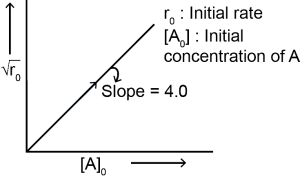
MediumMCQ
The kinetic study of a reaction like $vA \rightarrow P$ at $300 \ K$ provides the following curve,where concentration is taken in $mol \ dm^{-3}$ and time in $min$. Identify the correct order $(n)$ and rate constant $(k)$.
A
$n=0, k=4.0 \ mol \ dm^{-3} \ min^{-1}$
B
$n=1/2, k=2.0 \ mol^{1/2} \ dm^{-3/2} \ min^{-1}$
C
$n=1, k=80 \ min^{-1}$
D
$n=2, k=16.0 \ dm^3 \ mol^{-1} \ min^{-1}$
Solution
(D) The rate law for the reaction is given by $r = k[A]^n$.
Taking the square root on both sides,we get $\sqrt{r} = \sqrt{k} \times [A]^{n/2}$.
The given graph is a plot of $\sqrt{r_0}$ versus $[A]_0$,which is a straight line passing through the origin.
Comparing this with the equation $y = mx$,we have $y = \sqrt{r_0}$,$x = [A]_0$,and slope $m = \sqrt{k}$.
From the graph,the slope is $4.0$.
Therefore,$\sqrt{k} = 4.0$,which implies $k = (4.0)^2 = 16.0$.
Also,comparing the powers of $[A]$,we have $n/2 = 1$,which gives $n = 2$.
Thus,the order of the reaction is $n = 2$ and the rate constant is $k = 16.0 \ dm^3 \ mol^{-1} \ min^{-1}$.
Hence,option $(d)$ is the correct answer.
Taking the square root on both sides,we get $\sqrt{r} = \sqrt{k} \times [A]^{n/2}$.
The given graph is a plot of $\sqrt{r_0}$ versus $[A]_0$,which is a straight line passing through the origin.
Comparing this with the equation $y = mx$,we have $y = \sqrt{r_0}$,$x = [A]_0$,and slope $m = \sqrt{k}$.
From the graph,the slope is $4.0$.
Therefore,$\sqrt{k} = 4.0$,which implies $k = (4.0)^2 = 16.0$.
Also,comparing the powers of $[A]$,we have $n/2 = 1$,which gives $n = 2$.
Thus,the order of the reaction is $n = 2$ and the rate constant is $k = 16.0 \ dm^3 \ mol^{-1} \ min^{-1}$.
Hence,option $(d)$ is the correct answer.
0 likes
View Solution593
EasyMCQ
The rate of a certain reaction is given by,$Rate = k[H^{+}]^n$. The rate increases $100$ times when the $pH$ changes from $3$ to $1$. The order $(n)$ of the reaction is:
A
$2$
B
$0$
C
$1$
D
$1.5$
Solution
(C) Given the rate law: $Rate = k[H^{+}]^n$.
At $pH = 3$,the concentration of hydrogen ions is $[H^{+}]_1 = 10^{-3} \ M$.
At $pH = 1$,the concentration of hydrogen ions is $[H^{+}]_2 = 10^{-1} \ M$.
It is given that the rate increases $100$ times,so $Rate_2 = 100 \times Rate_1$.
Using the ratio: $\frac{Rate_2}{Rate_1} = \left(\frac{[H^{+}]_2}{[H^{+}]_1}\right)^n$.
Substituting the values: $100 = \left(\frac{10^{-1}}{10^{-3}}\right)^n$.
$100 = (10^2)^n$.
$10^2 = 10^{2n}$.
Comparing the exponents,$2 = 2n$,which gives $n = 1$.
At $pH = 3$,the concentration of hydrogen ions is $[H^{+}]_1 = 10^{-3} \ M$.
At $pH = 1$,the concentration of hydrogen ions is $[H^{+}]_2 = 10^{-1} \ M$.
It is given that the rate increases $100$ times,so $Rate_2 = 100 \times Rate_1$.
Using the ratio: $\frac{Rate_2}{Rate_1} = \left(\frac{[H^{+}]_2}{[H^{+}]_1}\right)^n$.
Substituting the values: $100 = \left(\frac{10^{-1}}{10^{-3}}\right)^n$.
$100 = (10^2)^n$.
$10^2 = 10^{2n}$.
Comparing the exponents,$2 = 2n$,which gives $n = 1$.
0 likes
View Solution594
EasyMCQ
Acid catalysed hydrolysis of ethyl acetate follows a pseudo-first order kinetics with respect to ester. If the reaction is carried out with large excess of ester,the order with respect to ester will be
A
$1.5$
B
$0$
C
$0.5$
D
$1$
Solution
(B) The reaction is $CH_{3}COOC_{2}H_{5} + H_{2}O \xrightarrow{H^+} CH_{3}COOH + C_{2}H_{5}OH$.
In a standard pseudo-first order reaction,water is in excess,making the order with respect to ester $1$.
However,if the reaction is carried out with a large excess of ester,the concentration of the ester remains effectively constant throughout the reaction.
Therefore,the rate of reaction becomes independent of the concentration of the ester,resulting in a zero-order reaction with respect to the ester.
In a standard pseudo-first order reaction,water is in excess,making the order with respect to ester $1$.
However,if the reaction is carried out with a large excess of ester,the concentration of the ester remains effectively constant throughout the reaction.
Therefore,the rate of reaction becomes independent of the concentration of the ester,resulting in a zero-order reaction with respect to the ester.
0 likes
View SolutionChemical Kinetics — Rate law , Rate constant , Order of Reaction and Molecularity · Frequently Asked Questions
1Are these Chemical Kinetics questions useful for JEE and NEET?
Yes. All questions in this section are mapped to JEE Main and NEET exam patterns. Previous year questions from JEE Main, NEET, GUJCET and state-level exams are included with full solutions.
2Can I switch to Hindi or Gujarati for these questions?
Yes. Use the language tabs in the hero section or the sidebar to view the same questions and solutions in English, Hindi or Gujarati.
3How do I generate a question paper from this subtopic?
Use the Vedclass Exam Paper Generator — select the chapter and subtopic, set difficulty, and generate Sets A, B, C, D automatically. First 3 chapters of every subject are free.
Vedclass Products
For Students
Vedclass Test Series
Mock tests in real JEE/NEET style with performance analysis. 5-day free trial.
Start Free TrialFor Teachers
Exam Paper Generator
Generate Set A/B/C/D papers from this chapter in 2 minutes. 3 chapters free.
Try FreeFor Institutes
Online Exam Module
Live online exams with unlimited students, 360° analytics & white-label branding.
See DemoFor Teachers & Institutes
Generate a Chemical Kinetics Exam Paper in 2 Minutes
Select subtopic & difficulty — Sets A, B, C, D auto-generated with No Repeat logic.
First 3 chapters of every subject are free — no payment required.