
A English
Rate law , Rate constant , Order of Reaction and Molecularity Questions in English
Class 12 Chemistry · Chemical Kinetics · Rate law , Rate constant , Order of Reaction and Molecularity
607+
Questions
English
Language
100%
With Solutions
Showing 7 of 607 questions in English
601
EasyMCQ
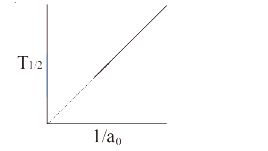
The following graph shows how $T_{1/2}$ (half-life) of a reactant $R$ changes with the initial reactant concentration $a_0$. The order of the reaction will be:
A
$0$
B
$1$
C
$2$
D
$3$
Solution
(C) For a reaction of order $n$,the half-life $T_{1/2}$ is related to the initial concentration $a_0$ by the expression: $T_{1/2} \propto \frac{1}{a_0^{n-1}}$.
From the given graph,$T_{1/2}$ is directly proportional to $\frac{1}{a_0}$.
This means $T_{1/2} \propto (a_0)^{-1}$.
Comparing the exponents of $a_0$,we get $n - 1 = 1$,which implies $n = 2$.
Therefore,the order of the reaction is $2$.
From the given graph,$T_{1/2}$ is directly proportional to $\frac{1}{a_0}$.
This means $T_{1/2} \propto (a_0)^{-1}$.
Comparing the exponents of $a_0$,we get $n - 1 = 1$,which implies $n = 2$.
Therefore,the order of the reaction is $2$.
0 likes
View Solution602
EasyMCQ
For the reaction $A + 2B \longrightarrow C$,the reaction rate is doubled if the concentration of $A$ is doubled. The rate is increased by four times when concentrations of both $A$ and $B$ are increased by four times. The order of the reaction is
A
$3$
B
$0$
C
$1$
D
$2$
Solution
(C) The rate law can be expressed as $Rate = k[A]^x[B]^y$.
When the concentration of $A$ is doubled,the rate doubles,which implies $2^x = 2$,so $x = 1$.
When both concentrations are increased by four times,the rate increases by four times: $4^x \times 4^y = 4$.
Substituting $x = 1$,we get $4^1 \times 4^y = 4$,which means $4^y = 1$,so $y = 0$.
The total order of the reaction is $x + y = 1 + 0 = 1$.
When the concentration of $A$ is doubled,the rate doubles,which implies $2^x = 2$,so $x = 1$.
When both concentrations are increased by four times,the rate increases by four times: $4^x \times 4^y = 4$.
Substituting $x = 1$,we get $4^1 \times 4^y = 4$,which means $4^y = 1$,so $y = 0$.
The total order of the reaction is $x + y = 1 + 0 = 1$.
0 likes
View Solution603
EasyMCQ
In the hydrolysis of an organic chloride in the presence of a large excess of water; $RCl + H_2O \rightarrow ROH + HCl$. What are the molecularity and order of the reaction?
A
Molecularity and order of reaction both are $2$
B
Molecularity is $2$ but order of reaction is $1$
C
Molecularity is $1$ but order of reaction is $2$
D
Molecularity is $1$ and order of reaction is also $1$
Solution
(B) The reaction is $RCl + H_2O \rightarrow ROH + HCl$.
Since water is present in large excess,its concentration remains practically constant during the reaction.
This makes the reaction a pseudo-first-order reaction,where the order of reaction is $1$.
However,the molecularity is determined by the number of reacting species colliding simultaneously in the elementary step,which is $2$ ($RCl$ and $H_2O$).
Therefore,the molecularity is $2$ and the order of reaction is $1$.
Since water is present in large excess,its concentration remains practically constant during the reaction.
This makes the reaction a pseudo-first-order reaction,where the order of reaction is $1$.
However,the molecularity is determined by the number of reacting species colliding simultaneously in the elementary step,which is $2$ ($RCl$ and $H_2O$).
Therefore,the molecularity is $2$ and the order of reaction is $1$.
0 likes
View Solution604
DifficultMCQ
$A \rightarrow$ products ($1^{st}$ order reaction). Three sets of experiment were performed for a reaction under similar experimental conditions. Run $1 \Rightarrow 100 \ mL$ of $10 \ M$ solution of reactant $A$. Run $2 \Rightarrow 200 \ mL$ of $10 \ M$ solution of reactant $A$. Run $3 \Rightarrow 100 \ mL$ of $10 \ M$ solution of reactant $A + 100 \ mL$ of $H_2O$ added. The correct variation of rate of reaction is:
A
Run $1 = $ Run $2 = $ Run $3$
B
Run $3 < $ Run $1 = $ Run $2$
C
Run $3 < $ Run $1 < $ Run $2$
D
Run $1 < $ Run $2 < $ Run $3$
Solution
(B) For a $1^{st}$ order reaction,the rate is given by $Rate = k[A]$.
In Run $1$,the concentration of $A$ is $10 \ M$.
In Run $2$,the volume is doubled,but the concentration of $A$ remains $10 \ M$,so the rate is the same as Run $1$.
In Run $3$,$100 \ mL$ of $H_2O$ is added to $100 \ mL$ of $10 \ M$ solution of $A$,which dilutes the solution to $5 \ M$.
Since the rate depends on the concentration of $A$,the rate in Run $3$ will be lower than in Run $1$ and Run $2$.
Therefore,the correct order is $Run \ 3 < Run \ 1 = Run \ 2$.
In Run $1$,the concentration of $A$ is $10 \ M$.
In Run $2$,the volume is doubled,but the concentration of $A$ remains $10 \ M$,so the rate is the same as Run $1$.
In Run $3$,$100 \ mL$ of $H_2O$ is added to $100 \ mL$ of $10 \ M$ solution of $A$,which dilutes the solution to $5 \ M$.
Since the rate depends on the concentration of $A$,the rate in Run $3$ will be lower than in Run $1$ and Run $2$.
Therefore,the correct order is $Run \ 3 < Run \ 1 = Run \ 2$.
0 likes
View Solution605
MediumMCQ
If the rate constant $k = 4.5 \times 10^{-7} \text{ L}^2 \text{ mol}^{-2} \text{ s}^{-1}$,then what is the order of the reaction?
A
$0$
B
$3$
C
$2$
D
$4$
Solution
(B) The general unit for the rate constant $k$ of an $n^{th}$ order reaction is given by the formula: $\text{mol}^{1-n} \text{L}^{n-1} \text{s}^{-1}$.
Given the unit of the rate constant is $\text{L}^2 \text{mol}^{-2} \text{s}^{-1}$.
Comparing the exponent of $\text{L}$ (liters) in the given unit with the general formula: $n - 1 = 2$.
Solving for $n$,we get $n = 3$.
Therefore,the order of the reaction is $3$.
Given the unit of the rate constant is $\text{L}^2 \text{mol}^{-2} \text{s}^{-1}$.
Comparing the exponent of $\text{L}$ (liters) in the given unit with the general formula: $n - 1 = 2$.
Solving for $n$,we get $n = 3$.
Therefore,the order of the reaction is $3$.
0 likes
View Solution606
MediumMCQ
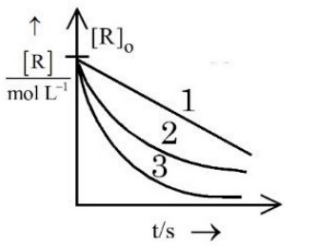
Consider the given graph showing the variation of reactant concentration with time. Three different reactions were started with identical initial concentration of reactants. Which of the following statements is correct?
A
The order of all the three reactions is the same.
B
The rate constant of reaction $3$ is larger than the rate constant of reaction $2$ if the order of reaction is the same for both.
C
The $SI$ unit of the rate constant of reaction $1$ is $s^{-1}$.
D
Thermal decomposition of $HI$ on a gold surface is an example of reaction $2$.
Solution
(B) The graph shows $[R]$ vs $t$. Reaction $1$,$2$,and $3$ represent decreasing concentrations with time.
For zero-order reactions,$[R] = [R]_{0} - kt$,which is a straight line. As the order increases,the curves become more convex.
Reaction $1$ is a straight line (zero-order),Reaction $2$ is first-order,and Reaction $3$ is second-order.
The unit of the rate constant for zero-order is $mol \text{ L}^{-1} \text{ s}^{-1}$. Thus,option $C$ is incorrect.
For a fixed initial concentration,the rate constant order is $k_{3} > k_{2} > k_{1}$ to maintain the decay profiles,as reaction $3$ decays faster than $2$. Therefore,option $B$ is correct.
For zero-order reactions,$[R] = [R]_{0} - kt$,which is a straight line. As the order increases,the curves become more convex.
Reaction $1$ is a straight line (zero-order),Reaction $2$ is first-order,and Reaction $3$ is second-order.
The unit of the rate constant for zero-order is $mol \text{ L}^{-1} \text{ s}^{-1}$. Thus,option $C$ is incorrect.
For a fixed initial concentration,the rate constant order is $k_{3} > k_{2} > k_{1}$ to maintain the decay profiles,as reaction $3$ decays faster than $2$. Therefore,option $B$ is correct.
0 likes
View Solution607
MediumMCQ
Match List-$I$ with List-$II$:
| List-$I$ (Order of Reaction) | List-$II$ (Unit of rate constant) |
| $A$. Zero order | $I$. $mol^{-1} L s^{-1}$ |
| $B$. First order | $II$. $mol^{-2} L^{2} s^{-1}$ |
| $C$. Second order | $III$. $s^{-1}$ |
| $D$. Third order | $IV$. $mol L^{-1} s^{-1}$ |
A
$A-IV, B-III, C-I, D-II$
B
$A-IV, B-III, C-I, D-II$
C
$A-I, B-III, C-II, D-IV$
D
$A-IV, B-II, C-I, D-III$
Solution
(B) The general unit for the rate constant $k$ for a reaction of order $n$ is given by the formula: $k = (mol \text{ } L^{-1})^{1-n} s^{-1}$.
For $n=0$ (Zero order): $k = (mol \text{ } L^{-1})^{1-0} s^{-1} = mol \text{ } L^{-1} s^{-1}$ (Matches $IV$).
For $n=1$ (First order): $k = (mol \text{ } L^{-1})^{1-1} s^{-1} = s^{-1}$ (Matches $III$).
For $n=2$ (Second order): $k = (mol \text{ } L^{-1})^{1-2} s^{-1} = mol^{-1} L s^{-1}$ (Matches $I$).
For $n=3$ (Third order): $k = (mol \text{ } L^{-1})^{1-3} s^{-1} = mol^{-2} L^{2} s^{-1}$ (Matches $II$).
Therefore,the correct matching is $A-IV, B-III, C-I, D-II$.
For $n=0$ (Zero order): $k = (mol \text{ } L^{-1})^{1-0} s^{-1} = mol \text{ } L^{-1} s^{-1}$ (Matches $IV$).
For $n=1$ (First order): $k = (mol \text{ } L^{-1})^{1-1} s^{-1} = s^{-1}$ (Matches $III$).
For $n=2$ (Second order): $k = (mol \text{ } L^{-1})^{1-2} s^{-1} = mol^{-1} L s^{-1}$ (Matches $I$).
For $n=3$ (Third order): $k = (mol \text{ } L^{-1})^{1-3} s^{-1} = mol^{-2} L^{2} s^{-1}$ (Matches $II$).
Therefore,the correct matching is $A-IV, B-III, C-I, D-II$.
0 likes
View SolutionChemical Kinetics — Rate law , Rate constant , Order of Reaction and Molecularity · Frequently Asked Questions
1Are these Chemical Kinetics questions useful for JEE and NEET?
Yes. All questions in this section are mapped to JEE Main and NEET exam patterns. Previous year questions from JEE Main, NEET, GUJCET and state-level exams are included with full solutions.
2Can I switch to Hindi or Gujarati for these questions?
Yes. Use the language tabs in the hero section or the sidebar to view the same questions and solutions in English, Hindi or Gujarati.
3How do I generate a question paper from this subtopic?
Use the Vedclass Exam Paper Generator — select the chapter and subtopic, set difficulty, and generate Sets A, B, C, D automatically. First 3 chapters of every subject are free.
Vedclass Products
For Students
Vedclass Test Series
Mock tests in real JEE/NEET style with performance analysis. 5-day free trial.
Start Free TrialFor Teachers
Exam Paper Generator
Generate Set A/B/C/D papers from this chapter in 2 minutes. 3 chapters free.
Try FreeFor Institutes
Online Exam Module
Live online exams with unlimited students, 360° analytics & white-label branding.
See DemoFor Teachers & Institutes
Generate a Chemical Kinetics Exam Paper in 2 Minutes
Select subtopic & difficulty — Sets A, B, C, D auto-generated with No Repeat logic.
First 3 chapters of every subject are free — no payment required.