
A English
Collision theory, Energy of activation and Arrhenius equation Questions in English
Class 12 Chemistry · Chemical Kinetics · Collision theory, Energy of activation and Arrhenius equation
499+
Questions
English
Language
100%
With Solutions
Showing 50 of 499 questions in English
351
MediumMCQ
For a reaction $A \rightarrow B$,the enthalpy of reaction is $-4.2 \ kJ \ mol^{-1}$ and the enthalpy of activation is $9.6 \ kJ \ mol^{-1}$. The correct potential energy profile for the reaction is shown in which option?
A
B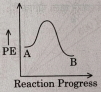
C
D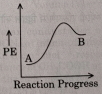
Solution
(B) The enthalpy of reaction $\Delta H$ is given by the difference between the activation energy of the forward reaction $(E_a)_f$ and the activation energy of the backward reaction $(E_a)_b$:
$\Delta H = (E_a)_f - (E_a)_b$
Given $\Delta H = -4.2 \ kJ \ mol^{-1}$ and $(E_a)_f = 9.6 \ kJ \ mol^{-1}$:
$-4.2 = 9.6 - (E_a)_b$
$(E_a)_b = 9.6 + 4.2 = 13.8 \ kJ \ mol^{-1}$
Since $\Delta H$ is negative,the reaction is exothermic,meaning the potential energy of the product $B$ must be lower than the potential energy of the reactant $A$. Among the given options,the graph where the product $B$ is at a lower energy level than reactant $A$ is represented by option $B$.
$\Delta H = (E_a)_f - (E_a)_b$
Given $\Delta H = -4.2 \ kJ \ mol^{-1}$ and $(E_a)_f = 9.6 \ kJ \ mol^{-1}$:
$-4.2 = 9.6 - (E_a)_b$
$(E_a)_b = 9.6 + 4.2 = 13.8 \ kJ \ mol^{-1}$
Since $\Delta H$ is negative,the reaction is exothermic,meaning the potential energy of the product $B$ must be lower than the potential energy of the reactant $A$. Among the given options,the graph where the product $B$ is at a lower energy level than reactant $A$ is represented by option $B$.
0 likes
View Solution352
MediumMCQ
The slope of the Arrhenius plot $(\ln k \, vs \, \frac{1}{T})$ of a first-order reaction is $-5 \times 10^{3} \, K$. The value of $E_{a}$ of the reaction is: (in $kJ \, mol^{-1}$)
$[\text{Given } R = 8.314 \, J \, K^{-1} \, mol^{-1}]$
$[\text{Given } R = 8.314 \, J \, K^{-1} \, mol^{-1}]$
A
$41.5$
B
$83.0$
C
$166$
D
$-83$
Solution
(A) The Arrhenius equation is given by $\ln k = \ln A - \frac{E_{a}}{RT}$.
Comparing this with the equation of a straight line $y = mx + c$,where $y = \ln k$ and $x = \frac{1}{T}$,the slope $m = -\frac{E_{a}}{R}$.
Given that the slope is $-5 \times 10^{3} \, K$,we have $-\frac{E_{a}}{R} = -5 \times 10^{3} \, K$.
Therefore,$E_{a} = 5 \times 10^{3} \times 8.314 \, J \, mol^{-1} = 41570 \, J \, mol^{-1}$.
Converting to $kJ \, mol^{-1}$,we get $E_{a} = 41.57 \, kJ \, mol^{-1} \approx 41.5 \, kJ \, mol^{-1}$.
Comparing this with the equation of a straight line $y = mx + c$,where $y = \ln k$ and $x = \frac{1}{T}$,the slope $m = -\frac{E_{a}}{R}$.
Given that the slope is $-5 \times 10^{3} \, K$,we have $-\frac{E_{a}}{R} = -5 \times 10^{3} \, K$.
Therefore,$E_{a} = 5 \times 10^{3} \times 8.314 \, J \, mol^{-1} = 41570 \, J \, mol^{-1}$.
Converting to $kJ \, mol^{-1}$,we get $E_{a} = 41.57 \, kJ \, mol^{-1} \approx 41.5 \, kJ \, mol^{-1}$.
0 likes
View Solution353
MediumMCQ
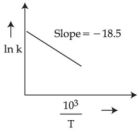
The rate constants for the decomposition of acetaldehyde have been measured over the temperature range $700-1000 \ K$. The data has been analysed by plotting a $\ln \ k \ vs \ \frac{10^{3}}{T}$ graph,which gives a slope of $-18.5$. The value of activation energy for the reaction is $...... \ kJ \ mol^{-1}$. (Nearest integer) (Given: $R = 8.31 \ J \ K^{-1} \ mol^{-1}$)
A
$234$
B
$154$
C
$701$
D
$185$
Solution
(B) According to the Arrhenius equation,$\ln \ k = \ln \ A - \frac{E_a}{RT}$.
We are plotting $\ln \ k$ versus $\frac{10^{3}}{T}$.
Rewriting the equation: $\ln \ k = \ln \ A - \left( \frac{E_a}{R \times 10^{3}} \right) \times \left( \frac{10^{3}}{T} \right)$.
Comparing this with the equation of a straight line $y = mx + c$,the slope $m = -\frac{E_a}{R \times 10^{3}}$.
Given the slope is $-18.5$,we have: $-18.5 = -\frac{E_a}{8.31 \times 10^{3}}$.
$E_a = 18.5 \times 8.31 \times 10^{3} \ J \ mol^{-1} = 153735 \ J \ mol^{-1}$.
Converting to $kJ \ mol^{-1}$: $E_a = 153.735 \ kJ \ mol^{-1}$.
Rounding to the nearest integer,we get $154 \ kJ \ mol^{-1}$.
We are plotting $\ln \ k$ versus $\frac{10^{3}}{T}$.
Rewriting the equation: $\ln \ k = \ln \ A - \left( \frac{E_a}{R \times 10^{3}} \right) \times \left( \frac{10^{3}}{T} \right)$.
Comparing this with the equation of a straight line $y = mx + c$,the slope $m = -\frac{E_a}{R \times 10^{3}}$.
Given the slope is $-18.5$,we have: $-18.5 = -\frac{E_a}{8.31 \times 10^{3}}$.
$E_a = 18.5 \times 8.31 \times 10^{3} \ J \ mol^{-1} = 153735 \ J \ mol^{-1}$.
Converting to $kJ \ mol^{-1}$: $E_a = 153.735 \ kJ \ mol^{-1}$.
Rounding to the nearest integer,we get $154 \ kJ \ mol^{-1}$.
0 likes
View Solution354
DifficultMCQ
Catalyst $A$ reduces the activation energy for a reaction by $10 \ kJ \ mol^{-1}$ at $300 \ K$. The ratio of rate $\frac{k_{T, \text{Catalysed}}}{k_{T, \text{Uncatalysed}}}$ is $e^{x}$. Find the value of $x$ [nearest integer].
[Assume that the pre-exponential factor is same in both the cases.
Given $R = 8.31 \ J \ K^{-1} \ mol^{-1}$]
[Assume that the pre-exponential factor is same in both the cases.
Given $R = 8.31 \ J \ K^{-1} \ mol^{-1}$]
A
$88$
B
$12$
C
$4$
D
$40$
Solution
(C) According to the Arrhenius equation,$k = A e^{-E_a / RT}$.
For the catalysed reaction,$k_{\text{cat}} = A e^{-E_{a, \text{cat}} / RT}$.
For the uncatalysed reaction,$k_{\text{uncat}} = A e^{-E_{a, \text{uncat}} / RT}$.
The ratio is $\frac{k_{\text{cat}}}{k_{\text{uncat}}} = e^{(E_{a, \text{uncat}} - E_{a, \text{cat}}) / RT}$.
Given $\Delta E_a = E_{a, \text{uncat}} - E_{a, \text{cat}} = 10 \ kJ \ mol^{-1} = 10000 \ J \ mol^{-1}$.
Substituting the values: $\frac{k_{\text{cat}}}{k_{\text{uncat}}} = e^{10000 / (8.31 \times 300)} = e^{10000 / 2493} = e^{4.011}$.
Comparing with $e^x$,we get $x \approx 4$.
For the catalysed reaction,$k_{\text{cat}} = A e^{-E_{a, \text{cat}} / RT}$.
For the uncatalysed reaction,$k_{\text{uncat}} = A e^{-E_{a, \text{uncat}} / RT}$.
The ratio is $\frac{k_{\text{cat}}}{k_{\text{uncat}}} = e^{(E_{a, \text{uncat}} - E_{a, \text{cat}}) / RT}$.
Given $\Delta E_a = E_{a, \text{uncat}} - E_{a, \text{cat}} = 10 \ kJ \ mol^{-1} = 10000 \ J \ mol^{-1}$.
Substituting the values: $\frac{k_{\text{cat}}}{k_{\text{uncat}}} = e^{10000 / (8.31 \times 300)} = e^{10000 / 2493} = e^{4.011}$.
Comparing with $e^x$,we get $x \approx 4$.
0 likes
View Solution355
MediumMCQ
It has been found that for a chemical reaction with a rise in temperature by $9 \, K$,the rate constant gets doubled. Assuming a reaction to be occurring at $300 \, K$,the value of activation energy is found to be $...... \, kJ \, mol^{-1}$. [nearest integer]
(Given $\ln 10 = 2.3, R = 8.3 \, J \, K^{-1} \, mol^{-1}, \log 2 = 0.30$ )
(Given $\ln 10 = 2.3, R = 8.3 \, J \, K^{-1} \, mol^{-1}, \log 2 = 0.30$ )
A
$66$
B
$12$
C
$59$
D
$78$
Solution
(C) The Arrhenius equation is given by: $\log_{10} \frac{K_2}{K_1} = \frac{E_a}{2.303 \, R} \left(\frac{T_2 - T_1}{T_1 T_2}\right)$
Given: $T_1 = 300 \, K$,$T_2 = 309 \, K$,$\frac{K_2}{K_1} = 2$,$R = 8.3 \, J \, K^{-1} \, mol^{-1}$,$\log 2 = 0.30$.
Substituting the values:
$0.3 = \frac{E_a}{2.303 \times 8.3} \left(\frac{9}{300 \times 309}\right)$
$E_a = \frac{0.3 \times 2.303 \times 8.3 \times 300 \times 309}{9}$
$E_a = 59065.04 \, J \, mol^{-1}$
$E_a \approx 59 \, kJ \, mol^{-1}$
Given: $T_1 = 300 \, K$,$T_2 = 309 \, K$,$\frac{K_2}{K_1} = 2$,$R = 8.3 \, J \, K^{-1} \, mol^{-1}$,$\log 2 = 0.30$.
Substituting the values:
$0.3 = \frac{E_a}{2.303 \times 8.3} \left(\frac{9}{300 \times 309}\right)$
$E_a = \frac{0.3 \times 2.303 \times 8.3 \times 300 \times 309}{9}$
$E_a = 59065.04 \, J \, mol^{-1}$
$E_a \approx 59 \, kJ \, mol^{-1}$
0 likes
View Solution356
MediumMCQ
The rate constant for a first order reaction is given by the following equation:
$\ln k = 33.24 - \frac{2.0 \times 10^{4} \, K}{T}$
The activation energy for the reaction is given by $... \, kJ \, mol^{-1}$. (In nearest integer)
(Given: $R = 8.3 \, J \, K^{-1} \, mol^{-1}$)
$\ln k = 33.24 - \frac{2.0 \times 10^{4} \, K}{T}$
The activation energy for the reaction is given by $... \, kJ \, mol^{-1}$. (In nearest integer)
(Given: $R = 8.3 \, J \, K^{-1} \, mol^{-1}$)
A
$15$
B
$166$
C
$961$
D
$247$
Solution
(B) The Arrhenius equation is given by $\ln k = \ln A - \frac{E_A}{RT}$.
Comparing this with the given equation $\ln k = 33.24 - \frac{2.0 \times 10^{4}}{T}$,we get:
$\frac{E_A}{R} = 2.0 \times 10^{4} \, K$.
Therefore,$E_A = 2.0 \times 10^{4} \times R$.
Substituting $R = 8.3 \, J \, K^{-1} \, mol^{-1}$:
$E_A = 2.0 \times 10^{4} \times 8.3 \, J \, mol^{-1} = 16.6 \times 10^{4} \, J \, mol^{-1}$.
Converting to $kJ \, mol^{-1}$:
$E_A = \frac{16.6 \times 10^{4}}{1000} \, kJ \, mol^{-1} = 166 \, kJ \, mol^{-1}$.
Comparing this with the given equation $\ln k = 33.24 - \frac{2.0 \times 10^{4}}{T}$,we get:
$\frac{E_A}{R} = 2.0 \times 10^{4} \, K$.
Therefore,$E_A = 2.0 \times 10^{4} \times R$.
Substituting $R = 8.3 \, J \, K^{-1} \, mol^{-1}$:
$E_A = 2.0 \times 10^{4} \times 8.3 \, J \, mol^{-1} = 16.6 \times 10^{4} \, J \, mol^{-1}$.
Converting to $kJ \, mol^{-1}$:
$E_A = \frac{16.6 \times 10^{4}}{1000} \, kJ \, mol^{-1} = 166 \, kJ \, mol^{-1}$.
0 likes
View Solution357
EasyMCQ
The equation $k = (6.5 \times 10^{12} \, s^{-1}) e^{-26000 \, K / T}$ is followed for the decomposition of compound $A$. The activation energy for the reaction is $..... \, kJ \, mol^{-1}$. [nearest integer] (Given: $R = 8.314 \, J \, K^{-1} \, mol^{-1}$)
A
$216$
B
$2160$
C
$26$
D
$674$
Solution
(A) The Arrhenius equation is given by $k = A e^{-E_a / RT}$.
Comparing this with the given equation $k = (6.5 \times 10^{12} \, s^{-1}) e^{-26000 \, K / T}$,we get $\frac{E_a}{R} = 26000 \, K$.
Substituting $R = 8.314 \, J \, K^{-1} \, mol^{-1}$,we have $E_a = 26000 \times 8.314 \, J \, mol^{-1}$.
$E_a = 216164 \, J \, mol^{-1} = 216.164 \, kJ \, mol^{-1}$.
Rounding to the nearest integer,the activation energy is $216 \, kJ \, mol^{-1}$.
Comparing this with the given equation $k = (6.5 \times 10^{12} \, s^{-1}) e^{-26000 \, K / T}$,we get $\frac{E_a}{R} = 26000 \, K$.
Substituting $R = 8.314 \, J \, K^{-1} \, mol^{-1}$,we have $E_a = 26000 \times 8.314 \, J \, mol^{-1}$.
$E_a = 216164 \, J \, mol^{-1} = 216.164 \, kJ \, mol^{-1}$.
Rounding to the nearest integer,the activation energy is $216 \, kJ \, mol^{-1}$.
0 likes
View Solution358
DifficultMCQ
The activation energy of one of the reactions in a biochemical process is $532611 \, J \, mol^{-1}$. When the temperature falls from $310 \, K$ to $300 \, K$,the change in rate constant observed is $k_{300} = x \times 10^{-3} \, k_{310}$. The value of $x$ is $.....$ [Given: $\ln 10 = 2.3$,$R = 8.3 \, J \, K^{-1} \, mol^{-1}$]
A
$1$
B
$10$
C
$45$
D
$985$
Solution
(A) Using the Arrhenius equation: $\ln \left(\frac{k_{310}}{k_{300}}\right) = \frac{E_a}{R} \left(\frac{1}{T_{300}} - \frac{1}{T_{310}}\right)$
$\ln \left(\frac{k_{310}}{k_{300}}\right) = \frac{532611}{8.3} \times \left(\frac{310 - 300}{310 \times 300}\right)$
$\ln \left(\frac{k_{310}}{k_{300}}\right) = \frac{532611}{8.3} \times \frac{10}{93000} = 64170 \times \frac{10}{93000} \approx 6.9$
Since $\ln 10 = 2.3$,then $6.9 = 3 \times 2.3 = 3 \times \ln 10 = \ln 10^3$.
Therefore,$\frac{k_{310}}{k_{300}} = 10^3$,which means $k_{300} = 10^{-3} \, k_{310}$.
Comparing this with $k_{300} = x \times 10^{-3} \, k_{310}$,we get $x = 1$.
$\ln \left(\frac{k_{310}}{k_{300}}\right) = \frac{532611}{8.3} \times \left(\frac{310 - 300}{310 \times 300}\right)$
$\ln \left(\frac{k_{310}}{k_{300}}\right) = \frac{532611}{8.3} \times \frac{10}{93000} = 64170 \times \frac{10}{93000} \approx 6.9$
Since $\ln 10 = 2.3$,then $6.9 = 3 \times 2.3 = 3 \times \ln 10 = \ln 10^3$.
Therefore,$\frac{k_{310}}{k_{300}} = 10^3$,which means $k_{300} = 10^{-3} \, k_{310}$.
Comparing this with $k_{300} = x \times 10^{-3} \, k_{310}$,we get $x = 1$.
0 likes
View Solution359
MediumMCQ
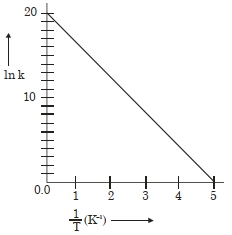
For a reaction,given below is the graph of $\ln k$ vs $\frac{1}{T}$. The activation energy for the reaction is equal to $...... \ cal \ mol^{-1}$. (Nearest integer). (Given : $R = 2 \ cal \ K^{-1} \ mol^{-1}$)
A
$8$
B
$40$
C
$4$
D
$20$
Solution
(A) The Arrhenius equation is given by $k = Ae^{-E_a/RT}$.
Taking the natural logarithm on both sides,we get $\ln k = -\frac{E_a}{R}(\frac{1}{T}) + \ln A$.
Comparing this with the equation of a straight line $y = mx + c$,the slope $m = -\frac{E_a}{R}$.
From the given graph,the slope is calculated as $\frac{y_2 - y_1}{x_2 - x_1} = \frac{0 - 20}{5 - 0} = -4$.
Equating the slopes: $-\frac{E_a}{R} = -4$,which gives $E_a = 4 \times R$.
Given $R = 2 \ cal \ K^{-1} \ mol^{-1}$,we have $E_a = 4 \times 2 = 8 \ cal \ mol^{-1}$.
Taking the natural logarithm on both sides,we get $\ln k = -\frac{E_a}{R}(\frac{1}{T}) + \ln A$.
Comparing this with the equation of a straight line $y = mx + c$,the slope $m = -\frac{E_a}{R}$.
From the given graph,the slope is calculated as $\frac{y_2 - y_1}{x_2 - x_1} = \frac{0 - 20}{5 - 0} = -4$.
Equating the slopes: $-\frac{E_a}{R} = -4$,which gives $E_a = 4 \times R$.
Given $R = 2 \ cal \ K^{-1} \ mol^{-1}$,we have $E_a = 4 \times 2 = 8 \ cal \ mol^{-1}$.
0 likes
View Solution360
AdvancedMCQ
For a first order chemical reaction,
A
the product formation rate is independent of reactant concentration.
B
the time taken for the completion of half of the reaction $t_{1/2}$ is $69.3 \%$ of the rate constant $(k)$.
C
the dimension of Arrhenius pre-exponential factor is reciprocal of time.
D
the concentration $vs$ time plot for the reactant should be linear with a negative slope.
Solution
(C) . The Arrhenius equation for the rate constant $k$ is $k = A e^{-E_a / RT}$,where $A$ is the pre-exponential factor.
Since the term $e^{-E_a / RT}$ is dimensionless,the dimension of $A$ is equal to the dimension of $k$.
For a first-order reaction,the dimension of $k$ is $\text{time}^{-1}$.
Therefore,the dimension of $A$ is also $\text{time}^{-1}$,which is the reciprocal of time.
Regarding other options:
For a first-order reaction,the rate of reaction is directly proportional to the reactant concentration.
The half-life $t_{1/2} = \frac{0.693}{k}$,which is $69.3 \%$ of $\frac{1}{k}$.
The concentration of the reactant changes with time according to the equation $[A]_t = [A]_0 e^{-kt}$,which represents an exponential decay,not a linear one.
Since the term $e^{-E_a / RT}$ is dimensionless,the dimension of $A$ is equal to the dimension of $k$.
For a first-order reaction,the dimension of $k$ is $\text{time}^{-1}$.
Therefore,the dimension of $A$ is also $\text{time}^{-1}$,which is the reciprocal of time.
Regarding other options:
For a first-order reaction,the rate of reaction is directly proportional to the reactant concentration.
The half-life $t_{1/2} = \frac{0.693}{k}$,which is $69.3 \%$ of $\frac{1}{k}$.
The concentration of the reactant changes with time according to the equation $[A]_t = [A]_0 e^{-kt}$,which represents an exponential decay,not a linear one.
0 likes
View Solution361
MediumMCQ
The enthalpy $(H)$ of an elementary exothermic reaction,$A \rightleftharpoons B$ is schematically plotted against the reaction coordinate. The plots in the presence and absence of a catalyst are shown in dashed and solid lines,respectively. Identify the correct plot for the reaction.
A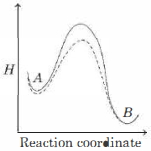
B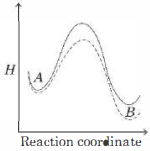
C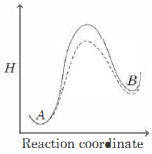
D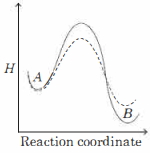
Solution
(A) For an exothermic reaction,$A \rightleftharpoons B$,the change in enthalpy is negative,i.e.,$\Delta H < 0$.
Since $\Delta H = E_{Product} - E_{Reactant}$,we have $E_{B} - E_{A} < 0$,which implies $E_{B} < E_{A}$.
This indicates that the energy level of the product $B$ must be lower than that of the reactant $A$.
Furthermore,a catalyst provides an alternative pathway with a lower activation energy but does not change the initial energy of the reactants or the final energy of the products.
Therefore,the solid line (uncatalyzed) and dashed line (catalyzed) must start and end at the same energy levels.
Plot $A$ correctly shows $E_{B} < E_{A}$ and the same starting and ending points for both catalyzed and uncatalyzed paths.
Since $\Delta H = E_{Product} - E_{Reactant}$,we have $E_{B} - E_{A} < 0$,which implies $E_{B} < E_{A}$.
This indicates that the energy level of the product $B$ must be lower than that of the reactant $A$.
Furthermore,a catalyst provides an alternative pathway with a lower activation energy but does not change the initial energy of the reactants or the final energy of the products.
Therefore,the solid line (uncatalyzed) and dashed line (catalyzed) must start and end at the same energy levels.
Plot $A$ correctly shows $E_{B} < E_{A}$ and the same starting and ending points for both catalyzed and uncatalyzed paths.
0 likes
View Solution362
MediumMCQ
$A$ reaction has an activation energy of $209 \, kJ \, mol^{-1}$. The rate increases $10$-fold when the temperature is increased from $27^{\circ} C$ to $X^{\circ} C$. The temperature $X$ is closest to
[Gas constant,$R = 8.314 \, J \, mol^{-1} \, K^{-1}$ ]
[Gas constant,$R = 8.314 \, J \, mol^{-1} \, K^{-1}$ ]
A
$35$
B
$40$
C
$30$
D
$45$
Solution
(A) Given,activation energy $E_a = 209 \, kJ \, mol^{-1} = 209000 \, J \, mol^{-1}$.
Rate increases $10$-fold,so $K_2 / K_1 = 10$.
Initial temperature $T_1 = 27 + 273 = 300 \, K$.
Using the Arrhenius equation: $\log(K_2 / K_1) = \frac{E_a}{2.303 \, R} \left[ \frac{1}{T_1} - \frac{1}{T_2} \right]$.
Substituting the values: $\log(10) = \frac{209000}{2.303 \times 8.314} \left[ \frac{1}{300} - \frac{1}{T_2} \right]$.
$1 = 10923.6 \times \left[ 0.003333 - \frac{1}{T_2} \right]$.
$0.0000915 = 0.003333 - \frac{1}{T_2}$.
$\frac{1}{T_2} = 0.003333 - 0.0000915 = 0.0032415$.
$T_2 = 308.5 \, K$.
$X = 308.5 - 273 = 35.5^{\circ} C \approx 35^{\circ} C$.
Rate increases $10$-fold,so $K_2 / K_1 = 10$.
Initial temperature $T_1 = 27 + 273 = 300 \, K$.
Using the Arrhenius equation: $\log(K_2 / K_1) = \frac{E_a}{2.303 \, R} \left[ \frac{1}{T_1} - \frac{1}{T_2} \right]$.
Substituting the values: $\log(10) = \frac{209000}{2.303 \times 8.314} \left[ \frac{1}{300} - \frac{1}{T_2} \right]$.
$1 = 10923.6 \times \left[ 0.003333 - \frac{1}{T_2} \right]$.
$0.0000915 = 0.003333 - \frac{1}{T_2}$.
$\frac{1}{T_2} = 0.003333 - 0.0000915 = 0.0032415$.
$T_2 = 308.5 \, K$.
$X = 308.5 - 273 = 35.5^{\circ} C \approx 35^{\circ} C$.
0 likes
View Solution363
MediumMCQ
The rate constant of a chemical reaction at a very high temperature will approach:
A
Arrhenius frequency factor divided by the ideal gas constant
B
Activation energy
C
Arrhenius frequency factor
D
Activation energy divided by the ideal gas constant
Solution
(C) The temperature dependence of the rate of a chemical reaction is expressed by the Arrhenius equation: $k = A e^{-E_{a} / (RT)}$.
When $T$ is very high,the factor $E_{a} / (RT)$ approaches $0$.
Therefore,$k = A e^{0} = A \times 1 = A$.
Thus,the rate constant of a chemical reaction at a very high temperature will approach the Arrhenius frequency factor $(A)$.
When $T$ is very high,the factor $E_{a} / (RT)$ approaches $0$.
Therefore,$k = A e^{0} = A \times 1 = A$.
Thus,the rate constant of a chemical reaction at a very high temperature will approach the Arrhenius frequency factor $(A)$.
0 likes
View Solution364
MediumMCQ
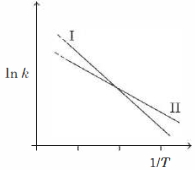
The Arrhenius plots of two reactions,$I$ and $II$ are shown graphically. The graph suggests that
A
$E_I > E_{II}$ and $A_I > A_{II}$
B
$E_{II} > E_I$ and $A_{II} > A_I$
C
$E_I > E_{II}$ and $A_{II} > A_I$
D
$E_{II} > E_I$ and $A_I > A_{II}$
Solution
(A) The Arrhenius equation is given by $k = A e^{-E_a / R T}$.
Taking the natural logarithm on both sides,we get $\ln k = \ln A - \frac{E_a}{R} \left( \frac{1}{T} \right)$.
Comparing this with the equation of a straight line $y = mx + c$,where $y = \ln k$ and $x = 1/T$:
The slope $m = -E_a / R$ and the intercept $c = \ln A$.
From the graph,the line for reaction $I$ is steeper than the line for reaction $II$. Since the slope is negative,a steeper line indicates a larger magnitude of slope,meaning $E_I > E_{II}$.
Also,the intercept on the $y$-axis (at $1/T = 0$) for line $I$ is higher than for line $II$. Since the intercept is $\ln A$,this implies $\ln A_I > \ln A_{II}$,which means $A_I > A_{II}$.
Therefore,the correct option is $A$.
Taking the natural logarithm on both sides,we get $\ln k = \ln A - \frac{E_a}{R} \left( \frac{1}{T} \right)$.
Comparing this with the equation of a straight line $y = mx + c$,where $y = \ln k$ and $x = 1/T$:
The slope $m = -E_a / R$ and the intercept $c = \ln A$.
From the graph,the line for reaction $I$ is steeper than the line for reaction $II$. Since the slope is negative,a steeper line indicates a larger magnitude of slope,meaning $E_I > E_{II}$.
Also,the intercept on the $y$-axis (at $1/T = 0$) for line $I$ is higher than for line $II$. Since the intercept is $\ln A$,this implies $\ln A_I > \ln A_{II}$,which means $A_I > A_{II}$.
Therefore,the correct option is $A$.
0 likes
View Solution365
DifficultMCQ
Among the following graphs showing the variation of rate constant $(k)$ with temperature $(T)$ for a reaction,the one that exhibits Arrhenius behaviour over the entire temperature range is:
A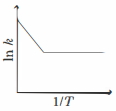
B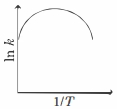
C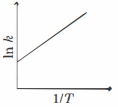
D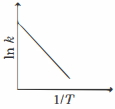
Solution
(D) According to the Arrhenius equation,$\ln k = \ln A - \frac{E_a}{RT}$.
Comparing this equation with the equation of a straight line,$y = mx + c$,where $y = \ln k$,$x = \frac{1}{T}$,$m = -\frac{E_a}{R}$ (slope),and $c = \ln A$ (intercept).
This indicates that a plot of $\ln k$ versus $\frac{1}{T}$ should be a straight line with a negative slope equal to $-\frac{E_a}{R}$.
Therefore,the graph that exhibits Arrhenius behaviour over the entire temperature range is the one showing a straight line with a negative slope,which corresponds to option $(d)$.
Comparing this equation with the equation of a straight line,$y = mx + c$,where $y = \ln k$,$x = \frac{1}{T}$,$m = -\frac{E_a}{R}$ (slope),and $c = \ln A$ (intercept).
This indicates that a plot of $\ln k$ versus $\frac{1}{T}$ should be a straight line with a negative slope equal to $-\frac{E_a}{R}$.
Therefore,the graph that exhibits Arrhenius behaviour over the entire temperature range is the one showing a straight line with a negative slope,which corresponds to option $(d)$.
0 likes
View Solution366
MediumMCQ
The rate of gas phase chemical reactions generally increases rapidly with a rise in temperature. This is mainly because
A
the collision frequency increases with temperature
B
the fraction of molecules having energy in excess of the activation energy increases with temperature
C
the activation energy decreases with temperature
D
the average kinetic energy of molecules increases with temperature
Solution
(B) .
According to the Arrhenius equation,$K = A e^{-E_a / RT}$,the rate constant $K$ depends on temperature.
As temperature increases,the fraction of molecules having kinetic energy greater than the activation energy $(E_a)$ increases significantly.
This factor,represented by $e^{-E_a / RT}$,is the primary reason for the rapid increase in the reaction rate.
According to the Arrhenius equation,$K = A e^{-E_a / RT}$,the rate constant $K$ depends on temperature.
As temperature increases,the fraction of molecules having kinetic energy greater than the activation energy $(E_a)$ increases significantly.
This factor,represented by $e^{-E_a / RT}$,is the primary reason for the rapid increase in the reaction rate.
0 likes
View Solution367
MediumMCQ
Increasing the temperature increases the rate of reaction,but does not increase the
A
number of collisions
B
activation energy
C
average energy of collisions
D
average velocity of the reactant molecules
Solution
(B)
Increasing the temperature increases the kinetic energy of the reactant molecules.
This leads to an increase in the number of collisions,the average energy of collisions,and the average velocity of the reactant molecules.
However,the activation energy $(E_a)$ is a characteristic property of the reaction pathway and is independent of temperature.
Therefore,increasing the temperature does not increase the activation energy.
Increasing the temperature increases the kinetic energy of the reactant molecules.
This leads to an increase in the number of collisions,the average energy of collisions,and the average velocity of the reactant molecules.
However,the activation energy $(E_a)$ is a characteristic property of the reaction pathway and is independent of temperature.
Therefore,increasing the temperature does not increase the activation energy.
0 likes
View Solution368
MediumMCQ
The rate constant for the reaction,$COCl_{2(g)} \longrightarrow CO_{(g)} + Cl_{2(g)}$ is given by $\ln[k / (min^{-1})] = -11067 / T(K) + 31.33$. The temperature at which the rate of this reaction will be doubled from that at $25^{\circ} C$ is $..... \, ^{\circ} C$.
A
$75$
B
$100$
C
$31$
D
$50$
Solution
(C) Given,$\ln k = -\frac{11067}{T} + 31.33$.
Comparing with the Arrhenius equation,$\ln k = \ln A - \frac{E_a}{RT}$,we get $\frac{E_a}{R} = 11067 \, K$.
For the rate constant to double,we use the relation $\log \left( \frac{k_2}{k_1} \right) = \frac{E_a}{2.303 R} \left[ \frac{1}{T_1} - \frac{1}{T_2} \right]$.
Here,$T_1 = 25^{\circ} C = 298 \, K$ and $\frac{k_2}{k_1} = 2$.
Substituting the values: $\log 2 = \frac{11067}{2.303} \left[ \frac{1}{298} - \frac{1}{T_2} \right]$.
$0.3010 = 4805.47 \left[ 0.0033557 - \frac{1}{T_2} \right]$.
$6.2637 \times 10^{-5} = 0.0033557 - \frac{1}{T_2}$.
$\frac{1}{T_2} = 0.003293$.
$T_2 \approx 303.66 \, K \approx 31^{\circ} C$.
Comparing with the Arrhenius equation,$\ln k = \ln A - \frac{E_a}{RT}$,we get $\frac{E_a}{R} = 11067 \, K$.
For the rate constant to double,we use the relation $\log \left( \frac{k_2}{k_1} \right) = \frac{E_a}{2.303 R} \left[ \frac{1}{T_1} - \frac{1}{T_2} \right]$.
Here,$T_1 = 25^{\circ} C = 298 \, K$ and $\frac{k_2}{k_1} = 2$.
Substituting the values: $\log 2 = \frac{11067}{2.303} \left[ \frac{1}{298} - \frac{1}{T_2} \right]$.
$0.3010 = 4805.47 \left[ 0.0033557 - \frac{1}{T_2} \right]$.
$6.2637 \times 10^{-5} = 0.0033557 - \frac{1}{T_2}$.
$\frac{1}{T_2} = 0.003293$.
$T_2 \approx 303.66 \, K \approx 31^{\circ} C$.
0 likes
View Solution369
MediumMCQ
Among the following,the $INCORRECT$ statement regarding the collision theory of chemical reaction is:
A
The reactant molecules are assumed to be hard spheres.
B
Collision frequency between reactants is one of the factors that determines the rate of the reaction.
C
The steric factor takes into account the relative orientation of the reactant molecules during collisions.
D
The theory takes into account the structural aspects of the molecules during collision.
Solution
(D)
Collision theory does not take into account the structural aspects of molecules during collision.
It assumes that reactant molecules are hard spheres and only considers their kinetic energy and orientation,not their internal structure.
Collision theory does not take into account the structural aspects of molecules during collision.
It assumes that reactant molecules are hard spheres and only considers their kinetic energy and orientation,not their internal structure.
0 likes
View Solution370
DifficultMCQ
The number of correct statement/s from the following is:
$A.$ Larger the activation energy,smaller is the value of the rate constant.
$B.$ The higher is the activation energy,higher is the value of the temperature coefficient.
$C.$ At lower temperatures,the increase in temperature causes a larger change in the value of $k$ than at higher temperatures.
$D.$ $A$ plot of $\ln k$ vs $\frac{1}{T}$ is a straight line with a slope equal to $-\frac{E_a}{R}$.
$A.$ Larger the activation energy,smaller is the value of the rate constant.
$B.$ The higher is the activation energy,higher is the value of the temperature coefficient.
$C.$ At lower temperatures,the increase in temperature causes a larger change in the value of $k$ than at higher temperatures.
$D.$ $A$ plot of $\ln k$ vs $\frac{1}{T}$ is a straight line with a slope equal to $-\frac{E_a}{R}$.
A
$2$
B
$1$
C
$3$
D
$4$
Solution
(D) $A.$ Correct. According to the Arrhenius equation,$k = Ae^{-\frac{E_a}{RT}}$. As $E_a$ increases,the exponential term $e^{-\frac{E_a}{RT}}$ decreases,so $k$ decreases.
$B.$ Correct. The temperature coefficient is defined as $\frac{k_{T+10}}{k_T} = e^{\frac{10E_a}{RT(T+10)}}$. As $E_a$ increases,the value of the temperature coefficient increases.
$C.$ Correct. The rate constant $k$ increases exponentially with temperature. The derivative $\frac{dk}{dT} = k \cdot \frac{E_a}{RT^2}$ shows that the rate of change of $k$ with respect to $T$ is higher at lower temperatures for a given $E_a$.
$D.$ Correct. From $\ln k = \ln A - \frac{E_a}{R} \cdot \frac{1}{T}$,the plot of $\ln k$ vs $\frac{1}{T}$ is a straight line with slope $-\frac{E_a}{R}$.
All four statements are correct. Therefore,the number of correct statements is $4$.
$B.$ Correct. The temperature coefficient is defined as $\frac{k_{T+10}}{k_T} = e^{\frac{10E_a}{RT(T+10)}}$. As $E_a$ increases,the value of the temperature coefficient increases.
$C.$ Correct. The rate constant $k$ increases exponentially with temperature. The derivative $\frac{dk}{dT} = k \cdot \frac{E_a}{RT^2}$ shows that the rate of change of $k$ with respect to $T$ is higher at lower temperatures for a given $E_a$.
$D.$ Correct. From $\ln k = \ln A - \frac{E_a}{R} \cdot \frac{1}{T}$,the plot of $\ln k$ vs $\frac{1}{T}$ is a straight line with slope $-\frac{E_a}{R}$.
All four statements are correct. Therefore,the number of correct statements is $4$.
0 likes
View Solution371
MediumMCQ
$A \rightarrow B$
The rate constants of the above reaction at $200 \, K$ and $300 \, K$ are $0.03 \, min^{-1}$ and $0.05 \, min^{-1}$ respectively. The activation energy for the reaction is $.... \, J$ (Nearest integer).
(Given: $\ln 10 = 2.3$,$R = 8.3 \, J \, K^{-1} \, mol^{-1}$,$\log 5 = 0.70$,$\log 3 = 0.48$,$\log 2 = 0.30$)
The rate constants of the above reaction at $200 \, K$ and $300 \, K$ are $0.03 \, min^{-1}$ and $0.05 \, min^{-1}$ respectively. The activation energy for the reaction is $.... \, J$ (Nearest integer).
(Given: $\ln 10 = 2.3$,$R = 8.3 \, J \, K^{-1} \, mol^{-1}$,$\log 5 = 0.70$,$\log 3 = 0.48$,$\log 2 = 0.30$)
A
$2510$
B
$2530$
C
$2540$
D
$2520$
Solution
(D) Using the Arrhenius equation: $\log \frac{K_2}{K_1} = \frac{E_a}{2.303 R} \left( \frac{T_2 - T_1}{T_1 T_2} \right)$
Given: $K_1 = 0.03 \, min^{-1}$ at $T_1 = 200 \, K$,$K_2 = 0.05 \, min^{-1}$ at $T_2 = 300 \, K$,$R = 8.3 \, J \, K^{-1} \, mol^{-1}$,$\ln 10 = 2.3$
$\log \frac{0.05}{0.03} = \frac{E_a}{2.3 \times 8.3} \left( \frac{300 - 200}{200 \times 300} \right)$
$\log \left( \frac{5}{3} \right) = \frac{E_a}{19.09} \times \frac{100}{60000}$
$\log 5 - \log 3 = \frac{E_a}{19.09} \times \frac{1}{600}$
$0.70 - 0.48 = \frac{E_a}{11454}$
$0.22 = \frac{E_a}{11454}$
$E_a = 0.22 \times 11454 = 2519.88 \, J \approx 2520 \, J$
Given: $K_1 = 0.03 \, min^{-1}$ at $T_1 = 200 \, K$,$K_2 = 0.05 \, min^{-1}$ at $T_2 = 300 \, K$,$R = 8.3 \, J \, K^{-1} \, mol^{-1}$,$\ln 10 = 2.3$
$\log \frac{0.05}{0.03} = \frac{E_a}{2.3 \times 8.3} \left( \frac{300 - 200}{200 \times 300} \right)$
$\log \left( \frac{5}{3} \right) = \frac{E_a}{19.09} \times \frac{100}{60000}$
$\log 5 - \log 3 = \frac{E_a}{19.09} \times \frac{1}{600}$
$0.70 - 0.48 = \frac{E_a}{11454}$
$0.22 = \frac{E_a}{11454}$
$E_a = 0.22 \times 11454 = 2519.88 \, J \approx 2520 \, J$
0 likes
View Solution372
DifficultMCQ
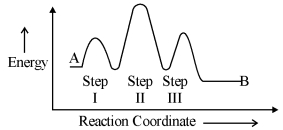
Consider the following reaction that proceeds from $A$ to $B$ in three steps as shown in the energy profile diagram. Choose the correct values for the following parameters:
$1$. Number of intermediates
$2$. Number of activated complexes
$3$. Rate determining step
$1$. Number of intermediates
$2$. Number of activated complexes
$3$. Rate determining step
A
$3, 2, II$
B
$2, 3, II$
C
$2, 3, I$
D
$2, 3, III$
Solution
(B) $1$. Intermediates are the local minima in the energy profile diagram between the reactant and product. Here,$P$ and $Q$ are the intermediates. So,the number of intermediates is $2$.
$2$. Activated complexes correspond to the peaks (maxima) in the energy profile diagram. There are $3$ peaks,so the number of activated complexes is $3$.
$3$. The rate-determining step $(RDS)$ is the step with the highest activation energy $(E_a)$. Comparing the peaks,step $II$ has the highest activation energy. Therefore,step $II$ is the $RDS$.
Thus,the correct values are: Number of intermediates $= 2$,Number of activated complexes $= 3$,$RDS = II$.
$2$. Activated complexes correspond to the peaks (maxima) in the energy profile diagram. There are $3$ peaks,so the number of activated complexes is $3$.
$3$. The rate-determining step $(RDS)$ is the step with the highest activation energy $(E_a)$. Comparing the peaks,step $II$ has the highest activation energy. Therefore,step $II$ is the $RDS$.
Thus,the correct values are: Number of intermediates $= 2$,Number of activated complexes $= 3$,$RDS = II$.
0 likes
View Solution373
DifficultMCQ
The number of given statement/s which is/are correct is $.....$.
$(A)$ The stronger the temperature dependence of the rate constant,the higher is the activation energy.
$(B)$ If a reaction has zero activation energy,its rate is independent of temperature.
$(C)$ The stronger the temperature dependence of the rate constant,the smaller is the activation energy.
$(D)$ If there is no correlation between the temperature and the rate constant then it means that the reaction has negative activation energy.
$(A)$ The stronger the temperature dependence of the rate constant,the higher is the activation energy.
$(B)$ If a reaction has zero activation energy,its rate is independent of temperature.
$(C)$ The stronger the temperature dependence of the rate constant,the smaller is the activation energy.
$(D)$ If there is no correlation between the temperature and the rate constant then it means that the reaction has negative activation energy.
A
$1$
B
$2$
C
$3$
D
$4$
Solution
(B) According to the Arrhenius equation,$k = A \cdot e^{-E_a / RT}$.
Taking the natural logarithm on both sides: $\ln k = \ln A - \frac{E_a}{RT}$.
Taking the base-$10$ logarithm: $\log k = \log A - \frac{E_a}{2.303 R} \cdot \frac{1}{T}$.
Evaluating the statements:
$(A)$ Correct: $A$ higher $E_a$ leads to a steeper slope $(-\frac{E_a}{2.303 R})$ in the $\log k$ vs $\frac{1}{T}$ plot,meaning the rate constant $k$ changes more rapidly with temperature.
$(B)$ Correct: If $E_a = 0$,then $k = A \cdot e^0 = A$,which is constant and independent of temperature.
$(C)$ Incorrect: This is the opposite of statement $(A)$.
$(D)$ Incorrect: If there is no correlation between temperature and rate constant,it implies $E_a = 0$,not a negative activation energy.
Thus,there are $2$ correct statements ($A$ and $B$).
Taking the natural logarithm on both sides: $\ln k = \ln A - \frac{E_a}{RT}$.
Taking the base-$10$ logarithm: $\log k = \log A - \frac{E_a}{2.303 R} \cdot \frac{1}{T}$.
Evaluating the statements:
$(A)$ Correct: $A$ higher $E_a$ leads to a steeper slope $(-\frac{E_a}{2.303 R})$ in the $\log k$ vs $\frac{1}{T}$ plot,meaning the rate constant $k$ changes more rapidly with temperature.
$(B)$ Correct: If $E_a = 0$,then $k = A \cdot e^0 = A$,which is constant and independent of temperature.
$(C)$ Incorrect: This is the opposite of statement $(A)$.
$(D)$ Incorrect: If there is no correlation between temperature and rate constant,it implies $E_a = 0$,not a negative activation energy.
Thus,there are $2$ correct statements ($A$ and $B$).
0 likes
View Solution374
MediumMCQ
The correct reaction profile diagram for a positive catalyst reaction.
A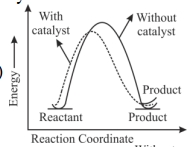
B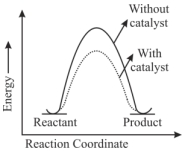
C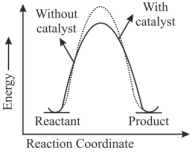
D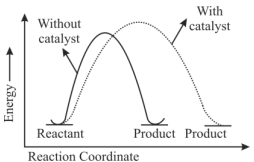
Solution
(B) positive catalyst increases the rate of reaction by providing an alternative pathway with lower activation energy $(E_a)$.
$(i)$ The energy of reactants and products remains the same,so $\Delta H$ does not change.
$(ii)$ The activation energy $(E_a)$ decreases,which is represented by a lower peak in the energy profile diagram.
Therefore,the diagram where the path with the catalyst has a lower peak than the path without the catalyst is the correct one,which corresponds to option $B$.
$(i)$ The energy of reactants and products remains the same,so $\Delta H$ does not change.
$(ii)$ The activation energy $(E_a)$ decreases,which is represented by a lower peak in the energy profile diagram.
Therefore,the diagram where the path with the catalyst has a lower peak than the path without the catalyst is the correct one,which corresponds to option $B$.
0 likes
View Solution375
MediumMCQ
For a reversible reaction $A \rightleftharpoons B$,the $\Delta H_{\text{forward}} = 20 \ kJ \ mol^{-1}$. The activation energy of the uncatalysed forward reaction is $300 \ kJ \ mol^{-1}$. When the reaction is catalysed keeping the reactant concentration same,the rate of the catalysed forward reaction at $27^{\circ}C$ is found to be same as that of the uncatalysed reaction at $327^{\circ}C$. The activation energy of the catalysed backward reaction is $.... \ kJ \ mol^{-1}$.
A
$130$
B
$120$
C
$110$
D
$100$
Solution
(A) Given: $\Delta H = 20 \ kJ \ mol^{-1}$,$E_{a,f} = 300 \ kJ \ mol^{-1}$.
For the same rate,the activation energy $E_{a}$ is proportional to temperature $T$ (assuming the pre-exponential factor $A$ remains constant).
$\frac{E_{a,f}}{T_{uncat}} = \frac{E_{a,f}^{\prime}}{T_{cat}}$
$T_{uncat} = 327 + 273 = 600 \ K$
$T_{cat} = 27 + 273 = 300 \ K$
$\frac{300}{600} = \frac{E_{a,f}^{\prime}}{300} \implies E_{a,f}^{\prime} = 150 \ kJ \ mol^{-1}$.
We know $\Delta H = E_{a,f}^{\prime} - E_{a,b}^{\prime}$.
$20 = 150 - E_{a,b}^{\prime}$.
$E_{a,b}^{\prime} = 150 - 20 = 130 \ kJ \ mol^{-1}$.
For the same rate,the activation energy $E_{a}$ is proportional to temperature $T$ (assuming the pre-exponential factor $A$ remains constant).
$\frac{E_{a,f}}{T_{uncat}} = \frac{E_{a,f}^{\prime}}{T_{cat}}$
$T_{uncat} = 327 + 273 = 600 \ K$
$T_{cat} = 27 + 273 = 300 \ K$
$\frac{300}{600} = \frac{E_{a,f}^{\prime}}{300} \implies E_{a,f}^{\prime} = 150 \ kJ \ mol^{-1}$.
We know $\Delta H = E_{a,f}^{\prime} - E_{a,b}^{\prime}$.
$20 = 150 - E_{a,b}^{\prime}$.
$E_{a,b}^{\prime} = 150 - 20 = 130 \ kJ \ mol^{-1}$.
0 likes
View Solution376
DifficultMCQ
Given below are two statements: one is labelled as Assertion $A$ and the other is labelled as Reason $R$.
Assertion $A$: $A$ reaction can have zero activation energy.
Reason $R$: The minimum extra amount of energy absorbed by reactant molecules so that their energy becomes equal to threshold value,is called activation energy.
In the light of the above statements,choose the correct answer from the options given below:
Assertion $A$: $A$ reaction can have zero activation energy.
Reason $R$: The minimum extra amount of energy absorbed by reactant molecules so that their energy becomes equal to threshold value,is called activation energy.
In the light of the above statements,choose the correct answer from the options given below:
A
$A$ is false but $R$ is true
B
Both $A$ and $R$ are true and $R$ is the correct explanation of $A$.
C
Both $A$ and $R$ are true but $R$ is $NOT$ the correct explanation of $A$.
D
$A$ is true but $R$ is false
Solution
(A) Assertion $A$ is false because a chemical reaction cannot have zero activation energy $(E_{a} > 0)$.
Reason $R$ is true because it correctly defines activation energy as the minimum extra energy required by reactant molecules to reach the threshold energy level.
Reason $R$ is true because it correctly defines activation energy as the minimum extra energy required by reactant molecules to reach the threshold energy level.
0 likes
View Solution377
DifficultMCQ
For a reaction taking place in three steps at the same temperature,the overall rate constant is $K = \frac{K_1 K_2}{K_3}$. If $E_{a1}$,$E_{a2}$,and $E_{a3}$ are $40 \ kJ/mol$,$50 \ kJ/mol$,and $60 \ kJ/mol$ respectively,the overall activation energy $E_a$ is . . . . . . $kJ/mol$.
A
$20$
B
$10$
C
$30$
D
$45$
Solution
(C) The overall rate constant is given by $K = \frac{K_1 K_2}{K_3}$.
Substituting the Arrhenius equation $K = A \cdot e^{-E_a / RT}$ for each step:
$A \cdot e^{-E_a / RT} = \frac{(A_1 e^{-E_{a1} / RT}) \cdot (A_2 e^{-E_{a2} / RT})}{(A_3 e^{-E_{a3} / RT})}$
$A \cdot e^{-E_a / RT} = \frac{A_1 A_2}{A_3} \cdot e^{-(E_{a1} + E_{a2} - E_{a3}) / RT}$
Comparing the exponents,we get $E_a = E_{a1} + E_{a2} - E_{a3}$.
Substituting the given values: $E_a = 40 + 50 - 60 = 30 \ kJ/mol$.
Substituting the Arrhenius equation $K = A \cdot e^{-E_a / RT}$ for each step:
$A \cdot e^{-E_a / RT} = \frac{(A_1 e^{-E_{a1} / RT}) \cdot (A_2 e^{-E_{a2} / RT})}{(A_3 e^{-E_{a3} / RT})}$
$A \cdot e^{-E_a / RT} = \frac{A_1 A_2}{A_3} \cdot e^{-(E_{a1} + E_{a2} - E_{a3}) / RT}$
Comparing the exponents,we get $E_a = E_{a1} + E_{a2} - E_{a3}$.
Substituting the given values: $E_a = 40 + 50 - 60 = 30 \ kJ/mol$.
0 likes
View Solution378
MediumMCQ
Consider the following transformation involving first order elementary reactions in each step at constant temperature as shown below.
$A + B \underset{\text{Step } 3}{\overset{\text{Step } 1}{\rightleftharpoons}} C \xrightarrow{\text{Step } 2} P$
Some details of the above reaction are listed below.
If the overall rate constant of the above transformation $(k)$ is given as $k = \frac{k_1 k_2}{k_3}$ and the overall activation energy $(E_a)$ is $400 \ kJ \ mol^{-1}$,then the value of $Ea_3$ is $\qquad$ $kJ \ mol^{-1}$ (nearest integer).
$A + B \underset{\text{Step } 3}{\overset{\text{Step } 1}{\rightleftharpoons}} C \xrightarrow{\text{Step } 2} P$
Some details of the above reaction are listed below.
| Step | Rate constant $(s^{-1})$ | Activation energy $(kJ \ mol^{-1})$ |
|---|---|---|
| $1$ | $k_1$ | $300$ |
| $2$ | $k_2$ | $200$ |
| $3$ | $k_3$ | $Ea_3$ |
If the overall rate constant of the above transformation $(k)$ is given as $k = \frac{k_1 k_2}{k_3}$ and the overall activation energy $(E_a)$ is $400 \ kJ \ mol^{-1}$,then the value of $Ea_3$ is $\qquad$ $kJ \ mol^{-1}$ (nearest integer).
A
$70$
B
$98$
C
$100$
D
$90$
Solution
(C) The overall rate constant is given by $k = \frac{k_1 k_2}{k_3}$.
Using the Arrhenius equation $k = A e^{\frac{-E_a}{RT}}$,we can write:
$A e^{\frac{-E_a}{RT}} = \frac{A_1 e^{\frac{-E_{a_1}}{RT}} \cdot A_2 e^{\frac{-E_{a_2}}{RT}}}{A_3 e^{\frac{-E_{a_3}}{RT}}}$
$A e^{\frac{-E_a}{RT}} = \frac{A_1 A_2}{A_3} e^{\frac{-(E_{a_1} + E_{a_2} - E_{a_3})}{RT}}$
Comparing the exponents,we get the overall activation energy expression:
$E_a = E_{a_1} + E_{a_2} - E_{a_3}$
Given $E_a = 400 \ kJ \ mol^{-1}$,$E_{a_1} = 300 \ kJ \ mol^{-1}$,and $E_{a_2} = 200 \ kJ \ mol^{-1}$:
$400 = 300 + 200 - E_{a_3}$
$400 = 500 - E_{a_3}$
$E_{a_3} = 500 - 400 = 100 \ kJ \ mol^{-1}$.
Using the Arrhenius equation $k = A e^{\frac{-E_a}{RT}}$,we can write:
$A e^{\frac{-E_a}{RT}} = \frac{A_1 e^{\frac{-E_{a_1}}{RT}} \cdot A_2 e^{\frac{-E_{a_2}}{RT}}}{A_3 e^{\frac{-E_{a_3}}{RT}}}$
$A e^{\frac{-E_a}{RT}} = \frac{A_1 A_2}{A_3} e^{\frac{-(E_{a_1} + E_{a_2} - E_{a_3})}{RT}}$
Comparing the exponents,we get the overall activation energy expression:
$E_a = E_{a_1} + E_{a_2} - E_{a_3}$
Given $E_a = 400 \ kJ \ mol^{-1}$,$E_{a_1} = 300 \ kJ \ mol^{-1}$,and $E_{a_2} = 200 \ kJ \ mol^{-1}$:
$400 = 300 + 200 - E_{a_3}$
$400 = 500 - E_{a_3}$
$E_{a_3} = 500 - 400 = 100 \ kJ \ mol^{-1}$.
0 likes
View Solution379
MediumMCQ
Which plot of $\ln k$ vs $\frac{1}{T}$ is consistent with the Arrhenius equation?
A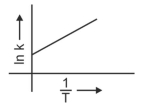
B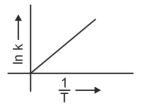
C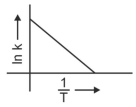
D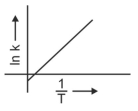
Solution
(C) The Arrhenius equation is given by:
$k = A e^{-\frac{E_a}{R T}}$
Taking the natural logarithm on both sides:
$\ln k = \ln A - \frac{E_a}{R T}$
This equation is in the form of a straight line $y = mx + c$,where:
$y = \ln k$
$x = \frac{1}{T}$
$m = -\frac{E_a}{R}$ (slope,which is negative)
$c = \ln A$ (y-intercept,which is positive)
Therefore,the plot of $\ln k$ vs $\frac{1}{T}$ is a straight line with a negative slope and a positive intercept,which corresponds to option $C$.
$k = A e^{-\frac{E_a}{R T}}$
Taking the natural logarithm on both sides:
$\ln k = \ln A - \frac{E_a}{R T}$
This equation is in the form of a straight line $y = mx + c$,where:
$y = \ln k$
$x = \frac{1}{T}$
$m = -\frac{E_a}{R}$ (slope,which is negative)
$c = \ln A$ (y-intercept,which is positive)
Therefore,the plot of $\ln k$ vs $\frac{1}{T}$ is a straight line with a negative slope and a positive intercept,which corresponds to option $C$.
0 likes
View Solution380
MediumMCQ
Activation energy of any chemical reaction can be calculated if one knows the value of
A
probability of collision
B
orientation of reactant molecules during collision
C
rate constant at two different temperatures
D
rate constant at standard temperature
Solution
(C) The activation energy $(E_a)$ can be calculated using the Arrhenius equation.
The equation is given by:
$\log \left( \frac{k_2}{k_1} \right) = \frac{E_a}{2.303 R} \left( \frac{1}{T_1} - \frac{1}{T_2} \right)$
From this equation,it is clear that $E_a$ can be determined if the rate constants ($k_1$ and $k_2$) are known at two different temperatures ($T_1$ and $T_2$).
The equation is given by:
$\log \left( \frac{k_2}{k_1} \right) = \frac{E_a}{2.303 R} \left( \frac{1}{T_1} - \frac{1}{T_2} \right)$
From this equation,it is clear that $E_a$ can be determined if the rate constants ($k_1$ and $k_2$) are known at two different temperatures ($T_1$ and $T_2$).
0 likes
View Solution381
MediumMCQ
The rate of a reaction quadruples when temperature changes from $27^{\circ} C$ to $57^{\circ} C$. Calculate the energy of activation.
Given $R=8.314 \ J \ K^{-1} \ mol^{-1}, \log 4=0.6021$
Given $R=8.314 \ J \ K^{-1} \ mol^{-1}, \log 4=0.6021$
A
$380.4 \ kJ \ mol^{-1}$
B
$3.80 \ kJ \ mol^{-1}$
C
$3804 \ kJ \ mol^{-1}$
D
$38.04 \ kJ \ mol^{-1}$
Solution
(D) The Arrhenius equation is given by: $\log \left(\frac{k_2}{k_1}\right) = \frac{E_a}{2.303 R} \left(\frac{1}{T_1} - \frac{1}{T_2}\right)$
Given: $k_2 = 4k_1$,$T_1 = 27 + 273 = 300 \ K$,$T_2 = 57 + 273 = 330 \ K$,$R = 8.314 \ J \ K^{-1} \ mol^{-1}$,$\log 4 = 0.6021$
Substituting the values:
$\log 4 = \frac{E_a}{2.303 \times 8.314} \left(\frac{1}{300} - \frac{1}{330}\right)$
$0.6021 = \frac{E_a}{19.147} \left(\frac{330 - 300}{300 \times 330}\right)$
$0.6021 = \frac{E_a}{19.147} \left(\frac{30}{99000}\right)$
$E_a = \frac{0.6021 \times 19.147 \times 99000}{30} \approx 38040 \ J \ mol^{-1}$
$E_a = 38.04 \ kJ \ mol^{-1}$
Given: $k_2 = 4k_1$,$T_1 = 27 + 273 = 300 \ K$,$T_2 = 57 + 273 = 330 \ K$,$R = 8.314 \ J \ K^{-1} \ mol^{-1}$,$\log 4 = 0.6021$
Substituting the values:
$\log 4 = \frac{E_a}{2.303 \times 8.314} \left(\frac{1}{300} - \frac{1}{330}\right)$
$0.6021 = \frac{E_a}{19.147} \left(\frac{330 - 300}{300 \times 330}\right)$
$0.6021 = \frac{E_a}{19.147} \left(\frac{30}{99000}\right)$
$E_a = \frac{0.6021 \times 19.147 \times 99000}{30} \approx 38040 \ J \ mol^{-1}$
$E_a = 38.04 \ kJ \ mol^{-1}$
1 likes
View Solution382
DifficultMCQ
For a first order reaction $A \rightarrow P$,the temperature $(T)$ dependent rate constant $(k)$ was found to follow the equation $\log k = -(2000) \frac{1}{T} + 6.0$. The pre-exponential factor $A$ and the activation energy $E_{a}$,respectively,are
A
$1.0 \times 10^6 \ s^{-1}$ and $9.2 \ kJ \ mol^{-1}$
B
$6.0 \ s^{-1}$ and $16.6 \ kJ \ mol^{-1}$
C
$1.0 \times 10^6 \ s^{-1}$ and $16.6 \ kJ \ mol^{-1}$
D
$1.0 \times 10^6 \ s^{-1}$ and $38.3 \ kJ \ mol^{-1}$
Solution
(D) The Arrhenius equation is given by $k = Ae^{-E_a/RT}$.
Taking the logarithm on both sides,we get $\log k = \log A - \frac{E_a}{2.303RT}$.
Comparing this with the given equation $\log k = -(2000) \frac{1}{T} + 6.0$:
For the pre-exponential factor $A$,$\log A = 6.0$,which gives $A = 10^6 \ s^{-1}$.
For the activation energy $E_a$,$\frac{E_a}{2.303R} = 2000$.
$E_a = 2000 \times 2.303 \times 8.314 \ J \ mol^{-1} \approx 38314 \ J \ mol^{-1} = 38.3 \ kJ \ mol^{-1}$.
Thus,the correct option is $D$.
Taking the logarithm on both sides,we get $\log k = \log A - \frac{E_a}{2.303RT}$.
Comparing this with the given equation $\log k = -(2000) \frac{1}{T} + 6.0$:
For the pre-exponential factor $A$,$\log A = 6.0$,which gives $A = 10^6 \ s^{-1}$.
For the activation energy $E_a$,$\frac{E_a}{2.303R} = 2000$.
$E_a = 2000 \times 2.303 \times 8.314 \ J \ mol^{-1} \approx 38314 \ J \ mol^{-1} = 38.3 \ kJ \ mol^{-1}$.
Thus,the correct option is $D$.
0 likes
View Solution383
AdvancedMCQ
According to the Arrhenius equation,which of the following statements are correct?
$(A)$ $A$ high activation energy usually implies a fast reaction.
$(B)$ Rate constant increases with increase in temperature. This is due to a greater number of collisions whose energy exceeds the activation energy.
$(C)$ Higher the magnitude of activation energy,stronger is the temperature dependence of the rate constant.
$(D)$ The pre-exponential factor is a measure of the rate at which collisions occur,irrespective of their energy.
$(A)$ $A$ high activation energy usually implies a fast reaction.
$(B)$ Rate constant increases with increase in temperature. This is due to a greater number of collisions whose energy exceeds the activation energy.
$(C)$ Higher the magnitude of activation energy,stronger is the temperature dependence of the rate constant.
$(D)$ The pre-exponential factor is a measure of the rate at which collisions occur,irrespective of their energy.
A
$B, C, A$
B
$B, C, D$
C
$B, A, D$
D
$B, C$
Solution
(B) The Arrhenius equation is given by $K = Ae^{-\frac{E_a}{RT}}$.
Statement $(A)$ is incorrect because a high activation energy $(E_a)$ implies a slow reaction,not a fast one.
Statement $(B)$ is correct because as temperature $(T)$ increases,the fraction of molecules with energy greater than $E_a$ increases,leading to more effective collisions.
Statement $(C)$ is correct because the term $e^{-\frac{E_a}{RT}}$ shows that the sensitivity of $K$ to temperature changes increases as $E_a$ increases.
Statement $(D)$ is correct because the pre-exponential factor $(A)$ represents the frequency of collisions,which is independent of the energy threshold.
Therefore,the correct statements are $(B)$,$(C)$,and $(D)$.
Statement $(A)$ is incorrect because a high activation energy $(E_a)$ implies a slow reaction,not a fast one.
Statement $(B)$ is correct because as temperature $(T)$ increases,the fraction of molecules with energy greater than $E_a$ increases,leading to more effective collisions.
Statement $(C)$ is correct because the term $e^{-\frac{E_a}{RT}}$ shows that the sensitivity of $K$ to temperature changes increases as $E_a$ increases.
Statement $(D)$ is correct because the pre-exponential factor $(A)$ represents the frequency of collisions,which is independent of the energy threshold.
Therefore,the correct statements are $(B)$,$(C)$,and $(D)$.
0 likes
View Solution384
AdvancedMCQ
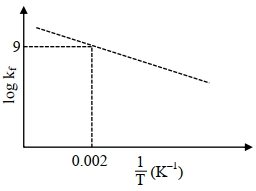
The plot of $\log k_f$ versus $1 / T$ for a reversible reaction $A_{(g)} \rightleftharpoons P_{(g)}$ is shown. Pre-exponential factors for the forward and backward reactions are $10^{15} \ s^{-1}$ and $10^{11} \ s^{-1}$,respectively. If the value of $\log K$ for the reaction at $500 \ K$ is $6$,the value of $|\log k_b|$ at $250 \ K$ is $\qquad$ $[K = \text{equilibrium constant of the reaction}, k_f = \text{rate constant of forward reaction}, k_b = \text{rate constant of backward reaction}]$
A
$4$
B
$5$
C
$2$
D
$3$
Solution
(B) For the reaction $A_{(g)} \rightleftharpoons P_{(g)}$,the Arrhenius equation for the forward reaction is $\log k_f = \frac{-E_f}{2.303 RT} + \log A_f$.
From the given plot,at $\frac{1}{T} = 0.002 \ K^{-1}$,$\log k_f = 9$.
Substituting the values: $9 = \frac{-E_f}{2.303 R}(0.002) + \log(10^{15}) \Rightarrow 9 = \frac{-E_f}{2.303 R}(0.002) + 15$.
$\frac{E_f}{2.303 R} = \frac{6}{0.002} = 3000$.
For the equilibrium constant $K = \frac{k_f}{k_b}$,we have $\log K = \log \left(\frac{A_f}{A_b}\right) - \frac{E_f - E_b}{2.303 RT}$.
At $500 \ K$,$\log K = 6$ and $\frac{A_f}{A_b} = \frac{10^{15}}{10^{11}} = 10^4$,so $\log(10^4) = 4$.
$6 = 4 - \frac{E_f - E_b}{2.303 R(500)}$ $\Rightarrow 2 = \frac{E_b - E_f}{2.303 R(500)}$ $\Rightarrow E_b - E_f = 1000(2.303 R)$.
Since $\frac{E_f}{2.303 R} = 3000$,$E_f = 3000(2.303 R)$.
Thus,$E_b = 1000(2.303 R) + 3000(2.303 R) = 4000(2.303 R)$.
For the backward reaction at $250 \ K$,$\log k_b = \log A_b - \frac{E_b}{2.303 RT} = \log(10^{11}) - \frac{4000(2.303 R)}{2.303 R(250)} = 11 - 16 = -5$.
Therefore,$|\log k_b| = |-5| = 5$.
From the given plot,at $\frac{1}{T} = 0.002 \ K^{-1}$,$\log k_f = 9$.
Substituting the values: $9 = \frac{-E_f}{2.303 R}(0.002) + \log(10^{15}) \Rightarrow 9 = \frac{-E_f}{2.303 R}(0.002) + 15$.
$\frac{E_f}{2.303 R} = \frac{6}{0.002} = 3000$.
For the equilibrium constant $K = \frac{k_f}{k_b}$,we have $\log K = \log \left(\frac{A_f}{A_b}\right) - \frac{E_f - E_b}{2.303 RT}$.
At $500 \ K$,$\log K = 6$ and $\frac{A_f}{A_b} = \frac{10^{15}}{10^{11}} = 10^4$,so $\log(10^4) = 4$.
$6 = 4 - \frac{E_f - E_b}{2.303 R(500)}$ $\Rightarrow 2 = \frac{E_b - E_f}{2.303 R(500)}$ $\Rightarrow E_b - E_f = 1000(2.303 R)$.
Since $\frac{E_f}{2.303 R} = 3000$,$E_f = 3000(2.303 R)$.
Thus,$E_b = 1000(2.303 R) + 3000(2.303 R) = 4000(2.303 R)$.
For the backward reaction at $250 \ K$,$\log k_b = \log A_b - \frac{E_b}{2.303 RT} = \log(10^{11}) - \frac{4000(2.303 R)}{2.303 R(250)} = 11 - 16 = -5$.
Therefore,$|\log k_b| = |-5| = 5$.
0 likes
View Solution385
AdvancedMCQ
In a bimolecular reaction,the steric factor $P$ was experimentally determined to be $4.5$. The correct option$(s)$ among the following is(are)
$[A]$ The activation energy of the reaction is unaffected by the value of the steric factor
$[B]$ Experimentally determined value of frequency factor is higher than that predicted by Arrhenius equation
$[C]$ Since $P=4.5$,the reaction will not proceed unless an effective catalyst is used
$[D]$ The value of frequency factor predicted by Arrhenius equation is higher than that determined experimentally
$[A]$ The activation energy of the reaction is unaffected by the value of the steric factor
$[B]$ Experimentally determined value of frequency factor is higher than that predicted by Arrhenius equation
$[C]$ Since $P=4.5$,the reaction will not proceed unless an effective catalyst is used
$[D]$ The value of frequency factor predicted by Arrhenius equation is higher than that determined experimentally
A
$A, B$
B
$A, C$
C
$A, D$
D
$A, B, C$
Solution
(A) According to the collision theory,the rate constant $k$ is given by $k = P \cdot Z \cdot e^{-E_a/RT}$,where $P$ is the steric factor and $Z$ is the collision frequency.
The experimental frequency factor $A_{exp}$ is equal to $P \cdot Z$.
The Arrhenius equation predicts the frequency factor as $A_{calc} = Z$.
Since $P = 4.5$ (which is $> 1$),we have $A_{exp} = 4.5 \cdot Z$,which means $A_{exp} > A_{calc}$. Thus,option $[B]$ is correct.
The activation energy $E_a$ is an energy barrier and is independent of the steric factor $P$,which accounts for the orientation of molecules. Thus,option $[A]$ is correct.
Option $[C]$ is incorrect because a reaction with $P > 1$ can proceed without a catalyst.
Option $[D]$ is incorrect because the experimental value is higher,not lower.
The experimental frequency factor $A_{exp}$ is equal to $P \cdot Z$.
The Arrhenius equation predicts the frequency factor as $A_{calc} = Z$.
Since $P = 4.5$ (which is $> 1$),we have $A_{exp} = 4.5 \cdot Z$,which means $A_{exp} > A_{calc}$. Thus,option $[B]$ is correct.
The activation energy $E_a$ is an energy barrier and is independent of the steric factor $P$,which accounts for the orientation of molecules. Thus,option $[A]$ is correct.
Option $[C]$ is incorrect because a reaction with $P > 1$ can proceed without a catalyst.
Option $[D]$ is incorrect because the experimental value is higher,not lower.
0 likes
View Solution386
AdvancedMCQ
Plots showing the variation of the rate constant $k$ with temperature $T$ are given below. The plot that follows Arrhenius equation is
A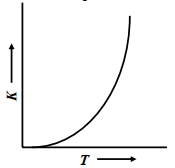
B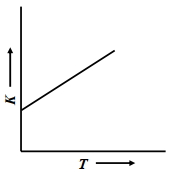
C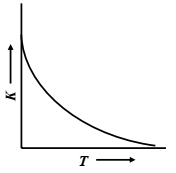
D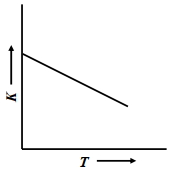
Solution
(A) The Arrhenius equation is given by $k = Ae^{-E_a / RT}$.
As the temperature $T$ increases,the term $e^{-E_a / RT}$ increases exponentially.
Therefore,the rate constant $k$ increases exponentially with an increase in temperature $T$.
This behavior is represented by the exponential curve shown in option $A$.
As the temperature $T$ increases,the term $e^{-E_a / RT}$ increases exponentially.
Therefore,the rate constant $k$ increases exponentially with an increase in temperature $T$.
This behavior is represented by the exponential curve shown in option $A$.
0 likes
View Solution387
AdvancedMCQ
Consider the following reversible reaction,
$A_{(g)} + B_{(g)} \rightleftharpoons AB_{(g)}.$
The activation energy of the backward reaction exceeds that of the forward reaction by $2RT$ (in $J \ mol^{-1}$). If the pre-exponential factor of the forward reaction is $4$ times that of the reverse reaction,the absolute value of $\Delta G^{\ominus}$ (in $J \ mol^{-1}$) for the reaction at $300 \ K$ is. . . . . (Given; $\ln(2)=0.7, RT=2500 \ J \ mol^{-1}$ at $300 \ K$ and $G$ is the Gibbs energy)
$A_{(g)} + B_{(g)} \rightleftharpoons AB_{(g)}.$
The activation energy of the backward reaction exceeds that of the forward reaction by $2RT$ (in $J \ mol^{-1}$). If the pre-exponential factor of the forward reaction is $4$ times that of the reverse reaction,the absolute value of $\Delta G^{\ominus}$ (in $J \ mol^{-1}$) for the reaction at $300 \ K$ is. . . . . (Given; $\ln(2)=0.7, RT=2500 \ J \ mol^{-1}$ at $300 \ K$ and $G$ is the Gibbs energy)
A
$8500$
B
$8800$
C
$900$
D
$1000$
Solution
(A) For the reaction $A_{(g)} + B_{(g)} \rightleftharpoons AB_{(g)}$,the equilibrium constant $K$ is given by $K = \frac{k_f}{k_b} = \frac{A_f e^{-E_a/RT}}{A_b e^{-E_b/RT}}$.
Given $E_b - E_a = 2RT$ and $A_f = 4A_b$,we substitute these into the expression for $K$:
$K = \frac{A_f}{A_b} e^{(E_b - E_a)/RT} = 4 e^{2RT/RT} = 4e^2$.
The standard Gibbs free energy change is $\Delta G^{\ominus} = -RT \ln K$.
Substituting the values: $\Delta G^{\ominus} = -RT \ln(4e^2) = -RT(\ln 4 + \ln e^2) = -RT(2 \ln 2 + 2)$.
Given $RT = 2500 \ J \ mol^{-1}$ and $\ln 2 = 0.7$:
$\Delta G^{\ominus} = -2500 \times (2 \times 0.7 + 2) = -2500 \times (1.4 + 2) = -2500 \times 3.4 = -8500 \ J \ mol^{-1}$.
The absolute value of $\Delta G^{\ominus}$ is $8500 \ J \ mol^{-1}$.
Given $E_b - E_a = 2RT$ and $A_f = 4A_b$,we substitute these into the expression for $K$:
$K = \frac{A_f}{A_b} e^{(E_b - E_a)/RT} = 4 e^{2RT/RT} = 4e^2$.
The standard Gibbs free energy change is $\Delta G^{\ominus} = -RT \ln K$.
Substituting the values: $\Delta G^{\ominus} = -RT \ln(4e^2) = -RT(\ln 4 + \ln e^2) = -RT(2 \ln 2 + 2)$.
Given $RT = 2500 \ J \ mol^{-1}$ and $\ln 2 = 0.7$:
$\Delta G^{\ominus} = -2500 \times (2 \times 0.7 + 2) = -2500 \times (1.4 + 2) = -2500 \times 3.4 = -8500 \ J \ mol^{-1}$.
The absolute value of $\Delta G^{\ominus}$ is $8500 \ J \ mol^{-1}$.
0 likes
View Solution388
DifficultMCQ
$A \rightarrow B$. The molecule $A$ changes into its isomeric form $B$ following first-order kinetics at a temperature of $1000 \ K$. If the energy barrier with respect to reactant energy for such isomeric transformation is $191.48 \ kJ \ mol^{-1}$ and the frequency factor is $10^{20} \ s^{-1}$,the time required for $50 \%$ of molecules of $A$ to become $B$ is $..............$ picoseconds (nearest integer). $[R = 8.314 \ J \ K^{-1} \ mol^{-1}]$
A
$23$
B
$65$
C
$70$
D
$69$
Solution
(D) For a first-order reaction,the rate constant $k$ is given by the Arrhenius equation: $k = A e^{-E_a/RT}$.
Substituting the given values: $k = 10^{20} \times e^{-\frac{191.48 \times 10^3}{8.314 \times 1000}}$.
$k = 10^{20} \times e^{-23.031} \approx 10^{20} \times e^{-\ln(10^{10})} = 10^{20} \times 10^{-10} = 10^{10} \ s^{-1}$.
The half-life $t_{1/2}$ is given by: $t_{1/2} = \frac{0.693}{k}$.
$t_{1/2} = \frac{0.693}{10^{10}} = 6.93 \times 10^{-11} \ s$.
Converting to picoseconds $(1 \ ps = 10^{-12} \ s)$: $t_{1/2} = 69.3 \ ps$.
The nearest integer is $69$.
Substituting the given values: $k = 10^{20} \times e^{-\frac{191.48 \times 10^3}{8.314 \times 1000}}$.
$k = 10^{20} \times e^{-23.031} \approx 10^{20} \times e^{-\ln(10^{10})} = 10^{20} \times 10^{-10} = 10^{10} \ s^{-1}$.
The half-life $t_{1/2}$ is given by: $t_{1/2} = \frac{0.693}{k}$.
$t_{1/2} = \frac{0.693}{10^{10}} = 6.93 \times 10^{-11} \ s$.
Converting to picoseconds $(1 \ ps = 10^{-12} \ s)$: $t_{1/2} = 69.3 \ ps$.
The nearest integer is $69$.
0 likes
View Solution389
DifficultMCQ
Consider the given energy profile diagram for a reaction and choose the correct option:
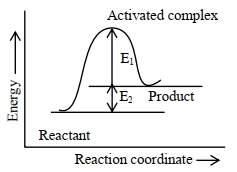
A
Activation energy of backward reaction is $E_1$ and product is more stable than reactant.
B
Activation energy of forward reaction is $E_1+E_2$ and product is more stable than reactant.
C
Activation energy of forward reaction is $E_1+E_2$ and product is less stable than reactant.
D
Activation energy of both forward and backward reaction is $E_1+E_2$ and reactant is more stable than product.
Solution
(C) From the given energy profile diagram:
$1$. The activation energy of the forward reaction $(E_{a,f})$ is the energy difference between the activated complex and the reactant,which is $E_1 + E_2$.
$2$. The energy of the product is higher than the energy of the reactant $(E_{product} > E_{reactant})$.
$3$. Since stability is inversely proportional to energy,the reactant is more stable than the product,or the product is less stable than the reactant.
$1$. The activation energy of the forward reaction $(E_{a,f})$ is the energy difference between the activated complex and the reactant,which is $E_1 + E_2$.
$2$. The energy of the product is higher than the energy of the reactant $(E_{product} > E_{reactant})$.
$3$. Since stability is inversely proportional to energy,the reactant is more stable than the product,or the product is less stable than the reactant.
0 likes
View Solution390
DifficultMCQ
Consider a complex reaction taking place in three steps with rate constants $k_1$,$k_2$,and $k_3$ respectively. The overall rate constant $k$ is given by the expression $k = \sqrt{\frac{k_1 k_3}{k_2}}$. If the activation energies of the three steps are $60$,$30$,and $10 \ kJ \ mol^{-1}$ respectively,then the overall energy of activation in $kJ \ mol^{-1}$ is $..........$ $(Nearest \ integer)$
A
$10$
B
$30$
C
$20$
D
$40$
Solution
(C) The overall rate constant is given by $k = (k_1 k_3 / k_2)^{1/2}$.
Using the Arrhenius equation $k = A \cdot e^{-E_a / RT}$,we substitute the expressions for each rate constant:
$A \cdot e^{-E_a / RT} = \left( \frac{A_1 e^{-E_{a_1} / RT} \cdot A_3 e^{-E_{a_3} / RT}}{A_2 e^{-E_{a_2} / RT}} \right)^{1/2}$.
Comparing the exponential terms:
$-E_a / RT = \frac{1}{2} (-E_{a_1} / RT - E_{a_3} / RT + E_{a_2} / RT)$.
Multiplying by $-RT$,we get $E_a = \frac{1}{2} (E_{a_1} + E_{a_3} - E_{a_2})$.
Substituting the given values $E_{a_1} = 60 \ kJ \ mol^{-1}$,$E_{a_2} = 30 \ kJ \ mol^{-1}$,and $E_{a_3} = 10 \ kJ \ mol^{-1}$:
$E_a = \frac{1}{2} (60 + 10 - 30) = \frac{40}{2} = 20 \ kJ \ mol^{-1}$.
Using the Arrhenius equation $k = A \cdot e^{-E_a / RT}$,we substitute the expressions for each rate constant:
$A \cdot e^{-E_a / RT} = \left( \frac{A_1 e^{-E_{a_1} / RT} \cdot A_3 e^{-E_{a_3} / RT}}{A_2 e^{-E_{a_2} / RT}} \right)^{1/2}$.
Comparing the exponential terms:
$-E_a / RT = \frac{1}{2} (-E_{a_1} / RT - E_{a_3} / RT + E_{a_2} / RT)$.
Multiplying by $-RT$,we get $E_a = \frac{1}{2} (E_{a_1} + E_{a_3} - E_{a_2})$.
Substituting the given values $E_{a_1} = 60 \ kJ \ mol^{-1}$,$E_{a_2} = 30 \ kJ \ mol^{-1}$,and $E_{a_3} = 10 \ kJ \ mol^{-1}$:
$E_a = \frac{1}{2} (60 + 10 - 30) = \frac{40}{2} = 20 \ kJ \ mol^{-1}$.
0 likes
View Solution391
DifficultMCQ
Reactant $A$ converts to product $D$ through the given mechanism (with the net evolution of heat) :
Which of the following represents the above reaction mechanism ?
| $A \rightarrow B$ | $slow ; \Delta H=+ve$ |
| $B \rightarrow C$ | $fast ; \Delta H=-ve$ |
| $C \rightarrow D$ | $fast ; \Delta H=-ve$ |
Which of the following represents the above reaction mechanism ?
A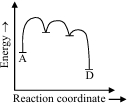
B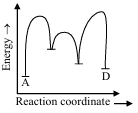
C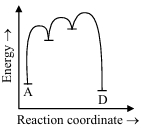
D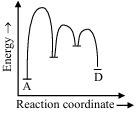
Solution
(A) The reaction mechanism involves three steps:
$1$. $A \rightarrow B$ is a slow step with $\Delta H = +ve$ (endothermic),meaning the energy of $B$ is higher than $A$,and it has a high activation energy $(E_{a_1})$.
$2$. $B \rightarrow C$ is a fast step with $\Delta H = -ve$ (exothermic),meaning the energy of $C$ is lower than $B$,and it has a low activation energy $(E_{a_2})$.
$3$. $C \rightarrow D$ is a fast step with $\Delta H = -ve$ (exothermic),meaning the energy of $D$ is lower than $C$,and it has a low activation energy $(E_{a_3})$.
The overall reaction is exothermic $(\Delta H_{net} = -ve)$,so the final product $D$ must be at a lower energy level than the reactant $A$.
The graph that correctly depicts these energy changes is shown in the solution image.
$1$. $A \rightarrow B$ is a slow step with $\Delta H = +ve$ (endothermic),meaning the energy of $B$ is higher than $A$,and it has a high activation energy $(E_{a_1})$.
$2$. $B \rightarrow C$ is a fast step with $\Delta H = -ve$ (exothermic),meaning the energy of $C$ is lower than $B$,and it has a low activation energy $(E_{a_2})$.
$3$. $C \rightarrow D$ is a fast step with $\Delta H = -ve$ (exothermic),meaning the energy of $D$ is lower than $C$,and it has a low activation energy $(E_{a_3})$.
The overall reaction is exothermic $(\Delta H_{net} = -ve)$,so the final product $D$ must be at a lower energy level than the reactant $A$.
The graph that correctly depicts these energy changes is shown in the solution image.
0 likes
View Solution392
DifficultMCQ
Consider the following statements related to the temperature dependence of rate constants. Identify the correct statements:
$A.$ The Arrhenius equation holds true only for an elementary homogeneous reaction.
$B.$ The unit of $A$ is the same as that of $k$ in the Arrhenius equation.
$C.$ At a given temperature,a low activation energy means a fast reaction.
$D.$ $A$ and $E_a$ as used in the Arrhenius equation depend on temperature.
$E.$ When $E_a > RT$,$A$ and $E_a$ become interdependent.
Choose the correct answer from the options given below:
$A.$ The Arrhenius equation holds true only for an elementary homogeneous reaction.
$B.$ The unit of $A$ is the same as that of $k$ in the Arrhenius equation.
$C.$ At a given temperature,a low activation energy means a fast reaction.
$D.$ $A$ and $E_a$ as used in the Arrhenius equation depend on temperature.
$E.$ When $E_a > RT$,$A$ and $E_a$ become interdependent.
Choose the correct answer from the options given below:
A
$A, C$ and $D$ Only
B
$B, D$ and $E$ Only
C
$B$ and $C$ Only
D
$A$ and $B$ Only
Solution
(C) The Arrhenius equation is $k = A e^{-E_a/RT}$.
Statement $A$ is incorrect because the Arrhenius equation is applicable to both elementary and complex reactions.
Statement $B$ is correct because $A$ (the frequency factor) has the same units as the rate constant $k$.
Statement $C$ is correct because a lower activation energy $(E_a)$ results in a larger value of $e^{-E_a/RT}$,leading to a faster reaction rate.
Statement $D$ is incorrect because $A$ and $E_a$ are generally considered temperature-independent constants for a given reaction.
Statement $E$ is incorrect as $A$ and $E_a$ are independent parameters.
Therefore,only statements $B$ and $C$ are correct.
Statement $A$ is incorrect because the Arrhenius equation is applicable to both elementary and complex reactions.
Statement $B$ is correct because $A$ (the frequency factor) has the same units as the rate constant $k$.
Statement $C$ is correct because a lower activation energy $(E_a)$ results in a larger value of $e^{-E_a/RT}$,leading to a faster reaction rate.
Statement $D$ is incorrect because $A$ and $E_a$ are generally considered temperature-independent constants for a given reaction.
Statement $E$ is incorrect as $A$ and $E_a$ are independent parameters.
Therefore,only statements $B$ and $C$ are correct.
0 likes
View Solution393
MediumMCQ
For the reaction $A_2 + B_2 \rightleftharpoons 2 AB$,the activation energies $(E_a)$ for the forward and backward reactions are $180 \ kJ \ mol^{-1}$ and $200 \ kJ \ mol^{-1}$ respectively. If a catalyst lowers the $E_a$ for both reactions by $100 \ kJ \ mol^{-1}$,which of the following statements is correct?
A
The catalyst does not alter the Gibbs energy change of the reaction.
B
The catalyst can cause non-spontaneous reactions to occur.
C
The enthalpy change for the reaction is $+20 \ kJ \ mol^{-1}$.
D
The enthalpy change for the catalysed reaction is different from that of the uncatalysed reaction.
Solution
(A) For the reaction $A_2 + B_2 \rightleftharpoons 2 AB$,the enthalpy change $\Delta H$ is given by the difference between the activation energy of the forward reaction $(E_f)$ and the backward reaction $(E_b)$:
$\Delta H = E_f - E_b = 180 \ kJ \ mol^{-1} - 200 \ kJ \ mol^{-1} = -20 \ kJ \ mol^{-1}$.
When a catalyst is added,it lowers the activation energy for both the forward and backward reactions by the same amount $(100 \ kJ \ mol^{-1})$:
$E_{f(cat)} = 180 - 100 = 80 \ kJ \ mol^{-1}$
$E_{b(cat)} = 200 - 100 = 100 \ kJ \ mol^{-1}$
The new enthalpy change is $\Delta H_{cat} = 80 - 100 = -20 \ kJ \ mol^{-1}$.
Since $\Delta H$ and $\Delta G$ are state functions,they depend only on the initial and final states of the reactants and products,not on the path taken. Therefore,a catalyst does not change the $\Delta H$ or $\Delta G$ of a reaction.
$\Delta H = E_f - E_b = 180 \ kJ \ mol^{-1} - 200 \ kJ \ mol^{-1} = -20 \ kJ \ mol^{-1}$.
When a catalyst is added,it lowers the activation energy for both the forward and backward reactions by the same amount $(100 \ kJ \ mol^{-1})$:
$E_{f(cat)} = 180 - 100 = 80 \ kJ \ mol^{-1}$
$E_{b(cat)} = 200 - 100 = 100 \ kJ \ mol^{-1}$
The new enthalpy change is $\Delta H_{cat} = 80 - 100 = -20 \ kJ \ mol^{-1}$.
Since $\Delta H$ and $\Delta G$ are state functions,they depend only on the initial and final states of the reactants and products,not on the path taken. Therefore,a catalyst does not change the $\Delta H$ or $\Delta G$ of a reaction.
0 likes
View Solution394
DifficultMCQ
Consider the following plots of log of rate constant $k$ $(\log k)$ vs $\frac{1}{T}$ for three different reactions. The correct order of activation energies of these reactions is
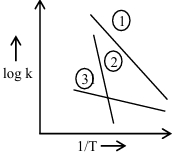
A
$Ea_2 > Ea_1 > Ea_3$
B
$Ea_1 > Ea_3 > Ea_2$
C
$Ea_1 > Ea_2 > Ea_3$
D
$Ea_3 > Ea_2 > Ea_1$
Solution
(A) According to the Arrhenius equation: $k = A e^{-Ea / RT}$
Taking log on both sides: $\log k = \log A - \frac{Ea}{2.303 RT}$
For a plot of $\log k$ versus $\frac{1}{T}$,the slope of the line is given by: $\text{Slope} = -\frac{Ea}{2.303 R}$
Since the slope is negative,the magnitude of the slope is directly proportional to the activation energy $(Ea)$: $|\text{Slope}| = \frac{Ea}{2.303 R}$
From the given graph,the steepness (magnitude of slope) of the lines follows the order: $(2) > (1) > (3)$
Therefore,the correct order of activation energies is: $Ea_2 > Ea_1 > Ea_3$
Taking log on both sides: $\log k = \log A - \frac{Ea}{2.303 RT}$
For a plot of $\log k$ versus $\frac{1}{T}$,the slope of the line is given by: $\text{Slope} = -\frac{Ea}{2.303 R}$
Since the slope is negative,the magnitude of the slope is directly proportional to the activation energy $(Ea)$: $|\text{Slope}| = \frac{Ea}{2.303 R}$
From the given graph,the steepness (magnitude of slope) of the lines follows the order: $(2) > (1) > (3)$
Therefore,the correct order of activation energies is: $Ea_2 > Ea_1 > Ea_3$
0 likes
View Solution395
MediumMCQ
With an increase in temperature,the rate constant $k$:
A
Increases
B
Decreases
C
Remains unchanged
D
None of these
Solution
(A) According to the Arrhenius equation,$k = A \cdot e^{-E_a / RT}$.
As the temperature $T$ increases,the term $e^{-E_a / RT}$ increases because the exponent becomes less negative.
Therefore,the rate constant $k$ increases exponentially with an increase in temperature.
As the temperature $T$ increases,the term $e^{-E_a / RT}$ increases because the exponent becomes less negative.
Therefore,the rate constant $k$ increases exponentially with an increase in temperature.
0 likes
View Solution396
MediumMCQ
In a multistep reaction such as $A + B$ $\longrightarrow Q$ $\longrightarrow C$,the potential energy diagram is shown below. What is $E_{a}$ for the reaction $Q \longrightarrow C$?
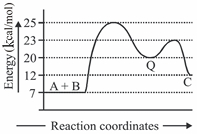
A
$3 \ kcal \ mol^{-1}$
B
$5 \ kcal \ mol^{-1}$
C
$8 \ kcal \ mol^{-1}$
D
$11 \ kcal \ mol^{-1}$
Solution
(A) The activation energy $(E_{a})$ for a reaction step is defined as the difference between the energy of the transition state (peak) and the energy of the reactants for that specific step.
For the reaction step $Q \longrightarrow C$,the reactant is $Q$ and the transition state is the peak immediately following $Q$.
From the given potential energy diagram:
Energy of $Q = 20 \ kcal \ mol^{-1}$.
Energy of the transition state for $Q \longrightarrow C = 23 \ kcal \ mol^{-1}$.
Therefore,$E_{a} = E_{\text{transition state}} - E_{Q} = 23 \ kcal \ mol^{-1} - 20 \ kcal \ mol^{-1} = 3 \ kcal \ mol^{-1}$.
For the reaction step $Q \longrightarrow C$,the reactant is $Q$ and the transition state is the peak immediately following $Q$.
From the given potential energy diagram:
Energy of $Q = 20 \ kcal \ mol^{-1}$.
Energy of the transition state for $Q \longrightarrow C = 23 \ kcal \ mol^{-1}$.
Therefore,$E_{a} = E_{\text{transition state}} - E_{Q} = 23 \ kcal \ mol^{-1} - 20 \ kcal \ mol^{-1} = 3 \ kcal \ mol^{-1}$.
0 likes
View Solution397
MediumMCQ
The activation energy of a certain reaction is $87 \ kJ \ mol^{-1}$. When the temperature is decreased from $37^{\circ} C$ to $15^{\circ} C$,what is the ratio of the rate constant at $37^{\circ} C$ to that at $15^{\circ} C$ for this reaction (in $/ 1$)?
A
$5$
B
$8.3$
C
$13$
D
$24$
Solution
(C) Given: $E_{a} = 87 \ kJ \ mol^{-1} = 87000 \ J \ mol^{-1}$,$T_{1} = 37 + 273 = 310 \ K$,$T_{2} = 15 + 273 = 288 \ K$.
Using the Arrhenius equation: $\log \left( \frac{k_{1}}{k_{2}} \right) = \frac{E_{a}}{2.303 \ R} \left[ \frac{T_{1} - T_{2}}{T_{1} T_{2}} \right]$.
Substituting the values: $\log \left( \frac{k_{1}}{k_{2}} \right) = \frac{87000}{2.303 \times 8.314} \left[ \frac{310 - 288}{310 \times 288} \right]$.
$\log \left( \frac{k_{1}}{k_{2}} \right) = \frac{87000}{19.147} \times \left[ \frac{22}{89280} \right] \approx 4543.8 \times 0.002464 \approx 1.119$.
$\frac{k_{1}}{k_{2}} = 10^{1.119} \approx 13.15$.
Thus,the ratio is approximately $13 / 1$.
Using the Arrhenius equation: $\log \left( \frac{k_{1}}{k_{2}} \right) = \frac{E_{a}}{2.303 \ R} \left[ \frac{T_{1} - T_{2}}{T_{1} T_{2}} \right]$.
Substituting the values: $\log \left( \frac{k_{1}}{k_{2}} \right) = \frac{87000}{2.303 \times 8.314} \left[ \frac{310 - 288}{310 \times 288} \right]$.
$\log \left( \frac{k_{1}}{k_{2}} \right) = \frac{87000}{19.147} \times \left[ \frac{22}{89280} \right] \approx 4543.8 \times 0.002464 \approx 1.119$.
$\frac{k_{1}}{k_{2}} = 10^{1.119} \approx 13.15$.
Thus,the ratio is approximately $13 / 1$.
0 likes
View Solution398
MediumMCQ
Consider the following graph of the kinetic energy distribution among molecules at temperature $T.$ If the temperature is increased,how would the resulting graph differ from the one above $:-$
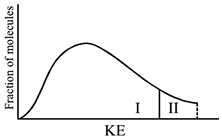
A
Both area $I$ and $II$ would increase
B
Both area $I$ and $II$ would decrease
C
Area $I$ would increase and area $II$ would decrease
D
Area $I$ would decrease and area $II$ would increase
Solution
(D) The Maxwell-Boltzmann distribution curve shows the fraction of molecules versus kinetic energy.
When the temperature is increased,the peak of the curve shifts to the right and the height of the peak decreases,while the curve flattens out.
Area $II$ represents the fraction of molecules with kinetic energy greater than the activation energy $(E_a)$.
As the temperature increases,a larger fraction of molecules possess kinetic energy equal to or greater than $E_a$,so area $II$ increases.
Since the total area under the curve must remain constant (equal to $1$),and area $II$ increases,the remaining area (area $I$) must decrease to compensate for the increase in area $II$.
When the temperature is increased,the peak of the curve shifts to the right and the height of the peak decreases,while the curve flattens out.
Area $II$ represents the fraction of molecules with kinetic energy greater than the activation energy $(E_a)$.
As the temperature increases,a larger fraction of molecules possess kinetic energy equal to or greater than $E_a$,so area $II$ increases.
Since the total area under the curve must remain constant (equal to $1$),and area $II$ increases,the remaining area (area $I$) must decrease to compensate for the increase in area $II$.
0 likes
View Solution399
MediumMCQ
The activation energy for the forward reaction is $150 \ kJ \ mol^{-1}$ and that of the reverse reaction is $260 \ kJ \ mol^{-1}$. The enthalpy change for the reaction is:
A
$410 \ kJ \ mol^{-1}$
B
$-110 \ kJ \ mol^{-1}$
C
$110 \ kJ \ mol^{-1}$
D
$-410 \ kJ \ mol^{-1}$
Solution
(B) The enthalpy change of a reaction $(\Delta H)$ is defined as the difference between the activation energy of the forward reaction $(Ea_{(f)})$ and the activation energy of the reverse reaction $(Ea_{(b)})$.
$\Delta H = Ea_{(f)} - Ea_{(b)}$
Given:
$Ea_{(f)} = 150 \ kJ \ mol^{-1}$
$Ea_{(b)} = 260 \ kJ \ mol^{-1}$
Substituting the values:
$\Delta H = 150 \ kJ \ mol^{-1} - 260 \ kJ \ mol^{-1}$
$\Delta H = -110 \ kJ \ mol^{-1}$
$\Delta H = Ea_{(f)} - Ea_{(b)}$
Given:
$Ea_{(f)} = 150 \ kJ \ mol^{-1}$
$Ea_{(b)} = 260 \ kJ \ mol^{-1}$
Substituting the values:
$\Delta H = 150 \ kJ \ mol^{-1} - 260 \ kJ \ mol^{-1}$
$\Delta H = -110 \ kJ \ mol^{-1}$
0 likes
View Solution400
MediumMCQ
In a reaction, for every $10^{\circ} C$ rise of temperature, the rate is doubled. If the temperature is increased from $10^{\circ} C$ to $100^{\circ} C$, the rate of the reaction will become $:-$ (in $times$)
A
$256$
B
$512$
C
$64$
D
$128$
Solution
(B) The temperature coefficient is $2$ for a $10^{\circ} C$ rise in temperature.
The number of $10^{\circ} C$ intervals is calculated as $n = \frac{100 - 10}{10} = \frac{90}{10} = 9$.
The rate of reaction increases by a factor of $2^n$.
Therefore, the rate becomes $2^9 = 512$ times the initial rate.
The number of $10^{\circ} C$ intervals is calculated as $n = \frac{100 - 10}{10} = \frac{90}{10} = 9$.
The rate of reaction increases by a factor of $2^n$.
Therefore, the rate becomes $2^9 = 512$ times the initial rate.
0 likes
View SolutionChemical Kinetics — Collision theory, Energy of activation and Arrhenius equation · Frequently Asked Questions
1Are these Chemical Kinetics questions useful for JEE and NEET?
Yes. All questions in this section are mapped to JEE Main and NEET exam patterns. Previous year questions from JEE Main, NEET, GUJCET and state-level exams are included with full solutions.
2Can I switch to Hindi or Gujarati for these questions?
Yes. Use the language tabs in the hero section or the sidebar to view the same questions and solutions in English, Hindi or Gujarati.
3How do I generate a question paper from this subtopic?
Use the Vedclass Exam Paper Generator — select the chapter and subtopic, set difficulty, and generate Sets A, B, C, D automatically. First 3 chapters of every subject are free.
Vedclass Products
For Students
Vedclass Test Series
Mock tests in real JEE/NEET style with performance analysis. 5-day free trial.
Start Free TrialFor Teachers
Exam Paper Generator
Generate Set A/B/C/D papers from this chapter in 2 minutes. 3 chapters free.
Try FreeFor Institutes
Online Exam Module
Live online exams with unlimited students, 360° analytics & white-label branding.
See DemoFor Teachers & Institutes
Generate a Chemical Kinetics Exam Paper in 2 Minutes
Select subtopic & difficulty — Sets A, B, C, D auto-generated with No Repeat logic.
First 3 chapters of every subject are free — no payment required.