
A English
Collision theory, Energy of activation and Arrhenius equation Questions in English
Class 12 Chemistry · Chemical Kinetics · Collision theory, Energy of activation and Arrhenius equation
499+
Questions
English
Language
100%
With Solutions
Showing 49 of 499 questions in English
101
EasyMCQ
The activation energy of a forward reaction is $50 \, kcal$. What will be the activation energy of its reverse reaction?
A
Equal to $50 \, kcal$.
B
Greater than $50 \, kcal$.
C
Less than $50 \, kcal$.
D
Can be greater or less than $50 \, kcal$.
Solution
(D) The relationship between the activation energy of the forward reaction $(E_{a,f})$,the activation energy of the reverse reaction $(E_{a,r})$,and the enthalpy change of the reaction $(\Delta H)$ is given by:
$E_{a,f} - E_{a,r} = \Delta H$.
If the reaction is exothermic $(\Delta H < 0)$,then $E_{a,f} < E_{a,r}$,meaning $E_{a,r} > 50 \, kcal$.
If the reaction is endothermic $(\Delta H > 0)$,then $E_{a,f} > E_{a,r}$,meaning $E_{a,r} < 50 \, kcal$.
Since the nature of the reaction (exothermic or endothermic) is not specified,the activation energy of the reverse reaction can be either greater or less than $50 \, kcal$.
$E_{a,f} - E_{a,r} = \Delta H$.
If the reaction is exothermic $(\Delta H < 0)$,then $E_{a,f} < E_{a,r}$,meaning $E_{a,r} > 50 \, kcal$.
If the reaction is endothermic $(\Delta H > 0)$,then $E_{a,f} > E_{a,r}$,meaning $E_{a,r} < 50 \, kcal$.
Since the nature of the reaction (exothermic or endothermic) is not specified,the activation energy of the reverse reaction can be either greater or less than $50 \, kcal$.
0 likes
View Solution102
MediumMCQ
When the temperature changes from $293 \ K$ to $313 \ K$,the rate of a certain reaction becomes four times. Find the activation energy of the reaction in $kJ \ mol^{-1}$. $(R = 8.314 \ J \ K^{-1} \ mol^{-1})$
A
$45.68$
B
$52.86$
C
$53.69$
D
$58.93$
Solution
(B) Using the Arrhenius equation: $\log \frac{k_2}{k_1} = \frac{E_a}{2.303R} \left[ \frac{T_2 - T_1}{T_1 T_2} \right]$
Given: $T_1 = 293 \ K$,$T_2 = 313 \ K$,$k_2 = 4k_1$,$R = 8.314 \ J \ K^{-1} \ mol^{-1}$.
Substituting the values: $\log(4) = \frac{E_a}{2.303 \times 8.314} \left[ \frac{313 - 293}{293 \times 313} \right]$
$0.6021 = \frac{E_a}{19.147} \times \frac{20}{91709}$
$E_a = \frac{0.6021 \times 19.147 \times 91709}{20} \approx 52863 \ J \ mol^{-1}$
$E_a = 52.86 \ kJ \ mol^{-1}$.
Given: $T_1 = 293 \ K$,$T_2 = 313 \ K$,$k_2 = 4k_1$,$R = 8.314 \ J \ K^{-1} \ mol^{-1}$.
Substituting the values: $\log(4) = \frac{E_a}{2.303 \times 8.314} \left[ \frac{313 - 293}{293 \times 313} \right]$
$0.6021 = \frac{E_a}{19.147} \times \frac{20}{91709}$
$E_a = \frac{0.6021 \times 19.147 \times 91709}{20} \approx 52863 \ J \ mol^{-1}$
$E_a = 52.86 \ kJ \ mol^{-1}$.
0 likes
View Solution103
MediumMCQ
Which of the following plots gives the value of activation energy?
A
$K$ versus $T$
B
$1/K$ versus $T$
C
$\log K$ versus $1/T$
D
$C$ versus $T$
Solution
(C) The Arrhenius equation is given by $K = A e^{-E_a / RT}$.
Taking the natural logarithm on both sides,we get $\ln K = \ln A - \frac{E_a}{RT}$.
Converting to base $10$ logarithm,we get $\log K = \log A - \frac{E_a}{2.303 R} \times \frac{1}{T}$.
Comparing this with the equation of a straight line $y = mx + c$,where $y = \log K$ and $x = 1/T$,the slope $m$ is equal to $-\frac{E_a}{2.303 R}$.
Thus,the plot of $\log K$ versus $1/T$ is a straight line with a slope of $-\frac{E_a}{2.303 R}$,which allows us to calculate the activation energy $E_a$.
Taking the natural logarithm on both sides,we get $\ln K = \ln A - \frac{E_a}{RT}$.
Converting to base $10$ logarithm,we get $\log K = \log A - \frac{E_a}{2.303 R} \times \frac{1}{T}$.
Comparing this with the equation of a straight line $y = mx + c$,where $y = \log K$ and $x = 1/T$,the slope $m$ is equal to $-\frac{E_a}{2.303 R}$.
Thus,the plot of $\log K$ versus $1/T$ is a straight line with a slope of $-\frac{E_a}{2.303 R}$,which allows us to calculate the activation energy $E_a$.
0 likes
View Solution104
DifficultMCQ
From the given data for the reaction $H_2 + I_2 \rightarrow 2HI$,calculate the activation energy $(E_a)$:
$T_1 = 769 \ K, \ 1/T_1 = 1.3 \times 10^{-3} \ K^{-1}, \ \log_{10} K_1 = 2.9$
$T_2 = 667 \ K, \ 1/T_2 = 1.5 \times 10^{-3} \ K^{-1}, \ \log_{10} K_2 = 1.1$
$T_1 = 769 \ K, \ 1/T_1 = 1.3 \times 10^{-3} \ K^{-1}, \ \log_{10} K_1 = 2.9$
$T_2 = 667 \ K, \ 1/T_2 = 1.5 \times 10^{-3} \ K^{-1}, \ \log_{10} K_2 = 1.1$
A
$4 \times 10^4 \ J \ mol^{-1}$
B
$2 \times 10^4 \ J \ mol^{-1}$
C
$8 \times 10^4 \ J \ mol^{-1}$
D
$3 \times 10^4 \ J \ mol^{-1}$
Solution
(A) Using the Arrhenius equation: $\log \frac{K_2}{K_1} = \frac{E_a}{2.303R} \left( \frac{1}{T_1} - \frac{1}{T_2} \right)$
Given $R \approx 8.314 \ J \ K^{-1} \ mol^{-1}$,but using $R = 2 \ cal \ K^{-1} \ mol^{-1}$ as per the provided calculation steps:
$\log K_2 - \log K_1 = \frac{E_a}{2.303 \times 2} [ (1.5 \times 10^{-3}) - (1.3 \times 10^{-3}) ]$
$1.1 - 2.9 = \frac{E_a}{4.606} [ 0.2 \times 10^{-3} ]$
$-1.8 = \frac{E_a \times 0.2 \times 10^{-3}}{4.606}$
$E_a = \frac{1.8 \times 4.606}{0.2 \times 10^{-3}} = 9 \times 4.606 \times 10^3 \approx 4.14 \times 10^4 \ J \ mol^{-1}$.
Rounding to the nearest provided option,the correct value is $4 \times 10^4 \ J \ mol^{-1}$.
Given $R \approx 8.314 \ J \ K^{-1} \ mol^{-1}$,but using $R = 2 \ cal \ K^{-1} \ mol^{-1}$ as per the provided calculation steps:
$\log K_2 - \log K_1 = \frac{E_a}{2.303 \times 2} [ (1.5 \times 10^{-3}) - (1.3 \times 10^{-3}) ]$
$1.1 - 2.9 = \frac{E_a}{4.606} [ 0.2 \times 10^{-3} ]$
$-1.8 = \frac{E_a \times 0.2 \times 10^{-3}}{4.606}$
$E_a = \frac{1.8 \times 4.606}{0.2 \times 10^{-3}} = 9 \times 4.606 \times 10^3 \approx 4.14 \times 10^4 \ J \ mol^{-1}$.
Rounding to the nearest provided option,the correct value is $4 \times 10^4 \ J \ mol^{-1}$.
0 likes
View Solution105
EasyMCQ
$A$ large increase in the rate of reaction for a small increase in temperature is due to:
A
Increase in the number of collisions
B
Increase in the number of activated molecules
C
Decrease in the activation energy
D
Decrease in the mean free path
Solution
(B) According to the Arrhenius equation,the rate constant $k$ is given by $k = A e^{-E_a/RT}$.
As the temperature $T$ increases,the fraction of molecules having energy equal to or greater than the activation energy $(E_a)$ increases significantly.
This leads to a larger number of effective collisions,resulting in a substantial increase in the reaction rate.
Therefore,the correct reason is the increase in the number of activated molecules.
As the temperature $T$ increases,the fraction of molecules having energy equal to or greater than the activation energy $(E_a)$ increases significantly.
This leads to a larger number of effective collisions,resulting in a substantial increase in the reaction rate.
Therefore,the correct reason is the increase in the number of activated molecules.
0 likes
View Solution106
EasyMCQ
The minimum energy required for molecules to participate in a chemical reaction is called $.......$.
A
Kinetic energy
B
Potential energy
C
Threshold energy
D
Activation energy
Solution
(C) The minimum amount of energy that colliding molecules must possess for a chemical reaction to occur is known as the $Threshold \ energy$.
Activation energy is the additional energy required over the average energy of the reactants to reach the threshold energy level.
Activation energy is the additional energy required over the average energy of the reactants to reach the threshold energy level.
0 likes
View Solution107
MediumMCQ
For a reaction,the temperature increases from $10\,^\circ\text{C}$ to $50\,^\circ\text{C}$. The rate of the reaction will increase by a factor of ........
A
$10$
B
$12$
C
$14$
D
$16$
Solution
(D) It is a general rule in chemical kinetics that for every $10\,^\circ\text{C}$ rise in temperature,the reaction rate increases by a factor of $2$ to $3$.
Assuming a temperature coefficient of $2$ for this calculation:
The temperature increase is $50\,^\circ\text{C} - 10\,^\circ\text{C} = 40\,^\circ\text{C}$.
This corresponds to $4$ intervals of $10\,^\circ\text{C}$ each $(40/10 = 4)$.
The rate increase factor is calculated as $2^n$,where $n$ is the number of $10\,^\circ\text{C}$ intervals.
Rate increase factor $= 2^4 = 16$.
Assuming a temperature coefficient of $2$ for this calculation:
The temperature increase is $50\,^\circ\text{C} - 10\,^\circ\text{C} = 40\,^\circ\text{C}$.
This corresponds to $4$ intervals of $10\,^\circ\text{C}$ each $(40/10 = 4)$.
The rate increase factor is calculated as $2^n$,where $n$ is the number of $10\,^\circ\text{C}$ intervals.
Rate increase factor $= 2^4 = 16$.
0 likes
View Solution108
MediumMCQ
For a reaction at a given temperature $T$,the rate constant $K$ is given by the Arrhenius equation. What is the value of $\lim_{T \to \infty} \log K$?
A
$\frac{A}{2.303}$
B
$A$
C
$2.303 A$
D
$\log A$
0 likes
View Solution109
EasyMCQ
$A$ reaction with low activation energy is always...............
A
Adiabatic
B
Slow
C
Non-spontaneous
D
Fast
Solution
(D) According to the Arrhenius equation,$k = A e^{-E_a / RT}$.
Here,$k$ is the rate constant,$A$ is the frequency factor,$E_a$ is the activation energy,$R$ is the gas constant,and $T$ is the temperature.
As the activation energy $(E_a)$ decreases,the value of the exponent $-E_a / RT$ becomes less negative (closer to zero).
Consequently,the value of $e^{-E_a / RT}$ increases,leading to a larger rate constant $(k)$.
$A$ larger rate constant indicates a faster reaction rate.
Therefore,reactions with low activation energy are generally fast.
Here,$k$ is the rate constant,$A$ is the frequency factor,$E_a$ is the activation energy,$R$ is the gas constant,and $T$ is the temperature.
As the activation energy $(E_a)$ decreases,the value of the exponent $-E_a / RT$ becomes less negative (closer to zero).
Consequently,the value of $e^{-E_a / RT}$ increases,leading to a larger rate constant $(k)$.
$A$ larger rate constant indicates a faster reaction rate.
Therefore,reactions with low activation energy are generally fast.
0 likes
View Solution110
EasyMCQ
According to the collision theory of chemical reaction,which of the following is correct?
A
Every collision between reactant molecules leads to a chemical reaction.
B
The rate of reaction is directly proportional to the velocity of the molecules.
C
All reactions in the gaseous state are zero-order reactions.
D
The rate of reaction is directly proportional to the collision frequency.
0 likes
View Solution111
EasyMCQ
For a chemical reaction $A \rightarrow B$,the activation energy in the forward direction is $E_a$. Then the activation energy in the reverse direction is.........
A
will be double of $E_a$
B
will be equal to $-E_a$
C
will always be less than $E_a$
D
can be less than or more than $E_a$
Solution
(D) The activation energy for the reverse reaction depends on the enthalpy change $(\Delta H)$ of the reaction.
For an endothermic reaction,$\Delta H > 0$,so $E_{a(\text{reverse})} = E_{a(\text{forward})} - \Delta H$,which is less than $E_a$.
For an exothermic reaction,$\Delta H < 0$,so $E_{a(\text{reverse})} = E_{a(\text{forward})} - \Delta H$,which is greater than $E_a$.
Therefore,the activation energy in the reverse direction can be less than or more than $E_a$.
For an endothermic reaction,$\Delta H > 0$,so $E_{a(\text{reverse})} = E_{a(\text{forward})} - \Delta H$,which is less than $E_a$.
For an exothermic reaction,$\Delta H < 0$,so $E_{a(\text{reverse})} = E_{a(\text{forward})} - \Delta H$,which is greater than $E_a$.
Therefore,the activation energy in the reverse direction can be less than or more than $E_a$.
0 likes
View Solution112
EasyMCQ
For the reaction $A + B \rightarrow C + D$,$\Delta H = -20 \ kJ \ mol^{-1}$. The activation energy for the forward reaction is $85 \ kJ \ mol^{-1}$. The activation energy for the reverse reaction is ......... $kJ \ mol^{-1}$.
A
$65$
B
$105$
C
$85$
D
$40$
Solution
(B) The relationship between enthalpy change $(\Delta H)$,activation energy of the forward reaction $(E_f)$,and activation energy of the reverse reaction $(E_b)$ is given by: $\Delta H = E_f - E_b$.
Given: $\Delta H = -20 \ kJ \ mol^{-1}$ and $E_f = 85 \ kJ \ mol^{-1}$.
Substituting the values: $-20 = 85 - E_b$.
Solving for $E_b$: $E_b = 85 + 20 = 105 \ kJ \ mol^{-1}$.
Given: $\Delta H = -20 \ kJ \ mol^{-1}$ and $E_f = 85 \ kJ \ mol^{-1}$.
Substituting the values: $-20 = 85 - E_b$.
Solving for $E_b$: $E_b = 85 + 20 = 105 \ kJ \ mol^{-1}$.
0 likes
View Solution113
MediumMCQ
The activation energy of a reaction is......
A
The energy released during the reaction.
B
The energy produced when the activated complex is formed.
C
The minimum amount of external energy required to overcome the potential barrier of the reaction.
D
The energy required to form one mole of product.
Solution
(C) The activation energy $(E_a)$ is defined as the minimum amount of extra energy absorbed by the reactant molecules to form the activated complex,which allows them to overcome the potential energy barrier of the reaction.
Therefore,it is the minimum external energy required for the reactants to reach the transition state.
Therefore,it is the minimum external energy required for the reactants to reach the transition state.
0 likes
View Solution114
EasyMCQ
For an effective collision to occur,the colliding molecules must possess:
A
$A$ fixed minimum value of energy
B
Energy equal to or greater than the threshold energy
C
Proper orientation
D
Threshold energy along with proper orientation
0 likes
View Solution115
MediumMCQ
At room temperature,the reaction between $NO$ and $O_2$ to form $NO_2$ is fast,whereas the reaction between $CO$ and $O_2$ is slow because:
A
The size of $CO$ is smaller than $NO$.
B
$CO$ is toxic.
C
The activation energy for $2NO + O_2 \rightarrow 2NO_2$ is lower than that for $2CO + O_2 \rightarrow 2CO_2$.
D
None of the above.
Solution
(C) The rate of a chemical reaction is inversely related to the activation energy $(E_a)$ of the reaction.
According to the Arrhenius equation,$k = Ae^{-E_a/RT}$,a lower activation energy leads to a higher rate constant $(k)$ and thus a faster reaction rate.
The reaction $2NO + O_2 \rightarrow 2NO_2$ has a significantly lower activation energy compared to the reaction $2CO + O_2 \rightarrow 2CO_2$ at room temperature.
Therefore,the reaction between $NO$ and $O_2$ is fast,while the reaction between $CO$ and $O_2$ is slow.
According to the Arrhenius equation,$k = Ae^{-E_a/RT}$,a lower activation energy leads to a higher rate constant $(k)$ and thus a faster reaction rate.
The reaction $2NO + O_2 \rightarrow 2NO_2$ has a significantly lower activation energy compared to the reaction $2CO + O_2 \rightarrow 2CO_2$ at room temperature.
Therefore,the reaction between $NO$ and $O_2$ is fast,while the reaction between $CO$ and $O_2$ is slow.
0 likes
View Solution116
MediumMCQ
For an exothermic reaction $A \rightarrow B$,the activation energy is $15 \, K \, cal/mol$ and the heat of reaction is $5 \, K \, cal/mol$. The activation energy for the reverse reaction $B \rightarrow A$ will be ......... $K \, cal/mol$.
A
$10$
B
$15$
C
$20$
D
$0$
Solution
(C) For an exothermic reaction,the enthalpy change $\Delta H$ is given by $\Delta H = E_{a(f)} - E_{a(b)}$,where $E_{a(f)}$ is the activation energy of the forward reaction and $E_{a(b)}$ is the activation energy of the backward reaction.
Given: $\Delta H = -5 \, K \, cal/mol$ (since it is exothermic),
$E_{a(f)} = 15 \, K \, cal/mol$.
Substituting the values: $-5 = 15 - E_{a(b)}$.
Therefore,$E_{a(b)} = 15 + 5 = 20 \, K \, cal/mol$.
Given: $\Delta H = -5 \, K \, cal/mol$ (since it is exothermic),
$E_{a(f)} = 15 \, K \, cal/mol$.
Substituting the values: $-5 = 15 - E_{a(b)}$.
Therefore,$E_{a(b)} = 15 + 5 = 20 \, K \, cal/mol$.
0 likes
View Solution117
EasyMCQ
In a reaction,the rate constant $K_1$ is twice the rate constant $K_2$ of another reaction. Find the relationship between the activation energies $E_1$ and $E_2$ of the two reactions at the same temperature.
A
$E_1 > E_2$
B
$E_1 < E_2$
C
$E_1 = E_2$
D
$E_1 = 4E_2$
Solution
(B) According to the Arrhenius equation,the rate constant is given by $K = A e^{-E_a/RT}$.
For two reactions at the same temperature $T$,assuming the frequency factor $A$ is the same for both:
$\frac{K_1}{K_2} = \frac{e^{-E_1/RT}}{e^{-E_2/RT}} = e^{(E_2 - E_1)/RT}$.
Given $K_1 = 2K_2$,we have $\frac{K_1}{K_2} = 2$.
Taking the natural logarithm on both sides: $\ln(2) = \frac{E_2 - E_1}{RT}$.
Since $\ln(2) > 0$,it follows that $E_2 - E_1 > 0$,which means $E_2 > E_1$ or $E_1 < E_2$.
For two reactions at the same temperature $T$,assuming the frequency factor $A$ is the same for both:
$\frac{K_1}{K_2} = \frac{e^{-E_1/RT}}{e^{-E_2/RT}} = e^{(E_2 - E_1)/RT}$.
Given $K_1 = 2K_2$,we have $\frac{K_1}{K_2} = 2$.
Taking the natural logarithm on both sides: $\ln(2) = \frac{E_2 - E_1}{RT}$.
Since $\ln(2) > 0$,it follows that $E_2 - E_1 > 0$,which means $E_2 > E_1$ or $E_1 < E_2$.
0 likes
View Solution118
DifficultMCQ
The activation energy of a first-order reaction at $25\,^{\circ}C$ is $30\,kJ/mol$. In the presence of a catalyst,the activation energy of the same reaction at $25\,^{\circ}C$ becomes $24\,kJ/mol$. The rate of the reaction in the presence of the catalyst will be how many times the original rate?
A
$10$
B
$11$
C
$12$
D
$13$
Solution
(B) Let the rate constant without a catalyst be $k_1$ and with a catalyst be $k_2$.
Activation energy without catalyst $(E_1) = 30\,kJ\,mol^{-1}$.
Activation energy with catalyst $(E_2) = 24\,kJ\,mol^{-1}$.
Temperature $(T) = 25 + 273 = 298\,K$.
According to the Arrhenius equation:
$\ln(\frac{k_2}{k_1}) = \frac{E_1 - E_2}{RT}$
$\log(\frac{k_2}{k_1}) = \frac{E_1 - E_2}{2.303RT}$
$\log(\frac{k_2}{k_1}) = \frac{(30 - 24) \times 10^3\,J\,mol^{-1}}{2.303 \times 8.314\,J\,K^{-1}\,mol^{-1} \times 298\,K}$
$\log(\frac{k_2}{k_1}) = \frac{6000}{5705.84} \approx 1.0515$
$\frac{k_2}{k_1} = \text{antilog}(1.0515) \approx 11.26$
Thus,the rate of reaction increases by approximately $11$ times.
Activation energy without catalyst $(E_1) = 30\,kJ\,mol^{-1}$.
Activation energy with catalyst $(E_2) = 24\,kJ\,mol^{-1}$.
Temperature $(T) = 25 + 273 = 298\,K$.
According to the Arrhenius equation:
$\ln(\frac{k_2}{k_1}) = \frac{E_1 - E_2}{RT}$
$\log(\frac{k_2}{k_1}) = \frac{E_1 - E_2}{2.303RT}$
$\log(\frac{k_2}{k_1}) = \frac{(30 - 24) \times 10^3\,J\,mol^{-1}}{2.303 \times 8.314\,J\,K^{-1}\,mol^{-1} \times 298\,K}$
$\log(\frac{k_2}{k_1}) = \frac{6000}{5705.84} \approx 1.0515$
$\frac{k_2}{k_1} = \text{antilog}(1.0515) \approx 11.26$
Thus,the rate of reaction increases by approximately $11$ times.
0 likes
View Solution119
MediumMCQ
For an exothermic reaction $X \rightarrow Y$,the activation energy is $30 \ kJ \ mol^{-1}$. If the enthalpy change $(\Delta H)$ for the reaction is $-20 \ kJ \ mol^{-1}$,then the activation energy for the reverse reaction is . . . . . . $kJ \ mol^{-1}$.
A
$10$
B
$20$
C
$50$
D
$30$
Solution
(C) For any reaction,the enthalpy change $(\Delta H)$ is related to the activation energy of the forward reaction $(E_{a(f)})$ and the reverse reaction $(E_{a(b)})$ by the equation: $\Delta H = E_{a(f)} - E_{a(b)}$.
Given: $E_{a(f)} = 30 \ kJ \ mol^{-1}$ and $\Delta H = -20 \ kJ \ mol^{-1}$.
Substituting the values: $-20 = 30 - E_{a(b)}$.
Rearranging the equation: $E_{a(b)} = 30 + 20 = 50 \ kJ \ mol^{-1}$.
Given: $E_{a(f)} = 30 \ kJ \ mol^{-1}$ and $\Delta H = -20 \ kJ \ mol^{-1}$.
Substituting the values: $-20 = 30 - E_{a(b)}$.
Rearranging the equation: $E_{a(b)} = 30 + 20 = 50 \ kJ \ mol^{-1}$.
0 likes
View Solution120
MediumMCQ
For the reaction $C_2H_5I + OH^- \rightarrow C_2H_5OH + I^-$,the rate constants at $30^\circ C$ and $60^\circ C$ are $0.325$ and $6.735 \ L \ mol^{-1} \ s^{-1}$ respectively. The value of activation energy $(E_a)$ is .......... calories.
A
$20260$
B
$2026$
C
$361.44$
D
$84773$
Solution
(A) Using the Arrhenius equation: $\log \frac{K_2}{K_1} = \frac{E_a}{2.303R} \left[ \frac{1}{T_1} - \frac{1}{T_2} \right]$
Given: $K_1 = 0.325$,$K_2 = 6.735$,$T_1 = 30 + 273 = 303 \ K$,$T_2 = 60 + 273 = 333 \ K$,$R = 1.987 \ cal \ K^{-1} \ mol^{-1}$.
Substituting the values:
$\log \left( \frac{6.735}{0.325} \right) = \frac{E_a}{2.303 \times 1.987} \left[ \frac{1}{303} - \frac{1}{333} \right]$
$\log(20.723) = \frac{E_a}{4.575} \left[ \frac{333 - 303}{303 \times 333} \right]$
$1.3164 = \frac{E_a}{4.575} \times \frac{30}{100899}$
$E_a = \frac{1.3164 \times 4.575 \times 100899}{30} \approx 20260 \ cal \ mol^{-1}$.
Given: $K_1 = 0.325$,$K_2 = 6.735$,$T_1 = 30 + 273 = 303 \ K$,$T_2 = 60 + 273 = 333 \ K$,$R = 1.987 \ cal \ K^{-1} \ mol^{-1}$.
Substituting the values:
$\log \left( \frac{6.735}{0.325} \right) = \frac{E_a}{2.303 \times 1.987} \left[ \frac{1}{303} - \frac{1}{333} \right]$
$\log(20.723) = \frac{E_a}{4.575} \left[ \frac{333 - 303}{303 \times 333} \right]$
$1.3164 = \frac{E_a}{4.575} \times \frac{30}{100899}$
$E_a = \frac{1.3164 \times 4.575 \times 100899}{30} \approx 20260 \ cal \ mol^{-1}$.
0 likes
View Solution121
EasyMCQ
Which of the following statements is true for a catalyst?
A
$A$ catalyst increases the rate of reaction by lowering the activation energy.
B
$A$ catalyst does not participate in the reaction mechanism.
C
If $\Delta G$ is more negative,it can be said that the catalyst speeds up the reaction.
D
$A$ catalyst shifts the equilibrium constant of the reaction in favor of the forward reaction.
Solution
(A) catalyst is a substance that increases the rate of a chemical reaction without itself undergoing any permanent chemical change.
It functions by providing an alternative pathway for the reaction with a lower activation energy $(E_a)$.
It does not change the Gibbs free energy $(\Delta G)$ of the reaction,nor does it alter the equilibrium constant $(K_{eq})$ of the reaction.
Therefore,statement $A$ is correct.
It functions by providing an alternative pathway for the reaction with a lower activation energy $(E_a)$.
It does not change the Gibbs free energy $(\Delta G)$ of the reaction,nor does it alter the equilibrium constant $(K_{eq})$ of the reaction.
Therefore,statement $A$ is correct.
0 likes
View Solution122
EasyMCQ
The influence of temperature on the rate of reaction can be found out by
A
Clapeyron-Clausius equation
B
Gibbs-Helmholtz equation
C
Arrhenius equation
D
Van der Waals equation
Solution
(C) The influence of temperature on the rate of reaction is described by the Arrhenius equation.
The equation is given by: $K = Ae^{-E_a/RT}$
Where $K$ is the rate constant,$A$ is the frequency factor,$E_a$ is the activation energy,$R$ is the gas constant,and $T$ is the temperature.
The equation is given by: $K = Ae^{-E_a/RT}$
Where $K$ is the rate constant,$A$ is the frequency factor,$E_a$ is the activation energy,$R$ is the gas constant,and $T$ is the temperature.
0 likes
View Solution123
MediumMCQ
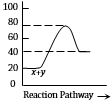
Consider the following energy profile for the reaction $X + Y \rightarrow R + S$. Which of the following deductions about the reaction is not correct?
A
The energy of activation for the backward reaction is $80 \, kJ$
B
The forward reaction is endothermic
C
$\Delta H$ for the forward reaction is $20 \, kJ$
D
The energy of activation for the forward reaction is $60 \, kJ$
Solution
(A) From the given energy profile diagram:
$1$. Energy of reactants $(E_R)$ = $20 \, kJ$
$2$. Energy of products $(E_P)$ = $40 \, kJ$
$3$. Threshold energy $(E_T)$ = $80 \, kJ$
Calculations:
- Activation energy for forward reaction $(E_{a(f)})$ = $E_T - E_R = 80 - 20 = 60 \, kJ$
- Activation energy for backward reaction $(E_{a(b)})$ = $E_T - E_P = 80 - 40 = 40 \, kJ$
- Enthalpy change $(\Delta H)$ = $E_P - E_R = 40 - 20 = 20 \, kJ$
Since $\Delta H > 0$,the reaction is endothermic.
Evaluating the options:
- Option $(A)$: $E_{a(b)} = 40 \, kJ$. The statement says $80 \, kJ$,which is incorrect.
- Option $(B)$: Correct,as $\Delta H > 0$.
- Option $(C)$: Correct,$\Delta H = 20 \, kJ$.
- Option $(D)$: Correct,$E_{a(f)} = 60 \, kJ$.
Therefore,the incorrect statement is $(A)$.
$1$. Energy of reactants $(E_R)$ = $20 \, kJ$
$2$. Energy of products $(E_P)$ = $40 \, kJ$
$3$. Threshold energy $(E_T)$ = $80 \, kJ$
Calculations:
- Activation energy for forward reaction $(E_{a(f)})$ = $E_T - E_R = 80 - 20 = 60 \, kJ$
- Activation energy for backward reaction $(E_{a(b)})$ = $E_T - E_P = 80 - 40 = 40 \, kJ$
- Enthalpy change $(\Delta H)$ = $E_P - E_R = 40 - 20 = 20 \, kJ$
Since $\Delta H > 0$,the reaction is endothermic.
Evaluating the options:
- Option $(A)$: $E_{a(b)} = 40 \, kJ$. The statement says $80 \, kJ$,which is incorrect.
- Option $(B)$: Correct,as $\Delta H > 0$.
- Option $(C)$: Correct,$\Delta H = 20 \, kJ$.
- Option $(D)$: Correct,$E_{a(f)} = 60 \, kJ$.
Therefore,the incorrect statement is $(A)$.
0 likes
View Solution124
EasyMCQ
The minimum energy required for molecules to enter into the reaction is called
A
Potential energy
B
Kinetic energy
C
Nuclear energy
D
Activation energy
Solution
(D) . The minimum amount of extra energy required by the reacting molecules to get converted into products is known as Activation energy.
0 likes
View Solution125
EasyMCQ
The minimum energy necessary to permit a reaction is
A
Internal energy
B
Threshold energy
C
Activation energy
D
Free energy
Solution
(B) The minimum energy that the colliding molecules must possess for a chemical reaction to occur is known as the threshold energy. Molecules must cross this energy barrier to convert into products.
0 likes
View Solution126
MediumMCQ
$A$ reaction rate constant is given by $k = 1.2 \times 10^{14} e^{-(25000/RT)} \, s^{-1}$. It means
A
$\log k$ versus $\log T$ will give a straight line with slope as $-25000$
B
$\log k$ versus $T$ will give a straight line with slope as $-25000$
C
$\log k$ versus $\log 1/T$ will give a straight line with slope as $-25000$
D
$\log k$ versus $1/T$ will give a straight line
Solution
(D) The Arrhenius equation is given by $k = A e^{-E_a/RT}$.
Taking the natural logarithm on both sides: $\ln k = \ln A - \frac{E_a}{RT}$.
Converting to base $10$ logarithm: $\log k = \log A - \frac{E_a}{2.303 R} \left( \frac{1}{T} \right)$.
Comparing this with the equation of a straight line $y = mx + c$,where $y = \log k$ and $x = 1/T$,we get a straight line with a slope of $-E_a / (2.303 R)$.
Therefore,plotting $\log k$ versus $1/T$ yields a straight line.
Taking the natural logarithm on both sides: $\ln k = \ln A - \frac{E_a}{RT}$.
Converting to base $10$ logarithm: $\log k = \log A - \frac{E_a}{2.303 R} \left( \frac{1}{T} \right)$.
Comparing this with the equation of a straight line $y = mx + c$,where $y = \log k$ and $x = 1/T$,we get a straight line with a slope of $-E_a / (2.303 R)$.
Therefore,plotting $\log k$ versus $1/T$ yields a straight line.
0 likes
View Solution127
MediumMCQ
$A$ catalyst:
A
Increases the average kinetic energy of reacting molecules
B
Increases the activation energy
C
Alters the reaction mechanism
D
Increases the frequency of collisions of reacting species
Solution
(C) catalyst provides an alternative pathway for the reaction with lower activation energy. By lowering the activation energy,a larger fraction of molecules can cross the energy barrier,which effectively increases the rate of the reaction. While the frequency of collisions is determined by temperature and concentration,the catalyst's primary role is to alter the reaction mechanism to a lower energy path. However,in the context of standard multiple-choice questions regarding the effect of catalysts on reaction rates,option $C$ is the most scientifically accurate description of how a catalyst functions.
0 likes
View Solution128
MediumMCQ
$A$ reaction having equal energies of activation for forward and reverse reactions has
A
$\Delta H = 0$
B
$\Delta H = \Delta G = \Delta S = 0$
C
$\Delta S = 0$
D
$\Delta G = 0$
Solution
(A) The enthalpy change of a reaction is given by the difference between the activation energy of the forward reaction $(E_a)_f$ and the activation energy of the reverse reaction $(E_a)_b$.
$\Delta H = (E_a)_f - (E_a)_b$
Given that the energies of activation for forward and reverse reactions are equal,i.e.,$(E_a)_f = (E_a)_b$.
Therefore,$\Delta H = 0$.
$\Delta H = (E_a)_f - (E_a)_b$
Given that the energies of activation for forward and reverse reactions are equal,i.e.,$(E_a)_f = (E_a)_b$.
Therefore,$\Delta H = 0$.
0 likes
View Solution129
MediumMCQ
For an endothermic reaction,the energy of activation is $E_a$ and the enthalpy of reaction is $\Delta H$ (both in $kJ/mol$). The minimum value of $E_a$ will be:
A
less than $\Delta H$
B
equal to $\Delta H$
C
more than $\Delta H$
D
equal to zero
Solution
(C) In an endothermic reaction,the energy of the reactants is less than that of the products.
From the potential energy diagram for an endothermic reaction,the relationship between the activation energy of the forward reaction $(E_a)$,the activation energy of the backward reaction $(E_a')$,and the enthalpy of reaction $(\Delta H)$ is given by:
$E_a = E_a' + \Delta H$
Since the activation energy of the backward reaction $(E_a')$ must always be a positive value $(E_a' > 0)$,it follows that:
$E_a > \Delta H$
Therefore,the minimum value of $E_a$ is greater than $\Delta H$.
From the potential energy diagram for an endothermic reaction,the relationship between the activation energy of the forward reaction $(E_a)$,the activation energy of the backward reaction $(E_a')$,and the enthalpy of reaction $(\Delta H)$ is given by:
$E_a = E_a' + \Delta H$
Since the activation energy of the backward reaction $(E_a')$ must always be a positive value $(E_a' > 0)$,it follows that:
$E_a > \Delta H$
Therefore,the minimum value of $E_a$ is greater than $\Delta H$.
0 likes
View Solution130
MediumMCQ
The addition of a catalyst during a chemical reaction alters which of the following quantities?
A
Enthalpy
B
Activation energy
C
Entropy
D
Internal energy
Solution
(B) catalyst is a substance that increases the rate of a chemical reaction without itself undergoing any permanent chemical change.
It functions by providing an alternative reaction pathway with a lower activation energy $(E_a)$.
As shown in the potential energy diagram,the catalyst reduces the energy barrier between reactants and products,but it does not change the energy of the reactants or products,meaning the enthalpy change $(\Delta H)$ remains unaffected.
It functions by providing an alternative reaction pathway with a lower activation energy $(E_a)$.
As shown in the potential energy diagram,the catalyst reduces the energy barrier between reactants and products,but it does not change the energy of the reactants or products,meaning the enthalpy change $(\Delta H)$ remains unaffected.
0 likes
View Solution131
MediumMCQ
The activation energy of a reaction can be determined from the slope of which of the following graphs?
A
$\ln k$ vs. $\frac{1}{T}$
B
$\frac{T}{\ln k}$ vs. $\frac{1}{T}$
C
$\ln k$ vs. $T$
D
$\frac{\ln k}{T}$ vs. $T$
Solution
(A) According to the Arrhenius equation: $k = A e^{-E_{a} / RT}$
Taking the natural logarithm on both sides: $\ln k = \ln A - \frac{E_{a}}{RT}$
This equation follows the linear form $y = mx + c$,where $y = \ln k$,$x = \frac{1}{T}$,and the slope $m = -\frac{E_{a}}{R}$.
Therefore,the activation energy $E_{a}$ can be determined from the slope of the graph of $\ln k$ vs. $\frac{1}{T}$.
Taking the natural logarithm on both sides: $\ln k = \ln A - \frac{E_{a}}{RT}$
This equation follows the linear form $y = mx + c$,where $y = \ln k$,$x = \frac{1}{T}$,and the slope $m = -\frac{E_{a}}{R}$.
Therefore,the activation energy $E_{a}$ can be determined from the slope of the graph of $\ln k$ vs. $\frac{1}{T}$.
0 likes
View Solution132
DifficultMCQ
What is the activation energy for a reaction if its rate doubles when the temperature is raised from $20 \,^{\circ}C$ to $35 \,^{\circ}C$ in $kJ \,mol^{-1}$? $(R = 8.314 \,J \,mol^{-1} \,K^{-1})$
A
$34.7$
B
$15.1$
C
$342$
D
$269$
Solution
(A) The Arrhenius equation is given by: $\log \frac{k_{2}}{k_{1}} = \frac{E_{a}}{2.303 \,R} \left( \frac{1}{T_{1}} - \frac{1}{T_{2}} \right)$
Given: $k_{2} = 2 \,k_{1}$,$T_{1} = 20 + 273 = 293 \,K$,$T_{2} = 35 + 273 = 308 \,K$,and $R = 8.314 \,J \,mol^{-1} \,K^{-1}$.
Substituting the values:
$\log(2) = \frac{E_{a}}{2.303 \times 8.314} \left( \frac{1}{293} - \frac{1}{308} \right)$
$0.3010 = \frac{E_{a}}{19.147} \times \left( \frac{308 - 293}{293 \times 308} \right)$
$0.3010 = \frac{E_{a}}{19.147} \times \frac{15}{90244}$
$E_{a} = \frac{0.3010 \times 19.147 \times 90244}{15} \approx 34673 \,J \,mol^{-1}$
Converting to $kJ \,mol^{-1}$: $E_{a} = 34.673 \,kJ \,mol^{-1} \approx 34.7 \,kJ \,mol^{-1}$.
Given: $k_{2} = 2 \,k_{1}$,$T_{1} = 20 + 273 = 293 \,K$,$T_{2} = 35 + 273 = 308 \,K$,and $R = 8.314 \,J \,mol^{-1} \,K^{-1}$.
Substituting the values:
$\log(2) = \frac{E_{a}}{2.303 \times 8.314} \left( \frac{1}{293} - \frac{1}{308} \right)$
$0.3010 = \frac{E_{a}}{19.147} \times \left( \frac{308 - 293}{293 \times 308} \right)$
$0.3010 = \frac{E_{a}}{19.147} \times \frac{15}{90244}$
$E_{a} = \frac{0.3010 \times 19.147 \times 90244}{15} \approx 34673 \,J \,mol^{-1}$
Converting to $kJ \,mol^{-1}$: $E_{a} = 34.673 \,kJ \,mol^{-1} \approx 34.7 \,kJ \,mol^{-1}$.
0 likes
View Solution133
DifficultMCQ
In a reaction,for every $10\,^{\circ}C$ rise of temperature,the rate is doubled. If the temperature is increased from $10\,^{\circ}C$ to $100\,^{\circ}C,$ the rate of the reaction will become $.......$ times.
A
$256$
B
$512$
C
$64$
D
$128$
Solution
(B) The number of $10\,^{\circ}C$ intervals $(n)$ is calculated as:
$n = \frac{T_2 - T_1}{10} = \frac{100 - 10}{10} = \frac{90}{10} = 9$
Since the rate doubles for every $10\,^{\circ}C$ rise,the rate increases by a factor of $2^n$.
Rate factor $= 2^9 = 512$
Therefore,the rate of the reaction will become $512$ times.
$n = \frac{T_2 - T_1}{10} = \frac{100 - 10}{10} = \frac{90}{10} = 9$
Since the rate doubles for every $10\,^{\circ}C$ rise,the rate increases by a factor of $2^n$.
Rate factor $= 2^9 = 512$
Therefore,the rate of the reaction will become $512$ times.
0 likes
View Solution134
MediumMCQ
Activation energy $(E_a)$ and rate constants $(k_1)$ and $(k_2)$ of a chemical reaction at two different temperatures $(T_1)$ and $(T_2)$ are related by
A
$\ln \frac{k_2}{k_1} = \frac{-E_a}{R} \left( \frac{1}{T_1} - \frac{1}{T_2} \right)$
B
$\ln \frac{k_2}{k_1} = \frac{-E_a}{R} \left( \frac{1}{T_2} - \frac{1}{T_1} \right)$
C
$\ln \frac{k_2}{k_1} = \frac{E_a}{R} \left( \frac{1}{T_1} - \frac{1}{T_2} \right)$
D
Both $(b)$ and $(c)$
Solution
(D) The Arrhenius equation is given by: $k = A e^{-E_a / RT}$.
For two different temperatures $T_1$ and $T_2$ with corresponding rate constants $k_1$ and $k_2$:
$\ln k_1 = \ln A - \frac{E_a}{RT_1}$
$\ln k_2 = \ln A - \frac{E_a}{RT_2}$
Subtracting the first equation from the second:
$\ln k_2 - \ln k_1 = \left( \ln A - \frac{E_a}{RT_2} \right) - \left( \ln A - \frac{E_a}{RT_1} \right)$
$\ln \frac{k_2}{k_1} = \frac{E_a}{R} \left( \frac{1}{T_1} - \frac{1}{T_2} \right)$
Alternatively,this can be written as:
$\ln \frac{k_2}{k_1} = \frac{-E_a}{R} \left( \frac{1}{T_2} - \frac{1}{T_1} \right)$
Thus,both expressions $(b)$ and $(c)$ are correct.
For two different temperatures $T_1$ and $T_2$ with corresponding rate constants $k_1$ and $k_2$:
$\ln k_1 = \ln A - \frac{E_a}{RT_1}$
$\ln k_2 = \ln A - \frac{E_a}{RT_2}$
Subtracting the first equation from the second:
$\ln k_2 - \ln k_1 = \left( \ln A - \frac{E_a}{RT_2} \right) - \left( \ln A - \frac{E_a}{RT_1} \right)$
$\ln \frac{k_2}{k_1} = \frac{E_a}{R} \left( \frac{1}{T_1} - \frac{1}{T_2} \right)$
Alternatively,this can be written as:
$\ln \frac{k_2}{k_1} = \frac{-E_a}{R} \left( \frac{1}{T_2} - \frac{1}{T_1} \right)$
Thus,both expressions $(b)$ and $(c)$ are correct.
0 likes
View Solution135
EasyMCQ
The rate of the reaction,$2NO + Cl_2 \rightarrow 2NOCl$ is given by the rate equation $\text{rate} = k[NO]^2[Cl_2]$. The value of the rate constant can be increased by
A
increasing the temperature
B
increasing the concentration of $NO$
C
increasing the concentration of $Cl_2$
D
doing all of these.
Solution
(A) The rate constant $k$ is a characteristic property of a reaction at a given temperature.
It is independent of the concentrations of the reactants.
According to the Arrhenius equation,$k = Ae^{-E_a/RT}$,the rate constant $k$ increases with an increase in temperature.
It is independent of the concentrations of the reactants.
According to the Arrhenius equation,$k = Ae^{-E_a/RT}$,the rate constant $k$ increases with an increase in temperature.
0 likes
View Solution136
DifficultMCQ
The rate constants $k_1$ and $k_2$ for two different reactions are $10^{16} \cdot e^{-2000/T}$ and $10^{15} \cdot e^{-1000/T},$ respectively. The temperature at which $k_1 = k_2$ is
A
$2000 \ K$
B
$\frac{1000}{2.303} \ K$
C
$1000 \ K$
D
$\frac{2000}{2.303} \ K$
Solution
(B) Given the rate constants: $k_1 = 10^{16} e^{-2000/T}$ and $k_2 = 10^{15} e^{-1000/T}$.
At the temperature where $k_1 = k_2$,we have:
$10^{16} e^{-2000/T} = 10^{15} e^{-1000/T}$
Dividing both sides by $10^{15} e^{-2000/T}$:
$\frac{10^{16}}{10^{15}} = \frac{e^{-1000/T}}{e^{-2000/T}}$
$10 = e^{1000/T}$
Taking the natural logarithm $(\ln)$ on both sides:
$\ln(10) = \frac{1000}{T}$
Since $\ln(10) = 2.303 \log_{10}(10) = 2.303$,we get:
$2.303 = \frac{1000}{T}$
$T = \frac{1000}{2.303} \ K$
At the temperature where $k_1 = k_2$,we have:
$10^{16} e^{-2000/T} = 10^{15} e^{-1000/T}$
Dividing both sides by $10^{15} e^{-2000/T}$:
$\frac{10^{16}}{10^{15}} = \frac{e^{-1000/T}}{e^{-2000/T}}$
$10 = e^{1000/T}$
Taking the natural logarithm $(\ln)$ on both sides:
$\ln(10) = \frac{1000}{T}$
Since $\ln(10) = 2.303 \log_{10}(10) = 2.303$,we get:
$2.303 = \frac{1000}{T}$
$T = \frac{1000}{2.303} \ K$
0 likes
View Solution137
EasyMCQ
The rate of a reaction can be expressed by the Arrhenius equation as:
$k = A e^{-E_a / RT}$
In this equation,$E_a$ represents:
$k = A e^{-E_a / RT}$
In this equation,$E_a$ represents:
A
the total energy of the reacting molecules at a temperature,$T$
B
the fraction of molecules with energy greater than the activation energy of the reaction
C
the energy above which all the colliding molecules will react
D
the energy below which all the colliding molecules will react
Solution
(C) In the Arrhenius equation $k = A e^{-E_a / RT}$,$E_a$ represents the activation energy.
Activation energy is defined as the minimum extra amount of energy absorbed by the reactant molecules so that their energy becomes equal to the threshold energy,allowing them to react and form products.
Therefore,it is the energy barrier that colliding molecules must overcome to react.
Activation energy is defined as the minimum extra amount of energy absorbed by the reactant molecules so that their energy becomes equal to the threshold energy,allowing them to react and form products.
Therefore,it is the energy barrier that colliding molecules must overcome to react.
0 likes
View Solution138
DifficultMCQ
The energies of activation for forward and reverse reactions for $A_2 + B_2 \rightleftharpoons 2AB$ are $180 \, kJ \, mol^{-1}$ and $200 \, kJ \, mol^{-1}$ respectively. The presence of a catalyst lowers the activation energy of both (forward and reverse) reactions by $100 \, kJ \, mol^{-1}.$ The enthalpy change of the reaction $(A_2 + B_2 \rightarrow 2AB)$ in the presence of a catalyst will be (in $kJ \, mol^{-1}$)
A
$-20$
B
$300$
C
$120$
D
$280$
Solution
$(A)$ The enthalpy change of a reaction $(\Delta H)$ is defined as the difference between the activation energy of the forward reaction $(E_{af})$ and the activation energy of the reverse reaction $(E_{ab})$.
$\Delta H = E_{af} - E_{ab} = 180 \, kJ \, mol^{-1} - 200 \, kJ \, mol^{-1} = -20 \, kJ \, mol^{-1}$.
$A$ catalyst provides an alternative reaction pathway with lower activation energy, but it does not change the energy of the reactants or the products.
Since $\Delta H$ is a state function, it depends only on the initial and final states of the system.
Therefore, the enthalpy change of the reaction remains unchanged in the presence of a catalyst, which is $-20 \, kJ \, mol^{-1}$.
$\Delta H = E_{af} - E_{ab} = 180 \, kJ \, mol^{-1} - 200 \, kJ \, mol^{-1} = -20 \, kJ \, mol^{-1}$.
$A$ catalyst provides an alternative reaction pathway with lower activation energy, but it does not change the energy of the reactants or the products.
Since $\Delta H$ is a state function, it depends only on the initial and final states of the system.
Therefore, the enthalpy change of the reaction remains unchanged in the presence of a catalyst, which is $-20 \, kJ \, mol^{-1}$.
0 likes
View Solution139
MediumMCQ
The rate of a chemical reaction doubles for every $10\,^{\circ}C$ rise of temperature. If the temperature is raised by $50\,^{\circ}C,$ the rate of the reaction increases by about ......... times.
A
$10$
B
$24$
C
$32$
D
$64$
Solution
(C) The temperature coefficient is $2$ for a $10\,^{\circ}C$ rise in temperature.
For a rise of $50\,^{\circ}C,$ the number of $10\,^{\circ}C$ intervals is $n = \frac{50}{10} = 5$.
The increase in the rate of reaction is given by $2^n = 2^5$.
$2^5 = 2 \times 2 \times 2 \times 2 \times 2 = 32$.
Therefore,the rate of the reaction increases by $32$ times.
For a rise of $50\,^{\circ}C,$ the number of $10\,^{\circ}C$ intervals is $n = \frac{50}{10} = 5$.
The increase in the rate of reaction is given by $2^n = 2^5$.
$2^5 = 2 \times 2 \times 2 \times 2 \times 2 = 32$.
Therefore,the rate of the reaction increases by $32$ times.
0 likes
View Solution140
DifficultMCQ
The rate of a reaction doubles when its temperature changes from $300 \, K$ to $310 \, K.$ Activation energy of such a reaction will be .......... $kJ \, mol^{-1}$. $(R= 8.314 \, J \, K^{-1} \, mol^{-1}$ and $\log 2=0.301)$
A
$53.6$
B
$48.6$
C
$58.5$
D
$60.5$
Solution
(A) The Arrhenius equation is given by $\log \frac{k_{2}}{k_{1}} = \frac{E_{a}}{2.303 R} \left( \frac{T_{2} - T_{1}}{T_{1} T_{2}} \right).$
Given: $\frac{k_{2}}{k_{1}} = 2, T_{1} = 300 \, K, T_{2} = 310 \, K, R = 8.314 \, J \, K^{-1} \, mol^{-1}, \log 2 = 0.301.$
Substituting the values:
$0.301 = \frac{E_{a}}{2.303 \times 8.314} \left( \frac{310 - 300}{310 \times 300} \right)$
$0.301 = \frac{E_{a}}{19.147} \times \frac{10}{93000}$
$E_{a} = \frac{0.301 \times 19.147 \times 93000}{10}$
$E_{a} = 53598.6 \, J \, mol^{-1} = 53.6 \, kJ \, mol^{-1}.$
Given: $\frac{k_{2}}{k_{1}} = 2, T_{1} = 300 \, K, T_{2} = 310 \, K, R = 8.314 \, J \, K^{-1} \, mol^{-1}, \log 2 = 0.301.$
Substituting the values:
$0.301 = \frac{E_{a}}{2.303 \times 8.314} \left( \frac{310 - 300}{310 \times 300} \right)$
$0.301 = \frac{E_{a}}{19.147} \times \frac{10}{93000}$
$E_{a} = \frac{0.301 \times 19.147 \times 93000}{10}$
$E_{a} = 53598.6 \, J \, mol^{-1} = 53.6 \, kJ \, mol^{-1}.$
0 likes
View Solution141
DifficultMCQ
Two reactions $R_1$ and $R_2$ have identical pre-exponential factors. Activation energy of $R_1$ exceeds that of $R_2$ by $10 \, kJ \, mol^{-1}.$ If $k_1$ and $k_2$ are rate constants for reactions $R_1$ and $R_2$ respectively at $300 \, K,$ then $\ln (k_2/k_1)$ is equal to :
$(R=8.314 \, J \, mol^{-1} \, K^{-1})$
$(R=8.314 \, J \, mol^{-1} \, K^{-1})$
A
$8$
B
$12$
C
$6$
D
$4$
Solution
(D) According to the Arrhenius equation,$k = A e^{-E_a / RT}$.
For reactions $R_1$ and $R_2$ with identical pre-exponential factors $A$:
$k_1 = A e^{-E_{a1} / RT}$
$k_2 = A e^{-E_{a2} / RT}$
Dividing $k_2$ by $k_1$:
$\frac{k_2}{k_1} = \frac{A e^{-E_{a2} / RT}}{A e^{-E_{a1} / RT}} = e^{(E_{a1} - E_{a2}) / RT}$
Taking the natural logarithm on both sides:
$\ln(k_2/k_1) = \frac{E_{a1} - E_{a2}}{RT}$
Given $E_{a1} - E_{a2} = 10 \, kJ \, mol^{-1} = 10,000 \, J \, mol^{-1}$,$R = 8.314 \, J \, mol^{-1} \, K^{-1}$,and $T = 300 \, K$:
$\ln(k_2/k_1) = \frac{10,000}{8.314 \times 300} \approx \frac{10,000}{2494.2} \approx 4.009 \approx 4$.
For reactions $R_1$ and $R_2$ with identical pre-exponential factors $A$:
$k_1 = A e^{-E_{a1} / RT}$
$k_2 = A e^{-E_{a2} / RT}$
Dividing $k_2$ by $k_1$:
$\frac{k_2}{k_1} = \frac{A e^{-E_{a2} / RT}}{A e^{-E_{a1} / RT}} = e^{(E_{a1} - E_{a2}) / RT}$
Taking the natural logarithm on both sides:
$\ln(k_2/k_1) = \frac{E_{a1} - E_{a2}}{RT}$
Given $E_{a1} - E_{a2} = 10 \, kJ \, mol^{-1} = 10,000 \, J \, mol^{-1}$,$R = 8.314 \, J \, mol^{-1} \, K^{-1}$,and $T = 300 \, K$:
$\ln(k_2/k_1) = \frac{10,000}{8.314 \times 300} \approx \frac{10,000}{2494.2} \approx 4.009 \approx 4$.
0 likes
View Solution142
MediumMCQ
For a first order reaction,the rate constant is $0.04 \, \text{min}^{-1}$ at $27 \, ^\circ\text{C}$ and $0.08 \, \text{min}^{-1}$ at $37 \, ^\circ\text{C}.$ The activation energy of reaction is .......... $\text{kcal} / \text{mol}$ $(\ln \, 2 = 0.7)$
A
$13.02$
B
$139.86$
C
$54.12$
D
$13020$
Solution
(A) The Arrhenius equation is given by: $\ln \frac{K_{2}}{K_{1}} = \frac{E_{a}}{R} \left( \frac{T_{2} - T_{1}}{T_{1} T_{2}} \right)$.
Given: $K_{1} = 0.04 \, \text{min}^{-1}$,$K_{2} = 0.08 \, \text{min}^{-1}$,$T_{1} = 27 + 273 = 300 \, \text{K}$,$T_{2} = 37 + 273 = 310 \, \text{K}$,and $R = 2 \, \text{cal} \, \text{K}^{-1} \, \text{mol}^{-1}$.
Substituting the values: $\ln \left( \frac{0.08}{0.04} \right) = \frac{E_{a}}{2} \left( \frac{310 - 300}{300 \times 310} \right)$.
$\ln(2) = \frac{E_{a}}{2} \left( \frac{10}{93000} \right)$.
$0.7 = \frac{E_{a}}{2} \times \frac{1}{9300}$.
$E_{a} = 0.7 \times 2 \times 9300 = 13020 \, \text{cal} / \text{mol}$.
Converting to $\text{kcal} / \text{mol}$: $E_{a} = 13.02 \, \text{kcal} / \text{mol}$.
Given: $K_{1} = 0.04 \, \text{min}^{-1}$,$K_{2} = 0.08 \, \text{min}^{-1}$,$T_{1} = 27 + 273 = 300 \, \text{K}$,$T_{2} = 37 + 273 = 310 \, \text{K}$,and $R = 2 \, \text{cal} \, \text{K}^{-1} \, \text{mol}^{-1}$.
Substituting the values: $\ln \left( \frac{0.08}{0.04} \right) = \frac{E_{a}}{2} \left( \frac{310 - 300}{300 \times 310} \right)$.
$\ln(2) = \frac{E_{a}}{2} \left( \frac{10}{93000} \right)$.
$0.7 = \frac{E_{a}}{2} \times \frac{1}{9300}$.
$E_{a} = 0.7 \times 2 \times 9300 = 13020 \, \text{cal} / \text{mol}$.
Converting to $\text{kcal} / \text{mol}$: $E_{a} = 13.02 \, \text{kcal} / \text{mol}$.
0 likes
View Solution143
DifficultMCQ
Select the correct statement.
A
Entropy change of all the elementary reactions increases with increase in temperature.
B
Enthalpy change of all the elementary reactions increases with increase in temperature.
C
Rate constant of all the elementary reactions increases with increase in temperature.
D
Activation energy of all the elementary reactions increases with increase in temperature.
Solution
(C) According to the Arrhenius equation,$k = A e^{-E_{a} / RT}$,where $k$ is the rate constant,$A$ is the frequency factor,$E_{a}$ is the activation energy,$R$ is the gas constant,and $T$ is the temperature in Kelvin.
As the temperature $T$ increases,the term $e^{-E_{a} / RT}$ increases,which leads to an increase in the rate constant $k$ for all elementary reactions.
Option $A$ and $B$ depend on the sign of $\Delta C_{p}$,which varies for different reactions.
Option $D$ is incorrect because activation energy is generally considered independent of temperature for elementary reactions.
As the temperature $T$ increases,the term $e^{-E_{a} / RT}$ increases,which leads to an increase in the rate constant $k$ for all elementary reactions.
Option $A$ and $B$ depend on the sign of $\Delta C_{p}$,which varies for different reactions.
Option $D$ is incorrect because activation energy is generally considered independent of temperature for elementary reactions.
0 likes
View Solution144
MediumMCQ
Choose the incorrect statement -
A
Activation energy of reaction decreases on decreasing temperature
B
Order of reaction may change with change in temperature
C
When slowest step is the first step in a mechanism,then the rate law of overall reaction is the same as the rate law for this step
D
Rate of photochemical reaction is directly proportional to intensity of photons.
Solution
(A) According to the Arrhenius equation,$k = A e^{-E_a/RT}$,the activation energy $(E_a)$ is a characteristic property of a reaction and is generally considered independent of temperature. Therefore,the statement that activation energy decreases on decreasing temperature is incorrect.
$(b)$ The order of reaction can change with temperature if the mechanism of the reaction changes.
$(c)$ If the first step is the rate-determining step (slowest step),the rate law of the overall reaction is determined by the rate law of that step.
$(d)$ The rate of a photochemical reaction is directly proportional to the intensity of the incident light (photons).
$(b)$ The order of reaction can change with temperature if the mechanism of the reaction changes.
$(c)$ If the first step is the rate-determining step (slowest step),the rate law of the overall reaction is determined by the rate law of that step.
$(d)$ The rate of a photochemical reaction is directly proportional to the intensity of the incident light (photons).
0 likes
View Solution145
MediumMCQ
For $N_2 + 3H_2 \rightarrow 2NH_3$,$\Delta H = -22 \ kcal$,and $E_a = 70 \ kcal$. Hence $E_a$ for $2NH_3 \rightarrow N_2 + 3H_2$ is $.....$ $kcal$.
A
$92$
B
$70$
C
$48$
D
$22$
Solution
(A) The enthalpy change of a reaction is given by the difference between the activation energy of the forward reaction $(E_a)_f$ and the activation energy of the backward reaction $(E_a)_b$:
$\Delta H = (E_a)_f - (E_a)_b$
Given $\Delta H = -22 \ kcal$ and $(E_a)_f = 70 \ kcal$:
$-22 = 70 - (E_a)_b$
Rearranging the equation to solve for $(E_a)_b$:
$(E_a)_b = 70 + 22 = 92 \ kcal$.
$\Delta H = (E_a)_f - (E_a)_b$
Given $\Delta H = -22 \ kcal$ and $(E_a)_f = 70 \ kcal$:
$-22 = 70 - (E_a)_b$
Rearranging the equation to solve for $(E_a)_b$:
$(E_a)_b = 70 + 22 = 92 \ kcal$.
0 likes
View Solution146
MediumMCQ
For the reaction,following data is given,
$A \rightarrow B$; $K_1 = 10^{15} \exp \left( \frac{-2000}{T} \right)$
$C \rightarrow D$; $K_2 = 10^{14} \exp \left( \frac{-1000}{T} \right)$
The temperature at which $K_1 = K_2$ is ........... $K$ $(exp. = e)$
$A \rightarrow B$; $K_1 = 10^{15} \exp \left( \frac{-2000}{T} \right)$
$C \rightarrow D$; $K_2 = 10^{14} \exp \left( \frac{-1000}{T} \right)$
The temperature at which $K_1 = K_2$ is ........... $K$ $(exp. = e)$
A
$1000$
B
$2000$
C
$868.4$
D
$434.22$
Solution
(D) Given that $K_1 = K_2$,we have:
$10^{15} \exp \left( \frac{-2000}{T} \right) = 10^{14} \exp \left( \frac{-1000}{T} \right)$
Dividing both sides by $10^{14}$:
$10 \exp \left( \frac{-2000}{T} \right) = \exp \left( \frac{-1000}{T} \right)$
Rearranging the exponential terms:
$10 = \frac{\exp \left( \frac{-1000}{T} \right)}{\exp \left( \frac{-2000}{T} \right)} = \exp \left( \frac{-1000}{T} - \left( \frac{-2000}{T} \right) \right) = \exp \left( \frac{1000}{T} \right)$
Taking the natural logarithm $(\ln)$ on both sides:
$\ln(10) = \frac{1000}{T}$
Using $\ln(10) \approx 2.303$:
$2.303 = \frac{1000}{T}$
$T = \frac{1000}{2.303} \approx 434.22 \ K$
$10^{15} \exp \left( \frac{-2000}{T} \right) = 10^{14} \exp \left( \frac{-1000}{T} \right)$
Dividing both sides by $10^{14}$:
$10 \exp \left( \frac{-2000}{T} \right) = \exp \left( \frac{-1000}{T} \right)$
Rearranging the exponential terms:
$10 = \frac{\exp \left( \frac{-1000}{T} \right)}{\exp \left( \frac{-2000}{T} \right)} = \exp \left( \frac{-1000}{T} - \left( \frac{-2000}{T} \right) \right) = \exp \left( \frac{1000}{T} \right)$
Taking the natural logarithm $(\ln)$ on both sides:
$\ln(10) = \frac{1000}{T}$
Using $\ln(10) \approx 2.303$:
$2.303 = \frac{1000}{T}$
$T = \frac{1000}{2.303} \approx 434.22 \ K$
0 likes
View Solution147
MediumMCQ
In an exothermic reaction $A \to B$,the evolved heat is $280 \ kJ \ mol^{-1}$ and the activation energy is $200 \ kJ \ mol^{-1}$. The activation energy of the reverse reaction $B \to A$ is $.......... \ kJ \ mol^{-1}$.
A
$80$
B
$480$
C
$200$
D
None of these
Solution
(B) For an exothermic reaction,the enthalpy change $\Delta_{r} H$ is negative. The relationship between the activation energy of the forward reaction $(E_{a})_{f}$,the activation energy of the reverse reaction $(E_{a})_{r}$,and the enthalpy change $\Delta_{r} H$ is given by:
$\Delta_{r} H = (E_{a})_{f} - (E_{a})_{r}$
Given that the reaction is exothermic,the heat evolved is $280 \ kJ \ mol^{-1}$,so $\Delta_{r} H = -280 \ kJ \ mol^{-1}$.
The activation energy of the forward reaction $(E_{a})_{f} = 200 \ kJ \ mol^{-1}$.
Substituting these values into the equation:
$-280 \ kJ \ mol^{-1} = 200 \ kJ \ mol^{-1} - (E_{a})_{r}$
$(E_{a})_{r} = 200 \ kJ \ mol^{-1} + 280 \ kJ \ mol^{-1} = 480 \ kJ \ mol^{-1}$.
$\Delta_{r} H = (E_{a})_{f} - (E_{a})_{r}$
Given that the reaction is exothermic,the heat evolved is $280 \ kJ \ mol^{-1}$,so $\Delta_{r} H = -280 \ kJ \ mol^{-1}$.
The activation energy of the forward reaction $(E_{a})_{f} = 200 \ kJ \ mol^{-1}$.
Substituting these values into the equation:
$-280 \ kJ \ mol^{-1} = 200 \ kJ \ mol^{-1} - (E_{a})_{r}$
$(E_{a})_{r} = 200 \ kJ \ mol^{-1} + 280 \ kJ \ mol^{-1} = 480 \ kJ \ mol^{-1}$.
0 likes
View Solution148
MediumMCQ
For a first order reaction $A \rightarrow P$,the temperature $(T)$ dependent rate constant $(k)$ was found to follow the equation $\log_{10} k = -(2000) \frac{1}{T} + 6$. The activation energy $(E_a)$ of the reaction in $kJ \, mol^{-1}$ will be ......... (Given: $\ln x = 2.3 \times \log_{10} x$ and $R = 8 \, J \, mol^{-1} K^{-1}$)
A
$9.2$
B
$16.2$
C
$116.6$
D
$36.8$
Solution
(D) The Arrhenius equation is given by $\ln k = \ln A - \frac{E_a}{RT}$.
Converting to base $10$,we get $\log_{10} k = \log_{10} A - \frac{E_a}{2.303 RT}$.
Comparing this with the given equation $\log_{10} k = -2000 \left(\frac{1}{T}\right) + 6$,we identify the slope as $-\frac{E_a}{2.303 R} = -2000$.
Thus,$E_a = 2000 \times 2.303 \times R$.
Using $R = 8 \, J \, mol^{-1} K^{-1}$ and the approximation $\ln x \approx 2.3 \log_{10} x$ provided in the question:
$E_a = 2000 \times 2.3 \times 8 = 36800 \, J \, mol^{-1}$.
Converting to $kJ \, mol^{-1}$,we get $E_a = \frac{36800}{1000} = 36.8 \, kJ \, mol^{-1}$.
Converting to base $10$,we get $\log_{10} k = \log_{10} A - \frac{E_a}{2.303 RT}$.
Comparing this with the given equation $\log_{10} k = -2000 \left(\frac{1}{T}\right) + 6$,we identify the slope as $-\frac{E_a}{2.303 R} = -2000$.
Thus,$E_a = 2000 \times 2.303 \times R$.
Using $R = 8 \, J \, mol^{-1} K^{-1}$ and the approximation $\ln x \approx 2.3 \log_{10} x$ provided in the question:
$E_a = 2000 \times 2.3 \times 8 = 36800 \, J \, mol^{-1}$.
Converting to $kJ \, mol^{-1}$,we get $E_a = \frac{36800}{1000} = 36.8 \, kJ \, mol^{-1}$.
0 likes
View Solution149
MediumMCQ
In which of the following cases is the percentage increase in rate constant maximum?
| $Case$ | $E_a \ (kcal/mol)$ | $Temp. \ Change \ (K)$ |
| $I$ | $40$ | $200 - 210$ |
| $II$ | $80$ | $200 - 210$ |
| $III$ | $40$ | $300 - 310$ |
| $IV$ | $80$ | $300 - 310$ |
A
$I$
B
$II$
C
$III$
D
$IV$
Solution
(B) The Arrhenius equation is given by $k = A e^{-E_a / RT}$.
Taking the natural logarithm,$\ln k = \ln A - \frac{E_a}{RT}$.
Differentiating with respect to $T$,$\frac{d(\ln k)}{dT} = \frac{E_a}{RT^2}$.
For a small temperature change $\Delta T$,the change in $\ln k$ is $\Delta(\ln k) \approx \frac{E_a}{RT^2} \Delta T$.
The percentage increase in rate constant is proportional to $\frac{\Delta k}{k} \approx \Delta(\ln k) = \frac{E_a \Delta T}{RT^2}$.
To maximize the percentage increase,we need to maximize the value of $\frac{E_a}{T^2}$ (since $\Delta T$ is constant at $10 \ K$ for all cases).
Comparing the cases:
$I$: $\frac{40}{200^2} = \frac{40}{40000} = 1 \times 10^{-3}$
$II$: $\frac{80}{200^2} = \frac{80}{40000} = 2 \times 10^{-3}$
$III$: $\frac{40}{300^2} = \frac{40}{90000} \approx 0.44 \times 10^{-3}$
$IV$: $\frac{80}{300^2} = \frac{80}{90000} \approx 0.89 \times 10^{-3}$
The value is maximum for case $II$.
Taking the natural logarithm,$\ln k = \ln A - \frac{E_a}{RT}$.
Differentiating with respect to $T$,$\frac{d(\ln k)}{dT} = \frac{E_a}{RT^2}$.
For a small temperature change $\Delta T$,the change in $\ln k$ is $\Delta(\ln k) \approx \frac{E_a}{RT^2} \Delta T$.
The percentage increase in rate constant is proportional to $\frac{\Delta k}{k} \approx \Delta(\ln k) = \frac{E_a \Delta T}{RT^2}$.
To maximize the percentage increase,we need to maximize the value of $\frac{E_a}{T^2}$ (since $\Delta T$ is constant at $10 \ K$ for all cases).
Comparing the cases:
$I$: $\frac{40}{200^2} = \frac{40}{40000} = 1 \times 10^{-3}$
$II$: $\frac{80}{200^2} = \frac{80}{40000} = 2 \times 10^{-3}$
$III$: $\frac{40}{300^2} = \frac{40}{90000} \approx 0.44 \times 10^{-3}$
$IV$: $\frac{80}{300^2} = \frac{80}{90000} \approx 0.89 \times 10^{-3}$
The value is maximum for case $II$.
0 likes
View SolutionChemical Kinetics — Collision theory, Energy of activation and Arrhenius equation · Frequently Asked Questions
1Are these Chemical Kinetics questions useful for JEE and NEET?
Yes. All questions in this section are mapped to JEE Main and NEET exam patterns. Previous year questions from JEE Main, NEET, GUJCET and state-level exams are included with full solutions.
2Can I switch to Hindi or Gujarati for these questions?
Yes. Use the language tabs in the hero section or the sidebar to view the same questions and solutions in English, Hindi or Gujarati.
3How do I generate a question paper from this subtopic?
Use the Vedclass Exam Paper Generator — select the chapter and subtopic, set difficulty, and generate Sets A, B, C, D automatically. First 3 chapters of every subject are free.
Vedclass Products
For Students
Vedclass Test Series
Mock tests in real JEE/NEET style with performance analysis. 5-day free trial.
Start Free TrialFor Teachers
Exam Paper Generator
Generate Set A/B/C/D papers from this chapter in 2 minutes. 3 chapters free.
Try FreeFor Institutes
Online Exam Module
Live online exams with unlimited students, 360° analytics & white-label branding.
See DemoFor Teachers & Institutes
Generate a Chemical Kinetics Exam Paper in 2 Minutes
Select subtopic & difficulty — Sets A, B, C, D auto-generated with No Repeat logic.
First 3 chapters of every subject are free — no payment required.