
A English
Collision theory, Energy of activation and Arrhenius equation Questions in English
Class 12 Chemistry · Chemical Kinetics · Collision theory, Energy of activation and Arrhenius equation
499+
Questions
English
Language
100%
With Solutions
Showing 50 of 499 questions in English
151
MediumMCQ
Which of the following statements is correct for the activation energy of a reaction?
A
It always increases with increase in temperature.
B
When activation energy is zero,the rate constant is temperature-dependent.
C
It always decreases with decrease in temperature.
D
It is nearly independent of temperature,over a wide range of temperature.
Solution
(D) The activation energy $(E_a)$ is the minimum energy required for a chemical reaction to occur.
According to the Arrhenius equation,$k = A e^{-E_a / RT}$,where $k$ is the rate constant,$A$ is the frequency factor,$R$ is the gas constant,and $T$ is the temperature.
For most reactions,the activation energy $(E_a)$ is considered to be a characteristic property of the reaction path and is nearly independent of temperature over a wide range of temperatures.
Therefore,option $D$ is the correct statement.
According to the Arrhenius equation,$k = A e^{-E_a / RT}$,where $k$ is the rate constant,$A$ is the frequency factor,$R$ is the gas constant,and $T$ is the temperature.
For most reactions,the activation energy $(E_a)$ is considered to be a characteristic property of the reaction path and is nearly independent of temperature over a wide range of temperatures.
Therefore,option $D$ is the correct statement.
0 likes
View Solution152
MediumMCQ
The rate constant for the decomposition of a hydrocarbon is given as $K = (4.5 \times 10^{11} \ s^{-1}) e^{-(28000 \ K) / T}$. The activation energy of the reaction (in $J/mol$) is:
A
$28000$
B
$28000 \times (8.314)^2$
C
$28000 \times 8.314$
D
$28000 / 8.314$
Solution
(C) The Arrhenius equation is given by $k = A e^{-E_{a} / RT}$.
Comparing the given equation $k = (4.5 \times 10^{11} \ s^{-1}) e^{-(28000 \ K) / T}$ with the Arrhenius equation,we identify the exponent term:
$E_{a} / R = 28000 \ K$.
Therefore,the activation energy $E_{a} = 28000 \times R$.
Using the gas constant $R = 8.314 \ J \ K^{-1} \ mol^{-1}$,we get:
$E_{a} = 28000 \times 8.314 \ J/mol = 232792 \ J/mol$.
Comparing the given equation $k = (4.5 \times 10^{11} \ s^{-1}) e^{-(28000 \ K) / T}$ with the Arrhenius equation,we identify the exponent term:
$E_{a} / R = 28000 \ K$.
Therefore,the activation energy $E_{a} = 28000 \times R$.
Using the gas constant $R = 8.314 \ J \ K^{-1} \ mol^{-1}$,we get:
$E_{a} = 28000 \times 8.314 \ J/mol = 232792 \ J/mol$.
0 likes
View Solution153
MediumMCQ
Which statement is incorrect according to the Arrhenius equation?
A
The number of effective collisions depends on the number of molecules above a certain threshold energy.
B
As the temperature increases,the number of molecules with energies exceeding the threshold energy increases.
C
The rate constant is a function of temperature.
D
Activation energy and pre-exponential factors are temperature independent.
Solution
(D) The Arrhenius equation is given by $k = A e^{-E_a / (RT)}$.
$(1)$ The rate constant $k$ is a function of temperature $T$.
$(2)$ As temperature $T$ increases,the fraction of molecules with energy greater than the threshold energy increases,leading to more effective collisions.
$(3)$ In the standard Arrhenius model,the activation energy $E_a$ and the pre-exponential factor $A$ are considered to be temperature independent constants.
$(4)$ Therefore,all statements $A$,$B$,and $C$ are correct according to the theory,while $D$ is technically an approximation but often treated as a correct premise in basic kinetics; however,if we look for the most accurate theoretical description,the Arrhenius equation assumes $E_a$ and $A$ are independent of $T$. Since the question asks for the incorrect statement,and all provided options are standard interpretations,there might be a misunderstanding. Re-evaluating: all statements are actually consistent with the basic Arrhenius model. Given the standard curriculum,this question is often flawed or implies that $A$ and $E_a$ might vary slightly with $T$ in complex systems. However,based on the provided options,none are strictly 'incorrect' in the context of the basic Arrhenius equation.
$(1)$ The rate constant $k$ is a function of temperature $T$.
$(2)$ As temperature $T$ increases,the fraction of molecules with energy greater than the threshold energy increases,leading to more effective collisions.
$(3)$ In the standard Arrhenius model,the activation energy $E_a$ and the pre-exponential factor $A$ are considered to be temperature independent constants.
$(4)$ Therefore,all statements $A$,$B$,and $C$ are correct according to the theory,while $D$ is technically an approximation but often treated as a correct premise in basic kinetics; however,if we look for the most accurate theoretical description,the Arrhenius equation assumes $E_a$ and $A$ are independent of $T$. Since the question asks for the incorrect statement,and all provided options are standard interpretations,there might be a misunderstanding. Re-evaluating: all statements are actually consistent with the basic Arrhenius model. Given the standard curriculum,this question is often flawed or implies that $A$ and $E_a$ might vary slightly with $T$ in complex systems. However,based on the provided options,none are strictly 'incorrect' in the context of the basic Arrhenius equation.
0 likes
View Solution154
DifficultMCQ
$A$ reaction takes place in three steps with individual rate constants and activation energies. The overall rate constant is given by $k = (\frac{k_1 k_2}{k_3})^{2/3}$. The overall activation energy of the reaction in $kJ/mol$ is:
| $Step$ | $Rate\ Constant\ /\ Activation\ energy$ |
| $Step\ 1$ | $k_1, E_{a_1} = 180\ kJ/mol$ |
| $Step\ 2$ | $k_2, E_{a_2} = 80\ kJ/mol$ |
| $Step\ 3$ | $k_3, E_{a_3} = 50\ kJ/mol$ |
A
$140$
B
$150$
C
$130$
D
$120$
Solution
(A) The Arrhenius equation is $k = A e^{-E_a / RT}$.
Given $k = (\frac{k_1 k_2}{k_3})^{2/3}$,we substitute $k_i = A_i e^{-E_{a_i} / RT}$:
$A e^{-E_a / RT} = [\frac{A_1 e^{-E_{a_1} / RT} \times A_2 e^{-E_{a_2} / RT}}{A_3 e^{-E_{a_3} / RT}}]^{2/3}$
$A e^{-E_a / RT} = [\frac{A_1 A_2}{A_3}]^{2/3} \times e^{(-E_{a_1} - E_{a_2} + E_{a_3}) \times \frac{2}{3RT}}$
Comparing the exponents of $e$:
$-\frac{E_a}{RT} = \frac{2}{3} \times \frac{(-E_{a_1} - E_{a_2} + E_{a_3})}{RT}$
$E_a = \frac{2}{3} [E_{a_1} + E_{a_2} - E_{a_3}]$
Substituting the values:
$E_a = \frac{2}{3} [180 + 80 - 50]$
$E_a = \frac{2}{3} [210] = 140\ kJ/mol$.
Given $k = (\frac{k_1 k_2}{k_3})^{2/3}$,we substitute $k_i = A_i e^{-E_{a_i} / RT}$:
$A e^{-E_a / RT} = [\frac{A_1 e^{-E_{a_1} / RT} \times A_2 e^{-E_{a_2} / RT}}{A_3 e^{-E_{a_3} / RT}}]^{2/3}$
$A e^{-E_a / RT} = [\frac{A_1 A_2}{A_3}]^{2/3} \times e^{(-E_{a_1} - E_{a_2} + E_{a_3}) \times \frac{2}{3RT}}$
Comparing the exponents of $e$:
$-\frac{E_a}{RT} = \frac{2}{3} \times \frac{(-E_{a_1} - E_{a_2} + E_{a_3})}{RT}$
$E_a = \frac{2}{3} [E_{a_1} + E_{a_2} - E_{a_3}]$
Substituting the values:
$E_a = \frac{2}{3} [180 + 80 - 50]$
$E_a = \frac{2}{3} [210] = 140\ kJ/mol$.
0 likes
View Solution155
DifficultMCQ
For the gaseous reactions:
$A \to B$ $k_1 = 10^{15} e^{-25000 / 8.34 T}$
$C \to D$ $k_2 = 10^{14} e^{-15000 / 8.34 T}$
Calculate the approximate temperature at which $k_1 = k_2$ in $K$.
$A \to B$ $k_1 = 10^{15} e^{-25000 / 8.34 T}$
$C \to D$ $k_2 = 10^{14} e^{-15000 / 8.34 T}$
Calculate the approximate temperature at which $k_1 = k_2$ in $K$.
A
$520$
B
$434$
C
$320$
D
$600$
Solution
(A) Given the rate constants $k_1 = 10^{15} e^{-25000 / 8.34 T}$ and $k_2 = 10^{14} e^{-15000 / 8.34 T}$.
Setting $k_1 = k_2$:
$10^{15} e^{-25000 / 8.34 T} = 10^{14} e^{-15000 / 8.34 T}$
$\frac{10^{15}}{10^{14}} = \frac{e^{-15000 / 8.34 T}}{e^{-25000 / 8.34 T}}$
$10 = e^{(25000 - 15000) / 8.34 T} = e^{10000 / 8.34 T}$
Taking the natural logarithm on both sides:
$\ln(10) = \frac{10000}{8.34 T}$
$2.303 = \frac{10000}{8.34 T}$
$T = \frac{10000}{8.34 \times 2.303} \approx \frac{10000}{19.207} \approx 520.6 \ K$
Rounding to the nearest integer,$T = 520 \ K$.
Hence,the correct answer is $(A)$.
Setting $k_1 = k_2$:
$10^{15} e^{-25000 / 8.34 T} = 10^{14} e^{-15000 / 8.34 T}$
$\frac{10^{15}}{10^{14}} = \frac{e^{-15000 / 8.34 T}}{e^{-25000 / 8.34 T}}$
$10 = e^{(25000 - 15000) / 8.34 T} = e^{10000 / 8.34 T}$
Taking the natural logarithm on both sides:
$\ln(10) = \frac{10000}{8.34 T}$
$2.303 = \frac{10000}{8.34 T}$
$T = \frac{10000}{8.34 \times 2.303} \approx \frac{10000}{19.207} \approx 520.6 \ K$
Rounding to the nearest integer,$T = 520 \ K$.
Hence,the correct answer is $(A)$.
0 likes
View Solution156
MediumMCQ
Which of the following options is incorrect?
A
Fraction of total molecules having energy greater than or equal to activation energy is $e^{-E_a/RT}$
B
Lesser the activation energy,faster will be the reaction
C
In Arrhenius equation $K = Ae^{-E_a/RT}$,Arrhenius factor $(A)$ is the product of collision frequency and probability factor
D
Reaction having high value of activation energy is less temperature dependent
Solution
(D) According to the Arrhenius equation,$K = Ae^{-E_a/RT}$.
$(1)$ The term $e^{-E_a/RT}$ represents the fraction of molecules having energy greater than or equal to activation energy $(E_a)$. This is correct.
$(2)$ As $E_a$ decreases,the value of $e^{-E_a/RT}$ increases,making the rate constant $K$ larger,thus the reaction is faster. This is correct.
$(3)$ The Arrhenius factor $A$ (frequency factor) is indeed the product of the collision frequency $(Z)$ and the steric/probability factor $(P)$,i.e.,$A = PZ$. This is correct.
$(4)$ The temperature dependence of a reaction is determined by the activation energy. $A$ reaction with a high $E_a$ is more sensitive to temperature changes because the exponential term $e^{-E_a/RT}$ changes significantly with temperature. Therefore,the statement that it is 'less temperature dependent' is incorrect.
$(1)$ The term $e^{-E_a/RT}$ represents the fraction of molecules having energy greater than or equal to activation energy $(E_a)$. This is correct.
$(2)$ As $E_a$ decreases,the value of $e^{-E_a/RT}$ increases,making the rate constant $K$ larger,thus the reaction is faster. This is correct.
$(3)$ The Arrhenius factor $A$ (frequency factor) is indeed the product of the collision frequency $(Z)$ and the steric/probability factor $(P)$,i.e.,$A = PZ$. This is correct.
$(4)$ The temperature dependence of a reaction is determined by the activation energy. $A$ reaction with a high $E_a$ is more sensitive to temperature changes because the exponential term $e^{-E_a/RT}$ changes significantly with temperature. Therefore,the statement that it is 'less temperature dependent' is incorrect.
0 likes
View Solution157
MediumMCQ
It is found that for every $10^{\circ}C$ rise in temperature,the rate of the reaction doubles itself. This is mainly because
A
The speed of the reactants doubles for every $10^{\circ}C$ rise in temperature.
B
The fraction of the molecules forming the activated complex doubles itself.
C
The concentration doubles itself.
D
The collision frequency doubles itself.
Solution
(B) The rate of a chemical reaction is proportional to the number of effective collisions,which depends on the fraction of molecules having energy greater than or equal to the activation energy $(E_a)$.
According to the Arrhenius equation,the fraction of molecules with energy $\geq E_a$ is given by $f = e^{-E_a/RT}$.
For a $10^{\circ}C$ rise in temperature,this fraction approximately doubles,leading to a doubling of the reaction rate.
Option $(A)$ is incorrect because the average speed $u$ is proportional to $\sqrt{T}$,so it does not double.
Option $(C)$ is incorrect as concentration is independent of temperature.
Option $(D)$ is incorrect because collision frequency increases only by a small factor (proportional to $\sqrt{T}$),not by a factor of $2$.
According to the Arrhenius equation,the fraction of molecules with energy $\geq E_a$ is given by $f = e^{-E_a/RT}$.
For a $10^{\circ}C$ rise in temperature,this fraction approximately doubles,leading to a doubling of the reaction rate.
Option $(A)$ is incorrect because the average speed $u$ is proportional to $\sqrt{T}$,so it does not double.
Option $(C)$ is incorrect as concentration is independent of temperature.
Option $(D)$ is incorrect because collision frequency increases only by a small factor (proportional to $\sqrt{T}$),not by a factor of $2$.
0 likes
View Solution158
MediumMCQ
The equilibrium constant at $27\,^{\circ}C$ and $127\,^{\circ}C$ is $30$ and $40$ respectively. What will be the ratio of activation energy $(E_{a})_{f} / (E_{a})_{b}$?
A
$> 1$
B
$-1$
C
$< 1$
D
Data is insufficient
Solution
(A) Given: $T_{1} = 27\,^{\circ}C = 300\,K$,$(K_{eq})_{1} = 30$.
$T_{2} = 127\,^{\circ}C = 400\,K$,$(K_{eq})_{2} = 40$.
Since the equilibrium constant increases with an increase in temperature,the reaction is endothermic.
For an endothermic reaction,the enthalpy change $\Delta H = (E_{a})_{f} - (E_{a})_{b} > 0$.
This implies $(E_{a})_{f} > (E_{a})_{b}$.
Therefore,the ratio $\frac{(E_{a})_{f}}{(E_{a})_{b}} > 1$.
$T_{2} = 127\,^{\circ}C = 400\,K$,$(K_{eq})_{2} = 40$.
Since the equilibrium constant increases with an increase in temperature,the reaction is endothermic.
For an endothermic reaction,the enthalpy change $\Delta H = (E_{a})_{f} - (E_{a})_{b} > 0$.
This implies $(E_{a})_{f} > (E_{a})_{b}$.
Therefore,the ratio $\frac{(E_{a})_{f}}{(E_{a})_{b}} > 1$.
0 likes
View Solution159
DifficultMCQ
On introducing a catalyst at $500 \, K,$ the rate constant of a first order reaction increases $2.718$ times. If the activation energy in the presence of a catalyst is $4.15 \, kJ \, mol^{-1},$ then what will be $E_a$ in the absence of a catalyst? (Value of $e = 2.718$ and $R = 8.314 \times 10^{-3} \, kJ \, K^{-1} \, mol^{-1}$)
A
$4.15$
B
$2.08$
C
$2.718$
D
$8.3$
Solution
(D) According to the Arrhenius equation:
$k = A \cdot e^{-E_a/RT}$ (Catalyst absent)
$k' = A \cdot e^{-E'_a/RT}$ (Catalyst present)
Given $E'_a = 4.15 \, kJ \, mol^{-1}$ and $\frac{k'}{k} = 2.718 = e^1$.
Taking the ratio:
$\frac{k'}{k} = e^{(E_a - E'_a)/RT}$
$e^1 = e^{(E_a - E'_a)/RT}$
Therefore,$1 = \frac{E_a - E'_a}{RT}$
$E_a = E'_a + RT$
Substituting the values ($R = 8.314 \times 10^{-3} \, kJ \, K^{-1} \, mol^{-1}$,$T = 500 \, K$):
$E_a = 4.15 + (8.314 \times 10^{-3} \times 500)$
$E_a = 4.15 + 4.157 = 8.307 \, kJ \, mol^{-1} \approx 8.3 \, kJ \, mol^{-1}$.
$k = A \cdot e^{-E_a/RT}$ (Catalyst absent)
$k' = A \cdot e^{-E'_a/RT}$ (Catalyst present)
Given $E'_a = 4.15 \, kJ \, mol^{-1}$ and $\frac{k'}{k} = 2.718 = e^1$.
Taking the ratio:
$\frac{k'}{k} = e^{(E_a - E'_a)/RT}$
$e^1 = e^{(E_a - E'_a)/RT}$
Therefore,$1 = \frac{E_a - E'_a}{RT}$
$E_a = E'_a + RT$
Substituting the values ($R = 8.314 \times 10^{-3} \, kJ \, K^{-1} \, mol^{-1}$,$T = 500 \, K$):
$E_a = 4.15 + (8.314 \times 10^{-3} \times 500)$
$E_a = 4.15 + 4.157 = 8.307 \, kJ \, mol^{-1} \approx 8.3 \, kJ \, mol^{-1}$.
0 likes
View Solution160
MediumMCQ
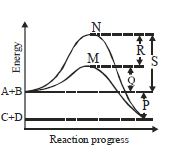
$A_{(g)} + B_{(g)} \rightleftharpoons C_{(g)} + D_{(g)}$
The curves $M$ and $N$ represent the variation of energy with reaction coordinate for the reaction in absence and presence of catalyst.
Which value represents the activation energy $(E_a)$ for the backward reaction in the presence of catalyst?
The curves $M$ and $N$ represent the variation of energy with reaction coordinate for the reaction in absence and presence of catalyst.
Which value represents the activation energy $(E_a)$ for the backward reaction in the presence of catalyst?
A
$P$
B
$Q$
C
$S+P$
D
$P+Q$
Solution
(D) $1$. In the given energy profile diagram,curve $N$ represents the reaction without a catalyst,and curve $M$ represents the reaction with a catalyst.
$2$. The activation energy for the backward reaction is the energy difference between the transition state (peak of the curve) and the energy level of the products $(C+D)$.
$3$. In the presence of a catalyst,the transition state is at the energy level corresponding to curve $M$.
$4$. The energy level of the products $(C+D)$ is at a distance $P$ below the energy level of the reactants $(A+B)$.
$5$. The energy level of the transition state for the catalyzed reaction $(M)$ is at a distance $Q$ above the reactants $(A+B)$.
$6$. Therefore,the activation energy for the backward reaction in the presence of a catalyst is the sum of the energy difference between the products and reactants $(P)$ and the energy difference between the reactants and the catalyzed transition state $(Q)$,which is $P+Q$.
$2$. The activation energy for the backward reaction is the energy difference between the transition state (peak of the curve) and the energy level of the products $(C+D)$.
$3$. In the presence of a catalyst,the transition state is at the energy level corresponding to curve $M$.
$4$. The energy level of the products $(C+D)$ is at a distance $P$ below the energy level of the reactants $(A+B)$.
$5$. The energy level of the transition state for the catalyzed reaction $(M)$ is at a distance $Q$ above the reactants $(A+B)$.
$6$. Therefore,the activation energy for the backward reaction in the presence of a catalyst is the sum of the energy difference between the products and reactants $(P)$ and the energy difference between the reactants and the catalyzed transition state $(Q)$,which is $P+Q$.
0 likes
View Solution161
MediumMCQ
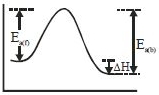
For an exothermic reaction $A \to B$,the activation energy is $65 \ kJ \ mol^{-1}$ and the heat of reaction is $-42 \ kJ \ mol^{-1}$. The activation energy for the reverse reaction $B \to A$ would be....... $kJ \ mol^{-1}$
A
$23$
B
$107$
C
$65$
D
$42$
Solution
(B) For an exothermic reaction,the relationship between the activation energy of the forward reaction $(E_{a(f)})$,the activation energy of the backward reaction $(E_{a(b)})$,and the enthalpy change $(\Delta H)$ is given by:
$\Delta H = E_{a(f)} - E_{a(b)}$
Given:
$E_{a(f)} = 65 \ kJ \ mol^{-1}$
$\Delta H = -42 \ kJ \ mol^{-1}$
Substituting the values:
$-42 = 65 - E_{a(b)}$
$E_{a(b)} = 65 + 42 = 107 \ kJ \ mol^{-1}$
$\Delta H = E_{a(f)} - E_{a(b)}$
Given:
$E_{a(f)} = 65 \ kJ \ mol^{-1}$
$\Delta H = -42 \ kJ \ mol^{-1}$
Substituting the values:
$-42 = 65 - E_{a(b)}$
$E_{a(b)} = 65 + 42 = 107 \ kJ \ mol^{-1}$
0 likes
View Solution162
DifficultMCQ
Consider the following statements:
$(i)$ Increase in concentration of reactant increases the rate of a zero order reaction
$(ii)$ Rate constant $k$ is equal to $A$ if $E_a = 0$
$(iii)$ Rate constant $k$ is equal to $A$ if $E_a = \infty$
$(iv)$ $\log_e k$ vs $T$ is a straight line
$(v)$ $\log_e k$ vs $1/T$ is a straight line
Which of the following statements are correct?
$(i)$ Increase in concentration of reactant increases the rate of a zero order reaction
$(ii)$ Rate constant $k$ is equal to $A$ if $E_a = 0$
$(iii)$ Rate constant $k$ is equal to $A$ if $E_a = \infty$
$(iv)$ $\log_e k$ vs $T$ is a straight line
$(v)$ $\log_e k$ vs $1/T$ is a straight line
Which of the following statements are correct?
A
$(i)$ and $(iv)$
B
$(ii)$ and $(v)$
C
$(iii)$ and $(iv)$
D
$(ii)$ and $(iii)$
Solution
(B) The Arrhenius equation is given by $k = A \times e^{-E_a/RT}$.
Statement $(i)$ is incorrect because the rate of a zero-order reaction is independent of the concentration of the reactant.
Statement $(ii)$ is correct because if $E_a = 0$,then $k = A \times e^0 = A$.
Statement $(iii)$ is incorrect because if $E_a = \infty$,then $k = A \times e^{-\infty} = 0$.
Statement $(iv)$ is incorrect because $\ln k = \ln A - \frac{E_a}{RT}$,which shows that $\ln k$ is a function of $1/T$,not $T$.
Statement $(v)$ is correct because the equation $\ln k = \ln A - \frac{E_a}{R} \times (1/T)$ represents a straight line with a slope of $-E_a/R$ when plotting $\ln k$ versus $1/T$.
Therefore,statements $(ii)$ and $(v)$ are correct.
Statement $(i)$ is incorrect because the rate of a zero-order reaction is independent of the concentration of the reactant.
Statement $(ii)$ is correct because if $E_a = 0$,then $k = A \times e^0 = A$.
Statement $(iii)$ is incorrect because if $E_a = \infty$,then $k = A \times e^{-\infty} = 0$.
Statement $(iv)$ is incorrect because $\ln k = \ln A - \frac{E_a}{RT}$,which shows that $\ln k$ is a function of $1/T$,not $T$.
Statement $(v)$ is correct because the equation $\ln k = \ln A - \frac{E_a}{R} \times (1/T)$ represents a straight line with a slope of $-E_a/R$ when plotting $\ln k$ versus $1/T$.
Therefore,statements $(ii)$ and $(v)$ are correct.
0 likes
View Solution163
DifficultMCQ
For reaction $A \to B$,the rate constant $k_1 = A_1 e^{-E_{a_1} / (RT)}$ and for the reaction $X \to Y$ the rate constant $k_2 = A_2 e^{-E_{a_2} / (RT)}$. If $A_1 = 10^8$,$A_2 = 10^{10}$ and $E_{a_1} = 600 \ cal/mol$,$E_{a_2} = 1800 \ cal/mol$,then the temperature at which $k_1 = k_2$ is (Given : $R = 2 \ cal/K \cdot mol$)
A
$1200 \ K$
B
$1200 \times 4.606 \ K$
C
$\frac{1200}{4.606} \ K$
D
$\frac{600}{4.606} \ K$
Solution
(D) Given that $k_1 = k_2$,we have $A_1 e^{-E_{a_1} / RT} = A_2 e^{-E_{a_2} / RT}$.
Substituting the values: $10^8 e^{-600 / RT} = 10^{10} e^{-1800 / RT}$.
Rearranging the terms: $\frac{e^{-600 / RT}}{e^{-1800 / RT}} = \frac{10^{10}}{10^8}$.
$e^{(1800 - 600) / RT} = 10^2$.
$e^{1200 / RT} = 100$.
Taking the natural logarithm on both sides: $\frac{1200}{RT} = \ln(100) = 2 \ln(10)$.
Using $\ln(10) \approx 2.303$ and $R = 2 \ cal/K \cdot mol$:
$\frac{1200}{2 \times T} = 2 \times 2.303$.
$\frac{600}{T} = 4.606$.
$T = \frac{600}{4.606} \ K$.
Substituting the values: $10^8 e^{-600 / RT} = 10^{10} e^{-1800 / RT}$.
Rearranging the terms: $\frac{e^{-600 / RT}}{e^{-1800 / RT}} = \frac{10^{10}}{10^8}$.
$e^{(1800 - 600) / RT} = 10^2$.
$e^{1200 / RT} = 100$.
Taking the natural logarithm on both sides: $\frac{1200}{RT} = \ln(100) = 2 \ln(10)$.
Using $\ln(10) \approx 2.303$ and $R = 2 \ cal/K \cdot mol$:
$\frac{1200}{2 \times T} = 2 \times 2.303$.
$\frac{600}{T} = 4.606$.
$T = \frac{600}{4.606} \ K$.
0 likes
View Solution164
DifficultMCQ
$A$ reaction takes place in three steps with individual rate constant and activation energy as follows:
If overall rate constant,$k = (\frac{k_1 k_2}{k_3})^{2/3}$,then overall activation energy of the reaction will be .......... $kJ/mol$.
| $Step$ | $Rate \ constant$ | $Activation \ energy$ |
| $Step-1$ | $k_1$ | $E_{a1} = 180 \ kJ/mol$ |
| $Step-2$ | $k_2$ | $E_{a2} = 80 \ kJ/mol$ |
| $Step-3$ | $k_3$ | $E_{a3} = 50 \ kJ/mol$ |
A
$140$
B
$150$
C
$130$
D
$120$
Solution
(A) The overall rate constant $k$ is given by $k = (\frac{k_1 k_2}{k_3})^{2/3}$.
Using the Arrhenius equation $k = A e^{-E_a/RT}$,we substitute the expressions for each rate constant:
$e^{-E_a/RT} = [\frac{e^{-E_{a1}/RT} \times e^{-E_{a2}/RT}}{e^{-E_{a3}/RT}}]^{2/3}$
Taking the natural logarithm on both sides:
$-\frac{E_a}{RT} = \frac{2}{3} [-\frac{E_{a1}}{RT} - \frac{E_{a2}}{RT} + \frac{E_{a3}}{RT}]$
$E_a = \frac{2}{3} [E_{a1} + E_{a2} - E_{a3}]$
Substituting the given values:
$E_a = \frac{2}{3} [180 + 80 - 50] = \frac{2}{3} [210] = 140 \ kJ/mol$.
Using the Arrhenius equation $k = A e^{-E_a/RT}$,we substitute the expressions for each rate constant:
$e^{-E_a/RT} = [\frac{e^{-E_{a1}/RT} \times e^{-E_{a2}/RT}}{e^{-E_{a3}/RT}}]^{2/3}$
Taking the natural logarithm on both sides:
$-\frac{E_a}{RT} = \frac{2}{3} [-\frac{E_{a1}}{RT} - \frac{E_{a2}}{RT} + \frac{E_{a3}}{RT}]$
$E_a = \frac{2}{3} [E_{a1} + E_{a2} - E_{a3}]$
Substituting the given values:
$E_a = \frac{2}{3} [180 + 80 - 50] = \frac{2}{3} [210] = 140 \ kJ/mol$.
0 likes
View Solution165
MediumMCQ
$A$ reaction rate constant is given by $k = 1.2 \times 10^{14} \, e^{-25000/RT} \, sec^{-1}$. It means
A
$\log \, k$ versus $\log \, T$ will give a straight line with a slope as $25000$
B
$\log \, k$ versus $\log \, T$ will give a straight line with a slope as $-2500$
C
$\log \, k$ versus $\log \, T$ will give a straight line with a slope as $-25000$
D
$\log \, k$ versus $1/T$ will give a straight line
Solution
(D) The Arrhenius equation is given by $k = A \, e^{-E_a/RT}$.
Taking the natural logarithm on both sides: $\ln \, k = \ln \, A - \frac{E_a}{RT}$.
Converting to base $10$ logarithm: $\log \, k = \log \, A - \frac{E_a}{2.303 \, R} \times \frac{1}{T}$.
Comparing this with the equation of a straight line $y = mx + c$,where $y = \log \, k$ and $x = \frac{1}{T}$,the slope $m = -\frac{E_a}{2.303 \, R}$.
Therefore,a plot of $\log \, k$ versus $\frac{1}{T}$ yields a straight line.
Taking the natural logarithm on both sides: $\ln \, k = \ln \, A - \frac{E_a}{RT}$.
Converting to base $10$ logarithm: $\log \, k = \log \, A - \frac{E_a}{2.303 \, R} \times \frac{1}{T}$.
Comparing this with the equation of a straight line $y = mx + c$,where $y = \log \, k$ and $x = \frac{1}{T}$,the slope $m = -\frac{E_a}{2.303 \, R}$.
Therefore,a plot of $\log \, k$ versus $\frac{1}{T}$ yields a straight line.
0 likes
View Solution166
MediumMCQ
If for two reactions $E_{a_1} > E_{a_2}$ and $\mu_1$ and $\mu_2$ are their respective temperature coefficients,then which of the following is correct?
A
$\mu_1 > \mu_2$
B
$\mu_1 < \mu_2$
C
$\mu_1 = \mu_2$
D
$\text{None of these}$
Solution
(A) The temperature coefficient $\mu$ is defined as the ratio of rate constants at temperatures $(T + 10) \ K$ and $T \ K$.
From the Arrhenius equation,$k = Ae^{-E_a / RT}$,it can be derived that $\log \mu \propto E_a$.
This implies that the temperature coefficient $\mu$ increases as the activation energy $E_a$ increases.
Given $E_{a_1} > E_{a_2}$,it follows that $\mu_1 > \mu_2$.
From the Arrhenius equation,$k = Ae^{-E_a / RT}$,it can be derived that $\log \mu \propto E_a$.
This implies that the temperature coefficient $\mu$ increases as the activation energy $E_a$ increases.
Given $E_{a_1} > E_{a_2}$,it follows that $\mu_1 > \mu_2$.
0 likes
View Solution167
MediumMCQ
For a reaction $E_a = 0$ and $k = 3.2 \times 10^8 \ s^{-1}$ at $300 \ K$. The value of frequency factor at $400 \ K$ would be
A
$6.4 \times 10^4 \ s^{-1}$
B
$3.2 \times 10^4 \ s^{-1}$
C
$3.2 \times 10^8 \ s^{-1}$
D
$3.2 \times 10^5 \ s^{-1}$
Solution
(C) The Arrhenius equation is given by $k = A \times e^{-E_a / (RT)}$.
Given that the activation energy $E_a = 0$.
Substituting $E_a = 0$ into the equation,we get $k = A \times e^0 = A \times 1 = A$.
This implies that the rate constant $k$ is equal to the frequency factor $A$ and is independent of temperature $T$.
Since $k = 3.2 \times 10^8 \ s^{-1}$ at $300 \ K$,the frequency factor $A$ is $3.2 \times 10^8 \ s^{-1}$.
Therefore,at $400 \ K$,the value of the frequency factor $A$ remains $3.2 \times 10^8 \ s^{-1}$.
Given that the activation energy $E_a = 0$.
Substituting $E_a = 0$ into the equation,we get $k = A \times e^0 = A \times 1 = A$.
This implies that the rate constant $k$ is equal to the frequency factor $A$ and is independent of temperature $T$.
Since $k = 3.2 \times 10^8 \ s^{-1}$ at $300 \ K$,the frequency factor $A$ is $3.2 \times 10^8 \ s^{-1}$.
Therefore,at $400 \ K$,the value of the frequency factor $A$ remains $3.2 \times 10^8 \ s^{-1}$.
0 likes
View Solution168
MediumMCQ
The rate of reaction is tripled for a $10^\circ C$ rise in temperature. The increase in the reaction rate if the temperature is increased by $60^\circ C$ is $............$ times.
A
$81$
B
$243$
C
$729$
D
$614$
Solution
(C) The temperature coefficient $\mu$ is given as $3$ for a $10^\circ C$ rise in temperature.
The change in temperature $\Delta T$ is $60^\circ C$.
The increase in the reaction rate is calculated using the formula: $\text{Rate increase} = \mu^{(\Delta T / 10)}$.
Substituting the values: $\text{Rate increase} = 3^{(60 / 10)} = 3^6$.
Calculating the value: $3^6 = 3 \times 3 \times 3 \times 3 \times 3 \times 3 = 729$.
The change in temperature $\Delta T$ is $60^\circ C$.
The increase in the reaction rate is calculated using the formula: $\text{Rate increase} = \mu^{(\Delta T / 10)}$.
Substituting the values: $\text{Rate increase} = 3^{(60 / 10)} = 3^6$.
Calculating the value: $3^6 = 3 \times 3 \times 3 \times 3 \times 3 \times 3 = 729$.
0 likes
View Solution169
MediumMCQ
For a first order reaction,the rate of reaction is $2.4 \times 10^{-3} \ mol \ L^{-1} \ s^{-1}$ at $27 \ ^\circ C$. The activation energy of the reaction is $24.942 \ kJ \ mol^{-1}$. The rate of reaction at $327 \ ^\circ C$ is ....... $mol \ L^{-1} \ s^{-1}$ [Take $e^5 = 150$,$e^{0.005} = 1$,$e^4 = 55$].
A
$0.36$
B
$1.6 \times 10^{-5}$
C
$2.4 \times 10^{-3}$
D
$0.13$
Solution
(A) The Arrhenius equation is given by $\ln(\frac{k_2}{k_1}) = \frac{E_a}{R} (\frac{1}{T_1} - \frac{1}{T_2})$.
Given: $T_1 = 27 + 273 = 300 \ K$,$T_2 = 327 + 273 = 600 \ K$,$E_a = 24.942 \ kJ \ mol^{-1} = 24942 \ J \ mol^{-1}$,$R = 8.314 \ J \ K^{-1} \ mol^{-1}$.
Substituting the values: $\ln(\frac{k_2}{k_1}) = \frac{24942}{8.314} (\frac{1}{300} - \frac{1}{600}) = 3000 \times (\frac{2-1}{600}) = 3000 \times \frac{1}{600} = 5$.
Therefore,$\frac{k_2}{k_1} = e^5 = 150$.
Since the rate of a first-order reaction is proportional to the rate constant $(Rate = k[A])$,the ratio of rates is equal to the ratio of rate constants.
$Rate_2 = 150 \times Rate_1 = 150 \times 2.4 \times 10^{-3} = 360 \times 10^{-3} = 0.36 \ mol \ L^{-1} \ s^{-1}$.
Given: $T_1 = 27 + 273 = 300 \ K$,$T_2 = 327 + 273 = 600 \ K$,$E_a = 24.942 \ kJ \ mol^{-1} = 24942 \ J \ mol^{-1}$,$R = 8.314 \ J \ K^{-1} \ mol^{-1}$.
Substituting the values: $\ln(\frac{k_2}{k_1}) = \frac{24942}{8.314} (\frac{1}{300} - \frac{1}{600}) = 3000 \times (\frac{2-1}{600}) = 3000 \times \frac{1}{600} = 5$.
Therefore,$\frac{k_2}{k_1} = e^5 = 150$.
Since the rate of a first-order reaction is proportional to the rate constant $(Rate = k[A])$,the ratio of rates is equal to the ratio of rate constants.
$Rate_2 = 150 \times Rate_1 = 150 \times 2.4 \times 10^{-3} = 360 \times 10^{-3} = 0.36 \ mol \ L^{-1} \ s^{-1}$.
0 likes
View Solution170
DifficultMCQ
For the gaseous reactions,calculate the approximate value of temperature at which $k_1 = k_2$. $[ln\, 10 = 2.3]$.
$A \to B$ $k_1 = 10^{15} e^{-25000 / 8.314\, T}$
$C \to D$ $k_2 = 10^{14} e^{-15000 / 8.314\, T}$
$A \to B$ $k_1 = 10^{15} e^{-25000 / 8.314\, T}$
$C \to D$ $k_2 = 10^{14} e^{-15000 / 8.314\, T}$
A
$522$
B
$434$
C
$320$
D
$500$
Solution
(A) Given $k_1 = k_2$:
$10^{15} e^{-25000 / 8.314\, T} = 10^{14} e^{-15000 / 8.314\, T}$
$\frac{10^{15}}{10^{14}} = e^{(25000 - 15000) / 8.314\, T}$
$10 = e^{10000 / 8.314\, T}$
Taking natural logarithm on both sides:
$ln(10) = \frac{10000}{8.314\, T}$
Given $ln(10) = 2.3$:
$2.3 = \frac{10000}{8.314\, T}$
$T = \frac{10000}{8.314 \times 2.3} \approx 522\, K$
Thus,the temperature is $522\, K$.
$10^{15} e^{-25000 / 8.314\, T} = 10^{14} e^{-15000 / 8.314\, T}$
$\frac{10^{15}}{10^{14}} = e^{(25000 - 15000) / 8.314\, T}$
$10 = e^{10000 / 8.314\, T}$
Taking natural logarithm on both sides:
$ln(10) = \frac{10000}{8.314\, T}$
Given $ln(10) = 2.3$:
$2.3 = \frac{10000}{8.314\, T}$
$T = \frac{10000}{8.314 \times 2.3} \approx 522\, K$
Thus,the temperature is $522\, K$.
0 likes
View Solution171
EasyMCQ
In the given expression $r = P Z_{AB} e^{-E_a/RT}$,which term is called the steric factor?
A
$Z_{AB}$
B
$P$
C
$e^{-E_a/RT}$
D
$P Z_{AB}$
Solution
(B) In the Arrhenius equation modified by collision theory,$r = P Z_{AB} e^{-E_a/RT}$,the term $P$ is known as the steric factor or probability factor.
It accounts for the requirement that molecules must be properly oriented during a collision to result in a chemical reaction.
It accounts for the requirement that molecules must be properly oriented during a collision to result in a chemical reaction.
0 likes
View Solution172
MediumMCQ
How much faster would a reaction proceed at $25\,^{\circ}C$ than at $0\,^{\circ}C$ if the activation energy is $65\,kJ/mol$?
A
$2$
B
$16$
C
$11$
D
$6$
Solution
(C) Using the Arrhenius equation: $\log \frac{K_{2}}{K_{1}} = \frac{E_{a}}{2.303 R} \left[ \frac{T_{2} - T_{1}}{T_{1} T_{2}} \right]$
Given: $E_{a} = 65,000 \, J/mol$,$R = 8.314 \, J/K \cdot mol$,$T_{1} = 273 \, K$,$T_{2} = 298 \, K$.
Substituting the values:
$\log \frac{K_{2}}{K_{1}} = \frac{65000}{2.303 \times 8.314} \left[ \frac{298 - 273}{273 \times 298} \right]$
$\log \frac{K_{2}}{K_{1}} = \frac{65000}{19.147} \times \frac{25}{81354}$
$\log \frac{K_{2}}{K_{1}} = 3394.78 \times 0.000307 \approx 1.043$
$\frac{K_{2}}{K_{1}} = 10^{1.043} \approx 11$
Thus,the reaction proceeds approximately $11$ times faster.
Given: $E_{a} = 65,000 \, J/mol$,$R = 8.314 \, J/K \cdot mol$,$T_{1} = 273 \, K$,$T_{2} = 298 \, K$.
Substituting the values:
$\log \frac{K_{2}}{K_{1}} = \frac{65000}{2.303 \times 8.314} \left[ \frac{298 - 273}{273 \times 298} \right]$
$\log \frac{K_{2}}{K_{1}} = \frac{65000}{19.147} \times \frac{25}{81354}$
$\log \frac{K_{2}}{K_{1}} = 3394.78 \times 0.000307 \approx 1.043$
$\frac{K_{2}}{K_{1}} = 10^{1.043} \approx 11$
Thus,the reaction proceeds approximately $11$ times faster.
0 likes
View Solution173
MediumMCQ
In the Arrhenius equation,$k = A e^{-E_a/RT}$,the Arrhenius constant $A$ will be equal to the rate constant when
A
$E_a = 0$
B
$T = \infty$
C
$T = 0$
D
$E_a = \infty$
Solution
(A, B) The Arrhenius equation is given by $k = A e^{-E_a/RT}$.
For the rate constant $k$ to be equal to the Arrhenius constant $A$,the exponential term $e^{-E_a/RT}$ must be equal to $1$.
This occurs when the exponent is $0$,i.e.,$-E_a/RT = 0$.
This condition is satisfied if $E_a = 0$ (activation energy is zero).
Alternatively,as $T \to \infty$,the term $E_a/RT \to 0$,so $e^0 = 1$,which also makes $k = A$.
For the rate constant $k$ to be equal to the Arrhenius constant $A$,the exponential term $e^{-E_a/RT}$ must be equal to $1$.
This occurs when the exponent is $0$,i.e.,$-E_a/RT = 0$.
This condition is satisfied if $E_a = 0$ (activation energy is zero).
Alternatively,as $T \to \infty$,the term $E_a/RT \to 0$,so $e^0 = 1$,which also makes $k = A$.
0 likes
View Solution174
MediumMCQ
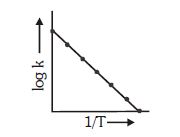
The temperature dependence of the rate constant $k$ is expressed as $k = A e^{-E_a / RT}$. When a plot between $\log k$ and $1/T$ is plotted,we get the graph as shown. What is the value of the slope in the graph?
A
$\frac{E_a}{RT}$
B
$-\frac{E_a}{2.303R}$
C
$-\frac{E_a}{2.303RT} \log A$
D
$-\frac{E_a}{2.303} \frac{R}{T}$
Solution
(B) The Arrhenius equation is given by $k = A e^{-E_a / RT}$.
Taking the natural logarithm on both sides:
$\ln k = \ln A - \frac{E_a}{RT}$.
To convert this to base $10$ logarithm,we divide by $2.303$:
$\log k = \log A - \frac{E_a}{2.303 RT}$.
This equation is in the form of a straight line $y = mx + c$,where $y = \log k$,$x = 1/T$,$m = -\frac{E_a}{2.303 R}$,and $c = \log A$.
Therefore,the slope of the graph is $-\frac{E_a}{2.303 R}$.
Taking the natural logarithm on both sides:
$\ln k = \ln A - \frac{E_a}{RT}$.
To convert this to base $10$ logarithm,we divide by $2.303$:
$\log k = \log A - \frac{E_a}{2.303 RT}$.
This equation is in the form of a straight line $y = mx + c$,where $y = \log k$,$x = 1/T$,$m = -\frac{E_a}{2.303 R}$,and $c = \log A$.
Therefore,the slope of the graph is $-\frac{E_a}{2.303 R}$.
0 likes
View Solution175
MediumMCQ
For a reaction,the rate constant is expressed as,$K = A \cdot e^{-40000/T}$. The energy of activation is ....... $cal$.
A
$40000$
B
$88000$
C
$80000$
D
$8000$
Solution
(C) The Arrhenius equation is given by $K = A \cdot e^{-E_a / RT}$.
Comparing this with the given equation $K = A \cdot e^{-40000/T}$,we get $\frac{E_a}{R} = 40000$.
Given that the gas constant $R \approx 2 \, cal \cdot K^{-1} \cdot mol^{-1}$.
Therefore,$E_a = 40000 \times 2 = 80000 \, cal$.
Comparing this with the given equation $K = A \cdot e^{-40000/T}$,we get $\frac{E_a}{R} = 40000$.
Given that the gas constant $R \approx 2 \, cal \cdot K^{-1} \cdot mol^{-1}$.
Therefore,$E_a = 40000 \times 2 = 80000 \, cal$.
0 likes
View Solution176
MediumMCQ
In a reaction,for every $10 ^\circ C$ rise in temperature,the rate is doubled. If the temperature is increased from $10 ^\circ C$ to $100 ^\circ C$,the rate of the reaction will become ......... times.
A
$64$
B
$128$
C
$256$
D
$512$
Solution
(D) The rate of reaction increases by a factor of $2^{\frac{\Delta T}{10}}$ for every $10 ^\circ C$ rise in temperature.
Here,$\Delta T = 100 ^\circ C - 10 ^\circ C = 90 ^\circ C$.
Therefore,the rate of reaction will become $(2)^{\frac{90}{10}}$ times.
$= 2^9 = 512$ times.
Here,$\Delta T = 100 ^\circ C - 10 ^\circ C = 90 ^\circ C$.
Therefore,the rate of reaction will become $(2)^{\frac{90}{10}}$ times.
$= 2^9 = 512$ times.
0 likes
View Solution177
DifficultMCQ
The rate of a reaction doubles when its temperature changes from $300 \ K$ to $310 \ K$. The activation energy of such a reaction will be ........ $kJ/mol$.
A
$53.6$
B
$48.6$
C
$53.6$
D
$60.5$
Solution
(A) Using the Arrhenius equation: $\log \frac{K_{2}}{K_{1}} = \frac{E_a}{2.303 \ R} \left( \frac{T_{2} - T_{1}}{T_{1} T_{2}} \right)$
Given: $K_{2} = 2K_{1}$,$T_{1} = 300 \ K$,$T_{2} = 310 \ K$,$R = 8.314 \ J \ K^{-1} \ mol^{-1}$.
$\log 2 = \frac{E_a}{2.303 \times 8.314} \left( \frac{310 - 300}{300 \times 310} \right)$
$0.3010 = \frac{E_a}{19.147} \left( \frac{10}{93000} \right)$
$E_a = \frac{0.3010 \times 19.147 \times 93000}{10} \ J/mol$
$E_a \approx 53598 \ J/mol = 53.6 \ kJ/mol$.
Given: $K_{2} = 2K_{1}$,$T_{1} = 300 \ K$,$T_{2} = 310 \ K$,$R = 8.314 \ J \ K^{-1} \ mol^{-1}$.
$\log 2 = \frac{E_a}{2.303 \times 8.314} \left( \frac{310 - 300}{300 \times 310} \right)$
$0.3010 = \frac{E_a}{19.147} \left( \frac{10}{93000} \right)$
$E_a = \frac{0.3010 \times 19.147 \times 93000}{10} \ J/mol$
$E_a \approx 53598 \ J/mol = 53.6 \ kJ/mol$.
0 likes
View Solution178
MediumMCQ
For a chemical reaction,if the temperature is increased from $25\,^{\circ}C$ to $55\,^{\circ}C$,the rate of reaction will change by a factor of (Assume $\mu = 3$).
A
$27$
B
$9$
C
$3$
D
$2$
Solution
(A) The rate of reaction changes with temperature according to the formula: $\frac{R_{2}}{R_{1}} = (\mu)^{\frac{\Delta T}{10}}$.
Here,$\Delta T = 55\,^{\circ}C - 25\,^{\circ}C = 30\,^{\circ}C$ and $\mu = 3$.
Substituting the values: $\frac{R_{2}}{R_{1}} = (3)^{\frac{30}{10}} = (3)^{3} = 27$.
Here,$\Delta T = 55\,^{\circ}C - 25\,^{\circ}C = 30\,^{\circ}C$ and $\mu = 3$.
Substituting the values: $\frac{R_{2}}{R_{1}} = (3)^{\frac{30}{10}} = (3)^{3} = 27$.
0 likes
View Solution179
MediumMCQ
Which of the following statements is correct regarding the Arrhenius equation and reaction kinetics?
A
Larger the activation energy,higher will be the value of temperature coefficient of reaction.
B
With an increase in temperature,in the high-temperature range,the rate constant increases more as compared to the low-temperature range.
C
The graph of $\ln k$ vs $\frac{1}{T}$ is a straight line with a slope of $-\frac{E_a}{R}$.
D
Chemical reactions with low activation energy always occur at a faster rate compared to reactions with higher activation energy.
Solution
(C) The Arrhenius equation is given by $k = A e^{-\frac{E_a}{RT}}$.
Taking the natural logarithm on both sides,we get $\ln k = \ln A - \frac{E_a}{RT}$.
Comparing this with the equation of a straight line $y = mx + c$,where $y = \ln k$ and $x = \frac{1}{T}$,the slope $m = -\frac{E_a}{R}$.
Option $C$ is correct because the slope of the plot of $\ln k$ versus $\frac{1}{T}$ is $-\frac{E_a}{R}$.
Note: If the plot is $\log_{10} k$ versus $\frac{1}{T}$,the slope is $-\frac{E_a}{2.303R}$.
Taking the natural logarithm on both sides,we get $\ln k = \ln A - \frac{E_a}{RT}$.
Comparing this with the equation of a straight line $y = mx + c$,where $y = \ln k$ and $x = \frac{1}{T}$,the slope $m = -\frac{E_a}{R}$.
Option $C$ is correct because the slope of the plot of $\ln k$ versus $\frac{1}{T}$ is $-\frac{E_a}{R}$.
Note: If the plot is $\log_{10} k$ versus $\frac{1}{T}$,the slope is $-\frac{E_a}{2.303R}$.
0 likes
View Solution180
MediumMCQ
Rate constant of a reaction is given as $\log_{10} K = -\frac{2000}{T} + 6.0$. Activation energy is ....... $kcal$.
A
$9.21$
B
$2.30$
C
$4.61$
D
$1.15$
Solution
(A) The Arrhenius equation in logarithmic form is $\log_{10} K = \log_{10} A - \frac{E_a}{2.303RT}$.
Comparing this with the given equation $\log_{10} K = -\frac{2000}{T} + 6.0$,we get $\frac{E_a}{2.303R} = 2000$.
Given $R = 1.987 \times 10^{-3} \ kcal \ K^{-1} \ mol^{-1} \approx 2 \times 10^{-3} \ kcal \ K^{-1} \ mol^{-1}$.
$E_a = 2000 \times 2.303 \times 2 \times 10^{-3} \ kcal \ mol^{-1}$.
$E_a = 2000 \times 2.303 \times 0.002 = 9.212 \ kcal \ mol^{-1}$.
Thus,the activation energy is $9.21 \ kcal \ mol^{-1}$.
Comparing this with the given equation $\log_{10} K = -\frac{2000}{T} + 6.0$,we get $\frac{E_a}{2.303R} = 2000$.
Given $R = 1.987 \times 10^{-3} \ kcal \ K^{-1} \ mol^{-1} \approx 2 \times 10^{-3} \ kcal \ K^{-1} \ mol^{-1}$.
$E_a = 2000 \times 2.303 \times 2 \times 10^{-3} \ kcal \ mol^{-1}$.
$E_a = 2000 \times 2.303 \times 0.002 = 9.212 \ kcal \ mol^{-1}$.
Thus,the activation energy is $9.21 \ kcal \ mol^{-1}$.
0 likes
View Solution181
DifficultMCQ
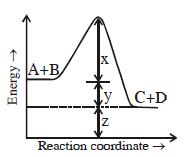
The following energy profile diagram is given for the reaction $A + B \to C + D$. The enthalpy change and activation energy for the reverse reaction $C + D \to A + B$ are respectively:
A
$x, y$
B
$x, x + y$
C
$y, x + y$
D
$y, y + z$
Solution
(C) For the forward reaction $A + B \to C + D$,the activation energy is $x$ and the enthalpy change is $-y$ (since it is an exothermic reaction).
For the reverse reaction $C + D \to A + B$:
$1$. The enthalpy change is equal in magnitude but opposite in sign to the forward reaction,which is $y$.
$2$. The activation energy for the reverse reaction is the energy difference between the transition state and the reactants $(C + D)$,which is $x + y$.
For the reverse reaction $C + D \to A + B$:
$1$. The enthalpy change is equal in magnitude but opposite in sign to the forward reaction,which is $y$.
$2$. The activation energy for the reverse reaction is the energy difference between the transition state and the reactants $(C + D)$,which is $x + y$.
0 likes
View Solution182
MediumMCQ
The activation energy for the reaction $2HI_{(g)} \to H_{2_{(g)}} + I_{2_{(g)}}$ is $200 \ kJ \ mol^{-1}$ at $600 \ K$. Calculate the fraction of molecules of reactant having energy equal to or greater than activation energy.
A
$e^{-30}$
B
$e^{-40}$
C
$e^{-2.5}$
D
$e^{-1/3}$
Solution
(B) The fraction of molecules $(f)$ having energy equal to or greater than the activation energy $(E_a)$ is given by the Arrhenius equation: $f = e^{-E_a/RT}$.
Given:
$E_a = 200 \ kJ \ mol^{-1} = 200,000 \ J \ mol^{-1}$
$R = 8.314 \ J \ K^{-1} \ mol^{-1}$
$T = 600 \ K$
Substituting the values:
$f = e^{-(200,000) / (8.314 \times 600)}$
$f = e^{-(200,000) / (4988.4)}$
$f \approx e^{-40.09} \approx e^{-40}$.
Given:
$E_a = 200 \ kJ \ mol^{-1} = 200,000 \ J \ mol^{-1}$
$R = 8.314 \ J \ K^{-1} \ mol^{-1}$
$T = 600 \ K$
Substituting the values:
$f = e^{-(200,000) / (8.314 \times 600)}$
$f = e^{-(200,000) / (4988.4)}$
$f \approx e^{-40.09} \approx e^{-40}$.
0 likes
View Solution183
DifficultMCQ
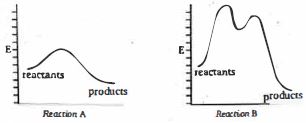
For the following two reactions,which statement is true?
A
Reaction $A$ is faster and less exergonic than $B$
B
Reaction $B$ is faster and more exergonic than $A$
C
Reaction $A$ is faster and less endergonic than $B$
D
Reaction $B$ is faster and more endergonic than $A$
Solution
(A) $1$. The rate of a reaction is inversely proportional to the activation energy $(E_a)$. $A$ lower activation energy means a faster reaction rate.
$2$. From the provided energy profile diagrams,it is clear that the activation energy for reaction $A$ $(E_{a1})$ is lower than the activation energy for reaction $B$ $(E_{a2})$,i.e.,$E_{a1} < E_{a2}$. Therefore,reaction $A$ is faster than reaction $B$.
$3$. Exergonic reactions are those where the free energy of the products is lower than that of the reactants (negative $\Delta G$). Both reactions are exergonic as the energy of the products is lower than the reactants.
$4$. Comparing the overall energy change $(\Delta E)$,the drop in energy for reaction $B$ is greater than for reaction $A$,making reaction $B$ more exergonic than reaction $A$.
$5$. Thus,reaction $A$ is faster,but reaction $B$ is more exergonic. This implies that reaction $A$ is faster and less exergonic than reaction $B$.
$2$. From the provided energy profile diagrams,it is clear that the activation energy for reaction $A$ $(E_{a1})$ is lower than the activation energy for reaction $B$ $(E_{a2})$,i.e.,$E_{a1} < E_{a2}$. Therefore,reaction $A$ is faster than reaction $B$.
$3$. Exergonic reactions are those where the free energy of the products is lower than that of the reactants (negative $\Delta G$). Both reactions are exergonic as the energy of the products is lower than the reactants.
$4$. Comparing the overall energy change $(\Delta E)$,the drop in energy for reaction $B$ is greater than for reaction $A$,making reaction $B$ more exergonic than reaction $A$.
$5$. Thus,reaction $A$ is faster,but reaction $B$ is more exergonic. This implies that reaction $A$ is faster and less exergonic than reaction $B$.
0 likes
View Solution184
MediumMCQ
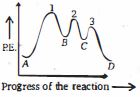
The energy profile diagram for a multi-step reaction,$A$ $\xrightarrow{1} B$ $\xrightarrow{2} C$ $\xrightarrow{3} D,$ is given below. The rate-determining step of the reaction is:
A
$A \to B$
B
$B \to C$
C
$C \to D$
D
Cannot be predicted
Solution
(A) The rate-determining step $(R.D.S.)$ of a multi-step reaction is the step with the highest activation energy $(E_a)$.
In the given energy profile diagram,the peak labeled $1$ represents the highest energy barrier relative to the preceding intermediate or reactant.
Therefore,the step corresponding to the highest peak,which is $A \to B$,is the rate-determining step.
In the given energy profile diagram,the peak labeled $1$ represents the highest energy barrier relative to the preceding intermediate or reactant.
Therefore,the step corresponding to the highest peak,which is $A \to B$,is the rate-determining step.
0 likes
View Solution185
MediumMCQ
Draw an energy profile diagram for a three-step reaction in which the first step is the slowest and the last step is the fastest. (Assume that the reaction is exothermic)
A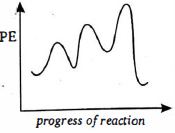
B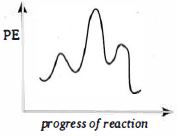
C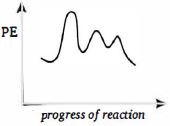
D
None of these
Solution
(C) According to the Arrhenius equation,$K = Ae^{-E_a/RT}$.
Therefore,a greater activation energy $(E_a)$ results in a smaller rate constant $(K)$.
The rate of reaction is inversely proportional to the height of the energy barrier.
Since the first step is the slowest (rate-determining step),it must have the highest activation energy barrier.
Therefore,the first peak in the energy profile diagram must be the highest,as shown in option $(C)$.
Therefore,a greater activation energy $(E_a)$ results in a smaller rate constant $(K)$.
The rate of reaction is inversely proportional to the height of the energy barrier.
Since the first step is the slowest (rate-determining step),it must have the highest activation energy barrier.
Therefore,the first peak in the energy profile diagram must be the highest,as shown in option $(C)$.
0 likes
View Solution186
MediumMCQ
The rate constant for a reaction can be increased by $\underline{a}$ the stability of the reactant or by $\underline{b}$ the stability of the transition state. Select the correct choice for $a$ and $b$.
A
decreasing,decreasing
B
increasing,decreasing
C
decreasing,increasing
D
increasing,increasing
Solution
(C) The rate constant $k$ is related to the activation energy $E_a$ by the Arrhenius equation,$k = A e^{-E_a/RT}$.
To increase the rate constant $k$,the activation energy $E_a$ must be decreased.
$E_a = E_{\text{transition state}} - E_{\text{reactant}}$.
Decreasing the stability of the reactant increases its energy,which decreases $E_a$.
Increasing the stability of the transition state decreases its energy,which also decreases $E_a$.
Therefore,the rate constant increases by decreasing the stability of the reactant or by increasing the stability of the transition state.
To increase the rate constant $k$,the activation energy $E_a$ must be decreased.
$E_a = E_{\text{transition state}} - E_{\text{reactant}}$.
Decreasing the stability of the reactant increases its energy,which decreases $E_a$.
Increasing the stability of the transition state decreases its energy,which also decreases $E_a$.
Therefore,the rate constant increases by decreasing the stability of the reactant or by increasing the stability of the transition state.
0 likes
View Solution187
AdvancedMCQ
The rate of a reaction $A$ doubles on increasing the temperature from $300 \, K$ to $310 \, K$. By how much should the temperature of reaction $B$ be increased from $300 \, K$ so that its rate doubles,if the activation energy of reaction $B$ is twice that of reaction $A$ (in $, K$)?
A
$9.84$
B
$4.92$
C
$2.45$
D
$19.67$
Solution
(B) Using the Arrhenius equation: $\ln(\frac{k_2}{k_1}) = \frac{E_a}{R} [\frac{T_2 - T_1}{T_1 T_2}]$.
For reaction $A$: $\ln(2) = \frac{E_{a,A}}{R} [\frac{310 - 300}{300 \times 310}] = \frac{E_{a,A}}{R} [\frac{10}{93000}]$.
For reaction $B$: $\ln(2) = \frac{E_{a,B}}{R} [\frac{\Delta T}{300(300 + \Delta T)}]$.
Given $E_{a,B} = 2 E_{a,A}$,we substitute $\ln(2)$ from reaction $A$ into reaction $B$:
$\frac{E_{a,A}}{R} [\frac{10}{93000}] = \frac{2 E_{a,A}}{R} [\frac{\Delta T}{300(300 + \Delta T)}]$.
$\frac{10}{93000} = \frac{2 \Delta T}{300(300 + \Delta T)}$.
$\frac{1}{9300} = \frac{\Delta T}{150(300 + \Delta T)}$.
$150(300 + \Delta T) = 9300 \Delta T$.
$45000 + 150 \Delta T = 9300 \Delta T$.
$9150 \Delta T = 45000$.
$\Delta T = \frac{45000}{9150} \approx 4.92 \, K$.
For reaction $A$: $\ln(2) = \frac{E_{a,A}}{R} [\frac{310 - 300}{300 \times 310}] = \frac{E_{a,A}}{R} [\frac{10}{93000}]$.
For reaction $B$: $\ln(2) = \frac{E_{a,B}}{R} [\frac{\Delta T}{300(300 + \Delta T)}]$.
Given $E_{a,B} = 2 E_{a,A}$,we substitute $\ln(2)$ from reaction $A$ into reaction $B$:
$\frac{E_{a,A}}{R} [\frac{10}{93000}] = \frac{2 E_{a,A}}{R} [\frac{\Delta T}{300(300 + \Delta T)}]$.
$\frac{10}{93000} = \frac{2 \Delta T}{300(300 + \Delta T)}$.
$\frac{1}{9300} = \frac{\Delta T}{150(300 + \Delta T)}$.
$150(300 + \Delta T) = 9300 \Delta T$.
$45000 + 150 \Delta T = 9300 \Delta T$.
$9150 \Delta T = 45000$.
$\Delta T = \frac{45000}{9150} \approx 4.92 \, K$.
0 likes
View Solution188
DifficultMCQ
The rate of a reaction quadruples when the temperature changes from $300 \, K$ to $310 \, K$. The activation energy of this reaction is ........... $kJ \, mol^{-1}$ (Assume activation energy and pre-exponential factor are independent of temperature; $\ln 2 = 0.693$; $R = 8.314 \, J \, mol^{-1} \, K^{-1}$)
A
$107.2$
B
$53.6$
C
$26.8$
D
$214.4$
Solution
(A) Using the Arrhenius equation: $\ln \frac{k_2}{k_1} = \frac{E_a}{R} \left( \frac{1}{T_1} - \frac{1}{T_2} \right)$
Given: $\frac{k_2}{k_1} = 4$,$T_1 = 300 \, K$,$T_2 = 310 \, K$,$R = 8.314 \, J \, mol^{-1} \, K^{-1}$,$\ln 2 = 0.693$.
$\ln 4 = \frac{E_a}{8.314} \left( \frac{310 - 300}{310 \times 300} \right)$
$2 \ln 2 = \frac{E_a}{8.314} \left( \frac{10}{93000} \right)$
$2 \times 0.693 = \frac{E_a}{8.314} \times \frac{1}{9300}$
$E_a = 1.386 \times 8.314 \times 9300 \, J \, mol^{-1} \approx 107200 \, J \, mol^{-1} = 107.2 \, kJ \, mol^{-1}$.
Given: $\frac{k_2}{k_1} = 4$,$T_1 = 300 \, K$,$T_2 = 310 \, K$,$R = 8.314 \, J \, mol^{-1} \, K^{-1}$,$\ln 2 = 0.693$.
$\ln 4 = \frac{E_a}{8.314} \left( \frac{310 - 300}{310 \times 300} \right)$
$2 \ln 2 = \frac{E_a}{8.314} \left( \frac{10}{93000} \right)$
$2 \times 0.693 = \frac{E_a}{8.314} \times \frac{1}{9300}$
$E_a = 1.386 \times 8.314 \times 9300 \, J \, mol^{-1} \approx 107200 \, J \, mol^{-1} = 107.2 \, kJ \, mol^{-1}$.
0 likes
View Solution189
DifficultMCQ
For the equilibrium $A_{(g)} \rightleftharpoons B_{(g)}$,$\Delta H$ is $-40 \ kJ/mol$. If the ratio of the activation energies of the forward $(E_f)$ and reverse $(E_b)$ reactions is $\frac{2}{3}$,then:
A
$E_f = 80 \ kJ/mol; E_b = 120 \ kJ/mol$
B
$E_f = 60 \ kJ/mol; E_b = 100 \ kJ/mol$
C
$E_f = 30 \ kJ/mol; E_b = 70 \ kJ/mol$
D
$E_f = 70 \ kJ/mol; E_b = 30 \ kJ/mol$
Solution
(A) Given,$\frac{E_f}{E_b} = \frac{2}{3}$.
We know that for a reaction,$\Delta H = E_f - E_b$.
Given $\Delta H = -40 \ kJ/mol$,so $-40 = E_f - E_b$,which implies $E_b = E_f + 40$.
Substituting this into the ratio: $\frac{E_f}{E_f + 40} = \frac{2}{3}$.
Cross-multiplying gives $3E_f = 2(E_f + 40)$.
$3E_f = 2E_f + 80$.
$E_f = 80 \ kJ/mol$.
Then,$E_b = 80 + 40 = 120 \ kJ/mol$.
We know that for a reaction,$\Delta H = E_f - E_b$.
Given $\Delta H = -40 \ kJ/mol$,so $-40 = E_f - E_b$,which implies $E_b = E_f + 40$.
Substituting this into the ratio: $\frac{E_f}{E_f + 40} = \frac{2}{3}$.
Cross-multiplying gives $3E_f = 2(E_f + 40)$.
$3E_f = 2E_f + 80$.
$E_f = 80 \ kJ/mol$.
Then,$E_b = 80 + 40 = 120 \ kJ/mol$.
0 likes
View Solution190
DifficultMCQ
The rate coefficient $(k)$ for a particular reaction is $1.3 \times 10^{-4} \ M^{-1} \ s^{-1}$ at $100 \ ^oC$ and $1.3 \times 10^{-3} \ M^{-1} \ s^{-1}$ at $150 \ ^oC$. What is the energy of activation $(E_a)$ (in $kJ \ mol^{-1}$) for this reaction? $(R = 8.314 \ J \ K^{-1} \ mol^{-1})$
A
$16$
B
$60$
C
$99$
D
$132$
Solution
(B) According to the Arrhenius equation:
$\log \frac{k_2}{k_1} = \frac{E_a}{2.303 \ R} \left( \frac{T_2 - T_1}{T_1 T_2} \right)$
Given: $k_1 = 1.3 \times 10^{-4} \ M^{-1} \ s^{-1}$,$T_1 = 100 + 273 = 373 \ K$
$k_2 = 1.3 \times 10^{-3} \ M^{-1} \ s^{-1}$,$T_2 = 150 + 273 = 423 \ K$
$\log \left( \frac{1.3 \times 10^{-3}}{1.3 \times 10^{-4}} \right) = \frac{E_a}{2.303 \times 8.314} \left( \frac{423 - 373}{373 \times 423} \right)$
$\log(10) = \frac{E_a}{19.147} \left( \frac{50}{157779} \right)$
$1 = \frac{E_a \times 50}{3020755.7}$
$E_a = \frac{3020755.7}{50} \approx 60415 \ J \ mol^{-1} \approx 60.4 \ kJ \ mol^{-1}$
Thus,the closest value is $60 \ kJ \ mol^{-1}$.
$\log \frac{k_2}{k_1} = \frac{E_a}{2.303 \ R} \left( \frac{T_2 - T_1}{T_1 T_2} \right)$
Given: $k_1 = 1.3 \times 10^{-4} \ M^{-1} \ s^{-1}$,$T_1 = 100 + 273 = 373 \ K$
$k_2 = 1.3 \times 10^{-3} \ M^{-1} \ s^{-1}$,$T_2 = 150 + 273 = 423 \ K$
$\log \left( \frac{1.3 \times 10^{-3}}{1.3 \times 10^{-4}} \right) = \frac{E_a}{2.303 \times 8.314} \left( \frac{423 - 373}{373 \times 423} \right)$
$\log(10) = \frac{E_a}{19.147} \left( \frac{50}{157779} \right)$
$1 = \frac{E_a \times 50}{3020755.7}$
$E_a = \frac{3020755.7}{50} \approx 60415 \ J \ mol^{-1} \approx 60.4 \ kJ \ mol^{-1}$
Thus,the closest value is $60 \ kJ \ mol^{-1}$.
0 likes
View Solution191
DifficultMCQ
The reaction $X \to Y$ is an exothermic reaction. The activation energy of the forward reaction $X \to Y$ is $150\,kJ\,mol^{-1}$. The enthalpy of the reaction is $-135\,kJ\,mol^{-1}$. The activation energy for the reverse reaction,$Y \to X$,will be $.......\,kJ\,mol^{-1}$.
A
$280$
B
$285$
C
$270$
D
$15$
Solution
(B) For a reaction $X \to Y$,the enthalpy change $\Delta H$ is given by the difference between the activation energy of the forward reaction $(E_{a(f)})$ and the activation energy of the reverse reaction $(E_{a(b)})$.
$\Delta H = E_{a(f)} - E_{a(b)}$
Given:
$E_{a(f)} = 150\,kJ\,mol^{-1}$
$\Delta H = -135\,kJ\,mol^{-1}$
Substituting the values into the equation:
$-135 = 150 - E_{a(b)}$
Rearranging to solve for $E_{a(b)}$:
$E_{a(b)} = 150 + 135 = 285\,kJ\,mol^{-1}$
$\Delta H = E_{a(f)} - E_{a(b)}$
Given:
$E_{a(f)} = 150\,kJ\,mol^{-1}$
$\Delta H = -135\,kJ\,mol^{-1}$
Substituting the values into the equation:
$-135 = 150 - E_{a(b)}$
Rearranging to solve for $E_{a(b)}$:
$E_{a(b)} = 150 + 135 = 285\,kJ\,mol^{-1}$
0 likes
View Solution192
DifficultMCQ
The activation energy for a reaction which doubles the rate when the temperature is raised from $298 \ K$ to $308 \ K$ is ........... $kJ \ mol^{-1}$
A
$52.89$
B
$39.2$
C
$52.9$
D
$29.5$
Solution
(C) The activation energy $(E_a)$ can be calculated using the Arrhenius equation: $\log(\frac{K_2}{K_1}) = \frac{E_a}{2.303 \ R} \times \frac{T_2 - T_1}{T_1 \times T_2}$.
Given: $\frac{K_2}{K_1} = 2$,$T_1 = 298 \ K$,$T_2 = 308 \ K$,and $R = 8.314 \ J \ K^{-1} \ mol^{-1}$.
Substituting the values: $\log(2) = \frac{E_a}{2.303 \times 8.314} \times \frac{308 - 298}{308 \times 298}$.
$0.3010 = \frac{E_a}{19.147} \times \frac{10}{91784}$.
$E_a = \frac{0.3010 \times 19.147 \times 91784}{10} \approx 52897 \ J \ mol^{-1} = 52.9 \ kJ \ mol^{-1}$.
Given: $\frac{K_2}{K_1} = 2$,$T_1 = 298 \ K$,$T_2 = 308 \ K$,and $R = 8.314 \ J \ K^{-1} \ mol^{-1}$.
Substituting the values: $\log(2) = \frac{E_a}{2.303 \times 8.314} \times \frac{308 - 298}{308 \times 298}$.
$0.3010 = \frac{E_a}{19.147} \times \frac{10}{91784}$.
$E_a = \frac{0.3010 \times 19.147 \times 91784}{10} \approx 52897 \ J \ mol^{-1} = 52.9 \ kJ \ mol^{-1}$.
0 likes
View Solution193
MediumMCQ
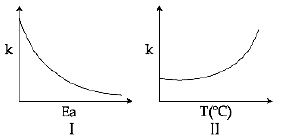
Consider the given plots for a reaction obeying the Arrhenius equation $(0\,^{\circ}C < T < 300\,^{\circ}C)$: ($k$ and $E_a$ are rate constant and activation energy respectively). Choose the correct option.
A
$I$ is right but $II$ is wrong
B
Both $I$ and $II$ are correct
C
$I$ is wrong but $II$ is right
D
Both $I$ and $II$ are wrong
Solution
(A) The Arrhenius equation is given by $k = A e^{-E_a/RT}$.
Plot $I$: As $E_a$ increases,the term $e^{-E_a/RT}$ decreases,so $k$ decreases. Thus,the plot of $k$ versus $E_a$ is an exponential decay curve,which is correct.
Plot $II$: As temperature $T$ increases,the term $e^{-E_a/RT}$ increases,so $k$ increases exponentially with $T$. The provided plot $II$ shows a curve that does not represent the standard exponential increase of $k$ with $T$ correctly (it looks more like a linear or different growth). Therefore,$II$ is incorrect.
Hence,$I$ is right but $II$ is wrong.
Plot $I$: As $E_a$ increases,the term $e^{-E_a/RT}$ decreases,so $k$ decreases. Thus,the plot of $k$ versus $E_a$ is an exponential decay curve,which is correct.
Plot $II$: As temperature $T$ increases,the term $e^{-E_a/RT}$ increases,so $k$ increases exponentially with $T$. The provided plot $II$ shows a curve that does not represent the standard exponential increase of $k$ with $T$ correctly (it looks more like a linear or different growth). Therefore,$II$ is incorrect.
Hence,$I$ is right but $II$ is wrong.
0 likes
View Solution194
MediumMCQ
If a reaction follows the Arrhenius equation,the plot $\ln k$ vs $1/(RT)$ gives a straight line with a gradient of $(-y) \ unit$. The energy required to activate the reactant is
A
$y \ unit$
B
$y/R \ unit$
C
$yR \ unit$
D
$-y \ unit$
Solution
(A) The Arrhenius equation is given by $\ln k = -\frac{E_a}{RT} + \ln A$.
Comparing this with the equation of a straight line $y = mx + c$,where $x = 1/(RT)$,the slope $m$ is equal to $-E_a$.
Given that the gradient is $-y$,we have $-E_a = -y$.
Therefore,the activation energy $E_a$ is equal to $y \ unit$.
Comparing this with the equation of a straight line $y = mx + c$,where $x = 1/(RT)$,the slope $m$ is equal to $-E_a$.
Given that the gradient is $-y$,we have $-E_a = -y$.
Therefore,the activation energy $E_a$ is equal to $y \ unit$.
0 likes
View Solution195
DifficultMCQ
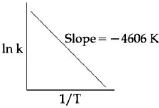
For a certain reaction,consider the plot of $\ln k$ versus $1/T$ given in the figure. If the rate constant of this reaction at $400 \ K$ is $10^{-5} \ s^{-1}$,then the rate constant at $500 \ K$ is:
A
$10^{-6} \ s^{-1}$
B
$2 \times 10^{-4} \ s^{-1}$
C
$10^{-4} \ s^{-1}$
D
$4 \times 10^{-4} \ s^{-1}$
Solution
(C) From the Arrhenius equation,$\ln k = \ln A - \frac{E_a}{R} \left( \frac{1}{T} \right)$.
Comparing this with the equation of a straight line $y = mx + c$,the slope $m = -\frac{E_a}{R}$.
Given slope $= -4606 \ K$,so $\frac{E_a}{R} = 4606 \ K$.
Using the integrated Arrhenius equation: $\ln \left( \frac{k_2}{k_1} \right) = \frac{E_a}{R} \left( \frac{1}{T_1} - \frac{1}{T_2} \right)$.
Here,$T_1 = 400 \ K$,$k_1 = 10^{-5} \ s^{-1}$,$T_2 = 500 \ K$,and $k_2 = ?$.
$\ln \left( \frac{k_2}{10^{-5}} \right) = 4606 \times \left( \frac{1}{400} - \frac{1}{500} \right) = 4606 \times \left( \frac{500 - 400}{200000} \right) = 4606 \times \frac{100}{200000} = 4606 \times \frac{1}{2000} = 2.303$.
Since $\ln 10 \approx 2.303$,we have $\ln \left( \frac{k_2}{10^{-5}} \right) = \ln 10$.
Therefore,$\frac{k_2}{10^{-5}} = 10$,which gives $k_2 = 10^{-4} \ s^{-1}$.
Comparing this with the equation of a straight line $y = mx + c$,the slope $m = -\frac{E_a}{R}$.
Given slope $= -4606 \ K$,so $\frac{E_a}{R} = 4606 \ K$.
Using the integrated Arrhenius equation: $\ln \left( \frac{k_2}{k_1} \right) = \frac{E_a}{R} \left( \frac{1}{T_1} - \frac{1}{T_2} \right)$.
Here,$T_1 = 400 \ K$,$k_1 = 10^{-5} \ s^{-1}$,$T_2 = 500 \ K$,and $k_2 = ?$.
$\ln \left( \frac{k_2}{10^{-5}} \right) = 4606 \times \left( \frac{1}{400} - \frac{1}{500} \right) = 4606 \times \left( \frac{500 - 400}{200000} \right) = 4606 \times \frac{100}{200000} = 4606 \times \frac{1}{2000} = 2.303$.
Since $\ln 10 \approx 2.303$,we have $\ln \left( \frac{k_2}{10^{-5}} \right) = \ln 10$.
Therefore,$\frac{k_2}{10^{-5}} = 10$,which gives $k_2 = 10^{-4} \ s^{-1}$.
0 likes
View Solution196
DifficultMCQ
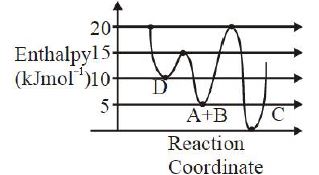
Consider the given plot of enthalpy of the following reaction between $A$ and $B$: $A + B \to C + D$. Identify the incorrect statement.
A
$C$ is the thermodynamically stable product.
B
Formation of $A$ and $B$ from $C$ has the highest enthalpy of activation.
C
$D$ is the kinetically stable product.
D
Activation enthalpy to form $C$ is $5\,kJ\,mol^{-1}$ less than that to form $D$.
Solution
(D) From the graph:
Enthalpy of $(A+B) = 5\,kJ\,mol^{-1}$.
Enthalpy of $D = 10\,kJ\,mol^{-1}$.
Enthalpy of $C = 0\,kJ\,mol^{-1}$.
Activation energy for $(A+B \to D) = 15 - 5 = 10\,kJ\,mol^{-1}$.
Activation energy for $(A+B \to C) = 20 - 5 = 15\,kJ\,mol^{-1}$.
Activation energy for $(C \to A+B) = 20 - 0 = 20\,kJ\,mol^{-1}$.
Activation energy for $(D \to A+B) = 15 - 10 = 5\,kJ\,mol^{-1}$.
Comparing the activation energies,the formation of $(A+B)$ from $C$ has the highest activation energy $(20\,kJ\,mol^{-1})$.
$C$ is the most stable product (lowest enthalpy).
$D$ is formed faster (lower activation energy),so it is the kinetically stable product.
Activation enthalpy to form $C$ $(15\,kJ\,mol^{-1})$ is $5\,kJ\,mol^{-1}$ more than that to form $D$ $(10\,kJ\,mol^{-1})$.
Therefore,statement $D$ is incorrect.
Enthalpy of $(A+B) = 5\,kJ\,mol^{-1}$.
Enthalpy of $D = 10\,kJ\,mol^{-1}$.
Enthalpy of $C = 0\,kJ\,mol^{-1}$.
Activation energy for $(A+B \to D) = 15 - 5 = 10\,kJ\,mol^{-1}$.
Activation energy for $(A+B \to C) = 20 - 5 = 15\,kJ\,mol^{-1}$.
Activation energy for $(C \to A+B) = 20 - 0 = 20\,kJ\,mol^{-1}$.
Activation energy for $(D \to A+B) = 15 - 10 = 5\,kJ\,mol^{-1}$.
Comparing the activation energies,the formation of $(A+B)$ from $C$ has the highest activation energy $(20\,kJ\,mol^{-1})$.
$C$ is the most stable product (lowest enthalpy).
$D$ is formed faster (lower activation energy),so it is the kinetically stable product.
Activation enthalpy to form $C$ $(15\,kJ\,mol^{-1})$ is $5\,kJ\,mol^{-1}$ more than that to form $D$ $(10\,kJ\,mol^{-1})$.
Therefore,statement $D$ is incorrect.
0 likes
View Solution197
DifficultMCQ
For the reaction of $H_2$ with $I_2$,the rate constant is $2.5 \times 10^{-4} \ dm^3 \ mol^{-1} \ s^{-1}$ at $327 \ ^oC$ and $1.0 \ dm^3 \ mol^{-1} \ s^{-1}$ at $527 \ ^oC$. The activation energy for the reaction,in $kJ \ mol^{-1}$ is: $(R = 8.314 \ J \ K^{-1} \ mol^{-1})$
A
$72$
B
$166$
C
$150$
D
$59$
Solution
(B) The Arrhenius equation is given by: $\log \frac{K_2}{K_1} = \frac{E_a}{2.303 \ R} \left( \frac{T_2 - T_1}{T_1 T_2} \right)$
Given:
$K_1 = 2.5 \times 10^{-4} \ dm^3 \ mol^{-1} \ s^{-1}$,$T_1 = 327 + 273 = 600 \ K$
$K_2 = 1.0 \ dm^3 \ mol^{-1} \ s^{-1}$,$T_2 = 527 + 273 = 800 \ K$
$R = 8.314 \ J \ K^{-1} \ mol^{-1}$
Substituting the values:
$\log \left( \frac{1}{2.5 \times 10^{-4}} \right) = \frac{E_a}{2.303 \times 8.314} \left( \frac{800 - 600}{600 \times 800} \right)$
$\log (4000) = \frac{E_a}{19.147} \left( \frac{200}{480000} \right)$
$3.602 = \frac{E_a}{19.147} \times 4.167 \times 10^{-4}$
$E_a = \frac{3.602 \times 19.147}{4.167 \times 10^{-4}} \approx 165500 \ J \ mol^{-1} = 165.5 \ kJ \ mol^{-1} \approx 166 \ kJ \ mol^{-1}$
Given:
$K_1 = 2.5 \times 10^{-4} \ dm^3 \ mol^{-1} \ s^{-1}$,$T_1 = 327 + 273 = 600 \ K$
$K_2 = 1.0 \ dm^3 \ mol^{-1} \ s^{-1}$,$T_2 = 527 + 273 = 800 \ K$
$R = 8.314 \ J \ K^{-1} \ mol^{-1}$
Substituting the values:
$\log \left( \frac{1}{2.5 \times 10^{-4}} \right) = \frac{E_a}{2.303 \times 8.314} \left( \frac{800 - 600}{600 \times 800} \right)$
$\log (4000) = \frac{E_a}{19.147} \left( \frac{200}{480000} \right)$
$3.602 = \frac{E_a}{19.147} \times 4.167 \times 10^{-4}$
$E_a = \frac{3.602 \times 19.147}{4.167 \times 10^{-4}} \approx 165500 \ J \ mol^{-1} = 165.5 \ kJ \ mol^{-1} \approx 166 \ kJ \ mol^{-1}$
0 likes
View Solution198
MediumMCQ
The rate constant for a chemical reaction taking place at $500 \ K$ is expressed as $K = A \ e^{-1000}$. The activation energy of the reaction is:
A
$100 \ cal/mol$
B
$1000 \ cal/mol$
C
$10^4 \ cal/mol$
D
$10^6 \ cal/mol$
Solution
(D) The Arrhenius equation is given by $K = A \ e^{-E_a / (RT)}$.
Comparing this with the given expression $K = A \ e^{-1000}$,we get $E_a / (RT) = 1000$.
Given $T = 500 \ K$ and the gas constant $R = 2 \ cal \ K^{-1} \ mol^{-1}$.
Substituting the values: $E_a = 1000 \times R \times T = 1000 \times 2 \times 500 = 1,000,000 \ cal/mol = 10^6 \ cal/mol$.
Comparing this with the given expression $K = A \ e^{-1000}$,we get $E_a / (RT) = 1000$.
Given $T = 500 \ K$ and the gas constant $R = 2 \ cal \ K^{-1} \ mol^{-1}$.
Substituting the values: $E_a = 1000 \times R \times T = 1000 \times 2 \times 500 = 1,000,000 \ cal/mol = 10^6 \ cal/mol$.
0 likes
View Solution199
MediumMCQ
Which graph shows zero activation energy?
A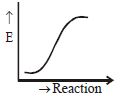
B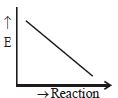
C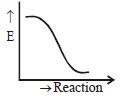
D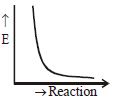
Solution
(B) Activation energy $(E_a)$ is defined as the difference between the energy of the transition state and the energy of the reactants.
For a reaction to have zero activation energy,the energy of the reactants must be equal to the energy of the transition state.
In the provided graphs,Graph $B$ shows a linear decrease in energy,which is not a standard representation of a reaction coordinate. However,in the context of such problems,if we consider the energy profile where the energy remains constant or decreases without a barrier,it represents a reaction with no activation barrier.
Given the standard options provided in such chemistry problems,Graph $B$ represents a case where the energy of the system decreases linearly,implying no energy barrier exists for the reaction to proceed.
Therefore,option $B$ is correct.
For a reaction to have zero activation energy,the energy of the reactants must be equal to the energy of the transition state.
In the provided graphs,Graph $B$ shows a linear decrease in energy,which is not a standard representation of a reaction coordinate. However,in the context of such problems,if we consider the energy profile where the energy remains constant or decreases without a barrier,it represents a reaction with no activation barrier.
Given the standard options provided in such chemistry problems,Graph $B$ represents a case where the energy of the system decreases linearly,implying no energy barrier exists for the reaction to proceed.
Therefore,option $B$ is correct.
0 likes
View Solution200
MediumMCQ
How fast is the reaction at $25\, ^\circ C$ as compared to $0\, ^\circ C$,if the activation energy is $65\, kJ/mol$?
A
$2$
B
$5$
C
$11$
D
$16$
Solution
(C) Using the Arrhenius equation: $\log \frac{K_{2}}{K_{1}} = \frac{E_{a}}{2.303 R} \left( \frac{T_{2} - T_{1}}{T_{1} T_{2}} \right)$
Given: $E_{a} = 65000\, J/mol$,$T_{1} = 273\, K$,$T_{2} = 298\, K$,$R = 8.314\, J/mol\cdot K$.
Substituting the values:
$\log \frac{K_{2}}{K_{1}} = \frac{65000}{2.303 \times 8.314} \left( \frac{298 - 273}{273 \times 298} \right)$
$\log \frac{K_{2}}{K_{1}} = \frac{65000}{19.147} \times \left( \frac{25}{81354} \right)$
$\log \frac{K_{2}}{K_{1}} = 3394.78 \times 0.000307 = 1.043$
$\frac{K_{2}}{K_{1}} = 10^{1.043} \approx 11$
Thus,the reaction is $11$ times faster.
Given: $E_{a} = 65000\, J/mol$,$T_{1} = 273\, K$,$T_{2} = 298\, K$,$R = 8.314\, J/mol\cdot K$.
Substituting the values:
$\log \frac{K_{2}}{K_{1}} = \frac{65000}{2.303 \times 8.314} \left( \frac{298 - 273}{273 \times 298} \right)$
$\log \frac{K_{2}}{K_{1}} = \frac{65000}{19.147} \times \left( \frac{25}{81354} \right)$
$\log \frac{K_{2}}{K_{1}} = 3394.78 \times 0.000307 = 1.043$
$\frac{K_{2}}{K_{1}} = 10^{1.043} \approx 11$
Thus,the reaction is $11$ times faster.
0 likes
View SolutionChemical Kinetics — Collision theory, Energy of activation and Arrhenius equation · Frequently Asked Questions
1Are these Chemical Kinetics questions useful for JEE and NEET?
Yes. All questions in this section are mapped to JEE Main and NEET exam patterns. Previous year questions from JEE Main, NEET, GUJCET and state-level exams are included with full solutions.
2Can I switch to Hindi or Gujarati for these questions?
Yes. Use the language tabs in the hero section or the sidebar to view the same questions and solutions in English, Hindi or Gujarati.
3How do I generate a question paper from this subtopic?
Use the Vedclass Exam Paper Generator — select the chapter and subtopic, set difficulty, and generate Sets A, B, C, D automatically. First 3 chapters of every subject are free.
Vedclass Products
For Students
Vedclass Test Series
Mock tests in real JEE/NEET style with performance analysis. 5-day free trial.
Start Free TrialFor Teachers
Exam Paper Generator
Generate Set A/B/C/D papers from this chapter in 2 minutes. 3 chapters free.
Try FreeFor Institutes
Online Exam Module
Live online exams with unlimited students, 360° analytics & white-label branding.
See DemoFor Teachers & Institutes
Generate a Chemical Kinetics Exam Paper in 2 Minutes
Select subtopic & difficulty — Sets A, B, C, D auto-generated with No Repeat logic.
First 3 chapters of every subject are free — no payment required.