
A English
Collision theory, Energy of activation and Arrhenius equation Questions in English
Class 12 Chemistry · Chemical Kinetics · Collision theory, Energy of activation and Arrhenius equation
499+
Questions
English
Language
100%
With Solutions
Showing 50 of 499 questions in English
51
MediumMCQ
The rate constant is doubled when temperature increases from $27\,^oC$ to $37\,^oC.$ Activation energy in $kJ$ is
A
$34$
B
$54$
C
$100$
D
$50$
Solution
(B) The Arrhenius equation is given by: $\log \frac{K_2}{K_1} = \frac{E_a}{2.303R} \left[ \frac{T_2 - T_1}{T_1 T_2} \right]$
Given: $\frac{K_2}{K_1} = 2$,$T_1 = 300 \, K$,$T_2 = 310 \, K$,$R = 8.314 \, J \, K^{-1} \, mol^{-1}$.
Substituting the values: $\log 2 = \frac{E_a}{2.303 \times 8.314} \left[ \frac{310 - 300}{300 \times 310} \right]$
$0.3010 = \frac{E_a}{19.147} \times \frac{10}{93000}$
$E_a = \frac{0.3010 \times 19.147 \times 93000}{10} \approx 53598 \, J \, mol^{-1} \approx 53.6 \, kJ \, mol^{-1}$.
Rounding to the nearest integer,the activation energy is $54 \, kJ \, mol^{-1}$.
Given: $\frac{K_2}{K_1} = 2$,$T_1 = 300 \, K$,$T_2 = 310 \, K$,$R = 8.314 \, J \, K^{-1} \, mol^{-1}$.
Substituting the values: $\log 2 = \frac{E_a}{2.303 \times 8.314} \left[ \frac{310 - 300}{300 \times 310} \right]$
$0.3010 = \frac{E_a}{19.147} \times \frac{10}{93000}$
$E_a = \frac{0.3010 \times 19.147 \times 93000}{10} \approx 53598 \, J \, mol^{-1} \approx 53.6 \, kJ \, mol^{-1}$.
Rounding to the nearest integer,the activation energy is $54 \, kJ \, mol^{-1}$.
0 likes
View Solution52
EasyMCQ
The activation energy of a reaction is zero. The rate constant of this reaction
A
Increases with increase of temperature
B
Decreases with an increase of temperature
C
Decreases with decrease of temperature
D
Is independent of temperature
Solution
(D) According to the Arrhenius equation,$k = A e^{-E_a / RT}$.
When the activation energy $E_a = 0$,the equation becomes $k = A e^0 = A$.
Since $A$ (the frequency factor) is a constant,the rate constant $k$ becomes independent of temperature.
When the activation energy $E_a = 0$,the equation becomes $k = A e^0 = A$.
Since $A$ (the frequency factor) is a constant,the rate constant $k$ becomes independent of temperature.
0 likes
View Solution53
MediumMCQ
The rate constant is given by the equation $k = p Z e^{-E_a/RT}$. Which factor should register a decrease for the reaction to proceed more rapidly?
A
$T$
B
$Z$
C
$E_a$
D
$p$
Solution
(C) The rate constant $k$ is given by the Arrhenius equation: $k = p Z e^{-E_a/RT}$.
For the reaction to proceed more rapidly,the rate constant $k$ must increase.
In the expression $k = p Z e^{-E_a/RT}$,$p$ is the steric factor,$Z$ is the collision frequency,$E_a$ is the activation energy,$R$ is the gas constant,and $T$ is the temperature.
To increase $k$,the value of the exponential term $e^{-E_a/RT}$ must increase.
This occurs when the exponent $-E_a/RT$ becomes less negative,which happens if the activation energy $E_a$ decreases or the temperature $T$ increases.
Therefore,a decrease in the activation energy $E_a$ will cause the reaction to proceed more rapidly.
For the reaction to proceed more rapidly,the rate constant $k$ must increase.
In the expression $k = p Z e^{-E_a/RT}$,$p$ is the steric factor,$Z$ is the collision frequency,$E_a$ is the activation energy,$R$ is the gas constant,and $T$ is the temperature.
To increase $k$,the value of the exponential term $e^{-E_a/RT}$ must increase.
This occurs when the exponent $-E_a/RT$ becomes less negative,which happens if the activation energy $E_a$ decreases or the temperature $T$ increases.
Therefore,a decrease in the activation energy $E_a$ will cause the reaction to proceed more rapidly.
0 likes
View Solution54
MediumMCQ
An endothermic reaction with high activation energy for the forward reaction is given by the diagram:
A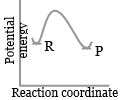
B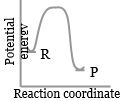
C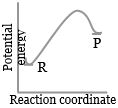
D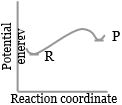
Solution
(C) In an endothermic reaction,the potential energy of the products $(P)$ is higher than that of the reactants $(R)$.
Activation energy $(E_a)$ is the energy difference between the transition state (peak of the curve) and the reactants $(R)$.
Diagram $C$ shows that the energy of the products is higher than the reactants (endothermic) and the energy barrier (peak) is significantly higher than the reactant energy,indicating high activation energy.
Activation energy $(E_a)$ is the energy difference between the transition state (peak of the curve) and the reactants $(R)$.
Diagram $C$ shows that the energy of the products is higher than the reactants (endothermic) and the energy barrier (peak) is significantly higher than the reactant energy,indicating high activation energy.
0 likes
View Solution55
EasyMCQ
Consider an endothermic reaction $X \to Y$ with the activation energies $E_b$ and $E_f$ for the backward and forward reactions,respectively. In general:
A
$E_b < E_f$
B
$E_b > E_f$
C
$E_b = E_f$
D
There is no definite relation between $E_b$ and $E_f$
Solution
(A) For an endothermic reaction,the enthalpy change $\Delta H$ is positive $(+ve)$.
The relationship between enthalpy change,forward activation energy $(E_f)$,and backward activation energy $(E_b)$ is given by the equation: $\Delta H = E_f - E_b$.
Since $\Delta H > 0$,it follows that $E_f - E_b > 0$,which implies $E_f > E_b$ or $E_b < E_f$.
The relationship between enthalpy change,forward activation energy $(E_f)$,and backward activation energy $(E_b)$ is given by the equation: $\Delta H = E_f - E_b$.
Since $\Delta H > 0$,it follows that $E_f - E_b > 0$,which implies $E_f > E_b$ or $E_b < E_f$.
0 likes
View Solution56
EasyMCQ
The temperature-dependent equation for the rate constant is written as:
A
$\ln k = \ln A - \frac{E_a}{RT}$
B
$\ln k = \ln A + \frac{E_a}{RT}$
C
$\ln k = \ln A - e^{RT/E_a}$
D
All of these
Solution
(A) The Arrhenius equation describes the dependence of the rate constant $(k)$ on temperature $(T)$ as:
$k = A e^{-E_a/RT}$
Taking the natural logarithm on both sides:
$\ln k = \ln(A e^{-E_a/RT})$
Using the properties of logarithms:
$\ln k = \ln A + \ln(e^{-E_a/RT})$
$\ln k = \ln A - \frac{E_a}{RT}$
Therefore,the correct expression is given by option $(A)$.
$k = A e^{-E_a/RT}$
Taking the natural logarithm on both sides:
$\ln k = \ln(A e^{-E_a/RT})$
Using the properties of logarithms:
$\ln k = \ln A + \ln(e^{-E_a/RT})$
$\ln k = \ln A - \frac{E_a}{RT}$
Therefore,the correct expression is given by option $(A)$.
0 likes
View Solution57
EasyMCQ
If we plot a graph between $\log \, K$ and $\frac{1}{T}$ by Arrhenius equation,the slope is
A
$-\frac{E_a}{R}$
B
$+\frac{E_a}{R}$
C
$-\frac{E_a}{2.303 \, R}$
D
$+\frac{E_a}{2.303 \, R}$
Solution
(C) The Arrhenius equation is given by $K = A \, e^{-E_a / RT}$.
Taking the natural logarithm on both sides,we get $\ln \, K = \ln \, A - \frac{E_a}{RT}$.
To convert this to base $10$,we divide by $2.303$,resulting in $\log \, K = \log \, A - \frac{E_a}{2.303 \, RT}$.
Comparing this with the equation of a straight line $y = mx + c$,where $y = \log \, K$ and $x = \frac{1}{T}$,the slope $m$ is equal to $-\frac{E_a}{2.303 \, R}$.
Taking the natural logarithm on both sides,we get $\ln \, K = \ln \, A - \frac{E_a}{RT}$.
To convert this to base $10$,we divide by $2.303$,resulting in $\log \, K = \log \, A - \frac{E_a}{2.303 \, RT}$.
Comparing this with the equation of a straight line $y = mx + c$,where $y = \log \, K$ and $x = \frac{1}{T}$,the slope $m$ is equal to $-\frac{E_a}{2.303 \, R}$.
0 likes
View Solution58
MediumMCQ
For an endothermic reaction,where $\Delta H$ represents the enthalpy of the reaction in $kJ/mol$,the minimum value for the energy of activation will be
A
Less than $\Delta H$
B
Zero
C
More than $\Delta H$
D
Equal to $\Delta H$
Solution
(C) For an endothermic reaction,the enthalpy change $\Delta H$ is positive.
The relationship between the activation energy of the forward reaction $(E_{a(f)})$,the activation energy of the backward reaction $(E_{a(b)})$,and the enthalpy of the reaction is given by the equation: $E_{a(f)} = E_{a(b)} + \Delta H$.
Since $E_{a(b)}$ must always be a positive value for any reaction to occur,it follows that $E_{a(f)} > \Delta H$.
Therefore,the minimum value for the energy of activation is more than $\Delta H$.
The relationship between the activation energy of the forward reaction $(E_{a(f)})$,the activation energy of the backward reaction $(E_{a(b)})$,and the enthalpy of the reaction is given by the equation: $E_{a(f)} = E_{a(b)} + \Delta H$.
Since $E_{a(b)}$ must always be a positive value for any reaction to occur,it follows that $E_{a(f)} > \Delta H$.
Therefore,the minimum value for the energy of activation is more than $\Delta H$.
1 likes
View Solution59
MediumMCQ
The rate constant $(K')$ of one reaction is double the rate constant $(K'')$ of another reaction. What is the relationship between the corresponding activation energies of the two reactions (${E_a}'$ and ${E_a}''$)?
A
${E_a}' > {E_a}''$
B
${E_a}' = {E_a}''$
C
${E_a}' < {E_a}''$
D
${E_a}' = 4{E_a}''$
Solution
(C) According to the Arrhenius equation,$K = A e^{-E_a / RT}$.
Taking the natural logarithm on both sides,$\ln K = \ln A - \frac{E_a}{RT}$.
This shows that the rate constant $K$ is inversely related to the activation energy $E_a$ for a given temperature and frequency factor $A$.
Since $K' = 2K''$,it implies that $K' > K''$.
Therefore,the reaction with the higher rate constant must have a lower activation energy.
Thus,${E_a}' < {E_a}''$.
Taking the natural logarithm on both sides,$\ln K = \ln A - \frac{E_a}{RT}$.
This shows that the rate constant $K$ is inversely related to the activation energy $E_a$ for a given temperature and frequency factor $A$.
Since $K' = 2K''$,it implies that $K' > K''$.
Therefore,the reaction with the higher rate constant must have a lower activation energy.
Thus,${E_a}' < {E_a}''$.
0 likes
View Solution60
AdvancedMCQ
The rate constant,the activation energy and the Arrhenius parameter of a chemical reaction at $25\,^oC$ are $3.0 \times 10^{-4}\,s^{-1}$,$104.4\,kJ\,mol^{-1}$ and $6.0 \times 10^{14}\,s^{-1}$ respectively. The value of the rate constant as $T \to \infty$ is
A
$2.0 \times 10^{18}\,s^{-1}$
B
$6.0 \times 10^{14}\,s^{-1}$
C
Infinity
D
$3.6 \times 10^{30}\,s^{-1}$
Solution
(B) The Arrhenius equation is given by $k = A e^{-E_a / RT}$.
As $T \to \infty$,the term $\frac{E_a}{RT} \to 0$.
Therefore,the rate constant $k$ approaches the pre-exponential factor $A$ (Arrhenius parameter).
Given that the Arrhenius parameter $A = 6.0 \times 10^{14}\,s^{-1}$,the value of the rate constant as $T \to \infty$ is $6.0 \times 10^{14}\,s^{-1}$.
As $T \to \infty$,the term $\frac{E_a}{RT} \to 0$.
Therefore,the rate constant $k$ approaches the pre-exponential factor $A$ (Arrhenius parameter).
Given that the Arrhenius parameter $A = 6.0 \times 10^{14}\,s^{-1}$,the value of the rate constant as $T \to \infty$ is $6.0 \times 10^{14}\,s^{-1}$.
0 likes
View Solution61
MediumMCQ
The $\Delta H$ value of the reaction $H_2 + Cl_2 \rightleftharpoons 2HCl$ is $-44.12 \ kcal$. If $E_1$ is the activation energy of the backward reaction and $E_2$ is the activation energy of the forward reaction,then for the above reaction:
A
$E_1 > E_2$
B
$E_1 < E_2$
C
$E_1 = E_2$
D
$\Delta H$ is not related to $E_1$ and $E_2$
Solution
(A) For the given reaction,$\Delta H = -44.12 \ kcal$. Since $\Delta H < 0$,the reaction is exothermic.
We know the relationship between enthalpy change and activation energies is given by $\Delta H = E_f - E_b$,where $E_f$ is the activation energy of the forward reaction $(E_2)$ and $E_b$ is the activation energy of the backward reaction $(E_1)$.
Thus,$\Delta H = E_2 - E_1$.
Since $\Delta H$ is negative,$E_2 - E_1 < 0$,which implies $E_1 > E_2$.
We know the relationship between enthalpy change and activation energies is given by $\Delta H = E_f - E_b$,where $E_f$ is the activation energy of the forward reaction $(E_2)$ and $E_b$ is the activation energy of the backward reaction $(E_1)$.
Thus,$\Delta H = E_2 - E_1$.
Since $\Delta H$ is negative,$E_2 - E_1 < 0$,which implies $E_1 > E_2$.
0 likes
View Solution62
DifficultMCQ
The temperature dependence of the rate constant $(k)$ of a chemical reaction is expressed by the Arrhenius equation,$k = A \cdot e^{-E^*/RT}$. The activation energy $(E^*)$ of the reaction can be calculated by plotting:
A
$\log \, k$ vs $\frac{1}{T}$
B
$k$ vs $T$
C
$k$ vs $\frac{1}{\log \, T}$
D
$\log \, k$ vs $T$
Solution
(A) The Arrhenius equation is given by $k = A e^{-E^*/RT}$.
Taking the logarithm on both sides,we get $\log \, k = \log \, A - \frac{E^*}{2.303 R} \cdot \frac{1}{T}$.
This equation follows the linear form $y = mx + c$,where $y = \log \, k$ and $x = \frac{1}{T}$.
Plotting $\log \, k$ versus $\frac{1}{T}$ yields a straight line with a slope equal to $-\frac{E^*}{2.303 R}$.
Thus,the activation energy $E^*$ can be determined from the slope of this plot.
Taking the logarithm on both sides,we get $\log \, k = \log \, A - \frac{E^*}{2.303 R} \cdot \frac{1}{T}$.
This equation follows the linear form $y = mx + c$,where $y = \log \, k$ and $x = \frac{1}{T}$.
Plotting $\log \, k$ versus $\frac{1}{T}$ yields a straight line with a slope equal to $-\frac{E^*}{2.303 R}$.
Thus,the activation energy $E^*$ can be determined from the slope of this plot.
0 likes
View Solution63
MediumMCQ
Activation energy of a chemical reaction can be determined by
A
Changing concentration of reactants
B
Evaluating rate constant at standard temperature
C
Evaluating rate constants at two different temperatures
D
Evaluating velocities of reaction at two different temperatures
Solution
(C) The activation energy $(E_a)$ is determined using the Arrhenius equation at two different temperatures ($T_1$ and $T_2$).
According to the Arrhenius equation: $\log \frac{K_2}{K_1} = \frac{E_a}{2.303R} \left[ \frac{T_2 - T_1}{T_1 T_2} \right]$.
By measuring the rate constants ($K_1$ and $K_2$) at two different temperatures,the activation energy can be calculated.
According to the Arrhenius equation: $\log \frac{K_2}{K_1} = \frac{E_a}{2.303R} \left[ \frac{T_2 - T_1}{T_1 T_2} \right]$.
By measuring the rate constants ($K_1$ and $K_2$) at two different temperatures,the activation energy can be calculated.
0 likes
View Solution64
DifficultMCQ
The activation energy for a reaction is $9.0 \, kcal/mol$. The increase in the rate constant when its temperature is increased from $298 \, K$ to $308 \, K$ is $......... \, \%$.
A
$65$
B
$50$
C
$100$
D
$10$
Solution
(A) Using the Arrhenius equation: $\log \frac{K_2}{K_1} = \frac{E_a}{2.303 \times R} \left[ \frac{T_2 - T_1}{T_1 T_2} \right]$
Given: $E_a = 9.0 \, kcal/mol = 9000 \, cal/mol$,$R = 1.987 \, cal \, K^{-1} \, mol^{-1} \approx 2 \, cal \, K^{-1} \, mol^{-1}$,$T_1 = 298 \, K$,$T_2 = 308 \, K$.
$\log \frac{K_2}{K_1} = \frac{9000}{2.303 \times 2} \left[ \frac{308 - 298}{308 \times 298} \right]$
$\log \frac{K_2}{K_1} = \frac{9000}{4.606} \times \frac{10}{91784} \approx 1954.19 \times 0.0001089 \approx 0.2129$
$\frac{K_2}{K_1} = \text{antilog}(0.2129) \approx 1.632$
Percentage increase = $\frac{K_2 - K_1}{K_1} \times 100 = (1.632 - 1) \times 100 = 63.2 \% \approx 63 \%$.
The closest option is $65 \%$.
Given: $E_a = 9.0 \, kcal/mol = 9000 \, cal/mol$,$R = 1.987 \, cal \, K^{-1} \, mol^{-1} \approx 2 \, cal \, K^{-1} \, mol^{-1}$,$T_1 = 298 \, K$,$T_2 = 308 \, K$.
$\log \frac{K_2}{K_1} = \frac{9000}{2.303 \times 2} \left[ \frac{308 - 298}{308 \times 298} \right]$
$\log \frac{K_2}{K_1} = \frac{9000}{4.606} \times \frac{10}{91784} \approx 1954.19 \times 0.0001089 \approx 0.2129$
$\frac{K_2}{K_1} = \text{antilog}(0.2129) \approx 1.632$
Percentage increase = $\frac{K_2 - K_1}{K_1} \times 100 = (1.632 - 1) \times 100 = 63.2 \% \approx 63 \%$.
The closest option is $65 \%$.
0 likes
View Solution65
EasyMCQ
For the reaction $A_2 + B_2 \rightleftarrows 2AB$,the activation energy for the forward and backward reactions are $180 \ kJ \ mol^{-1}$ and $200 \ kJ \ mol^{-1}$,respectively. If a catalyst lowers the activation energy of both forward and backward reactions by $100 \ kJ \ mol^{-1}$,what will be the enthalpy change $(\Delta H)$ for the reaction $A_2 + B_2 \rightarrow 2AB$ in the presence of the catalyst?
A
$-300 \ kJ \ mol^{-1}$
B
$-120 \ kJ \ mol^{-1}$
C
$-280 \ kJ \ mol^{-1}$
D
$-20 \ kJ \ mol^{-1}$
Solution
(D) The enthalpy change $(\Delta H)$ of a reaction is given by the difference between the activation energy of the forward reaction $(E_{af})$ and the activation energy of the backward reaction $(E_{ab})$.
$\Delta H = E_{af} - E_{ab}$
Initially,$\Delta H = 180 \ kJ \ mol^{-1} - 200 \ kJ \ mol^{-1} = -20 \ kJ \ mol^{-1}$.
$A$ catalyst lowers the activation energy of both the forward and backward reactions by the same amount $(100 \ kJ \ mol^{-1})$.
New $E_{af}' = 180 - 100 = 80 \ kJ \ mol^{-1}$.
New $E_{ab}' = 200 - 100 = 100 \ kJ \ mol^{-1}$.
New $\Delta H' = E_{af}' - E_{ab}' = 80 - 100 = -20 \ kJ \ mol^{-1}$.
Since a catalyst does not change the enthalpy of the reaction,the value remains $-20 \ kJ \ mol^{-1}$.
$\Delta H = E_{af} - E_{ab}$
Initially,$\Delta H = 180 \ kJ \ mol^{-1} - 200 \ kJ \ mol^{-1} = -20 \ kJ \ mol^{-1}$.
$A$ catalyst lowers the activation energy of both the forward and backward reactions by the same amount $(100 \ kJ \ mol^{-1})$.
New $E_{af}' = 180 - 100 = 80 \ kJ \ mol^{-1}$.
New $E_{ab}' = 200 - 100 = 100 \ kJ \ mol^{-1}$.
New $\Delta H' = E_{af}' - E_{ab}' = 80 - 100 = -20 \ kJ \ mol^{-1}$.
Since a catalyst does not change the enthalpy of the reaction,the value remains $-20 \ kJ \ mol^{-1}$.
0 likes
View Solution66
EasyMCQ
According to the Arrhenius equation,a plot of the logarithm of the rate constant $(\log \, k)$ versus which of the following yields a straight line?
A
$T$
B
$\log \, T$
C
$1/T$
D
$\log \, (1/T)$
Solution
(C) The Arrhenius equation is given by $k = A \cdot e^{-E_a / (RT)}$.
Taking the logarithm on both sides,we get $\ln \, k = \ln \, A - \frac{E_a}{RT}$.
Converting to base $10$ logarithm,we get $\log \, k = \log \, A - \frac{E_a}{2.303 \, R} \cdot \frac{1}{T}$.
Comparing this with the equation of a straight line $y = mx + c$,where $y = \log \, k$,$x = 1/T$,$m = -E_a / (2.303 \, R)$,and $c = \log \, A$.
Therefore,a plot of $\log \, k$ versus $1/T$ yields a straight line.
Taking the logarithm on both sides,we get $\ln \, k = \ln \, A - \frac{E_a}{RT}$.
Converting to base $10$ logarithm,we get $\log \, k = \log \, A - \frac{E_a}{2.303 \, R} \cdot \frac{1}{T}$.
Comparing this with the equation of a straight line $y = mx + c$,where $y = \log \, k$,$x = 1/T$,$m = -E_a / (2.303 \, R)$,and $c = \log \, A$.
Therefore,a plot of $\log \, k$ versus $1/T$ yields a straight line.
0 likes
View Solution67
DifficultMCQ
For a reaction,the rate constants $K_1$ and $K_2$ are given by $10^{16} \cdot e^{-2000/T}$ and $10^{15} \cdot e^{-1000/T}$ respectively. At what temperature will $K_1 = K_2$?
A
$2000 \, K$
B
$\frac{1000}{2.303} \, K$
C
$1000 \, K$
D
$\frac{2000}{2.303} \, K$
Solution
(B) Given that $K_1 = K_2$,we have:
$10^{16} \cdot e^{-2000/T} = 10^{15} \cdot e^{-1000/T}$
Divide both sides by $10^{15}$ and $e^{-1000/T}$:
$\frac{10^{16}}{10^{15}} = \frac{e^{-1000/T}}{e^{-2000/T}}$
$10 = e^{(-1000/T) - (-2000/T)}$
$10 = e^{1000/T}$
Taking the natural logarithm $(\ln)$ on both sides:
$\ln(10) = \frac{1000}{T}$
$2.303 \cdot \log_{10}(10) = \frac{1000}{T}$
$2.303 = \frac{1000}{T}$
Therefore,$T = \frac{1000}{2.303} \, K$.
$10^{16} \cdot e^{-2000/T} = 10^{15} \cdot e^{-1000/T}$
Divide both sides by $10^{15}$ and $e^{-1000/T}$:
$\frac{10^{16}}{10^{15}} = \frac{e^{-1000/T}}{e^{-2000/T}}$
$10 = e^{(-1000/T) - (-2000/T)}$
$10 = e^{1000/T}$
Taking the natural logarithm $(\ln)$ on both sides:
$\ln(10) = \frac{1000}{T}$
$2.303 \cdot \log_{10}(10) = \frac{1000}{T}$
$2.303 = \frac{1000}{T}$
Therefore,$T = \frac{1000}{2.303} \, K$.
0 likes
View Solution68
EasyMCQ
According to the collision theory,which of the following statements is $NOT$ correct?
A
Collision of molecules is a primary condition for a reaction to occur.
B
All collisions between reactant molecules result in the formation of products.
C
Reactants undergoing successful collisions form products.
D
Only those molecules that possess activation energy can undergo successful collisions.
Solution
(B) According to the collision theory of chemical reactions,for a reaction to occur,reactant molecules must collide with each other.
However,not all collisions lead to the formation of products.
Only those collisions where molecules possess energy equal to or greater than the activation energy $(E_a)$ and have the proper orientation are considered 'effective' or 'successful' collisions.
Therefore,the statement that 'all collisions between reactant molecules result in the formation of products' is incorrect.
However,not all collisions lead to the formation of products.
Only those collisions where molecules possess energy equal to or greater than the activation energy $(E_a)$ and have the proper orientation are considered 'effective' or 'successful' collisions.
Therefore,the statement that 'all collisions between reactant molecules result in the formation of products' is incorrect.
0 likes
View Solution69
MediumMCQ
For an exothermic reaction $A \rightarrow B$,the activation energy of $A$ is $17 \, kJ/mol$. The heat of reaction is $40 \, kJ$. Calculate the activation energy for the reverse reaction $B \rightarrow A$.
A
$23$
B
$52$
C
$53$
D
$57$
Solution
(D) For the forward reaction $A \rightarrow B$,the activation energy $E_a(f) = 17 \, kJ/mol$.
Since the reaction is exothermic,the enthalpy change $\Delta H = -40 \, kJ/mol$.
The relationship between activation energy of forward $(E_a(f))$ and reverse $(E_a(r))$ reactions is given by: $\Delta H = E_a(f) - E_a(r)$.
Substituting the values: $-40 = 17 - E_a(r)$.
Therefore,$E_a(r) = 17 + 40 = 57 \, kJ/mol$.
Since the reaction is exothermic,the enthalpy change $\Delta H = -40 \, kJ/mol$.
The relationship between activation energy of forward $(E_a(f))$ and reverse $(E_a(r))$ reactions is given by: $\Delta H = E_a(f) - E_a(r)$.
Substituting the values: $-40 = 17 - E_a(r)$.
Therefore,$E_a(r) = 17 + 40 = 57 \, kJ/mol$.
0 likes
View Solution70
DifficultMCQ
The rate of a certain reaction doubles when the temperature changes from $27\,^oC$ to $37\,^oC$. The activation energy for the reaction is ........... $kJ\,mol^{-1}$.
A
$45.6$
B
$52.3$
C
$53.6$
D
$58.9$
Solution
(C) Given: $T_1 = 27\,^oC = 300\,K$,$k_1 = k$
$T_2 = 37\,^oC = 310\,K$,$k_2 = 2k$
Using the Arrhenius equation: $\log \frac{k_2}{k_1} = \frac{E_a}{2.303R} \left( \frac{T_2 - T_1}{T_1 T_2} \right)$
Substituting the values:
$\log \frac{2k}{k} = \frac{E_a}{2.303 \times 8.314} \times \frac{310 - 300}{300 \times 310}$
$\log 2 = \frac{E_a}{2.303 \times 8.314} \times \frac{10}{93000}$
$0.3010 = \frac{E_a}{19.147} \times 0.0001075$
$E_a = \frac{0.3010 \times 19.147}{0.0001075} \approx 53598.6\,J\,mol^{-1}$
$E_a \approx 53.6\,kJ\,mol^{-1}$
$T_2 = 37\,^oC = 310\,K$,$k_2 = 2k$
Using the Arrhenius equation: $\log \frac{k_2}{k_1} = \frac{E_a}{2.303R} \left( \frac{T_2 - T_1}{T_1 T_2} \right)$
Substituting the values:
$\log \frac{2k}{k} = \frac{E_a}{2.303 \times 8.314} \times \frac{310 - 300}{300 \times 310}$
$\log 2 = \frac{E_a}{2.303 \times 8.314} \times \frac{10}{93000}$
$0.3010 = \frac{E_a}{19.147} \times 0.0001075$
$E_a = \frac{0.3010 \times 19.147}{0.0001075} \approx 53598.6\,J\,mol^{-1}$
$E_a \approx 53.6\,kJ\,mol^{-1}$
0 likes
View Solution71
MediumMCQ
For a first-order gaseous reaction,a plot of $\log \, k$ versus $1/T$ gives a straight line with a slope of $-8000$. Calculate the activation energy $(E_a)$ of the reaction in $cal$.
A
$36608$
B
$39709$
C
$41456$
D
$42340$
Solution
(A) According to the Arrhenius equation: $k = Ae^{-E_a/RT}$
Taking the logarithm on both sides: $\log \, k = \log \, A - \frac{E_a}{2.303R} \times \frac{1}{T}$
Comparing this with the equation of a straight line $y = mx + c$,the slope $(m)$ is given by: $m = -\frac{E_a}{2.303R}$
Given that the slope is $-8000$,we have: $\frac{E_a}{2.303R} = 8000$
Using $R = 1.987 \, cal \, K^{-1} \, mol^{-1}$:
$E_a = 8000 \times 2.303 \times 1.987$
$E_a = 36608 \, cal \, mol^{-1}$
Taking the logarithm on both sides: $\log \, k = \log \, A - \frac{E_a}{2.303R} \times \frac{1}{T}$
Comparing this with the equation of a straight line $y = mx + c$,the slope $(m)$ is given by: $m = -\frac{E_a}{2.303R}$
Given that the slope is $-8000$,we have: $\frac{E_a}{2.303R} = 8000$
Using $R = 1.987 \, cal \, K^{-1} \, mol^{-1}$:
$E_a = 8000 \times 2.303 \times 1.987$
$E_a = 36608 \, cal \, mol^{-1}$
0 likes
View Solution72
EasyMCQ
For the decomposition of $N_2O_5,$ the reaction is $2N_2O_{5(g)} \rightarrow 4NO_{2(g)} + O_{2(g)}$ with activation energy $E_a.$ If the reaction is written as $N_2O_{5(g)} \rightarrow 2NO_{2(g)} + 1/2 O_{2(g)}$ with activation energy $E_a',$ what is the relationship between $E_a$ and $E_a'$?
A
$E_a' > E_a$
B
$E_a' < E_a$
C
$E_a' = E_a$
D
$E_a = 2E_a'$
Solution
(C) The activation energy $(E_a)$ is the minimum energy required for a reaction to occur.
It is a characteristic property of the reaction mechanism and the transition state,which depends on the nature of the reactants and the pathway,not on the stoichiometric coefficients used to balance the chemical equation.
When we multiply or divide the stoichiometric coefficients of a balanced chemical equation by a constant factor,the reaction pathway and the transition state remain the same.
Therefore,the activation energy $E_a$ remains unchanged regardless of the stoichiometric coefficients.
Thus,$E_a = E_a'$.
It is a characteristic property of the reaction mechanism and the transition state,which depends on the nature of the reactants and the pathway,not on the stoichiometric coefficients used to balance the chemical equation.
When we multiply or divide the stoichiometric coefficients of a balanced chemical equation by a constant factor,the reaction pathway and the transition state remain the same.
Therefore,the activation energy $E_a$ remains unchanged regardless of the stoichiometric coefficients.
Thus,$E_a = E_a'$.
0 likes
View Solution73
EasyMCQ
For the reaction $2NO + Cl_2 \rightarrow 2NOCl$,the rate is given by $Rate = K[NO]^2[Cl_2]$. How can the rate constant $(K)$ of the reaction be increased?
A
By increasing the concentration of $NO$
B
By increasing the temperature of the reaction
C
By increasing the concentration of $Cl_2$
D
By increasing all of the above
Solution
(B) The rate constant $(K)$ is independent of the concentration of the reactants.
It depends only on the temperature of the reaction.
According to the Arrhenius equation,$K = Ae^{-E_a/RT}$,increasing the temperature $(T)$ increases the value of the rate constant $(K)$.
It depends only on the temperature of the reaction.
According to the Arrhenius equation,$K = Ae^{-E_a/RT}$,increasing the temperature $(T)$ increases the value of the rate constant $(K)$.
0 likes
View Solution74
MediumMCQ
For a first-order reaction $A \rightarrow P$,the rate constant $k$ depends on temperature $(T)$ according to the equation $\log \, k = - \frac{2000}{T} + 0.6$. The pre-exponential factor $A$ and the activation energy $E_a$ are,respectively:
A
$1.0 \times 10^6 \, s^{-1}$ and $9.2 \, kJ \, mol^{-1}$
B
$6.0 \, s^{-1}$ and $16.6 \, kJ \, mol^{-1}$
C
$1.0 \times 10^6 \, s^{-1}$ and $16.6 \, kJ \, mol^{-1}$
D
$1.0 \times 10^6 \, s^{-1}$ and $38.3 \, kJ \, mol^{-1}$
Solution
(D) The Arrhenius equation is given by $\log \, k = \log \, A - \frac{E_a}{2.303 \, RT}$.
Comparing this with the given equation $\log \, k = - \frac{2000}{T} + 0.6$:
$\log \, A = 0.6 \implies A = 10^{0.6} \approx 3.98 \, s^{-1}$ (Note: The provided option $10^6$ suggests the equation was $\log \, k = - \frac{2000}{T} + 6$).
Assuming the equation is $\log \, k = - \frac{2000}{T} + 6$:
$\log \, A = 6 \implies A = 10^6 \, s^{-1}$.
$\frac{E_a}{2.303 \, R} = 2000$.
$E_a = 2000 \times 2.303 \times 8.314 \, J \, mol^{-1} \approx 38297 \, J \, mol^{-1} = 38.3 \, kJ \, mol^{-1}$.
Comparing this with the given equation $\log \, k = - \frac{2000}{T} + 0.6$:
$\log \, A = 0.6 \implies A = 10^{0.6} \approx 3.98 \, s^{-1}$ (Note: The provided option $10^6$ suggests the equation was $\log \, k = - \frac{2000}{T} + 6$).
Assuming the equation is $\log \, k = - \frac{2000}{T} + 6$:
$\log \, A = 6 \implies A = 10^6 \, s^{-1}$.
$\frac{E_a}{2.303 \, R} = 2000$.
$E_a = 2000 \times 2.303 \times 8.314 \, J \, mol^{-1} \approx 38297 \, J \, mol^{-1} = 38.3 \, kJ \, mol^{-1}$.
0 likes
View Solution75
EasyMCQ
For the reaction $A \rightleftharpoons B$,if $E_a$ is the activation energy of the forward reaction,then the activation energy of the backward reaction is:
A
$-E_a$
B
Always less than $E_a$
C
Can be more or less than $E_a$
D
Always double of $E_a$
Solution
(C) For a reversible reaction $A \rightleftharpoons B$,the relationship between the activation energy of the forward reaction $(E_{a,f})$ and the backward reaction $(E_{a,b})$ is given by $\Delta H = E_{a,f} - E_{a,b}$.
If the reaction is exothermic $(\Delta H < 0)$,then $E_{a,b} > E_{a,f}$.
If the reaction is endothermic $(\Delta H > 0)$,then $E_{a,b} < E_{a,f}$.
Therefore,the activation energy of the backward reaction can be more or less than $E_a$ depending on the enthalpy change of the reaction.
If the reaction is exothermic $(\Delta H < 0)$,then $E_{a,b} > E_{a,f}$.
If the reaction is endothermic $(\Delta H > 0)$,then $E_{a,b} < E_{a,f}$.
Therefore,the activation energy of the backward reaction can be more or less than $E_a$ depending on the enthalpy change of the reaction.
0 likes
View Solution76
MediumMCQ
For a chemical reaction,the rate constant,activation energy,and Arrhenius factor at $25 \, ^\circ C$ are $3.0 \times 10^{-4} \, s^{-1}$,$104.4 \, kJ \, mol^{-1}$,and $6.0 \times 10^{14} \, s^{-1}$ respectively. Find the value of the rate constant as $T \rightarrow \infty$.
A
$2.0 \times 10^{18} \, s^{-1}$
B
$6.0 \times 10^{14} \, s^{-1}$
C
Infinity
D
$3.6 \times 10^{30} \, s^{-1}$
Solution
(B) The Arrhenius equation is given by $k = A \cdot e^{-E_a / (RT)}$.
As $T \rightarrow \infty$,the exponent term $-E_a / (RT) \rightarrow 0$.
Therefore,$e^{-E_a / (RT)} \rightarrow e^0 = 1$.
Thus,the rate constant $k$ approaches the Arrhenius factor $A$.
Given $A = 6.0 \times 10^{14} \, s^{-1}$,the value of the rate constant as $T \rightarrow \infty$ is $6.0 \times 10^{14} \, s^{-1}$.
As $T \rightarrow \infty$,the exponent term $-E_a / (RT) \rightarrow 0$.
Therefore,$e^{-E_a / (RT)} \rightarrow e^0 = 1$.
Thus,the rate constant $k$ approaches the Arrhenius factor $A$.
Given $A = 6.0 \times 10^{14} \, s^{-1}$,the value of the rate constant as $T \rightarrow \infty$ is $6.0 \times 10^{14} \, s^{-1}$.
1 likes
View Solution77
EasyMCQ
The rate of a chemical reaction doubles for every $10\,^{\circ}C$ rise in temperature. If the temperature is increased to $50\,^{\circ}C$ from $0\,^{\circ}C$,by how many times will the rate of reaction increase?
A
$32$
B
$64$
C
$10$
D
$24$
Solution
(A) The rate of reaction increases by a factor of $2^{\Delta T/10}$,where $\Delta T$ is the change in temperature.
Given,initial temperature $T_1 = 0\,^{\circ}C$ and final temperature $T_2 = 50\,^{\circ}C$.
Change in temperature $\Delta T = T_2 - T_1 = 50\,^{\circ}C - 0\,^{\circ}C = 50\,^{\circ}C$.
The number of $10\,^{\circ}C$ intervals is $n = \frac{50}{10} = 5$.
Therefore,the rate of reaction increases by $2^n = 2^5 = 32$ times.
Given,initial temperature $T_1 = 0\,^{\circ}C$ and final temperature $T_2 = 50\,^{\circ}C$.
Change in temperature $\Delta T = T_2 - T_1 = 50\,^{\circ}C - 0\,^{\circ}C = 50\,^{\circ}C$.
The number of $10\,^{\circ}C$ intervals is $n = \frac{50}{10} = 5$.
Therefore,the rate of reaction increases by $2^n = 2^5 = 32$ times.
0 likes
View Solution78
EasyMCQ
In a reaction,the rate of reaction doubles with a $10^\circ C$ rise in temperature. If the temperature is increased from $10^\circ C$ to $100^\circ C$,by how many times will the rate of reaction increase?
A
$256$
B
$512$
C
$1024$
D
$64$
Solution
(B) The rate of reaction doubles with every $10^\circ C$ rise in temperature.
The number of $10^\circ C$ intervals is $n = \frac{100^\circ C - 10^\circ C}{10^\circ C} = 9$.
The increase in rate is given by the formula $2^n$.
Therefore,the rate increase factor is $2^9 = 512$ times.
The number of $10^\circ C$ intervals is $n = \frac{100^\circ C - 10^\circ C}{10^\circ C} = 9$.
The increase in rate is given by the formula $2^n$.
Therefore,the rate increase factor is $2^9 = 512$ times.
0 likes
View Solution79
EasyMCQ
For an endothermic reaction $X \rightarrow Y$,the activation energies for the forward and backward reactions are $E_f$ and $E_b$ respectively. Then,in general:
A
$E_b > E_f$
B
$E_b < E_f$
C
There is no fixed relationship between $E_b$ and $E_f$.
D
$E_b = E_f$
Solution
(B) For an endothermic reaction,the energy of the products is higher than the energy of the reactants.
Mathematically,the enthalpy change $\Delta H = E_f - E_b > 0$.
This implies $E_f > E_b$,which can be rearranged as $E_b < E_f$.
Mathematically,the enthalpy change $\Delta H = E_f - E_b > 0$.
This implies $E_f > E_b$,which can be rearranged as $E_b < E_f$.
0 likes
View Solution80
MediumMCQ
For a reaction,the temperature coefficient is $2$. Calculate the activation energy $(E_a)$ in $kJ/mol$. (Assume the temperature range is $25^{\circ}C$ to $35^{\circ}C$)
A
$45.67$
B
$52.31$
C
$56.78$
D
$58.96$
Solution
(B) Given: Temperature coefficient $= \frac{K_2}{K_1} = 2$.
$T_1 = 25^{\circ}C = 298 \ K$,$T_2 = 35^{\circ}C = 308 \ K$.
Using the Arrhenius equation: $\log \frac{K_2}{K_1} = \frac{E_a}{2.303R} \left( \frac{T_2 - T_1}{T_1 T_2} \right)$.
Substituting the values: $\log 2 = \frac{E_a}{2.303 \times 8.314} \left( \frac{308 - 298}{298 \times 308} \right)$.
$0.3010 = \frac{E_a}{19.147} \left( \frac{10}{91784} \right)$.
$E_a = \frac{0.3010 \times 19.147 \times 91784}{10} \approx 52897 \ J/mol \approx 52.9 \ kJ/mol$.
Rounding to the nearest provided option,$E_a = 52.31 \ kJ/mol$.
$T_1 = 25^{\circ}C = 298 \ K$,$T_2 = 35^{\circ}C = 308 \ K$.
Using the Arrhenius equation: $\log \frac{K_2}{K_1} = \frac{E_a}{2.303R} \left( \frac{T_2 - T_1}{T_1 T_2} \right)$.
Substituting the values: $\log 2 = \frac{E_a}{2.303 \times 8.314} \left( \frac{308 - 298}{298 \times 308} \right)$.
$0.3010 = \frac{E_a}{19.147} \left( \frac{10}{91784} \right)$.
$E_a = \frac{0.3010 \times 19.147 \times 91784}{10} \approx 52897 \ J/mol \approx 52.9 \ kJ/mol$.
Rounding to the nearest provided option,$E_a = 52.31 \ kJ/mol$.
0 likes
View Solution81
EasyMCQ
For a first-order reaction,if the rate constant is $k_1$ at temperature $T_1$ and $k_2$ at temperature $T_2$,which of the following relations is correct? ($E_a$ = activation energy)
A
$\log \frac{k_1}{k_2} = \frac{E_a}{2.303 R} \left( \frac{T_2 - T_1}{T_1 T_2} \right)$
B
$\log \frac{k_1}{k_2} = \frac{E_a}{2.303 R} \left( \frac{T_1 - T_2}{T_1 T_2} \right)$
C
$\log \frac{k_1}{k_2} = \frac{2.303 E_a}{R} \left( \frac{T_1 T_2}{T_2 + T_1} \right)$
D
$\log \frac{k_1}{k_2} = \frac{E_a}{2.303 R} \left( \frac{T_1 T_2}{T_2 - T_1} \right)$
Solution
(B) According to the Arrhenius equation,the rate constant $k$ at temperature $T$ is given by $k = A e^{-E_a/RT}$.
For two different temperatures $T_1$ and $T_2$,we have:
$\ln k_1 = \ln A - \frac{E_a}{RT_1}$ and $\ln k_2 = \ln A - \frac{E_a}{RT_2}$.
Subtracting the two equations:
$\ln k_2 - \ln k_1 = \frac{E_a}{RT_1} - \frac{E_a}{RT_2} = \frac{E_a}{R} \left( \frac{1}{T_1} - \frac{1}{T_2} \right) = \frac{E_a}{R} \left( \frac{T_2 - T_1}{T_1 T_2} \right)$.
Converting to base $10$ logarithm:
$\log \frac{k_2}{k_1} = \frac{E_a}{2.303 R} \left( \frac{T_2 - T_1}{T_1 T_2} \right)$.
Multiplying by $-1$ on both sides:
$\log \frac{k_1}{k_2} = \frac{E_a}{2.303 R} \left( \frac{T_1 - T_2}{T_1 T_2} \right)$.
For two different temperatures $T_1$ and $T_2$,we have:
$\ln k_1 = \ln A - \frac{E_a}{RT_1}$ and $\ln k_2 = \ln A - \frac{E_a}{RT_2}$.
Subtracting the two equations:
$\ln k_2 - \ln k_1 = \frac{E_a}{RT_1} - \frac{E_a}{RT_2} = \frac{E_a}{R} \left( \frac{1}{T_1} - \frac{1}{T_2} \right) = \frac{E_a}{R} \left( \frac{T_2 - T_1}{T_1 T_2} \right)$.
Converting to base $10$ logarithm:
$\log \frac{k_2}{k_1} = \frac{E_a}{2.303 R} \left( \frac{T_2 - T_1}{T_1 T_2} \right)$.
Multiplying by $-1$ on both sides:
$\log \frac{k_1}{k_2} = \frac{E_a}{2.303 R} \left( \frac{T_1 - T_2}{T_1 T_2} \right)$.
0 likes
View Solution82
EasyMCQ
Which of the following graphs between the rate constant $(k)$ and temperature $(T)$ represents the Arrhenius equation?
A
B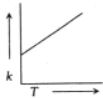
C
D
Solution
(A) The Arrhenius equation is given by $k = Ae^{-E_a/RT}$.
As temperature $(T)$ increases,the term $e^{-E_a/RT}$ increases exponentially.
Therefore,the rate constant $(k)$ increases exponentially with an increase in temperature $(T)$.
This relationship is represented by an exponential growth curve,which corresponds to the graph in option $A$.
As temperature $(T)$ increases,the term $e^{-E_a/RT}$ increases exponentially.
Therefore,the rate constant $(k)$ increases exponentially with an increase in temperature $(T)$.
This relationship is represented by an exponential growth curve,which corresponds to the graph in option $A$.
0 likes
View Solution83
DifficultMCQ
When the temperature changes from $20\,^oC$ to $50\,^oC$,the rate of reaction becomes three times. The activation energy $(E_a)$ for the reaction is $.... \, kJ \, mol^{-1}$ $(R = 8.314 \, J \, K^{-1} \, mol^{-1})$.
A
$28.81$
B
$29.31$
C
$25.66$
D
$24.75$
Solution
(A) Using the Arrhenius equation:
$\log_{10} \frac{K_2}{K_1} = \frac{E_a}{2.303 \times R} \left[ \frac{T_2 - T_1}{T_1 \times T_2} \right]$
Given:
$\frac{K_2}{K_1} = 3$,
$R = 8.314 \, J \, K^{-1} \, mol^{-1}$,
$T_1 = 20 + 273 = 293 \, K$,
$T_2 = 50 + 273 = 323 \, K$,
$\log_{10} 3 \approx 0.4771$.
Substituting the values:
$0.4771 = \frac{E_a}{2.303 \times 8.314} \left[ \frac{323 - 293}{323 \times 293} \right]$
$E_a = \frac{0.4771 \times 2.303 \times 8.314 \times 323 \times 293}{30}$
$E_a \approx 28811.8 \, J \, mol^{-1} = 28.81 \, kJ \, mol^{-1}$.
$\log_{10} \frac{K_2}{K_1} = \frac{E_a}{2.303 \times R} \left[ \frac{T_2 - T_1}{T_1 \times T_2} \right]$
Given:
$\frac{K_2}{K_1} = 3$,
$R = 8.314 \, J \, K^{-1} \, mol^{-1}$,
$T_1 = 20 + 273 = 293 \, K$,
$T_2 = 50 + 273 = 323 \, K$,
$\log_{10} 3 \approx 0.4771$.
Substituting the values:
$0.4771 = \frac{E_a}{2.303 \times 8.314} \left[ \frac{323 - 293}{323 \times 293} \right]$
$E_a = \frac{0.4771 \times 2.303 \times 8.314 \times 323 \times 293}{30}$
$E_a \approx 28811.8 \, J \, mol^{-1} = 28.81 \, kJ \, mol^{-1}$.
0 likes
View Solution84
EasyMCQ
The rate of a chemical reaction doubles for every $10^\circ \text{C}$ rise in temperature. If the temperature is increased by $50^\circ \text{C}$,the rate of reaction will increase by a factor of ........
A
$10$
B
$24$
C
$32$
D
$64$
Solution
(C) The temperature coefficient $\mu = 2$.
The relationship between the rate constant and temperature change is given by:
$\frac{K_2}{K_1} = \mu^{\frac{\Delta T}{10}}$
Given $\Delta T = 50^\circ \text{C}$ and $\mu = 2$:
$\frac{K_2}{K_1} = 2^{\frac{50}{10}}$
$\frac{K_2}{K_1} = 2^5 = 32$
Thus,the rate of reaction increases by a factor of $32$.
The relationship between the rate constant and temperature change is given by:
$\frac{K_2}{K_1} = \mu^{\frac{\Delta T}{10}}$
Given $\Delta T = 50^\circ \text{C}$ and $\mu = 2$:
$\frac{K_2}{K_1} = 2^{\frac{50}{10}}$
$\frac{K_2}{K_1} = 2^5 = 32$
Thus,the rate of reaction increases by a factor of $32$.
0 likes
View Solution85
EasyMCQ
In the Arrhenius equation,the rate of reaction is given by $k = A{e^{ - {E_a}/RT}}$. What does $E_a$ represent?
A
Energy below which molecules do not react.
B
Total energy of the reacting molecules at temperature $T$.
C
The fraction of molecules having energy greater than the activation energy of the reaction.
D
None of these.
0 likes
View Solution86
EasyMCQ
The Arrhenius equation can be represented as:
A
$\frac{d}{dT}(\ln K) = -\frac{E_a}{RT}$
B
$\frac{d}{dT}(\ln K) = \frac{E_a}{RT^2}$
C
$\frac{d}{dT}(\ln K) = +\frac{E_a}{RT^2}$
D
$\frac{d}{dT}(\ln K) = \frac{E_a}{RT}$
Solution
(B) The Arrhenius equation is given by $K = A e^{-E_a/RT}$.
Taking the natural logarithm on both sides,we get $\ln K = \ln A - \frac{E_a}{RT}$.
Differentiating both sides with respect to temperature $T$,we get $\frac{d}{dT}(\ln K) = \frac{d}{dT}(\ln A) - \frac{d}{dT}(\frac{E_a}{RT})$.
Since $A$ and $E_a$ are constants,$\frac{d}{dT}(\ln A) = 0$.
Thus,$\frac{d}{dT}(\ln K) = -E_a \cdot \frac{d}{dT}(T^{-1}) = -E_a \cdot (-T^{-2}) = \frac{E_a}{RT^2}$.
Taking the natural logarithm on both sides,we get $\ln K = \ln A - \frac{E_a}{RT}$.
Differentiating both sides with respect to temperature $T$,we get $\frac{d}{dT}(\ln K) = \frac{d}{dT}(\ln A) - \frac{d}{dT}(\frac{E_a}{RT})$.
Since $A$ and $E_a$ are constants,$\frac{d}{dT}(\ln A) = 0$.
Thus,$\frac{d}{dT}(\ln K) = -E_a \cdot \frac{d}{dT}(T^{-1}) = -E_a \cdot (-T^{-2}) = \frac{E_a}{RT^2}$.
0 likes
View Solution87
MediumMCQ
When a biochemical reaction is carried out in a laboratory without the presence of enzymes,the rate of reaction is $10^{-6}$ times slower. What will be the activation energy $(E_a)$ in the presence of enzymes?
A
$E_a$ will decrease.
B
$E_a$ will increase.
C
$E_a$ will remain the same.
D
Cannot be determined.
Solution
(A) Enzymes act as biological catalysts.
Catalysts provide an alternative reaction pathway with a lower activation energy $(E_a)$.
By lowering the activation energy,the number of effective collisions increases,which significantly enhances the rate of the reaction.
Therefore,in the presence of enzymes,the activation energy $(E_a)$ of the reaction decreases.
Catalysts provide an alternative reaction pathway with a lower activation energy $(E_a)$.
By lowering the activation energy,the number of effective collisions increases,which significantly enhances the rate of the reaction.
Therefore,in the presence of enzymes,the activation energy $(E_a)$ of the reaction decreases.
0 likes
View Solution88
EasyMCQ
In the Arrhenius equation,$k = A e^{-E_a/RT}$,the rate constant $k$ becomes equal to the frequency factor $A$ when:
A
$T = 0$
B
$T = 298 \ K$
C
$T \to \infty$
D
None of these
Solution
(C) The Arrhenius equation is given by $k = A e^{-E_a/RT}$.
For $k$ to be equal to $A$,the exponential term $e^{-E_a/RT}$ must be equal to $1$.
This happens when the exponent $-E_a/RT = 0$.
As $T \to \infty$,the term $E_a/RT$ approaches $0$,and $e^0 = 1$.
Therefore,$k = A$ when $T \to \infty$.
For $k$ to be equal to $A$,the exponential term $e^{-E_a/RT}$ must be equal to $1$.
This happens when the exponent $-E_a/RT = 0$.
As $T \to \infty$,the term $E_a/RT$ approaches $0$,and $e^0 = 1$.
Therefore,$k = A$ when $T \to \infty$.
0 likes
View Solution89
EasyMCQ
In a laboratory,a biochemical reaction performed outside the human body in the absence of an enzyme proceeds at a rate $10^{-6}$ times slower. If this reaction is performed in the presence of an enzyme,what will be the activation energy of the reaction?
A
$6RT$
B
External pressure is required
C
Different value from the $E_a$ of the laboratory reaction
D
Cannot be determined
Solution
(D) Enzymes act as biological catalysts that increase the rate of reaction by lowering the activation energy $(E_a)$.
Since the rate of reaction increases significantly in the presence of an enzyme,the activation energy of the catalyzed reaction is lower than that of the uncatalyzed reaction.
However,the exact value of the activation energy cannot be determined solely from the rate enhancement factor without knowing the specific Arrhenius parameters or the temperature.
Since the rate of reaction increases significantly in the presence of an enzyme,the activation energy of the catalyzed reaction is lower than that of the uncatalyzed reaction.
However,the exact value of the activation energy cannot be determined solely from the rate enhancement factor without knowing the specific Arrhenius parameters or the temperature.
0 likes
View Solution90
MediumMCQ
For a certain gaseous reaction,the temperature is increased by $10\,^{\circ}C$ from $25\,^{\circ}C$ to $35\,^{\circ}C$. If the rate of the reaction doubles,what will be the value of the activation energy $(E_a)$?
A
$\frac{10}{2.303R \times 298 \times 308}$
B
$\frac{2.303 \times R \times 298 \times 308}{10} \log 2$
C
$\frac{0.693R \times 10}{298 \times 308}$
D
$\frac{2.303 \times R \times 298 \times 308}{10}$
Solution
(B) The Arrhenius equation is given by: $\log \frac{K_2}{K_1} = \frac{E_a}{2.303R} \left( \frac{T_2 - T_1}{T_1 T_2} \right)$.
Given: $T_1 = 25 + 273 = 298 \, K$,$T_2 = 35 + 273 = 308 \, K$,and $K_2 = 2K_1$.
Substituting these values: $\log \frac{2K_1}{K_1} = \frac{E_a}{2.303R} \left( \frac{308 - 298}{298 \times 308} \right)$.
$\log 2 = \frac{E_a}{2.303R} \left( \frac{10}{298 \times 308} \right)$.
Rearranging for $E_a$: $E_a = \frac{2.303 \times R \times 298 \times 308 \times \log 2}{10}$.
Given: $T_1 = 25 + 273 = 298 \, K$,$T_2 = 35 + 273 = 308 \, K$,and $K_2 = 2K_1$.
Substituting these values: $\log \frac{2K_1}{K_1} = \frac{E_a}{2.303R} \left( \frac{308 - 298}{298 \times 308} \right)$.
$\log 2 = \frac{E_a}{2.303R} \left( \frac{10}{298 \times 308} \right)$.
Rearranging for $E_a$: $E_a = \frac{2.303 \times R \times 298 \times 308 \times \log 2}{10}$.
0 likes
View Solution91
MediumMCQ
For the reaction $A_2 + B_2 \rightleftharpoons 2AB$,the activation energies for the forward and backward reactions are $180 \, kJ \, mol^{-1}$ and $200 \, kJ \, mol^{-1}$ respectively. In the presence of a catalyst,the activation energy for both (forward and backward) reactions decreases by $100 \, kJ \, mol^{-1}$. What will be the enthalpy change $(\Delta H)$ for the reaction $(A_2 + B_2 \rightarrow 2AB)$ in the presence of a catalyst in $kJ \, mol^{-1}$?
A
$300$
B
$120$
C
$280$
D
$-20$
0 likes
View Solution92
MediumMCQ
For the forward reaction $X \rightarrow Y$,the activation energy is $60 \ kJ \ mol^{-1}$ and $\Delta H = -20 \ kJ \ mol^{-1}$. What is the activation energy for the reverse reaction $Y \rightarrow X$ in $kJ \ mol^{-1}$?
A
$80$
B
$40$
C
$60$
D
$20$
Solution
(A) The relationship between the activation energy of the forward reaction $(E_{a,f})$,the activation energy of the reverse reaction $(E_{a,r})$,and the enthalpy change $(\Delta H)$ is given by the equation: $\Delta H = E_{a,f} - E_{a,r}$.
Given: $E_{a,f} = 60 \ kJ \ mol^{-1}$ and $\Delta H = -20 \ kJ \ mol^{-1}$.
Substituting these values into the equation: $-20 = 60 - E_{a,r}$.
Rearranging to solve for $E_{a,r}$: $E_{a,r} = 60 + 20 = 80 \ kJ \ mol^{-1}$.
Given: $E_{a,f} = 60 \ kJ \ mol^{-1}$ and $\Delta H = -20 \ kJ \ mol^{-1}$.
Substituting these values into the equation: $-20 = 60 - E_{a,r}$.
Rearranging to solve for $E_{a,r}$: $E_{a,r} = 60 + 20 = 80 \ kJ \ mol^{-1}$.
0 likes
View Solution93
MediumMCQ
At a constant temperature,the activation energy of a reaction is found to be $2.303 \, RT \, J \, mol^{-1}$. The ratio of the rate constant to the Arrhenius constant will be $......$.
A
$0.01$
B
$0.1$
C
$0.02$
D
$0.001$
Solution
(B) The Arrhenius equation is given by: $\log K = \log A - \frac{E_a}{2.303 \, RT}$.
Rearranging the equation: $\log K - \log A = -\frac{E_a}{2.303 \, RT}$.
Using the property $\log K - \log A = \log(K/A)$,we get: $\log(K/A) = -\frac{E_a}{2.303 \, RT}$.
Given $E_a = 2.303 \, RT$,substituting this value:
$\log(K/A) = -\frac{2.303 \, RT}{2.303 \, RT} = -1$.
Therefore,the ratio $\frac{K}{A} = \text{antilog}(-1) = 10^{-1} = 0.1$.
Rearranging the equation: $\log K - \log A = -\frac{E_a}{2.303 \, RT}$.
Using the property $\log K - \log A = \log(K/A)$,we get: $\log(K/A) = -\frac{E_a}{2.303 \, RT}$.
Given $E_a = 2.303 \, RT$,substituting this value:
$\log(K/A) = -\frac{2.303 \, RT}{2.303 \, RT} = -1$.
Therefore,the ratio $\frac{K}{A} = \text{antilog}(-1) = 10^{-1} = 0.1$.
1 likes
View Solution94
MediumMCQ
If the rate of a reaction doubles when the temperature increases from $298 \, K$ to $308 \, K$,the activation energy of the reaction is ........... $kJ \, mol^{-1}$.
A
$29.5$
B
$39.2$
C
$52.9$
D
$59.2$
Solution
(C) The Arrhenius equation is given by: $\log \frac{k_2}{k_1} = \frac{E_a}{2.303R} \left[ \frac{T_2 - T_1}{T_1 T_2} \right]$
Given: $k_2 = 2k_1$,$T_1 = 298 \, K$,$T_2 = 308 \, K$,$R = 8.314 \, J \, mol^{-1} \, K^{-1}$.
Substituting the values: $\log(2) = \frac{E_a}{2.303 \times 8.314} \left[ \frac{308 - 298}{308 \times 298} \right]$
$0.3010 = \frac{E_a}{19.147} \left[ \frac{10}{91784} \right]$
$E_a = \frac{0.3010 \times 19.147 \times 91784}{10} \approx 52897 \, J \, mol^{-1} \approx 52.9 \, kJ \, mol^{-1}$.
Given: $k_2 = 2k_1$,$T_1 = 298 \, K$,$T_2 = 308 \, K$,$R = 8.314 \, J \, mol^{-1} \, K^{-1}$.
Substituting the values: $\log(2) = \frac{E_a}{2.303 \times 8.314} \left[ \frac{308 - 298}{308 \times 298} \right]$
$0.3010 = \frac{E_a}{19.147} \left[ \frac{10}{91784} \right]$
$E_a = \frac{0.3010 \times 19.147 \times 91784}{10} \approx 52897 \, J \, mol^{-1} \approx 52.9 \, kJ \, mol^{-1}$.
0 likes
View Solution95
EasyMCQ
For an exothermic reaction,where the enthalpy of reaction is $\Delta H$ in $kJ/mol$,the minimum value for the activation energy will be:
A
Less than $\Delta H$
B
Zero
C
More than $\Delta H$
D
Equal to $\Delta H$
Solution
(C) For any chemical reaction,the activation energy $(E_a)$ is the minimum energy required for the reactants to form the activated complex.
In an exothermic reaction,the energy of the products is lower than the energy of the reactants.
The relationship between activation energy $(E_a)$,enthalpy of reaction $(\Delta H)$,and the activation energy of the reverse reaction $(E_{a,reverse})$ is given by:
$E_a - E_{a,reverse} = \Delta H$.
Since $E_{a,reverse}$ must always be a positive value,$E_a$ must be greater than $\Delta H$ (considering the magnitude of $\Delta H$ for an exothermic reaction).
Therefore,the activation energy is always a positive value and is greater than the enthalpy change of the reaction.
In an exothermic reaction,the energy of the products is lower than the energy of the reactants.
The relationship between activation energy $(E_a)$,enthalpy of reaction $(\Delta H)$,and the activation energy of the reverse reaction $(E_{a,reverse})$ is given by:
$E_a - E_{a,reverse} = \Delta H$.
Since $E_{a,reverse}$ must always be a positive value,$E_a$ must be greater than $\Delta H$ (considering the magnitude of $\Delta H$ for an exothermic reaction).
Therefore,the activation energy is always a positive value and is greater than the enthalpy change of the reaction.
0 likes
View Solution96
EasyMCQ
The activation energy is ..........
A
The energy added to the molecules so that their energy becomes equal to the threshold energy.
B
The energy required for molecules to react.
C
The energy possessed by molecules so that they can undergo successful collisions.
D
The average kinetic energy of the molecules.
Solution
(A) Activation energy $(E_a)$ is defined as the minimum extra amount of energy absorbed by the reactant molecules so that their total energy becomes equal to the threshold energy $(E_T)$.
Mathematically,$E_a = E_T - E_{\text{average}}$.
Mathematically,$E_a = E_T - E_{\text{average}}$.
0 likes
View Solution97
MediumMCQ
When the temperature changes from $300 \ K$ to $310 \ K$,the rate of the reaction doubles. The activation energy of the reaction is ..... $kJ \ mol^{-1}$. $(R = 8.314 \ J \ K^{-1} \ mol^{-1} \text{ and } \log 2 = 0.301)$
A
$53.6$
B
$48.6$
C
$58.5$
D
$60.5$
Solution
(A) Using the Arrhenius equation: $\log \frac{k_2}{k_1} = \frac{E_a}{2.303R} \left[ \frac{T_2 - T_1}{T_1 T_2} \right]$
Given: $k_2 = 2k_1$,$T_1 = 300 \ K$,$T_2 = 310 \ K$,$R = 8.314 \ J \ K^{-1} \ mol^{-1}$.
$\log 2 = \frac{E_a}{2.303 \times 8.314} \left[ \frac{310 - 300}{300 \times 310} \right]$
$0.301 = \frac{E_a}{19.147} \left[ \frac{10}{93000} \right]$
$E_a = \frac{0.301 \times 19.147 \times 9300}{10} \approx 53598 \ J \ mol^{-1} \approx 53.6 \ kJ \ mol^{-1}$.
Given: $k_2 = 2k_1$,$T_1 = 300 \ K$,$T_2 = 310 \ K$,$R = 8.314 \ J \ K^{-1} \ mol^{-1}$.
$\log 2 = \frac{E_a}{2.303 \times 8.314} \left[ \frac{310 - 300}{300 \times 310} \right]$
$0.301 = \frac{E_a}{19.147} \left[ \frac{10}{93000} \right]$
$E_a = \frac{0.301 \times 19.147 \times 9300}{10} \approx 53598 \ J \ mol^{-1} \approx 53.6 \ kJ \ mol^{-1}$.
0 likes
View Solution98
EasyMCQ
Reactant $(A)$ produces two products. If $Ea_2 = 2 Ea_1$,then $K_1$ and $K_2$ are related as:
$A \xrightarrow{K_1} B$,activation energy: $Ea_1$
$A \xrightarrow{K_2} C$,activation energy: $Ea_2$
$A \xrightarrow{K_1} B$,activation energy: $Ea_1$
$A \xrightarrow{K_2} C$,activation energy: $Ea_2$
A
$K_1 = 2 K_2 e^{Ea_2/RT}$
B
$K_2 = K_1 e^{Ea_1/RT}$
C
$K_2 = K_1 e^{Ea_2/RT}$
D
$K_1 = A' K_2 e^{Ea_1/RT}$
Solution
(D) According to the Arrhenius equation,$K_1 = A_1 e^{-Ea_1/RT}$ and $K_2 = A_2 e^{-Ea_2/RT}$.
Dividing the two equations: $\frac{K_1}{K_2} = \frac{A_1}{A_2} e^{(Ea_2 - Ea_1)/RT}$.
Given $Ea_2 = 2 Ea_1$,substituting this into the exponent gives: $\frac{K_1}{K_2} = \frac{A_1}{A_2} e^{(2 Ea_1 - Ea_1)/RT} = \frac{A_1}{A_2} e^{Ea_1/RT}$.
Therefore,$K_1 = A' K_2 e^{Ea_1/RT}$,where $A' = \frac{A_1}{A_2}$.
Dividing the two equations: $\frac{K_1}{K_2} = \frac{A_1}{A_2} e^{(Ea_2 - Ea_1)/RT}$.
Given $Ea_2 = 2 Ea_1$,substituting this into the exponent gives: $\frac{K_1}{K_2} = \frac{A_1}{A_2} e^{(2 Ea_1 - Ea_1)/RT} = \frac{A_1}{A_2} e^{Ea_1/RT}$.
Therefore,$K_1 = A' K_2 e^{Ea_1/RT}$,where $A' = \frac{A_1}{A_2}$.
0 likes
View Solution99
EasyMCQ
The specific rate constant of a first-order reaction depends on .......
A
Concentration of reactant
B
Concentration of product
C
Time
D
Temperature
Solution
(D) The rate constant $(k)$ of a reaction is a characteristic property that depends primarily on the temperature of the reaction,as described by the Arrhenius equation: $k = A e^{-E_a / RT}$.
It is independent of the concentration of reactants,concentration of products,or time.
It is independent of the concentration of reactants,concentration of products,or time.
0 likes
View Solution100
EasyMCQ
Which of the following graphs of $\log \, K \rightarrow 1/T$ can be used to calculate the activation energy?
A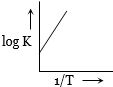
B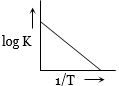
C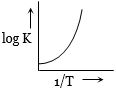
D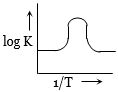
Solution
(B) According to the Arrhenius equation: $k = A e^{-E_a / RT}$.
Taking the logarithm on both sides:
$\ln \, k = \ln \, A - \frac{E_a}{RT}$
Converting to base $10$:
$\log \, k = \log \, A - \frac{E_a}{2.303 \, R} \left( \frac{1}{T} \right)$
This equation is in the form of a straight line $y = mx + c$,where $y = \log \, k$,$x = 1/T$,and the slope $m = -\frac{E_a}{2.303 \, R}$.
Since the slope is negative,the graph of $\log \, k$ versus $1/T$ is a straight line with a negative slope,as shown in option $B$.
Taking the logarithm on both sides:
$\ln \, k = \ln \, A - \frac{E_a}{RT}$
Converting to base $10$:
$\log \, k = \log \, A - \frac{E_a}{2.303 \, R} \left( \frac{1}{T} \right)$
This equation is in the form of a straight line $y = mx + c$,where $y = \log \, k$,$x = 1/T$,and the slope $m = -\frac{E_a}{2.303 \, R}$.
Since the slope is negative,the graph of $\log \, k$ versus $1/T$ is a straight line with a negative slope,as shown in option $B$.
0 likes
View SolutionChemical Kinetics — Collision theory, Energy of activation and Arrhenius equation · Frequently Asked Questions
1Are these Chemical Kinetics questions useful for JEE and NEET?
Yes. All questions in this section are mapped to JEE Main and NEET exam patterns. Previous year questions from JEE Main, NEET, GUJCET and state-level exams are included with full solutions.
2Can I switch to Hindi or Gujarati for these questions?
Yes. Use the language tabs in the hero section or the sidebar to view the same questions and solutions in English, Hindi or Gujarati.
3How do I generate a question paper from this subtopic?
Use the Vedclass Exam Paper Generator — select the chapter and subtopic, set difficulty, and generate Sets A, B, C, D automatically. First 3 chapters of every subject are free.
Vedclass Products
For Students
Vedclass Test Series
Mock tests in real JEE/NEET style with performance analysis. 5-day free trial.
Start Free TrialFor Teachers
Exam Paper Generator
Generate Set A/B/C/D papers from this chapter in 2 minutes. 3 chapters free.
Try FreeFor Institutes
Online Exam Module
Live online exams with unlimited students, 360° analytics & white-label branding.
See DemoFor Teachers & Institutes
Generate a Chemical Kinetics Exam Paper in 2 Minutes
Select subtopic & difficulty — Sets A, B, C, D auto-generated with No Repeat logic.
First 3 chapters of every subject are free — no payment required.