
A English
Carbohydrates Questions in English
Class 12 Chemistry · Biomolecules · Carbohydrates
808+
Questions
English
Language
100%
With Solutions
Showing 50 of 808 questions in English
251
MediumMCQ
Which one of the following statements is not true regarding $(+)$ lactose?
A
On hydrolysis $(+)$ lactose gives equal amount of $D(+)$ glucose and $D(+)$ galactose.
B
$(+)$ Lactose is a $\beta-$ glucoside formed by the union of a molecule of $D(+)$ glucose and a molecule of $D(+)$ galactose.
C
$(+)$ Lactose is a reducing sugar and does not exhibit mutarotation.
D
$(+)$ Lactose,$C_{12}H_{22}O_{11}$ contains $8-OH$ groups.
Solution
(C) $(+)$ Lactose is a reducing sugar because it contains a hemiacetal group,which allows it to exist in equilibrium with its open-chain form.
All reducing sugars exhibit mutarotation in aqueous solution.
Therefore,the statement that $(+)$ lactose does not exhibit mutarotation is false.
All reducing sugars exhibit mutarotation in aqueous solution.
Therefore,the statement that $(+)$ lactose does not exhibit mutarotation is false.
0 likes
View Solution252
MediumMCQ
Which one of the following does not exhibit the phenomenon of mutarotation?
A
$(+)$ Sucrose
B
$(+)$ Lactose
C
$(+)$ Maltose
D
$(-)$ Fructose
Solution
(A) Mutarotation is the phenomenon of change in optical rotation observed in freshly prepared solutions of reducing sugars.
This property is exhibited by sugars that possess a free hemiacetal or hemiketal group,which allows them to exist in equilibrium with their open-chain aldehyde $(-CHO)$ or ketone $(>C=O)$ forms.
$(+)$ Sucrose is a non-reducing sugar because its glycosidic linkage is formed between the anomeric carbons of glucose and fructose,leaving no free aldehyde or ketone group.
Therefore,$(+)$ Sucrose does not exhibit mutarotation.
This property is exhibited by sugars that possess a free hemiacetal or hemiketal group,which allows them to exist in equilibrium with their open-chain aldehyde $(-CHO)$ or ketone $(>C=O)$ forms.
$(+)$ Sucrose is a non-reducing sugar because its glycosidic linkage is formed between the anomeric carbons of glucose and fructose,leaving no free aldehyde or ketone group.
Therefore,$(+)$ Sucrose does not exhibit mutarotation.
0 likes
View Solution253
EasyMCQ
The term anomers of glucose refers to
A
enantiomers of glucose
B
isomers of glucose that differ in configuration at carbon one $(C-1)$
C
isomers of glucose that differ in configurations at carbons one and four $(C-1$ and $C-4)$
D
a mixture of $(D)-$glucose and $(L)-$glucose
Solution
(B) Anomers of glucose are cyclic diastereomers (epimers) that differ in configuration at the anomeric carbon,which is $C-1$.
They exist in two forms,$\alpha-$ and $\beta-$form,depending on the orientation of the hydroxyl group at $C-1$ relative to the $CH_2OH$ group.
They exist in two forms,$\alpha-$ and $\beta-$form,depending on the orientation of the hydroxyl group at $C-1$ relative to the $CH_2OH$ group.
0 likes
View Solution254
EasyMCQ
$\alpha-D-(+)$-glucose and $\beta-D-(+)$-glucose are
A
conformers
B
epimers
C
anomers
D
enantiomers
Solution
(C) $\alpha-D-(+)$-glucose and $\beta-D-(+)$-glucose differ in configuration only at the $C-1$ carbon atom,which is the anomeric carbon.
Such diastereomers that differ in configuration specifically at the $C-1$ atom are known as anomers.
Such diastereomers that differ in configuration specifically at the $C-1$ atom are known as anomers.
0 likes
View Solution255
MediumMCQ
The two functional groups present in a typical carbohydrate are:
A
$-CHO$ and $-COOH$
B
$ > C=O$ and $-COOH$
C
$-OH$ and $-CHO$ or $ > C=O$
D
$-OH$ and $-COOH$
Solution
(C) Carbohydrates are polyhydroxy aldehydes or polyhydroxy ketones.This means they contain multiple hydroxyl groups $(-OH)$ and either an aldehyde group $(-CHO)$ or a ketone group $( > C=O)$.
0 likes
View Solution256
MediumMCQ
Which of the following compounds can be detected by Molisch's Test?
A
Nitro compounds
B
Sugars
C
Amines
D
Primary alcohols
Solution
(B) Molisch's Test is a general chemical test for the presence of carbohydrates.
In this test,$2 \ mL$ of the sample solution is mixed with two drops of an alcoholic solution of $\alpha$-naphthol.
Then,$1 \ mL$ of concentrated $H_2SO_4$ is added carefully along the sides of the test tube.
The formation of a violet ring at the junction of the two liquids indicates the presence of carbohydrates or sugars.
In this test,$2 \ mL$ of the sample solution is mixed with two drops of an alcoholic solution of $\alpha$-naphthol.
Then,$1 \ mL$ of concentrated $H_2SO_4$ is added carefully along the sides of the test tube.
The formation of a violet ring at the junction of the two liquids indicates the presence of carbohydrates or sugars.
0 likes
View Solution257
MediumMCQ
Synthesis of each molecule of glucose in photosynthesis involves:
A
$18$ molecules of $ATP$
B
$10$ molecules of $ATP$
C
$8$ molecules of $ATP$
D
$6$ molecules of $ATP$
Solution
(A) The synthesis of $1$ molecule of glucose $(C_{6}H_{12}O_{6})$ during the Calvin cycle in photosynthesis requires $18$ molecules of $ATP$ and $12$ molecules of $NADPH$.
The balanced equation for the process is:
$6CO_{2} + 12NADPH + 18ATP \rightarrow C_{6}H_{12}O_{6} + 12NADP^{+} + 18ADP + 18Pi + 6H_{2}O$
The balanced equation for the process is:
$6CO_{2} + 12NADPH + 18ATP \rightarrow C_{6}H_{12}O_{6} + 12NADP^{+} + 18ADP + 18Pi + 6H_{2}O$
0 likes
View Solution258
DifficultMCQ
Which of the following compounds will behave as a reducing sugar in an aqueous $KOH$ solution?
A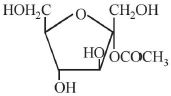
B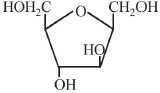
C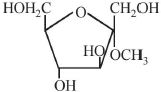
D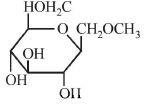
Solution
(A) reducing sugar is a carbohydrate that possesses a free aldehyde or ketone group,or a hemiacetal group that can open to form such a group in solution.
In an aqueous $KOH$ solution,esters of sugars (like the one shown in option $A$) undergo base-catalyzed hydrolysis.
The hydrolysis of the ester group at the anomeric carbon releases a free hydroxyl group,regenerating the hemiacetal structure.
This hemiacetal structure exists in equilibrium with its open-chain form containing a free aldehyde or ketone group,thus exhibiting reducing properties.
Therefore,the compound in option $A$ acts as a reducing sugar after hydrolysis in aqueous $KOH$.
In an aqueous $KOH$ solution,esters of sugars (like the one shown in option $A$) undergo base-catalyzed hydrolysis.
The hydrolysis of the ester group at the anomeric carbon releases a free hydroxyl group,regenerating the hemiacetal structure.
This hemiacetal structure exists in equilibrium with its open-chain form containing a free aldehyde or ketone group,thus exhibiting reducing properties.
Therefore,the compound in option $A$ acts as a reducing sugar after hydrolysis in aqueous $KOH$.
0 likes
View Solution259
EasyMCQ
Which of the following carbohydrates cannot reduce Tollen's reagent?
A
Fructose
B
Maltose
C
Sucrose
D
Lactose
Solution
(C) Tollen's reagent is reduced by carbohydrates that have a free hemiacetal or hemiketal group (reducing sugars).
In $Sucrose$,the glycosidic linkage is formed between $C1$ of $\alpha-D-glucose$ and $C2$ of $\beta-D-fructose$.
Since both anomeric carbons are involved in the glycosidic bond,there is no free anomeric $-OH$ group present.
Therefore,$Sucrose$ is a non-reducing sugar and cannot reduce Tollen's reagent.
In $Sucrose$,the glycosidic linkage is formed between $C1$ of $\alpha-D-glucose$ and $C2$ of $\beta-D-fructose$.
Since both anomeric carbons are involved in the glycosidic bond,there is no free anomeric $-OH$ group present.
Therefore,$Sucrose$ is a non-reducing sugar and cannot reduce Tollen's reagent.
0 likes
View Solution260
EasyMCQ
Which of the following pairs give a positive Tollen's test?
A
Glucose,sucrose
B
Glucose,fructose
C
Hexanal,acetophenone
D
Fructose,sucrose
Solution
(B) Tollen's test is given by reducing sugars and aldehydes.
Glucose is an aldose and fructose is a ketose,but in the presence of a basic Tollen's reagent,fructose undergoes tautomerization to form glucose and mannose,which are aldoses.
Therefore,both glucose and fructose act as reducing sugars and give a positive Tollen's test.
Glucose is an aldose and fructose is a ketose,but in the presence of a basic Tollen's reagent,fructose undergoes tautomerization to form glucose and mannose,which are aldoses.
Therefore,both glucose and fructose act as reducing sugars and give a positive Tollen's test.
0 likes
View Solution261
MediumMCQ
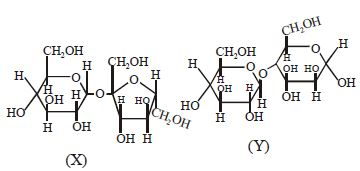
The correct statement$(s)$ about the following sugars $(X)$ and $(Y)$ is:
A
Both $(X)$ and $(Y)$ are non-reducing sugars.
B
$(X)$ is a non-reducing sugar and $(Y)$ is a reducing sugar.
C
$(X)$ is a reducing sugar and $(Y)$ is a non-reducing sugar.
D
Both $(X)$ and $(Y)$ are reducing sugars.
Solution
(B) In sugar $(X)$,the glycosidic linkage is formed between the anomeric carbons of both monosaccharide units (glucose and fructose). Thus,it has no free hemiacetal or hemiketal group,making it a non-reducing sugar.
In sugar $(Y)$,one of the monosaccharide units has a free anomeric carbon with a hemiacetal group ($-OH$ group attached to the same carbon as the ether oxygen). Thus,it is a reducing sugar.
In sugar $(Y)$,one of the monosaccharide units has a free anomeric carbon with a hemiacetal group ($-OH$ group attached to the same carbon as the ether oxygen). Thus,it is a reducing sugar.
0 likes
View Solution262
MediumMCQ
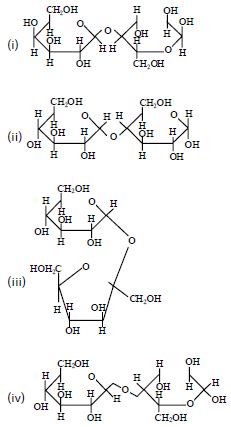
Which of the following are non-reducing sugars?
A
$i$ & $iv$
B
$i$,$ii$ and $iv$
C
$iii$
D
$iii$ & $iv$
Solution
(C) sugar is non-reducing if its anomeric carbon atoms are involved in the glycosidic linkage,meaning no free hemiacetal or hemiketal group is available to open into an aldehyde or ketone form.
$(i)$ Represents Maltose,which has a free anomeric carbon and is a reducing sugar.
(ii) Represents Lactose,which has a free anomeric carbon and is a reducing sugar.
(iii) Represents Sucrose,where both anomeric carbons ($C1$ of glucose and $C2$ of fructose) are involved in the glycosidic linkage,making it a non-reducing sugar.
(iv) Represents Cellobiose,which has a free anomeric carbon and is a reducing sugar.
Therefore,only structure $(iii)$ is a non-reducing sugar.
$(i)$ Represents Maltose,which has a free anomeric carbon and is a reducing sugar.
(ii) Represents Lactose,which has a free anomeric carbon and is a reducing sugar.
(iii) Represents Sucrose,where both anomeric carbons ($C1$ of glucose and $C2$ of fructose) are involved in the glycosidic linkage,making it a non-reducing sugar.
(iv) Represents Cellobiose,which has a free anomeric carbon and is a reducing sugar.
Therefore,only structure $(iii)$ is a non-reducing sugar.
0 likes
View Solution263
DifficultMCQ
Mutarotation involves -
A
Racemization
B
Optical resolution
C
Conformational inversion
D
Diastereoisomerization
Solution
(D) Mutarotation is the change in the specific optical rotation of a chiral compound in solution due to the equilibrium between two anomers. $\alpha-D$-glucose and $\beta-D$-glucose are anomers,which are a specific type of diastereomers. Therefore,the process involves the interconversion between these diastereomers.
0 likes
View Solution264
MediumMCQ
Identify the non-reducing sugar:
A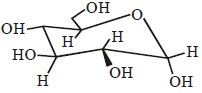
B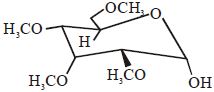
C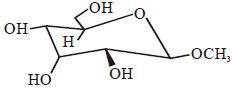
D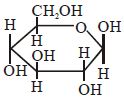
Solution
(B) sugar is non-reducing if it does not have a free hemiacetal or hemiketal group at the anomeric carbon.
In option $B$,the anomeric carbon is involved in a glycosidic linkage (as a methyl glycoside),meaning it lacks a free $-OH$ group at the anomeric position,making it a non-reducing sugar.
Options $A$,$C$,and $D$ possess a free $-OH$ group at the anomeric carbon,making them reducing sugars.
In option $B$,the anomeric carbon is involved in a glycosidic linkage (as a methyl glycoside),meaning it lacks a free $-OH$ group at the anomeric position,making it a non-reducing sugar.
Options $A$,$C$,and $D$ possess a free $-OH$ group at the anomeric carbon,making them reducing sugars.
0 likes
View Solution265
MediumMCQ
Which of the following represents the anomer of the compound shown?
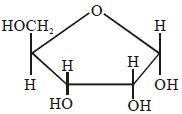
A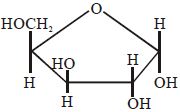
B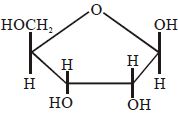
C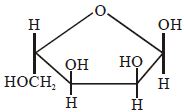
D
None of these
Solution
(A) Anomers are a pair of diastereomers that differ in configuration only at the anomeric carbon atom (the carbon derived from the carbonyl carbon in the open-chain form).
In the given structure,the anomeric carbon is the one bonded to both the ring oxygen and the $-OH$ group.
To form the anomer,the configuration at this specific carbon must be inverted while all other chiral centers remain unchanged.
Comparing the given structure with the options,option $A$ shows the same configuration at all chiral centers except the anomeric carbon,where the $-OH$ group is now in the opposite position.
Therefore,option $A$ represents the anomer.
In the given structure,the anomeric carbon is the one bonded to both the ring oxygen and the $-OH$ group.
To form the anomer,the configuration at this specific carbon must be inverted while all other chiral centers remain unchanged.
Comparing the given structure with the options,option $A$ shows the same configuration at all chiral centers except the anomeric carbon,where the $-OH$ group is now in the opposite position.
Therefore,option $A$ represents the anomer.
0 likes
View Solution266
MediumMCQ
Which of the following statements is incorrect about $\alpha-D$-glucopyranose and $\beta-D$-glucopyranose?
A
Both are anomers of each other.
B
Both are reducing sugars.
C
Both show mutarotation.
D
Both can reduce Schiff's reagent under normal conditions.
Solution
(D) $\alpha-D$-glucopyranose and $\beta-D$-glucopyranose are anomers of each other,as they differ in configuration only at the $C-1$ carbon.
Both are reducing sugars because they contain a hemiacetal group that can open to form an aldehyde group in aqueous solution.
Both exhibit mutarotation in aqueous solution as they interconvert through the open-chain form.
However,Schiff's reagent is a specific test for aldehydes. While glucose exists in equilibrium with its open-chain aldehyde form,the concentration of the free aldehyde is extremely low (less than $0.01\%$). Therefore,glucose does not restore the pink color of Schiff's reagent under normal conditions,making statement $D$ incorrect.
Both are reducing sugars because they contain a hemiacetal group that can open to form an aldehyde group in aqueous solution.
Both exhibit mutarotation in aqueous solution as they interconvert through the open-chain form.
However,Schiff's reagent is a specific test for aldehydes. While glucose exists in equilibrium with its open-chain aldehyde form,the concentration of the free aldehyde is extremely low (less than $0.01\%$). Therefore,glucose does not restore the pink color of Schiff's reagent under normal conditions,making statement $D$ incorrect.
0 likes
View Solution267
MediumMCQ
Identify the intermediate formed in the given reaction of $D$-glucose with methanol in the presence of an acid catalyst $(H^+)$.
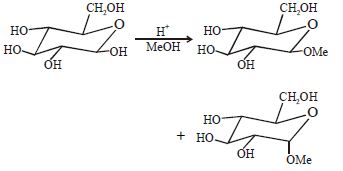
A
Carbocation which does not undergo resonance
B
Carbocation which undergo rearrangement
C
Carbocation which undergoes resonance
D
Free radical which does not undergo resonance
Solution
(C) The reaction shown is the formation of methyl glycoside from $D$-glucose in the presence of methanol and an acid catalyst.
In the first step,the anomeric hydroxyl group is protonated to form a good leaving group $(-OH_2^+)$.
Loss of water leads to the formation of an oxocarbenium ion at the anomeric carbon.
This carbocation is stabilized by resonance with the lone pair of the ring oxygen atom,making it an oxocarbenium ion.
Therefore,the intermediate is a carbocation which undergoes resonance.
In the first step,the anomeric hydroxyl group is protonated to form a good leaving group $(-OH_2^+)$.
Loss of water leads to the formation of an oxocarbenium ion at the anomeric carbon.
This carbocation is stabilized by resonance with the lone pair of the ring oxygen atom,making it an oxocarbenium ion.
Therefore,the intermediate is a carbocation which undergoes resonance.
0 likes
View Solution268
MediumMCQ
Select the correct statement among the following:
A
Number of chiral atoms in $\alpha-D$-glucose is less than $D$-glucose.
B
$D$-glucose and $D$-fructose give the same product with $HIO_4$.
C
$D$-glucose and $D$-fructose give the same product with $H_2NOH$.
D
$D$-glucose and $D$-fructose form the same product with $H_2N-NH-Ph$.
Solution
(D) $1$. Both $D$-glucose and $D$-fructose are aldose and ketose sugars respectively,but they share the same configuration at $C-3, C-4,$ and $C-5$.
$2$. When reacted with phenylhydrazine $(H_2N-NH-Ph)$,both $D$-glucose and $D$-fructose form the same osazone derivative because the reaction involves the first two carbon atoms,where the difference in structure is eliminated.
$3$. Option $A$ is incorrect because both have the same number of chiral centers.
$4$. Option $B$ is incorrect as they yield different products due to different oxidative cleavage patterns.
$5$. Option $C$ is incorrect as they form different oximes.
$2$. When reacted with phenylhydrazine $(H_2N-NH-Ph)$,both $D$-glucose and $D$-fructose form the same osazone derivative because the reaction involves the first two carbon atoms,where the difference in structure is eliminated.
$3$. Option $A$ is incorrect because both have the same number of chiral centers.
$4$. Option $B$ is incorrect as they yield different products due to different oxidative cleavage patterns.
$5$. Option $C$ is incorrect as they form different oximes.
0 likes
View Solution269
MediumMCQ
Which of the following molecules represents the $D$-form?
A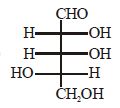
B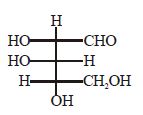
C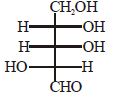
D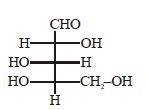
Solution
(A) To determine the $D$ or $L$ configuration of a carbohydrate,we look at the chiral carbon atom that is at the maximum distance from the principal functional group (the $CHO$ group in aldoses).
In a Fischer projection,if the $-OH$ group on this chiral carbon is on the right-hand side $(RHS)$,the molecule is assigned the $D$-configuration.
In option $A$,the chiral carbon furthest from the $CHO$ group is the $C-4$ atom. The $-OH$ group on this carbon is on the left-hand side,so it is an $L$-form.
However,looking at the standard definition,for a molecule to be $D$,the $-OH$ on the lowest chiral carbon must be on the right. In the provided structure $A$,the $-OH$ is on the left. Re-evaluating the structures,option $A$ is the standard representation of an aldose where the $OH$ on the bottom-most chiral center determines the configuration. Based on the standard $D$-glucose structure,the $OH$ on the $C-5$ (the lowest chiral carbon) is on the right. In the provided image $A$,the $OH$ is on the left,making it $L$. Given the options,$A$ is the intended structure for analysis.
In a Fischer projection,if the $-OH$ group on this chiral carbon is on the right-hand side $(RHS)$,the molecule is assigned the $D$-configuration.
In option $A$,the chiral carbon furthest from the $CHO$ group is the $C-4$ atom. The $-OH$ group on this carbon is on the left-hand side,so it is an $L$-form.
However,looking at the standard definition,for a molecule to be $D$,the $-OH$ on the lowest chiral carbon must be on the right. In the provided structure $A$,the $-OH$ is on the left. Re-evaluating the structures,option $A$ is the standard representation of an aldose where the $OH$ on the bottom-most chiral center determines the configuration. Based on the standard $D$-glucose structure,the $OH$ on the $C-5$ (the lowest chiral carbon) is on the right. In the provided image $A$,the $OH$ is on the left,making it $L$. Given the options,$A$ is the intended structure for analysis.
0 likes
View Solution270
MediumMCQ
Which of the following statements is incorrect?
A
The non-reducing half in lactose is $\beta-D-galactose$.
B
Cellulose is a polymer of $\beta-D-glucose$.
C
Starch is a polymer of $\alpha-D-glucose$.
D
In amylose,glucose residues are connected by $1,6$-glycosidic linkage.
Solution
(D) Lactose is a disaccharide composed of $\beta-D-galactose$ and $\beta-D-glucose$. The galactose unit is the non-reducing part.
Cellulose is a linear polymer of $\beta-D-glucose$ units linked by $\beta-1,4$-glycosidic bonds.
Starch is a polymer of $\alpha-D-glucose$ units.
Amylose is a linear component of starch where $\alpha-D-glucose$ units are connected by $\alpha-1,4$-glycosidic linkages,not $1,6$-linkages. The $1,6$-linkages are found in amylopectin (branched starch). Therefore,option $D$ is incorrect.
Cellulose is a linear polymer of $\beta-D-glucose$ units linked by $\beta-1,4$-glycosidic bonds.
Starch is a polymer of $\alpha-D-glucose$ units.
Amylose is a linear component of starch where $\alpha-D-glucose$ units are connected by $\alpha-1,4$-glycosidic linkages,not $1,6$-linkages. The $1,6$-linkages are found in amylopectin (branched starch). Therefore,option $D$ is incorrect.
0 likes
View Solution271
MediumMCQ
Which of the following are non-reducing sugars?
$I$. Glucose
$II$. Fructose
$III$. Maltose
$IV$. Sucrose
$V$. Galactose
$I$. Glucose
$II$. Fructose
$III$. Maltose
$IV$. Sucrose
$V$. Galactose
A
$I, II, III$
B
$III, IV$
C
$I, II, V$
D
Only $IV$
Solution
(D) non-reducing sugar is a carbohydrate that cannot be oxidized by a weak oxidizing agent like Tollens' reagent or Fehling's solution because it lacks a free hemiacetal or hemiketal group.
$I$. Glucose is a reducing sugar due to the presence of a free aldehyde group.
$II$. Fructose is a reducing sugar because it can isomerize to glucose/mannose in alkaline medium.
$III$. Maltose is a reducing sugar as it contains a free hemiacetal group.
$IV$. Sucrose is a non-reducing sugar because the glycosidic linkage is formed between the anomeric carbons of glucose and fructose,leaving no free hemiacetal or hemiketal group.
$V$. Galactose is a reducing sugar due to the presence of a free aldehyde group.
Therefore,only $IV$ (Sucrose) is a non-reducing sugar.
$I$. Glucose is a reducing sugar due to the presence of a free aldehyde group.
$II$. Fructose is a reducing sugar because it can isomerize to glucose/mannose in alkaline medium.
$III$. Maltose is a reducing sugar as it contains a free hemiacetal group.
$IV$. Sucrose is a non-reducing sugar because the glycosidic linkage is formed between the anomeric carbons of glucose and fructose,leaving no free hemiacetal or hemiketal group.
$V$. Galactose is a reducing sugar due to the presence of a free aldehyde group.
Therefore,only $IV$ (Sucrose) is a non-reducing sugar.
0 likes
View Solution272
AdvancedMCQ
When $D^{-}$-glucose is treated with $Br_2$ water,the product is:
A
Gluconic acid
B
Saccharic acid
C
$D^{-}$-glucitol
D
$n$-hexane
Solution
(A) $D^{-}$-glucose on reaction with bromine water ($Br_2$ water) gets oxidized to $D^{-}$-gluconic acid.
Bromine water is a mild oxidizing agent that oxidizes only the aldehyde group to a carboxylic acid group.
Bromine water is a mild oxidizing agent that oxidizes only the aldehyde group to a carboxylic acid group.
0 likes
View Solution273
DifficultMCQ
Rochelle salt is a dimetal salt of:
A
Tartaric acid
B
Citric acid
C
Oxalic acid
D
Salicylic acid
Solution
(A) Rochelle salt is chemically known as potassium sodium tartrate tetrahydrate.
Its chemical formula is $KNaC_4H_4O_6 \cdot 4H_2O$.
It is a double salt of tartaric acid,where the two acidic hydrogen atoms of the tartaric acid molecule are replaced by one potassium ion $(K^+)$ and one sodium ion $(Na^+)$.
Its chemical formula is $KNaC_4H_4O_6 \cdot 4H_2O$.
It is a double salt of tartaric acid,where the two acidic hydrogen atoms of the tartaric acid molecule are replaced by one potassium ion $(K^+)$ and one sodium ion $(Na^+)$.
0 likes
View Solution274
MediumMCQ
Which of the following statements is correct?
A
$\alpha-D$-glucose and $\beta-D$-glucose are enantiomers.
B
Glycine is optically active.
C
Cellulose on hydrolysis yields $\alpha-D$-glucose.
D
In Dumas method,nitrogen present in a compound is estimated as $N_2$ gas.
Solution
(D) $1$. $\alpha-D$-glucose and $\beta-D$-glucose are anomers,not enantiomers,because they differ in configuration only at the $C-1$ carbon.
$2$. Glycine $(NH_2CH_2COOH)$ is the only amino acid that is optically inactive because it lacks a chiral carbon atom.
$3$. Cellulose is a linear polymer of $\beta-D$-glucose units linked by $\beta-1,4$-glycosidic bonds; therefore,its hydrolysis yields $\beta-D$-glucose.
$4$. In the Dumas method,the nitrogen contained in an organic compound is oxidized to $N_2$ gas,which is then collected and measured. Thus,this statement is correct.
$2$. Glycine $(NH_2CH_2COOH)$ is the only amino acid that is optically inactive because it lacks a chiral carbon atom.
$3$. Cellulose is a linear polymer of $\beta-D$-glucose units linked by $\beta-1,4$-glycosidic bonds; therefore,its hydrolysis yields $\beta-D$-glucose.
$4$. In the Dumas method,the nitrogen contained in an organic compound is oxidized to $N_2$ gas,which is then collected and measured. Thus,this statement is correct.
0 likes
View Solution275
DifficultMCQ
How many products are produced respectively when optically pure glucose and fructose are reduced one by one by $NaBH_4$?
A
$1$ and $1$
B
$2$ and $2$
C
$1$ and $2$
D
$2$ and $1$
Solution
(C) $NaBH_4$ reduces the aldehyde group of glucose to a primary alcohol group $(-CH_2OH)$,resulting in a single product,$D$-sorbitol (also known as glucitol).
$NaBH_4$ reduces the keto group of fructose to a secondary alcohol group $(-CHOH-)$. This reduction creates a new chiral center at the $C-2$ position,resulting in two epimeric products: $D$-sorbitol and $D$-mannitol.
Therefore,the number of products for glucose and fructose are $1$ and $2$ respectively.
$NaBH_4$ reduces the keto group of fructose to a secondary alcohol group $(-CHOH-)$. This reduction creates a new chiral center at the $C-2$ position,resulting in two epimeric products: $D$-sorbitol and $D$-mannitol.
Therefore,the number of products for glucose and fructose are $1$ and $2$ respectively.
0 likes
View Solution276
MediumMCQ
Identify the correct statement for sucrose.
A
It is a reducing sugar.
B
It is a natural polymer.
C
On hydrolysis,it gives invert sugar.
D
It shows mutarotation.
Solution
(C) Sucrose is a disaccharide composed of $\alpha-D-glucose$ and $\beta-D-fructose$ linked by a glycosidic linkage between $C1$ of glucose and $C2$ of fructose.
Since both the anomeric carbons are involved in the glycosidic bond,it is a non-reducing sugar.
On hydrolysis,sucrose yields an equimolar mixture of $D-(+)-glucose$ and $D-(-)-fructose$.
This mixture is called invert sugar because the sign of optical rotation changes from dextrorotatory $(+66.5^{\circ})$ to levorotatory $(-39.9^{\circ})$.
Since both the anomeric carbons are involved in the glycosidic bond,it is a non-reducing sugar.
On hydrolysis,sucrose yields an equimolar mixture of $D-(+)-glucose$ and $D-(-)-fructose$.
This mixture is called invert sugar because the sign of optical rotation changes from dextrorotatory $(+66.5^{\circ})$ to levorotatory $(-39.9^{\circ})$.
0 likes
View Solution277
MediumMCQ
Which of the following is correct?
Pentaacetate of glucose $\xrightarrow{\text{Tollen's reagent}} +ve$ test $(A)$
Pentaacetate of glucose $\xrightarrow{\text{Benedict's reagent}} +ve$ test $(B)$
Pentaacetate of glucose $\xrightarrow{\text{Schiff's reagent}} -ve$ test $(C)$
Pentaacetate of glucose $\xrightarrow{NaHSO_3} -ve$ test $(D)$
Pentaacetate of glucose $\xrightarrow{\text{Tollen's reagent}} +ve$ test $(A)$
Pentaacetate of glucose $\xrightarrow{\text{Benedict's reagent}} +ve$ test $(B)$
Pentaacetate of glucose $\xrightarrow{\text{Schiff's reagent}} -ve$ test $(C)$
Pentaacetate of glucose $\xrightarrow{NaHSO_3} -ve$ test $(D)$
A
$A$ and $D$ are correct
B
$B$ and $C$ are correct
C
$A$ and $B$ are correct
D
$C$ and $D$ are correct
Solution
(D) Pentaacetate of glucose is formed by the acetylation of all five hydroxyl groups of glucose.
In the cyclic structure of glucose pentaacetate,the hemiacetal hydroxyl group (at $C-1$) is converted into an ester group $(-OAc)$.
Because there is no free hemiacetal hydroxyl group,it cannot undergo mutarotation to form the open-chain aldehyde form in solution.
Therefore,it does not show the characteristic reactions of an aldehyde group:
$1$. It does not react with Tollen's reagent (negative test).
$2$. It does not react with Benedict's reagent (negative test).
$3$. It does not react with Schiff's reagent (negative test).
$4$. It does not react with $NaHSO_3$ (negative test).
Thus,statements $(C)$ and $(D)$ are correct.
In the cyclic structure of glucose pentaacetate,the hemiacetal hydroxyl group (at $C-1$) is converted into an ester group $(-OAc)$.
Because there is no free hemiacetal hydroxyl group,it cannot undergo mutarotation to form the open-chain aldehyde form in solution.
Therefore,it does not show the characteristic reactions of an aldehyde group:
$1$. It does not react with Tollen's reagent (negative test).
$2$. It does not react with Benedict's reagent (negative test).
$3$. It does not react with Schiff's reagent (negative test).
$4$. It does not react with $NaHSO_3$ (negative test).
Thus,statements $(C)$ and $(D)$ are correct.
0 likes
View Solution278
AdvancedMCQ
Predict the product of the following reaction:
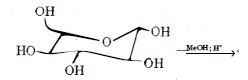
A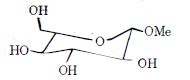
B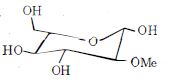
C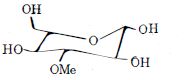
D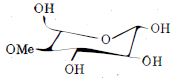
Solution
(A) The reaction of a sugar (like glucose) with methanol in the presence of an acid catalyst $(MeOH; H^+)$ is a classic Fischer glycosidation reaction.
$1$. The anomeric hydroxyl group $(-OH)$ is protonated by the acid catalyst.
$2$. Water is eliminated to form a resonance-stabilized oxocarbenium ion (the most stable carbocation intermediate).
$3$. Methanol acts as a nucleophile and attacks the oxocarbenium ion at the anomeric carbon.
$4$. Deprotonation yields the final glycoside product,which has a methoxy group $(-OMe)$ at the anomeric position.
$1$. The anomeric hydroxyl group $(-OH)$ is protonated by the acid catalyst.
$2$. Water is eliminated to form a resonance-stabilized oxocarbenium ion (the most stable carbocation intermediate).
$3$. Methanol acts as a nucleophile and attacks the oxocarbenium ion at the anomeric carbon.
$4$. Deprotonation yields the final glycoside product,which has a methoxy group $(-OMe)$ at the anomeric position.
0 likes
View Solution279
MediumMCQ
Four carbohydrates: glucose,lactose,sucrose,and starch are present. Different tests are carried out with these $4$ carbohydrates separately. The following observations are made:
$(a)$ Heated: It is charred.
$(b)$ $I_2$ solution: No violet colour.
$(c)$ Fehling solution: Reddish brown precipitate is observed.
$(d)$ It does not reduce copper$(II)$ acetate to $Cu_2O$. No red precipitate is observed in $5 \ min$.
Which carbohydrate satisfies all the above observations?
$(a)$ Heated: It is charred.
$(b)$ $I_2$ solution: No violet colour.
$(c)$ Fehling solution: Reddish brown precipitate is observed.
$(d)$ It does not reduce copper$(II)$ acetate to $Cu_2O$. No red precipitate is observed in $5 \ min$.
Which carbohydrate satisfies all the above observations?
A
Glucose
B
Lactose
C
Sucrose
D
Starch
Solution
(B) Let us analyze the observations for each carbohydrate:
$1$. $I_2$ solution test: Starch gives a blue-violet colour with $I_2$ solution. Since the observation is 'no violet colour',it is not starch.
$2$. Fehling solution test: Glucose and lactose are reducing sugars and give a reddish-brown precipitate with Fehling solution. Sucrose is a non-reducing sugar and does not react with Fehling solution.
$3$. Barfoed's test (Copper$(II)$ acetate): This test distinguishes between monosaccharides and disaccharides. Monosaccharides (like glucose) reduce copper$(II)$ acetate to $Cu_2O$ (red precipitate) within $5 \ min$. Disaccharides (like lactose) react very slowly or not at all within $5 \ min$.
$4$. Observation $(c)$ indicates it is a reducing sugar (glucose or lactose). Observation $(d)$ indicates it is a disaccharide (lactose) because it does not reduce copper$(II)$ acetate quickly.
Therefore,the carbohydrate is lactose.
$1$. $I_2$ solution test: Starch gives a blue-violet colour with $I_2$ solution. Since the observation is 'no violet colour',it is not starch.
$2$. Fehling solution test: Glucose and lactose are reducing sugars and give a reddish-brown precipitate with Fehling solution. Sucrose is a non-reducing sugar and does not react with Fehling solution.
$3$. Barfoed's test (Copper$(II)$ acetate): This test distinguishes between monosaccharides and disaccharides. Monosaccharides (like glucose) reduce copper$(II)$ acetate to $Cu_2O$ (red precipitate) within $5 \ min$. Disaccharides (like lactose) react very slowly or not at all within $5 \ min$.
$4$. Observation $(c)$ indicates it is a reducing sugar (glucose or lactose). Observation $(d)$ indicates it is a disaccharide (lactose) because it does not reduce copper$(II)$ acetate quickly.
Therefore,the carbohydrate is lactose.
0 likes
View Solution280
EasyMCQ
Which of the following is not a disaccharide?
A
sucrose
B
mannose
C
lactose
D
maltose
Solution
(B) Disaccharides are carbohydrates that yield two units of monosaccharides upon hydrolysis. Examples include sucrose,maltose,and lactose.
Mannose is a simple sugar consisting of a single unit,making it a monosaccharide,not a disaccharide.
Mannose is a simple sugar consisting of a single unit,making it a monosaccharide,not a disaccharide.
0 likes
View Solution281
MediumMCQ
Glucose,on oxidation with $Br_{2(aq)}$ gives
A
Gluconic acid
B
Saccharic acid
C
Tartaric acid
D
Oxalic acid
Solution
(A) Glucose is oxidized to gluconic acid on reaction with a mild oxidizing agent like bromine water $(Br_2/H_2O)$.
This reaction indicates that the carbonyl group in glucose is present as an aldehydic group.
$CHO-(CHOH)_4-CH_2OH \xrightarrow{Br_2/H_2O} COOH-(CHOH)_4-CH_2OH$
This reaction indicates that the carbonyl group in glucose is present as an aldehydic group.
$CHO-(CHOH)_4-CH_2OH \xrightarrow{Br_2/H_2O} COOH-(CHOH)_4-CH_2OH$
0 likes
View Solution282
MediumMCQ
Which is a reducing sugar?
A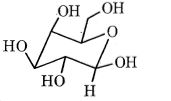
B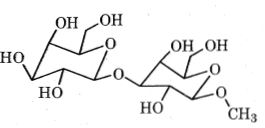
C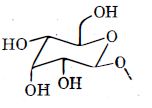
D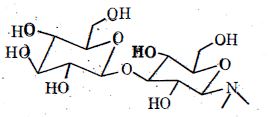
Solution
(A) reducing sugar is a carbohydrate that possesses a free aldehyde or ketone group,which allows it to act as a reducing agent.
In the given options,the structure in image $821-a493$ represents a monosaccharide (glucose) in its cyclic hemiacetal form.
This hemiacetal carbon (anomeric carbon) is in equilibrium with the open-chain aldehyde form in aqueous solution,making it a reducing sugar.
Options $B$,$C$,and $D$ represent glycosides or derivatives where the anomeric hydroxyl group is involved in a bond (acetal formation),thus preventing the formation of a free aldehyde group and rendering them non-reducing.
In the given options,the structure in image $821-a493$ represents a monosaccharide (glucose) in its cyclic hemiacetal form.
This hemiacetal carbon (anomeric carbon) is in equilibrium with the open-chain aldehyde form in aqueous solution,making it a reducing sugar.
Options $B$,$C$,and $D$ represent glycosides or derivatives where the anomeric hydroxyl group is involved in a bond (acetal formation),thus preventing the formation of a free aldehyde group and rendering them non-reducing.
0 likes
View Solution283
EasyMCQ
Select the correct statement among the following:
A
The linkage present in maltose is $\alpha-C_1-C_4$ linkage
B
Maltose is a non-reducing sugar
C
Maltose and sucrose both give similar products on hydrolysis
D
Maltose is a sweet polysaccharide
Solution
(A) Maltose is a disaccharide composed of two $\alpha-D-glucose$ units.
These units are linked by an $\alpha-C_1-C_4$ glycosidic linkage.
Since it has a free hemiacetal group at $C_1$ of the second glucose unit,it acts as a reducing sugar.
Hydrolysis of maltose yields two molecules of glucose,whereas sucrose yields one molecule of glucose and one molecule of fructose.
Maltose is an oligosaccharide,not a polysaccharide.
These units are linked by an $\alpha-C_1-C_4$ glycosidic linkage.
Since it has a free hemiacetal group at $C_1$ of the second glucose unit,it acts as a reducing sugar.
Hydrolysis of maltose yields two molecules of glucose,whereas sucrose yields one molecule of glucose and one molecule of fructose.
Maltose is an oligosaccharide,not a polysaccharide.
0 likes
View Solution284
AdvancedMCQ
Which among the following compounds is a $\beta-$ketohexofuranose?
A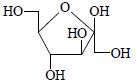
B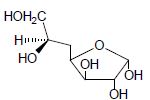
C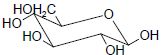
D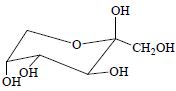
Solution
(A) $\beta-$ketohexofuranose is a sugar containing a ketone group (keto),six carbon atoms (hexo),and a five-membered furanose ring.
Structure $A$ represents a $\beta-$ketohexofuranose.
Structure $B$ has $7$ carbon atoms,so it is not a hexose sugar.
Structure $C$ is a $\beta-$aldohexopyranose.
Structure $D$ is a $\beta-$ketohexopyranose.
Structure $A$ represents a $\beta-$ketohexofuranose.
Structure $B$ has $7$ carbon atoms,so it is not a hexose sugar.
Structure $C$ is a $\beta-$aldohexopyranose.
Structure $D$ is a $\beta-$ketohexopyranose.
0 likes
View Solution285
EasyMCQ
On hydrolysis,which of the following carbohydrates gives glucose only?
A
Sucrose
B
Lactose
C
Maltose
D
Raffinose
Solution
(C) The hydrolysis reactions of the given carbohydrates are as follows:
$1$. $\text{Maltose} + H_{2}O \xrightarrow{H^{+}} 2 \text{ (glucose)}$
$2$. $\text{Sucrose} + H_{2}O \xrightarrow{H^{+}} \text{glucose} + \text{fructose}$
$3$. $\text{Lactose} + H_{2}O \xrightarrow{H^{+}} \text{glucose} + \text{galactose}$
$4$. $\text{Raffinose} + H_{2}O \xrightarrow{H^{+}} \text{glucose} + \text{fructose} + \text{galactose}$
Thus,only maltose yields two molecules of glucose upon hydrolysis.
$1$. $\text{Maltose} + H_{2}O \xrightarrow{H^{+}} 2 \text{ (glucose)}$
$2$. $\text{Sucrose} + H_{2}O \xrightarrow{H^{+}} \text{glucose} + \text{fructose}$
$3$. $\text{Lactose} + H_{2}O \xrightarrow{H^{+}} \text{glucose} + \text{galactose}$
$4$. $\text{Raffinose} + H_{2}O \xrightarrow{H^{+}} \text{glucose} + \text{fructose} + \text{galactose}$
Thus,only maltose yields two molecules of glucose upon hydrolysis.
0 likes
View Solution286
EasyMCQ
$D-(+)$-glucose reacts with hydroxylamine and yields an oxime. The structure of the oxime would be:
A
$CH=NOH-CH(OH)-CH(OH)-CH(OH)-CH(OH)-CH_2OH$
B
$CH=NOH-CH(OH)-CH(OH)-CH(OH)-CH(OH)-CH_2OH$
C
$CH=NOH-CH(OH)-CH(OH)-CH(OH)-CH(OH)-CH_2OH$
D
$CH=NOH-CH(OH)-CH(OH)-CH(OH)-CH(OH)-CH_2OH$
Solution
(D) $D-(+)$-glucose contains an aldehyde group $(-CHO)$ at $C-1$.
When it reacts with hydroxylamine $(NH_2OH)$,the carbonyl oxygen is replaced by $=NOH$ to form an oxime $(-CH=NOH)$.
The configuration of the remaining chiral centers ($C-2$ to $C-5$) remains unchanged from the original $D$-glucose structure.
In the Fischer projection of $D$-glucose,the $OH$ groups are on the right at $C-2, C-4,$ and $C-5$,and on the left at $C-3$.
Thus,the structure of the oxime is $CH=NOH-CH(OH)-CH(OH)-CH(OH)-CH(OH)-CH_2OH$.
When it reacts with hydroxylamine $(NH_2OH)$,the carbonyl oxygen is replaced by $=NOH$ to form an oxime $(-CH=NOH)$.
The configuration of the remaining chiral centers ($C-2$ to $C-5$) remains unchanged from the original $D$-glucose structure.
In the Fischer projection of $D$-glucose,the $OH$ groups are on the right at $C-2, C-4,$ and $C-5$,and on the left at $C-3$.
Thus,the structure of the oxime is $CH=NOH-CH(OH)-CH(OH)-CH(OH)-CH(OH)-CH_2OH$.
0 likes
View Solution287
DifficultMCQ
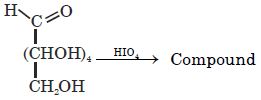
How many moles of formic acid are formed in the given reaction?
A
$3$
B
$4$
C
$5$
D
$6$
Solution
(C) The reaction of glucose $(CH_2OH(CHOH)_4CHO)$ with periodic acid $(HIO_4)$ involves the oxidative cleavage of all $C-C$ bonds between adjacent hydroxyl groups.
For glucose,the reaction is:
$CH_2OH(CHOH)_4CHO + 5HIO_4 \rightarrow 5HCOOH + HCHO + 5HIO_3$.
In this reaction,the aldehyde group and the four secondary alcohol groups are oxidized to $5$ moles of formic acid $(HCOOH)$,while the terminal primary alcohol group is oxidized to $1$ mole of formaldehyde $(HCHO)$.
Therefore,$5$ moles of formic acid are formed.
For glucose,the reaction is:
$CH_2OH(CHOH)_4CHO + 5HIO_4 \rightarrow 5HCOOH + HCHO + 5HIO_3$.
In this reaction,the aldehyde group and the four secondary alcohol groups are oxidized to $5$ moles of formic acid $(HCOOH)$,while the terminal primary alcohol group is oxidized to $1$ mole of formaldehyde $(HCHO)$.
Therefore,$5$ moles of formic acid are formed.
0 likes
View Solution288
EasyMCQ
Which is not a pair of reducing sugars?
A
Glucose and Mannose
B
Glucose and Fructose
C
Mannose and Galactose
D
Sucrose and Starch
Solution
(D) reducing sugar is any sugar that contains a free aldehyde or ketone group,allowing it to act as a reducing agent.
$Glucose$,$Mannose$,$Fructose$,and $Galactose$ are all monosaccharides and act as reducing sugars.
$Sucrose$ is a disaccharide where the glycosidic linkage is formed between the anomeric carbons of both glucose and fructose,leaving no free aldehyde or ketone group.
$Starch$ is a polysaccharide that is also non-reducing.
Therefore,the pair $Sucrose$ and $Starch$ are both non-reducing sugars.
$Glucose$,$Mannose$,$Fructose$,and $Galactose$ are all monosaccharides and act as reducing sugars.
$Sucrose$ is a disaccharide where the glycosidic linkage is formed between the anomeric carbons of both glucose and fructose,leaving no free aldehyde or ketone group.
$Starch$ is a polysaccharide that is also non-reducing.
Therefore,the pair $Sucrose$ and $Starch$ are both non-reducing sugars.
0 likes
View Solution289
EasyMCQ
Select the incorrect pair.
A
Cellulose $=$ Polymer of $\beta-D$-Glucose
B
Sucrose $=$ $\beta-D$-Glucose and $\alpha-D$-Fructose
C
Lactose $=$ $\beta-D$-Galactose and $\beta-D$-Glucose
D
Starch $=$ Polymer of $\alpha-D$-Glucose
Solution
(B) Sucrose is a disaccharide composed of $\alpha-D$-Glucose and $\beta-D$-Fructose units linked by a glycosidic bond. Therefore,the pair in option $B$ is incorrect as it swaps the anomeric configurations.
0 likes
View Solution290
MediumMCQ
Consider the following molecules:
Glucose $(K)$,Mannose $(L)$,Galactose $(M)$,$\alpha-Glucose$ $(N)$,$\beta-Glucose$ $(O)$
The correct set of epimer and anomer is respectively:
Epimer - Anomer
Glucose $(K)$,Mannose $(L)$,Galactose $(M)$,$\alpha-Glucose$ $(N)$,$\beta-Glucose$ $(O)$
The correct set of epimer and anomer is respectively:
Epimer - Anomer
A
$(K, L) - (N, O)$
B
$(K, M) - (M, O)$
C
$(K, L) - (M, N)$
D
$(K, M) - (N, O)$
Solution
(A) $1$. Epimers are diastereomers that differ in configuration at only one chiral center. Glucose $(K)$ and Mannose $(L)$ are $C-2$ epimers. Glucose $(K)$ and Galactose $(M)$ are $C-4$ epimers.
$2$. Anomers are a special type of epimers that differ in configuration at the anomeric carbon ($C-1$ in aldoses). $\alpha-Glucose$ $(N)$ and $\beta-Glucose$ $(O)$ are anomers of each other.
$3$. Looking at the options,$(K, L)$ represents an epimer pair and $(N, O)$ represents an anomer pair. Since option $(A)$ is $(K, L) - (N, O)$,this is the correct set.
$2$. Anomers are a special type of epimers that differ in configuration at the anomeric carbon ($C-1$ in aldoses). $\alpha-Glucose$ $(N)$ and $\beta-Glucose$ $(O)$ are anomers of each other.
$3$. Looking at the options,$(K, L)$ represents an epimer pair and $(N, O)$ represents an anomer pair. Since option $(A)$ is $(K, L) - (N, O)$,this is the correct set.
0 likes
View Solution291
MediumMCQ
The number of chiral carbon atoms present in the open-chain structure of $D-(-)$-fructose is:
A
$2$
B
$4$
C
$3$
D
$1$
Solution
(C) The open-chain structure of $D-(-)$-fructose is $CH_2OH-CO-CH(OH)-CH(OH)-CH(OH)-CH_2OH$.
In this structure,the carbon atoms at positions $C_3$,$C_4$,and $C_5$ are chiral because each is bonded to four different groups.
Therefore,there are $3$ chiral carbon atoms in the open-chain structure of fructose.
In this structure,the carbon atoms at positions $C_3$,$C_4$,and $C_5$ are chiral because each is bonded to four different groups.
Therefore,there are $3$ chiral carbon atoms in the open-chain structure of fructose.
0 likes
View Solution292
EasyMCQ
Which of the following carbohydrates does not show mutarotation?
A
Lactose
B
Glucose
C
Sucrose
D
Fructose
Solution
(C) Mutarotation is a property exhibited by reducing sugars that possess a free hemiacetal or hemiketal group,allowing them to exist in equilibrium between their open-chain and cyclic forms.
$Lactose$,$Glucose$,and $Fructose$ are reducing sugars and thus exhibit mutarotation.
$Sucrose$ is a non-reducing sugar because its glycosidic linkage involves the anomeric carbons of both glucose and fructose units,leaving no free hemiacetal or hemiketal group.
Therefore,$Sucrose$ does not show mutarotation.
$Lactose$,$Glucose$,and $Fructose$ are reducing sugars and thus exhibit mutarotation.
$Sucrose$ is a non-reducing sugar because its glycosidic linkage involves the anomeric carbons of both glucose and fructose units,leaving no free hemiacetal or hemiketal group.
Therefore,$Sucrose$ does not show mutarotation.
0 likes
View Solution293
MediumMCQ
Which of the following is the correct Haworth structure of $\alpha-D$-glucose?
A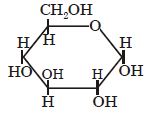
B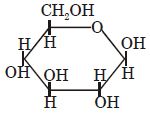
C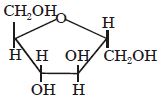
D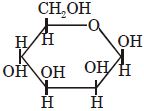
Solution
(A) The Haworth structure of $\alpha-D$-glucose is a six-membered pyranose ring.
In $\alpha-D$-glucose,the hydroxyl group $(-OH)$ at the $C1$ position (anomeric carbon) is oriented downwards (trans to the $-CH_2OH$ group at $C5$).
The $-OH$ groups at $C2$,$C3$,and $C4$ are oriented downwards,upwards,and downwards,respectively.
Comparing this with the given options,the structure in image $824-$a100 correctly represents $\alpha-D$-glucose.
In $\alpha-D$-glucose,the hydroxyl group $(-OH)$ at the $C1$ position (anomeric carbon) is oriented downwards (trans to the $-CH_2OH$ group at $C5$).
The $-OH$ groups at $C2$,$C3$,and $C4$ are oriented downwards,upwards,and downwards,respectively.
Comparing this with the given options,the structure in image $824-$a100 correctly represents $\alpha-D$-glucose.
0 likes
View Solution294
MediumMCQ
Glucose does not react with :-
A
$NH_2NHCONH_2$
B
$NH_2OH$
C
$HCN$
D
$NaHSO_3$
Solution
(D) Glucose contains an aldehyde group $(-CHO)$ and hydroxyl groups $(-OH)$.
However,it does not react with sodium bisulphite $(NaHSO_3)$ because the steric hindrance caused by the bulky polyhydroxy chain makes the addition of the bisulphite group to the carbonyl carbon unfavorable.
Glucose reacts with $NH_2OH$ to form an oxime,with $HCN$ to form a cyanohydrin,and with $NH_2NHCONH_2$ (semicarbazide) to form a semicarbazone.
However,it does not react with sodium bisulphite $(NaHSO_3)$ because the steric hindrance caused by the bulky polyhydroxy chain makes the addition of the bisulphite group to the carbonyl carbon unfavorable.
Glucose reacts with $NH_2OH$ to form an oxime,with $HCN$ to form a cyanohydrin,and with $NH_2NHCONH_2$ (semicarbazide) to form a semicarbazone.
0 likes
View Solution295
MediumMCQ
Which among the following is a non-reducing sugar?
A
Glucose
B
Maltose
C
Lactose
D
Sucrose
Solution
(D) $Sucrose$ is a non-reducing sugar because the anomeric carbon atoms of both the monosaccharide units (glucose and fructose) are involved in the formation of the glycosidic bond.
0 likes
View Solution296
MediumMCQ
Which of the following compounds will behave as a reducing sugar in $aq. KOH$ solution?
A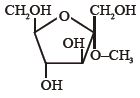
B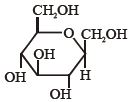
C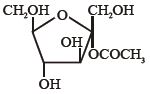
D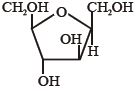
Solution
(C) reducing sugar must have a free hemiacetal or hemiketal group,which can exist in equilibrium with an open-chain aldehyde or ketone form.
In an aqueous $KOH$ solution,an ester group (like $-OCOCH_3$) can undergo hydrolysis to form a free hydroxyl group $(-OH)$.
Option $C$ contains an ester group $(-OCOCH_3)$ at the anomeric carbon. In the presence of $aq. KOH$,this ester undergoes base-catalyzed hydrolysis to yield a free hemiacetal group ($-OH$ at the anomeric carbon).
This free hemiacetal group can then open up to form an aldehyde,which acts as a reducing agent.
Therefore,the compound in option $C$ will behave as a reducing sugar in $aq. KOH$ solution.
In an aqueous $KOH$ solution,an ester group (like $-OCOCH_3$) can undergo hydrolysis to form a free hydroxyl group $(-OH)$.
Option $C$ contains an ester group $(-OCOCH_3)$ at the anomeric carbon. In the presence of $aq. KOH$,this ester undergoes base-catalyzed hydrolysis to yield a free hemiacetal group ($-OH$ at the anomeric carbon).
This free hemiacetal group can then open up to form an aldehyde,which acts as a reducing agent.
Therefore,the compound in option $C$ will behave as a reducing sugar in $aq. KOH$ solution.
0 likes
View Solution297
MediumMCQ
The correct corresponding names of the four aldoses with the configurations given below,respectively,are:
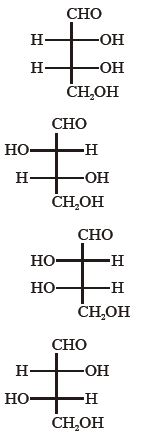
A
$L$-erythrose,$L$-threose,$D$-erythrose,$D$-threose
B
$D$-erythrose,$D$-threose,$L$-erythrose,$L$-threose
C
$L$-erythrose,$L$-threose,$L$-erythrose,$D$-threose
D
$D$-threose,$D$-erythrose,$L$-threose,$L$-erythrose
Solution
(B) $1$. The first structure has the $-OH$ group on the right at the chiral carbon (penultimate carbon),identifying it as a $D$-sugar. Since both $-OH$ groups are on the same side,it is $D$-erythrose.
$2$. The second structure has the $-OH$ group on the right at the chiral carbon,identifying it as a $D$-sugar. Since the $-OH$ groups are on opposite sides,it is $D$-threose.
$3$. The third structure has the $-OH$ group on the left at the chiral carbon,identifying it as an $L$-sugar. Since both $-OH$ groups are on the same side,it is $L$-erythrose.
$4$. The fourth structure has the $-OH$ group on the left at the chiral carbon,identifying it as an $L$-sugar. Since the $-OH$ groups are on opposite sides,it is $L$-threose.
Therefore,the correct order is $D$-erythrose,$D$-threose,$L$-erythrose,$L$-threose.
$2$. The second structure has the $-OH$ group on the right at the chiral carbon,identifying it as a $D$-sugar. Since the $-OH$ groups are on opposite sides,it is $D$-threose.
$3$. The third structure has the $-OH$ group on the left at the chiral carbon,identifying it as an $L$-sugar. Since both $-OH$ groups are on the same side,it is $L$-erythrose.
$4$. The fourth structure has the $-OH$ group on the left at the chiral carbon,identifying it as an $L$-sugar. Since the $-OH$ groups are on opposite sides,it is $L$-threose.
Therefore,the correct order is $D$-erythrose,$D$-threose,$L$-erythrose,$L$-threose.
0 likes
View Solution298
DifficultMCQ
$D-(+)$-glucose reacts with hydroxylamine $(NH_2OH)$ to yield an oxime. The structure of the oxime is:
A
$CH=NOH-CH(OH)-CH(OH)-CH(OH)-CH(OH)-CH_2OH$
B
$CH=NOH-CH(OH)-CH(OH)-CH(OH)-CH(OH)-CH_2OH$
C
$CH=NOH-CH(OH)-CH(OH)-CH(OH)-CH(OH)-CH_2OH$
D
$CH=NOH-CH(OH)-CH(OH)-CH(OH)-CH(OH)-CH_2OH$
Solution
(D) $D-(+)$-glucose contains an aldehyde group $(-CHO)$ at $C1$.
When it reacts with hydroxylamine $(NH_2OH)$,the aldehyde group is converted into an oxime group $(-CH=NOH)$.
The configuration of the remaining chiral centers ($C2$ to $C5$) remains the same as in $D$-glucose.
In the Fischer projection of $D$-glucose,the $-OH$ groups are at $C2$ (right),$C3$ (left),$C4$ (right),and $C5$ (right).
Option $(d)$ correctly represents the structure of glucose oxime where the aldehyde carbon is transformed into the oxime functional group while maintaining the stereochemistry of the chiral carbons.
When it reacts with hydroxylamine $(NH_2OH)$,the aldehyde group is converted into an oxime group $(-CH=NOH)$.
The configuration of the remaining chiral centers ($C2$ to $C5$) remains the same as in $D$-glucose.
In the Fischer projection of $D$-glucose,the $-OH$ groups are at $C2$ (right),$C3$ (left),$C4$ (right),and $C5$ (right).
Option $(d)$ correctly represents the structure of glucose oxime where the aldehyde carbon is transformed into the oxime functional group while maintaining the stereochemistry of the chiral carbons.
0 likes
View Solution299
EasyMCQ
Which of the following set of molecules give the same osazone when reacted with an excess of phenylhydrazine?
A
$Glucose$ and $fructose$
B
$Fructose$ and $galactose$
C
$Glucose$ and $galactose$
D
$Galactose$ and $mannose$
Solution
(A) When $glucose$,$fructose$,and $mannose$ react with an excess of phenylhydrazine,they form the same osazone derivative known as $glucosazone$.
This occurs because the structural differences at the $C-1$ and $C-2$ positions are lost during the formation of the osazone,resulting in an identical phenylhydrazone structure for these three sugars.
$Glucose$ ($C-1$ aldehyde,$C-2$ hydroxyl),$fructose$ ($C-1$ hydroxyl,$C-2$ ketone),and $mannose$ ($C-1$ aldehyde,$C-2$ hydroxyl with different configuration) all yield the same $glucosazone$ product.
This occurs because the structural differences at the $C-1$ and $C-2$ positions are lost during the formation of the osazone,resulting in an identical phenylhydrazone structure for these three sugars.
$Glucose$ ($C-1$ aldehyde,$C-2$ hydroxyl),$fructose$ ($C-1$ hydroxyl,$C-2$ ketone),and $mannose$ ($C-1$ aldehyde,$C-2$ hydroxyl with different configuration) all yield the same $glucosazone$ product.
0 likes
View Solution300
MediumMCQ
Predict the product of the following reaction:
$Glucose \xrightarrow{Br_2/H_2O} \text{Product}$
$Glucose \xrightarrow{Br_2/H_2O} \text{Product}$
A
Gluconic acid
B
Sorbitol
C
Glucaric acid
D
Cyanohydrin
Solution
(A) Bromine water $(Br_2/H_2O)$ is a mild oxidizing agent.
It selectively oxidizes the aldehyde group $(-CHO)$ of glucose to a carboxylic acid group $(-COOH)$ while leaving the primary alcohol group $(-CH_2OH)$ and secondary alcohol groups unaffected.
This reaction produces gluconic acid.
It selectively oxidizes the aldehyde group $(-CHO)$ of glucose to a carboxylic acid group $(-COOH)$ while leaving the primary alcohol group $(-CH_2OH)$ and secondary alcohol groups unaffected.
This reaction produces gluconic acid.
0 likes
View SolutionBiomolecules — Carbohydrates · Frequently Asked Questions
1Are these Biomolecules questions useful for JEE and NEET?
Yes. All questions in this section are mapped to JEE Main and NEET exam patterns. Previous year questions from JEE Main, NEET, GUJCET and state-level exams are included with full solutions.
2Can I switch to Hindi or Gujarati for these questions?
Yes. Use the language tabs in the hero section or the sidebar to view the same questions and solutions in English, Hindi or Gujarati.
3How do I generate a question paper from this subtopic?
Use the Vedclass Exam Paper Generator — select the chapter and subtopic, set difficulty, and generate Sets A, B, C, D automatically. First 3 chapters of every subject are free.
Vedclass Products
For Students
Vedclass Test Series
Mock tests in real JEE/NEET style with performance analysis. 5-day free trial.
Start Free TrialFor Teachers
Exam Paper Generator
Generate Set A/B/C/D papers from this chapter in 2 minutes. 3 chapters free.
Try FreeFor Institutes
Online Exam Module
Live online exams with unlimited students, 360° analytics & white-label branding.
See DemoFor Teachers & Institutes
Generate a Biomolecules Exam Paper in 2 Minutes
Select subtopic & difficulty — Sets A, B, C, D auto-generated with No Repeat logic.
First 3 chapters of every subject are free — no payment required.