
A English
Carbohydrates Questions in English
Class 12 Chemistry · Biomolecules · Carbohydrates
808+
Questions
English
Language
100%
With Solutions
Showing 50 of 808 questions in English
301
MediumMCQ
Which of the following will give the same osazone when treated with phenylhydrazine?
A
$A, B, E$
B
$A, C, E$
C
$A, B, C, D$
D
$B, C, E$
Solution
(B) Glucose,Fructose,and Mannose differ only in the configuration at $C-1$ and $C-2$ carbons.
When these sugars react with excess phenylhydrazine,the $C-1$ and $C-2$ carbons are involved in the formation of the osazone structure.
Since the configuration at $C-3, C-4, C-5,$ and $C-6$ remains identical for these three sugars,they all yield the same osazone derivative,known as glucosazone.
Therefore,$A$ (Glucose),$C$ (Fructose),and $E$ (Mannose) give the same osazone.
When these sugars react with excess phenylhydrazine,the $C-1$ and $C-2$ carbons are involved in the formation of the osazone structure.
Since the configuration at $C-3, C-4, C-5,$ and $C-6$ remains identical for these three sugars,they all yield the same osazone derivative,known as glucosazone.
Therefore,$A$ (Glucose),$C$ (Fructose),and $E$ (Mannose) give the same osazone.
0 likes
View Solution302
MediumMCQ
Which among the following statements is incorrect for glucose?
A
Glucose is an aldohexose
B
Glucose shows mutarotation
C
Glucose on reaction with $HI/\Delta$ gives $n-hexane$
D
$\alpha-D$-glucose is the monomer of cellulose
Solution
(D) $1$. Glucose is an aldohexose,which is a correct statement as it contains an aldehyde group and six carbon atoms.
$2$. Glucose exhibits mutarotation due to the equilibrium between its $\alpha$ and $\beta$ anomeric forms in solution.
$3$. Reaction of glucose with $HI/\Delta$ leads to the reduction of the carbon chain to $n-hexane$,confirming the presence of a straight chain of six carbons.
$4$. Cellulose is a linear polymer of $\beta-D$-glucose units linked by $\beta(1 \to 4)$ glycosidic bonds,not $\alpha-D$-glucose. Therefore,the statement that $\alpha-D$-glucose is the monomer of cellulose is incorrect.
$2$. Glucose exhibits mutarotation due to the equilibrium between its $\alpha$ and $\beta$ anomeric forms in solution.
$3$. Reaction of glucose with $HI/\Delta$ leads to the reduction of the carbon chain to $n-hexane$,confirming the presence of a straight chain of six carbons.
$4$. Cellulose is a linear polymer of $\beta-D$-glucose units linked by $\beta(1 \to 4)$ glycosidic bonds,not $\alpha-D$-glucose. Therefore,the statement that $\alpha-D$-glucose is the monomer of cellulose is incorrect.
0 likes
View Solution303
MediumMCQ
Which of the following does not show mutarotation?
A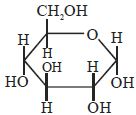
B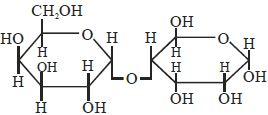
C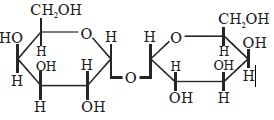
D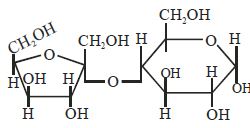
Solution
(D) Mutarotation is a characteristic property of reducing sugars,which possess a free hemiacetal or hemiketal group that allows them to exist in equilibrium between their open-chain and cyclic forms.
$A$. Glucose is a reducing sugar and shows mutarotation.
$B$. Maltose is a reducing sugar and shows mutarotation.
$C$. Lactose is a reducing sugar and shows mutarotation.
$D$. Sucrose is a non-reducing sugar because both the anomeric carbons of glucose and fructose are involved in the glycosidic linkage. Therefore,it does not show mutarotation.
$A$. Glucose is a reducing sugar and shows mutarotation.
$B$. Maltose is a reducing sugar and shows mutarotation.
$C$. Lactose is a reducing sugar and shows mutarotation.
$D$. Sucrose is a non-reducing sugar because both the anomeric carbons of glucose and fructose are involved in the glycosidic linkage. Therefore,it does not show mutarotation.
0 likes
View Solution304
MediumMCQ
Which of the following is the correct structure of $L$-glucose?
A
$CHO-C(OH)H-C(H)OH-C(OH)H-C(OH)H-CH_2OH$
B
$CHO-C(H)OH-C(OH)H-C(H)OH-C(H)OH-CH_2OH$
C
$CHO-C(H)OH-C(H)OH-C(H)OH-C(H)OH-CH_2OH$
D
$CHO-C(OH)H-C(H)OH-C(H)OH-C(OH)H-CH_2OH$
Solution
(A) $L$-glucose is the enantiomer of $D$-glucose.
In $L$-glucose,the $-OH$ group on the highest numbered chiral carbon $(C-5)$ is on the left side in the Fischer projection.
All other chiral centers $(C-2, C-3, C-4)$ are also inverted relative to $D$-glucose.
In $L$-glucose,the $-OH$ groups on $C-2, C-4,$ and $C-5$ are on the left,while the $-OH$ group on $C-3$ is on the right.
Therefore,the correct structure is $CHO-C(OH)H-C(H)OH-C(OH)H-C(OH)H-CH_2OH$.
In $L$-glucose,the $-OH$ group on the highest numbered chiral carbon $(C-5)$ is on the left side in the Fischer projection.
All other chiral centers $(C-2, C-3, C-4)$ are also inverted relative to $D$-glucose.
In $L$-glucose,the $-OH$ groups on $C-2, C-4,$ and $C-5$ are on the left,while the $-OH$ group on $C-3$ is on the right.
Therefore,the correct structure is $CHO-C(OH)H-C(H)OH-C(OH)H-C(OH)H-CH_2OH$.
0 likes
View Solution305
DifficultMCQ
Which of the following is $D$-isomer?
A
B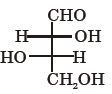
C
D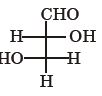
Solution
(B) In a Fischer projection,the $D/L$ configuration is determined by the position of the $-OH$ group on the chiral carbon atom furthest from the principal functional group (the carbonyl group in aldoses).
If the $-OH$ group is on the right side,it is assigned the $D$-configuration.
If the $-OH$ group is on the left side,it is assigned the $L$-configuration.
Looking at option $B$,the structure is glyceraldehyde derivative (specifically an aldotetrose). The chiral carbon furthest from the $CHO$ group is the one attached to the $CH_2OH$ group. In the structure shown in option $B$,the $-OH$ group on the chiral carbon furthest from the $CHO$ group is on the right side,which corresponds to the $D$-isomer.
If the $-OH$ group is on the right side,it is assigned the $D$-configuration.
If the $-OH$ group is on the left side,it is assigned the $L$-configuration.
Looking at option $B$,the structure is glyceraldehyde derivative (specifically an aldotetrose). The chiral carbon furthest from the $CHO$ group is the one attached to the $CH_2OH$ group. In the structure shown in option $B$,the $-OH$ group on the chiral carbon furthest from the $CHO$ group is on the right side,which corresponds to the $D$-isomer.
0 likes
View Solution306
EasyMCQ
$\alpha-D(+)$ glucose and $\beta-D(+)$ glucose are
$(i)$ Diastereomers
$(ii)$ Geometrical isomers
$(iii)$ Epimers
$(iv)$ Anomers
$(v)$ Enantiomers
$(i)$ Diastereomers
$(ii)$ Geometrical isomers
$(iii)$ Epimers
$(iv)$ Anomers
$(v)$ Enantiomers
A
$i$ and $iii$
B
$i, iii$ and $iv$
C
$ii, iv$ and $v$
D
$i, ii$ and $iv$
Solution
(B) $\alpha-D(+)$ glucose and $\beta-D(+)$ glucose differ only in the configuration at the $C-1$ carbon atom,which is the anomeric carbon.
Such isomers are specifically called anomers.
Since they are not mirror images of each other,they are diastereomers.
They are not epimers because epimers differ at a carbon other than the anomeric carbon (though they are a specific type of diastereomer,the term anomer is more precise).
Therefore,they are $(i)$ Diastereomers and $(iv)$ Anomers.
Since the provided options are slightly ambiguous,the most accurate classification is $(i)$ and $(iv)$.
Such isomers are specifically called anomers.
Since they are not mirror images of each other,they are diastereomers.
They are not epimers because epimers differ at a carbon other than the anomeric carbon (though they are a specific type of diastereomer,the term anomer is more precise).
Therefore,they are $(i)$ Diastereomers and $(iv)$ Anomers.
Since the provided options are slightly ambiguous,the most accurate classification is $(i)$ and $(iv)$.
0 likes
View Solution307
EasyMCQ
$\alpha-D-(+)-$Glucose and $\beta-D-(+)-$Glucose are not
A
Epimers
B
Anomers
C
Enantiomers
D
Diastereomers
Solution
(C) $\alpha-D-(+)-$glucose and $\beta-D-(+)-$glucose are diastereomers that differ in configuration only at the $C-1$ carbon atom.
Such isomers are specifically referred to as anomers.
Since they are diastereomers and anomers,they cannot be enantiomers,as enantiomers must be non-superimposable mirror images of each other.
Such isomers are specifically referred to as anomers.
Since they are diastereomers and anomers,they cannot be enantiomers,as enantiomers must be non-superimposable mirror images of each other.
0 likes
View Solution308
MediumMCQ
Which of the following correctly represents $D$-glyceraldehyde?
A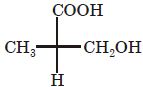
B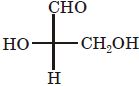
C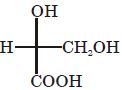
D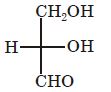
Solution
(D) Glyceraldehyde is an aldotriose with the formula $HOCH_2-CH(OH)-CHO$.
In a Fischer projection,the $D$-configuration is assigned when the hydroxyl group $(-OH)$ on the chiral carbon atom is on the right side when the carbon chain is written vertically with the most oxidized carbon $(CHO)$ at the top.
Option $D$ shows the $CHO$ group at the bottom,but by rotating the molecule or re-orienting the Fischer projection,we can see that the $-OH$ group is on the right side relative to the carbon chain.
Specifically,in option $D$,the $CHO$ is at the bottom and $CH_2OH$ is at the top. If we rotate the molecule by $180^{\circ}$ in the plane of the paper,the $CHO$ moves to the top and $CH_2OH$ moves to the bottom,placing the $-OH$ group on the right,which corresponds to $D$-glyceraldehyde.
In a Fischer projection,the $D$-configuration is assigned when the hydroxyl group $(-OH)$ on the chiral carbon atom is on the right side when the carbon chain is written vertically with the most oxidized carbon $(CHO)$ at the top.
Option $D$ shows the $CHO$ group at the bottom,but by rotating the molecule or re-orienting the Fischer projection,we can see that the $-OH$ group is on the right side relative to the carbon chain.
Specifically,in option $D$,the $CHO$ is at the bottom and $CH_2OH$ is at the top. If we rotate the molecule by $180^{\circ}$ in the plane of the paper,the $CHO$ moves to the top and $CH_2OH$ moves to the bottom,placing the $-OH$ group on the right,which corresponds to $D$-glyceraldehyde.
0 likes
View Solution309
EasyMCQ
$ \alpha-D-Glucose $ and $ \beta-D-Glucose $ are:
A
Position isomers
B
Anomers
C
Enantiomers
D
Acetals
Solution
(B) $ \alpha-D-Glucose $ and $ \beta-D-Glucose $ are examples of anomers.
Anomers are a type of stereoisomer that differ in configuration only at the anomeric carbon (the $ C-1 $ carbon in aldoses).
Since they differ specifically at the anomeric carbon,they are classified as anomers,which is a special case of epimers.
Anomers are a type of stereoisomer that differ in configuration only at the anomeric carbon (the $ C-1 $ carbon in aldoses).
Since they differ specifically at the anomeric carbon,they are classified as anomers,which is a special case of epimers.
0 likes
View Solution310
EasyMCQ
$D$-glucose and $L$-glucose are
A
Diastereomers
B
Enantiomers
C
Epimer
D
Anomers
Solution
(B) -glucose and $L$-glucose are non-superimposable mirror images of each other.
Such stereoisomers are known as enantiomers.
Such stereoisomers are known as enantiomers.
0 likes
View Solution311
EasyMCQ
The $C_4$-epimer of glucose is:
A
Allose
B
Mannose
C
Galactose
D
Fructose
Solution
(C) Epimers are diastereomers that differ in configuration at only one stereocenter.
Glucose and galactose differ only in the configuration of the hydroxyl group at the $C_4$ position.
Therefore,galactose is the $C_4$-epimer of glucose.
Glucose and galactose differ only in the configuration of the hydroxyl group at the $C_4$ position.
Therefore,galactose is the $C_4$-epimer of glucose.
0 likes
View Solution312
EasyMCQ
Glucose gives a positive test with
A
Tollen's reagent
B
Fehling's solution
C
Benedict's solution
D
All of these
Solution
(D) Glucose contains an aldehydic group $(-CHO)$.
Because of the presence of this free aldehydic group,glucose acts as a reducing sugar.
It reduces Tollen's reagent to metallic silver,Fehling's solution to red cuprous oxide $(Cu_2O)$,and Benedict's solution to red cuprous oxide $(Cu_2O)$.
Because of the presence of this free aldehydic group,glucose acts as a reducing sugar.
It reduces Tollen's reagent to metallic silver,Fehling's solution to red cuprous oxide $(Cu_2O)$,and Benedict's solution to red cuprous oxide $(Cu_2O)$.
0 likes
View Solution313
MediumMCQ
Which of the following structures represents $\alpha-D$-glucose?
A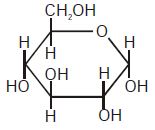
B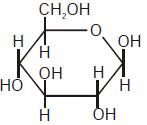
C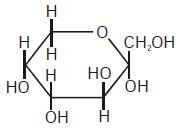
D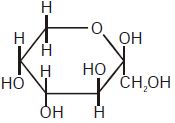
Solution
(A) In the Haworth projection of $\alpha-D$-glucose,the $-OH$ group at the anomeric carbon $(C-1)$ is positioned below the plane of the ring (trans to the $-CH_2OH$ group at $C-5$).
Option $A$ correctly depicts this configuration where the $-OH$ group at $C-1$ is in the downward position,which is characteristic of the $\alpha$-anomer.
Option $A$ correctly depicts this configuration where the $-OH$ group at $C-1$ is in the downward position,which is characteristic of the $\alpha$-anomer.
0 likes
View Solution314
MediumMCQ
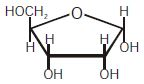
Which of the following represents the anomer of the compound shown?
A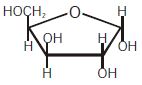
B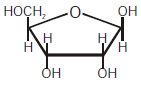
C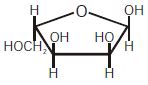
D
None of these
Solution
(C) Anomers are a type of stereoisomer found in cyclic carbohydrates,specifically differing in configuration at the anomeric carbon (the carbon derived from the carbonyl carbon in the open-chain form).
In the given structure (a furanose ring),the anomeric carbon is the one bonded to both the ring oxygen and an $-OH$ group.
The original structure has the $-OH$ group on the anomeric carbon pointing downwards (alpha-anomer).
To form the anomer,the configuration at this specific carbon must be inverted,meaning the $-OH$ group should point upwards (beta-anomer).
Looking at the options,the structure in image $830-$c170 shows the $-OH$ group on the anomeric carbon pointing upwards,which represents the beta-anomer of the original compound.
Therefore,the correct option is $C$.
In the given structure (a furanose ring),the anomeric carbon is the one bonded to both the ring oxygen and an $-OH$ group.
The original structure has the $-OH$ group on the anomeric carbon pointing downwards (alpha-anomer).
To form the anomer,the configuration at this specific carbon must be inverted,meaning the $-OH$ group should point upwards (beta-anomer).
Looking at the options,the structure in image $830-$c170 shows the $-OH$ group on the anomeric carbon pointing upwards,which represents the beta-anomer of the original compound.
Therefore,the correct option is $C$.
0 likes
View Solution315
DifficultMCQ
Identify the given structure:
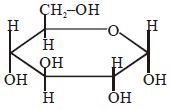
A
$\alpha-D-(+)-\text{Glucopyranose}$
B
$\beta-D-(+)-\text{Glucopyranose}$
C
$\alpha-D-(-)-\text{Fructofuranose}$
D
$\beta-D-(-)-\text{Fructofuranose}$
Solution
(A) The given structure is a Haworth projection of a six-membered pyranose ring.
By observing the configuration at the anomeric carbon $(C1)$,the $-OH$ group is pointing downwards,which corresponds to the $\alpha$-anomer.
Since it is a glucose derivative,it is $\alpha-D-(+)-\text{Glucopyranose}$.
By observing the configuration at the anomeric carbon $(C1)$,the $-OH$ group is pointing downwards,which corresponds to the $\alpha$-anomer.
Since it is a glucose derivative,it is $\alpha-D-(+)-\text{Glucopyranose}$.
0 likes
View Solution316
EasyMCQ
$C_2$-epimer of $D$-Glucose is
A
$D$-Galactose
B
$D$-Mannose
C
$D$-Gulose
D
$D$-Sucrose
Solution
(B) Epimers are diastereomers that differ in configuration at only one stereogenic center.
In $D$-Glucose,the configuration at $C_2$ is $-OH$ on the right.
In $D$-Mannose,the configuration at $C_2$ is $-OH$ on the left,while all other chiral centers $(C_3, C_4, C_5)$ remain the same as in $D$-Glucose.
Therefore,$D$-Mannose is the $C_2$-epimer of $D$-Glucose.
In $D$-Glucose,the configuration at $C_2$ is $-OH$ on the right.
In $D$-Mannose,the configuration at $C_2$ is $-OH$ on the left,while all other chiral centers $(C_3, C_4, C_5)$ remain the same as in $D$-Glucose.
Therefore,$D$-Mannose is the $C_2$-epimer of $D$-Glucose.
0 likes
View Solution317
MediumMCQ
Identify the non-reducing sugar.
A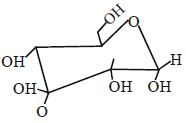
B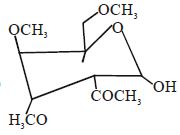
C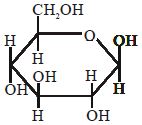
D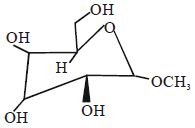
Solution
(D) sugar is considered non-reducing if it does not have a free hemiacetal or hemiketal group,meaning it cannot open to form an aldehyde or ketone in solution.
In option $D$,the anomeric carbon is involved in a glycosidic linkage ($-OCH_3$ group),which prevents the ring from opening.
Therefore,it cannot reduce Tollens' or Fehling's reagent,making it a non-reducing sugar.
In option $D$,the anomeric carbon is involved in a glycosidic linkage ($-OCH_3$ group),which prevents the ring from opening.
Therefore,it cannot reduce Tollens' or Fehling's reagent,making it a non-reducing sugar.
0 likes
View Solution318
EasyMCQ
Which biomolecule forms a starch-iodine complex?
A
Carbohydrate
B
Proteins
C
Vitamins
D
Nucleic acid
Solution
(A) Starch is a polysaccharide,which is a type of carbohydrate.
It consists of two components: amylose and amylopectin.
Amylose is a linear polymer of $\alpha$-$D$-glucose units that forms a helical structure.
This helical structure can trap iodine molecules $(I_2)$ within its cavity,resulting in the formation of a characteristic blue-black starch-iodine complex.
Therefore,carbohydrates are the biomolecules responsible for this reaction.
It consists of two components: amylose and amylopectin.
Amylose is a linear polymer of $\alpha$-$D$-glucose units that forms a helical structure.
This helical structure can trap iodine molecules $(I_2)$ within its cavity,resulting in the formation of a characteristic blue-black starch-iodine complex.
Therefore,carbohydrates are the biomolecules responsible for this reaction.
0 likes
View Solution319
MediumMCQ
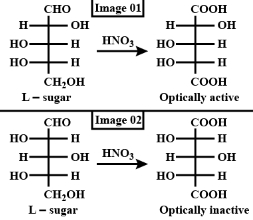
Which $L$-sugar on oxidation gives an optically active dibasic acid?
A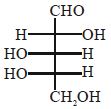
B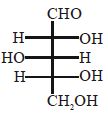
C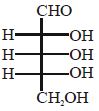
D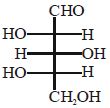
Solution
(A) sugar is optically active if its structure lacks a plane of symmetry. Upon oxidation with $HNO_3$,the terminal $-CHO$ and $-CH_2OH$ groups are converted into $-COOH$ groups,forming a dibasic acid (aldaric acid).
$1$. Identify the $L$-sugars: An $L$-sugar has the $-OH$ group on the chiral carbon furthest from the carbonyl group pointing to the left in a Fischer projection.
$2$. Analyze the options:
- Option $A$: This is $L$-gulose. Oxidation yields glucaric acid,which is optically active.
- Option $B$: This is $D$-galactose.
- Option $C$: This is $D$-glucose.
- Option $D$: This is $L$-galactose. Oxidation yields galactaric acid (mucic acid),which has a plane of symmetry and is optically inactive (meso compound).
Therefore,the $L$-sugar that yields an optically active dibasic acid is the one in option $A$.
$1$. Identify the $L$-sugars: An $L$-sugar has the $-OH$ group on the chiral carbon furthest from the carbonyl group pointing to the left in a Fischer projection.
$2$. Analyze the options:
- Option $A$: This is $L$-gulose. Oxidation yields glucaric acid,which is optically active.
- Option $B$: This is $D$-galactose.
- Option $C$: This is $D$-glucose.
- Option $D$: This is $L$-galactose. Oxidation yields galactaric acid (mucic acid),which has a plane of symmetry and is optically inactive (meso compound).
Therefore,the $L$-sugar that yields an optically active dibasic acid is the one in option $A$.
0 likes
View Solution320
EasyMCQ
$D$-Glucose $\overset{OH^{-}}{\longleftrightarrow} A + B$; $A$ and $B$ are
A
$D$-Mannose and $D$-Mannitol
B
$D$-Mannose and $D$-Fructose
C
$D$-Allose and $D$-Altrose
D
$D$-Glucose and $D$-Idose
Solution
(B) In the presence of a dilute base $(OH^-)$,$D$-Glucose undergoes tautomerization via an enediol intermediate.
This process leads to the formation of an equilibrium mixture containing $D$-Glucose,$D$-Mannose (its $C-2$ epimer),and $D$-Fructose (its ketose isomer).
Therefore,$A$ and $B$ are $D$-Mannose and $D$-Fructose.
This process leads to the formation of an equilibrium mixture containing $D$-Glucose,$D$-Mannose (its $C-2$ epimer),and $D$-Fructose (its ketose isomer).
Therefore,$A$ and $B$ are $D$-Mannose and $D$-Fructose.
0 likes
View Solution321
EasyMCQ
Which reagents can be used to distinguish glucose and fructose?
$I$. Bromine water
$II$. Tollen's reagent
$III$. Schiff's reagent
$I$. Bromine water
$II$. Tollen's reagent
$III$. Schiff's reagent
A
$I, II, III$
B
$II$ and $III$
C
Only $I$
D
Only $III$
Solution
(A) Glucose is an aldose containing an aldehyde group,while fructose is a ketose containing a ketone group.
$I$. Bromine water ($Br_2$ water) is a mild oxidizing agent that oxidizes the aldehyde group of glucose to gluconic acid,but it does not oxidize fructose. Thus,it can distinguish between them.
$II$. Tollen's reagent $(Ag(NH_3)_2^+)$ oxidizes both aldoses and ketoses (due to tautomerization of fructose into glucose in basic medium). Therefore,it cannot distinguish between them.
$III$. Schiff's reagent reacts with free aldehyde groups. While glucose has an aldehyde group,fructose does not. However,in the presence of Schiff's reagent,fructose does not show a positive test,but glucose does. Thus,it can also distinguish between them.
Therefore,both $I$ and $III$ can be used to distinguish glucose and fructose.
$I$. Bromine water ($Br_2$ water) is a mild oxidizing agent that oxidizes the aldehyde group of glucose to gluconic acid,but it does not oxidize fructose. Thus,it can distinguish between them.
$II$. Tollen's reagent $(Ag(NH_3)_2^+)$ oxidizes both aldoses and ketoses (due to tautomerization of fructose into glucose in basic medium). Therefore,it cannot distinguish between them.
$III$. Schiff's reagent reacts with free aldehyde groups. While glucose has an aldehyde group,fructose does not. However,in the presence of Schiff's reagent,fructose does not show a positive test,but glucose does. Thus,it can also distinguish between them.
Therefore,both $I$ and $III$ can be used to distinguish glucose and fructose.
0 likes
View Solution322
MediumMCQ
Glycogen is a branched chain polymer of $\alpha-D$-glucose units in which the chain is formed by $C_1-C_4$ glycosidic linkage,whereas branching occurs by the formation of $C_1-C_6$ glycosidic linkage. The structure of glycogen is similar to:
A
Amylose
B
Amylopectin
C
Cellulose
D
Glucose
Solution
(B) Amylopectin is a branched chain polymer of $\alpha-D$-glucose units.
In amylopectin,the linear chains are formed by $C_1-C_4$ glycosidic linkage,whereas branching occurs by the formation of $C_1-C_6$ glycosidic linkage.
Since glycogen also exhibits this same branching pattern,its structure is similar to amylopectin.
In amylopectin,the linear chains are formed by $C_1-C_4$ glycosidic linkage,whereas branching occurs by the formation of $C_1-C_6$ glycosidic linkage.
Since glycogen also exhibits this same branching pattern,its structure is similar to amylopectin.
0 likes
View Solution323
DifficultMCQ
Select the evidence for the open chain structure of glucose.
A
Reaction with Tollen's reagent
B
Reaction with Fehling solution
C
Pentaacetyl derivative of glucose
D
Cyanohydrin formation with $HCN$
Solution
(D) The formation of cyanohydrin by the reaction of glucose with $HCN$ is a characteristic reaction of the carbonyl group $(>C=O)$.
Since glucose reacts with $HCN$ to form a cyanohydrin,it confirms the presence of a carbonyl group in the open-chain structure of glucose.
While the other options also support the presence of specific functional groups,the reaction with $HCN$ is a classic piece of evidence for the open-chain carbonyl structure.
Since glucose reacts with $HCN$ to form a cyanohydrin,it confirms the presence of a carbonyl group in the open-chain structure of glucose.
While the other options also support the presence of specific functional groups,the reaction with $HCN$ is a classic piece of evidence for the open-chain carbonyl structure.
0 likes
View Solution324
DifficultMCQ
How many double bond equivalents (degree of unsaturation) does a compound with the molecular formula $C_6H_{12}O_6$ possess?
A
$0$
B
$1$
C
$2$
D
$3$
Solution
(B) The degree of unsaturation $(DU)$ or double bond equivalent is calculated using the formula: $DU = (C + 1) - \frac{H + X - N}{2}$.
Here,$C = 6$,$H = 12$,$X = 0$ (halogens),and $N = 0$ (nitrogen).
Oxygen atoms are ignored in this calculation.
Substituting the values: $DU = (6 + 1) - \frac{12}{2} = 7 - 6 = 1$.
Therefore,the compound has $1$ double bond equivalent.
Here,$C = 6$,$H = 12$,$X = 0$ (halogens),and $N = 0$ (nitrogen).
Oxygen atoms are ignored in this calculation.
Substituting the values: $DU = (6 + 1) - \frac{12}{2} = 7 - 6 = 1$.
Therefore,the compound has $1$ double bond equivalent.
0 likes
View Solution325
AdvancedMCQ
The following compounds differ in respect of
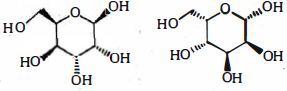
A
their chemical and physical properties
B
nothing
C
the direction in which they rotate plane of polarized light
D
their interactions with molecules
Solution
(A) The given structures represent two different monosaccharides (specifically,they are diastereomers,not enantiomers,as they differ in the configuration of one or more chiral centers).
Diastereomers have different physical and chemical properties.
They also differ in the direction in which they rotate the plane of polarized light $(P.P.L.)$.
Therefore,they differ in their physical properties,chemical properties,and their interaction with plane-polarized light.
Diastereomers have different physical and chemical properties.
They also differ in the direction in which they rotate the plane of polarized light $(P.P.L.)$.
Therefore,they differ in their physical properties,chemical properties,and their interaction with plane-polarized light.
0 likes
View Solution326
MediumMCQ
Determine the $D$ and $L$ configuration for the carbohydrates shown in the image.
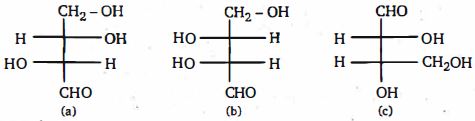
A
$L, L, D$
B
$L, D, L$
C
$L, L, L$
D
$L, D, D$
Solution
(A) To determine the $D$ or $L$ configuration of a carbohydrate in a Fischer projection,we look at the chiral center furthest from the carbonyl group (the lowest chiral carbon in the chain).
If the $-OH$ group is on the right side,it is a $D$-sugar. If the $-OH$ group is on the left side,it is an $L$-sugar.
For structure $(a)$:
The lowest chiral center has the $-OH$ group on the left. Thus,it is $L$.
For structure $(b)$:
The lowest chiral center has the $-OH$ group on the left. Thus,it is $L$.
For structure $(c)$:
The lowest chiral center has the $-OH$ group on the right. Thus,it is $D$.
Therefore,the configurations are $L, L, D$.
If the $-OH$ group is on the right side,it is a $D$-sugar. If the $-OH$ group is on the left side,it is an $L$-sugar.
For structure $(a)$:
The lowest chiral center has the $-OH$ group on the left. Thus,it is $L$.
For structure $(b)$:
The lowest chiral center has the $-OH$ group on the left. Thus,it is $L$.
For structure $(c)$:
The lowest chiral center has the $-OH$ group on the right. Thus,it is $D$.
Therefore,the configurations are $L, L, D$.
0 likes
View Solution327
DifficultMCQ
The structures of cyclic $D$-glucoside are given. Determine the moles of $HIO_4$ consumed by $X$ and $Y$ respectively.
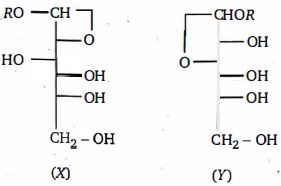
A
$2, 2$
B
$3, 3$
C
$2, 3$
D
$3, 2$
Solution
(D) Periodic acid $(HIO_4)$ cleaves vicinal diols ($1$,$2$-diols) and $\alpha$-hydroxy carbonyl compounds.
For structure $X$: The cyclic structure has three adjacent hydroxyl groups (including the primary alcohol) that are susceptible to cleavage. Specifically,the $C_2, C_3, C_4$ and $C_5$ positions with $OH$ groups allow for the consumption of $3$ moles of $HIO_4$.
For structure $Y$: The structure has two adjacent hydroxyl groups available for oxidation,leading to the consumption of $2$ moles of $HIO_4$.
Thus,the moles consumed are $3$ and $2$ respectively.
Therefore,the correct option is $(d)$.
For structure $X$: The cyclic structure has three adjacent hydroxyl groups (including the primary alcohol) that are susceptible to cleavage. Specifically,the $C_2, C_3, C_4$ and $C_5$ positions with $OH$ groups allow for the consumption of $3$ moles of $HIO_4$.
For structure $Y$: The structure has two adjacent hydroxyl groups available for oxidation,leading to the consumption of $2$ moles of $HIO_4$.
Thus,the moles consumed are $3$ and $2$ respectively.
Therefore,the correct option is $(d)$.
0 likes
View Solution328
DifficultMCQ
The reaction of an aldopentose with $4HIO_4$ yields which products?
A
$4HCO_2H, HCHO$
B
$4CH_2O, HCO_2H$
C
$CO_2, 4HCHO$
D
$CO_2, 3HCO_2H, HCHO$
Solution
(A) An aldopentose has the structure $CHO-(CHOH)_3-CH_2OH$.
Periodic acid $(HIO_4)$ cleaves vicinal diols and $\alpha$-hydroxy carbonyl compounds.
For an aldopentose,the reaction proceeds as follows:
$CHO-(CHOH)_3-CH_2OH + 4HIO_4 \to 4HCO_2H + HCHO$.
Thus,the products obtained are $4$ moles of formic acid $(HCO_2H)$ and $1$ mole of formaldehyde $(HCHO)$.
Periodic acid $(HIO_4)$ cleaves vicinal diols and $\alpha$-hydroxy carbonyl compounds.
For an aldopentose,the reaction proceeds as follows:
$CHO-(CHOH)_3-CH_2OH + 4HIO_4 \to 4HCO_2H + HCHO$.
Thus,the products obtained are $4$ moles of formic acid $(HCO_2H)$ and $1$ mole of formaldehyde $(HCHO)$.
0 likes
View Solution329
MediumMCQ
$(i) \ CHO-(CHOH)_3-CH_2OH \xrightarrow{4HIO_4} \text{Product}$
$(ii) \ CH_2OH-(CHOH)_4-CH_2OH \xrightarrow{5HIO_4} \text{Product}$
\text{The ratio of moles of formic acid obtained in reaction } $(i)$ \text{ and reaction } (ii) \text{ is:}
$(ii) \ CH_2OH-(CHOH)_4-CH_2OH \xrightarrow{5HIO_4} \text{Product}$
\text{The ratio of moles of formic acid obtained in reaction } $(i)$ \text{ and reaction } (ii) \text{ is:}
A
$3/4$
B
$4/5$
C
$1$
D
$5/4$
Solution
(C) In reaction $(i)$,the oxidation of aldopentose with $4$ moles of $HIO_4$ yields $4$ moles of formic acid $(HCOOH)$ and $1$ mole of formaldehyde $(HCHO)$.
$CHO-(CHOH)_3-CH_2OH \xrightarrow{4HIO_4} 4HCOOH + HCHO$
In reaction $(ii)$,the oxidation of hexitol with $5$ moles of $HIO_4$ yields $4$ moles of formic acid $(HCOOH)$ and $2$ moles of formaldehyde $(HCHO)$.
$CH_2OH-(CHOH)_4-CH_2OH \xrightarrow{5HIO_4} 4HCOOH + 2HCHO$
Ratio of moles of formic acid = $4 / 4 = 1$.
$CHO-(CHOH)_3-CH_2OH \xrightarrow{4HIO_4} 4HCOOH + HCHO$
In reaction $(ii)$,the oxidation of hexitol with $5$ moles of $HIO_4$ yields $4$ moles of formic acid $(HCOOH)$ and $2$ moles of formaldehyde $(HCHO)$.
$CH_2OH-(CHOH)_4-CH_2OH \xrightarrow{5HIO_4} 4HCOOH + 2HCHO$
Ratio of moles of formic acid = $4 / 4 = 1$.
0 likes
View Solution330
MediumMCQ
What is the maximum value of $x$ in the following reaction?
$MeO-CH-(CHOH)_3-CH-CH_2OH$ (with a cyclic ether linkage between the first and fifth carbon) $+ xHIO_4 \rightarrow$ products
$MeO-CH-(CHOH)_3-CH-CH_2OH$ (with a cyclic ether linkage between the first and fifth carbon) $+ xHIO_4 \rightarrow$ products
A
$1$
B
$2$
C
$3$
D
$4$
Solution
(B) Periodic acid $(HIO_4)$ cleaves vicinal diols ($1$,$2$-diols) to form carbonyl compounds.
It does not cleave ether linkages.
In the given structure,there are three adjacent hydroxyl groups $(CHOH-CHOH-CHOH)$ and one terminal primary alcohol group $(CH_2OH)$ attached to a carbon that is also part of an ether linkage.
Specifically,the sequence of diols available for cleavage are the three $CHOH$ groups.
Periodic acid will cleave the bonds between these adjacent hydroxyl-bearing carbons.
Since there are $3$ adjacent $CHOH$ groups,it requires $2$ moles of $HIO_4$ to cleave the two $C-C$ bonds between them.
The ether linkage remains intact.
Therefore,the value of $x$ is $2$.
It does not cleave ether linkages.
In the given structure,there are three adjacent hydroxyl groups $(CHOH-CHOH-CHOH)$ and one terminal primary alcohol group $(CH_2OH)$ attached to a carbon that is also part of an ether linkage.
Specifically,the sequence of diols available for cleavage are the three $CHOH$ groups.
Periodic acid will cleave the bonds between these adjacent hydroxyl-bearing carbons.
Since there are $3$ adjacent $CHOH$ groups,it requires $2$ moles of $HIO_4$ to cleave the two $C-C$ bonds between them.
The ether linkage remains intact.
Therefore,the value of $x$ is $2$.
0 likes
View Solution331
MediumMCQ
The product obtained in the reaction is:
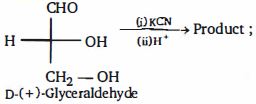
A
$Diastereomer$
B
$Racemic$
C
$Meso$
D
$Optically$ $pure$ $enantiomer$
Solution
(A) The reaction of $D-(+)-Glyceraldehyde$ with $KCN$ followed by $H^+$ is a cyanohydrin formation reaction.
This reaction creates a new chiral center at the carbonyl carbon.
Since the starting material $D-(+)-Glyceraldehyde$ is already chiral,the addition of the cyanide group can occur from either side of the planar carbonyl group.
This results in the formation of two new stereoisomers that are not mirror images of each other,which are known as diastereomers.
This reaction creates a new chiral center at the carbonyl carbon.
Since the starting material $D-(+)-Glyceraldehyde$ is already chiral,the addition of the cyanide group can occur from either side of the planar carbonyl group.
This results in the formation of two new stereoisomers that are not mirror images of each other,which are known as diastereomers.
0 likes
View Solution332
MediumMCQ
Which of the following pairs is a $C_2$-epimer?
A
$D$-Glucose,$D$-Maltose
B
$D$-Glucose,$D$-Mannose
C
$D$-Allose,$D$-Ribose
D
$D$-Glucose,$D$-Arabinose
Solution
(B) Epimers are diastereomers that differ in configuration at only one stereocenter.
$C_2$-epimers specifically differ in configuration only at the second carbon atom $(C_2)$.
$D$-Glucose and $D$-Mannose are aldohexoses that have the same configuration at all chiral centers except for the $C_2$ position.
In $D$-Glucose,the $-OH$ group at $C_2$ is on the right,whereas in $D$-Mannose,the $-OH$ group at $C_2$ is on the left.
Therefore,$D$-Glucose and $D$-Mannose form a $C_2$-epimer pair.
$C_2$-epimers specifically differ in configuration only at the second carbon atom $(C_2)$.
$D$-Glucose and $D$-Mannose are aldohexoses that have the same configuration at all chiral centers except for the $C_2$ position.
In $D$-Glucose,the $-OH$ group at $C_2$ is on the right,whereas in $D$-Mannose,the $-OH$ group at $C_2$ is on the left.
Therefore,$D$-Glucose and $D$-Mannose form a $C_2$-epimer pair.
0 likes
View Solution333
EasyMCQ
$A$ $D$-carbohydrate is:
A
Always dextrorotatory
B
Always laevorotatory
C
Always the mirror image of the corresponding $L$-carbohydrate
D
None of these
Solution
(D) The $D$ and $L$ configuration of carbohydrates is determined by the configuration of the chiral carbon atom farthest from the carbonyl group,which corresponds to the configuration of $D$-glyceraldehyde or $L$-glyceraldehyde,respectively.
$D$ and $L$ designations do not indicate the direction of optical rotation (dextrorotatory or laevorotatory).
Optical rotation is determined experimentally and is denoted by $(+)$ for dextrorotatory and $(-)$ for laevorotatory.
Therefore,a $D$-carbohydrate can be either dextrorotatory or laevorotatory,and it is not necessarily the mirror image of the corresponding $L$-carbohydrate (which would be its enantiomer,but $D$ and $L$ labels are relative to glyceraldehyde).
Thus,none of the given statements are universally true.
$D$ and $L$ designations do not indicate the direction of optical rotation (dextrorotatory or laevorotatory).
Optical rotation is determined experimentally and is denoted by $(+)$ for dextrorotatory and $(-)$ for laevorotatory.
Therefore,a $D$-carbohydrate can be either dextrorotatory or laevorotatory,and it is not necessarily the mirror image of the corresponding $L$-carbohydrate (which would be its enantiomer,but $D$ and $L$ labels are relative to glyceraldehyde).
Thus,none of the given statements are universally true.
0 likes
View Solution334
DifficultMCQ
Which $L$-sugar on oxidation with $HNO_3$ gives an optically active dibasic acid ($2$ $COOH$ groups)?
A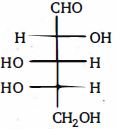
B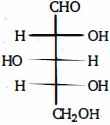
C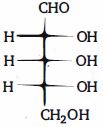
D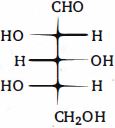
Solution
(A) Oxidation of an aldose with $HNO_3$ converts both the terminal $-CHO$ and $-CH_2OH$ groups into $-COOH$ groups,resulting in a dicarboxylic acid (aldaric acid).
For the resulting acid to be optically active,it must lack a plane of symmetry (i.e.,it should not be a meso compound).
Structure $(a)$ is $L$-gulose. Upon oxidation,it forms $L$-gularic acid,which is optically active.
Structure $(d)$ is $L$-galactose. Upon oxidation,it forms mucic acid (galactaric acid),which is a meso compound (optically inactive due to an internal plane of symmetry).
Therefore,the $L$-sugar that yields an optically active dibasic acid is $(a)$.
For the resulting acid to be optically active,it must lack a plane of symmetry (i.e.,it should not be a meso compound).
Structure $(a)$ is $L$-gulose. Upon oxidation,it forms $L$-gularic acid,which is optically active.
Structure $(d)$ is $L$-galactose. Upon oxidation,it forms mucic acid (galactaric acid),which is a meso compound (optically inactive due to an internal plane of symmetry).
Therefore,the $L$-sugar that yields an optically active dibasic acid is $(a)$.
0 likes
View Solution335
MediumMCQ
The given osazone can be obtained by:
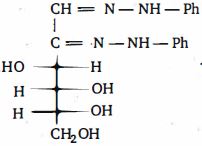
A
$D^{-}$-glucose
B
$D^{-}$-mannose
C
$D^{-}$-Idose
D
Both $(a)$ and $(b)$
Solution
(D) The given structure is the osazone of $D^{-}$-glucose,$D^{-}$-mannose,and $D^{-}$-fructose.
These three sugars differ only in the configuration at $C-1$ and $C-2$.
Since the osazone formation involves the reaction of the first two carbon atoms with phenylhydrazine,the configuration at $C-1$ and $C-2$ is lost,resulting in the same osazone for all three sugars.
Therefore,the correct answer is $(d)$.
These three sugars differ only in the configuration at $C-1$ and $C-2$.
Since the osazone formation involves the reaction of the first two carbon atoms with phenylhydrazine,the configuration at $C-1$ and $C-2$ is lost,resulting in the same osazone for all three sugars.
Therefore,the correct answer is $(d)$.
0 likes
View Solution336
MediumMCQ
Which of the following pairs gives the same phenyl osazone?
A
$D^{-}$-Glucose and $D^{-}$-Allose
B
$D^{-}$-Glucose and $D^{-}$-Altrose
C
$D^{-}$-Glucose and $D^{-}$-Mannose
D
$D^{-}$-Glucose and $D^{-}$-Talose
Solution
(C) $D^{-}$-Glucose,$D^{-}$-Mannose,and $D^{-}$-Fructose all possess the same configuration at $C-3$,$C-4$,and $C-5$ of their carbon chains.
During the formation of phenyl osazone,the first two carbon atoms ($C-1$ and $C-2$) are involved in the reaction with phenylhydrazine,which eliminates the stereochemical differences at these positions.
Therefore,these three sugars yield the same phenyl osazone derivative.
During the formation of phenyl osazone,the first two carbon atoms ($C-1$ and $C-2$) are involved in the reaction with phenylhydrazine,which eliminates the stereochemical differences at these positions.
Therefore,these three sugars yield the same phenyl osazone derivative.
0 likes
View Solution337
MediumMCQ
Among the three compounds shown below,two yield the same product on reaction with warm $HNO_3$. The exception is:
A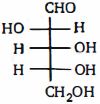
B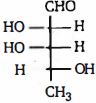
C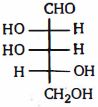
D
None of these
Solution
(B) Warm $HNO_3$ is a strong oxidizing agent that oxidizes both the terminal aldehyde group $(-CHO)$ and the terminal primary alcohol group $(-CH_2OH)$ to carboxylic acid groups $(-COOH)$,forming a dicarboxylic acid (aldaric acid).
Compound $a$ is $D$-galactose. Oxidation with $HNO_3$ yields galactaric acid (mucic acid).
Compound $c$ is $D$-talose. Oxidation with $HNO_3$ also yields galactaric acid (mucic acid) because $D$-galactose and $D$-talose are epimers at $C-4$,and their oxidation products are identical due to symmetry.
Compound $b$ is a deoxy sugar derivative and does not yield the same dicarboxylic acid product.
Therefore,the exception is compound $b$.
Compound $a$ is $D$-galactose. Oxidation with $HNO_3$ yields galactaric acid (mucic acid).
Compound $c$ is $D$-talose. Oxidation with $HNO_3$ also yields galactaric acid (mucic acid) because $D$-galactose and $D$-talose are epimers at $C-4$,and their oxidation products are identical due to symmetry.
Compound $b$ is a deoxy sugar derivative and does not yield the same dicarboxylic acid product.
Therefore,the exception is compound $b$.
0 likes
View Solution338
MediumMCQ
The optical rotation of the $\alpha$-form of a pyranose is $+150.7^{\circ}$,that of the $\beta$-form is $+52.8^{\circ}$. In solution,an equilibrium mixture of these anomers has an optical rotation of $+80.2^{\circ}$. The percentage of the $\alpha$-form in the equilibrium mixture is $....... \%$.
A
$28$
B
$32$
C
$68$
D
$72$
Solution
(A) Let the fraction of the $\alpha$-form be $X$ and the fraction of the $\beta$-form be $(1 - X)$.
The equilibrium rotation is given by the weighted average: $150.7(X) + 52.8(1 - X) = 80.2$.
Expanding the equation: $150.7X + 52.8 - 52.8X = 80.2$.
Simplifying the terms: $97.9X = 80.2 - 52.8$.
$97.9X = 27.4$.
$X = \frac{27.4}{97.9} \approx 0.2799$.
Converting to percentage: $0.2799 \times 100 \approx 28 \%$.
Thus,the percentage of the $\alpha$-form is $28 \%$.
The equilibrium rotation is given by the weighted average: $150.7(X) + 52.8(1 - X) = 80.2$.
Expanding the equation: $150.7X + 52.8 - 52.8X = 80.2$.
Simplifying the terms: $97.9X = 80.2 - 52.8$.
$97.9X = 27.4$.
$X = \frac{27.4}{97.9} \approx 0.2799$.
Converting to percentage: $0.2799 \times 100 \approx 28 \%$.
Thus,the percentage of the $\alpha$-form is $28 \%$.
0 likes
View Solution339
MediumMCQ
Which of the following represents the anomer of the compound shown?
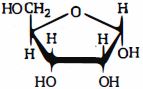
A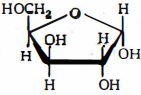
B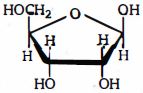
C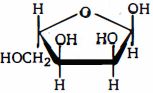
D
None of these
Solution
(B) Anomers are diastereomers of cyclic forms of sugars or similar molecules that differ in the configuration at the anomeric carbon (the carbon derived from the carbonyl carbon in the open-chain form).
In the given structure,the $-OH$ group at the anomeric carbon is pointing downwards (alpha-configuration).
The anomer of this compound would have the $-OH$ group at the anomeric carbon pointing upwards (beta-configuration).
Comparing the options,the structure that represents the beta-anomer is the correct choice.
In the given structure,the $-OH$ group at the anomeric carbon is pointing downwards (alpha-configuration).
The anomer of this compound would have the $-OH$ group at the anomeric carbon pointing upwards (beta-configuration).
Comparing the options,the structure that represents the beta-anomer is the correct choice.
0 likes
View Solution340
MediumMCQ
Which set of terms correctly identifies the carbohydrate shown?
$1$. Pentose $2$. Pentulose $3$. Hexulose $4$. Hexose
$5$. Aldose $6$. Ketose $7$. Pyranose $8$. Furanose
$1$. Pentose $2$. Pentulose $3$. Hexulose $4$. Hexose
$5$. Aldose $6$. Ketose $7$. Pyranose $8$. Furanose
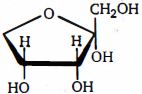
A
$2, 6, 8$
B
$2, 6, 7$
C
$1, 5, 8$
D
$A$ set of terms other than these
Solution
(C) The structure shown is Ribofuranose (or a derivative like Fructose in furanose form,but specifically here it represents a $5$-carbon sugar in a $5$-membered ring).
$1$. It has $5$ carbon atoms,so it is a Pentose.
$2$. The ring structure is a $5$-membered ring containing oxygen,which is called a Furanose ring.
$3$. Based on the structure,it is an Aldose (as it is a cyclic form of ribose).
Therefore,the correct set is $1, 5, 8$.
$1$. It has $5$ carbon atoms,so it is a Pentose.
$2$. The ring structure is a $5$-membered ring containing oxygen,which is called a Furanose ring.
$3$. Based on the structure,it is an Aldose (as it is a cyclic form of ribose).
Therefore,the correct set is $1, 5, 8$.
0 likes
View Solution341
MediumMCQ
For the complex conversion of $D^{-}$-glucose into the corresponding osazone,the minimum number of equivalents of phenylhydrazine required is:
A
$2$
B
$3$
C
$4$
D
$5$
Solution
(B) The formation of osazone from $D^{-}$-glucose involves the reaction with $3$ equivalents of phenylhydrazine $(PhNHNH_2)$.
$1$ equivalent is used for the oxidation of the $C-2$ hydroxyl group to a carbonyl group,while the other $2$ equivalents are used to form the phenylhydrazone linkages at $C-1$ and $C-2$ positions.
The overall reaction is: $D^{-}$-glucose $+ 3 \, PhNHNH_2 \to \text{Glucosazone} + PhNH_2 + NH_3 + 2 \, H_2O$.
$1$ equivalent is used for the oxidation of the $C-2$ hydroxyl group to a carbonyl group,while the other $2$ equivalents are used to form the phenylhydrazone linkages at $C-1$ and $C-2$ positions.
The overall reaction is: $D^{-}$-glucose $+ 3 \, PhNHNH_2 \to \text{Glucosazone} + PhNH_2 + NH_3 + 2 \, H_2O$.
0 likes
View Solution342
MediumMCQ
Which one of the following compounds will form an osazone derivative?
A
$CH_3CH_2COCH_2OH$
B
$CH_3COCH_2CH_2OH$
C
$CH_3CH_2CHOHCH_2OH$
D
$CH_3CH_2COCH_2OCH_3$
Solution
(A) Osazone formation is a characteristic reaction of $\alpha$-hydroxy carbonyl compounds (like $\alpha$-hydroxy ketones or $\alpha$-hydroxy aldehydes) with phenylhydrazine.
In the given options,$CH_3CH_2COCH_2OH$ contains a carbonyl group $(C=O)$ adjacent to a carbon atom bearing a hydroxyl group $(-OH)$,which is the structural requirement for osazone formation.
Therefore,$CH_3CH_2COCH_2OH$ will form an osazone derivative.
In the given options,$CH_3CH_2COCH_2OH$ contains a carbonyl group $(C=O)$ adjacent to a carbon atom bearing a hydroxyl group $(-OH)$,which is the structural requirement for osazone formation.
Therefore,$CH_3CH_2COCH_2OH$ will form an osazone derivative.
0 likes
View Solution343
MediumMCQ
Which of the following structures is $L$-arabinose?
A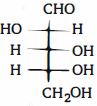
B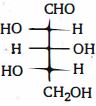
C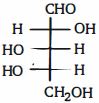
D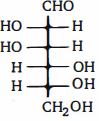
Solution
(B) $L$-arabinose is an aldopentose with the configuration $(2S, 3S, 4S)$ in its open-chain form.
In the Fischer projection,for an $L$-sugar,the hydroxyl group $(-OH)$ on the chiral carbon furthest from the aldehyde group (the $C-4$ carbon in this case) must be on the left side.
Comparing the given structures:
- Structure $A$ represents $D$-xylose.
- Structure $B$ represents $L$-arabinose,as the $-OH$ group at $C-4$ is on the left,and the configuration matches the $L$-arabinose stereoisomer.
- Structure $C$ represents $D$-ribose.
- Structure $D$ represents $D$-glucose (an aldohexose).
Therefore,the correct structure is $B$.
In the Fischer projection,for an $L$-sugar,the hydroxyl group $(-OH)$ on the chiral carbon furthest from the aldehyde group (the $C-4$ carbon in this case) must be on the left side.
Comparing the given structures:
- Structure $A$ represents $D$-xylose.
- Structure $B$ represents $L$-arabinose,as the $-OH$ group at $C-4$ is on the left,and the configuration matches the $L$-arabinose stereoisomer.
- Structure $C$ represents $D$-ribose.
- Structure $D$ represents $D$-glucose (an aldohexose).
Therefore,the correct structure is $B$.
0 likes
View Solution344
MediumMCQ
Which one of the statements concerning the equilibrium shown is true?
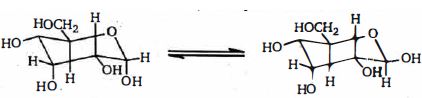
A
The two structures are enantiomers of each other. They have equal but opposite optical rotations and racemize slowly at room temperature.
B
The two structures are enantiomers of each other. They racemize too rapidly at room temperature for their optical rotations to be measured.
C
The two structures are diastereomers of each other. Their interconversion is called mutarotation.
D
The two structures are diastereomers of each other. Their interconversion does not require breaking and making bonds,only a change in conformation.
Solution
(C) The structures shown represent $\alpha-D$-glucose and $\beta-D$-glucose.
These are anomers,which are a specific type of diastereomers that differ in configuration only at the anomeric carbon $(C_1)$.
The process of interconversion between these two forms in solution is known as mutarotation.
Therefore,the correct statement is that they are diastereomers and their interconversion is called mutarotation.
These are anomers,which are a specific type of diastereomers that differ in configuration only at the anomeric carbon $(C_1)$.
The process of interconversion between these two forms in solution is known as mutarotation.
Therefore,the correct statement is that they are diastereomers and their interconversion is called mutarotation.
0 likes
View Solution345
MediumMCQ
The configurations of the chirality centres in $D$-threose (shown) are

A
$2R, 3R$
B
$2R, 3S$
C
$2S, 3R$
D
$2S, 3S$
Solution
(C) To determine the configuration of the chirality centers in $D$-threose,we assign priorities to the groups attached to each chiral carbon using Cahn-Ingold-Prelog $(CIP)$ rules.
For $C-2$ (the chiral carbon attached to the $CHO$ group):
$1$. $-OH$ (priority $1$)
$2$. $-CH(OH)CH_2OH$ (priority $2$)
$3$. $-CHO$ (priority $3$)
$4$. $-H$ (priority $4$)
In the Fischer projection,the $-H$ is on the horizontal bond. The sequence $1$ $\rightarrow 2$ $\rightarrow 3$ appears clockwise $(R)$,but since the lowest priority group $(-H)$ is on a horizontal bond,we reverse the configuration to $S$. Thus,$C-2$ is $2S$.
For $C-3$ (the chiral carbon attached to the $CH_2OH$ group):
$1$. $-OH$ (priority $1$)
$2$. $-CHO$ (priority $2$)
$3$. $-CH_2OH$ (priority $3$)
$4$. $-H$ (priority $4$)
In the Fischer projection,the $-H$ is on the horizontal bond. The sequence $1$ $\rightarrow 2$ $\rightarrow 3$ appears counter-clockwise $(S)$,but since the lowest priority group $(-H)$ is on a horizontal bond,we reverse the configuration to $R$. Thus,$C-3$ is $3R$.
Therefore,the configuration is $2S, 3R$.
For $C-2$ (the chiral carbon attached to the $CHO$ group):
$1$. $-OH$ (priority $1$)
$2$. $-CH(OH)CH_2OH$ (priority $2$)
$3$. $-CHO$ (priority $3$)
$4$. $-H$ (priority $4$)
In the Fischer projection,the $-H$ is on the horizontal bond. The sequence $1$ $\rightarrow 2$ $\rightarrow 3$ appears clockwise $(R)$,but since the lowest priority group $(-H)$ is on a horizontal bond,we reverse the configuration to $S$. Thus,$C-2$ is $2S$.
For $C-3$ (the chiral carbon attached to the $CH_2OH$ group):
$1$. $-OH$ (priority $1$)
$2$. $-CHO$ (priority $2$)
$3$. $-CH_2OH$ (priority $3$)
$4$. $-H$ (priority $4$)
In the Fischer projection,the $-H$ is on the horizontal bond. The sequence $1$ $\rightarrow 2$ $\rightarrow 3$ appears counter-clockwise $(S)$,but since the lowest priority group $(-H)$ is on a horizontal bond,we reverse the configuration to $R$. Thus,$C-3$ is $3R$.
Therefore,the configuration is $2S, 3R$.
0 likes
View Solution346
EasyMCQ
The rapid interconversion of $\alpha-D$-glucose and $\beta-D$-glucose in solution is known as:
A
racemization
B
asymmetric induction
C
fluxional isomerization
D
mutarotation
Solution
(D) The phenomenon of the change in specific optical rotation of an optically active compound in solution with time,to reach an equilibrium value,is called mutarotation.
For glucose,the specific rotation of $\alpha-D$-glucose is $+112^{\circ}$ and that of $\beta-D$-glucose is $+19^{\circ}$.
When either form is dissolved in water,they interconvert until an equilibrium mixture with a specific rotation of $+52.7^{\circ}$ is obtained.
Therefore,the correct answer is $(d)$ mutarotation.
For glucose,the specific rotation of $\alpha-D$-glucose is $+112^{\circ}$ and that of $\beta-D$-glucose is $+19^{\circ}$.
When either form is dissolved in water,they interconvert until an equilibrium mixture with a specific rotation of $+52.7^{\circ}$ is obtained.
Therefore,the correct answer is $(d)$ mutarotation.
0 likes
View Solution347
DifficultMCQ
What is the structure of $L$-glucose?
A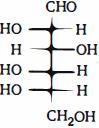
B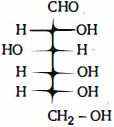
C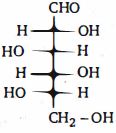
D
None of these
Solution
(A) -glucose has the configuration of $OH$ groups at $C2, C3, C4, C5$ as right,left,right,right respectively in the Fischer projection.
$L$-glucose is the enantiomer of $D$-glucose.
Therefore,the configuration of $OH$ groups at $C2, C3, C4, C5$ for $L$-glucose must be left,right,left,left.
Looking at the provided structures:
Image $378-$a345 shows $OH$ at $C2$ (left),$C3$ (right),$C4$ (left),$C5$ (left).
This matches the configuration of $L$-glucose.
Thus,the correct structure is represented by image $378-$a345.
$L$-glucose is the enantiomer of $D$-glucose.
Therefore,the configuration of $OH$ groups at $C2, C3, C4, C5$ for $L$-glucose must be left,right,left,left.
Looking at the provided structures:
Image $378-$a345 shows $OH$ at $C2$ (left),$C3$ (right),$C4$ (left),$C5$ (left).
This matches the configuration of $L$-glucose.
Thus,the correct structure is represented by image $378-$a345.
0 likes
View Solution348
MediumMCQ
What is the structure of $L$-glyceraldehyde?
A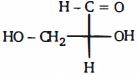
B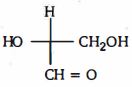
C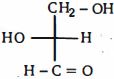
D
Both $(a)$ and $(b)$
Solution
(D) The structure of glyceraldehyde is $HOCH_2-CH(OH)-CHO$.
In the Fischer projection,the $D/L$ configuration is determined by the position of the $-OH$ group on the chiral carbon atom (the carbon atom adjacent to the $-CH_2OH$ group).
For $L$-glyceraldehyde,the $-OH$ group is on the left side of the chiral carbon.
Both structures $(a)$ and $(b)$ represent the same molecule,$L$-glyceraldehyde,just rotated in the plane of the paper.
Therefore,the correct option is $(d)$.
In the Fischer projection,the $D/L$ configuration is determined by the position of the $-OH$ group on the chiral carbon atom (the carbon atom adjacent to the $-CH_2OH$ group).
For $L$-glyceraldehyde,the $-OH$ group is on the left side of the chiral carbon.
Both structures $(a)$ and $(b)$ represent the same molecule,$L$-glyceraldehyde,just rotated in the plane of the paper.
Therefore,the correct option is $(d)$.
0 likes
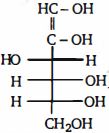
View Solution349
EasyMCQ
The given structure is the enol form of:
A
$D$-glucose
B
$D$-mannose
C
$D$-fructose
D
All of these
Solution
(D) The given structure is an enediol intermediate formed during the Lobry de Bruyn-van Ekenstein transformation.
In an alkaline medium,$D$-glucose,$D$-mannose,and $D$-fructose all undergo tautomerization to form a common enediol intermediate.
Therefore,the given enol form is common to all three sugars.
In an alkaline medium,$D$-glucose,$D$-mannose,and $D$-fructose all undergo tautomerization to form a common enediol intermediate.
Therefore,the given enol form is common to all three sugars.
0 likes
View Solution350
MediumMCQ
$D$-glucose $\overset{OH^{-}}{\longleftrightarrow} A + B$; $A$ and $B$ are
A
$D$-mannose & $D$-mannitol
B
$D$-mannose & $D$-fructose
C
$D$-allose & $D$-altrose
D
$D$-glucose & $D$-idose
Solution
(B) The reaction of $D$-glucose in the presence of a dilute base $(OH^{-})$ is known as the $Lobry \ de \ Bruyn-van \ Ekenstein$ transformation.
This process involves the formation of an enediol intermediate,which leads to the interconversion of aldoses and ketoses.
Specifically,$D$-glucose isomerizes to form $D$-mannose (an epimer) and $D$-fructose (a ketose).
Therefore,the correct products $A$ and $B$ are $D$-mannose and $D$-fructose.
This process involves the formation of an enediol intermediate,which leads to the interconversion of aldoses and ketoses.
Specifically,$D$-glucose isomerizes to form $D$-mannose (an epimer) and $D$-fructose (a ketose).
Therefore,the correct products $A$ and $B$ are $D$-mannose and $D$-fructose.
0 likes
View SolutionBiomolecules — Carbohydrates · Frequently Asked Questions
1Are these Biomolecules questions useful for JEE and NEET?
Yes. All questions in this section are mapped to JEE Main and NEET exam patterns. Previous year questions from JEE Main, NEET, GUJCET and state-level exams are included with full solutions.
2Can I switch to Hindi or Gujarati for these questions?
Yes. Use the language tabs in the hero section or the sidebar to view the same questions and solutions in English, Hindi or Gujarati.
3How do I generate a question paper from this subtopic?
Use the Vedclass Exam Paper Generator — select the chapter and subtopic, set difficulty, and generate Sets A, B, C, D automatically. First 3 chapters of every subject are free.
Vedclass Products
For Students
Vedclass Test Series
Mock tests in real JEE/NEET style with performance analysis. 5-day free trial.
Start Free TrialFor Teachers
Exam Paper Generator
Generate Set A/B/C/D papers from this chapter in 2 minutes. 3 chapters free.
Try FreeFor Institutes
Online Exam Module
Live online exams with unlimited students, 360° analytics & white-label branding.
See DemoFor Teachers & Institutes
Generate a Biomolecules Exam Paper in 2 Minutes
Select subtopic & difficulty — Sets A, B, C, D auto-generated with No Repeat logic.
First 3 chapters of every subject are free — no payment required.