
A English
Carbohydrates Questions in English
Class 12 Chemistry · Biomolecules · Carbohydrates
808+
Questions
English
Language
100%
With Solutions
Showing 50 of 808 questions in English
201
EasyMCQ
The number of chiral carbons in $\beta-D-(+)$-glucose is ......
A
$3$
B
$4$
C
$5$
D
$6$
Solution
(C) The structure of $\beta-D-(+)$-glucose is a cyclic hemiacetal form of glucose.
In the cyclic structure,the carbon atoms at positions $C_1, C_2, C_3, C_4,$ and $C_5$ are chiral centers.
$C_1$ is the anomeric carbon,which is bonded to $-H, -OH, -O-$ (ring oxygen),and $-C_2$.
$C_2, C_3,$ and $C_4$ are bonded to four different groups.
$C_5$ is bonded to $-H, -CH_2OH, -O-$ (ring oxygen),and $-C_4$.
Therefore,there are $5$ chiral carbon atoms in $\beta-D-(+)$-glucose.
In the cyclic structure,the carbon atoms at positions $C_1, C_2, C_3, C_4,$ and $C_5$ are chiral centers.
$C_1$ is the anomeric carbon,which is bonded to $-H, -OH, -O-$ (ring oxygen),and $-C_2$.
$C_2, C_3,$ and $C_4$ are bonded to four different groups.
$C_5$ is bonded to $-H, -CH_2OH, -O-$ (ring oxygen),and $-C_4$.
Therefore,there are $5$ chiral carbon atoms in $\beta-D-(+)$-glucose.
0 likes
View Solution202
EasyMCQ
Starch and cellulose are compounds made up of many ...... units.
A
Amino acids
B
Glycerol
C
Fatty acids
D
Simple sugars
Solution
(D) Starch and cellulose are polysaccharides,which are complex carbohydrates. They are polymers formed by the condensation of many monosaccharide units,which are commonly known as simple sugars (specifically $D$-glucose units).
0 likes
View Solution203
EasyMCQ
When glucose reacts with bromine water,the major product obtained is .......
A
Acetic acid
B
Saccharic acid
C
Glyceraldehyde
D
Gluconic acid
Solution
(D) The reaction of glucose with bromine water $(Br_2/H_2O)$ acts as a mild oxidizing agent that oxidizes the aldehyde group $(-CHO)$ to a carboxylic acid group $(-COOH)$ while leaving the secondary alcoholic groups unaffected.
$C_6H_{12}O_6 + [O] \xrightarrow{Br_2/H_2O} CH_2OH(CHOH)_4COOH$
Thus,the product formed is gluconic acid.
$C_6H_{12}O_6 + [O] \xrightarrow{Br_2/H_2O} CH_2OH(CHOH)_4COOH$
Thus,the product formed is gluconic acid.
0 likes
View Solution204
EasyMCQ
Heating glucose with Fehling's solution produces a $.........$ colored precipitate.
A
Yellow
B
Red
C
Black
D
White
Solution
(B) Glucose is a reducing sugar because it contains an aldehyde group. $ \text{When heated with Fehling's solution, it reduces } Cu^{2+} \text{ ions to } Cu^{+} \text{ ions, forming a red precipitate of cuprous oxide } (Cu_2O). $
$ \text{Reaction: } C_6H_{12}O_6 + 2Cu^{2+} + 5OH^- \rightarrow C_6H_{11}O_7^- + Cu_2O (\text{red ppt}) + 3H_2O. $
$ \text{Reaction: } C_6H_{12}O_6 + 2Cu^{2+} + 5OH^- \rightarrow C_6H_{11}O_7^- + Cu_2O (\text{red ppt}) + 3H_2O. $
0 likes
View Solution205
EasyMCQ
Which of the following statements is incorrect for glucose?
A
It is an aldohexose.
B
It forms $n-hexane$ on heating with $HI$.
C
It is present in furanose form.
D
It does not give $2, 4-DNP$ test.
0 likes
View Solution206
EasyMCQ
Which carbohydrate is used in the silvering of mirrors?
A
Fructose
B
Glucose
C
Sucrose
D
Starch
Solution
(B) Glucose is a reducing sugar because it contains an aldehyde group $(-CHO)$.
In the process of silvering mirrors,glucose is used to reduce Tollens' reagent $([Ag(NH_3)_2]^+)$ to metallic silver $(Ag)$,which deposits on the glass surface to form a mirror.
Therefore,glucose is the correct answer.
In the process of silvering mirrors,glucose is used to reduce Tollens' reagent $([Ag(NH_3)_2]^+)$ to metallic silver $(Ag)$,which deposits on the glass surface to form a mirror.
Therefore,glucose is the correct answer.
0 likes
View Solution207
EasyMCQ
Which of the following reduces Tollens' reagent?
A
Glucose
B
Fructose
C
Lactose
D
All of the above
Solution
(D) Tollens' reagent is reduced by all sugars that contain a free aldehyde group or those that can isomerize to form an aldehyde group in an alkaline medium.
$1$. Glucose is an aldose and contains a free aldehyde group,so it reduces Tollens' reagent.
$2$. Fructose,although a ketose,undergoes tautomerization in the alkaline medium of Tollens' reagent to form an aldose,thus it also reduces Tollens' reagent.
$3$. Lactose is a reducing sugar because it contains a free hemiacetal group,which allows it to exist in equilibrium with its open-chain aldehyde form.
Therefore,all the given options reduce Tollens' reagent.
$1$. Glucose is an aldose and contains a free aldehyde group,so it reduces Tollens' reagent.
$2$. Fructose,although a ketose,undergoes tautomerization in the alkaline medium of Tollens' reagent to form an aldose,thus it also reduces Tollens' reagent.
$3$. Lactose is a reducing sugar because it contains a free hemiacetal group,which allows it to exist in equilibrium with its open-chain aldehyde form.
Therefore,all the given options reduce Tollens' reagent.
0 likes
View Solution208
EasyMCQ
In $D-glucose$,the letter $D-$ indicates ...........
A
Configuration of all chiral carbons
B
Dextro
C
It is a monosaccharide
D
Configuration of a specific chiral carbon
Solution
(D) The $D$ and $L$ notations are used to describe the configuration of the chiral carbon atom furthest from the carbonyl group,relative to the reference molecule $glyceraldehyde$. In $D-glucose$,the $D-$ prefix indicates that the hydroxyl group $(-OH)$ on the chiral carbon furthest from the aldehyde group is on the right side in the Fischer projection,which corresponds to the configuration of $D-glyceraldehyde$.
0 likes
View Solution209
EasyMCQ
What are carbohydrates called that cannot be hydrolyzed into simpler compounds?
A
Monosaccharides
B
Disaccharides
C
Polysaccharides
D
Oligosaccharides
Solution
(A) Carbohydrates are classified based on their behavior upon hydrolysis.
Monosaccharides are the simplest form of carbohydrates and cannot be hydrolyzed further into smaller units of polyhydroxy aldehydes or ketones.
Examples include $Glucose$ and $Fructose$.
Monosaccharides are the simplest form of carbohydrates and cannot be hydrolyzed further into smaller units of polyhydroxy aldehydes or ketones.
Examples include $Glucose$ and $Fructose$.
0 likes
View Solution210
EasyMCQ
Which of the following pairs of monosaccharides form sucrose?
A
$\alpha - D - \text{glucopyranose and } \beta - D - \text{fructofuranose}$
B
$\alpha - D - \text{galactopyranose and } \beta - D - \text{glucopyranose}$
C
$\beta - D - \text{glucopyranose and } \alpha - D - \text{fructofuranose}$
D
$\alpha - D - \text{glucopyranose and } \beta - D - \text{fructopyranose}$
Solution
(A) Sucrose is a disaccharide formed by the condensation of one molecule of $\alpha - D - \text{glucose}$ (specifically $\alpha - D - \text{glucopyranose}$) and one molecule of $\beta - D - \text{fructose}$ (specifically $\beta - D - \text{fructofuranose}$).
The glycosidic linkage is formed between $C1$ of $\alpha - D - \text{glucopyranose}$ and $C2$ of $\beta - D - \text{fructofuranose}$.
The glycosidic linkage is formed between $C1$ of $\alpha - D - \text{glucopyranose}$ and $C2$ of $\beta - D - \text{fructofuranose}$.
0 likes
View Solution211
EasyMCQ
$\alpha-$ and $\beta-$ glucose are examples of ...... .
A
Isomers
B
Anomers
C
Isotropic
D
All of the above
Solution
(B) $\alpha-$ and $\beta-$ glucose are stereoisomers that differ in configuration only at the $C-1$ carbon atom,which is the anomeric carbon. Such isomers are specifically known as anomers.
0 likes
View Solution212
EasyMCQ
After digestion,milk is converted into.......
A
Cellulose
B
Fructose
C
Glucose and Galactose
D
Lactose
Solution
(C) Milk contains a disaccharide called lactose. During digestion,lactose undergoes hydrolysis in the presence of the enzyme lactase to produce two monosaccharides: $Glucose$ and $Galactose$. The reaction is: $C_{12}H_{22}O_{11} (Lactose) + H_2O \rightarrow C_6H_{12}O_6 (Glucose) + C_6H_{12}O_6 (Galactose)$.
0 likes
View Solution213
MediumMCQ
What is obtained when sucrose is heated with concentrated $H_2SO_4$?
A
$CO$ and $CO_2$
B
$CO$ and $SO_2$
C
$CO, CO_2$ and $SO_2$
D
None of these
Solution
(D) Sucrose $(C_{12}H_{22}O_{11})$ undergoes dehydration when heated with concentrated $H_2SO_4$.
The reaction is: $C_{12}H_{22}O_{11} \xrightarrow{conc. H_2SO_4} 12C_{(s)} + 11H_2O_{(l)}$.
Concentrated $H_2SO_4$ acts as a strong dehydrating agent,removing water molecules from the sugar,leaving behind carbon (charcoal).
The reaction is: $C_{12}H_{22}O_{11} \xrightarrow{conc. H_2SO_4} 12C_{(s)} + 11H_2O_{(l)}$.
Concentrated $H_2SO_4$ acts as a strong dehydrating agent,removing water molecules from the sugar,leaving behind carbon (charcoal).
0 likes
View Solution214
MediumMCQ
Which of the following pairs represents anomers?
A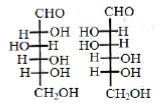
B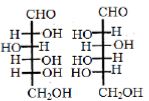
C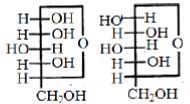
D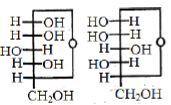
Solution
(D) Anomers are a type of stereoisomer found in carbohydrates that differ in configuration only at the anomeric carbon (the carbon derived from the carbonyl carbon in the open-chain form).
In cyclic structures,this is the carbon attached to two oxygen atoms.
Option $D$ shows two cyclic forms of glucose where the configuration at the $C-1$ (anomeric) carbon is different (one has $-OH$ on the right,the other on the left),while all other chiral centers remain identical.
Therefore,these represent $\alpha-D-glucose$ and $\beta-D-glucose$,which are anomers.
In cyclic structures,this is the carbon attached to two oxygen atoms.
Option $D$ shows two cyclic forms of glucose where the configuration at the $C-1$ (anomeric) carbon is different (one has $-OH$ on the right,the other on the left),while all other chiral centers remain identical.
Therefore,these represent $\alpha-D-glucose$ and $\beta-D-glucose$,which are anomers.
0 likes
View Solution215
EasyMCQ
Starch is formed by the linkage of which carbons of glucose units?
A
$C-1$ and $C-2$
B
$C-1$ and $C-3$
C
$C-1$ and $C-4$
D
$C-1$ and $C-5$
Solution
(C) Starch is a polysaccharide composed of two components: amylose and amylopectin.
Both components are polymers of $\alpha-D$-glucose units.
In amylose,the glucose units are linked by $\alpha$-glycosidic linkages between $C-1$ of one glucose unit and $C-4$ of the next glucose unit.
Similarly,in the linear chains of amylopectin,the glucose units are linked by $\alpha-1,4$-glycosidic linkages.
Both components are polymers of $\alpha-D$-glucose units.
In amylose,the glucose units are linked by $\alpha$-glycosidic linkages between $C-1$ of one glucose unit and $C-4$ of the next glucose unit.
Similarly,in the linear chains of amylopectin,the glucose units are linked by $\alpha-1,4$-glycosidic linkages.
0 likes
View Solution216
MediumMCQ
Which of the following equimolar mixtures is known as invert sugar?
A
$D(+)$-Glucose and $D(-)$-Galactose
B
$D(+)$-Glucose and $D(-)$-Fructose
C
$D(+)$-Glucose and $D(-)$-Mannose
D
$D(+)$-Glucose and $D(-)$-Ribose
Solution
(B) Invert sugar is an equimolar mixture of $D(+)$-glucose and $D(-)$-fructose.
It is obtained by the hydrolysis of sucrose.
The hydrolysis of sucrose results in a change in the sign of optical rotation from dextrorotatory $(+)$ to levorotatory $(-)$,which is why it is called invert sugar.
It is obtained by the hydrolysis of sucrose.
The hydrolysis of sucrose results in a change in the sign of optical rotation from dextrorotatory $(+)$ to levorotatory $(-)$,which is why it is called invert sugar.
0 likes
View Solution217
EasyMCQ
Which of the following carbohydrates is essential for the structure of all plant cell walls?
A
Starch
B
Maltose
C
Cellulose
D
Sucrose
Solution
(C) Cellulose is a linear polysaccharide of $D$-glucose units joined by $\beta$-glycosidic linkages. It is the main structural component of plant cell walls,providing rigidity and strength to the plant.
0 likes
View Solution218
EasyMCQ
Glucose gives a silver mirror test with Tollen's reagent. This indicates the presence of which group?
A
Acidic group
B
Alcoholic group
C
Aldehydic group
D
Amino group
Solution
(C) The reaction of glucose with Tollen's reagent is a characteristic test for the presence of an aldehydic group $(-CHO)$.
Glucose gets oxidized to gluconic acid,and the silver ions $(Ag^+)$ are reduced to metallic silver $(Ag)$,which forms a silver mirror on the inner walls of the test tube.
Reaction: $C_6H_{12}O_6 + 2[Ag(NH_3)_2]^+ + 3OH^- \rightarrow C_6H_{11}O_7^- + 2Ag + 4NH_3 + 2H_2O$.
Glucose gets oxidized to gluconic acid,and the silver ions $(Ag^+)$ are reduced to metallic silver $(Ag)$,which forms a silver mirror on the inner walls of the test tube.
Reaction: $C_6H_{12}O_6 + 2[Ag(NH_3)_2]^+ + 3OH^- \rightarrow C_6H_{11}O_7^- + 2Ag + 4NH_3 + 2H_2O$.
0 likes
View Solution219
EasyMCQ
How does glucose differ from fructose?
A
It does not undergo hydrolysis.
B
It gives a silver mirror test with Tollen's reagent.
C
It is a monosaccharide.
D
None of these.
Solution
(B) Glucose is an aldohexose containing an aldehyde group $(-CHO)$,whereas fructose is a ketohexose containing a ketone group $(-C=O)$.
Because of the presence of the aldehyde group,glucose acts as a reducing sugar and gives a positive silver mirror test with Tollen's reagent.
Fructose,although a ketose,also gives a positive test due to its isomerization into glucose and mannose in the alkaline medium of the reagent,but glucose is specifically characterized by its aldehyde functionality which is the primary structural difference.
Because of the presence of the aldehyde group,glucose acts as a reducing sugar and gives a positive silver mirror test with Tollen's reagent.
Fructose,although a ketose,also gives a positive test due to its isomerization into glucose and mannose in the alkaline medium of the reagent,but glucose is specifically characterized by its aldehyde functionality which is the primary structural difference.
0 likes
View Solution220
EasyMCQ
What is glycolysis?
A
Conversion of glucose into heme
B
Oxidation of glucose to glutamate
C
Conversion of pyruvate into citrate
D
Oxidation of glucose into pyruvate
Solution
(D) Glycolysis is a metabolic pathway that occurs in the cytoplasm of the cell.
It involves the breakdown of one molecule of $Glucose$ $(C_6H_{12}O_6)$ into two molecules of $Pyruvate$ $(CH_3COCOOH)$ through a series of enzyme-catalyzed reactions.
This process generates a net gain of $2$ $ATP$ and $2$ $NADH$ molecules.
It involves the breakdown of one molecule of $Glucose$ $(C_6H_{12}O_6)$ into two molecules of $Pyruvate$ $(CH_3COCOOH)$ through a series of enzyme-catalyzed reactions.
This process generates a net gain of $2$ $ATP$ and $2$ $NADH$ molecules.
0 likes
View Solution221
EasyMCQ
Lactose is a disaccharide of $......$.
A
Only glucose
B
Glucose and fructose
C
Glucose and galactose
D
Only galactose
Solution
(C) Lactose is a disaccharide composed of two monosaccharide units: $\beta-D-glucose$ and $\beta-D-galactose$.
The hydrolysis reaction is: $\text{Lactose} \xrightarrow{H_2O} \text{Glucose} + \text{Galactose}$.
The hydrolysis reaction is: $\text{Lactose} \xrightarrow{H_2O} \text{Glucose} + \text{Galactose}$.
0 likes
View Solution222
EasyMCQ
Milk contains which of the following disaccharides?
A
Maltose
B
Lactose
C
Sucrose
D
Cellulose
Solution
(B) Milk contains $Lactose$,which is a disaccharide composed of $Glucose$ and $Galactose$ units.
0 likes
View Solution223
EasyMCQ
With which reagent does glucose react to form a crystalline osazone derivative?
A
Fehling's solution
B
Phenylhydrazine
C
Hydroxylamine
D
None of the above
Solution
(B) Glucose reacts with excess phenylhydrazine $(C_6H_5NHNH_2)$ to form glucosazone,which is a crystalline osazone derivative.
This reaction involves the oxidation of the $C-2$ carbon and the formation of a hydrazone linkage at both $C-1$ and $C-2$ positions.
The chemical equation is: $CHO(CHOH)_4CH_2OH + 3C_6H_5NHNH_2 \rightarrow C_6H_{10}O_4(NNHC_6H_5)_2 + C_6H_5NH_2 + NH_3 + 2H_2O$.
This reaction involves the oxidation of the $C-2$ carbon and the formation of a hydrazone linkage at both $C-1$ and $C-2$ positions.
The chemical equation is: $CHO(CHOH)_4CH_2OH + 3C_6H_5NHNH_2 \rightarrow C_6H_{10}O_4(NNHC_6H_5)_2 + C_6H_5NH_2 + NH_3 + 2H_2O$.
0 likes
View Solution224
EasyMCQ
Hydrolysis of sucrose by acid or enzymes yields an equimolar mixture of glucose and fructose,which is known as .....
A
Esterification
B
Inversion
C
Saponification
D
Infiltration
Solution
(B) The hydrolysis of sucrose $(C_{12}H_{22}O_{11})$ in the presence of acid or the enzyme invertase produces an equimolar mixture of $D-(+)$-glucose and $D-(-)$-fructose.
This process is called the inversion of cane sugar because the optical rotation changes from dextrorotatory $(+66.5^{\circ})$ to levorotatory $(-39.9^{\circ})$.
This process is called the inversion of cane sugar because the optical rotation changes from dextrorotatory $(+66.5^{\circ})$ to levorotatory $(-39.9^{\circ})$.
0 likes
View Solution225
EasyMCQ
What is invert sugar?
A
$A$ mixture of sucrose
B
$A$ mixture of glucose and galactose
C
$A$ type of sucrose
D
An equimolar mixture of $D-(+)$-glucose and $D-(-)$-fructose
0 likes
View Solution226
EasyMCQ
The carbohydrate present in our food that we cannot digest is $......$.
A
Cellulose
B
Galactose
C
Maltose
D
Starch
Solution
(A) Humans lack the enzyme $cellulase$ required to break down the $\beta$-glycosidic linkages present in $cellulose$. Therefore,$cellulose$ cannot be digested by the human digestive system.
0 likes
View Solution227
MediumMCQ
What is the product formed when glucose reacts with an excess of $C_6H_5-NH.NH_2$?
A
Gluconic acid
B
Saccharic acid
C
Glucosazone
D
Glucose phenylhydrazone
Solution
(C) When glucose reacts with one equivalent of phenylhydrazine $(C_6H_5-NH.NH_2)$,it forms glucose phenylhydrazone.
However,when glucose reacts with an excess of phenylhydrazine,it undergoes a series of reactions to form a di-phenylhydrazone derivative known as glucosazone.
The reaction involves the oxidation of the $C-2$ carbon and the formation of a hydrazone linkage at both $C-1$ and $C-2$ positions.
However,when glucose reacts with an excess of phenylhydrazine,it undergoes a series of reactions to form a di-phenylhydrazone derivative known as glucosazone.
The reaction involves the oxidation of the $C-2$ carbon and the formation of a hydrazone linkage at both $C-1$ and $C-2$ positions.
0 likes
View Solution228
EasyMCQ
What is the nature of invert sugar?
A
Iso-rotatory
B
Dextrorotatory
C
Laevorotatory
D
Optically active
Solution
(C) Invert sugar is an equimolar mixture of $D-(+)-glucose$ and $D-(-)-fructose$.
Since the specific rotation of $D-(-)-fructose$ $(-92.4^{\circ})$ is greater in magnitude than that of $D-(+)-glucose$ $(+52.7^{\circ})$,the resulting mixture has a net negative specific rotation.
Therefore,invert sugar is laevorotatory.
Since the specific rotation of $D-(-)-fructose$ $(-92.4^{\circ})$ is greater in magnitude than that of $D-(+)-glucose$ $(+52.7^{\circ})$,the resulting mixture has a net negative specific rotation.
Therefore,invert sugar is laevorotatory.
0 likes
View Solution229
MediumMCQ
Which of the following compounds does not exhibit mutarotation?
A
$(+) \text{ Maltose}$
B
$(-) \text{ Fructose}$
C
$(+) \text{ Sucrose}$
D
$\text{Lactose}$
Solution
(C) Mutarotation is a property exhibited by reducing sugars that have a free hemiacetal or hemiketal group,allowing them to exist in equilibrium between their $\alpha$ and $\beta$ anomeric forms in solution.
Sucrose is a non-reducing sugar because the glycosidic linkage is formed between the anomeric carbons of both glucose and fructose ($C_1$ of glucose and $C_2$ of fructose).
Since there is no free hemiacetal or hemiketal group available,sucrose cannot undergo mutarotation.
Therefore,the correct option is $(C)$.
Sucrose is a non-reducing sugar because the glycosidic linkage is formed between the anomeric carbons of both glucose and fructose ($C_1$ of glucose and $C_2$ of fructose).
Since there is no free hemiacetal or hemiketal group available,sucrose cannot undergo mutarotation.
Therefore,the correct option is $(C)$.
0 likes
View Solution230
EasyMCQ
Glucose and Fructose are .......
A
Optical isomers
B
Tautomers
C
Functional isomers
D
Chain isomers
Solution
(C) Glucose is an aldohexose containing an aldehyde group $(-CHO)$.
Fructose is a ketohexose containing a ketone group $(>C=O)$.
Since they have the same molecular formula $(C_6H_{12}O_6)$ but different functional groups,they are functional isomers.
Fructose is a ketohexose containing a ketone group $(>C=O)$.
Since they have the same molecular formula $(C_6H_{12}O_6)$ but different functional groups,they are functional isomers.
0 likes
View Solution231
DifficultMCQ
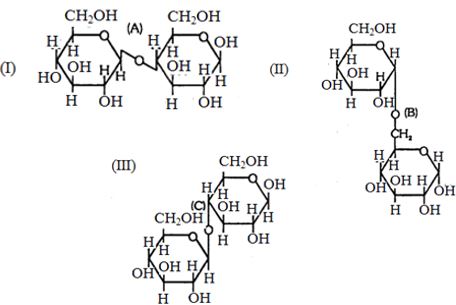
In the given three structures,two glucose units are linked. Which of the following correctly identifies the linkages between $C_1$ and $C_4$ and between $C_1$ and $C_6$?
A
$(A)$ is $C_1-C_4$; $(B)$ and $(C)$ are $C_1-C_6$
B
$(A)$ and $(B)$ are $C_1-C_4$; $(C)$ is $C_1-C_6$
C
$(A)$ and $(C)$ are $C_1-C_4$; $(B)$ is $C_1-C_6$
D
$(A)$ and $(C)$ are $C_1-C_6$; $(B)$ is $C_1-C_4$
Solution
(C) In structure $(I)$,the linkage $(A)$ connects the $C_1$ carbon of one glucose unit to the $C_4$ carbon of another glucose unit,representing a $C_1-C_4$ glycosidic linkage.
In structure $(II)$,the linkage $(B)$ connects the $C_1$ carbon of one glucose unit to the $C_6$ carbon (part of the $CH_2OH$ group) of another glucose unit,representing a $C_1-C_6$ glycosidic linkage.
In structure $(III)$,the linkage $(C)$ connects the $C_1$ carbon of one glucose unit to the $C_4$ carbon of another glucose unit,representing a $C_1-C_4$ glycosidic linkage.
Therefore,$(A)$ and $(C)$ are $C_1-C_4$ linkages,and $(B)$ is a $C_1-C_6$ linkage.
In structure $(II)$,the linkage $(B)$ connects the $C_1$ carbon of one glucose unit to the $C_6$ carbon (part of the $CH_2OH$ group) of another glucose unit,representing a $C_1-C_6$ glycosidic linkage.
In structure $(III)$,the linkage $(C)$ connects the $C_1$ carbon of one glucose unit to the $C_4$ carbon of another glucose unit,representing a $C_1-C_4$ glycosidic linkage.
Therefore,$(A)$ and $(C)$ are $C_1-C_4$ linkages,and $(B)$ is a $C_1-C_6$ linkage.
0 likes
View Solution232
EasyMCQ
Anomers of glucose are defined as:
A
Isomers of glucose that differ in configuration at $C-1$ and $C-4$ carbons.
B
$A$ mixture of $D$-glucose and $L$-glucose.
C
Enantiomers of glucose.
D
Isomers of glucose that differ in configuration at carbon one $(C-1)$.
Solution
(D) Anomers are a specific type of epimers that differ in configuration only at the anomeric carbon atom,which is $C-1$ in the case of aldoses like glucose.
Therefore,$\alpha-D$-glucose and $\beta-D$-glucose are anomers because they differ in the configuration of the hydroxyl group at the $C-1$ position.
Therefore,$\alpha-D$-glucose and $\beta-D$-glucose are anomers because they differ in the configuration of the hydroxyl group at the $C-1$ position.
0 likes
View Solution233
EasyMCQ
What are the two structures of $D$-glucopyranose obtained from $D$-glucose called?
A
Epimers
B
Anomers
C
Enantiomers
D
Geometrical isomers
Solution
(B) When $D$-glucose forms a cyclic structure (pyranose ring),a new chiral center is created at the $C-1$ carbon atom.
This results in two isomeric forms known as $\alpha-D$-glucopyranose and $\beta-D$-glucopyranose.
These isomers,which differ only in the configuration at the anomeric carbon $(C-1)$,are called anomers.
This results in two isomeric forms known as $\alpha-D$-glucopyranose and $\beta-D$-glucopyranose.
These isomers,which differ only in the configuration at the anomeric carbon $(C-1)$,are called anomers.
0 likes
View Solution234
EasyMCQ
Hydrolysis of sucrose yields $......$.
A
Two molecules of glucose
B
Two molecules of fructose
C
One molecule each of glucose and fructose
D
One molecule each of glucose and mannose
Solution
(C) Sucrose is a disaccharide composed of one molecule of $\alpha-D-glucose$ and one molecule of $\beta-D-fructose$ linked by a glycosidic linkage.
Upon hydrolysis,sucrose breaks down into its constituent monosaccharides:
$C_{12}H_{22}O_{11} + H_2O \xrightarrow{H^+} C_6H_{12}O_6 (\text{glucose}) + C_6H_{12}O_6 (\text{fructose})$
Therefore,the hydrolysis of sucrose yields one molecule each of glucose and fructose.
Upon hydrolysis,sucrose breaks down into its constituent monosaccharides:
$C_{12}H_{22}O_{11} + H_2O \xrightarrow{H^+} C_6H_{12}O_6 (\text{glucose}) + C_6H_{12}O_6 (\text{fructose})$
Therefore,the hydrolysis of sucrose yields one molecule each of glucose and fructose.
0 likes
View Solution235
EasyMCQ
Invert sugar refers to an equimolar mixture of:
A
$D-glucose$ and $D-galactose$
B
$D-glucose$ and $D-fructose$
C
$D-glucose$ and $D-mannose$
D
$D-glucose$ and $D-ribose$
Solution
(B) Invert sugar is an equimolar mixture of $D-(+)-glucose$ and $D-(-)-fructose$.
It is obtained by the hydrolysis of sucrose.
Sucrose is dextrorotatory $(+66.5^{\circ})$,but upon hydrolysis,it yields a mixture that is levorotatory because the specific rotation of $D-(-)-fructose$ $(-92.4^{\circ})$ is greater than that of $D-(+)-glucose$ $(+52.7^{\circ})$.
It is obtained by the hydrolysis of sucrose.
Sucrose is dextrorotatory $(+66.5^{\circ})$,but upon hydrolysis,it yields a mixture that is levorotatory because the specific rotation of $D-(-)-fructose$ $(-92.4^{\circ})$ is greater than that of $D-(+)-glucose$ $(+52.7^{\circ})$.
0 likes
View Solution236
EasyMCQ
$\alpha - D - (+) -$ glucose and $\beta - D - (+) -$ glucose are:
A
Conformers
B
Epimers
C
Anomers
D
Enantiomers
Solution
(C) $\alpha - D - (+) -$ glucose and $\beta - D - (+) -$ glucose differ only in the configuration of the hydroxyl group at the $C-1$ carbon atom,which is the anomeric carbon.
Such isomers,which differ in configuration at the hemiacetal or hemiketal carbon,are known as anomers.
Such isomers,which differ in configuration at the hemiacetal or hemiketal carbon,are known as anomers.
0 likes
View Solution237
MediumMCQ
Find the number of optical isomers for the compound $CHO-CH(OH)-CH(OH)-CH(OH)-CH(OH)-CH_2OH$.
A
$10$
B
$12$
C
$14$
D
$16$
Solution
(D) The given compound is an aldohexose (specifically glucose or its stereoisomers) with the structure $CHO-(CHOH)_4-CH_2OH$.
There are $n = 4$ chiral carbon atoms in this molecule.
The number of optically active isomers $(a)$ is given by $2^n = 2^4 = 16$.
Since the molecule is asymmetric (the two ends are different,$CHO$ and $CH_2OH$),there are no meso compounds $(m = 0)$.
Therefore,the total number of optical isomers is $2^n = 16$.
There are $n = 4$ chiral carbon atoms in this molecule.
The number of optically active isomers $(a)$ is given by $2^n = 2^4 = 16$.
Since the molecule is asymmetric (the two ends are different,$CHO$ and $CH_2OH$),there are no meso compounds $(m = 0)$.
Therefore,the total number of optical isomers is $2^n = 16$.
0 likes
View Solution238
EasyMCQ
What is the number of stereoisomers for $D$-glucose ($6$ carbon sugar)?
A
$8$
B
$12$
C
$16$
D
$24$
Solution
(C) The open-chain structure of $D$-glucose contains $4$ chiral carbon atoms.
According to the formula for the number of stereoisomers,$N = 2^n$,where $n$ is the number of chiral centers.
Therefore,$N = 2^4 = 16$.
According to the formula for the number of stereoisomers,$N = 2^n$,where $n$ is the number of chiral centers.
Therefore,$N = 2^4 = 16$.
0 likes
View Solution239
MediumMCQ
Which of the following statements is $NOT$ correct?
A
Pheromones are secreted outside the body by insects.
B
Aspirin is an analgesic and antipyretic.
C
Sucrose is a dipeptide commonly known as aspartame.
D
$RNA$ helps in the synthesis of $DNA$.
Solution
(C) Sucrose is a disaccharide,not a dipeptide. Aspartame is a dipeptide formed from aspartic acid and phenylalanine. Therefore,the statement in option $C$ is incorrect.
0 likes
View Solution240
MediumMCQ
What is the hydrolytic conversion of sucrose into glucose and fructose called?
A
Induction
B
Insertion
C
Inversion
D
Inhibition
Solution
(C) The hydrolysis of sucrose yields an equimolar mixture of $D-(+)$-glucose and $D-(-)$-fructose. Since the sign of optical rotation changes from dextrorotatory $(+66.5^{\circ})$ to levorotatory $(-39.9^{\circ})$,this process is known as the inversion of sucrose,and the resulting mixture is called invert sugar.
0 likes
View Solution241
MediumMCQ
What is the product of the mild oxidation of glycerol with $H_2O_2/FeSO_4$?
A
Glyceraldehyde
B
Dihydroxyacetone
C
Glycerose
D
None of these
Solution
(C) The mild oxidation of glycerol with $H_2O_2/FeSO_4$ (Fenton's reagent) yields a mixture of glyceraldehyde and dihydroxyacetone,which is collectively known as glycerose.
$CH_2OH-CHOH-CH_2OH \xrightarrow{H_2O_2/FeSO_4} CH_2OH-CHOH-CHO + CH_2OH-CO-CH_2OH$
(Glyceraldehyde + Dihydroxyacetone = Glycerose).
$CH_2OH-CHOH-CH_2OH \xrightarrow{H_2O_2/FeSO_4} CH_2OH-CHOH-CHO + CH_2OH-CO-CH_2OH$
(Glyceraldehyde + Dihydroxyacetone = Glycerose).
0 likes
View Solution242
EasyMCQ
Which of the following does not show mutarotation?
A
Sucrose
B
Maltose
C
Glucose
D
Fructose
Solution
(A) Mutarotation is a property exhibited by reducing sugars that possess a free hemiacetal or hemiketal group,allowing them to exist in equilibrium between their $\alpha$ and $\beta$ anomeric forms in solution.
$A$. Sucrose is a non-reducing sugar because its glycosidic linkage is formed between the anomeric carbons of both glucose and fructose units,leaving no free hemiacetal or hemiketal group.
Therefore,sucrose does not show mutarotation.
$A$. Sucrose is a non-reducing sugar because its glycosidic linkage is formed between the anomeric carbons of both glucose and fructose units,leaving no free hemiacetal or hemiketal group.
Therefore,sucrose does not show mutarotation.
0 likes
View Solution243
MediumMCQ
Glucose gives many reactions of aldehyde,because
A
It is hydrolysed to acetaldehyde
B
It is a polyhydroxy ketone
C
It is a cyclic aldehyde
D
It is a hemiacetal in equilibrium with its aldehyde form in solution
Solution
(D) Glucose exists in a cyclic hemiacetal form in the solid state,but in aqueous solution,it exists in equilibrium with its open-chain aldehyde form. This open-chain form contains a free $-CHO$ group,which allows it to undergo characteristic reactions of aldehydes.
0 likes
View Solution244
MediumMCQ
Glucose in blood can be quantitatively determined with
A
Tollen's reagent
B
Benedict's solution
C
Alkaline iodine solution
D
Bromine water
Solution
(B) The correct answer is $B$.
Benedict's solution is used for the quantitative determination of glucose in blood because it reacts with the aldehyde group of glucose to form a red precipitate of $Cu_2O$,which can be measured.
Tollen's reagent is typically used for qualitative detection of aldehydes,while Benedict's solution is preferred for quantitative analysis in clinical settings.
Benedict's solution is used for the quantitative determination of glucose in blood because it reacts with the aldehyde group of glucose to form a red precipitate of $Cu_2O$,which can be measured.
Tollen's reagent is typically used for qualitative detection of aldehydes,while Benedict's solution is preferred for quantitative analysis in clinical settings.
0 likes
View Solution245
MediumMCQ
Glucose reacts with methyl alcohol in the presence of dry $HCl$ gas to give:
A
$\alpha$-methyl glucoside
B
$\beta$-methyl glucoside
C
Both $(a)$ and $(b)$
D
None of these
Solution
(C) When glucose reacts with methyl alcohol in the presence of dry $HCl$ gas,it forms a mixture of two isomeric methyl glucosides,namely $\alpha$-methyl glucoside and $\beta$-methyl glucoside.
This reaction involves the formation of an acetal at the anomeric carbon $(C-1)$.
This reaction involves the formation of an acetal at the anomeric carbon $(C-1)$.
0 likes
View Solution246
MediumMCQ
Molisch's test is done for the detection of
A
Alkyl halide
B
Carbohydrate
C
Alkaloid
D
Fat
Solution
(B) $Molisch's$ test is a general test for the detection of carbohydrates.
It involves the reaction of carbohydrates with $\alpha$-naphthol in the presence of concentrated $H_2SO_4$,which results in the formation of a purple or violet colored ring at the junction of the two liquids.
It involves the reaction of carbohydrates with $\alpha$-naphthol in the presence of concentrated $H_2SO_4$,which results in the formation of a purple or violet colored ring at the junction of the two liquids.
0 likes
View Solution247
DifficultMCQ
The correct corresponding order of names of four aldoses with configurations given below,respectively,is:
$(1)$ $CHO-CH(OH)-CH(OH)-CH_2OH$ (both $-OH$ on right)
$(2)$ $CHO-CH(OH)-CH(OH)-CH_2OH$ ($-OH$ on left at $C-2$,right at $C-3$)
$(3)$ $CHO-CH(OH)-CH(OH)-CH_2OH$ (both $-OH$ on left)
$(4)$ $CHO-CH(OH)-CH(OH)-CH_2OH$ ($-OH$ on right at $C-2$,left at $C-3$)
$(1)$ $CHO-CH(OH)-CH(OH)-CH_2OH$ (both $-OH$ on right)
$(2)$ $CHO-CH(OH)-CH(OH)-CH_2OH$ ($-OH$ on left at $C-2$,right at $C-3$)
$(3)$ $CHO-CH(OH)-CH(OH)-CH_2OH$ (both $-OH$ on left)
$(4)$ $CHO-CH(OH)-CH(OH)-CH_2OH$ ($-OH$ on right at $C-2$,left at $C-3$)
A
$L$-erythrose,$L$-threose,$L$-erythrose,$D$-threose
B
$D$-threose,$D$-erythrose,$L$-threose,$L$-erythrose
C
$L$-erythrose,$L$-threose,$D$-erythrose,$D$-threose
D
$D$-erythrose,$D$-threose,$L$-erythrose,$L$-threose
Solution
(D) In a Fischer projection,the $D/L$ configuration is determined by the $-OH$ group on the chiral carbon furthest from the aldehyde group (the lowest chiral carbon).
If the $-OH$ is on the right,it is $D$; if on the left,it is $L$.
$(1)$ $D$-erythrose: Both $-OH$ groups are on the same side (right).
$(2)$ $D$-threose: $-OH$ groups are on opposite sides,with the bottom $-OH$ on the right.
$(3)$ $L$-erythrose: Both $-OH$ groups are on the same side (left).
$(4)$ $L$-threose: $-OH$ groups are on opposite sides,with the bottom $-OH$ on the left.
Thus,the correct order is $D$-erythrose,$D$-threose,$L$-erythrose,$L$-threose.
If the $-OH$ is on the right,it is $D$; if on the left,it is $L$.
$(1)$ $D$-erythrose: Both $-OH$ groups are on the same side (right).
$(2)$ $D$-threose: $-OH$ groups are on opposite sides,with the bottom $-OH$ on the right.
$(3)$ $L$-erythrose: Both $-OH$ groups are on the same side (left).
$(4)$ $L$-threose: $-OH$ groups are on opposite sides,with the bottom $-OH$ on the left.
Thus,the correct order is $D$-erythrose,$D$-threose,$L$-erythrose,$L$-threose.
0 likes
View Solution248
EasyMCQ
Which one given below is a non-reducing sugar?
A
Glucose
B
Sucrose
C
Maltose
D
Lactose
Solution
(B) Sucrose is a non-reducing sugar because it does not have a free $-CHO$ or ketonic group.
0 likes
View Solution249
DifficultMCQ
$D(+)$-glucose reacts with hydroxylamine $(NH_2OH)$ and yields an oxime. The structure of the oxime would be:
A
$CH=NOH - C(H)(OH) - C(OH)(H) - C(OH)(H) - CH_2 - CH_2OH$
B
$CH=NOH - C(OH)(H) - C(OH)(H) - C(H)(OH) - C(H)(OH) - CH_2OH$
C
$CH=NOH - C(OH)(H) - C(H)(OH) - C(OH)(H) - C(H)(OH) - CH_2OH$
D
$CH=NOH - C(H)(OH) - C(OH)(H) - C(H)(OH) - C(H)(OH) - CH_2OH$
Solution
(D) $D(+)$-glucose contains an aldehyde group at $C1$.
When it reacts with hydroxylamine $(NH_2OH)$,the carbonyl oxygen is replaced by $=NOH$ to form an oxime.
The configuration of the chiral centers ($C2$ to $C5$) remains the same as in $D$-glucose ($C2-OH$ right,$C3-OH$ left,$C4-OH$ right,$C5-OH$ right).
The structure is: $CH=NOH - C(H)(OH) - C(OH)(H) - C(H)(OH) - C(H)(OH) - CH_2OH$.
When it reacts with hydroxylamine $(NH_2OH)$,the carbonyl oxygen is replaced by $=NOH$ to form an oxime.
The configuration of the chiral centers ($C2$ to $C5$) remains the same as in $D$-glucose ($C2-OH$ right,$C3-OH$ left,$C4-OH$ right,$C5-OH$ right).
The structure is: $CH=NOH - C(H)(OH) - C(OH)(H) - C(H)(OH) - C(H)(OH) - CH_2OH$.
0 likes
View Solution250
MediumMCQ
Which one of the following sets of monosaccharides forms sucrose?
A
$\alpha-D$-glucopyranose and $\beta-D$-fructofuranose
B
$\alpha-D$-glucopyranose and $\alpha-D$-fructofuranose
C
$\beta-D$-glucopyranose and $\alpha-D$-fructofuranose
D
$\alpha-D$-glucopyranose and $\beta-D$-fructopyranose
Solution
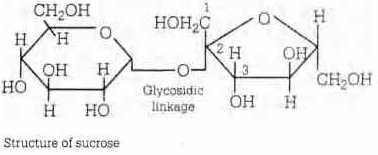
(A) Sucrose is a disaccharide composed of $\alpha-D$-glucopyranose and $\beta-D$-fructofuranose units.
These units are linked by an $\alpha, \beta-1,2$-glycosidic linkage between the $C-1$ of the glucose unit and the $C-2$ of the fructose unit.
These units are linked by an $\alpha, \beta-1,2$-glycosidic linkage between the $C-1$ of the glucose unit and the $C-2$ of the fructose unit.
0 likes
View SolutionBiomolecules — Carbohydrates · Frequently Asked Questions
1Are these Biomolecules questions useful for JEE and NEET?
Yes. All questions in this section are mapped to JEE Main and NEET exam patterns. Previous year questions from JEE Main, NEET, GUJCET and state-level exams are included with full solutions.
2Can I switch to Hindi or Gujarati for these questions?
Yes. Use the language tabs in the hero section or the sidebar to view the same questions and solutions in English, Hindi or Gujarati.
3How do I generate a question paper from this subtopic?
Use the Vedclass Exam Paper Generator — select the chapter and subtopic, set difficulty, and generate Sets A, B, C, D automatically. First 3 chapters of every subject are free.
Vedclass Products
For Students
Vedclass Test Series
Mock tests in real JEE/NEET style with performance analysis. 5-day free trial.
Start Free TrialFor Teachers
Exam Paper Generator
Generate Set A/B/C/D papers from this chapter in 2 minutes. 3 chapters free.
Try FreeFor Institutes
Online Exam Module
Live online exams with unlimited students, 360° analytics & white-label branding.
See DemoFor Teachers & Institutes
Generate a Biomolecules Exam Paper in 2 Minutes
Select subtopic & difficulty — Sets A, B, C, D auto-generated with No Repeat logic.
First 3 chapters of every subject are free — no payment required.