
A English
Carbohydrates Questions in English
Class 12 Chemistry · Biomolecules · Carbohydrates
808+
Questions
English
Language
100%
With Solutions
Showing 50 of 808 questions in English
151
EasyMCQ
The change in specific rotation of glucose is due to which phenomenon?
A
Racemization
B
Specific rotation
C
Mutarotation
D
Tautomerism
Solution
(C) When $D-(+)$-glucose is dissolved in water,its specific rotation gradually changes from $+112^{\circ}$ to $+52.7^{\circ}$.
This phenomenon is known as mutarotation.
It occurs due to the equilibrium established between the $\alpha-D$-glucose and $\beta-D$-glucose anomers through the open-chain form in the solution.
This phenomenon is known as mutarotation.
It occurs due to the equilibrium established between the $\alpha-D$-glucose and $\beta-D$-glucose anomers through the open-chain form in the solution.
0 likes
View Solution152
EasyMCQ
Which of the following is not an aldose?
A
Glucose
B
Ribose
C
Fructose
D
Mannose
Solution
(C) An aldose is a monosaccharide containing an aldehyde group $(-CHO)$ at the end of the carbon chain.
Glucose,Ribose,and Mannose are all aldoses as they contain an aldehyde group.
Fructose is a ketohexose,meaning it contains a ketone group $(>C=O)$ at the $C-2$ position.
Therefore,Fructose is not an aldose.
Glucose,Ribose,and Mannose are all aldoses as they contain an aldehyde group.
Fructose is a ketohexose,meaning it contains a ketone group $(>C=O)$ at the $C-2$ position.
Therefore,Fructose is not an aldose.
0 likes
View Solution153
EasyMCQ
In which of the following is cellulose soluble?
A
Organic solvents
B
Water
C
Schweizer's reagent (Ammoniacal cupric hydroxide)
D
None of these
Solution
(C) Cellulose is a polysaccharide that is insoluble in water and common organic solvents.
However,it is soluble in Schweizer's reagent,which is a solution of ammoniacal cupric hydroxide $[Cu(NH_3)_4(OH)_2]$.
However,it is soluble in Schweizer's reagent,which is a solution of ammoniacal cupric hydroxide $[Cu(NH_3)_4(OH)_2]$.
0 likes
View Solution154
EasyMCQ
What are glucose and mannose to each other?
A
Epimers
B
Anomers
C
Ketohexoses
D
Disaccharides
Solution
(A) Glucose and mannose differ in configuration at the $C_2$ carbon atom.
Therefore,they are known as epimers.
Therefore,they are known as epimers.
0 likes
View Solution155
MediumMCQ
Which of the following pairs will give the 'Tollens' test'?
A
Glucose,Sucrose
B
Glucose,Fructose
C
Hexanal,Acetophenone
D
Fructose,Sucrose
Solution
(B) The 'Tollens' test' is a chemical test used to distinguish between an aldehyde and a ketone. It is given by compounds containing a free aldehyde group $(-CHO)$ or those that can tautomerize to form an aldehyde group in an alkaline medium.
Glucose is an aldose and contains a free aldehyde group,so it gives a positive 'Tollens' test'.
Fructose is a ketose,but in an alkaline medium (used in the 'Tollens' reagent),it undergoes tautomerization to form glucose and mannose,which contain aldehyde groups,thus it also gives a positive 'Tollens' test'.
Sucrose is a non-reducing sugar because its glycosidic linkage involves the anomeric carbons of both glucose and fructose,preventing the formation of a free aldehyde group. Therefore,it does not give the 'Tollens' test'.
Glucose is an aldose and contains a free aldehyde group,so it gives a positive 'Tollens' test'.
Fructose is a ketose,but in an alkaline medium (used in the 'Tollens' reagent),it undergoes tautomerization to form glucose and mannose,which contain aldehyde groups,thus it also gives a positive 'Tollens' test'.
Sucrose is a non-reducing sugar because its glycosidic linkage involves the anomeric carbons of both glucose and fructose,preventing the formation of a free aldehyde group. Therefore,it does not give the 'Tollens' test'.
0 likes
View Solution156
EasyMCQ
$\alpha-D-(+)$-glucose and $\beta-D-(+)$-glucose are .......
A
Enantiomers
B
Geometrical isomers
C
Epimers
D
Anomers
Solution
(D) $\alpha-D-(+)$-glucose and $\beta-D-(+)$-glucose differ only in the configuration of the hydroxyl group at the $C-1$ carbon atom.
Such isomers,which differ in configuration at the hemiacetal or hemiketal carbon (anomeric carbon),are known as anomers.
Such isomers,which differ in configuration at the hemiacetal or hemiketal carbon (anomeric carbon),are known as anomers.
0 likes
View Solution157
EasyMCQ
Glucose is a/an:
A
Aldohexose
B
Aldopentose
C
Aldotriose
D
Ketohexose
Solution
(A) Glucose $(C_6H_{12}O_6)$ contains an aldehyde group $(-CHO)$ and six carbon atoms. Therefore,it is classified as an aldohexose.
0 likes
View Solution158
MediumMCQ
In a patient's urine test,diabetes can be detected using...........
A
Fehling's solution
B
Tollens' reagent
C
Benedict's solution
D
Baeyer's reagent
Solution
(C) Benedict's solution contains $CuSO_4$,$Na_2CO_3$,and sodium citrate.
Benedict's solution is more stable than Fehling's solution and is not affected by substances like uric acid present in urine.
Therefore,it is used to measure the presence of glucose in urine to detect diabetes.
Benedict's solution is more stable than Fehling's solution and is not affected by substances like uric acid present in urine.
Therefore,it is used to measure the presence of glucose in urine to detect diabetes.
0 likes
View Solution159
EasyMCQ
Ribose is an example of .........
A
Ketohexose
B
Aldopentose
C
Disaccharide
D
Aldohexose
Solution
(B) Ribose is a $5$-carbon sugar containing an aldehyde group,therefore it is classified as an $Aldopentose$.
0 likes
View Solution160
EasyMCQ
Which of the following contains a dextrorotatory sugar?
A
Glucose
B
Fructose
C
Cellulose
D
Starch
Solution
(A) Glucose $(C_6H_{12}O_6)$ is a dextrorotatory sugar,meaning it rotates the plane of plane-polarized light to the right.
Fructose is levorotatory.
Cellulose and starch are polysaccharides composed of glucose units,but the term 'dextrorotatory sugar' specifically refers to the monosaccharide glucose.
Fructose is levorotatory.
Cellulose and starch are polysaccharides composed of glucose units,but the term 'dextrorotatory sugar' specifically refers to the monosaccharide glucose.
0 likes
View Solution161
EasyMCQ
Which of the following reactions of glucose can be explained only by its cyclic structure?
A
Glucose forms glucose pentaacetate.
B
Glucose reacts with hydroxylamine to form an oxime.
C
Glucose pentaacetate does not react with hydroxylamine.
D
Glucose is oxidized to gluconic acid by nitric acid.
Solution
(C) The open-chain structure of glucose fails to explain why glucose pentaacetate does not react with hydroxylamine $(NH_2OH)$.
This is because the cyclic structure of glucose involves the formation of a hemiacetal,which prevents the presence of a free aldehyde group in the pentaacetate form.
Therefore,the inability of glucose pentaacetate to react with hydroxylamine is evidence for the cyclic structure of glucose.
This is because the cyclic structure of glucose involves the formation of a hemiacetal,which prevents the presence of a free aldehyde group in the pentaacetate form.
Therefore,the inability of glucose pentaacetate to react with hydroxylamine is evidence for the cyclic structure of glucose.
0 likes
View Solution162
MediumMCQ
Which of the following forms osazone with phenylhydrazine?
A
Glucose
B
Fructose
C
Maltose
D
All of the above
Solution
(D) Glucose,fructose,and maltose are all reducing sugars that contain a free or potentially free carbonyl group (aldehyde or ketone).
When these sugars react with excess phenylhydrazine $(C_6H_5NHNH_2)$,they form characteristic crystalline derivatives known as osazones.
Therefore,all three sugars listed form osazones.
When these sugars react with excess phenylhydrazine $(C_6H_5NHNH_2)$,they form characteristic crystalline derivatives known as osazones.
Therefore,all three sugars listed form osazones.
0 likes
View Solution163
MediumMCQ
With which of the following does glucose $NOT$ react?
A
$Br_2/H_2O$
B
$H_2NOH$
C
$HI$
D
$NaHSO_3$
Solution
(D) Glucose contains a carbonyl group (aldehyde) but it does not form a bisulphite addition product with $NaHSO_3$ because the equilibrium in aqueous solution exists primarily in the cyclic hemiacetal form,which is not reactive towards $NaHSO_3$.
$1.$ Glucose reacts with $Br_2/H_2O$ to form gluconic acid.
$2.$ Glucose reacts with $H_2NOH$ to form an oxime.
$3.$ Glucose reacts with $HI$ to form $n$-hexane.
$1.$ Glucose reacts with $Br_2/H_2O$ to form gluconic acid.
$2.$ Glucose reacts with $H_2NOH$ to form an oxime.
$3.$ Glucose reacts with $HI$ to form $n$-hexane.
0 likes
View Solution164
EasyMCQ
Which of the following statements is correct?
A
Starch is a polymer of $\alpha$-glucose.
B
Amylose is a part of cellulose.
C
Proteins contain only one type of amino acid.
D
The cyclic structure of fructose contains four carbon and one oxygen atom.
Solution
(A) Starch is a polysaccharide composed of $\alpha$-$D$-glucose units linked by glycosidic bonds. It consists of two components: amylose and amylopectin. Therefore, statement $A$ is correct.
Amylose is a component of starch, not cellulose. Thus, statement $B$ is incorrect.
Proteins are polymers of various amino acids, not just one type. Thus, statement $C$ is incorrect.
The cyclic structure of fructose (fructofuranose) contains a five-membered ring consisting of four carbon atoms and one oxygen atom. Thus, statement $D$ is incorrect.
Amylose is a component of starch, not cellulose. Thus, statement $B$ is incorrect.
Proteins are polymers of various amino acids, not just one type. Thus, statement $C$ is incorrect.
The cyclic structure of fructose (fructofuranose) contains a five-membered ring consisting of four carbon atoms and one oxygen atom. Thus, statement $D$ is incorrect.
0 likes
View Solution165
EasyMCQ
Only two carbon atoms of glucose participate in the formation of osazone because they undergo .......
A
Chelation
B
Oxidation
C
Reduction
D
Hydrolysis
Solution
(B) The formation of osazone involves the reaction of glucose with phenylhydrazine.
Initially,the carbonyl group at $C-1$ reacts with phenylhydrazine to form a phenylhydrazone.
Subsequently,the $C-2$ carbon atom undergoes oxidation to a carbonyl group,which then reacts with another molecule of phenylhydrazine to form the osazone.
Thus,the $C-1$ and $C-2$ carbon atoms are involved in the process due to the oxidation of the $C-2$ hydroxyl group.
Initially,the carbonyl group at $C-1$ reacts with phenylhydrazine to form a phenylhydrazone.
Subsequently,the $C-2$ carbon atom undergoes oxidation to a carbonyl group,which then reacts with another molecule of phenylhydrazine to form the osazone.
Thus,the $C-1$ and $C-2$ carbon atoms are involved in the process due to the oxidation of the $C-2$ hydroxyl group.
0 likes
View Solution166
EasyMCQ
What is the monomer of cellulose?
A
Fructose
B
Galactose
C
Glucose
D
None of these
Solution
(C) Cellulose is a linear polysaccharide composed of $D$-glucose units joined by $\beta$-glycosidic linkages.
Upon complete hydrolysis,cellulose yields only $D$-glucose.
The reaction is: $(C_6H_{10}O_5)_n + nH_2O \rightarrow nC_6H_{12}O_6$ (Glucose).
Upon complete hydrolysis,cellulose yields only $D$-glucose.
The reaction is: $(C_6H_{10}O_5)_n + nH_2O \rightarrow nC_6H_{12}O_6$ (Glucose).
0 likes
View Solution167
EasyMCQ
The specific rotations of $\alpha-$ and $\beta-$ glucose are different. When either is dissolved in water,their rotation changes until a constant value is reached. This phenomenon is called ......
A
Epimerization
B
Racemization
C
Anomerization
D
Mutarotation
Solution
(D) The phenomenon where the specific rotation of an optically active compound changes over time until it reaches a constant equilibrium value is known as mutarotation. $\alpha-D-$glucose and $\beta-D-$glucose undergo this process in aqueous solution due to the interconversion between their anomeric forms through an open-chain aldehyde intermediate.
0 likes
View Solution168
EasyMCQ
Lactose is composed of which of the following?
A
Only $\alpha-D$-glucose
B
$\alpha-D$-glucose and $\beta-D$-glucose
C
$\beta-D$-galactose and $\beta-D$-glucose
D
$\alpha-D$-galactose and $\alpha-D$-glucose
Solution
(C) Lactose,also known as milk sugar,is a disaccharide.
It is composed of two monosaccharide units: $\beta-D$-galactose and $\beta-D$-glucose.
These two units are linked by a $\beta-1,4$-glycosidic linkage.
It is composed of two monosaccharide units: $\beta-D$-galactose and $\beta-D$-glucose.
These two units are linked by a $\beta-1,4$-glycosidic linkage.
0 likes
View Solution169
MediumMCQ
Identify the carbohydrate structure shown in the image.
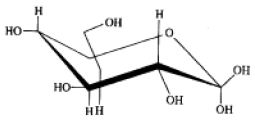
A
Ketohexose
B
Aldohexose
C
$\alpha-$Furanose
D
$\alpha-$Pyranose
Solution
(D) The structure shown is a six-membered ring containing an oxygen atom,which is characteristic of a pyranose form of a sugar.
Specifically,the configuration at the anomeric carbon (the carbon attached to two oxygen atoms) shows the $-OH$ group pointing downwards,which corresponds to the $\alpha-$anomer.
Therefore,the structure is $\alpha-$pyranose.
Specifically,the configuration at the anomeric carbon (the carbon attached to two oxygen atoms) shows the $-OH$ group pointing downwards,which corresponds to the $\alpha-$anomer.
Therefore,the structure is $\alpha-$pyranose.
0 likes
View Solution170
EasyMCQ
Which of the following is not true for glucose?
A
It has four $-CHOH$ groups.
B
It has one ketone group.
C
It has one $-CH_2OH$ group.
D
It has one $-CHO$ group.
Solution
(B) Glucose is an aldohexose with the formula $C_6H_{12}O_6$.
Its open-chain structure is $CHO-(CHOH)_4-CH_2OH$.
From this structure,we can observe:
$1$. It contains one aldehyde $(-CHO)$ group.
$2$. It contains four secondary alcoholic $(-CHOH)$ groups.
$3$. It contains one primary alcoholic $(-CH_2OH)$ group.
Therefore,the statement that it has a ketone group is incorrect,as glucose is an aldose,not a ketose.
Its open-chain structure is $CHO-(CHOH)_4-CH_2OH$.
From this structure,we can observe:
$1$. It contains one aldehyde $(-CHO)$ group.
$2$. It contains four secondary alcoholic $(-CHOH)$ groups.
$3$. It contains one primary alcoholic $(-CH_2OH)$ group.
Therefore,the statement that it has a ketone group is incorrect,as glucose is an aldose,not a ketose.
0 likes
View Solution171
EasyMCQ
Which of the following compounds is identified by the 'Molisch test'?
A
$1^{\circ}$ Alcohol
B
Nitro compound
C
Carbohydrates
D
Amines
Solution
(C) The Molisch test is a sensitive chemical test for the presence of carbohydrates.
It involves the reaction of carbohydrates with concentrated $H_2SO_4$ to form furfural or its derivatives,which then react with $\alpha$-naphthol to produce a purple or violet colored ring at the interface of the two liquids.
It involves the reaction of carbohydrates with concentrated $H_2SO_4$ to form furfural or its derivatives,which then react with $\alpha$-naphthol to produce a purple or violet colored ring at the interface of the two liquids.
0 likes
View Solution172
MediumMCQ
$\alpha-D$-glucose and $\beta-D$-glucose differ from each other due to the difference in the configuration of their carbon atom at:
A
Number of $-OH$ groups
B
Size of the hemiacetal ring
C
Conformation
D
Configuration at $C-1$
Solution
(D) $\alpha-D$-glucose and $\beta-D$-glucose are anomers of each other.
Anomers are a type of stereoisomer that differ in configuration only at the anomeric carbon atom,which is $C-1$ in the case of glucose.
In $\alpha-D$-glucose,the $-OH$ group at $C-1$ is below the plane of the ring,while in $\beta-D$-glucose,the $-OH$ group at $C-1$ is above the plane of the ring.
Anomers are a type of stereoisomer that differ in configuration only at the anomeric carbon atom,which is $C-1$ in the case of glucose.
In $\alpha-D$-glucose,the $-OH$ group at $C-1$ is below the plane of the ring,while in $\beta-D$-glucose,the $-OH$ group at $C-1$ is above the plane of the ring.
0 likes
View Solution173
EasyMCQ
All monosaccharides containing five or six carbon atoms exist in which form?
A
Open chain structure
B
Pyranose structure
C
Furanose structure
D
Pyranose or furanose structure
Solution
(D) Monosaccharides with $5$ or $6$ carbon atoms exist in cyclic forms in aqueous solution.
These cyclic structures are either $5$-membered rings,known as furanose structures,or $6$-membered rings,known as pyranose structures.
Therefore,they exist in either pyranose or furanose structures.
These cyclic structures are either $5$-membered rings,known as furanose structures,or $6$-membered rings,known as pyranose structures.
Therefore,they exist in either pyranose or furanose structures.
0 likes
View Solution174
EasyMCQ
According to the Fischer projection formulas,how are $\alpha-D-(+)-$glucose and $\beta-D-(+)-$glucose classified in relation to each other?
A
Enantiomers
B
Chain isomers
C
Epimers
D
Anomers
Solution
(D) The $\alpha-D-(+)-$glucose and $\beta-D-(+)-$glucose are isomers that differ in configuration only at the $C-1$ carbon atom,which is the anomeric carbon.
Such isomers,which differ in configuration at the hemiacetal or hemiketal carbon,are known as anomers.
Therefore,they are classified as anomers.
Such isomers,which differ in configuration at the hemiacetal or hemiketal carbon,are known as anomers.
Therefore,they are classified as anomers.
0 likes
View Solution175
MediumMCQ
Which of the following is a reducing sugar?
A
Glucose
B
Fructose
C
Maltose
D
All of the above
Solution
(D) Reducing sugars are carbohydrates that can reduce Fehling's solution and Tollens' reagent.
All monosaccharides (like $Glucose$ and $Fructose$) and most disaccharides (like $Maltose$) are reducing sugars because they contain a free hemiacetal or hemiketal group that can open to form an aldehyde or ketone group.
Therefore,all the given options are reducing sugars.
All monosaccharides (like $Glucose$ and $Fructose$) and most disaccharides (like $Maltose$) are reducing sugars because they contain a free hemiacetal or hemiketal group that can open to form an aldehyde or ketone group.
Therefore,all the given options are reducing sugars.
0 likes
View Solution176
EasyMCQ
What is the function of glucose?
A
To provide energy
B
To promote growth
C
To prevent diseases
D
All of the above
Solution
(A) Glucose $(C_6H_{12}O_6)$ is a primary source of energy for living organisms. It undergoes cellular respiration to produce $ATP$,which powers various biological processes,including growth and maintenance of cellular functions. Therefore,it is essential for providing energy.
0 likes
View Solution177
MediumMCQ
Which statement is correct for the given disaccharide?
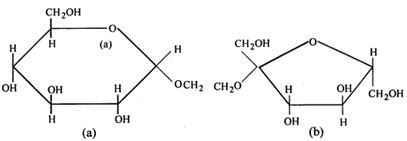
A
Ring $(a)$ is pyranose with an $\alpha$-glycosidic linkage.
B
Ring $(a)$ is furanose with an $\alpha$-glycosidic linkage.
C
Ring $(b)$ is furanose with an $\alpha$-glycosidic linkage.
D
Ring $(b)$ is pyranose with a $\beta$-glycosidic linkage.
Solution
(A) In the given structure,ring $(a)$ is a six-membered ring containing oxygen,which is a pyranose ring. The glycosidic linkage connects the anomeric carbon of ring $(a)$ to the other unit. Since the oxygen atom at the anomeric carbon of ring $(a)$ is pointing downwards relative to the ring plane,it represents an $\alpha$-glycosidic linkage. Ring $(b)$ is a five-membered ring,which is a furanose ring. Therefore,the correct statement is that ring $(a)$ is pyranose with an $\alpha$-glycosidic linkage.
0 likes
View Solution178
EasyMCQ
Which of the following derivatives is useful for the identification of reducing sugars?
A
Oxime
B
Phenylhydrazone
C
Osazone
D
Ozone
Solution
(C) Reducing sugars react with phenylhydrazine to form characteristic crystalline compounds known as osazones.
These osazones have distinct melting points and crystalline structures,which are used to identify specific reducing sugars like glucose,fructose,and mannose.
Therefore,the formation of osazones is a standard method for the identification of reducing sugars.
These osazones have distinct melting points and crystalline structures,which are used to identify specific reducing sugars like glucose,fructose,and mannose.
Therefore,the formation of osazones is a standard method for the identification of reducing sugars.
0 likes
View Solution179
EasyMCQ
Glucose reduces which of the following?
A
Tollens' reagent
B
Fehling's solution
C
Benedict's solution
D
All of the above
Solution
(D) Glucose is an aldose sugar containing a free aldehyde group $(-CHO)$.
Due to the presence of this aldehyde group,glucose acts as a reducing sugar.
It can reduce Tollens' reagent to metallic silver $(Ag)$,Fehling's solution to red cuprous oxide $(Cu_2O)$,and Benedict's solution to red cuprous oxide $(Cu_2O)$.
Therefore,glucose reduces all of the given reagents.
Due to the presence of this aldehyde group,glucose acts as a reducing sugar.
It can reduce Tollens' reagent to metallic silver $(Ag)$,Fehling's solution to red cuprous oxide $(Cu_2O)$,and Benedict's solution to red cuprous oxide $(Cu_2O)$.
Therefore,glucose reduces all of the given reagents.
0 likes
View Solution180
EasyMCQ
Monosaccharides contain .......
A
Always $6$ carbon atoms
B
Always $7$ carbon atoms
C
Always $4$ carbon atoms
D
Generally $3$ to $7$ carbon atoms
Solution
(D) Monosaccharides are the simplest form of carbohydrates that cannot be hydrolyzed further into smaller carbohydrate units.
They are classified based on the number of carbon atoms they contain,typically ranging from $3$ to $7$ carbon atoms.
For example,trioses ($3$ carbons),tetroses ($4$ carbons),pentoses ($5$ carbons),hexoses ($6$ carbons),and heptoses ($7$ carbons).
They are classified based on the number of carbon atoms they contain,typically ranging from $3$ to $7$ carbon atoms.
For example,trioses ($3$ carbons),tetroses ($4$ carbons),pentoses ($5$ carbons),hexoses ($6$ carbons),and heptoses ($7$ carbons).
0 likes
View Solution181
MediumMCQ
Amylopectin is . . . . . . .
A
Water soluble.
B
Insoluble in water.
C
Forms a colloidal solution in water.
D
Both $B$ and $C$.
Solution
(D) Amylopectin is a branched-chain polymer of $\alpha$-$D$-glucose units.
It is a major component of starch (about $80-85\%$).
Due to its branched structure and high molecular weight,it is insoluble in water.
However,it can form a colloidal solution when dispersed in water.
It is a major component of starch (about $80-85\%$).
Due to its branched structure and high molecular weight,it is insoluble in water.
However,it can form a colloidal solution when dispersed in water.
1 likes
View Solution182
MediumMCQ
$\alpha - D - $glucose and $\beta - D - $glucose differ from each other due to the difference in the configuration of one carbon atom called the:
A
Size of the ring
B
Number of $OH$ groups
C
Configuration
D
Molecularity
Solution
(C) $\alpha - D - $glucose and $\beta - D - $glucose are anomers of each other.
Anomers are a type of stereoisomers that differ in configuration only at the anomeric carbon (the $C-1$ carbon in glucose).
Therefore,they differ in their configuration at the $C-1$ carbon atom.
Anomers are a type of stereoisomers that differ in configuration only at the anomeric carbon (the $C-1$ carbon in glucose).
Therefore,they differ in their configuration at the $C-1$ carbon atom.
0 likes
View Solution183
EasyMCQ
Which of the following compounds does not give a test with ninhydrin but gives a positive test with Benedict's solution?
A
Protein
B
Monosaccharide
C
Lipid
D
Amino acid
Solution
(B) Ninhydrin reacts with amino groups in proteins and amino acids to produce a blue-violet color.
Monosaccharides (like glucose) contain a free aldehyde or ketone group,which reduces Benedict's solution (alkaline $CuSO_4$ and citrate ions) to form a red precipitate of $Cu_2O$.
Since monosaccharides do not contain free amino groups,they do not react with ninhydrin,making them the correct answer.
Monosaccharides (like glucose) contain a free aldehyde or ketone group,which reduces Benedict's solution (alkaline $CuSO_4$ and citrate ions) to form a red precipitate of $Cu_2O$.
Since monosaccharides do not contain free amino groups,they do not react with ninhydrin,making them the correct answer.
0 likes
View Solution184
EasyMCQ
At which carbon atom do $\alpha-$ and $\beta-$ glucose differ in the configuration of the $-OH$ group?
A
$C_1$
B
$C_2$
C
$C_4$
D
$C_5$
Solution
(A) The $\alpha-$ and $\beta-$ forms of glucose are anomers of each other.
Anomers are cyclic monosaccharides that differ in configuration only at the anomeric carbon.
For glucose,the anomeric carbon is $C_1$.
In $\alpha-D-$glucose,the $-OH$ group at $C_1$ is below the plane of the ring,while in $\beta-D-$glucose,the $-OH$ group at $C_1$ is above the plane of the ring.
Anomers are cyclic monosaccharides that differ in configuration only at the anomeric carbon.
For glucose,the anomeric carbon is $C_1$.
In $\alpha-D-$glucose,the $-OH$ group at $C_1$ is below the plane of the ring,while in $\beta-D-$glucose,the $-OH$ group at $C_1$ is above the plane of the ring.
0 likes
View Solution185
EasyMCQ
What are the anomers of glucose?
A
Isomers of glucose that differ in configuration at $C_1$ and $C_4$ carbons.
B
$A$ mixture of $D$-glucose and $L$-glucose.
C
Enantiomers of glucose.
D
Isomers of glucose that differ in configuration at the $C_1$ carbon.
Solution
(D) Anomers are a specific type of diastereomers (epimers) that differ in configuration only at the hemiacetal or hemiketal carbon,which is known as the anomeric carbon.
For glucose,the anomeric carbon is $C_1$.
Therefore,$\alpha-D$-glucose and $\beta-D$-glucose are anomers because they differ in the configuration of the hydroxyl group at the $C_1$ position.
For glucose,the anomeric carbon is $C_1$.
Therefore,$\alpha-D$-glucose and $\beta-D$-glucose are anomers because they differ in the configuration of the hydroxyl group at the $C_1$ position.
0 likes
View Solution186
EasyMCQ
The structure of glycogen is similar to:
A
Amylose
B
Amylopectin
C
Cellulose
D
Glucose
Solution
(B) Glycogen is a branched-chain polymer of $\alpha-D-glucose$ units. It is structurally similar to amylopectin but with more extensive branching. While amylopectin is branched at every $24-30$ glucose units,glycogen is more highly branched,occurring at every $8-12$ glucose units.
0 likes
View Solution187
EasyMCQ
Which of the following does not exhibit mutarotation?
A
Sucrose
B
$D$-Glucose
C
$L$-Glucose
D
None of these
Solution
(A) Mutarotation is the change in the optical rotation of a solution of a sugar due to the equilibrium between its $\alpha$ and $\beta$ anomeric forms.
This phenomenon is observed in reducing sugars that possess a free hemiacetal or hemiketal group.
Sucrose is a non-reducing disaccharide composed of $\alpha$-$D$-glucose and $\beta$-$D$-fructose linked by a glycosidic bond between $C1$ of glucose and $C2$ of fructose.
Since both anomeric carbons are involved in the glycosidic linkage,sucrose does not have a free hemiacetal or hemiketal group and therefore does not exhibit mutarotation.
Both $D$-glucose and $L$-glucose are monosaccharides with free anomeric carbons,so they exhibit mutarotation.
This phenomenon is observed in reducing sugars that possess a free hemiacetal or hemiketal group.
Sucrose is a non-reducing disaccharide composed of $\alpha$-$D$-glucose and $\beta$-$D$-fructose linked by a glycosidic bond between $C1$ of glucose and $C2$ of fructose.
Since both anomeric carbons are involved in the glycosidic linkage,sucrose does not have a free hemiacetal or hemiketal group and therefore does not exhibit mutarotation.
Both $D$-glucose and $L$-glucose are monosaccharides with free anomeric carbons,so they exhibit mutarotation.
0 likes
View Solution188
EasyMCQ
Which of the following is an example of a ketohexose?
A
Mannose
B
Galactose
C
Maltose
D
Fructose
Solution
(D) ketohexose is a monosaccharide containing six carbon atoms and a ketone group.
$Fructose$ $(C_6H_{12}O_6)$ is a classic example of a ketohexose because it contains a ketone functional group at the $C-2$ position and has a total of six carbon atoms.
$Mannose$ and $Galactose$ are aldohexoses,and $Maltose$ is a disaccharide.
$Fructose$ $(C_6H_{12}O_6)$ is a classic example of a ketohexose because it contains a ketone functional group at the $C-2$ position and has a total of six carbon atoms.
$Mannose$ and $Galactose$ are aldohexoses,and $Maltose$ is a disaccharide.
0 likes
View Solution189
EasyMCQ
Which of the following is a non-reducing sugar?
A
Sucrose
B
Maltose
C
Lactose
D
Ribose
Solution
(A) non-reducing sugar is a carbohydrate that does not have a free aldehyde or ketone group,meaning it cannot reduce Tollens' reagent or Fehling's solution.
Sucrose is a disaccharide composed of glucose and fructose linked by a glycosidic bond between their anomeric carbons ($C_1$ of glucose and $C_2$ of fructose).
Since both anomeric carbons are involved in the glycosidic linkage,there is no free functional group available to act as a reducing agent.
Therefore,sucrose is a non-reducing sugar.
Sucrose is a disaccharide composed of glucose and fructose linked by a glycosidic bond between their anomeric carbons ($C_1$ of glucose and $C_2$ of fructose).
Since both anomeric carbons are involved in the glycosidic linkage,there is no free functional group available to act as a reducing agent.
Therefore,sucrose is a non-reducing sugar.
0 likes
View Solution190
EasyMCQ
The specific rotation of the equilibrium mixture of $\alpha-D-$glucose and $\beta-D-$glucose is ......... $^o$.
A
$+19$
B
$+112$
C
$+52$
D
$+100$
Solution
(C) The process of mutarotation involves the interconversion of $\alpha-D-$glucose and $\beta-D-$glucose in an aqueous solution until an equilibrium is reached.
$\alpha-D-$glucose has a specific rotation of $+112^o$.
$\beta-D-$glucose has a specific rotation of $+19^o$.
At equilibrium,the mixture contains approximately $36\%$ of $\alpha-D-$glucose and $64\%$ of $\beta-D-$glucose.
The specific rotation of the equilibrium mixture is calculated as: $(0.36 \times 112^o) + (0.64 \times 19^o) \approx 40.32^o + 12.16^o = 52.48^o \approx +52^o$.
$\alpha-D-$glucose has a specific rotation of $+112^o$.
$\beta-D-$glucose has a specific rotation of $+19^o$.
At equilibrium,the mixture contains approximately $36\%$ of $\alpha-D-$glucose and $64\%$ of $\beta-D-$glucose.
The specific rotation of the equilibrium mixture is calculated as: $(0.36 \times 112^o) + (0.64 \times 19^o) \approx 40.32^o + 12.16^o = 52.48^o \approx +52^o$.
0 likes
View Solution191
EasyMCQ
Which of the following monosaccharides is a pentose?
A
Galactose
B
Glucose
C
Fructose
D
Arabinose
Solution
(D) pentose is a monosaccharide containing $5$ carbon atoms.
Galactose,glucose,and fructose are hexoses ($6$ carbon atoms).
Arabinose is an aldopentose with the formula $HOCH_2-(CHOH)_3CHO$.
Galactose,glucose,and fructose are hexoses ($6$ carbon atoms).
Arabinose is an aldopentose with the formula $HOCH_2-(CHOH)_3CHO$.
0 likes
View Solution192
EasyMCQ
Which of the following is a pentose sugar?
A
Ketohexose
B
Arabinose
C
Lyxose
D
Ribose
Solution
(D) pentose sugar is a monosaccharide containing $5$ carbon atoms.
Among the given options,$Arabinose$,$Lyxose$,and $Ribose$ are all pentose sugars.
However,in the context of standard chemistry multiple-choice questions where only one answer is expected,$Ribose$ is the most common and fundamental example of a pentose sugar found in $RNA$.
If the question implies selecting the most representative pentose,$Ribose$ is the standard answer.
Among the given options,$Arabinose$,$Lyxose$,and $Ribose$ are all pentose sugars.
However,in the context of standard chemistry multiple-choice questions where only one answer is expected,$Ribose$ is the most common and fundamental example of a pentose sugar found in $RNA$.
If the question implies selecting the most representative pentose,$Ribose$ is the standard answer.
0 likes
View Solution193
EasyMCQ
Which of the following is a disaccharide?
A
Cellobiose
B
Starch
C
Cellulose
D
Fructose
Solution
(A) disaccharide is a carbohydrate composed of two monosaccharide units linked by a glycosidic bond.
$Cellobiose$ is a disaccharide formed by two $D-glucose$ units linked by a $\beta(1 \to 4)$ glycosidic bond.
$Starch$ and $Cellulose$ are polysaccharides.
$Fructose$ is a monosaccharide.
$Cellobiose$ is a disaccharide formed by two $D-glucose$ units linked by a $\beta(1 \to 4)$ glycosidic bond.
$Starch$ and $Cellulose$ are polysaccharides.
$Fructose$ is a monosaccharide.
0 likes
View Solution194
MediumMCQ
Which of the following disaccharides is a non-reducing sugar?
A
Cellobiose
B
Sucrose
C
Lactose
D
Maltose
Solution
(B) non-reducing sugar is a carbohydrate that does not have a free hemiacetal or hemiketal group,meaning it cannot act as a reducing agent.
In disaccharides,if the glycosidic linkage involves the anomeric carbons of both monosaccharide units,the sugar is non-reducing.
Sucrose is composed of $\alpha-D-glucose$ and $\beta-D-fructose$ linked by a glycosidic bond between $C1$ of glucose and $C2$ of fructose. Since both anomeric carbons are involved in the linkage,it has no free hemiacetal or hemiketal group,making it a non-reducing sugar.
Cellobiose,lactose,and maltose all contain at least one free anomeric carbon,making them reducing sugars.
In disaccharides,if the glycosidic linkage involves the anomeric carbons of both monosaccharide units,the sugar is non-reducing.
Sucrose is composed of $\alpha-D-glucose$ and $\beta-D-fructose$ linked by a glycosidic bond between $C1$ of glucose and $C2$ of fructose. Since both anomeric carbons are involved in the linkage,it has no free hemiacetal or hemiketal group,making it a non-reducing sugar.
Cellobiose,lactose,and maltose all contain at least one free anomeric carbon,making them reducing sugars.
0 likes
View Solution195
EasyMCQ
Which of the following does not undergo hydrolysis to yield aldoses and ketoses?
A
Disaccharide
B
Monosaccharide
C
Polysaccharide
D
Oligosaccharide
Solution
(B) Monosaccharides are the simplest form of carbohydrates and cannot be further hydrolyzed into smaller polyhydroxy aldehyde or ketone units.
Disaccharides,oligosaccharides,and polysaccharides undergo hydrolysis to yield smaller units,which are ultimately monosaccharides (aldoses or ketoses).
Therefore,monosaccharides do not undergo hydrolysis.
Disaccharides,oligosaccharides,and polysaccharides undergo hydrolysis to yield smaller units,which are ultimately monosaccharides (aldoses or ketoses).
Therefore,monosaccharides do not undergo hydrolysis.
0 likes
View Solution196
EasyMCQ
Heating glucose with methanol in the presence of dry $HCl$ yields $\alpha$ and $\beta$ methyl glucosides. This indicates the presence of which of the following?
A
Aldehyde group
B
$-CH_2OH$ group
C
Cyclic structure
D
Five $-OH$ groups
Solution
(C) The reaction of glucose with methanol in the presence of dry $HCl$ is a Fischer glycosidation reaction.
This reaction involves the formation of an acetal from the hemiacetal form of glucose.
Since glucose exists in a cyclic hemiacetal form (pyranose structure) in solution,it reacts with methanol to form $\alpha$ and $\beta$ methyl glucosides.
This formation of glycosides is a characteristic property of the cyclic structure of glucose.
This reaction involves the formation of an acetal from the hemiacetal form of glucose.
Since glucose exists in a cyclic hemiacetal form (pyranose structure) in solution,it reacts with methanol to form $\alpha$ and $\beta$ methyl glucosides.
This formation of glycosides is a characteristic property of the cyclic structure of glucose.
0 likes
View Solution197
MediumMCQ
The specific rotation of glucose crystals obtained by the crystallization of glucose in acetic acid is ......... $^o$.
A
$111$
B
$52$
C
$66.5$
D
$19$
Solution
(D) Glucose exists in two anomeric forms: $\alpha$-$D$-glucose and $\beta$-$D$-glucose.
When glucose is crystallized from a concentrated aqueous solution at $30 \ ^\circ C$,$\alpha$-$D$-glucose is obtained,which has a specific rotation of $+111^\circ$.
When glucose is crystallized from hot glacial acetic acid,$\beta$-$D$-glucose is obtained,which has a specific rotation of $+19^\circ$.
Therefore,the specific rotation of glucose crystals obtained from acetic acid is $19^\circ$.
When glucose is crystallized from a concentrated aqueous solution at $30 \ ^\circ C$,$\alpha$-$D$-glucose is obtained,which has a specific rotation of $+111^\circ$.
When glucose is crystallized from hot glacial acetic acid,$\beta$-$D$-glucose is obtained,which has a specific rotation of $+19^\circ$.
Therefore,the specific rotation of glucose crystals obtained from acetic acid is $19^\circ$.
0 likes
View Solution198
EasyMCQ
Hydrolysis of a disaccharide gives .......
A
Two molecules of the same monosaccharide
B
One molecule each of two different monosaccharides
C
Three molecules of the same monosaccharide
D
Two molecules of the same or different monosaccharides
Solution
(D) Disaccharides are carbohydrates that yield two molecules of monosaccharides on hydrolysis. These two molecules may be the same or different. For example,sucrose on hydrolysis gives one molecule of glucose and one molecule of fructose (different),while maltose on hydrolysis gives two molecules of glucose (same).
0 likes
View Solution199
EasyMCQ
Methyl $-\alpha-D$-glucoside and methyl $-\beta-D$-glucoside are both ...... .
A
Epimers
B
Anomers
C
Enantiomers
D
Conformational diastereomers
Solution
(B) The structures of methyl $-\alpha-D$-glucoside and methyl $-\beta-D$-glucoside differ only in the configuration at the $C-1$ carbon atom (the anomeric carbon).
Such isomers,which differ in configuration only at the anomeric carbon,are known as anomers.
Therefore,they are anomers.
Such isomers,which differ in configuration only at the anomeric carbon,are known as anomers.
Therefore,they are anomers.
0 likes
View Solution200
MediumMCQ
$A$ molecule of glucose reacts with $X$ molecules of phenylhydrazine to form osazone. Determine the value of $X$.
A
$2$
B
$1$
C
$4$
D
$3$
Solution
(D) The reaction of glucose with phenylhydrazine involves the formation of an osazone derivative.
One molecule of glucose reacts with $3$ molecules of phenylhydrazine $(C_6H_5NHNH_2)$.
The first molecule forms a phenylhydrazone,the second molecule acts as an oxidizing agent to convert the $C-2$ hydroxyl group into a carbonyl group,and the third molecule forms the final osazone structure.
Thus,the value of $X$ is $3$.
One molecule of glucose reacts with $3$ molecules of phenylhydrazine $(C_6H_5NHNH_2)$.
The first molecule forms a phenylhydrazone,the second molecule acts as an oxidizing agent to convert the $C-2$ hydroxyl group into a carbonyl group,and the third molecule forms the final osazone structure.
Thus,the value of $X$ is $3$.
0 likes
View SolutionBiomolecules — Carbohydrates · Frequently Asked Questions
1Are these Biomolecules questions useful for JEE and NEET?
Yes. All questions in this section are mapped to JEE Main and NEET exam patterns. Previous year questions from JEE Main, NEET, GUJCET and state-level exams are included with full solutions.
2Can I switch to Hindi or Gujarati for these questions?
Yes. Use the language tabs in the hero section or the sidebar to view the same questions and solutions in English, Hindi or Gujarati.
3How do I generate a question paper from this subtopic?
Use the Vedclass Exam Paper Generator — select the chapter and subtopic, set difficulty, and generate Sets A, B, C, D automatically. First 3 chapters of every subject are free.
Vedclass Products
For Students
Vedclass Test Series
Mock tests in real JEE/NEET style with performance analysis. 5-day free trial.
Start Free TrialFor Teachers
Exam Paper Generator
Generate Set A/B/C/D papers from this chapter in 2 minutes. 3 chapters free.
Try FreeFor Institutes
Online Exam Module
Live online exams with unlimited students, 360° analytics & white-label branding.
See DemoFor Teachers & Institutes
Generate a Biomolecules Exam Paper in 2 Minutes
Select subtopic & difficulty — Sets A, B, C, D auto-generated with No Repeat logic.
First 3 chapters of every subject are free — no payment required.