
A English
Properties of Carboxylic Acids and Their Derivatives Questions in English
Class 12 Chemistry · 8-2.Carboxylic acids and Their derivative · Properties of Carboxylic Acids and Their Derivatives
791+
Questions
English
Language
100%
With Solutions
Showing 49 of 791 questions in English
251
MediumMCQ
Which acid has the least $pK_a$ value?
A
$Cl_3CCOOH$
B
$Cl_2CHCOOH$
C
$ClCH_2COOH$
D
$CH_3COOH$
Solution
(A) The $pK_a$ value is inversely proportional to the acidity of the compound.
Stronger acids have lower $pK_a$ values.
The acidity of carboxylic acids is increased by the presence of electron-withdrawing groups (like $Cl$) due to the inductive effect.
$Cl_3CCOOH$ contains three chlorine atoms,which exert the strongest electron-withdrawing effect,stabilizing the carboxylate anion most effectively.
Therefore,$Cl_3CCOOH$ is the strongest acid among the given options and has the least $pK_a$ value.
Stronger acids have lower $pK_a$ values.
The acidity of carboxylic acids is increased by the presence of electron-withdrawing groups (like $Cl$) due to the inductive effect.
$Cl_3CCOOH$ contains three chlorine atoms,which exert the strongest electron-withdrawing effect,stabilizing the carboxylate anion most effectively.
Therefore,$Cl_3CCOOH$ is the strongest acid among the given options and has the least $pK_a$ value.
0 likes
View Solution252
MediumMCQ
On strong heating,ammonium acetate gives
A
Acetamide
B
Methyl cyanide
C
Urea
D
Formamide
Solution
(B) When ammonium acetate $(CH_3COONH_4)$ is heated,it first forms acetamide $(CH_3CONH_2)$ by losing a water molecule.
Upon further strong heating,acetamide undergoes dehydration to form methyl cyanide $(CH_3CN)$.
The reaction is: $CH_3COONH_4$ $\xrightarrow{\Delta} CH_3CONH_2 + H_2O$ $\xrightarrow{\Delta} CH_3CN + H_2O$.
Upon further strong heating,acetamide undergoes dehydration to form methyl cyanide $(CH_3CN)$.
The reaction is: $CH_3COONH_4$ $\xrightarrow{\Delta} CH_3CONH_2 + H_2O$ $\xrightarrow{\Delta} CH_3CN + H_2O$.
0 likes
View Solution253
MediumMCQ
The common acid used in the manufacture of rayon and plastics is
A
Methanoic acid
B
Ethanoic acid
C
Propanoic acid
D
Butanoic acid
Solution
(B) . Ethanoic acid $(CH_3COOH)$,also known as acetic acid,is widely used in the chemical industry for the production of cellulose acetate,which is essential for manufacturing rayon fibers and various types of plastics.
0 likes
View Solution254
MediumMCQ
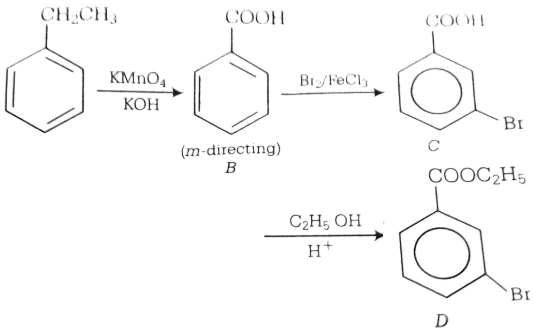
In a set of reactions,ethylbenzene yielded a product $D$.
Ethylbenzene $\xrightarrow[KOH]{KMnO_4} B$ $\xrightarrow[FeCl_3]{Br_2} C$ $\xrightarrow[H^{+}]{C_2H_5OH} D$
$D$ would be
Ethylbenzene $\xrightarrow[KOH]{KMnO_4} B$ $\xrightarrow[FeCl_3]{Br_2} C$ $\xrightarrow[H^{+}]{C_2H_5OH} D$
$D$ would be
A
Ethyl $3-$bromo$-2-$phenylpropanoate
B
Ethyl $2,4-$dibromobenzoate
C
Ethyl $3-$bromobenzoate
D
Ethyl $3-$bromophenyl ether
Solution
(C) $1$. Oxidation: Ethylbenzene reacts with alkaline $KMnO_4$ to form benzoic acid $(B)$. The alkyl group is oxidized to a $-COOH$ group.
$2$. Bromination: Benzoic acid is a meta-directing group. Reaction with $Br_2/FeCl_3$ yields $3-$bromobenzoic acid $(C)$.
$3$. Esterification: $3-$bromobenzoic acid reacts with ethanol $(C_2H_5OH)$ in the presence of an acid catalyst $(H^+)$ to form ethyl $3-$bromobenzoate $(D)$.
$2$. Bromination: Benzoic acid is a meta-directing group. Reaction with $Br_2/FeCl_3$ yields $3-$bromobenzoic acid $(C)$.
$3$. Esterification: $3-$bromobenzoic acid reacts with ethanol $(C_2H_5OH)$ in the presence of an acid catalyst $(H^+)$ to form ethyl $3-$bromobenzoate $(D)$.
0 likes
View Solution255
MediumMCQ
In the following sequence of reactions,$CH_3-Br$ $\xrightarrow{KCN} A$ $\xrightarrow{H_3O^{+}} B$ $\xrightarrow[ether]{LiAlH_4} C$,the end product $(C)$ is:
A
acetone
B
methane
C
acetaldehyde
D
ethyl alcohol
Solution
(D) The reaction sequence is as follows:
$1$. $CH_3Br + KCN \rightarrow CH_3CN (A) + KBr$
$2$. $CH_3CN + 2H_2O + H^{+} \rightarrow CH_3COOH (B) + NH_4^{+}$
$3$. $CH_3COOH + LiAlH_4 \xrightarrow{ether} CH_3CH_2OH (C)$
$LiAlH_4$ is a strong reducing agent that reduces carboxylic acids to primary alcohols. Therefore,the final product $(C)$ is $CH_3CH_2OH$,which is ethyl alcohol.
$1$. $CH_3Br + KCN \rightarrow CH_3CN (A) + KBr$
$2$. $CH_3CN + 2H_2O + H^{+} \rightarrow CH_3COOH (B) + NH_4^{+}$
$3$. $CH_3COOH + LiAlH_4 \xrightarrow{ether} CH_3CH_2OH (C)$
$LiAlH_4$ is a strong reducing agent that reduces carboxylic acids to primary alcohols. Therefore,the final product $(C)$ is $CH_3CH_2OH$,which is ethyl alcohol.
0 likes
View Solution256
EasyMCQ
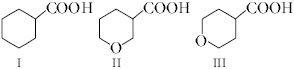
The correct order of strengths of the carboxylic acids is:
A
$I > II > III$
B
$II > III > I$
C
$III > II > I$
D
$II > I > III$
Solution
(B) The acidity of carboxylic acids is determined by the stability of the carboxylate anion formed after the loss of a proton. Electron-withdrawing groups ($-I$ effect) stabilize the carboxylate anion and increase acidity.
In compound $I$,there is no electron-withdrawing group.
In compound $II$,the oxygen atom is at the $\beta$-position relative to the $-COOH$ group.
In compound $III$,the oxygen atom is at the $\gamma$-position relative to the $-COOH$ group.
The $-I$ effect decreases with distance. Since the oxygen atom in $II$ is closer to the $-COOH$ group than in $III$,the $-I$ effect is stronger in $II$ than in $III$.
Therefore,the order of acidity is $II > III > I$.
In compound $I$,there is no electron-withdrawing group.
In compound $II$,the oxygen atom is at the $\beta$-position relative to the $-COOH$ group.
In compound $III$,the oxygen atom is at the $\gamma$-position relative to the $-COOH$ group.
The $-I$ effect decreases with distance. Since the oxygen atom in $II$ is closer to the $-COOH$ group than in $III$,the $-I$ effect is stronger in $II$ than in $III$.
Therefore,the order of acidity is $II > III > I$.
0 likes
View Solution257
MediumMCQ
Which one of the following esters gets hydrolysed most easily under alkaline conditions?
A
p-Methoxy phenyl acetate
B
Phenyl acetate
C
p-Chloro phenyl acetate
D
p-Nitro phenyl acetate
Solution
(D) The alkaline hydrolysis of esters follows a nucleophilic acyl substitution mechanism.
The rate of this reaction depends on the electrophilicity of the carbonyl carbon.
Electron-withdrawing groups $(EWG)$ increase the electrophilicity of the carbonyl carbon by pulling electron density away from it,thereby facilitating the attack of the nucleophile $(OH^-)$.
Among the given substituents,the nitro group $(-NO_2)$ is the strongest electron-withdrawing group due to its strong $-I$ and $-M$ effects.
Therefore,p-nitro phenyl acetate will be hydrolysed most easily.
The rate of this reaction depends on the electrophilicity of the carbonyl carbon.
Electron-withdrawing groups $(EWG)$ increase the electrophilicity of the carbonyl carbon by pulling electron density away from it,thereby facilitating the attack of the nucleophile $(OH^-)$.
Among the given substituents,the nitro group $(-NO_2)$ is the strongest electron-withdrawing group due to its strong $-I$ and $-M$ effects.
Therefore,p-nitro phenyl acetate will be hydrolysed most easily.
0 likes
View Solution258
MediumMCQ
The correct order of decreasing acid strength of trichloroacetic acid $(A)$,trifluoroacetic acid $(B)$,acetic acid $(C)$,and formic acid $(D)$ is
A
$B > A > D > C$
B
$B > D > C > A$
C
$A > B > C > D$
D
$A > C > B > D$
Solution
(A) The acid strength of carboxylic acids is determined by the stability of the carboxylate anion formed after the loss of a $H^+$ ion.
Electron-withdrawing groups ($-I$ effect) stabilize the carboxylate anion,thereby increasing the acidity.
Electron-donating groups ($+I$ effect) destabilize the carboxylate anion,thereby decreasing the acidity.
Comparing the substituents:
$CF_3-$ (trifluoroacetic acid,$B$) has a stronger $-I$ effect than $CCl_3-$ (trichloroacetic acid,$A$) due to the higher electronegativity of fluorine.
Formic acid ($D$,$HCOOH$) has no alkyl group,while acetic acid ($C$,$CH_3COOH$) has a methyl group which exerts a $+I$ effect.
Therefore,the order of decreasing acid strength is $CF_3COOH (B) > CCl_3COOH (A) > HCOOH (D) > CH_3COOH (C)$.
Electron-withdrawing groups ($-I$ effect) stabilize the carboxylate anion,thereby increasing the acidity.
Electron-donating groups ($+I$ effect) destabilize the carboxylate anion,thereby decreasing the acidity.
Comparing the substituents:
$CF_3-$ (trifluoroacetic acid,$B$) has a stronger $-I$ effect than $CCl_3-$ (trichloroacetic acid,$A$) due to the higher electronegativity of fluorine.
Formic acid ($D$,$HCOOH$) has no alkyl group,while acetic acid ($C$,$CH_3COOH$) has a methyl group which exerts a $+I$ effect.
Therefore,the order of decreasing acid strength is $CF_3COOH (B) > CCl_3COOH (A) > HCOOH (D) > CH_3COOH (C)$.
0 likes
View Solution259
MediumMCQ
Among the given compounds,the most susceptible to nucleophilic attack at the carbonyl group is
A
$CH_3COOCH_3$
B
$CH_3CONH_2$
C
$CH_3COOCOCH_3$
D
$CH_3COCl$
Solution
(D) The susceptibility of a carbonyl group to nucleophilic attack depends on the electrophilicity of the carbonyl carbon.
This electrophilicity is increased by the presence of an electron-withdrawing group attached to the carbonyl carbon.
Among the given derivatives,the chloride ion $(Cl^-)$ is the weakest base and therefore the best leaving group.
Since $Cl$ is highly electronegative and a good leaving group,it exerts a strong inductive effect,making the carbonyl carbon in $CH_3COCl$ the most electron-deficient and thus the most susceptible to nucleophilic attack.
This electrophilicity is increased by the presence of an electron-withdrawing group attached to the carbonyl carbon.
Among the given derivatives,the chloride ion $(Cl^-)$ is the weakest base and therefore the best leaving group.
Since $Cl$ is highly electronegative and a good leaving group,it exerts a strong inductive effect,making the carbonyl carbon in $CH_3COCl$ the most electron-deficient and thus the most susceptible to nucleophilic attack.
0 likes
View Solution260
MediumMCQ
Propionic acid with $Br_2/P$ yields a dibromo product. Its structure would be:
A
$CH(Br)_2-CH_2-COOH$
B
$CH_2(Br)-CH_2-COBr$
C
$CH_3-C(Br)_2-COOH$
D
$CH_2(Br)-CH(Br)-COOH$
Solution
(C) The reaction of propionic acid $(CH_3-CH_2-COOH)$ with $Br_2$ in the presence of red phosphorus is known as the $Hell-Volhard-Zelinsky$ $(HVZ)$ reaction.
This reaction specifically substitutes the $\alpha$-hydrogen atoms with bromine atoms.
Propionic acid has two $\alpha$-hydrogens on the carbon atom adjacent to the $-COOH$ group.
Since a dibromo product is formed,both $\alpha$-hydrogens are replaced by bromine,resulting in the structure $CH_3-C(Br)_2-COOH$.
This reaction specifically substitutes the $\alpha$-hydrogen atoms with bromine atoms.
Propionic acid has two $\alpha$-hydrogens on the carbon atom adjacent to the $-COOH$ group.
Since a dibromo product is formed,both $\alpha$-hydrogens are replaced by bromine,resulting in the structure $CH_3-C(Br)_2-COOH$.
0 likes
View Solution261
MediumMCQ
Consider the following compounds:
$(i) \, C_6H_5COCl$
$(ii) \, p-NO_2-C_6H_4-COCl$
$(iii) \, p-CH_3-C_6H_4-COCl$
$(iv) \, p-CHO-C_6H_4-COCl$
The correct decreasing order of their reactivity towards hydrolysis is:
$(i) \, C_6H_5COCl$
$(ii) \, p-NO_2-C_6H_4-COCl$
$(iii) \, p-CH_3-C_6H_4-COCl$
$(iv) \, p-CHO-C_6H_4-COCl$
The correct decreasing order of their reactivity towards hydrolysis is:
A
$(i) > (ii) > (iii) > (iv)$
B
$(iv) > (ii) > (i) > (iii)$
C
$(ii) > (iv) > (i) > (iii)$
D
$(ii) > (iv) > (iii) > (i)$
Solution
(C) The reactivity of acid chlorides towards hydrolysis depends on the magnitude of the positive charge on the carbonyl carbon atom.
Electron-withdrawing groups $(EWG)$ increase the positive charge on the carbonyl carbon,thereby increasing reactivity.
Electron-donating groups $(EDG)$ decrease the positive charge on the carbonyl carbon,thereby decreasing reactivity.
The substituents at the para-position are:
$(i)$ $-H$ (no effect)
$(ii)$ $-NO_2$ (strong $EWG$)
$(iii)$ $-CH_3$ ($EDG$ via hyperconjugation)
$(iv)$ $-CHO$ $(EWG)$
Comparing the strength of $EWG$,$-NO_2$ is a stronger electron-withdrawing group than $-CHO$.
Thus,the order of reactivity is: $(ii) > (iv) > (i) > (iii)$.
Electron-withdrawing groups $(EWG)$ increase the positive charge on the carbonyl carbon,thereby increasing reactivity.
Electron-donating groups $(EDG)$ decrease the positive charge on the carbonyl carbon,thereby decreasing reactivity.
The substituents at the para-position are:
$(i)$ $-H$ (no effect)
$(ii)$ $-NO_2$ (strong $EWG$)
$(iii)$ $-CH_3$ ($EDG$ via hyperconjugation)
$(iv)$ $-CHO$ $(EWG)$
Comparing the strength of $EWG$,$-NO_2$ is a stronger electron-withdrawing group than $-CHO$.
Thus,the order of reactivity is: $(ii) > (iv) > (i) > (iii)$.
0 likes
View Solution262
MediumMCQ
Which of the following represents the correct order of the acidity in the given compounds?
A
$FCH_2COOH > CH_3COOH > BrCH_2COOH > ClCH_2COOH$
B
$BrCH_2COOH > ClCH_2COOH > FCH_2COOH > CH_3COOH$
C
$FCH_2COOH > ClCH_2COOH > BrCH_2COOH > CH_3COOH$
D
$CH_3COOH > BrCH_2COOH > ClCH_2COOH > FCH_2COOH$
Solution
(C) The acidity of carboxylic acids is influenced by the inductive effect of the substituent attached to the alpha-carbon.
Electron-withdrawing groups (EWGs) increase the acidity by stabilizing the carboxylate anion through the $-I$ effect.
The strength of the $-I$ effect depends on the electronegativity of the halogen atom: $F > Cl > Br$.
Therefore,the acidity order is $FCH_2COOH > ClCH_2COOH > BrCH_2COOH > CH_3COOH$.
Electron-withdrawing groups (EWGs) increase the acidity by stabilizing the carboxylate anion through the $-I$ effect.
The strength of the $-I$ effect depends on the electronegativity of the halogen atom: $F > Cl > Br$.
Therefore,the acidity order is $FCH_2COOH > ClCH_2COOH > BrCH_2COOH > CH_3COOH$.
0 likes
View Solution263
MediumMCQ
The correct order of increasing acid strength of the compounds is:
$(A) CH_3CO_2H$
$(B) MeOCH_2CO_2H$
$(C) CF_3CO_2H$
$(D) (CH_3)_2CHCO_2H$
$(A) CH_3CO_2H$
$(B) MeOCH_2CO_2H$
$(C) CF_3CO_2H$
$(D) (CH_3)_2CHCO_2H$
A
$D < A < B < C$
B
$A < D < B < C$
C
$B < D < A < C$
D
$D < A < C < B$
Solution
(A) The acid strength of carboxylic acids depends on the stability of the conjugate base (carboxylate ion).
Electron-withdrawing groups $(EWG)$ increase acidity by stabilizing the negative charge,while electron-donating groups $(EDG)$ decrease acidity by destabilizing it.
The compounds are:
$(A) CH_3CO_2H$ (Acetic acid)
$(B) MeOCH_2CO_2H$ (Methoxyacetic acid,$-OCH_3$ is $EWG$)
$(C) CF_3CO_2H$ (Trifluoroacetic acid,$-CF_3$ is a very strong $EWG$)
$(D) (CH_3)_2CHCO_2H$ (Isobutyric acid,isopropyl group is $EDG$)
Comparing the effects:
$(D)$ has an isopropyl group (strongest $EDG$),making it the least acidic.
$(A)$ has a methyl group (weak $EDG$).
$(B)$ has a methoxy group $(EWG)$.
$(C)$ has three fluorine atoms (strongest $EWG$).
The order of increasing acid strength is $D < A < B < C$.
Electron-withdrawing groups $(EWG)$ increase acidity by stabilizing the negative charge,while electron-donating groups $(EDG)$ decrease acidity by destabilizing it.
The compounds are:
$(A) CH_3CO_2H$ (Acetic acid)
$(B) MeOCH_2CO_2H$ (Methoxyacetic acid,$-OCH_3$ is $EWG$)
$(C) CF_3CO_2H$ (Trifluoroacetic acid,$-CF_3$ is a very strong $EWG$)
$(D) (CH_3)_2CHCO_2H$ (Isobutyric acid,isopropyl group is $EDG$)
Comparing the effects:
$(D)$ has an isopropyl group (strongest $EDG$),making it the least acidic.
$(A)$ has a methyl group (weak $EDG$).
$(B)$ has a methoxy group $(EWG)$.
$(C)$ has three fluorine atoms (strongest $EWG$).
The order of increasing acid strength is $D < A < B < C$.
0 likes
View Solution264
MediumMCQ
$A$ liquid was mixed with ethanol and a drop of concentrated $H_2SO_4$ was added. $A$ compound with a fruity smell was formed. The liquid was :
A
$HCHO$
B
$CH_3COCH_3$
C
$CH_3COOH$
D
$CH_3OH$
Solution
(C) The reaction between a carboxylic acid and an alcohol in the presence of concentrated $H_2SO_4$ is known as esterification.
The product formed is an ester,which is characterized by a fruity smell.
Given that ethanol $(C_2H_5OH)$ is one of the reactants,the other reactant must be a carboxylic acid to produce an ester.
Among the options,$CH_3COOH$ (acetic acid) is the only carboxylic acid.
The reaction is: $CH_3COOH + C_2H_5OH \xrightarrow{conc. H_2SO_4} CH_3COOC_2H_5 + H_2O$.
The product formed is an ester,which is characterized by a fruity smell.
Given that ethanol $(C_2H_5OH)$ is one of the reactants,the other reactant must be a carboxylic acid to produce an ester.
Among the options,$CH_3COOH$ (acetic acid) is the only carboxylic acid.
The reaction is: $CH_3COOH + C_2H_5OH \xrightarrow{conc. H_2SO_4} CH_3COOC_2H_5 + H_2O$.
0 likes
View Solution265
MediumMCQ
The strongest acid amongst the following compounds is:
A
$CH_3COOH$
B
$HCOOH$
C
$CH_3CH_2CH(Cl)CO_2H$
D
$ClCH_2CH_2CH_2COOH$
Solution
(C) The acidity of carboxylic acids is increased by the presence of electron-withdrawing groups $(EWG)$ due to the inductive effect ($-I$ effect).
These groups stabilize the carboxylate anion by dispersing the negative charge.
The strength of the $-I$ effect depends on the distance of the substituent from the carboxylic acid group.
In $CH_3CH_2CH(Cl)CO_2H$,the chlorine atom is at the $\alpha$-position (closest to the $-COOH$ group),which exerts a strong $-I$ effect compared to the $\gamma$-position in $ClCH_2CH_2CH_2COOH$.
Therefore,$CH_3CH_2CH(Cl)CO_2H$ is the strongest acid among the given options.
These groups stabilize the carboxylate anion by dispersing the negative charge.
The strength of the $-I$ effect depends on the distance of the substituent from the carboxylic acid group.
In $CH_3CH_2CH(Cl)CO_2H$,the chlorine atom is at the $\alpha$-position (closest to the $-COOH$ group),which exerts a strong $-I$ effect compared to the $\gamma$-position in $ClCH_2CH_2CH_2COOH$.
Therefore,$CH_3CH_2CH(Cl)CO_2H$ is the strongest acid among the given options.
0 likes
View Solution266
MediumMCQ
Sodium ethoxide reacts with ethanoyl chloride. The compound that is produced in the above reaction is:
A
Diethyl ether
B
$2-$Butanone
C
Ethyl chloride
D
Ethyl ethanoate
Solution
(D) The reaction between sodium ethoxide $(C_2H_5ONa)$ and ethanoyl chloride $(CH_3COCl)$ is a nucleophilic acyl substitution reaction.
In this reaction,the ethoxide ion $(C_2H_5O^-)$ acts as a nucleophile and attacks the carbonyl carbon of the ethanoyl chloride,displacing the chloride ion $(Cl^-)$.
The chemical equation is: $CH_3COCl + C_2H_5ONa \rightarrow CH_3COOC_2H_5 + NaCl$.
The product formed is ethyl ethanoate $(CH_3COOC_2H_5)$.
In this reaction,the ethoxide ion $(C_2H_5O^-)$ acts as a nucleophile and attacks the carbonyl carbon of the ethanoyl chloride,displacing the chloride ion $(Cl^-)$.
The chemical equation is: $CH_3COCl + C_2H_5ONa \rightarrow CH_3COOC_2H_5 + NaCl$.
The product formed is ethyl ethanoate $(CH_3COOC_2H_5)$.
0 likes
View Solution267
MediumMCQ
In the reaction,$CH_3-COOH$ $\xrightarrow{LiAlH_4} A$ $\xrightarrow{PCl_5} B$ $\xrightarrow{Alc. KOH} C$,the product $C$ is:
A
Acetaldehyde
B
Acetylene
C
Ethylene
D
Acetyl chloride
Solution
(C) The reaction sequence is as follows:
$1.$ Reduction: $CH_3-COOH \xrightarrow{LiAlH_4} CH_3-CH_2-OH$ (Ethanol,$A$)
$2.$ Chlorination: $CH_3-CH_2-OH \xrightarrow{PCl_5} CH_3-CH_2-Cl$ (Ethyl chloride,$B$)
$3.$ Dehydrohalogenation: $CH_3-CH_2-Cl \xrightarrow{Alc. KOH} CH_2=CH_2$ (Ethylene,$C$)
Therefore,the product $C$ is Ethylene.
$1.$ Reduction: $CH_3-COOH \xrightarrow{LiAlH_4} CH_3-CH_2-OH$ (Ethanol,$A$)
$2.$ Chlorination: $CH_3-CH_2-OH \xrightarrow{PCl_5} CH_3-CH_2-Cl$ (Ethyl chloride,$B$)
$3.$ Dehydrohalogenation: $CH_3-CH_2-Cl \xrightarrow{Alc. KOH} CH_2=CH_2$ (Ethylene,$C$)
Therefore,the product $C$ is Ethylene.
0 likes
View Solution268
DifficultMCQ
Which of the following compounds undergoes decarboxylation upon gentle heating?
A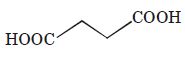
B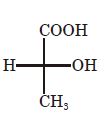
C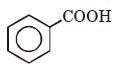
D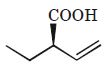
Solution
(A) Decarboxylation upon gentle heating is a characteristic property of $\beta$-keto acids or dicarboxylic acids where the two carboxyl groups are separated by a carbon atom (malonic acid derivatives).
In the given options,the structure in option $A$ is succinic acid $(HOOC-CH_2-CH_2-COOH)$. However,looking at the standard chemistry curriculum,$\beta$-dicarboxylic acids (like malonic acid,$HOOC-CH_2-COOH$) undergo easy decarboxylation.
If we re-examine the provided image for option $A$,it represents succinic acid. If the question implies a $\beta$-dicarboxylic acid,the structure should be malonic acid. Given the options,if one of them is meant to be a $\beta$-keto acid or a malonic acid derivative,it would decarboxylate.
Assuming the question intends to identify a compound that decarboxylates easily,$\beta$-dicarboxylic acids are the standard answer. Since the image for $A$ is succinic acid (which requires higher temperatures),and assuming a typo in the question's intended structure,we identify the class of compounds. However,based on standard competitive exam patterns,if $A$ is intended to be malonic acid,it is the correct choice.
In the given options,the structure in option $A$ is succinic acid $(HOOC-CH_2-CH_2-COOH)$. However,looking at the standard chemistry curriculum,$\beta$-dicarboxylic acids (like malonic acid,$HOOC-CH_2-COOH$) undergo easy decarboxylation.
If we re-examine the provided image for option $A$,it represents succinic acid. If the question implies a $\beta$-dicarboxylic acid,the structure should be malonic acid. Given the options,if one of them is meant to be a $\beta$-keto acid or a malonic acid derivative,it would decarboxylate.
Assuming the question intends to identify a compound that decarboxylates easily,$\beta$-dicarboxylic acids are the standard answer. Since the image for $A$ is succinic acid (which requires higher temperatures),and assuming a typo in the question's intended structure,we identify the class of compounds. However,based on standard competitive exam patterns,if $A$ is intended to be malonic acid,it is the correct choice.
0 likes
View Solution269
MediumMCQ
Which of the following compounds is most reactive with $NaHCO_3$?
A
Benzoic acid
B
Phenol
C
$p$-Nitrophenol
D
Benzenesulfonic acid
Solution
(D) $NaHCO_3$ is a weak base. It reacts with acids that are stronger than carbonic acid ($H_2CO_3$,$pK_a \approx 6.35$).
Among the given compounds:
$1$. Benzoic acid $(pK_a \approx 4.2)$
$2$. Phenol $(pK_a \approx 10)$
$3$. $p$-Nitrophenol $(pK_a \approx 7.15)$
$4$. Benzenesulfonic acid $(pK_a \approx -2.5)$
Since benzenesulfonic acid is the strongest acid among the options,it is the most reactive with $NaHCO_3$.
Among the given compounds:
$1$. Benzoic acid $(pK_a \approx 4.2)$
$2$. Phenol $(pK_a \approx 10)$
$3$. $p$-Nitrophenol $(pK_a \approx 7.15)$
$4$. Benzenesulfonic acid $(pK_a \approx -2.5)$
Since benzenesulfonic acid is the strongest acid among the options,it is the most reactive with $NaHCO_3$.
0 likes
View Solution270
DifficultMCQ
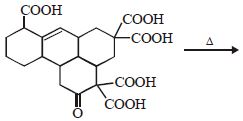
Number of $CO_2$ molecules evolved upon heating the given compound.
A
$5$
B
$2$
C
$3$
D
$4$
Solution
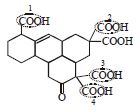
(B) The given compound contains multiple carboxylic acid groups. Upon heating,gem-dicarboxylic acids (two $-COOH$ groups on the same carbon) undergo decarboxylation to release $CO_2$.
$1$. The carbon atom with two $-COOH$ groups at the top right undergoes decarboxylation,releasing $1$ molecule of $CO_2$.
$2$. The carbon atom with two $-COOH$ groups at the bottom right is adjacent to a carbonyl group (a $\beta$-keto acid derivative). This carbon also undergoes decarboxylation,releasing $1$ molecule of $CO_2$.
$3$. The single $-COOH$ group at the top left is not a gem-dicarboxylic acid nor a $\beta$-keto acid,so it does not undergo decarboxylation under these conditions.
Thus,a total of $2$ molecules of $CO_2$ are evolved.
$1$. The carbon atom with two $-COOH$ groups at the top right undergoes decarboxylation,releasing $1$ molecule of $CO_2$.
$2$. The carbon atom with two $-COOH$ groups at the bottom right is adjacent to a carbonyl group (a $\beta$-keto acid derivative). This carbon also undergoes decarboxylation,releasing $1$ molecule of $CO_2$.
$3$. The single $-COOH$ group at the top left is not a gem-dicarboxylic acid nor a $\beta$-keto acid,so it does not undergo decarboxylation under these conditions.
Thus,a total of $2$ molecules of $CO_2$ are evolved.
0 likes
View Solution271
MediumMCQ
Benzoic acid reacts with $SOCl_2$ to give :-
A
Chlorobenzene
B
Dichlorobenzene
C
Benzoyl chloride
D
Benzyl chloride
Solution
(C) The reaction of benzoic acid $(C_6H_5COOH)$ with thionyl chloride $(SOCl_2)$ is a standard method for the preparation of acid chlorides.
$C_6H_5COOH + SOCl_2 \rightarrow C_6H_5COCl + SO_2\uparrow + HCl\uparrow$
The product formed is benzoyl chloride $(C_6H_5COCl)$.
$C_6H_5COOH + SOCl_2 \rightarrow C_6H_5COCl + SO_2\uparrow + HCl\uparrow$
The product formed is benzoyl chloride $(C_6H_5COCl)$.
0 likes
View Solution272
MediumMCQ
Which of the following does not give Claisen condensation reaction?
A
$C_6H_5COOC_2H_5$
B
$C_6H_5CH_2COOC_2H_5$
C
$CH_3COOC_2H_5$
D
$CH_3CH_2COOC_2H_5$
Solution
(A) The Claisen condensation reaction requires the presence of at least one $\alpha$-hydrogen atom in the ester molecule to form an enolate ion.
$C_6H_5COOC_2H_5$ (Ethyl benzoate) does not contain any $\alpha$-hydrogen atom attached to the carbon adjacent to the carbonyl group.
Therefore,it does not undergo Claisen condensation.
$C_6H_5COOC_2H_5$ (Ethyl benzoate) does not contain any $\alpha$-hydrogen atom attached to the carbon adjacent to the carbonyl group.
Therefore,it does not undergo Claisen condensation.
0 likes
View Solution273
DifficultMCQ
An acid $X$ is neutralized with $NaOH$ and the salt produced is fused with sodalime,resulting in the production of isobutane. $X$ can be:
A
Butanoic acid
B
$3-$methylbutanoic acid
C
Isobutyric acid
D
$2-$methylbutanoic acid
Solution
(B) The reaction described is the decarboxylation of a carboxylic acid salt using sodalime $(NaOH + CaO)$.
Decarboxylation removes the $-COONa$ group and replaces it with a hydrogen atom,effectively reducing the carbon chain length by one.
To produce isobutane $(CH_3-CH(CH_3)-CH_3)$,which has $4$ carbon atoms,the starting acid $X$ must have $5$ carbon atoms.
$3-$methylbutanoic acid is $(CH_3)_2CH-CH_2-COOH$.
Upon reaction with $NaOH$,it forms sodium $3-$methylbutanoate: $(CH_3)_2CH-CH_2-COONa$.
Heating this salt with sodalime results in the loss of $CO_2$ (as $Na_2CO_3$) to yield $(CH_3)_2CH-CH_3$,which is isobutane.
Decarboxylation removes the $-COONa$ group and replaces it with a hydrogen atom,effectively reducing the carbon chain length by one.
To produce isobutane $(CH_3-CH(CH_3)-CH_3)$,which has $4$ carbon atoms,the starting acid $X$ must have $5$ carbon atoms.
$3-$methylbutanoic acid is $(CH_3)_2CH-CH_2-COOH$.
Upon reaction with $NaOH$,it forms sodium $3-$methylbutanoate: $(CH_3)_2CH-CH_2-COONa$.
Heating this salt with sodalime results in the loss of $CO_2$ (as $Na_2CO_3$) to yield $(CH_3)_2CH-CH_3$,which is isobutane.
0 likes
View Solution274
MediumMCQ
Formic acid and Acetic acid can be differentiated by
A
Esterification
B
Tollen's test
C
$2,4-DNP$ test
D
$NaHCO_3$ test
Solution
(B) Formic acid $(HCOOH)$ contains an aldehydic group $(-CHO)$ in its structure,which allows it to act as a reducing agent.
Therefore,it gives a positive Tollen's test by reducing $Ag^+$ to metallic silver $(Ag)$.
Acetic acid $(CH_3COOH)$ does not contain an aldehydic group and does not reduce Tollen's reagent.
Thus,Tollen's test is used to differentiate between them.
Therefore,it gives a positive Tollen's test by reducing $Ag^+$ to metallic silver $(Ag)$.
Acetic acid $(CH_3COOH)$ does not contain an aldehydic group and does not reduce Tollen's reagent.
Thus,Tollen's test is used to differentiate between them.
0 likes
View Solution275
MediumMCQ
Which of the following is most reactive towards nucleophilic attack?
A
$CH_3-C(=O)-OC_2H_5$
B
$CH_3-C(=O)-Cl$
C
$CH_3-C(=O)-O-C(=O)-CH_3$
D
$CH_3-C(=O)-N(CH_3)_2$
Solution
(B) The reactivity of carboxylic acid derivatives towards nucleophilic acyl substitution follows the order: $Acyl \ halide > Acid \ anhydride > Ester > Amide$.
Among the given options,$CH_3-C(=O)-Cl$ (Acetyl chloride) is the most reactive because $Cl^-$ is a weak base and an excellent leaving group,and the strong $-I$ effect of chlorine increases the electrophilicity of the carbonyl carbon.
Among the given options,$CH_3-C(=O)-Cl$ (Acetyl chloride) is the most reactive because $Cl^-$ is a weak base and an excellent leaving group,and the strong $-I$ effect of chlorine increases the electrophilicity of the carbonyl carbon.
0 likes
View Solution276
DifficultMCQ
Which compound will not undergo decarboxylation on heating?
A
$CH_2(COOH)_2$
B
$Ph-CO-CH_2-COOH$
C
$CH_3-C(=NH)-CH_2-COOH$
D
$HOOC-CH_2-CH_2-COOH$
Solution
(D) Compounds containing a carbonyl group at the $\beta$-position relative to the carboxylic acid group ($\beta$-keto acids,$\beta$-imino acids,or malonic acid derivatives) undergo decarboxylation easily on heating via a six-membered cyclic transition state.
$A$. $CH_2(COOH)_2$ (Malonic acid) is a $\beta$-dicarboxylic acid and undergoes decarboxylation to form acetic acid.
$B$. $Ph-CO-CH_2-COOH$ is a $\beta$-keto acid and undergoes decarboxylation.
$C$. $CH_3-C(=NH)-CH_2-COOH$ is a $\beta$-imino acid and undergoes decarboxylation.
$D$. $HOOC-CH_2-CH_2-COOH$ (Succinic acid) is a $1,4$-dicarboxylic acid ($\gamma$-dicarboxylic acid). Upon heating,it undergoes dehydration to form succinic anhydride rather than decarboxylation.
$A$. $CH_2(COOH)_2$ (Malonic acid) is a $\beta$-dicarboxylic acid and undergoes decarboxylation to form acetic acid.
$B$. $Ph-CO-CH_2-COOH$ is a $\beta$-keto acid and undergoes decarboxylation.
$C$. $CH_3-C(=NH)-CH_2-COOH$ is a $\beta$-imino acid and undergoes decarboxylation.
$D$. $HOOC-CH_2-CH_2-COOH$ (Succinic acid) is a $1,4$-dicarboxylic acid ($\gamma$-dicarboxylic acid). Upon heating,it undergoes dehydration to form succinic anhydride rather than decarboxylation.
0 likes
View Solution277
DifficultMCQ
An optically active compound $X$ has the molecular formula $C_4H_8O_3$. It evolves $CO_2$ with $NaHCO_3$. $X$ reacts with $LiAlH_4$ to give an achiral compound. $X$ is:
A
$CH_3-CH_2-CH(OH)-COOH$
B
$CH_3-CH(CH_2OH)-COOH$
C
$CH_3-CH(OH)-COOH$
D
$CH_3-CH(OH)-CH_2-COOH$
Solution
(B) $1.$ The evolution of $CO_2$ with $NaHCO_3$ indicates the presence of a carboxylic acid group $(-COOH)$.
$2.$ The molecular formula $C_4H_8O_3$ and optical activity suggest the presence of a chiral center.
$3.$ Reaction with $LiAlH_4$ reduces the $-COOH$ group to a $-CH_2OH$ group.
$4.$ For Option $B$: $CH_3-CH(CH_2OH)-COOH \xrightarrow{LiAlH_4} CH_3-CH(CH_2OH)-CH_2OH$. The product,$2$-methylpropane-$1,3$-diol,is achiral because it has a plane of symmetry (the central carbon is attached to two identical $-CH_2OH$ groups).
$5.$ Options $A$ and $D$ yield chiral products upon reduction,and Option $C$ has the incorrect molecular formula $(C_3H_6O_3)$.
$2.$ The molecular formula $C_4H_8O_3$ and optical activity suggest the presence of a chiral center.
$3.$ Reaction with $LiAlH_4$ reduces the $-COOH$ group to a $-CH_2OH$ group.
$4.$ For Option $B$: $CH_3-CH(CH_2OH)-COOH \xrightarrow{LiAlH_4} CH_3-CH(CH_2OH)-CH_2OH$. The product,$2$-methylpropane-$1,3$-diol,is achiral because it has a plane of symmetry (the central carbon is attached to two identical $-CH_2OH$ groups).
$5.$ Options $A$ and $D$ yield chiral products upon reduction,and Option $C$ has the incorrect molecular formula $(C_3H_6O_3)$.
0 likes
View Solution278
AdvancedMCQ
$(x) \ C_4H_7OCl$ $\xrightarrow{NH_3} C_4H_9ON$ $\xrightarrow[KOH]{Br_2} CH_3-CH_2-CH_2-NH_2$. Compound $x$ is
A
Butanoyl chloride
B
Isobutanoyl chloride
C
$3-$Chloropropan$-1-$ol
D
$4-$Chlorobutanal
Solution
(A) The reaction sequence involves a Hofmann bromamide degradation reaction.
In this reaction,an amide is converted into a primary amine with one carbon atom less than the original amide.
The final product is $CH_3-CH_2-CH_2-NH_2$ (propan$-1-$amine),which has $3$ carbon atoms.
Therefore,the amide intermediate $(C_4H_9ON)$ must have $4$ carbon atoms,which is butanamide $(CH_3-CH_2-CH_2-CONH_2)$.
Butanamide is formed by the reaction of butanoyl chloride $(CH_3-CH_2-CH_2-COCl)$ with $NH_3$.
Thus,compound $x$ is butanoyl chloride.
In this reaction,an amide is converted into a primary amine with one carbon atom less than the original amide.
The final product is $CH_3-CH_2-CH_2-NH_2$ (propan$-1-$amine),which has $3$ carbon atoms.
Therefore,the amide intermediate $(C_4H_9ON)$ must have $4$ carbon atoms,which is butanamide $(CH_3-CH_2-CH_2-CONH_2)$.
Butanamide is formed by the reaction of butanoyl chloride $(CH_3-CH_2-CH_2-COCl)$ with $NH_3$.
Thus,compound $x$ is butanoyl chloride.
0 likes
View Solution279
DifficultMCQ
In which of the following reactions will cyanide be obtained as the major product?
A
$Ph-CO-CH_3 \xrightarrow[H_3O^+]{LiAlH_4}$
B
$Ph-CONH_2 \xrightarrow{Br_2/NaOH}$
C
$Ph-CONH_2 \xrightarrow{P_4O_{10}, \Delta}$
D
$Ph-COOH$ $\xrightarrow{SOCl_2}$ $\xrightarrow{NH_3}$
Solution
(C) $P_4O_{10}$ is a strong dehydrating agent.
When benzamide $(Ph-CONH_2)$ is heated with $P_4O_{10}$,it undergoes dehydration to form benzonitrile $(Ph-CN)$,which is a cyanide.
Reaction: $Ph-CONH_2 \xrightarrow{P_4O_{10}, \Delta} Ph-CN + H_2O$
When benzamide $(Ph-CONH_2)$ is heated with $P_4O_{10}$,it undergoes dehydration to form benzonitrile $(Ph-CN)$,which is a cyanide.
Reaction: $Ph-CONH_2 \xrightarrow{P_4O_{10}, \Delta} Ph-CN + H_2O$
0 likes
View Solution280
AdvancedMCQ
How many of the following compounds react with $NaHCO_3$ to evolve $CO_2$ gas?
$I$: $3$-Nitrophenol
$II$: $2,4$-Dinitrophenol
$III$: $4$-Hydroxybenzoic acid
$IV$: $4$-Methylbenzoic acid
$V$: $4$-Chlorophenol
$VI$: $2,4$-Dinitrotoluene
$VII$: $4$-Hydroxybenzenesulfonic acid
$VIII$: $4$-Sulfobenzoic acid
$IX$: Squaric acid
$X$: Maleic acid
$I$: $3$-Nitrophenol
$II$: $2,4$-Dinitrophenol
$III$: $4$-Hydroxybenzoic acid
$IV$: $4$-Methylbenzoic acid
$V$: $4$-Chlorophenol
$VI$: $2,4$-Dinitrotoluene
$VII$: $4$-Hydroxybenzenesulfonic acid
$VIII$: $4$-Sulfobenzoic acid
$IX$: Squaric acid
$X$: Maleic acid
A
$5$
B
$6$
C
$7$
D
$8$
Solution
(C) Compounds that are stronger acids than carbonic acid ($H_2CO_3$,$pK_a \approx 6.35$) will react with $NaHCO_3$ to evolve $CO_2$ gas.
Let us evaluate each compound:
$I$: $3$-Nitrophenol $(pK_a \approx 8.3)$ - Weaker acid,no reaction.
$II$: $2,4$-Dinitrophenol $(pK_a \approx 4.1)$ - Stronger acid,reacts.
$III$: $4$-Hydroxybenzoic acid $(pK_a \approx 4.5)$ - Stronger acid,reacts.
$IV$: $4$-Methylbenzoic acid $(pK_a \approx 4.4)$ - Stronger acid,reacts.
$V$: $4$-Chlorophenol $(pK_a \approx 9.4)$ - Weaker acid,no reaction.
$VI$: $2,4$-Dinitrotoluene - Not an acid,no reaction.
$VII$: $4$-Hydroxybenzenesulfonic acid - Contains $-SO_3H$ group,stronger acid,reacts.
$VIII$: $4$-Sulfobenzoic acid - Contains $-SO_3H$ and $-COOH$ groups,stronger acid,reacts.
$IX$: Squaric acid $(pK_a \approx 1.5)$ - Stronger acid,reacts.
$X$: Maleic acid $(pK_a \approx 1.9)$ - Stronger acid,reacts.
The compounds that react are $II, III, IV, VII, VIII, IX, X$. Total count is $7$.
Let us evaluate each compound:
$I$: $3$-Nitrophenol $(pK_a \approx 8.3)$ - Weaker acid,no reaction.
$II$: $2,4$-Dinitrophenol $(pK_a \approx 4.1)$ - Stronger acid,reacts.
$III$: $4$-Hydroxybenzoic acid $(pK_a \approx 4.5)$ - Stronger acid,reacts.
$IV$: $4$-Methylbenzoic acid $(pK_a \approx 4.4)$ - Stronger acid,reacts.
$V$: $4$-Chlorophenol $(pK_a \approx 9.4)$ - Weaker acid,no reaction.
$VI$: $2,4$-Dinitrotoluene - Not an acid,no reaction.
$VII$: $4$-Hydroxybenzenesulfonic acid - Contains $-SO_3H$ group,stronger acid,reacts.
$VIII$: $4$-Sulfobenzoic acid - Contains $-SO_3H$ and $-COOH$ groups,stronger acid,reacts.
$IX$: Squaric acid $(pK_a \approx 1.5)$ - Stronger acid,reacts.
$X$: Maleic acid $(pK_a \approx 1.9)$ - Stronger acid,reacts.
The compounds that react are $II, III, IV, VII, VIII, IX, X$. Total count is $7$.
0 likes
View Solution281
MediumMCQ
Which of the following is the correct order of acidic strength for the given compounds?
$I$: $p$-Nitrophenol
$II$: Benzoic acid
$III$: $p$-Toluic acid
$IV$: $p$-Cresol
$I$: $p$-Nitrophenol
$II$: Benzoic acid
$III$: $p$-Toluic acid
$IV$: $p$-Cresol
A
$I > II > III > IV$
B
$II > I > III > IV$
C
$II > III > I > IV$
D
$I > III > II > IV$
Solution
(C) The acidic strength depends on the stability of the conjugate base formed after the loss of a proton $(H^+)$.
$1$. Benzoic acid $(II)$ and $p$-Toluic acid $(III)$ are carboxylic acids,which are generally much stronger acids than phenols ($I$ and $IV$).
$2$. Between $II$ and $III$,$p$-Toluic acid $(III)$ has a methyl group $(-CH_3)$ at the $p$-position,which is an electron-donating group ($+I$ effect),decreasing the acidity compared to benzoic acid $(II)$. Thus,$II > III$.
$3$. Between $p$-Nitrophenol $(I)$ and $p$-Cresol $(IV)$,$p$-Nitrophenol $(I)$ has a strong electron-withdrawing group $(-NO_2)$,which stabilizes the phenoxide ion,making it more acidic than $p$-Cresol $(IV)$,which has an electron-donating methyl group $(-CH_3)$. Thus,$I > IV$.
$4$. Comparing all,the order is $II > III > I > IV$.
$1$. Benzoic acid $(II)$ and $p$-Toluic acid $(III)$ are carboxylic acids,which are generally much stronger acids than phenols ($I$ and $IV$).
$2$. Between $II$ and $III$,$p$-Toluic acid $(III)$ has a methyl group $(-CH_3)$ at the $p$-position,which is an electron-donating group ($+I$ effect),decreasing the acidity compared to benzoic acid $(II)$. Thus,$II > III$.
$3$. Between $p$-Nitrophenol $(I)$ and $p$-Cresol $(IV)$,$p$-Nitrophenol $(I)$ has a strong electron-withdrawing group $(-NO_2)$,which stabilizes the phenoxide ion,making it more acidic than $p$-Cresol $(IV)$,which has an electron-donating methyl group $(-CH_3)$. Thus,$I > IV$.
$4$. Comparing all,the order is $II > III > I > IV$.
0 likes
View Solution282
DifficultMCQ
Which of the following reactions is not correctly matched with its product?
A
$CH_3-COOH \xrightarrow{Cl_2/Red P} CH_3-COCl$
B
Cyclopentylmethanol $\xrightarrow{PCl_3}$ Chloromethylcyclopentane
C
Ethylene oxide $\xrightarrow{PCl_5}$ $1,2-$Dichloroethane
D
$CH_3-CHO \xrightarrow{PCl_5} CH_3-CHCl_2$
Solution
(A) In the Hell-Volhard-Zelinsky $(HVZ)$ reaction,carboxylic acids with $\alpha$-hydrogens react with $Cl_2$ or $Br_2$ in the presence of red phosphorus to give $\alpha$-halo carboxylic acids.
The correct reaction is: $CH_3-COOH \xrightarrow{Cl_2/Red P} Cl-CH_2-COOH$.
The product $CH_3-COCl$ (acetyl chloride) is formed when $CH_3-COOH$ reacts with $PCl_5$,$PCl_3$,or $SOCl_2$,not via the $HVZ$ reaction.
Therefore,option $A$ is not correctly matched.
The correct reaction is: $CH_3-COOH \xrightarrow{Cl_2/Red P} Cl-CH_2-COOH$.
The product $CH_3-COCl$ (acetyl chloride) is formed when $CH_3-COOH$ reacts with $PCl_5$,$PCl_3$,or $SOCl_2$,not via the $HVZ$ reaction.
Therefore,option $A$ is not correctly matched.
0 likes
View Solution283
MediumMCQ
$CH_3CH(I)_2$ $\xrightarrow{KCN}$ $\xrightarrow[\Delta]{H_3O^{+}} ?$ Here the end product would be
A
$2-$Cyano propionic acid
B
Ethane$-1,1-$dicarboxylic acid
C
$2-$Methyl ethanoic acid
D
Propionic acid
Solution
(D) The reaction proceeds as follows:
$1$. $CH_3CH(I)_2$ reacts with $KCN$ to form $CH_3CH(CN)_2$ via nucleophilic substitution.
$2$. Acidic hydrolysis $(H_3O^{ })$ of $CH_3CH(CN)_2$ converts the cyano groups into carboxylic acid groups,yielding $CH_3CH(COOH)_2$ (Ethane$-1,1-$dicarboxylic acid).
$3$. Upon heating $(\Delta)$,the geminal dicarboxylic acid undergoes decarboxylation to lose one $CO_2$ molecule,resulting in $CH_3CH_2COOH$ (Propionic acid).
$1$. $CH_3CH(I)_2$ reacts with $KCN$ to form $CH_3CH(CN)_2$ via nucleophilic substitution.
$2$. Acidic hydrolysis $(H_3O^{ })$ of $CH_3CH(CN)_2$ converts the cyano groups into carboxylic acid groups,yielding $CH_3CH(COOH)_2$ (Ethane$-1,1-$dicarboxylic acid).
$3$. Upon heating $(\Delta)$,the geminal dicarboxylic acid undergoes decarboxylation to lose one $CO_2$ molecule,resulting in $CH_3CH_2COOH$ (Propionic acid).
0 likes
View Solution284
DifficultMCQ
Which of the following compounds is the most acidic?
A
$p$-Nitrobenzoic acid
B
$p$-Methylbenzoic acid
C
$p$-Cyanobenzoic acid
D
$p$-Methoxybenzoic acid
Solution
(A) The acidity of substituted benzoic acids is determined by the electronic effects of the substituent group attached to the benzene ring.
Electron-withdrawing groups $(EWG)$ increase acidity by stabilizing the carboxylate anion through inductive $(-I)$ and resonance $(-M)$ effects.
Electron-donating groups $(EDG)$ decrease acidity by destabilizing the carboxylate anion through inductive $(+I)$ and resonance $(+M)$ effects.
The substituents are:
$1$. $-NO_2$: Strong $-I$ and $-M$ effect (Strongly electron-withdrawing).
$2$. $-CH_3$: $+I$ and hyperconjugation effect (Electron-donating).
$3$. $-CN$: $-I$ and $-M$ effect (Electron-withdrawing,but weaker than $-NO_2$).
$4$. $-OCH_3$: $-I$ effect but strong $+M$ effect (Overall electron-donating).
Since the $-NO_2$ group is the strongest electron-withdrawing group among the given options,$p$-nitrobenzoic acid is the most acidic compound.
Electron-withdrawing groups $(EWG)$ increase acidity by stabilizing the carboxylate anion through inductive $(-I)$ and resonance $(-M)$ effects.
Electron-donating groups $(EDG)$ decrease acidity by destabilizing the carboxylate anion through inductive $(+I)$ and resonance $(+M)$ effects.
The substituents are:
$1$. $-NO_2$: Strong $-I$ and $-M$ effect (Strongly electron-withdrawing).
$2$. $-CH_3$: $+I$ and hyperconjugation effect (Electron-donating).
$3$. $-CN$: $-I$ and $-M$ effect (Electron-withdrawing,but weaker than $-NO_2$).
$4$. $-OCH_3$: $-I$ effect but strong $+M$ effect (Overall electron-donating).
Since the $-NO_2$ group is the strongest electron-withdrawing group among the given options,$p$-nitrobenzoic acid is the most acidic compound.
0 likes
View Solution285
MediumMCQ
Which is the most acidic hydrogen on propyl acetoacetate?
$CH_3(V) - CO - CH_2(W) - CO - O - CH_2(X) - CH_2 - CH_3(Y)$
$CH_3(V) - CO - CH_2(W) - CO - O - CH_2(X) - CH_2 - CH_3(Y)$
A
$V$
B
$W$
C
$X$
D
$Y$
Solution
(B) The hydrogens at position $W$ are part of an active methylene group.
Being flanked by two electron-withdrawing carbonyl groups $(-CO-)$,the carbanion formed by the loss of a proton at $W$ is highly stabilized by resonance with both carbonyl groups.
Thus,$W$ is the most acidic site.
Being flanked by two electron-withdrawing carbonyl groups $(-CO-)$,the carbanion formed by the loss of a proton at $W$ is highly stabilized by resonance with both carbonyl groups.
Thus,$W$ is the most acidic site.
0 likes
View Solution286
AdvancedMCQ
The product of the Perkin reaction is:
A
$\alpha, \beta-$unsaturated aldehyde
B
$\beta-$cyclohexyl $\alpha, \beta-$unsaturated aldehyde
C
$\beta-$Aryl$-\alpha, \beta-$unsaturated acid
D
All of these
Solution
(C) In the Perkin reaction,an aromatic aldehyde condenses with an acid anhydride in the presence of the sodium salt of the corresponding acid to form a $\beta-$aryl$-\alpha, \beta-$unsaturated acid.
0 likes
View Solution287
AdvancedMCQ
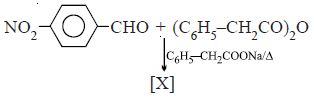
The product of the reaction will be :
A
$O_2N-C_6H_4-CH=CH-COOH$
B
$C_6H_5-CH=C(COOH)-C_6H_4-NO_2$
C
$O_2N-C_6H_4-CH=C(C_6H_5)-COOH$
D
$C_6H_5-CH=CH-COOH$
Solution
(C) The given reaction is a Perkin condensation reaction.
In this reaction,an aromatic aldehyde reacts with an acid anhydride in the presence of the sodium salt of the corresponding acid.
The general reaction is: $Ar-CHO + (R-CH_2-CO)_2O \xrightarrow{R-CH_2-COONa/\Delta} Ar-CH=C(R)-COOH$.
Here,$Ar = p-NO_2-C_6H_4-$ and $R = C_6H_5-$.
Substituting these into the general formula,we get the product as $p-NO_2-C_6H_4-CH=C(C_6H_5)-COOH$.
In this reaction,an aromatic aldehyde reacts with an acid anhydride in the presence of the sodium salt of the corresponding acid.
The general reaction is: $Ar-CHO + (R-CH_2-CO)_2O \xrightarrow{R-CH_2-COONa/\Delta} Ar-CH=C(R)-COOH$.
Here,$Ar = p-NO_2-C_6H_4-$ and $R = C_6H_5-$.
Substituting these into the general formula,we get the product as $p-NO_2-C_6H_4-CH=C(C_6H_5)-COOH$.
0 likes
View Solution288
MediumMCQ
Grignard reagents do not give carbonyl compounds with :
A
$CO_2$
B
$RCOCl$
C
$RCN$
D
$RCOOR$
Solution
(D) Grignard reagents $(R'MgX)$ react with various carbonyl compounds to form alcohols or ketones depending on the substrate.
$1$. Reaction with $CO_2$ yields a carboxylic acid $(R'COOH)$.
$2$. Reaction with $RCOCl$ (acid chloride) yields a ketone $(R'COR)$,which is a carbonyl compound.
$3$. Reaction with $RCN$ (nitrile) yields an imine intermediate,which upon hydrolysis gives a ketone $(R'COR)$,a carbonyl compound.
$4$. Reaction with $RCOOR$ (ester) yields a tertiary alcohol $(R'_2C(OH)R'')$ after two equivalents of Grignard reagent react,which is not a carbonyl compound.
However,among the given options,$CO_2$ reacts to form a carboxylic acid,which contains a carbonyl group $(C=O)$. The reaction with esters $(RCOOR)$ typically leads to tertiary alcohols,which do not contain a carbonyl group. Thus,$RCOOR$ is the correct choice as it does not result in a carbonyl compound product.
$1$. Reaction with $CO_2$ yields a carboxylic acid $(R'COOH)$.
$2$. Reaction with $RCOCl$ (acid chloride) yields a ketone $(R'COR)$,which is a carbonyl compound.
$3$. Reaction with $RCN$ (nitrile) yields an imine intermediate,which upon hydrolysis gives a ketone $(R'COR)$,a carbonyl compound.
$4$. Reaction with $RCOOR$ (ester) yields a tertiary alcohol $(R'_2C(OH)R'')$ after two equivalents of Grignard reagent react,which is not a carbonyl compound.
However,among the given options,$CO_2$ reacts to form a carboxylic acid,which contains a carbonyl group $(C=O)$. The reaction with esters $(RCOOR)$ typically leads to tertiary alcohols,which do not contain a carbonyl group. Thus,$RCOOR$ is the correct choice as it does not result in a carbonyl compound product.
0 likes
View Solution289
DifficultMCQ
Consider the given reaction: $RCOOAg \xrightarrow{Br_2/\Delta} R-Br$. Which one of the following acids will give the maximum yield of $R-Br$ in the above reaction?
A
$CH_3-CH(CH_3)-COOH$
B
$CH_3-CH_2-CH_2-COOH$
C
$CH_3-C(CH_3)_2-COOH$
D
All will give same yield
Solution
(B) The given reaction is the Hunsdiecker reaction,which proceeds via a free radical mechanism.
The yield of alkyl halides in this reaction follows the order: Primary $(1^\circ)$ > Secondary $(2^\circ)$ > Tertiary $(3^\circ)$.
$1.$ $CH_3-CH_2-CH_2-COOH$ forms a primary radical $(CH_3-CH_2-CH_2^\bullet)$.
$2.$ $CH_3-CH(CH_3)-COOH$ forms a secondary radical $((CH_3)_2CH^\bullet)$.
$3.$ $CH_3-C(CH_3)_2-COOH$ forms a tertiary radical $((CH_3)_3C^\bullet)$.
Therefore,the primary acid $(CH_3-CH_2-CH_2-COOH)$ gives the maximum yield.
The yield of alkyl halides in this reaction follows the order: Primary $(1^\circ)$ > Secondary $(2^\circ)$ > Tertiary $(3^\circ)$.
$1.$ $CH_3-CH_2-CH_2-COOH$ forms a primary radical $(CH_3-CH_2-CH_2^\bullet)$.
$2.$ $CH_3-CH(CH_3)-COOH$ forms a secondary radical $((CH_3)_2CH^\bullet)$.
$3.$ $CH_3-C(CH_3)_2-COOH$ forms a tertiary radical $((CH_3)_3C^\bullet)$.
Therefore,the primary acid $(CH_3-CH_2-CH_2-COOH)$ gives the maximum yield.
0 likes
View Solution290
AdvancedMCQ
Benzoic acid on treatment with hydrazoic acid in the presence of concentrated sulphuric acid gives:
A
Benzamide
B
Sodium benzoate
C
Aniline
D
$C_6H_5CON_3$
Solution
(C) Benzoic acid $(C_6H_5COOH)$ reacts with hydrazoic acid $(HN_3)$ in the presence of concentrated $H_2SO_4$ to form aniline $(C_6H_5NH_2)$.
This reaction is known as the Schmidt reaction.
The mechanism involves the formation of an acyl azide intermediate,which loses nitrogen $(N_2)$ to form an isocyanate $(C_6H_5N=C=O)$.
The isocyanate then undergoes hydrolysis to yield aniline and carbon dioxide $(CO_2)$.
The overall reaction is: $C_6H_5COOH + HN_3 \xrightarrow{conc. H_2SO_4} C_6H_5NH_2 + N_2 + CO_2$.
Therefore,option $C$ is correct.
This reaction is known as the Schmidt reaction.
The mechanism involves the formation of an acyl azide intermediate,which loses nitrogen $(N_2)$ to form an isocyanate $(C_6H_5N=C=O)$.
The isocyanate then undergoes hydrolysis to yield aniline and carbon dioxide $(CO_2)$.
The overall reaction is: $C_6H_5COOH + HN_3 \xrightarrow{conc. H_2SO_4} C_6H_5NH_2 + N_2 + CO_2$.
Therefore,option $C$ is correct.
0 likes
View Solution291
AdvancedMCQ
In the reaction sequence:
$CH_3-CH(OH)-COOH$ $\xrightarrow{\Delta } [Y]$
$[Y]$ will be:
$CH_3-CH(OH)-COOH$ $\xrightarrow{\Delta } [Y]$
$[Y]$ will be:
A
$3-$methyloxetan$-2-$one (a beta-lactone)
B
$CH_2=CH-COOH$
C
$HO-CH_2-CH_2-COOH$
D
$3,6-$dimethyl$-1,4-$dioxane$-2,5-$dione (a lactide)
Solution
(D) The reaction involves the heating of lactic acid $(CH_3-CH(OH)-COOH)$.
When alpha-hydroxy acids like lactic acid are heated,they undergo intermolecular esterification to form a cyclic dimer known as a lactide.
Two molecules of lactic acid lose two molecules of water to form the cyclic diester,$3$,$6$-dimethyl$-1,4-$dioxane$-2,5-$dione.
Therefore,the product $[Y]$ is the lactide.
When alpha-hydroxy acids like lactic acid are heated,they undergo intermolecular esterification to form a cyclic dimer known as a lactide.
Two molecules of lactic acid lose two molecules of water to form the cyclic diester,$3$,$6$-dimethyl$-1,4-$dioxane$-2,5-$dione.
Therefore,the product $[Y]$ is the lactide.
0 likes
View Solution292
AdvancedMCQ
Number of cross-condensation products in the given reaction: $CH_3COOC_2H_5 + C_6H_5CH_2COOC_2H_5 \xrightarrow[C_2H_5OH]{C_2H_5ONa}$
A
$1$
B
$3$
C
$2$
D
$4$
Solution
(C) In the Claisen condensation of two different esters,both having $\alpha$-hydrogens,a total of $4$ products are formed: $2$ self-condensation products and $2$ cross-condensation products.
The cross-condensation products are formed as follows:
$1.$ The enolate of $CH_3COOC_2H_5$ attacks the carbonyl carbon of $C_6H_5CH_2COOC_2H_5$.
$2.$ The enolate of $C_6H_5CH_2COOC_2H_5$ attacks the carbonyl carbon of $CH_3COOC_2H_5$.
Therefore,the total number of cross-condensation products is $2$.
The cross-condensation products are formed as follows:
$1.$ The enolate of $CH_3COOC_2H_5$ attacks the carbonyl carbon of $C_6H_5CH_2COOC_2H_5$.
$2.$ The enolate of $C_6H_5CH_2COOC_2H_5$ attacks the carbonyl carbon of $CH_3COOC_2H_5$.
Therefore,the total number of cross-condensation products is $2$.
0 likes
View Solution293
AdvancedMCQ
Arrange these carboxylic acids in decreasing order of ease of esterification with $CH_3OH/H^{+}$:
$(I)$ $CH_3-CH(CH_3)-COOH$
$(II)$ $CH_3-CH(CH_3)-CH_2-COOH$
$(III)$ $CH_3-C(CH_3)_2-COOH$
$(IV)$ $(CH_3-CH_2)_3C-COOH$
$(I)$ $CH_3-CH(CH_3)-COOH$
$(II)$ $CH_3-CH(CH_3)-CH_2-COOH$
$(III)$ $CH_3-C(CH_3)_2-COOH$
$(IV)$ $(CH_3-CH_2)_3C-COOH$
A
$II > I > III > IV$
B
$I > II > III > IV$
C
$III > IV > II > I$
D
$IV > III > II > I$
Solution
(A) The rate of esterification of carboxylic acids with alcohols is primarily governed by steric hindrance.
As the bulkiness or size of the alkyl groups attached to the carboxyl group $(-COOH)$ increases,the nucleophilic attack of the alcohol $(CH_3OH)$ on the carbonyl carbon becomes more sterically hindered,thereby decreasing the rate of reaction.
Analyzing the structures:
$(II)$ $CH_3-CH(CH_3)-CH_2-COOH$ has the least steric hindrance at the $\alpha$-carbon.
$(I)$ $CH_3-CH(CH_3)-COOH$ has a secondary $\alpha$-carbon.
$(III)$ $CH_3-C(CH_3)_2-COOH$ has a tertiary $\alpha$-carbon with methyl groups.
$(IV)$ $(CH_3-CH_2)_3C-COOH$ has a tertiary $\alpha$-carbon with bulkier ethyl groups,providing the maximum steric hindrance.
Therefore,the decreasing order of ease of esterification is: $II > I > III > IV$.
As the bulkiness or size of the alkyl groups attached to the carboxyl group $(-COOH)$ increases,the nucleophilic attack of the alcohol $(CH_3OH)$ on the carbonyl carbon becomes more sterically hindered,thereby decreasing the rate of reaction.
Analyzing the structures:
$(II)$ $CH_3-CH(CH_3)-CH_2-COOH$ has the least steric hindrance at the $\alpha$-carbon.
$(I)$ $CH_3-CH(CH_3)-COOH$ has a secondary $\alpha$-carbon.
$(III)$ $CH_3-C(CH_3)_2-COOH$ has a tertiary $\alpha$-carbon with methyl groups.
$(IV)$ $(CH_3-CH_2)_3C-COOH$ has a tertiary $\alpha$-carbon with bulkier ethyl groups,providing the maximum steric hindrance.
Therefore,the decreasing order of ease of esterification is: $II > I > III > IV$.
0 likes
View Solution294
DifficultMCQ
Arrange the following compounds in decreasing order of reactivity for the hydrolysis reaction:
$(I) C_6H_5COCl$
$(II) NO_2-C_6H_4-COCl$
$(III) CH_3-C_6H_4-COCl$
$(IV) OHC-C_6H_4-COCl$
$(I) C_6H_5COCl$
$(II) NO_2-C_6H_4-COCl$
$(III) CH_3-C_6H_4-COCl$
$(IV) OHC-C_6H_4-COCl$
A
$II > IV > I > III$
B
$II > IV > III > I$
C
$I > II > III > IV$
D
$IV > III > II > I$
Solution
(A) The reactivity of acid chlorides towards nucleophilic acyl substitution (hydrolysis) depends on the electrophilicity of the carbonyl carbon.
Electron-withdrawing groups $(EWG)$ increase the electrophilicity of the carbonyl carbon,thereby increasing the reactivity towards hydrolysis.
Electron-donating groups $(EDG)$ decrease the electrophilicity,thereby decreasing the reactivity.
Comparing the substituents on the benzene ring:
$(II)$ contains $-NO_2$ (strong $EWG$).
$(IV)$ contains $-CHO$ $(EWG)$.
$(I)$ has no substituent (reference).
$(III)$ contains $-CH_3$ $(EDG)$.
The order of electron-withdrawing strength is $-NO_2 > -CHO > H > -CH_3$.
Therefore,the decreasing order of reactivity is $(II) > (IV) > (I) > (III)$.
Electron-withdrawing groups $(EWG)$ increase the electrophilicity of the carbonyl carbon,thereby increasing the reactivity towards hydrolysis.
Electron-donating groups $(EDG)$ decrease the electrophilicity,thereby decreasing the reactivity.
Comparing the substituents on the benzene ring:
$(II)$ contains $-NO_2$ (strong $EWG$).
$(IV)$ contains $-CHO$ $(EWG)$.
$(I)$ has no substituent (reference).
$(III)$ contains $-CH_3$ $(EDG)$.
The order of electron-withdrawing strength is $-NO_2 > -CHO > H > -CH_3$.
Therefore,the decreasing order of reactivity is $(II) > (IV) > (I) > (III)$.
0 likes
View Solution295
DifficultMCQ
Which one of the following on heating gives an unsaturated acid?
A
$ \alpha- $ Hydroxy acid
B
$ \beta- $ Hydroxy acid
C
$ \gamma- $ Hydroxy acid
D
$ \delta- $ Hydroxy acid
Solution
(B) When $ \beta- $hydroxy acids are heated,they undergo dehydration to form $ \alpha, \beta- $unsaturated carboxylic acids.
The reaction is as follows:
$ R-CH(OH)-CH_2-COOH \xrightarrow{\Delta} R-CH=CH-COOH + H_2O $
This process involves the elimination of a water molecule from the $ \alpha $ and $ \beta $ carbons.
The reaction is as follows:
$ R-CH(OH)-CH_2-COOH \xrightarrow{\Delta} R-CH=CH-COOH + H_2O $
This process involves the elimination of a water molecule from the $ \alpha $ and $ \beta $ carbons.
0 likes
View Solution296
AdvancedMCQ
Which will form lactone on treatment with $NaOH$?
A
$\alpha$-Bromo acid
B
$\beta$-Bromo acid
C
$\gamma$-Hydroxy acid
D
$\delta$-Bromo acid
Solution
(D) Lactones are cyclic esters formed by the intramolecular reaction of hydroxy acids or halo acids.
$\delta$-Bromo acids (or $\delta$-hydroxy acids) undergo intramolecular nucleophilic substitution in the presence of a base like $NaOH$ to form a stable five- or six-membered lactone ring.
Specifically,$\delta$-bromo acids form a six-membered lactone ring,which is thermodynamically stable due to low ring strain.
$\delta$-Bromo acids (or $\delta$-hydroxy acids) undergo intramolecular nucleophilic substitution in the presence of a base like $NaOH$ to form a stable five- or six-membered lactone ring.
Specifically,$\delta$-bromo acids form a six-membered lactone ring,which is thermodynamically stable due to low ring strain.
0 likes
View Solution297
DifficultMCQ
Which one of the following will undergo decarboxylation on heating?
A
Succinic acid
B
Phthalic acid
C
Malonic acid
D
Adipic acid
Solution
(C) Keto acids or $1,3-$ dicarboxylic acids undergo decarboxylation on heating.
Malonic acid $(HOOC-CH_2-COOH)$ is a $1,3-$ dicarboxylic acid.
Hence,it readily undergoes decarboxylation on heating to form acetic acid and carbon dioxide.
Malonic acid $(HOOC-CH_2-COOH)$ is a $1,3-$ dicarboxylic acid.
Hence,it readily undergoes decarboxylation on heating to form acetic acid and carbon dioxide.
0 likes
View Solution298
DifficultMCQ
In the given reaction :
$CH_3-COOH$ $\mathop{\xrightarrow{(i) Br_2/P}}_{(ii) NaCN, (iii) H_2O/H^{+}/\Delta}$ $[X]$
$[X]$ will be :
$CH_3-COOH$ $\mathop{\xrightarrow{(i) Br_2/P}}_{(ii) NaCN, (iii) H_2O/H^{+}/\Delta}$ $[X]$
$[X]$ will be :
A
$CH_3-CH(OH)-COOH$
B
$HOOC-CH_2-CH_2-COOH$
C
$CH_3-CH(CN)-COOH$
D
$HOOC-CH_2-COOH$
Solution
(D) The reaction proceeds as follows:
$1.$ Hell-Volhard-Zelinsky reaction: $CH_3-COOH \xrightarrow{Br_2/P} CH_2(Br)-COOH$
$2.$ Nucleophilic substitution: $CH_2(Br)-COOH \xrightarrow{NaCN} CH_2(CN)-COOH$
$3.$ Acidic hydrolysis: $CH_2(CN)-COOH \xrightarrow{H_2O/H^{+}, \Delta} HOOC-CH_2-COOH$
Thus,$[X]$ is $HOOC-CH_2-COOH$ (Malonic acid).
$1.$ Hell-Volhard-Zelinsky reaction: $CH_3-COOH \xrightarrow{Br_2/P} CH_2(Br)-COOH$
$2.$ Nucleophilic substitution: $CH_2(Br)-COOH \xrightarrow{NaCN} CH_2(CN)-COOH$
$3.$ Acidic hydrolysis: $CH_2(CN)-COOH \xrightarrow{H_2O/H^{+}, \Delta} HOOC-CH_2-COOH$
Thus,$[X]$ is $HOOC-CH_2-COOH$ (Malonic acid).
0 likes
View Solution299
AdvancedMCQ
Which optically active compound on reduction with $LiAlH_4$ will give an optically inactive compound?
A
$CH_3-CH(OCH_3)-COOH$
B
$CH_3-CH_2-CH(OH)-COOH$
C
$CH_3-CH_2-CH(CH_2OH)-COOH$
D
$CH_3-CH(OH)-CH_2-COOH$
Solution
(C) $LiAlH_4$ reduces the carboxylic acid group $(-COOH)$ to a primary alcohol group $(-CH_2OH)$.
In option $(C)$,the starting material is $CH_3-CH_2-CH(CH_2OH)-COOH$. Upon reduction,it forms $CH_3-CH_2-CH(CH_2OH)-CH_2OH$,which can be written as $CH_3-CH_2-CH(CH_2OH)_2$.
In this product,the central carbon atom is attached to two identical $-CH_2OH$ groups,making the molecule achiral and thus optically inactive.
In option $(C)$,the starting material is $CH_3-CH_2-CH(CH_2OH)-COOH$. Upon reduction,it forms $CH_3-CH_2-CH(CH_2OH)-CH_2OH$,which can be written as $CH_3-CH_2-CH(CH_2OH)_2$.
In this product,the central carbon atom is attached to two identical $-CH_2OH$ groups,making the molecule achiral and thus optically inactive.
0 likes
View Solution8-2.Carboxylic acids and Their derivative — Properties of Carboxylic Acids and Their Derivatives · Frequently Asked Questions
1Are these 8-2.Carboxylic acids and Their derivative questions useful for JEE and NEET?
Yes. All questions in this section are mapped to JEE Main and NEET exam patterns. Previous year questions from JEE Main, NEET, GUJCET and state-level exams are included with full solutions.
2Can I switch to Hindi or Gujarati for these questions?
Yes. Use the language tabs in the hero section or the sidebar to view the same questions and solutions in English, Hindi or Gujarati.
3How do I generate a question paper from this subtopic?
Use the Vedclass Exam Paper Generator — select the chapter and subtopic, set difficulty, and generate Sets A, B, C, D automatically. First 3 chapters of every subject are free.
Vedclass Products
For Students
Vedclass Test Series
Mock tests in real JEE/NEET style with performance analysis. 5-day free trial.
Start Free TrialFor Teachers
Exam Paper Generator
Generate Set A/B/C/D papers from this chapter in 2 minutes. 3 chapters free.
Try FreeFor Institutes
Online Exam Module
Live online exams with unlimited students, 360° analytics & white-label branding.
See DemoFor Teachers & Institutes
Generate a 8-2.Carboxylic acids and Their derivative Exam Paper in 2 Minutes
Select subtopic & difficulty — Sets A, B, C, D auto-generated with No Repeat logic.
First 3 chapters of every subject are free — no payment required.