
A English
Properties of Carboxylic Acids and Their Derivatives Questions in English
Class 12 Chemistry · 8-2.Carboxylic acids and Their derivative · Properties of Carboxylic Acids and Their Derivatives
791+
Questions
English
Language
100%
With Solutions
Showing 50 of 791 questions in English
301
MediumMCQ
Which acid can be oxidised by Fehling solution?
A
Malonic acid
B
Acetic acid
C
Oxalic acid
D
Formic acid
Solution
(D) Formic acid $(HCOOH)$ contains an aldehydic group $(-CHO)$ in its structure,which makes it a strong reducing agent.
It can be oxidised by mild oxidising agents like Fehling solution,Tollen's reagent,mercuric chloride $(HgCl_2)$,and potassium permanganate $(KMnO_4)$.
It can be oxidised by mild oxidising agents like Fehling solution,Tollen's reagent,mercuric chloride $(HgCl_2)$,and potassium permanganate $(KMnO_4)$.
0 likes
View Solution302
MediumMCQ
Reducing property of formic acid is due to the presence of:
A
$-OH$
B
$-CHO$
C
$-COOH$
D
All of these
Solution
(B) The correct option is $(b)$.
Formic acid $(HCOOH)$ is unique among carboxylic acids because it contains both a carboxyl group $(-COOH)$ and a formyl group $(-CHO)$ attached to a hydrogen atom.
The presence of the formyl group $(-CHO)$ allows it to act as a reducing agent.
Consequently,it can reduce Tollen's reagent and Fehling's solution,a property not shared by other carboxylic acids.
Formic acid $(HCOOH)$ is unique among carboxylic acids because it contains both a carboxyl group $(-COOH)$ and a formyl group $(-CHO)$ attached to a hydrogen atom.
The presence of the formyl group $(-CHO)$ allows it to act as a reducing agent.
Consequently,it can reduce Tollen's reagent and Fehling's solution,a property not shared by other carboxylic acids.
0 likes
View Solution303
AdvancedMCQ
In the given reaction,the reactant is $\gamma$-valerolactone. Predict the product $[X]$ for the reaction: $\text{Reactant} \xrightarrow{H_2O/H^{+}} [X]$.
A
$HOOC-CH_2-CH_2-CH(OH)-CH_3$
B
$CH_3-CH_2-CH_2-CH_2-COOH$
C
$HO-CH_2-CH_2-CH_2-COOH$
D
$CH_3-CH_2-CH(OH)-CH_2-COOH$
Solution
(A) The reaction involves the acid-catalyzed hydrolysis of $\gamma$-valerolactone,which is a cyclic ester.
In the presence of $H_2O/H^{+}$,the ring opens between the carbonyl carbon and the ring oxygen atom.
This process results in the formation of $4$-hydroxypentanoic acid.
The structure of the product $[X]$ is $HOOC-CH_2-CH_2-CH(OH)-CH_3$.
In the presence of $H_2O/H^{+}$,the ring opens between the carbonyl carbon and the ring oxygen atom.
This process results in the formation of $4$-hydroxypentanoic acid.
The structure of the product $[X]$ is $HOOC-CH_2-CH_2-CH(OH)-CH_3$.
0 likes
View Solution304
MediumMCQ
Which of the following compounds gives carbon dioxide with $NaHCO_3$?
A
Acetic acid
B
Hexanol
C
Phenol
D
Acetylene
Solution
(A) Carboxylic acids are stronger acids than carbonic acid $(H_2CO_3)$.
When a carboxylic acid reacts with sodium bicarbonate $(NaHCO_3)$,it undergoes an acid-base reaction to form a sodium salt,water,and carbon dioxide gas $(CO_2)$.
The reaction is: $RCOOH + NaHCO_3 \rightarrow RCOONa + H_2O + CO_2 \uparrow$.
Among the given options,acetic acid $(CH_3COOH)$ is a carboxylic acid and will liberate $CO_2$ gas.
Phenol is a weaker acid than carbonic acid and does not react with $NaHCO_3$ to evolve $CO_2$.
When a carboxylic acid reacts with sodium bicarbonate $(NaHCO_3)$,it undergoes an acid-base reaction to form a sodium salt,water,and carbon dioxide gas $(CO_2)$.
The reaction is: $RCOOH + NaHCO_3 \rightarrow RCOONa + H_2O + CO_2 \uparrow$.
Among the given options,acetic acid $(CH_3COOH)$ is a carboxylic acid and will liberate $CO_2$ gas.
Phenol is a weaker acid than carbonic acid and does not react with $NaHCO_3$ to evolve $CO_2$.
0 likes
View Solution305
MediumMCQ
When propanoic acid is treated with aqueous sodium bicarbonate,carbon dioxide is liberated. The carbon of the $CO_2$ comes from :
A
Methyl group
B
Carboxylic group
C
Methylene group
D
Bicarbonate
Solution
(D) When propanoic acid $(CH_3CH_2COOH)$ reacts with aqueous sodium bicarbonate $(NaHCO_3)$,an acid-base reaction occurs.
The reaction is: $CH_3CH_2COOH + NaHCO_3 \rightarrow CH_3CH_2COONa + H_2O + CO_2 \uparrow$.
In this reaction,the $CO_2$ gas is evolved from the bicarbonate ion $(HCO_3^-)$ present in the sodium bicarbonate,not from the carboxylic acid group.
The reaction is: $CH_3CH_2COOH + NaHCO_3 \rightarrow CH_3CH_2COONa + H_2O + CO_2 \uparrow$.
In this reaction,the $CO_2$ gas is evolved from the bicarbonate ion $(HCO_3^-)$ present in the sodium bicarbonate,not from the carboxylic acid group.
0 likes
View Solution306
DifficultMCQ
Which one of the following esters cannot undergo self Claisen condensation?
A
$CH_3-CH_2-CH_2-COOC_2H_5$
B
$C_6H_5COOC_2H_5$
C
$C_6H_{11}-CH_2-COOC_2H_5$
D
$C_6H_5-CH_2COOC_2H_5$
Solution
(B) Self Claisen condensation requires the presence of at least one $\alpha-$hydrogen atom in the ester molecule to form an enolate ion.
$C_6H_5COOC_2H_5$ (Ethyl benzoate) does not possess any $\alpha-$hydrogen atom attached to the carbon adjacent to the carbonyl group.
Therefore,it cannot undergo self Claisen condensation.
$C_6H_5COOC_2H_5$ (Ethyl benzoate) does not possess any $\alpha-$hydrogen atom attached to the carbon adjacent to the carbonyl group.
Therefore,it cannot undergo self Claisen condensation.
0 likes
View Solution307
DifficultMCQ
The treatment of an ester with $LiAlH_4$ followed by acid hydrolysis produces :
A
Two aldehydes
B
One carboxylic acid and one alcohol
C
Two alcohols
D
Two acids
Solution
(C) The treatment of an ester with $LiAlH_4$ (a strong reducing agent) followed by acid hydrolysis results in the cleavage of the ester bond to produce two alcohols.
For example,the reduction of methyl acetate $(CH_3COOCH_3)$ with $LiAlH_4$ produces ethanol $(CH_3CH_2OH)$ and methanol $(CH_3OH)$.
The reaction is represented as:
$CH_3COOCH_3 + 4[H] \rightarrow CH_3CH_2OH + CH_3OH$
This reduction can also be achieved using sodium in the presence of alcohol or hydrogen gas with a copper chromite catalyst at high pressure and temperature $(200-300^{\circ} C)$.
For example,the reduction of methyl acetate $(CH_3COOCH_3)$ with $LiAlH_4$ produces ethanol $(CH_3CH_2OH)$ and methanol $(CH_3OH)$.
The reaction is represented as:
$CH_3COOCH_3 + 4[H] \rightarrow CH_3CH_2OH + CH_3OH$
This reduction can also be achieved using sodium in the presence of alcohol or hydrogen gas with a copper chromite catalyst at high pressure and temperature $(200-300^{\circ} C)$.
0 likes
View Solution308
MediumMCQ
Acetic anhydride reacts with ammonia to give the product:
A
$CH_3CONH_2$
B
$CH_3CONHCH_3$
C
$CH_3CN$
D
$CH_3COONH_4$
Solution
(A) The reaction between acetic anhydride $(CH_3CO)_2O$ and ammonia $(NH_3)$ is an ammonolysis reaction.
It proceeds as follows:
$(CH_3CO)_2O + NH_3 \rightarrow CH_3CONH_2 + CH_3COOH$
The main organic product formed is acetamide $(CH_3CONH_2)$ along with acetic acid $(CH_3COOH)$.
It proceeds as follows:
$(CH_3CO)_2O + NH_3 \rightarrow CH_3CONH_2 + CH_3COOH$
The main organic product formed is acetamide $(CH_3CONH_2)$ along with acetic acid $(CH_3COOH)$.
0 likes
View Solution309
DifficultMCQ
The yield of alkyl bromide obtained as a result of heating the dry silver salt of carboxylic acid with bromine in $CCl_4$ is:
A
$1^o > 2^o > 3^o$ bromides
B
$3^o > 2^o > 1^o$ bromides
C
$1^o > 3^o > 2^o$ bromides
D
$3^o > 1^o > 2^o$ bromides
Solution
(A) The reaction described is the Hunsdiecker reaction,where a silver salt of a carboxylic acid reacts with bromine in $CCl_4$ to form an alkyl bromide.
The mechanism involves the formation of a free radical intermediate $(R-COO^\bullet)$.
The stability of free radicals follows the order: $3^o > 2^o > 1^o$.
Therefore,the yield of the alkyl bromide follows the order of stability of the intermediate alkyl radical: $1^o > 2^o > 3^o$ bromides,because primary radicals are formed more easily due to less steric hindrance and the nature of the decarboxylation process in this specific reaction.
The mechanism involves the formation of a free radical intermediate $(R-COO^\bullet)$.
The stability of free radicals follows the order: $3^o > 2^o > 1^o$.
Therefore,the yield of the alkyl bromide follows the order of stability of the intermediate alkyl radical: $1^o > 2^o > 3^o$ bromides,because primary radicals are formed more easily due to less steric hindrance and the nature of the decarboxylation process in this specific reaction.
0 likes
View Solution310
DifficultMCQ
Which is incorrect about Hunsdiecker reaction?
A
Only $Cl_2$ can give alkyl halide
B
$I_2$ will give ester when treated with $RCOOAg$
C
The reaction proceeds through free radical
D
$F_2$ cannot give alkyl halide
Solution
(A) The Hunsdiecker reaction involves the reaction of silver salts of carboxylic acids $(RCOOAg)$ with halogens $(X_2)$ to produce alkyl halides $(RX)$.
$1$. $Cl_2$ and $Br_2$ are commonly used to produce alkyl chlorides and alkyl bromides,respectively. Thus,statement $A$ is incorrect as $Br_2$ is the most common reagent for this reaction.
$2$. When $I_2$ is used,the reaction produces an ester $(RCOOR)$ instead of an alkyl iodide; this is known as the Birnbaum-Simonini reaction. Thus,statement $B$ is correct.
$3$. The mechanism of the Hunsdiecker reaction involves the formation of a free radical intermediate. Thus,statement $C$ is correct.
$4$. $F_2$ is too reactive and leads to uncontrolled reactions,so it is not used to prepare alkyl fluorides via this method. Thus,statement $D$ is correct.
$1$. $Cl_2$ and $Br_2$ are commonly used to produce alkyl chlorides and alkyl bromides,respectively. Thus,statement $A$ is incorrect as $Br_2$ is the most common reagent for this reaction.
$2$. When $I_2$ is used,the reaction produces an ester $(RCOOR)$ instead of an alkyl iodide; this is known as the Birnbaum-Simonini reaction. Thus,statement $B$ is correct.
$3$. The mechanism of the Hunsdiecker reaction involves the formation of a free radical intermediate. Thus,statement $C$ is correct.
$4$. $F_2$ is too reactive and leads to uncontrolled reactions,so it is not used to prepare alkyl fluorides via this method. Thus,statement $D$ is correct.
0 likes
View Solution311
AdvancedMCQ
Which of the following reactions is called the 'Bouveault-Blanc reduction'?
A
Reduction of acyl halide with $H_2/Pd/BaSO_4$
B
Reduction of ester with $Na/C_2H_5OH$
C
Reduction of anhydride with $LiAlH_4$
D
Reduction of carbonyl compounds with $Na/Hg/HCl$
Solution
(B) The $Bouveault-Blanc$ reduction is a chemical reaction in which an ester is reduced to primary alcohols using absolute ethanol and sodium metal.
The general reaction is: $R^1COOR^2 + 4[H] \xrightarrow{Na/C_2H_5OH} R^1CH_2OH + R^2OH$.
The general reaction is: $R^1COOR^2 + 4[H] \xrightarrow{Na/C_2H_5OH} R^1CH_2OH + R^2OH$.
0 likes
View Solution312
AdvancedMCQ
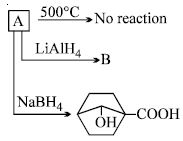
Organic compound $A$ does not undergo decarboxylation reaction because?
A
Intermediate does not follow Saytzeff's rule
B
Intermediate does not follow Hofmann's rule
C
Intermediate does not follow Bredt's rule
D
Intermediate does not follow Markownikoff's rule
Solution
(C) The compound $A$ is a bridged bicyclic carboxylic acid.
Decarboxylation typically involves the formation of a carbanion or a carbocation intermediate.
In this specific bridged system,the formation of a double bond at the bridgehead position (which would be required for the transition state or intermediate during decarboxylation) is forbidden by Bredt's rule.
Bredt's rule states that a double bond cannot be placed at the bridgehead of a bridged ring system unless the rings are large enough to accommodate the strain.
Decarboxylation typically involves the formation of a carbanion or a carbocation intermediate.
In this specific bridged system,the formation of a double bond at the bridgehead position (which would be required for the transition state or intermediate during decarboxylation) is forbidden by Bredt's rule.
Bredt's rule states that a double bond cannot be placed at the bridgehead of a bridged ring system unless the rings are large enough to accommodate the strain.
0 likes
View Solution313
MediumMCQ
The product obtained when benzoyl acetic acid is heated with soda-lime is:
A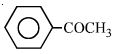
Acetophenone
B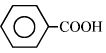
Benzene
C
Benzoic acid
D
Toluene
Solution
(A) Heating a carboxylic acid with soda-lime $(NaOH + CaO)$ leads to decarboxylation,which involves the removal of a $CO_2$ molecule.
Benzoyl acetic acid is $C_6H_5-CO-CH_2-COOH$.
Upon heating with soda-lime,the $-COOH$ group is removed as $Na_2CO_3$,and the hydrogen atom replaces the carboxyl group.
The reaction is: $C_6H_5-CO-CH_2-COOH \xrightarrow{\Delta, NaOH/CaO} C_6H_5-CO-CH_3 + CO_2$.
The product formed is Acetophenone $(C_6H_5-CO-CH_3)$.
Benzoyl acetic acid is $C_6H_5-CO-CH_2-COOH$.
Upon heating with soda-lime,the $-COOH$ group is removed as $Na_2CO_3$,and the hydrogen atom replaces the carboxyl group.
The reaction is: $C_6H_5-CO-CH_2-COOH \xrightarrow{\Delta, NaOH/CaO} C_6H_5-CO-CH_3 + CO_2$.
The product formed is Acetophenone $(C_6H_5-CO-CH_3)$.
0 likes
View Solution314
DifficultMCQ
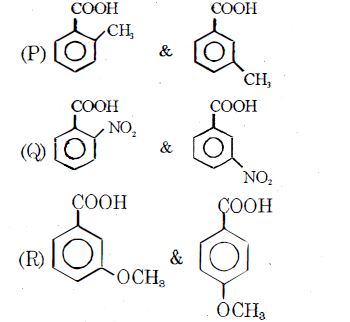
The set representing the more acidic compound among each of the following $3$ pairs is:
A
$2$-methylbenzoic acid,$2$-nitrobenzoic acid,$3$-methoxybenzoic acid
B
$2$-methylbenzoic acid,$2$-nitrobenzoic acid,$3$-methoxybenzoic acid
C
$2$-methylbenzoic acid,$2$-nitrobenzoic acid,$3$-methoxybenzoic acid
D
$3$-methylbenzoic acid,$3$-nitrobenzoic acid,$4$-methoxybenzoic acid
Solution
(A) To determine the acidity,we consider the electronic effects (inductive,resonance,and ortho effect) of the substituents on the benzoic acid ring.
$(P)$ Pair: $2$-methylbenzoic acid vs $3$-methylbenzoic acid. Due to the ortho effect,$2$-methylbenzoic acid is more acidic than $3$-methylbenzoic acid.
$(Q)$ Pair: $2$-nitrobenzoic acid vs $3$-nitrobenzoic acid. Due to the ortho effect,$2$-nitrobenzoic acid is more acidic than $3$-nitrobenzoic acid.
$(R)$ Pair: $3$-methoxybenzoic acid vs $4$-methoxybenzoic acid. In $3$-methoxybenzoic acid,the $-OCH_3$ group exerts a $-I$ effect,which increases acidity. In $4$-methoxybenzoic acid,the $-OCH_3$ group exerts a strong $+M$ effect,which decreases acidity. Thus,$3$-methoxybenzoic acid is more acidic.
Therefore,the set of more acidic compounds is $2$-methylbenzoic acid,$2$-nitrobenzoic acid,and $3$-methoxybenzoic acid.
$(P)$ Pair: $2$-methylbenzoic acid vs $3$-methylbenzoic acid. Due to the ortho effect,$2$-methylbenzoic acid is more acidic than $3$-methylbenzoic acid.
$(Q)$ Pair: $2$-nitrobenzoic acid vs $3$-nitrobenzoic acid. Due to the ortho effect,$2$-nitrobenzoic acid is more acidic than $3$-nitrobenzoic acid.
$(R)$ Pair: $3$-methoxybenzoic acid vs $4$-methoxybenzoic acid. In $3$-methoxybenzoic acid,the $-OCH_3$ group exerts a $-I$ effect,which increases acidity. In $4$-methoxybenzoic acid,the $-OCH_3$ group exerts a strong $+M$ effect,which decreases acidity. Thus,$3$-methoxybenzoic acid is more acidic.
Therefore,the set of more acidic compounds is $2$-methylbenzoic acid,$2$-nitrobenzoic acid,and $3$-methoxybenzoic acid.
0 likes
View Solution315
DifficultMCQ
How many organic products will be formed when the following compound undergoes decarboxylation?
(Image: $A$ substituted cyclopentane ring with two $-COOH$ groups at the same carbon atom,and two $-CH_3$ groups at adjacent carbons.)
(Image: $A$ substituted cyclopentane ring with two $-COOH$ groups at the same carbon atom,and two $-CH_3$ groups at adjacent carbons.)
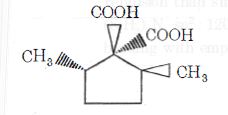
A
$0$
B
$1$
C
$2$
D
$3$
Solution
(B) The given compound is a gem-dicarboxylic acid (malonic acid derivative) attached to a cyclopentane ring.
Decarboxylation of a gem-dicarboxylic acid involves the loss of one molecule of $CO_2$ to form a monocarboxylic acid.
In the given structure,the two $-COOH$ groups are on the same carbon atom.
Upon heating,one of the $-COOH$ groups is lost as $CO_2$.
Since the carbon atom bearing the two $-COOH$ groups is a chiral center,the removal of one $-COOH$ group creates a new chiral center (or retains existing ones).
However,the question asks for the number of organic products formed.
Since the starting material is a single stereoisomer,the decarboxylation process typically proceeds through a cyclic transition state that preserves the stereochemistry at the other centers.
Thus,only $1$ organic product (a specific stereoisomer of the resulting monocarboxylic acid) is formed.
Decarboxylation of a gem-dicarboxylic acid involves the loss of one molecule of $CO_2$ to form a monocarboxylic acid.
In the given structure,the two $-COOH$ groups are on the same carbon atom.
Upon heating,one of the $-COOH$ groups is lost as $CO_2$.
Since the carbon atom bearing the two $-COOH$ groups is a chiral center,the removal of one $-COOH$ group creates a new chiral center (or retains existing ones).
However,the question asks for the number of organic products formed.
Since the starting material is a single stereoisomer,the decarboxylation process typically proceeds through a cyclic transition state that preserves the stereochemistry at the other centers.
Thus,only $1$ organic product (a specific stereoisomer of the resulting monocarboxylic acid) is formed.
0 likes
View Solution316
MediumMCQ
$R-CO-OR' \xrightarrow{LiAlH_4} B + C$. Both $B$ and $C$ give a positive iodoform test. $R$ and $R'$ can be:
A
$-Et, -Et$
B
$-CH_3, -CH_3$
C
$-CH_3, -CH(CH_3)_2$
D
$-Et, -CH(CH_3)_2$
Solution
(C) The reduction of an ester $R-CO-OR'$ with $LiAlH_4$ yields two alcohols: $R-CH_2OH$ and $R'-OH$.
For an alcohol to give a positive iodoform test,it must be ethanol $(CH_3CH_2OH)$ or a secondary alcohol with a methyl group attached to the carbinol carbon $(CH_3CH(OH)R)$.
$1.$ If $R = -CH_3$,then $B = CH_3CH_2OH$ (ethanol),which gives a positive iodoform test.
$2.$ If $R' = -CH(CH_3)_2$ (isopropyl group),then $C = (CH_3)_2CHOH$ (propan$-2-$ol),which also gives a positive iodoform test.
Therefore,the correct combination is $R = -CH_3$ and $R' = -CH(CH_3)_2$.
For an alcohol to give a positive iodoform test,it must be ethanol $(CH_3CH_2OH)$ or a secondary alcohol with a methyl group attached to the carbinol carbon $(CH_3CH(OH)R)$.
$1.$ If $R = -CH_3$,then $B = CH_3CH_2OH$ (ethanol),which gives a positive iodoform test.
$2.$ If $R' = -CH(CH_3)_2$ (isopropyl group),then $C = (CH_3)_2CHOH$ (propan$-2-$ol),which also gives a positive iodoform test.
Therefore,the correct combination is $R = -CH_3$ and $R' = -CH(CH_3)_2$.
0 likes
View Solution317
DifficultMCQ
Determine the decreasing order of the acidic nature of the given compounds $P$,$Q$,$R$,and $S$.
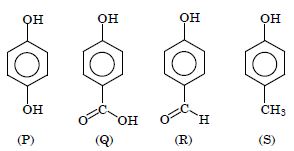
A
$P > Q > R > S$
B
$Q > R > P > S$
C
$R > Q > S > P$
D
$P > R > Q > S$
Solution
(B) The acidity of a compound depends on the stability of its conjugate base. Electron-withdrawing groups $(EWG)$ increase acidity by stabilizing the negative charge,while electron-donating groups $(EDG)$ decrease acidity by destabilizing it.
$Q$ is $p$-hydroxybenzoic acid. The $-COOH$ group is a strong $EWG$,making it the most acidic.
$R$ is $p$-hydroxybenzaldehyde. The $-CHO$ group is an $EWG$,but less acidic than the carboxylic acid group.
$P$ is hydroquinone ($p$-dihydroxybenzene). The $-OH$ group at the para position acts as an $EDG$ via resonance,but it is less donating than the alkyl group.
$S$ is $p$-cresol ($p$-methylphenol). The $-CH_3$ group is an $EDG$ via hyperconjugation and inductive effect,making it the least acidic.
Therefore,the decreasing order of acidity is $Q > R > P > S$.
$Q$ is $p$-hydroxybenzoic acid. The $-COOH$ group is a strong $EWG$,making it the most acidic.
$R$ is $p$-hydroxybenzaldehyde. The $-CHO$ group is an $EWG$,but less acidic than the carboxylic acid group.
$P$ is hydroquinone ($p$-dihydroxybenzene). The $-OH$ group at the para position acts as an $EDG$ via resonance,but it is less donating than the alkyl group.
$S$ is $p$-cresol ($p$-methylphenol). The $-CH_3$ group is an $EDG$ via hyperconjugation and inductive effect,making it the least acidic.
Therefore,the decreasing order of acidity is $Q > R > P > S$.
0 likes
View Solution318
MediumMCQ
Which of the following on reaction with excess $RMgX$ will give only $2^o$ alcohol?
A
$CH_3-C(=O)-O-CH(CH_3)_2$
B
$H-C(=O)-O-CH_2-CH_3$
C
$H-C(=O)-O-CH(CH_3)_2$
D
$CH_3-C(=O)-O-CH_3$
Solution
(C) When a formate ester $(H-COOR')$ reacts with excess Grignard reagent $(RMgX)$,it produces a secondary alcohol from the formate part and another alcohol from the alkoxy part $(R'OH)$.
Reaction: $H-COOR' + 2RMgX \xrightarrow{H_2O} R_2CH-OH + R'-OH$.
In option $(C)$,$H-C(=O)-O-CH(CH_3)_2$ (isopropyl formate),the products are $R_2CH-OH$ (a $2^o$ alcohol) and $(CH_3)_2CH-OH$ (isopropanol,which is also a $2^o$ alcohol). Thus,it gives only $2^o$ alcohols.
In options $(A)$ and $(D)$,the acetate part gives a $3^o$ alcohol.
In option $(B)$,the alkoxy part gives a $1^o$ alcohol $(CH_3CH_2OH)$.
Reaction: $H-COOR' + 2RMgX \xrightarrow{H_2O} R_2CH-OH + R'-OH$.
In option $(C)$,$H-C(=O)-O-CH(CH_3)_2$ (isopropyl formate),the products are $R_2CH-OH$ (a $2^o$ alcohol) and $(CH_3)_2CH-OH$ (isopropanol,which is also a $2^o$ alcohol). Thus,it gives only $2^o$ alcohols.
In options $(A)$ and $(D)$,the acetate part gives a $3^o$ alcohol.
In option $(B)$,the alkoxy part gives a $1^o$ alcohol $(CH_3CH_2OH)$.
0 likes
View Solution319
DifficultMCQ
Which of the following reactions will not produce $CO_2$?
A
$CH_3-CH_2-SO_3H \xrightarrow{NaHCO_3}$
B
Malonic acid $\xrightarrow{\Delta}$
C
$CH_3-CH_2-COONa \xrightarrow{\text{Electrolysis}}$
D
$\beta$-keto acid $\xrightarrow{\Delta}$
Solution
(A) Let's analyze each reaction:
$(A)$ $CH_3-CH_2-SO_3H + NaHCO_3 \rightarrow CH_3-CH_2-SO_3Na + H_2O + CO_2$. Sulfonic acids are stronger than carbonic acid,so they react with $NaHCO_3$ to release $CO_2$.
$(B)$ Malonic acid $(HOOC-CH_2-COOH)$ on heating undergoes decarboxylation to produce acetic acid and $CO_2$.
$(C)$ Kolbe's electrolysis of sodium propionate $(CH_3-CH_2-COONa)$ produces $CO_2$ at the anode along with butane and $H_2$.
$(D)$ $\beta$-keto acids (like the one shown in the image) undergo decarboxylation on heating to release $CO_2$.
Wait,re-evaluating $(A)$: While sulfonic acids are strong,the reaction $R-SO_3H + NaHCO_3 \rightarrow R-SO_3Na + H_2O + CO_2$ is standard. However,in many contexts,this question is designed to test the acidity relative to $NaHCO_3$. All options listed actually produce $CO_2$. Let's re-examine the options provided. If the question implies which one does $NOT$,and all do,there might be a nuance. Actually,all these reactions are known to produce $CO_2$. Given the standard nature of these reactions,all produce $CO_2$.
$(A)$ $CH_3-CH_2-SO_3H + NaHCO_3 \rightarrow CH_3-CH_2-SO_3Na + H_2O + CO_2$. Sulfonic acids are stronger than carbonic acid,so they react with $NaHCO_3$ to release $CO_2$.
$(B)$ Malonic acid $(HOOC-CH_2-COOH)$ on heating undergoes decarboxylation to produce acetic acid and $CO_2$.
$(C)$ Kolbe's electrolysis of sodium propionate $(CH_3-CH_2-COONa)$ produces $CO_2$ at the anode along with butane and $H_2$.
$(D)$ $\beta$-keto acids (like the one shown in the image) undergo decarboxylation on heating to release $CO_2$.
Wait,re-evaluating $(A)$: While sulfonic acids are strong,the reaction $R-SO_3H + NaHCO_3 \rightarrow R-SO_3Na + H_2O + CO_2$ is standard. However,in many contexts,this question is designed to test the acidity relative to $NaHCO_3$. All options listed actually produce $CO_2$. Let's re-examine the options provided. If the question implies which one does $NOT$,and all do,there might be a nuance. Actually,all these reactions are known to produce $CO_2$. Given the standard nature of these reactions,all produce $CO_2$.
0 likes
View Solution320
MediumMCQ
Identify the reaction which will $NOT$ produce an alcohol as a major product.
A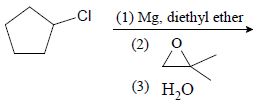
B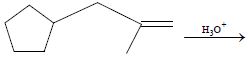
C
D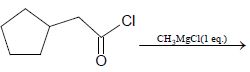
Solution
(D) Let us analyze each reaction:
$A$: Cyclopentyl magnesium chloride reacts with $2,2$-dimethyloxirane to form a primary alcohol after hydrolysis.
$B$: Acid-catalyzed hydration of an alkene ($1$-cyclopentylprop-$1$-ene) follows Markovnikov's rule to produce an alcohol.
$C$: Reaction of a ketone ($1$-cyclopentylpropan-$2$-one) with $1$ equivalent of Grignard reagent $(CH_3MgCl)$ produces a tertiary alcohol.
$D$: Reaction of an acid chloride (cyclopentylacetyl chloride) with $1$ equivalent of Grignard reagent $(CH_3MgCl)$ produces a ketone as the major product,not an alcohol. Further reaction with another equivalent of Grignard reagent would be required to form a tertiary alcohol. Therefore,this reaction will not produce an alcohol as the major product under the given conditions.
$A$: Cyclopentyl magnesium chloride reacts with $2,2$-dimethyloxirane to form a primary alcohol after hydrolysis.
$B$: Acid-catalyzed hydration of an alkene ($1$-cyclopentylprop-$1$-ene) follows Markovnikov's rule to produce an alcohol.
$C$: Reaction of a ketone ($1$-cyclopentylpropan-$2$-one) with $1$ equivalent of Grignard reagent $(CH_3MgCl)$ produces a tertiary alcohol.
$D$: Reaction of an acid chloride (cyclopentylacetyl chloride) with $1$ equivalent of Grignard reagent $(CH_3MgCl)$ produces a ketone as the major product,not an alcohol. Further reaction with another equivalent of Grignard reagent would be required to form a tertiary alcohol. Therefore,this reaction will not produce an alcohol as the major product under the given conditions.
0 likes
View Solution321
MediumMCQ
Which of the following has the highest $pK_a$ value?
A
$Br-CH_2-CH_2-COOH$
B
$CH_3-CH_2-COOH$
C
$CH_3-CH(Br)-COOH$
D
$CH_3-C(Br)_2-COOH$
Solution
(B) $pK_a$ value is inversely proportional to the acid strength $(pK_a = -\log K_a)$.
Electron-withdrawing groups ($-I$ effect) like $-Br$ increase the acidity of carboxylic acids by stabilizing the carboxylate anion,thereby decreasing the $pK_a$ value.
The closer the $-I$ group is to the $-COOH$ group,or the more $-I$ groups there are,the stronger the acid.
$1.$ $CH_3-C(Br)_2-COOH$ (Two $-Br$ groups at $\alpha$-position) is the strongest acid (lowest $pK_a$).
$2.$ $CH_3-CH(Br)-COOH$ (One $-Br$ group at $\alpha$-position) is the next strongest.
$3.$ $Br-CH_2-CH_2-COOH$ (One $-Br$ group at $\beta$-position) is weaker than the $\alpha$-substituted one.
$4.$ $CH_3-CH_2-COOH$ has no electron-withdrawing group,only the electron-donating $+I$ effect of the ethyl group,making it the weakest acid and thus giving it the highest $pK_a$ value.
Electron-withdrawing groups ($-I$ effect) like $-Br$ increase the acidity of carboxylic acids by stabilizing the carboxylate anion,thereby decreasing the $pK_a$ value.
The closer the $-I$ group is to the $-COOH$ group,or the more $-I$ groups there are,the stronger the acid.
$1.$ $CH_3-C(Br)_2-COOH$ (Two $-Br$ groups at $\alpha$-position) is the strongest acid (lowest $pK_a$).
$2.$ $CH_3-CH(Br)-COOH$ (One $-Br$ group at $\alpha$-position) is the next strongest.
$3.$ $Br-CH_2-CH_2-COOH$ (One $-Br$ group at $\beta$-position) is weaker than the $\alpha$-substituted one.
$4.$ $CH_3-CH_2-COOH$ has no electron-withdrawing group,only the electron-donating $+I$ effect of the ethyl group,making it the weakest acid and thus giving it the highest $pK_a$ value.
0 likes
View Solution322
DifficultMCQ
Which of the following has the most acidic hydrogen?
A
$CH_3CHO$
B
$CH_3COCH_2COCH_3$
C
$CH_3COCH(COCH_3)COCH_3$
D
$CH_3CH_2CHO$
Solution
(C) The acidity of $\alpha$-hydrogen increases with the number of electron-withdrawing groups ($-I$ and $-M$ effects) attached to the $\alpha$-carbon.
In $CH_3COCH(COCH_3)COCH_3$,the central carbon is attached to three carbonyl groups.
The conjugate base (carbanion) formed after the removal of the proton is highly stabilized by resonance with all three carbonyl groups,making this hydrogen the most acidic among the given options.
In $CH_3COCH(COCH_3)COCH_3$,the central carbon is attached to three carbonyl groups.
The conjugate base (carbanion) formed after the removal of the proton is highly stabilized by resonance with all three carbonyl groups,making this hydrogen the most acidic among the given options.
0 likes
View Solution323
DifficultMCQ
Which of the following represents the correct order of acidity?
A
$CF_3OH < CCl_3OH$
B
$CHCl_3 < CHF_3$
C
$4\text{-chlorophenol} < 4\text{-fluorophenol}$
D
$Cl_3C-CO_2H < F_3C-CO_2H$
Solution
(C) Acidity is determined by the stability of the conjugate base formed after the loss of a proton $(H^+)$. Electron-withdrawing groups $(EWG)$ stabilize the conjugate base through the inductive effect ($-I$ effect),thereby increasing acidity.
$(A)$ $CF_3OH$ is more acidic than $CCl_3OH$ because $F$ is more electronegative than $Cl$,exerting a stronger $-I$ effect.
$(B)$ $CHF_3$ is more acidic than $CHCl_3$ because $F$ is more electronegative than $Cl$,stabilizing the carbanion formed after deprotonation.
$(C)$ In $4\text{-fluorophenol}$,the $F$ atom exerts a strong $-I$ effect,which stabilizes the phenoxide ion more effectively than the $Cl$ atom in $4\text{-chlorophenol}$. Thus,$4\text{-chlorophenol} < 4\text{-fluorophenol}$ is correct.
$(D)$ $F_3C-CO_2H$ is more acidic than $Cl_3C-CO_2H$ due to the stronger $-I$ effect of the $CF_3$ group compared to the $CCl_3$ group.
All options provided represent correct acidity orders based on the $-I$ effect.
$(A)$ $CF_3OH$ is more acidic than $CCl_3OH$ because $F$ is more electronegative than $Cl$,exerting a stronger $-I$ effect.
$(B)$ $CHF_3$ is more acidic than $CHCl_3$ because $F$ is more electronegative than $Cl$,stabilizing the carbanion formed after deprotonation.
$(C)$ In $4\text{-fluorophenol}$,the $F$ atom exerts a strong $-I$ effect,which stabilizes the phenoxide ion more effectively than the $Cl$ atom in $4\text{-chlorophenol}$. Thus,$4\text{-chlorophenol} < 4\text{-fluorophenol}$ is correct.
$(D)$ $F_3C-CO_2H$ is more acidic than $Cl_3C-CO_2H$ due to the stronger $-I$ effect of the $CF_3$ group compared to the $CCl_3$ group.
All options provided represent correct acidity orders based on the $-I$ effect.
0 likes
View Solution324
MediumMCQ
$Ph-COOH + C_2H_5-^{18}OH \xrightarrow{Conc. H_2SO_4} \text{Major product will be}$
A
$Ph-C(=^{18}O)-O-C_2H_5$
B
$C_2H_5-C(=O)-^{18}O-Ph$
C
$C_2H_5-C(=^{18}O)-O-Ph$
D
$Ph-C(=O)-^{18}O-C_2H_5$
Solution
(D) In the Fischer esterification reaction between a carboxylic acid and an alcohol,the $OH$ group is removed from the carboxylic acid and the $H$ atom is removed from the alcohol to form water $(H_2O)$.
Therefore,the oxygen atom from the alcohol $(^{18}O)$ is incorporated into the ester linkage.
The reaction is: $Ph-COOH + C_2H_5-^{18}OH \xrightarrow{H^+} Ph-C(=O)-^{18}O-C_2H_5 + H_2O$.
Thus,the correct option is $D$.
Therefore,the oxygen atom from the alcohol $(^{18}O)$ is incorporated into the ester linkage.
The reaction is: $Ph-COOH + C_2H_5-^{18}OH \xrightarrow{H^+} Ph-C(=O)-^{18}O-C_2H_5 + H_2O$.
Thus,the correct option is $D$.
0 likes
View Solution325
MediumMCQ
What is the order of reactivity of the following compounds towards sodalime decarboxylation?
$(i)$ $m$-nitro-phenylacetic acid
(ii) $p$-nitro-phenylacetic acid
(iii) $p$-methoxy-phenylacetic acid
(iv) $p$-methyl-phenylacetic acid
$(i)$ $m$-nitro-phenylacetic acid
(ii) $p$-nitro-phenylacetic acid
(iii) $p$-methoxy-phenylacetic acid
(iv) $p$-methyl-phenylacetic acid
A
$i > ii > iii > iv$
B
$ii > i > iii > iv$
C
$ii > i > iv > iii$
D
$i > ii > iv > iii$
Solution
(C) Sodalime decarboxylation involves the formation of a carbanion intermediate. The rate of decarboxylation is directly proportional to the stability of the carbanion formed.
Electron-withdrawing groups $(EWG)$ stabilize the carbanion,while electron-donating groups $(EDG)$ destabilize it.
The stability order of the carbanion intermediate is determined by the inductive effect ($-I$ effect) of the substituents.
$(i)$ $m$-nitro group exerts a strong $-I$ effect.
(ii) $p$-nitro group exerts a strong $-I$ effect. Since the $p$-position is closer to the reaction center in terms of inductive influence compared to the $m$-position in this specific structure,or considering the overall electron-withdrawing strength,the order is $ii > i$.
(iii) $-OMe$ is an electron-donating group ($+M$ effect,though $-I$ at distance),which destabilizes the carbanion.
(iv) $-CH_3$ is an electron-donating group ($+I$ effect),which also destabilizes the carbanion,but less than $-OMe$.
Thus,the reactivity order is $ii > i > iv > iii$.
Electron-withdrawing groups $(EWG)$ stabilize the carbanion,while electron-donating groups $(EDG)$ destabilize it.
The stability order of the carbanion intermediate is determined by the inductive effect ($-I$ effect) of the substituents.
$(i)$ $m$-nitro group exerts a strong $-I$ effect.
(ii) $p$-nitro group exerts a strong $-I$ effect. Since the $p$-position is closer to the reaction center in terms of inductive influence compared to the $m$-position in this specific structure,or considering the overall electron-withdrawing strength,the order is $ii > i$.
(iii) $-OMe$ is an electron-donating group ($+M$ effect,though $-I$ at distance),which destabilizes the carbanion.
(iv) $-CH_3$ is an electron-donating group ($+I$ effect),which also destabilizes the carbanion,but less than $-OMe$.
Thus,the reactivity order is $ii > i > iv > iii$.
0 likes
View Solution326
MediumMCQ
Which of the following compounds is most reactive towards Grignard's reagent?
A
$H_2O$
B
$CH_3OH$
C
$CH_3COOH$
D
$CH_3SO_3H$
Solution
(D) Grignard's reagents $(RMgX)$ are strong bases and react rapidly with any compound containing an active hydrogen atom (acidic proton).
The reactivity towards Grignard's reagent depends on the acidity of the compound.
The order of acidity for the given compounds is: $CH_3SO_3H > CH_3COOH > CH_3OH > H_2O$.
Since $CH_3SO_3H$ (methanesulfonic acid) is the strongest acid among the given options,it has the most acidic proton and is therefore the most reactive towards the Grignard's reagent.
The reactivity towards Grignard's reagent depends on the acidity of the compound.
The order of acidity for the given compounds is: $CH_3SO_3H > CH_3COOH > CH_3OH > H_2O$.
Since $CH_3SO_3H$ (methanesulfonic acid) is the strongest acid among the given options,it has the most acidic proton and is therefore the most reactive towards the Grignard's reagent.
0 likes
View Solution327
DifficultMCQ
In the following sequence of reaction,$CH_3Br$ $\xrightarrow{KCN} (A)$ $\xrightarrow{H_3O^{+}} (B)$ $\xrightarrow{LiAlH_4, \text{ ether}} (C)$. The end product $(C)$ is
A
Acetone
B
Methane
C
Acetaldehyde
D
Ethyl alcohol
Solution
(D) $CH_3Br$ $\xrightarrow{KCN} CH_3CN (A)$ $\xrightarrow{H_3O^{+}} CH_3COOH (B)$ $\xrightarrow{LiAlH_4} CH_3CH_2OH (C)$
$1$. $CH_3Br$ reacts with $KCN$ via nucleophilic substitution to form acetonitrile $(CH_3CN)$.
$2$. Acidic hydrolysis of $CH_3CN$ yields acetic acid $(CH_3COOH)$.
$3$. $LiAlH_4$ is a strong reducing agent that reduces the carboxylic acid group $(-COOH)$ to a primary alcohol $(-CH_2OH)$.
Thus,the final product $(C)$ is ethyl alcohol $(CH_3CH_2OH)$.
$1$. $CH_3Br$ reacts with $KCN$ via nucleophilic substitution to form acetonitrile $(CH_3CN)$.
$2$. Acidic hydrolysis of $CH_3CN$ yields acetic acid $(CH_3COOH)$.
$3$. $LiAlH_4$ is a strong reducing agent that reduces the carboxylic acid group $(-COOH)$ to a primary alcohol $(-CH_2OH)$.
Thus,the final product $(C)$ is ethyl alcohol $(CH_3CH_2OH)$.
0 likes
View Solution328
MediumMCQ
Which of the following is a tribasic acid?
A
Succinic acid
B
Tartaric acid
C
Citric acid
D
Adipic acid
Solution
(C) Succinic acid $(HOOC-(CH_2)_2-COOH)$ is a dibasic acid.
Tartaric acid $(HOOC-CH(OH)-CH(OH)-COOH)$ is a dibasic acid.
Adipic acid $(HOOC-(CH_2)_4-COOH)$ is a dibasic acid.
Citric acid ($C_6H_8O_7$ or $HOOC-CH_2-C(OH)(COOH)-CH_2-COOH$) contains three carboxylic acid groups $(-COOH)$,making it a tribasic acid.
Tartaric acid $(HOOC-CH(OH)-CH(OH)-COOH)$ is a dibasic acid.
Adipic acid $(HOOC-(CH_2)_4-COOH)$ is a dibasic acid.
Citric acid ($C_6H_8O_7$ or $HOOC-CH_2-C(OH)(COOH)-CH_2-COOH$) contains three carboxylic acid groups $(-COOH)$,making it a tribasic acid.
0 likes
View Solution329
MediumMCQ
$RCOOH + NaHCO_3 \to RCOONa + H_2O + CO_2$. In this reaction,the $CO_2$ evolved comes from:
A
$RCOOH$
B
$NaHCO_3$
C
Both $RCOOH$ and $NaHCO_3$
D
Aqueous $H_2O$
Solution
(B) The reaction between a carboxylic acid $(RCOOH)$ and sodium bicarbonate $(NaHCO_3)$ is an acid-base reaction.
$RCOOH + NaHCO_3 \to RCOONa + H_2O + CO_2$
In this process,the $H^+$ ion from the carboxylic acid reacts with the $HCO_3^-$ ion from sodium bicarbonate to form carbonic acid $(H_2CO_3)$,which is unstable and decomposes into water $(H_2O)$ and carbon dioxide $(CO_2)$.
Since the $CO_2$ is produced from the decomposition of the bicarbonate ion $(HCO_3^-)$,the evolved $CO_2$ comes from $NaHCO_3$.
$RCOOH + NaHCO_3 \to RCOONa + H_2O + CO_2$
In this process,the $H^+$ ion from the carboxylic acid reacts with the $HCO_3^-$ ion from sodium bicarbonate to form carbonic acid $(H_2CO_3)$,which is unstable and decomposes into water $(H_2O)$ and carbon dioxide $(CO_2)$.
Since the $CO_2$ is produced from the decomposition of the bicarbonate ion $(HCO_3^-)$,the evolved $CO_2$ comes from $NaHCO_3$.
0 likes
View Solution330
MediumMCQ
Product $B$ in the following reaction is: $CH_3-COOH$ $\xrightarrow{NH_3, \Delta} A$ $\xrightarrow{P_2O_5, \Delta} B$
A
$CH_3-CN$
B
$CH_3-CONH_2$
C
$CH_3-NH_2$
D
$CH_3-CH_2-NH_2$
Solution
(A) Acetic acid $(CH_3-COOH)$ reacts with ammonia $(NH_3)$ followed by heating to form acetamide ($A$,$CH_3-CONH_2$).
Acetamide on dehydration with phosphorus pentoxide $(P_2O_5)$ undergoes elimination of water to yield methyl cyanide ($B$,$CH_3-CN$).
The reaction sequence is:
$CH_3-COOH$ $\xrightarrow{NH_3, \Delta} CH_3-CONH_2 (A)$ $\xrightarrow{P_2O_5, \Delta} CH_3-CN (B)$
Acetamide on dehydration with phosphorus pentoxide $(P_2O_5)$ undergoes elimination of water to yield methyl cyanide ($B$,$CH_3-CN$).
The reaction sequence is:
$CH_3-COOH$ $\xrightarrow{NH_3, \Delta} CH_3-CONH_2 (A)$ $\xrightarrow{P_2O_5, \Delta} CH_3-CN (B)$
0 likes
View Solution331
DifficultMCQ
When carboxylic acid is treated with chlorine in the presence of red phosphorus,an alpha-chloro acid is formed. This reaction is known as:
A
Hunsdicker reaction
B
Hell-Volhard-Zelinsky reaction
C
Friedel-Crafts reaction
D
Rosenmund reduction
Solution
(B) The reaction of carboxylic acids with chlorine or bromine in the presence of a small amount of red phosphorus to form alpha-halo acids is known as the Hell-Volhard-Zelinsky reaction.
$R-CH_2-COOH \xrightarrow{i. X_2 / \text{red } P, ii. H_2O} R-CH(X)-COOH$
In this reaction,the alpha-hydrogen atom of the carboxylic acid is replaced by a halogen atom.
$R-CH_2-COOH \xrightarrow{i. X_2 / \text{red } P, ii. H_2O} R-CH(X)-COOH$
In this reaction,the alpha-hydrogen atom of the carboxylic acid is replaced by a halogen atom.
0 likes
View Solution332
MediumMCQ
Arrange the following compounds in order of their acidic strength :-
$(i) \, CF_3SO_3H, \, (ii) \, C_6H_5COOH, \, (iii) \, C_6H_5OH$
$(i) \, CF_3SO_3H, \, (ii) \, C_6H_5COOH, \, (iii) \, C_6H_5OH$
A
$i > ii > iii$
B
$iii > ii > i$
C
$iii > i > ii$
D
$i > iii > ii$
Solution
(A) $CF_3SO_3H$ (Trifluoromethanesulfonic acid) is a superacid due to the strong electron-withdrawing effect of the $CF_3$ group and the resonance stabilization of the conjugate base $CF_3SO_3^-$.
$C_6H_5COOH$ (Benzoic acid) is a carboxylic acid,which is more acidic than phenol due to the resonance stabilization of the carboxylate ion.
$C_6H_5OH$ (Phenol) is a weak acid compared to carboxylic acids.
Therefore,the order of acidic strength is $(i) > (ii) > (iii)$.
$C_6H_5COOH$ (Benzoic acid) is a carboxylic acid,which is more acidic than phenol due to the resonance stabilization of the carboxylate ion.
$C_6H_5OH$ (Phenol) is a weak acid compared to carboxylic acids.
Therefore,the order of acidic strength is $(i) > (ii) > (iii)$.
0 likes
View Solution333
MediumMCQ
$CH_3-CH_2-C(=O)-OCH_3 + 2CH_3MgBr \to A \xrightarrow[\Delta]{H^+} B$
The product $B$ is:
The product $B$ is:
A
$CH_3-C(CH_3)=CH-CH_3$
B
$CH_3-CH(CH_3)-CH=CH_2$
C
$CH_3-C(OH)(CH_3)-CH_2-CH_3$
D
$CH_3-C(CH_3)_2-CH_2-OH$
Solution
(A) Methyl propionate $(CH_3-CH_2-COOCH_3)$ reacts with two equivalents of Grignard reagent $(CH_3MgBr)$ to form $2$-methylbutan-$2$-ol $(A)$.
$CH_3-CH_2-COOCH_3 + 2CH_3MgBr \to CH_3-CH_2-C(OH)(CH_3)_2 + CH_3OMgBr$
Acid-catalyzed dehydration of $2$-methylbutan-$2$-ol $(A)$ follows Saytzeff's rule to give $2$-methylbut-$2$-ene $(B)$ as the major product.
$CH_3-CH_2-C(OH)(CH_3)_2 \xrightarrow[\Delta]{H^+} CH_3-CH=C(CH_3)_2 + H_2O$
$CH_3-CH_2-COOCH_3 + 2CH_3MgBr \to CH_3-CH_2-C(OH)(CH_3)_2 + CH_3OMgBr$
Acid-catalyzed dehydration of $2$-methylbutan-$2$-ol $(A)$ follows Saytzeff's rule to give $2$-methylbut-$2$-ene $(B)$ as the major product.
$CH_3-CH_2-C(OH)(CH_3)_2 \xrightarrow[\Delta]{H^+} CH_3-CH=C(CH_3)_2 + H_2O$
0 likes
View Solution334
MediumMCQ
The reaction $RCOOR' \to RCH_2OH + R'OH$ is known as:
A
Bouveault-Blanc reduction
B
Stephen reduction
C
Wolff-Kishner reduction
D
Clemmensen reduction
Solution
(A) The reduction of esters to primary alcohols using sodium and ethanol is known as the Bouveault-Blanc reduction.
The reaction is represented as: $RCOOR' + 4[H] \xrightarrow{Na/C_2H_5OH} RCH_2OH + R'OH$
The reaction is represented as: $RCOOR' + 4[H] \xrightarrow{Na/C_2H_5OH} RCH_2OH + R'OH$
0 likes
View Solution335
MediumMCQ
Which one of the following esters gets hydrolysed most easily under alkaline conditions?
A
Phenyl acetate
B
p-Chlorophenyl acetate
C
p-Nitrophenyl acetate
D
p-Methoxyphenyl acetate
Solution
(C) The alkaline hydrolysis of an ester involves the nucleophilic attack of $OH^-$ on the carbonyl carbon. The rate of this reaction is increased by the presence of electron-withdrawing groups on the phenyl ring,as they make the carbonyl carbon more electrophilic and stabilize the transition state.
Comparing the substituents on the phenyl ring:
$1$. $-H$ (Phenyl acetate)
$2$. $-Cl$ (p-Chlorophenyl acetate) - Electron-withdrawing by inductive effect $(-I)$
$3$. $-NO_2$ (p-Nitrophenyl acetate) - Strong electron-withdrawing by both inductive $(-I)$ and resonance $(-M)$ effects
$4$. $-OCH_3$ (p-Methoxyphenyl acetate) - Electron-donating by resonance $(+M)$
The $-NO_2$ group is the strongest electron-withdrawing group among the given options. Therefore,$p$-Nitrophenyl acetate will be the most reactive towards alkaline hydrolysis.
Comparing the substituents on the phenyl ring:
$1$. $-H$ (Phenyl acetate)
$2$. $-Cl$ (p-Chlorophenyl acetate) - Electron-withdrawing by inductive effect $(-I)$
$3$. $-NO_2$ (p-Nitrophenyl acetate) - Strong electron-withdrawing by both inductive $(-I)$ and resonance $(-M)$ effects
$4$. $-OCH_3$ (p-Methoxyphenyl acetate) - Electron-donating by resonance $(+M)$
The $-NO_2$ group is the strongest electron-withdrawing group among the given options. Therefore,$p$-Nitrophenyl acetate will be the most reactive towards alkaline hydrolysis.
0 likes
View Solution336
DifficultMCQ
What is the correct acidic strength order of the following compounds?
A
p-Nitrophenol < Phenol < p-Methoxyphenol
B
m-Nitrobenzoic acid < Benzoic acid < m-Hydroxybenzoic acid
C
o-Toluic acid > m-Toluic acid > m-Ethylbenzoic acid
D
Benzoic acid < Phenol < Cyclohexanol
Solution
(C) To determine the correct acidic strength order,we analyze the electronic effects of substituents on the acidity of the parent compounds:
$A$. $p$-Nitrophenol is more acidic than phenol due to the $-M$ and $-I$ effects of the $-NO_2$ group,while $p$-methoxyphenol is less acidic due to the $+M$ effect of the $-OCH_3$ group. The correct order is $p$-Nitrophenol > Phenol > $p$-Methoxyphenol.
$B$. $m$-Nitrobenzoic acid is more acidic than benzoic acid due to the $-I$ effect of the $-NO_2$ group. $m$-Hydroxybenzoic acid is also more acidic than benzoic acid due to the $-I$ effect of the $-OH$ group. The order given is incorrect.
$C$. $o$-Toluic acid ($o$-methylbenzoic acid) is more acidic than $m$-toluic acid due to the ortho effect,which increases the acidity of ortho-substituted benzoic acids regardless of the nature of the substituent. $m$-Toluic acid is slightly more acidic than $m$-ethylbenzoic acid because the $+I$ effect of the ethyl group is stronger than that of the methyl group,making the conjugate base of $m$-ethylbenzoic acid less stable. Thus,$o$-Toluic acid > $m$-Toluic acid > $m$-Ethylbenzoic acid is the correct order.
$D$. Benzoic acid is significantly more acidic than phenol,and phenol is more acidic than cyclohexanol. The order given is incorrect.
$A$. $p$-Nitrophenol is more acidic than phenol due to the $-M$ and $-I$ effects of the $-NO_2$ group,while $p$-methoxyphenol is less acidic due to the $+M$ effect of the $-OCH_3$ group. The correct order is $p$-Nitrophenol > Phenol > $p$-Methoxyphenol.
$B$. $m$-Nitrobenzoic acid is more acidic than benzoic acid due to the $-I$ effect of the $-NO_2$ group. $m$-Hydroxybenzoic acid is also more acidic than benzoic acid due to the $-I$ effect of the $-OH$ group. The order given is incorrect.
$C$. $o$-Toluic acid ($o$-methylbenzoic acid) is more acidic than $m$-toluic acid due to the ortho effect,which increases the acidity of ortho-substituted benzoic acids regardless of the nature of the substituent. $m$-Toluic acid is slightly more acidic than $m$-ethylbenzoic acid because the $+I$ effect of the ethyl group is stronger than that of the methyl group,making the conjugate base of $m$-ethylbenzoic acid less stable. Thus,$o$-Toluic acid > $m$-Toluic acid > $m$-Ethylbenzoic acid is the correct order.
$D$. Benzoic acid is significantly more acidic than phenol,and phenol is more acidic than cyclohexanol. The order given is incorrect.
0 likes
View Solution337
MediumMCQ
Which of the following is more acidic than phenol?
A
$CH_3COOH$
B
Cyclohexanol
C
p-Cresol
D
$CH_3CH_2OH$
Solution
(A) The acidity of a compound depends on the stability of its conjugate base.
Phenol $(C_6H_5OH)$ is more acidic than alcohols like cyclohexanol and ethanol because the phenoxide ion is stabilized by resonance.
Carboxylic acids $(R-COOH)$ are significantly more acidic than phenols because the carboxylate ion is stabilized by two equivalent resonance structures,and the negative charge is delocalized over two electronegative oxygen atoms.
Therefore,$CH_3COOH$ is more acidic than phenol.
Phenol $(C_6H_5OH)$ is more acidic than alcohols like cyclohexanol and ethanol because the phenoxide ion is stabilized by resonance.
Carboxylic acids $(R-COOH)$ are significantly more acidic than phenols because the carboxylate ion is stabilized by two equivalent resonance structures,and the negative charge is delocalized over two electronegative oxygen atoms.
Therefore,$CH_3COOH$ is more acidic than phenol.
0 likes
View Solution338
AdvancedMCQ
Identify the product $B$ in the following reaction sequence:
$C_6H_5COOH$ $\xrightarrow{NaOH} A$ $\xrightarrow{\text{Electrolysis}} B$
$C_6H_5COOH$ $\xrightarrow{NaOH} A$ $\xrightarrow{\text{Electrolysis}} B$
A
Naphthalene
B
Biphenyl
C
Benzene
D
Decalin
Solution
(B) $1$. The reaction of benzoic acid $(C_6H_5COOH)$ with $NaOH$ produces sodium benzoate $(C_6H_5COONa)$,which is compound $A$.
$2$. The electrolysis of sodium salts of carboxylic acids is known as the Kolbe electrolysis.
$3$. In the Kolbe electrolysis of sodium benzoate,the carboxylate ion $(C_6H_5COO^-)$ undergoes oxidation at the anode to form a benzoyloxy radical $(C_6H_5COO\cdot)$,which then loses $CO_2$ to form a phenyl radical $(C_6H_5\cdot)$.
$4$. Two phenyl radicals combine to form biphenyl $(C_6H_5-C_6H_5)$,which is compound $B$.
$2$. The electrolysis of sodium salts of carboxylic acids is known as the Kolbe electrolysis.
$3$. In the Kolbe electrolysis of sodium benzoate,the carboxylate ion $(C_6H_5COO^-)$ undergoes oxidation at the anode to form a benzoyloxy radical $(C_6H_5COO\cdot)$,which then loses $CO_2$ to form a phenyl radical $(C_6H_5\cdot)$.
$4$. Two phenyl radicals combine to form biphenyl $(C_6H_5-C_6H_5)$,which is compound $B$.
0 likes
View Solution339
MediumMCQ
Which of the following is most acidic?
A
Benzoic acid
B
o-Nitrophenol
C
p-Nitrophenol
D
p-Nitrobenzoic acid
Solution
(D) To determine the most acidic compound,we compare the acidity of carboxylic acids and phenols. Carboxylic acids are significantly more acidic than phenols due to the resonance stabilization of the carboxylate anion $(RCOO^-)$ compared to the phenoxide anion $(PhO^-)$.
Among the given options:
$A$ is Benzoic acid $(C_6H_5COOH)$.
$B$ is $o$-Nitrophenol.
$C$ is $p$-Nitrophenol.
$D$ is $p$-Nitrobenzoic acid $(O_2N-C_6H_4-COOH)$.
Comparing $A$ and $D$,both are carboxylic acids. The nitro group $(-NO_2)$ is a strong electron-withdrawing group $(EWG)$ due to both $-I$ and $-M$ effects. In $p$-Nitrobenzoic acid,the $-NO_2$ group at the para position exerts a strong electron-withdrawing effect,which stabilizes the carboxylate anion more effectively than in benzoic acid. Therefore,$p$-Nitrobenzoic acid is more acidic than benzoic acid.
Since carboxylic acids are inherently more acidic than phenols,$p$-Nitrobenzoic acid is the most acidic among the choices.
Among the given options:
$A$ is Benzoic acid $(C_6H_5COOH)$.
$B$ is $o$-Nitrophenol.
$C$ is $p$-Nitrophenol.
$D$ is $p$-Nitrobenzoic acid $(O_2N-C_6H_4-COOH)$.
Comparing $A$ and $D$,both are carboxylic acids. The nitro group $(-NO_2)$ is a strong electron-withdrawing group $(EWG)$ due to both $-I$ and $-M$ effects. In $p$-Nitrobenzoic acid,the $-NO_2$ group at the para position exerts a strong electron-withdrawing effect,which stabilizes the carboxylate anion more effectively than in benzoic acid. Therefore,$p$-Nitrobenzoic acid is more acidic than benzoic acid.
Since carboxylic acids are inherently more acidic than phenols,$p$-Nitrobenzoic acid is the most acidic among the choices.
0 likes
View Solution340
MediumMCQ
The decreasing order of acidity of the following benzoic acid derivatives is:
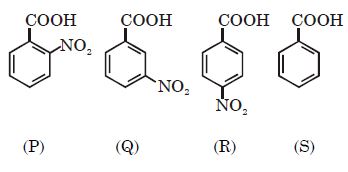
A
$P > R > Q > S$
B
$P > Q > R > S$
C
$R > P > Q > S$
D
$S > R > Q > P$
Solution
(A) The acidity of benzoic acid derivatives is influenced by the electronic effects of the substituents attached to the benzene ring.
$1$. Compound $P$ is $o$-nitrobenzoic acid. Due to the ortho effect,it is the most acidic among the given derivatives.
$2$. Compound $R$ is $p$-nitrobenzoic acid. The $-NO_2$ group exerts a strong $-I$ and $-M$ effect at the para position,which significantly increases acidity.
$3$. Compound $Q$ is $m$-nitrobenzoic acid. The $-NO_2$ group exerts only a $-I$ effect at the meta position,which increases acidity but to a lesser extent than at the para position.
$4$. Compound $S$ is benzoic acid,which has no electron-withdrawing substituent and is the least acidic.
Therefore,the decreasing order of acidity is $P > R > Q > S$.
$1$. Compound $P$ is $o$-nitrobenzoic acid. Due to the ortho effect,it is the most acidic among the given derivatives.
$2$. Compound $R$ is $p$-nitrobenzoic acid. The $-NO_2$ group exerts a strong $-I$ and $-M$ effect at the para position,which significantly increases acidity.
$3$. Compound $Q$ is $m$-nitrobenzoic acid. The $-NO_2$ group exerts only a $-I$ effect at the meta position,which increases acidity but to a lesser extent than at the para position.
$4$. Compound $S$ is benzoic acid,which has no electron-withdrawing substituent and is the least acidic.
Therefore,the decreasing order of acidity is $P > R > Q > S$.
0 likes
View Solution341
MediumMCQ
The reaction $\text{Cyclopentanecarboxamide} \xrightarrow[\Delta ]{P_2O_5} A$. The product $A$ is:
A
Cyclopentylmethanol
B
Cyclopentanecarbonitrile
C
Cyclopentylamine
D
Cyclopentylhydroxylamine
Solution
(B) The reaction of an amide with a dehydrating agent like $P_2O_5$ under heating conditions leads to the dehydration of the amide to form a nitrile. The reaction is: $R-CONH_2 \xrightarrow[\Delta ]{P_2O_5} R-CN + H_2O$. In this case,the reactant is cyclopentanecarboxamide,which upon dehydration yields cyclopentanecarbonitrile as the product $A$.
0 likes
View Solution342
MediumMCQ
The reaction of benzoic acid with methanol in the presence of an acid catalyst $(H^+)$ is shown below. Identify the correct product.
$C_6H_5COOH + CH_3O^{18}H \xrightarrow{H^+} \text{Product}$
$C_6H_5COOH + CH_3O^{18}H \xrightarrow{H^+} \text{Product}$
A
$C_6H_5COOCH_3 + H_2O^{18}$
B
$C_6H_5CO^{18}OCH_3 + H_2O$
C
$C_6H_5COOCH_3 + H_2O$
D
$C_6H_5CO^{18}OCH_3 + H_2O^{18}$
Solution
(B) The reaction is an acid-catalyzed Fischer esterification.
In this mechanism,the carboxylic acid $(RCOOH)$ loses an $-OH$ group,and the alcohol $(R'OH)$ loses an $-H$ atom to form water $(H_2O)$.
The oxygen atom of the alcohol is incorporated into the ester linkage.
Given the reaction: $C_6H_5COOH + CH_3O^{18}H \xrightarrow{H^+} C_6H_5CO^{18}OCH_3 + H_2O$.
The oxygen isotope $^{18}O$ from the methanol ends up in the ester product $(C_6H_5CO^{18}OCH_3)$,and the water molecule formed contains the oxygen from the carboxylic acid group.
In this mechanism,the carboxylic acid $(RCOOH)$ loses an $-OH$ group,and the alcohol $(R'OH)$ loses an $-H$ atom to form water $(H_2O)$.
The oxygen atom of the alcohol is incorporated into the ester linkage.
Given the reaction: $C_6H_5COOH + CH_3O^{18}H \xrightarrow{H^+} C_6H_5CO^{18}OCH_3 + H_2O$.
The oxygen isotope $^{18}O$ from the methanol ends up in the ester product $(C_6H_5CO^{18}OCH_3)$,and the water molecule formed contains the oxygen from the carboxylic acid group.
0 likes
View Solution343
MediumMCQ
Predict the product of the reaction:
$\text{2-oxocyclohexanecarboxylic acid} \xrightarrow[{(2)\Delta }]{{(1){H_3}{O^ + }}}$
$\text{2-oxocyclohexanecarboxylic acid} \xrightarrow[{(2)\Delta }]{{(1){H_3}{O^ + }}}$
A
$2-$oxocyclohexanecarboxylic acid
B
$2-$hydroxycyclohexanecarboxylic acid
C
cyclohexanone
D
$2-$(hydroxymethyl)cyclohexanone
Solution
(C) The starting material is a $\beta$-keto acid ($2$-oxocyclohexanecarboxylic acid).
$\beta$-keto acids are thermally unstable and undergo decarboxylation upon heating.
The reaction proceeds via a cyclic transition state,resulting in the loss of $CO_2$ and the formation of the corresponding ketone,which is cyclohexanone.
$\beta$-keto acids are thermally unstable and undergo decarboxylation upon heating.
The reaction proceeds via a cyclic transition state,resulting in the loss of $CO_2$ and the formation of the corresponding ketone,which is cyclohexanone.
0 likes
View Solution344
MediumMCQ
Which among the given acids has the lowest $pKa$ value?
A
Chloroacetic acid
B
Bromoacetic acid
C
Nitroacetic acid
D
Cyanoacetic acid
Solution
(C) The $pKa$ value is inversely proportional to the acidic strength of the carboxylic acid.
Acidic strength is increased by the presence of electron-withdrawing groups $(EWG)$ due to the $-I$ effect.
The strength of the $-I$ effect follows the order: $-NO_2 > -CN > -Cl > -Br$.
Among the given options,the nitro group $(-NO_2)$ is the strongest electron-withdrawing group.
Therefore,nitroacetic acid $((O_2N)-CH_2-COOH)$ is the strongest acid and has the lowest $pKa$ value.
Acidic strength is increased by the presence of electron-withdrawing groups $(EWG)$ due to the $-I$ effect.
The strength of the $-I$ effect follows the order: $-NO_2 > -CN > -Cl > -Br$.
Among the given options,the nitro group $(-NO_2)$ is the strongest electron-withdrawing group.
Therefore,nitroacetic acid $((O_2N)-CH_2-COOH)$ is the strongest acid and has the lowest $pKa$ value.
0 likes
View Solution345
MediumMCQ
$CH_3-CH_2-COOH$ $\xrightarrow{Br_2 / Red P} X$ $\xrightarrow{Alc. KOH / \Delta} Y$. $Y$ in the above reaction is:
A
$CH_3-COCl$
B
$CH_3-CH_2-CHO$
C
$CH_2=CH-COOH$
D
$Cl-CH_2-CH_2-COOH$
Solution
(C) The reaction sequence is as follows:
$1.$ $CH_3-CH_2-COOH \xrightarrow{Br_2 / Red P} CH_3-CH(Br)-COOH$ (Hell-Volhard-Zelinsky reaction).
$2.$ $CH_3-CH(Br)-COOH \xrightarrow{Alc. KOH / \Delta} CH_2=CH-COOH$ (Dehydrohalogenation).
Therefore,the final product $Y$ is acrylic acid $(CH_2=CH-COOH)$.
$1.$ $CH_3-CH_2-COOH \xrightarrow{Br_2 / Red P} CH_3-CH(Br)-COOH$ (Hell-Volhard-Zelinsky reaction).
$2.$ $CH_3-CH(Br)-COOH \xrightarrow{Alc. KOH / \Delta} CH_2=CH-COOH$ (Dehydrohalogenation).
Therefore,the final product $Y$ is acrylic acid $(CH_2=CH-COOH)$.
0 likes
View Solution346
MediumMCQ
Which of the following is most acidic?
A
Phenol
B
$p$-Nitrophenol
C
$p$-Cyanophenol
D
$p$-Hydroxybenzoic acid
Solution
(D) The acidity of phenols is increased by electron-withdrawing groups $(EWG)$ attached to the benzene ring,as they stabilize the phenoxide ion through inductive and resonance effects.
Comparing the substituents at the para position:
$1$. Phenol: No substituent.
$2$. $p$-Nitrophenol: The $-NO_2$ group is a strong electron-withdrawing group ($-I$ and $-M$ effects).
$3$. $p$-Cyanophenol: The $-CN$ group is an electron-withdrawing group ($-I$ and $-M$ effects),but less strong than $-NO_2$.
$4$. $p$-Hydroxybenzoic acid: The $-COOH$ group is an electron-withdrawing group ($-I$ and $-M$ effects). However,in $p$-hydroxybenzoic acid,the acidity is primarily determined by the carboxylic acid group $(-COOH)$ rather than the phenolic $-OH$ group. Carboxylic acids are significantly more acidic than phenols. Therefore,$p$-hydroxybenzoic acid is the most acidic among the given options.
Comparing the substituents at the para position:
$1$. Phenol: No substituent.
$2$. $p$-Nitrophenol: The $-NO_2$ group is a strong electron-withdrawing group ($-I$ and $-M$ effects).
$3$. $p$-Cyanophenol: The $-CN$ group is an electron-withdrawing group ($-I$ and $-M$ effects),but less strong than $-NO_2$.
$4$. $p$-Hydroxybenzoic acid: The $-COOH$ group is an electron-withdrawing group ($-I$ and $-M$ effects). However,in $p$-hydroxybenzoic acid,the acidity is primarily determined by the carboxylic acid group $(-COOH)$ rather than the phenolic $-OH$ group. Carboxylic acids are significantly more acidic than phenols. Therefore,$p$-hydroxybenzoic acid is the most acidic among the given options.
0 likes
View Solution347
DifficultMCQ
Which is most reactive towards soda-lime decarboxylation?
A
$p-CH_3O-C_6H_4-CH_2-COOH$
B
$p-O_2N-C_6H_4-CH_2-COOH$
C
$m-O_2N-C_6H_4-CH_2-COOH$
D
$m-CH_3O-C_6H_4-CH_2-COOH$
Solution
(B) The decarboxylation of carboxylic acids with soda-lime $(NaOH + CaO)$ proceeds through the formation of a carbanion intermediate. The rate of decarboxylation is directly proportional to the stability of the carbanion formed after the loss of $CO_2$. Electron-withdrawing groups (EWGs) stabilize the carbanion,thereby increasing the rate of decarboxylation,while electron-donating groups (EDGs) destabilize it.
Comparing the substituents:
$1$. $-NO_2$ is a strong electron-withdrawing group $(EWG)$ due to both $-I$ and $-M$ effects.
$2$. $-OCH_3$ is an electron-donating group $(EDG)$ due to its $+M$ effect.
Between the nitro-substituted compounds,the $-NO_2$ group at the ortho or para position exerts a stronger electron-withdrawing effect via resonance ($-M$ effect) compared to the meta position. However,in the case of $p-O_2N-C_6H_4-CH_2-COOH$,the $-NO_2$ group is at the para position relative to the $-CH_2COOH$ group. The electron-withdrawing effect of the $-NO_2$ group stabilizes the negative charge on the benzylic carbon formed during the transition state. Thus,$p-O_2N-C_6H_4-CH_2-COOH$ is the most reactive.
Comparing the substituents:
$1$. $-NO_2$ is a strong electron-withdrawing group $(EWG)$ due to both $-I$ and $-M$ effects.
$2$. $-OCH_3$ is an electron-donating group $(EDG)$ due to its $+M$ effect.
Between the nitro-substituted compounds,the $-NO_2$ group at the ortho or para position exerts a stronger electron-withdrawing effect via resonance ($-M$ effect) compared to the meta position. However,in the case of $p-O_2N-C_6H_4-CH_2-COOH$,the $-NO_2$ group is at the para position relative to the $-CH_2COOH$ group. The electron-withdrawing effect of the $-NO_2$ group stabilizes the negative charge on the benzylic carbon formed during the transition state. Thus,$p-O_2N-C_6H_4-CH_2-COOH$ is the most reactive.
0 likes
View Solution348
MediumMCQ
Phthalic acid $\xrightarrow{NH_3, \Delta } A$,'$A$' is
A
Phthalamide
B
Phthalamic acid
C
Phthalimide
D
Phthalic anhydride
Solution
(C) The reaction of phthalic acid with ammonia $(NH_3)$ followed by heating $(\Delta)$ proceeds as follows:
$1$. Phthalic acid reacts with $NH_3$ to form ammonium phthalate.
$2$. Upon heating,ammonium phthalate loses water to form phthalamide.
$3$. Further heating causes the loss of another molecule of $NH_3$ to form phthalimide.
Therefore,the final product '$A$' is phthalimide.
$1$. Phthalic acid reacts with $NH_3$ to form ammonium phthalate.
$2$. Upon heating,ammonium phthalate loses water to form phthalamide.
$3$. Further heating causes the loss of another molecule of $NH_3$ to form phthalimide.
Therefore,the final product '$A$' is phthalimide.
0 likes
View Solution349
DifficultMCQ
Which of the following does not give an alcohol with $NaBH_4$?
A
$RCHO$
B
$RCOR$
C
$RCOCl$
D
$RCOOH$
Solution
(D) $NaBH_4$ (sodium borohydride) is a selective reducing agent.
It effectively reduces aldehydes $(RCHO)$ and ketones $(RCOR)$ to their corresponding alcohols.
It also reduces acid chlorides $(RCOCl)$ to primary alcohols.
However,$NaBH_4$ is not strong enough to reduce carboxylic acids $(RCOOH)$ to alcohols.
Therefore,the correct answer is $RCOOH$.
It effectively reduces aldehydes $(RCHO)$ and ketones $(RCOR)$ to their corresponding alcohols.
It also reduces acid chlorides $(RCOCl)$ to primary alcohols.
However,$NaBH_4$ is not strong enough to reduce carboxylic acids $(RCOOH)$ to alcohols.
Therefore,the correct answer is $RCOOH$.
0 likes
View Solution350
MediumMCQ
Which of the following reactions is not correct?
A
$CH_3-COOC_2H_5 \xrightarrow{DIBAL-H} CH_3-CHO$
B
$CH_3-COCl \xrightarrow[Boiling \ xylene]{Pd-BaSO_4} CH_3-CHO$
C
$CH_3-CONH_2 \xrightarrow{LiAlH_4} CH_3-CH_2-NH_2$
D
$CH_3-CONH_2 \xrightarrow{PCl_5} CH_3-COCl$
Solution
(D) is the incorrect reaction.
$PCl_5$ acts as a dehydrating agent for primary amides.
When acetamide $(CH_3-CONH_2)$ reacts with $PCl_5$,it undergoes dehydration to form methyl cyanide $(CH_3-CN)$ instead of acetyl chloride $(CH_3-COCl)$.
The correct reaction is: $CH_3-CONH_2 + PCl_5 \rightarrow CH_3-CN + POCl_3 + 2HCl$.
$PCl_5$ acts as a dehydrating agent for primary amides.
When acetamide $(CH_3-CONH_2)$ reacts with $PCl_5$,it undergoes dehydration to form methyl cyanide $(CH_3-CN)$ instead of acetyl chloride $(CH_3-COCl)$.
The correct reaction is: $CH_3-CONH_2 + PCl_5 \rightarrow CH_3-CN + POCl_3 + 2HCl$.
0 likes
View Solution8-2.Carboxylic acids and Their derivative — Properties of Carboxylic Acids and Their Derivatives · Frequently Asked Questions
1Are these 8-2.Carboxylic acids and Their derivative questions useful for JEE and NEET?
Yes. All questions in this section are mapped to JEE Main and NEET exam patterns. Previous year questions from JEE Main, NEET, GUJCET and state-level exams are included with full solutions.
2Can I switch to Hindi or Gujarati for these questions?
Yes. Use the language tabs in the hero section or the sidebar to view the same questions and solutions in English, Hindi or Gujarati.
3How do I generate a question paper from this subtopic?
Use the Vedclass Exam Paper Generator — select the chapter and subtopic, set difficulty, and generate Sets A, B, C, D automatically. First 3 chapters of every subject are free.
Vedclass Products
For Students
Vedclass Test Series
Mock tests in real JEE/NEET style with performance analysis. 5-day free trial.
Start Free TrialFor Teachers
Exam Paper Generator
Generate Set A/B/C/D papers from this chapter in 2 minutes. 3 chapters free.
Try FreeFor Institutes
Online Exam Module
Live online exams with unlimited students, 360° analytics & white-label branding.
See DemoFor Teachers & Institutes
Generate a 8-2.Carboxylic acids and Their derivative Exam Paper in 2 Minutes
Select subtopic & difficulty — Sets A, B, C, D auto-generated with No Repeat logic.
First 3 chapters of every subject are free — no payment required.