
A English
Properties Questions in English
Class 12 Chemistry · 8-1.Aldehydes and Ketones · Properties
1739+
Questions
English
Language
100%
With Solutions
Showing 50 of 1739 questions in English
1401
EasyMCQ
Identify the symmetrical ketone from the following compounds.
A
Acetophenone
B
Ethyl methyl ketone
C
Ethylphenyl ketone
D
Benzophenone
Solution
(D) symmetrical ketone is one in which the two alkyl or aryl groups attached to the carbonyl carbon $(C=O)$ are identical.
$A$. Acetophenone: $C_6H_5-CO-CH_3$ (Unsymmetrical)
$B$. Ethyl methyl ketone: $CH_3CH_2-CO-CH_3$ (Unsymmetrical)
$C$. Ethylphenyl ketone: $C_6H_5-CO-CH_2CH_3$ (Unsymmetrical)
$D$. Benzophenone: $C_6H_5-CO-C_6H_5$ (Symmetrical,as both groups are phenyl groups)
Therefore,Benzophenone is a symmetrical ketone.
$A$. Acetophenone: $C_6H_5-CO-CH_3$ (Unsymmetrical)
$B$. Ethyl methyl ketone: $CH_3CH_2-CO-CH_3$ (Unsymmetrical)
$C$. Ethylphenyl ketone: $C_6H_5-CO-CH_2CH_3$ (Unsymmetrical)
$D$. Benzophenone: $C_6H_5-CO-C_6H_5$ (Symmetrical,as both groups are phenyl groups)
Therefore,Benzophenone is a symmetrical ketone.
0 likes
View Solution1402
MediumMCQ
The minimum number of carbon atoms in ketones which will show chain isomerism is:
A
$7$
B
$4$
C
$6$
D
$5$
Solution
(D) Chain isomerism in ketones requires a minimum of $5$ carbon atoms in the main chain to allow for branching.
For example,pentan-$2$-one $(CH_3COCH_2CH_2CH_3)$ can form a chain isomer,$3$-methylbutan-$2$-one $(CH_3COCH(CH_3)_2)$,by branching the carbon chain.
Thus,the minimum number of carbon atoms required is $5$.
For example,pentan-$2$-one $(CH_3COCH_2CH_2CH_3)$ can form a chain isomer,$3$-methylbutan-$2$-one $(CH_3COCH(CH_3)_2)$,by branching the carbon chain.
Thus,the minimum number of carbon atoms required is $5$.
0 likes
View Solution1403
EasyMCQ
Which of the following reactions represents the Wolff-Kishner reduction?
A
$RCOCl \xrightarrow[Pd-BaSO_4]{H_2} RCHO + HCl$
B
$RCN \xrightarrow[H_3O^+]{SnCl_2, HCl} RCHO + NH_4Cl$
C
$RCHO \xrightarrow[\Delta]{Zn-Hg, \text{conc. } HCl} RCH_3 + H_2O$
D
$RCOR' \xrightarrow[\text{ii) } KOH, HO(CH_2)_2OH]{\text{i) } H_2N-NH_2} RCH_2R'$
Solution
(D) The Wolff-Kishner reduction is a reaction used to convert carbonyl groups (aldehydes or ketones) into alkanes.
It involves the formation of a hydrazone intermediate by reacting the carbonyl compound with hydrazine $(H_2N-NH_2)$,followed by base-catalyzed decomposition (using $KOH$ in ethylene glycol) at high temperatures.
Option $D$ correctly represents this process: $RCOR' \xrightarrow[\text{ii) } KOH, HO(CH_2)_2OH]{\text{i) } H_2N-NH_2} RCH_2R'$.
Option $A$ is Rosenmund reduction,option $B$ is Stephen reduction,and option $C$ is Clemmensen reduction.
It involves the formation of a hydrazone intermediate by reacting the carbonyl compound with hydrazine $(H_2N-NH_2)$,followed by base-catalyzed decomposition (using $KOH$ in ethylene glycol) at high temperatures.
Option $D$ correctly represents this process: $RCOR' \xrightarrow[\text{ii) } KOH, HO(CH_2)_2OH]{\text{i) } H_2N-NH_2} RCH_2R'$.
Option $A$ is Rosenmund reduction,option $B$ is Stephen reduction,and option $C$ is Clemmensen reduction.
0 likes
View Solution1404
EasyMCQ
Which of the following reactions represents Clemmensen reduction?
A
$R-CO-Cl \xrightarrow{H_2, Pd-BaSO_4} R-CHO + HCl$
B
$R-CN \xrightarrow[H_3O^+]{SnCl_2, HCl} R-CHO + NH_4Cl$
C
$R-CHO \xrightarrow[\Delta]{Zn-Hg, \text{Conc. } HCl} R-CH_3 + H_2O$
D
$R-CO-R \xrightarrow[(ii) KOH, \Delta]{(i) H_2N-NH_2, HO-(CH_2)_2-OH} R-CH_2-R$
Solution
(C) The Clemmensen reduction is a chemical reaction that reduces aldehydes or ketones to their corresponding alkanes using zinc amalgam $(Zn-Hg)$ and concentrated hydrochloric acid $(HCl)$.
The general reaction is:
$R_1-CO-R_2 \xrightarrow{Zn(Hg), HCl} R_1-CH_2-R_2$
Option $C$ represents the reduction of an aldehyde to an alkane using $Zn-Hg$ and concentrated $HCl$,which is the characteristic condition for Clemmensen reduction.
The general reaction is:
$R_1-CO-R_2 \xrightarrow{Zn(Hg), HCl} R_1-CH_2-R_2$
Option $C$ represents the reduction of an aldehyde to an alkane using $Zn-Hg$ and concentrated $HCl$,which is the characteristic condition for Clemmensen reduction.
0 likes
View Solution1405
MediumMCQ
What type of compounds is obtained in the first step of the Wolff-Kishner reduction of carbonyl compounds?
A
Carboxylic Acids
B
Alcohols
C
Hydrazones
D
Alkenes
Solution
(C) In the Wolff-Kishner reduction,the first step involves the reaction of a carbonyl compound (aldehyde or ketone) with hydrazine $(H_2N-NH_2)$.
This reaction results in the formation of a hydrazone intermediate with the loss of a water molecule $(H_2O)$.
The general reaction is: $R_2C=O + H_2N-NH_2 \rightarrow R_2C=N-NH_2 + H_2O$.
Therefore,the compound obtained in the first step is a hydrazone.
This reaction results in the formation of a hydrazone intermediate with the loss of a water molecule $(H_2O)$.
The general reaction is: $R_2C=O + H_2N-NH_2 \rightarrow R_2C=N-NH_2 + H_2O$.
Therefore,the compound obtained in the first step is a hydrazone.
0 likes
View Solution1406
EasyMCQ
Identify the name of the reaction when an aldehyde or ketone reacts with $Zn-Hg / \text{conc. } HCl$ to give an alkane.
A
Stephen reduction
B
Clemmensen reduction
C
Wolff-Kishner reduction
D
Rosenmund reduction
Solution
(B) The reaction of an aldehyde or ketone with $Zn-Hg$ amalgam and concentrated $HCl$ is known as the Clemmensen reduction.
The general reaction is:
$R-C(=O)-R' \xrightarrow[\text{conc. } HCl]{Zn/Hg} R-CH_2-R' + H_2O$
This process reduces the carbonyl group $(C=O)$ to a methylene group $(CH_2)$.
The general reaction is:
$R-C(=O)-R' \xrightarrow[\text{conc. } HCl]{Zn/Hg} R-CH_2-R' + H_2O$
This process reduces the carbonyl group $(C=O)$ to a methylene group $(CH_2)$.
0 likes
View Solution1407
MediumMCQ
Which of the following is the Wolff-Kishner reduction?
A
$RCOCl \xrightarrow[Pd-BaSO_4]{H_2} R-CHO + HCl$
B
$RCN \xrightarrow{SnCl_2, HCl} R-CHO + NH_4Cl$
C
$R-CHO \xrightarrow[\Delta]{Zn-Hg, \text{ conc. } HCl} R-CH_3 + H_2O$
D
$R-CO-R \xrightarrow[(ii) KOH, HO(CH_2)_2OH]{(i) H_2N-NH_2, \Delta} R-CH_2-R + N_2$
Solution
(D) The Wolff-Kishner reduction is a chemical reaction used to convert carbonyl groups (aldehydes or ketones) into methylene groups $(-CH_2-)$ using hydrazine $(H_2N-NH_2)$ and a strong base (like $KOH$) in a high-boiling solvent such as ethylene glycol $(HO(CH_2)_2OH)$.
Option $D$ represents this reaction: $R-CO-R \xrightarrow[(ii) KOH, HO(CH_2)_2OH]{(i) H_2N-NH_2, \Delta} R-CH_2-R + N_2$.
Option $A$ is the Rosenmund reduction.
Option $B$ is the Stephen reduction.
Option $C$ is the Clemmensen reduction.
Option $D$ represents this reaction: $R-CO-R \xrightarrow[(ii) KOH, HO(CH_2)_2OH]{(i) H_2N-NH_2, \Delta} R-CH_2-R + N_2$.
Option $A$ is the Rosenmund reduction.
Option $B$ is the Stephen reduction.
Option $C$ is the Clemmensen reduction.
0 likes
View Solution1408
EasyMCQ
Identify the reaction in which the carbonyl group of aldehydes and ketones is reduced to a methylene group upon treatment with hydrazine followed by heating with sodium hydroxide in ethylene glycol.
A
$A$ Wolff-Kishner reduction
B
$B$ Clemmensen reduction
C
$C$ Stephen reaction
D
$D$ Etard reaction
Solution
(A) The reaction described is the Wolff-Kishner reduction.
In this reaction,aldehydes and ketones are treated with hydrazine $(NH_2NH_2)$ to form a hydrazone intermediate.
This hydrazone is then heated with a strong base like potassium hydroxide $(KOH)$ in a high-boiling solvent such as ethylene glycol $(HO-CH_2-CH_2-OH)$.
This process results in the reduction of the carbonyl group $(>C=O)$ to a methylene group $(-CH_2-)$ with the evolution of nitrogen gas $(N_2)$.
In this reaction,aldehydes and ketones are treated with hydrazine $(NH_2NH_2)$ to form a hydrazone intermediate.
This hydrazone is then heated with a strong base like potassium hydroxide $(KOH)$ in a high-boiling solvent such as ethylene glycol $(HO-CH_2-CH_2-OH)$.
This process results in the reduction of the carbonyl group $(>C=O)$ to a methylene group $(-CH_2-)$ with the evolution of nitrogen gas $(N_2)$.
0 likes
View Solution1409
EasyMCQ
Which of the following is Clemmensen reduction?
A
$RCOCl \xrightarrow{H_2, Pd-BaSO_4} RCHO + HCl$
B
$RCN \xrightarrow{SnCl_2, HCl, H_3O^+} RCHO + NH_4Cl$
C
$RCHO \xrightarrow{Zn-Hg, \text{Conc. } HCl, \Delta} RCH_3 + H_2O$
D
$RCOR \xrightarrow{i) H_2N-NH_2, ii) KOH, HO-CH_2-CH_2-OH} R-CH_2-R$
Solution
(C) The Clemmensen reduction is a chemical reaction that reduces aldehydes or ketones to their corresponding alkanes using zinc amalgam $(Zn-Hg)$ and concentrated hydrochloric acid $(HCl)$.
Option $C$ represents this reaction: $RCHO \xrightarrow{Zn-Hg, \text{Conc. } HCl, \Delta} RCH_3 + H_2O$.
Option $C$ represents this reaction: $RCHO \xrightarrow{Zn-Hg, \text{Conc. } HCl, \Delta} RCH_3 + H_2O$.
0 likes
View Solution1410
EasyMCQ
The reaction shown below is called:
$CH_3-CHO + 4[H] \xrightarrow{Zn-Hg / \text{conc. } HCl} CH_3-CH_3 + H_2O$
$CH_3-CHO + 4[H] \xrightarrow{Zn-Hg / \text{conc. } HCl} CH_3-CH_3 + H_2O$
A
Clemmensen reduction
B
Wolff-Kishner reduction
C
Aldol condensation
D
Cannizzaro reaction
Solution
(A) The given reaction involves the reduction of an aldehyde $(CH_3CHO)$ to an alkane $(CH_3CH_3)$ using zinc amalgam $(Zn-Hg)$ and concentrated hydrochloric acid $(HCl)$.
This specific reduction of carbonyl groups (aldehydes and ketones) to methylene groups $(-CH_2-)$ using $Zn-Hg$ and $conc. HCl$ is known as the Clemmensen reduction.
This specific reduction of carbonyl groups (aldehydes and ketones) to methylene groups $(-CH_2-)$ using $Zn-Hg$ and $conc. HCl$ is known as the Clemmensen reduction.
0 likes
View Solution1411
MediumMCQ
Identify the product $Y$ in the following reaction: $CH_3-CH=CH-CH_2-CHO + H_2 \xrightarrow{Ni} Y$
A
$CH_3-CH_2-CH_2-CH_2-CH_2-OH$
B
$CH_3-CH_2-CH_2-CH_2-CH_3$
C
$CH_3-CH_2-CH_2-CH_2-CHO$
D
$CH_3-CH=CH-CH_2-CH_2-OH$
Solution
(A) The reaction involves the catalytic hydrogenation of an unsaturated aldehyde $(CH_3-CH=CH-CH_2-CHO)$ using $Ni$ as a catalyst.
$Ni$ is a strong reducing agent that reduces both the carbon-carbon double bond $(C=C)$ and the carbonyl group $(C=O)$ in the presence of excess hydrogen.
$1$. The $C=C$ double bond is reduced to a single bond: $CH_3-CH=CH-CH_2-CHO \rightarrow CH_3-CH_2-CH_2-CH_2-CHO$.
$2$. The aldehyde group $(-CHO)$ is reduced to a primary alcohol $(-CH_2OH)$: $CH_3-CH_2-CH_2-CH_2-CHO \rightarrow CH_3-CH_2-CH_2-CH_2-CH_2-OH$.
Therefore,the final product is pentan$-1-$ol.
$Ni$ is a strong reducing agent that reduces both the carbon-carbon double bond $(C=C)$ and the carbonyl group $(C=O)$ in the presence of excess hydrogen.
$1$. The $C=C$ double bond is reduced to a single bond: $CH_3-CH=CH-CH_2-CHO \rightarrow CH_3-CH_2-CH_2-CH_2-CHO$.
$2$. The aldehyde group $(-CHO)$ is reduced to a primary alcohol $(-CH_2OH)$: $CH_3-CH_2-CH_2-CH_2-CHO \rightarrow CH_3-CH_2-CH_2-CH_2-CH_2-OH$.
Therefore,the final product is pentan$-1-$ol.
0 likes
View Solution1412
EasyMCQ
Which of the following reactions converts the carbonyl group of aldehydes and ketones to a methylene group on treatment with zinc amalgam and concentrated $HCl$?
A
Wolff-Kishner reduction
B
Stephen reduction
C
Clemmensen reduction
D
Rosenmund reduction
Solution
(C) The reaction that converts the carbonyl group $(>C=O)$ of aldehydes and ketones into a methylene group $(>CH_2)$ using zinc amalgam $(Zn-Hg)$ and concentrated hydrochloric acid $(HCl)$ is known as the Clemmensen reduction.
The general reaction is:
$R-CO-R' \xrightarrow{Zn-Hg/HCl} R-CH_2-R'$
Therefore,the correct option is $C$.
The general reaction is:
$R-CO-R' \xrightarrow{Zn-Hg/HCl} R-CH_2-R'$
Therefore,the correct option is $C$.
0 likes
View Solution1413
EasyMCQ
The reagent used in Wolff-Kishner reduction is
A
$NH_2NH_2$ and $KOH$ in ethylene glycol
B
$Zn(Hg)/conc. HCl$
C
$NaBH_4$
D
$Na(Hg)/H_2O$
Solution
(A) The Wolff-Kishner reduction is a chemical reaction used to convert carbonyl groups (aldehydes or ketones) into methylene groups $(-CH_2-)$.
The reagents used for this reduction are hydrazine $(NH_2NH_2)$ and a strong base like potassium hydroxide $(KOH)$ in a high-boiling solvent such as ethylene glycol.
The reagents used for this reduction are hydrazine $(NH_2NH_2)$ and a strong base like potassium hydroxide $(KOH)$ in a high-boiling solvent such as ethylene glycol.
0 likes
View Solution1414
DifficultMCQ
$2,2-$dichloropropane $\stackrel{Aq. KOH}{\longrightarrow} A$ $\xrightarrow{\text{Clemmensen reduction}} B$. $B$ is
A
propanol
B
propene
C
propane
D
ethane
Solution
(C) Step $1$: Reaction of $2,2-$dichloropropane with aqueous $KOH$ gives a gem-diol intermediate,which loses a water molecule to form acetone $(CH_3COCH_3)$ as product $A$.
Step $2$: Clemmensen reduction of acetone $(CH_3COCH_3)$ using $Zn(Hg)/HCl$ reduces the carbonyl group to a methylene group $(-CH_2-)$,yielding propane $(CH_3CH_2CH_3)$ as product $B$.
Therefore,the correct option is $C$.
Step $2$: Clemmensen reduction of acetone $(CH_3COCH_3)$ using $Zn(Hg)/HCl$ reduces the carbonyl group to a methylene group $(-CH_2-)$,yielding propane $(CH_3CH_2CH_3)$ as product $B$.
Therefore,the correct option is $C$.
0 likes
View Solution1415
EasyMCQ
In Clemmensen's reduction,the catalyst used is
A
$Zn-Hg + \text{conc. } HCl$
B
$NH_2NH_2 + C_2H_5ONa$
C
$PdCl_2 / H_2O$
D
$(C_6H_5)_3P + C_2H_5ONa$
Solution
(A) Clemmensen's reduction involves the reduction of carbonyl compounds (aldehydes and ketones) to alkanes.
The reagent used is zinc amalgam $(Zn-Hg)$ in the presence of concentrated hydrochloric acid $(HCl)$.
This reaction converts the $C=O$ group into a $CH_2$ group.
The reagent used is zinc amalgam $(Zn-Hg)$ in the presence of concentrated hydrochloric acid $(HCl)$.
This reaction converts the $C=O$ group into a $CH_2$ group.
0 likes
View Solution1416
EasyMCQ
Which is the major product obtained by hydrolysis of the compound formed by the reaction between formaldehyde and ethyl magnesium bromide?
A
Propan-$1$-ol
B
Ethan-$1$-ol
C
Propan-$2$-ol
D
$2$-Methyl-Propan-$2$-ol
Solution
(A) The reaction between formaldehyde $(HCHO)$ and ethyl magnesium bromide $(CH_3CH_2MgBr)$ is a Grignard reaction.
Step $1$: Nucleophilic attack of the ethyl group on the carbonyl carbon of formaldehyde forms an intermediate alkoxide: $HCHO + CH_3CH_2MgBr \rightarrow CH_3CH_2CH_2OMgBr$.
Step $2$: Acidic hydrolysis of the intermediate yields the final alcohol: $CH_3CH_2CH_2OMgBr + H_2O \rightarrow CH_3CH_2CH_2OH + Mg(OH)Br$.
The product formed is $CH_3CH_2CH_2OH$,which is Propan-$1$-ol.
Therefore,the correct option is $A$.
Step $1$: Nucleophilic attack of the ethyl group on the carbonyl carbon of formaldehyde forms an intermediate alkoxide: $HCHO + CH_3CH_2MgBr \rightarrow CH_3CH_2CH_2OMgBr$.
Step $2$: Acidic hydrolysis of the intermediate yields the final alcohol: $CH_3CH_2CH_2OMgBr + H_2O \rightarrow CH_3CH_2CH_2OH + Mg(OH)Br$.
The product formed is $CH_3CH_2CH_2OH$,which is Propan-$1$-ol.
Therefore,the correct option is $A$.
0 likes
View Solution1417
EasyMCQ
Which one of the following compounds does not give a primary alcohol on reduction?
A
Propanoic acid
B
Propanal
C
Methyl propanoate
D
Propan$-2-$one
Solution
(D) Reduction of $Propanoic \ acid$ $(CH_3CH_2COOH)$ gives $Propan-1-ol$ (primary alcohol).
Reduction of $Propanal$ $(CH_3CH_2CHO)$ gives $Propan-1-ol$ (primary alcohol).
Reduction of $Methyl \ propanoate$ $(CH_3CH_2COOCH_3)$ gives $Propan-1-ol$ and $Methanol$ (both primary alcohols).
Reduction of $Propan-2-one$ $(CH_3COCH_3)$ gives $Propan-2-ol$,which is a secondary alcohol.
Therefore,$Propan-2-one$ does not give a primary alcohol on reduction.
Reduction of $Propanal$ $(CH_3CH_2CHO)$ gives $Propan-1-ol$ (primary alcohol).
Reduction of $Methyl \ propanoate$ $(CH_3CH_2COOCH_3)$ gives $Propan-1-ol$ and $Methanol$ (both primary alcohols).
Reduction of $Propan-2-one$ $(CH_3COCH_3)$ gives $Propan-2-ol$,which is a secondary alcohol.
Therefore,$Propan-2-one$ does not give a primary alcohol on reduction.
0 likes
View Solution1418
EasyMCQ
Reduction of which compound gives an optically active alcohol?
A
Methyl butanoate
B
Butanone
C
Butanoic acid
D
Butanal
Solution
(B) The reduction of $Butanone$ $(CH_3COCH_2CH_3)$ using a reducing agent like $NaBH_4$ or $LiAlH_4$ yields $Butan-2-ol$ $(CH_3CH(OH)CH_2CH_3)$.
In $Butan-2-ol$,the carbon atom attached to the $-OH$ group is bonded to four different groups: $-H$,$-OH$,$-CH_3$,and $-CH_2CH_3$.
Since this carbon is a chiral center,$Butan-2-ol$ exists as a pair of enantiomers and is optically active.
The other options yield primary alcohols $(Butan-1-ol)$ which are achiral.
In $Butan-2-ol$,the carbon atom attached to the $-OH$ group is bonded to four different groups: $-H$,$-OH$,$-CH_3$,and $-CH_2CH_3$.
Since this carbon is a chiral center,$Butan-2-ol$ exists as a pair of enantiomers and is optically active.
The other options yield primary alcohols $(Butan-1-ol)$ which are achiral.
0 likes
View Solution1419
EasyMCQ
Which of the following compounds does not undergo the Cannizzaro reaction?
A
$1-$methylcyclohexanecarbaldehyde
B
Benzaldehyde
C
$HCHO$
D
$CH_3CHO$
Solution
(D) The Cannizzaro reaction is given by aldehydes that do not possess an $\alpha$-hydrogen atom.
$HCHO$ (formaldehyde) has no $\alpha$-hydrogen.
Benzaldehyde $(C_6H_5CHO)$ has no $\alpha$-hydrogen.
$1$-methylcyclohexanecarbaldehyde has no $\alpha$-hydrogen at the carbonyl carbon position.
$CH_3CHO$ (acetaldehyde) possesses three $\alpha$-hydrogen atoms,so it undergoes aldol condensation instead of the Cannizzaro reaction.
Therefore,the correct option is $D$.
$HCHO$ (formaldehyde) has no $\alpha$-hydrogen.
Benzaldehyde $(C_6H_5CHO)$ has no $\alpha$-hydrogen.
$1$-methylcyclohexanecarbaldehyde has no $\alpha$-hydrogen at the carbonyl carbon position.
$CH_3CHO$ (acetaldehyde) possesses three $\alpha$-hydrogen atoms,so it undergoes aldol condensation instead of the Cannizzaro reaction.
Therefore,the correct option is $D$.
0 likes
View Solution1420
EasyMCQ
What will be the main product in the following reaction?
$C_6H_5CHO + CH_3CHO \xrightarrow{OH^-, \Delta} ?$
$C_6H_5CHO + CH_3CHO \xrightarrow{OH^-, \Delta} ?$
A
$C_6H_5CH_2CH(OH)CHO$
B
$C_6H_5CH=CHCHO$
C
$C_6H_5CH_2CH_2CHO$
D
$C_6H_5CH=CHCOOH$
Solution
(B) The given reaction is a $Cross-Aldol$ condensation reaction between $benzaldehyde$ $(C_6H_5CHO)$ and $acetaldehyde$ $(CH_3CHO)$ in the presence of a dilute base $(OH^-)$ and heat $(\Delta)$.
$1.$ $Acetaldehyde$ contains $\alpha$-hydrogens,so it forms an enolate ion in the presence of a base.
$2.$ This enolate ion attacks the carbonyl carbon of $benzaldehyde$ (which has no $\alpha$-hydrogens) to form a $\beta$-hydroxy aldehyde intermediate $(C_6H_5CH(OH)CH_2CHO)$.
$3.$ Upon heating $(\Delta)$,this intermediate undergoes dehydration (loss of $H_2O$) to form the stable $\alpha,\beta$-unsaturated aldehyde,which is $cinnamaldehyde$ $(C_6H_5CH=CHCHO)$.
Therefore,the main product is $C_6H_5CH=CHCHO$.
$1.$ $Acetaldehyde$ contains $\alpha$-hydrogens,so it forms an enolate ion in the presence of a base.
$2.$ This enolate ion attacks the carbonyl carbon of $benzaldehyde$ (which has no $\alpha$-hydrogens) to form a $\beta$-hydroxy aldehyde intermediate $(C_6H_5CH(OH)CH_2CHO)$.
$3.$ Upon heating $(\Delta)$,this intermediate undergoes dehydration (loss of $H_2O$) to form the stable $\alpha,\beta$-unsaturated aldehyde,which is $cinnamaldehyde$ $(C_6H_5CH=CHCHO)$.
Therefore,the main product is $C_6H_5CH=CHCHO$.
0 likes
View Solution1421
EasyMCQ
Which of the following compounds will not give "Iodoform" by reaction with "Sodium hypoiodite"?
A
$CH_3CHO$
B
$CH_3CH(OH)CH_2CH_3$
C
$CH_3CH_2COCH_3$
D
$CH_3CH_2COCH_2CH_3$
Solution
(D) The "Iodoform" test is given by compounds containing the $CH_3CO-$ group or the $CH_3CH(OH)-$ group.
$A$. $CH_3CHO$ (Acetaldehyde) contains the $CH_3CO-$ group,so it gives a positive "Iodoform" test.
$B$. $CH_3CH(OH)CH_2CH_3$ (Butan-$2$-ol) contains the $CH_3CH(OH)-$ group,which is oxidized to a $CH_3CO-$ group by "Sodium hypoiodite",hence it gives a positive "Iodoform" test.
$C$. $CH_3CH_2COCH_3$ (Butan-$2$-one) contains the $CH_3CO-$ group,so it gives a positive "Iodoform" test.
$D$. $CH_3CH_2COCH_2CH_3$ (Pentan-$3$-one) does not contain the $CH_3CO-$ group or the $CH_3CH(OH)-$ group. Therefore,it will not give the "Iodoform" test.
Thus,the correct option is $D$.
$A$. $CH_3CHO$ (Acetaldehyde) contains the $CH_3CO-$ group,so it gives a positive "Iodoform" test.
$B$. $CH_3CH(OH)CH_2CH_3$ (Butan-$2$-ol) contains the $CH_3CH(OH)-$ group,which is oxidized to a $CH_3CO-$ group by "Sodium hypoiodite",hence it gives a positive "Iodoform" test.
$C$. $CH_3CH_2COCH_3$ (Butan-$2$-one) contains the $CH_3CO-$ group,so it gives a positive "Iodoform" test.
$D$. $CH_3CH_2COCH_2CH_3$ (Pentan-$3$-one) does not contain the $CH_3CO-$ group or the $CH_3CH(OH)-$ group. Therefore,it will not give the "Iodoform" test.
Thus,the correct option is $D$.
0 likes
View Solution1422
EasyMCQ
Which of the following compounds undergoes aldol condensation?
A
Trimethyl acetaldehyde
B
Formaldehyde
C
Trichloro acetaldehyde
D
Acetaldehyde
Solution
(D) Aldol condensation occurs in aldehydes or ketones that possess at least one $\alpha$-hydrogen atom.
$A$. Trimethyl acetaldehyde $(CH_3)_3CCHO$ has no $\alpha$-hydrogen.
$B$. Formaldehyde $(HCHO)$ has no $\alpha$-hydrogen.
$C$. Trichloro acetaldehyde $(CCl_3CHO)$ has no $\alpha$-hydrogen.
$D$. Acetaldehyde $(CH_3CHO)$ has three $\alpha$-hydrogen atoms attached to the $\alpha$-carbon.
Therefore,acetaldehyde undergoes aldol condensation.
$A$. Trimethyl acetaldehyde $(CH_3)_3CCHO$ has no $\alpha$-hydrogen.
$B$. Formaldehyde $(HCHO)$ has no $\alpha$-hydrogen.
$C$. Trichloro acetaldehyde $(CCl_3CHO)$ has no $\alpha$-hydrogen.
$D$. Acetaldehyde $(CH_3CHO)$ has three $\alpha$-hydrogen atoms attached to the $\alpha$-carbon.
Therefore,acetaldehyde undergoes aldol condensation.
0 likes
View Solution1423
EasyMCQ
Which of the following compounds is the least reactive towards nucleophilic addition reactions?
A
Acetophenone
B
Benzaldehyde
C
Formaldehyde
D
Benzophenone
Solution
(D) The reactivity of carbonyl compounds towards nucleophilic addition depends on steric hindrance and electronic effects.
$1$. Steric hindrance: As the number and size of alkyl or aryl groups attached to the carbonyl carbon increase,the attack of the nucleophile becomes more difficult.
$2$. Electronic effects: Electron-donating groups decrease the electrophilicity of the carbonyl carbon.
Formaldehyde $(HCHO)$ is the most reactive due to the absence of bulky groups.
Benzaldehyde $(C_6H_5CHO)$ is more reactive than ketones.
Among ketones,Acetophenone $(C_6H_5COCH_3)$ has one phenyl and one methyl group,while Benzophenone $(C_6H_5COC_6H_5)$ has two bulky phenyl groups.
Due to maximum steric hindrance and the resonance stabilization of the carbonyl group by two phenyl rings,Benzophenone is the least reactive.
$1$. Steric hindrance: As the number and size of alkyl or aryl groups attached to the carbonyl carbon increase,the attack of the nucleophile becomes more difficult.
$2$. Electronic effects: Electron-donating groups decrease the electrophilicity of the carbonyl carbon.
Formaldehyde $(HCHO)$ is the most reactive due to the absence of bulky groups.
Benzaldehyde $(C_6H_5CHO)$ is more reactive than ketones.
Among ketones,Acetophenone $(C_6H_5COCH_3)$ has one phenyl and one methyl group,while Benzophenone $(C_6H_5COC_6H_5)$ has two bulky phenyl groups.
Due to maximum steric hindrance and the resonance stabilization of the carbonyl group by two phenyl rings,Benzophenone is the least reactive.
0 likes
View Solution1424
EasyMCQ
Which of the following is not a final product obtained by cross aldol condensation of ethanal and propanal?
A
$3-$Methylbut$-2-$enal
B
$2-$Methylpent$-2-$enal
C
But$-2-$enal
D
Pent$-2-$enal
Solution
(A) The cross aldol condensation of ethanal $(CH_3CHO)$ and propanal $(CH_3CH_2CHO)$ involves four possible products:
$1$. Self-aldol of ethanal: $CH_3CH=CHCHO$ (But$-2-$enal)
$2$. Self-aldol of propanal: $CH_3CH_2CH=C(CH_3)CHO$ ($2-$Methylpent$-2-$enal)
$3$. Cross-aldol (ethanal as nucleophile): $CH_3CH_2CH=CHCHO$ (Pent$-2-$enal)
$4$. Cross-aldol (propanal as nucleophile): $CH_3CH=C(CH_3)CHO$ ($2-$Methylbut$-2-$enal)
Comparing these with the options,$3-$Methylbut$-2-$enal is not formed.
$1$. Self-aldol of ethanal: $CH_3CH=CHCHO$ (But$-2-$enal)
$2$. Self-aldol of propanal: $CH_3CH_2CH=C(CH_3)CHO$ ($2-$Methylpent$-2-$enal)
$3$. Cross-aldol (ethanal as nucleophile): $CH_3CH_2CH=CHCHO$ (Pent$-2-$enal)
$4$. Cross-aldol (propanal as nucleophile): $CH_3CH=C(CH_3)CHO$ ($2-$Methylbut$-2-$enal)
Comparing these with the options,$3-$Methylbut$-2-$enal is not formed.
0 likes
View Solution1425
EasyMCQ
What is the main product obtained by the cross-aldol condensation of benzene carbaldehyde and $1$-phenyl ethane$-1$-one?
A
$C_6H_5-CH_2-CH=CH-CO-C_6H_5$
B
$C_6H_5-CH=CH-CHO$
C
$C_6H_5-CH_2-CH=CH-C_6H_5$
D
$C_6H_5-CH=CH-CO-C_6H_5$
Solution
(D) The cross-aldol condensation between benzene carbaldehyde (benzaldehyde,$C_6H_5CHO$) and $1$-phenyl ethane$-1$-one (acetophenone,$C_6H_5COCH_3$) in the presence of a base leads to the formation of $1,3$-diphenylprop$-2$-en$-1$-one,commonly known as chalcone.
The reaction is as follows:
$C_6H_5CHO + CH_3COC_6H_5 \xrightarrow{OH^-} C_6H_5CH=CHCOC_6H_5 + H_2O$
Here,the enolate ion formed from acetophenone attacks the carbonyl carbon of benzaldehyde,followed by dehydration to form the $\alpha,\beta$-unsaturated ketone,which is represented by option $D$.
The reaction is as follows:
$C_6H_5CHO + CH_3COC_6H_5 \xrightarrow{OH^-} C_6H_5CH=CHCOC_6H_5 + H_2O$
Here,the enolate ion formed from acetophenone attacks the carbonyl carbon of benzaldehyde,followed by dehydration to form the $\alpha,\beta$-unsaturated ketone,which is represented by option $D$.
0 likes
View Solution1426
EasyMCQ
Which of the following compounds does not react with concentrated alkali to give the corresponding alcohol and salt of carboxylic acid?
A
Benzaldehyde
B
Trimethylacetaldehyde
C
Dimethyl acetaldehyde
D
Formaldehyde
Solution
(C) The reaction described is the $Cannizzaro$ reaction.
Aldehydes that do not contain an $\alpha$-hydrogen atom undergo self-oxidation and reduction (disproportionation) when treated with concentrated alkali.
$Benzaldehyde$ $(C_6H_5CHO)$ has no $\alpha$-hydrogen.
$Trimethylacetaldehyde$ $((CH_3)_3CCHO)$ has no $\alpha$-hydrogen.
$Formaldehyde$ $(HCHO)$ has no $\alpha$-hydrogen.
$Dimethyl$ $acetaldehyde$ (isobutyraldehyde,$(CH_3)_2CHCHO$) contains one $\alpha$-hydrogen atom attached to the $\alpha$-carbon.
Therefore,$Dimethyl$ $acetaldehyde$ does not undergo the $Cannizzaro$ reaction.
The correct option is $C$.
Aldehydes that do not contain an $\alpha$-hydrogen atom undergo self-oxidation and reduction (disproportionation) when treated with concentrated alkali.
$Benzaldehyde$ $(C_6H_5CHO)$ has no $\alpha$-hydrogen.
$Trimethylacetaldehyde$ $((CH_3)_3CCHO)$ has no $\alpha$-hydrogen.
$Formaldehyde$ $(HCHO)$ has no $\alpha$-hydrogen.
$Dimethyl$ $acetaldehyde$ (isobutyraldehyde,$(CH_3)_2CHCHO$) contains one $\alpha$-hydrogen atom attached to the $\alpha$-carbon.
Therefore,$Dimethyl$ $acetaldehyde$ does not undergo the $Cannizzaro$ reaction.
The correct option is $C$.
0 likes
View Solution1427
EasyMCQ
The solution of Fehling $B$ contains . . . . . . .
A
Alkaline sodium potassium citrate
B
Acidified Rochelle salt
C
Alkaline sodium potassium tartrate
D
Acidified sodium potassium citrate
Solution
(C) Fehling's solution is prepared by mixing two solutions,Fehling $A$ and Fehling $B$,in equal amounts just before use.
Fehling $A$ is an aqueous copper$(II)$ sulfate solution.
Fehling $B$ is an alkaline solution of sodium potassium tartrate,also known as Rochelle salt.
Therefore,the correct option is $C$.
Fehling $A$ is an aqueous copper$(II)$ sulfate solution.
Fehling $B$ is an alkaline solution of sodium potassium tartrate,also known as Rochelle salt.
Therefore,the correct option is $C$.
0 likes
View Solution1428
EasyMCQ
Which of the following reactions converts $Acetone$ into a hydrocarbon having the same number of carbon atoms?
A
Wolff-Kishner Reduction
B
Hoffmann Bromamide Degradation
C
Grignard Reaction
D
Reduction with $LiAlH_4$
Solution
(A) The $Wolff-Kishner$ reduction is a chemical reaction used to convert carbonyl groups (aldehydes or ketones) into methylene groups $(-CH_2-)$ using hydrazine $(NH_2NH_2)$ and a strong base like $KOH$ in a high-boiling solvent.
$Acetone$ $(CH_3COCH_3)$ has $3$ carbon atoms. Upon $Wolff-Kishner$ reduction,it is converted into $Propane$ $(CH_3CH_2CH_3)$,which also contains $3$ carbon atoms.
Therefore,the correct option is $A$.
$Acetone$ $(CH_3COCH_3)$ has $3$ carbon atoms. Upon $Wolff-Kishner$ reduction,it is converted into $Propane$ $(CH_3CH_2CH_3)$,which also contains $3$ carbon atoms.
Therefore,the correct option is $A$.
0 likes
View Solution1429
EasyMCQ
Which of the following is a nucleophilic addition reaction?
A
Hydrolysis of Ethyl Chloride by $NaOH$
B
Purification of Acetaldehyde by $NaHSO_3$
C
Alkylation of Anisole
D
Decarboxylation of Acetic acid
Solution
(B) The reaction of acetaldehyde with sodium bisulphite $(NaHSO_3)$ is a classic example of a nucleophilic addition reaction.
In this reaction,the bisulphite ion $(HSO_3^-)$ acts as a nucleophile and attacks the electrophilic carbonyl carbon of the acetaldehyde to form a crystalline bisulphite addition compound.
This reaction is reversible and is commonly used for the purification and separation of aldehydes and ketones.
In this reaction,the bisulphite ion $(HSO_3^-)$ acts as a nucleophile and attacks the electrophilic carbonyl carbon of the acetaldehyde to form a crystalline bisulphite addition compound.
This reaction is reversible and is commonly used for the purification and separation of aldehydes and ketones.
0 likes
View Solution1430
EasyMCQ
Which of the following compounds undergoes the Cannizzaro reaction?
A
$CH_2ClCHO$
B
$CCl_3CHO$
C
$CH_3CHO$
D
$CHCl_2CHO$
Solution
(B) The Cannizzaro reaction is given by aldehydes that do not contain an $\alpha$-hydrogen atom.
In $CH_3CHO$,there are three $\alpha$-hydrogens.
In $CH_2ClCHO$,there are two $\alpha$-hydrogens.
In $CHCl_2CHO$,there is one $\alpha$-hydrogen.
In $CCl_3CHO$ (trichloroacetaldehyde),there are no $\alpha$-hydrogen atoms attached to the carbonyl carbon.
Therefore,$CCl_3CHO$ undergoes the Cannizzaro reaction.
In $CH_3CHO$,there are three $\alpha$-hydrogens.
In $CH_2ClCHO$,there are two $\alpha$-hydrogens.
In $CHCl_2CHO$,there is one $\alpha$-hydrogen.
In $CCl_3CHO$ (trichloroacetaldehyde),there are no $\alpha$-hydrogen atoms attached to the carbonyl carbon.
Therefore,$CCl_3CHO$ undergoes the Cannizzaro reaction.
0 likes
View Solution1431
EasyMCQ
$C_6H_5CHO + C_6H_5COCH_3 \xrightarrow[293 \ K]{OH^{-}}$ product of reaction is . . . . . . .
A
$C_6H_5-CO-CH_2-CO-C_6H_5$
B
$C_6H_5-CH=CH-CO-C_6H_5$
C
$C_6H_5-CH_2-CO-CH_2-C_6H_5$
D
$C_6H_5-CH=CH-CH_2-C_6H_5$
Solution
(B) The reaction between benzaldehyde $(C_6H_5CHO)$ and acetophenone $(C_6H_5COCH_3)$ in the presence of a dilute base $(OH^-)$ is a Claisen-Schmidt condensation reaction.
In this reaction,the enolate ion formed from acetophenone attacks the carbonyl carbon of benzaldehyde.
The initial product is a $\beta$-hydroxy ketone,which subsequently undergoes dehydration to form an $\alpha,\beta$-unsaturated ketone.
The reaction is:
$C_6H_5CHO + CH_3COC_6H_5$ $\xrightarrow{OH^-} C_6H_5CH(OH)CH_2COC_6H_5$ $\xrightarrow{-H_2O} C_6H_5CH=CHCOC_6H_5$
The final product is benzalacetophenone (also known as chalcone),which corresponds to option $B$.
In this reaction,the enolate ion formed from acetophenone attacks the carbonyl carbon of benzaldehyde.
The initial product is a $\beta$-hydroxy ketone,which subsequently undergoes dehydration to form an $\alpha,\beta$-unsaturated ketone.
The reaction is:
$C_6H_5CHO + CH_3COC_6H_5$ $\xrightarrow{OH^-} C_6H_5CH(OH)CH_2COC_6H_5$ $\xrightarrow{-H_2O} C_6H_5CH=CHCOC_6H_5$
The final product is benzalacetophenone (also known as chalcone),which corresponds to option $B$.
0 likes
View Solution1432
EasyMCQ
Which compound can reduce Fehling reagent?
A
Acetophenone
B
Acetaldehyde
C
Acetone
D
Benzaldehyde
Solution
(B) Fehling reagent is a mild oxidizing agent that is used to distinguish between aliphatic aldehydes and ketones.
Aliphatic aldehydes,such as $CH_3CHO$ (Acetaldehyde),are easily oxidized by Fehling reagent to their corresponding carboxylate ions,resulting in a reddish-brown precipitate of $Cu_2O$.
Ketones (like Acetophenone and Acetone) and aromatic aldehydes (like Benzaldehyde) do not reduce Fehling reagent.
Therefore,the correct answer is $B$ (Acetaldehyde).
Aliphatic aldehydes,such as $CH_3CHO$ (Acetaldehyde),are easily oxidized by Fehling reagent to their corresponding carboxylate ions,resulting in a reddish-brown precipitate of $Cu_2O$.
Ketones (like Acetophenone and Acetone) and aromatic aldehydes (like Benzaldehyde) do not reduce Fehling reagent.
Therefore,the correct answer is $B$ (Acetaldehyde).
0 likes
View Solution1433
EasyMCQ
Which of the following compounds gives the Iodoform reaction?
A
Propanal
B
Acetone
C
Pent-$3$-one
D
Benzophenone
Solution
(B) The Iodoform reaction is given by compounds containing the $CH_3CO-$ group or the $CH_3CH(OH)-$ group.
$1$. Propanal $(CH_3CH_2CHO)$ does not contain the $CH_3CO-$ group.
$2$. Acetone $(CH_3COCH_3)$ contains the $CH_3CO-$ group and thus gives a positive Iodoform test.
$3$. Pent-$3$-one $(CH_3CH_2COCH_2CH_3)$ does not contain a methyl group attached to the carbonyl carbon.
$4$. Benzophenone $(C_6H_5COC_6H_5)$ does not contain a methyl group attached to the carbonyl carbon.
Therefore,the correct answer is $B$.
$1$. Propanal $(CH_3CH_2CHO)$ does not contain the $CH_3CO-$ group.
$2$. Acetone $(CH_3COCH_3)$ contains the $CH_3CO-$ group and thus gives a positive Iodoform test.
$3$. Pent-$3$-one $(CH_3CH_2COCH_2CH_3)$ does not contain a methyl group attached to the carbonyl carbon.
$4$. Benzophenone $(C_6H_5COC_6H_5)$ does not contain a methyl group attached to the carbonyl carbon.
Therefore,the correct answer is $B$.
0 likes
View Solution1434
EasyMCQ
Which product is obtained when cyclopentanone reacts with hydroxylamine in an acidic medium?
A
Cyclopentanone oxime
B
Cyclopentanol
C
Cyclopentanone hydrazone
D
Cyclopentenamide
Solution
(A) The reaction of a ketone with hydroxylamine $(NH_2OH)$ in an acidic medium is a nucleophilic addition-elimination reaction (condensation reaction).
Cyclopentanone reacts with hydroxylamine to form cyclopentanone oxime and water.
The reaction is represented as:
$C_5H_8O + NH_2OH \xrightarrow{H^+} C_5H_8NOH + H_2O$.
Therefore,the correct product is cyclopentanone oxime.
Cyclopentanone reacts with hydroxylamine to form cyclopentanone oxime and water.
The reaction is represented as:
$C_5H_8O + NH_2OH \xrightarrow{H^+} C_5H_8NOH + H_2O$.
Therefore,the correct product is cyclopentanone oxime.
0 likes
View Solution1435
EasyMCQ
The Cannizzaro reaction is not given by . . . . . . .
A
$HCHO$
B
$C_6H_5CHO$
C
$1\text{-methylcyclohexanecarbaldehyde}$
D
$CH_3CHO$
Solution
(D) The Cannizzaro reaction is a disproportionation reaction given by aldehydes that do not possess an $\alpha$-hydrogen atom.
$HCHO$ (formaldehyde) has no $\alpha$-hydrogen.
$C_6H_5CHO$ (benzaldehyde) has no $\alpha$-hydrogen.
$1\text{-methylcyclohexanecarbaldehyde}$ has no $\alpha$-hydrogen at the carbonyl carbon position.
$CH_3CHO$ (acetaldehyde) possesses three $\alpha$-hydrogen atoms,so it undergoes aldol condensation instead of the Cannizzaro reaction.
$HCHO$ (formaldehyde) has no $\alpha$-hydrogen.
$C_6H_5CHO$ (benzaldehyde) has no $\alpha$-hydrogen.
$1\text{-methylcyclohexanecarbaldehyde}$ has no $\alpha$-hydrogen at the carbonyl carbon position.
$CH_3CHO$ (acetaldehyde) possesses three $\alpha$-hydrogen atoms,so it undergoes aldol condensation instead of the Cannizzaro reaction.
0 likes
View Solution1436
MediumMCQ
$HCHO$ was treated with a reagent $X$. The product formed upon hydrolysis in the presence of an acid gave $C_{2}H_{5}OH$. The reagent $X$ is
A
alcoholic $KOH$
B
alcoholic $KCN$
C
$CH_{3}MgI$
D
aqueous $KOH$
Solution
(C) The reaction of formaldehyde $(HCHO)$ with a Grignard reagent $(RMgX)$ followed by acid hydrolysis yields a primary alcohol.
In this case,the product is ethanol $(C_{2}H_{5}OH)$,which contains two carbon atoms.
Since formaldehyde provides one carbon atom,the Grignard reagent must provide the other methyl group $(CH_{3})$.
Therefore,the reagent $X$ is methylmagnesium iodide $(CH_{3}MgI)$.
The reaction is: $HCHO + CH_{3}MgI$ $\rightarrow CH_{3}CH_{2}OMgI$ $\xrightarrow{H_{3}O^{+}} CH_{3}CH_{2}OH + Mg(OH)I$.
In this case,the product is ethanol $(C_{2}H_{5}OH)$,which contains two carbon atoms.
Since formaldehyde provides one carbon atom,the Grignard reagent must provide the other methyl group $(CH_{3})$.
Therefore,the reagent $X$ is methylmagnesium iodide $(CH_{3}MgI)$.
The reaction is: $HCHO + CH_{3}MgI$ $\rightarrow CH_{3}CH_{2}OMgI$ $\xrightarrow{H_{3}O^{+}} CH_{3}CH_{2}OH + Mg(OH)I$.
0 likes
View Solution1437
EasyMCQ
$CH_3-CH=CH-CH_2OH \xrightarrow{PCC} CH_3-CH=CH-CHO$
What is the change in hybridisation at $C-1$ in the above reaction?
What is the change in hybridisation at $C-1$ in the above reaction?
A
$sp^3$ to $sp$
B
$sp^3$ to $sp^2$
C
$sp^2$ to $sp^3$
D
$sp$ to $sp^2$
Solution
(B) In the reactant $CH_3-CH=CH-CH_2OH$,the carbon atom at position $C-1$ is bonded to two hydrogen atoms,one oxygen atom,and one carbon atom. It is $sp^3$ hybridised.
In the product $CH_3-CH=CH-CHO$,the carbon atom at position $C-1$ is part of the aldehyde group $(-CHO)$,where it forms a double bond with oxygen. It is $sp^2$ hybridised.
Therefore,the hybridisation of $C-1$ changes from $sp^3$ to $sp^2$.
In the product $CH_3-CH=CH-CHO$,the carbon atom at position $C-1$ is part of the aldehyde group $(-CHO)$,where it forms a double bond with oxygen. It is $sp^2$ hybridised.
Therefore,the hybridisation of $C-1$ changes from $sp^3$ to $sp^2$.
0 likes
View Solution1438
MediumMCQ
Arrange the following compounds in their decreasing order of reactivity towards nucleophilic addition reaction: $CH_3COCH_3$,$CH_3COC_2H_5$,$CH_3CHO$.
A
$CH_3CHO > CH_3COCH_3 > CH_3COC_2H_5$
B
$CH_3COCH_3 > CH_3CHO > CH_3COC_2H_5$
C
$CH_3COC_2H_5 > CH_3COCH_3 > CH_3CHO$
D
$CH_3CHO > CH_3COC_2H_5 > CH_3COCH_3$
Solution
(A) The reactivity of carbonyl compounds towards nucleophilic addition reaction is governed by two factors: electronic effects (positive charge on the carbonyl carbon) and steric hindrance.
Aldehydes are generally more reactive than ketones because they have less steric hindrance and a higher partial positive charge on the carbonyl carbon.
Among the given compounds:
$1$. $CH_3CHO$ (Acetaldehyde): One alkyl group attached to the carbonyl carbon.
$2$. $CH_3COCH_3$ (Acetone): Two methyl groups attached.
$3$. $CH_3COC_2H_5$ (Butanone): One methyl and one ethyl group attached.
As the size of the alkyl groups increases,steric hindrance increases,decreasing reactivity. Thus,the order is $CH_3CHO > CH_3COCH_3 > CH_3COC_2H_5$.
Aldehydes are generally more reactive than ketones because they have less steric hindrance and a higher partial positive charge on the carbonyl carbon.
Among the given compounds:
$1$. $CH_3CHO$ (Acetaldehyde): One alkyl group attached to the carbonyl carbon.
$2$. $CH_3COCH_3$ (Acetone): Two methyl groups attached.
$3$. $CH_3COC_2H_5$ (Butanone): One methyl and one ethyl group attached.
As the size of the alkyl groups increases,steric hindrance increases,decreasing reactivity. Thus,the order is $CH_3CHO > CH_3COCH_3 > CH_3COC_2H_5$.
0 likes
View Solution1439
EasyMCQ
Which is the most suitable reagent for the following conversion?
$CH_3-CH=CH-CH_2-CO-CH_3 \rightarrow CH_3-CH=CH-CH_2-COOH$
$CH_3-CH=CH-CH_2-CO-CH_3 \rightarrow CH_3-CH=CH-CH_2-COOH$
A
Tollen's reagent
B
Benzoyl peroxide
C
$I_2$ and $NaOH$ solution with subsequent acidification
D
$Sn$ and $NaOH$ solution
Solution
(C) The given reaction involves the oxidation of a methyl ketone group $(-COCH_3)$ to a carboxylic acid group $(-COOH)$ while keeping the carbon-carbon double bond intact.
This transformation is characteristic of the haloform reaction.
When a methyl ketone is treated with $I_2$ and $NaOH$,it undergoes the iodoform reaction to form a carboxylate salt,which upon subsequent acidification yields the corresponding carboxylic acid.
The reaction is:
$CH_3-CH=CH-CH_2-COCH_3 \xrightarrow[(ii) \text{ Acidification}]{(i) I_2/NaOH} CH_3-CH=CH-CH_2-COOH + CHI_3$
This transformation is characteristic of the haloform reaction.
When a methyl ketone is treated with $I_2$ and $NaOH$,it undergoes the iodoform reaction to form a carboxylate salt,which upon subsequent acidification yields the corresponding carboxylic acid.
The reaction is:
$CH_3-CH=CH-CH_2-COCH_3 \xrightarrow[(ii) \text{ Acidification}]{(i) I_2/NaOH} CH_3-CH=CH-CH_2-COOH + CHI_3$
0 likes
View Solution1440
MediumMCQ
The product '$A$' gives a white precipitate when treated with bromine water. The product '$B$' is treated with barium hydroxide to give the product $C$. The compound $C$ is heated strongly to form product $D$. The product $D$ is
A
$4-$methylpent$-3-$en$-2-$one
B
but$-2-$enal
C
$3-$methylpent$-3-$en$-2-$one
D
$2-$methylbut$-2-$enal
Solution
(A) The given reaction proceeds as follows:
$1$. The cumene hydroperoxide process yields phenol $(A)$ and acetone $(B)$.
$2$. Phenol $(A)$ gives a white precipitate with bromine water due to the formation of $2,4,6-$tribromophenol.
$3$. Acetone $(B)$ undergoes aldol condensation in the presence of barium hydroxide $(Ba(OH)_2)$ to form $4-$hydroxy$-4-$methylpentan$-2-$one $(C)$.
$4$. Upon strong heating,$C$ undergoes dehydration to form $4-$methylpent$-3-$en$-2-$one $(D)$,which is mesityl oxide.
Therefore,the product $D$ is $4-$methylpent$-3-$en$-2-$one.
$1$. The cumene hydroperoxide process yields phenol $(A)$ and acetone $(B)$.
$2$. Phenol $(A)$ gives a white precipitate with bromine water due to the formation of $2,4,6-$tribromophenol.
$3$. Acetone $(B)$ undergoes aldol condensation in the presence of barium hydroxide $(Ba(OH)_2)$ to form $4-$hydroxy$-4-$methylpentan$-2-$one $(C)$.
$4$. Upon strong heating,$C$ undergoes dehydration to form $4-$methylpent$-3-$en$-2-$one $(D)$,which is mesityl oxide.
Therefore,the product $D$ is $4-$methylpent$-3-$en$-2-$one.
0 likes
View Solution1441
MediumMCQ
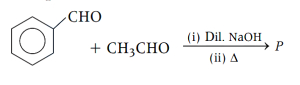
The product '$P$' is
A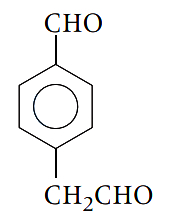
B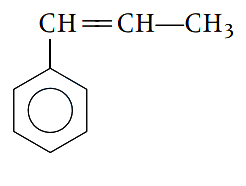
C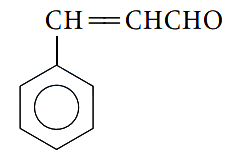
D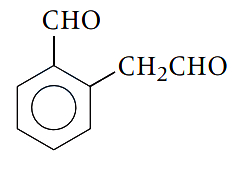
Solution
(C) The reaction between benzaldehyde $(C_6H_5CHO)$ and acetaldehyde $(CH_3CHO)$ in the presence of dilute $NaOH$ followed by heating $(\Delta)$ is a cross-aldol condensation reaction.
$1$. The enolate ion formed from acetaldehyde attacks the carbonyl carbon of benzaldehyde to form a $\beta$-hydroxy aldehyde.
$2$. Upon heating,this $\beta$-hydroxy aldehyde undergoes dehydration to form an $\alpha,\beta$-unsaturated aldehyde,which is cinnamaldehyde $(C_6H_5CH=CHCHO)$.
$1$. The enolate ion formed from acetaldehyde attacks the carbonyl carbon of benzaldehyde to form a $\beta$-hydroxy aldehyde.
$2$. Upon heating,this $\beta$-hydroxy aldehyde undergoes dehydration to form an $\alpha,\beta$-unsaturated aldehyde,which is cinnamaldehyde $(C_6H_5CH=CHCHO)$.
0 likes
View Solution1442
MediumMCQ
The carbonyl compound that does not undergo aldol condensation is
A
acetone
B
dichloro acetaldehyde
C
trichloro acetaldehyde
D
acetaldehyde
Solution
(C) Any carbonyl compound having $\alpha$-hydrogen will undergo aldol condensation.
In $CCl_3CHO$ (trichloro acetaldehyde),the $\alpha$-carbon is bonded to three chlorine atoms and has no $\alpha$-hydrogen atom attached to it.
Therefore,it does not show the aldol condensation reaction.
In $CCl_3CHO$ (trichloro acetaldehyde),the $\alpha$-carbon is bonded to three chlorine atoms and has no $\alpha$-hydrogen atom attached to it.
Therefore,it does not show the aldol condensation reaction.
0 likes
View Solution1443
DifficultMCQ
The reagents $A$,$B$ and $C$ respectively are:
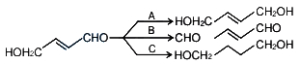
A
$NaBH_{4}$,$PCC$,$H_{2} / Pd$
B
$H_{2} / Pd$,alk. $KMnO_{4}$,$NaBH_{4}$
C
$H_{2} / Pd$,$PCC$,$NaBH_{4}$
D
$NaBH_{4}$,alk. $KMnO_{4}$,$H_{2} / Pd$
Solution
(A) The starting material is $HOCH_{2}-CH=CH-CHO$.
Step $A$: The product is $HOCH_{2}-CH=CH-CH_{2}OH$. This indicates the reduction of the aldehyde group to a primary alcohol while leaving the $C=C$ double bond intact. $NaBH_{4}$ is a selective reducing agent that reduces aldehydes/ketones but not $C=C$ double bonds.
Step $B$: The product is $HOCH_{2}-CH=CH-CHO$. This indicates that the aldehyde group remains unchanged. $PCC$ (Pyridinium chlorochromate) is an oxidizing agent used to oxidize alcohols to aldehydes,but it does not affect the aldehyde group itself.
Step $C$: The product is $HOCH_{2}-CH_{2}-CH_{2}-CH_{2}OH$. This indicates the reduction of both the aldehyde group and the $C=C$ double bond. $H_{2} / Pd$ is a catalytic hydrogenation reagent that reduces both aldehydes and $C=C$ double bonds.
Therefore,the reagents are $A = NaBH_{4}$,$B = PCC$,$C = H_{2} / Pd$.
Step $A$: The product is $HOCH_{2}-CH=CH-CH_{2}OH$. This indicates the reduction of the aldehyde group to a primary alcohol while leaving the $C=C$ double bond intact. $NaBH_{4}$ is a selective reducing agent that reduces aldehydes/ketones but not $C=C$ double bonds.
Step $B$: The product is $HOCH_{2}-CH=CH-CHO$. This indicates that the aldehyde group remains unchanged. $PCC$ (Pyridinium chlorochromate) is an oxidizing agent used to oxidize alcohols to aldehydes,but it does not affect the aldehyde group itself.
Step $C$: The product is $HOCH_{2}-CH_{2}-CH_{2}-CH_{2}OH$. This indicates the reduction of both the aldehyde group and the $C=C$ double bond. $H_{2} / Pd$ is a catalytic hydrogenation reagent that reduces both aldehydes and $C=C$ double bonds.
Therefore,the reagents are $A = NaBH_{4}$,$B = PCC$,$C = H_{2} / Pd$.
0 likes
View Solution1444
EasyMCQ
The appropriate reagent for the following transformation is
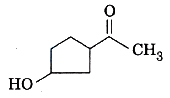
A
$Zn-Hg / HCl$
B
$H_2N-NH_2, KOH / \text{ethylene glycol}$
C
$Ni / H_2$
D
$NaBH_4$
Solution
(B) The transformation involves the reduction of a ketone group $(-C=O)$ to a methylene group $(-CH_2-)$ in the presence of an alcohol group $(-OH)$.
$Zn-Hg / HCl$ (Clemmensen reduction) is acidic and would cause the dehydration of the alcohol group.
$H_2N-NH_2, KOH / \text{ethylene glycol}$ (Wolff-Kishner reduction) is a basic condition,which is compatible with the presence of an alcohol group.
Therefore,the appropriate reagent is $H_2N-NH_2, KOH / \text{ethylene glycol}$.
$Zn-Hg / HCl$ (Clemmensen reduction) is acidic and would cause the dehydration of the alcohol group.
$H_2N-NH_2, KOH / \text{ethylene glycol}$ (Wolff-Kishner reduction) is a basic condition,which is compatible with the presence of an alcohol group.
Therefore,the appropriate reagent is $H_2N-NH_2, KOH / \text{ethylene glycol}$.
0 likes
View Solution1445
DifficultMCQ
Benzene carbaldehyde (benzaldehyde) is reacted with concentrated $NaOH$ solution to give the products $A$ and $B$. The product $A$ can be used as a food preservative and the product $B$ is an aromatic hydroxy compound where the $OH$ group is linked to an $sp^3$ hybridized carbon atom next to the benzene ring. The products $A$ and $B$ are respectively,
A
Sodium benzoate and phenol
B
Sodium benzoate and phenyl methanol
C
Sodium benzoate and cresol
D
Sodium benzoate and picric acid
Solution
(B) This reaction is an example of the Cannizzaro reaction,which occurs in aldehydes lacking $\alpha$-hydrogen atoms.
$2 C_6H_5CHO + NaOH (conc.) \rightarrow C_6H_5COONa (A) + C_6H_5CH_2OH (B)$
Product $A$ is Sodium benzoate,which is commonly used as a food preservative.
Product $B$ is Phenyl methanol (also known as Benzyl alcohol),which is an aromatic hydroxy compound where the $OH$ group is attached to an $sp^3$ hybridized carbon atom $(-CH_2-)$ adjacent to the benzene ring.
Therefore,the products $A$ and $B$ are Sodium benzoate and Phenyl methanol.
$2 C_6H_5CHO + NaOH (conc.) \rightarrow C_6H_5COONa (A) + C_6H_5CH_2OH (B)$
Product $A$ is Sodium benzoate,which is commonly used as a food preservative.
Product $B$ is Phenyl methanol (also known as Benzyl alcohol),which is an aromatic hydroxy compound where the $OH$ group is attached to an $sp^3$ hybridized carbon atom $(-CH_2-)$ adjacent to the benzene ring.
Therefore,the products $A$ and $B$ are Sodium benzoate and Phenyl methanol.
0 likes
View Solution1446
EasyMCQ
The formation of cyanohydrin from a ketone is an example of
A
Nucleophilic substitution
B
Nucleophilic addition
C
Electrophilic addition
D
Electrophilic substitution
Solution
(B) The formation of cyanohydrin from a ketone by reaction with $HCN$ is an example of a nucleophilic addition reaction.
In this reaction,the nucleophile $CN^-$ attacks the electrophilic carbonyl carbon of the ketone,leading to the formation of an intermediate alkoxide ion,which is then protonated to form the cyanohydrin.
In this reaction,the nucleophile $CN^-$ attacks the electrophilic carbonyl carbon of the ketone,leading to the formation of an intermediate alkoxide ion,which is then protonated to form the cyanohydrin.
0 likes
View Solution1447
EasyMCQ
The correct sequence of steps involved in the mechanism of Cannizzaro's reaction is
A
nucleophilic attack,transfer of $H^{-}$ and transfer of $H^{+}$
B
transfer of $H^{-}$,transfer of $H^{+}$ and nucleophilic attack
C
transfer of $H^{+}$,nucleophilic attack and transfer of $H^{-}$
D
electrophilic attack by $OH^{-}$,transfer of $H^{+}$ and transfer of $H^{-}$
Solution
(A) The Cannizzaro reaction mechanism involves the following steps:
Step $I$: Nucleophilic attack of $OH^{-}$ on the carbonyl carbon of the first aldehyde molecule to form a dihydroxyalkoxide intermediate.
Step $II$: Transfer of a hydride ion $(H^{-})$ from the intermediate to the carbonyl carbon of a second aldehyde molecule,resulting in the formation of a carboxylate ion and an alkoxide ion.
Step $III$: Rapid proton transfer $(H^{+})$ from the carboxylic acid (or solvent) to the alkoxide ion to form the alcohol.
Step $I$: Nucleophilic attack of $OH^{-}$ on the carbonyl carbon of the first aldehyde molecule to form a dihydroxyalkoxide intermediate.
Step $II$: Transfer of a hydride ion $(H^{-})$ from the intermediate to the carbonyl carbon of a second aldehyde molecule,resulting in the formation of a carboxylate ion and an alkoxide ion.
Step $III$: Rapid proton transfer $(H^{+})$ from the carboxylic acid (or solvent) to the alkoxide ion to form the alcohol.
0 likes
View Solution1448
EasyMCQ
$CH_3COOH$ $\xrightarrow{LiAlH_4} X$ $\xrightarrow{Cu, 300^{\circ}C} Y$ $\xrightarrow{\text{Dilute } NaOH} Z$. In the above reaction,$Z$ is:
A
butanol
B
aldol
C
ketol
D
acetal
Solution
(B) $Step \ 1$: Reduction of acetic acid $(CH_3COOH)$ with $LiAlH_4$ gives ethanol $(CH_3CH_2OH)$ as $X$.
$Step \ 2$: Dehydrogenation of ethanol $(X)$ over $Cu$ at $300^{\circ}C$ gives acetaldehyde $(CH_3CHO)$ as $Y$.
$Step \ 3$: Acetaldehyde $(Y)$ undergoes aldol condensation in the presence of dilute $NaOH$ to form $3-hydroxybutanal$ $(CH_3CH(OH)CH_2CHO)$,which is commonly known as aldol,as $Z$.
Therefore,the correct option is $B$.
$Step \ 2$: Dehydrogenation of ethanol $(X)$ over $Cu$ at $300^{\circ}C$ gives acetaldehyde $(CH_3CHO)$ as $Y$.
$Step \ 3$: Acetaldehyde $(Y)$ undergoes aldol condensation in the presence of dilute $NaOH$ to form $3-hydroxybutanal$ $(CH_3CH(OH)CH_2CHO)$,which is commonly known as aldol,as $Z$.
Therefore,the correct option is $B$.
0 likes
View Solution1449
EasyMCQ
The general name of the compound formed by the reaction between aldehyde and alcohol is
A
acetal
B
glycol
C
acetate
D
ester
Solution
(A) Aldehydes react with alcohols in the presence of dry $HCl$ gas to form hemiacetals,which further react with another molecule of alcohol to form acetals.
The reaction is as follows:
$R-CHO + R'-OH \rightleftharpoons R-CH(OH)(OR')$ (Hemiacetal)
$R-CH(OH)(OR') + R'-OH \rightleftharpoons R-CH(OR')_2 + H_2O$ (Acetal)
The reaction is as follows:
$R-CHO + R'-OH \rightleftharpoons R-CH(OH)(OR')$ (Hemiacetal)
$R-CH(OH)(OR') + R'-OH \rightleftharpoons R-CH(OR')_2 + H_2O$ (Acetal)
0 likes
View Solution1450
MediumMCQ
The test to differentiate between $\text{pentan-2-one}$ and $\text{pentan-3-one}$ is
A
Benedict's test
B
Fehling's test
C
Iodoform test
D
Baeyer's test
Solution
(C) $\text{Pentan-2-one}$ contains a $CH_3CO-$ group,which gives a positive iodoform test when reacted with $I_2$ and $NaOH$,resulting in yellow precipitates of iodoform $(CHI_3)$.
$\text{Pentan-3-one}$ does not contain a $CH_3CO-$ group and therefore does not give the iodoform test.
The reaction for $\text{pentan-2-one}$ is:
$CH_3CH_2CH_2COCH_3 + 3NaOI \rightarrow CH_3CH_2CH_2COONa + CHI_3 \downarrow + 2NaOH$
$\text{Pentan-3-one}$ does not contain a $CH_3CO-$ group and therefore does not give the iodoform test.
The reaction for $\text{pentan-2-one}$ is:
$CH_3CH_2CH_2COCH_3 + 3NaOI \rightarrow CH_3CH_2CH_2COONa + CHI_3 \downarrow + 2NaOH$
0 likes
View Solution8-1.Aldehydes and Ketones — Properties · Frequently Asked Questions
1Are these 8-1.Aldehydes and Ketones questions useful for JEE and NEET?
Yes. All questions in this section are mapped to JEE Main and NEET exam patterns. Previous year questions from JEE Main, NEET, GUJCET and state-level exams are included with full solutions.
2Can I switch to Hindi or Gujarati for these questions?
Yes. Use the language tabs in the hero section or the sidebar to view the same questions and solutions in English, Hindi or Gujarati.
3How do I generate a question paper from this subtopic?
Use the Vedclass Exam Paper Generator — select the chapter and subtopic, set difficulty, and generate Sets A, B, C, D automatically. First 3 chapters of every subject are free.
Vedclass Products
For Students
Vedclass Test Series
Mock tests in real JEE/NEET style with performance analysis. 5-day free trial.
Start Free TrialFor Teachers
Exam Paper Generator
Generate Set A/B/C/D papers from this chapter in 2 minutes. 3 chapters free.
Try FreeFor Institutes
Online Exam Module
Live online exams with unlimited students, 360° analytics & white-label branding.
See DemoFor Teachers & Institutes
Generate a 8-1.Aldehydes and Ketones Exam Paper in 2 Minutes
Select subtopic & difficulty — Sets A, B, C, D auto-generated with No Repeat logic.
First 3 chapters of every subject are free — no payment required.