
A English
Preparation Questions in English
Class 12 Chemistry · 8-1.Aldehydes and Ketones · Preparation
328+
Questions
English
Language
100%
With Solutions
Showing 50 of 328 questions in English
151
EasyMCQ
Calcium acetate,on heating,gives:
A
$Acetic \ anhydride$
B
$Acetone$
C
$Acetaldehyde$
D
$Ethyl \ alcohol$
Solution
(B) When calcium acetate is heated (dry distillation),it undergoes thermal decomposition to form acetone and calcium carbonate.
$(CH_3COO)_2Ca \xrightarrow{\Delta} CH_3COCH_3 + CaCO_3$
$(CH_3COO)_2Ca \xrightarrow{\Delta} CH_3COCH_3 + CaCO_3$
0 likes
View Solution152
MediumMCQ
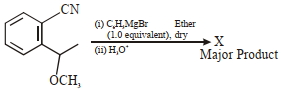
The structure of $X$ is :
A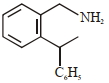
B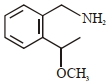
C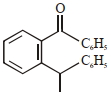
D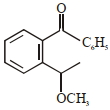
Solution
(D) The reaction of a nitrile $(-CN)$ with a Grignard reagent $(PhMgBr)$ followed by acid hydrolysis $(H_3O^+)$ is a standard method for the preparation of ketones.
$1$. The nucleophilic phenyl group $(Ph^-)$ from $PhMgBr$ attacks the electrophilic carbon of the nitrile group $(-CN)$ to form an imine magnesium salt intermediate.
$2$. Subsequent acid hydrolysis $(H_3O^+)$ converts the imine intermediate into a ketone $(C=O)$.
$3$. The other substituent on the benzene ring,$-\text{CH}(\text{CH}_3)\text{OCH}_3$,remains unaffected by these reagents.
$4$. Therefore,the final product $X$ is a ketone where the $-CN$ group is replaced by a $-COC_6H_5$ group,while the side chain $-\text{CH}(\text{CH}_3)\text{OCH}_3$ remains unchanged.
$1$. The nucleophilic phenyl group $(Ph^-)$ from $PhMgBr$ attacks the electrophilic carbon of the nitrile group $(-CN)$ to form an imine magnesium salt intermediate.
$2$. Subsequent acid hydrolysis $(H_3O^+)$ converts the imine intermediate into a ketone $(C=O)$.
$3$. The other substituent on the benzene ring,$-\text{CH}(\text{CH}_3)\text{OCH}_3$,remains unaffected by these reagents.
$4$. Therefore,the final product $X$ is a ketone where the $-CN$ group is replaced by a $-COC_6H_5$ group,while the side chain $-\text{CH}(\text{CH}_3)\text{OCH}_3$ remains unchanged.
0 likes
View Solution153
MediumMCQ
Which one of the following reactions will not form acetaldehyde?
A
$CH_3-CH_2-OH \xrightarrow[573 \ K]{Cu}$
B
$CH_3-CN \xrightarrow[(ii) H_2O]{(i) DIBAL-H}$
C
$CH_2=CH_2 + O_2 \xrightarrow[H_2O]{Pd(II)/Cu(II)}$
D
$CH_3-CH_2-OH \xrightarrow{CrO_3 - H_2SO_4}$
Solution
(D) $CH_3-CH_2-OH$ on oxidation with $CrO_3 - H_2SO_4$ (Jones reagent) gives acetic acid $(CH_3-COOH)$ because it is a strong oxidizing agent.
The other reactions produce acetaldehyde $(CH_3-CHO)$:
$(A)$ Dehydrogenation of ethanol: $CH_3-CH_2-OH \xrightarrow[573 \ K]{Cu} CH_3-CHO + H_2$
$(B)$ Reduction of nitrile: $CH_3-CN \xrightarrow[(ii) H_2O]{(i) DIBAL-H} CH_3-CHO$
$(C)$ Wacker process: $CH_2=CH_2 + O_2 \xrightarrow[H_2O]{Pd(II)/Cu(II)} CH_3-CHO$
The other reactions produce acetaldehyde $(CH_3-CHO)$:
$(A)$ Dehydrogenation of ethanol: $CH_3-CH_2-OH \xrightarrow[573 \ K]{Cu} CH_3-CHO + H_2$
$(B)$ Reduction of nitrile: $CH_3-CN \xrightarrow[(ii) H_2O]{(i) DIBAL-H} CH_3-CHO$
$(C)$ Wacker process: $CH_2=CH_2 + O_2 \xrightarrow[H_2O]{Pd(II)/Cu(II)} CH_3-CHO$
0 likes
View Solution154
EasyMCQ
The major product of the following chemical reaction is
$CH_{3}CH_{2}CN \xrightarrow[(3) Pd/BaSO_{4}, H_{2}]{(1) H_{3}O^{+}, \Delta \quad (2) SOCl_{2}} ?$
$CH_{3}CH_{2}CN \xrightarrow[(3) Pd/BaSO_{4}, H_{2}]{(1) H_{3}O^{+}, \Delta \quad (2) SOCl_{2}} ?$
A
$CH_{3}CH_{2}CH_{3}$
B
$CH_{3}CH_{2}CH_{2}OH$
C
$(CH_{3}CH_{2}CO)_{2}O$
D
$CH_{3}CH_{2}CHO$
Solution
(D) The reaction proceeds in three steps:
$1$. Acidic hydrolysis of propanenitrile $(CH_{3}CH_{2}CN)$ yields propanoic acid $(CH_{3}CH_{2}COOH)$.
$2$. Treatment of propanoic acid with $SOCl_{2}$ yields propanoyl chloride $(CH_{3}CH_{2}COCl)$.
$3$. Rosenmund reduction of propanoyl chloride using $Pd/BaSO_{4}$ and $H_{2}$ yields propanaldehyde $(CH_{3}CH_{2}CHO)$.
$1$. Acidic hydrolysis of propanenitrile $(CH_{3}CH_{2}CN)$ yields propanoic acid $(CH_{3}CH_{2}COOH)$.
$2$. Treatment of propanoic acid with $SOCl_{2}$ yields propanoyl chloride $(CH_{3}CH_{2}COCl)$.
$3$. Rosenmund reduction of propanoyl chloride using $Pd/BaSO_{4}$ and $H_{2}$ yields propanaldehyde $(CH_{3}CH_{2}CHO)$.
0 likes
View Solution155
MediumMCQ
The major product of the following reaction is:
$CH_3CH_2CH=CH_2$ $\xrightarrow[Rh \ \text{catalyst}]{H_2/CO}$
$CH_3CH_2CH=CH_2$ $\xrightarrow[Rh \ \text{catalyst}]{H_2/CO}$
A
$CH_3CH_2CH_2CH_2CHO$
B
$CH_3CH_2CH(CHO)CH_3$
C
$CH_3CH_2CH_2CH_2CHO$ (linear product) and $CH_3CH_2CH(CH_3)CHO$ (branched product)
D
$CH_3CH_2CH_2CHO$
Solution
(A) The reaction is the $OXO$ process or hydroformylation of alkenes.
In this reaction,an alkene reacts with $CO$ and $H_2$ in the presence of a rhodium $(Rh)$ or cobalt catalyst to form an aldehyde.
For the substrate $CH_3CH_2CH=CH_2$ (but$-1-$ene),the hydroformylation leads to two isomeric aldehydes:
$1$. $CH_3CH_2CH_2CH_2CHO$ (pentanal,linear product)
$2$. $CH_3CH_2CH(CH_3)CHO$ ($2$-methylbutanal,branched product)
Using a rhodium catalyst,the linear aldehyde is typically the major product due to less steric hindrance during the formation of the transition state.
Therefore,the major product is $CH_3CH_2CH_2CH_2CHO$.
In this reaction,an alkene reacts with $CO$ and $H_2$ in the presence of a rhodium $(Rh)$ or cobalt catalyst to form an aldehyde.
For the substrate $CH_3CH_2CH=CH_2$ (but$-1-$ene),the hydroformylation leads to two isomeric aldehydes:
$1$. $CH_3CH_2CH_2CH_2CHO$ (pentanal,linear product)
$2$. $CH_3CH_2CH(CH_3)CHO$ ($2$-methylbutanal,branched product)
Using a rhodium catalyst,the linear aldehyde is typically the major product due to less steric hindrance during the formation of the transition state.
Therefore,the major product is $CH_3CH_2CH_2CH_2CHO$.
0 likes
View Solution156
EasyMCQ
The intermediate compound $X$ in the following chemical reaction is :
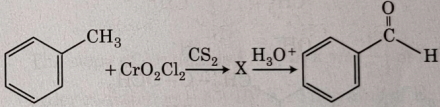
A
$C_6H_5CH(OCrOHCl_2)_2$
B
$C_6H_5CH(OCOCH_3)_2$
C
$C_6H_5CHCl_2$
D
$C_6H_5CHCl$
Solution
(A) The given reaction is the $Etard$ reaction,which is used for the oxidation of toluene to benzaldehyde using chromyl chloride $(CrO_2Cl_2)$ in the presence of a non-polar solvent like carbon disulfide $(CS_2)$.
In this reaction,the methyl group of toluene is oxidized to a chromium complex intermediate,which is $C_6H_5CH(OCrOHCl_2)_2$.
This intermediate is then hydrolyzed with water $(H_3O^+)$ to yield benzaldehyde.
In this reaction,the methyl group of toluene is oxidized to a chromium complex intermediate,which is $C_6H_5CH(OCrOHCl_2)_2$.
This intermediate is then hydrolyzed with water $(H_3O^+)$ to yield benzaldehyde.
0 likes
View Solution157
MediumMCQ
To synthesise $1.0 \ mole$ of $2-$methylpropan$-2-$ol from ethyl ethanoate,how many equivalents of $CH_{3}MgBr$ reagent will be required? (Integer value)
A
$5$
B
$4$
C
$2$
D
$1$
Solution
(C) The reaction of ethyl ethanoate $(CH_{3}COOCH_{2}CH_{3})$ with Grignard reagent $(CH_{3}MgBr)$ proceeds in two steps:
$1$. First,$1$ equivalent of $CH_{3}MgBr$ attacks the carbonyl carbon of the ester,leading to the elimination of the ethoxide group and the formation of acetone $(CH_{3}COCH_{3})$.
$2$. Second,another equivalent of $CH_{3}MgBr$ attacks the carbonyl carbon of the formed acetone to produce a tertiary alkoxide intermediate $(CH_{3}C(OMgBr)(CH_{3})_{2})$.
$3$. Upon acidic workup (hydrolysis),this intermediate yields $2-$methylpropan$-2-$ol.
Thus,a total of $2$ equivalents of $CH_{3}MgBr$ are required for the complete conversion of $1$ mole of ethyl ethanoate to $1$ mole of $2-$methylpropan$-2-$ol.
$1$. First,$1$ equivalent of $CH_{3}MgBr$ attacks the carbonyl carbon of the ester,leading to the elimination of the ethoxide group and the formation of acetone $(CH_{3}COCH_{3})$.
$2$. Second,another equivalent of $CH_{3}MgBr$ attacks the carbonyl carbon of the formed acetone to produce a tertiary alkoxide intermediate $(CH_{3}C(OMgBr)(CH_{3})_{2})$.
$3$. Upon acidic workup (hydrolysis),this intermediate yields $2-$methylpropan$-2-$ol.
Thus,a total of $2$ equivalents of $CH_{3}MgBr$ are required for the complete conversion of $1$ mole of ethyl ethanoate to $1$ mole of $2-$methylpropan$-2-$ol.
0 likes
View Solution158
DifficultMCQ
$R-CN \xrightarrow[(ii) H_2O]{(i) DIBAL-H} R-Y$
Consider the above reaction and identify $Y$.
Consider the above reaction and identify $Y$.
A
$-CHO$
B
$-CONH_2$
C
$-CH_2NH_2$
D
$-COOH$
Solution
(A) The reaction of nitriles $(R-CN)$ with $DIBAL-H$ (Diisobutylaluminium hydride) followed by hydrolysis is a standard method for the preparation of aldehydes.
The reaction proceeds as follows:
$R-C \equiv N \xrightarrow[(ii) H_2O]{(i) DIBAL-H} R-CHO$
Here,the nitrile group is reduced to an aldehyde group.
Therefore,$Y$ is $-CHO$ (Aldehyde).
The reaction proceeds as follows:
$R-C \equiv N \xrightarrow[(ii) H_2O]{(i) DIBAL-H} R-CHO$
Here,the nitrile group is reduced to an aldehyde group.
Therefore,$Y$ is $-CHO$ (Aldehyde).
0 likes
View Solution159
MediumMCQ
Which of the following reagents/reactions will convert $A$ to $B$?
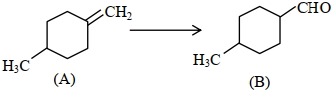
A
$PCC$ oxidation
B
Ozonolysis
C
$BH_3, H_2O_2 / OH^-$ followed by $PCC$ oxidation
D
$HBr$,hydrolysis followed by oxidation by $K_2Cr_2O_7$.
Solution
(C) The conversion of $A$ ($4$-methylmethylenecyclohexane) to $B$ ($4$-methylcyclohexanecarbaldehyde) involves the transformation of an exocyclic double bond into an aldehyde group.
$1$. First,hydroboration-oxidation using $BH_3, H_2O_2 / OH^-$ is performed. This reaction follows anti-Markovnikov addition of water across the double bond to form a primary alcohol,$4$-methylcyclohexylmethanol.
$2$. Second,the primary alcohol is oxidized to an aldehyde using $PCC$ (Pyridinium chlorochromate). $PCC$ is a mild oxidizing agent that stops the oxidation at the aldehyde stage,preventing further oxidation to a carboxylic acid.
$1$. First,hydroboration-oxidation using $BH_3, H_2O_2 / OH^-$ is performed. This reaction follows anti-Markovnikov addition of water across the double bond to form a primary alcohol,$4$-methylcyclohexylmethanol.
$2$. Second,the primary alcohol is oxidized to an aldehyde using $PCC$ (Pyridinium chlorochromate). $PCC$ is a mild oxidizing agent that stops the oxidation at the aldehyde stage,preventing further oxidation to a carboxylic acid.
0 likes
View Solution160
DifficultMCQ
Which of the following conditions or reaction sequences will $NOT$ give acetophenone as the major product?
A
$C_6H_5CHO + CH_3MgBr$ followed by $Na_2Cr_2O_7, H^+$
B
$CH_3CHO + C_6H_5MgBr$ followed by $PCC, DCM$
C
$C_6H_5COOC_2H_5 + 2CH_3MgBr$
D
$C_6H_5COCl + CH_3MgBr + CdCl_2$
Solution
(C) Acetophenone is $C_6H_5COCH_3$.
$(A)$ $C_6H_5CHO + CH_3MgBr \rightarrow C_6H_5CH(OH)CH_3$. Oxidation with $Na_2Cr_2O_7/H^+$ gives $C_6H_5COCH_3$ (Acetophenone).
$(B)$ $CH_3CHO + C_6H_5MgBr \rightarrow CH_3CH(OH)C_6H_5$. Oxidation with $PCC$ gives $CH_3COC_6H_5$ (Acetophenone).
$(C)$ Esters react with $2$ equivalents of Grignard reagent to form tertiary alcohols. $C_6H_5COOC_2H_5 + 2CH_3MgBr \rightarrow C_6H_5C(OH)(CH_3)_2$. This does not give acetophenone.
$(D)$ Acid chlorides react with organocadmium reagents (formed in situ from $2RMgX + CdCl_2$) to give ketones. $2C_6H_5COCl + (CH_3)_2Cd \rightarrow 2C_6H_5COCH_3$. This gives acetophenone.
$(A)$ $C_6H_5CHO + CH_3MgBr \rightarrow C_6H_5CH(OH)CH_3$. Oxidation with $Na_2Cr_2O_7/H^+$ gives $C_6H_5COCH_3$ (Acetophenone).
$(B)$ $CH_3CHO + C_6H_5MgBr \rightarrow CH_3CH(OH)C_6H_5$. Oxidation with $PCC$ gives $CH_3COC_6H_5$ (Acetophenone).
$(C)$ Esters react with $2$ equivalents of Grignard reagent to form tertiary alcohols. $C_6H_5COOC_2H_5 + 2CH_3MgBr \rightarrow C_6H_5C(OH)(CH_3)_2$. This does not give acetophenone.
$(D)$ Acid chlorides react with organocadmium reagents (formed in situ from $2RMgX + CdCl_2$) to give ketones. $2C_6H_5COCl + (CH_3)_2Cd \rightarrow 2C_6H_5COCH_3$. This gives acetophenone.
0 likes
View Solution161
EasyMCQ
Oxidation of toluene to benzaldehyde can be easily carried out with which of the following reagents?
A
$CrO_3$ / acetic acid,$H_3O^+$
B
$CrO_3$ / acetic anhydride,$H_3O^+$
C
$KMnO_4$ / $HCl$,$H_3O^+$
D
$CO$ / $HCl$,anhydrous $AlCl_3$
Solution
(B) The oxidation of toluene to benzaldehyde is known as the Etard reaction.
In this reaction,toluene is treated with chromyl chloride $(CrO_2Cl_2)$ or,as shown in the options,with $CrO_3$ in the presence of acetic anhydride.
The $CrO_3$ with acetic anhydride forms a gem-diacetate intermediate,which upon subsequent hydrolysis with $H_3O^+$ yields benzaldehyde.
The reaction sequence is:
$C_6H_5CH_3$ $\xrightarrow{CrO_3 / \text{acetic anhydride}} C_6H_5CH(OCOCH_3)_2$ $\xrightarrow{H_3O^+} C_6H_5CHO + 2CH_3COOH$
Therefore,the correct reagent is $CrO_3$ / acetic anhydride followed by $H_3O^+$.
In this reaction,toluene is treated with chromyl chloride $(CrO_2Cl_2)$ or,as shown in the options,with $CrO_3$ in the presence of acetic anhydride.
The $CrO_3$ with acetic anhydride forms a gem-diacetate intermediate,which upon subsequent hydrolysis with $H_3O^+$ yields benzaldehyde.
The reaction sequence is:
$C_6H_5CH_3$ $\xrightarrow{CrO_3 / \text{acetic anhydride}} C_6H_5CH(OCOCH_3)_2$ $\xrightarrow{H_3O^+} C_6H_5CHO + 2CH_3COOH$
Therefore,the correct reagent is $CrO_3$ / acetic anhydride followed by $H_3O^+$.
0 likes
View Solution162
DifficultMCQ
Which of the following reactions will yield benzaldehyde as a product?
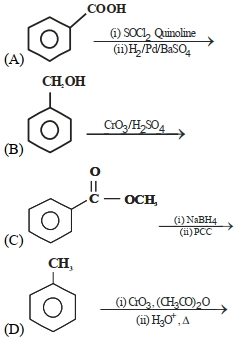
A
$(A)$ and $(B)$
B
$(C)$ and $(D)$
C
$(A)$ and $(D)$
D
$(A)$ and $(C)$
Solution
(C) Let us analyze each reaction:
$(A)$ Benzoic acid reacts with $SOCl_2$ to form benzoyl chloride,which on Rosenmund reduction $(H_2/Pd/BaSO_4)$ yields benzaldehyde.
$(B)$ Benzyl alcohol on oxidation with $CrO_3/H_2SO_4$ (Jones reagent) yields benzoic acid,not benzaldehyde.
$(C)$ Methyl benzoate does not react with $NaBH_4$ to form benzaldehyde.
$(D)$ Toluene reacts with $CrO_3$ in the presence of acetic anhydride to form a gem-diacetate intermediate,which on hydrolysis yields benzaldehyde (Etard reaction).
Therefore,reactions $(A)$ and $(D)$ yield benzaldehyde.
$(A)$ Benzoic acid reacts with $SOCl_2$ to form benzoyl chloride,which on Rosenmund reduction $(H_2/Pd/BaSO_4)$ yields benzaldehyde.
$(B)$ Benzyl alcohol on oxidation with $CrO_3/H_2SO_4$ (Jones reagent) yields benzoic acid,not benzaldehyde.
$(C)$ Methyl benzoate does not react with $NaBH_4$ to form benzaldehyde.
$(D)$ Toluene reacts with $CrO_3$ in the presence of acetic anhydride to form a gem-diacetate intermediate,which on hydrolysis yields benzaldehyde (Etard reaction).
Therefore,reactions $(A)$ and $(D)$ yield benzaldehyde.
0 likes
View Solution163
DifficultMCQ
Match List-$I$ with List-$II$.
Choose the correct answer from the options given below.
| $A$. $C_6H_5COCl + H_2 \xrightarrow{Pd-BaSO_4} C_6H_5CHO$ | $I$. Gattermann-Koch reaction |
| $B$. $CH_3CN + SnCl_2 + HCl \rightarrow CH_3CHO$ | $II$. Etard reaction |
| $C$. $C_6H_5CH_3 + CrO_2Cl_2 \rightarrow C_6H_5CHO$ | $III$. Stephen reaction |
| $D$. $C_6H_6 + CO + HCl \xrightarrow{AlCl_3} C_6H_5CHO$ | $IV$. Rosenmund reaction |
Choose the correct answer from the options given below.
A
$A-IV, B-III, C-II, D-I$
B
$A-I, B-II, C-III, D-IV$
C
$A-II, B-III, C-IV, D-I$
D
$A-III, B-II, C-I, D-IV$
Solution
(A) The correct matches are as follows:
$A$. $C_6H_5COCl + H_2 \xrightarrow{Pd-BaSO_4} C_6H_5CHO$ is the Rosenmund reaction $(IV)$.
$B$. $CH_3CN + SnCl_2 + HCl \rightarrow CH_3CHO$ is the Stephen reaction $(III)$.
$C$. $C_6H_5CH_3 + CrO_2Cl_2 \rightarrow C_6H_5CHO$ is the Etard reaction $(II)$.
$D$. $C_6H_6 + CO + HCl \xrightarrow{AlCl_3} C_6H_5CHO$ is the Gattermann-Koch reaction $(I)$.
Therefore,the correct sequence is $A-IV, B-III, C-II, D-I$.
$A$. $C_6H_5COCl + H_2 \xrightarrow{Pd-BaSO_4} C_6H_5CHO$ is the Rosenmund reaction $(IV)$.
$B$. $CH_3CN + SnCl_2 + HCl \rightarrow CH_3CHO$ is the Stephen reaction $(III)$.
$C$. $C_6H_5CH_3 + CrO_2Cl_2 \rightarrow C_6H_5CHO$ is the Etard reaction $(II)$.
$D$. $C_6H_6 + CO + HCl \xrightarrow{AlCl_3} C_6H_5CHO$ is the Gattermann-Koch reaction $(I)$.
Therefore,the correct sequence is $A-IV, B-III, C-II, D-I$.
0 likes
View Solution164
MediumMCQ
The major final product in the following reaction is $CH_3CH_2CN \xrightarrow[(ii) \ H_3O^{+}]{(i) \ CH_3MgBr}$
A
$CH_3CH_2C(NH)CH_3$
B
$CH_3CH_2CH=NCH_3$
C
$CH_3CH_2COCH_3$
D
$CH_3CH_2CONHCH_3$
Solution
(C) The reaction of a nitrile $(CH_3CH_2CN)$ with a Grignard reagent $(CH_3MgBr)$ followed by acidic hydrolysis $(H_3O^+)$ is a standard method for the preparation of ketones.
Step $1$: The nucleophilic methyl group from $CH_3MgBr$ attacks the electrophilic carbon of the nitrile group to form an imine salt intermediate $(CH_3CH_2C(NMgBr)CH_3)$.
Step $2$: Acidic hydrolysis of the imine salt converts it into a ketone $(CH_3CH_2COCH_3)$.
Therefore,the major final product is butan-$2$-one $(CH_3CH_2COCH_3)$.
Step $1$: The nucleophilic methyl group from $CH_3MgBr$ attacks the electrophilic carbon of the nitrile group to form an imine salt intermediate $(CH_3CH_2C(NMgBr)CH_3)$.
Step $2$: Acidic hydrolysis of the imine salt converts it into a ketone $(CH_3CH_2COCH_3)$.
Therefore,the major final product is butan-$2$-one $(CH_3CH_2COCH_3)$.
0 likes
View Solution165
MediumMCQ
Which of the following is an incorrect method for the synthesis of benzaldehyde?
A
$A$. Oxidation of toluene by $CrO_2Cl_2$ followed by hydrolysis
B
$B$. Reduction of benzoyl chloride with $H_2$ in the presence of $Pd-BaSO_4$
C
$C$. Oxidation of toluene by $CrO_3$ in the presence of acetic anhydride
D
$D$. Reaction of benzonitrile with $CH_3MgBr$ followed by hydrolysis
Solution
(D) Let us analyze each reaction pathway for the synthesis of benzaldehyde:
$A$. Etard reaction: Toluene is oxidized by $CrO_2Cl_2$ in $CS_2$ followed by hydrolysis to give benzaldehyde. This is a correct method.
$B$. Rosenmund reduction: Benzoyl chloride is reduced by $H_2$ in the presence of $Pd-BaSO_4$ (Lindlar catalyst) to give benzaldehyde. This is a correct method.
$C$. Toluene is oxidized by $CrO_3$ in the presence of acetic anhydride to form a gem-diacetate intermediate,which upon hydrolysis yields benzaldehyde. This is a correct method.
$D$. Reaction of benzonitrile $(C_6H_5CN)$ with $CH_3MgBr$ (a Grignard reagent) followed by hydrolysis yields acetophenone $(C_6H_5COCH_3)$,not benzaldehyde. Therefore,this is an incorrect method for the synthesis of benzaldehyde.
$A$. Etard reaction: Toluene is oxidized by $CrO_2Cl_2$ in $CS_2$ followed by hydrolysis to give benzaldehyde. This is a correct method.
$B$. Rosenmund reduction: Benzoyl chloride is reduced by $H_2$ in the presence of $Pd-BaSO_4$ (Lindlar catalyst) to give benzaldehyde. This is a correct method.
$C$. Toluene is oxidized by $CrO_3$ in the presence of acetic anhydride to form a gem-diacetate intermediate,which upon hydrolysis yields benzaldehyde. This is a correct method.
$D$. Reaction of benzonitrile $(C_6H_5CN)$ with $CH_3MgBr$ (a Grignard reagent) followed by hydrolysis yields acetophenone $(C_6H_5COCH_3)$,not benzaldehyde. Therefore,this is an incorrect method for the synthesis of benzaldehyde.
0 likes
View Solution166
DifficultMCQ
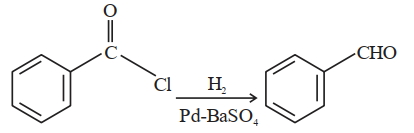
The reduction reaction shown is known as:
A
Rosenmund reduction
B
Wolff-Kishner reduction
C
Stephen reduction
D
Etard reduction
Solution
(A) The reaction shown is the partial reduction of an acid chloride (benzoyl chloride) to an aldehyde (benzaldehyde) using $H_2$ in the presence of a poisoned catalyst,$Pd-BaSO_4$. This specific reaction is known as the Rosenmund reduction.
0 likes
View Solution167
DifficultMCQ
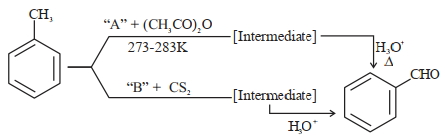
In the given reactions,identify the reagent $A$ and reagent $B$.
A
$A = CrO_3$,$B = CrO_3$
B
$A = CrO_3$,$B = CrO_2Cl_2$
C
$A = CrO_2Cl_2$,$B = CrO_2Cl_2$
D
$A = CrO_2Cl_2$,$B = CrO_3$
Solution
(B) The reaction involving $CrO_3$ and $(CH_3CO)_2O$ at $273-283 \ K$ is the oxidation of toluene to benzaldehyde via a gem-diacetate intermediate.
The reaction involving $CrO_2Cl_2$ (chromyl chloride) in $CS_2$ is the Etard reaction,which also oxidizes toluene to benzaldehyde via a chromium complex intermediate.
Therefore,reagent $A$ is $CrO_3$ and reagent $B$ is $CrO_2Cl_2$.
The reaction involving $CrO_2Cl_2$ (chromyl chloride) in $CS_2$ is the Etard reaction,which also oxidizes toluene to benzaldehyde via a chromium complex intermediate.
Therefore,reagent $A$ is $CrO_3$ and reagent $B$ is $CrO_2Cl_2$.
1 likes
View Solution168
DifficultMCQ
Identify the name reaction shown in the following chemical equation:

A
Stephen reaction
B
Etard reaction
C
Gatterman-Koch reaction
D
Rosenmund reduction
Solution
(C) The given reaction involves the treatment of benzene with carbon monoxide $(CO)$ and hydrogen chloride $(HCl)$ in the presence of anhydrous aluminum chloride $(AlCl_3)$ and cuprous chloride $(CuCl)$ to form benzaldehyde. This specific reaction is known as the Gatterman-Koch reaction.
0 likes
View Solution169
MediumMCQ
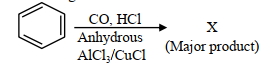
Identify the major product $X$ formed in the following reaction:
A
Benzoyl chloride
B
Benzophenone
C
Benzaldehyde
D
Benzyl chloride
Solution
(C) The given reaction is the Gattermann-Koch reaction. In this reaction,benzene reacts with carbon monoxide $(CO)$ and hydrogen chloride $(HCl)$ in the presence of anhydrous aluminum chloride $(AlCl_3)$ and cuprous chloride $(CuCl)$ to form benzaldehyde as the major product. The reaction is: $C_6H_6 + CO + HCl \xrightarrow{Anhydrous AlCl_3/CuCl} C_6H_5CHO$.
0 likes
View Solution170
MediumMCQ
Identify the correct reagents that would bring about the following transformation: $Cyclohexyl-CH_2-CH=CH_2 \rightarrow Cyclohexyl-CH_2-CH_2-CH_2-CHO$
A
$(i) BH_3, (ii) H_2O_2 / \stackrel{\ominus}{O}H, (iii) PCC$
B
$(i) BH_3, (ii) H_2O_2 / \stackrel{\ominus}{O}H, (iii) \text{alk. } KMnO_4, (iv) H_3O^{\oplus}$
C
$(i) H_2O / H^{+}, (ii) PCC$
D
$(i) H_2O / H^{+}, (ii) CrO_3$
Solution
(A) The transformation involves the anti-Markovnikov hydration of an alkene followed by the oxidation of the resulting primary alcohol to an aldehyde.
$1$. Hydroboration-oxidation: The reaction of $Cyclohexyl-CH_2-CH=CH_2$ with $(i) BH_3$ followed by $(ii) H_2O_2 / \stackrel{\ominus}{O}H$ yields the primary alcohol,$Cyclohexyl-CH_2-CH_2-CH_2OH$.
$2$. Oxidation: The primary alcohol is then oxidized to an aldehyde using a mild oxidizing agent like $PCC$ (Pyridinium chlorochromate),which stops the oxidation at the aldehyde stage.
Therefore,the correct sequence of reagents is $(i) BH_3, (ii) H_2O_2 / \stackrel{\ominus}{O}H, (iii) PCC$.
$1$. Hydroboration-oxidation: The reaction of $Cyclohexyl-CH_2-CH=CH_2$ with $(i) BH_3$ followed by $(ii) H_2O_2 / \stackrel{\ominus}{O}H$ yields the primary alcohol,$Cyclohexyl-CH_2-CH_2-CH_2OH$.
$2$. Oxidation: The primary alcohol is then oxidized to an aldehyde using a mild oxidizing agent like $PCC$ (Pyridinium chlorochromate),which stops the oxidation at the aldehyde stage.
Therefore,the correct sequence of reagents is $(i) BH_3, (ii) H_2O_2 / \stackrel{\ominus}{O}H, (iii) PCC$.
0 likes
View Solution171
MediumMCQ
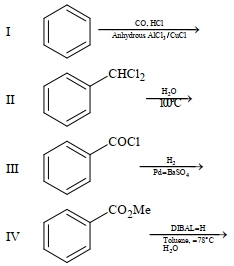
Among the following,the number of reaction$(s)$ that produce$(s)$ benzaldehyde is
A
$1$
B
$2$
C
$3$
D
$4$
Solution
(D) Let us analyze each reaction:
$I$. Gattermann-Koch reaction: Benzene reacts with $CO$ and $HCl$ in the presence of anhydrous $AlCl_3/CuCl$ to form benzaldehyde. This is a standard method for the preparation of benzaldehyde.
$II$. Hydrolysis of benzal chloride: Benzal chloride $(C_6H_5CHCl_2)$ on hydrolysis with water at $100 \ ^\circ C$ yields benzaldehyde $(C_6H_5CHO)$.
$III$. Rosenmund reduction: Benzoyl chloride $(C_6H_5COCl)$ is reduced to benzaldehyde using $H_2$ in the presence of $Pd-BaSO_4$ (Lindlar's catalyst).
$IV$. Reduction of ester: Methyl benzoate $(C_6H_5CO_2Me)$ is reduced to benzaldehyde using $DIBAL-H$ at $-78 \ ^\circ C$ followed by hydrolysis.
All four reactions produce benzaldehyde. Therefore,the total number of reactions is $4$.
$I$. Gattermann-Koch reaction: Benzene reacts with $CO$ and $HCl$ in the presence of anhydrous $AlCl_3/CuCl$ to form benzaldehyde. This is a standard method for the preparation of benzaldehyde.
$II$. Hydrolysis of benzal chloride: Benzal chloride $(C_6H_5CHCl_2)$ on hydrolysis with water at $100 \ ^\circ C$ yields benzaldehyde $(C_6H_5CHO)$.
$III$. Rosenmund reduction: Benzoyl chloride $(C_6H_5COCl)$ is reduced to benzaldehyde using $H_2$ in the presence of $Pd-BaSO_4$ (Lindlar's catalyst).
$IV$. Reduction of ester: Methyl benzoate $(C_6H_5CO_2Me)$ is reduced to benzaldehyde using $DIBAL-H$ at $-78 \ ^\circ C$ followed by hydrolysis.
All four reactions produce benzaldehyde. Therefore,the total number of reactions is $4$.
0 likes
View Solution172
DifficultMCQ
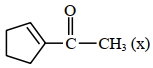
$A$ man has been asked to synthesize the molecule shown in the image. He thought of preparing the molecule using an aldol condensation reaction. He found a few cyclic alkenes in his laboratory. He thought of performing an ozonolysis reaction on an alkene to produce a dicarbonyl compound,followed by an aldol reaction to prepare "$x$". Predict the suitable alkene that can lead to the formation of "$x$".
A
$1-$methylcyclohex$-1-$ene
B
$3-$methylcyclohex$-1-$ene
C
methylenecyclohexane
D
$4-$methylcyclohex$-1-$ene
Solution
(A) The target molecule "$x$" is $1$-acetylcyclopent$-1-$ene.
To obtain this via an intramolecular aldol condensation,the precursor must be a dicarbonyl compound,specifically $6$-oxoheptanal.
Ozonolysis of $1$-methylcyclohex$-1-$ene ($1$-methylcyclohexene) breaks the double bond to form $6$-oxoheptanal $(CH_3COCH_2CH_2CH_2CH_2CHO)$.
This dicarbonyl compound undergoes intramolecular aldol condensation in the presence of $OH^{\ominus}/\Delta$ to form the five-membered ring product,$1$-acetylcyclopent$-1-$ene.
Thus,the correct starting alkene is $1$-methylcyclohex$-1-$ene.
To obtain this via an intramolecular aldol condensation,the precursor must be a dicarbonyl compound,specifically $6$-oxoheptanal.
Ozonolysis of $1$-methylcyclohex$-1-$ene ($1$-methylcyclohexene) breaks the double bond to form $6$-oxoheptanal $(CH_3COCH_2CH_2CH_2CH_2CHO)$.
This dicarbonyl compound undergoes intramolecular aldol condensation in the presence of $OH^{\ominus}/\Delta$ to form the five-membered ring product,$1$-acetylcyclopent$-1-$ene.
Thus,the correct starting alkene is $1$-methylcyclohex$-1-$ene.
0 likes
View Solution173
MediumMCQ
Match List-$I$ with List-$II$:
Choose the correct answer from the options given below:
| List-$I$ | List-$II$ |
|---|---|
| $A$. $RCN \xrightarrow[(ii) H_3O^+]{(i) SnCl_2, HCl} RCHO$ | $I$. Etard reaction |
| $B$. $C_6H_5COCl \xrightarrow{H_2, Pd-BaSO_4} C_6H_5CHO$ | $II$. Gatterman-Koch reaction |
| $C$. $C_6H_5CH_3 \xrightarrow[(ii) H_3O^+]{(i) CrO_2Cl_2, CS_2} C_6H_5CHO$ | $III$. Rosenmund reduction |
| $D$. $C_6H_6 \xrightarrow[(ii) \text{anhydrous } AlCl_3/CuCl]{(i) CO, HCl} C_6H_5CHO$ | $IV$. Stephen reaction |
Choose the correct answer from the options given below:
A
$A-IV, B-III, C-I, D-II$
B
$A-III, B-IV, C-II, D-I$
C
$A-I, B-III, C-II, D-IV$
D
$A-III, B-IV, C-I, D-II$
Solution
(A) The given reactions are matched as follows:
$A$. $RCN \xrightarrow[(ii) H_3O^+]{(i) SnCl_2, HCl} RCHO$ is the Stephen reaction $(IV)$.
$B$. $C_6H_5COCl \xrightarrow{H_2, Pd-BaSO_4} C_6H_5CHO$ is the Rosenmund reduction $(III)$.
$C$. $C_6H_5CH_3 \xrightarrow[(ii) H_3O^+]{(i) CrO_2Cl_2, CS_2} C_6H_5CHO$ is the Etard reaction $(I)$.
$D$. $C_6H_6 \xrightarrow[(ii) \text{anhydrous } AlCl_3/CuCl]{(i) CO, HCl} C_6H_5CHO$ is the Gatterman-Koch reaction $(II)$.
Therefore,the correct matching is $A-IV, B-III, C-I, D-II$.
$A$. $RCN \xrightarrow[(ii) H_3O^+]{(i) SnCl_2, HCl} RCHO$ is the Stephen reaction $(IV)$.
$B$. $C_6H_5COCl \xrightarrow{H_2, Pd-BaSO_4} C_6H_5CHO$ is the Rosenmund reduction $(III)$.
$C$. $C_6H_5CH_3 \xrightarrow[(ii) H_3O^+]{(i) CrO_2Cl_2, CS_2} C_6H_5CHO$ is the Etard reaction $(I)$.
$D$. $C_6H_6 \xrightarrow[(ii) \text{anhydrous } AlCl_3/CuCl]{(i) CO, HCl} C_6H_5CHO$ is the Gatterman-Koch reaction $(II)$.
Therefore,the correct matching is $A-IV, B-III, C-I, D-II$.
0 likes
View Solution174
MediumMCQ
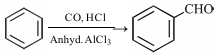
What is the name of the given reaction?
A
Gatterman-Koch reaction
B
Etard reaction
C
Gattermann reaction
D
Rosenmund reaction
Solution
(A) The given reaction involves the formylation of benzene using carbon monoxide $(CO)$ and hydrogen chloride $(HCl)$ in the presence of anhydrous aluminum chloride $(AlCl_3)$ to produce benzaldehyde.
This specific reaction is known as the Gatterman-Koch reaction.
This specific reaction is known as the Gatterman-Koch reaction.
0 likes
View Solution175
MediumMCQ
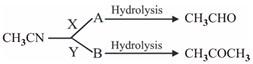
$X$ & $Y$ respectively are $-$
A
$CH_3MgX$ and $C_2H_5OH$
B
$SnCl_2 + HCl$ and $CH_3MgX$
C
$CH_3MgX$ and $SnCl_2 + HCl$
D
$SnCl_2 + HCl$ and $Na + C_2H_5OH$
Solution
(B) The reaction of $CH_3CN$ with $SnCl_2 + HCl$ (Stephen reduction) followed by hydrolysis yields an aldehyde $(CH_3CHO)$.
The reaction of $CH_3CN$ with a Grignard reagent $(CH_3MgX)$ followed by hydrolysis yields a ketone $(CH_3COCH_3)$.
Therefore,$X$ is $SnCl_2 + HCl$ and $Y$ is $CH_3MgX$.
The reaction of $CH_3CN$ with a Grignard reagent $(CH_3MgX)$ followed by hydrolysis yields a ketone $(CH_3COCH_3)$.
Therefore,$X$ is $SnCl_2 + HCl$ and $Y$ is $CH_3MgX$.
0 likes
View Solution176
MediumMCQ
In the given reaction,identify the intermediate '$X$':
$C_6H_5CH_3 + 2CrO_2Cl_2$ $\xrightarrow{CS_2} 'X'$ $\xrightarrow{H_3O^+} C_6H_5CHO$
'$X$' is:
$C_6H_5CH_3 + 2CrO_2Cl_2$ $\xrightarrow{CS_2} 'X'$ $\xrightarrow{H_3O^+} C_6H_5CHO$
'$X$' is:
A
$C_6H_5CH(OCrOHCl_2)_2$
B
$C_6H_5CH(OCrHCl_2)_2$
C
$C_6H_5CH(CrO_2Cl_2)_2$
D
$C_6H_5CH(CrOCl_2)_2$
Solution
(A) The reaction shown is the Etard reaction,which is used for the oxidation of toluene to benzaldehyde.
In this reaction,toluene reacts with chromyl chloride $(CrO_2Cl_2)$ in the presence of carbon disulfide $(CS_2)$ to form a brown chromium complex intermediate.
The structure of this chromium complex '$X$' is $C_6H_5CH(OCrOHCl_2)_2$.
Upon hydrolysis $(H_3O^+)$,this complex yields benzaldehyde.
In this reaction,toluene reacts with chromyl chloride $(CrO_2Cl_2)$ in the presence of carbon disulfide $(CS_2)$ to form a brown chromium complex intermediate.
The structure of this chromium complex '$X$' is $C_6H_5CH(OCrOHCl_2)_2$.
Upon hydrolysis $(H_3O^+)$,this complex yields benzaldehyde.
0 likes
View Solution177
EasyMCQ
$2,2-$dichloro propane on hydrolysis yields
A
acetone
B
$2,2-$propane diol
C
isopropyl alcohol
D
acetaldehyde
Solution
(A) The hydrolysis of $2,2-$dichloro propane $(CH_3-CCl_2-CH_3)$ involves the replacement of two chlorine atoms with two hydroxyl groups to form $2,2-$propane diol $(CH_3-C(OH)_2-CH_3)$.
Since two hydroxyl groups are attached to the same carbon atom,the resulting gem-diol is unstable.
It readily loses a water molecule $(H_2O)$ to form a stable carbonyl compound,which is acetone $(CH_3-CO-CH_3)$.
Since two hydroxyl groups are attached to the same carbon atom,the resulting gem-diol is unstable.
It readily loses a water molecule $(H_2O)$ to form a stable carbonyl compound,which is acetone $(CH_3-CO-CH_3)$.
0 likes
View Solution178
MediumMCQ
Identify the product '$B$' in the following reaction.
A
Benzal chloride
B
Benzaldehyde
C
Benzyl alcohol
D
Benzoic acid
Solution
(B) The given reaction is the $Etard$ reaction.
In this reaction,$Toluene$ is treated with $Chromyl$ $chloride$ $(CrO_2Cl_2)$ in the presence of $CS_2$ as a solvent to form a brown chromium complex.
This complex on hydrolysis with $H_3O^+$ yields $Benzaldehyde$ as the final product '$B$'.
The overall reaction is: $C_6H_5CH_3 + 2CrO_2Cl_2$ $\xrightarrow{CS_2} C_6H_5CH(OCrOHCl_2)_2$ $\xrightarrow{H_3O^+} C_6H_5CHO$.
In this reaction,$Toluene$ is treated with $Chromyl$ $chloride$ $(CrO_2Cl_2)$ in the presence of $CS_2$ as a solvent to form a brown chromium complex.
This complex on hydrolysis with $H_3O^+$ yields $Benzaldehyde$ as the final product '$B$'.
The overall reaction is: $C_6H_5CH_3 + 2CrO_2Cl_2$ $\xrightarrow{CS_2} C_6H_5CH(OCrOHCl_2)_2$ $\xrightarrow{H_3O^+} C_6H_5CHO$.
0 likes
View Solution179
DifficultMCQ
Identify the product $Y$ in the following series of reactions.
$4-$Nitrotoluene $\xrightarrow[(CH_3CO)_2O / CrO_3]{273-278 \ K} X$ $\xrightarrow{H_3O^{+} / \Delta} Y$
$4-$Nitrotoluene $\xrightarrow[(CH_3CO)_2O / CrO_3]{273-278 \ K} X$ $\xrightarrow{H_3O^{+} / \Delta} Y$
A
$4-$nitrobenzaldehyde
B
Benzaldehyde
C
$4-$nitrobenzoic acid
D
Acetophenone
Solution
(A) The reaction is an example of the Etard reaction modification using acetic anhydride and chromic oxide.
Step $1$: $4-$Nitrotoluene reacts with acetic anhydride and $CrO_3$ at $273-278 \ K$ to form a gem-diacetate derivative $(X)$.
Step $2$: The gem-diacetate derivative $(X)$ undergoes acid-catalyzed hydrolysis $(H_3O^{+} / \Delta)$ to yield $4-$nitrobenzaldehyde $(Y)$.
Step $1$: $4-$Nitrotoluene reacts with acetic anhydride and $CrO_3$ at $273-278 \ K$ to form a gem-diacetate derivative $(X)$.
Step $2$: The gem-diacetate derivative $(X)$ undergoes acid-catalyzed hydrolysis $(H_3O^{+} / \Delta)$ to yield $4-$nitrobenzaldehyde $(Y)$.
0 likes
View Solution180
EasyMCQ
Which of the following reactions is Rosenmund reduction?
A
$R-COCl + H_2 \xrightarrow{Pd-BaSO_4} R-CHO + HCl$
B
$R-CN \xrightarrow{SnCl_2, HCl} R-CHO + NH_4Cl$
C
$R-CHO \xrightarrow{Zn-Hg, \text{conc. } HCl} R-CH_3 + H_2O$
D
$Ar-CH_3 \xrightarrow{CrO_2Cl_2, CS_2} Ar-CHO$
Solution
(A) The Rosenmund reduction is a hydrogenation process where an acyl chloride $(R-COCl)$ is reduced to an aldehyde $(R-CHO)$ using hydrogen gas in the presence of a poisoned palladium catalyst,specifically palladium on barium sulfate $(Pd-BaSO_4)$.
The reaction is represented as:
$R-COCl + H_2 \xrightarrow{Pd-BaSO_4} R-CHO + HCl$
Therefore,option $A$ represents the Rosenmund reduction.
The reaction is represented as:
$R-COCl + H_2 \xrightarrow{Pd-BaSO_4} R-CHO + HCl$
Therefore,option $A$ represents the Rosenmund reduction.
0 likes
View Solution181
EasyMCQ
Which of the following compounds is obtained by Rosenmund reduction of benzoyl chloride?
A
Benzene
B
Benzyl alcohol
C
Benzaldehyde
D
Chlorobenzene
Solution
(C) Rosenmund reduction involves the hydrogenation of acid chlorides to aldehydes using $H_2$ gas in the presence of palladium supported on barium sulfate $(Pd-BaSO_4)$.
In this reaction,benzoyl chloride $(C_6H_5COCl)$ is reduced to benzaldehyde $(C_6H_5CHO)$.
The chemical equation is:
$C_6H_5COCl + H_2 \xrightarrow{Pd-BaSO_4} C_6H_5CHO + HCl$
Therefore,the correct product is benzaldehyde.
In this reaction,benzoyl chloride $(C_6H_5COCl)$ is reduced to benzaldehyde $(C_6H_5CHO)$.
The chemical equation is:
$C_6H_5COCl + H_2 \xrightarrow{Pd-BaSO_4} C_6H_5CHO + HCl$
Therefore,the correct product is benzaldehyde.
0 likes
View Solution182
MediumMCQ
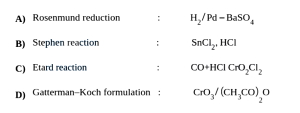
Which among the following reactions does not correctly match with its reagent?
A
$A$) Rosenmund reduction : $H_2/Pd-BaSO_4$
B
$B$) Stephen reaction : $SnCl_2, HCl$
C
$C$) Etard reaction : $CrO_2Cl_2$
D
$D$) Gatterman-Koch reaction : $CO + HCl$ (anhydrous $AlCl_3$)
Solution
(D) Let us analyze the given reactions:
$A$) Rosenmund reduction uses $H_2/Pd-BaSO_4$ to reduce acid chlorides to aldehydes. This is correct.
$B$) Stephen reaction uses $SnCl_2/HCl$ to reduce nitriles to imines,which are then hydrolyzed to aldehydes. This is correct.
$C$) Etard reaction uses $CrO_2Cl_2$ to oxidize toluene to benzaldehyde. This is correct.
$D$) Gatterman-Koch reaction uses $CO + HCl$ in the presence of anhydrous $AlCl_3$ to form benzaldehyde from benzene. The reagent given in the option $(CrO_3/(CH_3CO)_2O)$ is for the Etard-like oxidation of toluene to benzaldehyde diacetate. Thus,option $D$ is incorrectly matched.
$A$) Rosenmund reduction uses $H_2/Pd-BaSO_4$ to reduce acid chlorides to aldehydes. This is correct.
$B$) Stephen reaction uses $SnCl_2/HCl$ to reduce nitriles to imines,which are then hydrolyzed to aldehydes. This is correct.
$C$) Etard reaction uses $CrO_2Cl_2$ to oxidize toluene to benzaldehyde. This is correct.
$D$) Gatterman-Koch reaction uses $CO + HCl$ in the presence of anhydrous $AlCl_3$ to form benzaldehyde from benzene. The reagent given in the option $(CrO_3/(CH_3CO)_2O)$ is for the Etard-like oxidation of toluene to benzaldehyde diacetate. Thus,option $D$ is incorrectly matched.
0 likes
View Solution183
MediumMCQ
What is the product formed when side chain chlorination of toluene is carried out followed by acid hydrolysis at $373 \ K$?
A
Benzaldehyde
B
Benzal chloride
C
Chlorobenzene
D
Benzoic acid
Solution
(A) The side chain chlorination of toluene $(C_6H_5CH_3)$ with $Cl_2$ in the presence of light $(hv)$ gives benzal chloride $(C_6H_5CHCl_2)$.
Subsequent acid hydrolysis of benzal chloride at $373 \ K$ leads to the formation of benzaldehyde $(C_6H_5CHO)$ as the final product.
The reaction sequence is:
$C_6H_5CH_3$ $\xrightarrow{Cl_2/hv} C_6H_5CHCl_2$ $\xrightarrow{H_2O/H^+, 373 \ K} C_6H_5CHO$.
Subsequent acid hydrolysis of benzal chloride at $373 \ K$ leads to the formation of benzaldehyde $(C_6H_5CHO)$ as the final product.
The reaction sequence is:
$C_6H_5CH_3$ $\xrightarrow{Cl_2/hv} C_6H_5CHCl_2$ $\xrightarrow{H_2O/H^+, 373 \ K} C_6H_5CHO$.
0 likes
View Solution184
MediumMCQ
What is the final product obtained when benzonitrile reacts with phenyl magnesium bromide in equimolar proportion?
A
Diphenyl magnesium bromide
B
Benzene
C
Dicyclohexane
D
Benzophenone
Solution
(D) The reaction of benzonitrile $(C_6H_5CN)$ with phenyl magnesium bromide $(C_6H_5MgBr)$ in dry ether proceeds via a nucleophilic addition to the nitrile group.
$1$. The phenyl group from the Grignard reagent attacks the electrophilic carbon of the nitrile group to form an imine magnesium bromide complex $(C_6H_5-C(C_6H_5)=NMgBr)$.
$2$. Upon subsequent acid hydrolysis $(H_3O^+)$,the imine complex is converted into a ketone.
$3$. The final product formed is benzophenone $(C_6H_5-CO-C_6H_5)$.
$1$. The phenyl group from the Grignard reagent attacks the electrophilic carbon of the nitrile group to form an imine magnesium bromide complex $(C_6H_5-C(C_6H_5)=NMgBr)$.
$2$. Upon subsequent acid hydrolysis $(H_3O^+)$,the imine complex is converted into a ketone.
$3$. The final product formed is benzophenone $(C_6H_5-CO-C_6H_5)$.
0 likes
View Solution185
MediumMCQ
$Ethyl \ methyl \ ketone$ is obtained by heating calcium salts of
A
formic acid $+$ propionic acid
B
acetic acid $+$ propionic acid
C
acetic acid only
D
acetic acid $+$ methanoic acid
Solution
(B) $Ethyl \ methyl \ ketone$ is an unsymmetric ketone,so two different acids (in the form of calcium salts) are used.
The structure of $ethyl \ methyl \ ketone$ is $CH_3COCH_2CH_3$.
The reaction involves the dry distillation of a mixture of calcium acetate and calcium propionate:
$(CH_3COO)_2Ca + (C_2H_5COO)_2Ca \xrightarrow{\Delta} 2CH_3COCH_2CH_3 + 2CaCO_3$.
The structure of $ethyl \ methyl \ ketone$ is $CH_3COCH_2CH_3$.
The reaction involves the dry distillation of a mixture of calcium acetate and calcium propionate:
$(CH_3COO)_2Ca + (C_2H_5COO)_2Ca \xrightarrow{\Delta} 2CH_3COCH_2CH_3 + 2CaCO_3$.
0 likes
View Solution186
EasyMCQ
$Pentan-3-one$ is not obtained from:
A
$2, 2-$dichloropentane
B
$3, 3-$dichloropentane
C
$pentan-3-ol$
D
$pent-2-yne$
Solution
(A) $2, 2-$dichloropentane on hydrolysis gives $pentan-2-one$ because the geminal dichloride is at the $C-2$ position.
$3, 3-$dichloropentane on hydrolysis gives $pentan-3-one$.
$Pentan-3-ol$ on oxidation gives $pentan-3-one$.
$Pent-2-yne$ on hydration in the presence of $Hg^{2+}/H^+$ gives $pentan-2-one$ and $pentan-3-one$ as a mixture.
Therefore,$2, 2-$dichloropentane is the correct answer as it exclusively yields $pentan-2-one$.
$3, 3-$dichloropentane on hydrolysis gives $pentan-3-one$.
$Pentan-3-ol$ on oxidation gives $pentan-3-one$.
$Pent-2-yne$ on hydration in the presence of $Hg^{2+}/H^+$ gives $pentan-2-one$ and $pentan-3-one$ as a mixture.
Therefore,$2, 2-$dichloropentane is the correct answer as it exclusively yields $pentan-2-one$.
0 likes
View Solution187
EasyMCQ
Benzonitrile on reduction with stannous chloride $(SnCl_2)$ in the presence of hydrochloric acid $(HCl)$ followed by acid hydrolysis forms,
A
Benzal chloride
B
Benzoyl chloride
C
Benzophenone
D
Benzaldehyde
Solution
(D) The reaction described is the $Stephen$ reduction.
$1$. Benzonitrile $(C_6H_5CN)$ reacts with stannous chloride $(SnCl_2)$ and hydrochloric acid $(HCl)$ to form an imine hydrochloride intermediate $(C_6H_5CH=NH \cdot HCl)$.
$2$. Subsequent acid hydrolysis of this intermediate yields benzaldehyde $(C_6H_5CHO)$.
$3$. The overall reaction is: $C_6H_5CN + 2[H]$ $\xrightarrow{SnCl_2/HCl} C_6H_5CH=NH$ $\xrightarrow{H_3O^+} C_6H_5CHO$.
$1$. Benzonitrile $(C_6H_5CN)$ reacts with stannous chloride $(SnCl_2)$ and hydrochloric acid $(HCl)$ to form an imine hydrochloride intermediate $(C_6H_5CH=NH \cdot HCl)$.
$2$. Subsequent acid hydrolysis of this intermediate yields benzaldehyde $(C_6H_5CHO)$.
$3$. The overall reaction is: $C_6H_5CN + 2[H]$ $\xrightarrow{SnCl_2/HCl} C_6H_5CH=NH$ $\xrightarrow{H_3O^+} C_6H_5CHO$.
0 likes
View Solution188
EasyMCQ
Identify the reagent used for Rosenmund reduction.
A
$H_2 / Ni$
B
$H_2 / Pd, BaSO_4$
C
$Na-Hg / H_2O$
D
$SnCl_2 / HCl$
Solution
(B) The Rosenmund reduction is a hydrogenation process used to convert acid chlorides into aldehydes.
The reagent used is $H_2$ gas in the presence of palladium $(Pd)$ catalyst supported on barium sulfate $(BaSO_4)$.
$BaSO_4$ acts as a poison to prevent the further reduction of the aldehyde to a primary alcohol.
Therefore,the correct reagent is $H_2 / Pd, BaSO_4$.
The reagent used is $H_2$ gas in the presence of palladium $(Pd)$ catalyst supported on barium sulfate $(BaSO_4)$.
$BaSO_4$ acts as a poison to prevent the further reduction of the aldehyde to a primary alcohol.
Therefore,the correct reagent is $H_2 / Pd, BaSO_4$.
0 likes
View Solution189
MediumMCQ
Identify the reagent '$R$' used in the following reaction.
$C_6H_5COCl \xrightarrow{R} C_6H_5CHO$
$C_6H_5COCl \xrightarrow{R} C_6H_5CHO$
A
$CO, HCl$
B
$H_2, Pd-BaSO_4$
C
$DIBAL-H$
D
$H_2O$
Solution
(B) The reaction of benzoyl chloride $(C_6H_5COCl)$ to benzaldehyde $(C_6H_5CHO)$ is a standard reduction reaction.
Acyl chlorides are reduced to their corresponding aldehydes by hydrogen gas in the presence of a palladium catalyst poisoned with barium sulfate $(Pd-BaSO_4)$.
This specific reaction is known as the Rosenmund reduction.
Therefore,the reagent '$R$' is $H_2, Pd-BaSO_4$.
Acyl chlorides are reduced to their corresponding aldehydes by hydrogen gas in the presence of a palladium catalyst poisoned with barium sulfate $(Pd-BaSO_4)$.
This specific reaction is known as the Rosenmund reduction.
Therefore,the reagent '$R$' is $H_2, Pd-BaSO_4$.
0 likes
View Solution190
EasyMCQ
Which of the following is Stephen reaction?
A
$R-COCl \xrightarrow[Pd-BaSO_4]{H_2} R-CHO + HCl$
B
$R-CN \xrightarrow[ii) H_3O^+]{i) SnCl_2, HCl} R-CHO + NH_4Cl$
C
$R-CHO \xrightarrow[\Delta]{Zn-Hg, \text{ conc. } HCl} R-CH_3 + H_2O$
D
$R-CHO \xrightarrow[ii) KOH, HO-CH_2-CH_2-OH]{i) H_2N-NH_2} R-CH_2-R$
Solution
(B) Nitriles are reduced to imine hydrochloride by stannous chloride in the presence of hydrochloric acid,which on acid hydrolysis gives corresponding aldehydes. This reaction is called the Stephen reaction.
$R-CN \xrightarrow[ii) H_3O^+]{i) SnCl_2, HCl} R-CHO + NH_4Cl$
$R-CN \xrightarrow[ii) H_3O^+]{i) SnCl_2, HCl} R-CHO + NH_4Cl$
0 likes
View Solution191
MediumMCQ
Identify the product obtained in the following reaction:
$C_6H_6 \xrightarrow[\text{Anhydrous } AlCl_3, \text{high pressure}]{CO, HCl} \text{product}$
$C_6H_6 \xrightarrow[\text{Anhydrous } AlCl_3, \text{high pressure}]{CO, HCl} \text{product}$
A
$C_6H_5COOH$
B
$C_6H_5CHO$
C
$C_6H_5CHCl_2$
D
$C_6H_5Cl$
Solution
(B) The given reaction is the Gattermann-Koch reaction.
In this reaction,benzene $(C_6H_6)$ reacts with carbon monoxide $(CO)$ and hydrogen chloride $(HCl)$ in the presence of anhydrous aluminum chloride $(AlCl_3)$ under high pressure to form benzaldehyde $(C_6H_5CHO)$.
The reaction is: $C_6H_6 + CO + HCl \xrightarrow[\text{Anhydrous } AlCl_3]{\text{high pressure}} C_6H_5CHO$.
Therefore,the correct product is benzaldehyde $(C_6H_5CHO)$.
In this reaction,benzene $(C_6H_6)$ reacts with carbon monoxide $(CO)$ and hydrogen chloride $(HCl)$ in the presence of anhydrous aluminum chloride $(AlCl_3)$ under high pressure to form benzaldehyde $(C_6H_5CHO)$.
The reaction is: $C_6H_6 + CO + HCl \xrightarrow[\text{Anhydrous } AlCl_3]{\text{high pressure}} C_6H_5CHO$.
Therefore,the correct product is benzaldehyde $(C_6H_5CHO)$.
0 likes
View Solution192
EasyMCQ
Identify the product $B$ obtained in the following reaction.
$R-C \equiv N$ $\xrightarrow{SnCl_2/HCl} A$ $\xrightarrow{H_3O^{+}} B$
$R-C \equiv N$ $\xrightarrow{SnCl_2/HCl} A$ $\xrightarrow{H_3O^{+}} B$
A
$R-NH_2$
B
$R-CONH_2$
C
$R-CHO$
D
$R-COOH$
Solution
(C) The given reaction is the Stephen reduction reaction.
In the first step,the nitrile $(R-C \equiv N)$ is reduced by $SnCl_2/HCl$ to form an imine hydrochloride intermediate $(A)$,which is $R-CH=NH \cdot HCl$.
In the second step,the hydrolysis of the imine hydrochloride $(A)$ with $H_3O^{+}$ yields an aldehyde $(B)$ as the final product,which is $R-CHO$.
In the first step,the nitrile $(R-C \equiv N)$ is reduced by $SnCl_2/HCl$ to form an imine hydrochloride intermediate $(A)$,which is $R-CH=NH \cdot HCl$.
In the second step,the hydrolysis of the imine hydrochloride $(A)$ with $H_3O^{+}$ yields an aldehyde $(B)$ as the final product,which is $R-CHO$.
0 likes
View Solution193
EasyMCQ
Which reagent from the following is used for the preparation of aliphatic aldehyde from nitriles?
A
$CrO_2Cl_2$ in $CS_2$
B
$CrO_3$ in acetic anhydride
C
$SnCl_2, HCl$
D
$Co, HCl$,anhydrous $AlCl_3$
Solution
(C) The reduction of nitriles to aldehydes is known as the $Stephen$ reduction.
In this reaction,nitriles $(R-C \equiv N)$ are reduced to imines using stannous chloride $(SnCl_2)$ in the presence of hydrochloric acid $(HCl)$,which are then hydrolyzed to form aldehydes $(RCHO)$.
The reaction is:
$R-C \equiv N \xrightarrow[(ii) H_3O^+]{(i) SnCl_2 / dil. HCl} RCHO + NH_4Cl$
In this reaction,nitriles $(R-C \equiv N)$ are reduced to imines using stannous chloride $(SnCl_2)$ in the presence of hydrochloric acid $(HCl)$,which are then hydrolyzed to form aldehydes $(RCHO)$.
The reaction is:
$R-C \equiv N \xrightarrow[(ii) H_3O^+]{(i) SnCl_2 / dil. HCl} RCHO + NH_4Cl$
0 likes
View Solution194
MediumMCQ
Identify the reagent used for the preparation of benzophenone from benzonitrile.
A
$C_6H_5MgBr$
B
$CH_3MgCl$ (in dry ether)
C
$(CH_3)_2Cd$
D
$AlH(i-Bu)_2$
Solution
(A) The reaction of benzonitrile $(C_6H_5CN)$ with phenylmagnesium bromide $(C_6H_5MgBr)$ in the presence of dry ether followed by acid hydrolysis $(H_3O^+)$ yields benzophenone $(C_6H_5COC_6H_5)$.
The reaction steps are:
$1$. $C_6H_5-C \equiv N + C_6H_5-MgBr \xrightarrow{\text{dry ether}} C_6H_5-C(C_6H_5)=NMgBr$
$2$. $C_6H_5-C(C_6H_5)=NMgBr \xrightarrow{H_3O^+} C_6H_5-CO-C_6H_5 + NH_3 + Mg(Br)OH$
Thus,the required reagent is $C_6H_5MgBr$.
The reaction steps are:
$1$. $C_6H_5-C \equiv N + C_6H_5-MgBr \xrightarrow{\text{dry ether}} C_6H_5-C(C_6H_5)=NMgBr$
$2$. $C_6H_5-C(C_6H_5)=NMgBr \xrightarrow{H_3O^+} C_6H_5-CO-C_6H_5 + NH_3 + Mg(Br)OH$
Thus,the required reagent is $C_6H_5MgBr$.
0 likes
View Solution195
EasyMCQ
Which of the following reagents is used in the Etard reaction?
A
Chromium chloride
B
Chromyl chloride
C
Chromium oxide
D
Chromic acid
Solution
(B) In the Etard reaction,the methyl group of toluene (methylbenzene) is oxidized using $CrO_2Cl_2$ (chromyl chloride) in the presence of $CS_2$ (carbon disulfide) as a solvent.
This process forms a chromium complex intermediate,which upon acid hydrolysis yields benzaldehyde.
Therefore,the reagent used is chromyl chloride.
This process forms a chromium complex intermediate,which upon acid hydrolysis yields benzaldehyde.
Therefore,the reagent used is chromyl chloride.
0 likes
View Solution196
EasyMCQ
Which of the following compounds is obtained when toluene is treated with $CrO_2Cl_2$ in the presence of $CS_2$ followed by acid hydrolysis?
A
Chlorobenzene
B
Benzal chloride
C
Benzaldehyde
D
Benzoic acid
Solution
(C) The reaction of toluene with chromyl chloride $(CrO_2Cl_2)$ in the presence of carbon disulfide $(CS_2)$ followed by acid hydrolysis is known as the $Etard$ reaction.
In this reaction,the methyl group of toluene is oxidized to an aldehyde group,resulting in the formation of benzaldehyde $(C_6H_5CHO)$.
In this reaction,the methyl group of toluene is oxidized to an aldehyde group,resulting in the formation of benzaldehyde $(C_6H_5CHO)$.
0 likes
View Solution197
MediumMCQ
Identify the product '$B$' in the following reaction starting from Toluene:
$\text{Toluene}$ $\xrightarrow[CS_2]{\text{Chromyl chloride}} A$ $\xrightarrow{H_3O^+} B$
$\text{Toluene}$ $\xrightarrow[CS_2]{\text{Chromyl chloride}} A$ $\xrightarrow{H_3O^+} B$
A
Benzal chloride
B
Benzaldehyde
C
Benzyl alcohol
D
Benzoic acid
Solution
(B) The given reaction is the Etard reaction.
In this reaction,Toluene is oxidized by chromyl chloride $(CrO_2Cl_2)$ in the presence of carbon disulfide $(CS_2)$ to form a brown chromium complex $(A)$.
This complex $(A)$ on hydrolysis with water $(H_3O^+)$ gives Benzaldehyde $(B)$.
The reaction is:
$C_6H_5CH_3 + 2CrO_2Cl_2$ $\xrightarrow{CS_2} C_6H_5CH(OCrOHCl_2)_2$ $\xrightarrow{H_3O^+} C_6H_5CHO$
Thus,the product '$B$' is Benzaldehyde.
In this reaction,Toluene is oxidized by chromyl chloride $(CrO_2Cl_2)$ in the presence of carbon disulfide $(CS_2)$ to form a brown chromium complex $(A)$.
This complex $(A)$ on hydrolysis with water $(H_3O^+)$ gives Benzaldehyde $(B)$.
The reaction is:
$C_6H_5CH_3 + 2CrO_2Cl_2$ $\xrightarrow{CS_2} C_6H_5CH(OCrOHCl_2)_2$ $\xrightarrow{H_3O^+} C_6H_5CHO$
Thus,the product '$B$' is Benzaldehyde.
0 likes
View Solution198
EasyMCQ
What is the name of the following reaction?
$R-CO-Cl \xrightarrow{H_2, Pd-BaSO_4} R-CHO + HCl$
$R-CO-Cl \xrightarrow{H_2, Pd-BaSO_4} R-CHO + HCl$
A
Stephen reaction
B
Aldol condensation
C
Rosenmund reduction
D
Etard reaction
Solution
(C) The given reaction is the hydrogenation of an acid chloride $(R-CO-Cl)$ to an aldehyde $(R-CHO)$ using hydrogen gas $(H_2)$ in the presence of a palladium catalyst supported on barium sulfate $(Pd-BaSO_4)$.
This specific reaction is known as the Rosenmund reduction.
This specific reaction is known as the Rosenmund reduction.
0 likes
View Solution199
EasyMCQ
Which among the following reagents is used in the Rosenmund reduction?
A
$Zn-Hg / HCl$
B
$Na-Hg / H_2O$
C
$H_2 / Pt$ at $473 \ K$
D
$H_2 / Pd-BaSO_4$
Solution
(D) The Rosenmund reduction is a hydrogenation process used to convert acid chlorides into aldehydes.
It employs $H_2$ gas in the presence of a poisoned catalyst,specifically $Pd$ supported on $BaSO_4$ (palladium on barium sulfate).
The $BaSO_4$ acts as a poison to prevent further reduction of the aldehyde to an alcohol.
It employs $H_2$ gas in the presence of a poisoned catalyst,specifically $Pd$ supported on $BaSO_4$ (palladium on barium sulfate).
The $BaSO_4$ acts as a poison to prevent further reduction of the aldehyde to an alcohol.
0 likes
View Solution200
MediumMCQ
The reagent used for the Gatterman-Koch formylation of arene is
A
$CO_2, HCl$
B
$CrO_2 Cl_2$
C
$CO, HCl$
D
$DiBAl-H$
Solution
(C) In the Gatterman-Koch reaction,benzene or its derivatives are treated with carbon monoxide $(CO)$ and hydrogen chloride $(HCl)$ in the presence of anhydrous aluminum chloride $(AlCl_3)$ or cuprous chloride $(CuCl)$ under high pressure to form benzaldehyde or substituted benzaldehydes.
Thus,the reagents used are $CO$ and $HCl$.
Thus,the reagents used are $CO$ and $HCl$.
0 likes
View Solution8-1.Aldehydes and Ketones — Preparation · Frequently Asked Questions
1Are these 8-1.Aldehydes and Ketones questions useful for JEE and NEET?
Yes. All questions in this section are mapped to JEE Main and NEET exam patterns. Previous year questions from JEE Main, NEET, GUJCET and state-level exams are included with full solutions.
2Can I switch to Hindi or Gujarati for these questions?
Yes. Use the language tabs in the hero section or the sidebar to view the same questions and solutions in English, Hindi or Gujarati.
3How do I generate a question paper from this subtopic?
Use the Vedclass Exam Paper Generator — select the chapter and subtopic, set difficulty, and generate Sets A, B, C, D automatically. First 3 chapters of every subject are free.
Vedclass Products
For Students
Vedclass Test Series
Mock tests in real JEE/NEET style with performance analysis. 5-day free trial.
Start Free TrialFor Teachers
Exam Paper Generator
Generate Set A/B/C/D papers from this chapter in 2 minutes. 3 chapters free.
Try FreeFor Institutes
Online Exam Module
Live online exams with unlimited students, 360° analytics & white-label branding.
See DemoFor Teachers & Institutes
Generate a 8-1.Aldehydes and Ketones Exam Paper in 2 Minutes
Select subtopic & difficulty — Sets A, B, C, D auto-generated with No Repeat logic.
First 3 chapters of every subject are free — no payment required.