
A English
Preparation Questions in English
Class 12 Chemistry · 8-1.Aldehydes and Ketones · Preparation
328+
Questions
English
Language
100%
With Solutions
Showing 48 of 328 questions in English
201
MediumMCQ
Which of the following reagents is used in the reaction shown below?
Benzoyl chloride $\stackrel{?}{\longrightarrow}$ Benzaldehyde
Benzoyl chloride $\stackrel{?}{\longrightarrow}$ Benzaldehyde
A
$DIBAL-H$
B
$SnCl_2 / HCl$
C
$H_2 / Pd-BaSO_4$
D
Dimethyl cadmium
Solution
(C) The reaction shown is the Rosenmund reduction,which is used to convert acid chlorides to aldehydes.
In this reaction,benzoyl chloride is hydrogenated using $H_2$ gas in the presence of a palladium catalyst supported on barium sulfate $(Pd-BaSO_4)$.
The $BaSO_4$ acts as a poison to prevent the further reduction of the aldehyde to an alcohol.
Therefore,the correct reagent is $H_2 / Pd-BaSO_4$.
In this reaction,benzoyl chloride is hydrogenated using $H_2$ gas in the presence of a palladium catalyst supported on barium sulfate $(Pd-BaSO_4)$.
The $BaSO_4$ acts as a poison to prevent the further reduction of the aldehyde to an alcohol.
Therefore,the correct reagent is $H_2 / Pd-BaSO_4$.
0 likes
View Solution202
MediumMCQ
Identify the product formed when benzoyl chloride is reduced by hydrogen using a palladium catalyst poisoned with barium sulphate.
A
Chlorobenzene
B
Benzyl alcohol
C
Benzene
D
Benzaldehyde
Solution
(D) The reaction of benzoyl chloride with hydrogen in the presence of palladium $(Pd)$ catalyst supported on barium sulphate $(BaSO_4)$ is known as the Rosenmund reduction.
In this reaction,the acid chloride is selectively reduced to an aldehyde.
The chemical equation is:
$C_6H_5COCl + H_2 \xrightarrow{Pd/BaSO_4} C_6H_5CHO + HCl$
Thus,the product formed is benzaldehyde.
In this reaction,the acid chloride is selectively reduced to an aldehyde.
The chemical equation is:
$C_6H_5COCl + H_2 \xrightarrow{Pd/BaSO_4} C_6H_5CHO + HCl$
Thus,the product formed is benzaldehyde.
0 likes
View Solution203
EasyMCQ
Which of the following reactions is an example of Rosenmund reduction?
A
$R-CO-R \xrightarrow[\text{ethylene glycol}]{\text{NH}_2-\text{NH}_2, \Delta, \text{KOH}} R-CH_2-R$
B
$R-CHO \xrightarrow[\Delta]{\text{Zn-Hg} / \text{conc. HCl}} R-CH_3$
C
$R-CO-Cl \xrightarrow[\text{Pd/BaSO}_4]{\text{H}_2} R-CHO + \text{HCl}$
D
$R-CN \xrightarrow[\text{H}_3\text{O}^+]{\text{SnCl}_2 / \text{HCl}} R-CHO + \text{NH}_4\text{Cl}$
Solution
(C) The Rosenmund reduction is a hydrogenation process where an acid chloride $(R-CO-Cl)$ is reduced to an aldehyde $(R-CHO)$ using hydrogen gas in the presence of a poisoned palladium catalyst,typically $Pd$ supported on $BaSO_4$. The reaction is: $R-CO-Cl + \text{H}_2 \xrightarrow{\text{Pd/BaSO}_4} R-CHO + \text{HCl}$. Therefore,option $C$ represents the Rosenmund reduction.
0 likes
View Solution204
MediumMCQ
Identify the reagent used in the following conversion: $\text{Pent-3-enenitrile} \xrightarrow{A} \text{Pent-3-enal}$
A
$AlH(i-Bu)_2 / H_3O^{+}$
B
$K_2Cr_2O_7 / H_2SO_4$
C
$H_2 / Pd \cdot BaSO_4$
D
$SnCl_2 \cdot HCl$
Solution
(A) The conversion of a nitrile $(-CN)$ to an aldehyde $(-CHO)$ while preserving other functional groups like a double bond is achieved using Diisobutylaluminium hydride ($DIBAL-H$ or $AlH(i-Bu)_2$),followed by acid hydrolysis $(H_3O^{+})$.
$DIBAL-H$ is a selective reducing agent that reduces nitriles to imines,which upon hydrolysis yield aldehydes.
Therefore,the correct reagent is $AlH(i-Bu)_2 / H_3O^{+}$.
$DIBAL-H$ is a selective reducing agent that reduces nitriles to imines,which upon hydrolysis yield aldehydes.
Therefore,the correct reagent is $AlH(i-Bu)_2 / H_3O^{+}$.
0 likes
View Solution205
EasyMCQ
Which of the following is Rosenmund reduction?
A
$R-COCl + H_2 \xrightarrow{Pd/BaSO_4} R-CHO + HCl$
B
$R-C \equiv N + 2[H]$ $\xrightarrow[dil. HCl]{SnCl_2} R-CH=NH \cdot HCl$ $\xrightarrow{H_3O^+} R-CHO + NH_4Cl$
C
$R-CHO \xrightarrow[\Delta]{H_2N-NH_2, KOH/\text{ethylene glycol}} R-CH_3 + N_2$
D
$R-CO-R + 4[H] \xrightarrow[\Delta]{Zn-Hg/\text{conc. } HCl} R-CH_2-R + H_2O$
Solution
(A) Rosenmund reduction is the hydrogenation of an acid chloride $(R-COCl)$ to an aldehyde $(R-CHO)$ using a palladium catalyst poisoned with barium sulfate $(Pd/BaSO_4)$.
The reaction is:
$R-COCl + H_2 \xrightarrow{Pd/BaSO_4} R-CHO + HCl$
Therefore,option $A$ represents the Rosenmund reduction.
The reaction is:
$R-COCl + H_2 \xrightarrow{Pd/BaSO_4} R-CHO + HCl$
Therefore,option $A$ represents the Rosenmund reduction.
0 likes
View Solution206
EasyMCQ
Which of the following is obtained by hydrogenation of benzoyl chloride in the presence of $Pd$ on $BaSO_{4}$?
A
Benzene
B
Benzoic acid
C
Benzyl alcohol
D
Benzaldehyde
Solution
(D) The reaction of benzoyl chloride with $H_{2}$ in the presence of $Pd$ supported on $BaSO_{4}$ is known as the Rosenmund reduction.
In this reaction,the acid chloride is reduced to the corresponding aldehyde.
$C_{6}H_{5}COCl + H_{2} \xrightarrow{Pd/BaSO_{4}} C_{6}H_{5}CHO + HCl$
Therefore,benzaldehyde is obtained.
In this reaction,the acid chloride is reduced to the corresponding aldehyde.
$C_{6}H_{5}COCl + H_{2} \xrightarrow{Pd/BaSO_{4}} C_{6}H_{5}CHO + HCl$
Therefore,benzaldehyde is obtained.
0 likes
View Solution207
MediumMCQ
Identify product $A$ in the following reaction: $R-C \equiv N \xrightarrow[ii) H_{3}O^{+}]{i) DIBAl-H} A$
A
$R-CONH_{2}$
B
$R-COOH$
C
$R-CHO$
D
$R-CH_{2}NH_{2}$
Solution
(C) The reaction of a nitrile $(R-C \equiv N)$ with $DIBAl-H$ (Diisobutylaluminium hydride) followed by acidic hydrolysis $(H_{3}O^{+})$ is a standard method for the preparation of aldehydes.
$DIBAl-H$ acts as a selective reducing agent that reduces the nitrile group to an imine intermediate,which upon hydrolysis yields the corresponding aldehyde $(R-CHO)$.
$DIBAl-H$ acts as a selective reducing agent that reduces the nitrile group to an imine intermediate,which upon hydrolysis yields the corresponding aldehyde $(R-CHO)$.
0 likes
View Solution208
MediumMCQ
Which among the following compounds is obtained when calcium formate is dry distilled alone?
A
Methanoic acid
B
Methanal
C
Methanol
D
Methoxy methane
Solution
(B) When calcium formate $(HCOO)_2Ca$ is subjected to dry distillation,it undergoes thermal decomposition to produce formaldehyde (methanal) and calcium carbonate $(CaCO_3)$.
The chemical reaction is as follows:
$(HCOO)_2Ca \xrightarrow{\Delta} HCHO + CaCO_3$
Thus,the correct product is methanal.
The chemical reaction is as follows:
$(HCOO)_2Ca \xrightarrow{\Delta} HCHO + CaCO_3$
Thus,the correct product is methanal.
0 likes
View Solution209
EasyMCQ
Chromyl chloride converts a methyl group to a chromium complex,which on acid hydrolysis gives the corresponding aldehyde. This reaction is called:
A
Stephen reaction
B
Wolff-Kishner reaction
C
Etard reaction
D
Rosenmund reaction
Solution
(C) When toluene is treated with a solution of chromyl chloride $(CrO_2Cl_2)$ in $CS_2$,a brown chromium complex is obtained,which on acid hydrolysis gives benzaldehyde. This reaction is known as the Etard reaction. The reaction is represented as follows:
$C_6H_5CH_3 + 2CrO_2Cl_2$ $\xrightarrow{CS_2} C_6H_5CH(OCrCl_2OH)_2$ $\xrightarrow{H_3O^+} C_6H_5CHO$
$C_6H_5CH_3 + 2CrO_2Cl_2$ $\xrightarrow{CS_2} C_6H_5CH(OCrCl_2OH)_2$ $\xrightarrow{H_3O^+} C_6H_5CHO$
0 likes
View Solution210
EasyMCQ
Identify '$A$' in the following reaction: $A \xrightarrow{H_{2} / Pd-BaSO_{4}} C_{6}H_{5}CHO + HCl$
A
Benzoic acid
B
Benzyl chloride
C
Benzoyl chloride
D
Chlorobenzene
Solution
(C) The given reaction is the Rosenmund reduction,where an acid chloride is hydrogenated to an aldehyde using a poisoned catalyst,$Pd$ supported on $BaSO_{4}$.
In this reaction,benzoyl chloride $(C_{6}H_{5}COCl)$ reacts with $H_{2}$ in the presence of $Pd-BaSO_{4}$ to form benzaldehyde $(C_{6}H_{5}CHO)$ and $HCl$.
Therefore,'$A$' is benzoyl chloride.
In this reaction,benzoyl chloride $(C_{6}H_{5}COCl)$ reacts with $H_{2}$ in the presence of $Pd-BaSO_{4}$ to form benzaldehyde $(C_{6}H_{5}CHO)$ and $HCl$.
Therefore,'$A$' is benzoyl chloride.
0 likes
View Solution211
EasyMCQ
An acyl chloride is hydrogenated over a catalyst of palladium on barium sulphate to form an aldehyde. This reaction is called:
A
Stephen reaction
B
Rosenmund reduction
C
Etard reaction
D
Wolff-Kishner reduction
Solution
(B) The hydrogenation of an acyl chloride $(RCOCl)$ to an aldehyde $(RCHO)$ using palladium $(Pd)$ supported on barium sulphate $(BaSO_4)$ is known as the $Rosenmund \ reduction$.
The $BaSO_4$ acts as a poison to prevent the further reduction of the aldehyde to a primary alcohol.
The $BaSO_4$ acts as a poison to prevent the further reduction of the aldehyde to a primary alcohol.
0 likes
View Solution212
EasyMCQ
Which of the following is a Stephen reaction?
A
$R-C(=O)-R + 4[H] \xrightarrow{Zn-Hg/\text{conc. } HCl, \Delta} R-CH_2-R + H_2O$
B
$R-CH=O$ $\xrightarrow{H_2N-NH_2, -H_2O} R-CH=N-NH_2$ $\xrightarrow{KOH/\text{ethylene glycol}, \Delta} R-CH_3 + N_2$
C
$R-COCl \xrightarrow{H_2, Pd-BaSO_4} R-CHO + HCl$
D
$R-C \equiv N + 2[H]$ $\xrightarrow{SnCl_2/\text{dil. } HCl} R-CH=NH \cdot HCl$ $\xrightarrow{H_3O^+} R-CHO + NH_4Cl$
Solution
(D) The Stephen reaction involves the reduction of nitriles $(R-C \equiv N)$ to imines using stannous chloride $(SnCl_2)$ in the presence of hydrochloric acid $(HCl)$,followed by hydrolysis to yield aldehydes $(R-CHO)$.
Option $(D)$ represents the correct chemical equation for the Stephen reaction:
$R-C \equiv N + 2[H]$ $\xrightarrow{SnCl_2/\text{dil. } HCl} R-CH=NH \cdot HCl$ $\xrightarrow{H_3O^+} R-CHO + NH_4Cl$
Option $(D)$ represents the correct chemical equation for the Stephen reaction:
$R-C \equiv N + 2[H]$ $\xrightarrow{SnCl_2/\text{dil. } HCl} R-CH=NH \cdot HCl$ $\xrightarrow{H_3O^+} R-CHO + NH_4Cl$
0 likes
View Solution213
EasyMCQ
Which of the following is used to convert olefins into aldehydes?
A
$H_{2}$ and $CO$
B
$H_{2}$
C
$CO$ and alkyne
D
$CO$
Solution
(A) The conversion of olefins (alkenes) into aldehydes is known as the hydroformylation or oxo process.
In this process,an alkene reacts with a mixture of $CO$ and $H_{2}$ in the presence of a metal catalyst,such as cobalt carbonyl $(Co_{2}(CO)_{8})$,to produce an aldehyde.
The reaction is represented as:
$CH_{3}-CH=CH_{2} \xrightarrow{CO/H_{2}/Co_{2}(CO)_{8}, \Delta} CH_{3}-CH_{2}-CH_{2}CHO$
In this process,an alkene reacts with a mixture of $CO$ and $H_{2}$ in the presence of a metal catalyst,such as cobalt carbonyl $(Co_{2}(CO)_{8})$,to produce an aldehyde.
The reaction is represented as:
$CH_{3}-CH=CH_{2} \xrightarrow{CO/H_{2}/Co_{2}(CO)_{8}, \Delta} CH_{3}-CH_{2}-CH_{2}CHO$
0 likes
View Solution214
EasyMCQ
Which of the following catalysts is used in the Rosenmund reaction?
A
$Cu_2Cl_2$
B
$CS_2$
C
$Pd/BaSO_4$
D
$V_2O_5$
Solution
(C) The Rosenmund reaction involves the hydrogenation of acid chlorides to aldehydes using a palladium catalyst supported on barium sulphate $(Pd/BaSO_4)$.
$BaSO_4$ acts as a poison to prevent the further reduction of the aldehyde to an alcohol.
The reaction is represented as:
$RCOCl + H_2 \xrightarrow{Pd/BaSO_4} RCHO + HCl$
$BaSO_4$ acts as a poison to prevent the further reduction of the aldehyde to an alcohol.
The reaction is represented as:
$RCOCl + H_2 \xrightarrow{Pd/BaSO_4} RCHO + HCl$
0 likes
View Solution215
EasyMCQ
The reaction in which the methyl group on a benzene ring is converted to an aldehydic group is called:
A
$Etard$ reaction
B
$Friedel-Crafts$ reaction
C
$Rosenmund$ reaction
D
$Gatterman-Koch$ reaction
Solution
(A) In the $Etard$ reaction,toluene is treated with chromyl chloride $(CrO_2Cl_2)$ in the presence of carbon disulfide $(CS_2)$ to form a brown chromium complex,which upon hydrolysis gives benzaldehyde. The reaction is:
$C_6H_5CH_3 + 2CrO_2Cl_2$ $\xrightarrow{CS_2} C_6H_5CH(OCrCl_2OH)_2$ $\xrightarrow{H_3O^+} C_6H_5CHO$.
Therefore,the correct option is $A$.
$C_6H_5CH_3 + 2CrO_2Cl_2$ $\xrightarrow{CS_2} C_6H_5CH(OCrCl_2OH)_2$ $\xrightarrow{H_3O^+} C_6H_5CHO$.
Therefore,the correct option is $A$.
0 likes
View Solution216
MediumMCQ
Identify the product '$B$' in the following sequence of reactions.
$CH_3MgBr$ $\xrightarrow{CdCl_2} A$ $\xrightarrow{CH_3COCl} B$
$CH_3MgBr$ $\xrightarrow{CdCl_2} A$ $\xrightarrow{CH_3COCl} B$
A
Dimethyl cadmium
B
Propanone
C
Butanone
D
Propanal
Solution
(B) Step $1$: Reaction of methyl magnesium bromide with cadmium chloride gives dimethyl cadmium $(A)$.
$2CH_3MgBr + CdCl_2 \rightarrow (CH_3)_2Cd + 2Mg(Br)Cl$
Step $2$: Reaction of dimethyl cadmium with acetyl chloride $(CH_3COCl)$ yields propanone $(B)$.
$(CH_3)_2Cd + 2CH_3COCl \rightarrow 2CH_3COCH_3 + CdCl_2$
Thus,the product '$B$' is propanone.
$2CH_3MgBr + CdCl_2 \rightarrow (CH_3)_2Cd + 2Mg(Br)Cl$
Step $2$: Reaction of dimethyl cadmium with acetyl chloride $(CH_3COCl)$ yields propanone $(B)$.
$(CH_3)_2Cd + 2CH_3COCl \rightarrow 2CH_3COCH_3 + CdCl_2$
Thus,the product '$B$' is propanone.
0 likes
View Solution217
EasyMCQ
Identify substrate '$A$' in the following reaction.
$nA \xrightarrow{\text{Dimethyl cadmium}} 2n \text{ Propanone} + n \text{ Cadmium chloride}$
$nA \xrightarrow{\text{Dimethyl cadmium}} 2n \text{ Propanone} + n \text{ Cadmium chloride}$
A
$Ethyl$ chloride
B
$Ethylene$ dichloride
C
$Ethanoyl$ chloride
D
$Ethylidene$ dichloride
Solution
(C) The reaction of acyl chlorides with dialkyl cadmium reagents is a standard method for the preparation of ketones.
Given the reaction: $2CH_3COCl + (CH_3)_2Cd \rightarrow 2CH_3COCH_3 + CdCl_2$.
Here,$CH_3COCl$ is $Ethanoyl$ chloride,which reacts with dimethyl cadmium to form $Propanone$ $(CH_3COCH_3)$.
Given the reaction: $2CH_3COCl + (CH_3)_2Cd \rightarrow 2CH_3COCH_3 + CdCl_2$.
Here,$CH_3COCl$ is $Ethanoyl$ chloride,which reacts with dimethyl cadmium to form $Propanone$ $(CH_3COCH_3)$.
0 likes
View Solution218
EasyMCQ
Identify the product $B$ in the following sequence of reaction: $CH_3MgBr$ $\xrightarrow{CdCl_2} A$ $\xrightarrow{CH_3COCl} B$
A
Dimethyl Cadmium
B
Butanone
C
Propanone
D
Propanol
Solution
(C) Step $1$: Reaction of methyl magnesium bromide with cadmium chloride $(CdCl_2)$ produces dimethyl cadmium $(A)$.
$2CH_3MgBr + CdCl_2 \rightarrow (CH_3)_2Cd + 2Mg(Br)Cl$
Step $2$: Dimethyl cadmium reacts with acetyl chloride $(CH_3COCl)$ to form propanone $(B)$.
$2CH_3COCl + (CH_3)_2Cd \rightarrow 2CH_3COCH_3 + CdCl_2$
Thus,the product $B$ is propanone.
$2CH_3MgBr + CdCl_2 \rightarrow (CH_3)_2Cd + 2Mg(Br)Cl$
Step $2$: Dimethyl cadmium reacts with acetyl chloride $(CH_3COCl)$ to form propanone $(B)$.
$2CH_3COCl + (CH_3)_2Cd \rightarrow 2CH_3COCH_3 + CdCl_2$
Thus,the product $B$ is propanone.
0 likes
View Solution219
MediumMCQ
Which among the following compounds is treated with benzonitrile in dry ether followed by acid hydrolysis to obtain benzophenone?
A
$CH_3COCH_3$
B
$C_6H_5MgBr$
C
$C_6H_5ONa$
D
$CH_3MgBr$
Solution
(B) The reaction of benzonitrile $(C_6H_5CN)$ with phenylmagnesium bromide $(C_6H_5MgBr)$ in the presence of dry ether,followed by acid hydrolysis,yields benzophenone $(C_6H_5COC_6H_5)$.
The chemical reaction is as follows:
$C_6H_5CN + C_6H_5MgBr$ $\xrightarrow{\text{dry ether}} C_6H_5C(NMgBr)C_6H_5$ $\xrightarrow{H_3O^+} C_6H_5COC_6H_5 + Mg(OH)Br + NH_3$
The chemical reaction is as follows:
$C_6H_5CN + C_6H_5MgBr$ $\xrightarrow{\text{dry ether}} C_6H_5C(NMgBr)C_6H_5$ $\xrightarrow{H_3O^+} C_6H_5COC_6H_5 + Mg(OH)Br + NH_3$
0 likes
View Solution220
MediumMCQ
Identify '$A$' in the following reaction: $2A + (C_{6}H_{5}CH_{2})_{2}Cd \rightarrow 2CH_{3}-CO-CH_{2}-C_{6}H_{5} + CdCl_{2}$
A
$CH_{3}COCl$
B
$C_{6}H_{5}COCl$
C
$CH_{3}COCl$
D
$C_{6}H_{5}CH_{2}Cl$
Solution
(A) The reaction of an acid chloride with a dialkylcadmium reagent is a standard method for the preparation of ketones. The general reaction is: $2RCOCl + R'_{2}Cd \rightarrow 2RCOR' + CdCl_{2}$. In the given reaction,the product is $CH_{3}-CO-CH_{2}-C_{6}H_{5}$ (benzyl methyl ketone). Comparing this with the general reaction,$R$ must be $CH_{3}$ and $R'$ must be $C_{6}H_{5}CH_{2}$. Thus,$A$ is $CH_{3}COCl$ (acetyl chloride).
0 likes
View Solution221
MediumMCQ
Propanenitrile on reaction with ethylmagnesium iodide in the presence of dry ether gives an imine complex. This imine complex on acid hydrolysis forms:
A
$2-$Pentanone
B
Butanone
C
Propanone
D
$3-$Pentanone
Solution
(D) The reaction of propanenitrile $(CH_3CH_2CN)$ with ethylmagnesium iodide $(C_2H_5MgI)$ in the presence of dry ether proceeds as follows:
$1$. Nucleophilic attack of the ethyl group from the Grignard reagent on the carbon atom of the nitrile group leads to the formation of an imine magnesium complex: $CH_3CH_2CN + C_2H_5MgI \rightarrow CH_3CH_2C(C_2H_5)=NMgI$.
$2$. Acid hydrolysis $(H_3O^+)$ of this imine complex results in the formation of a ketone and ammonia: $CH_3CH_2C(C_2H_5)=NMgI + H_2O/H^+ \rightarrow CH_3CH_2COCH_2CH_3 + NH_3 + Mg(OH)I$.
$3$. The product formed is $CH_3CH_2COCH_2CH_3$,which is $3-$pentanone (pentan-$3-$one).
Therefore,the correct option is $D$.
$1$. Nucleophilic attack of the ethyl group from the Grignard reagent on the carbon atom of the nitrile group leads to the formation of an imine magnesium complex: $CH_3CH_2CN + C_2H_5MgI \rightarrow CH_3CH_2C(C_2H_5)=NMgI$.
$2$. Acid hydrolysis $(H_3O^+)$ of this imine complex results in the formation of a ketone and ammonia: $CH_3CH_2C(C_2H_5)=NMgI + H_2O/H^+ \rightarrow CH_3CH_2COCH_2CH_3 + NH_3 + Mg(OH)I$.
$3$. The product formed is $CH_3CH_2COCH_2CH_3$,which is $3-$pentanone (pentan-$3-$one).
Therefore,the correct option is $D$.
0 likes
View Solution222
MediumMCQ
Which of the following compounds when treated with dibenzyl cadmium yields benzyl methyl ketone?
A
$Acetone$
B
$Acetaldehyde$
C
$Acetic \ acid$
D
$Acetyl \ chloride$
Solution
(D) Organometallic compounds like dialkyl cadmium $(R_2Cd)$ react with acid chlorides $(R'COCl)$ to form ketones.
The reaction is: $2CH_3COCl + (C_6H_5CH_2)_2Cd \rightarrow 2CH_3COCH_2C_6H_5 + CdCl_2$.
Here,$Acetyl \ chloride$ $(CH_3COCl)$ reacts with $Dibenzyl \ cadmium$ $((C_6H_5CH_2)_2Cd)$ to produce $Benzyl \ methyl \ ketone$ $(CH_3COCH_2C_6H_5)$.
The reaction is: $2CH_3COCl + (C_6H_5CH_2)_2Cd \rightarrow 2CH_3COCH_2C_6H_5 + CdCl_2$.
Here,$Acetyl \ chloride$ $(CH_3COCl)$ reacts with $Dibenzyl \ cadmium$ $((C_6H_5CH_2)_2Cd)$ to produce $Benzyl \ methyl \ ketone$ $(CH_3COCH_2C_6H_5)$.
0 likes
View Solution223
MediumMCQ
Identify the substrate '$A$' in the following conversion.
$A \xrightarrow[H_3O^{+}]{AlH(i-Bu)_2} \text{Pent-}3\text{-enal}$
$A \xrightarrow[H_3O^{+}]{AlH(i-Bu)_2} \text{Pent-}3\text{-enal}$
A
Pentanenitrile
B
Pent-$3$-enenitrile
C
Pent-$3$-en-$1$-amine
D
Pent-$3$-ynenitrile
Solution
(B) The reagent $AlH(i-Bu)_2$ is Diisobutylaluminium hydride ($DIBAL$-$H$).
It is a selective reducing agent used to reduce nitriles $(-CN)$ to aldehydes $(-CHO)$ after acidic hydrolysis $(H_3O^+)$.
To obtain $\text{Pent-}3\text{-enal}$ $(CH_3-CH=CH-CH_2-CHO)$,the starting material must be a nitrile with the same carbon skeleton,which is $\text{Pent-}3\text{-enenitrile}$ $(CH_3-CH=CH-CH_2-CN)$.
Therefore,the substrate '$A$' is $\text{Pent-}3\text{-enenitrile}$.
It is a selective reducing agent used to reduce nitriles $(-CN)$ to aldehydes $(-CHO)$ after acidic hydrolysis $(H_3O^+)$.
To obtain $\text{Pent-}3\text{-enal}$ $(CH_3-CH=CH-CH_2-CHO)$,the starting material must be a nitrile with the same carbon skeleton,which is $\text{Pent-}3\text{-enenitrile}$ $(CH_3-CH=CH-CH_2-CN)$.
Therefore,the substrate '$A$' is $\text{Pent-}3\text{-enenitrile}$.
0 likes
View Solution224
EasyMCQ
Which of the following is used as a reagent in the Etard reaction?
A
Chromium chloride
B
Chromyl chloride
C
Chromium oxide
D
Chromic acid
Solution
(B) The Etard reaction is a chemical reaction in which an aromatic or heterocyclic bound methyl group is directly oxidized to an aldehyde using chromyl chloride $(CrO_2Cl_2)$.
Therefore,the correct reagent used in the Etard reaction is chromyl chloride.
Therefore,the correct reagent used in the Etard reaction is chromyl chloride.
0 likes
View Solution225
EasyMCQ
What reagent is used in the Etard reaction?
A
Chromyl chloride
B
Ethanoyl chloride
C
$SnCl_2$ and $HCl$
D
Cadmium chloride
Solution
(A) The Etard reaction is used for the oxidation of toluene to benzaldehyde.
Chromyl chloride $(CrO_2Cl_2)$ is the specific reagent used in this reaction.
Chromyl chloride $(CrO_2Cl_2)$ is the specific reagent used in this reaction.
0 likes
View Solution226
EasyMCQ
Which of the following reagents is used in the Gatterman-Koch formylation of an arene?
A
$AlH(i-Bu)_2$
B
$CO, HCl$ (anhyd. $AlCl_3$)
C
$CrO_2Cl_2$ in $CS_2$
D
$DIBAL-H$
Solution
(B) The Gatterman-Koch reaction is a specific formylation reaction used to introduce a formyl group $(-CHO)$ onto an aromatic ring.
In this reaction,the arene is treated with carbon monoxide $(CO)$ and hydrogen chloride $(HCl)$ in the presence of anhydrous aluminum chloride $(AlCl_3)$ and cuprous chloride $(CuCl)$ as a catalyst.
This combination generates the reactive electrophile $HCO^+$,which performs electrophilic aromatic substitution on the arene to yield an aromatic aldehyde.
Therefore,the correct reagent system is $CO, HCl$ (anhyd. $AlCl_3$).
In this reaction,the arene is treated with carbon monoxide $(CO)$ and hydrogen chloride $(HCl)$ in the presence of anhydrous aluminum chloride $(AlCl_3)$ and cuprous chloride $(CuCl)$ as a catalyst.
This combination generates the reactive electrophile $HCO^+$,which performs electrophilic aromatic substitution on the arene to yield an aromatic aldehyde.
Therefore,the correct reagent system is $CO, HCl$ (anhyd. $AlCl_3$).
0 likes
View Solution227
MediumMCQ
Identify the product '$B$' in the following sequence of reactions.
$CH_3CN$ $\xrightarrow{SnCl_2, HCl} A$ $\xrightarrow{H_3O^{+}} B + NH_4Cl$
$CH_3CN$ $\xrightarrow{SnCl_2, HCl} A$ $\xrightarrow{H_3O^{+}} B + NH_4Cl$
A
Ethylamine
B
Ethanamide
C
Ethanol
D
Ethanal
Solution
(D) The given reaction sequence is the Stephen reduction followed by hydrolysis.
$1$. Ethanenitrile $(CH_3CN)$ reacts with $SnCl_2$ and $HCl$ to form an imine intermediate $(CH_3CH=NH)$,which is compound '$A$'.
$2$. The imine intermediate '$A$' upon acid hydrolysis $(H_3O^{+})$ yields Ethanal $(CH_3CHO)$ as the final product '$B$' along with ammonium chloride $(NH_4Cl)$.
$3$. The reaction is: $CH_3CN$ $\xrightarrow{SnCl_2, HCl} CH_3CH=NH$ $\xrightarrow{H_3O^{+}} CH_3CHO + NH_4Cl$.
Therefore,the product '$B$' is Ethanal.
$1$. Ethanenitrile $(CH_3CN)$ reacts with $SnCl_2$ and $HCl$ to form an imine intermediate $(CH_3CH=NH)$,which is compound '$A$'.
$2$. The imine intermediate '$A$' upon acid hydrolysis $(H_3O^{+})$ yields Ethanal $(CH_3CHO)$ as the final product '$B$' along with ammonium chloride $(NH_4Cl)$.
$3$. The reaction is: $CH_3CN$ $\xrightarrow{SnCl_2, HCl} CH_3CH=NH$ $\xrightarrow{H_3O^{+}} CH_3CHO + NH_4Cl$.
Therefore,the product '$B$' is Ethanal.
0 likes
View Solution228
MediumMCQ
Identify the product '$B$' in the following series of reactions: Isopropyl cyanide $\xrightarrow[HCl]{SnCl_2} A$ $\xrightarrow{H_3O^{+}} B + NH_4Cl$
A
Propanal
B
Propanone
C
$2-$Methylpropanal
D
$2-$Methylpropanoic acid
Solution
(C) The reaction sequence is a Stephen reduction followed by hydrolysis.
$1$. Isopropyl cyanide $((CH_3)_2CH-CN)$ reacts with $SnCl_2$ and $HCl$ to form an imine hydrochloride intermediate $(A)$,which is $(CH_3)_2CH-CH=NH \cdot HCl$.
$2$. Subsequent acid hydrolysis $(H_3O^{+})$ of the imine hydrochloride converts the imine group into an aldehyde group,yielding $2-$Methylpropanal as product $B$ along with $NH_4Cl$.
$3$. The reaction is: $(CH_3)_2CH-CN$ $\xrightarrow[HCl]{SnCl_2} (CH_3)_2CH-CH=NH \cdot HCl$ $\xrightarrow{H_3O^{+}} (CH_3)_2CH-CHO + NH_4Cl$.
$1$. Isopropyl cyanide $((CH_3)_2CH-CN)$ reacts with $SnCl_2$ and $HCl$ to form an imine hydrochloride intermediate $(A)$,which is $(CH_3)_2CH-CH=NH \cdot HCl$.
$2$. Subsequent acid hydrolysis $(H_3O^{+})$ of the imine hydrochloride converts the imine group into an aldehyde group,yielding $2-$Methylpropanal as product $B$ along with $NH_4Cl$.
$3$. The reaction is: $(CH_3)_2CH-CN$ $\xrightarrow[HCl]{SnCl_2} (CH_3)_2CH-CH=NH \cdot HCl$ $\xrightarrow{H_3O^{+}} (CH_3)_2CH-CHO + NH_4Cl$.
0 likes
View Solution229
EasyMCQ
Identify product $B$ in the following reaction:
Benzonitrile $\xrightarrow[\text{Dry ether}]{C_6H_5MgBr} A$ $\xrightarrow{H_3O^{+}} B$
Benzonitrile $\xrightarrow[\text{Dry ether}]{C_6H_5MgBr} A$ $\xrightarrow{H_3O^{+}} B$
A
Benzophenone
B
Benzaldehyde
C
Benzyl alcohol
D
Benzoic acid
Solution
(A) The reaction of benzonitrile $(C_6H_5CN)$ with phenylmagnesium bromide $(C_6H_5MgBr)$ in the presence of dry ether forms an intermediate imine salt $(A)$: $C_6H_5-C(C_6H_5)=NMgBr$.
Upon acid hydrolysis $(H_3O^{+})$,this intermediate is converted into a ketone,specifically benzophenone $(C_6H_5-CO-C_6H_5)$,along with ammonia $(NH_3)$ and magnesium hydroxybromide $(Mg(Br)OH)$.
Therefore,product $B$ is benzophenone.
Upon acid hydrolysis $(H_3O^{+})$,this intermediate is converted into a ketone,specifically benzophenone $(C_6H_5-CO-C_6H_5)$,along with ammonia $(NH_3)$ and magnesium hydroxybromide $(Mg(Br)OH)$.
Therefore,product $B$ is benzophenone.
0 likes
View Solution230
MediumMCQ
Identify the product in the following reaction: $Pent-3-enenitrile \xrightarrow[H_3O^+]{AlH(i-Bu)_2} \text{Product}$
A
$Pent-3-en-1-amine$
B
$Pentanal$
C
$Pent-3-enal$
D
$Pent-3-en-1-ol$
Solution
(C) The reagent $AlH(i-Bu)_2$ is Diisobutylaluminium hydride ($DIBAL$-$H$).
It is a selective reducing agent that reduces nitriles $(-CN)$ to imines,which upon acidic hydrolysis $(H_3O^+)$ yield aldehydes.
The reaction is: $CH_3-CH=CH-CH_2-CN \xrightarrow[2. H_3O^+]{1. AlH(i-Bu)_2} CH_3-CH=CH-CH_2-CHO$.
Thus,the product formed is $Pent-3-enal$.
It is a selective reducing agent that reduces nitriles $(-CN)$ to imines,which upon acidic hydrolysis $(H_3O^+)$ yield aldehydes.
The reaction is: $CH_3-CH=CH-CH_2-CN \xrightarrow[2. H_3O^+]{1. AlH(i-Bu)_2} CH_3-CH=CH-CH_2-CHO$.
Thus,the product formed is $Pent-3-enal$.
0 likes
View Solution231
EasyMCQ
Which of the following reagents is used in Gatterman-Koch formylation of arene?
A
$CrO_3$
B
$CO, HCl / AlCl_3$ (anhydrous)
C
$CrO_2Cl_2, CS_2$
D
$Cl_2, hv, H_3O^{+}$
Solution
(B) The Gatterman-Koch formylation of an arene involves the treatment of benzene or a substituted benzene with carbon monoxide $(CO)$ and hydrogen chloride $(HCl)$ under high pressure.
This reaction yields benzaldehyde or a substituted benzaldehyde.
The reaction is catalyzed by anhydrous aluminium chloride $(AlCl_3)$ or cuprous chloride $(CuCl)$.
Therefore,the correct reagent is $CO, HCl / AlCl_3$ (anhydrous).
This reaction yields benzaldehyde or a substituted benzaldehyde.
The reaction is catalyzed by anhydrous aluminium chloride $(AlCl_3)$ or cuprous chloride $(CuCl)$.
Therefore,the correct reagent is $CO, HCl / AlCl_3$ (anhydrous).
0 likes
View Solution232
MediumMCQ
What is the product obtained when benzonitrile is treated with $C_6H_5MgBr$ in dry ether and then hydrolyzed?
A
Phenol
B
Benzophenone
C
Benzyl amine
D
Benzene
Solution
(B) The reaction of benzonitrile $(C_6H_5CN)$ with phenylmagnesium bromide $(C_6H_5MgBr)$ in dry ether proceeds via a nucleophilic addition to the nitrile group.
First,the phenyl group from the Grignard reagent attacks the electrophilic carbon of the nitrile,forming an imine complex intermediate: $C_6H_5CN + C_6H_5MgBr \rightarrow C_6H_5-C(C_6H_5)=N-MgBr$.
Subsequently,acid-catalyzed hydrolysis $(H_3O^+)$ of the imine complex converts the $C=N-MgBr$ group into a carbonyl group $(C=O)$,yielding benzophenone $(C_6H_5-CO-C_6H_5)$ as the final product along with ammonia and magnesium salts.
First,the phenyl group from the Grignard reagent attacks the electrophilic carbon of the nitrile,forming an imine complex intermediate: $C_6H_5CN + C_6H_5MgBr \rightarrow C_6H_5-C(C_6H_5)=N-MgBr$.
Subsequently,acid-catalyzed hydrolysis $(H_3O^+)$ of the imine complex converts the $C=N-MgBr$ group into a carbonyl group $(C=O)$,yielding benzophenone $(C_6H_5-CO-C_6H_5)$ as the final product along with ammonia and magnesium salts.
0 likes
View Solution233
MediumMCQ
Identify the product obtained when benzoyl chloride is treated with dimethyl cadmium.
A
Acetophenone
B
Benzoic acid
C
Benzophenone
D
Benzaldehyde
Solution
(A) The reaction between an acid chloride $(RCOCl)$ and a dialkyl cadmium reagent $(R'_2Cd)$ is a standard method for the preparation of ketones.
In this reaction,$2$ moles of benzoyl chloride $(C_6H_5COCl)$ react with $1$ mole of dimethyl cadmium $((CH_3)_2Cd)$ to produce acetophenone $(C_6H_5COCH_3)$ and cadmium chloride $(CdCl_2)$.
The chemical equation is:
$2C_6H_5COCl + (CH_3)_2Cd \rightarrow 2C_6H_5COCH_3 + CdCl_2$
Thus,the product obtained is acetophenone.
In this reaction,$2$ moles of benzoyl chloride $(C_6H_5COCl)$ react with $1$ mole of dimethyl cadmium $((CH_3)_2Cd)$ to produce acetophenone $(C_6H_5COCH_3)$ and cadmium chloride $(CdCl_2)$.
The chemical equation is:
$2C_6H_5COCl + (CH_3)_2Cd \rightarrow 2C_6H_5COCH_3 + CdCl_2$
Thus,the product obtained is acetophenone.
0 likes
View Solution234
EasyMCQ
Which of the following compounds is obtained by dry distillation of calcium propionate?
A
Pentan-$3$-one
B
Pentan-$2$-one
C
Propanone
D
Butan-$2$-one
Solution
(A) The dry distillation of calcium salts of carboxylic acids is a standard method for the preparation of ketones.
For calcium propionate,$(CH_3CH_2COO)_2Ca$,the reaction proceeds as follows:
$(CH_3CH_2COO)_2Ca \xrightarrow{\text{Dry Distillation}} CaCO_3 + CH_3CH_2COCH_2CH_3$
The product formed is $CH_3CH_2COCH_2CH_3$,which is diethyl ketone.
Diethyl ketone is also known as pentan-$3$-one.
For calcium propionate,$(CH_3CH_2COO)_2Ca$,the reaction proceeds as follows:
$(CH_3CH_2COO)_2Ca \xrightarrow{\text{Dry Distillation}} CaCO_3 + CH_3CH_2COCH_2CH_3$
The product formed is $CH_3CH_2COCH_2CH_3$,which is diethyl ketone.
Diethyl ketone is also known as pentan-$3$-one.
0 likes
View Solution235
MediumMCQ
Identify the product $A$ in the following reaction:
$CH_3-CCl_2-CH_2-CH_3 + 2KOH_{(aq)} \xrightarrow{\Delta} A + 2KCl + H_2O$
$CH_3-CCl_2-CH_2-CH_3 + 2KOH_{(aq)} \xrightarrow{\Delta} A + 2KCl + H_2O$
A
$CH_3-CH(OH)-CH_2-CH_3$
B
$CH_3-CH(Cl)-CHO$
C
$CH_3-CH(Cl)-CH(OH)-CH_3$
D
$CH_3-CH_2-CO-CH_3$
Solution
(D) The reaction of a geminal dihalide with aqueous $KOH$ followed by heating leads to the hydrolysis of both halogen atoms.
$CH_3-CCl_2-CH_2-CH_3 + 2KOH_{(aq)} \rightarrow CH_3-C(OH)_2-CH_2-CH_3 + 2KCl$.
Geminal diols are unstable and readily lose a water molecule to form a carbonyl compound.
$CH_3-C(OH)_2-CH_2-CH_3 \rightarrow CH_3-CO-CH_2-CH_3 + H_2O$.
Thus,the product $A$ is butan$-2-$one $(CH_3-CO-CH_2-CH_3)$.
$CH_3-CCl_2-CH_2-CH_3 + 2KOH_{(aq)} \rightarrow CH_3-C(OH)_2-CH_2-CH_3 + 2KCl$.
Geminal diols are unstable and readily lose a water molecule to form a carbonyl compound.
$CH_3-C(OH)_2-CH_2-CH_3 \rightarrow CH_3-CO-CH_2-CH_3 + H_2O$.
Thus,the product $A$ is butan$-2-$one $(CH_3-CO-CH_2-CH_3)$.
0 likes
View Solution236
MediumMCQ
Identify the compound formed by the action of chromyl chloride on toluene in the presence of $CS_2$,followed by hydrolysis.
A
Chlorobenzene
B
Benzal chloride
C
Benzaldehyde
D
Benzoic acid
Solution
(C) The reaction described is the $Etard$ reaction.
In this reaction,toluene reacts with chromyl chloride $(CrO_2Cl_2)$ in the presence of a non-polar solvent like $CS_2$ or $CCl_4$ to form a brown chromium complex.
This complex,upon subsequent hydrolysis,yields benzaldehyde $(C_6H_5CHO)$.
In this reaction,toluene reacts with chromyl chloride $(CrO_2Cl_2)$ in the presence of a non-polar solvent like $CS_2$ or $CCl_4$ to form a brown chromium complex.
This complex,upon subsequent hydrolysis,yields benzaldehyde $(C_6H_5CHO)$.
0 likes
View Solution237
MediumMCQ
Identify the product '$B$' in the following sequence of reactions.
$CH_3MgBr$ $\xrightarrow{CdCl_2} A$ $\xrightarrow{CH_3COCl} B$
$CH_3MgBr$ $\xrightarrow{CdCl_2} A$ $\xrightarrow{CH_3COCl} B$
A
Dimethyl cadmium
B
Propanone
C
Butanone
D
Propanal
Solution
(B) Step $1$: Reaction of Grignard reagent with cadmium chloride:
$2CH_3MgBr + CdCl_2 \rightarrow (CH_3)_2Cd + 2Mg(Cl)Br$
Here,product '$A$' is dimethyl cadmium,$(CH_3)_2Cd$.
Step $2$: Reaction of dimethyl cadmium with acetyl chloride:
$(CH_3)_2Cd + 2CH_3COCl \rightarrow 2CH_3COCH_3 + CdCl_2$
Here,product '$B$' is propanone $(CH_3COCH_3)$.
$2CH_3MgBr + CdCl_2 \rightarrow (CH_3)_2Cd + 2Mg(Cl)Br$
Here,product '$A$' is dimethyl cadmium,$(CH_3)_2Cd$.
Step $2$: Reaction of dimethyl cadmium with acetyl chloride:
$(CH_3)_2Cd + 2CH_3COCl \rightarrow 2CH_3COCH_3 + CdCl_2$
Here,product '$B$' is propanone $(CH_3COCH_3)$.
0 likes
View Solution238
MediumMCQ
Identify the product obtained when benzonitrile is reduced by stannous chloride $(SnCl_2)$ in the presence of hydrochloric acid $(HCl)$,followed by acid hydrolysis.
A
Benzal chloride
B
Benzoyl chloride
C
Benzophenone
D
Benzaldehyde
Solution
(D) This reaction is known as the Stephen reduction. The reaction proceeds as follows:
$1$. Benzonitrile $(C_6H_5-C \equiv N)$ is reduced by $SnCl_2$ and $HCl$ to form an imine hydrochloride intermediate,benzanimine hydrochloride $(C_6H_5-CH=NH \cdot HCl)$.
$2$. Subsequent acid hydrolysis $(H_3O^+)$ of the imine hydrochloride yields benzaldehyde $(C_6H_5-CHO)$ and ammonium chloride $(NH_4Cl)$.
The overall reaction is: $C_6H_5-C \equiv N + 2[H]$ $\xrightarrow{SnCl_2, HCl} C_6H_5-CH=NH \cdot HCl$ $\xrightarrow{H_3O^+} C_6H_5-CHO + NH_4Cl$.
$1$. Benzonitrile $(C_6H_5-C \equiv N)$ is reduced by $SnCl_2$ and $HCl$ to form an imine hydrochloride intermediate,benzanimine hydrochloride $(C_6H_5-CH=NH \cdot HCl)$.
$2$. Subsequent acid hydrolysis $(H_3O^+)$ of the imine hydrochloride yields benzaldehyde $(C_6H_5-CHO)$ and ammonium chloride $(NH_4Cl)$.
The overall reaction is: $C_6H_5-C \equiv N + 2[H]$ $\xrightarrow{SnCl_2, HCl} C_6H_5-CH=NH \cdot HCl$ $\xrightarrow{H_3O^+} C_6H_5-CHO + NH_4Cl$.
0 likes
View Solution239
MediumMCQ
Benzonitrile on reduction with stannous chloride $(SnCl_2)$ in the presence of hydrochloric acid $(HCl)$ followed by acid hydrolysis forms:
A
Benzal chloride
B
Benzoyl chloride
C
Benzophenone
D
Benzaldehyde
Solution
(D) The reaction described is the $Stephen$ reduction.
Benzonitrile $(C_6H_5CN)$ reacts with $SnCl_2$ and $HCl$ to form an imine hydrochloride intermediate $(C_6H_5CH=NH \cdot HCl)$.
This intermediate,upon subsequent acid hydrolysis $(H_3O^+)$,yields benzaldehyde $(C_6H_5CHO)$ and ammonium chloride $(NH_4Cl)$.
The overall reaction is:
$C_6H_5CN + 2[H] \xrightarrow{SnCl_2, HCl} C_6H_5CH=NH \cdot HCl$
$C_6H_5CH=NH \cdot HCl + H_2O \xrightarrow{H_3O^+} C_6H_5CHO + NH_4Cl$
Benzonitrile $(C_6H_5CN)$ reacts with $SnCl_2$ and $HCl$ to form an imine hydrochloride intermediate $(C_6H_5CH=NH \cdot HCl)$.
This intermediate,upon subsequent acid hydrolysis $(H_3O^+)$,yields benzaldehyde $(C_6H_5CHO)$ and ammonium chloride $(NH_4Cl)$.
The overall reaction is:
$C_6H_5CN + 2[H] \xrightarrow{SnCl_2, HCl} C_6H_5CH=NH \cdot HCl$
$C_6H_5CH=NH \cdot HCl + H_2O \xrightarrow{H_3O^+} C_6H_5CHO + NH_4Cl$
0 likes
View Solution240
EasyMCQ
Identify the reagent '$R$' used in the following reaction:
$C_6H_5-CO-Cl \xrightarrow{R} C_6H_5-CHO + HCl$
$C_6H_5-CO-Cl \xrightarrow{R} C_6H_5-CHO + HCl$
A
$CO, HCl$
B
$H_2, Pd-BaSO_4$
C
$H_2O$
D
$DIBAL-H$
Solution
(B) The given reaction is the reduction of an acyl chloride $(C_6H_5COCl)$ to an aldehyde $(C_6H_5CHO)$.
This specific reaction is known as the Rosenmund reduction.
In this process,the acyl chloride is hydrogenated using hydrogen gas $(H_2)$ in the presence of a palladium catalyst that is poisoned with barium sulfate $(Pd-BaSO_4)$.
The role of $BaSO_4$ is to prevent the further reduction of the aldehyde to an alcohol.
This specific reaction is known as the Rosenmund reduction.
In this process,the acyl chloride is hydrogenated using hydrogen gas $(H_2)$ in the presence of a palladium catalyst that is poisoned with barium sulfate $(Pd-BaSO_4)$.
The role of $BaSO_4$ is to prevent the further reduction of the aldehyde to an alcohol.
0 likes
View Solution241
EasyMCQ
Identify the name of the following reaction:
$Toluene + CrO_2Cl_2$ $\xrightarrow{CS_2} \text{complex}$ $\xrightarrow{H_3O^+} \text{Benzaldehyde}$
$Toluene + CrO_2Cl_2$ $\xrightarrow{CS_2} \text{complex}$ $\xrightarrow{H_3O^+} \text{Benzaldehyde}$
A
Stephen reaction
B
Rosenmund reaction
C
Etard reaction
D
Wolf-Kishner reaction
Solution
(C) The reaction of $Toluene$ with $Chromyl chloride$ $(CrO_2Cl_2)$ in the presence of $Carbon disulfide$ $(CS_2)$ followed by acid hydrolysis $(H_3O^+)$ to form $Benzaldehyde$ is known as the $Etard reaction$.
0 likes
View Solution242
EasyMCQ
Name the following reaction: $C_6H_5COCl + H_2 \xrightarrow{Pd-BaSO_4} C_6H_5CHO + HCl$
A
$Clemmensen$ reduction
B
$Stephen$ reaction
C
$Etard$ reaction
D
$Rosenmund$ reduction
Solution
(D) The given reaction is the hydrogenation of an acid chloride $(RCOCl)$ to an aldehyde $(RCHO)$ using a palladium catalyst poisoned with barium sulfate $(Pd-BaSO_4)$.
This specific reaction is known as the $Rosenmund$ reduction.
Therefore,the correct option is $D$.
This specific reaction is known as the $Rosenmund$ reduction.
Therefore,the correct option is $D$.
0 likes
View Solution243
EasyMCQ
Which of the following reactions does not produce benzaldehyde?
A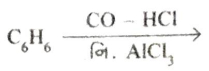
$C_6H_6 \xrightarrow[\text{Anhy. } AlCl_3]{CO, HCl} C_6H_5CHO$
B
$C_6H_5CH_3 \xrightarrow[CS_2]{CrO_2Cl_2} C_6H_5CHO$
C
$C_6H_5CH_3 \xrightarrow{KMnO_4 + KOH} C_6H_5COOK$
D
$C_6H_5COCl \xrightarrow[Pd-BaSO_4]{H_2} C_6H_5CHO$
Solution
(C) . Gattermann-Koch reaction: $C_6H_6 + CO + HCl \xrightarrow{\text{Anhy. } AlCl_3} C_6H_5CHO$ (Produces benzaldehyde).
$B$. Etard reaction: $C_6H_5CH_3 + CrO_2Cl_2 \xrightarrow{CS_2} C_6H_5CHO$ (Produces benzaldehyde).
$C$. Oxidation of toluene with $KMnO_4 + KOH$ yields potassium benzoate $(C_6H_5COOK)$,which upon acidification gives benzoic acid $(C_6H_5COOH)$,not benzaldehyde.
$D$. Rosenmund reduction: $C_6H_5COCl + H_2 \xrightarrow{Pd-BaSO_4} C_6H_5CHO$ (Produces benzaldehyde).
Therefore,the reaction that does not produce benzaldehyde is $C$.
$B$. Etard reaction: $C_6H_5CH_3 + CrO_2Cl_2 \xrightarrow{CS_2} C_6H_5CHO$ (Produces benzaldehyde).
$C$. Oxidation of toluene with $KMnO_4 + KOH$ yields potassium benzoate $(C_6H_5COOK)$,which upon acidification gives benzoic acid $(C_6H_5COOH)$,not benzaldehyde.
$D$. Rosenmund reduction: $C_6H_5COCl + H_2 \xrightarrow{Pd-BaSO_4} C_6H_5CHO$ (Produces benzaldehyde).
Therefore,the reaction that does not produce benzaldehyde is $C$.
0 likes
View Solution244
EasyMCQ
Which reagent is used in the preparation of benzaldehyde from benzene by the Gatterman-Koch reaction?
A
$CH_3COCl$ and anhydrous $AlCl_3$
B
$SnCl_2$ and $HCl$
C
$CO$,$HCl$ and anhydrous $AlCl_3$
D
$CrO_2Cl_2$ and $CS_2$
Solution
(C) The Gatterman-Koch reaction is a specific form of Friedel-Crafts acylation used to introduce a formyl group $(-CHO)$ into an aromatic ring.
In this reaction,benzene is treated with carbon monoxide $(CO)$ and hydrogen chloride $(HCl)$ in the presence of anhydrous aluminum chloride $(AlCl_3)$ or cuprous chloride $(CuCl)$ to produce benzaldehyde.
The reaction is represented as: $C_6H_6 + CO + HCl \xrightarrow{anhydrous \ AlCl_3 / CuCl} C_6H_5CHO$.
In this reaction,benzene is treated with carbon monoxide $(CO)$ and hydrogen chloride $(HCl)$ in the presence of anhydrous aluminum chloride $(AlCl_3)$ or cuprous chloride $(CuCl)$ to produce benzaldehyde.
The reaction is represented as: $C_6H_6 + CO + HCl \xrightarrow{anhydrous \ AlCl_3 / CuCl} C_6H_5CHO$.
0 likes
View Solution245
EasyMCQ
Which reagent is useful in the conversion of ethanenitrile to ethanal?
A
Anhydrous $Cr_2O_3$
B
$PCC$
C
$DIBAL-H$
D
$LiAlH_4$
Solution
(C) The conversion of nitriles $(R-CN)$ to aldehydes $(R-CHO)$ is typically achieved using $DIBAL-H$ (Diisobutylaluminium hydride) followed by hydrolysis.
$CH_3CN + DIBAL-H \xrightarrow{H_2O} CH_3CHO$.
$LiAlH_4$ would reduce the nitrile all the way to a primary amine $(CH_3CH_2NH_2)$.
$CH_3CN + DIBAL-H \xrightarrow{H_2O} CH_3CHO$.
$LiAlH_4$ would reduce the nitrile all the way to a primary amine $(CH_3CH_2NH_2)$.
0 likes
View Solution246
MediumMCQ
The compound which is not formed during the dry distillation of a mixture of calcium formate and calcium acetate is
A
methanal
B
propanal
C
propanone
D
ethanal
Solution
(B) Dry distillation of a mixture of calcium salts of carboxylic acids produces carbonyl compounds.
$1. (HCOO)_{2}Ca \xrightarrow{\Delta} HCHO + CaCO_{3}$ (Methanal)
$2. (CH_{3}COO)_{2}Ca \xrightarrow{\Delta} CH_{3}COCH_{3} + CaCO_{3}$ (Propanone)
$3. (HCOO)_{2}Ca + (CH_{3}COO)_{2}Ca \xrightarrow{\Delta} 2CH_{3}CHO + 2CaCO_{3}$ (Ethanal)
Propanal $(CH_{3}CH_{2}CHO)$ is not formed in this reaction.
$1. (HCOO)_{2}Ca \xrightarrow{\Delta} HCHO + CaCO_{3}$ (Methanal)
$2. (CH_{3}COO)_{2}Ca \xrightarrow{\Delta} CH_{3}COCH_{3} + CaCO_{3}$ (Propanone)
$3. (HCOO)_{2}Ca + (CH_{3}COO)_{2}Ca \xrightarrow{\Delta} 2CH_{3}CHO + 2CaCO_{3}$ (Ethanal)
Propanal $(CH_{3}CH_{2}CHO)$ is not formed in this reaction.
0 likes
View Solution247
MediumMCQ
In the reaction,$C_6H_5CN$ $\xrightarrow[(ii) H_3O^+]{(i) SnCl_2 + HCl} X$ $\xrightarrow{conc. KOH} Y + Z$,the formation of $X, Y$ and $Z$ are known by:
A
Rosenmund reduction,Cannizzaro reaction
B
Clemmensen reduction,Sandmeyer reaction
C
Wolff-Kishner reaction,Wurtz reaction
D
Stephen reaction,Cannizzaro reaction
Solution
(D) The given reaction is: $C_6H_5CN$ $\xrightarrow[(ii) H_3O^+]{(i) SnCl_2 + HCl} C_6H_5CHO (X)$ $\xrightarrow{conc. KOH} C_6H_5COOK (Y) + C_6H_5CH_2OH (Z)$.
$1$. The conversion of nitrile $(C_6H_5CN)$ to aldehyde $(C_6H_5CHO)$ using $SnCl_2 + HCl$ followed by hydrolysis is known as the Stephen reaction.
$2$. Benzaldehyde $(C_6H_5CHO)$ lacks $\alpha$-hydrogen atoms,so it undergoes the Cannizzaro reaction in the presence of concentrated alkali $(KOH)$ to form a mixture of alcohol $(C_6H_5CH_2OH)$ and salt of carboxylic acid $(C_6H_5COOK)$.
$1$. The conversion of nitrile $(C_6H_5CN)$ to aldehyde $(C_6H_5CHO)$ using $SnCl_2 + HCl$ followed by hydrolysis is known as the Stephen reaction.
$2$. Benzaldehyde $(C_6H_5CHO)$ lacks $\alpha$-hydrogen atoms,so it undergoes the Cannizzaro reaction in the presence of concentrated alkali $(KOH)$ to form a mixture of alcohol $(C_6H_5CH_2OH)$ and salt of carboxylic acid $(C_6H_5COOK)$.
0 likes
View Solution248
MediumMCQ
Which of the following reactions cannot be used to prepare benzaldehyde?
A
Benzoic acid $\xrightarrow{Zn-Hg \text{ and conc. } HCl}$
B
Toluene $\xrightarrow[(ii) H_3O^{+}]{(i) CrO_2Cl_2 \text{ in } CS_2}$ Benzaldehyde
C
Benzoyl chloride $+ H_2 \xrightarrow{Pd-BaSO_4}$ Benzaldehyde
D
Benzene $+ CO + HCl \xrightarrow{\text{Anhyd. } AlCl_3}$ Benzaldehyde
Solution
(A) The reaction in option $(A)$ involves Clemmensen reduction conditions $(Zn-Hg/HCl)$,which are used to reduce carbonyl groups (aldehydes or ketones) to methylene groups $(-CH_2-)$. Carboxylic acids are generally inert to these conditions,so benzaldehyde cannot be prepared from benzoic acid using this method.
Option $(B)$ is the Etard reaction,which produces benzaldehyde from toluene.
Option $(C)$ is the Rosenmund reduction,which produces benzaldehyde from benzoyl chloride.
Option $(D)$ is the Gattermann-Koch reaction,which produces benzaldehyde from benzene.
Option $(B)$ is the Etard reaction,which produces benzaldehyde from toluene.
Option $(C)$ is the Rosenmund reduction,which produces benzaldehyde from benzoyl chloride.
Option $(D)$ is the Gattermann-Koch reaction,which produces benzaldehyde from benzene.
0 likes
View Solution8-1.Aldehydes and Ketones — Preparation · Frequently Asked Questions
1Are these 8-1.Aldehydes and Ketones questions useful for JEE and NEET?
Yes. All questions in this section are mapped to JEE Main and NEET exam patterns. Previous year questions from JEE Main, NEET, GUJCET and state-level exams are included with full solutions.
2Can I switch to Hindi or Gujarati for these questions?
Yes. Use the language tabs in the hero section or the sidebar to view the same questions and solutions in English, Hindi or Gujarati.
3How do I generate a question paper from this subtopic?
Use the Vedclass Exam Paper Generator — select the chapter and subtopic, set difficulty, and generate Sets A, B, C, D automatically. First 3 chapters of every subject are free.
Vedclass Products
For Students
Vedclass Test Series
Mock tests in real JEE/NEET style with performance analysis. 5-day free trial.
Start Free TrialFor Teachers
Exam Paper Generator
Generate Set A/B/C/D papers from this chapter in 2 minutes. 3 chapters free.
Try FreeFor Institutes
Online Exam Module
Live online exams with unlimited students, 360° analytics & white-label branding.
See DemoFor Teachers & Institutes
Generate a 8-1.Aldehydes and Ketones Exam Paper in 2 Minutes
Select subtopic & difficulty — Sets A, B, C, D auto-generated with No Repeat logic.
First 3 chapters of every subject are free — no payment required.