
A English
Preparation Questions in English
Class 12 Chemistry · 8-1.Aldehydes and Ketones · Preparation
328+
Questions
English
Language
100%
With Solutions
Showing 50 of 328 questions in English
51
MediumMCQ
Consider the following statements. Which of the following reactions can be used to prepare acetophenone?
$I.$ Oxidation of $1$-phenylethanol.
$II.$ Reaction of benzaldehyde with methyl magnesium bromide.
$III.$ Friedel-Crafts acylation of benzene with acetyl chloride.
$IV.$ Distillation of calcium benzoate.
Which of these statements are correct?
$I.$ Oxidation of $1$-phenylethanol.
$II.$ Reaction of benzaldehyde with methyl magnesium bromide.
$III.$ Friedel-Crafts acylation of benzene with acetyl chloride.
$IV.$ Distillation of calcium benzoate.
Which of these statements are correct?
A
$I$ and $II$
B
$I$ and $IV$
C
$I$ and $III$
D
$III$ and $IV$
Solution
(C) $I.$ Oxidation of $1$-phenylethanol $(C_6H_5CH(OH)CH_3)$ yields acetophenone $(C_6H_5COCH_3)$. This is correct.
$II.$ Reaction of benzaldehyde with $CH_3MgBr$ followed by oxidation yields $1$-phenylethanol,not acetophenone. This is incorrect.
$III.$ Friedel-Crafts acylation of benzene with acetyl chloride $(CH_3COCl)$ in the presence of anhydrous $AlCl_3$ yields acetophenone. This is correct.
$IV.$ Distillation of calcium benzoate yields benzophenone,not acetophenone. This is incorrect.
Therefore,statements $I$ and $III$ are correct.
$II.$ Reaction of benzaldehyde with $CH_3MgBr$ followed by oxidation yields $1$-phenylethanol,not acetophenone. This is incorrect.
$III.$ Friedel-Crafts acylation of benzene with acetyl chloride $(CH_3COCl)$ in the presence of anhydrous $AlCl_3$ yields acetophenone. This is correct.
$IV.$ Distillation of calcium benzoate yields benzophenone,not acetophenone. This is incorrect.
Therefore,statements $I$ and $III$ are correct.
0 likes
View Solution52
MediumMCQ
In the Wacker process,what is the alkene converted into using $PdCl_2$?
A
Alcohol
B
Ketone
C
Aldehyde
D
Ether
Solution
(C) The Wacker process involves the oxidation of alkenes to carbonyl compounds using a palladium catalyst.
For ethene $(CH_2=CH_2)$,the reaction with $O_2$ in the presence of $PdCl_2$ and $CuCl_2$ yields acetaldehyde $(CH_3-CHO)$.
Reaction: $CH_2=CH_2 + \frac{1}{2}O_2 \xrightarrow{PdCl_2, CuCl_2} CH_3-CHO$.
For ethene $(CH_2=CH_2)$,the reaction with $O_2$ in the presence of $PdCl_2$ and $CuCl_2$ yields acetaldehyde $(CH_3-CHO)$.
Reaction: $CH_2=CH_2 + \frac{1}{2}O_2 \xrightarrow{PdCl_2, CuCl_2} CH_3-CHO$.
0 likes
View Solution53
MediumMCQ
Which of the following substances will give a ketone upon reaction with a Grignard reagent?
A
Formaldehyde
B
Ethanenitrile
C
Ethyl alcohol
D
Methyl iodide
Solution
(B) The reaction of a Grignard reagent $(RMgX)$ with a nitrile $(R'CN)$ followed by hydrolysis yields a ketone.
Specifically,for ethanenitrile $(CH_3CN)$:
$CH_3-C \equiv N + RMgX \to CH_3-C(R)=N-MgX$
Upon hydrolysis $(H_2O)$:
$CH_3-C(R)=N-MgX + H_2O \to CH_3-C(=O)-R + NH_3 + Mg(OH)X$
Thus,ethanenitrile reacts with a Grignard reagent to form a ketone.
Specifically,for ethanenitrile $(CH_3CN)$:
$CH_3-C \equiv N + RMgX \to CH_3-C(R)=N-MgX$
Upon hydrolysis $(H_2O)$:
$CH_3-C(R)=N-MgX + H_2O \to CH_3-C(=O)-R + NH_3 + Mg(OH)X$
Thus,ethanenitrile reacts with a Grignard reagent to form a ketone.
0 likes
View Solution54
EasyMCQ
What is the product of the reduction of benzoyl chloride with $H_2/Pd-BaSO_4$?
A
Benzyl alcohol
B
Benzaldehyde
C
Benzoic acid
D
Benzoyl cyanide
Solution
(B) The reaction of benzoyl chloride with $H_2$ in the presence of $Pd$ supported on $BaSO_4$ is known as the Rosenmund reduction.
This reaction specifically reduces acid chlorides to aldehydes.
Therefore,benzoyl chloride $(C_6H_5COCl)$ is reduced to benzaldehyde $(C_6H_5CHO)$.
This reaction specifically reduces acid chlorides to aldehydes.
Therefore,benzoyl chloride $(C_6H_5COCl)$ is reduced to benzaldehyde $(C_6H_5CHO)$.
0 likes
View Solution55
MediumMCQ
Which of the following reactions uses $SnCl_2/HCl$ as a catalyst?
A
Stephen reduction
B
Cannizzaro reaction
C
Clemmensen reduction
D
Rosenmund reduction
Solution
(A) The $SnCl_2/HCl$ reagent is specifically used in the $Stephen$ reduction to convert nitriles $(R-CN)$ into imines,which are then hydrolyzed to aldehydes $(R-CHO)$.
0 likes
View Solution56
MediumMCQ
Which of the following reactions can be used to obtain a ketone $(R_1COR_2)$,where $R_1 = R_2$ are alkyl groups,in a single step?
A
Hydrolysis of esters.
B
Oxidation of primary alcohols.
C
Oxidation of secondary alcohols.
D
Reaction of acid halides with alcohols.
Solution
(C) Secondary alcohols undergo oxidation in the presence of oxidizing agents like $K_2Cr_2O_7 / H_2SO_4$ to form ketones in a single step.
The reaction is:
$R_1-CH(OH)-R_2 + [O] \xrightarrow{K_2Cr_2O_7 / H_2SO_4} R_1-CO-R_2 + H_2O$
When $R_1 = R_2$,a symmetrical ketone is obtained.
The reaction is:
$R_1-CH(OH)-R_2 + [O] \xrightarrow{K_2Cr_2O_7 / H_2SO_4} R_1-CO-R_2 + H_2O$
When $R_1 = R_2$,a symmetrical ketone is obtained.
0 likes
View Solution57
MediumMCQ
What is the reaction called in which toluene is oxidized to benzaldehyde in the presence of chromyl chloride?
A
Wurtz reaction
B
Etard reaction
C
Fittig reaction
D
Rosenmund reaction
Solution
(B) The oxidation of toluene to benzaldehyde using chromyl chloride $(CrO_2Cl_2)$ is known as the Etard reaction.
In this reaction,the methyl group of toluene is oxidized to a formyl group.
In this reaction,the methyl group of toluene is oxidized to a formyl group.
0 likes
View Solution58
MediumMCQ
What is obtained when acetyl chloride is reduced in the presence of $BaSO_4$ and $Pd$?
A
$CH_3CHO$
B
$CH_3CH_2OH$
C
$CH_3COOH$
D
$CH_3COCH_3$
Solution
(A) The reduction of acid chlorides with $H_2$ in the presence of $Pd$ supported on $BaSO_4$ is known as the Rosenmund reduction.
$CH_3COCl + H_2 \xrightarrow{Pd/BaSO_4} CH_3CHO + HCl$
Acetyl chloride is reduced to acetaldehyde.
$CH_3COCl + H_2 \xrightarrow{Pd/BaSO_4} CH_3CHO + HCl$
Acetyl chloride is reduced to acetaldehyde.
0 likes
View Solution59
MediumMCQ
Which of the following reactions will produce $R-CO-Ar$?
A
$ArCOCl + H-Ar \xrightarrow{AlCl_3}$
B
$RCOCl + RMgX \to$
C
$R + CrO_3 \to$
D
$RCOCl + H-Ar \xrightarrow{AlCl_3}$
Solution
(D) The reaction $RCOCl + H-Ar \xrightarrow{AlCl_3} R-CO-Ar + HCl$ is known as the Friedel-Crafts acylation reaction.
In this reaction,an acyl chloride $(RCOCl)$ reacts with an aromatic compound $(Ar-H)$ in the presence of a Lewis acid catalyst like $AlCl_3$ to form an aromatic ketone $(R-CO-Ar)$.
In this reaction,an acyl chloride $(RCOCl)$ reacts with an aromatic compound $(Ar-H)$ in the presence of a Lewis acid catalyst like $AlCl_3$ to form an aromatic ketone $(R-CO-Ar)$.
0 likes
View Solution60
MediumMCQ
Which of the following reactions cannot be used to prepare benzaldehyde?
A
Benzene + $CO + HCl$ in the presence of anhydrous $AlCl_3$
B
Benzoic acid + $Zn/Hg$ and conc. $HCl$
C
Toluene + $CrO_2Cl_2$ in $CS_2$ followed by $H_3O^{+}$
D
Benzoyl chloride + $H_2$ in the presence of $Pd-BaSO_4$
Solution
(B) $1$. Gatterman-Koch reaction: Benzene reacts with $CO$ and $HCl$ in the presence of anhydrous $AlCl_3$ to form benzaldehyde.
$2$. Etard reaction: Toluene reacts with $CrO_2Cl_2$ in $CS_2$ followed by hydrolysis to form benzaldehyde.
$3$. Rosenmund reduction: Benzoyl chloride is reduced by $H_2$ in the presence of $Pd-BaSO_4$ to form benzaldehyde.
$4$. The reaction of benzoic acid with $Zn/Hg$ and conc. $HCl$ (Clemmensen reduction) is used to reduce aldehydes and ketones to alkanes,not to prepare aldehydes from carboxylic acids. Therefore,this reaction cannot be used to prepare benzaldehyde.
$2$. Etard reaction: Toluene reacts with $CrO_2Cl_2$ in $CS_2$ followed by hydrolysis to form benzaldehyde.
$3$. Rosenmund reduction: Benzoyl chloride is reduced by $H_2$ in the presence of $Pd-BaSO_4$ to form benzaldehyde.
$4$. The reaction of benzoic acid with $Zn/Hg$ and conc. $HCl$ (Clemmensen reduction) is used to reduce aldehydes and ketones to alkanes,not to prepare aldehydes from carboxylic acids. Therefore,this reaction cannot be used to prepare benzaldehyde.
0 likes
View Solution61
MediumMCQ
Consider the following reaction:
$C_6H_5COCl \xrightarrow{H_2, Pd/BaSO_4} A$
The product $A$ is:
$C_6H_5COCl \xrightarrow{H_2, Pd/BaSO_4} A$
The product $A$ is:
A
$C_6H_5CHO$
B
$C_6H_5OH$
C
$C_6H_5COCH_3$
D
$C_6H_5Cl$
Solution
(A) The given reaction is the Rosenmund reduction.
In this reaction,an acid chloride $(RCOCl)$ is hydrogenated to an aldehyde $(RCHO)$ using hydrogen gas in the presence of a palladium catalyst supported on barium sulfate $(Pd/BaSO_4)$.
The $BaSO_4$ acts as a poison to prevent the further reduction of the aldehyde to an alcohol.
Therefore,the reaction of benzoyl chloride $(C_6H_5COCl)$ with $H_2$ in the presence of $Pd/BaSO_4$ yields benzaldehyde $(C_6H_5CHO)$.
In this reaction,an acid chloride $(RCOCl)$ is hydrogenated to an aldehyde $(RCHO)$ using hydrogen gas in the presence of a palladium catalyst supported on barium sulfate $(Pd/BaSO_4)$.
The $BaSO_4$ acts as a poison to prevent the further reduction of the aldehyde to an alcohol.
Therefore,the reaction of benzoyl chloride $(C_6H_5COCl)$ with $H_2$ in the presence of $Pd/BaSO_4$ yields benzaldehyde $(C_6H_5CHO)$.
0 likes
View Solution62
MediumMCQ
The most suitable reagent for the conversion of $R-CH_2-OH \rightarrow R-CHO$ is:
A
$KMnO_4$
B
$K_2Cr_2O_7$
C
$CrO_3$
D
$PCC$ (Pyridinium Chlorochromate)
Solution
(D) $R-CH_2-OH \xrightarrow{PCC} R-CHO$
$PCC$ (Pyridinium chlorochromate) is a mild oxidizing agent that selectively oxidizes primary alcohols to aldehydes without further oxidation to carboxylic acids.
$KMnO_4$,$K_2Cr_2O_7$,and $CrO_3$ are strong oxidizing agents that typically oxidize primary alcohols directly to carboxylic acids.
$PCC$ (Pyridinium chlorochromate) is a mild oxidizing agent that selectively oxidizes primary alcohols to aldehydes without further oxidation to carboxylic acids.
$KMnO_4$,$K_2Cr_2O_7$,and $CrO_3$ are strong oxidizing agents that typically oxidize primary alcohols directly to carboxylic acids.
0 likes
View Solution63
MediumMCQ
In the following sequence of reactions:
$C_6H_5CH_3$ $\xrightarrow{KMnO_4} A$ $\xrightarrow{SOCl_2} B$ $\xrightarrow{H_2/Pd, BaSO_4} C$
the product $C$ is:
$C_6H_5CH_3$ $\xrightarrow{KMnO_4} A$ $\xrightarrow{SOCl_2} B$ $\xrightarrow{H_2/Pd, BaSO_4} C$
the product $C$ is:
A
$C_6H_5CH_2OH$
B
$C_6H_5CHO$
C
$C_6H_5COOH$
D
$C_6H_5CH_3$
Solution
(B) Step $1$: Toluene $(C_6H_5CH_3)$ undergoes oxidation with $KMnO_4$ to form benzoic acid $(C_6H_5COOH)$,which is product $A$.
Step $2$: Benzoic acid reacts with thionyl chloride $(SOCl_2)$ to form benzoyl chloride $(C_6H_5COCl)$,which is product $B$.
Step $3$: Benzoyl chloride undergoes Rosenmund reduction with $H_2/Pd$ and $BaSO_4$ to form benzaldehyde $(C_6H_5CHO)$,which is product $C$.
Step $2$: Benzoic acid reacts with thionyl chloride $(SOCl_2)$ to form benzoyl chloride $(C_6H_5COCl)$,which is product $B$.
Step $3$: Benzoyl chloride undergoes Rosenmund reduction with $H_2/Pd$ and $BaSO_4$ to form benzaldehyde $(C_6H_5CHO)$,which is product $C$.
0 likes
View Solution64
MediumMCQ
Nitriles are reduced to corresponding imine with stannous chloride in the presence of hydrochloric acid,which on hydrolysis gives the corresponding aldehyde. This reaction is called:
A
Rosenmund reaction
B
Reimer-Tiemann reaction
C
Stephen reaction
D
Gabriel phthalimide synthesis
Solution
(C) The reaction of nitriles $(R-CN)$ with stannous chloride $(SnCl_2)$ in the presence of hydrochloric acid $(HCl)$ reduces the nitrile to an imine $(R-CH=NH \cdot HCl)$.
Upon subsequent hydrolysis,the imine is converted into the corresponding aldehyde $(R-CHO)$.
This specific chemical transformation is known as the $Stephen$ reaction.
Upon subsequent hydrolysis,the imine is converted into the corresponding aldehyde $(R-CHO)$.
This specific chemical transformation is known as the $Stephen$ reaction.
0 likes
View Solution65
DifficultMCQ
Which of the following reactions will give a carbonyl compound as the major product?
A
$CH_3COCl \xrightarrow{H_2/Pd}$
B
$CH_3COCl \xrightarrow{H_2, Pd/BaSO_4}$
C
$CH_3COCl \xrightarrow{LiAlH_4}$
D
All of these
Solution
(B) The Rosenmund reduction involves the partial reduction of an acid chloride to an aldehyde using hydrogen gas over palladium poisoned with barium sulfate $(Pd/BaSO_4)$.
Aldehydes are carbonyl compounds.
In option $(a)$,$H_2/Pd$ reduces the acid chloride further to a primary alcohol.
In option $(c)$,$LiAlH_4$ is a strong reducing agent that reduces acid chlorides to primary alcohols.
Therefore,only the Rosenmund reduction produces an aldehyde (a carbonyl compound) as the major product.
Aldehydes are carbonyl compounds.
In option $(a)$,$H_2/Pd$ reduces the acid chloride further to a primary alcohol.
In option $(c)$,$LiAlH_4$ is a strong reducing agent that reduces acid chlorides to primary alcohols.
Therefore,only the Rosenmund reduction produces an aldehyde (a carbonyl compound) as the major product.
0 likes
View Solution66
DifficultMCQ
Benzaldehyde can be formed by :-
A
$C_6H_5CH_3 + CrO_2Cl_2$ $\rightarrow A$ $\xrightarrow{H_2O} C_6H_5CHO$
B
$C_6H_5CH_3 + CrO_3$ $\xrightarrow{(CH_3CO)_2O} A$ $\xrightarrow{H_2O, \Delta} C_6H_5CHO$
C
$C_6H_5CH_3 + Cl_2$ $\xrightarrow{hv} A$ $\xrightarrow{aq. NaOH} C_6H_5CHO$
D
All of them
Solution
(D) The given reactions are standard methods for the preparation of benzaldehyde from toluene:
$1$. Etard reaction: Toluene reacts with chromyl chloride $(CrO_2Cl_2)$ to form a chromium complex,which on hydrolysis gives benzaldehyde.
$2$. Oxidation with chromic oxide $(CrO_3)$ in the presence of acetic anhydride: Toluene is converted to benzylidene diacetate,which on hydrolysis yields benzaldehyde.
$3$. Side chain chlorination followed by hydrolysis: Toluene reacts with $Cl_2$ in the presence of light to form benzal chloride $(C_6H_5CHCl_2)$,which on hydrolysis with aqueous alkali gives benzaldehyde.
Since all three methods produce benzaldehyde,the correct option is $D$.
$1$. Etard reaction: Toluene reacts with chromyl chloride $(CrO_2Cl_2)$ to form a chromium complex,which on hydrolysis gives benzaldehyde.
$2$. Oxidation with chromic oxide $(CrO_3)$ in the presence of acetic anhydride: Toluene is converted to benzylidene diacetate,which on hydrolysis yields benzaldehyde.
$3$. Side chain chlorination followed by hydrolysis: Toluene reacts with $Cl_2$ in the presence of light to form benzal chloride $(C_6H_5CHCl_2)$,which on hydrolysis with aqueous alkali gives benzaldehyde.
Since all three methods produce benzaldehyde,the correct option is $D$.
0 likes
View Solution67
DifficultMCQ
In which of the following reactions is ethyl phenyl ketone obtained?
A
$C_6H_5-CN + CH_3-CH_2-MgBr$ $\rightarrow A$ $\xrightarrow{H_2O/H^{+}}$
B
$CH_3-CH_2-COCl + (C_6H_5)_2Cd \rightarrow$
C
$C_6H_6 + CH_3-CH_2-COCl \xrightarrow{Anhy. AlCl_3}$
D
All of these
Solution
(D) Ethyl phenyl ketone $(C_6H_5-CO-CH_2-CH_3)$ is formed in all the given reactions.
$(a)$ Nitriles react with Grignard reagents followed by hydrolysis to give ketones: $C_6H_5-CN + CH_3-CH_2-MgBr$ $\rightarrow C_6H_5-C(CH_2-CH_3)=NMgBr$ $\xrightarrow{H_3O^{+}} C_6H_5-CO-CH_2-CH_3$.
$(b)$ Acid chlorides react with dialkyl/diaryl cadmium to give ketones: $2CH_3-CH_2-COCl + (C_6H_5)_2Cd \rightarrow 2C_6H_5-CO-CH_2-CH_3 + CdCl_2$.
$(c)$ Benzene undergoes Friedel-Crafts acylation with propanoyl chloride to give ethyl phenyl ketone: $C_6H_6 + CH_3-CH_2-COCl \xrightarrow{AlCl_3} C_6H_5-CO-CH_2-CH_3 + HCl$.
$(a)$ Nitriles react with Grignard reagents followed by hydrolysis to give ketones: $C_6H_5-CN + CH_3-CH_2-MgBr$ $\rightarrow C_6H_5-C(CH_2-CH_3)=NMgBr$ $\xrightarrow{H_3O^{+}} C_6H_5-CO-CH_2-CH_3$.
$(b)$ Acid chlorides react with dialkyl/diaryl cadmium to give ketones: $2CH_3-CH_2-COCl + (C_6H_5)_2Cd \rightarrow 2C_6H_5-CO-CH_2-CH_3 + CdCl_2$.
$(c)$ Benzene undergoes Friedel-Crafts acylation with propanoyl chloride to give ethyl phenyl ketone: $C_6H_6 + CH_3-CH_2-COCl \xrightarrow{AlCl_3} C_6H_5-CO-CH_2-CH_3 + HCl$.
0 likes
View Solution68
DifficultMCQ
Which of the following reactions will not give an aldehyde as the major product?
A
$CH_3-C \equiv N$ $\xrightarrow[BaSO_4]{H_2, Pd}$ $\xrightarrow{H_3O^{+}}$
B
$CH_3-COCl \xrightarrow[BaSO_4]{H_2, Pd}$
C
$CH_3MgBr + CH_3-CN \xrightarrow{H_3O^{+}}$
D
$CH_3-COCl \xrightarrow[(ii) H_3O^{+}]{(i) DIBAL-H}$
Solution
(C) In reaction $(c)$,a Grignard reagent reacts with a nitrile to form an imine salt,which upon hydrolysis yields a ketone:
$CH_3MgBr + CH_3-CN$ $\rightarrow CH_3-C(CH_3)=NMgBr$ $\xrightarrow{H_3O^{+}} CH_3-CO-CH_3$ (Acetone).
The other reactions are:
$(a)$ Catalytic reduction of nitrile to imine followed by hydrolysis gives $CH_3-CHO$.
$(b)$ Rosenmund reduction of acid chloride gives $CH_3-CHO$.
$(d)$ $DIBAL-H$ reduction of acid chloride gives $CH_3-CHO$.
$CH_3MgBr + CH_3-CN$ $\rightarrow CH_3-C(CH_3)=NMgBr$ $\xrightarrow{H_3O^{+}} CH_3-CO-CH_3$ (Acetone).
The other reactions are:
$(a)$ Catalytic reduction of nitrile to imine followed by hydrolysis gives $CH_3-CHO$.
$(b)$ Rosenmund reduction of acid chloride gives $CH_3-CHO$.
$(d)$ $DIBAL-H$ reduction of acid chloride gives $CH_3-CHO$.
0 likes
View Solution69
AdvancedMCQ
Acetophenone can be obtained by the distillation of:
A
$(C_6H_5COO)_2Ca$
B
$(CH_3COO)_2Ca$
C
$(C_6H_5COO)_2Ca$ and $(CH_3COO)_2Ca$
D
$(C_6H_5COO)_2Ca$ and $(HCOO)_2Ca$
Solution
(C) Dry distillation of a mixture of calcium benzoate and calcium acetate yields acetophenone.
The reaction is as follows:
$(C_6H_5COO)_2Ca + (CH_3COO)_2Ca \xrightarrow{\text{dry distillation}} 2C_6H_5COCH_3 + 2CaCO_3$
The reaction is as follows:
$(C_6H_5COO)_2Ca + (CH_3COO)_2Ca \xrightarrow{\text{dry distillation}} 2C_6H_5COCH_3 + 2CaCO_3$
0 likes
View Solution70
AdvancedMCQ
Which one of the combinations will give propanaldehyde on dry distillation?
A
$(C_6H_5COO)_2Ca$ and $(HCOO)_2Ca$
B
$(CH_3COO)_2Ca$ and $(CH_3-CH_2-COO)_2Ca$
C
$(CH_3-CH_2-COO)_2Ca$ and $(HCOO)_2Ca$
D
$(CH_3COO)_2Ca$ and $(CH_3COO)_2Ca$
Solution
(C) Dry distillation of a mixture of calcium propionate and calcium formate yields propanaldehyde.
$(CH_3-CH_2-COO)_2Ca + (HCOO)_2Ca \xrightarrow{\Delta} 2 CH_3CH_2CHO + 2CaCO_3$
Calcium propionate reacts with calcium formate to produce propanaldehyde as the main product.
$(CH_3-CH_2-COO)_2Ca + (HCOO)_2Ca \xrightarrow{\Delta} 2 CH_3CH_2CHO + 2CaCO_3$
Calcium propionate reacts with calcium formate to produce propanaldehyde as the main product.
0 likes
View Solution71
DifficultMCQ
In the reaction:
$C_6H_5-H \xrightarrow{[X] / AlCl_3} C_6H_5-C(=O)-CH_2-C_6H_5$
$[X]$ will be:
$C_6H_5-H \xrightarrow{[X] / AlCl_3} C_6H_5-C(=O)-CH_2-C_6H_5$
$[X]$ will be:
A
$C_6H_5CH_2COCl$
B
$(C_6H_5-CH_2CO)_2O$
C
Both $(A)$ and $(B)$
D
$C_6H_5-CHCl_2$
Solution
(C) The given reaction is a Friedel-Crafts acylation reaction.
In Friedel-Crafts acylation,benzene reacts with an acylating agent (such as an acid chloride or an acid anhydride) in the presence of a Lewis acid catalyst like $AlCl_3$ to form an aromatic ketone.
For the product $C_6H_5-C(=O)-CH_2-C_6H_5$ (phenyl benzyl ketone),the acylating group is $C_6H_5-CH_2-CO-$.
Option $(A)$ is $C_6H_5CH_2COCl$ (phenylacetyl chloride),which is an acid chloride.
Option $(B)$ is $(C_6H_5-CH_2CO)_2O$ (phenylacetic anhydride),which is an acid anhydride.
Both acid chlorides and acid anhydrides can act as acylating agents in the presence of $AlCl_3$ to produce the same ketone.
Therefore,both $(A)$ and $(B)$ are correct.
In Friedel-Crafts acylation,benzene reacts with an acylating agent (such as an acid chloride or an acid anhydride) in the presence of a Lewis acid catalyst like $AlCl_3$ to form an aromatic ketone.
For the product $C_6H_5-C(=O)-CH_2-C_6H_5$ (phenyl benzyl ketone),the acylating group is $C_6H_5-CH_2-CO-$.
Option $(A)$ is $C_6H_5CH_2COCl$ (phenylacetyl chloride),which is an acid chloride.
Option $(B)$ is $(C_6H_5-CH_2CO)_2O$ (phenylacetic anhydride),which is an acid anhydride.
Both acid chlorides and acid anhydrides can act as acylating agents in the presence of $AlCl_3$ to produce the same ketone.
Therefore,both $(A)$ and $(B)$ are correct.
0 likes
View Solution72
DifficultMCQ
The reduction of benzoyl chloride with $Pd$ and $BaSO_4/CaCO_3$ produces :
A
Benzyl chloride
B
Benzoic acid
C
Benzaldehyde
D
All of these
Solution
(C) The reduction of benzoyl chloride with $Pd$ and $BaSO_4/CaCO_3$ produces benzaldehyde.
$BaSO_4$ acts as a catalyst poison to prevent the further reduction of the aldehyde to an alcohol. This reaction is known as the $Rosenmund$ reduction.
$C_6H_5COCl + H_2 \xrightarrow{Pd/BaSO_4} C_6H_5CHO + HCl$
$BaSO_4$ acts as a catalyst poison to prevent the further reduction of the aldehyde to an alcohol. This reaction is known as the $Rosenmund$ reduction.
$C_6H_5COCl + H_2 \xrightarrow{Pd/BaSO_4} C_6H_5CHO + HCl$
0 likes
View Solution73
MediumMCQ
$C_6H_5CH_3$ $\xrightarrow{CrO_2Cl_2} A$ $\xrightarrow{H_2O} B$
The functional group present in $B$ and the name of the reaction are:
The functional group present in $B$ and the name of the reaction are:
A
$-CHO$,Gattermann aldehyde synthesis
B
$-CHO$,Etard reaction
C
$-COCH_3$,Friedel-Crafts reaction
D
$-CHO$,Oxo reaction
Solution
(B) The given reaction is the oxidation of toluene $(C_6H_5CH_3)$ using chromyl chloride $(CrO_2Cl_2)$ in the presence of $CS_2$ or $CCl_4$ as a solvent,followed by hydrolysis.
This reaction is known as the $Etard$ reaction.
In this process,the methyl group of toluene is oxidized to a benzaldehyde group $(-CHO)$.
Thus,$A$ is a chromium complex intermediate,and $B$ is benzaldehyde $(C_6H_5CHO)$.
This reaction is known as the $Etard$ reaction.
In this process,the methyl group of toluene is oxidized to a benzaldehyde group $(-CHO)$.
Thus,$A$ is a chromium complex intermediate,and $B$ is benzaldehyde $(C_6H_5CHO)$.
0 likes
View Solution74
MediumMCQ
Etard reaction in the following is :
A
Oxidation of toluene to benzaldehyde by chromyl chloride
B
Oxidation of toluene to benzaldehyde by alkaline $KMnO_4$
C
Dry distillation of calcium benzoate
D
Reaction of benzene with $Cl_2$ in the presence of $UV$ light
Solution
(A) The $Etard$ reaction is a chemical reaction in which an aromatic or heterocyclic bound methyl group is directly oxidized to an aldehyde using chromyl chloride $(CrO_2Cl_2)$.
In this reaction,toluene is treated with chromyl chloride in a suitable solvent like $CS_2$ or $CCl_4$ to form a chromium complex,which upon hydrolysis yields benzaldehyde.
The reaction is represented as: $C_6H_5CH_3 + 2CrO_2Cl_2$ $\rightarrow C_6H_5CH_3 \cdot 2CrO_2Cl_2$ $\xrightarrow{H_3O^+} C_6H_5CHO$.
In this reaction,toluene is treated with chromyl chloride in a suitable solvent like $CS_2$ or $CCl_4$ to form a chromium complex,which upon hydrolysis yields benzaldehyde.
The reaction is represented as: $C_6H_5CH_3 + 2CrO_2Cl_2$ $\rightarrow C_6H_5CH_3 \cdot 2CrO_2Cl_2$ $\xrightarrow{H_3O^+} C_6H_5CHO$.
0 likes
View Solution75
DifficultMCQ
The product $A$ in the following reaction is:
$CH_3-CH=CH-CH_2-CN \xrightarrow[(2) H_3O^+]{(1) DIBAL-H, -78^{\circ}C} A$
$CH_3-CH=CH-CH_2-CN \xrightarrow[(2) H_3O^+]{(1) DIBAL-H, -78^{\circ}C} A$
A
$CH_3-CH=CH-CH_2-COOH$
B
$CH_3-CH_2-CH_2-CH_2-CHO$
C
$CH_3-CH=CH-CH_2-CHO$
D
$CH_3-CH=CH-CH_2-CH_2-NH_2$
Solution
(C) The reaction of a nitrile $(-CN)$ with $DIBAL-H$ (Diisobutylaluminium hydride) at $-78^{\circ}C$ followed by acid hydrolysis $(H_3O^+)$ is a selective reduction method to produce an aldehyde.
$DIBAL-H$ reduces the nitrile group to an imine intermediate,which upon hydrolysis yields the corresponding aldehyde.
Crucially,$DIBAL-H$ does not reduce the carbon-carbon double bond $(C=C)$ present in the molecule.
Therefore,the reaction is:
$CH_3-CH=CH-CH_2-CN \xrightarrow[(2) H_3O^+]{(1) DIBAL-H, -78^{\circ}C} CH_3-CH=CH-CH_2-CHO$
The correct product $A$ is $CH_3-CH=CH-CH_2-CHO$.
$DIBAL-H$ reduces the nitrile group to an imine intermediate,which upon hydrolysis yields the corresponding aldehyde.
Crucially,$DIBAL-H$ does not reduce the carbon-carbon double bond $(C=C)$ present in the molecule.
Therefore,the reaction is:
$CH_3-CH=CH-CH_2-CN \xrightarrow[(2) H_3O^+]{(1) DIBAL-H, -78^{\circ}C} CH_3-CH=CH-CH_2-CHO$
The correct product $A$ is $CH_3-CH=CH-CH_2-CHO$.
0 likes
View Solution76
MediumMCQ
Which of the following methods can be used to prepare acetophenone?
A
Oxidation of $1-$phenylethanol
B
Distillation of calcium benzoate
C
Oxidation of $2-$phenylethanol
D
Friedel-Crafts acylation of benzene with ethanoyl chloride in the presence of $AlCl_3$
Solution
(D) Acetophenone $(C_6H_5COCH_3)$ is a ketone.
$1$. Oxidation of $1-$phenylethanol $(C_6H_5CH(OH)CH_3)$ using oxidizing agents like $KMnO_4$ or $CrO_3$ yields acetophenone.
$2$. Friedel-Crafts acylation of benzene with ethanoyl chloride $(CH_3COCl)$ in the presence of anhydrous $AlCl_3$ is a standard industrial method to prepare acetophenone.
Since both $A$ and $D$ are valid methods,and $D$ is the most common textbook method for aromatic ketones,$D$ is the primary answer.
$1$. Oxidation of $1-$phenylethanol $(C_6H_5CH(OH)CH_3)$ using oxidizing agents like $KMnO_4$ or $CrO_3$ yields acetophenone.
$2$. Friedel-Crafts acylation of benzene with ethanoyl chloride $(CH_3COCl)$ in the presence of anhydrous $AlCl_3$ is a standard industrial method to prepare acetophenone.
Since both $A$ and $D$ are valid methods,and $D$ is the most common textbook method for aromatic ketones,$D$ is the primary answer.
0 likes
View Solution77
DifficultMCQ
Which of the following reactions will not produce acetaldehyde?
A
$CH_3-C \equiv N \xrightarrow[(ii) H_2O]{(i) AlH(i-Bu)_2}$
B
$CH_3-COCl \xrightarrow[BaSO_4]{H_2-Pd}$
C
$HC \equiv CH \xrightarrow[H_2SO_4/HgSO_4]{H_2O}$
D
$CH_3-C \equiv N \xrightarrow[(ii) H_2O]{(i) LiAlH_4}$
Solution
(D) . $CH_3-CN$ reacts with $AlH(i-Bu)_2$ ($DIBAL$-$H$) followed by hydrolysis to give $CH_3CHO$ (acetaldehyde).
$B$. $CH_3COCl$ undergoes Rosenmund reduction with $H_2-Pd/BaSO_4$ to produce $CH_3CHO$.
$C$. $HC \equiv CH$ undergoes hydration in the presence of $HgSO_4/H_2SO_4$ to form vinyl alcohol,which tautomerizes to $CH_3CHO$.
$D$. $CH_3-CN$ is reduced by $LiAlH_4$ to form ethylamine $(CH_3-CH_2-NH_2)$,not acetaldehyde. Therefore,option $D$ is the correct answer.
$B$. $CH_3COCl$ undergoes Rosenmund reduction with $H_2-Pd/BaSO_4$ to produce $CH_3CHO$.
$C$. $HC \equiv CH$ undergoes hydration in the presence of $HgSO_4/H_2SO_4$ to form vinyl alcohol,which tautomerizes to $CH_3CHO$.
$D$. $CH_3-CN$ is reduced by $LiAlH_4$ to form ethylamine $(CH_3-CH_2-NH_2)$,not acetaldehyde. Therefore,option $D$ is the correct answer.
0 likes
View Solution78
MediumMCQ
The reaction shown below is known as:-
$C_6H_5COCl + H_2 \xrightarrow{Pd-BaSO_4} C_6H_5CHO + HCl$
(Benzoyl chloride $\rightarrow$ Benzaldehyde)
$C_6H_5COCl + H_2 \xrightarrow{Pd-BaSO_4} C_6H_5CHO + HCl$
(Benzoyl chloride $\rightarrow$ Benzaldehyde)
A
Stephen reaction
B
Rosenmund reduction
C
Clemmensen's reaction
D
Riemer-Tiemann reaction
Solution
(B) The given reaction involves the catalytic hydrogenation of an acid chloride $(RCOCl)$ to an aldehyde $(RCHO)$ using $H_2$ gas in the presence of palladium supported on barium sulfate $(Pd-BaSO_4)$.
This specific reaction is known as the Rosenmund reduction.
In this process,$BaSO_4$ acts as a poison to the palladium catalyst,preventing the further reduction of the aldehyde to a primary alcohol.
This specific reaction is known as the Rosenmund reduction.
In this process,$BaSO_4$ acts as a poison to the palladium catalyst,preventing the further reduction of the aldehyde to a primary alcohol.
0 likes
View Solution79
DifficultMCQ
Choose the Gattermann-Koch reaction:
A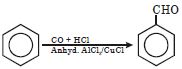
B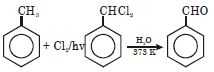
C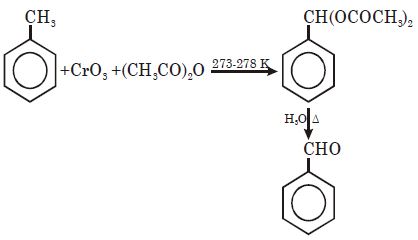
D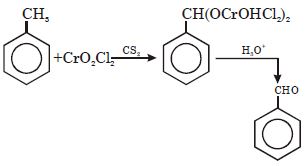
Solution
(A) The Gattermann-Koch reaction is a chemical reaction in which benzene is converted to benzaldehyde by treatment with carbon monoxide $(CO)$ and hydrogen chloride $(HCl)$ in the presence of a Lewis acid catalyst,typically anhydrous aluminum chloride $(AlCl_3)$ and cuprous chloride $(CuCl)$.
The reaction is represented as:
$C_6H_6 + CO + HCl \xrightarrow{Anhyd. AlCl_3/CuCl} C_6H_5CHO$
Option $A$ correctly represents this reaction.
The reaction is represented as:
$C_6H_6 + CO + HCl \xrightarrow{Anhyd. AlCl_3/CuCl} C_6H_5CHO$
Option $A$ correctly represents this reaction.
0 likes
View Solution80
MediumMCQ
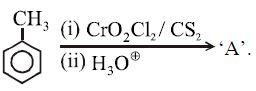
Product $A$ in the reaction will be:
A
Benzaldehyde
B
Benzoic acid
C
Toluene
D
Benzyl alcohol
Solution
(A) The given reaction is the Etard reaction.
In this reaction,toluene is treated with chromyl chloride $(CrO_2Cl_2)$ in the presence of carbon disulfide $(CS_2)$ as a solvent,followed by hydrolysis with $H_3O^+$.
This process selectively oxidizes the methyl group of toluene to a formyl group,resulting in the formation of benzaldehyde as the product $A$.
In this reaction,toluene is treated with chromyl chloride $(CrO_2Cl_2)$ in the presence of carbon disulfide $(CS_2)$ as a solvent,followed by hydrolysis with $H_3O^+$.
This process selectively oxidizes the methyl group of toluene to a formyl group,resulting in the formation of benzaldehyde as the product $A$.
0 likes
View Solution81
MediumMCQ
Rosenmund reduction cannot be used for the preparation of
A
$C_6H_5CHO$
B
$CH_3CHO$
C
$CH_3-CH(CH_3)-CHO$
D
$HCHO$
Solution
(D) Rosenmund reduction involves the catalytic hydrogenation of an acid chloride to an aldehyde using $H_2$ gas in the presence of $Pd/BaSO_4$.
To prepare formaldehyde $(HCHO)$,the required starting material would be formyl chloride $(HCOCl)$.
However,formyl chloride is highly unstable at room temperature and spontaneously decomposes into carbon monoxide $(CO)$ and hydrogen chloride $(HCl)$.
Therefore,$HCHO$ cannot be prepared by the Rosenmund reduction method.
To prepare formaldehyde $(HCHO)$,the required starting material would be formyl chloride $(HCOCl)$.
However,formyl chloride is highly unstable at room temperature and spontaneously decomposes into carbon monoxide $(CO)$ and hydrogen chloride $(HCl)$.
Therefore,$HCHO$ cannot be prepared by the Rosenmund reduction method.
0 likes
View Solution82
DifficultMCQ
Predict the product of the following reaction:
$m\text{-Tolunitrile} \xrightarrow[(ii) H_3O^+]{(i) CH_3MgBr} \text{Product}$
$m\text{-Tolunitrile} \xrightarrow[(ii) H_3O^+]{(i) CH_3MgBr} \text{Product}$
A
$m\text{-Methylphenylmethanol}$
B
$m\text{-Methylacetophenone}$
C
$m\text{-Tolualdehyde}$
D
$m\text{-Toluic acid}$
Solution
(B) The reaction of a nitrile $(R-CN)$ with a Grignard reagent $(R'MgX)$ followed by acid hydrolysis $(H_3O^+)$ is a standard method to synthesize ketones.
$1$. The Grignard reagent $(CH_3MgBr)$ acts as a nucleophile and attacks the electrophilic carbon of the nitrile group $(-CN)$.
$2$. This forms an imine intermediate: $m\text{-CH}_3C_6H_4-C(CH_3)=NMgBr$.
$3$. Subsequent acid hydrolysis $(H_3O^+)$ converts the imine intermediate into a ketone.
$4$. The final product is $m\text{-methylacetophenone}$ (also known as $3\text{-methylacetophenone}$).
Therefore,the correct option is $B$.
$1$. The Grignard reagent $(CH_3MgBr)$ acts as a nucleophile and attacks the electrophilic carbon of the nitrile group $(-CN)$.
$2$. This forms an imine intermediate: $m\text{-CH}_3C_6H_4-C(CH_3)=NMgBr$.
$3$. Subsequent acid hydrolysis $(H_3O^+)$ converts the imine intermediate into a ketone.
$4$. The final product is $m\text{-methylacetophenone}$ (also known as $3\text{-methylacetophenone}$).
Therefore,the correct option is $B$.
0 likes
View Solution83
MediumMCQ
Identify the reagent '$A$' in the following reaction:
$C_6H_5COCl \xrightarrow{A} C_6H_5CHO$
$C_6H_5COCl \xrightarrow{A} C_6H_5CHO$
A
$Pd + H_2$
B
$NaBH_4$
C
$LiAlH_4$
D
$Pd/BaSO_4 + H_2$
Solution
(D) The given reaction is the Rosenmund reduction,which is used to convert acid chlorides $(RCOCl)$ into aldehydes $(RCHO)$.
In this reaction,benzoyl chloride $(C_6H_5COCl)$ is reduced to benzaldehyde $(C_6H_5CHO)$ using hydrogen gas in the presence of palladium catalyst supported on barium sulfate $(Pd/BaSO_4)$.
$BaSO_4$ acts as a poison to prevent the further reduction of the aldehyde to an alcohol.
Therefore,the reagent '$A$' is $Pd/BaSO_4 + H_2$.
In this reaction,benzoyl chloride $(C_6H_5COCl)$ is reduced to benzaldehyde $(C_6H_5CHO)$ using hydrogen gas in the presence of palladium catalyst supported on barium sulfate $(Pd/BaSO_4)$.
$BaSO_4$ acts as a poison to prevent the further reduction of the aldehyde to an alcohol.
Therefore,the reagent '$A$' is $Pd/BaSO_4 + H_2$.
0 likes
View Solution84
MediumMCQ
Identify the product of the following reaction:
$C_6H_6 + CO + HCl \xrightarrow{AlCl_3} \text{Product}$
$C_6H_6 + CO + HCl \xrightarrow{AlCl_3} \text{Product}$
A
Ethylbenzene
B
Benzyl alcohol
C
Benzaldehyde
D
Benzoyl chloride
Solution
(C) The given reaction is the Gattermann-Koch reaction.
In this reaction,benzene reacts with carbon monoxide $(CO)$ and hydrogen chloride $(HCl)$ in the presence of anhydrous aluminum chloride $(AlCl_3)$ or cuprous chloride $(CuCl)$ to form benzaldehyde.
The reaction is as follows:
$C_6H_6 + CO + HCl \xrightarrow{AlCl_3} C_6H_5CHO + HCl$
Therefore,the product is benzaldehyde.
In this reaction,benzene reacts with carbon monoxide $(CO)$ and hydrogen chloride $(HCl)$ in the presence of anhydrous aluminum chloride $(AlCl_3)$ or cuprous chloride $(CuCl)$ to form benzaldehyde.
The reaction is as follows:
$C_6H_6 + CO + HCl \xrightarrow{AlCl_3} C_6H_5CHO + HCl$
Therefore,the product is benzaldehyde.
0 likes
View Solution85
MediumMCQ
Which of the following reactions cannot be used to prepare Benzaldehyde?
A
Benzene + $Zn/Hg$ and conc. $HCl$
B
Toluene + $CrO_2Cl_2$ in $CS_2$ followed by ${H_3}{O^ \oplus }$
C
Benzoyl chloride + $H_2$ in presence of $Pd/BaSO_4$
D
Benzene + $CO + HCl$ in presence of anhydrous $AlCl_3$
Solution
(A) The reaction of Benzene with $Zn/Hg$ and conc. $HCl$ is the Clemmensen reduction,which is used to reduce carbonyl groups (aldehydes or ketones) to methylene $(-CH_2-)$ groups. It does not prepare Benzaldehyde from Benzene.
Option $A$ is the correct answer because this reaction is not a method for the preparation of Benzaldehyde.
Option $B$ is the Etard reaction,which converts Toluene to Benzaldehyde.
Option $C$ is the Rosenmund reduction,which converts Benzoyl chloride to Benzaldehyde.
Option $D$ is the Gattermann-Koch reaction,which converts Benzene to Benzaldehyde.
Option $A$ is the correct answer because this reaction is not a method for the preparation of Benzaldehyde.
Option $B$ is the Etard reaction,which converts Toluene to Benzaldehyde.
Option $C$ is the Rosenmund reduction,which converts Benzoyl chloride to Benzaldehyde.
Option $D$ is the Gattermann-Koch reaction,which converts Benzene to Benzaldehyde.
0 likes
View Solution86
MediumMCQ
Which of the following reactions does not give an aldehyde as a product?
A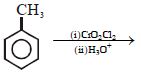
B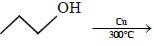
C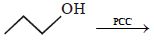
D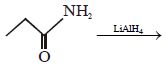
Solution
(D) Let us analyze each reaction:
$(A)$ Etard reaction: Toluene reacts with chromyl chloride $(CrO_2Cl_2)$ followed by hydrolysis to give benzaldehyde. This produces an aldehyde.
$(B)$ Dehydrogenation of primary alcohol: Propan$-1-$ol reacts with $Cu$ at $300 \ ^\circ C$ to give propanal (an aldehyde).
$(C)$ Oxidation of primary alcohol: Propan$-1-$ol reacts with Pyridinium chlorochromate $(PCC)$ to give propanal (an aldehyde).
$(D)$ Reduction of amide: Propanamide reacts with lithium aluminium hydride $(LiAlH_4)$ to give propan$-1-$amine (a primary amine),not an aldehyde.
Therefore,the reaction that does not give an aldehyde is $(D)$.
$(A)$ Etard reaction: Toluene reacts with chromyl chloride $(CrO_2Cl_2)$ followed by hydrolysis to give benzaldehyde. This produces an aldehyde.
$(B)$ Dehydrogenation of primary alcohol: Propan$-1-$ol reacts with $Cu$ at $300 \ ^\circ C$ to give propanal (an aldehyde).
$(C)$ Oxidation of primary alcohol: Propan$-1-$ol reacts with Pyridinium chlorochromate $(PCC)$ to give propanal (an aldehyde).
$(D)$ Reduction of amide: Propanamide reacts with lithium aluminium hydride $(LiAlH_4)$ to give propan$-1-$amine (a primary amine),not an aldehyde.
Therefore,the reaction that does not give an aldehyde is $(D)$.
0 likes
View Solution87
MediumMCQ
The reaction shown below is known as:
$C_6H_6 + CO + HCl \xrightarrow{\text{anhyd. } AlCl_3} C_6H_5CHO$
$C_6H_6 + CO + HCl \xrightarrow{\text{anhyd. } AlCl_3} C_6H_5CHO$
A
Gatterman aldehyde synthesis
B
Gatterman-Koch aldehyde synthesis
C
Williamson's synthesis
D
Reed's reaction
Solution
(B) The reaction of benzene with carbon monoxide $(CO)$ and hydrogen chloride $(HCl)$ in the presence of anhydrous aluminum chloride $(AlCl_3)$ or cuprous chloride $(CuCl)$ leads to the formation of benzaldehyde.
This specific reaction is known as the Gatterman-Koch reaction.
This specific reaction is known as the Gatterman-Koch reaction.
0 likes
View Solution88
DifficultMCQ
Which of the following reaction products is correct?
A
$2-$oxocyclohexyl acetate $\xrightarrow{NaBH_4}$ $2-$($2$-hydroxyethyl)cyclohexanone
B
$1-$acetylcyclohex$-1-$ene $\xrightarrow{H_2/Pd-C, \text{one equiv.}}$ $1-$($1$-hydroxyethyl)cyclohex$-1-$ene
C
Phenylacetonitrile $\xrightarrow{(1) DIBAL-H, (2) H_3O^+}$ Phenylacetaldehyde
D
$CH_3-C \equiv C-CH_3 \xrightarrow{Na/liq. NH_3}$ cis-but$-2-$ene
Solution
(C) Let us analyze each reaction:
$(A)$ $NaBH_4$ is a selective reducing agent that reduces aldehydes and ketones to alcohols but does not reduce esters. The reaction shown reduces the ester group to an alcohol while keeping the ketone intact,which is incorrect.
$(B)$ $H_2/Pd-C$ is a strong reducing agent that reduces both the $C=C$ double bond and the $C=O$ double bond. It would not stop at the alcohol stage with one equivalent; it would reduce the alkene as well.
$(C)$ The reduction of nitriles $(R-CN)$ with $DIBAL-H$ followed by acid hydrolysis $(H_3O^+)$ is a standard method to produce aldehydes $(R-CHO)$. Thus,$C_6H_5-CH_2-CN \xrightarrow{(1) DIBAL-H, (2) H_3O^+} C_6H_5-CH_2-CHO$ is correct.
$(D)$ The reduction of an internal alkyne with $Na/liq. NH_3$ (Birch reduction conditions) produces a trans-alkene,not a cis-alkene. Therefore,this is incorrect.
$(A)$ $NaBH_4$ is a selective reducing agent that reduces aldehydes and ketones to alcohols but does not reduce esters. The reaction shown reduces the ester group to an alcohol while keeping the ketone intact,which is incorrect.
$(B)$ $H_2/Pd-C$ is a strong reducing agent that reduces both the $C=C$ double bond and the $C=O$ double bond. It would not stop at the alcohol stage with one equivalent; it would reduce the alkene as well.
$(C)$ The reduction of nitriles $(R-CN)$ with $DIBAL-H$ followed by acid hydrolysis $(H_3O^+)$ is a standard method to produce aldehydes $(R-CHO)$. Thus,$C_6H_5-CH_2-CN \xrightarrow{(1) DIBAL-H, (2) H_3O^+} C_6H_5-CH_2-CHO$ is correct.
$(D)$ The reduction of an internal alkyne with $Na/liq. NH_3$ (Birch reduction conditions) produces a trans-alkene,not a cis-alkene. Therefore,this is incorrect.
0 likes
View Solution89
MediumMCQ
$CH_3-CO-CH_2-COOH \xrightarrow{\Delta} X$; $X$ can also be formed by
A
$CH_3-CH_2-CH_2-Cl \xrightarrow{LiAlH_4}$
B
$CH_3-CH_2-COOH \xrightarrow{P + HI}$
C
$CH_3-C \equiv CH \xrightarrow{Hg^{2+}, H_2O}$
D
All
Solution
(C) The starting material is acetoacetic acid $(CH_3-CO-CH_2-COOH)$.
Upon heating $(\Delta)$,$\beta$-keto acids undergo decarboxylation to form a ketone.
$CH_3-CO-CH_2-COOH \xrightarrow{\Delta} CH_3-CO-CH_3 CO_2$.
Thus,$X$ is acetone $(CH_3-CO-CH_3)$.
Now,let us evaluate the options:
$(A)$ $CH_3-CH_2-CH_2-Cl \xrightarrow{LiAlH_4} CH_3-CH_2-CH_3$ (Propane,not acetone).
$(B)$ $CH_3-CH_2-COOH \xrightarrow{P HI} CH_3-CH_2-CH_3$ (Propane,not acetone).
$(C)$ $CH_3-C \equiv CH \xrightarrow{Hg^{2 }, H_2O} CH_3-CO-CH_3$ (Acetone is formed via hydration of propyne).
Therefore,the correct option is $C$.
Upon heating $(\Delta)$,$\beta$-keto acids undergo decarboxylation to form a ketone.
$CH_3-CO-CH_2-COOH \xrightarrow{\Delta} CH_3-CO-CH_3 CO_2$.
Thus,$X$ is acetone $(CH_3-CO-CH_3)$.
Now,let us evaluate the options:
$(A)$ $CH_3-CH_2-CH_2-Cl \xrightarrow{LiAlH_4} CH_3-CH_2-CH_3$ (Propane,not acetone).
$(B)$ $CH_3-CH_2-COOH \xrightarrow{P HI} CH_3-CH_2-CH_3$ (Propane,not acetone).
$(C)$ $CH_3-C \equiv CH \xrightarrow{Hg^{2 }, H_2O} CH_3-CO-CH_3$ (Acetone is formed via hydration of propyne).
Therefore,the correct option is $C$.
0 likes
View Solution90
MediumMCQ
Which of the following reaction sequences would be the best for the synthesis of $2$-pentanone?
A
$CH_3-CH_2-CH_2-CHO$ $\xrightarrow[Et_2O]{CH_3MgI}$ $\xrightarrow{H_3O^{+}}$
B
$CH_3-CH(O)CH_2-CH_2$ $\xrightarrow[Et_2O]{CH_3MgI}$ $\xrightarrow{H_3O^{+}}$
C
$CH_3-CH_2-CH_2-CN$ $\xrightarrow[Et_2O]{CH_3MgI}$ $\xrightarrow{H_3O^{+}}$
D
$CH_3-CH_2-CHO$ $\xrightarrow[Et_2O]{CH_3MgI}$ $\xrightarrow{H_3O^{+}}$
Solution
(C) The reaction of a nitrile with a Grignard reagent followed by acid hydrolysis is a standard method for the synthesis of ketones.
$CH_3-CH_2-CH_2-CN + CH_3MgI$ $\xrightarrow{Et_2O} CH_3-CH_2-CH_2-C(CH_3)=NMgI$ $\xrightarrow{H_3O^{+}} CH_3-CH_2-CH_2-CO-CH_3 + NH_3 + Mg(OH)I$.
The product formed is $2$-pentanone. Options $(a)$,$(b)$,and $(d)$ primarily yield alcohols.
$CH_3-CH_2-CH_2-CN + CH_3MgI$ $\xrightarrow{Et_2O} CH_3-CH_2-CH_2-C(CH_3)=NMgI$ $\xrightarrow{H_3O^{+}} CH_3-CH_2-CH_2-CO-CH_3 + NH_3 + Mg(OH)I$.
The product formed is $2$-pentanone. Options $(a)$,$(b)$,and $(d)$ primarily yield alcohols.
0 likes
View Solution91
MediumMCQ
The reaction is given as follows:
$Ph-CO-N(CH_3)(OCH_3) + 2CH_3MgBr \xrightarrow{H_3O^+} (P)$
Product $(P)$ is:
$Ph-CO-N(CH_3)(OCH_3) + 2CH_3MgBr \xrightarrow{H_3O^+} (P)$
Product $(P)$ is:
A
$Ph-C(OH)(CH_3)_2$
B
$Ph-CO-CH_3$
C
$Ph-CH(OH)-CH_3$
D
$Ph-C(OH)(Ph)_2$
Solution
(B) The starting material is $N$-methoxy-$N$-methylbenzamide (Weinreb amide).
Weinreb amides react with Grignard reagents $(RMgX)$ to form ketones after hydrolysis.
In this reaction,$N$-methoxy-$N$-methylbenzamide reacts with $2$ equivalents of $CH_3MgBr$.
The first equivalent of $CH_3MgBr$ attacks the carbonyl carbon to form a stable tetrahedral intermediate,which prevents further reaction with the Grignard reagent.
Upon acid hydrolysis $(H_3O^+)$,this intermediate decomposes to form acetophenone $(Ph-CO-CH_3)$.
Therefore,the product $(P)$ is acetophenone $(Ph-CO-CH_3)$.
Weinreb amides react with Grignard reagents $(RMgX)$ to form ketones after hydrolysis.
In this reaction,$N$-methoxy-$N$-methylbenzamide reacts with $2$ equivalents of $CH_3MgBr$.
The first equivalent of $CH_3MgBr$ attacks the carbonyl carbon to form a stable tetrahedral intermediate,which prevents further reaction with the Grignard reagent.
Upon acid hydrolysis $(H_3O^+)$,this intermediate decomposes to form acetophenone $(Ph-CO-CH_3)$.
Therefore,the product $(P)$ is acetophenone $(Ph-CO-CH_3)$.
0 likes
View Solution92
MediumMCQ
What is the major product of the following reaction? $CH_3-C \equiv N$ $\xrightarrow[Et_2O]{CH_3MgI}$ $\xrightarrow{H_3O^{+}}$
A
$CH_3-CH_2-NH-CH_3$
B
$CH_3-C(=NH)-CH_3$
C
$CH_3-C(=O)-CH_3$
D
$CH_3-CH_2-C(=O)-OH$
Solution
(C) When nitriles react with Grignard reagents,they form an imine salt intermediate,which upon acid hydrolysis yields a ketone.
Reaction:
$CH_3-C \equiv N + CH_3MgI \xrightarrow{Et_2O} CH_3-C(CH_3)=N-MgI$
$CH_3-C(CH_3)=N-MgI \xrightarrow{H_3O^{+}} CH_3-C(=O)-CH_3 + NH_3 + Mg(OH)I$
The major product is acetone $(CH_3-C(=O)-CH_3)$.
Reaction:
$CH_3-C \equiv N + CH_3MgI \xrightarrow{Et_2O} CH_3-C(CH_3)=N-MgI$
$CH_3-C(CH_3)=N-MgI \xrightarrow{H_3O^{+}} CH_3-C(=O)-CH_3 + NH_3 + Mg(OH)I$
The major product is acetone $(CH_3-C(=O)-CH_3)$.
0 likes
View Solution93
MediumMCQ
Which,if any,of the following pairs of reagents could be used to prepare $2$-phenyl-$2$-butanol?
A
$CH_3CH_2MgBr + Ph-C(=O)-CH_3$
B
$CH_3CH_2MgBr + C_6H_5CH_2-CHO$
C
$CH_3MgI + C_6H_5CH_2-C(=O)CH_3$
D
$C_6H_5MgCl + CH_3-C(=O)-CH_2CH_2CH_3$
Solution
(A) $2$-phenyl-$2$-butanol is a tertiary alcohol with the structure $CH_3-C(OH)(Ph)-CH_2CH_3$.
It can be prepared by the nucleophilic addition of a Grignard reagent to a ketone.
The reaction of ethylmagnesium bromide $(CH_3CH_2MgBr)$ with acetophenone $(Ph-C(=O)-CH_3)$ followed by acidic hydrolysis yields $2$-phenyl-$2$-butanol.
$CH_3CH_2MgBr + Ph-C(=O)-CH_3$ $\rightarrow Ph-C(OMgBr)(CH_3)CH_2CH_3$ $\xrightarrow{H_3O^+} Ph-C(OH)(CH_3)CH_2CH_3$.
It can be prepared by the nucleophilic addition of a Grignard reagent to a ketone.
The reaction of ethylmagnesium bromide $(CH_3CH_2MgBr)$ with acetophenone $(Ph-C(=O)-CH_3)$ followed by acidic hydrolysis yields $2$-phenyl-$2$-butanol.
$CH_3CH_2MgBr + Ph-C(=O)-CH_3$ $\rightarrow Ph-C(OMgBr)(CH_3)CH_2CH_3$ $\xrightarrow{H_3O^+} Ph-C(OH)(CH_3)CH_2CH_3$.
0 likes
View Solution94
DifficultMCQ
What sequence of steps represents the best synthesis of $4-heptanol$ $(CH_3CH_2CH_2)_2CHOH$?
A
$CH_3CH_2CH_2MgBr$ $(2 \ moles)$ $+$ formaldehyde $(H_2C=O)$ in diethyl ether followed by $H_3O^{+}$
B
$CH_3CH_2CH_2MgBr$ $+$ butanal $(CH_3CH_2CH_2CH=O)$ in diethyl ether followed by $H_3O^{+}$
C
$CH_3CH_2CH_2CH_2MgBr$ $+$ acetone $[(CH_3)_2C=O]$ in diethyl ether followed by $H_3O^{+}$
D
$(CH_3CH_2CH_2)_2CHMgBr$ $+$ formaldehyde $(H_2C=O)$ in diethyl ether followed by $H_3O^{+}$
Solution
(B) The synthesis of $4-heptanol$ requires the addition of a propyl Grignard reagent to a butyraldehyde (butanal) substrate.
$(A)$ $CH_3CH_2CH_2MgBr + H_2C=O \rightarrow CH_3CH_2CH_2CH_2OH$ $(1-butanol)$.
$(B)$ $CH_3CH_2CH_2MgBr + CH_3CH_2CH_2CHO \rightarrow (CH_3CH_2CH_2)_2CHOH$ $(4-heptanol)$. This is the correct synthesis.
$(C)$ $CH_3CH_2CH_2CH_2MgBr + (CH_3)_2C=O \rightarrow 2-methyl-2-hexanol$.
$(D)$ $(CH_3CH_2CH_2)_2CHMgBr + H_2C=O \rightarrow (CH_3CH_2CH_2)_2CHCH_2OH$ $(2-propyl-1-pentanol)$.
$(A)$ $CH_3CH_2CH_2MgBr + H_2C=O \rightarrow CH_3CH_2CH_2CH_2OH$ $(1-butanol)$.
$(B)$ $CH_3CH_2CH_2MgBr + CH_3CH_2CH_2CHO \rightarrow (CH_3CH_2CH_2)_2CHOH$ $(4-heptanol)$. This is the correct synthesis.
$(C)$ $CH_3CH_2CH_2CH_2MgBr + (CH_3)_2C=O \rightarrow 2-methyl-2-hexanol$.
$(D)$ $(CH_3CH_2CH_2)_2CHMgBr + H_2C=O \rightarrow (CH_3CH_2CH_2)_2CHCH_2OH$ $(2-propyl-1-pentanol)$.
0 likes
View Solution95
DifficultMCQ
Identify product $Z$ in the following reaction sequence:
$CH_2=CH-CH_2Br$ $\xrightarrow{NaCN} Y$ $\xrightarrow[1. C_6H_5MgBr, \text{diethylether}]{2. H_3O^{+}} Z$
$CH_2=CH-CH_2Br$ $\xrightarrow{NaCN} Y$ $\xrightarrow[1. C_6H_5MgBr, \text{diethylether}]{2. H_3O^{+}} Z$
A
$CH_2=CH-CH_2-C(=O)-C_6H_5$
B
$CH_2=CH-CH_2-NH-C(=O)-C_6H_5$
C
$CH_2=CH-CH_2-CH(OH)-C_6H_5$
D
$CH_2=CH-CH_2-CH(NH_2)-C_6H_5$
Solution
(A) Step $1$: $CH_2=CH-CH_2Br$ undergoes nucleophilic substitution with $NaCN$ to form $CH_2=CH-CH_2CN$ $(Y)$.
Step $2$: The reaction of nitrile $(Y)$ with Grignard reagent $(C_6H_5MgBr)$ followed by acid hydrolysis $(H_3O^{+})$ yields a ketone.
$CH_2=CH-CH_2Br + NaCN \rightarrow CH_2=CH-CH_2CN$ $(Y)$
$CH_2=CH-CH_2CN + C_6H_5MgBr$ $\xrightarrow{\text{ether}} CH_2=CH-CH_2-C(=NMgBr)-C_6H_5$ $\xrightarrow{H_3O^{+}} CH_2=CH-CH_2-C(=O)-C_6H_5$ $(Z)$
Step $2$: The reaction of nitrile $(Y)$ with Grignard reagent $(C_6H_5MgBr)$ followed by acid hydrolysis $(H_3O^{+})$ yields a ketone.
$CH_2=CH-CH_2Br + NaCN \rightarrow CH_2=CH-CH_2CN$ $(Y)$
$CH_2=CH-CH_2CN + C_6H_5MgBr$ $\xrightarrow{\text{ether}} CH_2=CH-CH_2-C(=NMgBr)-C_6H_5$ $\xrightarrow{H_3O^{+}} CH_2=CH-CH_2-C(=O)-C_6H_5$ $(Z)$
0 likes
View Solution96
MediumMCQ
Identify the product $(A)$ in the following reaction:
$4-\text{tert-butylcyclohexanol} + \text{PCC} \xrightarrow{\text{CH}_2\text{Cl}_2} (A)$
$4-\text{tert-butylcyclohexanol} + \text{PCC} \xrightarrow{\text{CH}_2\text{Cl}_2} (A)$
A
$4-$tert-butylcyclohexene
B
$4-$tert-butylcyclohexanone
C
$4-$tert-butylcyclohexyl chloride
D
$4-$tert-butylcyclohex$-2-$enone
Solution
(B) $PCC$ (Pyridinium chlorochromate) is a mild oxidizing agent that selectively oxidizes primary alcohols to aldehydes and secondary alcohols to ketones without affecting other functional groups like double bonds.
In the given reaction,$4-\text{tert-butylcyclohexanol}$ is a secondary alcohol.
Therefore,$PCC$ oxidizes the secondary alcohol group $(-OH)$ to a ketone group $(=O)$,resulting in $4-\text{tert-butylcyclohexanone}$.
In the given reaction,$4-\text{tert-butylcyclohexanol}$ is a secondary alcohol.
Therefore,$PCC$ oxidizes the secondary alcohol group $(-OH)$ to a ketone group $(=O)$,resulting in $4-\text{tert-butylcyclohexanone}$.
0 likes
View Solution97
MediumMCQ
Which sequence of steps describes the best synthesis of $2-$methyl$-3-$pentanone?
A
$(1)$ $1-$Propanol $+ (CH_3)_2CHMgBr$,diethyl ether
$(2)$ $H_3O^{+}$
$(3)$ $PCC, CH_2Cl_2$
$(2)$ $H_3O^{+}$
$(3)$ $PCC, CH_2Cl_2$
B
$(1)$ $1-$Propanol $+ Na_2Cr_2O_7, H_2SO_4, H_2O$,heat
$(2)$ $SOCl_2$
$(3)$ $(CH_3)_2CHCl, AlCl_3$
$(2)$ $SOCl_2$
$(3)$ $(CH_3)_2CHCl, AlCl_3$
C
$(1)$ $1-$Propanol $+ PCC, CH_2Cl_2$
$(2)$ $(CH_3)_2CHLi$,diethyl ether
$(3)$ $H_3O^{+}$
$(4)$ $Na_2Cr_2O_7, H_2SO_4, H_2O$,heat
$(2)$ $(CH_3)_2CHLi$,diethyl ether
$(3)$ $H_3O^{+}$
$(4)$ $Na_2Cr_2O_7, H_2SO_4, H_2O$,heat
D
$(1)$ $2-$Propanol $+ Na_2Cr_2O_7, H_2SO_4, H_2O$,heat
$(2)$ $CH_3CH_2CH_2Li$,diethyl ether
$(3)$ $H_3O^{+}$
$(4)$ $PCC, CH_2Cl_2$
$(2)$ $CH_3CH_2CH_2Li$,diethyl ether
$(3)$ $H_3O^{+}$
$(4)$ $PCC, CH_2Cl_2$
Solution
(C) The synthesis of $2-$methyl$-3-$pentanone can be achieved by the following steps:
$1.$ Oxidation of $1-$propanol to propanal using $PCC$ in $CH_2Cl_2$.
$2.$ Nucleophilic addition of isopropyl lithium $(CH_3)_2CHLi$ to propanal followed by acidic workup $(H_3O^{+})$ to form $2-$methyl$-3-$pentanol.
$3.$ Oxidation of the resulting secondary alcohol to the ketone using $Na_2Cr_2O_7, H_2SO_4, H_2O$ (Jones reagent).
This corresponds to the sequence in option $C$.
$1.$ Oxidation of $1-$propanol to propanal using $PCC$ in $CH_2Cl_2$.
$2.$ Nucleophilic addition of isopropyl lithium $(CH_3)_2CHLi$ to propanal followed by acidic workup $(H_3O^{+})$ to form $2-$methyl$-3-$pentanol.
$3.$ Oxidation of the resulting secondary alcohol to the ketone using $Na_2Cr_2O_7, H_2SO_4, H_2O$ (Jones reagent).
This corresponds to the sequence in option $C$.
0 likes
View Solution98
MediumMCQ
$1$-Phenylethanol can be prepared by the reaction of benzaldehyde with the product obtained in the reaction between
A
$CH_3I$ and $Mg$
B
$C_2H_5I$ and $Mg$
C
$CH_3Br$ and $AlCl_3$
D
$CH_3OH$ and $ZnCl_2$
Solution
(A) The preparation of $1$-phenylethanol involves the nucleophilic addition of a Grignard reagent to benzaldehyde.
Benzaldehyde $(C_6H_5CHO)$ reacts with methylmagnesium iodide $(CH_3MgI)$ to form an intermediate,which upon acidic hydrolysis yields $1$-phenylethanol.
The Grignard reagent $CH_3MgI$ is prepared by the reaction between $CH_3I$ and $Mg$ in the presence of dry ether.
Thus,the correct option is $A$.
Benzaldehyde $(C_6H_5CHO)$ reacts with methylmagnesium iodide $(CH_3MgI)$ to form an intermediate,which upon acidic hydrolysis yields $1$-phenylethanol.
The Grignard reagent $CH_3MgI$ is prepared by the reaction between $CH_3I$ and $Mg$ in the presence of dry ether.
Thus,the correct option is $A$.
0 likes
View Solution99
DifficultMCQ
Which sequence represents the best synthesis of hexanal?
$CH_3CH_2CH_2CH_2CH_2CH=O$ (Hexanal)
$CH_3CH_2CH_2CH_2CH_2CH=O$ (Hexanal)
A
$1$. $CH_3CH_2CH_2CH_2Br + NaC\equiv CH$; $2$. $H_2O, H_2SO_4, HgSO_4$
B
$1$. $CH_3CH_2CH_2CH=CH_2 + CH_3COOH$ (followed by $2$. $CH_3MgBr$,diethyl ether; $3$. $H_3O^{+}$; $4$. $PCC, CH_2Cl_2$)
C
$1$. $CH_3CH_2CH_2CH_2COCH_3$; $2$. $CH_3COOH$; $3$. $LiAlH_4$; $4$. $H_2O$; $5$. $PCC, CH_2Cl_2$
D
$1$. $CH_3CH_2CH_2CH_2MgBr + \text{ethylene oxide}$; $2$. $H_3O^{+}$; $3$. $PCC, CH_2Cl_2$
Solution
(D) The synthesis of hexanal $(C_6H_{12}O)$ can be achieved by the reaction of a Grignard reagent with ethylene oxide followed by oxidation.
Step $1$: $CH_3CH_2CH_2CH_2MgBr + C_2H_4O \rightarrow CH_3CH_2CH_2CH_2CH_2CH_2OMgBr$.
Step $2$: Acidic workup $(H_3O^{+})$ yields $1$-hexanol $(CH_3CH_2CH_2CH_2CH_2CH_2OH)$.
Step $3$: Oxidation of the primary alcohol with $PCC$ (Pyridinium chlorochromate) in $CH_2Cl_2$ gives hexanal $(CH_3CH_2CH_2CH_2CH_2CHO)$.
Step $1$: $CH_3CH_2CH_2CH_2MgBr + C_2H_4O \rightarrow CH_3CH_2CH_2CH_2CH_2CH_2OMgBr$.
Step $2$: Acidic workup $(H_3O^{+})$ yields $1$-hexanol $(CH_3CH_2CH_2CH_2CH_2CH_2OH)$.
Step $3$: Oxidation of the primary alcohol with $PCC$ (Pyridinium chlorochromate) in $CH_2Cl_2$ gives hexanal $(CH_3CH_2CH_2CH_2CH_2CHO)$.
0 likes
View Solution100
MediumMCQ
$CH_3-COOH \xrightarrow[\Delta]{Ca(OH)_2} (A)$
Product $(A)$ is
Product $(A)$ is
A
B
C
D
Solution
(B) When carboxylic acids are heated with $Ca(OH)_2$,they form calcium salts of the acid.
$2CH_3COOH + Ca(OH)_2 \rightarrow (CH_3COO)_2Ca + 2H_2O$
Upon further heating,the calcium salt undergoes dry distillation to produce a ketone.
$(CH_3COO)_2Ca \xrightarrow{\Delta} CH_3COCH_3 + CaCO_3$
The product $(A)$ is acetone $(CH_3COCH_3)$,which corresponds to the structure shown in option $B$.
$2CH_3COOH + Ca(OH)_2 \rightarrow (CH_3COO)_2Ca + 2H_2O$
Upon further heating,the calcium salt undergoes dry distillation to produce a ketone.
$(CH_3COO)_2Ca \xrightarrow{\Delta} CH_3COCH_3 + CaCO_3$
The product $(A)$ is acetone $(CH_3COCH_3)$,which corresponds to the structure shown in option $B$.
0 likes
View Solution8-1.Aldehydes and Ketones — Preparation · Frequently Asked Questions
1Are these 8-1.Aldehydes and Ketones questions useful for JEE and NEET?
Yes. All questions in this section are mapped to JEE Main and NEET exam patterns. Previous year questions from JEE Main, NEET, GUJCET and state-level exams are included with full solutions.
2Can I switch to Hindi or Gujarati for these questions?
Yes. Use the language tabs in the hero section or the sidebar to view the same questions and solutions in English, Hindi or Gujarati.
3How do I generate a question paper from this subtopic?
Use the Vedclass Exam Paper Generator — select the chapter and subtopic, set difficulty, and generate Sets A, B, C, D automatically. First 3 chapters of every subject are free.
Vedclass Products
For Students
Vedclass Test Series
Mock tests in real JEE/NEET style with performance analysis. 5-day free trial.
Start Free TrialFor Teachers
Exam Paper Generator
Generate Set A/B/C/D papers from this chapter in 2 minutes. 3 chapters free.
Try FreeFor Institutes
Online Exam Module
Live online exams with unlimited students, 360° analytics & white-label branding.
See DemoFor Teachers & Institutes
Generate a 8-1.Aldehydes and Ketones Exam Paper in 2 Minutes
Select subtopic & difficulty — Sets A, B, C, D auto-generated with No Repeat logic.
First 3 chapters of every subject are free — no payment required.