
A English
Preparation Questions in English
Class 12 Chemistry · 8-1.Aldehydes and Ketones · Preparation
328+
Questions
English
Language
100%
With Solutions
Showing 50 of 328 questions in English
101
MediumMCQ
$Ph-COOH$ $\xrightarrow{SOCl_2} (A)$ $\xrightarrow{H_2, Pd-BaSO_4} (B)$. Product $(B)$ is:
A
$Ph-CHO$
B
$Ph-CH_2-OH$
C
$Ph-CH_2-Cl$
D
$Ph-CH=CH_2$
Solution
(A) Step $1$: Benzoic acid $(Ph-COOH)$ reacts with $SOCl_2$ to form benzoyl chloride $(Ph-COCl)$ as product $(A)$.
$Ph-COOH + SOCl_2 \rightarrow Ph-COCl + SO_2 + HCl$
Step $2$: Benzoyl chloride undergoes Rosenmund reduction in the presence of $H_2$ and $Pd-BaSO_4$ to form benzaldehyde $(Ph-CHO)$ as product $(B)$.
$Ph-COCl + H_2 \xrightarrow{Pd-BaSO_4} Ph-CHO + HCl$
$Ph-COOH + SOCl_2 \rightarrow Ph-COCl + SO_2 + HCl$
Step $2$: Benzoyl chloride undergoes Rosenmund reduction in the presence of $H_2$ and $Pd-BaSO_4$ to form benzaldehyde $(Ph-CHO)$ as product $(B)$.
$Ph-COCl + H_2 \xrightarrow{Pd-BaSO_4} Ph-CHO + HCl$
0 likes
View Solution102
MediumMCQ
The conversion,$PhCN \to PhCOCH_3$,can be achieved most conveniently by reaction with
A
$CH_3MgBr$ followed by hydrolysis
B
$I_2 - NaOH, CH_3I$
C
dil. $H_2SO_4$ followed by reaction with $CH_2N_2$
D
$LAH$ followed by reaction with $CH_3I$
Solution
(A) The reaction of a nitrile $(PhCN)$ with a Grignard reagent $(CH_3MgBr)$ followed by acid hydrolysis is a standard method for the synthesis of ketones.
Step $1$: The nucleophilic $CH_3^-$ group from $CH_3MgBr$ attacks the electrophilic carbon of the nitrile group $(Ph-C \equiv N)$ to form an imine magnesium salt intermediate,$Ph-C(CH_3)=NMgBr$.
Step $2$: Subsequent acid hydrolysis $(H_3O^+)$ of the imine intermediate yields the ketone,$PhCOCH_3$.
Step $1$: The nucleophilic $CH_3^-$ group from $CH_3MgBr$ attacks the electrophilic carbon of the nitrile group $(Ph-C \equiv N)$ to form an imine magnesium salt intermediate,$Ph-C(CH_3)=NMgBr$.
Step $2$: Subsequent acid hydrolysis $(H_3O^+)$ of the imine intermediate yields the ketone,$PhCOCH_3$.
0 likes
View Solution103
DifficultMCQ
Identify the compound $C$ in the following sequence:
$(CH_3)_2CHCH_2C \equiv N$ $\xrightarrow{HCl, H_2O} \text{compound } A$ $\xrightarrow[2. H_2O]{1. LiAlH_4} \text{compound } B$ $\xrightarrow{PCC, CH_2Cl_2} \text{compound } C$
$(CH_3)_2CHCH_2C \equiv N$ $\xrightarrow{HCl, H_2O} \text{compound } A$ $\xrightarrow[2. H_2O]{1. LiAlH_4} \text{compound } B$ $\xrightarrow{PCC, CH_2Cl_2} \text{compound } C$
A
$(CH_3)_2CHCH_2COCH_3$
B
$(CH_3)_2CHCH_2COOH$
C
$(CH_3)_2CHCH_2CHO$
D
$(CH_3)_2CHCH_2CH_2OH$
Solution
(C) Step $1$: Acidic hydrolysis of nitrile $(CH_3)_2CHCH_2C \equiv N$ yields carboxylic acid $A$,which is $(CH_3)_2CHCH_2COOH$.
Step $2$: Reduction of carboxylic acid $A$ with $LiAlH_4$ followed by water yields primary alcohol $B$,which is $(CH_3)_2CHCH_2CH_2OH$.
Step $3$: Oxidation of primary alcohol $B$ with $PCC$ (Pyridinium chlorochromate) in $CH_2Cl_2$ yields aldehyde $C$,which is $(CH_3)_2CHCH_2CHO$.
Step $2$: Reduction of carboxylic acid $A$ with $LiAlH_4$ followed by water yields primary alcohol $B$,which is $(CH_3)_2CHCH_2CH_2OH$.
Step $3$: Oxidation of primary alcohol $B$ with $PCC$ (Pyridinium chlorochromate) in $CH_2Cl_2$ yields aldehyde $C$,which is $(CH_3)_2CHCH_2CHO$.
0 likes
View Solution104
DifficultMCQ
Which of the following reactions can be used to prepare acetophenone?
A
$C_6H_6 + CH_3COCl \xrightarrow[2. H_2O]{1. AlCl_3}$
B
$(C_6H_5COO)_2Ca + (CH_3COO)_2Ca \xrightarrow{\Delta}$
C
$C_6H_5CN \xrightarrow[2. H_3O^{+}]{1. CH_3MgI}$
D
All of these
Solution
(D) . Friedel-Crafts acylation of benzene with acetyl chloride in the presence of anhydrous $AlCl_3$ yields acetophenone.
$B$. Dry distillation of a mixture of calcium benzoate and calcium acetate yields acetophenone.
$C$. Reaction of phenylmagnesium iodide (or methylmagnesium iodide with benzonitrile) followed by hydrolysis yields acetophenone.
Since all three methods are valid,the correct option is $(d)$.
$B$. Dry distillation of a mixture of calcium benzoate and calcium acetate yields acetophenone.
$C$. Reaction of phenylmagnesium iodide (or methylmagnesium iodide with benzonitrile) followed by hydrolysis yields acetophenone.
Since all three methods are valid,the correct option is $(d)$.
0 likes
View Solution105
MediumMCQ
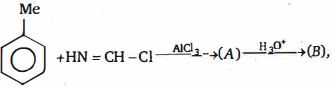
The product $(B)$ of the following reaction is:
A
$3-$methylbenzaldehyde
B
$4-$methylbenzaldehyde
C
No reaction
D
Acetophenone
Solution
(B) The given reaction is a variation of the Gattermann-Koch reaction or a form of Friedel-Crafts formylation using formyl chloride equivalent $(HN=CH-Cl)$.
$1$. The reagent $HN=CH-Cl$ in the presence of $AlCl_3$ generates an electrophilic species $HN=CH^+$.
$2$. This electrophile attacks the toluene ring. Since the methyl group $(-CH_3)$ is an ortho/para-directing group and para-position is sterically less hindered,the electrophile attacks the para-position to form an imine intermediate $(A)$.
$3$. Subsequent hydrolysis of the imine intermediate $(A)$ with $H_3O^+$ yields the corresponding aldehyde,which is $4$-methylbenzaldehyde (p-tolualdehyde).
$1$. The reagent $HN=CH-Cl$ in the presence of $AlCl_3$ generates an electrophilic species $HN=CH^+$.
$2$. This electrophile attacks the toluene ring. Since the methyl group $(-CH_3)$ is an ortho/para-directing group and para-position is sterically less hindered,the electrophile attacks the para-position to form an imine intermediate $(A)$.
$3$. Subsequent hydrolysis of the imine intermediate $(A)$ with $H_3O^+$ yields the corresponding aldehyde,which is $4$-methylbenzaldehyde (p-tolualdehyde).
0 likes
View Solution106
DifficultMCQ
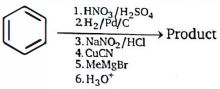
Give the product of the following reaction sequence:
A
$C_6H_5COOH$
B
$C_6H_5COCH_3$
C
$C_6H_5CH_2COOH$
D
$C_6H_5OH$
Solution
(B) The reaction sequence proceeds as follows:
$1$. Nitration of benzene with $HNO_3/H_2SO_4$ gives nitrobenzene $(C_6H_5NO_2)$.
$2$. Reduction of nitrobenzene with $H_2/Pd/C$ gives aniline $(C_6H_5NH_2)$.
$3$. Diazotization of aniline with $NaNO_2/HCl$ at $0-5^{\circ}C$ gives benzenediazonium chloride $(C_6H_5N_2^+Cl^-)$.
$4$. Reaction with $CuCN$ (Sandmeyer reaction) replaces the diazonium group with a cyano group,yielding benzonitrile $(C_6H_5CN)$.
$5$. Grignard reaction with $MeMgBr$ followed by acidic hydrolysis $(H_3O^+)$ converts the nitrile group into a ketone group,yielding acetophenone $(C_6H_5COCH_3)$.
$1$. Nitration of benzene with $HNO_3/H_2SO_4$ gives nitrobenzene $(C_6H_5NO_2)$.
$2$. Reduction of nitrobenzene with $H_2/Pd/C$ gives aniline $(C_6H_5NH_2)$.
$3$. Diazotization of aniline with $NaNO_2/HCl$ at $0-5^{\circ}C$ gives benzenediazonium chloride $(C_6H_5N_2^+Cl^-)$.
$4$. Reaction with $CuCN$ (Sandmeyer reaction) replaces the diazonium group with a cyano group,yielding benzonitrile $(C_6H_5CN)$.
$5$. Grignard reaction with $MeMgBr$ followed by acidic hydrolysis $(H_3O^+)$ converts the nitrile group into a ketone group,yielding acetophenone $(C_6H_5COCH_3)$.
0 likes
View Solution107
DifficultMCQ
The major product of the following reaction is
$R-C \equiv N \xrightarrow[(2) \ H_2O]{(1) \ AlH(i-Bu)_2} ?$
$R-C \equiv N \xrightarrow[(2) \ H_2O]{(1) \ AlH(i-Bu)_2} ?$
A
$RCOOH$
B
$RCONH_2$
C
$RCHO$
D
$RCH_2NH_2$
Solution
(C) The reagent $AlH(i-Bu)_2$ is known as $DIBAL-H$ (Diisobutylaluminium hydride).
It is a selective reducing agent that reduces nitriles $(R-C \equiv N)$ to imines,which upon subsequent hydrolysis with $H_2O$ yield aldehydes $(RCHO)$.
The reaction mechanism involves the nucleophilic attack of the hydride from $DIBAL-H$ onto the carbon of the nitrile group,followed by hydrolysis of the resulting imine intermediate to form the aldehyde.
It is a selective reducing agent that reduces nitriles $(R-C \equiv N)$ to imines,which upon subsequent hydrolysis with $H_2O$ yield aldehydes $(RCHO)$.
The reaction mechanism involves the nucleophilic attack of the hydride from $DIBAL-H$ onto the carbon of the nitrile group,followed by hydrolysis of the resulting imine intermediate to form the aldehyde.
0 likes
View Solution108
DifficultMCQ
$R-C \equiv N + SnCl_2 + HCl$ $\longrightarrow A$ $\xrightarrow{H_3O^+} RCHO$. The above reaction is known as:
A
Stephen reaction
B
Rosenmund reduction
C
Etard reaction
D
Mendius reaction
Solution
(A) The given reaction is the $Stephen$ reaction.
In this reaction,nitriles $(R-CN)$ are reduced to imines using stannous chloride $(SnCl_2)$ in the presence of hydrochloric acid $(HCl)$.
The intermediate imine ($A$,which is $R-CH=NH \cdot HCl$) is then hydrolyzed with water $(H_3O^+)$ to yield the corresponding aldehyde $(RCHO)$.
In this reaction,nitriles $(R-CN)$ are reduced to imines using stannous chloride $(SnCl_2)$ in the presence of hydrochloric acid $(HCl)$.
The intermediate imine ($A$,which is $R-CH=NH \cdot HCl$) is then hydrolyzed with water $(H_3O^+)$ to yield the corresponding aldehyde $(RCHO)$.
0 likes
View Solution109
MediumMCQ
The compound $X$ is formed by the decarboxylation of acetoacetic acid $(CH_3COCH_2COOH)$ upon heating. $X$ can also be formed by:
A
$CH_3-CH_2-CH_2-Cl \xrightarrow{LiAlH_4}$
B
$CH_3-CH_2-COOH \xrightarrow{P + HI}$
C
$CH_3-C \equiv CH \xrightarrow[H_2O]{Hg^{+2}}$
D
All
Solution
(C) The reaction shown is the decarboxylation of acetoacetic acid $(CH_3COCH_2COOH \xrightarrow{\Delta} CH_3COCH_3 + CO_2)$.
Thus,$X$ is acetone $(CH_3COCH_3)$.
Now,let us evaluate the options:
Option $A$: $CH_3-CH_2-CH_2-Cl \xrightarrow{LiAlH_4} CH_3-CH_2-CH_3$ (Propane).
Option $B$: $CH_3-CH_2-COOH \xrightarrow{P + HI} CH_3-CH_2-CH_3$ (Propane).
Option $C$: $CH_3-C \equiv CH \xrightarrow[H_2O]{Hg^{+2}} CH_3-CO-CH_3$ (Acetone).
Since $X$ is acetone,option $C$ is the correct method to form $X$.
Thus,$X$ is acetone $(CH_3COCH_3)$.
Now,let us evaluate the options:
Option $A$: $CH_3-CH_2-CH_2-Cl \xrightarrow{LiAlH_4} CH_3-CH_2-CH_3$ (Propane).
Option $B$: $CH_3-CH_2-COOH \xrightarrow{P + HI} CH_3-CH_2-CH_3$ (Propane).
Option $C$: $CH_3-C \equiv CH \xrightarrow[H_2O]{Hg^{+2}} CH_3-CO-CH_3$ (Acetone).
Since $X$ is acetone,option $C$ is the correct method to form $X$.
0 likes
View Solution110
MediumMCQ
Identify the reaction shown in the image:
$C_6H_5CN \xrightarrow[(ii) H_3O^+]{(i) SnCl_2 + HCl} C_6H_5CHO$
$C_6H_5CN \xrightarrow[(ii) H_3O^+]{(i) SnCl_2 + HCl} C_6H_5CHO$
A
Stephen's reaction
B
Etard reaction
C
Kolbe's reaction
D
Sandmeyer reaction
Solution
(A) The given reaction involves the reduction of a nitrile $(R-CN)$ to an imine using stannous chloride $(SnCl_2)$ and hydrochloric acid $(HCl)$,followed by hydrolysis to yield an aldehyde $(R-CHO)$.
This specific chemical transformation is known as the Stephen's reaction.
Therefore,the correct option is $A$.
This specific chemical transformation is known as the Stephen's reaction.
Therefore,the correct option is $A$.
0 likes
View Solution111
DifficultMCQ
Which of the following reactions does not give benzaldehyde as a product?
A
Benzene + $HCN + HCl \xrightarrow{ZnCl_2, H_2O}$
B
Toluene + $(1) CrO_2Cl_2, (2) H_2O \rightarrow$
C
Toluene + $(1) CrO_3, (CH_3CO)_2O, (2) H_2O \rightarrow$
D
Phenol + $CHCl_3 + KOH \rightarrow$
Solution
(D) Let us analyze each reaction:
$A$. Gattermann-Koch reaction: Benzene reacts with $CO + HCl$ in the presence of anhydrous $AlCl_3$ or $CuCl$ to give benzaldehyde. The reaction shown with $HCN + HCl$ (Gattermann reaction) also yields benzaldehyde.
$B$. Etard reaction: Toluene reacts with chromyl chloride $(CrO_2Cl_2)$ followed by hydrolysis to give benzaldehyde.
$C$. Toluene reacts with chromic oxide $(CrO_3)$ in acetic anhydride followed by hydrolysis to give benzaldehyde (this is a variation of the Etard reaction).
$D$. Reimer-Tiemann reaction: Phenol reacts with chloroform $(CHCl_3)$ and aqueous $KOH$ to give salicylaldehyde (o-hydroxybenzaldehyde) as the major product,not benzaldehyde.
Therefore,option $D$ does not yield benzaldehyde.
$A$. Gattermann-Koch reaction: Benzene reacts with $CO + HCl$ in the presence of anhydrous $AlCl_3$ or $CuCl$ to give benzaldehyde. The reaction shown with $HCN + HCl$ (Gattermann reaction) also yields benzaldehyde.
$B$. Etard reaction: Toluene reacts with chromyl chloride $(CrO_2Cl_2)$ followed by hydrolysis to give benzaldehyde.
$C$. Toluene reacts with chromic oxide $(CrO_3)$ in acetic anhydride followed by hydrolysis to give benzaldehyde (this is a variation of the Etard reaction).
$D$. Reimer-Tiemann reaction: Phenol reacts with chloroform $(CHCl_3)$ and aqueous $KOH$ to give salicylaldehyde (o-hydroxybenzaldehyde) as the major product,not benzaldehyde.
Therefore,option $D$ does not yield benzaldehyde.
0 likes
View Solution112
DifficultMCQ
$Ph - C \equiv C - CH_3 \xrightarrow{Hg^{2+}/H^+} A$. What is $A$?
A
$1-$Phenylpropan$-1-$one
B
$1-$Phenylpropan$-2-$one
C
$1-$Phenylprop$-1-$en$-1-$ol
D
$1-$Phenylprop$-1-$en$-2-$ol
Solution
(A) The reaction of an alkyne with $Hg^{2+}/H^+$ (Kuccherov reaction) involves the hydration of the triple bond to form an enol intermediate,which then tautomerizes to a more stable ketone.
For the unsymmetrical alkyne $Ph-C \equiv C-CH_3$,the hydration follows Markovnikov's rule.
The $OH$ group attaches to the carbon atom that can better stabilize the positive charge in the transition state (the carbon attached to the phenyl group).
This forms the enol $Ph-C(OH)=CH-CH_3$,which tautomerizes to the ketone $Ph-CO-CH_2-CH_3$ ($1$-phenylpropan$-1-$one).
For the unsymmetrical alkyne $Ph-C \equiv C-CH_3$,the hydration follows Markovnikov's rule.
The $OH$ group attaches to the carbon atom that can better stabilize the positive charge in the transition state (the carbon attached to the phenyl group).
This forms the enol $Ph-C(OH)=CH-CH_3$,which tautomerizes to the ketone $Ph-CO-CH_2-CH_3$ ($1$-phenylpropan$-1-$one).
0 likes
View Solution113
AdvancedMCQ
$CH_3-C(CH_3)(OH)-C(CH_3)(OH)-CH_3 \xrightarrow[H^{+}]{\Delta} ?$
A
$3,3-$dimethylbutan$-2-$one
B
$3,3-$dimethylbutan$-2-$one (structure)
C
$2-$pentanone
D
$2,3-$dimethylbutane
Solution
(B) The reaction is an example of the Pinacol-Pinacolone rearrangement.
In the presence of an acid $(H^{+})$,$2,3$-dimethylbutane-$2,3$-diol (Pinacol) undergoes dehydration and rearrangement to form $3,3$-dimethylbutan-$2$-one (Pinacolone).
The mechanism involves the protonation of one of the hydroxyl groups,followed by the loss of a water molecule to form a carbocation.
Then,a methyl group shifts to the adjacent carbon atom,followed by the loss of a proton to form the final ketone product,$CH_3-CO-C(CH_3)_3$.
In the presence of an acid $(H^{+})$,$2,3$-dimethylbutane-$2,3$-diol (Pinacol) undergoes dehydration and rearrangement to form $3,3$-dimethylbutan-$2$-one (Pinacolone).
The mechanism involves the protonation of one of the hydroxyl groups,followed by the loss of a water molecule to form a carbocation.
Then,a methyl group shifts to the adjacent carbon atom,followed by the loss of a proton to form the final ketone product,$CH_3-CO-C(CH_3)_3$.
0 likes
View Solution114
MediumMCQ
The given reaction is: $C_6H_5COCl + H_2 \xrightarrow{Pd/BaSO_4} C_6H_5CHO + HCl$
A
Mendius reaction
B
Stephen's reaction
C
Rosenmund's reduction
D
Cannizzaro's reaction
Solution
(C) The given reaction involves the hydrogenation of an acid chloride $(C_6H_5COCl)$ to an aldehyde $(C_6H_5CHO)$ using hydrogen gas in the presence of palladium $(Pd)$ supported on barium sulfate $(BaSO_4)$.
This specific reaction is known as the Rosenmund reduction.
The $BaSO_4$ acts as a poison to prevent the further reduction of the aldehyde to an alcohol.
This specific reaction is known as the Rosenmund reduction.
The $BaSO_4$ acts as a poison to prevent the further reduction of the aldehyde to an alcohol.
0 likes
View Solution115
MediumMCQ
Which of the following is not correctly matched?
A
$C_6H_5-COCl \xrightarrow[BaSO_4]{H_2 + Pd}$ (Rosenmund's reduction)
B
$C_6H_5-CHO \xrightarrow{50\% KOH}$ (Cannizzaro's reaction)
C
$C_6H_5-CH_3 \xrightarrow[(2) H_2O/H^{+}]{(1) CrO_3 \text{ in } (Ac)_2O}$ (Etard reaction)
D
$C_6H_5-NH_2 + CHCl_3 \xrightarrow{KOH}$ (Hofmann's carbylamine reaction)
Solution
(C) In the Etard reaction,toluene is oxidized to benzaldehyde using chromyl chloride $(CrO_2Cl_2)$ in $CS_2$. The reaction given in option $(c)$ uses $CrO_3$ in acetic anhydride,which is a different synthetic route to benzaldehyde via a gem-diacetate intermediate.
0 likes
View Solution116
DifficultMCQ
Identify $P$ and $R$ in the given reaction sequence:
$Toluene$ $\xrightarrow[(2) H_3O^+]{(1) CrO_2Cl_2} P$ $\xrightarrow{R} Benzoic \ acid$
$Toluene$ $\xrightarrow[(2) H_3O^+]{(1) CrO_2Cl_2} P$ $\xrightarrow{R} Benzoic \ acid$
A
Benzaldehyde and $HI$
B
Benzaldehyde and $H_2 + Pd$
C
Benzoic acid and $H_2 + Pd$
D
Benzaldehyde and $Zn-Hg/HCl$
Solution
(B) The reaction of toluene with chromyl chloride $(CrO_2Cl_2)$ followed by hydrolysis is the Etard reaction,which produces benzaldehyde $(P = C_6H_5CHO)$.
To convert benzaldehyde $(C_6H_5CHO)$ to benzoic acid $(C_6H_5COOH)$,an oxidizing agent is required.
Among the given options,the reaction sequence $P$ (benzaldehyde) $\xrightarrow{R}$ benzoic acid requires an oxidation step.
However,looking at the options provided,there is a mismatch in the standard reagents. The oxidation of benzaldehyde to benzoic acid is typically done using $KMnO_4$ or $K_2Cr_2O_7$.
Given the options,if we assume the question asks for the product $P$ and a reagent $R$ that could potentially oxidize it,none of the reagents listed ($HI$,$H_2+Pd$,$Zn-Hg/HCl$) are standard oxidants.
Re-evaluating the provided options: Option $B$ identifies $P$ correctly as benzaldehyde. If the question implies a typo in the reagent $R$ or a specific context,$P$ is definitely benzaldehyde.
To convert benzaldehyde $(C_6H_5CHO)$ to benzoic acid $(C_6H_5COOH)$,an oxidizing agent is required.
Among the given options,the reaction sequence $P$ (benzaldehyde) $\xrightarrow{R}$ benzoic acid requires an oxidation step.
However,looking at the options provided,there is a mismatch in the standard reagents. The oxidation of benzaldehyde to benzoic acid is typically done using $KMnO_4$ or $K_2Cr_2O_7$.
Given the options,if we assume the question asks for the product $P$ and a reagent $R$ that could potentially oxidize it,none of the reagents listed ($HI$,$H_2+Pd$,$Zn-Hg/HCl$) are standard oxidants.
Re-evaluating the provided options: Option $B$ identifies $P$ correctly as benzaldehyde. If the question implies a typo in the reagent $R$ or a specific context,$P$ is definitely benzaldehyde.
0 likes
View Solution117
MediumMCQ
Which of the following reactions is best for the preparation of an aldehyde from a primary alcohol?
A
$CH_3-CH_2-CH_2-OH \xrightarrow{[Ag(NH_3)_2]^+}{}$
B
$CH_3-CH_2-CH_2-OH \xrightarrow{CrO_3}{}$
C
$CH_3-CH_2-CH_2-OH \xrightarrow{P.C.C.}{}$
D
$CH_3-CH_2-CH_2-OH \xrightarrow{KMnO_4/OH^-}{}$
Solution
(C) The oxidation of primary alcohols to aldehydes is best achieved using mild oxidizing agents that do not further oxidize the aldehyde to a carboxylic acid.
$P.C.C.$ (Pyridinium chlorochromate) is a selective oxidizing agent that stops the oxidation at the aldehyde stage.
$CrO_3$ in acidic medium or $KMnO_4$ are strong oxidizing agents that typically oxidize primary alcohols directly to carboxylic acids.
$[Ag(NH_3)_2]^+$ (Tollens' reagent) is used to oxidize aldehydes to carboxylic acids,not alcohols to aldehydes.
$P.C.C.$ (Pyridinium chlorochromate) is a selective oxidizing agent that stops the oxidation at the aldehyde stage.
$CrO_3$ in acidic medium or $KMnO_4$ are strong oxidizing agents that typically oxidize primary alcohols directly to carboxylic acids.
$[Ag(NH_3)_2]^+$ (Tollens' reagent) is used to oxidize aldehydes to carboxylic acids,not alcohols to aldehydes.
0 likes
View Solution118
DifficultMCQ
The product $(A)$ in the following reaction is: $Cl-CO-C_6H_4-Cl + C_6H_6 \xrightarrow{AlCl_3} A$
A
$4-$chlorobenzophenone
B
$4-$chlorobenzyl alcohol
C
$3-$chlorobenzophenone
D
$4-$chlorobenzoic acid
Solution
(A) The reaction of $4$-chlorobenzoyl chloride with benzene in the presence of anhydrous $AlCl_3$ is a Friedel-Crafts acylation reaction.
In this reaction,the $Cl$ atom of the acid chloride group is replaced by the phenyl group from benzene,resulting in the formation of $4$-chlorobenzophenone $(Cl-C_6H_4-CO-C_6H_5)$.
In this reaction,the $Cl$ atom of the acid chloride group is replaced by the phenyl group from benzene,resulting in the formation of $4$-chlorobenzophenone $(Cl-C_6H_4-CO-C_6H_5)$.
0 likes
View Solution119
DifficultMCQ
In the reaction sequence $CHCl_3$ $\xrightarrow{Air/hv} x$ $\xrightarrow[Excess]{C_6H_6 / Anhy. AlCl_3} y$,$y$ will be
A
$CH_3-CO-Cl$
B
$C_6H_5-CO-Cl$
C
$C_6H_5-CO-C_6H_5$
D
$C_6H_5-CHO$
Solution
(C) In the first step,chloroform $(CHCl_3)$ is oxidized by air in the presence of light to form phosgene $(COCl_2)$:
$2CHCl_3 + O_2 \xrightarrow{hv} 2COCl_2 + 2HCl$
In the second step,phosgene $(x)$ reacts with excess benzene in the presence of anhydrous $AlCl_3$ (Friedel-Crafts acylation) to form benzophenone $(y)$:
$COCl_2 + 2C_6H_6 \xrightarrow{Anhy. AlCl_3} C_6H_5-CO-C_6H_5 + 2HCl$
$2CHCl_3 + O_2 \xrightarrow{hv} 2COCl_2 + 2HCl$
In the second step,phosgene $(x)$ reacts with excess benzene in the presence of anhydrous $AlCl_3$ (Friedel-Crafts acylation) to form benzophenone $(y)$:
$COCl_2 + 2C_6H_6 \xrightarrow{Anhy. AlCl_3} C_6H_5-CO-C_6H_5 + 2HCl$
0 likes
View Solution120
MediumMCQ
What is the name of the given reaction?
$C_6H_6 + CO + HCl \xrightarrow{Anhyd. AlCl_3} C_6H_5CHO$
$C_6H_6 + CO + HCl \xrightarrow{Anhyd. AlCl_3} C_6H_5CHO$
A
Gatterman-Koch reaction
B
Etard reaction
C
Gattermann reaction
D
Rosenmund reaction
Solution
(A) The reaction of benzene with carbon monoxide $(CO)$ and hydrogen chloride $(HCl)$ in the presence of anhydrous aluminum chloride $(AlCl_3)$ or cuprous chloride $(CuCl)$ to form benzaldehyde $(C_6H_5CHO)$ is known as the Gatterman-Koch reaction.
0 likes
View Solution121
MediumMCQ
The oxidation of toluene with air in the presence of $V_2O_5$ gives ...........
A
Phenol
B
Benzoic acid
C
Benzaldehyde
D
Benzyl alcohol
Solution
(C) The catalytic oxidation of toluene with air in the presence of $V_2O_5$ (Vanadium pentoxide) is a standard industrial process to produce benzaldehyde.
The reaction is: $C_6H_5CH_3 + [O] \xrightarrow{V_2O_5} C_6H_5CHO + H_2O$.
The reaction is: $C_6H_5CH_3 + [O] \xrightarrow{V_2O_5} C_6H_5CHO + H_2O$.
0 likes
View Solution122
MediumMCQ
Identify the reaction shown below:
$C_6H_5CN \xrightarrow[(ii) H_3O^+]{(i) SnCl_2 + HCl} C_6H_5CHO$
$C_6H_5CN \xrightarrow[(ii) H_3O^+]{(i) SnCl_2 + HCl} C_6H_5CHO$
A
Stephen's reaction
B
Etard reaction
C
Kolbe's reaction
D
Sandmeyer reaction
Solution
(A) The given reaction involves the reduction of a nitrile $(R-CN)$ to an imine using stannous chloride $(SnCl_2)$ in the presence of hydrochloric acid $(HCl)$,followed by acid hydrolysis to yield an aldehyde $(R-CHO)$.
This specific chemical transformation is known as the Stephen's reaction (or Stephen reduction).
Therefore,the correct option is $A$.
This specific chemical transformation is known as the Stephen's reaction (or Stephen reduction).
Therefore,the correct option is $A$.
0 likes
View Solution123
DifficultMCQ
Which of the following reactions does not give benzaldehyde as a product?
A
Benzene $+ (HCN + HCl) \xrightarrow[{(2) \ H_2O}]{{(1) \ ZnCl_2}}$
B
Toluene $\xrightarrow[{(2) \ H_2O}]{{(1) \ CrO_2Cl_2}}$
C
Toluene $\xrightarrow[{(2) \ H_2O}]{{(1) \ CrO_3, \ (CH_3CO)_2O}}$
D
Phenol $+ CHCl_3 \xrightarrow{KOH}$
Solution
(D) Let us analyze each reaction:
$A$. Gattermann-Koch reaction: Benzene reacts with $CO + HCl$ in the presence of $Anhydrous \ AlCl_3 / CuCl$ to give benzaldehyde. The reaction with $HCN + HCl$ (Gattermann reaction) also yields benzaldehyde.
$B$. Etard reaction: Toluene reacts with chromyl chloride $(CrO_2Cl_2)$ followed by hydrolysis to give benzaldehyde.
$C$. Toluene reacts with chromic oxide $(CrO_3)$ in acetic anhydride to form benzylidene diacetate,which on hydrolysis gives benzaldehyde.
$D$. Reimer-Tiemann reaction: Phenol reacts with $CHCl_3$ and $KOH$ to give salicylaldehyde (o-hydroxybenzaldehyde),not benzaldehyde.
$A$. Gattermann-Koch reaction: Benzene reacts with $CO + HCl$ in the presence of $Anhydrous \ AlCl_3 / CuCl$ to give benzaldehyde. The reaction with $HCN + HCl$ (Gattermann reaction) also yields benzaldehyde.
$B$. Etard reaction: Toluene reacts with chromyl chloride $(CrO_2Cl_2)$ followed by hydrolysis to give benzaldehyde.
$C$. Toluene reacts with chromic oxide $(CrO_3)$ in acetic anhydride to form benzylidene diacetate,which on hydrolysis gives benzaldehyde.
$D$. Reimer-Tiemann reaction: Phenol reacts with $CHCl_3$ and $KOH$ to give salicylaldehyde (o-hydroxybenzaldehyde),not benzaldehyde.
0 likes
View Solution124
MediumMCQ
Which of the following reagents is most suitable for the conversion of $R-CH_2OH$ to $RCHO$?
A
$KMnO_4$
B
$K_2Cr_2O_7$
C
$CrO_3$
D
$PCC$ (Pyridinium chlorochromate)
Solution
(D) The conversion of primary alcohols $(R-CH_2OH)$ to aldehydes $(RCHO)$ requires a mild oxidizing agent that stops the oxidation at the aldehyde stage without further oxidizing it to a carboxylic acid.
$PCC$ (Pyridinium chlorochromate) is a selective oxidizing agent that performs this specific transformation efficiently.
Strong oxidizing agents like $KMnO_4$,$K_2Cr_2O_7$,and $CrO_3$ (in acidic medium) typically oxidize primary alcohols directly to carboxylic acids.
$PCC$ (Pyridinium chlorochromate) is a selective oxidizing agent that performs this specific transformation efficiently.
Strong oxidizing agents like $KMnO_4$,$K_2Cr_2O_7$,and $CrO_3$ (in acidic medium) typically oxidize primary alcohols directly to carboxylic acids.
0 likes
View Solution125
MediumMCQ
$CH_3CH_2C \equiv N \xrightarrow{X} CH_3CH_2CHO$. The compound $X$ is:
A
$SnCl_2 / HCl / H_2O$,boil
B
$H_2 / Pd - BaSO_4$
C
$LiAlH_4 / \text{ether}$
D
$NaBH_4 / \text{ether} / H_3O^{+}$
Solution
(A) The reaction is a standard method for the reduction of nitriles to aldehydes known as Stephen's reduction.
Step $1$: The nitrile $(CH_3CH_2C \equiv N)$ is reduced by $SnCl_2 / HCl$ to form an imine intermediate $(CH_3CH_2CH = NH)$.
Step $2$: The imine intermediate is then hydrolyzed by boiling with water $(H_2O)$ to yield the corresponding aldehyde $(CH_3CH_2CHO)$ and ammonium chloride $(NH_4Cl)$.
Step $1$: The nitrile $(CH_3CH_2C \equiv N)$ is reduced by $SnCl_2 / HCl$ to form an imine intermediate $(CH_3CH_2CH = NH)$.
Step $2$: The imine intermediate is then hydrolyzed by boiling with water $(H_2O)$ to yield the corresponding aldehyde $(CH_3CH_2CHO)$ and ammonium chloride $(NH_4Cl)$.
0 likes
View Solution126
Difficult
Give names of the reagents to bring about the following transformations:
$(i)$ $\text{Hexan-}1\text{-ol}$ to $\text{hexanal}$
$(ii)$ $\text{Cyclohexanol}$ to $\text{cyclohexanone}$
$(iii)$ $p\text{-Fluorotoluene}$ to $p\text{-fluorobenzaldehyde}$
$(iv)$ $\text{Ethanenitrile}$ to $\text{ethanal}$
$(v)$ $\text{Allyl alcohol}$ to $\text{propenal}$
$(vi)$ $\text{But-}2\text{-ene}$ to $\text{ethanal}$
$(i)$ $\text{Hexan-}1\text{-ol}$ to $\text{hexanal}$
$(ii)$ $\text{Cyclohexanol}$ to $\text{cyclohexanone}$
$(iii)$ $p\text{-Fluorotoluene}$ to $p\text{-fluorobenzaldehyde}$
$(iv)$ $\text{Ethanenitrile}$ to $\text{ethanal}$
$(v)$ $\text{Allyl alcohol}$ to $\text{propenal}$
$(vi)$ $\text{But-}2\text{-ene}$ to $\text{ethanal}$
Solution
(N/A) $(i)$ $\text{Pyridinium chlorochromate } (PCC)$
$(ii)$ $\text{Jones reagent } (CrO_{3} / H_{2}SO_{4}) \text{ or } PCC$
$(iii)$ $\text{Chromyl chloride } (CrO_{2}Cl_{2}) \text{ followed by hydrolysis } (Etard \text{ reaction})$
$(iv)$ $\text{Diisobutylaluminium hydride } (DIBAL-H) \text{ followed by } H_{3}O^{+}$
$(v)$ $\text{Pyridinium chlorochromate } (PCC)$
$(vi)$ $\text{Ozonolysis } (1. O_{3}, 2. Zn / H_{2}O)$
$(ii)$ $\text{Jones reagent } (CrO_{3} / H_{2}SO_{4}) \text{ or } PCC$
$(iii)$ $\text{Chromyl chloride } (CrO_{2}Cl_{2}) \text{ followed by hydrolysis } (Etard \text{ reaction})$
$(iv)$ $\text{Diisobutylaluminium hydride } (DIBAL-H) \text{ followed by } H_{3}O^{+}$
$(v)$ $\text{Pyridinium chlorochromate } (PCC)$
$(vi)$ $\text{Ozonolysis } (1. O_{3}, 2. Zn / H_{2}O)$
0 likes
View Solution127
Easy
Write the structures of products of the following reactions:
$(i)$ Benzene + $C_{2}H_{5}COCl$ $\xrightarrow{\text{Anhyd. } AlCl_{3}, CS_{2}}$
$(ii)$ $(C_{6}H_{5}CH_{2})_{2}Cd + 2 CH_{3}COCl \rightarrow$
$(iii)$ $H_{3}C - C \equiv C - H$ $\xrightarrow{Hg^{2+}, H_{2}SO_{4}}$
$(iv)$ $p$-Nitrotoluene $\xrightarrow{1. CrO_{2}Cl_{2}, 2. H_{3}O^{+}}$
$(i)$ Benzene + $C_{2}H_{5}COCl$ $\xrightarrow{\text{Anhyd. } AlCl_{3}, CS_{2}}$
$(ii)$ $(C_{6}H_{5}CH_{2})_{2}Cd + 2 CH_{3}COCl \rightarrow$
$(iii)$ $H_{3}C - C \equiv C - H$ $\xrightarrow{Hg^{2+}, H_{2}SO_{4}}$
$(iv)$ $p$-Nitrotoluene $\xrightarrow{1. CrO_{2}Cl_{2}, 2. H_{3}O^{+}}$
Solution
(N/A) $(i)$ Benzene + $C_{2}H_{5}COCl$ $\xrightarrow{\text{Anhyd. } AlCl_{3}, CS_{2}}$ Propiophenone $(C_{6}H_{5}COC_{2}H_{5})$ + $HCl$
$(ii)$ $(C_{6}H_{5}CH_{2})_{2}Cd + 2 CH_{3}COCl \rightarrow 2 C_{6}H_{5}CH_{2}COCH_{3}$ ($1$-Phenylpropan$-2-$one) + $CdCl_{2}$
$(iii)$ $H_{3}C - C \equiv C - H + H_{2}O$ $\xrightarrow{Hg^{2+}, H_{2}SO_{4}}$ $H_{3}C - CO - CH_{3}$ (Propanone)
$(iv)$ $p$-Nitrotoluene $\xrightarrow{1. CrO_{2}Cl_{2}, 2. H_{3}O^{+}}$ $p$-Nitrobenzaldehyde $(O_{2}NC_{6}H_{4}CHO)$
$(ii)$ $(C_{6}H_{5}CH_{2})_{2}Cd + 2 CH_{3}COCl \rightarrow 2 C_{6}H_{5}CH_{2}COCH_{3}$ ($1$-Phenylpropan$-2-$one) + $CdCl_{2}$
$(iii)$ $H_{3}C - C \equiv C - H + H_{2}O$ $\xrightarrow{Hg^{2+}, H_{2}SO_{4}}$ $H_{3}C - CO - CH_{3}$ (Propanone)
$(iv)$ $p$-Nitrotoluene $\xrightarrow{1. CrO_{2}Cl_{2}, 2. H_{3}O^{+}}$ $p$-Nitrobenzaldehyde $(O_{2}NC_{6}H_{4}CHO)$
0 likes
View Solution128
Medium
Write a note on the preparation of aldehydes and ketones from the oxidation of alcohols.
Solution
(N/A) Preparation of aldehydes and ketones by oxidation of alcohols:
Aldehydes and ketones are generally prepared by the oxidation of primary and secondary alcohols,respectively.
These reactions involve the cleavage and formation of bonds. They are also known as dehydrogenation reactions because they involve the loss of dihydrogen from an alcohol molecule.
Depending on the oxidising agent used,a primary alcohol is oxidised to an aldehyde,which can be further oxidised to a carboxylic acid.
$RCH_2OH \xrightarrow{(K_2Cr_2O_7 + H_2SO_4), CrO_3, (O), -H_2O} RCHO$
$1^\circ$-Alcohol $\rightarrow$ Aldehyde
$CH_3CH_2OH \xrightarrow{(K_2Cr_2O_7 + H_2SO_4), CrO_3, (O), -H_2O} CH_3CHO$
$(b)$ $A$ better reagent for the oxidation of primary alcohols to aldehydes in good yield is pyridinium chlorochromate $(PCC)$,a complex of chromium trioxide with pyridine and $HCl$.
$(c)$ Secondary alcohols are oxidised to ketones by chromic anhydride $(CrO_3)$ in anhydrous medium.
$R-CH(OH)-R' \xrightarrow{CrO_3, (O), -H_2O} R-CO-R'$
Examples:
$(i) CH_3CH(OH)CH_3 \xrightarrow{CrO_3, (O), -H_2O} CH_3COCH_3$
$(ii) CH_3CH(OH)CH_2CH_3 \xrightarrow{CrO_3, (O), -H_2O} CH_3COCH_2CH_3$
$(iii) C_6H_5CH(OH)CH_3 \xrightarrow{CrO_3, (O), -H_2O} C_6H_5COCH_3$
Under strong reaction conditions such as strong oxidising agents $(KMnO_4)$ and elevated temperatures,cleavage of various $C-C$ bonds takes place,and a mixture of carboxylic acids containing a lesser number of carbon atoms is formed.
Aldehydes and ketones are generally prepared by the oxidation of primary and secondary alcohols,respectively.
These reactions involve the cleavage and formation of bonds. They are also known as dehydrogenation reactions because they involve the loss of dihydrogen from an alcohol molecule.
Depending on the oxidising agent used,a primary alcohol is oxidised to an aldehyde,which can be further oxidised to a carboxylic acid.
$RCH_2OH \xrightarrow{(K_2Cr_2O_7 + H_2SO_4), CrO_3, (O), -H_2O} RCHO$
$1^\circ$-Alcohol $\rightarrow$ Aldehyde
$CH_3CH_2OH \xrightarrow{(K_2Cr_2O_7 + H_2SO_4), CrO_3, (O), -H_2O} CH_3CHO$
$(b)$ $A$ better reagent for the oxidation of primary alcohols to aldehydes in good yield is pyridinium chlorochromate $(PCC)$,a complex of chromium trioxide with pyridine and $HCl$.
$(c)$ Secondary alcohols are oxidised to ketones by chromic anhydride $(CrO_3)$ in anhydrous medium.
$R-CH(OH)-R' \xrightarrow{CrO_3, (O), -H_2O} R-CO-R'$
Examples:
$(i) CH_3CH(OH)CH_3 \xrightarrow{CrO_3, (O), -H_2O} CH_3COCH_3$
$(ii) CH_3CH(OH)CH_2CH_3 \xrightarrow{CrO_3, (O), -H_2O} CH_3COCH_2CH_3$
$(iii) C_6H_5CH(OH)CH_3 \xrightarrow{CrO_3, (O), -H_2O} C_6H_5COCH_3$
Under strong reaction conditions such as strong oxidising agents $(KMnO_4)$ and elevated temperatures,cleavage of various $C-C$ bonds takes place,and a mixture of carboxylic acids containing a lesser number of carbon atoms is formed.
0 likes
View Solution129
Medium
Write a method for the preparation of aldehydes and ketones by the dehydrogenation of alcohols.
Solution
(N/A) This method is suitable for volatile alcohols and is of industrial application. In this method,alcohol vapors are passed over heavy metal catalysts ($Ag$ or $Cu$) at $573 \ K$.
$1^{\circ}$ Alcohols give aldehydes:
$RCH_2OH \xrightarrow{Cu, 573 \ K} RCHO + H_2$
Example: $CH_3CH_2OH \xrightarrow{Cu, 573 \ K} CH_3CHO + H_2$
$2^{\circ}$ Alcohols give ketones:
$R-CH(OH)-R' \xrightarrow{Cu, 573 \ K} R-CO-R' + H_2$
Example: $CH_3-CH(OH)-CH_3 \xrightarrow{Cu, 573 \ K} CH_3-CO-CH_3 + H_2$
$1^{\circ}$ Alcohols give aldehydes:
$RCH_2OH \xrightarrow{Cu, 573 \ K} RCHO + H_2$
Example: $CH_3CH_2OH \xrightarrow{Cu, 573 \ K} CH_3CHO + H_2$
$2^{\circ}$ Alcohols give ketones:
$R-CH(OH)-R' \xrightarrow{Cu, 573 \ K} R-CO-R' + H_2$
Example: $CH_3-CH(OH)-CH_3 \xrightarrow{Cu, 573 \ K} CH_3-CO-CH_3 + H_2$
0 likes
View Solution130
Medium
Explain the method of preparation of aldehydes and ketones from hydrocarbon (alkene and alkyne) compounds with suitable examples.
Solution
(N/A) $i$. By ozonolysis of alkenes: Ozonolysis of alkenes followed by reaction with zinc dust and water gives aldehydes,ketones,or a mixture of both,depending on the substitution pattern of the alkene.
$1$. Preparation of methanal from ethene:
$CH_2=CH_2 + O_3$ $\rightarrow \text{Ethylene ozonide}$ $\xrightarrow{Zn, H_2O} 2HCHO + ZnO$
$2$. Preparation of ethanal and methanal from propene:
$CH_3-CH=CH_2 + O_3$ $\rightarrow \text{Propene ozonide}$ $\xrightarrow{Zn, H_2O} CH_3CHO + HCHO + ZnO$
$3$. Preparation of propanone and methanal from $2$-methylpropene:
$(CH_3)_2C=CH_2 + O_3$ $\rightarrow \text{Ozonide}$ $\xrightarrow{Zn, H_2O} CH_3COCH_3 + HCHO + ZnO$
$ii$. By hydration of alkynes: Alkynes react with water in the presence of $H_2SO_4$ and $HgSO_4$ to form carbonyl compounds.
$e.g.$,Ethyne on hydration gives ethanal:
$HC \equiv CH + H_2O$ $\xrightarrow{H_2SO_4, HgSO_4} [CH_2=CHOH]$ $\rightarrow CH_3CHO$
$1$. Preparation of methanal from ethene:
$CH_2=CH_2 + O_3$ $\rightarrow \text{Ethylene ozonide}$ $\xrightarrow{Zn, H_2O} 2HCHO + ZnO$
$2$. Preparation of ethanal and methanal from propene:
$CH_3-CH=CH_2 + O_3$ $\rightarrow \text{Propene ozonide}$ $\xrightarrow{Zn, H_2O} CH_3CHO + HCHO + ZnO$
$3$. Preparation of propanone and methanal from $2$-methylpropene:
$(CH_3)_2C=CH_2 + O_3$ $\rightarrow \text{Ozonide}$ $\xrightarrow{Zn, H_2O} CH_3COCH_3 + HCHO + ZnO$
$ii$. By hydration of alkynes: Alkynes react with water in the presence of $H_2SO_4$ and $HgSO_4$ to form carbonyl compounds.
$e.g.$,Ethyne on hydration gives ethanal:
$HC \equiv CH + H_2O$ $\xrightarrow{H_2SO_4, HgSO_4} [CH_2=CHOH]$ $\rightarrow CH_3CHO$
0 likes
View Solution131
Medium
Explain the method of preparation of aldehydes and ketones from acyl chloride (acid chloride) compounds with suitable examples.
Solution
(N/A) Aldehyde from acyl chloride: Acyl chloride is hydrogenated over a catalyst,palladium on barium sulphate $(Pd/BaSO_4)$. This reaction is known as the Rosenmund reduction.
$(i)$ Preparation of ethanal (acetaldehyde) from ethanoyl chloride (acetyl chloride):
$CH_3COCl + H_2 \xrightarrow{Pd/BaSO_4} CH_3CHO + HCl$
$(ii)$ Preparation of benzaldehyde from benzoyl chloride:
$C_6H_5COCl + H_2 \xrightarrow{Pd/BaSO_4} C_6H_5CHO + HCl$
$(b)$ Ketone from acyl chloride: Ketones can be prepared by the reaction of acyl chlorides with dialkylcadmium $(R_2Cd)$,which is prepared by the reaction of Grignard reagent with cadmium chloride $(CdCl_2)$.
$2RMgX + CdCl_2 \rightarrow R_2Cd + 2Mg(X)Cl$
$2R'COCl + R_2Cd \rightarrow 2R'COR + CdCl_2$
$(i)$ Preparation of ethanal (acetaldehyde) from ethanoyl chloride (acetyl chloride):
$CH_3COCl + H_2 \xrightarrow{Pd/BaSO_4} CH_3CHO + HCl$
$(ii)$ Preparation of benzaldehyde from benzoyl chloride:
$C_6H_5COCl + H_2 \xrightarrow{Pd/BaSO_4} C_6H_5CHO + HCl$
$(b)$ Ketone from acyl chloride: Ketones can be prepared by the reaction of acyl chlorides with dialkylcadmium $(R_2Cd)$,which is prepared by the reaction of Grignard reagent with cadmium chloride $(CdCl_2)$.
$2RMgX + CdCl_2 \rightarrow R_2Cd + 2Mg(X)Cl$
$2R'COCl + R_2Cd \rightarrow 2R'COR + CdCl_2$
0 likes
View Solution132
Medium
Explain the method of preparation of aldehydes and ketones from Grignard reagents with suitable examples.
Solution
(N/A) Aldehydes and ketones can be prepared from Grignard reagents $(RMgX)$ by reaction with nitriles $(R'CN)$ followed by acid hydrolysis.
$1.$ Preparation of Aldehydes:
Reaction of Grignard reagent with hydrogen cyanide $(HCN)$ followed by hydrolysis yields an aldehyde.
$H-C \equiv N + RMgX$ $\rightarrow [R-CH=NMgX]$ $\xrightarrow{H_2O, H^+} R-CHO + NH_3 + Mg(OH)X$
Example: $H-C \equiv N + CH_3MgI$ $\rightarrow CH_3-CH=NMgI$ $\xrightarrow{H_2O, H^+} CH_3CHO + NH_3 + Mg(OH)I$
$2.$ Preparation of Ketones:
Reaction of Grignard reagent with alkyl nitriles $(R'CN)$ followed by hydrolysis yields a ketone.
$R'C \equiv N + RMgX$ $\rightarrow [R'C(R)=NMgX]$ $\xrightarrow{H_2O, H^+} R'COR + NH_3 + Mg(OH)X$
Example: $CH_3C \equiv N + CH_3MgI$ $\rightarrow CH_3C(CH_3)=NMgI$ $\xrightarrow{H_2O, H^+} CH_3COCH_3 + NH_3 + Mg(OH)I$
$1.$ Preparation of Aldehydes:
Reaction of Grignard reagent with hydrogen cyanide $(HCN)$ followed by hydrolysis yields an aldehyde.
$H-C \equiv N + RMgX$ $\rightarrow [R-CH=NMgX]$ $\xrightarrow{H_2O, H^+} R-CHO + NH_3 + Mg(OH)X$
Example: $H-C \equiv N + CH_3MgI$ $\rightarrow CH_3-CH=NMgI$ $\xrightarrow{H_2O, H^+} CH_3CHO + NH_3 + Mg(OH)I$
$2.$ Preparation of Ketones:
Reaction of Grignard reagent with alkyl nitriles $(R'CN)$ followed by hydrolysis yields a ketone.
$R'C \equiv N + RMgX$ $\rightarrow [R'C(R)=NMgX]$ $\xrightarrow{H_2O, H^+} R'COR + NH_3 + Mg(OH)X$
Example: $CH_3C \equiv N + CH_3MgI$ $\rightarrow CH_3C(CH_3)=NMgI$ $\xrightarrow{H_2O, H^+} CH_3COCH_3 + NH_3 + Mg(OH)I$
0 likes
View Solution133
Medium
Explain the method of preparation of aldehydes and ketones from nitrile compounds.
Solution
(N/A) Preparation of aldehyde from nitrile compounds by Stephen reduction reaction:
Nitriles are reduced to the corresponding imine with stannous chloride $(SnCl_2)$ in the presence of hydrochloric acid $(HCl)$,which on hydrolysis gives the corresponding aldehyde. This reaction is called the Stephen reaction.
$RC \equiv N + SnCl_2 + HCl$ $\rightarrow RCH = NH$ $\xrightarrow{H_3O^+} RCHO$
$(b)$ Formation of aldehyde by reduction reaction of nitrile compounds with $DIBAL-H$ followed by hydrolysis:
Nitriles are selectively reduced by diisobutylaluminium hydride $(DIBAL-H)$ to imines,followed by hydrolysis to aldehydes:
$RC \equiv N \xrightarrow[(ii) H_2O]{(i) AlH(i-Bu)_2} RCHO$
$(c)$ Preparation of ketones from nitrile compounds:
Ketones are prepared by the reaction of nitriles with Grignard reagents $(R'MgX)$ followed by hydrolysis.
$RCN + R'MgX$ $\rightarrow R-C(R')=NMgX$ $\xrightarrow{H_3O^+} R-C(=O)R' + NH_3 + Mg(OH)X$
Nitriles are reduced to the corresponding imine with stannous chloride $(SnCl_2)$ in the presence of hydrochloric acid $(HCl)$,which on hydrolysis gives the corresponding aldehyde. This reaction is called the Stephen reaction.
$RC \equiv N + SnCl_2 + HCl$ $\rightarrow RCH = NH$ $\xrightarrow{H_3O^+} RCHO$
$(b)$ Formation of aldehyde by reduction reaction of nitrile compounds with $DIBAL-H$ followed by hydrolysis:
Nitriles are selectively reduced by diisobutylaluminium hydride $(DIBAL-H)$ to imines,followed by hydrolysis to aldehydes:
$RC \equiv N \xrightarrow[(ii) H_2O]{(i) AlH(i-Bu)_2} RCHO$
$(c)$ Preparation of ketones from nitrile compounds:
Ketones are prepared by the reaction of nitriles with Grignard reagents $(R'MgX)$ followed by hydrolysis.
$RCN + R'MgX$ $\rightarrow R-C(R')=NMgX$ $\xrightarrow{H_3O^+} R-C(=O)R' + NH_3 + Mg(OH)X$
0 likes
View Solution134
Medium
Describe the method of preparation of aldehydes from nitrile and ester compounds by reaction with $DIBAL-H$.
Solution
(N/A) $DIBAL-H$ stands for diisobutylaluminium hydride,$AlH(i-Bu)_2$.
$(a)$ Preparation of aldehyde from nitriles:
Nitriles are selectively reduced by $DIBAL-H$ to imines,which upon hydrolysis yield the corresponding aldehydes.
$R-CN \xrightarrow[(ii) H_2O]{(i) DIBAL-H} R-CHO$
$(b)$ Preparation of aldehyde from esters:
Esters are selectively reduced by $DIBAL-H$ to aldehydes.
$R-COOR' \xrightarrow[(ii) H_2O]{(i) DIBAL-H} R-CHO + R'OH$
Example reaction for ester:
$CH_3(CH_2)_9-CO-OC_2H_5 \xrightarrow[(ii) H_2O]{(i) DIBAL-H} CH_3(CH_2)_9-CHO$
$(a)$ Preparation of aldehyde from nitriles:
Nitriles are selectively reduced by $DIBAL-H$ to imines,which upon hydrolysis yield the corresponding aldehydes.
$R-CN \xrightarrow[(ii) H_2O]{(i) DIBAL-H} R-CHO$
$(b)$ Preparation of aldehyde from esters:
Esters are selectively reduced by $DIBAL-H$ to aldehydes.
$R-COOR' \xrightarrow[(ii) H_2O]{(i) DIBAL-H} R-CHO + R'OH$
Example reaction for ester:
$CH_3(CH_2)_9-CO-OC_2H_5 \xrightarrow[(ii) H_2O]{(i) DIBAL-H} CH_3(CH_2)_9-CHO$
0 likes
View Solution135
Medium
Write the chemical reactions for the following conversions:
$1.$ $2$-Chloropropane to Propanone
$2.$ Propene to Propanone
$1.$ $2$-Chloropropane to Propanone
$2.$ Propene to Propanone
Solution
(N/A) $1.$ $2$-Chloropropane to Propanone:
$CH_3-CHCl-CH_3$ $\xrightarrow{NaOH(aq)} CH_3-CH(OH)-CH_3$ $\xrightarrow{CrO_3} CH_3-CO-CH_3$
$2.$ Propene to Propanone:
$CH_3-CH=CH_2$ $\xrightarrow{H_2O/H^+} CH_3-CH(OH)-CH_3$ $\xrightarrow{CrO_3 \text{ or } Cu, 573K} CH_3-CO-CH_3$
$CH_3-CHCl-CH_3$ $\xrightarrow{NaOH(aq)} CH_3-CH(OH)-CH_3$ $\xrightarrow{CrO_3} CH_3-CO-CH_3$
$2.$ Propene to Propanone:
$CH_3-CH=CH_2$ $\xrightarrow{H_2O/H^+} CH_3-CH(OH)-CH_3$ $\xrightarrow{CrO_3 \text{ or } Cu, 573K} CH_3-CO-CH_3$
0 likes
View Solution136
MediumMCQ
Provide the missing product in the following reaction:
$CH_3-CH=CH-CH_2OH \xrightarrow{PCC} (?)$
$CH_3-CH=CH-CH_2OH \xrightarrow{PCC} (?)$
A
$CH_3-CH=CH-CHO$
B
$CH_3-CH=CH-COOH$
C
$CH_3-CH_2-CH_2-CHO$
D
$CH_3-CH_2-CH_2-COOH$
Solution
(A) $PCC$ (Pyridinium chlorochromate) is a mild oxidizing agent that selectively oxidizes primary alcohols to aldehydes without further oxidation to carboxylic acids.
The reaction is:
$CH_3-CH=CH-CH_2OH \xrightarrow{PCC} CH_3-CH=CH-CHO$
The product formed is $But-2-en-1-al$.
The reaction is:
$CH_3-CH=CH-CH_2OH \xrightarrow{PCC} CH_3-CH=CH-CHO$
The product formed is $But-2-en-1-al$.
0 likes
View Solution137
Medium
Explain different methods of formation of benzaldehyde by chemical reactions.
Solution
(N/A) Benzaldehyde can be prepared by the following methods:
$1$. From acyl chloride (Rosenmund reduction):
Benzoyl chloride is hydrogenated over catalyst palladium on barium sulphate $(Pd/BaSO_4)$ to form benzaldehyde. The reaction is poisoned by sulphur or quinoline to prevent further reduction to alcohol.
$C_6H_5COCl + H_2 \xrightarrow{Pd/BaSO_4} C_6H_5CHO + HCl$
$2$. From aromatic hydrocarbons (Toluene):
$a$. Oxidation by chromyl chloride (Etard reaction): Toluene is oxidised by chromyl chloride $(CrO_2Cl_2)$ to a chromium complex,which on hydrolysis gives benzaldehyde.
$C_6H_5CH_3 + 2CrO_2Cl_2$ $\rightarrow C_6H_5CH(OCrOHCl_2)_2$ $\xrightarrow{H_3O^+} C_6H_5CHO$
$b$. Side chain chlorination followed by hydrolysis: Side chain chlorination of toluene gives benzal chloride,which on hydrolysis gives benzaldehyde.
$C_6H_5CH_3 + Cl_2$ $\xrightarrow{hv} C_6H_5CHCl_2$ $\xrightarrow{H_2O, 373K} C_6H_5CHO$
$c$. Gatterman-Koch reaction: Benzene is treated with carbon monoxide and hydrogen chloride in the presence of anhydrous aluminium chloride $(AlCl_3)$ or cuprous chloride $(CuCl)$ to give benzaldehyde.
$C_6H_6 + CO + HCl \xrightarrow{anhydrous AlCl_3/CuCl} C_6H_5CHO$
$1$. From acyl chloride (Rosenmund reduction):
Benzoyl chloride is hydrogenated over catalyst palladium on barium sulphate $(Pd/BaSO_4)$ to form benzaldehyde. The reaction is poisoned by sulphur or quinoline to prevent further reduction to alcohol.
$C_6H_5COCl + H_2 \xrightarrow{Pd/BaSO_4} C_6H_5CHO + HCl$
$2$. From aromatic hydrocarbons (Toluene):
$a$. Oxidation by chromyl chloride (Etard reaction): Toluene is oxidised by chromyl chloride $(CrO_2Cl_2)$ to a chromium complex,which on hydrolysis gives benzaldehyde.
$C_6H_5CH_3 + 2CrO_2Cl_2$ $\rightarrow C_6H_5CH(OCrOHCl_2)_2$ $\xrightarrow{H_3O^+} C_6H_5CHO$
$b$. Side chain chlorination followed by hydrolysis: Side chain chlorination of toluene gives benzal chloride,which on hydrolysis gives benzaldehyde.
$C_6H_5CH_3 + Cl_2$ $\xrightarrow{hv} C_6H_5CHCl_2$ $\xrightarrow{H_2O, 373K} C_6H_5CHO$
$c$. Gatterman-Koch reaction: Benzene is treated with carbon monoxide and hydrogen chloride in the presence of anhydrous aluminium chloride $(AlCl_3)$ or cuprous chloride $(CuCl)$ to give benzaldehyde.
$C_6H_6 + CO + HCl \xrightarrow{anhydrous AlCl_3/CuCl} C_6H_5CHO$
0 likes
View Solution138
Medium
Describe different methods for the preparation of ketones with suitable chemical reactions.
Solution
(N/A) From Acyl Chlorides: Reaction of $RCOCl$ with dialkylcadmium $(R'_2Cd)$,prepared from Grignard reagent $(R'MgX)$ and $CdCl_2$,gives ketones: $2RCOCl + R'_2Cd \rightarrow 2RCOR' + CdCl_2$.
$(b)$ From Nitriles: Treatment of nitriles with Grignard reagent followed by hydrolysis yields ketones: $RCN + R'MgX$ $\rightarrow RR'C=NMgX$ $\xrightarrow{H_3O^+} RCOR' + NH_3 + Mg(OH)X$.
$(c)$ Friedel-Crafts Acylation: Benzene or substituted benzenes react with acid chlorides $(RCOCl)$ or acid anhydrides $(RCO)_2O$ in the presence of anhydrous $AlCl_3$ to form aromatic ketones: $C_6H_6 + RCOCl \xrightarrow{Anhydrous \ AlCl_3} C_6H_5COR + HCl$.
$(b)$ From Nitriles: Treatment of nitriles with Grignard reagent followed by hydrolysis yields ketones: $RCN + R'MgX$ $\rightarrow RR'C=NMgX$ $\xrightarrow{H_3O^+} RCOR' + NH_3 + Mg(OH)X$.
$(c)$ Friedel-Crafts Acylation: Benzene or substituted benzenes react with acid chlorides $(RCOCl)$ or acid anhydrides $(RCO)_2O$ in the presence of anhydrous $AlCl_3$ to form aromatic ketones: $C_6H_6 + RCOCl \xrightarrow{Anhydrous \ AlCl_3} C_6H_5COR + HCl$.
0 likes
View Solution139
Medium
Enumerate different methods to prepare aldehyde compounds.
Solution
(N/A) Aldehyde compounds can be prepared by the following methods:
$i$. Oxidation of primary alcohols using $PCC$ or $CrO_3$.
$ii$. Dehydrogenation of primary alcohols over $Cu$ catalyst at $573 \ K$.
$iii$. Ozonolysis of alkenes followed by reduction with $Zn/H_2O$.
$iv$. Rosenmund reduction: Hydrogenation of acyl chlorides using $Pd/BaSO_4$.
$v$. Stephen reaction: Reduction of nitriles with $SnCl_2/HCl$ followed by hydrolysis.
$vi$. Reduction of nitriles and esters using $DIBAL-H$ followed by hydrolysis.
$vii$. Etard reaction: Oxidation of toluene using $CrO_2Cl_2$ followed by hydrolysis.
$viii$. Oxidation of toluene with $CrO_3$ in acetic anhydride.
$ix$. Side chain chlorination of toluene followed by hydrolysis.
$x$. Gatterman-Koch reaction: Formylation of benzene using $CO$ and $HCl$ in the presence of anhydrous $AlCl_3$ or $CuCl$.
$i$. Oxidation of primary alcohols using $PCC$ or $CrO_3$.
$ii$. Dehydrogenation of primary alcohols over $Cu$ catalyst at $573 \ K$.
$iii$. Ozonolysis of alkenes followed by reduction with $Zn/H_2O$.
$iv$. Rosenmund reduction: Hydrogenation of acyl chlorides using $Pd/BaSO_4$.
$v$. Stephen reaction: Reduction of nitriles with $SnCl_2/HCl$ followed by hydrolysis.
$vi$. Reduction of nitriles and esters using $DIBAL-H$ followed by hydrolysis.
$vii$. Etard reaction: Oxidation of toluene using $CrO_2Cl_2$ followed by hydrolysis.
$viii$. Oxidation of toluene with $CrO_3$ in acetic anhydride.
$ix$. Side chain chlorination of toluene followed by hydrolysis.
$x$. Gatterman-Koch reaction: Formylation of benzene using $CO$ and $HCl$ in the presence of anhydrous $AlCl_3$ or $CuCl$.
0 likes
View Solution140
Medium
Write a note on the preparation of primary alcohol from aldehyde by reduction reaction.
Solution
(N/A) Aldehydes are reduced to primary alcohols by using reducing agents like sodium borohydride $(NaBH_4)$ or lithium aluminium hydride $(LiAlH_4)$,as well as by catalytic hydrogenation.
General reaction:
$RCHO + 2[H] \xrightarrow{NaBH_4 / LiAlH_4 / (Pd/H_2)} RCH_2OH$
Example:
$(i) CH_3CHO + 2[H] \xrightarrow{NaBH_4 / LiAlH_4 / (Pd/H_2)} CH_3CH_2OH$
$(\text{Ethanal}) \qquad (\text{Ethanol})$
General reaction:
$RCHO + 2[H] \xrightarrow{NaBH_4 / LiAlH_4 / (Pd/H_2)} RCH_2OH$
Example:
$(i) CH_3CHO + 2[H] \xrightarrow{NaBH_4 / LiAlH_4 / (Pd/H_2)} CH_3CH_2OH$
$(\text{Ethanal}) \qquad (\text{Ethanol})$
0 likes
View Solution141
Difficult
Give the conversion of the following:
$(i)$ Lactic acid from ethanal
$(ii)$ $p-$fluorobenzaldehyde from $p-$fluorotoluene
$(i)$ Lactic acid from ethanal
$(ii)$ $p-$fluorobenzaldehyde from $p-$fluorotoluene
Solution
(N/A) $(i)$ Conversion of ethanal to lactic acid:
$CH_3CHO + HCN$ $\rightarrow CH_3CH(OH)CN$ $\xrightarrow{H_3O^+} CH_3CH(OH)COOH$ (Lactic acid)
$(ii)$ Conversion of $p-$fluorotoluene to $p-$fluorobenzaldehyde:
$p-F-C_6H_4-CH_3$ $\xrightarrow[273-278 \ K]{CrO_3, (CH_3CO)_2O} p-F-C_6H_4-CH(OCOCH_3)_2$ $\xrightarrow{H_3O^+} p-F-C_6H_4-CHO$ ($p-$fluorobenzaldehyde)
$CH_3CHO + HCN$ $\rightarrow CH_3CH(OH)CN$ $\xrightarrow{H_3O^+} CH_3CH(OH)COOH$ (Lactic acid)
$(ii)$ Conversion of $p-$fluorotoluene to $p-$fluorobenzaldehyde:
$p-F-C_6H_4-CH_3$ $\xrightarrow[273-278 \ K]{CrO_3, (CH_3CO)_2O} p-F-C_6H_4-CH(OCOCH_3)_2$ $\xrightarrow{H_3O^+} p-F-C_6H_4-CHO$ ($p-$fluorobenzaldehyde)
0 likes
View Solution142
Difficult
$Benzaldehyde$ can be obtained from $benzal$ chloride. Write reactions for obtaining $benzal$ chloride and then $benzaldehyde$ from it.
Solution
(N/A) Step $1$: Preparation of $benzal$ chloride from $toluene$:
$Toluene$ reacts with chlorine $(Cl_2)$ in the presence of light $(h\nu)$ at $383 \ K$ to form $benzal$ chloride (also known as $benzylidene$ chloride).
$C_6H_5CH_3 + 2Cl_2 \xrightarrow{h\nu, 383 \ K} C_6H_5CHCl_2 + 2HCl$
Step $2$: Preparation of $benzaldehyde$ from $benzal$ chloride:
$Benzal$ chloride undergoes hydrolysis with water at $373 \ K$ to yield $benzaldehyde$.
$C_6H_5CHCl_2 + H_2O \xrightarrow{373 \ K} C_6H_5CHO + 2HCl$
$Toluene$ reacts with chlorine $(Cl_2)$ in the presence of light $(h\nu)$ at $383 \ K$ to form $benzal$ chloride (also known as $benzylidene$ chloride).
$C_6H_5CH_3 + 2Cl_2 \xrightarrow{h\nu, 383 \ K} C_6H_5CHCl_2 + 2HCl$
Step $2$: Preparation of $benzaldehyde$ from $benzal$ chloride:
$Benzal$ chloride undergoes hydrolysis with water at $373 \ K$ to yield $benzaldehyde$.
$C_6H_5CHCl_2 + H_2O \xrightarrow{373 \ K} C_6H_5CHO + 2HCl$
0 likes
View Solution143
Medium
Ethylbenzene is generally prepared by acetylation of benzene followed by reduction and not by direct alkylation. Explain why.
Solution
(N/A) Direct alkylation of benzene (Friedel-Crafts alkylation) with ethyl chloride $(CH_3CH_2Cl)$ in the presence of anhydrous $AlCl_3$ leads to polyalkylation because the alkyl group is electron-donating,which activates the benzene ring towards further electrophilic substitution.
Additionally,primary alkyl halides can undergo rearrangement.
To avoid these issues,ethylbenzene is prepared by Friedel-Crafts acylation of benzene with acetyl chloride $(CH_3COCl)$ to form acetophenone,followed by Clemmensen reduction $(Zn-Hg/HCl)$ to yield ethylbenzene.
The reaction sequence is:
$C_6H_6 + CH_3COCl$ $\xrightarrow{Anhydrous \ AlCl_3} C_6H_5COCH_3$ $\xrightarrow{Zn-Hg/HCl} C_6H_5CH_2CH_3$.
Additionally,primary alkyl halides can undergo rearrangement.
To avoid these issues,ethylbenzene is prepared by Friedel-Crafts acylation of benzene with acetyl chloride $(CH_3COCl)$ to form acetophenone,followed by Clemmensen reduction $(Zn-Hg/HCl)$ to yield ethylbenzene.
The reaction sequence is:
$C_6H_6 + CH_3COCl$ $\xrightarrow{Anhydrous \ AlCl_3} C_6H_5COCH_3$ $\xrightarrow{Zn-Hg/HCl} C_6H_5CH_2CH_3$.
0 likes
View Solution144
Medium
Can Gatterman-Koch reaction be considered similar to Friedel-Crafts acylation? Discuss.
Solution
(N/A) Yes,the Gatterman-Koch reaction is considered a special case of Friedel-Crafts acylation.
In standard Friedel-Crafts acylation,benzene (or an arene) reacts with an acid chloride (e.g.,$CH_3COCl$) in the presence of anhydrous $AlCl_3$ to form an aryl ketone.
In the Gatterman-Koch reaction,benzene is treated with $CO$ and $HCl$ in the presence of anhydrous $AlCl_3$. Since formyl chloride $(HCOCl)$ is unstable,it is generated in situ from $CO$ and $HCl$.
This in situ generated $HCOCl$ then acts as the acylating agent,similar to the acid chloride in Friedel-Crafts acylation,to produce benzaldehyde. Thus,the mechanism is analogous.
In standard Friedel-Crafts acylation,benzene (or an arene) reacts with an acid chloride (e.g.,$CH_3COCl$) in the presence of anhydrous $AlCl_3$ to form an aryl ketone.
In the Gatterman-Koch reaction,benzene is treated with $CO$ and $HCl$ in the presence of anhydrous $AlCl_3$. Since formyl chloride $(HCOCl)$ is unstable,it is generated in situ from $CO$ and $HCl$.
This in situ generated $HCOCl$ then acts as the acylating agent,similar to the acid chloride in Friedel-Crafts acylation,to produce benzaldehyde. Thus,the mechanism is analogous.
0 likes
View Solution145
Medium
Give the chemical reactions for the following conversions:
$(1)$ Acetone from propene
$(2)$ Ethanal from $2-$bromobutane
$(1)$ Acetone from propene
$(2)$ Ethanal from $2-$bromobutane
Solution
(N/A) $(1)$ Acetone from propene:
$CH_3CH=CH_2$ $\xrightarrow{Br_2, CCl_4} CH_3-CHBr-CH_2Br$ $\xrightarrow{alc. KOH, \Delta} CH_3C \equiv CH$ $\xrightarrow{HgSO_4, H_2SO_4} CH_3COCH_3$
$(2)$ Ethanal from $2-$bromobutane:
$CH_3CH(Br)CH_2CH_3$ $\xrightarrow{alc. KOH, \Delta} CH_3CH=CHCH_3$ $\xrightarrow{(i) O_3, CH_2Cl_2, (ii) Zn, H_2O} 2CH_3CHO$
$CH_3CH=CH_2$ $\xrightarrow{Br_2, CCl_4} CH_3-CHBr-CH_2Br$ $\xrightarrow{alc. KOH, \Delta} CH_3C \equiv CH$ $\xrightarrow{HgSO_4, H_2SO_4} CH_3COCH_3$
$(2)$ Ethanal from $2-$bromobutane:
$CH_3CH(Br)CH_2CH_3$ $\xrightarrow{alc. KOH, \Delta} CH_3CH=CHCH_3$ $\xrightarrow{(i) O_3, CH_2Cl_2, (ii) Zn, H_2O} 2CH_3CHO$
0 likes
View Solution146
Difficult
In column - $I$ reaction name,in column - $II$ reactant and in column - $III$ product are given,match column - $I$ with column - $II$ and column - $III$ with the correct option.
| Column - $I$ and $II$ | Column - $III$ |
|---|---|
| $(A).$ Rosenmund reaction - $(i).$ $H_2, Pd, BaSO_4$ | $(p).$ Benzene to benzaldehyde |
| $(B).$ Stephen reaction - $(iii).$ $SnCl_2, HCl$ | $(q).$ Benzoyl chloride to benzaldehyde |
| $(C).$ Etard reaction - $(iv).$ $CrO_2Cl_2, CS_2$ | $(r).$ Toluene to chromium complex |
| $(D).$ Gatterman-Koch reaction - $(ii).$ $CO, HCl$ anhydrous $AlCl_3/CuCl$ | $(s).$ $RCN \to RCHO$ |
Solution
(A) The correct matching is as follows:
$(A).$ Rosenmund reaction uses $H_2, Pd, BaSO_4$ to convert Benzoyl chloride to benzaldehyde. So,$(A \to i \to q)$.
$(B).$ Stephen reaction uses $SnCl_2, HCl$ to convert $RCN$ to $RCHO$. So,$(B \to iii \to s)$.
$(C).$ Etard reaction uses $CrO_2Cl_2, CS_2$ to convert Toluene to a chromium complex. So,$(C \to iv \to r)$.
$(D).$ Gatterman-Koch reaction uses $CO, HCl$ with anhydrous $AlCl_3/CuCl$ to convert Benzene to benzaldehyde. So,$(D \to ii \to p)$.
$(A).$ Rosenmund reaction uses $H_2, Pd, BaSO_4$ to convert Benzoyl chloride to benzaldehyde. So,$(A \to i \to q)$.
$(B).$ Stephen reaction uses $SnCl_2, HCl$ to convert $RCN$ to $RCHO$. So,$(B \to iii \to s)$.
$(C).$ Etard reaction uses $CrO_2Cl_2, CS_2$ to convert Toluene to a chromium complex. So,$(C \to iv \to r)$.
$(D).$ Gatterman-Koch reaction uses $CO, HCl$ with anhydrous $AlCl_3/CuCl$ to convert Benzene to benzaldehyde. So,$(D \to ii \to p)$.
0 likes
View Solution147
Difficult
Match the reactants in column $-I$ with the reaction conditions in column $-II$ to find the corresponding products in column $-III$.
| Column $-I$ (Reactant) | Column $-II$ (Reaction Condition) | Column $-III$ (Product) |
|---|---|---|
| $A$. $CH_3CN + C_6H_5MgBr$ | $i$. $Ether, H_3O^+$ | $p$. Benzaldehyde |
| $B$. $Benzene + CH_3COCl$ | $ii$. $Hg^{2+}, H_2SO_4, H_2O$ | $q$. Acetophenone |
| $C$. $Toluene$ | $iii$. $Anhydrous AlCl_3$ | $r$. Propiophenone |
| $D$. $Phenyl ethyne$ | $iv$. $x. Cl_2, hv$; $y. H_2O, 373 \ K$ | $s$. Acetaldehyde |
Solution
(A-I-Q, B-III-Q, C-IV-P, D-II-Q) The correct matches are:
$A$ $\rightarrow i$ $\rightarrow q$: $CH_3CN + C_6H_5MgBr$ $\xrightarrow{Ether} CH_3C(NMgBr)C_6H_5$ $\xrightarrow{H_3O^+} CH_3COC_6H_5$ (Acetophenone).
$B$ $\rightarrow iii$ $\rightarrow q$: Friedel-Crafts acylation of benzene with $CH_3COCl$ in the presence of anhydrous $AlCl_3$ gives Acetophenone.
$C$ $\rightarrow iv$ $\rightarrow p$: Side-chain chlorination of toluene followed by hydrolysis gives Benzaldehyde.
$D$ $\rightarrow ii$ $\rightarrow q$: Hydration of phenyl ethyne in the presence of $Hg^{2+}$ and $H_2SO_4$ gives Acetophenone.
$A$ $\rightarrow i$ $\rightarrow q$: $CH_3CN + C_6H_5MgBr$ $\xrightarrow{Ether} CH_3C(NMgBr)C_6H_5$ $\xrightarrow{H_3O^+} CH_3COC_6H_5$ (Acetophenone).
$B$ $\rightarrow iii$ $\rightarrow q$: Friedel-Crafts acylation of benzene with $CH_3COCl$ in the presence of anhydrous $AlCl_3$ gives Acetophenone.
$C$ $\rightarrow iv$ $\rightarrow p$: Side-chain chlorination of toluene followed by hydrolysis gives Benzaldehyde.
$D$ $\rightarrow ii$ $\rightarrow q$: Hydration of phenyl ethyne in the presence of $Hg^{2+}$ and $H_2SO_4$ gives Acetophenone.
0 likes
View Solution148
DifficultMCQ
The correct match between Item-$I$ (starting material) and Item-$II$ (reagent) for the preparation of benzaldehyde is :
| Item-$I$ | Item-$II$ |
| $I$. Benzene | $P$. $HCl$ and $SnCl_2, H_3O^{+}$ |
| $II$. Benzonitrile | $Q$. $H_2, Pd-BaSO_4, S$ and quinoline |
| $III$. Benzoyl Chloride | $R$. $CO, HCl$ and $AlCl_3$ |
A
$I-Q, II-R$ and $III-P$
B
$I-R, II-Q$ and $III-P$
C
$I-R, II-P$ and $III-Q$
D
$I-P, II-Q$ and $III-R$
Solution
(C) The correct matches are as follows:
$1$. Benzene $(I)$ reacts with $CO, HCl$ and $AlCl_3$ (Gattermann-Koch reaction) to form benzaldehyde. Thus,$I-R$.
$2$. Benzonitrile $(II)$ reacts with $SnCl_2, HCl$ followed by $H_3O^{+}$ (Stephen reduction) to form benzaldehyde. Thus,$II-P$.
$3$. Benzoyl chloride $(III)$ reacts with $H_2, Pd-BaSO_4, S$ and quinoline (Rosenmund reduction) to form benzaldehyde. Thus,$III-Q$.
Therefore,the correct match is $I-R, II-P$ and $III-Q$.
$1$. Benzene $(I)$ reacts with $CO, HCl$ and $AlCl_3$ (Gattermann-Koch reaction) to form benzaldehyde. Thus,$I-R$.
$2$. Benzonitrile $(II)$ reacts with $SnCl_2, HCl$ followed by $H_3O^{+}$ (Stephen reduction) to form benzaldehyde. Thus,$II-P$.
$3$. Benzoyl chloride $(III)$ reacts with $H_2, Pd-BaSO_4, S$ and quinoline (Rosenmund reduction) to form benzaldehyde. Thus,$III-Q$.
Therefore,the correct match is $I-R, II-P$ and $III-Q$.
0 likes
View Solution149
MediumMCQ
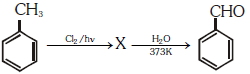
Identify compound $X$ in the following sequence of reactions:
A
Benzotrichloride $(C_6H_5CCl_3)$
B
Chlorobenzene $(C_6H_5Cl)$
C
Benzyl chloride $(C_6H_5CH_2Cl)$
D
Benzal chloride $(C_6H_5CHCl_2)$
Solution
(D) The reaction sequence is the industrial preparation of benzaldehyde from toluene.
$1$. Toluene reacts with chlorine in the presence of light $(Cl_2/h\nu)$ to undergo side-chain chlorination.
$2$. The reaction proceeds through the formation of benzyl chloride,then benzal chloride $(C_6H_5CHCl_2)$,and finally benzotrichloride.
$3$. To obtain benzaldehyde,the reaction is controlled to produce benzal chloride $(C_6H_5CHCl_2)$ as the intermediate $X$.
$4$. Benzal chloride $(C_6H_5CHCl_2)$ on hydrolysis with water at $373 \ K$ yields benzaldehyde $(C_6H_5CHO)$.
Therefore,compound $X$ is benzal chloride $(C_6H_5CHCl_2)$.
$1$. Toluene reacts with chlorine in the presence of light $(Cl_2/h\nu)$ to undergo side-chain chlorination.
$2$. The reaction proceeds through the formation of benzyl chloride,then benzal chloride $(C_6H_5CHCl_2)$,and finally benzotrichloride.
$3$. To obtain benzaldehyde,the reaction is controlled to produce benzal chloride $(C_6H_5CHCl_2)$ as the intermediate $X$.
$4$. Benzal chloride $(C_6H_5CHCl_2)$ on hydrolysis with water at $373 \ K$ yields benzaldehyde $(C_6H_5CHO)$.
Therefore,compound $X$ is benzal chloride $(C_6H_5CHCl_2)$.
0 likes
View Solution150
MediumMCQ
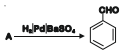
Identify compound $(A)$ in the following reaction:
A
Benzoic acid
B
Benzoyl chloride
C
Toluene
D
Acetophenone
Solution
(B) The given reaction is the Rosenmund reduction.
In this reaction,an acid chloride $(RCOCl)$ is hydrogenated to an aldehyde $(RCHO)$ using $H_2$ gas in the presence of a palladium catalyst supported on barium sulfate $(Pd/BaSO_4)$.
The reaction is:
$C_6H_5COCl + H_2 \xrightarrow{Pd/BaSO_4} C_6H_5CHO + HCl$
Here,compound $(A)$ is benzoyl chloride $(C_6H_5COCl)$.
In this reaction,an acid chloride $(RCOCl)$ is hydrogenated to an aldehyde $(RCHO)$ using $H_2$ gas in the presence of a palladium catalyst supported on barium sulfate $(Pd/BaSO_4)$.
The reaction is:
$C_6H_5COCl + H_2 \xrightarrow{Pd/BaSO_4} C_6H_5CHO + HCl$
Here,compound $(A)$ is benzoyl chloride $(C_6H_5COCl)$.
0 likes
View Solution8-1.Aldehydes and Ketones — Preparation · Frequently Asked Questions
1Are these 8-1.Aldehydes and Ketones questions useful for JEE and NEET?
Yes. All questions in this section are mapped to JEE Main and NEET exam patterns. Previous year questions from JEE Main, NEET, GUJCET and state-level exams are included with full solutions.
2Can I switch to Hindi or Gujarati for these questions?
Yes. Use the language tabs in the hero section or the sidebar to view the same questions and solutions in English, Hindi or Gujarati.
3How do I generate a question paper from this subtopic?
Use the Vedclass Exam Paper Generator — select the chapter and subtopic, set difficulty, and generate Sets A, B, C, D automatically. First 3 chapters of every subject are free.
Vedclass Products
For Students
Vedclass Test Series
Mock tests in real JEE/NEET style with performance analysis. 5-day free trial.
Start Free TrialFor Teachers
Exam Paper Generator
Generate Set A/B/C/D papers from this chapter in 2 minutes. 3 chapters free.
Try FreeFor Institutes
Online Exam Module
Live online exams with unlimited students, 360° analytics & white-label branding.
See DemoFor Teachers & Institutes
Generate a 8-1.Aldehydes and Ketones Exam Paper in 2 Minutes
Select subtopic & difficulty — Sets A, B, C, D auto-generated with No Repeat logic.
First 3 chapters of every subject are free — no payment required.