
A English
Preparation Questions in English
Class 12 Chemistry · 8-1.Aldehydes and Ketones · Preparation
328+
Questions
English
Language
100%
With Solutions
Showing 36 of 328 questions in English
251
MediumMCQ
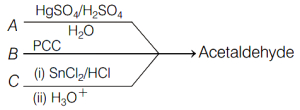
$A, B$ and $C$ respectively are
A
ethyne,ethanol and ethane nitrile
B
ethane nitrile,ethanol and ethyne
C
ethyne,ethane nitrile and ethanol
D
ethanol,ethane nitrile and ethyne
Solution
(A) The given reactions are standard methods for the preparation of acetaldehyde $(CH_3CHO)$:
$1$. $A$ is ethyne $(HC \equiv CH)$. Hydration of ethyne in the presence of $HgSO_4 / H_2SO_4$ gives vinyl alcohol $(CH_2=CH-OH)$,which tautomerises to form acetaldehyde $(CH_3CHO)$.
$2$. $B$ is ethanol $(CH_3CH_2OH)$. $PCC$ (Pyridinium chlorochromate) is a mild oxidising agent that oxidises primary alcohols to aldehydes. Thus,$CH_3CH_2OH \xrightarrow{PCC} CH_3CHO$.
$3$. $C$ is ethane nitrile $(CH_3CN)$. The Stephen reduction of nitriles using $SnCl_2 / HCl$ followed by acid hydrolysis $(H_3O^+)$ yields acetaldehyde $(CH_3CHO)$.
Therefore,$A$ is ethyne,$B$ is ethanol,and $C$ is ethane nitrile.
$1$. $A$ is ethyne $(HC \equiv CH)$. Hydration of ethyne in the presence of $HgSO_4 / H_2SO_4$ gives vinyl alcohol $(CH_2=CH-OH)$,which tautomerises to form acetaldehyde $(CH_3CHO)$.
$2$. $B$ is ethanol $(CH_3CH_2OH)$. $PCC$ (Pyridinium chlorochromate) is a mild oxidising agent that oxidises primary alcohols to aldehydes. Thus,$CH_3CH_2OH \xrightarrow{PCC} CH_3CHO$.
$3$. $C$ is ethane nitrile $(CH_3CN)$. The Stephen reduction of nitriles using $SnCl_2 / HCl$ followed by acid hydrolysis $(H_3O^+)$ yields acetaldehyde $(CH_3CHO)$.
Therefore,$A$ is ethyne,$B$ is ethanol,and $C$ is ethane nitrile.
0 likes
View Solution252
MediumMCQ
Statement-$I$: Reduction of ester by $DIBAL-H$ followed by hydrolysis gives aldehyde.
Statement-$II$: Oxidation of benzyl alcohol with aqueous $KMnO_4$ leads to the formation of benzaldehyde.
Among the above statements,identify the correct statement.
Statement-$II$: Oxidation of benzyl alcohol with aqueous $KMnO_4$ leads to the formation of benzaldehyde.
Among the above statements,identify the correct statement.
A
Both statements-$I$ and $II$ are false
B
Statement-$I$ is true but statement-$II$ is false
C
Statement-$I$ is false but statement-$II$ is true
D
Both statements-$I$ and $II$ are true.
Solution
(B) Statement-$I$ is true: Esters are reduced to aldehydes using $DIBAL-H$ at low temperature followed by hydrolysis.
Statement-$II$ is false: Oxidation of benzyl alcohol with aqueous $KMnO_4$ (a strong oxidizing agent) leads to the formation of benzoic acid,not benzaldehyde.
Statement-$II$ is false: Oxidation of benzyl alcohol with aqueous $KMnO_4$ (a strong oxidizing agent) leads to the formation of benzoic acid,not benzaldehyde.
0 likes
View Solution253
EasyMCQ
Acetophenone cannot be prepared easily starting from
A
$C_{6}H_{5}CH_{3}$
B
$C_{6}H_{6}$
C
$C_{6}H_{5}CH(OH)CH_{3}$
D
$C_{6}H_{5}C \equiv CH$
Solution
(A) Acetophenone $(C_{6}H_{5}COCH_{3})$ is a ketone.
$1$. $C_{6}H_{6}$ (Benzene) can undergo Friedel-Crafts acylation with acetyl chloride to form acetophenone.
$2$. $C_{6}H_{5}CH(OH)CH_{3}$ ($1$-phenylethanol) can be oxidized to form acetophenone.
$3$. $C_{6}H_{5}C \equiv CH$ (Phenylacetylene) can undergo hydration to form acetophenone.
$4$. $C_{6}H_{5}CH_{3}$ (Toluene) cannot be directly converted to acetophenone easily because oxidation of the methyl group typically yields benzoic acid,and Friedel-Crafts acylation of toluene would result in a mixture of ortho and para isomers,not the desired acetophenone.
$1$. $C_{6}H_{6}$ (Benzene) can undergo Friedel-Crafts acylation with acetyl chloride to form acetophenone.
$2$. $C_{6}H_{5}CH(OH)CH_{3}$ ($1$-phenylethanol) can be oxidized to form acetophenone.
$3$. $C_{6}H_{5}C \equiv CH$ (Phenylacetylene) can undergo hydration to form acetophenone.
$4$. $C_{6}H_{5}CH_{3}$ (Toluene) cannot be directly converted to acetophenone easily because oxidation of the methyl group typically yields benzoic acid,and Friedel-Crafts acylation of toluene would result in a mixture of ortho and para isomers,not the desired acetophenone.
0 likes
View Solution254
EasyMCQ
Which of the following gives an aldehyde on dry distillation?
A
Calcium formate $+$ calcium acetate
B
Calcium acetate $+$ calcium benzoate
C
Calcium acetate
D
Calcium benzoate
Solution
(A) Dry distillation of a mixture of calcium formate and another calcium salt of a carboxylic acid yields an aldehyde.
Specifically,the reaction between calcium formate $(HCOO)_2Ca$ and calcium acetate $(CH_3COO)_2Ca$ produces acetaldehyde $(CH_3CHO)$ along with calcium carbonate $(CaCO_3)$.
The reaction is: $(HCOO)_2Ca + (CH_3COO)_2Ca \xrightarrow{400^{\circ}C} 2CH_3CHO + 2CaCO_3$.
Specifically,the reaction between calcium formate $(HCOO)_2Ca$ and calcium acetate $(CH_3COO)_2Ca$ produces acetaldehyde $(CH_3CHO)$ along with calcium carbonate $(CaCO_3)$.
The reaction is: $(HCOO)_2Ca + (CH_3COO)_2Ca \xrightarrow{400^{\circ}C} 2CH_3CHO + 2CaCO_3$.
0 likes
View Solution255
EasyMCQ
Acetic acid is treated with $Ca(OH)_2$ and the product so obtained is subjected to dry distillation. The final product is
A
ethanal
B
propanal
C
propanone
D
ethanol
Solution
(C) When acetic acid reacts with slaked lime,calcium acetate is formed,which on dry distillation produces a ketone.
$2 CH_3COOH + Ca(OH)_2 \rightarrow (CH_3COO)_2Ca + 2 H_2O$
$(CH_3COO)_2Ca \xrightarrow{\Delta} CH_3COCH_3 + CaCO_3$
The final product obtained is propanone $(CH_3COCH_3)$.
$2 CH_3COOH + Ca(OH)_2 \rightarrow (CH_3COO)_2Ca + 2 H_2O$
$(CH_3COO)_2Ca \xrightarrow{\Delta} CH_3COCH_3 + CaCO_3$
The final product obtained is propanone $(CH_3COCH_3)$.
0 likes
View Solution256
EasyMCQ
What is the compound formed when a mixture of calcium acetate and calcium formate is subjected to dry distillation?
A
acetone
B
acetaldehyde
C
benzaldehyde
D
acetophenone
Solution
(B) The dry distillation of a mixture of calcium acetate $(CH_3COO)_2Ca$ and calcium formate $(HCOO)_2Ca$ results in the formation of acetaldehyde $(CH_3CHO)$ and calcium carbonate $(CaCO_3)$.
The chemical reaction is as follows:
$(CH_3COO)_2Ca + (HCOO)_2Ca \xrightarrow{\text{dry distillation}} 2CH_3CHO + 2CaCO_3$
The chemical reaction is as follows:
$(CH_3COO)_2Ca + (HCOO)_2Ca \xrightarrow{\text{dry distillation}} 2CH_3CHO + 2CaCO_3$
0 likes
View Solution257
EasyMCQ
Oxidation of $Toluene$ with chromyl chloride $(CrO_2Cl_2)$ followed by hydrolysis gives $Benzaldehyde$. This reaction is known as . . . . . . .
A
$Etard$ Reaction
B
$Kolbe$ reaction
C
$Stephen$ reaction
D
$Cannizzaro$ Reaction
Solution
(A) The oxidation of $Toluene$ to $Benzaldehyde$ using chromyl chloride $(CrO_2Cl_2)$ in a suitable solvent like $CS_2$ or $CCl_4$,followed by hydrolysis,is a well-known named reaction in organic chemistry.
This specific transformation is called the $Etard$ reaction.
The reaction proceeds through the formation of a brown chromium complex intermediate,which upon hydrolysis yields $Benzaldehyde$.
This specific transformation is called the $Etard$ reaction.
The reaction proceeds through the formation of a brown chromium complex intermediate,which upon hydrolysis yields $Benzaldehyde$.
0 likes
View Solution258
DifficultMCQ
In the following reaction sequence,identify the compound $Z$ if the starting material is toluene $(C_6H_5CH_3)$:
$C_6H_5CH_3 \xrightarrow{CrO_2Cl_2 / CS_2, H_3O^+} Z$
$C_6H_5CH_3 \xrightarrow{CrO_2Cl_2 / CS_2, H_3O^+} Z$
A
Benzoic acid
B
Benzaldehyde
C
Acetophenone
D
Benzene
Solution
(B) The reaction of toluene $(C_6H_5CH_3)$ with chromyl chloride $(CrO_2Cl_2)$ in the presence of carbon disulfide $(CS_2)$ followed by hydrolysis is known as the Etard reaction.
This reaction specifically oxidizes the methyl group of toluene to a formyl group,resulting in the formation of benzaldehyde $(C_6H_5CHO)$.
Therefore,the compound $Z$ is benzaldehyde.
This reaction specifically oxidizes the methyl group of toluene to a formyl group,resulting in the formation of benzaldehyde $(C_6H_5CHO)$.
Therefore,the compound $Z$ is benzaldehyde.
0 likes
View Solution259
EasyMCQ
Conversion of benzene to acetophenone can be brought about by
A
Wurtz reaction
B
Wurtz-Fittig's reaction
C
Friedel-Crafts alkylation
D
Friedel-Crafts acylation
Solution
(D) The conversion of benzene to acetophenone is achieved by reacting benzene with acetyl chloride $(CH_3COCl)$ in the presence of an anhydrous Lewis acid catalyst like $AlCl_3$.
This reaction is a specific type of electrophilic aromatic substitution known as Friedel-Crafts acylation,where an acyl group $(-COCH_3)$ is introduced into the benzene ring.
The reaction is represented as:
$C_6H_6 + CH_3COCl \xrightarrow{AlCl_3} C_6H_5COCH_3 + HCl$
This reaction is a specific type of electrophilic aromatic substitution known as Friedel-Crafts acylation,where an acyl group $(-COCH_3)$ is introduced into the benzene ring.
The reaction is represented as:
$C_6H_6 + CH_3COCl \xrightarrow{AlCl_3} C_6H_5COCH_3 + HCl$
0 likes
View Solution260
EasyMCQ
For the reaction sequence: $P$ $\xrightarrow[2. H_3O^+]{1. CH_3MgBr} R$ $\xrightarrow[2. \Delta]{1. \text{dil. } NaOH} \text{4-methylpent-3-en-2-one}$,identify $P$.
A
Ethanamine
B
Ethanal
C
Propanone
D
Ethanenitrile
Solution
(D) The final product is $4\text{-methylpent-3-en-2-one}$,which is an $\alpha,\beta\text{-unsaturated ketone}$ formed by the aldol condensation of $2$ molecules of acetone $(CH_3COCH_3)$.
Thus,$R$ must be acetone $(CH_3COCH_3)$.
The reaction of $P$ with $CH_3MgBr$ followed by hydrolysis yields acetone $(R)$.
$CH_3CN + CH_3MgBr$ $\rightarrow CH_3C(CH_3)=NMgBr$ $\xrightarrow{H_3O^+} CH_3COCH_3 + NH_3 + Mg(OH)Br$.
Therefore,$P$ is $CH_3CN$ (Ethanenitrile).
Thus,$R$ must be acetone $(CH_3COCH_3)$.
The reaction of $P$ with $CH_3MgBr$ followed by hydrolysis yields acetone $(R)$.
$CH_3CN + CH_3MgBr$ $\rightarrow CH_3C(CH_3)=NMgBr$ $\xrightarrow{H_3O^+} CH_3COCH_3 + NH_3 + Mg(OH)Br$.
Therefore,$P$ is $CH_3CN$ (Ethanenitrile).
0 likes
View Solution261
MediumMCQ
Consider the following reactions:
$C_2H_2 + H_2O \xrightarrow[333 \ K]{Hg^{2+} / H^{+}} [X] \stackrel{\text{Isomerisation}}{\rightleftharpoons} Y$
$Y$ cannot be obtained from which of the following reactions?
$C_2H_2 + H_2O \xrightarrow[333 \ K]{Hg^{2+} / H^{+}} [X] \stackrel{\text{Isomerisation}}{\rightleftharpoons} Y$
$Y$ cannot be obtained from which of the following reactions?
A
$CH_3COCl + H_2 \xrightarrow{Pd / BaSO_4}$
B
$CH_3CH_2OH \xrightarrow{Cu / 573 \ K}$
C
$CH_3CN + SnCl_2 + HCl$ $\longrightarrow \text{Intermediate}$ $\xrightarrow{H_3O^{+}} CH_3CHO$
D
$CH_3COOH \xrightarrow[\text{(ii) } H_2O]{\text{(i) } LiAlH_4 / \text{ether}}$
Solution
(D) The reaction sequence is:
$HC \equiv CH + H_2O \xrightarrow{Hg^{2+}/H^+, 333 \ K} [CH_2=CH-OH] \rightleftharpoons CH_3CHO$
Here,$Y$ is $CH_3CHO$ (Ethanal).
$A$: Rosenmund reduction of acetyl chloride gives ethanal $(CH_3COCl + H_2 \xrightarrow{Pd/BaSO_4} CH_3CHO + HCl)$.
$B$: Dehydrogenation of ethanol gives ethanal $(CH_3CH_2OH \xrightarrow{Cu, 573 \ K} CH_3CHO + H_2)$.
$C$: Stephen reduction of acetonitrile gives ethanal $(CH_3CN + SnCl_2 + HCl$ $\rightarrow CH_3CH=NH$ $\xrightarrow{H_3O^+} CH_3CHO)$.
$D$: Reduction of acetic acid with $LiAlH_4$ gives ethanol $(CH_3CH_2OH)$,not ethanal $(CH_3CHO)$.
Therefore,$Y$ cannot be obtained from reaction $D$.
$HC \equiv CH + H_2O \xrightarrow{Hg^{2+}/H^+, 333 \ K} [CH_2=CH-OH] \rightleftharpoons CH_3CHO$
Here,$Y$ is $CH_3CHO$ (Ethanal).
$A$: Rosenmund reduction of acetyl chloride gives ethanal $(CH_3COCl + H_2 \xrightarrow{Pd/BaSO_4} CH_3CHO + HCl)$.
$B$: Dehydrogenation of ethanol gives ethanal $(CH_3CH_2OH \xrightarrow{Cu, 573 \ K} CH_3CHO + H_2)$.
$C$: Stephen reduction of acetonitrile gives ethanal $(CH_3CN + SnCl_2 + HCl$ $\rightarrow CH_3CH=NH$ $\xrightarrow{H_3O^+} CH_3CHO)$.
$D$: Reduction of acetic acid with $LiAlH_4$ gives ethanol $(CH_3CH_2OH)$,not ethanal $(CH_3CHO)$.
Therefore,$Y$ cannot be obtained from reaction $D$.
0 likes
View Solution262
MediumMCQ
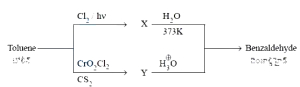
What are $X$ and $Y$ in the following reactions?
A
$X = C_6H_5CCl_3$,$Y = C_6H_5CH[OCr(OH)Cl_2]_2$
B
$X = C_6H_5CHCl_2$,$Y = C_6H_5CH[OCr(OH)Cl_2]_2$
C
$X = C_6H_5CH_2Cl$,$Y = C_6H_5CH[OCr(OH)_2Cl_2]_2$
D
$X = C_6H_4(CH_3)Cl$,$Y = C_6H_5CH[OCrCl_3]_2$
Solution
(B) The reaction of toluene with $Cl_2$ in the presence of $hv$ (photochemical chlorination) leads to the formation of benzal chloride $(C_6H_5CHCl_2)$ as the intermediate $X$,which upon hydrolysis at $373 \ K$ gives benzaldehyde.
The reaction of toluene with chromyl chloride $(CrO_2Cl_2)$ in $CS_2$ is the Etard reaction. This reaction proceeds through the formation of a brown chromium complex intermediate $Y$,which is $C_6H_5CH[OCr(OH)Cl_2]_2$. This complex upon acidic hydrolysis $(H_3O^+)$ yields benzaldehyde.
Therefore,$X = C_6H_5CHCl_2$ and $Y = C_6H_5CH[OCr(OH)Cl_2]_2$.
The reaction of toluene with chromyl chloride $(CrO_2Cl_2)$ in $CS_2$ is the Etard reaction. This reaction proceeds through the formation of a brown chromium complex intermediate $Y$,which is $C_6H_5CH[OCr(OH)Cl_2]_2$. This complex upon acidic hydrolysis $(H_3O^+)$ yields benzaldehyde.
Therefore,$X = C_6H_5CHCl_2$ and $Y = C_6H_5CH[OCr(OH)Cl_2]_2$.
0 likes
View Solution263
MediumMCQ
Which of the following sets of reagents convert toluene to benzaldehyde?
$A$. $Cl_2 / h\nu ; H_2O, \Delta$
$B$. $Cl_2 / Fe ; H_2O$
$C$. $KMnO_4 / OH^{-} ; H^{+}$
$D$. $CrO_2Cl_2 / CS_2 ; H_3O^{+}$
$A$. $Cl_2 / h\nu ; H_2O, \Delta$
$B$. $Cl_2 / Fe ; H_2O$
$C$. $KMnO_4 / OH^{-} ; H^{+}$
$D$. $CrO_2Cl_2 / CS_2 ; H_3O^{+}$
A
$B, C, D$
B
$A, C$
C
$A, D$
D
$B, D$
Solution
(C) The conversion of toluene to benzaldehyde can be achieved by the following methods:
$1$. Side chain chlorination followed by hydrolysis $(A)$: Toluene reacts with $Cl_2$ in the presence of light $(h\nu)$ to form benzal chloride $(C_6H_5CHCl_2)$,which upon hydrolysis with $H_2O$ at high temperature $(\Delta)$ yields benzaldehyde.
$2$. Etard reaction $(D)$: Toluene reacts with chromyl chloride $(CrO_2Cl_2)$ in $CS_2$ solvent followed by acidic hydrolysis $(H_3O^{+})$ to give benzaldehyde.
$3$. Reagent $C$ $(KMnO_4 / OH^{-} ; H^{+})$ is an oxidizing agent that converts toluene directly to benzoic acid,not benzaldehyde.
Therefore,the correct sets are $A$ and $D$.
$1$. Side chain chlorination followed by hydrolysis $(A)$: Toluene reacts with $Cl_2$ in the presence of light $(h\nu)$ to form benzal chloride $(C_6H_5CHCl_2)$,which upon hydrolysis with $H_2O$ at high temperature $(\Delta)$ yields benzaldehyde.
$2$. Etard reaction $(D)$: Toluene reacts with chromyl chloride $(CrO_2Cl_2)$ in $CS_2$ solvent followed by acidic hydrolysis $(H_3O^{+})$ to give benzaldehyde.
$3$. Reagent $C$ $(KMnO_4 / OH^{-} ; H^{+})$ is an oxidizing agent that converts toluene directly to benzoic acid,not benzaldehyde.
Therefore,the correct sets are $A$ and $D$.
0 likes
View Solution264
MediumMCQ
The sequence of reagents required to convert ethyl bromide to propanal is
A
$CH_3COOAg, DIBAL-H, H_2O$
B
$CH_3COOAg, LiAlH_4, H_2O$
C
$Mg/ether, HCHO, H_2O$
D
$CH_3COOH, LiAlH_4, H_2O$
Solution
(A) The conversion of ethyl bromide $(CH_3CH_2Br)$ to propanal $(CH_3CH_2CHO)$ involves the following steps:
$1$. Reaction of ethyl bromide with silver acetate $(CH_3COOAg)$ to form ethyl ethanoate $(CH_3COOCH_2CH_3)$:
$CH_3COOAg + CH_3CH_2Br \rightarrow CH_3COOCH_2CH_3 + AgBr \downarrow$
$2$. Reduction of the ester (ethyl ethanoate) to an aldehyde using $DIBAL-H$ (Diisobutylaluminium hydride) followed by hydrolysis $(H_2O)$:
$CH_3COOCH_2CH_3 \xrightarrow{DIBAL-H, H_2O} CH_3CH_2CHO$
Thus,the correct sequence of reagents is $CH_3COOAg, DIBAL-H, H_2O$.
$1$. Reaction of ethyl bromide with silver acetate $(CH_3COOAg)$ to form ethyl ethanoate $(CH_3COOCH_2CH_3)$:
$CH_3COOAg + CH_3CH_2Br \rightarrow CH_3COOCH_2CH_3 + AgBr \downarrow$
$2$. Reduction of the ester (ethyl ethanoate) to an aldehyde using $DIBAL-H$ (Diisobutylaluminium hydride) followed by hydrolysis $(H_2O)$:
$CH_3COOCH_2CH_3 \xrightarrow{DIBAL-H, H_2O} CH_3CH_2CHO$
Thus,the correct sequence of reagents is $CH_3COOAg, DIBAL-H, H_2O$.
0 likes
View Solution265
EasyMCQ
The reagents used in the Etard reaction $(I)$ and the Stephen reaction $(II)$ are:
A
$PCC$ and $SnCl_2 / HCl$
B
$SnCl_2 / HCl$ and $CrO_2Cl_2$
C
$CrO_2Cl_2$ and $SnCl_2 / HCl$
D
$CrO_2Cl_2$ and $PCC$
Solution
(C) The Etard reaction $(I)$ involves the oxidation of toluene to benzaldehyde using chromyl chloride $(CrO_2Cl_2)$ in the presence of $CCl_4$ as a solvent. The reaction proceeds through the formation of a brown chromium complex,which is subsequently hydrolyzed to give benzaldehyde.
The Stephen reaction $(II)$ involves the reduction of nitriles $(R-CN)$ to imines using stannous chloride $(SnCl_2)$ in the presence of hydrochloric acid $(HCl)$,followed by hydrolysis to yield the corresponding aldehyde $(R-CHO)$.
The Stephen reaction $(II)$ involves the reduction of nitriles $(R-CN)$ to imines using stannous chloride $(SnCl_2)$ in the presence of hydrochloric acid $(HCl)$,followed by hydrolysis to yield the corresponding aldehyde $(R-CHO)$.
0 likes
View Solution266
MediumMCQ
In which of the following reactions is benzaldehyde formed from benzoyl chloride and hydrogen in the presence of $Pd-BaSO_4$?
A
Stephen reaction
B
Etard reaction
C
Gattermann-Koch reaction
D
Rosenmund reduction reaction
Solution
(D) The reaction of benzoyl chloride with hydrogen in the presence of $Pd$ supported on $BaSO_4$ is known as the Rosenmund reduction reaction.
In this reaction,acid chlorides are selectively reduced to their corresponding aldehydes.
The chemical equation is:
$C_6H_5COCl + H_2 \xrightarrow{Pd/BaSO_4} C_6H_5CHO + HCl$
In this reaction,acid chlorides are selectively reduced to their corresponding aldehydes.
The chemical equation is:
$C_6H_5COCl + H_2 \xrightarrow{Pd/BaSO_4} C_6H_5CHO + HCl$
0 likes
View Solution267
EasyMCQ
Identify the name of the following reaction: $C_6H_5CH_3$ $\xrightarrow[CS_2]{CrO_2Cl_2} A$ $\xrightarrow{H_3O^+} C_6H_5CHO$
A
Gattermann Koch reaction
B
Gattermann reaction
C
Stephen reaction
D
Etard reaction
Solution
(D) The given reaction involves the oxidation of toluene $(C_6H_5CH_3)$ to benzaldehyde $(C_6H_5CHO)$ using chromyl chloride $(CrO_2Cl_2)$ in the presence of carbon disulfide $(CS_2)$ as a solvent,followed by hydrolysis.
This specific chemical transformation is known as the Etard reaction.
This specific chemical transformation is known as the Etard reaction.
0 likes
View Solution268
DifficultMCQ
What is $(P)$ in the reaction given below?
$(P)$ $\xrightarrow[\text{(ii) } H_3O^{+}]{\text{(i) } CH_3MgBr} (R)$ $\xrightarrow[\text{(ii) } \Delta]{\text{(i) dil. } NaOH} \text{4-methylpent-3-en-2-one}$
$(P)$ $\xrightarrow[\text{(ii) } H_3O^{+}]{\text{(i) } CH_3MgBr} (R)$ $\xrightarrow[\text{(ii) } \Delta]{\text{(i) dil. } NaOH} \text{4-methylpent-3-en-2-one}$
A
Propanone
B
Ethanamine
C
Ethane nitrile
D
Ethane
Solution
(C) The final product is $4\text{-methylpent-3-en-2-one}$,which is an $\alpha,\beta\text{-unsaturated ketone}$ formed by the aldol condensation of $2$ moles of acetone $(propanone)$.
Thus,$(R)$ must be $propanone$ $(CH_3COCH_3)$.
The reaction of $(P)$ with $CH_3MgBr$ followed by $H_3O^{+}$ yields $propanone$. This is a characteristic reaction of nitriles.
$CH_3CN + CH_3MgBr$ $\rightarrow CH_3C(CH_3)=NMgBr$ $\xrightarrow{H_3O^{+}} CH_3COCH_3 + NH_3 + Mg(OH)Br$.
Therefore,$(P)$ is $CH_3CN$ $(Ethane\ nitrile)$.
Thus,$(R)$ must be $propanone$ $(CH_3COCH_3)$.
The reaction of $(P)$ with $CH_3MgBr$ followed by $H_3O^{+}$ yields $propanone$. This is a characteristic reaction of nitriles.
$CH_3CN + CH_3MgBr$ $\rightarrow CH_3C(CH_3)=NMgBr$ $\xrightarrow{H_3O^{+}} CH_3COCH_3 + NH_3 + Mg(OH)Br$.
Therefore,$(P)$ is $CH_3CN$ $(Ethane\ nitrile)$.
0 likes
View Solution269
MediumMCQ
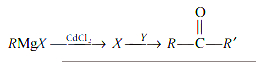
In the following reaction sequence,$X$ and $Y$ are:
A
$R CdCl$ & $R^{\prime} COCl$
B
$R_2 Cd$ & $(R^{\prime} CO)_2$
C
$R_2 Cd$ & $R^{\prime} COCl$
D
$R_2 MgCdCl_2$ & $R COO R^{\prime}$
Solution
(C) The reaction of a Grignard reagent $(RMgX)$ with cadmium chloride $(CdCl_2)$ produces an organocadmium compound $(R_2Cd)$,which is represented as $X$.
This organocadmium compound $(R_2Cd)$ reacts with an acid chloride $(R^{\prime}COCl)$,represented as $Y$,to form a ketone $(R-CO-R^{\prime})$.
The reaction is:
$2RMgX + CdCl_2 \rightarrow R_2Cd + 2MgXCl$
$R_2Cd + 2R^{\prime}COCl \rightarrow 2R-CO-R^{\prime} + CdCl_2$
This organocadmium compound $(R_2Cd)$ reacts with an acid chloride $(R^{\prime}COCl)$,represented as $Y$,to form a ketone $(R-CO-R^{\prime})$.
The reaction is:
$2RMgX + CdCl_2 \rightarrow R_2Cd + 2MgXCl$
$R_2Cd + 2R^{\prime}COCl \rightarrow 2R-CO-R^{\prime} + CdCl_2$
0 likes
View Solution270
MediumMCQ
What is $A$ in the following reaction?
$CH_3-CH=CH-CH_2-CH_2-CN \xrightarrow[\text{2) } H_2O]{\text{1) } AlH(i-Bu)_2} (A)$
$CH_3-CH=CH-CH_2-CH_2-CN \xrightarrow[\text{2) } H_2O]{\text{1) } AlH(i-Bu)_2} (A)$
A
$CH_3-CH=CH-CH_2-CH_2-CH_2-NH_2$
B
$CH_3-CH_2-CH_2-CH_2-CH_2-CH_2-NH_2$
C
$CH_3-CH=CH-CH_2-CH_2-CHO$
D
$CH_3-CH_2-CH_2-CH_2-CH_2-CHO$
Solution
(C) The reagent $AlH(i-Bu)_2$ is Diisobutylaluminium hydride,commonly known as $DIBAL-H$.
$DIBAL-H$ is a selective reducing agent that reduces nitriles $(-CN)$ to aldehydes $(-CHO)$ upon hydrolysis.
In the given reaction,the nitrile group $(-CN)$ is converted to an aldehyde group $(-CHO)$ while the double bond $(C=C)$ remains unaffected.
Therefore,the reaction is: $CH_3-CH=CH-CH_2-CH_2-CN \xrightarrow[\text{2) } H_2O]{\text{1) } DIBAL-H} CH_3-CH=CH-CH_2-CH_2-CHO$.
Thus,the correct option is $C$.
$DIBAL-H$ is a selective reducing agent that reduces nitriles $(-CN)$ to aldehydes $(-CHO)$ upon hydrolysis.
In the given reaction,the nitrile group $(-CN)$ is converted to an aldehyde group $(-CHO)$ while the double bond $(C=C)$ remains unaffected.
Therefore,the reaction is: $CH_3-CH=CH-CH_2-CH_2-CN \xrightarrow[\text{2) } H_2O]{\text{1) } DIBAL-H} CH_3-CH=CH-CH_2-CH_2-CHO$.
Thus,the correct option is $C$.
0 likes
View Solution271
MediumMCQ
What are $X$ and $Y$ in the following reaction sequence ?
$C_6H_5N_2^+Cl^{-}$ $\xrightarrow{X} C_6H_5CN$ $\xrightarrow[\text{(ii) } H_2O]{\text{(i) } CH_3MgBr} Y$
$C_6H_5N_2^+Cl^{-}$ $\xrightarrow{X} C_6H_5CN$ $\xrightarrow[\text{(ii) } H_2O]{\text{(i) } CH_3MgBr} Y$
A
$KCN ; C_6H_5COCH_3$
B
$KCN ; C_6H_5C(OH)(CH_3)_2$
C
$CuCN \mid KCN ; C_6H_5CH(OH)CH_3$
D
$CuCN \mid KCN ; C_6H_5COCH_3$
Solution
(D) Step $1$: The conversion of benzene diazonium chloride $(C_6H_5N_2^+Cl^-)$ to benzonitrile $(C_6H_5CN)$ is a Sandmeyer reaction,which uses $CuCN \mid KCN$ as the reagent $X$.
Step $2$: The reaction of benzonitrile with a Grignard reagent $(CH_3MgBr)$ followed by acid hydrolysis $(H_2O)$ is a standard method to prepare ketones.
Step $3$: The mechanism involves the nucleophilic attack of $CH_3^-$ on the nitrile carbon to form an imine intermediate,which upon hydrolysis yields acetophenone $(C_6H_5COCH_3)$.
Therefore,$X = CuCN \mid KCN$ and $Y = C_6H_5COCH_3$.
Step $2$: The reaction of benzonitrile with a Grignard reagent $(CH_3MgBr)$ followed by acid hydrolysis $(H_2O)$ is a standard method to prepare ketones.
Step $3$: The mechanism involves the nucleophilic attack of $CH_3^-$ on the nitrile carbon to form an imine intermediate,which upon hydrolysis yields acetophenone $(C_6H_5COCH_3)$.
Therefore,$X = CuCN \mid KCN$ and $Y = C_6H_5COCH_3$.
0 likes
View Solution272
MediumMCQ
In the following sequence of reactions,what is the end product $(D)$?
$C_2H_5Br$ $\xrightarrow{KCN} A$ $\xrightarrow{H_3O^{+}} B$ $\xrightarrow{LiAlH_4} C$ $\xrightarrow[573 \ K]{Cu} D$.
$C_2H_5Br$ $\xrightarrow{KCN} A$ $\xrightarrow{H_3O^{+}} B$ $\xrightarrow{LiAlH_4} C$ $\xrightarrow[573 \ K]{Cu} D$.
A
Acetaldehyde
B
Acetone
C
Propionaldehyde
D
Propanol-$1$
Solution
(C) The reaction sequence is as follows:
$1$. $C_2H_5Br + KCN \rightarrow C_2H_5CN + KBr$ ($A$ is Propanenitrile).
$2$. $C_2H_5CN + 2H_2O + H_3O^{+} \rightarrow C_2H_5COOH + NH_4^{+}$ ($B$ is Propanoic acid).
$3$. $C_2H_5COOH \xrightarrow{LiAlH_4} C_2H_5CH_2OH$ ($C$ is Propan$-1-$ol).
$4$. $C_2H_5CH_2OH \xrightarrow[573 \ K]{Cu} C_2H_5CHO + H_2$ ($D$ is Propionaldehyde or Propanal).
$1$. $C_2H_5Br + KCN \rightarrow C_2H_5CN + KBr$ ($A$ is Propanenitrile).
$2$. $C_2H_5CN + 2H_2O + H_3O^{+} \rightarrow C_2H_5COOH + NH_4^{+}$ ($B$ is Propanoic acid).
$3$. $C_2H_5COOH \xrightarrow{LiAlH_4} C_2H_5CH_2OH$ ($C$ is Propan$-1-$ol).
$4$. $C_2H_5CH_2OH \xrightarrow[573 \ K]{Cu} C_2H_5CHO + H_2$ ($D$ is Propionaldehyde or Propanal).
0 likes
View Solution273
MediumMCQ
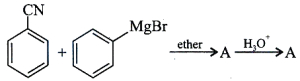
Identify the final product $A$ in the given reaction sequence.
A
The intermediate imine salt $Ph-C(Ph)=NMgBr$
B
Benzophenone imine $(Ph_2C=NH)$
C
Benzophenone $(Ph_2C=O)$
D
Benzophenone oxime $(Ph_2C=NOH)$
Solution
(C) The reaction involves the nucleophilic addition of a Grignard reagent $(PhMgBr)$ to a nitrile $(PhCN)$.
$1$. The phenyl group $(Ph^-)$ from $PhMgBr$ attacks the electrophilic carbon of the nitrile group $(-CN)$,forming an intermediate imine salt: $Ph-C(Ph)=NMgBr$.
$2$. Upon hydrolysis with $H_3O^+$,the imine salt is converted into an imine $(Ph_2C=NH)$,which is further hydrolyzed to the final carbonyl compound,benzophenone $(Ph_2C=O)$.
$1$. The phenyl group $(Ph^-)$ from $PhMgBr$ attacks the electrophilic carbon of the nitrile group $(-CN)$,forming an intermediate imine salt: $Ph-C(Ph)=NMgBr$.
$2$. Upon hydrolysis with $H_3O^+$,the imine salt is converted into an imine $(Ph_2C=NH)$,which is further hydrolyzed to the final carbonyl compound,benzophenone $(Ph_2C=O)$.
0 likes
View Solution274
DifficultMCQ
What are $A$ and $B$ in the following reaction sequence?
$\text{Propionitrile} + A$ $\longrightarrow B$ $\xrightarrow{H_3O^{+}} \text{propiophenone}$
$\text{Propionitrile} + A$ $\longrightarrow B$ $\xrightarrow{H_3O^{+}} \text{propiophenone}$
A
$A = C_2H_5MgBr, B = CH_3CH_2C(NMgBr)C_2H_5$
B
$A = C_2H_5MgBr, B = CH_3CH_2CH_2C(NH)C_2H_5$
C
$A = C_6H_5MgBr, B = CH_3CH_2C(NMgBr)C_6H_5$
D
$A = C_6H_5CH_2MgBr, B = CH_3CH_2CH_2C(NH)CH_2C_6H_5$
Solution
(C) The reaction of a nitrile with a Grignard reagent $(RMgX)$ followed by acid hydrolysis yields a ketone.
For the formation of propiophenone $(CH_3CH_2-CO-C_6H_5)$,the starting material is propionitrile $(CH_3CH_2-CN)$.
The Grignard reagent $(A)$ must be phenylmagnesium bromide $(C_6H_5MgBr)$.
The reaction proceeds as follows:
$CH_3CH_2-C \equiv N + C_6H_5MgBr \longrightarrow CH_3CH_2-C(C_6H_5)=NMgBr$ $(B)$
$CH_3CH_2-C(C_6H_5)=NMgBr + 2H_2O \xrightarrow{H_3O^{+}} CH_3CH_2-CO-C_6H_5 + NH_3 + Mg(OH)Br$
Thus,$A$ is $C_6H_5MgBr$ and $B$ is $CH_3CH_2C(NMgBr)C_6H_5$.
For the formation of propiophenone $(CH_3CH_2-CO-C_6H_5)$,the starting material is propionitrile $(CH_3CH_2-CN)$.
The Grignard reagent $(A)$ must be phenylmagnesium bromide $(C_6H_5MgBr)$.
The reaction proceeds as follows:
$CH_3CH_2-C \equiv N + C_6H_5MgBr \longrightarrow CH_3CH_2-C(C_6H_5)=NMgBr$ $(B)$
$CH_3CH_2-C(C_6H_5)=NMgBr + 2H_2O \xrightarrow{H_3O^{+}} CH_3CH_2-CO-C_6H_5 + NH_3 + Mg(OH)Br$
Thus,$A$ is $C_6H_5MgBr$ and $B$ is $CH_3CH_2C(NMgBr)C_6H_5$.
0 likes
View Solution275
MediumMCQ
Identify $Z$ in the following sequence of reactions.
$C_2H_4Br_2$ $\xrightarrow[\text{(ii) } NaNH_2]{\text{(i) alc- } KOH} X$ $\xrightarrow[\text{Red hot}]{\text{Fe tube, } 873 \ K} Y$ $\xrightarrow[\Delta]{\left(CH_3CO\right)_2O / \text{Anhyd-} AlCl_3} Z$
$C_2H_4Br_2$ $\xrightarrow[\text{(ii) } NaNH_2]{\text{(i) alc- } KOH} X$ $\xrightarrow[\text{Red hot}]{\text{Fe tube, } 873 \ K} Y$ $\xrightarrow[\Delta]{\left(CH_3CO\right)_2O / \text{Anhyd-} AlCl_3} Z$
A
Acetophenone
B
Anisole
C
Toluene
D
Chlorobenzene
Solution
(A) $C_2H_4Br_2$ undergoes dehydrohalogenation with alc. $KOH$ followed by $NaNH_2$ to form ethyne $(X)$: $C_2H_4Br_2 \xrightarrow{\text{alc. } KOH, NaNH_2} HC \equiv CH (X)$.
Ethyne undergoes cyclic polymerization in the presence of red hot $Fe$ tube at $873 \ K$ to form benzene $(Y)$: $3C_2H_2 \xrightarrow{\text{Red hot Fe tube}} C_6H_6 (Y)$.
Benzene reacts with acetic anhydride in the presence of anhydrous $AlCl_3$ (Friedel-Crafts acylation) to form acetophenone $(Z)$: $C_6H_6 + (CH_3CO)_2O \xrightarrow{AlCl_3} C_6H_5COCH_3 (Z)$.
Ethyne undergoes cyclic polymerization in the presence of red hot $Fe$ tube at $873 \ K$ to form benzene $(Y)$: $3C_2H_2 \xrightarrow{\text{Red hot Fe tube}} C_6H_6 (Y)$.
Benzene reacts with acetic anhydride in the presence of anhydrous $AlCl_3$ (Friedel-Crafts acylation) to form acetophenone $(Z)$: $C_6H_6 + (CH_3CO)_2O \xrightarrow{AlCl_3} C_6H_5COCH_3 (Z)$.
0 likes
View Solution276
EasyMCQ
Identify the correct reagent for the Etard reaction.
A
$CrO_2Cl_2, H_3O^+$
B
$Pd-BaSO_4$
C
$CrO_3, H_3O^+$
D
$SnCl_2, HCl$
Solution
(A) The correct reagent for the Etard reaction is $CrO_2Cl_2$ followed by hydrolysis $(H_3O^+)$.
In the Etard reaction,toluene is oxidized to benzaldehyde using chromyl chloride $(CrO_2Cl_2)$.
The reaction proceeds through the formation of a chromium complex intermediate which upon hydrolysis yields the aldehyde.
The reaction is represented as:
$C_6H_5CH_3 \xrightarrow{CrO_2Cl_2, CCl_4 / H_3O^+} C_6H_5CHO$.
In the Etard reaction,toluene is oxidized to benzaldehyde using chromyl chloride $(CrO_2Cl_2)$.
The reaction proceeds through the formation of a chromium complex intermediate which upon hydrolysis yields the aldehyde.
The reaction is represented as:
$C_6H_5CH_3 \xrightarrow{CrO_2Cl_2, CCl_4 / H_3O^+} C_6H_5CHO$.
0 likes
View Solution277
MediumMCQ
An organic compound $X$ gives a red precipitate on heating with Fehling's solution. Which one of the following reactions yields $X$ as a major product?
A
$HCHO \xrightarrow[(ii) H_2O]{(i) CH_3MgI}$
B
$C_2H_5Br + AgOH \xrightarrow{\Delta} C_2H_5OH$
C
$2C_2H_5Br + Ag_2O \xrightarrow{\Delta} (C_2H_5)_2O$
D
$C_2H_2 + H_2O \xrightarrow[1\% HgSO_4]{40\% H_2SO_4} CH_3CHO$
Solution
(D) Fehling's solution is a test for aliphatic aldehydes. The compound $X$ that gives a red precipitate with Fehling's solution is acetaldehyde $(CH_3CHO)$.
The reaction of acetylene $(C_2H_2)$ with water in the presence of $40\% H_2SO_4$ and $1\% HgSO_4$ (Kucherov reaction) yields acetaldehyde $(CH_3CHO)$ as the major product.
$C_2H_2 + H_2O \xrightarrow[1\% HgSO_4]{40\% H_2SO_4} CH_3CHO$
Acetaldehyde then reacts with Fehling's solution to give a red precipitate of cuprous oxide $(Cu_2O)$.
The reaction of acetylene $(C_2H_2)$ with water in the presence of $40\% H_2SO_4$ and $1\% HgSO_4$ (Kucherov reaction) yields acetaldehyde $(CH_3CHO)$ as the major product.
$C_2H_2 + H_2O \xrightarrow[1\% HgSO_4]{40\% H_2SO_4} CH_3CHO$
Acetaldehyde then reacts with Fehling's solution to give a red precipitate of cuprous oxide $(Cu_2O)$.
0 likes
View Solution278
EasyMCQ
Which of the following represents the Etard reaction?
A
$C_6H_5CH_3 + 2CrO_2Cl_2$ $\rightarrow C_6H_5CH(OCrOHCl_2)_2$ $\xrightarrow{H_3O^{+}} C_6H_5CHO$
B
Toluene reacting with $CrO_2Cl_2$ in $CS_2$ followed by hydrolysis to form benzaldehyde.
C
Toluene reacting with $CrO_3$ and acetic anhydride followed by hydrolysis to form benzaldehyde.
D
Gattermann-Koch reaction of toluene with $CO$ and $HCl$ in the presence of anhydrous $AlCl_3$.
Solution
(A) The Etard reaction is a chemical reaction in which an aromatic or heterocyclic bound methyl group is directly oxidized to an aldehyde using chromyl chloride $(CrO_2Cl_2)$. The reaction involves the formation of a brown chromium complex intermediate,which upon hydrolysis yields the corresponding aldehyde. The correct representation is: $C_6H_5CH_3 + 2CrO_2Cl_2$ $\rightarrow C_6H_5CH(OCrOHCl_2)_2$ $\xrightarrow{H_3O^{+}} C_6H_5CHO$.
0 likes
View Solution279
DifficultMCQ
Identify $A, B$ and $C$ in the following reaction:
$\text{Toluene} + A + B$ $\xrightarrow{273-283 \ K} C$ $\xrightarrow{H_3O^{\oplus}} \text{Benzaldehyde}$
$\text{Toluene} + A + B$ $\xrightarrow{273-283 \ K} C$ $\xrightarrow{H_3O^{\oplus}} \text{Benzaldehyde}$
A
$A = CrO_3, B = (CH_3CO)_2O, C = C_6H_5CH(OCOCH_3)_2$
B
$A = CrO_2Cl_2, B = CH_3COCl, C = C_6H_5CH(OH)COCH_3$
C
$A = V_2O_3, B = (CH_3CO)_2O, C = C_6H_5CH_2OCOCH_3$
D
$A = AlCl_3, B = CH_3COOH, C = C_6H_5C(OCOCH_3)_3$
Solution
(A) The reaction described is the Etard reaction or a variation of the oxidation of toluene to benzaldehyde using chromyl chloride or chromic oxide in acetic anhydride.
Specifically,the reaction of toluene with $CrO_3$ and acetic anhydride $(CH_3CO)_2O$ at $273-283 \ K$ forms a gem-diacetate intermediate,$C_6H_5CH(OCOCH_3)_2$,which is $C$.
Upon subsequent hydrolysis with $H_3O^{\oplus}$,this intermediate yields benzaldehyde.
Therefore,$A = CrO_3$,$B = (CH_3CO)_2O$,and $C = C_6H_5CH(OCOCH_3)_2$.
Specifically,the reaction of toluene with $CrO_3$ and acetic anhydride $(CH_3CO)_2O$ at $273-283 \ K$ forms a gem-diacetate intermediate,$C_6H_5CH(OCOCH_3)_2$,which is $C$.
Upon subsequent hydrolysis with $H_3O^{\oplus}$,this intermediate yields benzaldehyde.
Therefore,$A = CrO_3$,$B = (CH_3CO)_2O$,and $C = C_6H_5CH(OCOCH_3)_2$.
0 likes
View Solution280
MediumMCQ
The chemicals used for preparing acetophenone are:
$(A)$ $C_6H_6$
$(B)$ $CH_3COCH_3$
$(C)$ $CH_3COCl$
$(D)$ Anhydrous $AlCl_3$
$(A)$ $C_6H_6$
$(B)$ $CH_3COCH_3$
$(C)$ $CH_3COCl$
$(D)$ Anhydrous $AlCl_3$
A
$A, B, C$
B
$B, C, D$
C
$A, C, D$
D
$A, B, D$
Solution
(C) Acetophenone is prepared by the Friedel-Crafts acylation of benzene.
In this reaction,benzene $(C_6H_6)$ reacts with acetyl chloride $(CH_3COCl)$ in the presence of an anhydrous Lewis acid catalyst,anhydrous $AlCl_3$.
The reaction is:
$C_6H_6 + CH_3COCl \xrightarrow{\text{anhydrous } AlCl_3} C_6H_5COCH_3 + HCl$
Thus,the chemicals required are $C_6H_6$ $(A)$,$CH_3COCl$ $(C)$,and anhydrous $AlCl_3$ $(D)$.
In this reaction,benzene $(C_6H_6)$ reacts with acetyl chloride $(CH_3COCl)$ in the presence of an anhydrous Lewis acid catalyst,anhydrous $AlCl_3$.
The reaction is:
$C_6H_6 + CH_3COCl \xrightarrow{\text{anhydrous } AlCl_3} C_6H_5COCH_3 + HCl$
Thus,the chemicals required are $C_6H_6$ $(A)$,$CH_3COCl$ $(C)$,and anhydrous $AlCl_3$ $(D)$.
0 likes
View Solution281
MediumMCQ
What are $X$ and $Y$ in the following reaction sequence?
$C_5H_{12}O$ $\xrightarrow[573 \ K]{Cu} C_5H_{10}$ $\xrightarrow[\text{(ii) } Zn/H_2O]{\text{(i) } O_3} X + Y$
$C_5H_{12}O$ $\xrightarrow[573 \ K]{Cu} C_5H_{10}$ $\xrightarrow[\text{(ii) } Zn/H_2O]{\text{(i) } O_3} X + Y$
A
Acetone + Acetaldehyde
B
Isobutyraldehyde + Formaldehyde
C
Propionaldehyde + Acetaldehyde
D
Butyraldehyde + Formic acid
Solution
(A) The reaction sequence is as follows:
$1$. Dehydrogenation of $C_5H_{12}O$ (a primary or secondary alcohol) with $Cu$ at $573 \ K$ gives an alkene $(C_5H_{10})$.
$2$. Ozonolysis of the alkene $(C_5H_{10})$ followed by reductive workup $(Zn/H_2O)$ yields carbonyl compounds $X$ and $Y$.
$3$. Considering the options,if the alkene is $2$-methylbut-$2$-ene $(CH_3-C(CH_3)=CH-CH_3)$,its ozonolysis gives acetone $(CH_3COCH_3)$ and acetaldehyde $(CH_3CHO)$.
$4$. Thus,$X$ and $Y$ are acetone and acetaldehyde.
$1$. Dehydrogenation of $C_5H_{12}O$ (a primary or secondary alcohol) with $Cu$ at $573 \ K$ gives an alkene $(C_5H_{10})$.
$2$. Ozonolysis of the alkene $(C_5H_{10})$ followed by reductive workup $(Zn/H_2O)$ yields carbonyl compounds $X$ and $Y$.
$3$. Considering the options,if the alkene is $2$-methylbut-$2$-ene $(CH_3-C(CH_3)=CH-CH_3)$,its ozonolysis gives acetone $(CH_3COCH_3)$ and acetaldehyde $(CH_3CHO)$.
$4$. Thus,$X$ and $Y$ are acetone and acetaldehyde.
0 likes
View Solution282
EasyMCQ
In the reaction $\underset{\text{(Vapour)}}{C_2H_5OH} \xrightarrow[300^{\circ}C]{Cu} X$. The molecular formula of $X$ is
A
$C_4H_6O$
B
$C_4H_{10}O$
C
$C_2H_4O$
D
$C_2H_6$
Solution
(C) Primary alcohols,when passed over heated copper at $300^{\circ}C$,undergo dehydrogenation to form aldehydes.
The reaction is: $C_2H_5OH \xrightarrow[300^{\circ}C]{Cu} CH_3CHO + H_2$.
The product $X$ is acetaldehyde,which has the molecular formula $C_2H_4O$.
The reaction is: $C_2H_5OH \xrightarrow[300^{\circ}C]{Cu} CH_3CHO + H_2$.
The product $X$ is acetaldehyde,which has the molecular formula $C_2H_4O$.
0 likes
View Solution283
EasyMCQ
Which of the following represents the Gatterman-Koch reaction?
A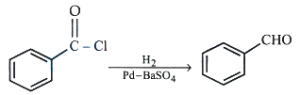
B
C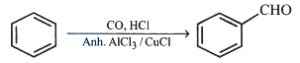
D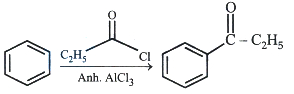
Solution
(C) The Gatterman-Koch reaction involves the formylation of benzene or its derivatives using carbon monoxide $(CO)$ and hydrogen chloride $(HCl)$ in the presence of anhydrous aluminum chloride $(AlCl_3)$ and cuprous chloride $(CuCl)$ as a catalyst to produce benzaldehyde.
Option $A$ represents the Rosenmund reduction.
Option $B$ represents the Etard reaction.
Option $C$ represents the Gatterman-Koch reaction.
Option $D$ represents the Friedel-Crafts acylation reaction.
Option $A$ represents the Rosenmund reduction.
Option $B$ represents the Etard reaction.
Option $C$ represents the Gatterman-Koch reaction.
Option $D$ represents the Friedel-Crafts acylation reaction.
0 likes
View Solution284
MediumMCQ
Dry distillation of calcium acetate and calcium formate forms:
A
methanol
B
ethanal
C
ethanol
D
acetone
Solution
(B) The dry distillation of a mixture of calcium acetate $(CH_3COO)_2Ca$ and calcium formate $(HCOO)_2Ca$ results in the formation of ethanal $(CH_3CHO)$ and calcium carbonate $(CaCO_3)$.
The reaction is as follows:
$(CH_3COO)_2Ca + (HCOO)_2Ca \xrightarrow{\text{dry distillation}} 2CH_3CHO + 2CaCO_3$
Thus,the correct product is ethanal.
The reaction is as follows:
$(CH_3COO)_2Ca + (HCOO)_2Ca \xrightarrow{\text{dry distillation}} 2CH_3CHO + 2CaCO_3$
Thus,the correct product is ethanal.
0 likes
View Solution285
EasyMCQ
Match the following:
| List-$I$ | List-$II$ |
| :--- | :--- |
| $(A)$ Acid chloride to aldehyde | $(I)$ $DIBAL-H$ |
| $(B)$ Benzene to benzaldehyde | $(II)$ $CO, HCl, \text{anhyd. } AlCl_3$ |
| $(C)$ Acetylene to aldehyde | $(III)$ $HgSO_4, H_2SO_4$ |
| $(D)$ Ester to aldehyde | $(IV)$ $H_2, Pd-BaSO_4$ |
| List-$I$ | List-$II$ |
| :--- | :--- |
| $(A)$ Acid chloride to aldehyde | $(I)$ $DIBAL-H$ |
| $(B)$ Benzene to benzaldehyde | $(II)$ $CO, HCl, \text{anhyd. } AlCl_3$ |
| $(C)$ Acetylene to aldehyde | $(III)$ $HgSO_4, H_2SO_4$ |
| $(D)$ Ester to aldehyde | $(IV)$ $H_2, Pd-BaSO_4$ |
A
$A-IV, B-II, C-III, D-I$
B
$A-I, B-II, C-III, D-IV$
C
$A-III, B-II, C-I, D-IV$
D
$A-IV, B-II, C-I, D-III$
Solution
(A) The correct matches are as follows:
$(A)$ Acid chloride to aldehyde is the Rosenmund reduction,which uses $H_2, Pd-BaSO_4$ $(IV)$.
$(B)$ Benzene to benzaldehyde is the Gatterman-Koch reaction,which uses $CO, HCl, \text{anhyd. } AlCl_3$ $(II)$.
$(C)$ Acetylene to aldehyde involves the hydration of alkyne,which uses $HgSO_4, H_2SO_4$ $(III)$.
$(D)$ Ester to aldehyde is achieved using $DIBAL-H$ $(I)$.
Therefore,the correct matching is $A-IV, B-II, C-III, D-I$.
$(A)$ Acid chloride to aldehyde is the Rosenmund reduction,which uses $H_2, Pd-BaSO_4$ $(IV)$.
$(B)$ Benzene to benzaldehyde is the Gatterman-Koch reaction,which uses $CO, HCl, \text{anhyd. } AlCl_3$ $(II)$.
$(C)$ Acetylene to aldehyde involves the hydration of alkyne,which uses $HgSO_4, H_2SO_4$ $(III)$.
$(D)$ Ester to aldehyde is achieved using $DIBAL-H$ $(I)$.
Therefore,the correct matching is $A-IV, B-II, C-III, D-I$.
0 likes
View Solution286
MediumMCQ
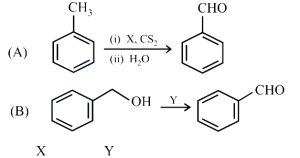
Identify $X$ and $Y$ in the reactions given below:
A
$CrO_3$ $\quad$ $KMnO_4$ (alkaline),$\Delta$
B
$CrO_2Cl_2$ $\quad$ $Cu, 573 \ K$
C
$AlCl_3$ $\quad$ $CrO_3, H_2SO_4$,reflux
D
$H_2O_2$ $\quad$ $KMnO_4$ (acidic),$\Delta$
Solution
(B) In reaction $(A)$,toluene is converted to benzaldehyde using $CrO_2Cl_2$ in $CS_2$ followed by hydrolysis. This is the Etard reaction,so $X = CrO_2Cl_2$.
In reaction $(B)$,benzyl alcohol is converted to benzaldehyde using $Cu$ at $573 \ K$. This is a catalytic dehydrogenation reaction,so $Y = Cu, 573 \ K$.
Therefore,the correct option is $B$.
In reaction $(B)$,benzyl alcohol is converted to benzaldehyde using $Cu$ at $573 \ K$. This is a catalytic dehydrogenation reaction,so $Y = Cu, 573 \ K$.
Therefore,the correct option is $B$.
0 likes
View Solution8-1.Aldehydes and Ketones — Preparation · Frequently Asked Questions
1Are these 8-1.Aldehydes and Ketones questions useful for JEE and NEET?
Yes. All questions in this section are mapped to JEE Main and NEET exam patterns. Previous year questions from JEE Main, NEET, GUJCET and state-level exams are included with full solutions.
2Can I switch to Hindi or Gujarati for these questions?
Yes. Use the language tabs in the hero section or the sidebar to view the same questions and solutions in English, Hindi or Gujarati.
3How do I generate a question paper from this subtopic?
Use the Vedclass Exam Paper Generator — select the chapter and subtopic, set difficulty, and generate Sets A, B, C, D automatically. First 3 chapters of every subject are free.
Vedclass Products
For Students
Vedclass Test Series
Mock tests in real JEE/NEET style with performance analysis. 5-day free trial.
Start Free TrialFor Teachers
Exam Paper Generator
Generate Set A/B/C/D papers from this chapter in 2 minutes. 3 chapters free.
Try FreeFor Institutes
Online Exam Module
Live online exams with unlimited students, 360° analytics & white-label branding.
See DemoFor Teachers & Institutes
Generate a 8-1.Aldehydes and Ketones Exam Paper in 2 Minutes
Select subtopic & difficulty — Sets A, B, C, D auto-generated with No Repeat logic.
First 3 chapters of every subject are free — no payment required.