
A English
The Pistil, Megasporangium (ovule) and Embryo sac Questions in English
Class 12 Biology · Sexual Reproduction in Flowering Plants · The Pistil, Megasporangium (ovule) and Embryo sac
351+
Questions
English
Language
100%
With Solutions
Showing 50 of 351 questions in English
201
EasyMCQ
The pistil (gynoecium) consists of how many parts?
A
One
B
Two
C
Three
D
Four
Solution
(C) The pistil or gynoecium represents the female reproductive part of a flower. It consists of three distinct parts:
$1$. Stigma: The landing platform for pollen grains.
$2$. Style: The elongated slender part beneath the stigma.
$3$. Ovary: The swollen basal part containing the ovules.
Therefore,the correct answer is $3$.
$1$. Stigma: The landing platform for pollen grains.
$2$. Style: The elongated slender part beneath the stigma.
$3$. Ovary: The swollen basal part containing the ovules.
Therefore,the correct answer is $3$.
0 likes
View Solution202
MediumMCQ
Which part of the pistil serves as a landing platform for pollen grains?
A
Anther
B
Stigma
C
Style
D
Ovary
Solution
(B) The pistil or carpel consists of three parts: the stigma, the style, and the ovary.
$1$. The $Stigma$ serves as a landing platform for pollen grains.
$2$. The $Style$ is the elongated slender part beneath the stigma.
$3$. The $Ovary$ is the basal bulged part of the pistil.
Therefore, the correct option is $B$.
$1$. The $Stigma$ serves as a landing platform for pollen grains.
$2$. The $Style$ is the elongated slender part beneath the stigma.
$3$. The $Ovary$ is the basal bulged part of the pistil.
Therefore, the correct option is $B$.
0 likes
View Solution203
MediumMCQ
What is present inside the ovarian cavity?
A
Fruit
B
Placenta
C
Pollen grain
D
Ovule
Solution
(B) The ovarian cavity (locule) contains the placenta.
Inside the ovary,the placenta is the site where the ovules are attached.
Therefore,the placenta is present inside the ovarian cavity,which supports the development of ovules.
Inside the ovary,the placenta is the site where the ovules are attached.
Therefore,the placenta is present inside the ovarian cavity,which supports the development of ovules.
0 likes
View Solution204
MediumMCQ
The ovule represents which stage?
A
Microsporangium
B
Megasporangium
C
Male gametophyte
D
Female gametophyte
Solution
(B) In angiosperms,the ovule is the structure that develops into the seed after fertilization. Morphologically and functionally,the ovule is equivalent to the megasporangium. Inside the megasporangium,the megaspore mother cell undergoes meiosis to produce megaspores,which eventually develop into the female gametophyte (embryo sac).
0 likes
View Solution205
MediumMCQ
The ovule is attached to which of the following?
A
Placenta
B
Ovary wall
C
Style
D
Thalamus
Solution
(A) In flowering plants,the ovule is attached to the placenta,which is a flattened,cushion-like tissue located within the ovary. The placenta is connected to the ovary wall. Therefore,the ovule is attached to the placenta.
0 likes
View Solution206
MediumMCQ
What is the protective covering of the ovule called?
A
Seed coat
B
Pericarp
C
Integument
D
Both $B$ and $C$
Solution
(C) The ovule is a structure in seed plants that develops into a seed after fertilization.
It is protected by one or more layers of tissue known as the integuments.
These integuments eventually harden to form the seed coat after fertilization.
Therefore,the protective covering of the ovule is called the integument.
It is protected by one or more layers of tissue known as the integuments.
These integuments eventually harden to form the seed coat after fertilization.
Therefore,the protective covering of the ovule is called the integument.
0 likes
View Solution207
MediumMCQ
The megasporangium is attached to the placenta by which structure?
A
Nucellus
B
Embryo sac
C
Chalaza
D
Funiculus
Solution
(D) The megasporangium (ovule) is attached to the placenta by means of a stalk called the $Funiculus$.
$1$. The point of attachment of the body of the ovule with the $Funiculus$ is known as the $Hilum$.
$2$. The $Nucellus$ is the central mass of tissue within the ovule.
$3$. The $Embryo \text{ } sac$ is the female gametophyte located inside the $Nucellus$.
$4$. The $Chalaza$ represents the basal part of the ovule opposite to the micropyle.
$1$. The point of attachment of the body of the ovule with the $Funiculus$ is known as the $Hilum$.
$2$. The $Nucellus$ is the central mass of tissue within the ovule.
$3$. The $Embryo \text{ } sac$ is the female gametophyte located inside the $Nucellus$.
$4$. The $Chalaza$ represents the basal part of the ovule opposite to the micropyle.
0 likes
View Solution208
MediumMCQ
The integuments of an ovule enclose which structure?
A
Chalaza
B
Funicle
C
Nucellus
D
Micropyle
Solution
(C) In an angiosperm ovule, the main body of the ovule is composed of a mass of parenchymatous tissue called the $Nucellus$.
This $Nucellus$ is protected by one or two protective envelopes known as $Integuments$.
The $Integuments$ surround the $Nucellus$ except at the tip where a small opening called the $Micropyle$ is present.
This $Nucellus$ is protected by one or two protective envelopes known as $Integuments$.
The $Integuments$ surround the $Nucellus$ except at the tip where a small opening called the $Micropyle$ is present.
0 likes
View Solution209
MediumMCQ
What is the small opening at the apex of the megasporangium,which is not covered by the integuments,called?
A
Germ pore
B
Micropyle
C
Embryo sac
D
Stomatal pore
Solution
(B) The megasporangium (ovule) is surrounded by protective layers called integuments.
These integuments encircle the nucellus except at the tip,where a small opening is left.
This small opening is known as the $Micropyle$.
It serves as the entry point for the pollen tube during fertilization.
These integuments encircle the nucellus except at the tip,where a small opening is left.
This small opening is known as the $Micropyle$.
It serves as the entry point for the pollen tube during fertilization.
0 likes
View Solution210
MediumMCQ
What is the part located at the pole opposite to the micropyle called?
A
Embryo sac
B
Micropyle
C
Integument
D
Chalaza
Solution
(D) In the structure of an angiosperm ovule,the micropyle is the small opening at one end. The pole directly opposite to the micropyle is known as the chalaza. The chalaza represents the basal part of the ovule.
0 likes
View Solution211
MediumMCQ
What is the mass of cells enclosed within the integuments of an ovule called?
A
Nucellus
B
Chalazal pole
C
Hilum
D
Funiculus
Solution
(A) The ovule is a small structure attached to the placenta by means of a stalk called the funiculus. The body of the ovule fuses with the funiculus in the region called the hilum. Each ovule has one or two protective envelopes called integuments. Integuments encircle the nucellus except at the tip where a small opening called the micropyle is organized. The nucellus is a mass of cells enclosed within the integuments that contains reserve food materials.
0 likes
View Solution212
MediumMCQ
The nucellus is present in which of the following?
A
Megasporangium
B
Microsporangium
C
Thalamus
D
Anther
Solution
(A) The $nucellus$ is the central part of the $megasporangium$ (ovule) in flowering plants. It consists of a mass of parenchymatous cells enclosed within the integuments. The $megasporangium$ is the structure that develops into the seed after fertilization. Therefore,the $nucellus$ is a characteristic feature of the $megasporangium$.
0 likes
View Solution213
MediumMCQ
What develops inside the nucellus?
A
Embryo sac
B
Pollen grain
C
Micropyle
D
Pollen tube
Solution
(A) In angiosperms,the ovule consists of a central mass of tissue called the nucellus,which is protected by integuments. Within the nucellus,a single megaspore mother cell differentiates and undergoes meiosis to form megaspores. One of these megaspores develops into the female gametophyte,which is known as the embryo sac. Therefore,the embryo sac develops inside the nucellus.
0 likes
View Solution214
MediumMCQ
Choose the correct option for the embryo sac.
A
Male gametophyte
B
Microsporangium
C
Female gametophyte
D
Megasporangium
Solution
(C) The embryo sac is the female gametophyte in flowering plants.
It develops from the functional megaspore within the ovule (megasporangium).
It typically consists of $7$ cells and $8$ nuclei at maturity.
Therefore,the correct option is $C$.
It develops from the functional megaspore within the ovule (megasporangium).
It typically consists of $7$ cells and $8$ nuclei at maturity.
Therefore,the correct option is $C$.
0 likes
View Solution215
MediumMCQ
In a typical angiosperm,how many female gametophytes develop within a single megasporangium?
A
One
B
Two
C
Three
D
Four
Solution
(A) In most angiosperms,a single megaspore mother cell $(MMC)$ undergoes meiosis to produce four haploid megaspores. Out of these four,three degenerate and only one functional megaspore develops into the female gametophyte (embryo sac). This is known as monosporic development. Therefore,a single megasporangium typically contains only one female gametophyte.
0 likes
View Solution216
MediumMCQ
Select the correct option for megasporogenesis.
A
$PMC \rightarrow \text{Megaspore}$
B
$PMC \rightarrow \text{Megagamete}$
C
$MMC \rightarrow \text{Megagamete}$
D
$MMC \rightarrow \text{Megaspore}$
Solution
(D) Megasporogenesis is the process of formation of megaspores from the megaspore mother cell $(MMC)$.
In this process,a diploid $MMC$ undergoes meiosis to produce four haploid megaspores.
Therefore,the correct sequence is $MMC \rightarrow \text{Megaspore}$.
In this process,a diploid $MMC$ undergoes meiosis to produce four haploid megaspores.
Therefore,the correct sequence is $MMC \rightarrow \text{Megaspore}$.
0 likes
View Solution217
MediumMCQ
How many Megaspore Mother Cells (MMCs) are typically present in the nucellus of an ovule?
A
One
B
Two
C
Three
D
Four
Solution
(A) In the process of megasporogenesis,a single cell of the nucellus,usually towards the micropylar end,differentiates into a Megaspore Mother Cell $(MMC)$.
This cell is large and contains dense cytoplasm and a prominent nucleus.
Therefore,typically,there is only one $MMC$ present in the nucellus of an ovule.
This cell is large and contains dense cytoplasm and a prominent nucleus.
Therefore,typically,there is only one $MMC$ present in the nucellus of an ovule.
0 likes
View Solution218
MediumMCQ
What is the ploidy of the megaspore mother cell $(MMC)$?
A
$n$
B
$2n$
C
$3n$
D
$4n$
Solution
(B) The megaspore mother cell $(MMC)$ is a diploid cell derived from the nucellus of the ovule.
It undergoes meiosis to produce four haploid megaspores.
Therefore,the ploidy of the megaspore mother cell is $2n$.
It undergoes meiosis to produce four haploid megaspores.
Therefore,the ploidy of the megaspore mother cell is $2n$.
0 likes
View Solution219
MediumMCQ
Which process occurs in the megaspore mother cell to form megaspores?
A
Amitosis
B
Meiosis
C
Mitosis
D
Both $B$ and $C$
Solution
(B) The process of formation of megaspores from the megaspore mother cell $(MMC)$ is known as megasporogenesis.
In this process,the diploid $MMC$ undergoes meiosis (reduction division) to produce four haploid megaspores.
Therefore,the correct process is meiosis.
In this process,the diploid $MMC$ undergoes meiosis (reduction division) to produce four haploid megaspores.
Therefore,the correct process is meiosis.
0 likes
View Solution220
MediumMCQ
If $100$ megaspore mother cells undergo meiosis,then how many megaspores are formed $(a)$,how many degenerate $(b)$,and how many remain functional $(c)$?
A
$a- 400, b- 200, c- 200$
B
$a- 200, b- 0, c- 200$
C
$a- 400, b- 0, c- 400$
D
$a- 400, b- 300, c- 100$
Solution
(D) During megasporogenesis,one megaspore mother cell $(MMC)$ undergoes meiosis to produce $4$ haploid megaspores.
Therefore,$100$ $MMC$s will produce $100 \times 4 = 400$ megaspores $(a = 400)$.
In a typical angiosperm,out of the $4$ megaspores,$3$ degenerate $(b)$ and only $1$ remains functional $(c)$.
For $100$ $MMC$s,the number of degenerating megaspores is $100 \times 3 = 300$ $(b = 300)$.
The number of functional megaspores is $100 \times 1 = 100$ $(c = 100)$.
Therefore,$100$ $MMC$s will produce $100 \times 4 = 400$ megaspores $(a = 400)$.
In a typical angiosperm,out of the $4$ megaspores,$3$ degenerate $(b)$ and only $1$ remains functional $(c)$.
For $100$ $MMC$s,the number of degenerating megaspores is $100 \times 3 = 300$ $(b = 300)$.
The number of functional megaspores is $100 \times 1 = 100$ $(c = 100)$.
0 likes
View Solution221
MediumMCQ
In the functional megaspore,the nuclei formed after ......... move towards opposite poles.
A
First meiosis
B
First mitosis
C
Second meiosis
D
Third mitosis
Solution
(B) In the development of the female gametophyte (embryo sac) from a functional megaspore,the nucleus undergoes free nuclear divisions.
$1$. The nucleus of the functional megaspore divides by mitosis to form two nuclei,which move to opposite poles,forming the $2-$nucleate embryo sac.
$2$. This is followed by two more successive mitotic divisions,leading to $4-$nucleate and then $8-$nucleate stages.
$3$. Therefore,the movement of nuclei towards opposite poles occurs after the first mitotic division.
$1$. The nucleus of the functional megaspore divides by mitosis to form two nuclei,which move to opposite poles,forming the $2-$nucleate embryo sac.
$2$. This is followed by two more successive mitotic divisions,leading to $4-$nucleate and then $8-$nucleate stages.
$3$. Therefore,the movement of nuclei towards opposite poles occurs after the first mitotic division.
0 likes
View Solution222
MediumMCQ
How many mitotic divisions are required for the formation of an eight-nucleate embryo sac from a functional megaspore?
A
Two
B
Three
C
Four
D
Eight
Solution
(B) The development of the embryo sac from a single functional megaspore is known as monosporic development.
$1$. The nucleus of the functional megaspore undergoes the first mitotic division to form two nuclei.
$2$. These two nuclei undergo a second mitotic division to form four nuclei.
$3$. These four nuclei undergo a third mitotic division to form eight nuclei.
Thus,a total of $3$ successive mitotic divisions are required to produce $8$ nuclei from a single functional megaspore.
$1$. The nucleus of the functional megaspore undergoes the first mitotic division to form two nuclei.
$2$. These two nuclei undergo a second mitotic division to form four nuclei.
$3$. These four nuclei undergo a third mitotic division to form eight nuclei.
Thus,a total of $3$ successive mitotic divisions are required to produce $8$ nuclei from a single functional megaspore.
0 likes
View Solution223
MediumMCQ
The embryo sac represents which stage?
A
Female gametophyte
B
Male gametophyte
C
Male sporophyte
D
Female sporophyte
Solution
(A) In angiosperms,the megaspore mother cell undergoes meiosis to produce four megaspores.
Three of these degenerate,and the remaining one develops into the embryo sac.
The embryo sac is a seven-celled,eight-nucleate structure that represents the female gametophyte in flowering plants.
Three of these degenerate,and the remaining one develops into the embryo sac.
The embryo sac is a seven-celled,eight-nucleate structure that represents the female gametophyte in flowering plants.
0 likes
View Solution224
MediumMCQ
In the embryo sac,after which stage does cell wall formation occur?
A
Eight-nucleate
B
Four-nucleate
C
Two-nucleate
D
Three-nucleate
Solution
(A) In the development of a typical angiosperm embryo sac (Polygonum type),the functional megaspore undergoes three successive free nuclear mitotic divisions.
$1$. The first division results in a $2$-nucleate stage.
$2$. The second division results in a $4$-nucleate stage.
$3$. The third division results in an $8$-nucleate stage.
After the $8$-nucleate stage,cell walls are laid down,leading to the organization of the typical $7$-celled and $8$-nucleate embryo sac.
$1$. The first division results in a $2$-nucleate stage.
$2$. The second division results in a $4$-nucleate stage.
$3$. The third division results in an $8$-nucleate stage.
After the $8$-nucleate stage,cell walls are laid down,leading to the organization of the typical $7$-celled and $8$-nucleate embryo sac.
0 likes
View Solution225
MediumMCQ
How many nuclei in the embryo sac are surrounded by cell walls and organized into cells?
A
$2$
B
$4$
C
$6$
D
$8$
Solution
(C) In a typical angiosperm embryo sac,there are $8$ nuclei in total.
Out of these $8$ nuclei,$6$ nuclei are surrounded by cell walls and organized into cells.
These include $3$ cells of the egg apparatus (one egg cell and two synergids) at the micropylar end and $3$ antipodal cells at the chalazal end.
The remaining $2$ nuclei,known as polar nuclei,are situated in the large central cell and are not surrounded by individual cell walls.
Therefore,the correct answer is $6$.
Out of these $8$ nuclei,$6$ nuclei are surrounded by cell walls and organized into cells.
These include $3$ cells of the egg apparatus (one egg cell and two synergids) at the micropylar end and $3$ antipodal cells at the chalazal end.
The remaining $2$ nuclei,known as polar nuclei,are situated in the large central cell and are not surrounded by individual cell walls.
Therefore,the correct answer is $6$.
0 likes
View Solution226
MediumMCQ
Which cells possess the filiform apparatus?
A
Antipodal cells
B
Synergids
C
Egg cell
D
Central cell
Solution
(B) The filiform apparatus is a specialized cellular thickening of the cell wall in the synergids.
It consists of finger-like projections that extend into the cytoplasm of the synergid cells.
The primary function of the filiform apparatus is to guide the entry of the pollen tube into the synergid.
It consists of finger-like projections that extend into the cytoplasm of the synergid cells.
The primary function of the filiform apparatus is to guide the entry of the pollen tube into the synergid.
0 likes
View Solution227
MediumMCQ
How many nuclei does the central cell contain?
A
One
B
Two
C
Three
D
Eight
Solution
(B) In the process of embryo sac development in angiosperms,the mature embryo sac typically consists of $7$ cells and $8$ nuclei.
Among these,the central cell is the largest cell.
It contains two polar nuclei,which eventually fuse to form a single diploid secondary nucleus before fertilization.
Therefore,the central cell contains two nuclei.
Among these,the central cell is the largest cell.
It contains two polar nuclei,which eventually fuse to form a single diploid secondary nucleus before fertilization.
Therefore,the central cell contains two nuclei.
0 likes
View Solution228
MediumMCQ
In the embryo sac,where is the egg cell located?
A
Chalazal end
B
Center
C
Micropylar end
D
Lateral side
Solution
(C) In a typical angiosperm embryo sac,the egg apparatus is located at the micropylar end. The egg apparatus consists of two synergids and one egg cell. The synergids have special cellular thickenings at the micropylar tip called filiform apparatus,which guide the pollen tube into the synergid. Therefore,the egg cell is situated at the micropylar end.
0 likes
View Solution229
MediumMCQ
Which cells together form the egg apparatus?
A
Antipodal cells and synergids
B
Central cell and antipodal cells
C
Egg cell and synergids
D
Central cell and synergids
Solution
(C) In the mature embryo sac of angiosperms,the egg apparatus is located at the micropylar end. It consists of two synergids and one egg cell. The synergids have special cellular thickenings at the micropylar tip called filiform apparatus,which guide the pollen tube into the synergid. Therefore,the egg cell and the two synergids together constitute the egg apparatus.
0 likes
View Solution230
MediumMCQ
How many synergid cells are present in a mature female gametophyte?
A
$1$
B
$2$
C
$3$
D
$5$
Solution
(B) mature female gametophyte (embryo sac) in angiosperms typically consists of $7$ cells and $8$ nuclei.
These cells include $3$ antipodal cells,$1$ central cell (with $2$ polar nuclei),$1$ egg cell,and $2$ synergid cells.
The synergid cells are located at the micropylar end and play a crucial role in guiding the pollen tube towards the egg cell.
Therefore,there are $2$ synergid cells present in a mature female gametophyte.
These cells include $3$ antipodal cells,$1$ central cell (with $2$ polar nuclei),$1$ egg cell,and $2$ synergid cells.
The synergid cells are located at the micropylar end and play a crucial role in guiding the pollen tube towards the egg cell.
Therefore,there are $2$ synergid cells present in a mature female gametophyte.
0 likes
View Solution231
MediumMCQ
What are the respective numbers of antipodal cells,central cell,egg cell,and synergids in an embryo sac?
A
$3, 1, 1, 2$
B
$2, 1, 1, 3$
C
$3, 2, 1, 2$
D
$3, 2, 2, 3$
Solution
(A) In a typical angiosperm embryo sac (polygonum type),the organization is as follows:
$1$. Antipodal cells: These are $3$ cells located at the chalazal end.
$2$. Central cell: There is $1$ large central cell containing $2$ polar nuclei.
$3$. Egg cell: There is $1$ egg cell located at the micropylar end.
$4$. Synergids: There are $2$ synergids located at the micropylar end along with the egg cell.
Therefore,the sequence is $3$ antipodal cells,$1$ central cell,$1$ egg cell,and $2$ synergids. The correct option is $A$.
$1$. Antipodal cells: These are $3$ cells located at the chalazal end.
$2$. Central cell: There is $1$ large central cell containing $2$ polar nuclei.
$3$. Egg cell: There is $1$ egg cell located at the micropylar end.
$4$. Synergids: There are $2$ synergids located at the micropylar end along with the egg cell.
Therefore,the sequence is $3$ antipodal cells,$1$ central cell,$1$ egg cell,and $2$ synergids. The correct option is $A$.
0 likes
View Solution232
MediumMCQ
Which cells are located at the chalazal end in the embryo sac?
A
Synergids
B
Antipodal cells
C
Egg cell
D
Central cell
Solution
(B) In a typical angiosperm embryo sac,the cells are organized as follows:
$1$. At the micropylar end,there is an egg apparatus consisting of one egg cell and two synergids.
$2$. At the chalazal end,there are three cells known as antipodal cells.
$3$. In the center,there is a large central cell with two polar nuclei.
Therefore,the cells located at the chalazal end are the antipodal cells.
$1$. At the micropylar end,there is an egg apparatus consisting of one egg cell and two synergids.
$2$. At the chalazal end,there are three cells known as antipodal cells.
$3$. In the center,there is a large central cell with two polar nuclei.
Therefore,the cells located at the chalazal end are the antipodal cells.
0 likes
View Solution233
MediumMCQ
How many embryo sacs are present in $100$ mature female gametophytes?
A
$400$
B
$100$
C
$200$
D
$300$
Solution
(B) In angiosperms,the mature female gametophyte is known as the embryo sac.
According to the development of a typical monosporic embryo sac (Polygonum type),one functional megaspore develops into one embryo sac.
Therefore,$1$ mature female gametophyte contains $1$ embryo sac.
Consequently,$100$ mature female gametophytes will contain $100 \times 1 = 100$ embryo sacs.
According to the development of a typical monosporic embryo sac (Polygonum type),one functional megaspore develops into one embryo sac.
Therefore,$1$ mature female gametophyte contains $1$ embryo sac.
Consequently,$100$ mature female gametophytes will contain $100 \times 1 = 100$ embryo sacs.
0 likes
View Solution234
MediumMCQ
Which stage does the egg cell represent?
A
Female gamete
B
Female gametophyte
C
Sporophyte
D
Both $A$ and $B$
Solution
(A) The egg cell (or oosphere) is the female gamete in flowering plants.
It is a haploid cell produced within the embryo sac.
The embryo sac itself represents the female gametophyte.
Therefore,the egg cell specifically represents the female gamete.
It is a haploid cell produced within the embryo sac.
The embryo sac itself represents the female gametophyte.
Therefore,the egg cell specifically represents the female gamete.
0 likes
View Solution235
MediumMCQ
Choose the correct option regarding a typical mature embryo sac of an angiosperm.
A
$8-$celled,$7-$nucleated
B
$8-$nucleated and $7-$celled
C
$8-$celled,$8-$nucleated
D
$7-$celled and $7-$nucleated
Solution
(B) In a typical angiosperm,the mature embryo sac (female gametophyte) is $8-$nucleated and $7-$celled.
It consists of $3$ antipodal cells,$2$ synergids,$1$ egg cell,and $1$ large central cell containing $2$ polar nuclei.
Thus,the total number of cells is $3 + 2 + 1 + 1 = 7$ cells,and the total number of nuclei is $3 + 2 + 1 + 2 = 8$ nuclei.
It consists of $3$ antipodal cells,$2$ synergids,$1$ egg cell,and $1$ large central cell containing $2$ polar nuclei.
Thus,the total number of cells is $3 + 2 + 1 + 1 = 7$ cells,and the total number of nuclei is $3 + 2 + 1 + 2 = 8$ nuclei.
0 likes
View Solution236
MediumMCQ
Where is the female gamete formed?
A
Pollen grain
B
Anther
C
Embryo sac
D
Style
Solution
(C) In flowering plants,the female gamete (egg cell) is formed within the embryo sac.
$1$. The embryo sac is also known as the female gametophyte.
$2$. It develops inside the ovule (megasporangium).
$3$. Within the embryo sac,the egg apparatus consists of two synergids and one egg cell (female gamete).
$4$. Pollen grains produce male gametes,while the anther is the part of the stamen that produces pollen.
$1$. The embryo sac is also known as the female gametophyte.
$2$. It develops inside the ovule (megasporangium).
$3$. Within the embryo sac,the egg apparatus consists of two synergids and one egg cell (female gamete).
$4$. Pollen grains produce male gametes,while the anther is the part of the stamen that produces pollen.
0 likes
View Solution237
MediumMCQ
How many megasporangia do wind-pollinated flowers typically possess?
A
$1$
B
$2$
C
$3$
D
$4$
Solution
(A) In wind-pollinated flowers,each ovary typically contains a single ovule (megasporangium). This is an adaptation to ensure efficient seed production,as wind pollination is a random process and having a single ovule per ovary is common in many wind-pollinated plants like grasses and cereals.
0 likes
View Solution238
MediumMCQ
How many ovules are present in each ovary of a maize flower?
A
One
B
Two
C
Three
D
Four
Solution
(A) In maize $(Zea \, mays)$, each ovary typically contains a single ovule. This is a characteristic feature of many monocotyledonous plants where the ovary develops into a single-seeded fruit (caryopsis). Therefore, the correct answer is $A$.
0 likes
View Solution239
MediumMCQ
How many meiotic and mitotic divisions are required for the formation of a mature embryo sac from a megaspore mother cell in flowering plants?
A
Two meiotic and four mitotic divisions
B
One meiotic and four mitotic divisions
C
Four meiotic and three mitotic divisions
D
One meiotic and three mitotic divisions
Solution
(D) $1$. The megaspore mother cell $(MMC)$ undergoes a single meiotic division to produce four haploid megaspores.
$2$. Out of these four,three degenerate,and one functional megaspore develops into the embryo sac.
$3$. The nucleus of the functional megaspore undergoes three successive free nuclear mitotic divisions to form $8$ nuclei.
$4$. These nuclei then organize into a $7$-celled,$8$-nucleate mature embryo sac.
$5$. Therefore,the process requires $1$ meiotic division and $3$ mitotic divisions.
$2$. Out of these four,three degenerate,and one functional megaspore develops into the embryo sac.
$3$. The nucleus of the functional megaspore undergoes three successive free nuclear mitotic divisions to form $8$ nuclei.
$4$. These nuclei then organize into a $7$-celled,$8$-nucleate mature embryo sac.
$5$. Therefore,the process requires $1$ meiotic division and $3$ mitotic divisions.
0 likes
View Solution240
MediumMCQ
Match the following columns:
| Column-$I$ | Column-$II$ |
| $(a)$ Synergids | $(1)$ Female gamete |
| $(b)$ Central cell | $(2)$ Chalazal end |
| $(c)$ Antipodals | $(3)$ Filiform apparatus |
| $(d)$ Egg cell | $(4)$ Polar nuclei |
A
$a-2, b-4, c-3, d-1$
B
$a-3, b-4, c-2, d-1$
C
$a-3, b-1, c-2, d-4$
D
$a-1, b-3, c-4, d-2$
Solution
(B) The structure of a mature embryo sac in angiosperms consists of:
$1$. Synergids: These are two specialized cells present at the micropylar end, which possess a special cellular thickening called the filiform apparatus that guides the pollen tube into the synergid.
$2$. Central cell: This is the largest cell of the embryo sac, containing two polar nuclei.
$3$. Antipodals: These are three cells situated at the chalazal end of the embryo sac.
$4$. Egg cell: This is the female gamete located at the micropylar end, flanked by the two synergids.
Matching these:
$(a)$ Synergids - $(3)$ Filiform apparatus
$(b)$ Central cell - $(4)$ Polar nuclei
$(c)$ Antipodals - $(2)$ Chalazal end
$(d)$ Egg cell - $(1)$ Female gamete
Therefore, the correct sequence is $a-3, b-4, c-2, d-1$.
$1$. Synergids: These are two specialized cells present at the micropylar end, which possess a special cellular thickening called the filiform apparatus that guides the pollen tube into the synergid.
$2$. Central cell: This is the largest cell of the embryo sac, containing two polar nuclei.
$3$. Antipodals: These are three cells situated at the chalazal end of the embryo sac.
$4$. Egg cell: This is the female gamete located at the micropylar end, flanked by the two synergids.
Matching these:
$(a)$ Synergids - $(3)$ Filiform apparatus
$(b)$ Central cell - $(4)$ Polar nuclei
$(c)$ Antipodals - $(2)$ Chalazal end
$(d)$ Egg cell - $(1)$ Female gamete
Therefore, the correct sequence is $a-3, b-4, c-2, d-1$.
0 likes
View Solution241
MediumMCQ
Select the correct statement.
A
$A$ single megaspore mother cell generally differentiates in an ovule.
B
Generally,many embryo sacs are formed from a single megaspore.
C
$A$ mature embryo sac consists of an eight-celled stage.
D
$A$ mature embryo sac contains two egg apparatuses.
Solution
(A) In the process of megasporogenesis,a single megaspore mother cell $(MMC)$ undergoes meiosis to produce four megaspores. Out of these,three degenerate and only one functional megaspore develops into the embryo sac. Therefore,statement $A$ is correct.
Statement $B$ is incorrect because only one embryo sac is typically formed from a single functional megaspore (monosporic development).
Statement $C$ is incorrect because a mature embryo sac is $7$-celled and $8$-nucleated.
Statement $D$ is incorrect because a mature embryo sac contains only one egg apparatus.
Statement $B$ is incorrect because only one embryo sac is typically formed from a single functional megaspore (monosporic development).
Statement $C$ is incorrect because a mature embryo sac is $7$-celled and $8$-nucleated.
Statement $D$ is incorrect because a mature embryo sac contains only one egg apparatus.
0 likes
View Solution242
MediumMCQ
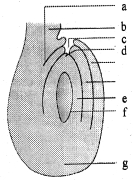
Identify the given figure.
A
Ovary
B
Multicarpellary syncarpous pistil
C
Ovule
D
Stamen
Solution
(C) The provided figure represents the structure of an anatropous ovule (megasporangium).
It shows various parts such as the funicle,hilum,integuments,micropyle,nucellus,and embryo sac.
Therefore,the correct identification of the given figure is an ovule.
It shows various parts such as the funicle,hilum,integuments,micropyle,nucellus,and embryo sac.
Therefore,the correct identification of the given figure is an ovule.
0 likes
View Solution243
MediumMCQ
In the given figure,what do 'a','b',and 'c' represent respectively?
A
Hilum,Funicle,Micropyle
B
Micropyle,Funicle,Nucellus
C
Hilum,Micropyle,Funicle
D
Embryo sac,Micropyle,Outer integument
Solution
(A) Based on the structure of a typical anatropous ovule:
- 'a' points to the Hilum,which is the junction between the ovule and the funicle.
- 'b' points to the Funicle,the stalk that attaches the ovule to the placenta.
- 'c' points to the Micropyle,the small opening at the apex of the ovule through which the pollen tube enters.
Therefore,the correct sequence is Hilum,Funicle,and Micropyle.
- 'a' points to the Hilum,which is the junction between the ovule and the funicle.
- 'b' points to the Funicle,the stalk that attaches the ovule to the placenta.
- 'c' points to the Micropyle,the small opening at the apex of the ovule through which the pollen tube enters.
Therefore,the correct sequence is Hilum,Funicle,and Micropyle.
0 likes
View Solution244
MediumMCQ
What do '$d$' and '$e$' represent in the given figure?
A
Micropylar pole and Embryo sac
B
Micropyle and Inner integument
C
Funiculus and Nucellus
D
Micropylar pole and Nucellus
Solution
(D) In the provided diagram of an anatropous ovule:
- '$a$' represents the Funiculus.
- '$b$' represents the Hilum.
- '$c$' represents the Micropyle.
- '$d$' represents the Micropylar pole.
- '$e$' represents the Nucellus.
- '$f$' represents the Embryo sac.
- '$g$' represents the Chalaza.
Therefore,'$d$' is the Micropylar pole and '$e$' is the Nucellus.
- '$a$' represents the Funiculus.
- '$b$' represents the Hilum.
- '$c$' represents the Micropyle.
- '$d$' represents the Micropylar pole.
- '$e$' represents the Nucellus.
- '$f$' represents the Embryo sac.
- '$g$' represents the Chalaza.
Therefore,'$d$' is the Micropylar pole and '$e$' is the Nucellus.
0 likes
View Solution245
MediumMCQ
What do '$f$' and '$g$' represent in the given figure?
A
Embryo sac and Chalazal pole
B
Nucellus and Chalazal pole
C
Integument and Chalazal pole
D
Funiculus and Nucellus
Solution
(A) In the provided diagram of an anatropous ovule:
- '$a$' represents the Hilum.
- '$b$' represents the Funiculus.
- '$c$' represents the Micropyle.
- '$d$' represents the Outer integument.
- '$e$' represents the Nucellus.
- '$f$' represents the Embryo sac.
- '$g$' represents the Chalazal pole.
Therefore,'$f$' is the Embryo sac and '$g$' is the Chalazal pole.
- '$a$' represents the Hilum.
- '$b$' represents the Funiculus.
- '$c$' represents the Micropyle.
- '$d$' represents the Outer integument.
- '$e$' represents the Nucellus.
- '$f$' represents the Embryo sac.
- '$g$' represents the Chalazal pole.
Therefore,'$f$' is the Embryo sac and '$g$' is the Chalazal pole.
0 likes
View Solution246
MediumMCQ
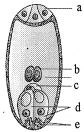
What do '$a$' and '$b$' represent in the given figure?
A
Synergids and Egg cell
B
Antipodal cells and Polar nuclei
C
Antipodal cells and Egg cell
D
Egg cell and Central cell
Solution
(B) In the structure of a mature embryo sac (Polygonum type):
$1$. '$a$' points to the group of three cells located at the chalazal end,which are known as Antipodal cells.
$2$. '$b$' points to the two nuclei located in the center of the large central cell,known as Polar nuclei.
Therefore,'$a$' represents Antipodal cells and '$b$' represents Polar nuclei.
$1$. '$a$' points to the group of three cells located at the chalazal end,which are known as Antipodal cells.
$2$. '$b$' points to the two nuclei located in the center of the large central cell,known as Polar nuclei.
Therefore,'$a$' represents Antipodal cells and '$b$' represents Polar nuclei.
0 likes
View Solution247
MediumMCQ
Identify '$C$' in the given figure and state its ploidy.
A
Zygote and $2n$
B
Synergid and $n$
C
Egg cell and $n$
D
Central cell and $2n$
Solution
(C) In the provided diagram of a mature embryo sac (Polygonum type):
- '$a$' represents antipodal cells.
- '$b$' represents polar nuclei.
- '$c$' represents the egg cell.
- '$d$' represents synergids.
- '$e$' represents filiform apparatus.
The egg cell is a haploid $(n)$ gamete formed within the embryo sac. Therefore,'$C$' is the egg cell and its ploidy is $n$.
- '$a$' represents antipodal cells.
- '$b$' represents polar nuclei.
- '$c$' represents the egg cell.
- '$d$' represents synergids.
- '$e$' represents filiform apparatus.
The egg cell is a haploid $(n)$ gamete formed within the embryo sac. Therefore,'$C$' is the egg cell and its ploidy is $n$.
0 likes
View Solution248
MediumMCQ
What do '$d$' and '$e$' represent in the given figure?
A
Antipodal cells and Filiform apparatus
B
Synergids and Filiform apparatus
C
Synergids and Egg apparatus
D
Antipodal cells and Egg apparatus
Solution
(B) In the given diagram of a mature embryo sac (polygonum type):
- '$a$' represents Antipodal cells.
- '$b$' represents Polar nuclei.
- '$c$' represents Central cell.
- '$d$' represents Synergids.
- '$e$' represents Filiform apparatus.
Therefore,'$d$' and '$e$' represent Synergids and Filiform apparatus respectively.
- '$a$' represents Antipodal cells.
- '$b$' represents Polar nuclei.
- '$c$' represents Central cell.
- '$d$' represents Synergids.
- '$e$' represents Filiform apparatus.
Therefore,'$d$' and '$e$' represent Synergids and Filiform apparatus respectively.
0 likes
View Solution249
MediumMCQ
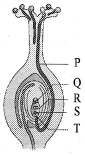
What do '$S$' and '$T$' represent in the given figure?
A
Epiblast and Coleoptile
B
Egg cell and Synergid
C
Radicle and Cotyledon
D
Filiform apparatus and Synergid
Solution
(B) In the provided diagram of a longitudinal section of a carpel showing pollen tube entry into the ovule:
- '$P$' represents the pollen tube.
- '$Q$' represents the antipodal cells.
- '$R$' represents the central cell (polar nuclei).
- '$S$' represents the egg cell.
- '$T$' represents the synergid cell.
Therefore,'$S$' and '$T$' represent the egg cell and synergid,respectively.
- '$P$' represents the pollen tube.
- '$Q$' represents the antipodal cells.
- '$R$' represents the central cell (polar nuclei).
- '$S$' represents the egg cell.
- '$T$' represents the synergid cell.
Therefore,'$S$' and '$T$' represent the egg cell and synergid,respectively.
0 likes
View Solution250
MediumMCQ
How many $MMC$ (Megaspore Mother Cells) are required to produce $800$ functional megaspores?
A
$200$
B
$400$
C
$600$
D
$800$
Solution
(D) In angiosperms,one $MMC$ (Megaspore Mother Cell) undergoes meiosis to produce four haploid megaspores.
Out of these four megaspores,usually only one remains functional,while the other three degenerate.
Therefore,$1$ $MMC$ produces $1$ functional megaspore.
To produce $800$ functional megaspores,we require $800$ $MMC$s.
Out of these four megaspores,usually only one remains functional,while the other three degenerate.
Therefore,$1$ $MMC$ produces $1$ functional megaspore.
To produce $800$ functional megaspores,we require $800$ $MMC$s.
0 likes
View SolutionSexual Reproduction in Flowering Plants — The Pistil, Megasporangium (ovule) and Embryo sac · Frequently Asked Questions
1Are these Sexual Reproduction in Flowering Plants questions useful for JEE and NEET?
Yes. All questions in this section are mapped to JEE Main and NEET exam patterns. Previous year questions from JEE Main, NEET, GUJCET and state-level exams are included with full solutions.
2Can I switch to Hindi or Gujarati for these questions?
Yes. Use the language tabs in the hero section or the sidebar to view the same questions and solutions in English, Hindi or Gujarati.
3How do I generate a question paper from this subtopic?
Use the Vedclass Exam Paper Generator — select the chapter and subtopic, set difficulty, and generate Sets A, B, C, D automatically. First 3 chapters of every subject are free.
Vedclass Products
For Students
Vedclass Test Series
Mock tests in real JEE/NEET style with performance analysis. 5-day free trial.
Start Free TrialFor Teachers
Exam Paper Generator
Generate Set A/B/C/D papers from this chapter in 2 minutes. 3 chapters free.
Try FreeFor Institutes
Online Exam Module
Live online exams with unlimited students, 360° analytics & white-label branding.
See DemoFor Teachers & Institutes
Generate a Sexual Reproduction in Flowering Plants Exam Paper in 2 Minutes
Select subtopic & difficulty — Sets A, B, C, D auto-generated with No Repeat logic.
First 3 chapters of every subject are free — no payment required.