
A English
Double Fertilisation Questions in English
Class 12 Biology · Sexual Reproduction in Flowering Plants · Double Fertilisation
143+
Questions
English
Language
100%
With Solutions
Showing 50 of 143 questions in English
1
MediumMCQ
Syngamy means
A
Fusion of similar spores
B
Fusion of dissimilar spores
C
Fusion of cytoplasm
D
Fusion of gametes
Solution
(D) Syngamy is the process of fusion of male and female gametes to form a diploid zygote.
In flowering plants,it specifically refers to the fusion of one of the male gametes with the egg cell to produce a diploid zygote $(2n)$.
In flowering plants,it specifically refers to the fusion of one of the male gametes with the egg cell to produce a diploid zygote $(2n)$.
0 likes
View Solution2
EasyMCQ
Double fertilization was discovered by
A
Karl Schnarf
B
$P$. Maheshwari
C
$S$.$G$. Nawaschin
D
$B$.$G$.$L$. Swamy
Solution
(C) Double fertilization is a characteristic feature of angiosperms.
It was discovered by $S.G. Nawaschin$ in $1898$ in the plants $Fritillaria$ and $Lilium$.
In this process,one male gamete fuses with the egg cell to form a zygote,and the other male gamete fuses with the two polar nuclei to form the primary endosperm nucleus $(PEN)$.
It was discovered by $S.G. Nawaschin$ in $1898$ in the plants $Fritillaria$ and $Lilium$.
In this process,one male gamete fuses with the egg cell to form a zygote,and the other male gamete fuses with the two polar nuclei to form the primary endosperm nucleus $(PEN)$.
0 likes
View Solution3
MediumMCQ
Double fertilization is a characteristic of
A
Gymnosperms
B
Bryophytes
C
Angiosperms
D
Pteridophytes
Solution
(C) Double fertilization is a unique and defining characteristic of $Angiosperms$ (flowering plants).
In this process, one male gamete fuses with the egg cell to form a diploid zygote $(syngamy)$, and the second male gamete fuses with the two polar nuclei to form a triploid primary endosperm nucleus $(triple \text{ } fusion)$.
$Gymnosperms$, $Bryophytes$, and $Pteridophytes$ do not exhibit this process, as they undergo only single fertilization.
In this process, one male gamete fuses with the egg cell to form a diploid zygote $(syngamy)$, and the second male gamete fuses with the two polar nuclei to form a triploid primary endosperm nucleus $(triple \text{ } fusion)$.
$Gymnosperms$, $Bryophytes$, and $Pteridophytes$ do not exhibit this process, as they undergo only single fertilization.
0 likes
View Solution4
MediumMCQ
Number of nuclei taking part in double fertilization is
A
$2$
B
$3$
C
$4$
D
$5$
Solution
(D) Double fertilization involves two processes: syngamy and triple fusion.
$1$. Syngamy involves the fusion of one male gamete (sperm nucleus) with the egg cell (egg nucleus).
$2$. Triple fusion involves the fusion of the second male gamete (sperm nucleus) with the two polar nuclei.
Therefore,the total number of nuclei involved is $1$ (sperm) + $1$ (egg) + $1$ (sperm) + $2$ (polar nuclei) = $5$ nuclei.
$1$. Syngamy involves the fusion of one male gamete (sperm nucleus) with the egg cell (egg nucleus).
$2$. Triple fusion involves the fusion of the second male gamete (sperm nucleus) with the two polar nuclei.
Therefore,the total number of nuclei involved is $1$ (sperm) + $1$ (egg) + $1$ (sperm) + $2$ (polar nuclei) = $5$ nuclei.
0 likes
View Solution5
MediumMCQ
Fusion of two dissimilar gametes is called
A
Fertilization
B
Pollination
C
Self-pollination
D
Self-fertilization
Solution
(A) The fusion of two dissimilar gametes (male and female gametes) is known as fertilization or syngamy.
This process results in the formation of a diploid zygote.
Pollination is the transfer of pollen grains from the anther to the stigma,which is a precursor to fertilization but not the fusion itself.
This process results in the formation of a diploid zygote.
Pollination is the transfer of pollen grains from the anther to the stigma,which is a precursor to fertilization but not the fusion itself.
0 likes
View Solution6
MediumMCQ
By double fertilization is formed:
A
Endosperm
B
Megaspore
C
Seed
D
Fruit
Solution
(A) Double fertilization involves two fusion events: syngamy (fusion of one male gamete with the egg cell to form a zygote) and triple fusion (fusion of the second male gamete with two polar nuclei to form the Primary Endosperm Nucleus $(PEN)$).
The $PEN$ subsequently develops into the endosperm, which provides nutrition to the developing embryo.
Therefore, double fertilization is essential as it ensures the formation of nutritive tissue $(endosperm)$ only when embryo formation is guaranteed.
The $PEN$ subsequently develops into the endosperm, which provides nutrition to the developing embryo.
Therefore, double fertilization is essential as it ensures the formation of nutritive tissue $(endosperm)$ only when embryo formation is guaranteed.
0 likes
View Solution7
MediumMCQ
Which one of the following events in a botanical garden is never directly influenced by light?
A
Flowering
B
Photosynthesis
C
Transpiration
D
Fertilization
Solution
(D) Light is a critical environmental factor that influences many physiological processes in plants.
$1$. Flowering is regulated by photoperiodism,which is the response of plants to the duration of light and dark periods.
$2$. Photosynthesis is directly dependent on light energy to convert carbon dioxide and water into glucose.
$3$. Transpiration is influenced by light because light triggers the opening of stomata,which increases the rate of water loss.
$4$. Fertilization,which involves the fusion of male and female gametes within the embryo sac,is an internal process that is not directly triggered or regulated by light intensity or duration. Therefore,it is the correct answer.
$1$. Flowering is regulated by photoperiodism,which is the response of plants to the duration of light and dark periods.
$2$. Photosynthesis is directly dependent on light energy to convert carbon dioxide and water into glucose.
$3$. Transpiration is influenced by light because light triggers the opening of stomata,which increases the rate of water loss.
$4$. Fertilization,which involves the fusion of male and female gametes within the embryo sac,is an internal process that is not directly triggered or regulated by light intensity or duration. Therefore,it is the correct answer.
0 likes
View Solution8
MediumMCQ
The process of fusion between the male nucleus and the egg nucleus is called
A
Syngamy
B
Triple fusion
C
Double fertilization
D
Conjugation
Solution
(A) The fusion of a male gamete with the egg cell (female gamete) is known as $Syngamy$. This process results in the formation of a diploid zygote. $Triple \text{ } fusion$ involves the fusion of the second male gamete with two polar nuclei to form the primary endosperm nucleus. $Double \text{ } fertilization$ is the collective term for both $Syngamy$ and $Triple \text{ } fusion$ occurring in angiosperms.
0 likes
View Solution9
EasyMCQ
Double fertilization was first discovered by Nawaschin $(1898)$ in
A
Lilium and Fritillaria
B
Mango and sugarcane
C
Papaya and pea
D
Brassica and Candytuft
Solution
(A) Double fertilization is a characteristic feature of angiosperms. It involves the fusion of one male gamete with the egg cell (syngamy) and the other male gamete with the two polar nuclei (triple fusion). This process was first discovered by Sergei Nawaschin in $1898$ in the members of the Liliaceae family,specifically in the genera $Lilium$ and $Fritillaria$.
0 likes
View Solution10
EasyMCQ
The phenomenon of syngamy (fertilization) in angiosperms was discovered by
A
Svedberg
B
Strasburger
C
Nawaschin
D
Coulter and Chamberlin
Solution
(B) The phenomenon of syngamy (fertilization) in angiosperms was discovered by Eduard Strasburger in $1884$.
In angiosperms,the pollen tube delivers the male gametes to the embryo sac,where one male gamete fuses with the egg cell to form a zygote,a process known as syngamy.
In angiosperms,the pollen tube delivers the male gametes to the embryo sac,where one male gamete fuses with the egg cell to form a zygote,a process known as syngamy.
0 likes
View Solution11
MediumMCQ
In angiosperms,triple fusion is necessary for the formation of:
A
Seed coat
B
Fruit wall
C
Embryo
D
Endosperm
Solution
(D) In angiosperms,double fertilization involves two processes: syngamy and triple fusion.
Syngamy involves the fusion of one male gamete with the egg cell to form a diploid zygote,which develops into the embryo.
Triple fusion involves the fusion of the second male gamete with two polar nuclei (or a secondary nucleus) to form a primary endosperm nucleus $(PEN)$.
The $PEN$ develops into the endosperm,which provides nutrition to the developing embryo.
Therefore,triple fusion is necessary for the formation of the endosperm.
Syngamy involves the fusion of one male gamete with the egg cell to form a diploid zygote,which develops into the embryo.
Triple fusion involves the fusion of the second male gamete with two polar nuclei (or a secondary nucleus) to form a primary endosperm nucleus $(PEN)$.
The $PEN$ develops into the endosperm,which provides nutrition to the developing embryo.
Therefore,triple fusion is necessary for the formation of the endosperm.
0 likes
View Solution12
MediumMCQ
Which of the following is without exception in angiosperms?
A
Secondary growth
B
Presence of vessels
C
Double fertilization
D
Autotrophic nutrition
Solution
(C) $Double$ $fertilization$ is a unique and defining characteristic found exclusively in angiosperms, with no exceptions.
During this process, one male gamete fuses with the egg cell to form a diploid zygote $(2n)$, while the second male gamete fuses with the two polar nuclei (or the secondary nucleus) to form a triploid primary endosperm nucleus $(3n)$.
The triploid nucleus develops into the endosperm, which provides nourishment to the developing embryo.
During this process, one male gamete fuses with the egg cell to form a diploid zygote $(2n)$, while the second male gamete fuses with the two polar nuclei (or the secondary nucleus) to form a triploid primary endosperm nucleus $(3n)$.
The triploid nucleus develops into the endosperm, which provides nourishment to the developing embryo.
0 likes
View Solution13
MediumMCQ
Triple fusion in angiosperms is the fusion of the second sperm with:
A
Antipodal cell and one synergid cell
B
Two antipodal cells
C
Two synergid cells
D
Two polar nuclei
Solution
(D) In angiosperms,double fertilization involves two processes: syngamy and triple fusion.
During triple fusion,the second male gamete (sperm) fuses with the two polar nuclei located in the central cell of the embryo sac.
This fusion results in the formation of a triploid $(3n)$ primary endosperm nucleus $(PEN)$.
Therefore,the correct answer is the fusion of the second sperm with two polar nuclei.
During triple fusion,the second male gamete (sperm) fuses with the two polar nuclei located in the central cell of the embryo sac.
This fusion results in the formation of a triploid $(3n)$ primary endosperm nucleus $(PEN)$.
Therefore,the correct answer is the fusion of the second sperm with two polar nuclei.
0 likes
View Solution14
MediumMCQ
Triple fusion is characteristic of
A
Thallophytes
B
Bryophytes
C
Pteridophytes
D
Angiosperms
Solution
(D) Triple fusion is a unique process that occurs during the double fertilization of angiosperms.
In this process,one of the two male gametes fuses with the two polar nuclei (or the secondary nucleus) located in the central cell of the embryo sac.
This fusion results in the formation of a triploid $(3n)$ primary endosperm nucleus $(PEN)$.
Since this process involves the fusion of three haploid nuclei,it is termed triple fusion.
Therefore,it is a characteristic feature of angiosperms.
In this process,one of the two male gametes fuses with the two polar nuclei (or the secondary nucleus) located in the central cell of the embryo sac.
This fusion results in the formation of a triploid $(3n)$ primary endosperm nucleus $(PEN)$.
Since this process involves the fusion of three haploid nuclei,it is termed triple fusion.
Therefore,it is a characteristic feature of angiosperms.
0 likes
View Solution15
MediumMCQ
Double fertilization involves
A
Fertilization of the egg by two male gametes
B
Fertilization of two eggs in the same embryo sac by two sperms brought by one pollen tube
C
Fertilization of the egg and the central cell by two sperms brought by different pollen tubes
D
Fertilization of the egg and the central cell by two sperms brought by the same pollen tube
Solution
(D) Double fertilization is a characteristic feature of angiosperms.
It involves two fusion events:
$1$. Syngamy: One male gamete fuses with the egg cell to form a diploid zygote $(2n)$.
$2$. Triple fusion: The second male gamete fuses with the two polar nuclei (or the secondary nucleus) in the central cell to form a triploid primary endosperm nucleus ($PEN$,$3n$).
Both male gametes are delivered to the embryo sac by the same pollen tube.
It involves two fusion events:
$1$. Syngamy: One male gamete fuses with the egg cell to form a diploid zygote $(2n)$.
$2$. Triple fusion: The second male gamete fuses with the two polar nuclei (or the secondary nucleus) in the central cell to form a triploid primary endosperm nucleus ($PEN$,$3n$).
Both male gametes are delivered to the embryo sac by the same pollen tube.
0 likes
View Solution16
MediumMCQ
Which of the following is not true for double fertilization?
A
Discovered by Nawaschin
B
Male gamete and secondary nucleus fuse to form endosperm nucleus
C
Endosperm nucleus is diploid
D
Endosperm provides nutrition to the embryo
Solution
(C) Double fertilization involves two processes: syngamy and triple fusion.
In triple fusion,one male gamete $(n)$ fuses with the secondary nucleus or two polar nuclei $(2n)$ to form the Primary Endosperm Nucleus $(PEN)$,which is triploid $(3n)$.
Therefore,the statement that the endosperm nucleus is diploid is incorrect.
Thus,the correct option is $C$.
In triple fusion,one male gamete $(n)$ fuses with the secondary nucleus or two polar nuclei $(2n)$ to form the Primary Endosperm Nucleus $(PEN)$,which is triploid $(3n)$.
Therefore,the statement that the endosperm nucleus is diploid is incorrect.
Thus,the correct option is $C$.
0 likes
View Solution17
MediumMCQ
Double fertilisation results in the production of
A
Haploid nucleus
B
Diploid nucleus
C
Triploid nucleus
D
Tetraploid nucleus
Solution
(C) Double fertilisation is a characteristic feature of angiosperms.
It involves two fusion events:
$1$. Syngamy: One male gamete $(n)$ fuses with the egg cell $(n)$ to form a diploid zygote $(2n)$.
$2$. Triple fusion: The second male gamete $(n)$ fuses with the two polar nuclei $(n + n)$ to form the primary endosperm nucleus $(PEN)$,which is triploid $(3n)$.
Therefore,the process results in the production of a triploid nucleus $(3n)$ in the form of $PEN$.
It involves two fusion events:
$1$. Syngamy: One male gamete $(n)$ fuses with the egg cell $(n)$ to form a diploid zygote $(2n)$.
$2$. Triple fusion: The second male gamete $(n)$ fuses with the two polar nuclei $(n + n)$ to form the primary endosperm nucleus $(PEN)$,which is triploid $(3n)$.
Therefore,the process results in the production of a triploid nucleus $(3n)$ in the form of $PEN$.
0 likes
View Solution18
MediumMCQ
The endosperm in angiosperms is formed:
A
After fertilization
B
Before fertilization
C
Along with fertilization
D
Before pollen discharge
Solution
(A) In angiosperms,the endosperm is formed through a process called $Triple \ Fusion$.
During double fertilization,one male gamete fuses with the two polar nuclei (or the secondary nucleus) to form the Primary Endosperm Nucleus $(PEN)$.
Since this process occurs as a result of the fusion of gametes,it takes place after the fertilization process has initiated.
During double fertilization,one male gamete fuses with the two polar nuclei (or the secondary nucleus) to form the Primary Endosperm Nucleus $(PEN)$.
Since this process occurs as a result of the fusion of gametes,it takes place after the fertilization process has initiated.
0 likes
View Solution19
MediumMCQ
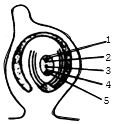
The diagram below is a longitudinal section of an ovule of an angiosperm. With which of the following structures do the contents of one pollen tube fuse?
A
$1$ and $3$
B
$1$ and $4$
C
$2$ and $3$
D
$3$ and $4$
Solution
(D) In an angiosperm ovule,double fertilization occurs. One male gamete fuses with the egg cell (labeled $4$) to form a diploid zygote. The other male gamete fuses with the two polar nuclei (labeled $3$) to form the primary endosperm nucleus $(PEN)$,which is triploid. Therefore,the contents of the pollen tube fuse with structures $3$ and $4$.
0 likes
View Solution20
MediumMCQ
The process of double fertilization means:
A
Fusion of one male gamete nucleus with the egg nucleus and the fusion of the other male gamete nucleus with the secondary nucleus.
B
Fusion of a male gamete nucleus with the secondary nucleus.
C
Fusion of two polar nuclei with each other.
D
Fusion of a male gamete nucleus with the egg nucleus.
Solution
(A) Double fertilization is a characteristic feature of angiosperms. It involves two distinct fusion events:
$1$. Syngamy: One male gamete fuses with the egg cell to form a diploid zygote $(n + n = 2n)$.
$2$. Triple Fusion: The second male gamete fuses with the two polar nuclei (or the secondary nucleus) to form a triploid primary endosperm nucleus $(n + n + n = 3n)$.
Together,these two processes are known as double fertilization.
$1$. Syngamy: One male gamete fuses with the egg cell to form a diploid zygote $(n + n = 2n)$.
$2$. Triple Fusion: The second male gamete fuses with the two polar nuclei (or the secondary nucleus) to form a triploid primary endosperm nucleus $(n + n + n = 3n)$.
Together,these two processes are known as double fertilization.
0 likes
View Solution21
MediumMCQ
Fertilization is depicted by the condition:
A
$n \to 2n$
B
$2n \to 3n$
C
$2n \to 4n$
D
$4n \to 8n$
Solution
(A) Fertilization is the process of fusion of a haploid male gamete (sperm,$n$) and a haploid female gamete (ovum,$n$).
This fusion results in the formation of a diploid zygote $(2n)$.
Therefore,the process is represented by the condition $n + n \to 2n$,which simplifies to $n \to 2n$ in terms of ploidy change.
This fusion results in the formation of a diploid zygote $(2n)$.
Therefore,the process is represented by the condition $n + n \to 2n$,which simplifies to $n \to 2n$ in terms of ploidy change.
0 likes
View Solution22
MediumMCQ
Syngamy is the process in which
A
Male gamete fuses with female gamete
B
Pollen tube enters into the ovule through micropyle
C
Pollen tube enter into the ovule through chalaza
D
Vegetative cell and tube cell fuse
Solution
(A) Syngamy is the process of fusion of the male gamete with the female gamete (ovum) to form a diploid zygote.
This process involves the fusion of the sperm and egg pronuclei.
The envelopes of the sperm and egg pronuclei degenerate,and their chromosomes intermingle to form a $Synkaryon$,which is also known as $Karyogamy$ or $Syngamy$.
This process involves the fusion of the sperm and egg pronuclei.
The envelopes of the sperm and egg pronuclei degenerate,and their chromosomes intermingle to form a $Synkaryon$,which is also known as $Karyogamy$ or $Syngamy$.
0 likes
View Solution23
MediumMCQ
Which group of plants exhibits the phenomenon of double fertilization?
A
Angiosperms
B
Algae
C
Gymnosperms
D
Bryophytes
Solution
(A) Double fertilization is a unique and defining characteristic of angiosperms (flowering plants).
In this process,one male gamete fuses with the egg cell to form a diploid zygote (syngamy),and the second male gamete fuses with the two polar nuclei to form a triploid primary endosperm nucleus (triple fusion).
This combined process is known as double fertilization.
In this process,one male gamete fuses with the egg cell to form a diploid zygote (syngamy),and the second male gamete fuses with the two polar nuclei to form a triploid primary endosperm nucleus (triple fusion).
This combined process is known as double fertilization.
0 likes
View Solution24
EasyMCQ
Double fertilization is a characteristic feature of which of the following?
A
Angiosperms
B
Gymnosperms
C
Algae
D
Pteridophytes
Solution
(A) Double fertilization is a unique process that occurs in $Angiosperms$.
It involves two fusion events:
$1$. Syngamy: One male gamete fuses with the egg cell to form a diploid zygote $(2n)$.
$2$. Triple fusion: The second male gamete fuses with the two polar nuclei (or secondary nucleus) to form the primary endosperm nucleus $(PEN)$,which is triploid $(3n)$.
This process is exclusive to flowering plants $(Angiosperms)$.
It involves two fusion events:
$1$. Syngamy: One male gamete fuses with the egg cell to form a diploid zygote $(2n)$.
$2$. Triple fusion: The second male gamete fuses with the two polar nuclei (or secondary nucleus) to form the primary endosperm nucleus $(PEN)$,which is triploid $(3n)$.
This process is exclusive to flowering plants $(Angiosperms)$.
0 likes
View Solution25
MediumMCQ
Double fertilization and triple fusion are characteristic features of . . . . . . .
A
Spermatophyta
B
Gymnosperms
C
Pteridophytes
D
Angiosperms
Solution
(D) Double fertilization is a complex fertilization mechanism in angiosperms.
It involves the fusion of one male gamete with the egg cell to form a diploid zygote (syngamy).
The second male gamete fuses with the two polar nuclei (or secondary nucleus) to form a triploid primary endosperm nucleus $(PEN)$,a process known as triple fusion.
Since these two processes occur in the same embryo sac,the phenomenon is collectively called double fertilization,which is unique to angiosperms.
It involves the fusion of one male gamete with the egg cell to form a diploid zygote (syngamy).
The second male gamete fuses with the two polar nuclei (or secondary nucleus) to form a triploid primary endosperm nucleus $(PEN)$,a process known as triple fusion.
Since these two processes occur in the same embryo sac,the phenomenon is collectively called double fertilization,which is unique to angiosperms.
0 likes
View Solution26
EasyMCQ
Double fertilization is observed only in:
A
Gymnosperms
B
Angiosperms
C
Spermatophyta
D
Embryophyta
Solution
(B) Double fertilization is a unique characteristic feature of angiosperms (flowering plants).
It involves two fusion events:
$1$. Syngamy: One male gamete fuses with the egg cell to form a diploid zygote $(2n)$.
$2$. Triple fusion: The second male gamete fuses with the two polar nuclei (or secondary nucleus) to form a triploid primary endosperm nucleus $(3n)$.
This process ensures the development of an embryo and the formation of endosperm to provide nourishment.
It involves two fusion events:
$1$. Syngamy: One male gamete fuses with the egg cell to form a diploid zygote $(2n)$.
$2$. Triple fusion: The second male gamete fuses with the two polar nuclei (or secondary nucleus) to form a triploid primary endosperm nucleus $(3n)$.
This process ensures the development of an embryo and the formation of endosperm to provide nourishment.
0 likes
View Solution27
MediumMCQ
The main embryo develops from the structure formed as a result of . . . . . . .
A
Double fertilization
B
Triple fusion
C
Syngamy
D
Fusion of two polar nuclei of the endosperm
Solution
(C) In angiosperms,the process of fertilization involves two events: syngamy and triple fusion.
Syngamy is the fusion of the male gamete with the egg cell to form a diploid zygote $(2n)$.
The zygote subsequently develops into the embryo.
Triple fusion involves the fusion of the second male gamete with two polar nuclei to form the primary endosperm nucleus $(PEN)$,which develops into the endosperm.
Therefore,the embryo develops from the product of syngamy.
Syngamy is the fusion of the male gamete with the egg cell to form a diploid zygote $(2n)$.
The zygote subsequently develops into the embryo.
Triple fusion involves the fusion of the second male gamete with two polar nuclei to form the primary endosperm nucleus $(PEN)$,which develops into the endosperm.
Therefore,the embryo develops from the product of syngamy.
0 likes
View Solution28
MediumMCQ
The term $Xenia$ refers to the effect of foreign pollen on which of the following?
A
Stomatal tissue
B
Root
C
Flowers
D
Endosperm
Solution
(D) $Xenia$ is defined as the effect of foreign pollen on the development and characteristics of the endosperm in a seed. This phenomenon occurs due to the phenomenon of double fertilization,where the male gamete fuses with the two polar nuclei to form the triploid $(3n)$ endosperm. The genetic contribution from the pollen parent can influence the phenotype (such as color or texture) of the endosperm tissue within the seed.
0 likes
View Solution29
EasyMCQ
One of the male gametes moves towards the egg cell and fuses with its nucleus. This process is called ....
A
Syngamy
B
Triple fusion
C
Double fertilization
D
None of these
Solution
(A) In angiosperms,the process of fertilization involves two events:
$1$. Syngamy: One of the male gametes fuses with the egg cell (ovum) to form a diploid zygote $(2n)$.
$2$. Triple fusion: The second male gamete fuses with the two polar nuclei to form the primary endosperm nucleus $(PEN)$.
Since the question specifically describes the fusion of a male gamete with the egg cell nucleus,this process is known as Syngamy.
$1$. Syngamy: One of the male gametes fuses with the egg cell (ovum) to form a diploid zygote $(2n)$.
$2$. Triple fusion: The second male gamete fuses with the two polar nuclei to form the primary endosperm nucleus $(PEN)$.
Since the question specifically describes the fusion of a male gamete with the egg cell nucleus,this process is known as Syngamy.
0 likes
View Solution30
EasyMCQ
In $Capsella$,the pollen tube enters the ovule through the micropyle; therefore,such fertilization is called......
A
Porogamous
B
Chalazogamous
C
Mesogamous
D
Basigamous
Solution
(A) In angiosperms,the entry of the pollen tube into the ovule can occur in three ways:
$1$. $Porogamy$: The pollen tube enters through the micropyle. This is the most common type,observed in $Capsella$.
$2$. $Chalazogamy$: The pollen tube enters through the chalaza.
$3$. $Mesogamy$: The pollen tube enters through the integuments or the funiculus.
Since the question specifies entry through the micropyle,the correct term is $Porogamous$.
$1$. $Porogamy$: The pollen tube enters through the micropyle. This is the most common type,observed in $Capsella$.
$2$. $Chalazogamy$: The pollen tube enters through the chalaza.
$3$. $Mesogamy$: The pollen tube enters through the integuments or the funiculus.
Since the question specifies entry through the micropyle,the correct term is $Porogamous$.
0 likes
View Solution31
MediumMCQ
Which of the following is $NOT$ true regarding double fertilization?
A
It was discovered by Nawaschin.
B
Fusion of male gamete and secondary nucleus to form primary endosperm nucleus.
C
The primary endosperm nucleus is diploid.
D
Endosperm provides nutrition to the embryo.
Solution
(C) Double fertilization involves two processes: Syngamy and Triple Fusion.
$1$. Syngamy: One male gamete fuses with the egg cell to form a diploid zygote $(2n)$.
$2$. Triple Fusion: The second male gamete $(n)$ fuses with the secondary nucleus $(2n)$ to form the Primary Endosperm Nucleus $(PEN)$.
Since the secondary nucleus is diploid $(2n)$ and the male gamete is haploid $(n)$,the resulting $PEN$ is triploid $(3n)$.
Therefore,the statement that the primary endosperm nucleus is diploid is incorrect.
$1$. Syngamy: One male gamete fuses with the egg cell to form a diploid zygote $(2n)$.
$2$. Triple Fusion: The second male gamete $(n)$ fuses with the secondary nucleus $(2n)$ to form the Primary Endosperm Nucleus $(PEN)$.
Since the secondary nucleus is diploid $(2n)$ and the male gamete is haploid $(n)$,the resulting $PEN$ is triploid $(3n)$.
Therefore,the statement that the primary endosperm nucleus is diploid is incorrect.
0 likes
View Solution32
MediumMCQ
During double fertilization,the endosperm is formed by ........
A
Two polar nuclei and one male gamete
B
One polar nucleus and one male gamete
C
Egg cell and one male gamete
D
Two polar nuclei and two male gametes
Solution
(A) In angiosperms,double fertilization involves two processes: syngamy and triple fusion.
During triple fusion,one male gamete $(n)$ fuses with two polar nuclei $(n + n)$ or the secondary nucleus $(2n)$ present in the central cell.
This process results in the formation of the Primary Endosperm Nucleus $(PEN)$,which is triploid $(3n)$.
This $PEN$ subsequently develops into the endosperm,which provides nourishment to the developing embryo.
During triple fusion,one male gamete $(n)$ fuses with two polar nuclei $(n + n)$ or the secondary nucleus $(2n)$ present in the central cell.
This process results in the formation of the Primary Endosperm Nucleus $(PEN)$,which is triploid $(3n)$.
This $PEN$ subsequently develops into the endosperm,which provides nourishment to the developing embryo.
0 likes
View Solution33
EasyMCQ
Double fertilization is a characteristic feature of only ....
A
Bryophytes
B
Angiosperms
C
Gymnosperms
D
Pteridophytes
Solution
(B) Double fertilization is a unique and defining characteristic of angiosperms (flowering plants).
In this process,one male gamete fuses with the egg cell to form a diploid zygote (syngamy),and the other male gamete fuses with the two polar nuclei to form a triploid primary endosperm nucleus (triple fusion).
This combined process is known as double fertilization.
In this process,one male gamete fuses with the egg cell to form a diploid zygote (syngamy),and the other male gamete fuses with the two polar nuclei to form a triploid primary endosperm nucleus (triple fusion).
This combined process is known as double fertilization.
0 likes
View Solution34
MediumMCQ
What is double fertilization?
A
Fusion of male gametes and egg cell
B
Fusion of two polar nuclei
C
Fusion of one male gamete with the egg and the second male gamete with the secondary nucleus
D
All of the above
Solution
(C) Double fertilization is a characteristic feature of angiosperms.
It involves two fusion events:
$1$. Syngamy: One male gamete fuses with the egg cell to form a diploid zygote $(n + n = 2n)$.
$2$. Triple Fusion: The second male gamete fuses with the two polar nuclei (or secondary nucleus) to form a triploid primary endosperm nucleus $(n + n + n = 3n)$.
Therefore,the correct definition is the fusion of one male gamete with the egg and the second male gamete with the secondary nucleus.
It involves two fusion events:
$1$. Syngamy: One male gamete fuses with the egg cell to form a diploid zygote $(n + n = 2n)$.
$2$. Triple Fusion: The second male gamete fuses with the two polar nuclei (or secondary nucleus) to form a triploid primary endosperm nucleus $(n + n + n = 3n)$.
Therefore,the correct definition is the fusion of one male gamete with the egg and the second male gamete with the secondary nucleus.
0 likes
View Solution35
EasyMCQ
The discoverer of the process of double fertilization is........
A
Hofmeister
B
Strasburger
C
Nawaschin
D
Amici
Solution
(C) Double fertilization is a complex fertilization mechanism in angiosperms. It involves the joining of a female gametophyte with two male gametes. This process was discovered by $S.G. Nawaschin$ in $1898$ in the plants $Lilium$ and $Fritillaria$.
0 likes
View Solution36
EasyMCQ
Double fertilization is essential for the formation of:
A
Cotyledon
B
Seed coat
C
Endosperm
D
Nucellus
Solution
(C) Double fertilization is a unique phenomenon in angiosperms. It involves two fusion events:
$1$. Syngamy: One male gamete fuses with the egg cell to form a diploid zygote $(2n)$,which develops into the embryo.
$2$. Triple Fusion: The second male gamete fuses with the two polar nuclei (or the secondary nucleus) to form the primary endosperm nucleus $(PEN)$,which is triploid $(3n)$.
The $PEN$ subsequently develops into the endosperm,which provides nutrition to the developing embryo. Therefore,double fertilization is essential for the formation of the endosperm.
$1$. Syngamy: One male gamete fuses with the egg cell to form a diploid zygote $(2n)$,which develops into the embryo.
$2$. Triple Fusion: The second male gamete fuses with the two polar nuclei (or the secondary nucleus) to form the primary endosperm nucleus $(PEN)$,which is triploid $(3n)$.
The $PEN$ subsequently develops into the endosperm,which provides nutrition to the developing embryo. Therefore,double fertilization is essential for the formation of the endosperm.
0 likes
View Solution37
EasyMCQ
Double fertilization was first discovered by $Nawaschin$ in which of the following?
A
$Lilium$ and $Fritillaria$
B
$Mangifera$ and $Saccharum$
C
$Carica$ and $Pisum$
D
$Brassica$ and $Iberis$
Solution
(A) Double fertilization is a characteristic feature of angiosperms. It was first discovered by $S.G. Nawaschin$ in $1898$ in the members of the family $Liliaceae$,specifically in the genera $Lilium$ and $Fritillaria$. During this process,one male gamete fuses with the egg cell to form a diploid zygote (syngamy),and the other male gamete fuses with the two polar nuclei to form a triploid primary endosperm nucleus (triple fusion).
0 likes
View Solution38
MediumMCQ
In angiosperms,the endosperm is formed from:
A
Secondary polar nuclei
B
Primary polar nuclei
C
Diploid nuclei
D
Zygote
Solution
(A) In angiosperms,the process of double fertilization involves the fusion of one male gamete with the egg cell to form a diploid zygote $(2n)$.
Simultaneously,the second male gamete fuses with the two polar nuclei (or a single diploid secondary nucleus) located in the central cell.
This process is known as triple fusion,resulting in the formation of the Primary Endosperm Nucleus $(PEN)$,which is triploid $(3n)$.
This $PEN$ subsequently develops into the endosperm,which provides nourishment to the developing embryo.
Simultaneously,the second male gamete fuses with the two polar nuclei (or a single diploid secondary nucleus) located in the central cell.
This process is known as triple fusion,resulting in the formation of the Primary Endosperm Nucleus $(PEN)$,which is triploid $(3n)$.
This $PEN$ subsequently develops into the endosperm,which provides nourishment to the developing embryo.
0 likes
View Solution39
EasyMCQ
The primary endosperm nucleus is formed by the fusion of:
A
$2$ nuclei
B
$3$ nuclei
C
$4$ nuclei
D
$5$ nuclei
Solution
(B) In angiosperms,double fertilization occurs. One male gamete fuses with the egg cell to form a zygote $(n + n = 2n)$. The other male gamete fuses with the two polar nuclei (or the secondary nucleus) present in the central cell. This process is known as triple fusion because three haploid nuclei $(n + n + n = 3n)$ fuse together to form the primary endosperm nucleus $(PEN)$. Therefore,the $PEN$ is formed by the fusion of $3$ nuclei.
0 likes
View Solution40
EasyMCQ
The number of nuclei involved in double fertilization is.......
A
Two
B
Three
C
Four
D
Five
Solution
(D) Double fertilization involves two distinct fusion events in the embryo sac:
$1$. Syngamy: One male gamete $(n)$ fuses with the egg cell $(n)$ to form a diploid zygote $(2n)$. This involves $2$ nuclei.
$2$. Triple fusion: The second male gamete $(n)$ fuses with the two polar nuclei $(n + n)$ to form the primary endosperm nucleus ($PEN$,$3n$). This involves $3$ nuclei.
Total nuclei involved = $2$ (syngamy) + $3$ (triple fusion) = $5$ nuclei.
$1$. Syngamy: One male gamete $(n)$ fuses with the egg cell $(n)$ to form a diploid zygote $(2n)$. This involves $2$ nuclei.
$2$. Triple fusion: The second male gamete $(n)$ fuses with the two polar nuclei $(n + n)$ to form the primary endosperm nucleus ($PEN$,$3n$). This involves $3$ nuclei.
Total nuclei involved = $2$ (syngamy) + $3$ (triple fusion) = $5$ nuclei.
0 likes
View Solution41
MediumMCQ
How many and what type of male gametes are produced by the male gametophyte of $Capsella$?
A
One,multiflagellated
B
Two,biflagellated
C
Two,multiflagellated
D
Two,non-motile
Solution
(D) In angiosperms like $Capsella$,the pollen grain represents the male gametophyte.
Upon germination,the generative cell divides to form two male gametes.
These male gametes in angiosperms are non-motile and lack flagella,as they are transported to the egg cell via the pollen tube.
Upon germination,the generative cell divides to form two male gametes.
These male gametes in angiosperms are non-motile and lack flagella,as they are transported to the egg cell via the pollen tube.
0 likes
View Solution42
EasyMCQ
The product formed by the fusion of polar nuclei and a male gamete is called.........
A
Nucellus
B
Primary Endosperm Nucleus
C
Zygote
D
Secondary Nucleus
Solution
(B) In angiosperms,double fertilization occurs. One male gamete fuses with the egg cell to form a diploid zygote $(2n)$. The second male gamete fuses with the two polar nuclei (or the secondary nucleus) to form the Primary Endosperm Nucleus $(PEN)$. This process is known as triple fusion,and the resulting structure is the Primary Endosperm Nucleus $(3n)$.
0 likes
View Solution43
MediumMCQ
Syngamy is a process in which .....
A
Male gametes fuse with female gametes.
B
Pollen tube enters the ovule through the hilum.
C
Pollen tube enters the ovule through the micropyle.
D
Fusion of vegetative cells and generative cells.
Solution
(A) Syngamy is the process of fusion of a male gamete with a female gamete (egg cell) to form a diploid zygote. This is the primary event of fertilization in flowering plants. In the context of double fertilization,syngamy results in the formation of the zygote,while the fusion of the second male gamete with the two polar nuclei (or secondary nucleus) is known as triple fusion,which results in the formation of the primary endosperm nucleus $(PEN)$.
0 likes
View Solution44
MediumMCQ
What does double fertilization represent?
A
Fertilization of eggs by two male gametes.
B
Fertilization of two eggs in the same embryo sac by two sperms from the same pollen tube.
C
Fertilization of the egg and the central cell by two different sperms from different pollen tubes.
D
Fertilization of the egg and the central cell by two different sperms from the same pollen tube.
Solution
(D) Double fertilization is a characteristic feature of angiosperms. It involves two fusion events occurring within the embryo sac:
$1$. Syngamy: One male gamete fuses with the egg cell to form a diploid zygote $(2n)$.
$2$. Triple Fusion: The second male gamete fuses with the two polar nuclei (or the secondary nucleus) in the central cell to form a triploid primary endosperm nucleus $(3n)$.
Both male gametes are delivered to the embryo sac by the same pollen tube.
$1$. Syngamy: One male gamete fuses with the egg cell to form a diploid zygote $(2n)$.
$2$. Triple Fusion: The second male gamete fuses with the two polar nuclei (or the secondary nucleus) in the central cell to form a triploid primary endosperm nucleus $(3n)$.
Both male gametes are delivered to the embryo sac by the same pollen tube.
0 likes
View Solution45
MediumMCQ
Double fertilization is defined as the fusion of:
A
One polar nucleus with synergids and one male gamete with the egg cell.
B
One male gamete with polar nuclei and the other with antipodal cells.
C
One male gamete with the secondary nucleus and the other male gamete with the egg cell.
D
One antipodal cell with the egg cell and synergids with antipodal cells.
Solution
(C) Double fertilization is a characteristic feature of angiosperms. It involves two fusion events:
$1$. Syngamy: One male gamete fuses with the egg cell to form a diploid zygote $(2n)$.
$2$. Triple Fusion: The second male gamete fuses with the two polar nuclei (or the secondary nucleus) to form a triploid primary endosperm nucleus ($PEN$,$3n$).
Therefore,the correct description is the fusion of one male gamete with the secondary nucleus and the other male gamete with the egg cell.
$1$. Syngamy: One male gamete fuses with the egg cell to form a diploid zygote $(2n)$.
$2$. Triple Fusion: The second male gamete fuses with the two polar nuclei (or the secondary nucleus) to form a triploid primary endosperm nucleus ($PEN$,$3n$).
Therefore,the correct description is the fusion of one male gamete with the secondary nucleus and the other male gamete with the egg cell.
0 likes
View Solution46
EasyMCQ
Which of the following nuclei participate in double fertilization?
A
Egg cell
B
Secondary nucleus
C
Two male nuclei
D
All of the above
Solution
(D) Double fertilization is a characteristic feature of angiosperms. It involves two fusion events:
$1$. Syngamy: One male gamete fuses with the egg cell to form a diploid zygote $(n + n = 2n)$.
$2$. Triple fusion: The second male gamete fuses with the two polar nuclei (or the secondary nucleus) to form the primary endosperm nucleus $(PEN)$ which is triploid $(n + n + n = 3n)$.
Since the egg cell,the secondary nucleus,and the two male nuclei are all involved in these processes,the correct answer is 'All of the above'.
$1$. Syngamy: One male gamete fuses with the egg cell to form a diploid zygote $(n + n = 2n)$.
$2$. Triple fusion: The second male gamete fuses with the two polar nuclei (or the secondary nucleus) to form the primary endosperm nucleus $(PEN)$ which is triploid $(n + n + n = 3n)$.
Since the egg cell,the secondary nucleus,and the two male nuclei are all involved in these processes,the correct answer is 'All of the above'.
0 likes
View Solution47
MediumMCQ
When a diploid female plant is crossed with a tetraploid male plant,the ploidy of the endosperm in the resulting seed will be:
A
Pentaploid
B
Diploid
C
Triploid
D
Tetraploid
Solution
(D) In angiosperms,the endosperm is formed by the process of double fertilization,specifically through the fusion of one male gamete $(n)$ with two polar nuclei $(n + n)$.
$1$. The female plant is diploid $(2n)$,so its megaspore mother cell undergoes meiosis to produce haploid $(n)$ megaspores. The embryo sac formed is haploid $(n)$,and the two polar nuclei are each haploid $(n)$.
$2$. The male plant is tetraploid $(4n)$,so its microspore mother cell undergoes meiosis to produce diploid $(2n)$ pollen grains. Therefore,the male gamete involved in fertilization is diploid $(2n)$.
$3$. The endosperm is formed by the fusion of one male gamete $(2n)$ and two polar nuclei $(n + n)$.
$4$. Thus,the ploidy of the endosperm = $2n + n + n = 4n$ (Tetraploid).
$1$. The female plant is diploid $(2n)$,so its megaspore mother cell undergoes meiosis to produce haploid $(n)$ megaspores. The embryo sac formed is haploid $(n)$,and the two polar nuclei are each haploid $(n)$.
$2$. The male plant is tetraploid $(4n)$,so its microspore mother cell undergoes meiosis to produce diploid $(2n)$ pollen grains. Therefore,the male gamete involved in fertilization is diploid $(2n)$.
$3$. The endosperm is formed by the fusion of one male gamete $(2n)$ and two polar nuclei $(n + n)$.
$4$. Thus,the ploidy of the endosperm = $2n + n + n = 4n$ (Tetraploid).
0 likes
View Solution48
EasyMCQ
Double fertilization was discovered by . . . . . . .
A
$S.G. Nawaschin$
B
Strasburger
C
Robert Brown
D
Purkinje
Solution
(A) Double fertilization is a complex fertilization mechanism in angiosperms. It involves the joining of a female gametophyte (megagametophyte, also called the embryo sac) with two male gametes (sperm). It was discovered by the Russian cytologist $S.G. Nawaschin$ in $1898$ in the plants $Lilium$ and $Fritillaria$.
0 likes
View Solution49
MediumMCQ
In angiosperms,the process of double fertilization required to initiate the development of endosperm involves:
A
Fusion of the second male gamete with only one polar nucleus.
B
Fusion of two polar nuclei with the second male gamete.
C
Fusion of four or more polar nuclei with the second male gamete.
D
Fusion of the types mentioned above in different angiosperms.
Solution
(B) In angiosperms,double fertilization involves two fusion events:
$1$. Syngamy: The first male gamete fuses with the egg cell to form a diploid zygote $(2n)$.
$2$. Triple Fusion: The second male gamete fuses with two polar nuclei (or the secondary nucleus) located in the central cell to form the Primary Endosperm Nucleus ($PEN$,$3n$).
This process of triple fusion is essential for the development of the endosperm,which provides nourishment to the developing embryo.
$1$. Syngamy: The first male gamete fuses with the egg cell to form a diploid zygote $(2n)$.
$2$. Triple Fusion: The second male gamete fuses with two polar nuclei (or the secondary nucleus) located in the central cell to form the Primary Endosperm Nucleus ($PEN$,$3n$).
This process of triple fusion is essential for the development of the endosperm,which provides nourishment to the developing embryo.
0 likes
View Solution50
EasyMCQ
Double fertilization is observed in .......... .
A
Lower gymnosperms
B
Higher gymnosperms
C
Angiosperms
D
All of the above
Solution
(C) Double fertilization is a characteristic feature of $Angiosperms$ (flowering plants).
In this process,one male gamete fuses with the egg cell to form a diploid zygote (syngamy),and the second male gamete fuses with the two polar nuclei to form a triploid primary endosperm nucleus (triple fusion).
This unique process is not found in gymnosperms or any other plant groups.
In this process,one male gamete fuses with the egg cell to form a diploid zygote (syngamy),and the second male gamete fuses with the two polar nuclei to form a triploid primary endosperm nucleus (triple fusion).
This unique process is not found in gymnosperms or any other plant groups.
0 likes
View SolutionSexual Reproduction in Flowering Plants — Double Fertilisation · Frequently Asked Questions
1Are these Sexual Reproduction in Flowering Plants questions useful for JEE and NEET?
Yes. All questions in this section are mapped to JEE Main and NEET exam patterns. Previous year questions from JEE Main, NEET, GUJCET and state-level exams are included with full solutions.
2Can I switch to Hindi or Gujarati for these questions?
Yes. Use the language tabs in the hero section or the sidebar to view the same questions and solutions in English, Hindi or Gujarati.
3How do I generate a question paper from this subtopic?
Use the Vedclass Exam Paper Generator — select the chapter and subtopic, set difficulty, and generate Sets A, B, C, D automatically. First 3 chapters of every subject are free.
Vedclass Products
For Students
Vedclass Test Series
Mock tests in real JEE/NEET style with performance analysis. 5-day free trial.
Start Free TrialFor Teachers
Exam Paper Generator
Generate Set A/B/C/D papers from this chapter in 2 minutes. 3 chapters free.
Try FreeFor Institutes
Online Exam Module
Live online exams with unlimited students, 360° analytics & white-label branding.
See DemoFor Teachers & Institutes
Generate a Sexual Reproduction in Flowering Plants Exam Paper in 2 Minutes
Select subtopic & difficulty — Sets A, B, C, D auto-generated with No Repeat logic.
First 3 chapters of every subject are free — no payment required.