
A English
The Pistil, Megasporangium (ovule) and Embryo sac Questions in English
Class 12 Biology · Sexual Reproduction in Flowering Plants · The Pistil, Megasporangium (ovule) and Embryo sac
351+
Questions
English
Language
100%
With Solutions
Showing 50 of 351 questions in English
151
MediumMCQ
What is not correct about megasporogenesis?
A
Process of formation of megaspore
B
Megaspores are formed from the megaspore mother cell
C
Ovules differentiate into more than two megaspore
D
Megaspore mother cells undergo meiosis
Solution
(C) Megasporogenesis is the process of formation of megaspores from the megaspore mother cell $(MMC)$.
In this process,the $MMC$ undergoes meiosis to produce four haploid megaspores.
Usually,only one megaspore remains functional while the other three degenerate.
Therefore,the statement that 'ovules differentiate into more than two megaspores' is incorrect because,although four are produced initially,they do not all remain as functional megaspores,and the process specifically results in a single functional megaspore in most angiosperms.
In this process,the $MMC$ undergoes meiosis to produce four haploid megaspores.
Usually,only one megaspore remains functional while the other three degenerate.
Therefore,the statement that 'ovules differentiate into more than two megaspores' is incorrect because,although four are produced initially,they do not all remain as functional megaspores,and the process specifically results in a single functional megaspore in most angiosperms.
0 likes
View Solution152
MediumMCQ
Which single cell is present in the micropylar region of the nucellus and develops into the embryo sac?
A
$PMC$
B
$MMC$
C
Leaf
D
Endosperm
Solution
(B) In the process of megasporogenesis,a single cell in the micropylar region of the nucellus differentiates into the Megaspore Mother Cell $(MMC)$.
This $MMC$ undergoes meiosis to form four megaspores,out of which one becomes functional and develops into the embryo sac (female gametophyte).
Therefore,the correct answer is $MMC$.
This $MMC$ undergoes meiosis to form four megaspores,out of which one becomes functional and develops into the embryo sac (female gametophyte).
Therefore,the correct answer is $MMC$.
0 likes
View Solution153
MediumMCQ
Choose the correct sentence$(s)$.
$(I)$ Nucleus of the functional megaspore divides meiotically to form two nuclei.
$(II)$ After the $8$-nucleate stage,cell walls are laid down leading to the organization of a typical female gametophyte.
$(III)$ The egg apparatus consists of two synergids and one egg cell.
$(IV)$ Three cells at the chalaza end are called antipodal cells.
$(I)$ Nucleus of the functional megaspore divides meiotically to form two nuclei.
$(II)$ After the $8$-nucleate stage,cell walls are laid down leading to the organization of a typical female gametophyte.
$(III)$ The egg apparatus consists of two synergids and one egg cell.
$(IV)$ Three cells at the chalaza end are called antipodal cells.
A
Only $I$ and $II$
B
Only $II, III$ and $IV$
C
Only $I$ and $IV$
D
$I, II, III, IV$
Solution
(B) Statement $(I)$ is incorrect because the nucleus of the functional megaspore divides mitotically,not meiotically,to form two nuclei.
Statement $(II)$ is correct. After the $8$-nucleate stage,cell walls are laid down,leading to the organization of the typical female gametophyte (embryo sac).
Statement $(III)$ is correct. The egg apparatus is located at the micropylar end and consists of two synergids and one egg cell.
Statement $(IV)$ is correct. Three cells located at the chalaza end are known as antipodal cells.
Therefore,statements $(II), (III)$,and $(IV)$ are correct.
Statement $(II)$ is correct. After the $8$-nucleate stage,cell walls are laid down,leading to the organization of the typical female gametophyte (embryo sac).
Statement $(III)$ is correct. The egg apparatus is located at the micropylar end and consists of two synergids and one egg cell.
Statement $(IV)$ is correct. Three cells located at the chalaza end are known as antipodal cells.
Therefore,statements $(II), (III)$,and $(IV)$ are correct.
0 likes
View Solution154
MediumMCQ
Choose the correct sentences:
$(i)$ The gynoecium represents the female reproductive part of the flower.
$(ii)$ Ovule is located in the anther.
$(iii)$ Each pistil has three parts: the stigma,style,and ovary.
$(iv)$ The uppermost part of the gynoecium is the anther.
$(i)$ The gynoecium represents the female reproductive part of the flower.
$(ii)$ Ovule is located in the anther.
$(iii)$ Each pistil has three parts: the stigma,style,and ovary.
$(iv)$ The uppermost part of the gynoecium is the anther.
A
$(i), (ii)$
B
$(ii), (iii)$
C
$(i), (iii)$
D
$(iii), (iv)$
Solution
(C) Statement $(i)$ is correct: The gynoecium is the female reproductive part of the flower.
Statement $(ii)$ is incorrect: The ovule is located within the ovary,not the anther.
Statement $(iii)$ is correct: Each pistil (or carpel) consists of three parts: the stigma (landing platform for pollen),the style (elongated slender part),and the ovary (basal swollen part).
Statement $(iv)$ is incorrect: The uppermost part of the gynoecium is the stigma,while the anther is the terminal part of the stamen (male reproductive organ).
Statement $(ii)$ is incorrect: The ovule is located within the ovary,not the anther.
Statement $(iii)$ is correct: Each pistil (or carpel) consists of three parts: the stigma (landing platform for pollen),the style (elongated slender part),and the ovary (basal swollen part).
Statement $(iv)$ is incorrect: The uppermost part of the gynoecium is the stigma,while the anther is the terminal part of the stamen (male reproductive organ).
0 likes
View Solution155
MediumMCQ
Which is not a part of the pistil?
A
Pollen tube
B
Style
C
Ovary
D
Stigma
Solution
(A) The pistil (or carpel) is the female reproductive organ of a flower. It consists of three main parts:
$1$. The $Stigma$, which serves as a landing platform for pollen grains.
$2$. The $Style$, which is the elongated slender part beneath the stigma.
$3$. The $Ovary$, which is the basal bulged part containing the ovules.
A $Pollen \text{ tube}$ is a structure that grows from a pollen grain after pollination to deliver male gametes to the ovule; it is not a structural part of the pistil itself.
$1$. The $Stigma$, which serves as a landing platform for pollen grains.
$2$. The $Style$, which is the elongated slender part beneath the stigma.
$3$. The $Ovary$, which is the basal bulged part containing the ovules.
A $Pollen \text{ tube}$ is a structure that grows from a pollen grain after pollination to deliver male gametes to the ovule; it is not a structural part of the pistil itself.
0 likes
View Solution156
MediumMCQ
$A$ - Four cells are at the chalazal end and are called the antipodals.
$R$ - $A$ typical angiosperm embryo sac,at maturity,though $8$-nucleate is $7$-celled.
$R$ - $A$ typical angiosperm embryo sac,at maturity,though $8$-nucleate is $7$-celled.
A
$A$ and $R$ are correct,$R$ is the correct explanation of $A$.
B
$A$ and $R$ are correct,$R$ is not the correct explanation of $A$.
C
$A$ is correct,$R$ is incorrect.
D
$A$ is incorrect,$R$ is correct.
Solution
(D) In a typical angiosperm embryo sac,there are $3$ cells at the chalazal end,which are called antipodals,not $4$. Therefore,statement $A$ is incorrect.
$A$ typical mature angiosperm embryo sac consists of $8$ nuclei but only $7$ cells. These include $3$ antipodal cells at the chalazal end,$2$ synergids and $1$ egg cell at the micropylar end (forming the egg apparatus),and $1$ large central cell containing $2$ polar nuclei. Therefore,statement $R$ is correct.
$A$ typical mature angiosperm embryo sac consists of $8$ nuclei but only $7$ cells. These include $3$ antipodal cells at the chalazal end,$2$ synergids and $1$ egg cell at the micropylar end (forming the egg apparatus),and $1$ large central cell containing $2$ polar nuclei. Therefore,statement $R$ is correct.
0 likes
View Solution157
MediumMCQ
Choose the correct option for $X, Y, Z$ in the figure:
A
$X$ - Funicle,$Y$ - Micropyle,$Z$ - Embryo sac
B
$X$ - Hilum,$Y$ - Micropyle pole,$Z$ - Inner integument
C
$X$ - Funicle,$Y$ - Micropyle pole,$Z$ - Nucellus
D
$X$ - Funicle,$Y$ - Micropyle,$Z$ - Nucellus
Solution
(D) In a typical anatropous ovule,the stalk by which it is attached to the placenta is called the $X$ - Funicle.
The small opening at the apex of the ovule through which the pollen tube enters is the $Y$ - Micropyle.
The central mass of tissue enclosed within the integuments,which provides nutrition to the developing embryo,is the $Z$ - Nucellus.
Therefore,the correct labeling is $X$ - Funicle,$Y$ - Micropyle,and $Z$ - Nucellus.
The small opening at the apex of the ovule through which the pollen tube enters is the $Y$ - Micropyle.
The central mass of tissue enclosed within the integuments,which provides nutrition to the developing embryo,is the $Z$ - Nucellus.
Therefore,the correct labeling is $X$ - Funicle,$Y$ - Micropyle,and $Z$ - Nucellus.
0 likes
View Solution158
MediumMCQ
The megaspore mother cell divides meiotically to form ....... megaspores.
A
$1$
B
$2$
C
$3$
D
$4$
Solution
(D) The process of formation of megaspores from the megaspore mother cell $(MMC)$ is known as megasporogenesis.
In this process,the diploid $MMC$ undergoes a single meiotic division (meiosis),which results in the production of four haploid megaspores.
These four megaspores are typically arranged in a linear tetrad.
Therefore,the correct answer is $4$.
In this process,the diploid $MMC$ undergoes a single meiotic division (meiosis),which results in the production of four haploid megaspores.
These four megaspores are typically arranged in a linear tetrad.
Therefore,the correct answer is $4$.
0 likes
View Solution159
EasyMCQ
Which of the following is not found in the embryo sac of a dicotyledonous plant?
A
Egg cell
B
Synergid cells
C
Antipodal cells
D
Antheridia
Solution
(D) The mature embryo sac of a typical angiosperm (including dicotyledons) is $7$-celled and $8$-nucleate.
It consists of an egg apparatus (one egg cell and two synergids),three antipodal cells,and a central cell with two polar nuclei.
Antheridia are male sex organs found in bryophytes,pteridophytes,and some algae,but they are not present in the embryo sac of angiosperms.
Therefore,the correct option is $D$.
It consists of an egg apparatus (one egg cell and two synergids),three antipodal cells,and a central cell with two polar nuclei.
Antheridia are male sex organs found in bryophytes,pteridophytes,and some algae,but they are not present in the embryo sac of angiosperms.
Therefore,the correct option is $D$.
0 likes
View Solution160
MediumMCQ
Which of the following is not a part of the Gynoecium?
A
Stigma
B
Style
C
Anther
D
Ovary
Solution
(C) The Gynoecium is the female reproductive part of a flower,consisting of one or more carpels (or pistils).
Each carpel typically consists of three parts: the $Stigma$,the $Style$,and the $Ovary$.
$Anther$ is a part of the $Stamen$ (the male reproductive organ or $Androecium$),not the $Gynoecium$.
Therefore,$Anther$ is the correct answer.
Each carpel typically consists of three parts: the $Stigma$,the $Style$,and the $Ovary$.
$Anther$ is a part of the $Stamen$ (the male reproductive organ or $Androecium$),not the $Gynoecium$.
Therefore,$Anther$ is the correct answer.
0 likes
View Solution161
MediumMCQ
In angiosperms, the female gametophyte is known as the .........
A
Ovule
B
Megaspore mother cell
C
Embryo sac
D
Nucellus
Solution
(C) In angiosperms, the female gametophyte is represented by the $Embryo \text{ } sac$.
$1$. The $Megaspore \text{ } mother \text{ } cell$ undergoes meiosis to produce four megaspores.
$2$. Out of these, three degenerate and one functional megaspore develops into the $Embryo \text{ } sac$ through mitosis.
$3$. The $Embryo \text{ } sac$ typically consists of $8$ nuclei and $7$ cells, representing the mature female gametophyte.
$1$. The $Megaspore \text{ } mother \text{ } cell$ undergoes meiosis to produce four megaspores.
$2$. Out of these, three degenerate and one functional megaspore develops into the $Embryo \text{ } sac$ through mitosis.
$3$. The $Embryo \text{ } sac$ typically consists of $8$ nuclei and $7$ cells, representing the mature female gametophyte.
0 likes
View Solution162
MediumMCQ
The embryo sac is formed in $..........$.
A
Embryo
B
Embryonal axis
C
Ovule
D
Endosperm
Solution
(C) The embryo sac,also known as the female gametophyte,develops within the nucellus of the ovule.
During the process of megasporogenesis,a single megaspore mother cell undergoes meiosis to produce four megaspores.
Usually,three of these degenerate,and the remaining functional megaspore develops into the embryo sac through the process of megagametogenesis.
Therefore,the embryo sac is formed inside the ovule.
During the process of megasporogenesis,a single megaspore mother cell undergoes meiosis to produce four megaspores.
Usually,three of these degenerate,and the remaining functional megaspore develops into the embryo sac through the process of megagametogenesis.
Therefore,the embryo sac is formed inside the ovule.
0 likes
View Solution163
MediumMCQ
What is an ovule called when the funicle,hilum,micropyle,and chalaza lie in a single straight line?
A
Orthotropous
B
Anatropous
C
Campylotropous
D
Amphitropous
Solution
(A) In an $Orthotropous$ (or $Atropous$) ovule,the body of the ovule is straight,and the funicle,hilum,micropyle,and chalaza lie in a single straight vertical line. This is considered the most primitive type of ovule and is found in plants like $Polygonum$ and $Piper$.
0 likes
View Solution164
EasyMCQ
In an anatropous ovule,what is the orientation of the micropyle?
A
Upward
B
Downward
C
Right side
D
Left side
Solution
(B) An anatropous ovule is the most common type of ovule in angiosperms. In this type,the body of the ovule becomes completely inverted during development,such that the micropyle comes to lie very close to the funicle (stalk). Due to this inversion,the micropyle is directed downwards towards the placenta.
0 likes
View Solution165
MediumMCQ
What is an ovule called when it is curved such that the nucellus and embryo sac lie at a right angle to the funicle?
A
Hemitropous
B
Campylotropous
C
Anatropous
D
Orthotropous
Solution
(A) In a $Hemitropous$ ovule,the body of the ovule is placed transversely at a right angle $(90^{\circ})$ to the funicle.
In this type,the nucellus and the embryo sac lie at a right angle to the funicle.
$Orthotropous$ ovules are straight,$Anatropous$ ovules are inverted $(180^{\circ})$,and $Campylotropous$ ovules have a curved body where the nucellus is bent.
In this type,the nucellus and the embryo sac lie at a right angle to the funicle.
$Orthotropous$ ovules are straight,$Anatropous$ ovules are inverted $(180^{\circ})$,and $Campylotropous$ ovules have a curved body where the nucellus is bent.
0 likes
View Solution166
MediumMCQ
Which of the following ovules has a horseshoe-shaped embryo sac,and the funicle and micropyle are close to each other?
A
Campylotropous
B
Circinotropous
C
Orthotropous
D
Amphitropous
Solution
(D) In an $Amphitropous$ ovule,the curvature of the ovule is so pronounced that the embryo sac becomes horseshoe-shaped. Due to this curvature,the funicle and the micropyle come very close to each other. This is a characteristic feature of $Amphitropous$ ovules.
0 likes
View Solution167
EasyMCQ
What is the arrangement of nuclei in a typical mature embryo sac of an angiosperm?
A
$3 + 2 + 3$
B
$2 + 3 + 3$
C
$3 + 1 + 2$
D
$2 + 4 + 2$
Solution
(A) typical mature embryo sac of an angiosperm is $7$-celled and $8$-nucleate.
$1$. At the micropylar end,there is an egg apparatus consisting of $2$ synergids and $1$ egg cell ($3$ nuclei).
$2$. In the central cell,there are $2$ polar nuclei ($2$ nuclei).
$3$. At the chalazal end,there are $3$ antipodal cells ($3$ nuclei).
Therefore,the arrangement of nuclei is $3 + 2 + 3$.
$1$. At the micropylar end,there is an egg apparatus consisting of $2$ synergids and $1$ egg cell ($3$ nuclei).
$2$. In the central cell,there are $2$ polar nuclei ($2$ nuclei).
$3$. At the chalazal end,there are $3$ antipodal cells ($3$ nuclei).
Therefore,the arrangement of nuclei is $3 + 2 + 3$.
0 likes
View Solution168
MediumMCQ
Which of the following plant structures contains a haploid $(n)$ number of chromosomes?
A
Megaspore mother cell and antipodal cells
B
Egg cell and antipodal cells
C
Nucellus and antipodal cells
D
Egg cell nucleus and secondary nucleus
Solution
(B) In angiosperms,the haploid $(n)$ structures are those formed after meiosis or those that are part of the gametophyte generation.
$1$. The egg cell is a haploid gamete formed within the embryo sac.
$2$. Antipodal cells are haploid cells located at the chalazal end of the embryo sac.
$3$. The megaspore mother cell $(2n)$ is diploid.
$4$. The nucellus $(2n)$ is diploid tissue.
$5$. The secondary nucleus $(2n)$ is diploid because it is formed by the fusion of two polar nuclei.
Therefore,both the egg cell and antipodal cells are haploid $(n)$.
$1$. The egg cell is a haploid gamete formed within the embryo sac.
$2$. Antipodal cells are haploid cells located at the chalazal end of the embryo sac.
$3$. The megaspore mother cell $(2n)$ is diploid.
$4$. The nucellus $(2n)$ is diploid tissue.
$5$. The secondary nucleus $(2n)$ is diploid because it is formed by the fusion of two polar nuclei.
Therefore,both the egg cell and antipodal cells are haploid $(n)$.
0 likes
View Solution169
EasyMCQ
The megasporangium is equivalent to which of the following?
A
Embryo sac
B
Fruit
C
Nucellus
D
Ovule
Solution
(D) In angiosperms,the megasporangium is technically referred to as the ovule.
Inside the ovule,the nucellus is protected by integuments.
Within the nucellus,a single megaspore mother cell undergoes meiosis to produce megaspores,which eventually develop into the embryo sac.
Therefore,the entire structure of the ovule represents the megasporangium.
Inside the ovule,the nucellus is protected by integuments.
Within the nucellus,a single megaspore mother cell undergoes meiosis to produce megaspores,which eventually develop into the embryo sac.
Therefore,the entire structure of the ovule represents the megasporangium.
0 likes
View Solution170
EasyMCQ
Filiform apparatus is a characteristic feature of ...
A
Generative cell
B
Nucellus
C
Antipodal cells
D
Synergids
Solution
(D) The filiform apparatus consists of finger-like projections of the cell wall that extend into the cytoplasm of the synergids.
These structures are located at the micropylar end of the synergids.
Their primary function is to guide the entry of the pollen tube into the synergids during the process of fertilization.
Therefore,the filiform apparatus is a characteristic feature of the synergids.
These structures are located at the micropylar end of the synergids.
Their primary function is to guide the entry of the pollen tube into the synergids during the process of fertilization.
Therefore,the filiform apparatus is a characteristic feature of the synergids.
0 likes
View Solution171
EasyMCQ
The ovule of an angiosperm is equivalent to which of the following?
A
Megasporangium
B
Megasporophyll
C
Megaspore mother cell
D
Megaspore
Solution
(A) In angiosperms,the ovule is a specialized structure that develops into a seed after fertilization.
Structurally and functionally,the ovule is equivalent to the $Megasporangium$.
It contains the nucellus (the main body of the ovule) protected by integuments,where the megaspore mother cell undergoes meiosis to produce megaspores.
Structurally and functionally,the ovule is equivalent to the $Megasporangium$.
It contains the nucellus (the main body of the ovule) protected by integuments,where the megaspore mother cell undergoes meiosis to produce megaspores.
0 likes
View Solution172
MediumMCQ
In a majority of angiosperms, . . . . . . .
A
the egg cell has a filiform apparatus.
B
there are numerous antipodal cells.
C
reduction division occurs in the megaspore mother cell.
D
there is a small central cell in the embryo sac.
Solution
(C) In a majority of angiosperms,the megaspore mother cell $(MMC)$ undergoes meiosis (reduction division) to form four megaspores.
This is a characteristic feature of the development of the female gametophyte (embryo sac).
Option $A$ is incorrect because the filiform apparatus is present in synergids,not the egg cell.
Option $B$ is incorrect because there are typically only $3$ antipodal cells.
Option $D$ is incorrect because the central cell is the largest cell in the embryo sac.
This is a characteristic feature of the development of the female gametophyte (embryo sac).
Option $A$ is incorrect because the filiform apparatus is present in synergids,not the egg cell.
Option $B$ is incorrect because there are typically only $3$ antipodal cells.
Option $D$ is incorrect because the central cell is the largest cell in the embryo sac.
0 likes
View Solution173
EasyMCQ
In angiosperms,the functional megaspore develops into .............
A
Ovule
B
Endosperm
C
Embryo sac
D
Embryo
Solution
(C) In angiosperms,the megaspore mother cell undergoes meiosis to produce four haploid megaspores.
Out of these four,three degenerate,and only one remains functional.
This functional megaspore undergoes three successive mitotic divisions to form an $8$-nucleated and $7$-celled structure known as the embryo sac (female gametophyte).
Out of these four,three degenerate,and only one remains functional.
This functional megaspore undergoes three successive mitotic divisions to form an $8$-nucleated and $7$-celled structure known as the embryo sac (female gametophyte).
0 likes
View Solution174
MediumMCQ
Assertion : In hemianatropous ovule,the funicle lies parallel to body of ovule.
Reason : Here,body of ovule is rotated by $90^o$.
Reason : Here,body of ovule is rotated by $90^o$.
A
If both Assertion and Reason are correct and the Reason is a correct explanation of the Assertion.
B
If both Assertion and Reason are correct but Reason is not a correct explanation of the Assertion.
C
If the Assertion is correct but Reason is incorrect.
D
If the Assertion is incorrect but the Reason is correct.
Solution
(D) In a hemianatropous ovule,the body of the ovule is rotated by $90^o$ with respect to the funicle.
As a result,the body of the ovule lies at a right angle $(90^o)$ to the funicle,not parallel to it.
Therefore,the Assertion is incorrect because the funicle is perpendicular to the body of the ovule,while the Reason is correct as it accurately describes the rotation of the ovule body.
As a result,the body of the ovule lies at a right angle $(90^o)$ to the funicle,not parallel to it.
Therefore,the Assertion is incorrect because the funicle is perpendicular to the body of the ovule,while the Reason is correct as it accurately describes the rotation of the ovule body.
0 likes
View Solution175
MediumMCQ
Assertion: The megaspore mother cell divides mitotically to produce four spores.
Reason: Megaspore mother cells are diploid and megaspore is haploid.
Reason: Megaspore mother cells are diploid and megaspore is haploid.
A
If both Assertion and Reason are correct and the Reason is a correct explanation of the Assertion.
B
If both Assertion and Reason are correct but Reason is not a correct explanation of the Assertion.
C
If the Assertion is correct but Reason is incorrect.
D
If the Assertion is incorrect but the Reason is correct.
Solution
(D) The Assertion is incorrect because the megaspore mother cell $(MMC)$ undergoes meiosis,not mitosis,to produce four megaspores.
The Reason is correct because the $MMC$ is diploid $(2n)$ and the resulting megaspores are haploid $(n)$.
Therefore,the Assertion is false,but the Reason is true.
The Reason is correct because the $MMC$ is diploid $(2n)$ and the resulting megaspores are haploid $(n)$.
Therefore,the Assertion is false,but the Reason is true.
0 likes
View Solution176
EasyMCQ
Which is the most common type of embryo sac in angiosperms?
A
Tetrasporic with one mitotic stage of divisions
B
Monosporic with three sequential mitotic divisions
C
Monosporic with two sequential mitotic divisions
D
Bisporic with two sequential mitotic divisions
Solution
(B) The most common type of embryo sac in angiosperms is the $Polygonum$ type,which is monosporic.
In this process,the functional megaspore undergoes three successive free nuclear mitotic divisions.
$1$. The first mitotic division results in $2$ nuclei.
$2$. The second mitotic division results in $4$ nuclei.
$3$. The third mitotic division results in $8$ nuclei.
These nuclei then organize into the $7$-celled,$8$-nucleate structure known as the mature embryo sac.
In this process,the functional megaspore undergoes three successive free nuclear mitotic divisions.
$1$. The first mitotic division results in $2$ nuclei.
$2$. The second mitotic division results in $4$ nuclei.
$3$. The third mitotic division results in $8$ nuclei.
These nuclei then organize into the $7$-celled,$8$-nucleate structure known as the mature embryo sac.
0 likes
View Solution177
Medium
With a neat,labelled diagram,describe the parts of a typical angiosperm ovule.
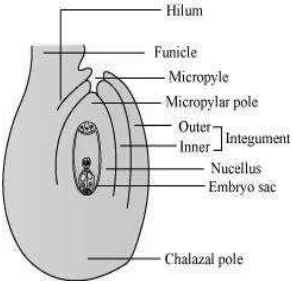
Solution
(N/A) An ovule is a female megasporangium where the formation of megaspores takes place.
The various parts of an ovule are:
$1$. Funiculus: It is a stalk-like structure which represents the point of attachment of the ovule to the placenta of the ovary.
$2$. Hilum: It is the point where the body of the ovule is attached to the funiculus.
$3$. Integuments: These are the protective envelopes surrounding the ovule. They provide protection to the developing embryo.
$4$. Micropyle: It is a small opening or pore at the tip of the ovule formed by the projection of integuments. It marks the point where the pollen tube enters the ovule at the time of fertilization.
$5$. Nucellus: It is a mass of parenchymatous tissue enclosed within the integuments. The nucellus provides nutrition to the developing embryo sac.
$6$. Chalaza: It is the basal part of the ovule,representing the point of origin of the integuments.
The various parts of an ovule are:
$1$. Funiculus: It is a stalk-like structure which represents the point of attachment of the ovule to the placenta of the ovary.
$2$. Hilum: It is the point where the body of the ovule is attached to the funiculus.
$3$. Integuments: These are the protective envelopes surrounding the ovule. They provide protection to the developing embryo.
$4$. Micropyle: It is a small opening or pore at the tip of the ovule formed by the projection of integuments. It marks the point where the pollen tube enters the ovule at the time of fertilization.
$5$. Nucellus: It is a mass of parenchymatous tissue enclosed within the integuments. The nucellus provides nutrition to the developing embryo sac.
$6$. Chalaza: It is the basal part of the ovule,representing the point of origin of the integuments.
0 likes
View Solution178
Easy
What is meant by monosporic development of the female gametophyte?
Solution
(N/A) The female gametophyte or the embryo sac develops from a single functional megaspore. This is known as monosporic development of the female gametophyte. In most flowering plants,a single megaspore mother cell $(MMC)$ present at the micropylar pole of the nucellus region of the ovule undergoes meiosis to produce four haploid megaspores. Later,out of these four megaspores,only one functional megaspore develops into the female gametophyte,while the remaining three degenerate.
0 likes
View Solution179
Easy
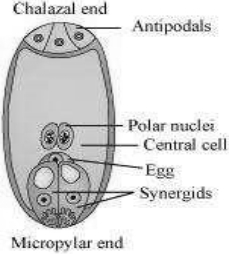
With a neat diagram,explain the $7$-celled,$8$-nucleate nature of the female gametophyte.
Solution
(N/A) The female gametophyte (embryo sac) develops from a single functional megaspore. This megaspore undergoes three successive mitotic divisions to form an $8$-nucleate embryo sac.
The first mitotic division in the megaspore forms two nuclei. One nucleus moves towards the micropylar end while the other moves towards the chalazal end. Then,these nuclei divide at their respective ends and redivide to form an $8$-nucleate stage. As a result,there are four nuclei at each end,i.e.,at the micropylar and the chalazal end in the embryo sac.
At the micropylar end,out of the four nuclei,only three differentiate into two synergids and one egg cell. Together,they are known as the egg apparatus. Similarly,at the chalazal end,three out of four nuclei differentiate as antipodal cells. The remaining two nuclei (one from the micropylar and one from the chalazal end) move towards the centre and are known as the polar nuclei,which are situated in a large central cell.
Hence,at maturity,the female gametophyte appears as a $7$-celled structure,though it has $8$ nuclei.
The first mitotic division in the megaspore forms two nuclei. One nucleus moves towards the micropylar end while the other moves towards the chalazal end. Then,these nuclei divide at their respective ends and redivide to form an $8$-nucleate stage. As a result,there are four nuclei at each end,i.e.,at the micropylar and the chalazal end in the embryo sac.
At the micropylar end,out of the four nuclei,only three differentiate into two synergids and one egg cell. Together,they are known as the egg apparatus. Similarly,at the chalazal end,three out of four nuclei differentiate as antipodal cells. The remaining two nuclei (one from the micropylar and one from the chalazal end) move towards the centre and are known as the polar nuclei,which are situated in a large central cell.
Hence,at maturity,the female gametophyte appears as a $7$-celled structure,though it has $8$ nuclei.
0 likes
View Solution180
Medium
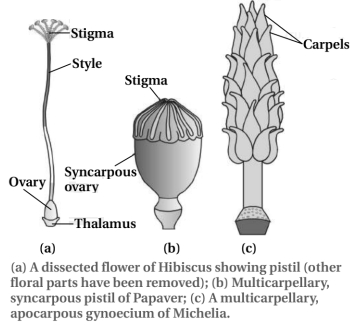
Describe the pistil (gynoecium).
Solution
(N/A) The gynoecium represents the female reproductive part of the flower.
The gynoecium may consist of a single pistil (monocarpellary) or may have more than one pistil (multicarpellary).
When there is more than one,the pistils may be fused together (syncarpous) or may be free (apocarpous).
Each pistil has three parts: the stigma,style,and ovary.
Stigma: The stigma serves as a landing platform for pollen grains.
Style: The style is the elongated slender part beneath the stigma.
Ovary: The basal bulged part of the pistil is the ovary.
Placenta: It is located inside the ovarian cavity. Arising from the placenta are the megasporangia,commonly called ovules. The number of ovules in an ovary may be one (e.g.,wheat,paddy,mango) to many (e.g.,papaya,watermelon,orchids).
The gynoecium may consist of a single pistil (monocarpellary) or may have more than one pistil (multicarpellary).
When there is more than one,the pistils may be fused together (syncarpous) or may be free (apocarpous).
Each pistil has three parts: the stigma,style,and ovary.
Stigma: The stigma serves as a landing platform for pollen grains.
Style: The style is the elongated slender part beneath the stigma.
Ovary: The basal bulged part of the pistil is the ovary.
Placenta: It is located inside the ovarian cavity. Arising from the placenta are the megasporangia,commonly called ovules. The number of ovules in an ovary may be one (e.g.,wheat,paddy,mango) to many (e.g.,papaya,watermelon,orchids).
0 likes
View Solution181
Medium
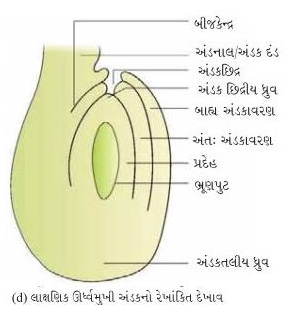
Describe the structure of Megasporangium (ovule) with a diagram.
Solution
(N/A) The ovule is a small structure attached to the placenta by means of a stalk called funicle.
The body of the ovule fuses with the funicle in the region called hilum. Thus,the hilum represents the junction between the ovule and the funicle.
Each ovule has one or two protective envelopes called integuments.
Integuments encircle the nucellus except at the tip,where a small opening called the micropyle is organized.
Opposite the micropylar end is the chalaza,representing the basal part of the ovule.
Enclosed within the integuments is a mass of cells called the nucellus. Cells of the nucellus have abundant reserve food materials.
Located in the nucellus is the embryo sac or female gametophyte. An ovule generally has a single embryo sac formed from a megaspore.
Megasporogenesis: The process of formation of megaspores from the megaspore mother cell is called megasporogenesis.
The body of the ovule fuses with the funicle in the region called hilum. Thus,the hilum represents the junction between the ovule and the funicle.
Each ovule has one or two protective envelopes called integuments.
Integuments encircle the nucellus except at the tip,where a small opening called the micropyle is organized.
Opposite the micropylar end is the chalaza,representing the basal part of the ovule.
Enclosed within the integuments is a mass of cells called the nucellus. Cells of the nucellus have abundant reserve food materials.
Located in the nucellus is the embryo sac or female gametophyte. An ovule generally has a single embryo sac formed from a megaspore.
Megasporogenesis: The process of formation of megaspores from the megaspore mother cell is called megasporogenesis.
0 likes
View Solution182
Medium
Explain the structure and development of the embryo sac.
Solution
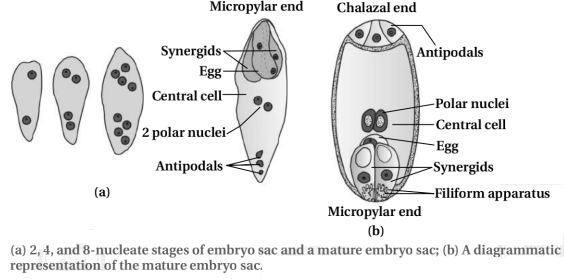
(N/A) The nucleus of the functional megaspore divides mitotically to form two nuclei which move to the opposite poles,forming the $2$-nucleate embryo sac.
Two more sequential mitotic nuclear divisions result in the formation of the $4$-nucleate and later $8$-nucleate stages of the embryo sac. These mitotic divisions are strictly free-nuclear,meaning nuclear divisions are not followed immediately by cell wall formation.
After the $8$-nucleate stage,cell walls are laid down,leading to the organization of the typical female gametophyte or embryo sac.
Six of the eight nuclei are surrounded by cell walls and organized into cells; the remaining two nuclei,called polar nuclei,are situated below the egg apparatus in the large central cell. There is a characteristic distribution of the cells within the embryo sac.
Three cells are grouped together at the micropylar end and constitute the egg apparatus. The egg apparatus,in turn,consists of two synergids and one egg cell.
The synergids have special cellular thickenings at the micropylar tip called the filiform apparatus,which play an important role in guiding the pollen tubes into the synergid.
Three cells are at the chalazal end and are called the antipodals.
The large central cell,as mentioned,has two polar nuclei.
Thus,a typical angiosperm embryo sac,at maturity,although $8$-nucleate,is $7$-celled.
Panchanan Maheshwari has classified the female gametophyte into monosporic,bisporic,and tetrasporic embryo sacs based on how many megaspores take part in the development of the embryo sac.
Two more sequential mitotic nuclear divisions result in the formation of the $4$-nucleate and later $8$-nucleate stages of the embryo sac. These mitotic divisions are strictly free-nuclear,meaning nuclear divisions are not followed immediately by cell wall formation.
After the $8$-nucleate stage,cell walls are laid down,leading to the organization of the typical female gametophyte or embryo sac.
Six of the eight nuclei are surrounded by cell walls and organized into cells; the remaining two nuclei,called polar nuclei,are situated below the egg apparatus in the large central cell. There is a characteristic distribution of the cells within the embryo sac.
Three cells are grouped together at the micropylar end and constitute the egg apparatus. The egg apparatus,in turn,consists of two synergids and one egg cell.
The synergids have special cellular thickenings at the micropylar tip called the filiform apparatus,which play an important role in guiding the pollen tubes into the synergid.
Three cells are at the chalazal end and are called the antipodals.
The large central cell,as mentioned,has two polar nuclei.
Thus,a typical angiosperm embryo sac,at maturity,although $8$-nucleate,is $7$-celled.
Panchanan Maheshwari has classified the female gametophyte into monosporic,bisporic,and tetrasporic embryo sacs based on how many megaspores take part in the development of the embryo sac.
0 likes
View Solution183
Easy
Definitions / Explanation :
$1.$ Nutritive layer
$2.$ Funicle
$1.$ Nutritive layer
$2.$ Funicle
Solution
(N/A) $(1)$ The nutritive layer is the innermost layer of the microsporangium,known as the tapetum. It consists of cells with dense cytoplasm and generally more than one nucleus,providing nourishment to the developing pollen grains.
$(2)$ The funicle is the stalk by which the ovule is attached to the placenta within the ovary.
$(2)$ The funicle is the stalk by which the ovule is attached to the placenta within the ovary.
0 likes
View Solution184
Easy
Define/Explain the following terms:
$1.$ Micropyle
$2.$ Chalaza
$1.$ Micropyle
$2.$ Chalaza
Solution
(N/A) $(1)$ The integuments encircle the nucellus except at the tip,where a small opening called the micropyle is organized.
$(2)$ Opposite the micropylar end lies the chalaza,which represents the basal part of the ovule.
$(2)$ Opposite the micropylar end lies the chalaza,which represents the basal part of the ovule.
0 likes
View Solution185
Medium
Definitions / Explanation:
$1.$ Perisperm
$2.$ Chalaza
$1.$ Perisperm
$2.$ Chalaza
Solution
(N/A) In some seeds, such as black pepper and beet, remnants of the nucellus are persistent. This residual, persistent nucellus is known as the $Perisperm$.
Opposite the micropylar end is the $Chalaza$, which represents the basal part of the ovule.
Opposite the micropylar end is the $Chalaza$, which represents the basal part of the ovule.
0 likes
View Solution186
Easy
Definitions / Explanation:
$1.$ Nucellus
$2.$ Funicle
$1.$ Nucellus
$2.$ Funicle
Solution
(N/A) The $nucellus$ is a mass of cells enclosed within the integuments of an ovule. These cells contain abundant reserve food materials, which provide nourishment to the developing embryo sac.
The $funicle$ is a stalk-like structure by which the ovule is attached to the placenta of the ovary.
The $funicle$ is a stalk-like structure by which the ovule is attached to the placenta of the ovary.
0 likes
View Solution187
Medium
Define the following terms:
$1.$ Embryo sac
$2.$ Monosporic development
$1.$ Embryo sac
$2.$ Monosporic development
Solution
(N/A) $1$. Embryo sac: The embryo sac,also known as the female gametophyte,is located within the nucellus of the ovule. It is the structure where the egg cell is produced and fertilization occurs.
$2$. Monosporic development: This is a type of embryo sac formation where the female gametophyte develops from a single functional megaspore,while the other three megaspores degenerate. This is the most common type of development in angiosperms.
$2$. Monosporic development: This is a type of embryo sac formation where the female gametophyte develops from a single functional megaspore,while the other three megaspores degenerate. This is the most common type of development in angiosperms.
0 likes
View Solution188
Medium
Define the following terms:
$1.$ Egg apparatus
$2.$ Filiform apparatus
$1.$ Egg apparatus
$2.$ Filiform apparatus
Solution
(N/A) In an ovule,three cells grouped together at the micropylar end constitute the egg apparatus.
The egg apparatus consists of two synergids and one egg cell.
The synergids have special cellular thickenings at the micropylar tip called the filiform apparatus,which guide the entry of the pollen tube into the synergid.
The egg apparatus consists of two synergids and one egg cell.
The synergids have special cellular thickenings at the micropylar tip called the filiform apparatus,which guide the entry of the pollen tube into the synergid.
0 likes
View Solution189
Medium
Identify the location and function of the following structures in a flowering plant:
$1.$ Ovary
$2.$ Placenta
$1.$ Ovary
$2.$ Placenta
Solution
(N/A) $(1)$ Location: The basal swollen part of the pistil.
Function: Ovules develop from the ovary.
$(2)$ Location: It is located inside the ovarian cavity.
Function: Megasporangia (ovules) develop from the placenta.
Function: Ovules develop from the ovary.
$(2)$ Location: It is located inside the ovarian cavity.
Function: Megasporangia (ovules) develop from the placenta.
0 likes
View Solution190
MediumMCQ
Identify the location and function of the following structures in an angiosperm ovule:
$1.$ Nucellus
$2.$ Filiform apparatus
$1.$ Nucellus
$2.$ Filiform apparatus
A
Nucellus: Inside integuments,provides nutrition; Filiform apparatus: Micropylar end,guides pollen tube.
B
Nucellus: Outside integuments,protects embryo; Filiform apparatus: Chalazal end,absorbs water.
C
Nucellus: Inside embryo sac,produces gametes; Filiform apparatus: Micropylar end,stores starch.
D
Nucellus: Chalazal end,supports ovule; Filiform apparatus: Micropylar end,secretes enzymes.
Solution
(A) $1.$ Nucellus:
Location: It is the central mass of tissue enclosed within the integuments of the ovule.
Function: It contains abundant reserve food material and provides nutrition to the developing embryo sac.
$2.$ Filiform apparatus:
Location: It consists of special cellular thickenings at the micropylar end of the synergids.
Function: It plays a crucial role in guiding the entry of the pollen tube into the synergids.
Location: It is the central mass of tissue enclosed within the integuments of the ovule.
Function: It contains abundant reserve food material and provides nutrition to the developing embryo sac.
$2.$ Filiform apparatus:
Location: It consists of special cellular thickenings at the micropylar end of the synergids.
Function: It plays a crucial role in guiding the entry of the pollen tube into the synergids.
0 likes
View Solution191
MediumMCQ
Name the component cells of the 'egg apparatus' in an embryo sac.
A
Two synergids and one egg cell
B
Three antipodal cells
C
Two polar nuclei
D
One egg cell and two polar nuclei
Solution
(A) The egg apparatus, located at the micropylar end of the embryo sac, consists of three cells: two $synergids$ and one $egg$ $cell$.
$1$. The $synergids$ are specialized cells that guide the pollen tube towards the egg cell.
$2$. The $egg$ $cell$ is the female gamete that fuses with the male gamete during fertilization.
$3$. The $synergids$ also possess a special cellular thickening at the micropylar tip known as the $filiform$ $apparatus$, which plays a crucial role in guiding the pollen tube into the synergid.
$1$. The $synergids$ are specialized cells that guide the pollen tube towards the egg cell.
$2$. The $egg$ $cell$ is the female gamete that fuses with the male gamete during fertilization.
$3$. The $synergids$ also possess a special cellular thickening at the micropylar tip known as the $filiform$ $apparatus$, which plays a crucial role in guiding the pollen tube into the synergid.
0 likes
View Solution192
Medium
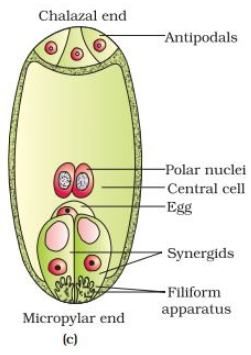
Draw the diagram of a mature embryo sac and show its $8-$ nucleate,$7-$ celled nature. Show the following parts: antipodals,synergids,egg,central cell,polar nuclei.
Solution
(N/A) mature embryo sac is $8-$ nucleate and $7-$ celled.
$1$. $3$ cells are grouped at the chalazal end and are called antipodals.
$2$. $3$ cells are grouped at the micropylar end,which constitute the egg apparatus (one egg cell and two synergids).
$3$. The large central cell contains two polar nuclei,which eventually fuse to form a diploid secondary nucleus.
Thus,the arrangement is $3+2+3$ nuclei,resulting in $7$ cells ($3$ antipodals + $1$ central cell + $2$ synergids + $1$ egg cell).
$1$. $3$ cells are grouped at the chalazal end and are called antipodals.
$2$. $3$ cells are grouped at the micropylar end,which constitute the egg apparatus (one egg cell and two synergids).
$3$. The large central cell contains two polar nuclei,which eventually fuse to form a diploid secondary nucleus.
Thus,the arrangement is $3+2+3$ nuclei,resulting in $7$ cells ($3$ antipodals + $1$ central cell + $2$ synergids + $1$ egg cell).
0 likes
View Solution193
Medium
With a neat,labelled diagram,describe the parts of a mature angiosperm embryo sac. Mention the role of synergids.
Solution
(N/A) mature angiosperm embryo sac is typically $8$-nucleate and $7$-celled.
$1$. Egg Apparatus: Located at the micropylar end,it consists of two synergids and one egg cell.
$2$. Antipodal Cells: Three cells located at the chalazal end are called antipodals.
$3$. Central Cell: The large central cell contains two polar nuclei,which eventually fuse to form a diploid secondary nucleus.
Role of Synergids: Synergids possess special cellular thickenings at the micropylar tip called the filiform apparatus. This apparatus plays a crucial role in guiding the pollen tube into the synergid.
$1$. Egg Apparatus: Located at the micropylar end,it consists of two synergids and one egg cell.
$2$. Antipodal Cells: Three cells located at the chalazal end are called antipodals.
$3$. Central Cell: The large central cell contains two polar nuclei,which eventually fuse to form a diploid secondary nucleus.
Role of Synergids: Synergids possess special cellular thickenings at the micropylar tip called the filiform apparatus. This apparatus plays a crucial role in guiding the pollen tube into the synergid.
0 likes
View Solution194
Medium
Draw a neat,labeled diagram showing the parts of a typical angiosperm ovule.
Solution
(N/A) typical angiosperm ovule (megasporangium) consists of the following parts:
$1$. Funicle: The stalk that attaches the ovule to the placenta.
$2$. Hilum: The junction point between the ovule and the funicle.
$3$. Integuments: Protective envelopes surrounding the nucellus.
$4$. Micropyle: $A$ small opening at the tip of the integuments.
$5$. Chalaza: The basal part of the ovule representing the origin of integuments.
$6$. Nucellus: The central mass of cells containing food reserves.
$7$. Embryo sac: The female gametophyte located within the nucellus.
$1$. Funicle: The stalk that attaches the ovule to the placenta.
$2$. Hilum: The junction point between the ovule and the funicle.
$3$. Integuments: Protective envelopes surrounding the nucellus.
$4$. Micropyle: $A$ small opening at the tip of the integuments.
$5$. Chalaza: The basal part of the ovule representing the origin of integuments.
$6$. Nucellus: The central mass of cells containing food reserves.
$7$. Embryo sac: The female gametophyte located within the nucellus.
0 likes
View Solution195
Easy
Match the following columns regarding the components of the embryo sac:
| Column $I$ | Column $II$ |
| $(a)$ Sex cell | $(1)$ Synergid cells |
| $(b)$ Synergid cell | $(2)$ Antipodal cells |
| $(c)$ Cell opposite to micropyle | $(3)$ Egg cell |
| $(d)$ Central cell | $(4)$ Secondary nucleus |
Solution
(A) The correct matching is as follows:
$(a)$ Sex cell of the embryo sac is the $(3)$ Egg cell.
$(b)$ Synergid cells are the $(1)$ Synergid cells present in the embryo sac.
$(c)$ Cells opposite to the micropyle are the $(2)$ Antipodal cells.
$(d)$ The $(4)$ Secondary nucleus is located within the central cell of the embryo sac.
Therefore, the correct sequence is $(a-3), (b-1), (c-2), (d-4)$.
$(a)$ Sex cell of the embryo sac is the $(3)$ Egg cell.
$(b)$ Synergid cells are the $(1)$ Synergid cells present in the embryo sac.
$(c)$ Cells opposite to the micropyle are the $(2)$ Antipodal cells.
$(d)$ The $(4)$ Secondary nucleus is located within the central cell of the embryo sac.
Therefore, the correct sequence is $(a-3), (b-1), (c-2), (d-4)$.
0 likes
View Solution196
EasyMCQ
The body of the ovule is fused with the funicle at:
A
Hilum
B
Micropyle
C
Nucellus
D
Chalaza
Solution
(A) The ovule is attached to the placenta by means of a stalk called the funicle. The point of attachment of the body of the ovule with the funicle is known as the hilum. Thus,the hilum represents the junction between the ovule and the funicle.
0 likes
View Solution197
MediumMCQ
The ovary is a part of which of the following?
A
Stamen
B
Pistil
C
Calyx
D
Corolla
Solution
(B) The flower is the reproductive unit of angiosperms. The female reproductive part of the flower is called the $Pistil$ or $Gynoecium$.
The $Pistil$ consists of three main parts: the $Stigma$,the $Style$,and the $Ovary$.
The $Ovary$ is the enlarged basal part of the $Pistil$ that contains the ovules.
Therefore,the $Ovary$ is a part of the $Pistil$.
The $Pistil$ consists of three main parts: the $Stigma$,the $Style$,and the $Ovary$.
The $Ovary$ is the enlarged basal part of the $Pistil$ that contains the ovules.
Therefore,the $Ovary$ is a part of the $Pistil$.
0 likes
View Solution198
MediumMCQ
Which of the following structures is not a part of the pistil (gynoecium)?
A
Ovary
B
Style
C
Stigma
D
Connective
Solution
(D) The pistil or gynoecium is the female reproductive part of a flower. It consists of three main parts:
$1$. $Stigma$: The landing platform for pollen grains.
$2$. $Style$: The elongated slender part beneath the stigma.
$3$. $Ovary$: The enlarged basal part containing the ovules.
The $Connective$ is a sterile tissue that connects the two lobes of an anther in the stamen (the male reproductive part). Therefore, it is not a part of the pistil.
$1$. $Stigma$: The landing platform for pollen grains.
$2$. $Style$: The elongated slender part beneath the stigma.
$3$. $Ovary$: The enlarged basal part containing the ovules.
The $Connective$ is a sterile tissue that connects the two lobes of an anther in the stamen (the male reproductive part). Therefore, it is not a part of the pistil.
0 likes
View Solution199
MediumMCQ
Which of the following is the female reproductive organ of a flower?
A
Calyx
B
Androecium
C
Gynoecium
D
Corolla
Solution
(C) In a flower, the reproductive organs are categorized as follows:
$1$. The $Androecium$ (stamen) is the male reproductive organ.
$2$. The $Gynoecium$ (pistil or carpel) is the female reproductive organ.
$3$. The $Calyx$ (sepals) and $Corolla$ (petals) are accessory whorls involved in protection and attraction, respectively.
Therefore, the $Gynoecium$ represents the female reproductive part.
$1$. The $Androecium$ (stamen) is the male reproductive organ.
$2$. The $Gynoecium$ (pistil or carpel) is the female reproductive organ.
$3$. The $Calyx$ (sepals) and $Corolla$ (petals) are accessory whorls involved in protection and attraction, respectively.
Therefore, the $Gynoecium$ represents the female reproductive part.
0 likes
View Solution200
MediumMCQ
How many pistils are present in a monocarpellary gynoecium?
A
One
B
Two
C
Three
D
Many
Solution
(A) The term 'monocarpellary' is derived from 'mono' meaning one and 'carpellary' referring to the carpel or pistil. Therefore,a monocarpellary gynoecium consists of exactly $1$ pistil.
0 likes
View SolutionSexual Reproduction in Flowering Plants — The Pistil, Megasporangium (ovule) and Embryo sac · Frequently Asked Questions
1Are these Sexual Reproduction in Flowering Plants questions useful for JEE and NEET?
Yes. All questions in this section are mapped to JEE Main and NEET exam patterns. Previous year questions from JEE Main, NEET, GUJCET and state-level exams are included with full solutions.
2Can I switch to Hindi or Gujarati for these questions?
Yes. Use the language tabs in the hero section or the sidebar to view the same questions and solutions in English, Hindi or Gujarati.
3How do I generate a question paper from this subtopic?
Use the Vedclass Exam Paper Generator — select the chapter and subtopic, set difficulty, and generate Sets A, B, C, D automatically. First 3 chapters of every subject are free.
Vedclass Products
For Students
Vedclass Test Series
Mock tests in real JEE/NEET style with performance analysis. 5-day free trial.
Start Free TrialFor Teachers
Exam Paper Generator
Generate Set A/B/C/D papers from this chapter in 2 minutes. 3 chapters free.
Try FreeFor Institutes
Online Exam Module
Live online exams with unlimited students, 360° analytics & white-label branding.
See DemoFor Teachers & Institutes
Generate a Sexual Reproduction in Flowering Plants Exam Paper in 2 Minutes
Select subtopic & difficulty — Sets A, B, C, D auto-generated with No Repeat logic.
First 3 chapters of every subject are free — no payment required.