
A English
Flower Questions in English
Class 12 Biology · Sexual Reproduction in Flowering Plants · Flower
92+
Questions
English
Language
100%
With Solutions
Showing 50 of 92 questions in English
1
EasyMCQ
Flower is intersexual in
A
Date palm
B
Cucurbita
C
Papaya
D
Hibiscus
Solution
(D) The correct answer is $D$.
An intersexual or bisexual (hermaphrodite) flower is one that contains both essential reproductive organs,i.e.,stamens (male) and pistils (female),within the same flower.
$Hibiscus$ is a classic example of a plant that produces bisexual flowers.
In contrast,$Date$ $palm$,$Cucurbita$,and $Papaya$ typically produce unisexual flowers.
An intersexual or bisexual (hermaphrodite) flower is one that contains both essential reproductive organs,i.e.,stamens (male) and pistils (female),within the same flower.
$Hibiscus$ is a classic example of a plant that produces bisexual flowers.
In contrast,$Date$ $palm$,$Cucurbita$,and $Papaya$ typically produce unisexual flowers.
0 likes
View Solution2
MediumMCQ
Thalamus is
A
Base of flower
B
Base of ovary
C
Modification of pollen
D
Modification of petal
Solution
(A) The broadened base of a flower,which is located at the tip of the pedicel,is known as the torus,thalamus,or receptacle. It serves as the platform upon which all other floral parts (sepals,petals,stamens,and carpels) are arranged.
0 likes
View Solution3
MediumMCQ
$A$ characteristic of angiosperms is
A
Flower
B
Root
C
Seed
D
All of these
Solution
(A) The flower is a highly modified and condensed shoot meant for sexual reproduction. It is the most distinct and characteristic feature of angiosperms.
0 likes
View Solution4
MediumMCQ
$A$ flower is considered complete when it has:
A
Calyx,corolla,androecium,and gynoecium
B
Calyx and corolla
C
Androecium and gynoecium
D
Corolla,androecium,and gynoecium
Solution
(A) flower is defined as complete when it possesses all four floral whorls: calyx,corolla,androecium,and gynoecium.
These four whorls are arranged on the thalamus.
If any of these parts are missing,the flower is referred to as an incomplete flower.
These four whorls are arranged on the thalamus.
If any of these parts are missing,the flower is referred to as an incomplete flower.
0 likes
View Solution5
MediumMCQ
Flowers in which only one set of essential organs is present are said to be:
A
Unisexual
B
Monoecious
C
Dioecious
D
Both $(A)$ and $(C)$
Solution
(A) Flowers that contain only one set of essential reproductive organs (either stamens or pistils) are called unisexual or imperfect flowers.
Unisexual flowers are also referred to as diclinous.
If a plant species produces only unisexual flowers,the plant itself is often described as dioecious (if staminate and pistillate flowers are on different plants) or monoecious (if both types are on the same plant).
However,the term 'unisexual' specifically describes the flower itself,and the condition of having only one set of essential organs is characteristic of unisexual flowers,which are found in both monoecious and dioecious plants.
Therefore,the most appropriate classification for such flowers is unisexual.
Unisexual flowers are also referred to as diclinous.
If a plant species produces only unisexual flowers,the plant itself is often described as dioecious (if staminate and pistillate flowers are on different plants) or monoecious (if both types are on the same plant).
However,the term 'unisexual' specifically describes the flower itself,and the condition of having only one set of essential organs is characteristic of unisexual flowers,which are found in both monoecious and dioecious plants.
Therefore,the most appropriate classification for such flowers is unisexual.
0 likes
View Solution6
MediumMCQ
The most important part in the life cycle of a plant is:
A
Leaf
B
Root
C
Flower
D
All of these
Solution
(C) The flower is the most important part of a plant's life cycle because it is the reproductive structure of angiosperms.
It contains the male $(androecium)$ and female $(gynoecium)$ reproductive organs.
Through the process of pollination and fertilization, the flower produces seeds and fruits, which are essential for the continuation of the species and the dispersal of the plant to new environments.
It contains the male $(androecium)$ and female $(gynoecium)$ reproductive organs.
Through the process of pollination and fertilization, the flower produces seeds and fruits, which are essential for the continuation of the species and the dispersal of the plant to new environments.
0 likes
View Solution7
EasyMCQ
In Maize,the flowers are
A
Absent
B
Unisexual but on different plants
C
Bisexual
D
Unisexual but on the same plant
Solution
(D) In Maize,the flowers are unisexual,meaning each flower contains either only stamens (male) or only pistils (female).
However,both male and female flowers are present on the same individual plant.
This condition is known as monoecious.
Therefore,the correct option is $D$.
However,both male and female flowers are present on the same individual plant.
This condition is known as monoecious.
Therefore,the correct option is $D$.
0 likes
View Solution8
MediumMCQ
$A$ versatile anther is attached to the filament:
A
At the top firmly
B
At the base firmly
C
Throughout its length
D
At about the middle of the connective,allowing free movement
Solution
(D) versatile anther is a type of anther attachment where the filament is attached to the back of the anther at a single point,usually near the middle. This allows the anther to swing freely like a pendulum or a weather vane. This adaptation is commonly found in grasses (family $Poaceae$) to facilitate pollination by wind,as it allows the anther to sway and release pollen grains easily.
0 likes
View Solution9
MediumMCQ
Flower is a modified shoot because:
A
Thalamus may elongate to show internodes
B
There is aggregation into inflorescence
C
It bears essential organs
D
It may have epicalyx
Solution
(A) The flower is considered a modified shoot because the floral axis (thalamus or receptacle) can sometimes elongate to reveal distinct internodes between different floral whorls. Examples of such internodal elongation include the anthophore (between calyx and corolla),androphore (between corolla and androecium),and gynophore (between androecium and gynoecium). This structural arrangement provides evidence that the flower is a modified shoot with condensed nodes and internodes.
0 likes
View Solution10
MediumMCQ
Which statement is correct regarding a flower? It is a modified:
A
Root
B
Shoot
C
Leaf
D
Inflorescence
Solution
(B) The correct answer is $(B)$. $A$ number of evidences prove that a flower is a modified shoot. These are as follows:
$(1)$ $A$ flower develops from a bud,which is either axillary or terminal.
$(2)$ The tip of the thalamus can sometimes prolong to form another flower or a vegetative shoot.
$(3)$ Flowers may get modified into fleshy buds or bulbils,for example,in $Allium$ $cepa$ (Onion).
$(1)$ $A$ flower develops from a bud,which is either axillary or terminal.
$(2)$ The tip of the thalamus can sometimes prolong to form another flower or a vegetative shoot.
$(3)$ Flowers may get modified into fleshy buds or bulbils,for example,in $Allium$ $cepa$ (Onion).
0 likes
View Solution11
EasyMCQ
The smallest flower belongs to which of the following plants?
A
Rosa indica
B
Wolffia microscopica
C
Ranunculus sceleratus
D
Colocasia antiquorum
Solution
(B) $Wolffia$ is a genus of rootless aquatic plants in the family $Araceae$.
$Wolffia$ species are known as the smallest flowering plants on Earth.
Specifically, $Wolffia$ $microscopica$ is widely recognized as having the smallest flower among all angiosperms.
$Wolffia$ species are known as the smallest flowering plants on Earth.
Specifically, $Wolffia$ $microscopica$ is widely recognized as having the smallest flower among all angiosperms.
0 likes
View Solution12
EasyMCQ
The largest flower is that of:
A
Sunflower
B
Rafflesia
C
Nelumbo
D
Drosera
Solution
(B) $Rafflesia$ is known to have the largest flower in the world,which can reach a diameter of approximately $1$ meter. It is a parasitic plant that lacks visible leaves,stems,or roots.
0 likes
View Solution13
EasyMCQ
The study of flowers is known as:
A
Anthology
B
Pomology
C
Floriculture
D
Spermology
Solution
(A) The study of flowers is called $Anthology$.
$Pomology$ is the study of fruits.
$Floriculture$ is the cultivation of flowering plants.
$Spermology$ is the study of seeds.
$Pomology$ is the study of fruits.
$Floriculture$ is the cultivation of flowering plants.
$Spermology$ is the study of seeds.
0 likes
View Solution14
EasyMCQ
The term Anthesis is used for
A
Cluster of anthers
B
Opening of flowers
C
Dehiscence of anthers
D
Falling of flowers
Solution
(B) Anthesis is a botanical term that refers to the period during which a flower is fully open and functional. It marks the time when the flower is ready for pollination. Therefore,it specifically describes the process of the opening of a flower bud.
0 likes
View Solution15
EasyMCQ
The largest flower found in India is:
A
Wolffia
B
Victoria
C
Rafflesia
D
Sapria
Solution
(D) The genus $Sapria$ (specifically $Sapria \text{ himalayana}$) is a rare parasitic plant found in the northeastern regions of India, such as Arunachal Pradesh and Assam.
It is considered the largest flower found in India, often reaching a diameter of up to $20-30 \text{ cm}$.
While $Rafflesia$ is the largest flower in the world, it is not native to India.
$Wolffia$ is the smallest flowering plant, and $Victoria$ is known for its large leaves, not its flowers.
It is considered the largest flower found in India, often reaching a diameter of up to $20-30 \text{ cm}$.
While $Rafflesia$ is the largest flower in the world, it is not native to India.
$Wolffia$ is the smallest flowering plant, and $Victoria$ is known for its large leaves, not its flowers.
0 likes
View Solution16
EasyMCQ
Androecium having dissimilar stamens is known as:
A
Unequal
B
Heterostemonous
C
Diplostemonous
D
Obdiplostemonous
Solution
(B) The condition where stamens in a flower are of different lengths or sizes is called $Heterostemonous$.
For example,in $Cassia$,the stamens are of unequal lengths,which is a classic example of heterostemony.
For example,in $Cassia$,the stamens are of unequal lengths,which is a classic example of heterostemony.
0 likes
View Solution17
MediumMCQ
When the anthers do not possess pollen grains at all,these are known as
A
Staminodes
B
Basifixed anthers
C
Antheroids
D
Petalloid
Solution
(A) . Staminodes are sterile,underdeveloped stamens that do not produce functional pollen grains.
$B$. They are often found in flowers where some stamens are modified or reduced.
$C$. $A$ classic example of staminodes is observed in the genus $Salvia$.
$B$. They are often found in flowers where some stamens are modified or reduced.
$C$. $A$ classic example of staminodes is observed in the genus $Salvia$.
0 likes
View Solution18
MediumMCQ
When both sexes are absent from a flower or are non-functional, the flower is said to be
A
Neutral
B
Incomplete
C
Unisexual
D
Intersexual
Solution
A flower is termed as $Neutral$ (or neuter) when both the reproductive organs, i.e., stamens (male) and pistils (female), are either absent or non-functional.
This condition is commonly observed in the ray florets of $Helianthus \, annuus$ (sunflower), where the flowers lack both functional stamens and carpels.
This condition is commonly observed in the ray florets of $Helianthus \, annuus$ (sunflower), where the flowers lack both functional stamens and carpels.
0 likes
View Solution19
MediumMCQ
For self-pollination,a flower must be:
A
Unisexual
B
Bisexual
C
Monosexual
D
Asexual
Solution
(B) Self-pollination is the transfer of pollen grains from the anther to the stigma of the same flower. For this process to occur,the flower must possess both male (stamen) and female (pistil) reproductive organs. Such flowers are known as bisexual or hermaphrodite flowers.
0 likes
View Solution20
EasyMCQ
Which is the largest flower?
A
Agave
B
Wolffia
C
Rafflesia
D
Eucalyptus
Solution
(C) The largest flower in the world is $Rafflesia$ $arnoldii$.
It is a parasitic plant that produces a massive,single flower that can reach a diameter of about $1$ meter and weigh up to $11$ kg.
In contrast,$Wolffia$ is known as the smallest flowering plant,and $Eucalyptus$ is a genus of tall trees.
It is a parasitic plant that produces a massive,single flower that can reach a diameter of about $1$ meter and weigh up to $11$ kg.
In contrast,$Wolffia$ is known as the smallest flowering plant,and $Eucalyptus$ is a genus of tall trees.
0 likes
View Solution21
EasyMCQ
What is the approximate weight of the flower of $Rafflesia$ $arnoldii$ (in $kg$)?
A
$9$
B
$5$
C
$8$
D
$6$
Solution
(A) $Rafflesia$ $arnoldii$ is known for producing the largest individual flower on Earth.
This parasitic plant is found in the rainforests of Sumatra and Borneo.
The flower of $Rafflesia$ $arnoldii$ can reach a diameter of about $1$ meter and its weight can reach up to $11$ kg,but in standard biological contexts and multiple-choice questions,the value of $10$ kg or approximately $9-11$ kg is often cited.
Among the given options,$9$ kg is the most accurate representation of its massive weight.
This parasitic plant is found in the rainforests of Sumatra and Borneo.
The flower of $Rafflesia$ $arnoldii$ can reach a diameter of about $1$ meter and its weight can reach up to $11$ kg,but in standard biological contexts and multiple-choice questions,the value of $10$ kg or approximately $9-11$ kg is often cited.
Among the given options,$9$ kg is the most accurate representation of its massive weight.
0 likes
View Solution22
MediumMCQ
What is a group of stamens called?
A
Androecium
B
Connective
C
Pollination
D
Stigma
Solution
(A) The $Androecium$ is the male reproductive part of a flower,which is composed of a whorl of stamens. Therefore,a group of stamens is collectively referred to as the $Androecium$.
0 likes
View Solution23
MediumMCQ
$S$: The Amorphophallus (Ramban) has a large inflorescence of about $6 \ m$ height.
$R$: Rafflesia arnoldii has the largest flower,weighing about $8 \ kg$ and having a diameter of about $1 \ m$.
$R$: Rafflesia arnoldii has the largest flower,weighing about $8 \ kg$ and having a diameter of about $1 \ m$.
A
$S$ and $R$ are both true,and $R$ is the correct explanation of $S$.
B
$S$ and $R$ are both true,but $R$ is not the correct explanation of $S$.
C
$S$ is true and $R$ is false.
D
$S$ is false and $R$ is true.
Solution
(B) $S$ is true: Amorphophallus (the flower of which is known as the tallest flower) produces a very large inflorescence that can reach a height of about $6 \ m$.
$R$ is true: Rafflesia arnoldii is known to produce the largest individual flower in the world,which can weigh up to $8 \ kg$ and reach a diameter of approximately $1 \ m$.
Both statements are independent facts regarding botanical records of size and are not causally linked; therefore,$R$ is not the explanation of $S$.
$R$ is true: Rafflesia arnoldii is known to produce the largest individual flower in the world,which can weigh up to $8 \ kg$ and reach a diameter of approximately $1 \ m$.
Both statements are independent facts regarding botanical records of size and are not causally linked; therefore,$R$ is not the explanation of $S$.
0 likes
View Solution24
MediumMCQ
The structure of the androecium is formed by which of the following?
A
Internode
B
Node
C
Sepal
D
Petal
Solution
(B) The androecium is the male reproductive part of a flower,consisting of stamens. In botanical morphology,the floral parts (sepals,petals,stamens,and carpels) are considered modified leaves that develop at the nodes of the floral axis. Therefore,the androecium is formed at the node of the floral axis.
0 likes
View Solution25
MediumMCQ
Which whorls are essential in a flower?
A
Calyx and Corolla
B
Corolla and Gynoecium
C
Androecium and Gynoecium
D
All of the above
Solution
(C) In a flower,the reproductive parts are essential for sexual reproduction.
$1$. The $Androecium$ (stamen) is the male reproductive whorl.
$2$. The $Gynoecium$ (pistil/carpel) is the female reproductive whorl.
These two whorls are directly involved in the production of gametes and are therefore considered essential whorls,while the calyx and corolla are accessory whorls.
$1$. The $Androecium$ (stamen) is the male reproductive whorl.
$2$. The $Gynoecium$ (pistil/carpel) is the female reproductive whorl.
These two whorls are directly involved in the production of gametes and are therefore considered essential whorls,while the calyx and corolla are accessory whorls.
0 likes
View Solution26
MediumMCQ
Chasmogamy is a condition where......
A
Flowers remain closed.
B
Flowers are absent.
C
Flowers remain open.
D
Flowers are gamopetalous.
Solution
(C) Chasmogamy is a phenomenon in flowering plants where the flowers remain open,exposing their reproductive organs (anthers and stigma) to the environment. This allows for cross-pollination by external agents like wind,water,or insects. In contrast,cleistogamy is a condition where flowers remain closed,ensuring self-pollination.
0 likes
View Solution27
MediumMCQ
Where are the nectar-secreting glands found?
A
Sepals
B
Petals
C
Thalamus
D
None of these
Solution
(C) Nectar-secreting glands,known as nectaries,are specialized structures found in flowers. While they can be located in various parts of the flower depending on the species,they are most commonly associated with the floral base or the receptacle (thalamus). In many plants,these glands are situated on the thalamus to attract pollinators.
0 likes
View Solution28
MediumMCQ
The tassels of corn cob are the modification of which part of the flower?
A
Stigma
B
Style
C
Ovary
D
Hair
Solution
(B) In maize $(Zea \ mays)$,the tassels that hang out from the end of the cob are the elongated styles and stigmas.
These structures are adapted to trap wind-borne pollen grains.
The style is very long to ensure that the stigma is exposed to the air to capture pollen,which is essential for fertilization in wind-pollinated plants.
These structures are adapted to trap wind-borne pollen grains.
The style is very long to ensure that the stigma is exposed to the air to capture pollen,which is essential for fertilization in wind-pollinated plants.
0 likes
View Solution29
MediumMCQ
In a basifixed anther,the filament is attached to the anther at the .............
A
firmly at the apex
B
firmly at the base
C
both $(A)$ and $(B)$
D
all of these
Solution
(B) In botany,the attachment of the filament to the anther is classified based on the point of connection.
In a basifixed anther,the filament is attached to the base of the anther lobe.
This is a characteristic feature where the filament is continuous with the base of the anther,making it fixed firmly at the bottom.
Therefore,the correct option is $(B)$.
In a basifixed anther,the filament is attached to the base of the anther lobe.
This is a characteristic feature where the filament is continuous with the base of the anther,making it fixed firmly at the bottom.
Therefore,the correct option is $(B)$.
0 likes
View Solution30
EasyMCQ
What is the approximate weight of the flower of $Rafflesia$ $arnoldii$ (in $kg$)?
A
$12$
B
$8$
C
$10$
D
$6$
Solution
(C) $Rafflesia$ $arnoldii$ is known for producing the largest individual flower on Earth.
It is a parasitic plant found in the rainforests of Indonesia.
The flower of $Rafflesia$ $arnoldii$ can reach a diameter of about $1$ meter and can weigh approximately $10$ kg.
It is a parasitic plant found in the rainforests of Indonesia.
The flower of $Rafflesia$ $arnoldii$ can reach a diameter of about $1$ meter and can weigh approximately $10$ kg.
0 likes
View Solution31
EasyMCQ
What is the approximate diameter of the flower of $Rafflesia$ $arnoldii$?
A
$100$ cm
B
$800$ cm
C
$200$ to $500$ cm
D
$400$ cm
Solution
(A) $Rafflesia$ $arnoldii$ is known for producing the largest individual flower in the world.
Its diameter typically measures about $1$ meter,which is equivalent to $100$ cm.
Therefore,the correct option is $A$.
Its diameter typically measures about $1$ meter,which is equivalent to $100$ cm.
Therefore,the correct option is $A$.
0 likes
View Solution32
EasyMCQ
Which of the following are the essential whorls in a flower?
A
Androecium and Corolla
B
Gynoecium and Calyx
C
Androecium and Gynoecium
D
Corolla and Calyx
Solution
(C) In a flower,the reproductive parts are considered the essential whorls because they are directly involved in the process of sexual reproduction.
$1$. The $Androecium$ (stamen) is the male reproductive whorl.
$2$. The $Gynoecium$ (pistil/carpel) is the female reproductive whorl.
$3$. The $Calyx$ and $Corolla$ are considered accessory whorls as they provide protection to the reproductive organs and help in pollination,but they do not participate directly in gamete formation.
$1$. The $Androecium$ (stamen) is the male reproductive whorl.
$2$. The $Gynoecium$ (pistil/carpel) is the female reproductive whorl.
$3$. The $Calyx$ and $Corolla$ are considered accessory whorls as they provide protection to the reproductive organs and help in pollination,but they do not participate directly in gamete formation.
0 likes
View Solution33
EasyMCQ
It is the collective term for stamens.
A
Calyx
B
Corolla
C
Gynoecium
D
Androecium
Solution
(D) The flower consists of four whorls: Calyx,Corolla,Androecium,and Gynoecium.
$1$. The Calyx is the collective term for sepals.
$2$. The Corolla is the collective term for petals.
$3$. The Androecium is the collective term for stamens,which are the male reproductive organs of a flower.
$4$. The Gynoecium is the collective term for carpels or pistils,which are the female reproductive organs.
Therefore,the correct answer is Androecium.
$1$. The Calyx is the collective term for sepals.
$2$. The Corolla is the collective term for petals.
$3$. The Androecium is the collective term for stamens,which are the male reproductive organs of a flower.
$4$. The Gynoecium is the collective term for carpels or pistils,which are the female reproductive organs.
Therefore,the correct answer is Androecium.
0 likes
View Solution34
EasyMCQ
What is the collective term for stamens?
A
Androecium
B
Connective
C
Pollination
D
Stigma
Solution
(A) The stamen is the male reproductive part of a flower. $A$ single stamen consists of a filament and an anther. The collective term for all the stamens in a flower is known as the $Androecium$.
0 likes
View Solution35
EasyMCQ
What do angiosperms and gymnosperms produce for sexual reproduction,respectively?
A
Flowers and cones
B
Cones and flowers
C
Seeds and cones
D
Cones and fruits
Solution
(A) Angiosperms (flowering plants) produce flowers as their reproductive structures,where fertilization occurs to form seeds enclosed within fruits.
Gymnosperms (naked-seeded plants) produce cones (strobili) as their reproductive structures,where seeds are exposed and not enclosed within fruits.
Therefore,for sexual reproduction,angiosperms produce flowers and gymnosperms produce cones.
Gymnosperms (naked-seeded plants) produce cones (strobili) as their reproductive structures,where seeds are exposed and not enclosed within fruits.
Therefore,for sexual reproduction,angiosperms produce flowers and gymnosperms produce cones.
0 likes
View Solution36
EasyMCQ
Long filamentous threads protruding at the end of a young cob of maize are
A
hairs
B
anthers
C
styles
D
ovaries
Solution
(C) : In maize,the male inflorescence occupies the terminal position on the main axis,whereas the female inflorescence (ear or cob) is borne on modified lateral branches in the axils of leaves.
The ear-producing branch has short internodes and bears a female spike at its apex.
Each spikelet has a pair of small membranous glumes and two florets.
The feathery,long,filamentous threads protruding from the cob are the styles of the female florets.
These styles emerge out of the cob to expose the stigma,which facilitates wind pollination.
The ear-producing branch has short internodes and bears a female spike at its apex.
Each spikelet has a pair of small membranous glumes and two florets.
The feathery,long,filamentous threads protruding from the cob are the styles of the female florets.
These styles emerge out of the cob to expose the stigma,which facilitates wind pollination.
0 likes
View Solution37
MediumMCQ
The proximal end of the filament of a stamen is attached to the:
A
placenta
B
connective
C
anther
D
thalamus or petal
Solution
(D) The stamen consists of two parts: the anther and the filament. The distal end of the filament is attached to the anther,while the proximal end of the filament is attached to the thalamus or the petal of the flower. Therefore,the correct option is $D$.
0 likes
View Solution38
EasyMCQ
What does the term 'monoecious' mean in plants?
A
Only male flowers are present on the plant.
B
Only female flowers are present on the plant.
C
Both male and female flowers are present on the same individual plant.
D
No reproductive organs are present in the flowers of this plant.
Solution
(C) The term 'monoecious' refers to plants that bear both male and female reproductive structures (flowers) on the same individual plant.
Examples include maize,cucurbits,and coconut.
In contrast,'dioecious' plants have male and female flowers on separate individuals (e.g.,papaya,date palm).
Examples include maize,cucurbits,and coconut.
In contrast,'dioecious' plants have male and female flowers on separate individuals (e.g.,papaya,date palm).
0 likes
View Solution39
EasyMCQ
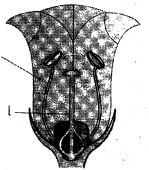
Identify the figure:
A
Female thallus
B
Male thallus
C
Bisexual flower
D
Unisexual flower
Solution
(C) The provided figure shows a flower containing both male reproductive organs (stamens) and female reproductive organs (pistil/carpel) within the same structure.
Such a flower is known as a bisexual flower (also called a hermaphrodite flower).
Therefore,the correct option is $C$.
Such a flower is known as a bisexual flower (also called a hermaphrodite flower).
Therefore,the correct option is $C$.
0 likes
View Solution40
MediumMCQ
Choose the correct pair.
A
Androecium - reproductive organ
B
Gynoecium - accessory organ
C
Calyx - reproductive organ
D
Corolla - reproductive organ
Solution
(A) In a flower,the floral parts are categorized into accessory organs and reproductive organs.
$1$. Accessory organs: These include the calyx (sepals) and corolla (petals),which protect the reproductive parts and help in pollination.
$2$. Reproductive organs: These include the androecium (stamens,the male reproductive part) and the gynoecium (carpels/pistils,the female reproductive part).
Therefore,the correct pair is $A$ (Androecium - reproductive organ).
$1$. Accessory organs: These include the calyx (sepals) and corolla (petals),which protect the reproductive parts and help in pollination.
$2$. Reproductive organs: These include the androecium (stamens,the male reproductive part) and the gynoecium (carpels/pistils,the female reproductive part).
Therefore,the correct pair is $A$ (Androecium - reproductive organ).
0 likes
View Solution41
MediumMCQ
Which accessory whorl of a flower attracts insects for pollination?
A
Calyx
B
Corolla
C
Gynoecium
D
Androecium
Solution
(B) The flower consists of four whorls: Calyx,Corolla,Androecium,and Gynoecium.
$1$. The Calyx and Corolla are considered accessory whorls because they do not directly participate in reproduction.
$2$. The Corolla is composed of petals,which are usually brightly colored to attract insects and other animals for pollination.
$3$. The Calyx (sepals) primarily protects the flower in the bud stage.
$4$. The Androecium and Gynoecium are the reproductive whorls.
Therefore,the correct option is $B$.
$1$. The Calyx and Corolla are considered accessory whorls because they do not directly participate in reproduction.
$2$. The Corolla is composed of petals,which are usually brightly colored to attract insects and other animals for pollination.
$3$. The Calyx (sepals) primarily protects the flower in the bud stage.
$4$. The Androecium and Gynoecium are the reproductive whorls.
Therefore,the correct option is $B$.
0 likes
View Solution42
MediumMCQ
Which of the following is not a part of a flower?
A
Gynoecium
B
Androecium
C
Bract
D
Corolla
Solution
(C) flower typically consists of four whorls arranged on the thalamus: Calyx,Corolla,Androecium,and Gynoecium.
$1$. Calyx (sepals) and Corolla (petals) are accessory organs.
$2$. Androecium (stamens) and Gynoecium (carpels) are reproductive organs.
$3$. $A$ Bract is a leaf-like structure at the base of a flower or inflorescence,but it is not considered a part of the flower itself (it is an accessory structure associated with the flower).
Therefore,the Bract is not a floral whorl.
$1$. Calyx (sepals) and Corolla (petals) are accessory organs.
$2$. Androecium (stamens) and Gynoecium (carpels) are reproductive organs.
$3$. $A$ Bract is a leaf-like structure at the base of a flower or inflorescence,but it is not considered a part of the flower itself (it is an accessory structure associated with the flower).
Therefore,the Bract is not a floral whorl.
0 likes
View Solution43
MediumMCQ
...... is the enlarged basal part of the gynoecium.
A
Anther
B
Stigma
C
Thalamus
D
Ovary
Solution
(D) The gynoecium is the female reproductive part of a flower,consisting of one or more carpels.
Each carpel typically consists of three parts: the stigma,the style,and the ovary.
The ovary is the enlarged basal part of the carpel (gynoecium) that contains the ovules.
Therefore,the correct option is $D$.
Each carpel typically consists of three parts: the stigma,the style,and the ovary.
The ovary is the enlarged basal part of the carpel (gynoecium) that contains the ovules.
Therefore,the correct option is $D$.
0 likes
View Solution44
MediumMCQ
Which of the following is considered a reproductive whorl of a flower?
A
Corolla
B
Calyx
C
Androecium
D
All of the above
Solution
(C) typical flower has four different kinds of whorls arranged successively on the swollen end of the stalk or pedicel,called thalamus or receptacle.
These are Calyx,Corolla,Androecium,and Gynoecium.
$1$. Calyx and Corolla are accessory whorls because they do not directly participate in reproduction.
$2$. Androecium (male reproductive part) and Gynoecium (female reproductive part) are the reproductive whorls of a flower.
Therefore,Androecium is the correct answer.
These are Calyx,Corolla,Androecium,and Gynoecium.
$1$. Calyx and Corolla are accessory whorls because they do not directly participate in reproduction.
$2$. Androecium (male reproductive part) and Gynoecium (female reproductive part) are the reproductive whorls of a flower.
Therefore,Androecium is the correct answer.
0 likes
View Solution45
EasyMCQ
The phenomenon of $Anthesis$ is known for which of the following?
A
Reception of pollen grains by the stigma
B
Formation of pollen grains
C
Development of the anther
D
Opening of a flower bud
Solution
(D) $Anthesis$ is defined as the period during which a flower is fully open and functional. It refers to the process of the opening of a flower bud into a mature flower,allowing for pollination to occur. Therefore,the correct option is $D$.
0 likes
View Solution46
MediumMCQ
Chasmogamy refers to the condition where
A
Flowers remain closed
B
Flowers are absent
C
Flowers are open
D
Flowers are gamopetalous
Solution
(C) Chasmogamous flowers are those that remain open,exposing their anthers and stigmas to the environment. This allows for cross-pollination or self-pollination. In certain bisexual plants like $Commelina$ and $Viola$,both chasmogamous and cleistogamous flowers (which never open throughout their life) are found.
0 likes
View Solution47
Difficult
What is a flower? Describe the parts of a typical angiosperm flower.
Solution
(N/A) flower is defined as the reproductive unit of an angiosperm,specialized for sexual reproduction.
$A$ typical flower consists of four distinct whorls arranged on a condensed axis called the thalamus:
$(A)$ Calyx: The outermost whorl consisting of sepals. They are typically green and protect the flower in the bud stage. If sepals are free,it is polysepalous; if fused,it is gamosepalous.
$(B)$ Corolla: The second whorl consisting of petals. They are often brightly colored to attract pollinators. If petals are free,it is polypetalous; if fused,it is gamopetalous.
$(C)$ Androecium: The male reproductive whorl consisting of stamens. Each stamen has a filament and a bilobed anther,where pollen grains are produced via meiosis.
$(D)$ Gynoecium: The innermost female reproductive whorl consisting of one or more carpels. Each carpel comprises an ovary at the base,a style (tube),and a stigma (receptive surface). The ovary contains ovules attached to the placenta.
$A$ typical flower consists of four distinct whorls arranged on a condensed axis called the thalamus:
$(A)$ Calyx: The outermost whorl consisting of sepals. They are typically green and protect the flower in the bud stage. If sepals are free,it is polysepalous; if fused,it is gamosepalous.
$(B)$ Corolla: The second whorl consisting of petals. They are often brightly colored to attract pollinators. If petals are free,it is polypetalous; if fused,it is gamopetalous.
$(C)$ Androecium: The male reproductive whorl consisting of stamens. Each stamen has a filament and a bilobed anther,where pollen grains are produced via meiosis.
$(D)$ Gynoecium: The innermost female reproductive whorl consisting of one or more carpels. Each carpel comprises an ovary at the base,a style (tube),and a stigma (receptive surface). The ovary contains ovules attached to the placenta.
0 likes
View Solution48
Easy
What is a bisexual flower? Collect five bisexual flowers from your neighbourhood and find out their common and scientific names.
Solution
A flower that contains both the male (stamen) and female (pistil) reproductive structures is called a bisexual flower.
Examples of plants bearing bisexual flowers are:
$1$. Water lily $(Nymphaea \text{ } odorata)$
$2$. Rose $(Rosa \text{ } multiflora)$
$3$. Hibiscus $(Hibiscus \text{ } rosa-sinensis)$
$4$. Mustard $(Brassica \text{ } nigra)$
$5$. Petunia $(Petunia \text{ } hybrida)$
Examples of plants bearing bisexual flowers are:
$1$. Water lily $(Nymphaea \text{ } odorata)$
$2$. Rose $(Rosa \text{ } multiflora)$
$3$. Hibiscus $(Hibiscus \text{ } rosa-sinensis)$
$4$. Mustard $(Brassica \text{ } nigra)$
$5$. Petunia $(Petunia \text{ } hybrida)$
0 likes
View Solution49
Medium
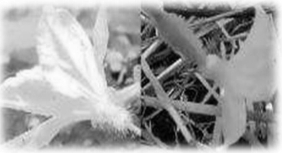
Examine a few flowers of any cucurbit plant and try to identify the staminate and pistillate flowers. Do you know any other plant that bears unisexual flowers?
Solution
(N/A) Cucurbit plants bear unisexual flowers because these flowers contain either only stamens or only pistils.
The staminate flowers possess bright,yellow-coloured petals along with stamens,which represent the male reproductive structure.
On the other hand,the pistillate flowers bear only the pistil,which represents the female reproductive structure.
Other examples of plants that bear unisexual flowers include corn,papaya,and cucumber.
The staminate flowers possess bright,yellow-coloured petals along with stamens,which represent the male reproductive structure.
On the other hand,the pistillate flowers bear only the pistil,which represents the female reproductive structure.
Other examples of plants that bear unisexual flowers include corn,papaya,and cucumber.
0 likes
View Solution50
Easy
Define/Explain the following terms:
$1.$ Bisexual (Monoecious)
$2.$ Unisexual (Dioecious)
$3.$ Gamete Transfer
$1.$ Bisexual (Monoecious)
$2.$ Unisexual (Dioecious)
$3.$ Gamete Transfer
Solution
(N/A) Bisexual (Monoecious): When both male and female reproductive structures are present in the same plant,it is called a bisexual or monoecious plant.
Unisexual (Dioecious): When male and female reproductive structures are present in different plants,they are called unisexual or dioecious plants.
Gamete Transfer: The process of movement of male gametes towards the female gamete is known as gamete transfer.
Unisexual (Dioecious): When male and female reproductive structures are present in different plants,they are called unisexual or dioecious plants.
Gamete Transfer: The process of movement of male gametes towards the female gamete is known as gamete transfer.
0 likes
View SolutionSexual Reproduction in Flowering Plants — Flower · Frequently Asked Questions
1Are these Sexual Reproduction in Flowering Plants questions useful for JEE and NEET?
Yes. All questions in this section are mapped to JEE Main and NEET exam patterns. Previous year questions from JEE Main, NEET, GUJCET and state-level exams are included with full solutions.
2Can I switch to Hindi or Gujarati for these questions?
Yes. Use the language tabs in the hero section or the sidebar to view the same questions and solutions in English, Hindi or Gujarati.
3How do I generate a question paper from this subtopic?
Use the Vedclass Exam Paper Generator — select the chapter and subtopic, set difficulty, and generate Sets A, B, C, D automatically. First 3 chapters of every subject are free.
Vedclass Products
For Students
Vedclass Test Series
Mock tests in real JEE/NEET style with performance analysis. 5-day free trial.
Start Free TrialFor Teachers
Exam Paper Generator
Generate Set A/B/C/D papers from this chapter in 2 minutes. 3 chapters free.
Try FreeFor Institutes
Online Exam Module
Live online exams with unlimited students, 360° analytics & white-label branding.
See DemoFor Teachers & Institutes
Generate a Sexual Reproduction in Flowering Plants Exam Paper in 2 Minutes
Select subtopic & difficulty — Sets A, B, C, D auto-generated with No Repeat logic.
First 3 chapters of every subject are free — no payment required.