
A English
Embryo Questions in English
Class 12 Biology · Sexual Reproduction in Flowering Plants · Embryo
81+
Questions
English
Language
100%
With Solutions
Showing 49 of 81 questions in English
1
MediumMCQ
Meroblastic type of embryo development takes place in
A
Ferns
B
Selaginella
C
Pinus
D
All the above
Solution
(C) In meroblastic development,only a portion of the zygote undergoes division to form the embryo,while the remaining part serves other functions or remains inactive.
In gymnosperms like $Pinus$,the zygote undergoes free nuclear divisions followed by cell wall formation,where only a part of the zygote contributes to the embryo proper.
Therefore,$Pinus$ exhibits meroblastic embryogeny.
In gymnosperms like $Pinus$,the zygote undergoes free nuclear divisions followed by cell wall formation,where only a part of the zygote contributes to the embryo proper.
Therefore,$Pinus$ exhibits meroblastic embryogeny.
0 likes
View Solution2
MediumMCQ
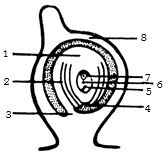
The diagram below shows a fertilised ovule and carpel. Which numbers represent the structures which will become:
$(i)$ The future embryo
$(ii)$ The future testa
$(iii)$ The future micropyle of the seeds
$(i), (ii), (iii)$ respectively?
$(i)$ The future embryo
$(ii)$ The future testa
$(iii)$ The future micropyle of the seeds
$(i), (ii), (iii)$ respectively?
A
$5, 3, 1$
B
$7, 8, 4$
C
$6, 3, 7$
D
$5, 2, 4$
Solution
(D) The correct answer is $(d)$.
In the provided diagram of an ovule:
- Number $5$ represents the zygote (formed after fertilization of the egg cell),which develops into the embryo.
- Number $2$ represents the integument,which develops into the seed coat or testa.
- Number $4$ represents the micropyle,which remains as the micropyle in the seed.
Therefore,the sequence $(i), (ii), (iii)$ corresponds to $5, 2, 4$.
In the provided diagram of an ovule:
- Number $5$ represents the zygote (formed after fertilization of the egg cell),which develops into the embryo.
- Number $2$ represents the integument,which develops into the seed coat or testa.
- Number $4$ represents the micropyle,which remains as the micropyle in the seed.
Therefore,the sequence $(i), (ii), (iii)$ corresponds to $5, 2, 4$.
0 likes
View Solution3
MediumMCQ
$A$ one-celled suspensor is found in:
A
Solanum
B
Hedera
C
Petunia
D
Triticum
Solution
(D) In the development of the embryo,the suspensor is a structure that pushes the embryo into the endosperm for nutrition.
In most dicots,the suspensor is multicellular.
However,in certain monocots like $Triticum$ (wheat) and $Sagittaria$,the suspensor is reduced to a single cell.
Therefore,the correct option is $D$.
In most dicots,the suspensor is multicellular.
However,in certain monocots like $Triticum$ (wheat) and $Sagittaria$,the suspensor is reduced to a single cell.
Therefore,the correct option is $D$.
0 likes
View Solution4
MediumMCQ
When the inner half of the oospore after the first division develops into an embryo and the outer half develops into a suspensor,this type of development is called:
A
Endosporic
B
Endoscopic
C
Exosporic
D
Exoscopic
Solution
(B) In the development of an embryo,the oospore (zygote) undergoes its first division to form two cells: a basal cell and a terminal cell.
If the embryo develops from the cell that is towards the inner side (micropylar or chalazal depending on the orientation) and the suspensor develops from the cell towards the outer side,the orientation is termed as endoscopic.
In endoscopic development,the apex of the embryo is directed towards the interior of the embryo sac.
Therefore,the correct term for this type of development is endoscopic.
If the embryo develops from the cell that is towards the inner side (micropylar or chalazal depending on the orientation) and the suspensor develops from the cell towards the outer side,the orientation is termed as endoscopic.
In endoscopic development,the apex of the embryo is directed towards the interior of the embryo sac.
Therefore,the correct term for this type of development is endoscopic.
0 likes
View Solution5
MediumMCQ
$A$ typical dicot embryo consists of which of the following parts?
A
Radicle and plumule
B
Radicle,plumule,cotyledons and sometimes endosperm
C
Radicle,plumule,cotyledons and tegmen
D
Radicle,plumule,cotyledons,tegmen and testa
Solution
(B) typical dicot embryo consists of an embryonal axis and two cotyledons.
The portion of the embryonal axis above the level of cotyledons is the epicotyl,which terminates with the plumule or stem tip.
The cylindrical portion below the level of cotyledons is the hypocotyl,which terminates at its lower end in the radicle or root tip.
While the embryo itself consists of these parts,in some seeds,the endosperm may persist as a food storage tissue,though it is often consumed during development.
The portion of the embryonal axis above the level of cotyledons is the epicotyl,which terminates with the plumule or stem tip.
The cylindrical portion below the level of cotyledons is the hypocotyl,which terminates at its lower end in the radicle or root tip.
While the embryo itself consists of these parts,in some seeds,the endosperm may persist as a food storage tissue,though it is often consumed during development.
0 likes
View Solution6
MediumMCQ
In angiosperms,the oospore on development produces
A
Seed
B
Embryo
C
Protonema
D
Endosperm
Solution
(B) In angiosperms,the zygote is also known as the oospore.
Embryogeny is the process of the development of a mature embryo from the zygote or oospore after fertilization.
Embryogeny is the process of the development of a mature embryo from the zygote or oospore after fertilization.
0 likes
View Solution7
MediumMCQ
In a seed of maize,scutellum is considered as a cotyledon because it
A
Protects the embryo
B
Contains food for the embryo
C
Absorbs food materials and supplies them to the embryo
D
Converts itself into a monocot leaf
Solution
(C) In monocot seeds like maize,the embryo consists of a single cotyledon,which is known as the scutellum.
It is situated laterally and is shield-shaped.
The primary function of the scutellum is to act as an absorptive organ.
It absorbs nutrients from the endosperm and supplies them to the developing embryo during germination.
It is situated laterally and is shield-shaped.
The primary function of the scutellum is to act as an absorptive organ.
It absorbs nutrients from the endosperm and supplies them to the developing embryo during germination.
0 likes
View Solution8
MediumMCQ
The function of the embryonal suspensor in angiosperms is to
A
Serve as a channel for $H_2O$
B
Push the embryo deeper into the endosperm
C
Release growth hormones
D
Transfer nutrients from the parent sporophyte to the young embryo
Solution
(B) In angiosperms,the zygote undergoes division to form a proembryo and a suspensor. The primary function of the suspensor is to push the developing embryo deeper into the endosperm,where it can easily absorb nutrients for its growth and development. Therefore,option $B$ is the correct answer.
0 likes
View Solution9
MediumMCQ
The hollow foliar structure that encloses the shoot apex and a few leaf primordia is called ....
A
Coleoptile
B
Coleorhiza
C
Scutellum
D
Epiblast
Solution
(A) In the embryo of a grass seed (monocot),the shoot apex and a few leaf primordia are enclosed in a hollow foliar structure called the $Coleoptile$.
$Coleorhiza$ is the undifferentiated sheath covering the radicle and root cap.
$Scutellum$ is the large shield-shaped cotyledon.
$Epiblast$ is a small,rudimentary structure found in some grass embryos.
$Coleorhiza$ is the undifferentiated sheath covering the radicle and root cap.
$Scutellum$ is the large shield-shaped cotyledon.
$Epiblast$ is a small,rudimentary structure found in some grass embryos.
0 likes
View Solution10
MediumMCQ
In grass,the single shield-shaped cotyledon is known as:
A
Tegellum
B
Scutellum
C
Coleoptile
D
None of these
Solution
(B) In the family $Poaceae$ (grass family),the embryo has only one cotyledon.
This single cotyledon is situated towards one side (lateral) of the embryonal axis.
It is shield-shaped and is known as the $Scutellum$.
This single cotyledon is situated towards one side (lateral) of the embryonal axis.
It is shield-shaped and is known as the $Scutellum$.
0 likes
View Solution11
MediumMCQ
The function of the suspensor is . . . . . . .
A
to provide water
B
to provide oxygen
C
to push the embryo into the endosperm for nourishment
D
to absorb food
Solution
(C) In the development of a dicot embryo,the zygote divides to form a terminal cell and a basal cell. The basal cell undergoes transverse divisions to form a filamentous structure called the suspensor. The primary function of the suspensor is to push the developing embryo deep into the endosperm,which facilitates the absorption of nutrients required for the growth and development of the embryo.
0 likes
View Solution12
MediumMCQ
In $Capsella$,the suspensor develops from the.....
A
Apical cell
B
Basal cell
C
Micropylar cell
D
Both apical and basal cells
Solution
(B) In the development of a dicot embryo like $Capsella$,the zygote undergoes a transverse division to form two cells: a larger basal cell and a smaller apical cell (terminal cell).
The basal cell undergoes repeated transverse divisions to form a filamentous structure called the suspensor.
The suspensor helps in pushing the developing embryo into the endosperm for nutrition.
The apical cell undergoes further divisions to form the embryo proper (proembryo).
Therefore,the suspensor develops from the basal cell.
The basal cell undergoes repeated transverse divisions to form a filamentous structure called the suspensor.
The suspensor helps in pushing the developing embryo into the endosperm for nutrition.
The apical cell undergoes further divisions to form the embryo proper (proembryo).
Therefore,the suspensor develops from the basal cell.
0 likes
View Solution13
MediumMCQ
In which of the following is the $Anagrad$ type of embryo development found?
A
$Solanum$
B
$Capsella$
C
$Lilium$
D
$Hibiscus$
Solution
(B) The $Anagrad$ type of embryo development is a specific classification found in embryology.
$Capsella$ $bursa-pastoris$ is the most common example used to describe the $Onagrad$ (often referred to as $Anagrad$ in some older texts) type of embryo development.
In this type,the zygote divides transversely to form a terminal cell and a basal cell,followed by a series of divisions that lead to the formation of a globular,heart-shaped,and finally a mature embryo.
Therefore,$Capsella$ is the correct answer.
$Capsella$ $bursa-pastoris$ is the most common example used to describe the $Onagrad$ (often referred to as $Anagrad$ in some older texts) type of embryo development.
In this type,the zygote divides transversely to form a terminal cell and a basal cell,followed by a series of divisions that lead to the formation of a globular,heart-shaped,and finally a mature embryo.
Therefore,$Capsella$ is the correct answer.
0 likes
View Solution14
MediumMCQ
The 'haustorial embryo' is generally found in the seeds of......
A
Euphorbiaceae
B
Compositae
C
Palmae or Arecaceae
D
Gramineae
Solution
(C) The 'haustorial embryo' is a specialized structure found in the seeds of the family $Palmae$ (also known as $Arecaceae$).
In these plants,the cotyledon is modified into a structure called the haustorium,which helps in absorbing nutrients from the endosperm for the developing embryo.
Therefore,the correct option is $C$.
In these plants,the cotyledon is modified into a structure called the haustorium,which helps in absorbing nutrients from the endosperm for the developing embryo.
Therefore,the correct option is $C$.
0 likes
View Solution15
MediumMCQ
The embryo develops from which of the following?
A
Two polar nuclei in the embryo sac
B
Secondary nucleus and male gametes
C
Egg cell and male gamete
D
Synergid cells
Solution
(C) In angiosperms,the process of double fertilization involves two events:
$1$. Syngamy: The fusion of one male gamete with the egg cell to form a diploid zygote $(2n)$. This zygote subsequently undergoes mitotic divisions to develop into the embryo.
$2$. Triple fusion: The fusion of the second male gamete with the two polar nuclei (or the secondary nucleus) to form the primary endosperm nucleus $(PEN)$,which develops into the endosperm.
Therefore,the embryo develops from the zygote,which is formed by the fusion of the egg cell and a male gamete.
$1$. Syngamy: The fusion of one male gamete with the egg cell to form a diploid zygote $(2n)$. This zygote subsequently undergoes mitotic divisions to develop into the embryo.
$2$. Triple fusion: The fusion of the second male gamete with the two polar nuclei (or the secondary nucleus) to form the primary endosperm nucleus $(PEN)$,which develops into the endosperm.
Therefore,the embryo develops from the zygote,which is formed by the fusion of the egg cell and a male gamete.
0 likes
View Solution16
EasyMCQ
Embryonic development in $Capsella$ occurs through which type?
A
Asterad type
B
Caryophyllad type
C
Crucifer type
D
Solanad type
Solution
(C) The embryonic development in $Capsella$ $bursa-pastoris$ is of the $Crucifer$ type (also known as $Onagrad$ type).
In this type,the zygote divides transversely to form a terminal cell $(ca)$ and a basal cell $(cb)$.
The terminal cell divides longitudinally,while the basal cell divides transversely,leading to the formation of a proembryo that eventually develops into a heart-shaped embryo and finally a mature embryo.
In this type,the zygote divides transversely to form a terminal cell $(ca)$ and a basal cell $(cb)$.
The terminal cell divides longitudinally,while the basal cell divides transversely,leading to the formation of a proembryo that eventually develops into a heart-shaped embryo and finally a mature embryo.
0 likes
View Solution17
EasyMCQ
The tips of the radicle are formed with the help of which cells in a developing embryo?
A
Epibasal cells
B
Hypobasal cells
C
Cotyledons
D
Hypophysis
Solution
(D) In the development of a dicot embryo,the zygote undergoes transverse division to form a terminal cell and a basal cell. The basal cell divides to form the suspensor,and the terminal cell (embryonal cell) divides to form the embryo proper. The cell of the suspensor adjacent to the embryonal mass is called the hypophysis. The hypophysis subsequently divides to give rise to the radicle tip and the root cap.
0 likes
View Solution18
MediumMCQ
The function of the suspensor in angiosperms is to .....
A
act as a channel for $H_2O$
B
push the embryo deep into the endosperm
C
secrete growth hormones
D
transport nutrients from the parent sporophyte to the young embryo
Solution
(B) In angiosperms,the zygote undergoes division to form a proembryo and a suspensor.
The primary function of the suspensor is to push the developing embryo deep into the endosperm to ensure it has access to a rich supply of nutrients for its growth and development.
While it may facilitate some nutrient transport,its mechanical role of positioning the embryo is its most characteristic function.
The primary function of the suspensor is to push the developing embryo deep into the endosperm to ensure it has access to a rich supply of nutrients for its growth and development.
While it may facilitate some nutrient transport,its mechanical role of positioning the embryo is its most characteristic function.
0 likes
View Solution19
EasyMCQ
Who first studied embryogeny in $Capsella$?
A
Hanstein
B
Caminezin
C
Souèges
D
All of these
Solution
(C) The study of embryogeny in the genus $Capsella$ (specifically $Capsella$ $\text{bursa-pastoris}$) was pioneered by the French botanist $René$ $\text{Souèges}$.
He provided a detailed description of the developmental stages of the embryo in this plant, which is now considered the classic model for dicot embryogeny.
Therefore, the correct answer is $Souèges$.
He provided a detailed description of the developmental stages of the embryo in this plant, which is now considered the classic model for dicot embryogeny.
Therefore, the correct answer is $Souèges$.
0 likes
View Solution20
MediumMCQ
The wheat grain has an embryo with one large,shield-shaped cotyledon known as
A
scutellum
B
coleoptile
C
epiblast
D
coleorhiza
Solution
(A) : The seeds of monocotyledonous plants have only one cotyledon.
In the family $Poaceae$ (e.g.,wheat,maize,etc.),this cotyledon is called the scutellum,which is situated towards the lateral side of the embryonal axis.
It provides nourishment to the developing embryo.
In the family $Poaceae$ (e.g.,wheat,maize,etc.),this cotyledon is called the scutellum,which is situated towards the lateral side of the embryonal axis.
It provides nourishment to the developing embryo.
1 likes
View Solution21
MediumMCQ
The scutellum observed in a grain of wheat or maize is comparable to which part of the seed in other monocotyledons?
A
Cotyledon
B
Endosperm
C
Aleurone layer
D
Plumule
Solution
(A) The scutellum is the tissue in a grass,wheat,or maize seed that lies between the embryo and the endosperm. It is a modified cotyledon,specialized for the digestion and absorption of the endosperm nutrients for the developing embryo.
0 likes
View Solution22
DifficultMCQ
Identify $X$ and $Y$ from the given figure.
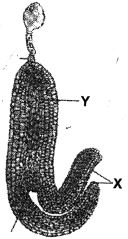
A
$X$ - Radicle,$Y$ - Plumule
B
$X$ - Plumule,$Y$ - Suspensor
C
$X$ - Suspensor,$Y$ - Cotyledon
D
$X$ - Cotyledon,$Y$ - Radicle
Solution
(D) The provided figure represents a developing dicot embryo.
In a typical dicot embryo,the structure consists of an embryonal axis and two cotyledons.
$X$ points to the cotyledons,which are the seed leaves that store food.
$Y$ points to the radicle,which is the embryonic root tip located at the lower end of the embryonal axis.
Therefore,$X$ is the cotyledon and $Y$ is the radicle.
In a typical dicot embryo,the structure consists of an embryonal axis and two cotyledons.
$X$ points to the cotyledons,which are the seed leaves that store food.
$Y$ points to the radicle,which is the embryonic root tip located at the lower end of the embryonal axis.
Therefore,$X$ is the cotyledon and $Y$ is the radicle.
0 likes
View Solution23
MediumMCQ
Monocot embryo consists of one large shield-shaped cotyledon known as:
A
Scutellum
B
Coleoptile
C
Coleorhiza
D
Endosperm
Solution
(A) In monocotyledonous seeds,such as maize,the embryo consists of a single large,shield-shaped cotyledon known as the $Scutellum$.
It is situated towards one side of the embryonal axis.
$Coleoptile$ is the protective sheath covering the plumule,while $Coleorhiza$ is the protective sheath covering the radicle.
$Endosperm$ is the food-storing tissue in the seed,not the cotyledon itself.
It is situated towards one side of the embryonal axis.
$Coleoptile$ is the protective sheath covering the plumule,while $Coleorhiza$ is the protective sheath covering the radicle.
$Endosperm$ is the food-storing tissue in the seed,not the cotyledon itself.
0 likes
View Solution24
EasyMCQ
The study of the formation,growth,and development of a new organism from an egg is known as:
A
Apomixis
B
Embryology
C
Embryogenesis
D
Cytology
Solution
(B) Embryology is the branch of biology that deals with the study of the formation,growth,and development of a new organism from an egg (zygote).
$1$. Apomixis is a form of asexual reproduction that mimics sexual reproduction.
$2$. Embryogenesis refers specifically to the process of development of an embryo from the zygote.
$3$. Cytology is the study of the structure and function of cells.
Therefore,the correct answer is Embryology.
$1$. Apomixis is a form of asexual reproduction that mimics sexual reproduction.
$2$. Embryogenesis refers specifically to the process of development of an embryo from the zygote.
$3$. Cytology is the study of the structure and function of cells.
Therefore,the correct answer is Embryology.
0 likes
View Solution25
MediumMCQ
The scutellum observed in the grains of maize or wheat can be compared to which part of the seed in other monocotyledonous plants?
A
Cotyledon
B
Endosperm
C
Aleurone layer
D
Coleoptile
Solution
(A) In monocotyledonous seeds,such as those of the family $Poaceae$ (e.g.,maize,wheat),the embryo consists of a single large shield-shaped cotyledon known as the $scutellum$. This $scutellum$ is homologous to the cotyledon found in other monocotyledonous plants. It serves to absorb nutrients from the endosperm and transfer them to the developing embryo.
0 likes
View Solution26
MediumMCQ
In $Pinus$,the third tier of embryonal cells from below is known as:
A
rosette tier
B
suspensor tier
C
embryonal tier
D
free-nuclear tier
Solution
(A) In $Pinus$,the proembryo consists of four tiers of cells.
$1$. The lowermost tier (farthest from the micropylar end) is the embryonal tier,which develops into the embryo.
$2$. The second tier from below is the suspensor tier,which elongates to push the embryo into the endosperm.
$3$. The third tier from below is known as the rosette tier.
$4$. The uppermost tier is the free-nuclear tier,consisting of $4$ nuclei.
$1$. The lowermost tier (farthest from the micropylar end) is the embryonal tier,which develops into the embryo.
$2$. The second tier from below is the suspensor tier,which elongates to push the embryo into the endosperm.
$3$. The third tier from below is known as the rosette tier.
$4$. The uppermost tier is the free-nuclear tier,consisting of $4$ nuclei.
0 likes
View Solution27
MediumMCQ
Assertion: The two cotyledons in a seed are embryonic leaves.
Reason: The embryo contains a radicle and a plumule.
Reason: The embryo contains a radicle and a plumule.
A
If both Assertion and Reason are correct and the Reason is a correct explanation of the Assertion.
B
If both Assertion and Reason are correct but Reason is not a correct explanation of the Assertion.
C
If the Assertion is correct but Reason is incorrect.
D
If both the Assertion and Reason are incorrect.
Solution
(B) The Assertion is correct because cotyledons are indeed embryonic leaves that store food or perform photosynthesis in early development.
The Reason is also correct because the embryo consists of an embryonal axis,which includes the radicle (future root) and the plumule (future shoot).
However,the Reason does not explain why cotyledons are considered embryonic leaves; it merely describes the components of the embryo. Therefore,the Reason is not the correct explanation of the Assertion.
The Reason is also correct because the embryo consists of an embryonal axis,which includes the radicle (future root) and the plumule (future shoot).
However,the Reason does not explain why cotyledons are considered embryonic leaves; it merely describes the components of the embryo. Therefore,the Reason is not the correct explanation of the Assertion.
0 likes
View Solution28
Easy
Why do you think the zygote is dormant for some time in a fertilized ovule?
Solution
(N/A) The zygote is formed by the fusion of the male gamete with the nucleus of the egg cell. The zygote remains dormant for some time and waits for the endosperm to form,which develops from the primary endosperm cell resulting from triple fusion. The endosperm provides food for the growing embryo and after the formation of the endosperm,further development of the embryo from the zygote starts.
0 likes
View Solution29
Medium
What is an embryo? Explain the structure of monocot and dicot embryos.
Solution
(N/A) An embryo develops at the micropylar end of the embryo sac where the zygote is situated. Most zygotes divide only after a certain amount of endosperm is formed. This is an adaptation to provide assured nutrition to the developing embryo.
Although seeds differ greatly,the early stages of embryo development are similar in both monocotyledons and dicotyledons.
The zygote gives rise to the proembryo and subsequently to the globular,heart-shaped,and mature embryo.
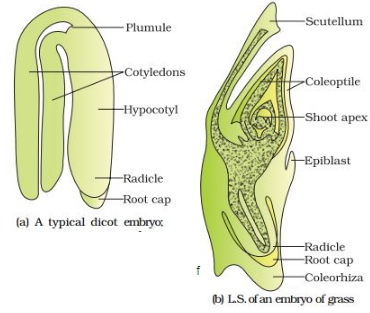
Typical dicot embryo: $A$ typical dicotyledonous embryo consists of an embryonal axis and two cotyledons. The portion of the embryonal axis above the level of cotyledons is the epicotyl,which terminates with the plumule or stem tip. The cylindrical portion below the level of cotyledons is the hypocotyl,which terminates at its lower end in the radicle or root tip. The root tip is covered with a root cap.
Embryo of monocotyledons: Embryos of monocotyledons possess only one cotyledon. In the grass family,the cotyledon is called the scutellum,which is situated towards one side (lateral) of the embryonal axis. At its lower end,the embryonal axis has the radicle and root cap enclosed in an undifferentiated sheath called the coleorrhiza. The portion of the embryonal axis above the level of attachment of the scutellum is the epicotyl.
The epicotyl has a shoot apex and a few leaf primordia enclosed in a hollow foliar structure called the coleoptile.
Although seeds differ greatly,the early stages of embryo development are similar in both monocotyledons and dicotyledons.
The zygote gives rise to the proembryo and subsequently to the globular,heart-shaped,and mature embryo.
Typical dicot embryo: $A$ typical dicotyledonous embryo consists of an embryonal axis and two cotyledons. The portion of the embryonal axis above the level of cotyledons is the epicotyl,which terminates with the plumule or stem tip. The cylindrical portion below the level of cotyledons is the hypocotyl,which terminates at its lower end in the radicle or root tip. The root tip is covered with a root cap.
Embryo of monocotyledons: Embryos of monocotyledons possess only one cotyledon. In the grass family,the cotyledon is called the scutellum,which is situated towards one side (lateral) of the embryonal axis. At its lower end,the embryonal axis has the radicle and root cap enclosed in an undifferentiated sheath called the coleorrhiza. The portion of the embryonal axis above the level of attachment of the scutellum is the epicotyl.
The epicotyl has a shoot apex and a few leaf primordia enclosed in a hollow foliar structure called the coleoptile.
0 likes
View Solution30
Medium
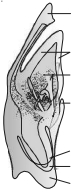
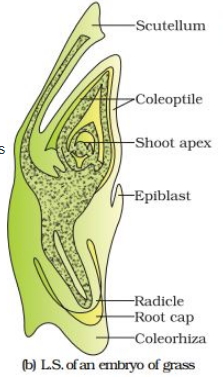
In the given diagram, identify and label the parts indicated by the lines.
Solution
(N/A) The embryo of monocot plants has only one cotyledon. In the grass family, this is called the $Scutellum$, which is located at one side of the embryonal axis.
At its lower end, the embryonal axis has the $Radicle$ and $Root cap$ enclosed in an undifferentiated sheath called the $Coleorrhiza$.
The portion of the embryonal axis above the level of attachment of the $Scutellum$ is the $Epicotyl$. The $Epicotyl$ has a $Shoot apex$ and a few leaf primordia enclosed in a hollow foliar structure, the $Coleoptile$.
Additionally, the $Epiblast$ is a small, non-functional remnant of the second cotyledon found in some grass embryos.
At its lower end, the embryonal axis has the $Radicle$ and $Root cap$ enclosed in an undifferentiated sheath called the $Coleorrhiza$.
The portion of the embryonal axis above the level of attachment of the $Scutellum$ is the $Epicotyl$. The $Epicotyl$ has a $Shoot apex$ and a few leaf primordia enclosed in a hollow foliar structure, the $Coleoptile$.
Additionally, the $Epiblast$ is a small, non-functional remnant of the second cotyledon found in some grass embryos.
0 likes
View Solution31
Difficult
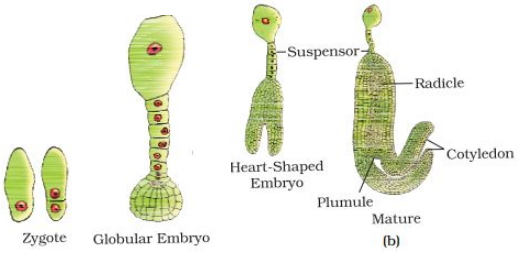
Starting with the zygote,draw the diagrams of the different stages of embryo development in a dicot.
Solution
(N/A) The development of a dicot embryo proceeds through several distinct stages starting from the zygote:
$1$. Zygote: The process begins with the formation of a zygote after fertilization.
$2$. Proembryo: The zygote undergoes transverse divisions to form a proembryo.
$3$. Globular Embryo: Further cell divisions lead to the formation of a globular-shaped embryo.
$4$. Heart-Shaped Embryo: As development continues,the embryo takes on a heart-shaped appearance.
$5$. Mature Embryo: Finally,the embryo matures,showing distinct parts such as the radicle,plumule,and two cotyledons,supported by a suspensor.
$1$. Zygote: The process begins with the formation of a zygote after fertilization.
$2$. Proembryo: The zygote undergoes transverse divisions to form a proembryo.
$3$. Globular Embryo: Further cell divisions lead to the formation of a globular-shaped embryo.
$4$. Heart-Shaped Embryo: As development continues,the embryo takes on a heart-shaped appearance.
$5$. Mature Embryo: Finally,the embryo matures,showing distinct parts such as the radicle,plumule,and two cotyledons,supported by a suspensor.
0 likes
View Solution32
Medium
Describe the structure of a typical dicotyledonous embryo in detail.
Solution
(N/A) typical dicotyledonous embryo consists of an embryonal axis and two cotyledons.
The portion of the embryonal axis above the level of cotyledons is the epicotyl,which terminates with the plumule or stem tip.
The cylindrical portion below the level of cotyledons is the hypocotyl,which terminates at its lower end in the radicle or root tip.
The root tip is covered with a root cap.
The portion of the embryonal axis above the level of cotyledons is the epicotyl,which terminates with the plumule or stem tip.
The cylindrical portion below the level of cotyledons is the hypocotyl,which terminates at its lower end in the radicle or root tip.
The root tip is covered with a root cap.
0 likes
View Solution33
Medium
Explain: Embryo of a monocotyledon.
Solution
(N/A) The embryo of a monocotyledon possesses only one cotyledon. In the grass family,this cotyledon is called the $scutellum$. It is situated towards one side (lateral side) of the embryonal axis. At its lower end,the embryonal axis has the radicle and root cap enclosed in an undifferentiated sheath called the $coleorrhiza$. The portion of the embryonal axis above the level of attachment of the $scutellum$ is the $epicotyl$.
0 likes
View Solution34
EasyMCQ
Which cell acts as the vital link that ensures continuity of species between organisms of one generation and the next?
A
Male gamete
B
Zygote
C
Both $A$ and $B$
D
Somatic cell
Solution
(B) The $Zygote$ is the vital link that ensures continuity of species between organisms of one generation and the next.
It is a diploid cell formed by the fusion of two haploid gametes (male and female) during fertilization.
It contains the genetic material from both parents,which is then passed on to the offspring,thereby maintaining the continuity of the species across generations.
It is a diploid cell formed by the fusion of two haploid gametes (male and female) during fertilization.
It contains the genetic material from both parents,which is then passed on to the offspring,thereby maintaining the continuity of the species across generations.
0 likes
View Solution35
EasyMCQ
Select the correct option for embryogenesis.
A
Zygote $\rightarrow$ Embryo
B
Embryo $\rightarrow$ Zygote
C
Somatic cell $\rightarrow$ Embryo
D
Embryo $\rightarrow$ Somatic cell
Solution
(A) Embryogenesis is the process of development of an embryo from the zygote. During this process,the zygote undergoes cell division (mitosis) and cell differentiation. Cell division increases the number of cells in the developing embryo,while cell differentiation helps groups of cells to undergo certain modifications to form specialized tissues and organs to form an organism. Therefore,the correct sequence is Zygote $\rightarrow$ Embryo.
0 likes
View Solution36
MediumMCQ
What is formed from the zygote?
A
Endosperm
B
$PEN$
C
Embryo
D
Female gametophyte
Solution
(C) In angiosperms,the process of syngamy involves the fusion of the male gamete with the egg cell to form a diploid zygote $(2n)$.
Following fertilization,the zygote undergoes mitotic divisions to develop into an embryo.
The $PEN$ (Primary Endosperm Nucleus) is formed by the fusion of the second male gamete with the two polar nuclei (triple fusion),which later develops into the endosperm.
Following fertilization,the zygote undergoes mitotic divisions to develop into an embryo.
The $PEN$ (Primary Endosperm Nucleus) is formed by the fusion of the second male gamete with the two polar nuclei (triple fusion),which later develops into the endosperm.
0 likes
View Solution37
MediumMCQ
What is the ploidy of the cell from which the embryo develops?
A
Haploid
B
Diploid
C
Triploid
D
Tetraploid
Solution
(B) In flowering plants,the embryo develops from the zygote.
The zygote is formed by the fusion of a male gamete $(n)$ and an egg cell $(n)$.
Therefore,the zygote is diploid $(2n)$.
Since the embryo develops from the zygote through mitotic divisions,the cells of the embryo are also diploid $(2n)$.
The zygote is formed by the fusion of a male gamete $(n)$ and an egg cell $(n)$.
Therefore,the zygote is diploid $(2n)$.
Since the embryo develops from the zygote through mitotic divisions,the cells of the embryo are also diploid $(2n)$.
0 likes
View Solution38
MediumMCQ
Which stage is $NOT$ observed during embryogeny in dicots?
A
Globular
B
Cuboidal
C
Heart-shaped
D
Mature embryo
Solution
(B) In dicotyledonous plants,the development of the embryo (embryogeny) follows a specific sequence of stages. The zygote undergoes transverse division to form a proembryo. The subsequent stages include the $Globular$ stage,the $Heart-shaped$ stage,and finally the $Mature$ embryo stage. The $Cuboidal$ stage is not a recognized developmental stage in the embryogeny of dicots.
0 likes
View Solution39
MediumMCQ
How many cotyledons does a typical dicot embryo possess?
A
Four
B
Three
C
Two
D
One
Solution
(C) typical dicot embryo consists of an embryonal axis and two cotyledons. The term 'dicot' itself is derived from 'di' meaning two and 'cotyledon' referring to the seed leaf. Therefore,a typical dicot embryo possesses two cotyledons.
0 likes
View Solution40
MediumMCQ
Find the odd one out.
A
Coleoptile
B
Shoot apex
C
Epicotyl
D
Radicle
Solution
(D) In the structure of a monocot embryo,the $A$,$B$,and $C$ options (Coleoptile,Shoot apex,and Epicotyl) are all components associated with the plumule or the shoot system development. The $D$ option (Radicle) is the embryonic root,which is part of the root system. Therefore,the Radicle is the odd one out.
0 likes
View Solution41
MediumMCQ
The epicotyl terminates with the:
A
Root cap
B
Root tip
C
Plumule
D
Radicle
Solution
(C) In the structure of a dicot embryo,the portion of the embryonal axis above the level of cotyledons is the epicotyl,which terminates with the plumule or stem tip. The portion of the embryonal axis below the level of cotyledons is the hypocotyl,which terminates with its lower end in the radicle or root tip.
0 likes
View Solution42
MediumMCQ
In grass embryos,the root cap is covered by which of the following?
A
Coleoptile
B
Epiblast
C
Coleorhiza
D
Scutellum
Solution
(C) In the embryo of a grass,the radicle and root cap are enclosed in an undifferentiated sheath called the $Coleorhiza$.
$Coleoptile$ is the protective sheath covering the plumule.
$Scutellum$ is the single cotyledon in monocots.
$Epiblast$ is the rudimentary second cotyledon found in some grasses.
$Coleoptile$ is the protective sheath covering the plumule.
$Scutellum$ is the single cotyledon in monocots.
$Epiblast$ is the rudimentary second cotyledon found in some grasses.
0 likes
View Solution43
MediumMCQ
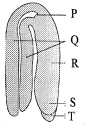
What do '$P$','$Q$',and '$R$' represent in the given figure?
A
Plumule,Cotyledons,Hypocotyl
B
Radicle,Cotyledons,Epicotyl
C
Epicotyl,Hypocotyl,Cotyledon
D
Plumule,Cotyledons,Epicotyl
Solution
(D) The given figure represents the structure of a dicot embryo.
$P$ points to the plumule (the embryonic shoot).
$Q$ points to the cotyledons (the seed leaves).
$R$ points to the epicotyl (the region of the embryo axis above the level of cotyledons).
Therefore,$P$ is the plumule,$Q$ are the cotyledons,and $R$ is the epicotyl.
$P$ points to the plumule (the embryonic shoot).
$Q$ points to the cotyledons (the seed leaves).
$R$ points to the epicotyl (the region of the embryo axis above the level of cotyledons).
Therefore,$P$ is the plumule,$Q$ are the cotyledons,and $R$ is the epicotyl.
0 likes
View Solution44
MediumMCQ
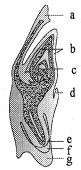
What do '$a$','$b$','$c$',and '$d$' represent in the given figure?
A
Scutellum,Coleoptile,Shoot apex,Epiblast
B
Root cap,Coleoptile,Radicle,Root cap
C
Scutellum,Coleoptile,Shoot apex,Epiblast
D
Epiblast,Shoot apex,Coleoptile,Scutellum
Solution
(A) In the diagram of a monocot embryo (grass embryo),the labels represent the following parts:
$a$ = Scutellum (the single cotyledon in grasses)
$b$ = Coleoptile (a protective sheath covering the plumule)
$c$ = Shoot apex (the growing tip of the shoot)
$d$ = Epiblast (a small,non-functional remnant of the second cotyledon)
Therefore,the correct sequence is Scutellum,Coleoptile,Shoot apex,and Epiblast.
$a$ = Scutellum (the single cotyledon in grasses)
$b$ = Coleoptile (a protective sheath covering the plumule)
$c$ = Shoot apex (the growing tip of the shoot)
$d$ = Epiblast (a small,non-functional remnant of the second cotyledon)
Therefore,the correct sequence is Scutellum,Coleoptile,Shoot apex,and Epiblast.
0 likes
View Solution45
MediumMCQ
What do 'e','f',and 'g' represent in the given figure?
A
Shoot apex,root cap,coleoptile
B
Plumule,coleoptile,epiblast
C
Scutellum,coleorhiza,root cap
D
Radicle,root cap,coleorhiza
Solution
(D) The provided figure represents the structure of a monocot embryo (specifically a grass embryo).
Based on the labeling:
'e' represents the radicle (the embryonic root).
'f' represents the coleorhiza (the protective sheath covering the radicle).
'g' represents the root cap (the protective structure at the tip of the root).
Therefore,the correct sequence is radicle,coleorhiza,and root cap.
Based on the labeling:
'e' represents the radicle (the embryonic root).
'f' represents the coleorhiza (the protective sheath covering the radicle).
'g' represents the root cap (the protective structure at the tip of the root).
Therefore,the correct sequence is radicle,coleorhiza,and root cap.
0 likes
View Solution46
EasyMCQ
Cotyledons are
A
Modified roots
B
Embryonic leaves
C
Known as primary endosperm nucleus
D
Present in gymnospermic seeds only
Solution
(B) Cotyledons are the first leaves to appear from a germinating seed. They are part of the embryo within the seed and are often referred to as embryonic leaves or seed leaves. They provide initial nourishment to the developing seedling before it becomes capable of photosynthesis.
0 likes
View Solution47
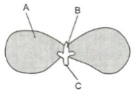
MediumMCQ
Identify $A, B$ and $C$ in the given diagram.
A
$A-Plumule, B-Cotyledon, C-Radicle$
B
$A-Radicle, B-Cotyledon, C-Plumule$
C
$A-Cotyledon, B-Plumule, C-Radicle$
D
$A-Cotyledon, B-Radicle, C-Plumule$
Solution
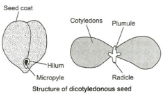
(C) In the given diagram of a dicotyledonous seed embryo:
$A$ represents the Cotyledon, which is the seed leaf that stores food.
$B$ represents the Plumule, which is the part of the embryo that develops into the shoot system.
$C$ represents the Radicle, which is the part of the embryo that develops into the root system.
Therefore, the correct identification is $A-Cotyledon, B-Plumule, C-Radicle$.
$A$ represents the Cotyledon, which is the seed leaf that stores food.
$B$ represents the Plumule, which is the part of the embryo that develops into the shoot system.
$C$ represents the Radicle, which is the part of the embryo that develops into the root system.
Therefore, the correct identification is $A-Cotyledon, B-Plumule, C-Radicle$.
0 likes
View Solution48
MediumMCQ
Which of the following parts of the embryo contains radicle and plumule?
A
Cotyledon
B
Seed coat
C
Embryonal axis
D
Endosperm
Solution
(C) The embryo of a seed consists of an embryonal axis and one or two cotyledons. The portion of the embryonal axis above the level of cotyledons is the epicotyl,which terminates with the plumule or stem tip. The cylindrical portion below the level of cotyledons is the hypocotyl,which terminates at its lower end in the radicle or root tip. Therefore,the radicle and plumule are parts of the embryonal axis.
0 likes
View Solution49
MediumMCQ
Scutellum is a
A
Food storing haploid structure in grass embryo
B
Remnant of cotyledon in maize
C
Shield shaped and large cotyledon of grasses
D
Protective covering of plumule in grasses
Solution
(C) The $Scutellum$ is a specialized,shield-shaped,and large cotyledon found in the embryos of grasses (family $Poaceae$).
It is responsible for absorbing nutrients from the endosperm and transferring them to the developing embryo during germination.
It is responsible for absorbing nutrients from the endosperm and transferring them to the developing embryo during germination.
0 likes
View SolutionSexual Reproduction in Flowering Plants — Embryo · Frequently Asked Questions
1Are these Sexual Reproduction in Flowering Plants questions useful for JEE and NEET?
Yes. All questions in this section are mapped to JEE Main and NEET exam patterns. Previous year questions from JEE Main, NEET, GUJCET and state-level exams are included with full solutions.
2Can I switch to Hindi or Gujarati for these questions?
Yes. Use the language tabs in the hero section or the sidebar to view the same questions and solutions in English, Hindi or Gujarati.
3How do I generate a question paper from this subtopic?
Use the Vedclass Exam Paper Generator — select the chapter and subtopic, set difficulty, and generate Sets A, B, C, D automatically. First 3 chapters of every subject are free.
Vedclass Products
For Students
Vedclass Test Series
Mock tests in real JEE/NEET style with performance analysis. 5-day free trial.
Start Free TrialFor Teachers
Exam Paper Generator
Generate Set A/B/C/D papers from this chapter in 2 minutes. 3 chapters free.
Try FreeFor Institutes
Online Exam Module
Live online exams with unlimited students, 360° analytics & white-label branding.
See DemoFor Teachers & Institutes
Generate a Sexual Reproduction in Flowering Plants Exam Paper in 2 Minutes
Select subtopic & difficulty — Sets A, B, C, D auto-generated with No Repeat logic.
First 3 chapters of every subject are free — no payment required.