
A English
The Pistil, Megasporangium (ovule) and Embryo sac Questions in English
Class 12 Biology · Sexual Reproduction in Flowering Plants · The Pistil, Megasporangium (ovule) and Embryo sac
351+
Questions
English
Language
100%
With Solutions
Showing 50 of 351 questions in English
301
MediumMCQ
In a majority of flowering plants,out of the four megaspores,........ megaspores degenerate and ........ megaspore remains functional.
A
$2, 2$
B
$3, 1$
C
$1, 3$
D
None of these
Solution
(B) During the process of megasporogenesis,the megaspore mother cell undergoes meiosis to produce four haploid megaspores.
In the majority of flowering plants,three of these four megaspores degenerate,while only one megaspore remains functional.
This functional megaspore develops into the female gametophyte (embryo sac).
Therefore,the correct answer is $3$ megaspores degenerate and $1$ megaspore remains functional.
In the majority of flowering plants,three of these four megaspores degenerate,while only one megaspore remains functional.
This functional megaspore develops into the female gametophyte (embryo sac).
Therefore,the correct answer is $3$ megaspores degenerate and $1$ megaspore remains functional.
0 likes
View Solution302
EasyMCQ
Which of the following is true for a typical mature embryo sac?
A
$8$-nucleate,$7$-celled
B
$7$-nucleate,$8$-celled
C
$7$-nucleate,$7$-celled
D
$8$-nucleate,$8$-celled
Solution
(A) typical mature embryo sac (Polygonum type) is formed after three rounds of free nuclear divisions following meiosis of the megaspore mother cell.
It contains $8$ nuclei: $3$ at the micropylar end (egg apparatus),$3$ at the chalazal end (antipodals),and $2$ polar nuclei in the central cell.
However,it is $7$-celled because the two polar nuclei fuse to form a single central cell,while the other $6$ nuclei are enclosed in individual cell membranes.
Thus,it is $8$-nucleate and $7$-celled.
It contains $8$ nuclei: $3$ at the micropylar end (egg apparatus),$3$ at the chalazal end (antipodals),and $2$ polar nuclei in the central cell.
However,it is $7$-celled because the two polar nuclei fuse to form a single central cell,while the other $6$ nuclei are enclosed in individual cell membranes.
Thus,it is $8$-nucleate and $7$-celled.
0 likes
View Solution303
MediumMCQ
What is monosporic development?
A
Formation of embryo sac from a single megaspore.
B
Formation of embryo sac from a single megaspore mother cell.
C
Formation of ovule from a single megaspore.
D
Formation of ovule from a single megaspore mother cell.
Solution
(A) Monosporic development refers to the process where the embryo sac (female gametophyte) develops from only one of the four megaspores produced after meiosis of the megaspore mother cell. In most flowering plants,three megaspores degenerate,and only one functional megaspore undergoes mitosis to form the mature embryo sac (Polygonum type).
0 likes
View Solution304
MediumMCQ
The egg apparatus consists of $.......$
A
Egg cell $+$ Antipodal cells
B
Egg cell $+$ Central cell
C
Egg cell $+$ Synergids
D
Egg cell
Solution
(C) In the mature embryo sac of angiosperms,the egg apparatus is located at the micropylar end.
It consists of two synergids and one egg cell.
Therefore,the egg apparatus is defined as the combination of the egg cell and the two synergids.
It consists of two synergids and one egg cell.
Therefore,the egg apparatus is defined as the combination of the egg cell and the two synergids.
0 likes
View Solution305
EasyMCQ
Identify the location of the filiform apparatus that guides the pollen tube into the synergids.
A
Egg cell
B
Synergids
C
Antipodal cells
D
Central cell
Solution
(B) The filiform apparatus is a specialized cellular thickening located at the micropylar end of the synergids.
Its primary function is to secrete chemical substances that guide the entry of the pollen tube into the synergids during the process of fertilization in angiosperms.
Its primary function is to secrete chemical substances that guide the entry of the pollen tube into the synergids during the process of fertilization in angiosperms.
0 likes
View Solution306
EasyMCQ
What is the arrangement of nuclei in the embryo sac?
A
$3+2+3$
B
$2+3+3$
C
$3+3+2$
D
$3+3+3$
Solution
(A) In a typical mature angiosperm embryo sac,the arrangement of nuclei is as follows:
$1$. At the micropylar end,there are $3$ cells: $2$ synergids and $1$ egg cell.
$2$. In the central cell,there are $2$ polar nuclei.
$3$. At the chalazal end,there are $3$ antipodal cells.
Therefore,the arrangement of nuclei is $3$ (antipodals) $+ 2$ (polar nuclei) $+ 3$ (egg apparatus) = $3+2+3$.
$1$. At the micropylar end,there are $3$ cells: $2$ synergids and $1$ egg cell.
$2$. In the central cell,there are $2$ polar nuclei.
$3$. At the chalazal end,there are $3$ antipodal cells.
Therefore,the arrangement of nuclei is $3$ (antipodals) $+ 2$ (polar nuclei) $+ 3$ (egg apparatus) = $3+2+3$.
0 likes
View Solution307
MediumMCQ
The three cells present at the chalazal end form $.....P......$,and the three cells present at the micropylar end form $.....Q.....$.
$\quad\quad\quad \quad \text { P } \quad\quad\quad \text { Q }$
$\quad\quad\quad \quad \text { P } \quad\quad\quad \text { Q }$
A
Antipodal cells $\quad$ $\quad$ $\quad$ Egg apparatus
B
Egg apparatus $\quad$ $\quad$ $\quad$ Antipodal cells
C
Egg apparatus $\quad$ $\quad$ $\quad$ Secondary nuclei
D
Secondary nuclei $\quad$ $\quad$ $\quad$ Egg apparatus
Solution
(A) In a typical angiosperm embryo sac,there are $8$ nuclei and $7$ cells.
$1$. The three cells located at the chalazal end are known as antipodal cells $(P)$.
$2$. The three cells located at the micropylar end constitute the egg apparatus $(Q)$,which consists of one egg cell and two synergids.
$3$. Therefore,$P$ represents antipodal cells and $Q$ represents the egg apparatus.
Thus,the correct option is $A$.
$1$. The three cells located at the chalazal end are known as antipodal cells $(P)$.
$2$. The three cells located at the micropylar end constitute the egg apparatus $(Q)$,which consists of one egg cell and two synergids.
$3$. Therefore,$P$ represents antipodal cells and $Q$ represents the egg apparatus.
Thus,the correct option is $A$.
0 likes
View Solution308
MediumMCQ
Which cell of the embryo sac is the largest cell?
A
Synergid
B
Egg cell
C
Antipodal cell
D
Central cell
Solution
(D) In a typical angiosperm embryo sac,the $7$-celled and $8$-nucleate structure consists of three antipodal cells,two synergids,one egg cell,and one large central cell.
The central cell is the largest cell of the embryo sac because it occupies the major portion of the embryo sac and contains two polar nuclei before fusion.
Therefore,the correct option is $D$.
The central cell is the largest cell of the embryo sac because it occupies the major portion of the embryo sac and contains two polar nuclei before fusion.
Therefore,the correct option is $D$.
0 likes
View Solution309
MediumMCQ
Identify the location of the filiform apparatus.
A
Located at the chalazal end of the antipodal cells.
B
Located at the micropylar end of the antipodal cells.
C
Located at the chalazal end of the synergids.
D
Located at the micropylar end of the synergids.
Solution
(D) The filiform apparatus is a specialized cellular thickening present in the synergids of the embryo sac. It is located at the micropylar end of the synergids. Its primary function is to guide the entry of the pollen tube into the synergids during fertilization.
0 likes
View Solution310
MediumMCQ
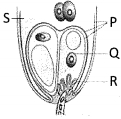
Identify the synergid cell from the given diagram.
A
$P$
B
$Q$
C
$R$
D
$S$
Solution
(A) In the provided diagram of the embryo sac,the labels represent the following structures:
$P$ represents the synergids.
$Q$ represents the egg cell.
$R$ represents the filiform apparatus.
$S$ represents the antipodal cells.
Synergids are specialized cells present at the micropylar end of the embryo sac that help in guiding the pollen tube towards the egg cell.
Therefore,the correct option is $A$.
$P$ represents the synergids.
$Q$ represents the egg cell.
$R$ represents the filiform apparatus.
$S$ represents the antipodal cells.
Synergids are specialized cells present at the micropylar end of the embryo sac that help in guiding the pollen tube towards the egg cell.
Therefore,the correct option is $A$.
0 likes
View Solution311
MediumMCQ
In general,the embryo sac in angiosperms consists of:
A
One egg cell,two synergids,three antipodal cells,two polar nuclei
B
One egg cell,two synergids,two antipodal cells,three polar nuclei
C
One egg cell,three synergids,two antipodal cells,two polar nuclei
D
One egg cell,two synergids,two antipodal cells,two polar nuclei
Solution
(A) The typical mature embryo sac of angiosperms is $7$-celled and $8$-nucleate.
It consists of the following components:
$1$. An egg apparatus at the micropylar end,which includes one egg cell and two synergids.
$2$. Three antipodal cells at the chalazal end.
$3$. $A$ large central cell containing two polar nuclei,which eventually fuse to form a diploid secondary nucleus.
Therefore,the correct composition is one egg cell,two synergids,three antipodal cells,and two polar nuclei.
It consists of the following components:
$1$. An egg apparatus at the micropylar end,which includes one egg cell and two synergids.
$2$. Three antipodal cells at the chalazal end.
$3$. $A$ large central cell containing two polar nuclei,which eventually fuse to form a diploid secondary nucleus.
Therefore,the correct composition is one egg cell,two synergids,three antipodal cells,and two polar nuclei.
0 likes
View Solution312
MediumMCQ
Given below are two statements: One is labelled as Assertion $(A)$ and the other is labelled as Reason $(R)$.
Assertion $(A):$ $A$ typical unfertilised,angiosperm embryo sac at maturity is $8$-nucleate and $7$-celled.
Reason $(R):$ The egg apparatus has $2$ polar nuclei.
In the light of the above statements,choose the correct answer from the options given below:
Assertion $(A):$ $A$ typical unfertilised,angiosperm embryo sac at maturity is $8$-nucleate and $7$-celled.
Reason $(R):$ The egg apparatus has $2$ polar nuclei.
In the light of the above statements,choose the correct answer from the options given below:
A
Both $(A)$ and $(R)$ are true and $(R)$ is the correct explanation of $(A)$.
B
Both $(A)$ and $(R)$ are true but $(R)$ is $NOT$ the correct explanation of $(A)$.
C
$(A)$ is true but $(R)$ is false.
D
$(A)$ is false but $(R)$ is true.
Solution
(C) Assertion $(A)$ is true. $A$ mature,typical angiosperm embryo sac (Polygonum type) undergoes three rounds of free nuclear mitotic divisions,resulting in $8$ nuclei. These are organized into $7$ cells: $3$ antipodal cells,$1$ central cell (containing $2$ polar nuclei),and the egg apparatus consisting of $2$ synergids and $1$ egg cell.
Reason $(R)$ is false. The egg apparatus consists of $1$ egg cell and $2$ synergids. The $2$ polar nuclei are located in the large central cell,not in the egg apparatus.
Reason $(R)$ is false. The egg apparatus consists of $1$ egg cell and $2$ synergids. The $2$ polar nuclei are located in the large central cell,not in the egg apparatus.
0 likes
View Solution313
MediumMCQ
How many meiotic and mitotic divisions need to occur for the development of a mature female gametophyte from the megaspore mother cell in an angiosperm plant?
A
$2$ Meiosis and $3$ Mitosis
B
$1$ Meiosis and $2$ Mitosis
C
$1$ Meiosis and $3$ Mitosis
D
No Meiosis and $2$ Mitosis
Solution
(C) $1$. The development of a mature female gametophyte (embryo sac) starts from a diploid megaspore mother cell $(MMC)$.
$2$. The $MMC$ undergoes one meiotic division to produce four haploid megaspores.
$3$. Out of these four megaspores,three degenerate and only one functional megaspore develops into the female gametophyte.
$4$. This functional megaspore undergoes three successive free nuclear mitotic divisions to form an $8$-nucleated embryo sac.
$5$. Therefore,the process requires $1$ meiotic division and $3$ mitotic divisions.
$2$. The $MMC$ undergoes one meiotic division to produce four haploid megaspores.
$3$. Out of these four megaspores,three degenerate and only one functional megaspore develops into the female gametophyte.
$4$. This functional megaspore undergoes three successive free nuclear mitotic divisions to form an $8$-nucleated embryo sac.
$5$. Therefore,the process requires $1$ meiotic division and $3$ mitotic divisions.
0 likes
View Solution314
MediumMCQ
Match the columns $I$ and $II$ and choose the correct combinations.
| Column-$I$ | Column-$II$ |
|---|---|
| $(a)$ Funicle | $(i)$ Small opening of ovule |
| $(b)$ Integuments | $(ii)$ Stalk of ovule |
| $(c)$ Chalaza | $(iii)$ Protective envelopes of ovule |
| $(d)$ Hilum | $(iv)$ Junction part of ovule and stalk |
| $(e)$ Micropyle | $(v)$ Base of ovule |
A
$a-ii, b-iii, c-v, d-iv, e-i$
B
$a-iii, b-ii, c-i, d-iv, e-v$
C
$a-ii, b-iii, c-v, d-i, e-iv$
D
$a-v, b-iv, c-iii, d-ii, e-i$
Solution
(A) The correct matches are as follows:
$(a)$ Funicle: It is the stalk that attaches the ovule to the placenta,so $(a-ii)$.
$(b)$ Integuments: These are the protective layers surrounding the nucellus of the ovule,so $(b-iii)$.
$(c)$ Chalaza: It represents the basal part of the ovule,opposite to the micropylar end,so $(c-v)$.
$(d)$ Hilum: It is the junction point where the body of the ovule fuses with the funicle,so $(d-iv)$.
$(e)$ Micropyle: It is a small opening at the tip of the ovule through which the pollen tube enters,so $(e-i)$.
Therefore,the correct combination is $(a-ii, b-iii, c-v, d-iv, e-i)$.
$(a)$ Funicle: It is the stalk that attaches the ovule to the placenta,so $(a-ii)$.
$(b)$ Integuments: These are the protective layers surrounding the nucellus of the ovule,so $(b-iii)$.
$(c)$ Chalaza: It represents the basal part of the ovule,opposite to the micropylar end,so $(c-v)$.
$(d)$ Hilum: It is the junction point where the body of the ovule fuses with the funicle,so $(d-iv)$.
$(e)$ Micropyle: It is a small opening at the tip of the ovule through which the pollen tube enters,so $(e-i)$.
Therefore,the correct combination is $(a-ii, b-iii, c-v, d-iv, e-i)$.
0 likes
View Solution315
MediumMCQ
Female gametophyte of angiosperm is represented by $-$
A
Ovule
B
Embryo sac
C
Nucellus
D
Megaspore mother cell
Solution
(B) In angiosperms,the female gametophyte is known as the embryo sac.
It is a small,seven-celled,and eight-nucleated structure that develops within the nucellus of the ovule.
The process begins with a single megaspore mother cell undergoing meiosis to produce four megaspores,of which three degenerate and one functional megaspore develops into the embryo sac.
It is a small,seven-celled,and eight-nucleated structure that develops within the nucellus of the ovule.
The process begins with a single megaspore mother cell undergoing meiosis to produce four megaspores,of which three degenerate and one functional megaspore develops into the embryo sac.
0 likes
View Solution316
EasyMCQ
Assertion $(A) -$ In majority of angiosperms,there is monosporic type of embryo sac development.
Reason $(R) -$ The embryo sac develops from the single functional megaspore.
Reason $(R) -$ The embryo sac develops from the single functional megaspore.
A
Both $(A)$ and $(R)$ are true and $(R)$ is the correct explanation of $(A)$.
B
Both $(A)$ and $(R)$ are true but $(R)$ is not the correct explanation of $(A)$.
C
$(A)$ is true but $(R)$ is false.
D
Both $(A)$ and $(R)$ are false.
Solution
(A) In the process of megasporogenesis,the megaspore mother cell undergoes meiosis to produce four megaspores.
In the majority of angiosperms,three megaspores degenerate,and only one remains functional.
This single functional megaspore develops into the embryo sac,which is known as monosporic development.
Therefore,both the assertion and the reason are true,and the reason correctly explains why it is called monosporic development.
In the majority of angiosperms,three megaspores degenerate,and only one remains functional.
This single functional megaspore develops into the embryo sac,which is known as monosporic development.
Therefore,both the assertion and the reason are true,and the reason correctly explains why it is called monosporic development.
0 likes
View Solution317
MediumMCQ
Filiform apparatus is a characteristic feature of$-$
A
Generative cell
B
Nucellar embryo
C
Aleurone layer
D
Synergids
Solution
(D) The filiform apparatus is a specialized cellular thickening of the cell wall in the synergid cells of the embryo sac.
It consists of finger-like projections that extend into the cytoplasm of the synergids.
Its primary function is to guide the entry of the pollen tube into the synergids during the process of fertilization.
Therefore,the filiform apparatus is a characteristic feature of the synergids.
It consists of finger-like projections that extend into the cytoplasm of the synergids.
Its primary function is to guide the entry of the pollen tube into the synergids during the process of fertilization.
Therefore,the filiform apparatus is a characteristic feature of the synergids.
0 likes
View Solution318
MediumMCQ
Match List-$I$ with List-$II$:
Choose the correct answer from the options given below:
| List-$I$ | List-$II$ |
|---|---|
| $A$. Hilum | $I$. Residual persistent nucellus |
| $B$. Perisperm | $II$. Basal part of ovule |
| $C$. Chalaza | $III$. Junction between ovule and funicle |
| $D$. Funicle | $IV$. Stalk by which ovule is attached to placenta |
Choose the correct answer from the options given below:
A
$A-I, B-II, C-III, D-IV$
B
$A-III, B-II, C-I, D-IV$
C
$A-III, B-I, C-II, D-IV$
D
$A-IV, B-III, C-II, D-I$
Solution
(C) The correct matches are as follows:
$1$. Hilum $(A)$: It is the junction between the ovule and the funicle $(III)$.
$2$. Perisperm $(B)$: It refers to the residual persistent nucellus in some seeds $(I)$.
$3$. Chalaza $(C)$: It represents the basal part of the ovule,opposite to the micropyle $(II)$.
$4$. Funicle $(D)$: It is the stalk by which the ovule is attached to the placenta $(IV)$.
Therefore,the correct matching is $A-III, B-I, C-II, D-IV$.
$1$. Hilum $(A)$: It is the junction between the ovule and the funicle $(III)$.
$2$. Perisperm $(B)$: It refers to the residual persistent nucellus in some seeds $(I)$.
$3$. Chalaza $(C)$: It represents the basal part of the ovule,opposite to the micropyle $(II)$.
$4$. Funicle $(D)$: It is the stalk by which the ovule is attached to the placenta $(IV)$.
Therefore,the correct matching is $A-III, B-I, C-II, D-IV$.
0 likes
View Solution319
MediumMCQ
In an embryo sac,three cells located at the chalazal end are known as $-$
A
Synergid cells
B
Antipodal cells
C
Egg apparatus
D
Filiform apparatus
Solution
(B) In a typical angiosperm embryo sac,the organization is $7$-celled and $8$-nucleate.
At the micropylar end,there is an egg apparatus consisting of one egg cell and two synergids.
At the chalazal end,there are three cells known as antipodal cells.
The central cell contains two polar nuclei.
Therefore,the three cells at the chalazal end are called antipodal cells.
At the micropylar end,there is an egg apparatus consisting of one egg cell and two synergids.
At the chalazal end,there are three cells known as antipodal cells.
The central cell contains two polar nuclei.
Therefore,the three cells at the chalazal end are called antipodal cells.
0 likes
View Solution320
MediumMCQ
How many meiotic and mitotic divisions are required for the formation of a fully mature female gametophyte (embryo sac) from a megaspore mother cell?
A
One meiotic and three mitotic divisions
B
One meiotic and two mitotic divisions
C
Three meiotic and one mitotic division
D
One meiotic and one mitotic division
Solution
(A) $1$. The process begins with a diploid megaspore mother cell $(MMC)$.
$2$. The $MMC$ undergoes one meiotic division (meiosis) to produce four haploid megaspores.
$3$. Three of these megaspores degenerate,and one functional megaspore develops into the female gametophyte (embryo sac).
$4$. The nucleus of the functional megaspore undergoes three successive free nuclear mitotic divisions to form an $8$-nucleated structure.
$5$. These nuclei then organize into the $7$-celled,$8$-nucleated mature embryo sac.
$6$. Therefore,the formation requires $1$ meiotic division and $3$ mitotic divisions.
$2$. The $MMC$ undergoes one meiotic division (meiosis) to produce four haploid megaspores.
$3$. Three of these megaspores degenerate,and one functional megaspore develops into the female gametophyte (embryo sac).
$4$. The nucleus of the functional megaspore undergoes three successive free nuclear mitotic divisions to form an $8$-nucleated structure.
$5$. These nuclei then organize into the $7$-celled,$8$-nucleated mature embryo sac.
$6$. Therefore,the formation requires $1$ meiotic division and $3$ mitotic divisions.
0 likes
View Solution321
EasyMCQ
In Angiosperms,functional megaspore develops into $:-$
A
Embryo
B
Endosperm
C
Embryo sac
D
Ovule
Solution
(C) In angiosperms,the process of megasporogenesis results in the formation of four megaspores from a megaspore mother cell $(MMC)$ through meiosis.
Out of these four megaspores,three degenerate,and only one remains functional.
This single functional megaspore undergoes three successive rounds of free-nuclear mitotic divisions to form an $8$-nucleate structure,which eventually organizes into the embryo sac (also known as the female gametophyte).
Therefore,the functional megaspore develops into the embryo sac.
Out of these four megaspores,three degenerate,and only one remains functional.
This single functional megaspore undergoes three successive rounds of free-nuclear mitotic divisions to form an $8$-nucleate structure,which eventually organizes into the embryo sac (also known as the female gametophyte).
Therefore,the functional megaspore develops into the embryo sac.
0 likes
View Solution322
EasyMCQ
How many polar nuclei migrate to the centre of the developing female gametophyte from each pole of the female gametophyte?
A
$1$
B
$2$
C
$3$
D
$4$
Solution
(A) In the development of a typical angiosperm female gametophyte (embryo sac),the nucleus of the functional megaspore undergoes three successive mitotic divisions to form $8$ nuclei.
After the $8$-nucleate stage,cell walls are laid down,leading to the organization of the typical female gametophyte.
Specifically,$3$ nuclei move to the micropylar end to form the egg apparatus,and $3$ nuclei move to the chalazal end to form antipodal cells.
The remaining $2$ nuclei,known as polar nuclei,migrate from each pole (one from the micropylar end and one from the chalazal end) to the centre of the embryo sac.
Therefore,$1$ nucleus from each pole migrates to the centre,making a total of $2$ polar nuclei in the central cell.
After the $8$-nucleate stage,cell walls are laid down,leading to the organization of the typical female gametophyte.
Specifically,$3$ nuclei move to the micropylar end to form the egg apparatus,and $3$ nuclei move to the chalazal end to form antipodal cells.
The remaining $2$ nuclei,known as polar nuclei,migrate from each pole (one from the micropylar end and one from the chalazal end) to the centre of the embryo sac.
Therefore,$1$ nucleus from each pole migrates to the centre,making a total of $2$ polar nuclei in the central cell.
0 likes
View Solution323
EasyMCQ
Stalk of an anatropous angiosperm ovule is called . . . . . . .
A
chalaza
B
placenta
C
funiculus
D
hilum
Solution
(C) The stalk that attaches the ovule to the placenta of the ovary is known as the funiculus.
$i$. Chalaza: The basal part of the ovule opposite to the micropyle.
$ii$. Hilum: The junction or point of attachment between the ovule body and the funiculus.
$iii$. Placenta: The tissue within the ovary wall to which the ovule is attached via the funiculus.
$i$. Chalaza: The basal part of the ovule opposite to the micropyle.
$ii$. Hilum: The junction or point of attachment between the ovule body and the funiculus.
$iii$. Placenta: The tissue within the ovary wall to which the ovule is attached via the funiculus.
0 likes
View Solution324
EasyMCQ
Identify the correct sequence of ploidy of megaspore mother cell,nucellus,and egg respectively in an angiospermic ovary.
A
$2n, 2n, n$
B
$4n, 8n, 2n$
C
$2n, 2n, 4n$
D
$4n, 2n, n$
Solution
(A) $1$. The megaspore mother cell $(MMC)$ is a diploid cell $(2n)$ derived from the nucellus tissue.
$2$. The nucellus is the central part of the ovule consisting of diploid cells $(2n)$ that provide nutrition to the developing embryo sac.
$3$. The egg cell is a haploid gamete $(n)$ formed after meiosis and subsequent mitotic divisions within the embryo sac.
$4$. Therefore,the correct sequence of ploidy is $2n, 2n, n$.
$2$. The nucellus is the central part of the ovule consisting of diploid cells $(2n)$ that provide nutrition to the developing embryo sac.
$3$. The egg cell is a haploid gamete $(n)$ formed after meiosis and subsequent mitotic divisions within the embryo sac.
$4$. Therefore,the correct sequence of ploidy is $2n, 2n, n$.
0 likes
View Solution325
EasyMCQ
Just before fertilization,the angiosperm's embryo sac contains . . . . . . and . . . . . . nuclei.
A
six haploid,one diploid
B
five haploid,two diploid
C
six diploid,one haploid
D
seven haploid,one diploid
Solution
(D) In a mature angiosperm embryo sac,there are $7$ cells and $8$ nuclei.
These include $3$ antipodal cells (haploid),$2$ synergids (haploid),$1$ egg cell (haploid),and $1$ central cell containing $2$ polar nuclei (haploid).
Thus,there are $7$ haploid nuclei ($3$ antipodals + $2$ synergids + $1$ egg + $1$ polar nucleus) and $1$ diploid nucleus (formed by the fusion of $2$ polar nuclei in the central cell).
Therefore,the embryo sac contains $7$ haploid and $1$ diploid nucleus.
These include $3$ antipodal cells (haploid),$2$ synergids (haploid),$1$ egg cell (haploid),and $1$ central cell containing $2$ polar nuclei (haploid).
Thus,there are $7$ haploid nuclei ($3$ antipodals + $2$ synergids + $1$ egg + $1$ polar nucleus) and $1$ diploid nucleus (formed by the fusion of $2$ polar nuclei in the central cell).
Therefore,the embryo sac contains $7$ haploid and $1$ diploid nucleus.
0 likes
View Solution326
EasyMCQ
Which one of the following shows more than one ovule?
A
Rice
B
Mango
C
Tomato
D
Wheat
Solution
(C) In flowering plants, the number of ovules in an ovary varies depending on the species.
- $Rice$, $Wheat$, and $Mango$ typically contain a single ovule in their ovary, which develops into a single seed.
- $Tomato$ (and other fruits like $Papaya$ and $Watermelon$) contains many ovules within its ovary, which develop into multiple seeds.
- Therefore, $Tomato$ is the correct answer as it exhibits more than one ovule.
- $Rice$, $Wheat$, and $Mango$ typically contain a single ovule in their ovary, which develops into a single seed.
- $Tomato$ (and other fruits like $Papaya$ and $Watermelon$) contains many ovules within its ovary, which develop into multiple seeds.
- Therefore, $Tomato$ is the correct answer as it exhibits more than one ovule.
0 likes
View Solution327
EasyMCQ
Which one of the following is unlike other nuclei in the embryo sac of angiosperms regarding ploidy?
A
Male gamete nucleus
B
Egg nucleus
C
Secondary nucleus
D
Antipodal nucleus
Solution
(C) In the embryo sac of angiosperms,the egg nucleus,antipodal nuclei,and synergid nuclei are haploid $(n)$. The male gamete is also haploid $(n)$. However,the secondary nucleus (or definitive nucleus) is formed by the fusion of two polar nuclei,making it diploid $(2n)$. Therefore,the secondary nucleus is unlike the others regarding ploidy.
0 likes
View Solution328
EasyMCQ
In angiosperms,the embryo sac is . . . . . . .
A
uninucleate
B
binucleate
C
multinucleate
D
enucleate
Solution
(C) In angiosperms,the mature embryo sac (female gametophyte) typically consists of $8$ nuclei and $7$ cells.
Since it contains multiple nuclei,it is described as multinucleate.
The $8$ nuclei are arranged as follows: $3$ at the micropylar end (egg apparatus),$3$ at the chalazal end (antipodals),and $2$ polar nuclei in the central cell.
Since it contains multiple nuclei,it is described as multinucleate.
The $8$ nuclei are arranged as follows: $3$ at the micropylar end (egg apparatus),$3$ at the chalazal end (antipodals),and $2$ polar nuclei in the central cell.
0 likes
View Solution329
EasyMCQ
Generally,the embryo sac in angiosperms is . . . . . . .
A
Bisporic,endosporic,$8$-celled and $7-$nucleated
B
Bisporic,exosporic,$7$-celled and $8-$nucleated
C
Monosporic,endosporic,$7$-celled and $8-$nucleated
D
Monosporic,exosporic,$8$-celled and $7-$nucleated
Solution
(C) The typical angiosperm embryo sac is monosporic,meaning it develops from a single functional megaspore.
It is endosporic because it develops within the megaspore wall inside the ovule.
It consists of $7$ cells and $8$ nuclei at maturity (three antipodal cells,two synergids,one egg cell,and one central cell with two polar nuclei).
It is endosporic because it develops within the megaspore wall inside the ovule.
It consists of $7$ cells and $8$ nuclei at maturity (three antipodal cells,two synergids,one egg cell,and one central cell with two polar nuclei).
0 likes
View Solution330
EasyMCQ
The megasporangium in angiosperms is usually . . . . . . .
A
unitegmic
B
polytegmic
C
tritegmic
D
bitegmic
Solution
(D) In angiosperms,the megasporangium is also known as the ovule.
Most angiosperms have ovules that are surrounded by two protective layers called integuments.
An ovule with two integuments is termed as bitegmic.
While some plants may have unitegmic (one integument) or ategmic (no integument) ovules,the most common condition in angiosperms is bitegmic.
Most angiosperms have ovules that are surrounded by two protective layers called integuments.
An ovule with two integuments is termed as bitegmic.
While some plants may have unitegmic (one integument) or ategmic (no integument) ovules,the most common condition in angiosperms is bitegmic.
0 likes
View Solution331
EasyMCQ
During the development of the embryo sac,a megaspore mother cell undergoes . . . . . . meiosis and . . . . . . mitosis respectively.
A
$1$,$3$
B
$3$,$1$
C
$1$,$4$
D
$4$,$1$
Solution
(A) During the development of the embryo sac (monosporic development),a diploid megaspore mother cell $(MMC)$ undergoes a single meiotic division to produce four haploid megaspores.
Out of these four,three degenerate,and one functional megaspore remains.
This functional megaspore then undergoes three successive rounds of free-nuclear mitotic divisions to form an $8$-nucleated embryo sac.
Out of these four,three degenerate,and one functional megaspore remains.
This functional megaspore then undergoes three successive rounds of free-nuclear mitotic divisions to form an $8$-nucleated embryo sac.
0 likes
View Solution332
EasyMCQ
The megasporangium proper of an angiosperm ovule is represented by:
A
Integument
B
Funicle
C
Nucellus
D
Micropyle
Solution
(C) In angiosperms,the ovule is technically referred to as the megasporangium. The main body of the ovule,which consists of a mass of diploid parenchymatous cells enclosed within the integuments,is called the nucellus. Since the megaspore mother cell differentiates within this tissue,the nucellus is considered the megasporangium proper.
0 likes
View Solution333
EasyMCQ
In angiosperms,megaspores formed after meiosis of megaspore mother cell are arranged in . . . . . . .
A
Isobilateral tetrad
B
Linear tetrad
C
Tetrahedral tetrad
D
$T$-shaped tetrad
Solution
(B) In angiosperms,the megaspore mother cell $(MMC)$ undergoes meiosis to produce four haploid megaspores.
These four megaspores are typically arranged in a linear row,which is known as a linear tetrad.
Out of these four,usually three degenerate,and only one functional megaspore develops into the embryo sac.
These four megaspores are typically arranged in a linear row,which is known as a linear tetrad.
Out of these four,usually three degenerate,and only one functional megaspore develops into the embryo sac.
0 likes
View Solution334
EasyMCQ
Which of the following is the first cell of the female gametophytic generation in angiosperms?
A
Megaspore mother cell
B
Microspore mother cell
C
Functional megaspore
D
Egg cell
Solution
(C) In angiosperms,the process of megasporogenesis involves the formation of megaspores from the megaspore mother cell $(MMC)$ through meiosis.
Out of the four megaspores produced,three degenerate,and only one remains functional.
This functional megaspore is the first cell of the female gametophyte (embryo sac).
It undergoes mitotic divisions to develop into the mature embryo sac.
Out of the four megaspores produced,three degenerate,and only one remains functional.
This functional megaspore is the first cell of the female gametophyte (embryo sac).
It undergoes mitotic divisions to develop into the mature embryo sac.
0 likes
View Solution335
EasyMCQ
Which of the following in the embryo sac of angiosperms shows the filiform apparatus?
A
Antipodals
B
Polar nuclei
C
Egg
D
Synergids
Solution
(D) In the mature embryo sac of angiosperms,the egg apparatus consists of two synergids and one egg cell.
The synergids possess special cellular thickenings at the micropylar end called the filiform apparatus.
The primary function of the filiform apparatus is to guide the entry of the pollen tube into the synergids.
The synergids possess special cellular thickenings at the micropylar end called the filiform apparatus.
The primary function of the filiform apparatus is to guide the entry of the pollen tube into the synergids.
0 likes
View Solution336
EasyMCQ
The female gametophyte in flowering plants develops after which of the following processes?
A
$1$ meiosis and $2$ mitosis
B
$2$ meiosis and $2$ mitosis
C
$1$ meiosis and $3$ mitosis
D
$2$ meiosis and $1$ mitosis
Solution
(C) In flowering plants,the development of the female gametophyte (embryo sac) begins from a single functional megaspore.
$1$. The megaspore mother cell undergoes $1$ meiosis to produce $4$ haploid megaspores.
$2$. Out of these,$3$ degenerate and $1$ remains functional.
$3$. The functional megaspore undergoes $3$ successive rounds of free-nuclear mitosis to form an $8$-nucleate structure.
$4$. These nuclei then organize into the $7$-celled,$8$-nucleate embryo sac (female gametophyte).
Therefore,the process involves $1$ meiosis and $3$ mitosis.
$1$. The megaspore mother cell undergoes $1$ meiosis to produce $4$ haploid megaspores.
$2$. Out of these,$3$ degenerate and $1$ remains functional.
$3$. The functional megaspore undergoes $3$ successive rounds of free-nuclear mitosis to form an $8$-nucleate structure.
$4$. These nuclei then organize into the $7$-celled,$8$-nucleate embryo sac (female gametophyte).
Therefore,the process involves $1$ meiosis and $3$ mitosis.
0 likes
View Solution337
EasyMCQ
The ovule is attached to the placenta by . . . . . . .
A
Hilum
B
Chalaza
C
Funicle
D
Micropyle
Solution
(C) The ovule is attached to the placenta by a stalk called the $Funicle$. The point of attachment of the body of the ovule with the $Funicle$ is known as the $Hilum$. Therefore,the $Funicle$ acts as the stalk connecting the ovule to the placenta.
0 likes
View Solution338
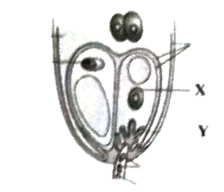
EasyMCQ
What do '$X$' and '$Y$' indicate in the following diagram?
A
$X = \text{Egg cell}; Y = \text{Synergid}$
B
$X = \text{Synergid}; Y = \text{Filiform apparatus}$
C
$X = \text{Filiform apparatus}; Y = \text{Synergid}$
D
$X = \text{Egg cell}; Y = \text{Filiform apparatus}$
Solution
(B) In the provided diagram of the embryo sac, the structure labeled '$Y$' represents the finger-like projections at the micropylar end of the synergids, known as the filiform apparatus. The structure labeled '$X$' points to one of the two synergid cells located adjacent to the egg cell. Therefore, the correct identification is $X = \text{Synergid}$ and $Y = \text{Filiform apparatus}$. However, based on the standard labeling in $NCERT$ diagrams for this specific image, '$X$' points to the synergid and '$Y$' points to the filiform apparatus. Looking at the options provided, option $(B)$ matches this description.
0 likes
View Solution339
EasyMCQ
What will be the respective ploidy of the cells of the Nucellus,Megaspore Mother Cell,the functional Megaspore,and the female gametophyte?
A
$2n, n, n, n$
B
$2n, n, n, 2n$
C
$2n, 2n, n, n$
D
$n, 2n, n, 2n$
Solution
(C) The Nucellus is a mass of diploid $(2n)$ cells within the ovule.
The Megaspore Mother Cell $(MMC)$ is derived from the nucellus and is also diploid $(2n)$.
The functional Megaspore is formed after meiosis of the $MMC$ and is haploid $(n)$.
The female gametophyte (embryo sac) develops from the functional megaspore through mitosis and is also haploid $(n)$.
Therefore,the correct sequence of ploidy is $2n, 2n, n, n$.
The Megaspore Mother Cell $(MMC)$ is derived from the nucellus and is also diploid $(2n)$.
The functional Megaspore is formed after meiosis of the $MMC$ and is haploid $(n)$.
The female gametophyte (embryo sac) develops from the functional megaspore through mitosis and is also haploid $(n)$.
Therefore,the correct sequence of ploidy is $2n, 2n, n, n$.
0 likes
View Solution340
EasyMCQ
. . . . . . is the region on which,the ovule is connected to the funicle.
A
Chalaza
B
Hilum
C
Micropylar region
D
Nucellus
Solution
(B) The $Hilum$ is the junction or the point of attachment where the body of the ovule is fused with the funicle. The funicle is the stalk that attaches the ovule to the placenta of the ovary. Therefore,the correct option is $B$.
0 likes
View Solution341
EasyMCQ
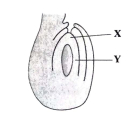
Identify $X$ and $Y$ in the given diagram of an anatropous ovule.
A
$X$ - Nucellus,$Y$ - Embryo sac
B
$X$ - Outer integument,$Y$ - Embryo sac
C
$X$ - Micropyle,$Y$ - Nucellus
D
$X$ - Micropylar pole,$Y$ - Nucellus
Solution
(C) In the provided diagram of an anatropous ovule:
$X$ points to the small opening at the apex of the ovule,which is the Micropyle.
$Y$ points to the mass of nutritive tissue enclosed within the integuments,which is the Nucellus.
Therefore,the correct identification is $X$ - Micropyle and $Y$ - Nucellus.
$X$ points to the small opening at the apex of the ovule,which is the Micropyle.
$Y$ points to the mass of nutritive tissue enclosed within the integuments,which is the Nucellus.
Therefore,the correct identification is $X$ - Micropyle and $Y$ - Nucellus.
0 likes
View Solution342
EasyMCQ
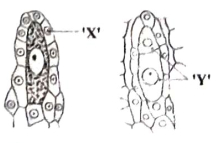
In the given figure,megasporogenesis is shown in angiosperms. What are the ploidy levels in given '$X$' and '$Y$' respectively?
A
$n, 2n$
B
$2n, n$
C
$3n, n$
D
$n, n$
Solution
(B) In the process of megasporogenesis,the nucellus contains diploid $(2n)$ cells.
'$X$' represents the cells of the nucellus,which are diploid $(2n)$.
'$Y$' represents the megaspore mother cell $(MMC)$ or the developing megaspore,which undergoes meiosis to form haploid $(n)$ megaspores.
Therefore,the ploidy of '$X$' is $2n$ and the ploidy of '$Y$' is $n$.
'$X$' represents the cells of the nucellus,which are diploid $(2n)$.
'$Y$' represents the megaspore mother cell $(MMC)$ or the developing megaspore,which undergoes meiosis to form haploid $(n)$ megaspores.
Therefore,the ploidy of '$X$' is $2n$ and the ploidy of '$Y$' is $n$.
0 likes
View Solution343
EasyMCQ
What do '$X$' and '$Y$' indicate in the given figure?
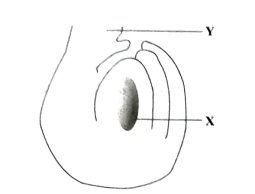
A
$X = \text{Embryo sac}, Y = \text{Funicle}$
B
$X = \text{Hilum}, Y = \text{Embryo sac}$
C
$X = \text{Nucellus}, Y = \text{Micropyle}$
D
$X = \text{Funicle}, Y = \text{Embryo sac}$
Solution
(A) In the provided diagram of an anatropous ovule:
$X$ points to the central structure within the nucellus,which is the embryo sac (female gametophyte).
$Y$ points to the stalk that attaches the ovule to the placenta,known as the funicle.
Therefore,the correct identification is $X = \text{Embryo sac}$ and $Y = \text{Funicle}$.
$X$ points to the central structure within the nucellus,which is the embryo sac (female gametophyte).
$Y$ points to the stalk that attaches the ovule to the placenta,known as the funicle.
Therefore,the correct identification is $X = \text{Embryo sac}$ and $Y = \text{Funicle}$.
0 likes
View Solution344
EasyMCQ
$A$ typical angiosperm embryo sac,at maturity,though $8$-nucleate is . . . . . . .
A
$7$-nucleate - $8$-celled
B
$8$-nucleate - $7$-celled
C
$6$-nucleate - $7$-celled
D
$7$-nucleate - $6$-celled
Solution
(B) In a typical angiosperm,the embryo sac (female gametophyte) undergoes three successive mitotic divisions after the formation of the functional megaspore.
These divisions result in $8$ nuclei.
After the divisions,cell walls are laid down,leading to the organization of the typical female gametophyte.
It consists of $3$ antipodal cells,$2$ synergids,$1$ egg cell,and $1$ large central cell containing $2$ polar nuclei.
Thus,it is $8$-nucleate but $7$-celled because the two polar nuclei are enclosed within a single central cell.
These divisions result in $8$ nuclei.
After the divisions,cell walls are laid down,leading to the organization of the typical female gametophyte.
It consists of $3$ antipodal cells,$2$ synergids,$1$ egg cell,and $1$ large central cell containing $2$ polar nuclei.
Thus,it is $8$-nucleate but $7$-celled because the two polar nuclei are enclosed within a single central cell.
0 likes
View Solution345
EasyMCQ
$A$ typical mature embryo sac of an angiosperm is:
A
$7-$nucleated,$8$-celled structure
B
$8-$nucleated,$8$-celled structure
C
$8-$nucleated,$1$-celled structure
D
$8-$nucleated,$7$-celled structure
Solution
(D) The correct answer is $D$.
In a typical angiosperm,the mature embryo sac (female gametophyte) is $8$-nucleated and $7$-celled.
It consists of $3$ antipodal cells,$2$ synergids,$1$ egg cell,and $1$ large central cell containing $2$ polar nuclei.
In a typical angiosperm,the mature embryo sac (female gametophyte) is $8$-nucleated and $7$-celled.
It consists of $3$ antipodal cells,$2$ synergids,$1$ egg cell,and $1$ large central cell containing $2$ polar nuclei.
0 likes
View Solution346
EasyMCQ
The ovule of an angiosperm is technically known as:
A
megaspore mother cell
B
megasporangium
C
megaspore
D
megasporophyll
Solution
(B) megasporangium.
In angiosperms,the ovule is a specialized structure that develops into a seed after fertilization. Technically,the ovule is referred to as a megasporangium because it contains the nucellus (the megasporangium proper) surrounded by integuments.
In angiosperms,the ovule is a specialized structure that develops into a seed after fertilization. Technically,the ovule is referred to as a megasporangium because it contains the nucellus (the megasporangium proper) surrounded by integuments.
0 likes
View Solution347
EasyMCQ
Identify the correct statement.
A
Only one megaspore present towards chalazal end remains functional.
B
$3$ megaspores present towards chalazal end degenerate gradually.
C
Each megaspore mother cell directly develops into a megaspore.
D
Each female gametophyte is $7-$celled and $7-$nucleated structure.
Solution
(A) In the process of megasporogenesis,the megaspore mother cell $(MMC)$ undergoes meiosis to form four haploid megaspores.
Out of these four megaspores,three megaspores present towards the micropylar end degenerate,while only one megaspore present towards the chalazal end remains functional.
This functional megaspore develops into the female gametophyte (embryo sac).
The mature female gametophyte is typically $7$-celled and $8$-nucleated.
Out of these four megaspores,three megaspores present towards the micropylar end degenerate,while only one megaspore present towards the chalazal end remains functional.
This functional megaspore develops into the female gametophyte (embryo sac).
The mature female gametophyte is typically $7$-celled and $8$-nucleated.
0 likes
View Solution348
EasyMCQ
If a tetraploid plant contains $48$ chromosomes in its nucellus,then what is the number of chromosomes in the egg cell and in a synergid,respectively?
A
$48$ and $48$
B
$24$ and $24$
C
$24$ and $48$
D
$48$ and $24$
Solution
(B) The nucellus is a diploid $(2n)$ tissue in the ovule,but in a tetraploid plant,the somatic cells are $4n$.
Given that the tetraploid plant has $4n = 48$ chromosomes in its nucellus,the haploid number $(n)$ is $48 / 4 = 12$.
The egg cell and synergids are part of the embryo sac (gametophyte) and are haploid $(n)$.
Therefore,the number of chromosomes in the egg cell is $n = 12$ and in a synergid is $n = 12$.
Wait,re-evaluating the ploidy: If the plant is tetraploid $(4n)$,the gametes produced by meiosis are diploid $(2n)$.
Thus,$4n = 48$,so $2n = 24$.
Both the egg cell and synergids are haploid relative to the sporophyte,but since the sporophyte is $4n$,the gametophyte cells are $2n$.
Therefore,both the egg cell and the synergid contain $24$ chromosomes.
Given that the tetraploid plant has $4n = 48$ chromosomes in its nucellus,the haploid number $(n)$ is $48 / 4 = 12$.
The egg cell and synergids are part of the embryo sac (gametophyte) and are haploid $(n)$.
Therefore,the number of chromosomes in the egg cell is $n = 12$ and in a synergid is $n = 12$.
Wait,re-evaluating the ploidy: If the plant is tetraploid $(4n)$,the gametes produced by meiosis are diploid $(2n)$.
Thus,$4n = 48$,so $2n = 24$.
Both the egg cell and synergids are haploid relative to the sporophyte,but since the sporophyte is $4n$,the gametophyte cells are $2n$.
Therefore,both the egg cell and the synergid contain $24$ chromosomes.
0 likes
View Solution349
EasyMCQ
With respect to angiosperms,identify the incorrect pair from the following.
A
Primary endosperm nucleus - $3n$
B
Antipodals - $2n$
C
Cells of nucellus of ovule - $2n$
D
Vegetative cell of male gametophyte - $n$
Solution
(B) The correct answer is $B$.
Antipodal cells are formed after the mitotic division of the functional megaspore within the embryo sac.
Since the megaspore is haploid $(n)$,the antipodal cells formed from it are also haploid $(n)$,not diploid $(2n)$.
Therefore,the pair 'Antipodals - $2n$' is incorrect.
Antipodal cells are formed after the mitotic division of the functional megaspore within the embryo sac.
Since the megaspore is haploid $(n)$,the antipodal cells formed from it are also haploid $(n)$,not diploid $(2n)$.
Therefore,the pair 'Antipodals - $2n$' is incorrect.
0 likes
View Solution350
EasyMCQ
The embryo sac of an angiosperm is made up of
A
$8$ cells
B
$7$ cells and $8$ nuclei
C
$8$ nuclei
D
$8$ cells and $7$ nuclei
Solution
(B) The correct answer is $B$.
An angiosperm embryo sac,also known as the female gametophyte,typically follows the $Polygonum$ type of development.
It consists of $7$ cells: $1$ egg cell,$2$ synergids,$3$ antipodal cells,and $1$ large central cell.
Although there are $7$ cells,there are $8$ nuclei because the central cell contains $2$ polar nuclei,while the other $6$ cells each contain $1$ nucleus.
An angiosperm embryo sac,also known as the female gametophyte,typically follows the $Polygonum$ type of development.
It consists of $7$ cells: $1$ egg cell,$2$ synergids,$3$ antipodal cells,and $1$ large central cell.
Although there are $7$ cells,there are $8$ nuclei because the central cell contains $2$ polar nuclei,while the other $6$ cells each contain $1$ nucleus.
0 likes
View SolutionSexual Reproduction in Flowering Plants — The Pistil, Megasporangium (ovule) and Embryo sac · Frequently Asked Questions
1Are these Sexual Reproduction in Flowering Plants questions useful for JEE and NEET?
Yes. All questions in this section are mapped to JEE Main and NEET exam patterns. Previous year questions from JEE Main, NEET, GUJCET and state-level exams are included with full solutions.
2Can I switch to Hindi or Gujarati for these questions?
Yes. Use the language tabs in the hero section or the sidebar to view the same questions and solutions in English, Hindi or Gujarati.
3How do I generate a question paper from this subtopic?
Use the Vedclass Exam Paper Generator — select the chapter and subtopic, set difficulty, and generate Sets A, B, C, D automatically. First 3 chapters of every subject are free.
Vedclass Products
For Students
Vedclass Test Series
Mock tests in real JEE/NEET style with performance analysis. 5-day free trial.
Start Free TrialFor Teachers
Exam Paper Generator
Generate Set A/B/C/D papers from this chapter in 2 minutes. 3 chapters free.
Try FreeFor Institutes
Online Exam Module
Live online exams with unlimited students, 360° analytics & white-label branding.
See DemoFor Teachers & Institutes
Generate a Sexual Reproduction in Flowering Plants Exam Paper in 2 Minutes
Select subtopic & difficulty — Sets A, B, C, D auto-generated with No Repeat logic.
First 3 chapters of every subject are free — no payment required.