
A English
The Pistil, Megasporangium (ovule) and Embryo sac Questions in English
Class 12 Biology · Sexual Reproduction in Flowering Plants · The Pistil, Megasporangium (ovule) and Embryo sac
351+
Questions
English
Language
100%
With Solutions
Showing 50 of 351 questions in English
251
EasyMCQ
Select the correct diagram of a mature embryo sac.
A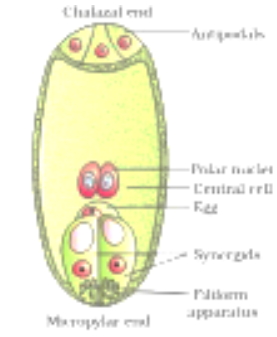
B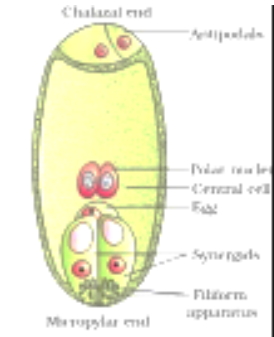
C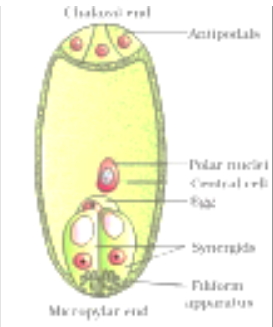
D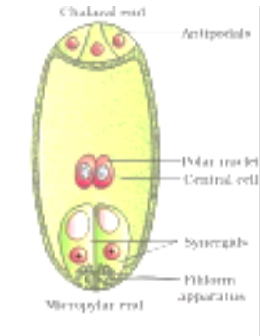
Solution
(A) mature angiosperm embryo sac is typically $7$-celled and $8$-nucleate.
It consists of three antipodal cells at the chalazal end,two synergids and one egg cell at the micropylar end,and a large central cell containing two polar nuclei.
Image $A$ correctly depicts this structure with three antipodal cells at the top (chalazal end),two synergids and one egg cell at the bottom (micropylar end),and two polar nuclei in the central cell.
It consists of three antipodal cells at the chalazal end,two synergids and one egg cell at the micropylar end,and a large central cell containing two polar nuclei.
Image $A$ correctly depicts this structure with three antipodal cells at the top (chalazal end),two synergids and one egg cell at the bottom (micropylar end),and two polar nuclei in the central cell.
0 likes
View Solution252
MediumMCQ
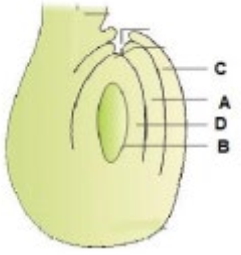
Which of the following labels in the given diagram of an ovule is incorrect?
A
$D$ - Inner integument
B
$B$ - Embryo sac
C
$C$ - Outer integument
D
$A$ - Inner integument
Solution
(A) In the provided diagram of an anatropous ovule:
$C$ represents the outer integument.
$A$ represents the inner integument.
$D$ represents the nucellus (the central mass of tissue).
$B$ represents the embryo sac.
Therefore,the statement '$D$ - Inner integument' is incorrect because $D$ points to the nucellus,while $A$ points to the inner integument.
$C$ represents the outer integument.
$A$ represents the inner integument.
$D$ represents the nucellus (the central mass of tissue).
$B$ represents the embryo sac.
Therefore,the statement '$D$ - Inner integument' is incorrect because $D$ points to the nucellus,while $A$ points to the inner integument.
0 likes
View Solution253
MediumMCQ
The egg apparatus of angiosperms consists of
A
One synergid and two egg cells
B
Two synergids and one egg cell
C
One central cell,two polar nuclei and three antipodal cells
D
One egg cell,two polar nuclei and three antipodal cells
Solution
(B) The egg apparatus consists of two synergids and one egg cell.
In angiosperms,the most common type of embryo sac is the $Polygonum$ type.
It is $7$-celled and $8$-nucleate.
The nuclei are arranged such that three are organized at the micropylar end to form the egg apparatus (one egg cell and two synergids).
Two nuclei migrate to the center to form polar nuclei within a single central cell.
Three nuclei at the chalazal pole are organized into antipodal cells.
In angiosperms,the most common type of embryo sac is the $Polygonum$ type.
It is $7$-celled and $8$-nucleate.
The nuclei are arranged such that three are organized at the micropylar end to form the egg apparatus (one egg cell and two synergids).
Two nuclei migrate to the center to form polar nuclei within a single central cell.
Three nuclei at the chalazal pole are organized into antipodal cells.
0 likes
View Solution254
MediumMCQ
Eight nucleated female gametophyte is found in
A
Bryophytes
B
Gymnosperms
C
Angiosperms
D
Pteridophytes
Solution
(C) The $Polygonum$ type of embryo sac is the most common type found in angiosperms.
It is $7$-celled and $8$-nucleate.
The nuclei are arranged such that three are organized at the micropylar end to form the egg apparatus (one egg cell and two synergids).
Two nuclei migrate to the center to form polar nuclei within a single central cell.
Three nuclei at the chalazal pole are organized into antipodal cells.
It is $7$-celled and $8$-nucleate.
The nuclei are arranged such that three are organized at the micropylar end to form the egg apparatus (one egg cell and two synergids).
Two nuclei migrate to the center to form polar nuclei within a single central cell.
Three nuclei at the chalazal pole are organized into antipodal cells.
0 likes
View Solution255
MediumMCQ
Embryo sac consists of
A
One egg cell
B
Two synergids
C
Three antipodal and two polar nuclei
D
All of the above
Solution
(D) An ideal embryo sac contains $7$ cells and $8$ nuclei.
$3$ cells are present at the micropylar end forming the egg apparatus,which consists of one egg cell and two synergids.
One large central cell is present in the middle of the embryo sac,which contains two polar nuclei.
The remaining $3$ cells are present at the chalazal end and are known as antipodal cells.
Therefore,all the given options are components of the embryo sac.
$3$ cells are present at the micropylar end forming the egg apparatus,which consists of one egg cell and two synergids.
One large central cell is present in the middle of the embryo sac,which contains two polar nuclei.
The remaining $3$ cells are present at the chalazal end and are known as antipodal cells.
Therefore,all the given options are components of the embryo sac.
0 likes
View Solution256
EasyMCQ
The megaspore mother cell is differentiated from one of the cells of the
A
Nucellus
B
Pollen grain
C
Microsporangia
D
Both $(b)$ and $(c)$
Solution
(A) In the process of megasporogenesis,a single cell of the nucellus,usually towards the micropylar end,differentiates into the megaspore mother cell $(MMC)$.
The nucellus is the central part of the ovule that provides nutrition to the developing embryo sac.
The nucellus is the central part of the ovule that provides nutrition to the developing embryo sac.
0 likes
View Solution257
EasyMCQ
In angiosperms,the female gametophyte is also known as:
A
Nucellus
B
Embryo sac
C
Endosperm
D
Stigma
Solution
(B) In angiosperms,the female gametophyte is commonly referred to as the embryo sac. It is a small structure located within the ovule that contains the egg cell,which is essential for fertilization.
0 likes
View Solution258
EasyMCQ
In angiosperms,the megaspore develops into:
A
Pollen grain
B
Embryo sac
C
Stigma
D
Ovary
Solution
(B) In angiosperms,the functional megaspore undergoes mitotic divisions to develop into the female gametophyte,which is known as the embryo sac.
0 likes
View Solution259
MediumMCQ
The endosperm of a gymnosperm is ontogenetically similar to which of the following in angiosperms?
A
Endosperm
B
Embryo sac
C
Archegonium
D
Megasporangia
Solution
(B) In gymnosperms,the endosperm is formed before fertilization and is a haploid $(n)$ tissue derived directly from the female gametophyte. In angiosperms,the embryo sac represents the female gametophyte. Therefore,ontogenetically,the gymnosperm endosperm is equivalent to the female gametophyte or the embryo sac of angiosperms.
0 likes
View Solution260
EasyMCQ
Which one is the female gametophyte in angiosperms?
A
Embryo
B
Embryo sac
C
Endosperm
D
Synergid
Solution
(B) In angiosperms,the female gametophyte is known as the embryo sac.
It is a $7$-celled and $8$-nucleate structure that develops within the ovule.
The embryo is the result of fertilization (diploid),the endosperm is the nutritive tissue formed after double fertilization (usually triploid),and the synergid is a specific cell type found within the embryo sac.
It is a $7$-celled and $8$-nucleate structure that develops within the ovule.
The embryo is the result of fertilization (diploid),the endosperm is the nutritive tissue formed after double fertilization (usually triploid),and the synergid is a specific cell type found within the embryo sac.
0 likes
View Solution261
EasyMCQ
Embryo sac is found in:
A
Endosperm
B
Embryo
C
Ovule
D
Seed
Solution
(C) The embryo sac,also known as the female gametophyte,is a structure found within the ovule of flowering plants (angiosperms).
It develops from the functional megaspore through the process of megagametogenesis.
The ovule contains the embryo sac,which houses the egg cell and other associated cells (synergids and antipodals) necessary for fertilization.
Therefore,the correct location of the embryo sac is the ovule.
It develops from the functional megaspore through the process of megagametogenesis.
The ovule contains the embryo sac,which houses the egg cell and other associated cells (synergids and antipodals) necessary for fertilization.
Therefore,the correct location of the embryo sac is the ovule.
0 likes
View Solution262
MediumMCQ
Embryo sac is also known as
A
Micro-gametophyte
B
Mega-gametophyte
C
Micro-sporangium
D
Mega-sporangium
Solution
(B) The $mega-gametophyte$ or female gametophyte,which is also called the embryo sac,is typically a $7$-celled and $8$-nucleate structure in angiosperms.
0 likes
View Solution263
MediumMCQ
The chalazal pole is present:
A
Opposite to the micropyle
B
At the origin of integuments
C
Opposite to the nucellus
D
Near the embryo sac
Solution
(A) The chalazal pole is located exactly opposite to the micropylar end of the ovule.
It represents the basal part of the ovule where the integuments originate.
It represents the basal part of the ovule where the integuments originate.
0 likes
View Solution264
MediumMCQ
Polar nuclei are located in
A
Embryo sac
B
Thalamus
C
Pollen tube
D
Ovule
Solution
(A) The embryo sac (female gametophyte) contains seven cells and eight nuclei. Two of these nuclei,known as polar nuclei,are situated in the central cell. During double fertilization,these polar nuclei fuse with one of the male gametes to form the primary endosperm nucleus $(PEN)$ through a process called triple fusion.
0 likes
View Solution265
MediumMCQ
The stalk with which ovules are attached to the placenta is called:
A
Funicle
B
Raphe
C
Hilum
D
Chalaza
Solution
(A) The funicle (or funiculus) is the stalk-like structure that attaches the ovule to the placenta within the ovary of a flowering plant.
0 likes
View Solution266
MediumMCQ
Egg apparatus of angiosperms consists of
A
One synergid and two egg cells
B
Two synergids and one egg cell
C
One central cell,two synergids and three antipodal cells
D
One egg cell,two polar nuclei and three antipodal cells
Solution
(B) In the embryo sac of an angiosperm,the egg apparatus is located towards the micropylar pole.
It typically consists of two synergids and one egg cell.
The egg cell contains a large vacuole at its upper end and a prominent nucleus near its lower end.
Synergids possess a specialized cellular thickening called the filiform apparatus at their micropylar end.
This apparatus is responsible for attracting and guiding the pollen tube into the synergid.
It typically consists of two synergids and one egg cell.
The egg cell contains a large vacuole at its upper end and a prominent nucleus near its lower end.
Synergids possess a specialized cellular thickening called the filiform apparatus at their micropylar end.
This apparatus is responsible for attracting and guiding the pollen tube into the synergid.
0 likes
View Solution267
EasyMCQ
$A$ typical angiosperm embryo sac at maturity is:
A
$4$-nucleate,$2$-celled
B
$8$-nucleate,$7$-celled
C
$4$-nucleate,$4$-celled
D
$8$-nucleate,$4$-celled
Solution
(B) The $Polygonum$ type of embryo sac is the most common in angiosperms. It is $7$-celled and $8$-nucleate at maturity.
The nuclei are arranged such that three are organized at the micropylar end to form the egg apparatus (one egg cell and two synergids).
Two nuclei migrate to the center to form polar nuclei within a single large central cell.
Three nuclei at the chalazal pole are organized into antipodal cells.
The nuclei are arranged such that three are organized at the micropylar end to form the egg apparatus (one egg cell and two synergids).
Two nuclei migrate to the center to form polar nuclei within a single large central cell.
Three nuclei at the chalazal pole are organized into antipodal cells.
0 likes
View Solution268
MediumMCQ
Two nuclei within one cell are found in
A
Antipodal cell
B
Chalazal cell
C
Central cell
D
Synergid cell
Solution
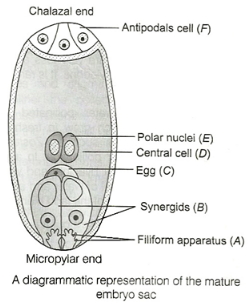
(C) The correct answer is the Central cell.
In a mature angiosperm embryo sac,six out of the eight nuclei are surrounded by cell walls and organized into cells (the egg apparatus consisting of one egg cell and two synergids,and three antipodal cells).
The remaining two nuclei,known as polar nuclei,are situated below the egg apparatus within a large central cell.
Thus,a typical mature angiospermic embryo sac is $8$-nucleate and $7$-celled.
In a mature angiosperm embryo sac,six out of the eight nuclei are surrounded by cell walls and organized into cells (the egg apparatus consisting of one egg cell and two synergids,and three antipodal cells).
The remaining two nuclei,known as polar nuclei,are situated below the egg apparatus within a large central cell.
Thus,a typical mature angiospermic embryo sac is $8$-nucleate and $7$-celled.
0 likes
View Solution269
MediumMCQ
'Cells in the micropylar region are called antipodal cells.'
A
True
B
False
C
Sometimes $(a)$ and sometimes $(b)$
D
Neither $(a)$ nor $(b)$
Solution
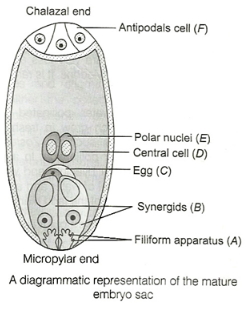
(B) The statement is False.
In a mature embryo sac,the cells present at the chalazal end are known as antipodal cells.
At the micropylar end,the egg apparatus is present,which consists of two synergids and one egg cell.
In a mature embryo sac,the cells present at the chalazal end are known as antipodal cells.
At the micropylar end,the egg apparatus is present,which consists of two synergids and one egg cell.
0 likes
View Solution270
MediumMCQ
The ovule in which the funicle,chalaza and micropyle lie in one vertical plane is called:
A
Campylotropous
B
Amphitropous
C
Orthotropous
D
Anatropous
Solution
(C) The ovule in which the funicle,chalaza,and micropyle lie in one vertical plane is called $Orthotropous$ (Greek: $Orthos$ = straight; $tope$ = turned).
In this type,the body of the ovule is straight.
The hilum and chalaza occur nearly at the same position.
It is also called an $atropous$ or $erect$ ovule,for example,in $Piperaceae$,$Polygonaceae$,and $Urticaceae$.
It is considered the most primitive and simplest type of ovule found in angiosperms.
In this type,the body of the ovule is straight.
The hilum and chalaza occur nearly at the same position.
It is also called an $atropous$ or $erect$ ovule,for example,in $Piperaceae$,$Polygonaceae$,and $Urticaceae$.
It is considered the most primitive and simplest type of ovule found in angiosperms.
0 likes
View Solution271
MediumMCQ
The diagram given below represents the sectional view of

A
Amphitropous ovule
B
Campylotropous ovule
C
Anatropous ovule
D
Orthotropous ovule
Solution
(D) The provided diagram shows an orthotropous ovule.
In an orthotropous ovule,the micropyle,chalaza,and funicle lie in a single straight vertical line.
This is considered the most primitive type of ovule and is found in members of the family Polygonaceae (e.g.,Polygonum) and Piperaceae.
In an orthotropous ovule,the micropyle,chalaza,and funicle lie in a single straight vertical line.
This is considered the most primitive type of ovule and is found in members of the family Polygonaceae (e.g.,Polygonum) and Piperaceae.
0 likes
View Solution272
MediumMCQ
Filiform apparatus are
A
Special cellular thickening at antipodal cells
B
Special cellular thickening at egg cell
C
Special cellular thickening at synergid cells
D
Special cellular thickening at nuclear end
Solution
(C) Filiform apparatus are specialized cellular thickenings found in the synergid cells of the embryo sac.
These structures play a crucial role in guiding the pollen tube into the synergids and facilitating the release of male gametes for fertilization.
These structures play a crucial role in guiding the pollen tube into the synergids and facilitating the release of male gametes for fertilization.
0 likes
View Solution273
MediumMCQ
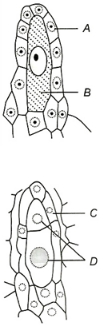
Identify the labels $A, B, C,$ and $D$ in the given diagrams.
A
$A-MMC, B-Megaspore dyad, C-Nucellus, D-Nucleus$
B
$A-Nucellus, B-Megaspore dyad, C-Nucellus, D-MMC$
C
$A-Nucellus, B-MMC, C-Nucellus, D-Megaspore dyad$
D
$A-MMC, B-Nucellus, C-Megaspore dyad, D-Nucleus$
Solution
(C) Based on the provided diagrams of megasporogenesis:
$A$ points to the cells of the nucellus surrounding the developing megaspore mother cell.
$B$ points to the Megaspore Mother Cell $(MMC)$,which is a large cell with dense cytoplasm.
$C$ points to the nucellus tissue.
$D$ points to the Megaspore dyad,which is formed after the first meiotic division of the $MMC$.
Therefore,the correct labeling is $A-Nucellus, B-MMC, C-Nucellus, D-Megaspore dyad$.
Thus,option $C$ is correct.
$A$ points to the cells of the nucellus surrounding the developing megaspore mother cell.
$B$ points to the Megaspore Mother Cell $(MMC)$,which is a large cell with dense cytoplasm.
$C$ points to the nucellus tissue.
$D$ points to the Megaspore dyad,which is formed after the first meiotic division of the $MMC$.
Therefore,the correct labeling is $A-Nucellus, B-MMC, C-Nucellus, D-Megaspore dyad$.
Thus,option $C$ is correct.
0 likes
View Solution274
MediumMCQ
Identify the different types of ovules in diagrams $A$ to $F$.
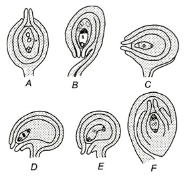
A
$A$-Circinotropous,$B$-Amphitropous,$C$-Campylotropous,$D$-Hemitropous,$E$-Anatropous,$F$-Orthotropous
B
$A$-Campylotropous,$B$-Anatropous,$C$-Hemitropous,$D$-Amphitropous,$E$-Circinotropous,$F$-Orthotropous
C
$A$-Orthotropous,$B$-Anatropous,$C$-Hemitropous,$D$-Campylotropous,$E$-Amphitropous,$F$-Circinotropous
D
$A$-Campylotropous,$B$-Anatropous,$C$-Hemitropous,$D$-Amphitropous,$E$-Orthotropous,$F$-Circinotropous
Solution
(C) -Orthotropous: It is also called atropous. It is erect with no bending,e.g.,$Polygonum$.
$B$-Anatropous: Completely inverted,e.g.,$Helianthus$.
$C$-Hemitropous: The micropyle and chalaza lie at $90^{\circ}$ to the funicle,e.g.,$Ranunculus$.
$D$-Campylotropous: More curvature than hemitropous,e.g.,$Capparis$,mustard.
$E$-Amphitropous: Horse-shoe shaped embryo sac,e.g.,$Capsella$.
$F$-Circinotropous: The funicle grows around the ovule,e.g.,$Opuntia$.
$B$-Anatropous: Completely inverted,e.g.,$Helianthus$.
$C$-Hemitropous: The micropyle and chalaza lie at $90^{\circ}$ to the funicle,e.g.,$Ranunculus$.
$D$-Campylotropous: More curvature than hemitropous,e.g.,$Capparis$,mustard.
$E$-Amphitropous: Horse-shoe shaped embryo sac,e.g.,$Capsella$.
$F$-Circinotropous: The funicle grows around the ovule,e.g.,$Opuntia$.
0 likes
View Solution275
MediumMCQ
Integumented megasporangium is known as:
A
Ovule
B
Pollen sac
C
Pollen grain
D
Embryo sac
Solution
(A) The megasporangium in angiosperms is commonly referred to as the $Ovule$.
It consists of a central mass of tissue called the nucellus,which is protected by one or two protective envelopes known as integuments.
Therefore,an integumented megasporangium is technically defined as an $Ovule$.
It consists of a central mass of tissue called the nucellus,which is protected by one or two protective envelopes known as integuments.
Therefore,an integumented megasporangium is technically defined as an $Ovule$.
0 likes
View Solution276
MediumMCQ
The nutritive tissue present in the ovule is called
A
Nucellus
B
Funicle
C
Embryo
D
Integuments
Solution
(A) The $Nucellus$ is the central part of the ovule consisting of a mass of parenchymatous cells enclosed within the integuments. It serves as the primary nutritive tissue that provides essential nutrients to the developing embryo sac.
0 likes
View Solution277
MediumMCQ
The number of embryo sac in an ovule is generally
A
One
B
Many
C
Four
D
Three
Solution
(A) In most flowering plants (angiosperms),a single megaspore mother cell undergoes meiosis to produce four megaspores. Out of these,three degenerate,and only one functional megaspore develops into a single embryo sac (also known as the female gametophyte). Therefore,the number of embryo sac in an ovule is generally one.
0 likes
View Solution278
MediumMCQ
The ploidy level of nucellus and female gametophyte respectively is
A
$n, n$
B
$n, 2n$
C
$2n, n$
D
$2n, 2n$
Solution
(C) The nucellus is a mass of diploid $(2n)$ cells found within the ovule that provides nutrition to the developing embryo sac.
The female gametophyte,also known as the embryo sac,is formed from the functional megaspore through mitosis and is haploid $(n)$.
The female gametophyte,also known as the embryo sac,is formed from the functional megaspore through mitosis and is haploid $(n)$.
0 likes
View Solution279
EasyMCQ
The number of nuclei in a mature embryo sac are
A
Eight
B
Seven
C
Six
D
Four
Solution
(A) mature embryo sac (also known as the female gametophyte) in angiosperms typically undergoes three successive mitotic divisions following the formation of the functional megaspore.
These divisions result in the formation of $8$ nuclei.
Specifically,the mature embryo sac consists of $3$ antipodal cells,$2$ synergids,$1$ egg cell,and $1$ central cell containing $2$ polar nuclei.
While there are $7$ cells in total,the number of nuclei is $8$ ($3$ in the antipodal cells + $2$ in the synergids + $1$ in the egg cell + $2$ polar nuclei in the central cell).
These divisions result in the formation of $8$ nuclei.
Specifically,the mature embryo sac consists of $3$ antipodal cells,$2$ synergids,$1$ egg cell,and $1$ central cell containing $2$ polar nuclei.
While there are $7$ cells in total,the number of nuclei is $8$ ($3$ in the antipodal cells + $2$ in the synergids + $1$ in the egg cell + $2$ polar nuclei in the central cell).
0 likes
View Solution280
EasyMCQ
The largest cell of the mature embryo sac is
A
Antipodal cells
B
Synergids
C
Central cell
D
Egg cell
Solution
(C) In a mature $7$-celled,$8$-nucleate embryo sac (Polygonum type),the central cell is the largest cell.
It occupies the major portion of the embryo sac and contains two polar nuclei,which later fuse to form a single diploid secondary nucleus.
The other cells,such as the egg cell,synergids,and antipodal cells,are significantly smaller in size compared to the central cell.
It occupies the major portion of the embryo sac and contains two polar nuclei,which later fuse to form a single diploid secondary nucleus.
The other cells,such as the egg cell,synergids,and antipodal cells,are significantly smaller in size compared to the central cell.
0 likes
View Solution281
MediumMCQ
The number of mitotic generations required to form a mature embryo sac in most of the flowering plants is
A
One
B
Two
C
Three
D
Four
Solution
(C) In most flowering plants,the functional megaspore undergoes $3$ successive free-nuclear mitotic divisions to form an $8$-nucleate embryo sac.
These divisions are:
$1$. First mitotic division produces $2$ nuclei.
$2$. Second mitotic division produces $4$ nuclei.
$3$. Third mitotic division produces $8$ nuclei.
Therefore,a total of $3$ mitotic generations are required.
These divisions are:
$1$. First mitotic division produces $2$ nuclei.
$2$. Second mitotic division produces $4$ nuclei.
$3$. Third mitotic division produces $8$ nuclei.
Therefore,a total of $3$ mitotic generations are required.
0 likes
View Solution282
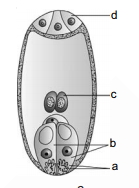
MediumMCQ
Examine the figure given below and select the right option identifying all the four parts $a, b, c$ and $d$.
A
Synergids,Antipodal cells,Polar nuclei,Filiform apparatus
B
Filiform apparatus,Egg,Polar nuclei,Nucellus
C
Filiform apparatus,Synergids,Polar nuclei,Antipodal cells
D
Synergids,Polar nuclei,Filiform apparatus,Antipodal cells
Solution
(C) The figure represents a mature embryo sac (female gametophyte) of an angiosperm.
- Part $a$ points to the finger-like projections at the micropylar end of the synergids,known as the filiform apparatus.
- Part $b$ points to the two synergids located at the micropylar end.
- Part $c$ points to the two polar nuclei located in the central cell.
- Part $d$ points to the three antipodal cells located at the chalazal end.
Therefore,the correct sequence is $a$: Filiform apparatus,$b$: Synergids,$c$: Polar nuclei,$d$: Antipodal cells. This matches option $C$.
- Part $a$ points to the finger-like projections at the micropylar end of the synergids,known as the filiform apparatus.
- Part $b$ points to the two synergids located at the micropylar end.
- Part $c$ points to the two polar nuclei located in the central cell.
- Part $d$ points to the three antipodal cells located at the chalazal end.
Therefore,the correct sequence is $a$: Filiform apparatus,$b$: Synergids,$c$: Polar nuclei,$d$: Antipodal cells. This matches option $C$.
0 likes
View Solution283
MediumMCQ
$A$: Chalazal vacuole is present in the synergid cell of the embryo sac.
$R$: Polarity of synergid cytoplasm is opposite to the egg cell.
$R$: Polarity of synergid cytoplasm is opposite to the egg cell.
A
Assertion and Reason both are correct and Reason is the correct explanation of Assertion.
B
Assertion and Reason both are correct but Reason is not the correct explanation of Assertion.
C
Assertion is correct,but Reason is incorrect.
D
Both Assertion and Reason are incorrect.
Solution
(A) In the mature embryo sac,the synergids are characterized by the presence of a large vacuole at the chalazal end and a filiform apparatus at the micropylar end.
This specific arrangement of organelles and vacuoles creates a distinct polarity within the synergid cell.
The egg cell,conversely,has a large vacuole at the micropylar end and the nucleus at the chalazal end.
Therefore,the polarity of the synergid cytoplasm is indeed opposite to that of the egg cell.
Both the Assertion and the Reason are correct,and the Reason explains why the synergid has a specific polarity.
This specific arrangement of organelles and vacuoles creates a distinct polarity within the synergid cell.
The egg cell,conversely,has a large vacuole at the micropylar end and the nucleus at the chalazal end.
Therefore,the polarity of the synergid cytoplasm is indeed opposite to that of the egg cell.
Both the Assertion and the Reason are correct,and the Reason explains why the synergid has a specific polarity.
0 likes
View Solution284
MediumMCQ
$A$: Anatropous ovule is a resupinate ovule.
$R$: The body of the ovule is completely bent with the hilum close to the micropylar end.
$R$: The body of the ovule is completely bent with the hilum close to the micropylar end.
A
Assertion and Reason both are correct and Reason is the correct explanation of Assertion.
B
Assertion and Reason both are correct but Reason is not the correct explanation of Assertion.
C
Assertion is correct,but Reason is incorrect.
D
Both Assertion and Reason are incorrect.
Solution
(A) An anatropous ovule is the most common type of ovule in angiosperms,occurring in more than $80\%$ of families.
In an anatropous ovule,the body of the ovule becomes completely inverted during development,resulting in the micropyle and the funicle being located side-by-side.
Because of this $180^{\circ}$ rotation (inversion),it is also known as a resupinate ovule.
The hilum and the micropyle are brought close to each other due to this curvature.
Therefore,both the Assertion and the Reason are correct,and the Reason provides the correct explanation for the Assertion.
In an anatropous ovule,the body of the ovule becomes completely inverted during development,resulting in the micropyle and the funicle being located side-by-side.
Because of this $180^{\circ}$ rotation (inversion),it is also known as a resupinate ovule.
The hilum and the micropyle are brought close to each other due to this curvature.
Therefore,both the Assertion and the Reason are correct,and the Reason provides the correct explanation for the Assertion.
0 likes
View Solution285
MediumMCQ
Which of the following describes a typical mature angiosperm embryo sac?
A
$7$-nucleate and $8$-celled
B
$8$-nucleate and $7$-celled
C
$7$-nucleate and $7$-celled
D
$8$-nucleate and $8$-celled
Solution
(B) typical mature angiosperm embryo sac (Polygonum type) is $8$-nucleate and $7$-celled.
It consists of:
$1$. Three antipodal cells at the chalazal end.
$2$. Two synergids and one egg cell (egg apparatus) at the micropylar end.
$3$. One large central cell containing two polar nuclei,which later fuse to form a single diploid secondary nucleus.
Thus,there are $8$ nuclei in total,but they are organized into $7$ cells.
It consists of:
$1$. Three antipodal cells at the chalazal end.
$2$. Two synergids and one egg cell (egg apparatus) at the micropylar end.
$3$. One large central cell containing two polar nuclei,which later fuse to form a single diploid secondary nucleus.
Thus,there are $8$ nuclei in total,but they are organized into $7$ cells.
1 likes
View Solution286
EasyMCQ
Choose the correct option for the embryo sac of angiosperms.
A
Eight-celled,eight-nucleated
B
Seven-celled,eight-nucleated
C
Seven-celled,seven-nucleated
D
Eight-celled,seven-nucleated
Solution
(B) In a typical angiosperm,the mature embryo sac (female gametophyte) is $7$-celled and $8$-nucleated.
It consists of:
$1$. Three antipodal cells at the chalazal end.
$2$. Two synergids and one egg cell at the micropylar end (forming the egg apparatus).
$3$. One central cell containing two polar nuclei.
Thus,there are $7$ cells in total,but because the central cell contains two nuclei,there are $8$ nuclei in total.
It consists of:
$1$. Three antipodal cells at the chalazal end.
$2$. Two synergids and one egg cell at the micropylar end (forming the egg apparatus).
$3$. One central cell containing two polar nuclei.
Thus,there are $7$ cells in total,but because the central cell contains two nuclei,there are $8$ nuclei in total.
0 likes
View Solution287
EasyMCQ
Identify the correct sequence of parts in the gynoecium from the basal to the apical region.
A
Stigma $\rightarrow$ Style $\rightarrow$ Ovary
B
Ovary $\rightarrow$ Style $\rightarrow$ Stigma
C
Anther $\rightarrow$ Style $\rightarrow$ Ovary
D
Ovary $\rightarrow$ Style $\rightarrow$ Anther
Solution
(B) The gynoecium (pistil) is the female reproductive part of a flower.
It consists of three main parts:
$1$. Ovary: The basal, swollen part of the pistil.
$2$. Style: The elongated, slender part that connects the ovary to the stigma.
$3$. Stigma: The apical, receptive surface for pollen grains.
Therefore, the sequence from the basal (bottom) to the apical (top) region is $Ovary \rightarrow Style \rightarrow Stigma$.
It consists of three main parts:
$1$. Ovary: The basal, swollen part of the pistil.
$2$. Style: The elongated, slender part that connects the ovary to the stigma.
$3$. Stigma: The apical, receptive surface for pollen grains.
Therefore, the sequence from the basal (bottom) to the apical (top) region is $Ovary \rightarrow Style \rightarrow Stigma$.
0 likes
View Solution288
MediumMCQ
An ovule is equivalent to:
A
Megasporophyll
B
Megasporangium
C
Microsporophyll
D
Microsporangium
Solution
(B) In angiosperms,the ovule is the structure that develops into a seed after fertilization.
Botanically,the ovule is defined as the integumented megasporangium.
Therefore,an ovule is equivalent to a megasporangium.
Botanically,the ovule is defined as the integumented megasporangium.
Therefore,an ovule is equivalent to a megasporangium.
0 likes
View Solution289
MediumMCQ
Which whorl of the flower is responsible for producing the female gamete?
A
Calyx
B
Corolla
C
Androecium
D
Gynoecium
Solution
(D) The flower consists of four whorls: Calyx,Corolla,Androecium,and Gynoecium.
$1$. The Calyx $(A)$ and Corolla $(B)$ are accessory whorls.
$2$. The Androecium $(C)$ is the male reproductive whorl,which produces pollen grains (male gametes).
$3$. The Gynoecium $(D)$ is the female reproductive whorl,also known as the pistil or carpel,which produces the ovules containing the female gamete (egg cell).
Therefore,the Gynoecium is responsible for producing the female gamete.
$1$. The Calyx $(A)$ and Corolla $(B)$ are accessory whorls.
$2$. The Androecium $(C)$ is the male reproductive whorl,which produces pollen grains (male gametes).
$3$. The Gynoecium $(D)$ is the female reproductive whorl,also known as the pistil or carpel,which produces the ovules containing the female gamete (egg cell).
Therefore,the Gynoecium is responsible for producing the female gamete.
0 likes
View Solution290
MediumMCQ
Which of the following is not a part of the pistil?
A
Stigma
B
Ovary
C
Anther
D
Style
Solution
(C) The pistil (or gynoecium) is the female reproductive part of a flower. It consists of three main parts:
$1$. $Stigma$: The receptive surface for pollen grains.
$2$. $Style$: The elongated stalk that connects the stigma to the ovary.
$3$. $Ovary$: The enlarged basal part containing the ovules.
Anther is a part of the stamen, which is the male reproductive organ of the flower. Therefore, the anther is not a part of the pistil.
$1$. $Stigma$: The receptive surface for pollen grains.
$2$. $Style$: The elongated stalk that connects the stigma to the ovary.
$3$. $Ovary$: The enlarged basal part containing the ovules.
Anther is a part of the stamen, which is the male reproductive organ of the flower. Therefore, the anther is not a part of the pistil.
0 likes
View Solution291
MediumMCQ
Identify the parts of the pistil labeled as $P$,$Q$,and $R$:
Receptive surface for pollen grains $- P$
Elongated slender part of the pistil $- Q$
Basal swollen part of the pistil $- R$
$\quad\quad\quad\quad P \quad\quad\quad Q \quad\quad\quad R$
Receptive surface for pollen grains $- P$
Elongated slender part of the pistil $- Q$
Basal swollen part of the pistil $- R$
$\quad\quad\quad\quad P \quad\quad\quad Q \quad\quad\quad R$
A
Stigma $\quad$ Style $\quad$ Ovary
B
Style $\quad$ Stigma $\quad$ Ovary
C
Stigma $\quad$ Ovary $\quad$ Style
D
Style $\quad$ Ovary $\quad$ Stigma
Solution
(A) The pistil (gynoecium) consists of three main parts:
$1$. $P$ (Stigma): It acts as a receptive surface for pollen grains.
$2$. $Q$ (Style): It is the elongated slender part beneath the stigma.
$3$. $R$ (Ovary): It is the basal swollen part of the pistil that contains the ovules.
Therefore,the correct sequence is $P = \text{Stigma}$,$Q = \text{Style}$,$R = \text{Ovary}$.
$1$. $P$ (Stigma): It acts as a receptive surface for pollen grains.
$2$. $Q$ (Style): It is the elongated slender part beneath the stigma.
$3$. $R$ (Ovary): It is the basal swollen part of the pistil that contains the ovules.
Therefore,the correct sequence is $P = \text{Stigma}$,$Q = \text{Style}$,$R = \text{Ovary}$.
0 likes
View Solution292
MediumMCQ
The $ \dots $ arises from the placenta which is present inside the ovarian cavity.
A
Megaspore
B
Megasporangium
C
Megaspore mother cell
D
Stigma
Solution
(B) In flowering plants, the placenta is located inside the ovarian cavity. The megasporangium, commonly known as the ovule, develops from this placenta. Within the megasporangium, the megaspore mother cell undergoes meiosis to produce megaspores. Therefore, the structure that arises from the placenta is the megasporangium (ovule).
0 likes
View Solution293
MediumMCQ
Identify the correct option for $P$ and $Q$ based on the number of ovules in an ovary:
$P$: Number of ovules in an ovary is one
$Q$: Number of ovules in an ovary is more than one
$\quad\quad\quad\quad P \quad\quad\quad\quad\quad\quad\quad\quad Q$
$(A)$ Papaya,Watermelon,Mango | Wheat,Paddy,Orchid
$(B)$ Wheat,Paddy,Orchid | Papaya,Watermelon,Mango
$(C)$ Wheat,Paddy,Mango | Papaya,Watermelon,Orchid
$(D)$ Papaya,Watermelon,Orchid | Wheat,Paddy,Mango
$P$: Number of ovules in an ovary is one
$Q$: Number of ovules in an ovary is more than one
$\quad\quad\quad\quad P \quad\quad\quad\quad\quad\quad\quad\quad Q$
$(A)$ Papaya,Watermelon,Mango | Wheat,Paddy,Orchid
$(B)$ Wheat,Paddy,Orchid | Papaya,Watermelon,Mango
$(C)$ Wheat,Paddy,Mango | Papaya,Watermelon,Orchid
$(D)$ Papaya,Watermelon,Orchid | Wheat,Paddy,Mango
A
Papaya,Watermelon,Mango | Wheat,Paddy,Orchid
B
Wheat,Paddy,Orchid | Papaya,Watermelon,Mango
C
Wheat,Paddy,Mango | Papaya,Watermelon,Orchid
D
Papaya,Watermelon,Orchid | Wheat,Paddy,Mango
Solution
(C) The number of ovules in an ovary varies among different plant species.
$P$ (One ovule in an ovary): Examples include wheat,paddy (rice),and mango.
$Q$ (Many ovules in an ovary): Examples include papaya,watermelon,and orchids.
Therefore,the correct classification is $P$: Wheat,Paddy,Mango and $Q$: Papaya,Watermelon,Orchid. This corresponds to option $C$.
$P$ (One ovule in an ovary): Examples include wheat,paddy (rice),and mango.
$Q$ (Many ovules in an ovary): Examples include papaya,watermelon,and orchids.
Therefore,the correct classification is $P$: Wheat,Paddy,Mango and $Q$: Papaya,Watermelon,Orchid. This corresponds to option $C$.
0 likes
View Solution294
EasyMCQ
The ovule is attached to the placenta by means of a/an .......
A
Hilum
B
Funiculus
C
Chalaza
D
Micropyle
Solution
(B) The ovule is a small structure attached to the placenta by means of a stalk called the funiculus. The point of attachment of the body of the ovule with the funiculus is known as the hilum. Thus,the funiculus acts as the stalk that connects the ovule to the placenta.
0 likes
View Solution295
EasyMCQ
The point where the body of the ovule is attached to the funicle is called .....
A
Hilum
B
Micropyle
C
Chalaza
D
Funicle
Solution
(A) The ovule is attached to the placenta by means of a stalk called the funicle. The point of attachment of the body of the ovule to the funicle is known as the hilum. Thus,the hilum represents the junction between the ovule and the funicle.
0 likes
View Solution296
MediumMCQ
...... surrounds the nucellus.
A
Hilum
B
Integuments
C
Chalaza
D
Micropyle
Solution
(B) In an angiosperm ovule,the $nucellus$ is the central mass of tissue that contains the embryo sac.
This $nucellus$ is protected by one or two protective envelopes known as $integuments$.
These $integuments$ surround the $nucellus$ except at the tip where a small opening called the $micropyle$ is present.
This $nucellus$ is protected by one or two protective envelopes known as $integuments$.
These $integuments$ surround the $nucellus$ except at the tip where a small opening called the $micropyle$ is present.
0 likes
View Solution297
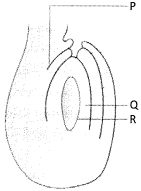
MediumMCQ
The following figure shows a diagrammatic view of a typical anatropous ovule. What are $P$,$Q$,and $R$?
A
Hilum,Nucellus,Embryo sac
B
Hilum,Integument,Embryo sac
C
Funicle,Nucellus,Embryo sac
D
Funicle,Integument,Embryo sac
Solution
(C) In the given diagram of an anatropous ovule:
$P$ represents the Funicle,which is the stalk that attaches the ovule to the placenta.
$Q$ represents the Nucellus,which is the central mass of parenchymatous tissue protected by integuments.
$R$ represents the Embryo sac (female gametophyte),which is located within the nucellus.
Therefore,the correct sequence is $P$ = Funicle,$Q$ = Nucellus,$R$ = Embryo sac.
$P$ represents the Funicle,which is the stalk that attaches the ovule to the placenta.
$Q$ represents the Nucellus,which is the central mass of parenchymatous tissue protected by integuments.
$R$ represents the Embryo sac (female gametophyte),which is located within the nucellus.
Therefore,the correct sequence is $P$ = Funicle,$Q$ = Nucellus,$R$ = Embryo sac.
0 likes
View Solution298
MediumMCQ
What is the correct sequence for the formation of an embryo sac?
A
Nucellar cell $\rightarrow$ Megasporangium $\rightarrow$ Megaspore mother cell $\rightarrow$ Megaspore $\rightarrow$ Embryo sac
B
Nucellar cell $\rightarrow$ Megaspore $\rightarrow$ Megaspore mother cell $\rightarrow$ Embryo sac
C
Nucellar cell $\rightarrow$ Megaspore mother cell $\rightarrow$ Megaspore $\rightarrow$ Embryo sac
D
None of the above
Solution
(C) The process of embryo sac formation (megagametogenesis) begins with a cell of the nucellus.
$1$. $A$ specific cell in the nucellus differentiates into the Megaspore Mother Cell $(MMC)$.
$2$. The $MMC$ undergoes meiosis to produce four haploid megaspores.
$3$. Usually,three megaspores degenerate,and one functional megaspore develops into the embryo sac (female gametophyte) through mitosis.
Therefore,the correct sequence is: Nucellar cell $\rightarrow$ Megaspore mother cell $\rightarrow$ Megaspore $\rightarrow$ Embryo sac.
$1$. $A$ specific cell in the nucellus differentiates into the Megaspore Mother Cell $(MMC)$.
$2$. The $MMC$ undergoes meiosis to produce four haploid megaspores.
$3$. Usually,three megaspores degenerate,and one functional megaspore develops into the embryo sac (female gametophyte) through mitosis.
Therefore,the correct sequence is: Nucellar cell $\rightarrow$ Megaspore mother cell $\rightarrow$ Megaspore $\rightarrow$ Embryo sac.
0 likes
View Solution299
MediumMCQ
Determine the ploidy of the following cells: Megaspore,Megaspore Mother Cell $(MMC)$,Integument cell,Nucellus cell,Egg cell,Antipodal cell,Synergid cell.
A
$2n, 2n, 2n, 2n, n, n, n$
B
$n, 2n, 2n, 2n, n, 3n, 2n$
C
$2n, 2n, 2n, 2n, n, 3n, 2n$
D
$n, 2n, 2n, 2n, n, n, n$
Solution
(D) $1$. Megaspore: Formed after meiosis,hence it is haploid $(n)$.
$2$. Megaspore Mother Cell $(MMC)$: $A$ diploid cell $(2n)$ that undergoes meiosis.
$3$. Integument cell: Part of the ovule wall,hence diploid $(2n)$.
$4$. Nucellus cell: Part of the ovule tissue,hence diploid $(2n)$.
$5$. Egg cell: Part of the embryo sac,formed after mitosis,hence haploid $(n)$.
$6$. Antipodal cell: Part of the embryo sac,hence haploid $(n)$.
$7$. Synergid cell: Part of the embryo sac,hence haploid $(n)$.
Therefore,the sequence is $n, 2n, 2n, 2n, n, n, n$.
$2$. Megaspore Mother Cell $(MMC)$: $A$ diploid cell $(2n)$ that undergoes meiosis.
$3$. Integument cell: Part of the ovule wall,hence diploid $(2n)$.
$4$. Nucellus cell: Part of the ovule tissue,hence diploid $(2n)$.
$5$. Egg cell: Part of the embryo sac,formed after mitosis,hence haploid $(n)$.
$6$. Antipodal cell: Part of the embryo sac,hence haploid $(n)$.
$7$. Synergid cell: Part of the embryo sac,hence haploid $(n)$.
Therefore,the sequence is $n, 2n, 2n, 2n, n, n, n$.
0 likes
View Solution300
MediumMCQ
Select the incorrect statement regarding the Megaspore Mother Cell $(MMC)$.
A
The $MMC$ is formed from a cell of the nucellus.
B
The $MMC$ is haploid.
C
The $MMC$ undergoes meiosis to form megaspores.
D
The $MMC$ contains dense cytoplasm and a prominent nucleus.
Solution
(B) $1$. The Megaspore Mother Cell $(MMC)$ is a large cell containing dense cytoplasm and a prominent nucleus.
$2$. It differentiates from a cell of the nucellus in the micropylar region of the ovule.
$3$. Since the nucellus is composed of diploid $(2n)$ cells,the $MMC$ is also diploid $(2n)$.
$4$. The $MMC$ undergoes meiosis (reduction division) to produce four haploid $(n)$ megaspores.
$5$. Therefore,the statement that the $MMC$ is haploid is incorrect.
$2$. It differentiates from a cell of the nucellus in the micropylar region of the ovule.
$3$. Since the nucellus is composed of diploid $(2n)$ cells,the $MMC$ is also diploid $(2n)$.
$4$. The $MMC$ undergoes meiosis (reduction division) to produce four haploid $(n)$ megaspores.
$5$. Therefore,the statement that the $MMC$ is haploid is incorrect.
0 likes
View SolutionSexual Reproduction in Flowering Plants — The Pistil, Megasporangium (ovule) and Embryo sac · Frequently Asked Questions
1Are these Sexual Reproduction in Flowering Plants questions useful for JEE and NEET?
Yes. All questions in this section are mapped to JEE Main and NEET exam patterns. Previous year questions from JEE Main, NEET, GUJCET and state-level exams are included with full solutions.
2Can I switch to Hindi or Gujarati for these questions?
Yes. Use the language tabs in the hero section or the sidebar to view the same questions and solutions in English, Hindi or Gujarati.
3How do I generate a question paper from this subtopic?
Use the Vedclass Exam Paper Generator — select the chapter and subtopic, set difficulty, and generate Sets A, B, C, D automatically. First 3 chapters of every subject are free.
Vedclass Products
For Students
Vedclass Test Series
Mock tests in real JEE/NEET style with performance analysis. 5-day free trial.
Start Free TrialFor Teachers
Exam Paper Generator
Generate Set A/B/C/D papers from this chapter in 2 minutes. 3 chapters free.
Try FreeFor Institutes
Online Exam Module
Live online exams with unlimited students, 360° analytics & white-label branding.
See DemoFor Teachers & Institutes
Generate a Sexual Reproduction in Flowering Plants Exam Paper in 2 Minutes
Select subtopic & difficulty — Sets A, B, C, D auto-generated with No Repeat logic.
First 3 chapters of every subject are free — no payment required.