
A English
The Pistil, Megasporangium (ovule) and Embryo sac Questions in English
Class 12 Biology · Sexual Reproduction in Flowering Plants · The Pistil, Megasporangium (ovule) and Embryo sac
351+
Questions
English
Language
100%
With Solutions
Showing 50 of 351 questions in English
101
MediumMCQ
"Endostome and Exostome" are parts of the......
A
Nucellus
B
Chalaza
C
Pollen wall
D
Micropyle
Solution
(D) The ovule is surrounded by one or two protective envelopes called integuments.
These integuments encircle the nucellus except at the tip where a small opening called the micropyle is organized.
In bitegmic ovules (ovules with two integuments), the outer integument forms the exostome, and the inner integument forms the endostome.
Therefore, the endostome and exostome are parts of the micropyle.
These integuments encircle the nucellus except at the tip where a small opening called the micropyle is organized.
In bitegmic ovules (ovules with two integuments), the outer integument forms the exostome, and the inner integument forms the endostome.
Therefore, the endostome and exostome are parts of the micropyle.
0 likes
View Solution102
EasyMCQ
The Polygonum type of embryo sac is .....
A
$7$-celled,$8$-nucleate
B
$8$-celled,$7$-nucleate
C
$9$-nucleate
D
$16$-nucleate
Solution
(A) The Polygonum type of embryo sac is the most common type of embryo sac found in angiosperms.
It develops from a single functional megaspore (monosporic development).
During its development,the nucleus undergoes three successive mitotic divisions,resulting in $8$ nuclei.
These nuclei are organized into $7$ cells: $3$ antipodal cells,$2$ synergids,$1$ egg cell,and $1$ central cell containing $2$ polar nuclei.
Therefore,it is described as $7$-celled and $8$-nucleate.
It develops from a single functional megaspore (monosporic development).
During its development,the nucleus undergoes three successive mitotic divisions,resulting in $8$ nuclei.
These nuclei are organized into $7$ cells: $3$ antipodal cells,$2$ synergids,$1$ egg cell,and $1$ central cell containing $2$ polar nuclei.
Therefore,it is described as $7$-celled and $8$-nucleate.
0 likes
View Solution103
EasyMCQ
Which structure is present in the ovule?
A
Two polar nuclei
B
Degeneration of tube nucleus and synergid nucleus
C
Filiform apparatus
D
Two male nuclei
Solution
(C) The $Filiform \text{ } apparatus$ is a specialized cellular thickening located at the micropylar end of the synergid cells within the embryo sac of an ovule. Its primary function is to guide the entry of the pollen tube into the synergids.
0 likes
View Solution104
MediumMCQ
The embryo sac is represented by:
A
Megagametophyte
B
Megasporophyll
C
Megagametes
D
Megaspore
Solution
(A) In angiosperms,the megaspore undergoes three successive mitotic divisions to form an $8$-nucleated and $7$-celled structure known as the embryo sac. Since the embryo sac represents the female gametophyte generation in flowering plants,it is technically referred to as the $Megagametophyte$.
0 likes
View Solution105
MediumMCQ
The megasporophyll is known as the.......
A
Gynoecium
B
Pistil
C
Ovary
D
Stigma
Solution
(B) In angiosperms,the megasporophyll is the carpel or pistil. The pistil represents the female reproductive part of the flower,which bears the ovules (megasporangia). Therefore,the megasporophyll is known as the pistil.
0 likes
View Solution106
EasyMCQ
When the chalaza,funicle,and micropyle lie in a single straight line,the ovule is called......
A
Amphitropous
B
Orthotropous
C
Campylotropous
D
Anatropous
Solution
(B) In an $Orthotropous$ (or $Atropous$) ovule,the micropyle,chalaza,and funicle lie in a single straight vertical line. This is considered the most primitive and simplest type of ovule. In $Anatropous$ ovules,the body of the ovule becomes inverted,bringing the micropyle close to the hilum. In $Campylotropous$ ovules,the body of the ovule is curved. Therefore,the correct option is $B$.
0 likes
View Solution107
EasyMCQ
The point of attachment of the ovule to the funicle is called the ....
A
Raphe
B
Hilum
C
Micropyle
D
Chalaza
Solution
(B) The ovule is attached to the placenta by means of a stalk called the funicle. The point of attachment of the body of the ovule to the funicle is known as the hilum. Thus,the hilum represents the junction between the ovule and the funicle.
0 likes
View Solution108
MediumMCQ
The part of the pistil which serves as a landing platform for pollen grains is called .....
A
Stigma
B
Style
C
Ovule
D
Ovary
Solution
(A) The pistil (or carpel) consists of three main parts: the stigma, the style, and the ovary.
$1$. The $Stigma$ acts as a landing platform for pollen grains.
$2$. The $Style$ is the elongated slender part beneath the stigma.
$3$. The $Ovary$ is the basal bulged part of the pistil.
Therefore, the correct answer is $Stigma$.
$1$. The $Stigma$ acts as a landing platform for pollen grains.
$2$. The $Style$ is the elongated slender part beneath the stigma.
$3$. The $Ovary$ is the basal bulged part of the pistil.
Therefore, the correct answer is $Stigma$.
0 likes
View Solution109
MediumMCQ
Which of the following is the female gametophyte?
A
Embryo
B
Embryo sac
C
Endosperm
D
Pistil
Solution
(B) In angiosperms,the female gametophyte is represented by the embryo sac.
$1$. The megaspore mother cell undergoes meiosis to form four megaspores.
$2$. Three of these degenerate,and the functional megaspore undergoes three successive mitotic divisions to form an $8$-nucleate,$7$-celled structure known as the embryo sac.
$3$. The embryo sac is embedded within the nucellus of the ovule and is responsible for the production of the egg cell,which participates in fertilization.
$1$. The megaspore mother cell undergoes meiosis to form four megaspores.
$2$. Three of these degenerate,and the functional megaspore undergoes three successive mitotic divisions to form an $8$-nucleate,$7$-celled structure known as the embryo sac.
$3$. The embryo sac is embedded within the nucellus of the ovule and is responsible for the production of the egg cell,which participates in fertilization.
0 likes
View Solution110
MediumMCQ
The arrangement of nuclei in a typical angiosperm embryo sac is ......... .
A
$2 + 4 + 2$
B
$3 + 2 + 3$
C
$2 + 3 + 3$
D
$3 + 3 + 2$
Solution
(B) typical angiosperm embryo sac is $7$-celled and $8$-nucleate.
During the development of the embryo sac,the nuclei are arranged as follows:
$1$. Three nuclei are present at the chalazal end,forming the antipodal cells.
$2$. Two nuclei are present in the center,forming the central cell (polar nuclei).
$3$. Three nuclei are present at the micropylar end,forming the egg apparatus (one egg cell and two synergids).
Therefore,the arrangement of nuclei is $3 + 2 + 3$.
During the development of the embryo sac,the nuclei are arranged as follows:
$1$. Three nuclei are present at the chalazal end,forming the antipodal cells.
$2$. Two nuclei are present in the center,forming the central cell (polar nuclei).
$3$. Three nuclei are present at the micropylar end,forming the egg apparatus (one egg cell and two synergids).
Therefore,the arrangement of nuclei is $3 + 2 + 3$.
0 likes
View Solution111
MediumMCQ
In angiosperms,the embryo sac is formed from which of the following?
A
Megaspore mother cell
B
Diploid nucleus
C
Tapetum
D
Microspore mother cell
Solution
(A) In angiosperms,the process of formation of megaspores from the megaspore mother cell $(MMC)$ is called megasporogenesis.
$1$. The $MMC$ undergoes meiosis to produce four haploid megaspores.
$2$. In most flowering plants,three megaspores degenerate,and only one functional megaspore develops into the embryo sac (female gametophyte).
$3$. Therefore,the embryo sac is derived from the functional megaspore,which originates from the megaspore mother cell $(MMC)$.
$1$. The $MMC$ undergoes meiosis to produce four haploid megaspores.
$2$. In most flowering plants,three megaspores degenerate,and only one functional megaspore develops into the embryo sac (female gametophyte).
$3$. Therefore,the embryo sac is derived from the functional megaspore,which originates from the megaspore mother cell $(MMC)$.
0 likes
View Solution112
EasyMCQ
In $Capsella$,the functional megaspore is always located at the........
A
Micropylar end
B
Chalazal end
C
All of these
D
None of these
Solution
(B) In the process of megasporogenesis,a single megaspore mother cell $(MMC)$ undergoes meiosis to form four haploid megaspores.
In most angiosperms,including $Capsella$,the three megaspores towards the micropylar end degenerate,while the single megaspore towards the chalazal end remains functional.
This functional megaspore develops into the female gametophyte (embryo sac).
Therefore,the functional megaspore is always located at the chalazal end.
In most angiosperms,including $Capsella$,the three megaspores towards the micropylar end degenerate,while the single megaspore towards the chalazal end remains functional.
This functional megaspore develops into the female gametophyte (embryo sac).
Therefore,the functional megaspore is always located at the chalazal end.
0 likes
View Solution113
EasyMCQ
Anatropous ovule is found in which of the following?
A
Capsella
B
Polygonum
C
Ranunculus
D
All of the above
Solution
(D) Anatropous ovule is the most common type of ovule in angiosperms.
In an anatropous ovule, the body of the ovule becomes completely inverted during development so that the micropyle and the funicle come to lie very close to each other.
$Capsella$, $Polygonum$, and $Ranunculus$ are all examples of angiosperms that possess anatropous ovules.
Therefore, the correct answer is $All \text{ of the above}$.
In an anatropous ovule, the body of the ovule becomes completely inverted during development so that the micropyle and the funicle come to lie very close to each other.
$Capsella$, $Polygonum$, and $Ranunculus$ are all examples of angiosperms that possess anatropous ovules.
Therefore, the correct answer is $All \text{ of the above}$.
0 likes
View Solution114
MediumMCQ
$.......$ embryo sac is an $8$-nucleate structure.
A
Monosporic
B
Bisporic
C
Tetrasporic
D
All of these
Solution
(D) The development of the embryo sac can be classified based on the number of megaspore nuclei that participate in its formation.
$1$. Monosporic development: Only one megaspore nucleus participates (e.g., Polygonum type).
$2$. Bisporic development: Two megaspore nuclei participate (e.g., Allium type).
$3$. Tetrasporic development: All four megaspore nuclei participate (e.g., Fritillaria type).
All these types of development result in an $8$-nucleate, $7$-celled mature embryo sac. Therefore, the correct answer is $D$.
$1$. Monosporic development: Only one megaspore nucleus participates (e.g., Polygonum type).
$2$. Bisporic development: Two megaspore nuclei participate (e.g., Allium type).
$3$. Tetrasporic development: All four megaspore nuclei participate (e.g., Fritillaria type).
All these types of development result in an $8$-nucleate, $7$-celled mature embryo sac. Therefore, the correct answer is $D$.
0 likes
View Solution115
EasyMCQ
The tissue that attaches the ovule to the inner side of the ovary is called .......
A
Funiculus
B
Hilum
C
Placenta
D
Ovum
Solution
(C) The placenta is the specialized tissue within the ovary that serves as the site of attachment for the ovule.
It provides a connection through which the ovule receives nutrients and develops.
Therefore,the correct term for the tissue attaching the ovule to the inner wall of the ovary is the placenta.
It provides a connection through which the ovule receives nutrients and develops.
Therefore,the correct term for the tissue attaching the ovule to the inner wall of the ovary is the placenta.
0 likes
View Solution116
MediumMCQ
In an epigynous flower,what is the orientation of the micropyle?
A
Upward
B
Downward
C
Rightward
D
Leftward
Solution
(B) In an epigynous flower,the thalamus grows upward,enclosing the ovary completely and fusing with it. The floral parts (sepals,petals,and stamens) arise from above the ovary. Due to this structural arrangement,the ovule within the ovary is inverted (anatropous),which causes the micropyle to point downward.
0 likes
View Solution117
MediumMCQ
An ovule in which the nucellus and embryo sac are placed at a right angle to the funicle is known as:
A
Hemitropous
B
Campylotropous
C
Anatropous
D
Orthotropous
Solution
(A) In a $Hemitropous$ (or $Hemianatropous$) ovule,the body of the ovule is placed transversely at a right angle $(90^{\circ})$ to the funicle. The hilum,chalaza,and micropyle lie in a straight line,but the main body of the ovule is oriented horizontally relative to the stalk. Therefore,the correct option is $A$.
0 likes
View Solution118
EasyMCQ
The ovule shown represents which of the following types?
A
Amphitropous
B
Circinotropous
C
Atropous
D
Anatropous
Solution
(D) The ovule in which the body of the ovule is completely inverted so that the micropyle and the funicle come to lie very close to each other is known as an anatropous ovule. This is the most common type of ovule found in angiosperms. Therefore,the correct answer is $D$.
0 likes
View Solution119
EasyMCQ
The filiform apparatus is a characteristic feature of which of the following?
A
Suspensor
B
Egg cell
C
Synergids
D
Zygote
Solution
(C) The filiform apparatus consists of specialized cellular thickenings at the micropylar end of the synergids. Its primary function is to guide the entry of the pollen tube into the synergids during the process of fertilization in angiosperms. Therefore,it is a characteristic feature of the synergids.
0 likes
View Solution120
MediumMCQ
The $8$-nucleate embryo sac is .....
A
Always $4$-celled
B
Always $1$-celled
C
Always $2$-celled
D
Sometimes $1$-celled,sometimes $2$-celled,and sometimes $4$-celled
Solution
(D) In a typical angiosperm,the mature embryo sac is $8$-nucleate and $7$-celled.
However,the question refers to the developmental stages or variations in cellularity.
During the development of the Polygonum type of embryo sac,the $8$ nuclei are organized into $7$ cells: $3$ antipodal cells,$2$ synergids,$1$ egg cell,and $1$ central cell (which contains $2$ polar nuclei).
Therefore,the mature embryo sac is $7$-celled.
Given the options provided,the question likely refers to the variation in the number of cells during the development or specific types of embryo sacs (like Oenothera type which is $4$-nucleate and $4$-celled).
However,in the context of standard $8$-nucleate embryo sacs,the most appropriate answer reflecting the developmental complexity is $D$.
However,the question refers to the developmental stages or variations in cellularity.
During the development of the Polygonum type of embryo sac,the $8$ nuclei are organized into $7$ cells: $3$ antipodal cells,$2$ synergids,$1$ egg cell,and $1$ central cell (which contains $2$ polar nuclei).
Therefore,the mature embryo sac is $7$-celled.
Given the options provided,the question likely refers to the variation in the number of cells during the development or specific types of embryo sacs (like Oenothera type which is $4$-nucleate and $4$-celled).
However,in the context of standard $8$-nucleate embryo sacs,the most appropriate answer reflecting the developmental complexity is $D$.
0 likes
View Solution121
MediumMCQ
What is the arrangement of nuclei in a typical angiosperm embryo sac?
A
$3 + 2 + 3$
B
$2 + 3 + 3$
C
$3 + 3 + 2$
D
$2 + 4 + 2$
Solution
(A) typical angiosperm embryo sac is $7$-celled and $8$-nucleate.
At the micropylar end,there are $3$ cells (one egg cell and two synergids).
At the chalazal end,there are $3$ antipodal cells.
In the central cell,there are $2$ polar nuclei.
Therefore,the arrangement of nuclei from the micropylar end to the chalazal end is $3 + 2 + 3$ (where $3$ are at the micropylar end,$2$ are in the central cell,and $3$ are at the chalazal end).
At the micropylar end,there are $3$ cells (one egg cell and two synergids).
At the chalazal end,there are $3$ antipodal cells.
In the central cell,there are $2$ polar nuclei.
Therefore,the arrangement of nuclei from the micropylar end to the chalazal end is $3 + 2 + 3$ (where $3$ are at the micropylar end,$2$ are in the central cell,and $3$ are at the chalazal end).
0 likes
View Solution122
MediumMCQ
Which of the following plants has orthotropous ovules?
A
Cycas
B
Equisetum
C
Strigula
D
Funaria
Solution
(A) An orthotropous ovule is the most primitive and simplest type of ovule where the micropyle,chalaza,and funicle lie in a straight vertical line.
In $Cycas$ (a gymnosperm),the ovules are orthotropous.
$Equisetum$ and $Funaria$ are pteridophytes and bryophytes respectively,which do not produce seeds or ovules.
$Strigula$ is a lichen,which also does not produce ovules.
In $Cycas$ (a gymnosperm),the ovules are orthotropous.
$Equisetum$ and $Funaria$ are pteridophytes and bryophytes respectively,which do not produce seeds or ovules.
$Strigula$ is a lichen,which also does not produce ovules.
0 likes
View Solution123
MediumMCQ
What is the type of ovule in $Thuja$?
A
Orthotropous
B
Anatropous
C
Campylotropous
D
Amphitropous
Solution
(A) In $Thuja$,which belongs to the family $Cupressaceae$ (Gymnosperms),the ovules are $orthotropous$.
An $orthotropous$ ovule is one where the micropyle,chalaza,and funicle lie in a straight vertical line.
This is a characteristic feature of many primitive seed plants and gymnosperms.
An $orthotropous$ ovule is one where the micropyle,chalaza,and funicle lie in a straight vertical line.
This is a characteristic feature of many primitive seed plants and gymnosperms.
0 likes
View Solution124
EasyMCQ
Which of the following parts does the pistil (gynoecium) contain?
A
Anther
B
Style
C
Ovary
D
All of the above
Solution
(D) The pistil or carpel is the female reproductive part of a flower. It consists of three main parts:
$1$. Stigma: The receptive surface for pollen grains.
$2$. Style: The elongated tube that connects the stigma to the ovary.
$3$. Ovary: The enlarged basal part that contains the ovules.
Since the ovary and style are parts of the pistil,and the stigma (though not explicitly listed as a separate option,it is part of the pistil) is implied,the correct answer is that the pistil comprises these structures. However,among the given options,'Anther' is part of the stamen (male reproductive part). Therefore,the question implies which of these are components of the gynoecium. Since 'Style' and 'Ovary' are both parts of the pistil,the question structure suggests 'All of the above' is intended to cover the components of the female reproductive system,though 'Anther' is technically incorrect. Given the standard format,the intended answer is $D$.
$1$. Stigma: The receptive surface for pollen grains.
$2$. Style: The elongated tube that connects the stigma to the ovary.
$3$. Ovary: The enlarged basal part that contains the ovules.
Since the ovary and style are parts of the pistil,and the stigma (though not explicitly listed as a separate option,it is part of the pistil) is implied,the correct answer is that the pistil comprises these structures. However,among the given options,'Anther' is part of the stamen (male reproductive part). Therefore,the question implies which of these are components of the gynoecium. Since 'Style' and 'Ovary' are both parts of the pistil,the question structure suggests 'All of the above' is intended to cover the components of the female reproductive system,though 'Anther' is technically incorrect. Given the standard format,the intended answer is $D$.
0 likes
View Solution125
MediumMCQ
The pistil is divided into which parts?
A
Anther,Connective,Ovary
B
Anther,Filament,Style
C
Ovary,Filament,Anther
D
Stigma,Ovary,Style
Solution
(D) The pistil (or gynoecium) is the female reproductive part of a flower.
It consists of three distinct parts:
$1$. Stigma: The terminal part which serves as a landing platform for pollen grains.
$2$. Style: The elongated slender part beneath the stigma.
$3$. Ovary: The basal bulged part of the pistil which contains the ovules.
Therefore,the correct option is $D$.
It consists of three distinct parts:
$1$. Stigma: The terminal part which serves as a landing platform for pollen grains.
$2$. Style: The elongated slender part beneath the stigma.
$3$. Ovary: The basal bulged part of the pistil which contains the ovules.
Therefore,the correct option is $D$.
0 likes
View Solution126
MediumMCQ
In a haplontic life cycle,how many of the four haploid nuclei degenerate?
A
One
B
Two
C
Three
D
Four
Solution
(C) In a haplontic life cycle,specifically during the formation of the female gametophyte (embryo sac) in angiosperms (which is a common context for this question),the megaspore mother cell undergoes meiosis to produce four haploid megaspores. Out of these four,three degenerate and only one remains functional to develop into the embryo sac. Therefore,the correct answer is $3$.
0 likes
View Solution127
MediumMCQ
How many megaspores are produced by the megasporangium of a gymnosperm?
A
Four
B
Three
C
Two
D
One
Solution
(D) In gymnosperms, the megaspore mother cell undergoes meiosis to produce four haploid megaspores. However, in most gymnosperms, three of these megaspores degenerate, and only one functional megaspore develops into the female gametophyte. Therefore, the functional megaspore produced is one.
0 likes
View Solution128
MediumMCQ
The megasporophyll of gymnosperms is homologous to which organ of angiosperms?
A
Stamen
B
Carpel
C
Ovule
D
Pollen grain
Solution
(B) In gymnosperms,the reproductive structures are organized into cones or strobili. The female cone bears megasporophylls,which are leaf-like structures that carry ovules. In angiosperms,the female reproductive organ is the carpel (or pistil),which encloses the ovules. Therefore,the megasporophyll of gymnosperms is homologous to the carpel of angiosperms.
0 likes
View Solution129
MediumMCQ
Which of the following parts belong to the gynoecium? $P$ - Stigma,$Q$ - Anther,$R$ - Style,$S$ - Ovary,$T$ - Connective,$U$ - Filament
A
$S, T, U$
B
$P, Q, R$
C
$Q, R, S$
D
$P, R, S$
Solution
(D) The gynoecium (pistil) is the female reproductive part of a flower.
It consists of three main parts:
$1$. Stigma $(P)$: The receptive surface for pollen grains.
$2$. Style $(R)$: The elongated stalk connecting the stigma to the ovary.
$3$. Ovary $(S)$: The enlarged basal portion containing ovules.
Anther $(Q)$,Connective $(T)$,and Filament $(U)$ are parts of the androecium (stamen),which is the male reproductive part.
Therefore,the correct parts of the gynoecium are $P, R,$ and $S$.
It consists of three main parts:
$1$. Stigma $(P)$: The receptive surface for pollen grains.
$2$. Style $(R)$: The elongated stalk connecting the stigma to the ovary.
$3$. Ovary $(S)$: The enlarged basal portion containing ovules.
Anther $(Q)$,Connective $(T)$,and Filament $(U)$ are parts of the androecium (stamen),which is the male reproductive part.
Therefore,the correct parts of the gynoecium are $P, R,$ and $S$.
0 likes
View Solution130
EasyMCQ
Functional megaspore in an angiosperm develops into an
A
endosperm
B
embryo sac
C
embryo
D
ovule
Solution
(B) : In angiosperms,the functional megaspore is the first cell of the female gametophyte. It enlarges and undergoes mitotic divisions to form the embryo sac,which is the mature female gametophyte.
0 likes
View Solution131
MediumMCQ
In the majority of angiosperms,
A
the egg has a filiform apparatus.
B
there are numerous antipodal cells.
C
reduction division occurs in the megaspore mother cells.
D
a small central cell is present in the embryo sac.
Solution
(C) In the majority of angiosperms,the process of megasporogenesis involves the differentiation of a single megaspore mother cell $(MMC)$ within the nucellus of the ovule.
This $MMC$ undergoes meiosis,which is a reduction division,to produce four haploid megaspores.
Therefore,option $(C)$ is correct.
- Filiform apparatus is found in synergids,not the egg cell.
- There are typically only three antipodal cells.
- The central cell is usually the largest cell in the embryo sac.
This $MMC$ undergoes meiosis,which is a reduction division,to produce four haploid megaspores.
Therefore,option $(C)$ is correct.
- Filiform apparatus is found in synergids,not the egg cell.
- There are typically only three antipodal cells.
- The central cell is usually the largest cell in the embryo sac.
0 likes
View Solution132
MediumMCQ
The ovule of an angiosperm is technically equivalent to
A
megasporangium
B
megasporophyll
C
megaspore mother cell
D
megaspore
Solution
(A) The ovule of an angiosperm is technically equivalent to an integumented megasporangium.
In angiosperms,the megasporangium is protected by one or two protective envelopes called integuments,which together with the nucellus and embryo sac constitute the ovule.
In angiosperms,the megasporangium is protected by one or two protective envelopes called integuments,which together with the nucellus and embryo sac constitute the ovule.
0 likes
View Solution133
EasyMCQ
Filiform apparatus is a characteristic feature of
A
aleurone cell
B
synergids
C
generative cell
D
nucellar embryo
Solution
(B) The filiform apparatus is a specialized mass of finger-like projections of the cell wall extending into the cytoplasm.
It is a characteristic feature of the synergids (helper cells) located in the micropylar region of the embryo sac.
Its primary function is to guide the pollen tube into the synergids within the ovule towards the egg cell.
It is a characteristic feature of the synergids (helper cells) located in the micropylar region of the embryo sac.
Its primary function is to guide the pollen tube into the synergids within the ovule towards the egg cell.
0 likes
View Solution134
MediumMCQ
Megasporangium is equivalent to
A
ovule
B
nucellus
C
embryo sac
D
fruit
Solution
(A) The megasporangium is equivalent to the ovule.
An ovule is technically referred to as an integumented megasporangium.
It is located within the ovary and is attached to a cushion-like structure known as the placenta.
Inside the ovule,a single embryo sac is formed from a functional megaspore through the process of meiosis (reduction division).
An ovule is technically referred to as an integumented megasporangium.
It is located within the ovary and is attached to a cushion-like structure known as the placenta.
Inside the ovule,a single embryo sac is formed from a functional megaspore through the process of meiosis (reduction division).
0 likes
View Solution135
MediumMCQ
Megaspores are produced from the megaspore mother cells after
A
mitotic division
B
formation of thick wall
C
differentiation
D
meiotic division
Solution
(D) The correct answer is $D$.
In flowering plants,the process of formation of megaspores from the diploid megaspore mother cell $(MMC)$ is known as megasporogenesis.
This process involves a meiotic division (reduction division) of the $MMC$,which results in the formation of four haploid megaspores.
Megasporogenesis occurs within the ovule of the plant.
In flowering plants,the process of formation of megaspores from the diploid megaspore mother cell $(MMC)$ is known as megasporogenesis.
This process involves a meiotic division (reduction division) of the $MMC$,which results in the formation of four haploid megaspores.
Megasporogenesis occurs within the ovule of the plant.
0 likes
View Solution136
EasyMCQ
Filiform apparatus is a characteristic feature of
A
suspensor
B
egg
C
synergid
D
zygote
Solution
(C) The correct answer is $C$.
Filiform apparatus is a mass of finger-like projections of the cell wall extending into the cytoplasm.
It is present in the synergids (helper cells) of the embryo sac,specifically in the micropylar region.
Its primary function is to guide the pollen tube into the embryo sac within the ovule.
Filiform apparatus is a mass of finger-like projections of the cell wall extending into the cytoplasm.
It is present in the synergids (helper cells) of the embryo sac,specifically in the micropylar region.
Its primary function is to guide the pollen tube into the embryo sac within the ovule.
0 likes
View Solution137
MediumMCQ
In angiosperms,the functional megaspore develops into
A
embryo sac
B
ovule
C
endosperm
D
pollen sac
Solution
(A) The correct answer is $A$. In angiosperms,the functional megaspore represents the first cell of the female gametophyte. It undergoes successive mitotic divisions to develop into the mature embryo sac,also known as the female gametophyte.
0 likes
View Solution138
EasyMCQ
The arrangement of the nuclei in a normal embryo sac in the dicot plants is
A
$3 + 3 + 2$
B
$2 + 4 + 2$
C
$3 + 2 + 3$
D
$2 + 3 + 3$
Solution
(C) typical mature embryo sac of an angiosperm (including dicots) is $7$-celled and $8$-nucleate.
The arrangement of these $8$ nuclei is as follows:
$1$. Three nuclei are present at the micropylar end,forming the egg apparatus (one egg cell and two synergids).
$2$. Two nuclei are present in the central cell,known as polar nuclei.
$3$. Three nuclei are present at the chalazal end,known as antipodal cells.
Therefore,the arrangement is $3 + 2 + 3$ (three at the top,two in the center,and three at the bottom).
The arrangement of these $8$ nuclei is as follows:
$1$. Three nuclei are present at the micropylar end,forming the egg apparatus (one egg cell and two synergids).
$2$. Two nuclei are present in the central cell,known as polar nuclei.
$3$. Three nuclei are present at the chalazal end,known as antipodal cells.
Therefore,the arrangement is $3 + 2 + 3$ (three at the top,two in the center,and three at the bottom).
0 likes
View Solution139
MediumMCQ
Select the correct option regarding megasporogenesis.
A
Ovules generally differentiate into two megaspore mother cells in the micropylar region.
B
$MMC$ is a small cell containing dense cytoplasm.
C
Megaspore mother cell undergoes meiotic division.
D
Meiosis results in the production of two megaspores.
Solution
(C) $1$. The process of formation of megaspores from the megaspore mother cell $(MMC)$ is called megasporogenesis.
$2$. Ovules generally differentiate a single megaspore mother cell in the micropylar region of the nucellus.
$3$. The $MMC$ is a large cell containing dense cytoplasm and a prominent nucleus.
$4$. The $MMC$ undergoes meiotic division,which results in the production of four megaspores.
$2$. Ovules generally differentiate a single megaspore mother cell in the micropylar region of the nucellus.
$3$. The $MMC$ is a large cell containing dense cytoplasm and a prominent nucleus.
$4$. The $MMC$ undergoes meiotic division,which results in the production of four megaspores.
0 likes
View Solution140
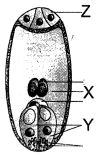
MediumMCQ
Identify the labelled parts $X, Y$ and $Z$ from the given figure of an embryo sac:
A
Central cell - Synergids - Antipodal
B
Egg - Central cells - Polar nuclei
C
Synergids - Egg - Central cells
D
Antipodals - Filiform apparatus - Synergids
Solution
(A) In the given figure of a mature embryo sac:
$X$ points to the central cell,which contains two polar nuclei.
$Y$ points to the synergids,which are the two cells flanking the egg cell.
$Z$ points to the antipodal cells,which are the three cells located at the chalazal end.
Therefore,the correct identification is $X$ = Central cell,$Y$ = Synergids,$Z$ = Antipodal cells.
Thus,option $A$ is the correct answer.
$X$ points to the central cell,which contains two polar nuclei.
$Y$ points to the synergids,which are the two cells flanking the egg cell.
$Z$ points to the antipodal cells,which are the three cells located at the chalazal end.
Therefore,the correct identification is $X$ = Central cell,$Y$ = Synergids,$Z$ = Antipodal cells.
Thus,option $A$ is the correct answer.
0 likes
View Solution141
EasyMCQ
Filiform apparatus is a feature of
A
Seed
B
Antipodal Cell
C
Polar nuclei
D
Synergid Cell
Solution
(D) The filiform apparatus is a specialized structure consisting of finger-like projections of the cell wall that extend into the cytoplasm of the synergid cells.
It is located at the micropylar end of the synergids.
Its primary function is to guide the entry of the pollen tube into the synergid cell during the process of fertilization in angiosperms.
It is located at the micropylar end of the synergids.
Its primary function is to guide the entry of the pollen tube into the synergid cell during the process of fertilization in angiosperms.
0 likes
View Solution142
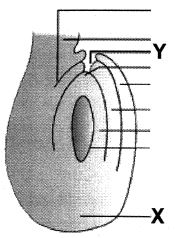
MediumMCQ
Identify $X$ and $Y$ from the given diagram of an ovule.
A
$X$ - Chalazal pole,$Y$ - Micropyle
B
$X$ - Chalazal pole,$Y$ - Egg cell
C
$X$ - Micropylar pole,$Y$ - Synergids
D
$X$ - Micropylar pole,$Y$ - Antipodals
Solution
(A) In the provided diagram of an anatropous ovule:
$1$. $X$ points to the base of the ovule,which is the $Chalazal$ $pole$.
$2$. $Y$ points to the small opening at the apex of the ovule,which is the $Micropyle$.
Therefore,the correct identification is $X$ - Chalazal pole and $Y$ - Micropyle.
$1$. $X$ points to the base of the ovule,which is the $Chalazal$ $pole$.
$2$. $Y$ points to the small opening at the apex of the ovule,which is the $Micropyle$.
Therefore,the correct identification is $X$ - Chalazal pole and $Y$ - Micropyle.
0 likes
View Solution143
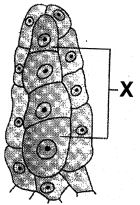
MediumMCQ
In the given figure,the labeled part $X$ is formed by:
A
$PMC$
B
Megaspore Tetrad
C
Microspore
D
Megaspore
Solution
(B) The provided figure shows the process of megasporogenesis in an ovule. The labeled part $X$ represents a linear arrangement of four haploid cells,which is known as a megaspore tetrad. This structure is formed after the meiotic division of the Megaspore Mother Cell $(MMC)$. Therefore,the correct option is $B$.
0 likes
View Solution144
MediumMCQ
The egg apparatus consists of...
A
Two antipodal cells $+$ one egg cell
B
Two synergid cells $+$ polar nuclei
C
Polar nuclei $+$ one egg cell
D
Two synergid cells $+$ one egg cell
Solution
(D) In the mature embryo sac of angiosperms,the egg apparatus is located at the micropylar end.
It consists of three cells: two synergids and one egg cell.
The synergids have special cellular thickenings at the micropylar tip called filiform apparatus,which guide the entry of the pollen tube into the synergid.
Therefore,the correct composition of the egg apparatus is two synergid cells and one egg cell.
It consists of three cells: two synergids and one egg cell.
The synergids have special cellular thickenings at the micropylar tip called filiform apparatus,which guide the entry of the pollen tube into the synergid.
Therefore,the correct composition of the egg apparatus is two synergid cells and one egg cell.
0 likes
View Solution145
EasyMCQ
$A$ typical angiosperm embryo sac,at maturity,is ...... nucleate and ....... celled.
A
$7, 8$
B
$7, 7$
C
$8, 8$
D
$8, 7$
Solution
(D) typical angiosperm embryo sac (Polygonum type) undergoes three successive mitotic divisions after the formation of the functional megaspore.
These divisions result in the formation of $8$ nuclei.
Out of these $8$ nuclei,$6$ nuclei are surrounded by cell walls and organized into cells (three antipodal cells,two synergids,and one egg cell).
The remaining $2$ nuclei,known as polar nuclei,are situated in the large central cell.
Therefore,a mature embryo sac is $8$-nucleate and $7$-celled.
These divisions result in the formation of $8$ nuclei.
Out of these $8$ nuclei,$6$ nuclei are surrounded by cell walls and organized into cells (three antipodal cells,two synergids,and one egg cell).
The remaining $2$ nuclei,known as polar nuclei,are situated in the large central cell.
Therefore,a mature embryo sac is $8$-nucleate and $7$-celled.
0 likes
View Solution146
MediumMCQ
$X$ - $MMC$ is a large cell containing dense cytoplasm and a prominent nucleus.
$Y$ - Method of embryo sac formation from a single megaspore is termed monosporic.
$Y$ - Method of embryo sac formation from a single megaspore is termed monosporic.
A
Both incorrect
B
Both correct
C
$X$ - correct,$Y$ - incorrect
D
$X$ - incorrect,$Y$ - correct
Solution
(B) $X$ is correct: The Megaspore Mother Cell $(MMC)$ is a diploid cell that is significantly larger than surrounding cells,characterized by dense cytoplasm and a prominent nucleus.
$Y$ is correct: In angiosperms,when the embryo sac develops from a single functional megaspore,the development is known as monosporic development.
$Y$ is correct: In angiosperms,when the embryo sac develops from a single functional megaspore,the development is known as monosporic development.
0 likes
View Solution147
MediumMCQ
Megasporangia arise from the ....
A
Stigma
B
Anther
C
Funicle
D
Placenta
Solution
(D) In flowering plants,the megasporangium is commonly known as the ovule.
These ovules are attached to the placenta within the ovary.
The placenta is the tissue that connects the ovule to the ovary wall.
Therefore,megasporangia (ovules) arise from the placenta.
These ovules are attached to the placenta within the ovary.
The placenta is the tissue that connects the ovule to the ovary wall.
Therefore,megasporangia (ovules) arise from the placenta.
0 likes
View Solution148
EasyMCQ
Which of the following is not a part of the gynoecium?
A
Style
B
Pollen tube
C
Ovary
D
Stigma
Solution
(B) The gynoecium (or pistil) is the female reproductive part of a flower. It consists of three main parts: the stigma, the style, and the ovary.
$1$. The $Stigma$ serves as a landing platform for pollen grains.
$2$. The $Style$ is the elongated slender part beneath the stigma.
$3$. The $Ovary$ is the basal bulged part of the pistil.
The $Pollen \text{ } tube$ is a structure that develops from the pollen grain after pollination to deliver male gametes to the ovule; it is not a structural part of the gynoecium itself.
$1$. The $Stigma$ serves as a landing platform for pollen grains.
$2$. The $Style$ is the elongated slender part beneath the stigma.
$3$. The $Ovary$ is the basal bulged part of the pistil.
The $Pollen \text{ } tube$ is a structure that develops from the pollen grain after pollination to deliver male gametes to the ovule; it is not a structural part of the gynoecium itself.
0 likes
View Solution149
MediumMCQ
Synergids are which type?
A
Diploid
B
Haploid
C
Triploid
D
Tetraploid
Solution
(B) In the process of megasporogenesis,a single megaspore mother cell undergoes meiosis to produce four haploid megaspores.
Three of these megaspores degenerate,and the remaining functional megaspore undergoes mitosis to form the embryo sac (female gametophyte).
The cells within the embryo sac,including the synergids,egg cell,and antipodal cells,are formed through mitotic divisions of the haploid megaspore nucleus.
Therefore,synergids are haploid $(n)$ in nature.
Three of these megaspores degenerate,and the remaining functional megaspore undergoes mitosis to form the embryo sac (female gametophyte).
The cells within the embryo sac,including the synergids,egg cell,and antipodal cells,are formed through mitotic divisions of the haploid megaspore nucleus.
Therefore,synergids are haploid $(n)$ in nature.
0 likes
View Solution150
EasyMCQ
$A$ typical angiosperm embryo sac at maturity has
A
$7$-nucleate and $8$-celled
B
$6$-celled and $6$-nucleate
C
$8$-nucleate and $7$-celled
D
$1$-nucleate and $1$-celled
Solution
(C) typical angiosperm embryo sac,also known as the $Polygonum$ type,undergoes three successive free nuclear divisions after the formation of the functional megaspore.
These divisions result in $8$ nuclei.
After the migration of nuclei,cell walls are formed,leading to the organization of the embryo sac into $7$ cells.
The arrangement consists of:
$1$. Three antipodal cells at the chalazal end.
$2$. Two synergids and one egg cell (egg apparatus) at the micropylar end.
$3$. One central cell containing two polar nuclei.
Thus,the mature embryo sac is $8$-nucleate and $7$-celled.
These divisions result in $8$ nuclei.
After the migration of nuclei,cell walls are formed,leading to the organization of the embryo sac into $7$ cells.
The arrangement consists of:
$1$. Three antipodal cells at the chalazal end.
$2$. Two synergids and one egg cell (egg apparatus) at the micropylar end.
$3$. One central cell containing two polar nuclei.
Thus,the mature embryo sac is $8$-nucleate and $7$-celled.
0 likes
View SolutionSexual Reproduction in Flowering Plants — The Pistil, Megasporangium (ovule) and Embryo sac · Frequently Asked Questions
1Are these Sexual Reproduction in Flowering Plants questions useful for JEE and NEET?
Yes. All questions in this section are mapped to JEE Main and NEET exam patterns. Previous year questions from JEE Main, NEET, GUJCET and state-level exams are included with full solutions.
2Can I switch to Hindi or Gujarati for these questions?
Yes. Use the language tabs in the hero section or the sidebar to view the same questions and solutions in English, Hindi or Gujarati.
3How do I generate a question paper from this subtopic?
Use the Vedclass Exam Paper Generator — select the chapter and subtopic, set difficulty, and generate Sets A, B, C, D automatically. First 3 chapters of every subject are free.
Vedclass Products
For Students
Vedclass Test Series
Mock tests in real JEE/NEET style with performance analysis. 5-day free trial.
Start Free TrialFor Teachers
Exam Paper Generator
Generate Set A/B/C/D papers from this chapter in 2 minutes. 3 chapters free.
Try FreeFor Institutes
Online Exam Module
Live online exams with unlimited students, 360° analytics & white-label branding.
See DemoFor Teachers & Institutes
Generate a Sexual Reproduction in Flowering Plants Exam Paper in 2 Minutes
Select subtopic & difficulty — Sets A, B, C, D auto-generated with No Repeat logic.
First 3 chapters of every subject are free — no payment required.