
A English
Method of birth control Questions in English
Class 12 Biology · Reproductive Health · Method of birth control
340+
Questions
English
Language
100%
With Solutions
Showing 47 of 340 questions in English
51
EasyMCQ
In vasectomy, a small part of the $vas \text{ } deferens$ is removed through a small incision on the scrotum.
A
Vasa efferentia
B
Epididymis
C
Urinogenital duct
D
Vas deferens
Solution
(D) Vasectomy is a surgical procedure for male sterilization or permanent contraception.
In this procedure, a small part of the $vas \text{ } deferens$ (the tube that carries sperm from the epididymis to the urethra) is removed or tied through a small incision made on the scrotum.
This prevents the transport of sperm from the testes to the ejaculatory duct, thereby preventing fertilization.
Therefore, the correct option is $D$.
In this procedure, a small part of the $vas \text{ } deferens$ (the tube that carries sperm from the epididymis to the urethra) is removed or tied through a small incision made on the scrotum.
This prevents the transport of sperm from the testes to the ejaculatory duct, thereby preventing fertilization.
Therefore, the correct option is $D$.
0 likes
View Solution52
MediumMCQ
Choose the correct pair.
A
Hormone releasing IUDs - Lippes loop
B
Hormone releasing IUDs - $Cu7$
C
Hormone releasing IUDs - Multiload $375$
D
Hormone releasing IUDs - $LNG-20$
Solution
(D) Intrauterine devices $(IUDs)$ are effective contraceptive methods. They are categorized as follows:
$1$. Non-medicated $IUDs$: Example is Lippes loop.
$2$. Copper-releasing $IUDs$: Examples are $CuT$,$Cu7$,and Multiload $375$.
$3$. Hormone-releasing $IUDs$: Examples are Progestasert and $LNG-20$.
Therefore,the correct pair is Hormone-releasing $IUDs$ - $LNG-20$.
$1$. Non-medicated $IUDs$: Example is Lippes loop.
$2$. Copper-releasing $IUDs$: Examples are $CuT$,$Cu7$,and Multiload $375$.
$3$. Hormone-releasing $IUDs$: Examples are Progestasert and $LNG-20$.
Therefore,the correct pair is Hormone-releasing $IUDs$ - $LNG-20$.
0 likes
View Solution53
MediumMCQ
Choose the incorrect sentence regarding the physical contraception method.
A
In this method,a condom is used.
B
Condoms are barriers made of thin rubber.
C
This method has been effective only up to a maximum period of six months.
D
Both the male and the female condoms are disposable.
Solution
(C) Physical methods of contraception,such as condoms,act as barriers to prevent the physical meeting of sperm and ovum.
Condoms are made of thin rubber or latex sheath.
They are disposable and are used once.
Option $C$ is incorrect because the six-month effectiveness limit refers to the 'Lactational Amenorrhea' method,not the physical barrier method.
Condoms are made of thin rubber or latex sheath.
They are disposable and are used once.
Option $C$ is incorrect because the six-month effectiveness limit refers to the 'Lactational Amenorrhea' method,not the physical barrier method.
0 likes
View Solution54
MediumMCQ
Which of the following statements is correct regarding oral contraceptive pills?
A
High side effects.
B
Low contraceptive value.
C
Injectable medicine.
D
Non-steroidal preparation.
Solution
(D) Oral contraceptive pills (OCPs) are highly effective methods of birth control when taken correctly,making option $B$ incorrect.
They are taken orally,not via injection,making option $C$ incorrect.
Most conventional oral contraceptive pills contain synthetic forms of estrogen and progestogen (steroids),which help in inhibiting ovulation. However,certain newer formulations like 'Saheli' are non-steroidal.
In the context of standard biology curriculum questions,pills are generally considered to have fewer side effects compared to other hormonal methods,and they are highly effective. Given the options provided,the most accurate scientific statement in the context of modern contraceptive development is that some pills are non-steroidal preparations.
They are taken orally,not via injection,making option $C$ incorrect.
Most conventional oral contraceptive pills contain synthetic forms of estrogen and progestogen (steroids),which help in inhibiting ovulation. However,certain newer formulations like 'Saheli' are non-steroidal.
In the context of standard biology curriculum questions,pills are generally considered to have fewer side effects compared to other hormonal methods,and they are highly effective. Given the options provided,the most accurate scientific statement in the context of modern contraceptive development is that some pills are non-steroidal preparations.
0 likes
View Solution55
MediumMCQ
Contraceptive pills contain ......... .
A
Progesterone
B
$FSH$
C
$LH$
D
Both $(B)$ and $(C)$
Solution
(A) Contraceptive pills,commonly known as oral contraceptive pills (OCPs),are used to prevent pregnancy.
These pills typically contain either a combination of synthetic progesterone and estrogen or only progesterone (mini-pill).
Progesterone inhibits ovulation by suppressing the release of gonadotropins ($FSH$ and $LH$) from the anterior pituitary gland.
Therefore,the correct answer is Progesterone.
These pills typically contain either a combination of synthetic progesterone and estrogen or only progesterone (mini-pill).
Progesterone inhibits ovulation by suppressing the release of gonadotropins ($FSH$ and $LH$) from the anterior pituitary gland.
Therefore,the correct answer is Progesterone.
0 likes
View Solution56
MediumMCQ
Progesterone is a very important component of oral contraceptive pills. It prevents implantation by ..........
A
inhibiting ovulation
B
inhibiting cleavage in the fertilized egg
C
creating an unfavorable chemical environment for sperm survival in the female reproductive tract
D
altering the quality of cervical mucus to prevent/retard entry of sperms
Solution
(D) Oral contraceptive pills contain either progesterone alone or a combination of progesterone and estrogen.
These hormones act by inhibiting ovulation and implantation as well as altering the quality of cervical mucus to prevent or retard the entry of sperms.
Specifically,progesterone prevents implantation by altering the endometrial lining of the uterus,making it unsuitable for the attachment of the blastocyst.
These hormones act by inhibiting ovulation and implantation as well as altering the quality of cervical mucus to prevent or retard the entry of sperms.
Specifically,progesterone prevents implantation by altering the endometrial lining of the uterus,making it unsuitable for the attachment of the blastocyst.
0 likes
View Solution57
MediumMCQ
Match the following methods $(A-D)$ with their mode of action $(i-iv)$ for contraception and select the correct option:
| Method | Mode of Action |
|---|---|
| $(A)$ Pills | $(i)$ Prevents sperm from reaching the cervix |
| $(B)$ Condom | $(ii)$ Prevents implantation |
| $(C)$ Vasectomy | $(iii)$ Inhibits ovulation |
| $(D)$ Copper-$T$ | $(iv)$ Semen contains no sperm |
A
$A-(ii), B-(iv), C-(i), D-(iii)$
B
$A-(iii), B-(i), C-(iv), D-(ii)$
C
$A-(iii), B-(i), C-(iv), D-(ii)$
D
$A-(iv), B-(i), C-(ii), D-(iii)$
Solution
(B) The correct matching is as follows:
$(A)$ Pills: These contain hormones that inhibit ovulation $(iii)$.
$(B)$ Condom: Acts as a barrier that prevents sperm from reaching the cervix $(i)$.
$(C)$ Vasectomy: $A$ surgical method where the vas deferens is cut or tied,ensuring semen contains no sperm $(iv)$.
$(D)$ Copper-$T$: An intrauterine device $(IUD)$ that prevents implantation of the embryo $(ii)$.
Therefore,the correct sequence is $A-(iii), B-(i), C-(iv), D-(ii)$.
$(A)$ Pills: These contain hormones that inhibit ovulation $(iii)$.
$(B)$ Condom: Acts as a barrier that prevents sperm from reaching the cervix $(i)$.
$(C)$ Vasectomy: $A$ surgical method where the vas deferens is cut or tied,ensuring semen contains no sperm $(iv)$.
$(D)$ Copper-$T$: An intrauterine device $(IUD)$ that prevents implantation of the embryo $(ii)$.
Therefore,the correct sequence is $A-(iii), B-(i), C-(iv), D-(ii)$.
0 likes
View Solution58
MediumMCQ
How do $Cu$-releasing Intrauterine Devices $(IUDs)$ function?
A
They make the uterus unsuitable for implantation.
B
They increase phagocytosis of sperms.
C
They suppress sperm motility.
D
They prevent ovulation.
0 likes
View Solution59
EasyMCQ
Which of the following contraceptive methods is currently widely adopted in India?
A
Cervical caps
B
Tubectomy
C
Diaphragms
D
Intra Uterine Devices $(IUDs)$
Solution
(D) In India,Intra Uterine Devices $(IUDs)$ are widely adopted and recommended as one of the most effective and popular contraceptive methods.
$IUDs$ are highly effective,long-acting,and reversible methods of contraception.
While tubectomy is a permanent sterilization method,$IUDs$ are preferred for spacing births and are widely promoted by healthcare programs in India.
$IUDs$ are highly effective,long-acting,and reversible methods of contraception.
While tubectomy is a permanent sterilization method,$IUDs$ are preferred for spacing births and are widely promoted by healthcare programs in India.
0 likes
View Solution60
MediumMCQ
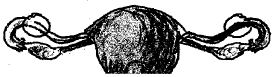
What does the given figure represent?
A
Ovarian cancer
B
Uterine cancer
C
Tubectomy
D
Vasectomy
Solution
(C) The provided figure shows the female reproductive system where the fallopian tubes (oviducts) have been cut and tied. This surgical procedure is known as tubectomy,which is a permanent method of contraception in females. In this method,a small part of the fallopian tube is removed or tied up to block the transport of the ovum,thereby preventing fertilization.
0 likes
View Solution61
MediumMCQ
Which of the following is a legal method for birth control?
A
Abortion by taking appropriate medication.
B
Abstaining from coitus from day $10-17$ of the menstrual cycle.
C
Having intercourse by keeping a gap of days.
D
Withdrawal of the penis from the vagina before ejaculation.
Solution
(B) The method described in option $B$ is known as 'Periodic Abstinence' or the 'Rhythm Method'.
In this method,couples avoid or abstain from coitus from day $10$ to $17$ of the menstrual cycle when ovulation could be expected.
As ovulation occurs on about the $14$th day,the chances of fertilization are very high during this period,which is called the 'fertile period'.
Therefore,abstaining from coitus during this time is a natural and effective method to prevent conception.
In this method,couples avoid or abstain from coitus from day $10$ to $17$ of the menstrual cycle when ovulation could be expected.
As ovulation occurs on about the $14$th day,the chances of fertilization are very high during this period,which is called the 'fertile period'.
Therefore,abstaining from coitus during this time is a natural and effective method to prevent conception.
0 likes
View Solution62
EasyMCQ
Which of the following is a hormone-releasing intrauterine device $(IUD)$?
A
Multiload $375$
B
$LNG-20$
C
Cervical cap
D
Vault
Solution
(B) Intrauterine devices (IUDs) are classified into three types:
$1$. Non-medicated IUDs (e.g.,Lippes loop).
$2$. Copper-releasing IUDs (e.g.,$CuT$,$Cu7$,Multiload $375$).
$3$. Hormone-releasing IUDs (e.g.,Progestasert,$LNG-20$).
Therefore,$LNG-20$ is a hormone-releasing $IUD$ that makes the uterus unsuitable for implantation and the cervix hostile to the sperms.
$1$. Non-medicated IUDs (e.g.,Lippes loop).
$2$. Copper-releasing IUDs (e.g.,$CuT$,$Cu7$,Multiload $375$).
$3$. Hormone-releasing IUDs (e.g.,Progestasert,$LNG-20$).
Therefore,$LNG-20$ is a hormone-releasing $IUD$ that makes the uterus unsuitable for implantation and the cervix hostile to the sperms.
0 likes
View Solution63
EasyMCQ
Tubectomy is a sterilization method in which:
A
$A$ small part of the fallopian tube is removed or tied up.
B
Ovaries are removed surgically.
C
$A$ small part of the vas deferens is removed or tied up.
D
The uterus is removed surgically.
Solution
(A) Tubectomy is a surgical sterilization procedure performed in females.
In this method,a small part of the fallopian tubes is either removed or tied up (ligated) to prevent the fertilization of the ovum by the sperm.
This prevents the egg from reaching the uterus,thereby acting as a permanent method of contraception.
In contrast,vasectomy is the sterilization method for males,where a small part of the vas deferens is removed or tied up.
In this method,a small part of the fallopian tubes is either removed or tied up (ligated) to prevent the fertilization of the ovum by the sperm.
This prevents the egg from reaching the uterus,thereby acting as a permanent method of contraception.
In contrast,vasectomy is the sterilization method for males,where a small part of the vas deferens is removed or tied up.
0 likes
View Solution64
MediumMCQ
Which of the following is incorrect regarding vasectomy?
A
Semen does not contain sperms.
B
Epididymis does not contain sperms.
C
The vas deferens is cut and tied.
D
It is an irreversible sterilization procedure.
Solution
(B) Vasectomy is a surgical method of contraception in males. In this procedure,a small part of the vas deferens is removed or tied up through a small incision on the scrotum. This prevents the transport of sperms from the testes to the urethra. Consequently,the semen produced does not contain sperms. However,the epididymis,which is located before the site of the cut,still contains sperms. Therefore,option $B$ is incorrect because the epididymis continues to store sperms even after the procedure. While vasectomy is intended to be permanent,it is technically reversible in many cases,making the statement that it is 'irreversible' (option $D$) also technically incorrect in a clinical context,but in the context of standard textbook MCQs,the presence of sperms in the epididymis is the primary physiological fact to identify.
0 likes
View Solution65
MediumMCQ
Which of the following methods does not function as a contraceptive?
A
Intrauterine devices (IUDs) - Increase phagocytosis of sperms, suppress sperm motility, and reduce the fertilizing capacity of sperms.
B
Hormonal contraceptives - Prevent or retard entry of sperms, prevent ovulation, and fertilization.
C
Vasectomy - Inhibits spermatogenesis.
D
Barrier methods - Prevent physical meeting of sperm and ovum.
Solution
(C) The correct answer is $C$. Vasectomy is a surgical sterilization method (permanent contraception) that works by blocking the transport of sperms (vas deferens is cut and tied). It does not inhibit spermatogenesis (the production of sperms in the testes). Sperms are still produced but cannot reach the urethra to be ejaculated. Other options are correct: $A$ (IUDs) increase phagocytosis and reduce motility, $B$ (Hormonal pills) prevent ovulation and alter cervical mucus, and $D$ (Barrier methods) physically prevent the meeting of gametes.
0 likes
View Solution66
MediumMCQ
What is the function of copper ions in copper-releasing $IUDs$?
A
They suppress sperm motility and the fertilizing capacity of sperms.
B
They inhibit gametogenesis.
C
They make the uterus unsuitable for implantation.
D
They inhibit ovulation.
Solution
(A) Copper-releasing $IUDs$ (e.g.,$CuT$,$Cu7$,$Multiload$ $375$) release copper ions $(Cu^{2+})$ into the uterus.
These copper ions suppress the motility of sperms and reduce their fertilizing capacity.
Additionally,they increase phagocytosis of sperms within the uterus,thereby acting as an effective contraceptive method.
These copper ions suppress the motility of sperms and reduce their fertilizing capacity.
Additionally,they increase phagocytosis of sperms within the uterus,thereby acting as an effective contraceptive method.
0 likes
View Solution67
EasyMCQ
The contraceptive $SAHELI$:
A
is a post-coital contraceptive.
B
increases the concentration of estrogen and prevents ovulation in females.
C
is an $IUD$.
D
blocks estrogen receptors in the uterus,preventing eggs from getting implanted.
Solution
(D) $SAHELI$ is a non-steroidal oral contraceptive pill developed by the $CDRI$ (Central Drug Research Institute) in Lucknow,India.
It contains a compound called $Centchroman$.
Unlike hormonal pills that prevent ovulation,$SAHELI$ works by blocking estrogen receptors in the uterus.
By blocking these receptors,it prevents the implantation of the fertilized egg (blastocyst) in the uterine wall,thereby acting as an effective contraceptive.
It is taken once a week,making it a popular choice for birth control.
It contains a compound called $Centchroman$.
Unlike hormonal pills that prevent ovulation,$SAHELI$ works by blocking estrogen receptors in the uterus.
By blocking these receptors,it prevents the implantation of the fertilized egg (blastocyst) in the uterine wall,thereby acting as an effective contraceptive.
It is taken once a week,making it a popular choice for birth control.
0 likes
View Solution68
MediumMCQ
Select the hormone-releasing Intra-Uterine Devices (IUDs).
A
Vaults,$LNG-20$
B
Multiload $375$,Progestasert
C
Progestasert,$LNG-20$
D
Lippes Loop,Multiload $375$
Solution
(C) Intra-Uterine Devices (IUDs) are effective contraceptive methods.
They are categorized into three types:
$1$. Non-medicated IUDs: e.g.,Lippes Loop.
$2$. Copper-releasing IUDs: e.g.,Copper $T$ $(CuT)$,Copper $7$ $(Cu7)$,Multiload $375$.
$3$. Hormone-releasing IUDs: These release hormones that make the uterus unsuitable for implantation and the cervix hostile to the sperms. Examples include Progestasert and $LNG-20$.
Therefore,the correct option is $C$.
They are categorized into three types:
$1$. Non-medicated IUDs: e.g.,Lippes Loop.
$2$. Copper-releasing IUDs: e.g.,Copper $T$ $(CuT)$,Copper $7$ $(Cu7)$,Multiload $375$.
$3$. Hormone-releasing IUDs: These release hormones that make the uterus unsuitable for implantation and the cervix hostile to the sperms. Examples include Progestasert and $LNG-20$.
Therefore,the correct option is $C$.
0 likes
View Solution69
EasyMCQ
Which of the following contraceptive methods involves a role of hormones?
A
Lactational amenorrhea,Pills,Emergency contraceptives
B
Barrier method,Lactational amenorrhea,Pills
C
CuT,Pills,Emergency contraceptives
D
Pills,Emergency contraceptives,Barrier methods
Solution
(A) $1$. Lactational amenorrhea is a natural method based on the fact that ovulation does not occur during the period of intense lactation following parturition. This is regulated by high levels of prolactin,which inhibits $GnRH$ secretion,thus preventing ovulation. This is a hormonal-based physiological state.
$2$. Pills (Oral contraceptives) contain either progestogens or a combination of progestogen and estrogen,which inhibit ovulation and implantation.
$3$. Emergency contraceptives (e.g.,morning-after pills) contain high doses of progestogens or progestogen-estrogen combinations to prevent or delay ovulation.
$4$. Barrier methods (e.g.,condoms,diaphragms) are physical devices that prevent the meeting of sperm and ovum; they do not involve hormones.
$5$. $CuT$ (Copper-$T$) is an Intrauterine Device $(IUD)$ that releases copper ions to suppress sperm motility and fertilizing capacity; it does not involve hormones.
Therefore,Lactational amenorrhea,Pills,and Emergency contraceptives all involve a role of hormones.
$2$. Pills (Oral contraceptives) contain either progestogens or a combination of progestogen and estrogen,which inhibit ovulation and implantation.
$3$. Emergency contraceptives (e.g.,morning-after pills) contain high doses of progestogens or progestogen-estrogen combinations to prevent or delay ovulation.
$4$. Barrier methods (e.g.,condoms,diaphragms) are physical devices that prevent the meeting of sperm and ovum; they do not involve hormones.
$5$. $CuT$ (Copper-$T$) is an Intrauterine Device $(IUD)$ that releases copper ions to suppress sperm motility and fertilizing capacity; it does not involve hormones.
Therefore,Lactational amenorrhea,Pills,and Emergency contraceptives all involve a role of hormones.
0 likes
View Solution70
MediumMCQ
What is the function of Copper-$T$?
A
Checks mutation
B
Stops fertilization
C
Stops zygote formation
D
Stops obliteration of blastocoel
Solution
(B) Copper-$T$ is a copper-releasing intra-uterine device $(IUD)$. It increases the phagocytosis of sperms within the uterus,suppresses sperm motility,and reduces the fertilizing capacity of sperms,thereby preventing fertilization.
0 likes
View Solution71
MediumMCQ
Progestasert and $LNG-20$ are
A
Implants
B
Copper releasing $IUDs$
C
Non-medicated $IUDs$
D
Hormone releasing $IUDs$
Solution
(D) Progestasert and $LNG-20$ are examples of hormone-releasing $IUDs$ (Intrauterine Devices).
These devices work by increasing the phagocytosis of sperm within the uterus and by altering the uterine environment to make it unsuitable for implantation.
Additionally,they make the cervix hostile to sperm,thereby preventing fertilization.
Therefore,the correct option is $D$.
These devices work by increasing the phagocytosis of sperm within the uterus and by altering the uterine environment to make it unsuitable for implantation.
Additionally,they make the cervix hostile to sperm,thereby preventing fertilization.
Therefore,the correct option is $D$.
0 likes
View Solution72
EasyMCQ
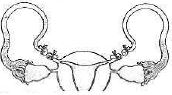
What is the figure given below showing in particular?
A
Ovarian cancer
B
Uterine cancer
C
Tubectomy
D
Vasectomy
Solution
(C) The figure shows a tubectomy. This is a surgical method of contraception used in females. In this procedure,a small part of the fallopian tube is removed or tied through a small incision in the abdomen or through the vagina. It is a highly effective method of birth control,but its reversibility is very poor.
0 likes
View Solution73
MediumMCQ
Match Column $-I$ with Column $-II$.
| Column $-I$ (Method) | Column $-II$ (Mode of Action) |
| $A$. The pill | $I$. Prevents sperms reaching cervix |
| $B$. Condom | $II$. Prevents implantation |
| $C$. Vasectomy | $III$. Prevents ovulation |
| $D$. Copper $T$ | $IV$. Semen contains no sperms |
A
$A-III, B-I, C-IV, D-II$
B
$A-IV, B-I, C-II, D-III$
C
$A-III, B-IV, C-I, D-II$
D
$A-II, B-III, C-I, D-IV$
Solution
$(A)$. The pill: Prevents ovulation. Oral contraceptive pills contain hormones that inhibit the release of the egg from the ovary.
$B$. Condom: Prevents sperm from reaching the cervix. It acts as a physical barrier.
$C$. Vasectomy: Semen contains no sperms. It is a surgical sterilization method in males where the vas deferens is cut or tied.
$D$. Copper $T$: Prevents implantation. It is an Intrauterine Device $(IUD)$ that releases copper ions, which suppress sperm motility and fertilization capacity, and also prevent implantation of the embryo.
$B$. Condom: Prevents sperm from reaching the cervix. It acts as a physical barrier.
$C$. Vasectomy: Semen contains no sperms. It is a surgical sterilization method in males where the vas deferens is cut or tied.
$D$. Copper $T$: Prevents implantation. It is an Intrauterine Device $(IUD)$ that releases copper ions, which suppress sperm motility and fertilization capacity, and also prevent implantation of the embryo.
0 likes
View Solution74
MediumMCQ
Assertion : $Cu-T$ and $Cu-7$ do not suppress sperm motility.
Reason : Hormones released by them affect sperm motility.
Reason : Hormones released by them affect sperm motility.
A
If both Assertion and Reason are correct and the Reason is a correct explanation of the Assertion.
B
If both Assertion and Reason are correct but Reason is not a correct explanation of the Assertion.
C
If both the Assertion and Reason are incorrect.
D
If the Assertion is correct but Reason is incorrect.
Solution
(C) $Cu-T$ and $Cu-7$ are copper-releasing intrauterine devices $(IUDs)$.
They do not suppress sperm motility; instead,they release copper ions $(Cu^{2+})$ which suppress sperm motility and fertilizing capacity of sperms.
However,the assertion states they do not suppress sperm motility,which is scientifically incorrect because copper ions are known to reduce sperm motility.
Furthermore,the reason is incorrect because these devices do not release any hormones.
Therefore,both the Assertion and the Reason are incorrect.
They do not suppress sperm motility; instead,they release copper ions $(Cu^{2+})$ which suppress sperm motility and fertilizing capacity of sperms.
However,the assertion states they do not suppress sperm motility,which is scientifically incorrect because copper ions are known to reduce sperm motility.
Furthermore,the reason is incorrect because these devices do not release any hormones.
Therefore,both the Assertion and the Reason are incorrect.
0 likes
View Solution75
MediumMCQ
Assertion: $HIV$ infection can be avoided by the use of condoms.
Reason: Condoms secrete anti-viral interferons.
Reason: Condoms secrete anti-viral interferons.
A
If both Assertion and Reason are correct and the Reason is a correct explanation of the Assertion.
B
If both Assertion and Reason are correct but Reason is not a correct explanation of the Assertion.
C
If the Assertion is correct but Reason is incorrect.
D
If both the Assertion and Reason are incorrect.
Solution
(C) The Assertion is correct because condoms act as a physical barrier that prevents the exchange of body fluids,thereby reducing the risk of $HIV$ transmission.
The Reason is incorrect because condoms are made of latex or polyurethane and do not secrete any biological substances like anti-viral interferons. They function solely as a mechanical barrier.
The Reason is incorrect because condoms are made of latex or polyurethane and do not secrete any biological substances like anti-viral interferons. They function solely as a mechanical barrier.
0 likes
View Solution76
EasyMCQ
Assertion : Copper $-T$ is an effective contraceptive device in human females.
Reason : Copper $-T$ prevents passage of sperms from vagina upwards into fallopian tubes.
Reason : Copper $-T$ prevents passage of sperms from vagina upwards into fallopian tubes.
A
If both Assertion and Reason are correct and the Reason is a correct explanation of the Assertion.
B
If both Assertion and Reason are correct but Reason is not a correct explanation of the Assertion.
C
If the Assertion is correct but Reason is incorrect.
D
If both the Assertion and Reason are incorrect.
Solution
(C) Copper $-T$ is an Intra-Uterine Device $(IUD)$ that is highly effective in preventing pregnancy.
It works by releasing copper ions $(Cu^{2+})$ which suppress sperm motility and the fertilizing capacity of sperms.
It does not prevent the passage of sperms from the vagina to the fallopian tubes; rather,it acts within the uterus to prevent fertilization and implantation.
Therefore,the Assertion is correct,but the Reason is incorrect.
It works by releasing copper ions $(Cu^{2+})$ which suppress sperm motility and the fertilizing capacity of sperms.
It does not prevent the passage of sperms from the vagina to the fallopian tubes; rather,it acts within the uterus to prevent fertilization and implantation.
Therefore,the Assertion is correct,but the Reason is incorrect.
0 likes
View Solution77
EasyMCQ
Which of the following is a correct statement?
A
IUDs once inserted need not be replaced.
B
IUDs are generally inserted by the user herself.
C
IUDs increase phagocytosis of sperms in the uterus.
D
IUDs suppress gametogenesis.
Solution
(C) Intrauterine devices $(IUDs)$ are effective contraceptive methods.
$IUDs$ are inserted by doctors or expert nurses in the uterus through the vagina.
They are not self-inserted by the user.
$IUDs$ increase phagocytosis of sperms within the uterus,which is their primary mode of action,especially for copper-releasing $IUDs$.
They do not suppress gametogenesis; instead,they act by preventing fertilization or implantation.
Therefore,the correct statement is that $IUDs$ increase phagocytosis of sperms in the uterus.
$IUDs$ are inserted by doctors or expert nurses in the uterus through the vagina.
They are not self-inserted by the user.
$IUDs$ increase phagocytosis of sperms within the uterus,which is their primary mode of action,especially for copper-releasing $IUDs$.
They do not suppress gametogenesis; instead,they act by preventing fertilization or implantation.
Therefore,the correct statement is that $IUDs$ increase phagocytosis of sperms in the uterus.
0 likes
View Solution78
Easy
Is the use of contraceptives justified? Give reasons.
Solution
(N/A) Yes,the use of contraceptives is absolutely justified.
$1$. The human population is increasing at an alarming rate,leading to resource depletion and environmental stress.
$2$. Contraceptives help in regulating reproduction,which is a necessary demand in the present times to control population growth.
$3$. They are effective in preventing unwanted pregnancies,thereby reducing the birth rate.
$4$. By controlling the birth rate,contraceptives play a crucial role in checking population explosion and ensuring a better quality of life for the existing population.
$1$. The human population is increasing at an alarming rate,leading to resource depletion and environmental stress.
$2$. Contraceptives help in regulating reproduction,which is a necessary demand in the present times to control population growth.
$3$. They are effective in preventing unwanted pregnancies,thereby reducing the birth rate.
$4$. By controlling the birth rate,contraceptives play a crucial role in checking population explosion and ensuring a better quality of life for the existing population.
0 likes
View Solution79
MediumMCQ
Removal of gonads cannot be considered as a contraceptive option. Why?
A
It causes permanent infertility.
B
It leads to hormonal imbalance.
C
It is a surgical procedure.
D
All of the above.
Solution
(D) Contraceptive methods are designed to prevent unwanted pregnancy and the spread of $STDs$ without permanently damaging the body's physiological functions.
Methods such as natural,barrier,oral,and surgical (like vasectomy or tubectomy) are used to prevent fertilization.
However,the complete removal of gonads (gonadectomy) is not considered a contraceptive option because it leads to permanent infertility and the loss of essential sex hormones (like testosterone or estrogen).
These hormones are crucial for the normal functioning of accessory reproductive organs and overall health.
Therefore,contraceptive methods should aim to prevent fertilization rather than causing permanent physiological damage or hormonal deficiency.
Methods such as natural,barrier,oral,and surgical (like vasectomy or tubectomy) are used to prevent fertilization.
However,the complete removal of gonads (gonadectomy) is not considered a contraceptive option because it leads to permanent infertility and the loss of essential sex hormones (like testosterone or estrogen).
These hormones are crucial for the normal functioning of accessory reproductive organs and overall health.
Therefore,contraceptive methods should aim to prevent fertilization rather than causing permanent physiological damage or hormonal deficiency.
0 likes
View Solution80
Medium
Give information about natural methods useful as contraceptives.
Solution
(N/A) Natural methods work on the principle of avoiding the chances of ovum and sperm meeting,which are as follows:
$(i)$ Periodic abstinence: In this method,couples avoid or abstain from coitus from day $10$ to $17$ of the menstrual cycle,when ovulation is expected. Since the chances of fertilization are very high during this period,it is called the fertile period. Therefore,abstaining from coitus during this period can prevent conception.
$(ii)$ Coitus interruptus: In this method,the male partner withdraws his penis from the vagina just before ejaculation to avoid insemination.
$(iii)$ Lactational amenorrhea: This method is based on the fact that ovulation and the menstrual cycle do not occur during the period of intense lactation following parturition. Therefore,as long as the mother breastfeeds the child fully,the chances of conception are almost nil. This method is effective only up to a maximum period of six months following parturition.
Since no medicines or devices are used in these methods,side effects are almost nil. However,the chances of failure for these methods are high.
$(i)$ Periodic abstinence: In this method,couples avoid or abstain from coitus from day $10$ to $17$ of the menstrual cycle,when ovulation is expected. Since the chances of fertilization are very high during this period,it is called the fertile period. Therefore,abstaining from coitus during this period can prevent conception.
$(ii)$ Coitus interruptus: In this method,the male partner withdraws his penis from the vagina just before ejaculation to avoid insemination.
$(iii)$ Lactational amenorrhea: This method is based on the fact that ovulation and the menstrual cycle do not occur during the period of intense lactation following parturition. Therefore,as long as the mother breastfeeds the child fully,the chances of conception are almost nil. This method is effective only up to a maximum period of six months following parturition.
Since no medicines or devices are used in these methods,side effects are almost nil. However,the chances of failure for these methods are high.
0 likes
View Solution81
Medium
Describe the usage of Nirodh/condom as a contraceptive method of family planning.
Solution
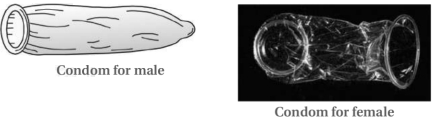
(N/A) Condoms are a type of barrier method used for contraception. They are available for both males and females.
$(i)$ Mechanism: In this method,the ovum and sperms are prevented from physically meeting with the help of barriers.
(ii) Physical Method: Condoms are barriers made of thin rubber or latex sheaths. Male condoms are used to cover the penis,while female condoms are used to cover the vagina and cervix just before coitus,so that the ejaculated semen does not enter the female reproductive tract. This prevents conception.
(iii) Advantages: Nirodh is a popular brand of male condom. The use of condoms has increased in recent years due to their additional benefit of protecting the user from contracting Sexually Transmitted Infections $(STIs)$ and $AIDS$. They can be self-inserted,providing privacy to the user.
(iv) Other Barriers: Diaphragms,cervical caps,and vaults are also rubber barriers inserted into the female reproductive tract to cover the cervix during coitus. They prevent conception by blocking the entry of sperms through the cervix and are reusable.
$(v)$ Chemical Method: Spermicidal creams,jellies,and foams are often used along with these barriers to increase their contraceptive efficiency.
$(i)$ Mechanism: In this method,the ovum and sperms are prevented from physically meeting with the help of barriers.
(ii) Physical Method: Condoms are barriers made of thin rubber or latex sheaths. Male condoms are used to cover the penis,while female condoms are used to cover the vagina and cervix just before coitus,so that the ejaculated semen does not enter the female reproductive tract. This prevents conception.
(iii) Advantages: Nirodh is a popular brand of male condom. The use of condoms has increased in recent years due to their additional benefit of protecting the user from contracting Sexually Transmitted Infections $(STIs)$ and $AIDS$. They can be self-inserted,providing privacy to the user.
(iv) Other Barriers: Diaphragms,cervical caps,and vaults are also rubber barriers inserted into the female reproductive tract to cover the cervix during coitus. They prevent conception by blocking the entry of sperms through the cervix and are reusable.
$(v)$ Chemical Method: Spermicidal creams,jellies,and foams are often used along with these barriers to increase their contraceptive efficiency.
0 likes
View Solution82
Easy
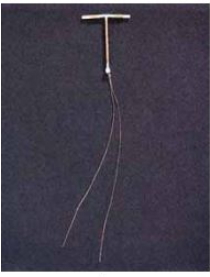
What are $\rm {IUDs}$? Give their types and effects.
Solution
(N/A) The devices inserted by doctors or expert nurses in the uterus through the vagina are called Intra Uterine Devices $(IUDs)$.
$IUDs$ are of three main types:
$(a)$ Non-medicated $IUDs$: e.g.,Lippes loop.
$(b)$ Copper-releasing $IUDs$: e.g.,$CuT$,$Cu7$,Multiload $375$.
$(c)$ Hormone-releasing $IUDs$: e.g.,Progestasert,$LNG-20$.
Effects of $IUDs$:
$1$. $IUDs$ increase phagocytosis of sperms within the uterus.
$2$. The $Cu$ ions released by copper-releasing $IUDs$ suppress sperm motility and the fertilizing capacity of sperms.
$3$. The hormone-releasing $IUDs$ make the uterus unsuitable for implantation and the cervix hostile to sperms.
$IUDs$ are ideal contraceptives for females who want to delay pregnancy and/or space children.
$IUDs$ are of three main types:
$(a)$ Non-medicated $IUDs$: e.g.,Lippes loop.
$(b)$ Copper-releasing $IUDs$: e.g.,$CuT$,$Cu7$,Multiload $375$.
$(c)$ Hormone-releasing $IUDs$: e.g.,Progestasert,$LNG-20$.
Effects of $IUDs$:
$1$. $IUDs$ increase phagocytosis of sperms within the uterus.
$2$. The $Cu$ ions released by copper-releasing $IUDs$ suppress sperm motility and the fertilizing capacity of sperms.
$3$. The hormone-releasing $IUDs$ make the uterus unsuitable for implantation and the cervix hostile to sperms.
$IUDs$ are ideal contraceptives for females who want to delay pregnancy and/or space children.
0 likes
View Solution83
Medium
Describe the sterilization method with a diagram.
Solution
(N/A) Surgical methods,also known as sterilization,are advised for male or female partners as a terminal method to prevent any further pregnancies.
Surgical intervention blocks gamete transport and thereby prevents conception.
$(a)$ Vasectomy: The sterilization procedure in males is called vasectomy. In this procedure,a small part of the vas deferens is removed or tied up through a small incision on the scrotum.
$(b)$ Tubectomy: In tubectomy,a small part of the fallopian tube is removed or tied up through a small incision in the abdomen or through the vagina.
These techniques are highly effective,but their reversibility is very poor.
Surgical intervention blocks gamete transport and thereby prevents conception.
$(a)$ Vasectomy: The sterilization procedure in males is called vasectomy. In this procedure,a small part of the vas deferens is removed or tied up through a small incision on the scrotum.
$(b)$ Tubectomy: In tubectomy,a small part of the fallopian tube is removed or tied up through a small incision in the abdomen or through the vagina.
These techniques are highly effective,but their reversibility is very poor.
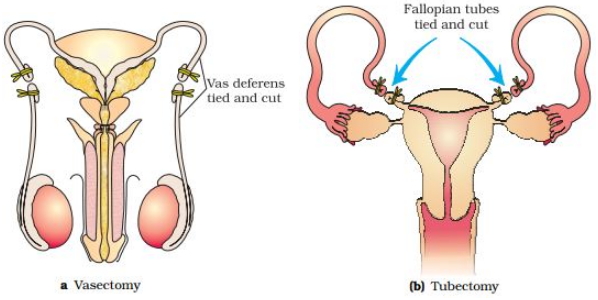
0 likes
View Solution84
Medium
Differentiate between the physical barrier method and the chemical barrier method of contraception.
Solution
(N/A)
| Physical barrier method | Chemical barrier method |
|---|---|
| $(1)$ These methods are used to cover the penis in males or the vagina/cervix in females just before coitus to prevent sperm from entering the female reproductive tract. | $(1)$ These involve the use of chemical substances like creams,jellies,or foams applied in the vagina before coitus to immobilize or kill sperms. |
| $(2)$ By acting as a physical shield,they prevent the meeting of sperm and ovum,thereby preventing fertilization. | $(2)$ These chemicals act as spermicides,disrupting the metabolic processes or oxygen uptake of sperms,leading to their death and preventing fertilization. |
0 likes
View Solution85
Easy
Give differences: Vasectomy and Tubectomy.
Solution
(N/A)
| Vasectomy | Tubectomy |
|---|---|
| $(1)$ Sterilization procedure in males to prevent pregnancy is called vasectomy. | $(1)$ Sterilization process in females to prevent pregnancy is called tubectomy. |
| $(2)$ In vasectomy, a small part of the vas deferens is removed or tied up through a small incision on the scrotum. | $(2)$ $A$ small part of the fallopian tube is removed or tied up through a small incision in the abdomen or through the vagina. |
| $(3)$ Sperms are not transported. | $(3)$ Ovum are not transported. |
0 likes
View Solution86
Easy
Differentiate between the natural method of family planning and the artificial method of family planning.
Solution
(N/A)
| Natural method of family planning | Artificial method of family planning |
|---|---|
| $1$. Based on the principle of avoiding the meeting of ovum and sperm. | $1$. Based on preventing the meeting of gametes using barriers or inhibiting gamete production. |
| $2$. Includes periodic abstinence,where couples avoid coitus during the fertile period ($10$ to $17$ days of the menstrual cycle). | $2$. Includes the use of external devices like condoms,diaphragms,or chemical gels. |
| $3$. Relies on behavioral changes such as coitus interruptus (withdrawal method). | $3$. Includes permanent surgical methods like vasectomy in males and tubectomy in females. |
| $4$. Lactational amenorrhea is a natural method where ovulation is absent during intense lactation for up to $6$ months. | $4$. Provides highly effective and reliable clinical remedies for contraception and family planning. |
0 likes
View Solution87
Medium
Give scientific reasons: Pills taken orally prevent pregnancy.
Solution
(N/A) Oral contraceptive pills contain a synthetic combination of progesterone and estrogen hormones.
These pills are typically taken starting from the $5^{th}$ day of the menstrual cycle.
The primary mechanism of action is the inhibition of ovulation by suppressing the release of follicle-stimulating hormone $(FSH)$ and luteinizing hormone $(LH)$ from the pituitary gland.
Additionally,these hormones alter the quality of the cervical mucus,making it thick and viscous,which prevents the entry of sperm into the uterus.
Furthermore,they alter the lining of the endometrium,making it unsuitable for implantation.
By preventing ovulation and blocking sperm entry,these pills effectively obstruct the process of fertilization,thereby preventing pregnancy.
These pills are typically taken starting from the $5^{th}$ day of the menstrual cycle.
The primary mechanism of action is the inhibition of ovulation by suppressing the release of follicle-stimulating hormone $(FSH)$ and luteinizing hormone $(LH)$ from the pituitary gland.
Additionally,these hormones alter the quality of the cervical mucus,making it thick and viscous,which prevents the entry of sperm into the uterus.
Furthermore,they alter the lining of the endometrium,making it unsuitable for implantation.
By preventing ovulation and blocking sperm entry,these pills effectively obstruct the process of fertilization,thereby preventing pregnancy.
0 likes
View Solution88
Medium
Give scientific reasons: Pregnancy can be stopped or prevented without artificial methods of family planning.
Solution
(N/A) Pregnancy can be prevented naturally by avoiding coitus during the fertile period of the menstrual cycle. The days between $10$ and $17$ of the menstrual cycle are considered the fertile period because ovulation typically occurs around the $14$th day. Avoiding sexual intercourse during this window prevents fertilization.
Additionally,Lactational Amenorrhea is a natural method based on the fact that ovulation and the menstrual cycle do not occur during the period of intense lactation following parturition. As long as the mother breastfeeds the infant fully,the chances of conception are negligible.
Additionally,Lactational Amenorrhea is a natural method based on the fact that ovulation and the menstrual cycle do not occur during the period of intense lactation following parturition. As long as the mother breastfeeds the infant fully,the chances of conception are negligible.
0 likes
View Solution89
EasyMCQ
Explain the difference between condoms and diaphragms.
A
Condoms are for males,diaphragms are for females.
B
Condoms cover the penis,diaphragms cover the cervix.
C
Both are barrier methods made of rubber/latex.
D
All of the above.
Solution
(D) Condoms: These are made of thin rubber/latex sheaths used to cover the penis in the male during coitus to prevent the ejaculation of semen into the vagina.
Diaphragms: These are also made of rubber and are inserted into the female reproductive tract to cover the cervix during coitus to prevent the entry of sperms into the uterus.
Diaphragms: These are also made of rubber and are inserted into the female reproductive tract to cover the cervix during coitus to prevent the entry of sperms into the uterus.
0 likes
View Solution90
EasyMCQ
Explain the difference between non-medicated $IUD$ and copper-releasing $IUD$.
A
Non-medicated $IUD$s are inert, while copper-releasing $IUD$s release copper ions.
B
Non-medicated $IUD$s release hormones, while copper-releasing $IUD$s release copper ions.
C
Non-medicated $IUD$s are permanent, while copper-releasing $IUD$s are temporary.
D
There is no difference between them.
Solution
(A) $1$. Non-medicated $IUD$s: These are inert devices (e.g., $Lippes \, loop$) that do not release any chemical substances. They function by increasing phagocytosis of sperms within the uterus.
$2$. Copper-releasing $IUD$s: These devices (e.g., $CuT$, $Cu7$, $Multiload \, 375$) release copper ions $(Cu^{2+})$ into the uterine cavity. These ions suppress sperm motility and the fertilizing capacity of sperms, thereby preventing fertilization.
$2$. Copper-releasing $IUD$s: These devices (e.g., $CuT$, $Cu7$, $Multiload \, 375$) release copper ions $(Cu^{2+})$ into the uterine cavity. These ions suppress sperm motility and the fertilizing capacity of sperms, thereby preventing fertilization.
0 likes
View Solution91
EasyMCQ
Explain the difference between Pills and Saheli.
A
Pills are taken daily,while Saheli is taken once a week.
B
Pills are steroidal,while Saheli is non-steroidal.
C
Pills contain progesterone or progestogen-estrogen combinations,while Saheli contains centchroman.
D
All of the above.
Solution
(D) Pills: These are oral contraceptives containing small doses of either progesterone or progestogen-estrogen combinations. They are typically taken daily for $21$ days,starting within the first $5$ days of the menstrual cycle.
Saheli: This is a non-steroidal oral contraceptive pill developed by $CDRI$,Lucknow. It is taken once a week and has fewer side effects compared to conventional hormonal pills.
Saheli: This is a non-steroidal oral contraceptive pill developed by $CDRI$,Lucknow. It is taken once a week and has fewer side effects compared to conventional hormonal pills.
0 likes
View Solution92
EasyMCQ
Describe the location and function of Diaphragms and Foams in the context of reproductive health.
A
Diaphragms: Used in the uterus; Function: Kills sperms.
B
Diaphragms: Used in the vagina to cover the cervix; Function: Prevents pregnancy by blocking sperm entry. Foams: Used in the vagina; Function: Kills sperms.
C
Diaphragms: Used in the fallopian tube; Function: Prevents fertilization. Foams: Used in the ovary; Function: Prevents ovulation.
D
Diaphragms: Used in the vagina; Function: Increases sperm motility. Foams: Used in the uterus; Function: Increases sperm survival.
Solution
(B) $(1)$ Diaphragms:
Location: These are rubber barriers inserted into the female vagina to cover the cervix during coitus.
Function: They act as physical barriers to prevent the entry of sperms into the uterus,thereby preventing pregnancy.
$(2)$ Foams:
Location: These are chemical spermicidal agents applied within the female vagina.
Function: They attach to sperms,disrupt their metabolic processes (such as $O_{2}$ uptake),and effectively kill the sperm cells.
Location: These are rubber barriers inserted into the female vagina to cover the cervix during coitus.
Function: They act as physical barriers to prevent the entry of sperms into the uterus,thereby preventing pregnancy.
$(2)$ Foams:
Location: These are chemical spermicidal agents applied within the female vagina.
Function: They attach to sperms,disrupt their metabolic processes (such as $O_{2}$ uptake),and effectively kill the sperm cells.
0 likes
View Solution93
EasyMCQ
What is the significance of the progesterone-estrogen combination as a contraceptive measure?
A
It promotes ovulation and implantation.
B
It inhibits ovulation and implantation.
C
It increases the risk of pregnancy.
D
It has no effect on the reproductive cycle.
Solution
(B) Progestogens in combination with estrogen play an important role as contraceptives. These are commonly known as oral contraceptive pills.
$\Rightarrow$ Their primary mechanism of action is to inhibit ovulation and alter the cervical mucus to prevent the entry of sperm,thereby inhibiting implantation.
$\Rightarrow$ These combinations can also be used by females as injections or implants under the skin. Their mode of action is similar to that of pills,but their effective periods are much longer.
$\Rightarrow$ Their primary mechanism of action is to inhibit ovulation and alter the cervical mucus to prevent the entry of sperm,thereby inhibiting implantation.
$\Rightarrow$ These combinations can also be used by females as injections or implants under the skin. Their mode of action is similar to that of pills,but their effective periods are much longer.
0 likes
View Solution94
Medium
Mention two advantages of lactational amenorrhea as a contraceptive method.
Solution
(N/A) The two advantages of lactational amenorrhea are as follows:
$(i)$ As long as the mother breastfeeds the child fully,the chances of conception are almost nil.
$(ii)$ The mother does not need to use any pills,devices,or chemicals for birth control,and its side effects are almost nil.
$(i)$ As long as the mother breastfeeds the child fully,the chances of conception are almost nil.
$(ii)$ The mother does not need to use any pills,devices,or chemicals for birth control,and its side effects are almost nil.
0 likes
View Solution95
Medium
Copper ion-releasing $(IUDs)$ are more efficient than non-medicated methods. Why?
Solution
(N/A) Intra Uterine Devices $(IUDs)$ are effective and popular contraceptive methods inserted by doctors or expert nurses into the uterus through the vagina.
These devices are categorized into three types:
$1$. Non-medicated $IUDs$ (e.g.,Lippes loop).
$2$. Copper-releasing $IUDs$ (e.g.,$CuT, Cu7,$ Multiload $375$).
$3$. Hormone-releasing $IUDs$ (e.g.,Progestasert,$LNG-20$).
All $IUDs$ increase the phagocytosis of sperms within the uterus. However,copper-releasing $IUDs$ are more efficient because the $Cu$ ions released suppress sperm motility and the fertilising capacity of sperms,providing an additional mechanism of action beyond simple phagocytosis.
These devices are categorized into three types:
$1$. Non-medicated $IUDs$ (e.g.,Lippes loop).
$2$. Copper-releasing $IUDs$ (e.g.,$CuT, Cu7,$ Multiload $375$).
$3$. Hormone-releasing $IUDs$ (e.g.,Progestasert,$LNG-20$).
All $IUDs$ increase the phagocytosis of sperms within the uterus. However,copper-releasing $IUDs$ are more efficient because the $Cu$ ions released suppress sperm motility and the fertilising capacity of sperms,providing an additional mechanism of action beyond simple phagocytosis.
0 likes
View Solution96
EasyMCQ
What are the advantages of natural methods of contraception over artificial methods?
A
They are highly effective and reliable.
B
They involve no use of medicines or devices,thus having no side effects.
C
They provide protection against sexually transmitted infections.
D
They are the most recommended methods by medical professionals.
Solution
(B) Natural methods of contraception (such as periodic abstinence,withdrawal,or lactational amenorrhea) do not involve the use of any external medicines,chemicals,or mechanical devices.
Because no foreign substances or physical barriers are introduced into the body,there are no physiological side effects associated with these methods.
However,it is important to note that the failure rate of these natural methods is significantly higher compared to artificial or barrier methods.
Because no foreign substances or physical barriers are introduced into the body,there are no physiological side effects associated with these methods.
However,it is important to note that the failure rate of these natural methods is significantly higher compared to artificial or barrier methods.
0 likes
View Solution97
Medium
Discuss the mode of action and advantages/disadvantages of hormonal contraceptives.
Solution
(D) Hormonal contraceptives function primarily by altering the hormonal balance in the female body to prevent pregnancy.
Mode of Action:
$1$. Hormone-releasing $IUDs$ (e.g.,$Progestasert$,$LNG-20$) make the uterus unsuitable for implantation and the cervix hostile to sperm.
$2$. Progestogens or progestogen-estrogen combinations (as pills,injections,or implants) inhibit ovulation and thicken cervical mucus,preventing sperm entry.
Advantages:
$1$. Highly effective for birth control.
$2$. Emergency contraception: $IUDs$ or hormonal pills used within $72$ hours of unprotected intercourse can prevent pregnancy.
Disadvantages:
$1$. Side effects: May cause nausea,mood swings,or weight gain.
$2$. Tissue damage: Improper insertion of $IUDs$ can cause uterine perforation or bleeding.
$3$. Hormonal imbalance: Long-term use may disrupt the natural endocrine cycle,potentially leading to temporary infertility or menstrual irregularities.
$4$. Allergic reactions: Some individuals may experience sensitivity to the materials or hormones used.
Mode of Action:
$1$. Hormone-releasing $IUDs$ (e.g.,$Progestasert$,$LNG-20$) make the uterus unsuitable for implantation and the cervix hostile to sperm.
$2$. Progestogens or progestogen-estrogen combinations (as pills,injections,or implants) inhibit ovulation and thicken cervical mucus,preventing sperm entry.
Advantages:
$1$. Highly effective for birth control.
$2$. Emergency contraception: $IUDs$ or hormonal pills used within $72$ hours of unprotected intercourse can prevent pregnancy.
Disadvantages:
$1$. Side effects: May cause nausea,mood swings,or weight gain.
$2$. Tissue damage: Improper insertion of $IUDs$ can cause uterine perforation or bleeding.
$3$. Hormonal imbalance: Long-term use may disrupt the natural endocrine cycle,potentially leading to temporary infertility or menstrual irregularities.
$4$. Allergic reactions: Some individuals may experience sensitivity to the materials or hormones used.
0 likes
View SolutionReproductive Health — Method of birth control · Frequently Asked Questions
1Are these Reproductive Health questions useful for JEE and NEET?
Yes. All questions in this section are mapped to JEE Main and NEET exam patterns. Previous year questions from JEE Main, NEET, GUJCET and state-level exams are included with full solutions.
2Can I switch to Hindi or Gujarati for these questions?
Yes. Use the language tabs in the hero section or the sidebar to view the same questions and solutions in English, Hindi or Gujarati.
3How do I generate a question paper from this subtopic?
Use the Vedclass Exam Paper Generator — select the chapter and subtopic, set difficulty, and generate Sets A, B, C, D automatically. First 3 chapters of every subject are free.
Vedclass Products
For Students
Vedclass Test Series
Mock tests in real JEE/NEET style with performance analysis. 5-day free trial.
Start Free TrialFor Teachers
Exam Paper Generator
Generate Set A/B/C/D papers from this chapter in 2 minutes. 3 chapters free.
Try FreeFor Institutes
Online Exam Module
Live online exams with unlimited students, 360° analytics & white-label branding.
See DemoFor Teachers & Institutes
Generate a Reproductive Health Exam Paper in 2 Minutes
Select subtopic & difficulty — Sets A, B, C, D auto-generated with No Repeat logic.
First 3 chapters of every subject are free — no payment required.