
A English
Method of birth control Questions in English
Class 12 Biology · Reproductive Health · Method of birth control
340+
Questions
English
Language
100%
With Solutions
Showing 49 of 340 questions in English
1
MediumMCQ
Most of the contraceptive pills contain
A
Estrogen + $FSH$
B
Progesterone + $LH$
C
$FSH$ + $LH$
D
Estrogen + progesterone
Solution
(D) Most contraceptive pills for women contain synthetic forms of the female sex hormones,estrogen and progesterone.
These hormones work primarily by inhibiting the secretion of $FSH$ and $LH$ from the pituitary gland,which prevents the development of follicles and ovulation.
Additionally,these hormones alter the cervical mucus,making it thick and hostile to sperm,thereby preventing fertilization.
These hormones work primarily by inhibiting the secretion of $FSH$ and $LH$ from the pituitary gland,which prevents the development of follicles and ovulation.
Additionally,these hormones alter the cervical mucus,making it thick and hostile to sperm,thereby preventing fertilization.
0 likes
View Solution2
EasyMCQ
In females,the oviducts are surgically cut or tied to prevent fertilization. This procedure is called:
A
Vasectomy
B
Ovariodectomy
C
Sterilization
D
Tubectomy $(Salpingectomy)$
Solution
(D) Tubectomy,also known as $Salpingectomy$,is a permanent surgical method of contraception in females.
In this procedure,a small part of the fallopian tubes (oviducts) is either removed or tied up to block the passage of the ovum,thereby preventing fertilization.
Vasectomy is the corresponding surgical procedure in males.
Ovariodectomy refers to the surgical removal of ovaries,which is not a standard contraceptive method.
Sterilization is a general term for any procedure that makes an individual infertile,but $Tubectomy$ is the specific term for the procedure described.
In this procedure,a small part of the fallopian tubes (oviducts) is either removed or tied up to block the passage of the ovum,thereby preventing fertilization.
Vasectomy is the corresponding surgical procedure in males.
Ovariodectomy refers to the surgical removal of ovaries,which is not a standard contraceptive method.
Sterilization is a general term for any procedure that makes an individual infertile,but $Tubectomy$ is the specific term for the procedure described.
0 likes
View Solution3
MediumMCQ
The action of jellies and creams used as contraceptives is:
A
Spermicidal and immobilizing the sperms
B
Entangling the sperms
C
Preventing the ova from being released
D
Enabling the sperms to reach the ovum speedily
Solution
(A) Jellies,creams,and foams are chemical barriers used for contraception. These substances contain spermicidal agents (such as nonoxynol-$9$) that kill the sperms upon contact. Additionally,their viscous consistency acts as a physical barrier that immobilizes the sperms,thereby preventing them from reaching the ovum for fertilization.
0 likes
View Solution4
MediumMCQ
The action of contraceptives is to:
A
Prevent ovulation only
B
Prevent ovulation and fertilization only
C
Prevent ovulation,fertilization,and implantation
D
Prevent the rapid passage of eggs in the oviduct
Solution
(C) Contraceptive methods are designed to prevent unwanted pregnancies by interfering with the reproductive process at various stages.
$1$. Some methods (like oral contraceptive pills) prevent ovulation by inhibiting the release of the egg from the ovary.
$2$. Barrier methods (like condoms) and surgical methods prevent fertilization by blocking the meeting of sperm and egg.
$3$. Intrauterine devices (IUDs) and certain hormonal methods can prevent implantation of the embryo in the uterus.
Therefore,contraceptives can act by preventing ovulation,fertilization,and implantation.
$1$. Some methods (like oral contraceptive pills) prevent ovulation by inhibiting the release of the egg from the ovary.
$2$. Barrier methods (like condoms) and surgical methods prevent fertilization by blocking the meeting of sperm and egg.
$3$. Intrauterine devices (IUDs) and certain hormonal methods can prevent implantation of the embryo in the uterus.
Therefore,contraceptives can act by preventing ovulation,fertilization,and implantation.
0 likes
View Solution5
MediumMCQ
The action of a vaginal diaphragm is
A
To prevent the ova from entering the uterus
B
To prevent the sperm from coming in contact with the ova
C
Spermicidal
D
Anti-implantational
Solution
(B) vaginal diaphragm is a dome-shaped rubber or silicone barrier device that is inserted into the female vagina to cover the cervix.
Its primary function is to act as a physical barrier that prevents sperm from entering the uterus,thereby preventing the sperm from coming into contact with the ova.
Its primary function is to act as a physical barrier that prevents sperm from entering the uterus,thereby preventing the sperm from coming into contact with the ova.
0 likes
View Solution6
MediumMCQ
Surgical removal or cutting and ligation of the ends of the oviduct is known as
A
Tubectomy
B
Oviductomy
C
Vasectomy
D
Ovarioctomy
Solution
(A) Sterilization is a permanent and effective method of birth control.
In females,the surgical procedure involves cutting and ligating the fallopian tubes (oviducts) to prevent the egg from reaching the uterus,which is known as $Tubectomy$.
In males,the surgical procedure involves cutting and ligating the vas deferens to prevent the transport of sperm,which is known as $Vasectomy$.
In females,the surgical procedure involves cutting and ligating the fallopian tubes (oviducts) to prevent the egg from reaching the uterus,which is known as $Tubectomy$.
In males,the surgical procedure involves cutting and ligating the vas deferens to prevent the transport of sperm,which is known as $Vasectomy$.
0 likes
View Solution7
MediumMCQ
Surgical removal of testes is known as
A
Testectomy
B
Gonadectomy
C
Castration
D
None
Solution
(C) The surgical removal of the testes is known as castration.
It is a permanent method of birth control in males,which prevents the production of sperm.
It is a permanent method of birth control in males,which prevents the production of sperm.
0 likes
View Solution8
MediumMCQ
Removal of a segment surgically and ligation of cut ends of vas deferens is known as
A
Tubectomy
B
Vasectomy
C
Gonadectomy
D
Castration
Solution
(B) The surgical procedure that involves the removal of a small segment of the vas deferens and the ligation (tying) of the cut ends is known as $Vasectomy$.
This is a permanent method of contraception in males.
$Tubectomy$ is the corresponding procedure in females,where the fallopian tubes are blocked or cut.
$Gonadectomy$ refers to the removal of gonads (testes or ovaries).
$Castration$ is the removal of the testes.
This is a permanent method of contraception in males.
$Tubectomy$ is the corresponding procedure in females,where the fallopian tubes are blocked or cut.
$Gonadectomy$ refers to the removal of gonads (testes or ovaries).
$Castration$ is the removal of the testes.
0 likes
View Solution9
MediumMCQ
The mechanical measures of population control include:
A
Condom only
B
Diaphragm only
C
$IUD$ only
D
All of the above
Solution
(D) Mechanical methods of birth control are designed to prevent the physical meeting of sperm and ovum. These include:
$1$. Condoms (e.g.,$Nirodh$): These are barrier methods used by males or females.
$2$. Diaphragms and cervical caps: These are barrier devices used by females.
$3$. Intrauterine devices $(IUDs)$: These are devices inserted into the uterus to prevent implantation or fertilization.
Therefore,all the options listed are considered mechanical or barrier methods of population control.
$1$. Condoms (e.g.,$Nirodh$): These are barrier methods used by males or females.
$2$. Diaphragms and cervical caps: These are barrier devices used by females.
$3$. Intrauterine devices $(IUDs)$: These are devices inserted into the uterus to prevent implantation or fertilization.
Therefore,all the options listed are considered mechanical or barrier methods of population control.
0 likes
View Solution10
MediumMCQ
The chemical method of contraception includes:
A
Jellies only
B
Creams and foams only
C
Oral contraceptives only
D
All of the above
Solution
(D) Chemical methods of contraception are used to prevent fertilization by killing or immobilizing sperm.
These methods include:
$1$. Spermicidal agents such as jellies,creams,and foams,which are applied in the vagina to kill sperm.
$2$. Oral contraceptives (pills),which contain hormones that inhibit ovulation or alter the cervical mucus to prevent sperm entry.
Therefore,all the listed options are considered chemical methods of contraception.
These methods include:
$1$. Spermicidal agents such as jellies,creams,and foams,which are applied in the vagina to kill sperm.
$2$. Oral contraceptives (pills),which contain hormones that inhibit ovulation or alter the cervical mucus to prevent sperm entry.
Therefore,all the listed options are considered chemical methods of contraception.
0 likes
View Solution11
MediumMCQ
The trade name of the weekly oral contraceptive pill is:
A
Mala
B
Saheli
C
Mala $A$
D
Mala $D$
Solution
(B) $Saheli$ is a non-steroidal oral contraceptive pill developed by the Central Drug Research Institute $(CDRI)$ in Lucknow,India.
It is taken once a week,making it distinct from other daily oral contraceptive pills like $Mala-D$ or $Mala-N$.
It is taken once a week,making it distinct from other daily oral contraceptive pills like $Mala-D$ or $Mala-N$.
0 likes
View Solution12
MediumMCQ
Which of the following is a daily oral contraceptive pill?
A
Mala $C$
B
Mala $N$ and Mala $D$
C
Mala $A$
D
Mala $D$
Solution
(D) Mala $D$ is a commonly used oral contraceptive pill in India,provided by the government under the National Family Welfare Programme. It is a combined oral contraceptive pill containing synthetic progesterone and estrogen. It is taken daily for $21$ days,starting from the $5$th day of the menstrual cycle,followed by a $7$-day break or the use of iron tablets to maintain the habit.
0 likes
View Solution13
MediumMCQ
Which of the following is a method for birth control?
A
$IUDs$
B
$GIFT$
C
$HTF$
D
$IVF-ET$
Solution
(A) $IUDs$ (Intra Uterine Devices) are effective methods for birth control. They work by increasing phagocytosis of sperms within the uterus,suppressing sperm motility,and reducing the fertilizing capacity of sperms. Copper-releasing $IUDs$ (like $CuT$,$Cu7$,$Multiload$ $375$) suppress sperm motility and the fertilizing capacity of sperms. In contrast,$GIFT$ (Gamete Intra Fallopian Transfer) and $IVF-ET$ (In Vitro Fertilization - Embryo Transfer) are assisted reproductive technologies used for infertility treatment.
0 likes
View Solution14
MediumMCQ
$A$ contraceptive pill contains:
A
Progesterone and estrogen
B
Spermicidal salts
C
Chemicals that cause automatic abortion
D
Chemicals that prevent fertilization of ovum
Solution
(A) Oral contraceptive pills contain either a combination of synthetic progesterone and estrogen or only progesterone.
These hormones work by inhibiting ovulation (the release of an egg from the ovary) and altering the cervical mucus to prevent sperm from reaching the egg.
Therefore,the correct option is $A$.
These hormones work by inhibiting ovulation (the release of an egg from the ovary) and altering the cervical mucus to prevent sperm from reaching the egg.
Therefore,the correct option is $A$.
0 likes
View Solution15
MediumMCQ
Progesterone pills help in preventing pregnancy by not allowing:
A
Ova formation
B
Fertilization
C
Implantation
D
None of these
Solution
(A) Progesterone-only pills (POPs) or combined oral contraceptive pills work primarily by inhibiting ovulation.
By maintaining high levels of progesterone (or synthetic progestin),the pituitary gland is signaled to suppress the release of $FSH$ and $LH$.
Without the $LH$ surge,the mature follicle does not rupture,and the ovum is not released from the ovary.
Therefore,the primary mechanism is the prevention of ova formation (ovulation).
By maintaining high levels of progesterone (or synthetic progestin),the pituitary gland is signaled to suppress the release of $FSH$ and $LH$.
Without the $LH$ surge,the mature follicle does not rupture,and the ovum is not released from the ovary.
Therefore,the primary mechanism is the prevention of ova formation (ovulation).
0 likes
View Solution16
MediumMCQ
The method of sterilization is:
A
Loop
B
$IUD$
C
Diaphragm
D
Tubectomy
Solution
(D) The method of sterilization is tubectomy (female) or vasectomy (male). These are permanent methods of contraception. In contrast,loops,$IUDs$,and diaphragms are temporary methods used to maintain a time gap between two children.
0 likes
View Solution17
EasyMCQ
Surgical removal of the uterus is called:
A
Vasectomy
B
Tubectomy
C
Hysterectomy
D
Anatomy
Solution
(C) The surgical removal of the uterus is known as $Hysterectomy$.
$Vasectomy$ is a surgical procedure for male sterilization involving the cutting or tying of the $vas \ deferens$.
$Tubectomy$ is a surgical procedure for female sterilization involving the cutting or tying of the $fallopian \ tubes$.
$Anatomy$ refers to the study of the internal structure of organisms,not a surgical procedure.
$Vasectomy$ is a surgical procedure for male sterilization involving the cutting or tying of the $vas \ deferens$.
$Tubectomy$ is a surgical procedure for female sterilization involving the cutting or tying of the $fallopian \ tubes$.
$Anatomy$ refers to the study of the internal structure of organisms,not a surgical procedure.
0 likes
View Solution18
MediumMCQ
The most important component of the oral contraceptive pills is
A
Progesterone
B
Growth hormone
C
Thyroxin
D
Luteinizing hormone
Solution
(A) The most important component of oral contraceptive pills is $Progesterone$ or a combination of $Progesterone$ and $Estrogen$.
These hormones work by inhibiting the release of $Gonadotropin-releasing$ $\text{hormone}$ $(GnRH)$ from the hypothalamus, which in turn prevents the secretion of $Follicle-stimulating$ $\text{hormone}$ $(FSH)$ and $Luteinizing$ $\text{hormone}$ $(LH)$ from the anterior pituitary gland.
By suppressing the surge of $LH$, these pills effectively prevent ovulation, thereby preventing pregnancy.
These hormones work by inhibiting the release of $Gonadotropin-releasing$ $\text{hormone}$ $(GnRH)$ from the hypothalamus, which in turn prevents the secretion of $Follicle-stimulating$ $\text{hormone}$ $(FSH)$ and $Luteinizing$ $\text{hormone}$ $(LH)$ from the anterior pituitary gland.
By suppressing the surge of $LH$, these pills effectively prevent ovulation, thereby preventing pregnancy.
0 likes
View Solution19
EasyMCQ
What is the surgical procedure called where the fallopian tubes are cut and the ends are tied?
A
Tubectomy
B
Oviductomy
C
Castration
D
Vasectomy
Solution
(A) The surgical procedure in which a small part of the fallopian tube is removed or tied up is known as $Tubectomy$. This is a permanent method of contraception in females. In this process,the fallopian tubes are blocked to prevent the egg from reaching the uterus,thereby preventing fertilization. $Vasectomy$ is the corresponding surgical procedure in males,where the $vas$ $deferens$ is cut and tied.
0 likes
View Solution20
EasyMCQ
What is the purpose of cutting the vas deferens?
A
Female sterilization
B
Male sterilization
C
Both of the above
D
Temporary sterilization
Solution
(B) The surgical procedure of cutting and tying the vas deferens is known as vasectomy.
This procedure is performed in males to prevent the transport of sperm from the testes to the urethra.
Therefore,it is a method of male sterilization.
This procedure is performed in males to prevent the transport of sperm from the testes to the urethra.
Therefore,it is a method of male sterilization.
0 likes
View Solution21
MediumMCQ
What happens after a vasectomy?
A
Absence of semen
B
Sperm become dead or inactive
C
Sperm are immediately absent from semen
D
Sperm will gradually disappear from semen
Solution
(D) vasectomy is a surgical procedure for male sterilization in which the $vas \ deferens$ are cut and tied or sealed. This prevents sperm from entering the ejaculatory duct. However,it does not stop the production of semen by the accessory glands (seminal vesicles,prostate,and bulbourethral glands). Since there are still sperm stored in the reproductive tract beyond the point of the cut,it takes some time (usually several weeks or a certain number of ejaculations) for the remaining sperm to be cleared out. Therefore,sperm will gradually disappear from the semen.
0 likes
View Solution22
EasyMCQ
What is the purpose of tubectomy?
A
Fertilization
B
Coitus
C
Ovum production
D
Embryo development
Solution
(A) Tubectomy is a surgical sterilization procedure for females.
In this procedure,a small part of the fallopian tubes is removed or tied up to block the passage of the ovum.
By blocking the fallopian tubes,the sperm is prevented from reaching the ovum,thereby preventing fertilization.
Therefore,the primary purpose of tubectomy is to prevent fertilization.
In this procedure,a small part of the fallopian tubes is removed or tied up to block the passage of the ovum.
By blocking the fallopian tubes,the sperm is prevented from reaching the ovum,thereby preventing fertilization.
Therefore,the primary purpose of tubectomy is to prevent fertilization.
0 likes
View Solution23
MediumMCQ
The function of copper ions in copper-releasing $IUDs$ is:
A
they inhibit gametogenesis
B
they make the uterus unsuitable for implantation
C
they inhibit ovulation
D
they suppress sperm motility and the fertilising capacity of sperms
Solution
(D) : Copper-releasing $IUDs$ (e.g.,$CuT$,$Cu7$,$Multiload$ $375$) are placed in the uterus of females.
These devices are highly efficient methods of birth control.
The copper ions $(Cu^{2+})$ released by these devices increase phagocytosis of sperms within the uterus.
Furthermore,these ions suppress the motility of sperms and reduce their fertilising capacity,thereby preventing fertilization.
These devices are highly efficient methods of birth control.
The copper ions $(Cu^{2+})$ released by these devices increase phagocytosis of sperms within the uterus.
Furthermore,these ions suppress the motility of sperms and reduce their fertilising capacity,thereby preventing fertilization.
0 likes
View Solution24
MediumMCQ
Which of the following is a hormone-releasing $IUD$?
A
$LNG-20$
B
Multiload $375$
C
Lippes loop
D
$Cu7$
Solution
(A) $LNG-20$ is a hormone-releasing $IUD$.
Multiload $375$ and $Cu7$ are copper-releasing $IUDs$.
Lippes loop is a non-medicated $IUD$.
Multiload $375$ and $Cu7$ are copper-releasing $IUDs$.
Lippes loop is a non-medicated $IUD$.
0 likes
View Solution25
MediumMCQ
Which of the following is incorrect regarding vasectomy?
A
No sperm occurs in seminal fluid
B
No sperm occurs in epididymis
C
Vasa deferentia is cut and tied
D
Irreversible sterility
Solution
(B) : Vasectomy is a surgical contraception method performed in males. In vasectomy,a small part of the vas deferens is removed or tied up through a small cut on the scrotum. This prevents sperm transport. Vasectomy has a poor reversibility. There is no effect on libido and erectile functioning. Seminal vesicles are one pair of sac-like structures which join vasa deferentia to form the ejaculatory duct. They secrete seminal fluid which contains fructose,prostaglandins,and clotting proteins,but no sperms. In a male who has undergone vasectomy,the ejaculatory duct will receive seminal fluid,but due to the cut in vasa deferentia,sperms will not be transported from the epididymis; hence,the semen will lack sperms.
0 likes
View Solution26
MediumMCQ
Which of the following approaches does not give the defined action of contraceptive?
A
Hormonal contraceptives $-$ Prevent/retard entry of sperms,prevent ovulation and fertilisation
B
Vasectomy $-$ Prevents spermatogenesis
C
Barrier methods $-$ Prevents fertilisation
D
Intra uterine devices $-$ Increases phagocytosis of sperms,suppress sperm motility and fertilising capacity of sperms
Solution
(B) : Vasectomy is a surgical sterilisation technique for males in which a small part of the $vas \ deferens$ is removed or tied up through a small incision on the scrotum to prevent the transport of sperms.
Spermatogenesis is the biological process of sperm production occurring within the seminiferous tubules of the testes,which is not affected by vasectomy.
Spermatogenesis is the biological process of sperm production occurring within the seminiferous tubules of the testes,which is not affected by vasectomy.
0 likes
View Solution27
MediumMCQ
Tubectomy is a method of sterilization in which
A
small part of the Fallopian tube is removed or tied up
B
ovaries are removed surgically
C
small part of vas deferens is removed or tied up
D
uterus is removed surgically.
Solution
(A) : Sterilization provides a permanent and sure birth control method.
In females,this surgical procedure is called tubectomy.
Tubectomy involves the blocking of the Fallopian tubes to prevent the meeting of sperm and ovum.
$A$ small part of the Fallopian tube is removed or tied up through a small incision in the abdomen or through the vagina.
In females,this surgical procedure is called tubectomy.
Tubectomy involves the blocking of the Fallopian tubes to prevent the meeting of sperm and ovum.
$A$ small part of the Fallopian tube is removed or tied up through a small incision in the abdomen or through the vagina.
0 likes
View Solution28
MediumMCQ
Which of the following is a hormone releasing Intra Uterine Device $(IUD)$?
A
Multiload $375$
B
$LNG-20$
C
Cervical cap
D
Vault
Solution
(B) The correct answer is $(B)$.
Intra Uterine Devices $(IUDs)$ are devices inserted by doctors into the uterus through the vagina to prevent pregnancy.
These are categorized into three types:
$1$. Non-medicated $IUDs$: Example includes Lippes loop.
$2$. Copper-releasing $IUDs$: Examples include $CuT$,$Cu7$,and Multiload $375$.
$3$. Hormone-releasing $IUDs$: Examples include Progestasert and $LNG-20$.
Cervical caps and Vaults are barrier methods,not $IUDs$.
Intra Uterine Devices $(IUDs)$ are devices inserted by doctors into the uterus through the vagina to prevent pregnancy.
These are categorized into three types:
$1$. Non-medicated $IUDs$: Example includes Lippes loop.
$2$. Copper-releasing $IUDs$: Examples include $CuT$,$Cu7$,and Multiload $375$.
$3$. Hormone-releasing $IUDs$: Examples include Progestasert and $LNG-20$.
Cervical caps and Vaults are barrier methods,not $IUDs$.
0 likes
View Solution29
MediumMCQ
One of the legal methods of birth control is
A
by having coitus at the time of day break
B
by a premature ejaculation during coitus
C
by abstaining from coitus from day $10$ to $17$ of the menstrual cycle.
D
abortion by taking an appropriate medicine
Solution
(C) The correct option is $C$.
By abstaining from coitus from day $10$ to $17$ of the menstrual cycle,during which ovulation occurs,pregnancy can be prevented. This method of birth control is known as 'periodic abstinence' or the 'rhythm method'.
This is a natural and effective method to prevent pregnancy and is considered a legal and safe approach to birth control.
By abstaining from coitus from day $10$ to $17$ of the menstrual cycle,during which ovulation occurs,pregnancy can be prevented. This method of birth control is known as 'periodic abstinence' or the 'rhythm method'.
This is a natural and effective method to prevent pregnancy and is considered a legal and safe approach to birth control.
0 likes
View Solution30
MediumMCQ
One of the following is not a method of contraception. Which one?
A
Condoms
B
Pills of a combination of oxytocin and vasopressin
C
Lippes loop
D
Tubectomy
Solution
(B) : Oxytocin is a birth hormone,and vasopressin (anti-diuretic hormone) is responsible for reabsorbing water from the renal tubules to conserve water in the body. Neither of these hormones has any role in contraception.
0 likes
View Solution31
MediumMCQ
Which one of the following is the most widely accepted method of contraception in India at present?
A
Cervical caps
B
Tubectomy
C
Diaphragms
D
$IUDs$ (Intra uterine devices)
Solution
(D) The correct answer is $D$.
At present, the most widely accepted method of contraception in India is $IUDs$ (Intra Uterine Devices).
These devices are presently available as non-medicated $IUDs$ (e.g., Lippes loop), copper-releasing $IUDs$ $(CuT, Cu7, \text{Multiload } 375)$, and hormone-releasing $IUDs$ (Progestasert, $LNG-20$).
$IUDs$ increase the phagocytosis of sperms within the uterus.
The copper ions released suppress sperm motility and the fertilizing capacity of sperms.
The hormone-releasing $IUDs$ make the uterus unsuitable for implantation and the cervix hostile to the sperms.
At present, the most widely accepted method of contraception in India is $IUDs$ (Intra Uterine Devices).
These devices are presently available as non-medicated $IUDs$ (e.g., Lippes loop), copper-releasing $IUDs$ $(CuT, Cu7, \text{Multiload } 375)$, and hormone-releasing $IUDs$ (Progestasert, $LNG-20$).
$IUDs$ increase the phagocytosis of sperms within the uterus.
The copper ions released suppress sperm motility and the fertilizing capacity of sperms.
The hormone-releasing $IUDs$ make the uterus unsuitable for implantation and the cervix hostile to the sperms.
0 likes
View Solution32
MediumMCQ
$Cu$ ions released from copper-releasing intrauterine devices $(IUDs)$:
A
make uterus unsuitable for implantation
B
increase phagocytosis of sperms
C
suppress sperm motility
D
prevent ovulation
Solution
(C) $Cu$ ions released from copper-releasing $IUDs$ (e.g.,$CuT$,$Cu7$,$Multiload$ $375$) act by suppressing the motility and fertilizing capacity of sperms.
While $IUDs$ also increase the phagocytosis of sperms within the uterus,the primary effect of the copper ions specifically is the inhibition of sperm motility and their ability to fertilize the egg.
While $IUDs$ also increase the phagocytosis of sperms within the uterus,the primary effect of the copper ions specifically is the inhibition of sperm motility and their ability to fertilize the egg.
0 likes
View Solution33
MediumMCQ
Spermicidal agents are used as a method of birth control. Which of the following statements is correct regarding them?
A
They are available in the form of creams.
B
They are available in the form of jellies.
C
They inhibit the oxygen uptake of sperm.
D
All of the above.
Solution
(D) Spermicidal agents are chemical substances that kill sperm or reduce their motility.
$1$. These agents are available in various forms such as creams,jellies,foams,or tablets.
$2$. They damage the cell membrane of the sperm and inhibit their oxygen uptake,which leads to the death of the sperm.
Therefore,all the given statements are correct.
$1$. These agents are available in various forms such as creams,jellies,foams,or tablets.
$2$. They damage the cell membrane of the sperm and inhibit their oxygen uptake,which leads to the death of the sperm.
Therefore,all the given statements are correct.
0 likes
View Solution34
MediumMCQ
How do Intrauterine Devices $(IUDs)$ function as a method of birth control?
A
Increases mobility of sperms
B
Increases phagocytosis of sperms
C
Increases ovum production
D
Makes the uterus permeable for sperms
Solution
(B) Intrauterine Devices $(IUDs)$ are effective contraceptive methods that work through several mechanisms.
$1$. $IUDs$ increase the phagocytosis of sperms within the uterus.
$2$. Copper-releasing $IUDs$ (like $CuT$,$Cu7$,$Multiload$ $375$) release copper ions $(Cu^{2+})$ which suppress sperm motility and the fertilizing capacity of sperms.
$3$. Hormone-releasing $IUDs$ (like $Progestasert$,$LNG-20$) make the uterus unsuitable for implantation and the cervix hostile to the sperms.
Therefore,the correct mechanism among the given options is the increase in phagocytosis of sperms.
$1$. $IUDs$ increase the phagocytosis of sperms within the uterus.
$2$. Copper-releasing $IUDs$ (like $CuT$,$Cu7$,$Multiload$ $375$) release copper ions $(Cu^{2+})$ which suppress sperm motility and the fertilizing capacity of sperms.
$3$. Hormone-releasing $IUDs$ (like $Progestasert$,$LNG-20$) make the uterus unsuitable for implantation and the cervix hostile to the sperms.
Therefore,the correct mechanism among the given options is the increase in phagocytosis of sperms.
0 likes
View Solution35
MediumMCQ
Possible ill-effects of hormonal methods for contraception are:
A
Breakthrough bleeding,breast cancer,abdominal pain
B
Swelling,nausea,spotting,typhoid
C
Itching,slight pain in genital parts,decreased memory
D
Malaria,pneumonia,coughing,influenza
Solution
(A) Hormonal contraceptives (such as oral pills,implants,or injections) work by altering the hormonal balance in the body to prevent ovulation or fertilization.
Common side effects associated with their use include breakthrough bleeding (spotting between periods),nausea,abdominal pain,and in some cases,an increased risk of breast cancer.
Options $B$,$C$,and $D$ contain conditions like typhoid,malaria,pneumonia,or memory loss,which are not direct side effects of hormonal contraceptives.
Therefore,the correct set of side effects is breakthrough bleeding,breast cancer,and abdominal pain.
Common side effects associated with their use include breakthrough bleeding (spotting between periods),nausea,abdominal pain,and in some cases,an increased risk of breast cancer.
Options $B$,$C$,and $D$ contain conditions like typhoid,malaria,pneumonia,or memory loss,which are not direct side effects of hormonal contraceptives.
Therefore,the correct set of side effects is breakthrough bleeding,breast cancer,and abdominal pain.
0 likes
View Solution36
MediumMCQ
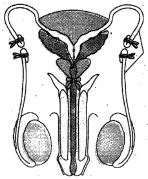
Identify the figure:
A
Tubectomy
B
Vasectomy
C
Male condoms
D
None
Solution
(B) The provided figure illustrates a surgical sterilization procedure in males known as Vasectomy.
In this procedure,a small part of the vas deferens is removed or tied up through a small incision on the scrotum.
This blocks the transport of sperm from the testes to the urethra,thereby preventing fertilization.
Tubectomy,on the other hand,is a sterilization procedure in females where the fallopian tubes are blocked or cut.
Therefore,the correct option is $B$.
In this procedure,a small part of the vas deferens is removed or tied up through a small incision on the scrotum.
This blocks the transport of sperm from the testes to the urethra,thereby preventing fertilization.
Tubectomy,on the other hand,is a sterilization procedure in females where the fallopian tubes are blocked or cut.
Therefore,the correct option is $B$.
0 likes
View Solution37
MediumMCQ
Which of the following is an oral contraceptive?
A
$LNG$-$20$
B
Saheli
C
CuT
D
Lippes loop
Solution
(B) An oral contraceptive is a pill taken by mouth to prevent pregnancy.
$1$. $LNG-20$ is a hormone-releasing intrauterine device $(IUD)$.
$2$. $Saheli$ is a non-steroidal oral contraceptive pill taken once a week.
$3$. $CuT$ is a copper-releasing intrauterine device $(IUD)$.
$4$. $Lippes$ $loop$ is a non-medicated intrauterine device $(IUD)$.
Therefore,$Saheli$ is the correct oral contraceptive.
$1$. $LNG-20$ is a hormone-releasing intrauterine device $(IUD)$.
$2$. $Saheli$ is a non-steroidal oral contraceptive pill taken once a week.
$3$. $CuT$ is a copper-releasing intrauterine device $(IUD)$.
$4$. $Lippes$ $loop$ is a non-medicated intrauterine device $(IUD)$.
Therefore,$Saheli$ is the correct oral contraceptive.
0 likes
View Solution38
MediumMCQ
....... $IUDs$,in addition,make the uterus unsuitable for implantation and the cervix hostile to the sperms.
A
Non-medicated
B
Ideal contraceptive
C
Copper releasing
D
Hormone releasing
Solution
(D) Hormone-releasing $IUDs$ (e.g.,$Progestasert$,$LNG-20$) increase the viscosity of cervical mucus,making the cervix hostile to sperms.
Additionally,they alter the endometrial lining of the uterus,making it unsuitable for implantation.
Non-medicated $IUDs$ (e.g.,$Lippes$ loop) primarily act by phagocytosis of sperms within the uterus.
Copper-releasing $IUDs$ (e.g.,$CuT$,$Cu7$,$Multiload$ $375$) suppress sperm motility and the fertilizing capacity of sperms.
Additionally,they alter the endometrial lining of the uterus,making it unsuitable for implantation.
Non-medicated $IUDs$ (e.g.,$Lippes$ loop) primarily act by phagocytosis of sperms within the uterus.
Copper-releasing $IUDs$ (e.g.,$CuT$,$Cu7$,$Multiload$ $375$) suppress sperm motility and the fertilizing capacity of sperms.
0 likes
View Solution39
MediumMCQ
$CuT$,$LNG-20$,and $Cu7$ are examples of:
A
Contraceptive pills
B
Surgical methods of sterilization
C
$ART$
D
Intrauterine devices $(IUDs)$
Solution
(D) $CuT$,$Cu7$,and $LNG-20$ are well-known examples of Intrauterine devices $(IUDs)$.
$CuT$ and $Cu7$ are copper-releasing $IUDs$ that increase phagocytosis of sperms within the uterus and suppress sperm motility and the fertilizing capacity of sperms.
$LNG-20$ is a hormone-releasing $IUD$ that makes the uterus unsuitable for implantation and the cervix hostile to the sperms.
Therefore,the correct option is $D$.
$CuT$ and $Cu7$ are copper-releasing $IUDs$ that increase phagocytosis of sperms within the uterus and suppress sperm motility and the fertilizing capacity of sperms.
$LNG-20$ is a hormone-releasing $IUD$ that makes the uterus unsuitable for implantation and the cervix hostile to the sperms.
Therefore,the correct option is $D$.
0 likes
View Solution40
MediumMCQ
What is the primary function of $Cu$ ions released by $IUDs$?
A
Suppress sperm motility
B
Increase phagocytosis of sperms
C
Prevent ovulation
D
Make uterus unsuitable for implantation
Solution
(A) Copper-releasing $IUDs$ (such as $CuT$,$Cu7$,$Multiload$ $375$) release $Cu^{2+}$ ions into the uterus.
These ions suppress the motility of sperms and reduce their fertilizing capacity.
While they also increase the phagocytosis of sperms within the uterus,the suppression of sperm motility is the primary mechanism that prevents fertilization.
These ions suppress the motility of sperms and reduce their fertilizing capacity.
While they also increase the phagocytosis of sperms within the uterus,the suppression of sperm motility is the primary mechanism that prevents fertilization.
0 likes
View Solution41
MediumMCQ
$A$ contraceptive pill contains
A
Progestogen and estrogen
B
Spermicidal salt
C
Chemicals that cause automatic abortion
D
Chemicals that prevent fertilization of ovum.
Solution
(A) Oral contraceptive pills,commonly known as birth control pills,are a highly effective method of preventing pregnancy.
These pills typically contain a combination of synthetic hormones,specifically $Progestogen$ and $Estrogen$,or sometimes only $Progestogen$ (mini-pills).
These hormones work primarily by inhibiting ovulation,altering the cervical mucus to prevent sperm entry,and changing the lining of the uterus to prevent implantation.
Therefore,the correct composition of a standard contraceptive pill is $Progestogen$ and $Estrogen$.
These pills typically contain a combination of synthetic hormones,specifically $Progestogen$ and $Estrogen$,or sometimes only $Progestogen$ (mini-pills).
These hormones work primarily by inhibiting ovulation,altering the cervical mucus to prevent sperm entry,and changing the lining of the uterus to prevent implantation.
Therefore,the correct composition of a standard contraceptive pill is $Progestogen$ and $Estrogen$.
0 likes
View Solution42
MediumMCQ
Saheli - the new oral contraceptive for the females contains a ............
A
Steroidal preparation
B
Antibiotic preparation
C
Non-steroidal preparation
D
Toxic preparation to kill sperms
Solution
(C) Saheli is a once-a-week oral contraceptive pill developed by the Central Drug Research Institute $(CDRI)$ in Lucknow,India.
It contains a non-steroidal compound called centchroman.
Unlike traditional oral contraceptive pills that contain synthetic hormones (estrogen and progesterone),Saheli works by inhibiting the implantation of the fertilized egg in the uterus.
Therefore,it is a non-steroidal preparation.
It contains a non-steroidal compound called centchroman.
Unlike traditional oral contraceptive pills that contain synthetic hormones (estrogen and progesterone),Saheli works by inhibiting the implantation of the fertilized egg in the uterus.
Therefore,it is a non-steroidal preparation.
0 likes
View Solution43
MediumMCQ
Lactational amenorrhea prevents
A
Secretion of milk from the breast
B
Conception
C
Secretion of prolactin
D
Spermatogenesis
Solution
(B) Lactational amenorrhea is a natural method of contraception based on the fact that ovulation and the menstrual cycle do not occur during the period of intense lactation following parturition.
During this period,high levels of prolactin inhibit the release of gonadotropin-releasing hormone $(GnRH)$ from the hypothalamus,which in turn prevents the release of follicle-stimulating hormone $(FSH)$ and luteinizing hormone $(LH)$ from the anterior pituitary.
As a result,ovulation is suppressed,thereby preventing conception.
This method is effective only up to a maximum period of six months following parturition.
During this period,high levels of prolactin inhibit the release of gonadotropin-releasing hormone $(GnRH)$ from the hypothalamus,which in turn prevents the release of follicle-stimulating hormone $(FSH)$ and luteinizing hormone $(LH)$ from the anterior pituitary.
As a result,ovulation is suppressed,thereby preventing conception.
This method is effective only up to a maximum period of six months following parturition.
0 likes
View Solution44
MediumMCQ
Identify the odd one out among the following copper-releasing $IUDs$.
A
$CuT$
B
$Cu7$
C
$LNG-20$
D
Multiload $375$
Solution
(C) The $IUDs$ (Intrauterine Devices) are categorized based on their mechanism of action.
$CuT$,$Cu7$,and Multiload $375$ are copper-releasing $IUDs$ that increase phagocytosis of sperms within the uterus and suppress sperm motility and the fertilizing capacity of sperms.
$LNG-20$ is a hormone-releasing $IUD$ (progestasert),which makes the uterus unsuitable for implantation and the cervix hostile to the sperms.
Therefore,$LNG-20$ is the odd one out.
$CuT$,$Cu7$,and Multiload $375$ are copper-releasing $IUDs$ that increase phagocytosis of sperms within the uterus and suppress sperm motility and the fertilizing capacity of sperms.
$LNG-20$ is a hormone-releasing $IUD$ (progestasert),which makes the uterus unsuitable for implantation and the cervix hostile to the sperms.
Therefore,$LNG-20$ is the odd one out.
0 likes
View Solution45
MediumMCQ
In birth control methods,which one is an intra-uterine device?
A
Lippes loop
B
Saheli
C
Condom
D
Vasectomy
Solution
(A) Intra-uterine devices $(IUDs)$ are devices inserted by doctors or expert nurses into the uterus through the vagina.
$Lippes$ $loop$ is a non-medicated $IUD$.
$Saheli$ is an oral contraceptive pill.
$Condom$ is a barrier method.
$Vasectomy$ is a surgical sterilization method.
Therefore,the correct option is $A$.
$Lippes$ $loop$ is a non-medicated $IUD$.
$Saheli$ is an oral contraceptive pill.
$Condom$ is a barrier method.
$Vasectomy$ is a surgical sterilization method.
Therefore,the correct option is $A$.
0 likes
View Solution46
MediumMCQ
Identify the odd one out.
A
Avoid coitus when ovulation could be expected
B
Coitus interruptus
C
Lactational amenorrhea
D
$IUDs$
Solution
(D) The methods of birth control are categorized into natural,barrier,chemical,and surgical methods.
$A$,$B$,and $C$ (Periodic abstinence,Coitus interruptus,and Lactational amenorrhea) are all examples of natural methods of contraception.
$D$ $(IUDs)$ stands for Intrauterine Devices,which are clinical or medical devices inserted into the uterus,thus falling under a different category of contraception.
$A$,$B$,and $C$ (Periodic abstinence,Coitus interruptus,and Lactational amenorrhea) are all examples of natural methods of contraception.
$D$ $(IUDs)$ stands for Intrauterine Devices,which are clinical or medical devices inserted into the uterus,thus falling under a different category of contraception.
0 likes
View Solution47
DifficultMCQ
$IUDs$ within .......... of coitus have been found to be very effective as emergency contraceptives as they could be used to avoid possible pregnancy due to rape or casual unprotected intercourse. (in $hours$)
A
$72$
B
$48$
C
$96$
D
$24$
Solution
(A) Intrauterine devices $(IUDs)$ are highly effective as emergency contraceptives when inserted within $72$ hours of unprotected coitus.
They work by preventing implantation of the fertilized egg in the uterus.
This method is recommended for preventing pregnancy following cases of rape or casual unprotected sexual intercourse.
They work by preventing implantation of the fertilized egg in the uterus.
This method is recommended for preventing pregnancy following cases of rape or casual unprotected sexual intercourse.
0 likes
View Solution48
MediumMCQ
Use of Intra Uterine Devices $(IUDs)$ is one of the most widely accepted methods of contraception in India; because
A
They increase the phagocytosis of sperms and suppress sperm motility.
B
They make the uterus unsuitable for implantation.
C
They reduce the fertilizing capacity of sperms.
D
All of the above.
Solution
(D) Intra Uterine Devices $(IUDs)$ are highly effective and widely accepted contraceptive methods in India.
These devices work through various mechanisms:
$1$. They increase the phagocytosis of sperms within the uterus.
$2$. They suppress sperm motility and their fertilizing capacity.
$3$. Hormonal $IUDs$ make the uterus unsuitable for implantation and the cervix hostile to sperms.
Since all the given options describe the functional mechanisms of different types of $IUDs$ (like copper-releasing and hormone-releasing $IUDs$),the correct answer is $D$.
These devices work through various mechanisms:
$1$. They increase the phagocytosis of sperms within the uterus.
$2$. They suppress sperm motility and their fertilizing capacity.
$3$. Hormonal $IUDs$ make the uterus unsuitable for implantation and the cervix hostile to sperms.
Since all the given options describe the functional mechanisms of different types of $IUDs$ (like copper-releasing and hormone-releasing $IUDs$),the correct answer is $D$.
0 likes
View Solution49
MediumMCQ
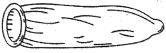
Identify the given figure.
A
Condom for female
B
Loop
C
CuT
D
Condom for male
Solution
(D) The figure shows a male condom,which is a barrier method of contraception.
It is a thin,flexible sheath made of latex or polyurethane that is worn over the erect penis during intercourse.
It prevents the deposition of semen into the female reproductive tract,thereby preventing fertilization and also providing protection against sexually transmitted infections (STIs).
It is a thin,flexible sheath made of latex or polyurethane that is worn over the erect penis during intercourse.
It prevents the deposition of semen into the female reproductive tract,thereby preventing fertilization and also providing protection against sexually transmitted infections (STIs).
0 likes
View SolutionReproductive Health — Method of birth control · Frequently Asked Questions
1Are these Reproductive Health questions useful for JEE and NEET?
Yes. All questions in this section are mapped to JEE Main and NEET exam patterns. Previous year questions from JEE Main, NEET, GUJCET and state-level exams are included with full solutions.
2Can I switch to Hindi or Gujarati for these questions?
Yes. Use the language tabs in the hero section or the sidebar to view the same questions and solutions in English, Hindi or Gujarati.
3How do I generate a question paper from this subtopic?
Use the Vedclass Exam Paper Generator — select the chapter and subtopic, set difficulty, and generate Sets A, B, C, D automatically. First 3 chapters of every subject are free.
Vedclass Products
For Students
Vedclass Test Series
Mock tests in real JEE/NEET style with performance analysis. 5-day free trial.
Start Free TrialFor Teachers
Exam Paper Generator
Generate Set A/B/C/D papers from this chapter in 2 minutes. 3 chapters free.
Try FreeFor Institutes
Online Exam Module
Live online exams with unlimited students, 360° analytics & white-label branding.
See DemoFor Teachers & Institutes
Generate a Reproductive Health Exam Paper in 2 Minutes
Select subtopic & difficulty — Sets A, B, C, D auto-generated with No Repeat logic.
First 3 chapters of every subject are free — no payment required.