
A English
Method of birth control Questions in English
Class 12 Biology · Reproductive Health · Method of birth control
340+
Questions
English
Language
100%
With Solutions
Showing 50 of 340 questions in English
101
MediumMCQ
Match the columns:
| Column $I$ | Column $II$ |
| $(a)$ Physical method | $(p)$ Synthesized rubber or plastic cap |
| $(b)$ Diaphragms | $(q)$ Spermicidal substance |
| $(c)$ Chemical method | $(r)$ Condoms |
A
$a-r, b-p, c-q$
B
$a-p, b-r, c-q$
C
$a-q, b-p, c-r$
D
$a-r, b-q, c-p$
Solution
(A) The correct matching is as follows:
$1$. Physical methods include barriers like condoms, which prevent the meeting of sperm and ovum. Thus, $(a)$ matches with $(r)$.
$2$. Diaphragms are barrier devices made of synthesized rubber or plastic caps that cover the cervix. Thus, $(b)$ matches with $(p)$.
$3$. Chemical methods involve the use of spermicidal creams, jellies, or foams that kill sperm. Thus, $(c)$ matches with $(q)$.
Therefore, the correct sequence is $(a-r, b-p, c-q)$.
$1$. Physical methods include barriers like condoms, which prevent the meeting of sperm and ovum. Thus, $(a)$ matches with $(r)$.
$2$. Diaphragms are barrier devices made of synthesized rubber or plastic caps that cover the cervix. Thus, $(b)$ matches with $(p)$.
$3$. Chemical methods involve the use of spermicidal creams, jellies, or foams that kill sperm. Thus, $(c)$ matches with $(q)$.
Therefore, the correct sequence is $(a-r, b-p, c-q)$.
0 likes
View Solution102
MediumMCQ
Match the following columns regarding the types of Intrauterine Devices $(IUDs)$:
| Column $1$ | Column $2$ | Column $3$ |
|---|---|---|
| $(a)$ First generation | $(p)$ High contraceptive efficacy | $(w)$ Non-medicated |
| $(b)$ Second generation | $(q)$ Effect on uterine lining | $(x)$ Metal ion releasing |
| $(c)$ Third generation | $(r)$ Low contraceptive efficacy | $(y)$ Hormone releasing |
A
$a-r-w, b-p-x, c-q-y$
B
$a-p-w, b-r-x, c-q-y$
C
$a-q-w, b-p-x, c-r-y$
D
$a-r-y, b-p-x, c-q-w$
Solution
(A) The classification of $IUDs$ is based on their mechanism of action and composition:
$1$. First generation $IUDs$ are non-medicated (e.g.,Lippes loop). They have lower contraceptive efficacy compared to newer generations and act by causing a foreign body reaction in the uterus. Thus,$(a-r-w)$.
$2$. Second generation $IUDs$ are copper-releasing (e.g.,$CuT$,$Cu7$). They release metal ions that suppress sperm motility and fertilizing capacity,showing high efficacy. Thus,$(b-p-x)$.
$3$. Third generation $IUDs$ are hormone-releasing (e.g.,Progestasert,$LNG-20$). They alter the uterine lining (endometrium) to make it unsuitable for implantation and thicken cervical mucus. Thus,$(c-q-y)$.
Therefore,the correct match is $(a-r-w), (b-p-x), (c-q-y)$.
$1$. First generation $IUDs$ are non-medicated (e.g.,Lippes loop). They have lower contraceptive efficacy compared to newer generations and act by causing a foreign body reaction in the uterus. Thus,$(a-r-w)$.
$2$. Second generation $IUDs$ are copper-releasing (e.g.,$CuT$,$Cu7$). They release metal ions that suppress sperm motility and fertilizing capacity,showing high efficacy. Thus,$(b-p-x)$.
$3$. Third generation $IUDs$ are hormone-releasing (e.g.,Progestasert,$LNG-20$). They alter the uterine lining (endometrium) to make it unsuitable for implantation and thicken cervical mucus. Thus,$(c-q-y)$.
Therefore,the correct match is $(a-r-w), (b-p-x), (c-q-y)$.
0 likes
View Solution103
EasyMCQ
What is the primary purpose of female sterilization (tubectomy)?
A
Fertilization
B
Coitus
C
Ovum production
D
Embryo development
Solution
(A) Female sterilization,commonly known as tubectomy,is a surgical procedure where the fallopian tubes are blocked or cut.
This prevents the ovum from meeting the sperm,thereby blocking the process of fertilization.
It does not affect ovulation (ovum production) or sexual intercourse (coitus),but it effectively prevents conception.
This prevents the ovum from meeting the sperm,thereby blocking the process of fertilization.
It does not affect ovulation (ovum production) or sexual intercourse (coitus),but it effectively prevents conception.
0 likes
View Solution104
MediumMCQ
Which contraceptive pill was developed by $CDRI$?
A
$Saheli$
B
$Mala-D$
C
$Gossypol$
D
$Nim-75$
Solution
(A) The Central Drug Research Institute $(CDRI)$ in Lucknow,India,developed a non-steroidal oral contraceptive pill for females known as $Saheli$.
It is a once-a-week pill with very few side effects and high contraceptive value.
It is a once-a-week pill with very few side effects and high contraceptive value.
0 likes
View Solution105
MediumMCQ
What is the full form of $CDRI$?
A
Central Drug Research Institute
B
Central Drug Reactive Institute
C
Central Drug Release Institute
D
Control Drug Research Institute
Solution
(A) $CDRI$ stands for Central Drug Research Institute. It is a premier research laboratory located in Lucknow,India,which is involved in various pharmaceutical and biomedical research activities,including the development of contraceptives like $Saheli$.
0 likes
View Solution106
MediumMCQ
Which of the following conditions can help in avoiding fertilization?
A
Lactational amenorrhea
B
Coitus before ovulation
C
Menopause period
D
All of the above
Solution
(D) Fertilization can be avoided by several natural methods:
$1$. $Lactational \text{ } amenorrhea$: This is a natural method based on the fact that ovulation does not occur during the period of intense lactation following parturition.
$2$. $Coitus \text{ } before \text{ } ovulation$: By avoiding sexual intercourse during the fertile period (approximately day $10$ to $17$ of the menstrual cycle), fertilization can be prevented.
$3$. $Menopause$: This is the permanent cessation of the menstrual cycle, which naturally prevents fertilization as no eggs are released.
Therefore, all the given options are correct.
$1$. $Lactational \text{ } amenorrhea$: This is a natural method based on the fact that ovulation does not occur during the period of intense lactation following parturition.
$2$. $Coitus \text{ } before \text{ } ovulation$: By avoiding sexual intercourse during the fertile period (approximately day $10$ to $17$ of the menstrual cycle), fertilization can be prevented.
$3$. $Menopause$: This is the permanent cessation of the menstrual cycle, which naturally prevents fertilization as no eggs are released.
Therefore, all the given options are correct.
0 likes
View Solution107
MediumMCQ
Which of the following is not included in the physical barriers used to prevent fertilization?
A
Condoms
B
Cervical caps
C
Vaults
D
$Cu-T$
Solution
(D) Physical barriers are devices used to prevent the meeting of sperm and ovum by creating a physical obstruction.
$A$,$B$,and $C$ (Condoms,Cervical caps,and Vaults) are examples of physical barriers.
$D$ $(Cu-T)$ is an Intrauterine Device $(IUD)$,which works by releasing copper ions to suppress sperm motility and fertilizing capacity,rather than acting as a physical barrier.
Therefore,$Cu-T$ is not a physical barrier.
$A$,$B$,and $C$ (Condoms,Cervical caps,and Vaults) are examples of physical barriers.
$D$ $(Cu-T)$ is an Intrauterine Device $(IUD)$,which works by releasing copper ions to suppress sperm motility and fertilizing capacity,rather than acting as a physical barrier.
Therefore,$Cu-T$ is not a physical barrier.
0 likes
View Solution108
MediumMCQ
Which of the following is a second-generation $IUD$?
A
Lippes loop
B
Multiload $375$
C
$LNG-20$
D
Progestasert
Solution
(B) Intrauterine devices $(IUDs)$ are classified into generations based on their composition and mechanism of action:
$1$. First-generation $IUDs$: These are non-medicated or inert $IUDs$,such as the Lippes loop.
$2$. Second-generation $IUDs$: These are copper-releasing $IUDs$,such as Copper $T$ $(CuT)$,Copper $7$ $(Cu7)$,and Multiload $375$.
$3$. Third-generation $IUDs$: These are hormone-releasing $IUDs$,such as Progestasert and $LNG-20$.
Therefore,Multiload $375$ is a second-generation $IUD$.
$1$. First-generation $IUDs$: These are non-medicated or inert $IUDs$,such as the Lippes loop.
$2$. Second-generation $IUDs$: These are copper-releasing $IUDs$,such as Copper $T$ $(CuT)$,Copper $7$ $(Cu7)$,and Multiload $375$.
$3$. Third-generation $IUDs$: These are hormone-releasing $IUDs$,such as Progestasert and $LNG-20$.
Therefore,Multiload $375$ is a second-generation $IUD$.
0 likes
View Solution109
EasyMCQ
Which of the following is a hormone-releasing $IUD$?
A
$CuT$
B
$Cu7$
C
$LNG-20$
D
Lippes loop
Solution
(C) Intrauterine devices $(IUDs)$ are effective contraceptives.
$CuT$ and $Cu7$ are copper-releasing $IUDs$ that increase phagocytosis of sperm within the uterus and suppress sperm motility and fertilizing capacity.
$LNG-20$ is a hormone-releasing $IUD$ that makes the uterus unsuitable for implantation and the cervix hostile to the sperm.
Lippes loop is a non-medicated $IUD$.
$CuT$ and $Cu7$ are copper-releasing $IUDs$ that increase phagocytosis of sperm within the uterus and suppress sperm motility and fertilizing capacity.
$LNG-20$ is a hormone-releasing $IUD$ that makes the uterus unsuitable for implantation and the cervix hostile to the sperm.
Lippes loop is a non-medicated $IUD$.
0 likes
View Solution110
MediumMCQ
Which of the following is included in non-medicated $IUDs$?
A
Lippes loop
B
$CuT$
C
$LNG-20$
D
Multiload $375$
Solution
(A) Intrauterine devices $(IUDs)$ are categorized based on their mechanism of action.
$1$. Non-medicated $IUDs$: These do not release any hormones or metal ions. An example is the Lippes loop.
$2$. Copper-releasing $IUDs$: These release copper ions which suppress sperm motility and fertilizing capacity. Examples include $CuT$,$Cu7$,and Multiload $375$.
$3$. Hormone-releasing $IUDs$: These release hormones that make the uterus unsuitable for implantation and the cervix hostile to the sperm. Examples include Progestasert and $LNG-20$.
Therefore,the Lippes loop is the correct example of a non-medicated $IUD$.
$1$. Non-medicated $IUDs$: These do not release any hormones or metal ions. An example is the Lippes loop.
$2$. Copper-releasing $IUDs$: These release copper ions which suppress sperm motility and fertilizing capacity. Examples include $CuT$,$Cu7$,and Multiload $375$.
$3$. Hormone-releasing $IUDs$: These release hormones that make the uterus unsuitable for implantation and the cervix hostile to the sperm. Examples include Progestasert and $LNG-20$.
Therefore,the Lippes loop is the correct example of a non-medicated $IUD$.
0 likes
View Solution111
MediumMCQ
Which of the following statements regarding $IUDs$ is incorrect?
A
$IUDs$ increase phagocytosis of sperms within the uterus.
B
$Cu$ ions suppress sperm motility and the fertilizing capacity of sperms.
C
They make the uterus unsuitable for implantation.
D
All of the above.
Solution
(D) The correct answer is $B$. Here is the explanation regarding the functioning of $IUDs$ (Intra-Uterine Devices):
$1$. $IUDs$ increase the phagocytosis of sperms within the uterus,which is a correct statement.
$2$. Copper-releasing $IUDs$ (such as $CuT$) release $Cu$ ions that suppress sperm motility and their fertilizing capacity. The statement in option $B$ claims they suppress these,which is scientifically correct; however,looking at the standard question format where one must be incorrect,let us re-evaluate: Actually,all statements $A$,$B$,and $C$ are correct descriptions of $IUD$ functions. Therefore,if the question asks for the incorrect statement,and all are correct,the question might be flawed. Given the options,if we assume the question implies which is $NOT$ a function,all are functions. However,based on standard textbook content,all these are correct. If forced to choose an 'incorrect' statement among these,there is none. Assuming the question intended to ask for a correct statement or contained a typo,based on the provided options,all are correct. If the question implies which is incorrect,and all are correct,then $D$ would be the answer if it were 'None of the above'. Since $D$ is 'All of the above',and all are correct,the question is technically invalid. However,in many contexts,$B$ is sometimes misread. Given the prompt,we identify that $A$,$B$,and $C$ are all correct functions.
$1$. $IUDs$ increase the phagocytosis of sperms within the uterus,which is a correct statement.
$2$. Copper-releasing $IUDs$ (such as $CuT$) release $Cu$ ions that suppress sperm motility and their fertilizing capacity. The statement in option $B$ claims they suppress these,which is scientifically correct; however,looking at the standard question format where one must be incorrect,let us re-evaluate: Actually,all statements $A$,$B$,and $C$ are correct descriptions of $IUD$ functions. Therefore,if the question asks for the incorrect statement,and all are correct,the question might be flawed. Given the options,if we assume the question implies which is $NOT$ a function,all are functions. However,based on standard textbook content,all these are correct. If forced to choose an 'incorrect' statement among these,there is none. Assuming the question intended to ask for a correct statement or contained a typo,based on the provided options,all are correct. If the question implies which is incorrect,and all are correct,then $D$ would be the answer if it were 'None of the above'. Since $D$ is 'All of the above',and all are correct,the question is technically invalid. However,in many contexts,$B$ is sometimes misread. Given the prompt,we identify that $A$,$B$,and $C$ are all correct functions.
0 likes
View Solution112
MediumMCQ
What do contraceptive progestogen pills contain?
A
Combination of estrogen and progestogen
B
$Cu$ ions
C
Both $A$ and $B$
D
None of these
Solution
(D) Contraceptive pills can be of two types: combined pills (containing both estrogen and progestogen) or progestogen-only pills (mini-pills). Since the question specifically asks about 'progestogen pills',they contain only progestogen. However,in the context of standard multiple-choice questions where 'progestogen pills' often refers to the class of oral contraceptives,if the option 'None of these' is present,it is the most accurate because they do not contain $Cu$ ions (which are used in IUDs) and they are distinct from combined pills. Therefore,the correct answer is $D$.
0 likes
View Solution113
MediumMCQ
When should a female take oral contraceptive pills?
A
During days $1$ to $21$ of the menstrual cycle.
B
Continuously for $21$ days after the menstrual phase.
C
From day $8$ to $28$ of the menstrual cycle,excluding the first $1$ to $7$ days.
D
Both $A$ and $C$.
Solution
(D) Oral contraceptive pills (OCPs) contain synthetic progesterone or a combination of estrogen and progesterone. These pills are designed to inhibit ovulation and alter the cervical mucus to prevent sperm entry. To be effective,they must be taken daily for $21$ days,starting within the first $5$ days of the menstrual cycle (typically starting on day $1$ or $5$). Therefore,taking them from day $1$ to $21$ is the standard protocol. Option $C$ describes a similar window of coverage,making both $A$ and $C$ valid descriptions of the administration schedule.
0 likes
View Solution114
MediumMCQ
What is the function of oral contraceptive pills?
A
They stimulate ovulation and implantation.
B
They alter the quality of cervical mucus to prevent or retard the entry of sperms.
C
They do not prevent the entry of sperms.
D
Both $A$ and $C$.
Solution
(B) Oral contraceptive pills (OCPs) contain either progesterone alone or a combination of progesterone and estrogen.
They function by inhibiting ovulation and implantation.
Additionally,they alter the quality of cervical mucus to prevent or retard the entry of sperms into the uterus.
Therefore,option $B$ is the correct function,while options $A$ and $C$ are incorrect statements.
They function by inhibiting ovulation and implantation.
Additionally,they alter the quality of cervical mucus to prevent or retard the entry of sperms into the uterus.
Therefore,option $B$ is the correct function,while options $A$ and $C$ are incorrect statements.
0 likes
View Solution115
MediumMCQ
Which of the following is a non-steroidal oral contraceptive pill taken once a week?
A
Saheli
B
$UNWANTED$-$72$
C
Mala-$D$
D
All of the above
Solution
(A) Saheli is a non-steroidal oral contraceptive pill developed by the Central Drug Research Institute $(CDRI)$ in Lucknow,India.
It is taken once a week and is known for having very few side effects and high contraceptive value.
$UNWANTED$-$72$ is an emergency contraceptive pill,and Mala-$D$ is a daily oral contraceptive pill.
It is taken once a week and is known for having very few side effects and high contraceptive value.
$UNWANTED$-$72$ is an emergency contraceptive pill,and Mala-$D$ is a daily oral contraceptive pill.
0 likes
View Solution116
MediumMCQ
Which of the following oral contraceptive pills has the fewest side effects?
A
Gossypol
B
Saheli
C
$UNWANTED$-$72$
D
Mala-$D$
Solution
(B) Saheli is a non-steroidal oral contraceptive pill developed by the Central Drug Research Institute $(CDRI)$ in Lucknow,India.
It contains a selective estrogen receptor modulator called Centchroman.
Unlike conventional hormonal pills (like Mala-$D$),which contain synthetic estrogen and progestogen,Saheli does not contain hormones.
Due to its non-steroidal nature,it has very few side effects and is taken once a week.
It contains a selective estrogen receptor modulator called Centchroman.
Unlike conventional hormonal pills (like Mala-$D$),which contain synthetic estrogen and progestogen,Saheli does not contain hormones.
Due to its non-steroidal nature,it has very few side effects and is taken once a week.
0 likes
View Solution117
MediumMCQ
Which of the following is the terminal method of contraception?
A
$IUDs$
B
Barrier methods
C
Natural methods
D
Sterilization
Solution
(D) Sterilization,also known as surgical methods,is considered the terminal method of contraception.
These procedures are highly effective and are generally irreversible.
In males,this procedure is called vasectomy,and in females,it is called tubectomy.
$IUDs$,barrier methods,and natural methods are temporary contraceptive measures.
These procedures are highly effective and are generally irreversible.
In males,this procedure is called vasectomy,and in females,it is called tubectomy.
$IUDs$,barrier methods,and natural methods are temporary contraceptive measures.
0 likes
View Solution118
MediumMCQ
Which of the following contraceptive methods is considered to have the least side effects?
A
IUDs
B
Barrier methods
C
Natural methods
D
Sterilization
Solution
(C) Natural methods of contraception,such as periodic abstinence,withdrawal (coitus interruptus),and lactational amenorrhea,are considered to have the least side effects because they do not involve the use of any chemicals,hormones,or physical devices that could interfere with the body's natural physiological processes. While they have a high failure rate compared to other methods,they are completely free from side effects.
0 likes
View Solution119
MediumMCQ
In male sterilization, a small part of the vas deferens is removed or tied up. What is this procedure called?
A
Vasectomy
B
Tubectomy
C
Sterilization
D
None of these
Solution
(A) In male sterilization, a surgical procedure known as $Vasectomy$ is performed.
During this procedure, a small part of the $vas deferens$ is removed or tied up through a small incision on the scrotum.
This prevents the transport of sperm from the testes to the urethra, thereby acting as a permanent method of contraception.
$Tubectomy$ is the corresponding procedure performed in females, where the fallopian tubes are blocked or cut.
During this procedure, a small part of the $vas deferens$ is removed or tied up through a small incision on the scrotum.
This prevents the transport of sperm from the testes to the urethra, thereby acting as a permanent method of contraception.
$Tubectomy$ is the corresponding procedure performed in females, where the fallopian tubes are blocked or cut.
0 likes
View Solution120
MediumMCQ
Which of the following side effects can occur due to the excessive use of contraceptive methods?
A
Nausea,abdominal pain
B
Breakthrough bleeding or irregular menstrual bleeding
C
Breast cancer
D
All of the above
Solution
(D) Contraceptive methods,especially hormonal contraceptives (like oral pills),are highly effective but are not devoid of side effects.
Common side effects associated with their use include nausea,abdominal pain,breakthrough bleeding,irregular menstrual bleeding,and even breast cancer in some cases.
Therefore,these methods should be used under the guidance of a qualified medical professional.
Thus,the correct option is $D$.
Common side effects associated with their use include nausea,abdominal pain,breakthrough bleeding,irregular menstrual bleeding,and even breast cancer in some cases.
Therefore,these methods should be used under the guidance of a qualified medical professional.
Thus,the correct option is $D$.
0 likes
View Solution121
MediumMCQ
Which process do the contraceptive pills $Today$ and $Nim-72$ use to prevent fertilization?
A
By binding to sperm and destroying them
B
By preventing sperm from obtaining $O_2$
C
Both $A$ and $B$
D
None of the above
Solution
(A) The contraceptive pills $Today$ and $Nim-72$ are chemical contraceptives. These pills contain spermicidal agents. They work by binding to the sperm and destroying them,thereby preventing fertilization. They do not function by depriving sperm of $O_2$. Therefore,the correct mechanism is the destruction of sperm upon contact.
0 likes
View Solution122
EasyMCQ
Which organization developed the spermicide 'Saheli' (or related contraceptive research)?
A
Defence Institute of Pure and Applied Sciences
B
Central Drug Research Institute
C
National Centre for Cell Science
D
Gujarat Cancer Research Institute
Solution
(B) The Central Drug Research Institute $(CDRI)$,located in Lucknow,India,is responsible for the development of the non-steroidal oral contraceptive pill 'Saheli'. While 'spermicides' are a category of contraceptives,the most significant contribution of $CDRI$ in the field of reproductive health in India is the development of this unique once-a-week pill.
0 likes
View Solution123
MediumMCQ
What does the oral contraceptive pill taken by females contain in its composition?
A
Synthetic estrogen (Ethinyl estradiol)
B
Synthetic progesterone (Norethisterone acetate)
C
Both $A$ and $B$
D
None of these
Solution
(C) Oral contraceptive pills,commonly known as birth control pills,are used to prevent pregnancy.
These pills contain either a combination of synthetic estrogen and synthetic progesterone or only progesterone.
Commonly used synthetic estrogen is Ethinyl estradiol and synthetic progesterone is Norethisterone acetate.
These hormones work by inhibiting ovulation,altering the cervical mucus to prevent sperm entry,and changing the uterine lining to prevent implantation.
Therefore,both $A$ and $B$ are correct components found in these pills.
These pills contain either a combination of synthetic estrogen and synthetic progesterone or only progesterone.
Commonly used synthetic estrogen is Ethinyl estradiol and synthetic progesterone is Norethisterone acetate.
These hormones work by inhibiting ovulation,altering the cervical mucus to prevent sperm entry,and changing the uterine lining to prevent implantation.
Therefore,both $A$ and $B$ are correct components found in these pills.
0 likes
View Solution124
MediumMCQ
Which of the following pills contains only progesterone?
A
$I-pill$
B
$Unwanted-72$
C
Gossypol
D
Both $A$ and $B$
Solution
(D) Progesterone-only pills (POPs),often called 'mini-pills',contain only the progestogen hormone and no estrogen.
$I-pill$ and $Unwanted-72$ are emergency contraceptive pills that contain the synthetic progestogen 'levonorgestrel'.
Therefore,both $A$ and $B$ are correct as they are progesterone-only formulations used for emergency contraception.
$I-pill$ and $Unwanted-72$ are emergency contraceptive pills that contain the synthetic progestogen 'levonorgestrel'.
Therefore,both $A$ and $B$ are correct as they are progesterone-only formulations used for emergency contraception.
0 likes
View Solution125
MediumMCQ
Identify the odd one out.
A
$Cu-T$
B
$LNG-20$
C
$Cu-7$
D
Multiload $375$
Solution
(B) The given options represent various types of Intrauterine Devices $(IUDs)$.
$Cu-T$,$Cu-7$,and Multiload $375$ are all Copper-releasing $IUDs$.
$LNG-20$ is a Hormone-releasing $IUD$.
Therefore,$LNG-20$ is the odd one out as it functions through a different mechanism compared to the others.
$Cu-T$,$Cu-7$,and Multiload $375$ are all Copper-releasing $IUDs$.
$LNG-20$ is a Hormone-releasing $IUD$.
Therefore,$LNG-20$ is the odd one out as it functions through a different mechanism compared to the others.
0 likes
View Solution126
MediumMCQ
Select the odd one out.
A
Condoms
B
Diaphragms
C
Cervical caps
D
Vaults
Solution
(A) The options $A$,$B$,$C$,and $D$ represent barrier methods of contraception. However,$B$,$C$,and $D$ (Diaphragms,Cervical caps,and Vaults) are specifically categorized as barrier devices made of rubber that are inserted into the female reproductive tract to cover the cervix. Condoms $(A)$ are also barrier methods but are distinct in their application (worn on the penis or inside the vagina) and material usage. In many textbook contexts,Diaphragms,Cervical caps,and Vaults are grouped together as 'cervical barriers',making Condoms the odd one out.
0 likes
View Solution127
MediumMCQ
Select the odd one out.
A
Mala-$D$
B
Mala-$N$
C
Saheli
D
Gossypol
Solution
(D) The correct answer is $D$ (Gossypol).
$Mala-D$,$Mala-N$,and $Saheli$ are all oral contraceptive pills used for birth control in women.
$Mala-D$ and $Mala-N$ are combined oral contraceptive pills containing synthetic hormones,while $Saheli$ is a non-steroidal oral contraceptive pill.
$Gossypol$ is a phenolic compound derived from the cotton plant,which has been investigated as a potential male contraceptive,but it is not an oral contraceptive pill for women like the other three options.
$Mala-D$,$Mala-N$,and $Saheli$ are all oral contraceptive pills used for birth control in women.
$Mala-D$ and $Mala-N$ are combined oral contraceptive pills containing synthetic hormones,while $Saheli$ is a non-steroidal oral contraceptive pill.
$Gossypol$ is a phenolic compound derived from the cotton plant,which has been investigated as a potential male contraceptive,but it is not an oral contraceptive pill for women like the other three options.
0 likes
View Solution128
MediumMCQ
What is the full form of $IUCDs$?
A
Intra Uterine Devices
B
Intra Uterine Contraceptive Devices
C
Inter Uterine Devices
D
Inter Uterous Contraceptive Devices
Solution
(B) $IUCDs$ stands for Intra Uterine Contraceptive Devices.
These are effective contraceptive methods used to prevent pregnancy by being inserted into the uterus by doctors or expert nurses.
These are effective contraceptive methods used to prevent pregnancy by being inserted into the uterus by doctors or expert nurses.
0 likes
View Solution129
MediumMCQ
Which of the following is used for emergency contraception?
A
Condom
B
$I$-Pills
C
Saheli
D
Mala-$D$
Solution
(B) Emergency contraception refers to methods used to prevent pregnancy after unprotected sexual intercourse or failure of a contraceptive method.
$I-Pills$ (containing levonorgestrel) are widely used as emergency contraceptive pills if taken within $72$ hours of unprotected intercourse.
Condoms are barrier methods,Saheli is a non-steroidal oral contraceptive taken once a week,and Mala-$D$ is a combined oral contraceptive pill taken daily.
$I-Pills$ (containing levonorgestrel) are widely used as emergency contraceptive pills if taken within $72$ hours of unprotected intercourse.
Condoms are barrier methods,Saheli is a non-steroidal oral contraceptive taken once a week,and Mala-$D$ is a combined oral contraceptive pill taken daily.
0 likes
View Solution130
MediumMCQ
What is the mode of action of $Saheli$?
A
Anti-estrogenic
B
Anti-progestogenic
C
Inhibits implantation by releasing progesterone
D
Inhibits sperm motility by releasing copper
Solution
(A) $Saheli$ is a non-steroidal oral contraceptive pill for females.
It contains a compound called $Centchroman$.
Its primary mode of action is anti-estrogenic,which prevents the implantation of the fertilized egg in the uterus by inhibiting the estrogen receptors in the endometrium.
It contains a compound called $Centchroman$.
Its primary mode of action is anti-estrogenic,which prevents the implantation of the fertilized egg in the uterus by inhibiting the estrogen receptors in the endometrium.
0 likes
View Solution131
MediumMCQ
Match the following items in List-$I$ with List-$II$:
| List-$I$ | List-$II$ |
|---|---|
| $(1)$ Condom | $(a)$ Semen without sperm |
| $(2)$ Copper-$T$ | $(b)$ Inhibits ovulation |
| $(3)$ Vasectomy | $(c)$ Prevents sperm from reaching the uterus |
| $(4)$ Mala-$D$ | $(d)$ Prevents fertilization |
A
$1-b, 2-c, 3-d, 4-a$
B
$1-c, 2-d, 3-a, 4-b$
C
$1-d, 2-c, 3-b, 4-a$
D
$1-c, 2-d, 3-a, 4-b$
Solution
(D) The correct matches are as follows:
$(1)$ Condom: It acts as a barrier method that prevents sperm from reaching the uterus/cervix. Thus,$(1-c)$.
$(2)$ Copper-$T$: It is an Intrauterine Device $(IUD)$ that releases copper ions,which suppress sperm motility and their fertilizing capacity,thereby preventing fertilization. Thus,$(2-d)$.
$(3)$ Vasectomy: It is a surgical sterilization method in males where the vas deferens is cut and tied,resulting in semen without sperm. Thus,$(3-a)$.
$(4)$ Mala-$D$: It is an oral contraceptive pill containing hormones that inhibit ovulation. Thus,$(4-b)$.
Therefore,the correct sequence is $1-c, 2-d, 3-a, 4-b$.
$(1)$ Condom: It acts as a barrier method that prevents sperm from reaching the uterus/cervix. Thus,$(1-c)$.
$(2)$ Copper-$T$: It is an Intrauterine Device $(IUD)$ that releases copper ions,which suppress sperm motility and their fertilizing capacity,thereby preventing fertilization. Thus,$(2-d)$.
$(3)$ Vasectomy: It is a surgical sterilization method in males where the vas deferens is cut and tied,resulting in semen without sperm. Thus,$(3-a)$.
$(4)$ Mala-$D$: It is an oral contraceptive pill containing hormones that inhibit ovulation. Thus,$(4-b)$.
Therefore,the correct sequence is $1-c, 2-d, 3-a, 4-b$.
0 likes
View Solution132
MediumMCQ
Match the following columns:
| Column-$I$ | Column-$II$ |
| $(1)$ Tubectomy | $(a)$ Female sterilization |
| $(2)$ First generation $IUD$ | $(b)$ Non-steroidal pill |
| $(3)$ Second generation $IUD$ | $(c)$ Lippes loop |
| $(4)$ Saheli | $(d)$ $Cu-T$ |
A
$1-a, 2-b, 3-d, 4-c$
B
$1-a, 2-d, 3-c, 4-b$
C
$1-a, 2-c, 3-d, 4-b$
D
$1-a, 2-d, 3-b, 4-c$
Solution
(C) The correct matches are as follows:
$(1)$ Tubectomy is a surgical method of female sterilization, where the fallopian tubes are blocked or cut. Thus, $(1-a)$.
$(2)$ First generation $IUDs$ are inert devices, such as the Lippes loop. Thus, $(2-c)$.
$(3)$ Second generation $IUDs$ are copper-releasing devices, such as $Cu-T$. Thus, $(3-d)$.
$(4)$ Saheli is a non-steroidal oral contraceptive pill taken once a week. Thus, $(4-b)$.
Therefore, the correct sequence is $(1-a, 2-c, 3-d, 4-b)$.
$(1)$ Tubectomy is a surgical method of female sterilization, where the fallopian tubes are blocked or cut. Thus, $(1-a)$.
$(2)$ First generation $IUDs$ are inert devices, such as the Lippes loop. Thus, $(2-c)$.
$(3)$ Second generation $IUDs$ are copper-releasing devices, such as $Cu-T$. Thus, $(3-d)$.
$(4)$ Saheli is a non-steroidal oral contraceptive pill taken once a week. Thus, $(4-b)$.
Therefore, the correct sequence is $(1-a, 2-c, 3-d, 4-b)$.
0 likes
View Solution133
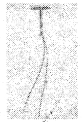
MediumMCQ
The given figure shows which of the following?
A
Non-medicated $IUDs$
B
Copper-releasing $IUDs$
C
Hormone-releasing $IUDs$
D
All of the above
Solution
(B) The figure shows a $Copper-T$ $(CuT)$,which is a type of copper-releasing intrauterine device $(IUD)$.
Copper-releasing $IUDs$ increase phagocytosis of sperms within the uterus and the copper ions released suppress sperm motility and the fertilizing capacity of sperms.
Therefore,the correct option is $B$.
Copper-releasing $IUDs$ increase phagocytosis of sperms within the uterus and the copper ions released suppress sperm motility and the fertilizing capacity of sperms.
Therefore,the correct option is $B$.
0 likes
View Solution134
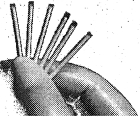
MediumMCQ
What does the given figure represent?
A
Pills
B
$IUDs$
C
Implants
D
Multiload $375$
Solution
(C) The figure shows hormonal implants (e.g.,Norplant). These are small,rod-like devices that are inserted under the skin of the upper arm. They release hormones slowly over a long period to prevent pregnancy by inhibiting ovulation and thickening cervical mucus. Therefore,the correct representation is implants.
0 likes
View Solution135
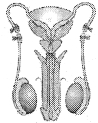
MediumMCQ
What phenomenon is depicted in the given figure?
A
Tubectomy
B
Vasectomy
C
Female sterilization
D
Terminal method for females to prevent fertilization
Solution
(B) The figure shows the surgical procedure performed on the male reproductive system where a small part of the vas deferens is removed or tied up. This procedure is known as Vasectomy. It acts as a terminal method of contraception in males by preventing the transport of sperms.
0 likes
View Solution136
MediumMCQ
Spermicidal tablets are composed of which of the following substances?
A
$ZnSO_4, KMnO_4$
B
Boric acid,Lactic acid,Citric acid
C
$OAA$,Pyruvic acid
D
Both $A$ and $B$
Solution
(D) Spermicidal agents are chemical substances used in contraceptives to kill or immobilize sperm.
Commonly used spermicidal agents include chemicals like $ZnSO_4$ (Zinc sulfate),$KMnO_4$ (Potassium permanganate),and various mild acids such as Boric acid,Lactic acid,and Citric acid.
These substances alter the pH of the vaginal environment or directly damage the sperm membrane,thereby preventing fertilization.
Therefore,both options $A$ and $B$ are correct components used in the formulation of spermicidal tablets.
Commonly used spermicidal agents include chemicals like $ZnSO_4$ (Zinc sulfate),$KMnO_4$ (Potassium permanganate),and various mild acids such as Boric acid,Lactic acid,and Citric acid.
These substances alter the pH of the vaginal environment or directly damage the sperm membrane,thereby preventing fertilization.
Therefore,both options $A$ and $B$ are correct components used in the formulation of spermicidal tablets.
0 likes
View Solution137
EasyMCQ
What is the Lippes loop $IUD$ made of?
A
Polyethylene
B
$BaSO_4$
C
Both $A$ and $B$
D
$ZnSO_4$
Solution
(C) The Lippes loop is a type of non-medicated (inert) intrauterine device $(IUD)$.
It is manufactured using polyethylene,which is a plastic polymer.
To make the device radiopaque (visible on $X$-ray imaging),barium sulfate $(BaSO_4)$ is added to the polyethylene material.
Therefore,the Lippes loop is composed of both polyethylene and $BaSO_4$.
It is manufactured using polyethylene,which is a plastic polymer.
To make the device radiopaque (visible on $X$-ray imaging),barium sulfate $(BaSO_4)$ is added to the polyethylene material.
Therefore,the Lippes loop is composed of both polyethylene and $BaSO_4$.
0 likes
View Solution138
MediumMCQ
Which of the following drugs is taken orally by females?
A
Gossypol
B
Mala-$D$
C
Mala-$N$
D
Both $B$ and $C$
Solution
(D) Oral contraceptive pills are used by females to prevent pregnancy.
$Mala-D$ and $Mala-N$ are common oral contraceptive pills distributed by the government in India.
These pills contain synthetic hormones that inhibit ovulation.
Gossypol is a male contraceptive agent,not a female oral contraceptive.
Therefore,both $Mala-D$ and $Mala-N$ are correct options for female oral contraceptives.
$Mala-D$ and $Mala-N$ are common oral contraceptive pills distributed by the government in India.
These pills contain synthetic hormones that inhibit ovulation.
Gossypol is a male contraceptive agent,not a female oral contraceptive.
Therefore,both $Mala-D$ and $Mala-N$ are correct options for female oral contraceptives.
0 likes
View Solution139
MediumMCQ
How do injectable contraceptives ($DMPA$ - Depot Medroxyprogesterone Acetate) prevent ovulation?
A
By increasing the secretion of gonadotropins
B
By inhibiting the secretion of gonadotropins
C
By inhibiting the secretion of estrogen
D
By reducing the maturation of ovaries
Solution
(B) Injectable contraceptives like $DMPA$ (Depot Medroxyprogesterone Acetate) contain synthetic progestogens.
These hormones act by providing negative feedback to the hypothalamus and the anterior pituitary gland.
This feedback mechanism inhibits the release of gonadotropins,specifically $FSH$ (Follicle Stimulating Hormone) and $LH$ (Luteinizing Hormone).
Since the surge of $LH$ is essential for ovulation,the inhibition of these gonadotropins prevents the process of ovulation,thereby acting as an effective contraceptive.
These hormones act by providing negative feedback to the hypothalamus and the anterior pituitary gland.
This feedback mechanism inhibits the release of gonadotropins,specifically $FSH$ (Follicle Stimulating Hormone) and $LH$ (Luteinizing Hormone).
Since the surge of $LH$ is essential for ovulation,the inhibition of these gonadotropins prevents the process of ovulation,thereby acting as an effective contraceptive.
0 likes
View Solution140
MediumMCQ
What is the function of the gossypol pill derived from cottonseed?
A
Azoospermia (inhibits spermatogenesis)
B
Reduces sperm maturation
C
Induces spermatogenesis
D
Inhibits the maturation capacity of the epididymal duct
Solution
(A) Gossypol is a phenolic compound derived from the cotton plant ($Gossypium$ species).
It has been studied as a potential male contraceptive.
Its primary mechanism of action involves the inhibition of spermatogenesis in the testes,leading to a condition known as azoospermia (absence of sperm in the ejaculate) or severe oligospermia.
Therefore,it acts by effectively stopping the production of viable sperm.
It has been studied as a potential male contraceptive.
Its primary mechanism of action involves the inhibition of spermatogenesis in the testes,leading to a condition known as azoospermia (absence of sperm in the ejaculate) or severe oligospermia.
Therefore,it acts by effectively stopping the production of viable sperm.
0 likes
View Solution141
EasyMCQ
Progestogens alone or in combination with estrogens can be used as a contraceptive in the form of
A
Pills only
B
Implants only
C
Injections only
D
Pills,injections and implants
Solution
(D) Option $D$ is the correct answer as progestogens alone or in combination with estrogens can be used as a contraceptive in the form of pills,injections,and implants.
These hormonal preparations act by inhibiting ovulation and implantation,as well as by altering the quality of cervical mucus to prevent the entry of sperm.
These hormonal preparations act by inhibiting ovulation and implantation,as well as by altering the quality of cervical mucus to prevent the entry of sperm.
0 likes
View Solution142
MediumMCQ
Mark the correct statement.
A
Saheli is a once-a-week oral contraceptive.
B
Progestasert releases estrogen.
C
$Cu-T$ is a barrier method.
D
Vasectomy and tubectomy are temporary methods of contraception.
Solution
(A) The correct statement is that $Saheli$ is a once-a-week oral contraceptive.
$Saheli$ is a non-steroidal oral contraceptive pill developed by $CDRI$,Lucknow,which is taken once a week.
$Progestasert$ is a hormone-releasing $IUD$ that releases progesterone,not estrogen.
$Cu-T$ is a copper-releasing $IUD$,not a barrier method.
Vasectomy and tubectomy are permanent sterilization methods,not temporary.
$Saheli$ is a non-steroidal oral contraceptive pill developed by $CDRI$,Lucknow,which is taken once a week.
$Progestasert$ is a hormone-releasing $IUD$ that releases progesterone,not estrogen.
$Cu-T$ is a copper-releasing $IUD$,not a barrier method.
Vasectomy and tubectomy are permanent sterilization methods,not temporary.
0 likes
View Solution143
EasyMCQ
$Saheli$ is a:
A
Oral contraceptive for females
B
Surgical sterilization method for females
C
Diaphragm for females
D
Surgical method of sterilization in males
Solution
(A) $Saheli$ is a new oral contraceptive for females.
It contains a non-steroidal preparation.
It is a once-a-week pill with very low side effects and high contraceptive value.
It contains a non-steroidal preparation.
It is a once-a-week pill with very low side effects and high contraceptive value.
0 likes
View Solution144
MediumMCQ
Tablets to prevent contraception contain
A
Progesterone
B
$FSH$
C
$LH$
D
Both $(b)$ and $(c)$
Solution
(A) Oral contraceptive pills are used to prevent pregnancy. These pills contain either a combination of synthetic progesterone and oestrogen or only progesterone. These hormones work by inhibiting the secretion of $FSH$ and $LH$ from the pituitary gland,thereby preventing ovulation.
0 likes
View Solution145
MediumMCQ
Which of these is used to control human population?
A
Oestrogen and progesterone
B
$IUCD$ and $MTP$
C
Tubectomy and vasectomy
D
All of the above
Solution
(D) To control the human population,various birth control methods are employed.
These include hormonal methods,such as contraceptive pills (which contain oestrogen and progesterone as main constituents).
Mechanical prevention methods,such as the use of $IUCDs$ (Intra Uterine Contraceptive Devices),are also effective.
Surgical sterilization methods,such as tubectomy (surgical removal or ligation of fallopian tubes) and vasectomy (surgical removal or ligation of vas deferens),are permanent methods used to control population growth.
Therefore,all the mentioned options are used for population control.
These include hormonal methods,such as contraceptive pills (which contain oestrogen and progesterone as main constituents).
Mechanical prevention methods,such as the use of $IUCDs$ (Intra Uterine Contraceptive Devices),are also effective.
Surgical sterilization methods,such as tubectomy (surgical removal or ligation of fallopian tubes) and vasectomy (surgical removal or ligation of vas deferens),are permanent methods used to control population growth.
Therefore,all the mentioned options are used for population control.
0 likes
View Solution146
EasyMCQ
Saheli is an oral contraceptive containing
A
Oestrogen and progesterone
B
Oestrogen
C
Centchroman
D
Testosterone and $FSH$
Solution
(C) Saheli is a non-steroidal oral contraceptive pill developed by the Central Drug Research Institute $(CDRI)$ in Lucknow,India. It contains a compound called Centchroman. Unlike traditional hormonal pills,it does not contain oestrogen or progesterone and is taken once a week.
0 likes
View Solution147
EasyMCQ
What is the primary function of $Cu$ ions released from copper-releasing Intra Uterine Devices $(IUDs)$?
A
Make uterus unsuitable for implantation
B
Increase phagocytosis of sperms
C
Suppress sperm motility
D
Prevent ovulation
Solution
(C) Copper-releasing $IUDs$ (like $CuT$,$Cu7$,$Multiload$ $375$) release $Cu^{2+}$ ions into the uterus.
These ions suppress sperm motility and the fertilizing capacity of sperms.
Therefore,the correct function is to suppress sperm motility.
These ions suppress sperm motility and the fertilizing capacity of sperms.
Therefore,the correct function is to suppress sperm motility.
0 likes
View Solution148
EasyMCQ
Female condoms are known as:
A
Femidom
B
Female condom
C
Contraceptive condom
D
None of these
Solution
(A) The term $Femidom$ is specifically used to refer to female condoms. It is a barrier method of contraception that is inserted into the vagina to prevent pregnancy and sexually transmitted infections.
0 likes
View Solution149
MediumMCQ
Natural methods of contraception:
A
Increase spermicidal activity
B
Prevent fertilisation
C
Decrease mortality
D
Increase mortality
Solution
(B) Natural methods of contraception are the natural ways to prevent fertilisation. These methods include:
$(i)$ Periodic Abstinence: Couples avoid coitus or intercourse from day $10$ to $17$ of the menstrual cycle when ovulation is expected to occur.
$(ii)$ Coitus Interruptus or withdrawal method: Withdrawal of the penis from the vagina just before ejaculation so as to avoid insemination.
$(iii)$ Lactational Amenorrhoea (absence of menstruation): This method is based on the fact that ovulation and therefore the menstrual cycle do not occur during the period of intense lactation following parturition. Therefore,as long as the mother breastfeeds the child,chances of conception are almost nil.
$(i)$ Periodic Abstinence: Couples avoid coitus or intercourse from day $10$ to $17$ of the menstrual cycle when ovulation is expected to occur.
$(ii)$ Coitus Interruptus or withdrawal method: Withdrawal of the penis from the vagina just before ejaculation so as to avoid insemination.
$(iii)$ Lactational Amenorrhoea (absence of menstruation): This method is based on the fact that ovulation and therefore the menstrual cycle do not occur during the period of intense lactation following parturition. Therefore,as long as the mother breastfeeds the child,chances of conception are almost nil.
0 likes
View Solution150
MediumMCQ
What is the withdrawal method of natural contraception?
A
Withdrawal of penis before ejaculation
B
Withdrawal of penis after ejaculation
C
Avoid sex during ovulation
D
Prefer sex during ovulation
Solution
(A) The withdrawal method,also known as coitus interruptus,involves the withdrawal of the penis from the vagina just before ejaculation to avoid insemination.
This method is only moderately effective because the moment of ejaculation is highly pleasurable,especially for males,and some sperm may pass into the vagina even before full ejaculation occurs.
Natural methods of contraception are natural ways to prevent fertilization,which include:
$(i)$ Periodic Abstinence: Couples avoid coitus from day $10$ to $17$ of the menstrual cycle when ovulation is expected to occur.
$(ii)$ Coitus Interruptus or Withdrawal Method: Withdrawal of the penis from the vagina just before ejaculation to prevent insemination.
$(iii)$ Lactational Amenorrhea: This method is based on the fact that ovulation and the menstrual cycle do not occur during the period of intense lactation following parturition. Therefore,as long as the mother breastfeeds the child,the chances of conception are almost nil.
This method is only moderately effective because the moment of ejaculation is highly pleasurable,especially for males,and some sperm may pass into the vagina even before full ejaculation occurs.
Natural methods of contraception are natural ways to prevent fertilization,which include:
$(i)$ Periodic Abstinence: Couples avoid coitus from day $10$ to $17$ of the menstrual cycle when ovulation is expected to occur.
$(ii)$ Coitus Interruptus or Withdrawal Method: Withdrawal of the penis from the vagina just before ejaculation to prevent insemination.
$(iii)$ Lactational Amenorrhea: This method is based on the fact that ovulation and the menstrual cycle do not occur during the period of intense lactation following parturition. Therefore,as long as the mother breastfeeds the child,the chances of conception are almost nil.
0 likes
View SolutionReproductive Health — Method of birth control · Frequently Asked Questions
1Are these Reproductive Health questions useful for JEE and NEET?
Yes. All questions in this section are mapped to JEE Main and NEET exam patterns. Previous year questions from JEE Main, NEET, GUJCET and state-level exams are included with full solutions.
2Can I switch to Hindi or Gujarati for these questions?
Yes. Use the language tabs in the hero section or the sidebar to view the same questions and solutions in English, Hindi or Gujarati.
3How do I generate a question paper from this subtopic?
Use the Vedclass Exam Paper Generator — select the chapter and subtopic, set difficulty, and generate Sets A, B, C, D automatically. First 3 chapters of every subject are free.
Vedclass Products
For Students
Vedclass Test Series
Mock tests in real JEE/NEET style with performance analysis. 5-day free trial.
Start Free TrialFor Teachers
Exam Paper Generator
Generate Set A/B/C/D papers from this chapter in 2 minutes. 3 chapters free.
Try FreeFor Institutes
Online Exam Module
Live online exams with unlimited students, 360° analytics & white-label branding.
See DemoFor Teachers & Institutes
Generate a Reproductive Health Exam Paper in 2 Minutes
Select subtopic & difficulty — Sets A, B, C, D auto-generated with No Repeat logic.
First 3 chapters of every subject are free — no payment required.