
A English
Method of birth control Questions in English
Class 12 Biology · Reproductive Health · Method of birth control
340+
Questions
English
Language
100%
With Solutions
Showing 50 of 340 questions in English
151
MediumMCQ
Which oral contraceptive is developed by $CDRI$?
A
Saheli
B
Mala-$D$
C
Both $(a)$ and $(b)$
D
None of these
Solution
(A) The oral contraceptive 'Saheli' was developed by scientists at the Central Drug Research Institute $(CDRI)$ in Lucknow,India.
It is a non-steroidal,once-a-week pill used for female contraception.
Therefore,the correct option is $A$.
It is a non-steroidal,once-a-week pill used for female contraception.
Therefore,the correct option is $A$.
0 likes
View Solution152
MediumMCQ
Diaphragms,cervical caps,and vaults are:
A
Non-reusable
B
For female use only
C
For male use only
D
None of these
Solution
(B) Diaphragms,cervical caps,and vaults are barrier methods of contraception used by females. These devices are designed to be inserted into the female reproductive tract to prevent the entry of sperm into the uterus. Unlike some other contraceptive methods,these devices are reusable after proper cleaning.
0 likes
View Solution153
MediumMCQ
The period of periodic abstinence is:
A
$10-11$ days of the menstrual cycle
B
$10-17$ days of the menstrual cycle
C
$17-20$ days of the menstrual cycle
D
$20-28$ days of the menstrual cycle
Solution
(B) Periodic abstinence is a natural method of contraception where couples avoid or abstain from coitus from day $10$ to $17$ of the menstrual cycle when ovulation could be expected.
As ovulation occurs on about the $14$th day and the ovum survives for about $1-2$ days,and sperm can survive in the female reproductive tract for up to $2-3$ days,this period is considered the 'fertile period'.
Therefore,avoiding coitus during this time prevents conception.
This method is also known as the rhythm method or calendar method.
As ovulation occurs on about the $14$th day and the ovum survives for about $1-2$ days,and sperm can survive in the female reproductive tract for up to $2-3$ days,this period is considered the 'fertile period'.
Therefore,avoiding coitus during this time prevents conception.
This method is also known as the rhythm method or calendar method.
0 likes
View Solution154
MediumMCQ
Which of the following birth control measures can be considered as the safest?
A
The rhythm method
B
The use of physical barriers
C
Termination of unwanted pregnancy
D
Use of foams
Solution
(B) Physical barriers,such as condoms,are considered the safest method of birth control among the given options.
They provide a dual benefit: they act as a mechanical barrier to prevent conception and also protect against sexually transmitted infections (STIs).
The rhythm method is unreliable due to irregular cycles.
Termination of pregnancy $(MTP)$ is a medical procedure with associated risks and is not a primary contraceptive method.
Foams are chemical spermicides that are less effective when used alone compared to barrier methods.
They provide a dual benefit: they act as a mechanical barrier to prevent conception and also protect against sexually transmitted infections (STIs).
The rhythm method is unreliable due to irregular cycles.
Termination of pregnancy $(MTP)$ is a medical procedure with associated risks and is not a primary contraceptive method.
Foams are chemical spermicides that are less effective when used alone compared to barrier methods.
0 likes
View Solution155
MediumMCQ
Condoms are made up of a thin rubber/latex sheath which is used to cover:
A
Penis in male
B
Cervix in female
C
Both $(a)$ and $(b)$
D
None of the above
Solution
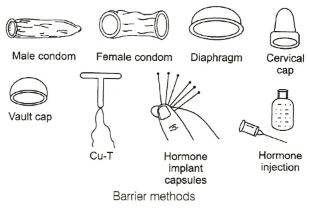
(C) Condoms are barrier methods of contraception made of thin rubber or latex sheaths.
In males,they are used to cover the penis.
In females,they are used to cover the vagina and cervix.
These barriers prevent the deposition of ejaculated semen into the female reproductive tract,thereby preventing the contact between sperm and ovum.
In males,they are used to cover the penis.
In females,they are used to cover the vagina and cervix.
These barriers prevent the deposition of ejaculated semen into the female reproductive tract,thereby preventing the contact between sperm and ovum.
0 likes
View Solution156
MediumMCQ
$IUD$ stands for
A
Inter Uterine Devices
B
Intra Uterine Device
C
Inter Uterine Development
D
Intra Uterine Development
Solution
(B) $IUD$ stands for Intra Uterine Devices, which are used for contraception.
$(i)$ These devices are inserted by doctors into the uterus through the vagina.
$(ii)$ There are three types of $IUDs$:
- Non-medicated $IUDs$: They increase the phagocytosis of sperms within the uterus, $e.g.$, Lippes loop.
- Copper Releasing $IUDs$: Along with the phagocytosis of sperms, the released copper ions suppress sperm motility and the fertilizing capacity of the sperm, $e.g.$, $Cu-T, Cu-7, \text{multiload-}375$.
- Hormone Releasing $IUDs$: They make the uterus unsuitable for implantation and the cervix hostile to the sperms, $e.g.$, $\text{progestasert}, LNG-20$.
$(i)$ These devices are inserted by doctors into the uterus through the vagina.
$(ii)$ There are three types of $IUDs$:
- Non-medicated $IUDs$: They increase the phagocytosis of sperms within the uterus, $e.g.$, Lippes loop.
- Copper Releasing $IUDs$: Along with the phagocytosis of sperms, the released copper ions suppress sperm motility and the fertilizing capacity of the sperm, $e.g.$, $Cu-T, Cu-7, \text{multiload-}375$.
- Hormone Releasing $IUDs$: They make the uterus unsuitable for implantation and the cervix hostile to the sperms, $e.g.$, $\text{progestasert}, LNG-20$.
0 likes
View Solution157
MediumMCQ
Coitus interruption is the --- of natural contraception.
A
withdrawal method
B
lactation amenorrhoea
C
physical barrier
D
All of these
Solution
(A) Coitus interruption is also known as the withdrawal method. It is a natural method of contraception where the male partner withdraws his penis from the vagina just before ejaculation to avoid insemination.
Natural methods of contraception are ways to prevent fertilization without the use of drugs or devices. These include:
$(i)$ Periodic Abstinence: Couples avoid coitus from day $10$ to $17$ of the menstrual cycle when ovulation is expected to occur.
$(ii)$ Coitus interruption or withdrawal method: The male partner withdraws the penis from the vagina just before ejaculation to avoid insemination.
$(iii)$ Lactational Amenorrhoea: This method is based on the fact that ovulation and the menstrual cycle do not occur during the period of intense lactation following parturition. As long as the mother breastfeeds the child,the chances of conception are almost nil.
Natural methods of contraception are ways to prevent fertilization without the use of drugs or devices. These include:
$(i)$ Periodic Abstinence: Couples avoid coitus from day $10$ to $17$ of the menstrual cycle when ovulation is expected to occur.
$(ii)$ Coitus interruption or withdrawal method: The male partner withdraws the penis from the vagina just before ejaculation to avoid insemination.
$(iii)$ Lactational Amenorrhoea: This method is based on the fact that ovulation and the menstrual cycle do not occur during the period of intense lactation following parturition. As long as the mother breastfeeds the child,the chances of conception are almost nil.
0 likes
View Solution158
MediumMCQ
Oral contraceptives inhibit $A$ and implantation as well as the quality of cervical $B$ to prevent the entry of sperms. Choose the correct option for $A$ and $B$ to complete the given statement.
A
$A-$ovulation; $B-$mucus
B
$A-$oogenesis; $B-$structure
C
$A-$oogenesis; $B-$nucleus
D
$A-$spermatogenesis; $B-$mucus
Solution
(A) Oral contraceptives (pills) contain either progestogens alone or in combination with estrogen. They work primarily by inhibiting $A-$ovulation and implantation. Additionally,they alter the quality of cervical $B-$mucus to prevent or retard the entry of sperms into the uterus. Therefore,the correct option is $A$.
0 likes
View Solution159
MediumMCQ
Example of copper releasing $IUD$ is
A
$Cu-T$
B
$Cu-7$
C
Multiload-$375$
D
All of these
Solution
(D) Intra Uterine Devices $(IUDs)$ are used for contraception.
$(i)$ These devices are inserted by doctors into the uterus through the vagina.
$(ii)$ There are three types of $IUDs$:
$1.$ Non-medicated $IUDs$: These increase the phagocytosis of sperms within the uterus,$e.g.$,Lippes loop.
$2.$ Copper Releasing $IUDs$: Along with the phagocytosis of sperms,the released copper ions suppress the sperm motility and the fertilizing capacity of the sperm,$e.g.$,$Cu-T$,$Cu-7$,Multiload-$375$.
$3.$ Hormone Releasing $IUDs$: These make the uterus unsuitable for implantation and the cervix hostile to the sperms,$e.g.$,Progestasert,$LNG-20$.
Therefore,$Cu-T$,$Cu-7$,and Multiload-$375$ are all examples of copper-releasing $IUDs$.
$(i)$ These devices are inserted by doctors into the uterus through the vagina.
$(ii)$ There are three types of $IUDs$:
$1.$ Non-medicated $IUDs$: These increase the phagocytosis of sperms within the uterus,$e.g.$,Lippes loop.
$2.$ Copper Releasing $IUDs$: Along with the phagocytosis of sperms,the released copper ions suppress the sperm motility and the fertilizing capacity of the sperm,$e.g.$,$Cu-T$,$Cu-7$,Multiload-$375$.
$3.$ Hormone Releasing $IUDs$: These make the uterus unsuitable for implantation and the cervix hostile to the sperms,$e.g.$,Progestasert,$LNG-20$.
Therefore,$Cu-T$,$Cu-7$,and Multiload-$375$ are all examples of copper-releasing $IUDs$.
0 likes
View Solution160
MediumMCQ
Oral contraceptives prevent:
A
Ovulation
B
Menstruation
C
Implantation
D
Entry of sperms in vagina
Solution
(A) Oral contraceptive pills contain synthetic progesterone and estrogen. These hormones act by inhibiting the secretion of $FSH$ and $LH$ from the anterior pituitary gland. The suppression of $LH$ surge prevents the process of ovulation,thereby preventing pregnancy.
0 likes
View Solution161
MediumMCQ
The birth control device not used by women is:
A
Diaphragm
B
Oral pill
C
Male Condom
D
Copper $T$
Solution
(C) The $Male \ Condom$ is a barrier method of contraception designed specifically for use by men.
Diaphragms, oral pills, and $Copper \ T$ (an intrauterine device) are all methods of contraception used by women.
Therefore, the correct option is $C$.
Diaphragms, oral pills, and $Copper \ T$ (an intrauterine device) are all methods of contraception used by women.
Therefore, the correct option is $C$.
0 likes
View Solution162
MediumMCQ
In male sterilization,$A$ is cut and tied. This process is called $B$. Fill in the correct option for $A$ and $B$.
A
$A-$vas deferens; $B-$tubectomy
B
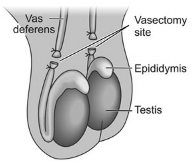
$A-$vas deferens; $B-$vasectomy
C
$A-$vas efferentia; $B-$tubectomy
D
$A-$vas efferentia; $B-$vasectomy
Solution
(B) In male sterilization,a small part of the $A-$vas deferens is removed or tied up through a small incision on the scrotum. This surgical procedure is known as $B-$vasectomy. It acts as a permanent method of contraception by preventing the transport of sperm.
0 likes
View Solution163
MediumMCQ
In female sterilization,$A$ is cut and tied. This process is called $B$. Fill in the correct option for $A$ and $B$.
A
$A-$cervix; $B-$vasectomy
B
$A-$Fallopian tube; $B-$tubectomy
C
$A-$cervix; $B-$tubectomy
D
$A-$Fallopian tube; $B-$vasectomy
Solution
(B) In female sterilization,the $A-$Fallopian tube is cut and tied to prevent the movement of the ovum to the uterus. This surgical procedure is known as $B-$tubectomy. Therefore,the correct option is $B$.
0 likes
View Solution164
MediumMCQ
$A$ method of birth control is:
A
$GIFT$
B
$ZIFT$
C
$IVF-ET$
D
$IUDs$
Solution
(D) Birth control methods are used to prevent unwanted pregnancies.
$IUDs$ (Intrauterine Devices) are effective contraceptive methods that prevent fertilization or implantation.
$GIFT$ (Gamete Intrafallopian Transfer),$ZIFT$ (Zygote Intrafallopian Transfer),and $IVF-ET$ (In Vitro Fertilization-Embryo Transfer) are all Assisted Reproductive Technologies $(ART)$ used to treat infertility,not for birth control.
$IUDs$ (Intrauterine Devices) are effective contraceptive methods that prevent fertilization or implantation.
$GIFT$ (Gamete Intrafallopian Transfer),$ZIFT$ (Zygote Intrafallopian Transfer),and $IVF-ET$ (In Vitro Fertilization-Embryo Transfer) are all Assisted Reproductive Technologies $(ART)$ used to treat infertility,not for birth control.
0 likes
View Solution165
MediumMCQ
The most important component of contraceptive pills is:
A
Progesterone
B
Growth hormone
C
Thyroxine
D
Luteinising hormone
Solution
(A) Contraceptive pills,commonly known as oral contraceptives,primarily contain synthetic forms of the hormones $Progesterone$ and $Estrogen$.
These hormones work by inhibiting ovulation,altering the cervical mucus to prevent sperm entry,and changing the lining of the uterus to prevent implantation.
Among the options provided,$Progesterone$ is the key component responsible for these contraceptive effects.
Therefore,the correct option is $A$.
These hormones work by inhibiting ovulation,altering the cervical mucus to prevent sperm entry,and changing the lining of the uterus to prevent implantation.
Among the options provided,$Progesterone$ is the key component responsible for these contraceptive effects.
Therefore,the correct option is $A$.
0 likes
View Solution166
MediumMCQ
Example of the non-medicated $IUD$ is
A
$Cu-T$
B
$Cu-7$
C
Multiload-$375$
D
Lippes loop
Solution
(D) The correct answer is Lippes loop.
Intra Uterine Devices $(IUDs)$ are used for contraception.
$(i)$ These devices are inserted by doctors into the uterus through the vagina.
$(ii)$ There are three types of $IUDs$:
$1$. Non-medicated $IUDs$: These increase the phagocytosis of sperms within the uterus,$e.g.$,Lippes loop.
$2$. Copper Releasing $IUDs$: Along with the phagocytosis of sperms,the copper ions released suppress sperm motility and the fertilizing capacity of the sperm,$e.g.$,$Cu-T$,$Cu-7$,Multiload-$375$.
$3$. Hormone Releasing $IUDs$: These make the uterus unsuitable for implantation and the cervix hostile to the sperms,$e.g.$,Progestasert,$LNG-20$.
Intra Uterine Devices $(IUDs)$ are used for contraception.
$(i)$ These devices are inserted by doctors into the uterus through the vagina.
$(ii)$ There are three types of $IUDs$:
$1$. Non-medicated $IUDs$: These increase the phagocytosis of sperms within the uterus,$e.g.$,Lippes loop.
$2$. Copper Releasing $IUDs$: Along with the phagocytosis of sperms,the copper ions released suppress sperm motility and the fertilizing capacity of the sperm,$e.g.$,$Cu-T$,$Cu-7$,Multiload-$375$.
$3$. Hormone Releasing $IUDs$: These make the uterus unsuitable for implantation and the cervix hostile to the sperms,$e.g.$,Progestasert,$LNG-20$.
0 likes
View Solution167
MediumMCQ
Progesterone in the contraceptive pill:
A
Prevents ovulation
B
Inhibits estrogen
C
Checks attachment of zygote to endometrium
D
All the above
Solution
(D) Contraceptive pills contain either progesterone alone or a combination of progesterone and estrogen.
These hormones act through several mechanisms to prevent pregnancy:
$1$. They inhibit the release of $FSH$ and $LH$ from the pituitary gland,which prevents ovulation.
$2$. They alter the quality of cervical mucus to prevent or retard the entry of sperms.
$3$. They alter the uterine endometrium to make it unsuitable for implantation of the zygote.
Therefore,all the mentioned actions are part of the contraceptive effect.
These hormones act through several mechanisms to prevent pregnancy:
$1$. They inhibit the release of $FSH$ and $LH$ from the pituitary gland,which prevents ovulation.
$2$. They alter the quality of cervical mucus to prevent or retard the entry of sperms.
$3$. They alter the uterine endometrium to make it unsuitable for implantation of the zygote.
Therefore,all the mentioned actions are part of the contraceptive effect.
0 likes
View Solution168
MediumMCQ
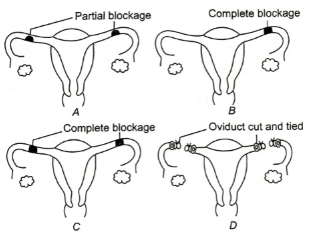
Based on the provided diagram,in which conditions of the fallopian tubes is fertilisation impossible?
A
$A$ and $B$
B
$B$ and $C$
C
$C$ and $D$
D
$A$ and $D$
Solution
(C) Fertilisation occurs in the ampullary region of the fallopian tube. For fertilisation to happen,the sperm must be able to reach the ovum.
In condition $A$,there is only a partial blockage,which might still allow some sperm to pass.
In conditions $B$ and $C$,there is a complete blockage of the fallopian tubes,preventing the sperm from reaching the ovum.
In condition $D$,the oviducts (fallopian tubes) are cut and tied (tubectomy),which creates a permanent physical barrier,making fertilisation impossible.
Therefore,in conditions $B$,$C$,and $D$,fertilisation is impossible. However,based on the provided options,the most accurate choice representing complete obstruction or surgical disconnection is $C$ and $D$.
In condition $A$,there is only a partial blockage,which might still allow some sperm to pass.
In conditions $B$ and $C$,there is a complete blockage of the fallopian tubes,preventing the sperm from reaching the ovum.
In condition $D$,the oviducts (fallopian tubes) are cut and tied (tubectomy),which creates a permanent physical barrier,making fertilisation impossible.
Therefore,in conditions $B$,$C$,and $D$,fertilisation is impossible. However,based on the provided options,the most accurate choice representing complete obstruction or surgical disconnection is $C$ and $D$.
0 likes
View Solution169
MediumMCQ
Find out the correct statement.
$I$. Pills prevent ovulation during use as a contraception technique.
$II$. Copper-$T$ prevents implantation.
$III$. Vasectomy produces semen containing no sperm.
$I$. Pills prevent ovulation during use as a contraception technique.
$II$. Copper-$T$ prevents implantation.
$III$. Vasectomy produces semen containing no sperm.
A
$I$ and $II$
B
$II$ and $III$
C
$I$ and $III$
D
$I, II$ and $III$
Solution
(D) The correct statements are as follows:
$(i)$ Oral contraceptive pills contain hormones that inhibit the release of eggs from the ovary,thereby preventing ovulation.
$(ii)$ Copper-$T$ (an intrauterine device) releases copper ions which suppress sperm motility and their fertilizing capacity,and it also prevents implantation of the embryo in the uterus.
$(iii)$ Vasectomy is a surgical sterilization method in males where the vas deferens is cut and tied,which prevents the transport of sperm into the semen. Thus,the semen produced does not contain any sperm.
Therefore,all three statements are correct.
$(i)$ Oral contraceptive pills contain hormones that inhibit the release of eggs from the ovary,thereby preventing ovulation.
$(ii)$ Copper-$T$ (an intrauterine device) releases copper ions which suppress sperm motility and their fertilizing capacity,and it also prevents implantation of the embryo in the uterus.
$(iii)$ Vasectomy is a surgical sterilization method in males where the vas deferens is cut and tied,which prevents the transport of sperm into the semen. Thus,the semen produced does not contain any sperm.
Therefore,all three statements are correct.
0 likes
View Solution170
MediumMCQ
What is the purpose of the surgical method of contraception?
A
Prevent gamete motility
B
Prevent gamete formation
C
Gametogenesis promotion
D
Facilitate implantation
Solution
(A) The surgical methods of contraception,also known as sterilization,involve blocking the transport of gametes.
In males,this procedure is called $Vasectomy$,where a small part of the $vas$ $deferens$ is removed or tied up.
In females,it is called $Tubectomy$,where a small part of the $Fallopian$ $tubes$ is removed or tied up.
These procedures effectively prevent the motility and transport of gametes (sperm or ova),thereby preventing fertilization.
In $Vasectomy$,the semen still contains secretions from accessory glands like the seminal vesicles,prostate,and $Cowper's$ glands,but it lacks sperm.
In males,this procedure is called $Vasectomy$,where a small part of the $vas$ $deferens$ is removed or tied up.
In females,it is called $Tubectomy$,where a small part of the $Fallopian$ $tubes$ is removed or tied up.
These procedures effectively prevent the motility and transport of gametes (sperm or ova),thereby preventing fertilization.
In $Vasectomy$,the semen still contains secretions from accessory glands like the seminal vesicles,prostate,and $Cowper's$ glands,but it lacks sperm.
0 likes
View Solution171
MediumMCQ
Identify the natural methods of contraception from the following list:
$I$. Implantation
$II$. Lactational amenorrhoea
$III$. Condoms
$IV$. Vasectomy
$V$. Tubectomy
$VI$. Sterilisation
$I$. Implantation
$II$. Lactational amenorrhoea
$III$. Condoms
$IV$. Vasectomy
$V$. Tubectomy
$VI$. Sterilisation
A
$I$ and $II$
B
$III$ and $IV$
C
$V$ and $VI$
D
Only $II$
Solution
(D) Natural methods of contraception work on the principle of avoiding chances of ovum and sperm meeting.
Lactational amenorrhoea is a natural method based on the fact that ovulation and the menstrual cycle do not occur during the period of intense lactation following parturition.
Implantation is a biological process,not a contraceptive method.
Condoms are barrier methods.
Vasectomy,Tubectomy,and Sterilisation are surgical methods (permanent methods).
Therefore,only $II$ (Lactational amenorrhoea) is a natural method.
Lactational amenorrhoea is a natural method based on the fact that ovulation and the menstrual cycle do not occur during the period of intense lactation following parturition.
Implantation is a biological process,not a contraceptive method.
Condoms are barrier methods.
Vasectomy,Tubectomy,and Sterilisation are surgical methods (permanent methods).
Therefore,only $II$ (Lactational amenorrhoea) is a natural method.
0 likes
View Solution172
MediumMCQ
Choose the correct statement among the following regarding $IUDs$:
A
$IUDs$ are generally inserted by the user herself.
B
$IUDs$ increase phagocytosis reaction in the uterus.
C
$IUDs$ suppress gametogenesis.
D
$IUDs$ once inserted need not be replaced.
Solution
(B) $IUDs$ (Intra Uterine Devices) are effective contraceptive methods.
$1$. $IUDs$ must be inserted by doctors or expert nurses,not by the user herself.
$2$. $IUDs$ increase phagocytosis of sperms within the uterus,which is their primary mechanism of action.
$3$. $IUDs$ do not suppress gametogenesis; they primarily act by preventing fertilization or implantation.
$4$. $IUDs$ need to be replaced after a specific period depending on the type (e.g.,Copper-$T$ or hormonal $IUDs$).
Therefore,the correct statement is that $IUDs$ increase phagocytosis reaction in the uterus.
$1$. $IUDs$ must be inserted by doctors or expert nurses,not by the user herself.
$2$. $IUDs$ increase phagocytosis of sperms within the uterus,which is their primary mechanism of action.
$3$. $IUDs$ do not suppress gametogenesis; they primarily act by preventing fertilization or implantation.
$4$. $IUDs$ need to be replaced after a specific period depending on the type (e.g.,Copper-$T$ or hormonal $IUDs$).
Therefore,the correct statement is that $IUDs$ increase phagocytosis reaction in the uterus.
0 likes
View Solution173
MediumMCQ
Hormone releasing $IUDs$ among the following are
A
$Copper-T$
B
$LNG-20$
C
Saheli
D
Diaphragm
Solution
(B) The hormone-releasing $IUD$ among the given options is $LNG-20$.
Intra Uterine Devices $(IUDs)$ are used for contraception and are inserted by doctors into the uterus through the vagina.
$IUDs$ are classified into three types:
$1$. Non-medicated $IUDs$: These increase the phagocytosis of sperms within the uterus,$e.g.$,Lippes loop.
$2$. Copper-releasing $IUDs$: Along with the phagocytosis of sperms,the released copper ions suppress sperm motility and their fertilizing capacity,$e.g.$,$Cu-T$,$Cu-7$,Multiload-$375$.
$3$. Hormone-releasing $IUDs$: These make the uterus unsuitable for implantation and the cervix hostile to sperms,$e.g.$,Progestasert,$LNG-20$.
Intra Uterine Devices $(IUDs)$ are used for contraception and are inserted by doctors into the uterus through the vagina.
$IUDs$ are classified into three types:
$1$. Non-medicated $IUDs$: These increase the phagocytosis of sperms within the uterus,$e.g.$,Lippes loop.
$2$. Copper-releasing $IUDs$: Along with the phagocytosis of sperms,the released copper ions suppress sperm motility and their fertilizing capacity,$e.g.$,$Cu-T$,$Cu-7$,Multiload-$375$.
$3$. Hormone-releasing $IUDs$: These make the uterus unsuitable for implantation and the cervix hostile to sperms,$e.g.$,Progestasert,$LNG-20$.
0 likes
View Solution174
MediumMCQ
Which hormone of the female body is suppressed by the oral contraceptive pills?
A
$FSH$
B
Inhibin
C
Progesterone
D
Testosterone
Solution
(A) Oral contraceptive pills contain synthetic forms of progesterone and estrogen.
These hormones act via negative feedback mechanisms to suppress the secretion of $FSH$ (Follicle Stimulating Hormone) and $LH$ (Luteinizing Hormone) from the anterior pituitary gland.
By inhibiting $FSH$ and $LH$,these pills prevent the maturation of ovarian follicles and ovulation,thereby preventing pregnancy.
These hormones act via negative feedback mechanisms to suppress the secretion of $FSH$ (Follicle Stimulating Hormone) and $LH$ (Luteinizing Hormone) from the anterior pituitary gland.
By inhibiting $FSH$ and $LH$,these pills prevent the maturation of ovarian follicles and ovulation,thereby preventing pregnancy.
0 likes
View Solution175
MediumMCQ
Progestasert and $LNG-20$ are the examples of
A
Non-medicated $IUDs$
B
Copper releasing $IUDs$
C
Hormone releasing $IUDs$
D
All of the above
Solution
(C) The correct answer is Hormone releasing $IUDs$.
Intra Uterine Devices $(IUDs)$ are used for contraception.
$(i)$ These devices are inserted by doctors into the uterus through the vagina.
(ii) There are three types of $IUDs$:
- Non-medicated $IUDs$: These increase the phagocytosis of sperm within the uterus,e.g.,Lippes loop.
- Copper Releasing $IUDs$: Along with phagocytosis of sperm,the copper ions released suppress sperm motility and the fertilizing capacity of the sperm,e.g.,$Cu-T$,$Cu-7$,Multiload-$375$.
- Hormone Releasing $IUDs$: These make the uterus unsuitable for implantation and the cervix hostile to the sperm,e.g.,Progestasert,$LNG-20$.
Intra Uterine Devices $(IUDs)$ are used for contraception.
$(i)$ These devices are inserted by doctors into the uterus through the vagina.
(ii) There are three types of $IUDs$:
- Non-medicated $IUDs$: These increase the phagocytosis of sperm within the uterus,e.g.,Lippes loop.
- Copper Releasing $IUDs$: Along with phagocytosis of sperm,the copper ions released suppress sperm motility and the fertilizing capacity of the sperm,e.g.,$Cu-T$,$Cu-7$,Multiload-$375$.
- Hormone Releasing $IUDs$: These make the uterus unsuitable for implantation and the cervix hostile to the sperm,e.g.,Progestasert,$LNG-20$.
0 likes
View Solution176
MediumMCQ
The best way to decrease the population growth of a country is:
A
To educate people
B
To have better houses
C
To kill people on a large scale
D
To practice and implement family planning
Solution
(D) The most effective and ethical method to control population growth is to practice and implement family planning. Family planning involves the use of contraceptive methods and birth control measures to regulate the number and spacing of children. This approach empowers individuals and couples to make informed decisions about their reproductive health,leading to a stable population growth rate. Education is a contributing factor,but family planning is the direct mechanism for population control.
0 likes
View Solution177
MediumMCQ
What is the use of condoms?
A
Decreases sperm motility
B
Increases sperm motility
C
Barrier to prevent fusion of sperm and ova
D
Increases phagocytosis
Solution
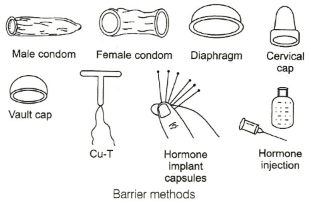
(C) Barrier Methods:
These methods prevent the contact of sperm and ovum with the help of barriers.
$(i)$ Condoms are barriers made of thin rubber/latex sheath used to cover the penis in the male or vagina and cervix in the female. It prevents the deposition of the ejaculated semen into the vagina of the female.
(ii) Diaphragms,cervical caps,and vaults are barriers made of rubber that are inserted into the female reproductive tract to cover the cervix during coitus.
(iii) Spermicidal creams,jellies,and foams are used along with these barriers to increase their contraceptive efficiency.
These methods prevent the contact of sperm and ovum with the help of barriers.
$(i)$ Condoms are barriers made of thin rubber/latex sheath used to cover the penis in the male or vagina and cervix in the female. It prevents the deposition of the ejaculated semen into the vagina of the female.
(ii) Diaphragms,cervical caps,and vaults are barriers made of rubber that are inserted into the female reproductive tract to cover the cervix during coitus.
(iii) Spermicidal creams,jellies,and foams are used along with these barriers to increase their contraceptive efficiency.
0 likes
View Solution178
MediumMCQ
Diaphragms are contraceptive devices used by females. Choose the correct option from the statements given below:
$i$. They are introduced into the uterus
$ii$. They are placed to cover the cervical region
$iii$. They act as physical barriers for sperm entry
$iv$. They act as spermicidal agents
$i$. They are introduced into the uterus
$ii$. They are placed to cover the cervical region
$iii$. They act as physical barriers for sperm entry
$iv$. They act as spermicidal agents
A
$i$ and $ii$
B
$i$ and $iii$
C
$ii$ and $iii$
D
$iii$ and $iv$
Solution
(C) Diaphragms are barrier methods of contraception used by females.
They are made of rubber and are inserted into the female reproductive tract to cover the cervix during coitus.
By covering the cervix,they prevent the entry of sperms into the uterus,thus acting as physical barriers.
Statement $i$ is incorrect because they are placed in the vagina,not inside the uterus.
Statement $iv$ is incorrect because diaphragms themselves are not spermicidal; however,they are often used in conjunction with spermicidal creams,jellies,or foams to increase their efficacy.
Therefore,statements $ii$ and $iii$ are correct.
They are made of rubber and are inserted into the female reproductive tract to cover the cervix during coitus.
By covering the cervix,they prevent the entry of sperms into the uterus,thus acting as physical barriers.
Statement $i$ is incorrect because they are placed in the vagina,not inside the uterus.
Statement $iv$ is incorrect because diaphragms themselves are not spermicidal; however,they are often used in conjunction with spermicidal creams,jellies,or foams to increase their efficacy.
Therefore,statements $ii$ and $iii$ are correct.
0 likes
View Solution179
MediumMCQ
What is the function of Copper $T$?
A
Prevents mutation
B
Prevents fertilization
C
Prevents implantation
D
Both $(B)$ and $(C)$
Solution
(D) Copper $T$ is an Intrauterine Device $(IUD)$ used for contraception.
It functions primarily by releasing copper ions $(Cu^{2+})$ into the uterus.
These copper ions suppress the motility and fertilizing capacity of sperm,thereby preventing fertilization.
Additionally,$IUDs$ like Copper $T$ increase phagocytosis of sperm within the uterus and alter the uterine environment,which makes the uterus unsuitable for implantation of the embryo.
Therefore,it prevents both fertilization and implantation.
It functions primarily by releasing copper ions $(Cu^{2+})$ into the uterus.
These copper ions suppress the motility and fertilizing capacity of sperm,thereby preventing fertilization.
Additionally,$IUDs$ like Copper $T$ increase phagocytosis of sperm within the uterus and alter the uterine environment,which makes the uterus unsuitable for implantation of the embryo.
Therefore,it prevents both fertilization and implantation.
0 likes
View Solution180
MediumMCQ
What is the difference between oral contraceptives and hormonal implants?
A
They differ in their sites of administration.
B
They differ in their duration of action.
C
Both $(A)$ and $(B)$.
D
None of the above.
Solution
(C) Oral contraceptives and hormonal implants both function by releasing synthetic hormones,typically a combination of oestrogen and progesterone,to prevent ovulation and alter cervical mucus.
They differ in their site of administration: oral contraceptives are taken by mouth (systemic),whereas hormonal implants are inserted subdermally (under the skin).
They also differ significantly in their duration of action: oral contraceptives must be taken daily,whereas hormonal implants provide long-term contraception lasting for several years.
They differ in their site of administration: oral contraceptives are taken by mouth (systemic),whereas hormonal implants are inserted subdermally (under the skin).
They also differ significantly in their duration of action: oral contraceptives must be taken daily,whereas hormonal implants provide long-term contraception lasting for several years.
0 likes
View Solution181
MediumMCQ
Injections and implants (containing progesterone or progesterone-oestrogen combinations) are used by females under the:
A
Skin of the inner arm above the elbow
B
Vagina
C
Stomach's upper skin
D
Cervix
Solution
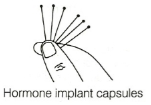
(A) Hormonal implants consist of small,matchstick-sized capsules containing synthetic hormones (progesterone or a combination of progesterone and oestrogen). These are surgically inserted under the skin of the inner arm,just above the elbow. Once implanted,they slowly release the hormones into the bloodstream over a period of several years to prevent pregnancy.
0 likes
View Solution182
MediumMCQ
Which $IUD$ increases the phagocytosis of the sperms within the uterus?
A
Hormone releasing $IUD$
B
Copper releasing $IUD$
C
Both $(a)$ and $(b)$
D
None
Solution
(C) The correct answer is $(c)$.
Intra Uterine Devices $(IUDs)$ are effective contraceptive methods.
$(i)$ Non-medicated $IUDs$ (e.g.,Lippes loop) increase the phagocytosis of sperms within the uterus.
$(ii)$ Copper releasing $IUDs$ (e.g.,$Cu-T$,$Cu-7$,Multiload $375$) release copper ions which suppress sperm motility and fertilizing capacity,in addition to increasing phagocytosis.
$(iii)$ Hormone releasing $IUDs$ (e.g.,Progestasert,$LNG-20$) make the uterus unsuitable for implantation and the cervix hostile to sperms.
Since both non-medicated $IUDs$ (often categorized under general $IUD$ functions in some contexts) and copper-releasing $IUDs$ exhibit phagocytic activity,option $(c)$ is the most appropriate choice.
Intra Uterine Devices $(IUDs)$ are effective contraceptive methods.
$(i)$ Non-medicated $IUDs$ (e.g.,Lippes loop) increase the phagocytosis of sperms within the uterus.
$(ii)$ Copper releasing $IUDs$ (e.g.,$Cu-T$,$Cu-7$,Multiload $375$) release copper ions which suppress sperm motility and fertilizing capacity,in addition to increasing phagocytosis.
$(iii)$ Hormone releasing $IUDs$ (e.g.,Progestasert,$LNG-20$) make the uterus unsuitable for implantation and the cervix hostile to sperms.
Since both non-medicated $IUDs$ (often categorized under general $IUD$ functions in some contexts) and copper-releasing $IUDs$ exhibit phagocytic activity,option $(c)$ is the most appropriate choice.
0 likes
View Solution183
MediumMCQ
Which of the following is a mechanical barrier used in birth control?
A
Loop
B
Copper-$T$
C
Diaphragm
D
Dalcon shield
Solution
(C) Mechanical barriers are devices used to prevent the physical meeting of sperm and ovum during intercourse.
$A$ $Loop$,$B$ $Copper-T$,and $D$ $Dalcon$ $shield$ are all types of Intrauterine Devices $(IUDs)$,which are chemical or hormonal methods of contraception.
$C$ $Diaphragm$ is a mechanical barrier made of rubber that is inserted into the female reproductive tract to cover the cervix,thereby preventing sperm from entering the uterus.
$A$ $Loop$,$B$ $Copper-T$,and $D$ $Dalcon$ $shield$ are all types of Intrauterine Devices $(IUDs)$,which are chemical or hormonal methods of contraception.
$C$ $Diaphragm$ is a mechanical barrier made of rubber that is inserted into the female reproductive tract to cover the cervix,thereby preventing sperm from entering the uterus.
0 likes
View Solution184
MediumMCQ
Administration of progesterone, progesterone-oestrogen combination, and $IUDs$ are effective as emergency contraceptives within
A
$72 \; \text{hours}$
B
$48 \; \text{hours}$
C
$24 \; \text{hours}$
D
$96 \; \text{hours}$
Solution
(A) Progesterone, progesterone-oestrogen combinations, and $IUDs$ are highly effective as emergency contraceptives if administered within $72 \; \text{hours}$ of unprotected sexual intercourse. These methods work by preventing or delaying ovulation or by preventing implantation of the fertilized egg.
0 likes
View Solution185
MediumMCQ
Periodic abstinence is a method of birth control that involves avoiding sexual intercourse during which phase?
A
Luteal phase
B
Ovulatory phase
C
Menstrual phase
D
None of these
Solution
(B) Periodic abstinence involves avoiding sexual intercourse during the fertile period to prevent conception.
Ovulation typically occurs around the $14^{th}$ day of the menstrual cycle.
Since sperm can survive in the female reproductive tract for $2-3$ days and the ovum remains viable for about $24$ hours,the period from day $10$ to day $17$ of the menstrual cycle is considered the 'fertile period' or 'ovulatory phase'.
Therefore,avoiding sexual intercourse during this time significantly reduces the chances of pregnancy.
However,the effectiveness of this method is limited because it requires a regular menstrual cycle,and the exact time of ovulation can be difficult to predict.
Ovulation typically occurs around the $14^{th}$ day of the menstrual cycle.
Since sperm can survive in the female reproductive tract for $2-3$ days and the ovum remains viable for about $24$ hours,the period from day $10$ to day $17$ of the menstrual cycle is considered the 'fertile period' or 'ovulatory phase'.
Therefore,avoiding sexual intercourse during this time significantly reduces the chances of pregnancy.
However,the effectiveness of this method is limited because it requires a regular menstrual cycle,and the exact time of ovulation can be difficult to predict.
0 likes
View Solution186
MediumMCQ
Find out the correct choice for $Cu$-based $IUDs$.
$I$. Increases phagocytosis of sperms.
$II$. Releases $Cu^{2+}$ ions that suppress the sperm motility and fertilizing capacity of sperms.
$III$. Make the uterus unsuitable for implantation.
$I$. Increases phagocytosis of sperms.
$II$. Releases $Cu^{2+}$ ions that suppress the sperm motility and fertilizing capacity of sperms.
$III$. Make the uterus unsuitable for implantation.
A
$I$,$II$ and $III$
B
$I$ and $II$
C
Only $I$
D
None of the above
Solution
(B) Copper-releasing $IUDs$ (like $Cu-T$,$Cu-7$,$Multiload-375$) function through the following mechanisms:
$1$. They increase the phagocytosis of sperms within the uterus.
$2$. They release $Cu^{2+}$ ions,which suppress the sperm motility and the fertilizing capacity of the sperms.
Statement $III$ refers to the mechanism of hormone-releasing $IUDs$ (like $Progestasert$,$LNG-20$),which make the uterus unsuitable for implantation and the cervix hostile to the sperms.
Therefore,only statements $I$ and $II$ are correct for $Cu$-based $IUDs$.
$1$. They increase the phagocytosis of sperms within the uterus.
$2$. They release $Cu^{2+}$ ions,which suppress the sperm motility and the fertilizing capacity of the sperms.
Statement $III$ refers to the mechanism of hormone-releasing $IUDs$ (like $Progestasert$,$LNG-20$),which make the uterus unsuitable for implantation and the cervix hostile to the sperms.
Therefore,only statements $I$ and $II$ are correct for $Cu$-based $IUDs$.
0 likes
View Solution187
MediumMCQ
$Statement 1$: Use of condoms is a safeguard against $AIDS$ and sexual diseases besides checking pregnancy.
$Statement 2$: Certain contraceptives are planted under the skin of the upper arm to prevent pregnancy.
$Statement 2$: Certain contraceptives are planted under the skin of the upper arm to prevent pregnancy.
A
$Statement 1$ is True, $Statement 2$ is True; $Statement 2$ is the correct explanation for $Statement 1$.
B
$Statement 1$ is True, $Statement 2$ is True; $Statement 2$ is not the correct explanation for $Statement 1$.
C
$Statement 1$ is True, $Statement 2$ is False.
D
$Statement 1$ is False, $Statement 2$ is True.
Solution
(B) $Statement 1$ is true because condoms act as a physical barrier that prevents the exchange of body fluids, thereby protecting against $AIDS$ and other sexually transmitted infections $(STIs)$ in addition to preventing pregnancy.
$Statement 2$ is also true because hormonal implants (like Norplant) are small, flexible rods containing synthetic progestogen that are inserted under the skin of the upper arm to provide long-term contraception.
However, $Statement 2$ does not explain why condoms are effective against $AIDS$; they are two independent facts about different contraceptive methods. Therefore, $Statement 2$ is not the correct explanation for $Statement 1$.
$Statement 2$ is also true because hormonal implants (like Norplant) are small, flexible rods containing synthetic progestogen that are inserted under the skin of the upper arm to provide long-term contraception.
However, $Statement 2$ does not explain why condoms are effective against $AIDS$; they are two independent facts about different contraceptive methods. Therefore, $Statement 2$ is not the correct explanation for $Statement 1$.
0 likes
View Solution188
EasyMCQ
Match the following columns:
| Column-$I$ | Column-$II$ |
|---|---|
| $A$. Pill | $1$. Intra uterine device |
| $B$. Condom | $2$. Prevents ovulation |
| $C$. Vasectomy | $3$. Prevents sperms from reaching to cervix |
| $D$. Cu-$T$ | $4$. Semen contains no sperms |
A
$A-1, B-2, C-4, D-3$
B
$A-2, B-3, C-4, D-1$
C
$A-2, B-3, C-1, D-4$
D
$A-4, B-3, C-2, D-1$
Solution
(B) . Pill: These are oral contraceptives that prevent ovulation.
$B$. Condom: These are barrier methods that prevent sperms from reaching the cervix.
$C$. Vasectomy: This is a surgical sterilization method in males where the vas deferens is cut and tied,resulting in semen that contains no sperms.
$D$. Cu-$T$: This is a type of Intra Uterine Device $(IUD)$ used for contraception.
Therefore,the correct matching is $A-2, B-3, C-4, D-1$.
$B$. Condom: These are barrier methods that prevent sperms from reaching the cervix.
$C$. Vasectomy: This is a surgical sterilization method in males where the vas deferens is cut and tied,resulting in semen that contains no sperms.
$D$. Cu-$T$: This is a type of Intra Uterine Device $(IUD)$ used for contraception.
Therefore,the correct matching is $A-2, B-3, C-4, D-1$.
0 likes
View Solution189
MediumMCQ
Match the following columns:
| Column-$I$ | Column-$II$ |
| $(A)$ Barrier | $(1)$ Copper-$T$ |
| $(B)$ $IUD$ | $(2)$ Vasectomy and tubectomy |
| $(C)$ Surgical technique | $(3)$ Condoms,cervical caps |
| $(D)$ Administering hormones | $(4)$ Oral pills and Saheli |
A
$(A)-(4), (B)-(2), (C)-(1), (D)-(3)$
B
$(A)-(1), (B)-(2), (C)-(3), (D)-(4)$
C
$(A)-(4), (B)-(3), (C)-(2), (D)-(1)$
D
$(A)-(3), (B)-(1), (C)-(2), (D)-(4)$
Solution
(D) The correct matching is as follows:
$(A)$ Barrier methods prevent the physical meeting of sperm and ovum. Examples include condoms and cervical caps. Thus,$(A)-(3)$.
$(B)$ $IUD$ (Intrauterine Device) includes devices like Copper-$T$ which are inserted into the uterus. Thus,$(B)-(1)$.
$(C)$ Surgical techniques (sterilization) include vasectomy in males and tubectomy in females. Thus,$(C)-(2)$.
$(D)$ Administering hormones involves the use of oral contraceptive pills and drugs like Saheli. Thus,$(D)-(4)$.
Therefore,the correct sequence is $(A)-(3), (B)-(1), (C)-(2), (D)-(4)$.
$(A)$ Barrier methods prevent the physical meeting of sperm and ovum. Examples include condoms and cervical caps. Thus,$(A)-(3)$.
$(B)$ $IUD$ (Intrauterine Device) includes devices like Copper-$T$ which are inserted into the uterus. Thus,$(B)-(1)$.
$(C)$ Surgical techniques (sterilization) include vasectomy in males and tubectomy in females. Thus,$(C)-(2)$.
$(D)$ Administering hormones involves the use of oral contraceptive pills and drugs like Saheli. Thus,$(D)-(4)$.
Therefore,the correct sequence is $(A)-(3), (B)-(1), (C)-(2), (D)-(4)$.
0 likes
View Solution190
MediumMCQ
What is the purpose of contraceptive pills?
$I$. They inhibit ovulation and implantation
$II$. They alter the quality of cervical mucous to prevent or retard the entry of sperms
$III$. They prevent the ejaculated semen from entering the female vagina
$IV$. They inhibit spermatogenesis
$I$. They inhibit ovulation and implantation
$II$. They alter the quality of cervical mucous to prevent or retard the entry of sperms
$III$. They prevent the ejaculated semen from entering the female vagina
$IV$. They inhibit spermatogenesis
A
$I, II \text{ and } IV$
B
$I, II \text{ and } III$
C
$I \text{ and } II$
D
$I, II, III \text{ and } IV$
Solution
(C) Oral contraceptive pills contain either progestogens alone or in combination with oestrogen.
These pills work primarily by inhibiting ovulation and implantation.
Additionally,they alter the quality of cervical mucus to prevent or retard the entry of sperms into the uterus.
Statement $III$ describes the function of barrier methods (like condoms),and statement $IV$ is incorrect as pills do not inhibit spermatogenesis in males.
Therefore,only statements $I$ and $II$ are correct regarding the mechanism of action of contraceptive pills.
These pills work primarily by inhibiting ovulation and implantation.
Additionally,they alter the quality of cervical mucus to prevent or retard the entry of sperms into the uterus.
Statement $III$ describes the function of barrier methods (like condoms),and statement $IV$ is incorrect as pills do not inhibit spermatogenesis in males.
Therefore,only statements $I$ and $II$ are correct regarding the mechanism of action of contraceptive pills.
0 likes
View Solution191
MediumMCQ
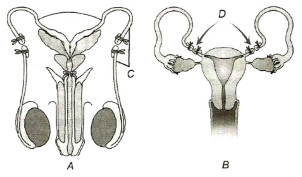
Choose the correct option for $A, B, C$ and $D$.
A
$A-$Tubectomy,$B-$Vasectomy,$C-$Fallopian tube cut and tied,$D-$Vas-deferens cut and tied
B
$A-$Tubectomy,$B-$Vasectomy,$C-$Cervix,$D-$Vas-deferens cut and tied
C
$A-$Vasectomy,$B-$Tubectomy,$C-$Vas deferens cut and tied,$D-$Fallopian tube cut and tied
D
$A-$Tubectomy,$B-$Vasectomy,$C-$Vas deferens cut and tied,$D-$Fallopian tube cut and tied
Solution
(C) The correct option is $C$.
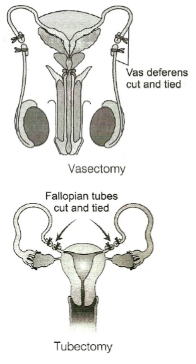
$A-$Vasectomy (male sterilization),$B-$Tubectomy (female sterilization).
$C-$Vas deferens cut and tied (in males).
$D-$Fallopian tube cut and tied (in females).
Surgical methods,also called sterilization,are terminal methods used to prevent pregnancy. They work by blocking the transport of gametes.
$1.$ Vasectomy: In males,a small portion of the vas deferens is removed or tied up through a small incision on the scrotum.
$2.$ Tubectomy: In females,a small part of the Fallopian tube is removed or tied up through a small incision in the abdomen or through the vagina.
$A-$Vasectomy (male sterilization),$B-$Tubectomy (female sterilization).
$C-$Vas deferens cut and tied (in males).
$D-$Fallopian tube cut and tied (in females).
Surgical methods,also called sterilization,are terminal methods used to prevent pregnancy. They work by blocking the transport of gametes.
$1.$ Vasectomy: In males,a small portion of the vas deferens is removed or tied up through a small incision on the scrotum.
$2.$ Tubectomy: In females,a small part of the Fallopian tube is removed or tied up through a small incision in the abdomen or through the vagina.
0 likes
View Solution192
MediumMCQ
Spermicidal creams used on the coating of condoms,diaphragms,cervical caps,and vaults are used for:
A
For lubrication
B
For shining
C
For increasing effectiveness
D
None of the above
Solution
(C) Spermicidal creams contain chemical agents that kill sperm cells. When these creams are used in conjunction with barrier methods of contraception like condoms,diaphragms,cervical caps,and vaults,they significantly increase the overall effectiveness of these contraceptive devices by providing an additional chemical barrier against fertilization.
0 likes
View Solution193
MediumMCQ
Identify the false statement regarding the techniques of contraception.
$I$. There are many side effects of tubectomy and vasectomy.
$II$. The purpose of tubectomy is to prevent egg formation.
$III$. The most important component of the oral contraceptive pill is progesterone.
$IV$. Contraceptive oral pills help in birth control by preventing ovulation.
$I$. There are many side effects of tubectomy and vasectomy.
$II$. The purpose of tubectomy is to prevent egg formation.
$III$. The most important component of the oral contraceptive pill is progesterone.
$IV$. Contraceptive oral pills help in birth control by preventing ovulation.
A
$I, II$ and $III$
B
$I$ and $II$
C
$III, IV$ and $II$
D
$IV$ and $II$
Solution
(B) Statement $I$ is false because tubectomy and vasectomy are surgical sterilization methods with little to no long-term side effects.
Statement $II$ is false because the purpose of tubectomy is to block the fallopian tubes to prevent the transport of the egg,not to prevent egg formation (ovulation still occurs).
Statement $III$ is true as oral contraceptive pills contain either progestogens alone or in combination with estrogen.
Statement $IV$ is true as these pills inhibit ovulation and implantation.
Statement $II$ is false because the purpose of tubectomy is to block the fallopian tubes to prevent the transport of the egg,not to prevent egg formation (ovulation still occurs).
Statement $III$ is true as oral contraceptive pills contain either progestogens alone or in combination with estrogen.
Statement $IV$ is true as these pills inhibit ovulation and implantation.
0 likes
View Solution194
MediumMCQ
Copper releasing $IUDs$ are used for suppressing the
A
Activity of ova
B
Activity of the uterus
C
Motility of the sperms
D
Motility of ova
Solution
(C) Copper releasing $IUDs$ (Intra Uterine Devices) function by releasing copper ions $(Cu^{2+})$ into the uterus.
These copper ions increase the phagocytosis of sperms within the uterus.
Furthermore,the released copper ions significantly suppress the motility of the sperms and reduce their fertilizing capacity.
Examples of copper-releasing $IUDs$ include $Cu-T$,$Cu-7$,and $Multiload-375$.
These copper ions increase the phagocytosis of sperms within the uterus.
Furthermore,the released copper ions significantly suppress the motility of the sperms and reduce their fertilizing capacity.
Examples of copper-releasing $IUDs$ include $Cu-T$,$Cu-7$,and $Multiload-375$.
0 likes
View Solution195
MediumMCQ
Emergency contraceptives are effective if used within:
A
$72 \;hrs$ of coitus
B
$72 \;hrs$ of ovulation
C
$72 \;hrs$ of menstruation
D
$72 \;hrs$ of implantation
Solution
(A) Emergency contraceptives,such as pills containing progestogens or progestogen-estrogen combinations,are designed to prevent pregnancy after unprotected sexual intercourse.
These methods are highly effective if administered within $72 \;hrs$ of coitus (unprotected sexual intercourse).
They work primarily by inhibiting or delaying ovulation,altering the cervical mucus to prevent sperm entry,or preventing implantation if fertilization has already occurred.
Therefore,the correct time frame for their effectiveness is $72 \;hrs$ post-coitus.
These methods are highly effective if administered within $72 \;hrs$ of coitus (unprotected sexual intercourse).
They work primarily by inhibiting or delaying ovulation,altering the cervical mucus to prevent sperm entry,or preventing implantation if fertilization has already occurred.
Therefore,the correct time frame for their effectiveness is $72 \;hrs$ post-coitus.
0 likes
View Solution196
MediumMCQ
What is true about 'Saheli'?
$I$. Developed at $CDRI$,Lucknow
$II$. Contains a steroidal preparation
$III$. 'Once-a-week' pill
$IV$. Many side effects
$V$. High contraceptive value
$VI$. Very few side effects
$VII$. Low contraceptive value
$I$. Developed at $CDRI$,Lucknow
$II$. Contains a steroidal preparation
$III$. 'Once-a-week' pill
$IV$. Many side effects
$V$. High contraceptive value
$VI$. Very few side effects
$VII$. Low contraceptive value
A
$I, II, III, V$ and $VI$
B
$I, III, V$ and $VI$
C
$I, II, III, IV$ and $V$
D
$I, III, IV$ and $V$
Solution
(B) 'Saheli' is a non-steroidal oral contraceptive pill developed by the Central Drug Research Institute $(CDRI)$ in Lucknow.
It is a 'once-a-week' pill that is highly effective as a contraceptive.
It is known for having very few side effects compared to other hormonal contraceptives.
Therefore,the correct statements are $I$ (Developed at $CDRI$),$III$ ('Once-a-week' pill),$V$ (High contraceptive value),and $VI$ (Very few side effects).
Statement $II$ is incorrect because 'Saheli' is non-steroidal.
It is a 'once-a-week' pill that is highly effective as a contraceptive.
It is known for having very few side effects compared to other hormonal contraceptives.
Therefore,the correct statements are $I$ (Developed at $CDRI$),$III$ ('Once-a-week' pill),$V$ (High contraceptive value),and $VI$ (Very few side effects).
Statement $II$ is incorrect because 'Saheli' is non-steroidal.
0 likes
View Solution197
MediumMCQ
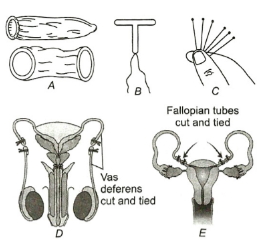
Match the following figures with their respective identities:
$I$. Tubectomy $II$. Vasectomy
$III$. Implants $IV$. Condoms
$V$. Copper$-T$
$I$. Tubectomy $II$. Vasectomy
$III$. Implants $IV$. Condoms
$V$. Copper$-T$
A
$A-IV; B-V; C-III; D-II; E-I$
B
$A-IV; B-IV; C-II; D-I; E-V$
C
$A-I; B-II; C-III; D-IV; E-V$
D
$A-III; B-IV; C-V; D-I; E-II$
Solution
(A) Based on the provided figures:
$A$ represents Condoms (barrier method).
$B$ represents Copper$-T$ (intrauterine device).
$C$ represents Implants (hormonal method).
$D$ represents Vasectomy (surgical method in males where vas deferens is cut and tied).
$E$ represents Tubectomy (surgical method in females where fallopian tubes are cut and tied).
Therefore,the correct matching is $A-IV, B-V, C-III, D-II, E-I$.
$A$ represents Condoms (barrier method).
$B$ represents Copper$-T$ (intrauterine device).
$C$ represents Implants (hormonal method).
$D$ represents Vasectomy (surgical method in males where vas deferens is cut and tied).
$E$ represents Tubectomy (surgical method in females where fallopian tubes are cut and tied).
Therefore,the correct matching is $A-IV, B-V, C-III, D-II, E-I$.
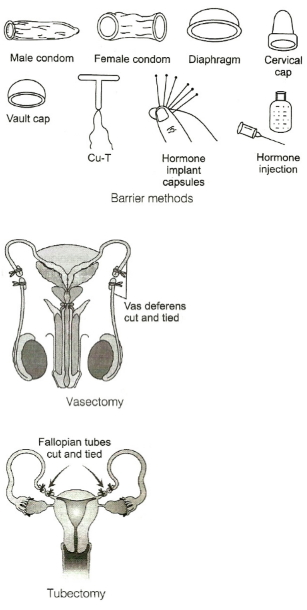
0 likes
View Solution198
MediumMCQ
Copper-$T$ prevents:
A
Ovulation
B
Fertilization of egg
C
Sperm Motility
D
Both $(B)$ and $(C)$
Solution
(D) Copper-$T$ is an Intrauterine Device $(IUD)$ that releases copper ions $(Cu^{2+})$ into the uterus.
These copper ions suppress the motility of sperm and their fertilizing capacity.
By reducing sperm motility,the $IUD$ effectively prevents the sperm from reaching the egg,thereby inhibiting fertilization.
Therefore,Copper-$T$ prevents both the fertilization of the egg and reduces sperm motility.
These copper ions suppress the motility of sperm and their fertilizing capacity.
By reducing sperm motility,the $IUD$ effectively prevents the sperm from reaching the egg,thereby inhibiting fertilization.
Therefore,Copper-$T$ prevents both the fertilization of the egg and reduces sperm motility.
0 likes
View Solution199
MediumMCQ
Find out the correct aspects of lactational amenorrhoea.
$I$. Ovulation does not occur during the lactational period.
$II$. Chances of the failure of contraception are almost nil up to six months following parturition.
$III$. Side effects are almost nil.
$IV$. It is a natural method of contraception.
$V$. It increases phagocytosis of sperms.
$I$. Ovulation does not occur during the lactational period.
$II$. Chances of the failure of contraception are almost nil up to six months following parturition.
$III$. Side effects are almost nil.
$IV$. It is a natural method of contraception.
$V$. It increases phagocytosis of sperms.
A
$II, III, IV$ and $V$
B
All except $V$
C
$I, II, III$ and $IV$
D
All of these
Solution
(C) $I$. Ovulation does not occur during the period of intense lactation,which is correct.
$II$. Chances of failure are almost nil up to six months following parturition,which is correct.
$III$. Since it is a natural method,side effects are almost nil,which is correct.
$IV$. It is a natural method of contraception,which is correct.
$V$. The increase in phagocytosis of sperms is a characteristic of $IUDs$ (Intra Uterine Devices),not lactational amenorrhoea. Therefore,this statement is incorrect.
Thus,statements $I, II, III$ and $IV$ are correct.
$II$. Chances of failure are almost nil up to six months following parturition,which is correct.
$III$. Since it is a natural method,side effects are almost nil,which is correct.
$IV$. It is a natural method of contraception,which is correct.
$V$. The increase in phagocytosis of sperms is a characteristic of $IUDs$ (Intra Uterine Devices),not lactational amenorrhoea. Therefore,this statement is incorrect.
Thus,statements $I, II, III$ and $IV$ are correct.
0 likes
View Solution200
MediumMCQ
In delaying pregnancy or spacing among children,the ideal contraceptive is
A
$IUD$
B
Natural method
C
Oral contraceptive
D
Pills
Solution
(A) $IUD$ (Intra Uterine Devices) are highly effective and widely used for spacing children.
New improved $IUD$s are available,which offer greater durability to prevent unwanted pregnancy.
Some of these devices are effective for a period ranging from $1$ to $5$ years.
Therefore,for delaying pregnancy or maintaining a gap between children,$IUD$ is considered the most ideal contraceptive method.
New improved $IUD$s are available,which offer greater durability to prevent unwanted pregnancy.
Some of these devices are effective for a period ranging from $1$ to $5$ years.
Therefore,for delaying pregnancy or maintaining a gap between children,$IUD$ is considered the most ideal contraceptive method.
0 likes
View SolutionReproductive Health — Method of birth control · Frequently Asked Questions
1Are these Reproductive Health questions useful for JEE and NEET?
Yes. All questions in this section are mapped to JEE Main and NEET exam patterns. Previous year questions from JEE Main, NEET, GUJCET and state-level exams are included with full solutions.
2Can I switch to Hindi or Gujarati for these questions?
Yes. Use the language tabs in the hero section or the sidebar to view the same questions and solutions in English, Hindi or Gujarati.
3How do I generate a question paper from this subtopic?
Use the Vedclass Exam Paper Generator — select the chapter and subtopic, set difficulty, and generate Sets A, B, C, D automatically. First 3 chapters of every subject are free.
Vedclass Products
For Students
Vedclass Test Series
Mock tests in real JEE/NEET style with performance analysis. 5-day free trial.
Start Free TrialFor Teachers
Exam Paper Generator
Generate Set A/B/C/D papers from this chapter in 2 minutes. 3 chapters free.
Try FreeFor Institutes
Online Exam Module
Live online exams with unlimited students, 360° analytics & white-label branding.
See DemoFor Teachers & Institutes
Generate a Reproductive Health Exam Paper in 2 Minutes
Select subtopic & difficulty — Sets A, B, C, D auto-generated with No Repeat logic.
First 3 chapters of every subject are free — no payment required.