
A English
Mendelism Questions in English
Class 12 Biology · Principles of Inheritance and Variation · Mendelism
354+
Questions
English
Language
100%
With Solutions
Showing 50 of 354 questions in English
301
MediumMCQ
Mendel published his work on the inheritance of characters in $1865$,but it remained unrecognized until $1900$ because:
$(a)$ He could not provide any physical proof for the existence of factors.
$(b)$ His concept of factors as stable,discrete units that controlled the expression of traits did not find acceptance from his contemporaries.
$(c)$ Mendel's approach of using mathematics to explain biological phenomena was considered ahead of its time and unconventional.
$(d)$ Communication was not easy (as it is now),and his work could not be widely publicized.
$(a)$ He could not provide any physical proof for the existence of factors.
$(b)$ His concept of factors as stable,discrete units that controlled the expression of traits did not find acceptance from his contemporaries.
$(c)$ Mendel's approach of using mathematics to explain biological phenomena was considered ahead of its time and unconventional.
$(d)$ Communication was not easy (as it is now),and his work could not be widely publicized.
A
$(a), (b) \; \& \; (c)$ are correct
B
$(c) \; \& \; (d)$ are correct
C
$(a), (b) \; \& \; (d)$ are correct
D
Only $(a)$ is correct
Solution
(C) Gregor Mendel's work remained unrecognized for several reasons:
$1$. Communication was not easy at that time,so his work could not be widely publicized $(d)$.
$2$. His concept of factors (genes) as stable,discrete units that control the expression of traits was new and did not find acceptance from his contemporaries $(b)$.
$3$. He could not provide any physical proof for the existence of factors or what they were made of $(a)$.
$4$. His approach of using mathematics to explain biological phenomena was totally new and unconventional for biologists of that time,not 'old' as stated in the original option $(c)$.
Therefore,statements $(a), (b),$ and $(d)$ are the correct reasons for his work remaining unrecognized.
$1$. Communication was not easy at that time,so his work could not be widely publicized $(d)$.
$2$. His concept of factors (genes) as stable,discrete units that control the expression of traits was new and did not find acceptance from his contemporaries $(b)$.
$3$. He could not provide any physical proof for the existence of factors or what they were made of $(a)$.
$4$. His approach of using mathematics to explain biological phenomena was totally new and unconventional for biologists of that time,not 'old' as stated in the original option $(c)$.
Therefore,statements $(a), (b),$ and $(d)$ are the correct reasons for his work remaining unrecognized.
0 likes
View Solution302
MediumMCQ
Fruit flies $(Drosophila \text{ } melanogaster)$ are one of the best materials for genetic studies because of all, except:
A
Ability to grow on simple synthetic medium in the laboratory
B
Short life span
C
Production of a large number of progeny in each mating
D
Presence of few externally visible and identifiable contrasting traits
Solution
(D) Fruit flies $(Drosophila \text{ } melanogaster)$ are considered ideal for genetic studies due to several reasons:
$1$. They can be grown on simple synthetic media in the laboratory.
$2$. They have a very short life span (about $2$ weeks).
$3$. They produce a large number of progeny in a single mating.
$4$. They exhibit many clearly visible and identifiable contrasting traits (not few).
Therefore, the statement that they have 'few' externally visible traits is incorrect, making option $D$ the correct answer.
$1$. They can be grown on simple synthetic media in the laboratory.
$2$. They have a very short life span (about $2$ weeks).
$3$. They produce a large number of progeny in a single mating.
$4$. They exhibit many clearly visible and identifiable contrasting traits (not few).
Therefore, the statement that they have 'few' externally visible traits is incorrect, making option $D$ the correct answer.
0 likes
View Solution303
MediumMCQ
Select the incorrect statement with respect to a reciprocal cross.
A
To know whether the alleles are present on sex chromosomes or autosomes.
B
It is made to eliminate the effect of nuclear traits.
C
Two individuals with contrasting genotypes are involved.
D
Results are not changed for autosomal traits.
Solution
(B) reciprocal cross is a breeding experiment where the sexes of the parents are reversed in two successive crosses.
$1$. It is primarily used to determine if a trait is sex-linked or autosomal.
$2$. If the trait is autosomal,the results of the reciprocal cross remain the same.
$3$. If the trait is sex-linked,the results differ because the sex chromosomes are inherited differently by the offspring.
$4$. Option $B$ is incorrect because a reciprocal cross does not eliminate the effect of nuclear traits; rather,it helps in identifying whether the trait is influenced by the sex of the parent (sex-linkage) or if it is inherited through nuclear genes on autosomes.
$1$. It is primarily used to determine if a trait is sex-linked or autosomal.
$2$. If the trait is autosomal,the results of the reciprocal cross remain the same.
$3$. If the trait is sex-linked,the results differ because the sex chromosomes are inherited differently by the offspring.
$4$. Option $B$ is incorrect because a reciprocal cross does not eliminate the effect of nuclear traits; rather,it helps in identifying whether the trait is influenced by the sex of the parent (sex-linkage) or if it is inherited through nuclear genes on autosomes.
0 likes
View Solution304
MediumMCQ
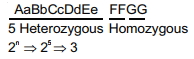
$A$ diploid organism is heterozygous for $5$ loci and homozygous for $2$ loci,how many types of gametes can be produced?
A
$128$
B
$32$
C
$4$
D
$14$
Solution
(B) The number of different types of gametes produced by an organism is calculated using the formula $2^n$,where $n$ is the number of heterozygous loci.
In this case,the organism is heterozygous for $5$ loci $(n = 5)$ and homozygous for $2$ loci.
Therefore,the number of types of gametes = $2^n = 2^5 = 32$.
Thus,the correct option is $B$.
In this case,the organism is heterozygous for $5$ loci $(n = 5)$ and homozygous for $2$ loci.
Therefore,the number of types of gametes = $2^n = 2^5 = 32$.
Thus,the correct option is $B$.
0 likes
View Solution305
MediumMCQ
$A$: Dominance is not an autonomous feature of a gene.
$R$: It depends as much on the gene product and the production of a particular phenotype from this product.
$R$: It depends as much on the gene product and the production of a particular phenotype from this product.
A
Assertion and Reason both are correct and Reason is the correct explanation of Assertion.
B
Assertion and Reason both are correct but Reason is not the correct explanation of Assertion.
C
Assertion is correct,but Reason is incorrect.
D
Both Assertion and Reason are incorrect.
Solution
(A) Dominance is not an autonomous feature of a gene or the product that it has information for. It depends as much on the gene product and the production of a particular phenotype from this product as it does on the particular phenotype that we choose to examine. In case of codominance or incomplete dominance,the gene product and the resulting phenotype vary,showing that dominance is a relative concept rather than an absolute property of a gene. Therefore,both Assertion and Reason are correct,and Reason is the correct explanation of Assertion.
0 likes
View Solution306
MediumMCQ
$A$: Mendel proposed postulates like "principles of segregation and principles of independent assortment" after studying seven pairs of contrasting traits in garden pea.
$R$: He was lucky in selecting seven characters in pea that were located on seven different chromosomes.
$R$: He was lucky in selecting seven characters in pea that were located on seven different chromosomes.
A
Assertion and Reason both are correct and Reason is the correct explanation of Assertion.
B
Assertion and Reason both are correct but Reason is not the correct explanation of Assertion.
C
Assertion is correct, but Reason is incorrect.
D
Both Assertion and Reason are incorrect.
Solution
(C) Mendel studied seven pairs of contrasting traits in garden pea $(Pisum \text{ } sativum)$ and formulated the laws of inheritance, including the law of segregation and the law of independent assortment. Thus, the Assertion is correct.
However, the Reason is incorrect. The garden pea plant has $7$ pairs of chromosomes $(2n = 14)$. Mendel studied seven traits, but these traits were not located on seven different chromosomes. In fact, some of the traits he studied were linked (located on the same chromosome), but because they were far apart, they showed independent assortment. Therefore, the statement that he was lucky because the traits were on seven different chromosomes is scientifically inaccurate.
However, the Reason is incorrect. The garden pea plant has $7$ pairs of chromosomes $(2n = 14)$. Mendel studied seven traits, but these traits were not located on seven different chromosomes. In fact, some of the traits he studied were linked (located on the same chromosome), but because they were far apart, they showed independent assortment. Therefore, the statement that he was lucky because the traits were on seven different chromosomes is scientifically inaccurate.
0 likes
View Solution307
EasyMCQ
The production of gametes by the parents,formation of zygotes,the $F_{1}$ and $F_{2}$ plants,can be understood from a diagram called:
A
Bullet square
B
Punch square
C
Punnett square
D
Net square
Solution
(C) The $Punnett$ $square$ is a graphical representation used to calculate the probability of all possible genotypes of offspring in a genetic cross.
It was developed by the British geneticist $Reginald$ $C.$ $Punnett$.
This diagram helps in visualizing the segregation of alleles during gamete formation and their random fusion during fertilization to form zygotes,which subsequently develop into $F_{1}$ and $F_{2}$ generation plants.
It was developed by the British geneticist $Reginald$ $C.$ $Punnett$.
This diagram helps in visualizing the segregation of alleles during gamete formation and their random fusion during fertilization to form zygotes,which subsequently develop into $F_{1}$ and $F_{2}$ generation plants.
0 likes
View Solution308
MediumMCQ
Given below are two statements:
Statement $I$:
Mendel studied seven pairs of contrasting traits in pea plants and proposed the Laws of Inheritance.
Statement $II$:
Seven characters examined by Mendel in his experiment on pea plants were seed shape and colour,flower colour,pod shape and colour,flower position and stem height.
In the light of the above statements,choose the correct answer from the options given below:
Statement $I$:
Mendel studied seven pairs of contrasting traits in pea plants and proposed the Laws of Inheritance.
Statement $II$:
Seven characters examined by Mendel in his experiment on pea plants were seed shape and colour,flower colour,pod shape and colour,flower position and stem height.
In the light of the above statements,choose the correct answer from the options given below:
A
Both Statement $I$ and Statement $II$ are incorrect.
B
Statement $I$ is correct but Statement $II$ is incorrect.
C
Statement $I$ is incorrect but Statement $II$ is correct.
D
Both Statement $I$ and Statement $II$ are correct.
Solution
(D) Statement $I$ is correct: Gregor Mendel conducted hybridization experiments on garden peas ($Pisum$ $sativum$) for seven years and selected seven pairs of contrasting traits to propose the Laws of Inheritance.
Statement $II$ is correct: The seven characters studied by Mendel were:
$1$. Seed shape (round/wrinkled)
$2$. Seed colour (yellow/green)
$3$. Flower colour (violet/white)
$4$. Pod shape (inflated/constricted)
$5$. Pod colour (green/yellow)
$6$. Flower position (axial/terminal)
$7$. Stem height (tall/dwarf)
Since both statements are factually accurate,the correct option is $D$.
Statement $II$ is correct: The seven characters studied by Mendel were:
$1$. Seed shape (round/wrinkled)
$2$. Seed colour (yellow/green)
$3$. Flower colour (violet/white)
$4$. Pod shape (inflated/constricted)
$5$. Pod colour (green/yellow)
$6$. Flower position (axial/terminal)
$7$. Stem height (tall/dwarf)
Since both statements are factually accurate,the correct option is $D$.
0 likes
View Solution309
MediumMCQ
What is heredity?
A
Transmission of characters from one generation to the next.
B
The phenomenon of parental traits being passed down to offspring.
C
The similarity between parents and offspring.
D
All of the above.
Solution
(D) Heredity is the process by which traits are passed from parents to their offspring.
$1$. It involves the transmission of genetic information from one generation to the next.
$2$. It explains why offspring resemble their parents (the phenomenon of parental traits being inherited).
$3$. Therefore,all the given options describe different aspects of heredity.
Thus,the correct answer is $D$.
$1$. It involves the transmission of genetic information from one generation to the next.
$2$. It explains why offspring resemble their parents (the phenomenon of parental traits being inherited).
$3$. Therefore,all the given options describe different aspects of heredity.
Thus,the correct answer is $D$.
0 likes
View Solution310
MediumMCQ
The cause of variation is hidden in the process of $.....P.....$ - this knowledge was acquired by humans in $.....Q.....$.
$\quad \quad P \quad\quad\quad Q$
$\quad \quad P \quad\quad\quad Q$
A
Sexual reproduction $\quad\quad 8000-1000 \text{ B.C.}$
B
Asexual reproduction $\quad\quad 8000-1000 \text{ B.C.}$
C
Sexual reproduction $\quad\quad 8000-10,000 \text{ B.C.}$
D
Asexual reproduction $\quad\quad 8000-10,000 \text{ B.C.}$
Solution
(A) The concept of variation and heredity has been understood by humans since ancient times. Humans knew that sexual reproduction is the cause of variation in offspring. This knowledge was applied in the selective breeding of plants and animals,which dates back to $8000-1000 \text{ B.C.}$ (the period of early agriculture and domestication). Thus,$P$ is sexual reproduction and $Q$ is $8000-1000 \text{ B.C.}$
0 likes
View Solution311
EasyMCQ
Who is known as the father of genetics?
A
Hugo de Vries
B
Gregor Mendel
C
Darwin
D
Carl Correns
Solution
(B) Gregor Mendel is known as the father of genetics. He performed experiments on pea plants ($Pisum$ $sativum$) and formulated the fundamental laws of inheritance,which laid the foundation for the field of modern genetics.
0 likes
View Solution312
EasyMCQ
Gregor Mendel conducted his hybridization experiments on garden peas for ......... years.
A
$1863-1866$
B
$1856-1863$
C
$1846-1853$
D
$1866-1873$
Solution
(B) Gregor Mendel, known as the father of genetics, performed his hybridization experiments on garden peas $(Pisum \text{ } sativum)$ for $7$ years.
These experiments were conducted from $1856$ to $1863$.
During this period, he studied the inheritance of various traits and formulated the laws of inheritance.
These experiments were conducted from $1856$ to $1863$.
During this period, he studied the inheritance of various traits and formulated the laws of inheritance.
0 likes
View Solution313
EasyMCQ
Mendel selected ....... true-breeding pea plant varieties.
A
$7$
B
$14$
C
$21$
D
$28$
Solution
(B) Gregor Mendel conducted his hybridization experiments on garden peas ($Pisum$ $sativum$).
He selected $14$ true-breeding pea plant varieties (lines) as pairs which were similar except for one character with contrasting traits.
These $14$ varieties represented $7$ pairs of contrasting characters (e.g.,tall/dwarf,violet/white flowers,etc.).
Therefore,the correct answer is $14$.
He selected $14$ true-breeding pea plant varieties (lines) as pairs which were similar except for one character with contrasting traits.
These $14$ varieties represented $7$ pairs of contrasting characters (e.g.,tall/dwarf,violet/white flowers,etc.).
Therefore,the correct answer is $14$.
0 likes
View Solution314
MediumMCQ
Which of the following traits was $NOT$ considered by Mendel in his experiments on pea plants?
A
Seed shape
B
Seed color
C
Flower shape
D
Flower color
Solution
(C) Gregor Mendel studied $7$ pairs of contrasting traits in pea plants ($Pisum$ $sativum$).
These traits were:
$1$. Stem height (Tall/Dwarf)
$2$. Flower color (Violet/White)
$3$. Flower position (Axial/Terminal)
$4$. Pod shape (Inflated/Constricted)
$5$. Pod color (Green/Yellow)
$6$. Seed shape (Round/Wrinkled)
$7$. Seed color (Yellow/Green)
Among the given options,'Flower shape' was not one of the traits studied by Mendel. Therefore,the correct option is $C$.
These traits were:
$1$. Stem height (Tall/Dwarf)
$2$. Flower color (Violet/White)
$3$. Flower position (Axial/Terminal)
$4$. Pod shape (Inflated/Constricted)
$5$. Pod color (Green/Yellow)
$6$. Seed shape (Round/Wrinkled)
$7$. Seed color (Yellow/Green)
Among the given options,'Flower shape' was not one of the traits studied by Mendel. Therefore,the correct option is $C$.
0 likes
View Solution315
MediumMCQ
On which of the following plants did Mendel perform his experiments?
A
Pisum sativum
B
Cicer arietinum
C
Lathyrus odoratus
D
Cajanus cajan
Solution
(A) Gregor Johann Mendel,known as the 'Father of Genetics',conducted his hybridization experiments on the garden pea plant.
The scientific name of the garden pea plant is $Pisum$ $sativum$.
He selected this plant because it has several contrasting characters,a short life cycle,and is easy to cultivate.
The scientific name of the garden pea plant is $Pisum$ $sativum$.
He selected this plant because it has several contrasting characters,a short life cycle,and is easy to cultivate.
0 likes
View Solution316
EasyMCQ
Which of the following traits of a pea plant is $NOT$ dominant?
A
Pod color - Yellow
B
Seed shape - Round
C
Flower color - Violet
D
Flower position - Axial
Solution
$(A)$ According to Mendel's experiments on pea plants $(Pisum \text{ } sativum)$, there are seven pairs of contrasting traits.
In the case of pod color, green is the dominant trait, while yellow is the recessive trait.
In the case of seed shape, round is dominant and wrinkled is recessive.
In the case of flower color, violet is dominant and white is recessive.
In the case of flower position, axial is dominant and terminal is recessive.
Therefore, 'Pod color - Yellow' is not a dominant trait.
In the case of pod color, green is the dominant trait, while yellow is the recessive trait.
In the case of seed shape, round is dominant and wrinkled is recessive.
In the case of flower color, violet is dominant and white is recessive.
In the case of flower position, axial is dominant and terminal is recessive.
Therefore, 'Pod color - Yellow' is not a dominant trait.
0 likes
View Solution317
MediumMCQ
$A$ true-breeding pea plant can be obtained by .......
A
Outbreeding
B
Cross-pollination
C
Interspecific hybridization
D
Inbreeding
Solution
(D) true-breeding plant is one that,when self-pollinated,produces offspring with the same traits as the parent generation over several generations.
Inbreeding,which involves the mating of closely related individuals (or self-pollination in plants),is the standard method used to achieve homozygosity.
By repeatedly self-pollinating a plant,the recessive alleles are expressed and the plant becomes homozygous for the desired traits,thus establishing a true-breeding line.
Inbreeding,which involves the mating of closely related individuals (or self-pollination in plants),is the standard method used to achieve homozygosity.
By repeatedly self-pollinating a plant,the recessive alleles are expressed and the plant becomes homozygous for the desired traits,thus establishing a true-breeding line.
0 likes
View Solution318
MediumMCQ
.......... is the unit of inheritance.
A
$DNA$
B
Nucleus
C
Gene
D
Chromosome
Solution
(C) The unit of inheritance is the $Gene$.
According to the principles of genetics, genes are the functional units of heredity that are passed from parents to offspring.
They contain the instructions necessary to build and maintain an organism.
According to the principles of genetics, genes are the functional units of heredity that are passed from parents to offspring.
They contain the instructions necessary to build and maintain an organism.
0 likes
View Solution319
MediumMCQ
Select the incorrect statement from the following.
A
All gametes produced by a homozygous parent are of the same type.
B
Gametes produced by a heterozygous parent are of two types.
C
An organism can be homozygous or heterozygous.
D
Gametes can be homozygous or heterozygous.
Solution
(D) In genetics,the term 'homozygous' or 'heterozygous' refers to the genetic constitution of an organism (the genotype of the individual).
Gametes are haploid cells $(n)$ that contain only one allele for each gene.
Since gametes contain only one allele per gene,they cannot be classified as homozygous or heterozygous,as these terms require the presence of two alleles to compare.
Therefore,the statement '$D$' is incorrect because gametes are always haploid and do not possess pairs of alleles.
Gametes are haploid cells $(n)$ that contain only one allele for each gene.
Since gametes contain only one allele per gene,they cannot be classified as homozygous or heterozygous,as these terms require the presence of two alleles to compare.
Therefore,the statement '$D$' is incorrect because gametes are always haploid and do not possess pairs of alleles.
0 likes
View Solution320
MediumMCQ
The modified allele could be responsible for the production of which of the following?
A
Normal enzyme / Less efficient enzyme
B
Non-functional enzyme
C
No enzyme production
D
All of the above
Solution
(D) एक जीन सामान्यतः एक विशिष्ट एंजाइम के निर्माण के लिए जानकारी रखता है। जब इस जीन में परिवर्तन (रूपांतरण) होता है,तो यह निम्नलिखित परिणाम दे सकता है:
$1$. यह सामान्य एंजाइम या कम कुशल एंजाइम बना सकता है।
$2$. यह एक अक्रियाशील (non-functional) एंजाइम बना सकता है।
$3$. यह एंजाइम का उत्पादन पूरी तरह से बंद कर सकता है।
अतः,सही विकल्प $D$ है।
$1$. यह सामान्य एंजाइम या कम कुशल एंजाइम बना सकता है।
$2$. यह एक अक्रियाशील (non-functional) एंजाइम बना सकता है।
$3$. यह एंजाइम का उत्पादन पूरी तरह से बंद कर सकता है।
अतः,सही विकल्प $D$ है।
0 likes
View Solution321
MediumMCQ
An allele is defined as:
A
Slightly different forms of the same gene
B
$A$ single form of a single gene
C
Different forms of different genes
D
$A$ single form of different genes
Solution
(A) An allele is one of two or more alternative forms of a gene that arise by mutation and are found at the same place (locus) on a chromosome. These alleles determine distinct traits that can be passed from parents to offspring. Therefore,alleles are slightly different forms of the same gene.
0 likes
View Solution322
MediumMCQ
The synthesis of starch in pea seeds is controlled by a single gene. This gene has two alleles,$B$ and $b$. If the shape of the pea seed is considered as the phenotype,what type of inheritance does this represent?
A
Complete dominance
B
Codominance
C
Incomplete dominance
D
Multiple alleles
Solution
(A) In pea plants,the gene for starch synthesis has two alleles,$B$ and $b$.
$BB$ homozygotes produce large starch grains and are round in shape.
$bb$ homozygotes produce smaller starch grains and are wrinkled in shape.
$Bb$ heterozygotes produce intermediate-sized starch grains and are round in shape.
Since the phenotype of the heterozygote $(Bb)$ is similar to the dominant homozygote $(BB)$ in terms of seed shape,this is an example of complete dominance.
$BB$ homozygotes produce large starch grains and are round in shape.
$bb$ homozygotes produce smaller starch grains and are wrinkled in shape.
$Bb$ heterozygotes produce intermediate-sized starch grains and are round in shape.
Since the phenotype of the heterozygote $(Bb)$ is similar to the dominant homozygote $(BB)$ in terms of seed shape,this is an example of complete dominance.
0 likes
View Solution323
MediumMCQ
Mendel published his work on the inheritance of characters in .......... but it remained unrecognized until the year ........ for several reasons.
A
$1865, 1900$
B
$1863, 1900$
C
$1800, 1963$
D
$1800, 1965$
Solution
(A) Gregor Mendel published his research paper titled 'Experiments on Plant Hybridization' in the year $1865$ in the Proceedings of the Natural History Society of Brünn.
However,his work remained unrecognized until $1900$ due to several reasons,such as lack of communication,the concept of 'factors' being considered abstract,and the lack of mathematical evidence for biological phenomena at that time.
In $1900$,three scientists—Hugo de Vries,Carl Correns,and Erich von Tschermak—independently rediscovered Mendel's work.
However,his work remained unrecognized until $1900$ due to several reasons,such as lack of communication,the concept of 'factors' being considered abstract,and the lack of mathematical evidence for biological phenomena at that time.
In $1900$,three scientists—Hugo de Vries,Carl Correns,and Erich von Tschermak—independently rediscovered Mendel's work.
0 likes
View Solution324
EasyMCQ
Who rediscovered Mendel's results on inheritance?
A
Hugo de Vries
B
Carl Correns
C
Erich von Tschermak
D
All of the above
Solution
(D) In $1900$,three scientists independently rediscovered Mendel's work on the inheritance of traits. These scientists were $Hugo \ de \ Vries$ (from the Netherlands),$Carl \ Correns$ (from Germany),and $Erich \ von \ Tschermak$ (from Austria). Their work confirmed the principles of inheritance proposed by Gregor Mendel,leading to the birth of modern genetics. Therefore,the correct answer is $D$.
0 likes
View Solution325
EasyMCQ
Mendel obtained pure-breeding pea lines by:
A
Inbreeding
B
Outcrossing
C
Cross-breeding
D
Interspecific hybridization
Solution
(A) Mendel selected true-breeding pea plant varieties as the starting material for his experiments.
True-breeding lines are those that,having undergone continuous self-pollination,show the stable trait inheritance and expression for several generations.
In plant breeding,this process of continuous self-pollination to achieve homozygosity is known as $Inbreeding$.
True-breeding lines are those that,having undergone continuous self-pollination,show the stable trait inheritance and expression for several generations.
In plant breeding,this process of continuous self-pollination to achieve homozygosity is known as $Inbreeding$.
0 likes
View Solution326
EasyMCQ
In Mendelian experiments,which of the following traits is dominant?
A
Yellow pod colour
B
Yellow seed colour
C
Wrinkled seed
D
Dwarf plant
Solution
(B) In $Mendel's$ experiments on pea plants ($Pisum$ $sativum$),he studied seven pairs of contrasting traits.
Among the given options:
$1$. Yellow seed colour is a dominant trait,while green seed colour is recessive.
$2$. Yellow pod colour is a recessive trait,while green pod colour is dominant.
$3$. Wrinkled seed shape is a recessive trait,while round seed shape is dominant.
$4$. Dwarf plant height is a recessive trait,while tall plant height is dominant.
Therefore,the correct dominant trait among the options is yellow seed colour.
Among the given options:
$1$. Yellow seed colour is a dominant trait,while green seed colour is recessive.
$2$. Yellow pod colour is a recessive trait,while green pod colour is dominant.
$3$. Wrinkled seed shape is a recessive trait,while round seed shape is dominant.
$4$. Dwarf plant height is a recessive trait,while tall plant height is dominant.
Therefore,the correct dominant trait among the options is yellow seed colour.
0 likes
View Solution327
MediumMCQ
Statement-$1$: Alleles are slightly different forms of the same gene.
Statement-$2$: The segregation of alleles is a random process and so there is $50$ percent chance of a gamete containing either allele.
Statement-$2$: The segregation of alleles is a random process and so there is $50$ percent chance of a gamete containing either allele.
A
Both statement-$1$ and statement-$2$ are correct.
B
Statement-$1$ is correct but statement-$2$ is incorrect.
C
Statement-$1$ is incorrect but statement-$2$ is correct.
D
Both statement-$1$ and statement-$2$ are incorrect.
Solution
(A) Statement-$1$ is correct because alleles are indeed alternative forms of a gene that occupy the same locus on homologous chromosomes.
Statement-$2$ is correct because,according to Mendel's Law of Segregation,the two alleles of a gene pair separate during gamete formation. Since this process is random,each gamete has an equal probability ($50$ percent) of receiving either one of the two alleles.
Statement-$2$ is correct because,according to Mendel's Law of Segregation,the two alleles of a gene pair separate during gamete formation. Since this process is random,each gamete has an equal probability ($50$ percent) of receiving either one of the two alleles.
0 likes
View Solution328
MediumMCQ
Which of the following is incorrect for garden pea?
A
Character $\rightarrow$ Flower position,Genotype $\rightarrow$ Homozygous and heterozygous,Phenotype $\rightarrow$ Terminal
B
Character $\rightarrow$ Seed colour,Genotype $\rightarrow$ Homozygous and heterozygous,Phenotype $\rightarrow$ Yellow
C
Character $\rightarrow$ Pod colour,Genotype $\rightarrow$ Homozygous and heterozygous,Phenotype $\rightarrow$ Green
D
Character $\rightarrow$ Pod shape,Genotype $\rightarrow$ Only homozygous,Phenotype $\rightarrow$ Constricted
Solution
(A) In $Pisum$ $sativum$ (garden pea),Mendel studied seven pairs of contrasting traits.
For the character 'Flower position',the two phenotypes are 'Axial' (dominant) and 'Terminal' (recessive).
Both phenotypes can exist in homozygous or heterozygous conditions (e.g.,$AA$ or $Aa$ for axial,$aa$ for terminal).
However,the option $A$ states that the phenotype 'Terminal' is associated with both homozygous and heterozygous genotypes,which is incorrect because 'Terminal' is a recessive trait and can only be expressed in the homozygous recessive condition $(aa)$.
Therefore,option $A$ is the incorrect statement.
For the character 'Flower position',the two phenotypes are 'Axial' (dominant) and 'Terminal' (recessive).
Both phenotypes can exist in homozygous or heterozygous conditions (e.g.,$AA$ or $Aa$ for axial,$aa$ for terminal).
However,the option $A$ states that the phenotype 'Terminal' is associated with both homozygous and heterozygous genotypes,which is incorrect because 'Terminal' is a recessive trait and can only be expressed in the homozygous recessive condition $(aa)$.
Therefore,option $A$ is the incorrect statement.
0 likes
View Solution329
MediumMCQ
Statement-$I$: The segregation of alleles is a random process and so there is a $50\%$ chance of a gamete containing either allele.
Statement-$II$: Alleles do not show any blending at either $F_1$ or $F_2$ generation.
Statement-$II$: Alleles do not show any blending at either $F_1$ or $F_2$ generation.
A
Both statement $I$ and $II$ are correct
B
Both statement $I$ and $II$ are incorrect
C
Statement $I$ is correct and statement $II$ is incorrect
D
Statement $I$ is incorrect and statement $II$ is correct
Solution
(A) Statement-$I$ is correct because according to Mendel's Law of Segregation,the two alleles of a gene pair segregate from each other during gamete formation,such that each gamete receives only one of the two alleles. This process is random,resulting in a $50\%$ probability for either allele to be present in a gamete.
Statement-$II$ is correct because Mendel observed that the traits do not blend or mix in the $F_1$ or $F_2$ generations. Even if a trait is not expressed in the $F_1$ generation,it reappears in the $F_2$ generation,proving that alleles remain distinct and do not blend.
Statement-$II$ is correct because Mendel observed that the traits do not blend or mix in the $F_1$ or $F_2$ generations. Even if a trait is not expressed in the $F_1$ generation,it reappears in the $F_2$ generation,proving that alleles remain distinct and do not blend.
0 likes
View Solution330
EasyMCQ
Recessive traits are seen due to:
A
Formation of non-functional enzyme
B
Enzyme is not produced
C
Both $(A)$ and $(B)$
D
Formation of functional enzyme
Solution
(C) In genetics,a gene typically contains the information required to express a particular trait. This expression usually occurs through the production of an enzyme that catalyzes a specific biochemical reaction.
$1$. If the gene is mutated,it may result in the production of a non-functional enzyme,meaning the biochemical reaction cannot proceed normally.
$2$. Alternatively,the mutation might prevent the production of the enzyme entirely.
In both cases,the phenotype associated with the dominant allele is not expressed,leading to the manifestation of the recessive trait. Therefore,both $(A)$ and $(B)$ are correct reasons for the expression of recessive traits.
$1$. If the gene is mutated,it may result in the production of a non-functional enzyme,meaning the biochemical reaction cannot proceed normally.
$2$. Alternatively,the mutation might prevent the production of the enzyme entirely.
In both cases,the phenotype associated with the dominant allele is not expressed,leading to the manifestation of the recessive trait. Therefore,both $(A)$ and $(B)$ are correct reasons for the expression of recessive traits.
0 likes
View Solution331
MediumMCQ
The law of dominance is used to explain the expression of only one of the parental character in a monohybrid cross in $........$ generation and the expression of both in $........$ generation.
A
$F_1$ & $F_2$
B
$F_2$ & $F_3$
C
$F_1$ & $F_3$
D
$F_2$ & $F_1$
Solution
(A) The law of dominance states that in a heterozygous organism,only one allele (the dominant one) expresses its phenotype,masking the effect of the other (the recessive one).
In a monohybrid cross,the $F_1$ generation shows only the dominant parental trait.
In the $F_2$ generation,both parental traits appear due to the segregation of alleles,which is explained by the law of segregation and the law of dominance.
In a monohybrid cross,the $F_1$ generation shows only the dominant parental trait.
In the $F_2$ generation,both parental traits appear due to the segregation of alleles,which is explained by the law of segregation and the law of dominance.
0 likes
View Solution332
MediumMCQ
Consider the following four statements $I, II, III$ and $IV$ and select the correct statement:
$I.$ Mendelian experiments have a large sampling size, which gave greater credibility to the data that he collected.
$II.$ Recessive allele influences the appearance of the phenotype even in the presence of a dominant allele.
$III.$ Mendel analysed qualitative characters in garden pea.
$IV.$ In $F_2$-generation of a Mendelian monohybrid cross, the tall and dwarf traits were identical to their parental types and show no blending inheritance.
$I.$ Mendelian experiments have a large sampling size, which gave greater credibility to the data that he collected.
$II.$ Recessive allele influences the appearance of the phenotype even in the presence of a dominant allele.
$III.$ Mendel analysed qualitative characters in garden pea.
$IV.$ In $F_2$-generation of a Mendelian monohybrid cross, the tall and dwarf traits were identical to their parental types and show no blending inheritance.
A
$I$ and $III$
B
$III$ and $IV$
C
$II$ and $IV$
D
$II$ and $III$
Solution
(A) $I.$ Correct: Mendel used a large sampling size in his experiments, which provided statistical support and credibility to his data.
$II.$ Incorrect: A recessive allele does not influence the phenotype in the presence of a dominant allele; it is masked by the dominant allele.
$III.$ Correct: Mendel studied qualitative characters (like seed shape, seed color, flower color, etc.) in garden pea $(Pisum \text{ } sativum)$.
$IV.$ Incorrect: In a Mendelian monohybrid cross, the $F_2$-generation traits are identical to the parents, and they do not show blending inheritance; rather, they follow the law of segregation where alleles remain distinct.
$II.$ Incorrect: A recessive allele does not influence the phenotype in the presence of a dominant allele; it is masked by the dominant allele.
$III.$ Correct: Mendel studied qualitative characters (like seed shape, seed color, flower color, etc.) in garden pea $(Pisum \text{ } sativum)$.
$IV.$ Incorrect: In a Mendelian monohybrid cross, the $F_2$-generation traits are identical to the parents, and they do not show blending inheritance; rather, they follow the law of segregation where alleles remain distinct.
0 likes
View Solution333
MediumMCQ
Match the following (Column-$I$ with Column-$II$):
| Column-$I$ | Column-$II$ |
|---|---|
| $a$. Allele | $i$. Two alleles of a gene are identical |
| $b$. Genotype | $ii$. An individual having two different alleles of a gene |
| $c$. Homozygous | $iii$. Genetic constitution of an organism |
| $d$. Heterozygous | $iv$. Alternative forms of a gene |
A
$a-i, b-ii, c-iii, d-iv$
B
$a-iv, b-iii, c-i, d-ii$
C
$a-iii, b-iv, c-ii, d-i$
D
$a-iii, b-ii, c-iv, d-i$
Solution
(B) The correct matching is as follows:
$1$. Allele $(a)$: These are alternative forms of a gene $(iv)$.
$2$. Genotype $(b)$: This refers to the genetic constitution of an organism $(iii)$.
$3$. Homozygous $(c)$: $A$ condition where two alleles of a gene are identical $(i)$.
$4$. Heterozygous $(d)$: An individual having two different alleles of a gene $(ii)$.
Therefore,the correct sequence is $a-iv, b-iii, c-i, d-ii$.
$1$. Allele $(a)$: These are alternative forms of a gene $(iv)$.
$2$. Genotype $(b)$: This refers to the genetic constitution of an organism $(iii)$.
$3$. Homozygous $(c)$: $A$ condition where two alleles of a gene are identical $(i)$.
$4$. Heterozygous $(d)$: An individual having two different alleles of a gene $(ii)$.
Therefore,the correct sequence is $a-iv, b-iii, c-i, d-ii$.
0 likes
View Solution334
MediumMCQ
Genotype of $F_1$ individuals can be tested by
A
Backcross with homozygous dominant parent.
B
Backcross with heterozygous dominant parent
C
Backcross with homozygous recessive parent
D
Reciprocal cross
Solution
(C) test cross is a cross between an individual with an unknown genotype (usually $F_1$ generation) and a homozygous recessive parent.
This cross is performed to determine the genotype of the $F_1$ individual.
If the $F_1$ individual is homozygous dominant,all offspring will show the dominant phenotype.
If the $F_1$ individual is heterozygous,the offspring will show both dominant and recessive phenotypes in a $1:1$ ratio.
Therefore,the correct method to test the genotype is a backcross with a homozygous recessive parent.
This cross is performed to determine the genotype of the $F_1$ individual.
If the $F_1$ individual is homozygous dominant,all offspring will show the dominant phenotype.
If the $F_1$ individual is heterozygous,the offspring will show both dominant and recessive phenotypes in a $1:1$ ratio.
Therefore,the correct method to test the genotype is a backcross with a homozygous recessive parent.
0 likes
View Solution335
MediumMCQ
Which of the following is incorrect for garden pea?
A
Character $\rightarrow$ Flower position,Genotype $\rightarrow$ Homozygous or heterozygous,Phenotype $\rightarrow$ Terminal
B
Character $\rightarrow$ Seed colour,Genotype $\rightarrow$ Homozygous or heterozygous,Phenotype $\rightarrow$ Yellow
C
Character $\rightarrow$ Pod colour,Genotype $\rightarrow$ Homozygous or heterozygous,Phenotype $\rightarrow$ Green
D
Character $\rightarrow$ Pod shape,Genotype $\rightarrow$ Homozygous or heterozygous,Phenotype $\rightarrow$ Inflated
Solution
(A) In $Pisum$ $sativum$ (garden pea),Mendel studied seven pairs of contrasting traits.
For the character 'Flower position',the dominant trait is 'Axial' and the recessive trait is 'Terminal'.
Option $A$ lists 'Terminal' as a phenotype,which is a valid recessive trait for flower position.
Option $B$ lists 'Yellow' seed colour,which is the dominant trait.
Option $C$ lists 'Green' pod colour,which is the dominant trait.
Option $D$ lists 'Inflated' pod shape,which is the dominant trait.
Upon reviewing the standard $NCERT$ table for Mendel's traits,all listed phenotypes are valid traits for garden pea. However,if this question implies identifying an incorrect association based on specific textbook conventions or potential typos in the source,we must re-evaluate. Given the options provided,all phenotypes listed are correct traits of the garden pea. If we assume the question asks for an error in the provided options,there is no factual error in the biological traits listed. However,in many competitive exam contexts,this question is often presented with a specific distractor. Since all are biologically correct,the question is technically flawed.
For the character 'Flower position',the dominant trait is 'Axial' and the recessive trait is 'Terminal'.
Option $A$ lists 'Terminal' as a phenotype,which is a valid recessive trait for flower position.
Option $B$ lists 'Yellow' seed colour,which is the dominant trait.
Option $C$ lists 'Green' pod colour,which is the dominant trait.
Option $D$ lists 'Inflated' pod shape,which is the dominant trait.
Upon reviewing the standard $NCERT$ table for Mendel's traits,all listed phenotypes are valid traits for garden pea. However,if this question implies identifying an incorrect association based on specific textbook conventions or potential typos in the source,we must re-evaluate. Given the options provided,all phenotypes listed are correct traits of the garden pea. If we assume the question asks for an error in the provided options,there is no factual error in the biological traits listed. However,in many competitive exam contexts,this question is often presented with a specific distractor. Since all are biologically correct,the question is technically flawed.
0 likes
View Solution336
EasyMCQ
If two alleles for a particular trait in an organism are identical,it is called . . . . . .
A
heterozygous
B
homozygous
C
homologous
D
non-homologous
Solution
(B) An individual possessing identical alleles for a particular trait is called homozygous or pure for that trait.
Homozygous individuals breed true to the trait and produce only one type of gamete.
Homozygous individuals breed true to the trait and produce only one type of gamete.
0 likes
View Solution337
EasyMCQ
$A$ test cross is performed by:
A
Back crossing the hybrid with its dominant parent.
B
Back crossing the hybrid with its recessive parent.
C
Crossing any two plants with contrasting traits.
D
Selfing the hybrid.
Solution
(B) test cross is a genetic cross between an individual with a dominant phenotype (whose genotype is unknown) and a homozygous recessive individual.
This cross is used to determine the zygosity of the dominant individual.
If the offspring show a $1:1$ ratio of dominant to recessive phenotypes,the parent is heterozygous.
If all offspring show the dominant phenotype,the parent is homozygous dominant.
Therefore,it involves back-crossing the hybrid (or individual of unknown genotype) with its recessive parent.
This cross is used to determine the zygosity of the dominant individual.
If the offspring show a $1:1$ ratio of dominant to recessive phenotypes,the parent is heterozygous.
If all offspring show the dominant phenotype,the parent is homozygous dominant.
Therefore,it involves back-crossing the hybrid (or individual of unknown genotype) with its recessive parent.
0 likes
View Solution338
EasyMCQ
Given below are two statements:
Statement $I$: Back cross is the crossing of $F_1$ hybrid with one of the two parents from which they were derived.
Statement $II$: Test cross involves the crossing of $F_1$ hybrid with its homozygous recessive parent.
In light of the above statements,choose the correct answer from the options given below.
Statement $I$: Back cross is the crossing of $F_1$ hybrid with one of the two parents from which they were derived.
Statement $II$: Test cross involves the crossing of $F_1$ hybrid with its homozygous recessive parent.
In light of the above statements,choose the correct answer from the options given below.
A
Both statement $I$ and statement $II$ are correct
B
Both statement $I$ and statement $II$ are incorrect
C
Statement $I$ is correct and statement $II$ is incorrect
D
Statement $I$ is incorrect and statement $II$ is correct
Solution
(A) Statement $I$ is correct: $A$ back cross is defined as the crossing of an $F_1$ hybrid with either of its parents. This is a general term used in genetics.
Statement $II$ is correct: $A$ test cross is a specific type of back cross where the $F_1$ hybrid is crossed with the homozygous recessive parent to determine the genotype of the $F_1$ individual.
Since both statements are scientifically accurate,the correct option is $A$.
Statement $II$ is correct: $A$ test cross is a specific type of back cross where the $F_1$ hybrid is crossed with the homozygous recessive parent to determine the genotype of the $F_1$ individual.
Since both statements are scientifically accurate,the correct option is $A$.
0 likes
View Solution339
EasyMCQ
The genotype of vestigial wings in $Drosophila$ is . . . . . . .
A
$vg^{st}$
B
$vg$
C
$vg^{no}$
D
$vg^{ni}$
Solution
(B) In $Drosophila$ $melanogaster$,the vestigial wing trait is a classic recessive mutation. The wild-type allele is denoted as $vg^+$,while the mutant allele responsible for the vestigial wing phenotype is represented by the symbol $vg$.
Therefore,the genotype for vestigial wings is $vg$.
| $vg^{st}$ | Strap wings |
| $vg^{no}$ | Notched wings |
| $vg^{ni}$ | Nicked wings |
| $vg$ | Vestigial wings |
Therefore,the genotype for vestigial wings is $vg$.
0 likes
View Solution340
EasyMCQ
Mendel studied . . . . . . pure breeding traits of Pisum sativum.
A
$6$
B
$7$
C
$2$
D
$4$
Solution
(B) Gregor Mendel selected $14$ true-breeding pea plant varieties, as pairs which were similar except for one character with contrasting traits. These $14$ varieties represented $7$ pairs of contrasting traits. Therefore, Mendel studied $7$ pairs of contrasting traits in $Pisum \text{ } sativum$.
0 likes
View Solution341
EasyMCQ
With reference to the Mendelian experiments,which one of the following statements is $INCORRECT$?
A
$A$ factor has only one allele.
B
Recessive allele is not expressed in the presence of an alternative allele.
C
The alleles occupy identical loci on homologous chromosomes.
D
Allele is an alternative form of a given gene.
Solution
(A) In Mendelian genetics,a gene (factor) is represented by at least two alleles in a diploid organism.
Option $A$ is incorrect because a gene (factor) typically exists in at least two allelic forms in a diploid individual,not just one.
Option $B$ is correct as the recessive allele remains masked in the presence of a dominant allele.
Option $C$ is correct because alleles of a gene are located at the same locus on homologous chromosomes.
Option $D$ is correct as alleles are indeed alternative forms of the same gene.
Option $A$ is incorrect because a gene (factor) typically exists in at least two allelic forms in a diploid individual,not just one.
Option $B$ is correct as the recessive allele remains masked in the presence of a dominant allele.
Option $C$ is correct because alleles of a gene are located at the same locus on homologous chromosomes.
Option $D$ is correct as alleles are indeed alternative forms of the same gene.
0 likes
View Solution342
EasyMCQ
Johann Mendel is considered a genius much ahead of his time, as he proposed the concept of "factors" (now called genes) based on the fact that . . . . . . .
A
he was the first to conduct experiments in plant hybridization.
B
he was the first to suggest the concept.
C
he proposed the concept before the discovery of mitosis, meiosis, and chromosomes.
D
he was the first to use a microscope.
Solution
(C) Gregor Johann Mendel is known as the 'Father of Genetics'. He proposed the concept of 'factors' to explain the inheritance of traits. The brilliance of his work lies in the fact that he formulated these laws of inheritance in the $1860s$, long before the scientific community had any knowledge of the physical basis of heredity, such as $mitosis$, $meiosis$, or the existence of $chromosomes$ and $DNA$.
0 likes
View Solution343
EasyMCQ
To determine whether $F_1$ hybrid is homozygous or heterozygous for a particular trait,a . . . . . . cross is performed.
A
monohybrid
B
test
C
back
D
reciprocal
Solution
(B) $test$ cross is a cross between an individual with an unknown genotype (showing a dominant trait) and a homozygous recessive individual.
It is used to determine whether the individual is homozygous dominant or heterozygous for a particular trait.
If the offspring show a $1:1$ phenotypic ratio,the parent is heterozygous.
If all offspring show the dominant trait,the parent is homozygous dominant.
It is used to determine whether the individual is homozygous dominant or heterozygous for a particular trait.
If the offspring show a $1:1$ phenotypic ratio,the parent is heterozygous.
If all offspring show the dominant trait,the parent is homozygous dominant.
0 likes
View Solution344
EasyMCQ
Two alternative forms of a gene or alleles are located on . . . . . . .
A
identical loci of the same chromosome
B
non-identical loci of the same chromosome
C
identical loci of homologous chromosomes
D
non-identical loci of homologous chromosomes
Solution
(C) Alleles are defined as alternative forms of a gene that occupy the same position or locus on homologous chromosomes.
Homologous chromosomes are pairs of chromosomes (one inherited from each parent) that have the same gene sequence.
Since alleles represent different versions of the same gene,they must be situated at the exact same physical location (locus) on these homologous chromosomes to ensure proper pairing and segregation during meiosis.
Homologous chromosomes are pairs of chromosomes (one inherited from each parent) that have the same gene sequence.
Since alleles represent different versions of the same gene,they must be situated at the exact same physical location (locus) on these homologous chromosomes to ensure proper pairing and segregation during meiosis.
0 likes
View Solution345
EasyMCQ
Which of the following crosses will result in recessive progeny in the $F_1$ generation?
A
$TT \times tt$
B
$Tt \times TT$
C
$tt \times tt$
D
$TT \times TT$
Solution
(C) recessive trait is expressed only when both alleles are recessive (homozygous recessive,$tt$).
In option $A$ $(TT \times tt)$,all progeny will be $Tt$ (dominant phenotype).
In option $B$ $(Tt \times TT)$,progeny will be $TT$ or $Tt$ (all dominant phenotype).
In option $C$ $(tt \times tt)$,all progeny will be $tt$,which expresses the recessive trait.
In option $D$ $(TT \times TT)$,all progeny will be $TT$ (dominant phenotype).
Therefore,only the cross $tt \times tt$ produces recessive progeny.
In option $A$ $(TT \times tt)$,all progeny will be $Tt$ (dominant phenotype).
In option $B$ $(Tt \times TT)$,progeny will be $TT$ or $Tt$ (all dominant phenotype).
In option $C$ $(tt \times tt)$,all progeny will be $tt$,which expresses the recessive trait.
In option $D$ $(TT \times TT)$,all progeny will be $TT$ (dominant phenotype).
Therefore,only the cross $tt \times tt$ produces recessive progeny.
0 likes
View Solution346
EasyMCQ
The alleles are
A
$A$ pair of genes governing a specific character such as tallness or dwarfiness
B
Multiple forms of genes
C
Genes governing eye characters
D
Genes present in allosomes
Solution
(A) Alleles are slightly different versions of the same gene that occupy the same locus on homologous chromosomes. They govern the same trait (e.g.,height) but may result in different expressions (e.g.,tallness or dwarfness). Therefore,they are defined as a pair of genes governing a specific character.
0 likes
View Solution347
EasyMCQ
Identify the recessive character of the pea plant studied by Mendel.
A
Terminal flower
B
Violet flower
C
Inflated pod shape
D
Round seed
Solution
(A) Mendel studied $7$ pairs of contrasting traits in pea plants.
Among the options provided,the traits are categorized as follows:
$1$. Violet flower color is dominant,while white is recessive.
$2$. Inflated pod shape is dominant,while constricted is recessive.
$3$. Round seed shape is dominant,while wrinkled is recessive.
$4$. Terminal flower position is recessive,while axial is dominant.
Therefore,the correct recessive character is the terminal flower position.
Among the options provided,the traits are categorized as follows:
$1$. Violet flower color is dominant,while white is recessive.
$2$. Inflated pod shape is dominant,while constricted is recessive.
$3$. Round seed shape is dominant,while wrinkled is recessive.
$4$. Terminal flower position is recessive,while axial is dominant.
Therefore,the correct recessive character is the terminal flower position.
0 likes
View Solution348
EasyMCQ
What is represented by the following cross?
$Tt \times tt$
$Tt \times tt$
A
Test cross
B
Dihybrid cross
C
Co-dominance
D
Incomplete dominance
Solution
(A) test cross is defined as a cross between an individual of unknown genotype (showing a dominant phenotype) and a homozygous recessive individual.
In the given cross,$Tt$ (heterozygous dominant) is crossed with $tt$ (homozygous recessive).
This specific type of cross is used to determine the zygosity of the dominant phenotype,which is the fundamental definition of a test cross.
In the given cross,$Tt$ (heterozygous dominant) is crossed with $tt$ (homozygous recessive).
This specific type of cross is used to determine the zygosity of the dominant phenotype,which is the fundamental definition of a test cross.
0 likes
View Solution349
DifficultMCQ
$A$ human male is heterozygous for autosomal genes '$A$' and '$B$'. He is also hemizygous for the haemophilic gene '$h$'. What percentage of sperms will carry the '$abh$' genotype (in $\%$) (in $\%$)?
A
$12.5$
B
$25$
C
$50$
D
$6.25$
Solution
(A) The genotype of the human male is $AaBbX^{h}Y$.
Since the genes are on different chromosomes (autosomal and sex-linked),they assort independently.
The possible gametes are formed by the combination of alleles: $(A, a) \times (B, b) \times (X^{h}, Y)$.
This results in $2 \times 2 \times 2 = 8$ types of gametes: $ABX^{h}, ABY, aBX^{h}, aBY, AbX^{h}, AbY, abX^{h}, abY$.
Among these $8$ types,the genotype '$abh$' corresponds to the gamete $abX^{h}$.
Therefore,the probability of producing a sperm with the '$abh$' genotype is $1/8$,which is $12.5 \%$.
Since the genes are on different chromosomes (autosomal and sex-linked),they assort independently.
The possible gametes are formed by the combination of alleles: $(A, a) \times (B, b) \times (X^{h}, Y)$.
This results in $2 \times 2 \times 2 = 8$ types of gametes: $ABX^{h}, ABY, aBX^{h}, aBY, AbX^{h}, AbY, abX^{h}, abY$.
Among these $8$ types,the genotype '$abh$' corresponds to the gamete $abX^{h}$.
Therefore,the probability of producing a sperm with the '$abh$' genotype is $1/8$,which is $12.5 \%$.
0 likes
View Solution350
EasyMCQ
$A$ test cross in a pea plant is defined as:
A
$A$ cross between an $F_2$ tall plant and a recessive parent.
B
$A$ cross between an $F_2$ dwarf plant and a recessive parent.
C
$A$ cross between an $F_2$ tall plant and a dominant parent.
D
$A$ cross between two $F_1$ plants.
Solution
(A) The correct answer is $A$.
$A$ test cross is a genetic cross between an individual showing a dominant phenotype (whose genotype is unknown, such as an $F_2$ tall plant) and a homozygous recessive parent.
This cross is performed to determine the genotype of the dominant individual.
If the $F_2$ tall plant is homozygous dominant $(TT)$, all offspring will be tall.
If the $F_2$ tall plant is heterozygous $(Tt)$, the offspring will be $50\%$ tall and $50\%$ dwarf.
$A$ test cross is a genetic cross between an individual showing a dominant phenotype (whose genotype is unknown, such as an $F_2$ tall plant) and a homozygous recessive parent.
This cross is performed to determine the genotype of the dominant individual.
If the $F_2$ tall plant is homozygous dominant $(TT)$, all offspring will be tall.
If the $F_2$ tall plant is heterozygous $(Tt)$, the offspring will be $50\%$ tall and $50\%$ dwarf.
0 likes
View SolutionPrinciples of Inheritance and Variation — Mendelism · Frequently Asked Questions
1Are these Principles of Inheritance and Variation questions useful for JEE and NEET?
Yes. All questions in this section are mapped to JEE Main and NEET exam patterns. Previous year questions from JEE Main, NEET, GUJCET and state-level exams are included with full solutions.
2Can I switch to Hindi or Gujarati for these questions?
Yes. Use the language tabs in the hero section or the sidebar to view the same questions and solutions in English, Hindi or Gujarati.
3How do I generate a question paper from this subtopic?
Use the Vedclass Exam Paper Generator — select the chapter and subtopic, set difficulty, and generate Sets A, B, C, D automatically. First 3 chapters of every subject are free.
Vedclass Products
For Students
Vedclass Test Series
Mock tests in real JEE/NEET style with performance analysis. 5-day free trial.
Start Free TrialFor Teachers
Exam Paper Generator
Generate Set A/B/C/D papers from this chapter in 2 minutes. 3 chapters free.
Try FreeFor Institutes
Online Exam Module
Live online exams with unlimited students, 360° analytics & white-label branding.
See DemoFor Teachers & Institutes
Generate a Principles of Inheritance and Variation Exam Paper in 2 Minutes
Select subtopic & difficulty — Sets A, B, C, D auto-generated with No Repeat logic.
First 3 chapters of every subject are free — no payment required.