
A English
Mendelism Questions in English
Class 12 Biology · Principles of Inheritance and Variation · Mendelism
354+
Questions
English
Language
100%
With Solutions
Showing 50 of 354 questions in English
201
Difficult
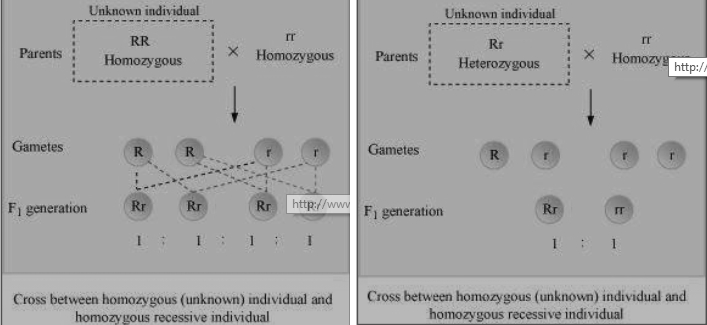
Define and design a test cross.
Solution
(N/A) test cross is a genetic cross between an individual with an unknown genotype (showing a dominant phenotype) and a homozygous recessive parent. It is used to determine whether the individual is homozygous or heterozygous for a specific trait.
If the progeny produced by a test cross shows $50 \%$ dominant trait and $50 \%$ recessive trait (a $1:1$ ratio),then the unknown individual is heterozygous $(Rr)$.
On the other hand,if all the progeny produced show the dominant trait,then the unknown individual is homozygous dominant $(RR)$.
If the progeny produced by a test cross shows $50 \%$ dominant trait and $50 \%$ recessive trait (a $1:1$ ratio),then the unknown individual is heterozygous $(Rr)$.
On the other hand,if all the progeny produced show the dominant trait,then the unknown individual is homozygous dominant $(RR)$.
0 likes
View Solution202
Medium
Why do we study Genetics? Give its historical background.
Solution
(N/A) We study Genetics to understand fundamental biological questions such as:
- Why does an elephant always give birth to a baby elephant and not another animal?
- Why does a mango seed produce only a mango plant?
- Are offspring identical to their parents,or do they show variations?
- Why do siblings sometimes look similar and sometimes very different?
Genetics is the branch of biology that deals with the inheritance and variation of characters from parents to offspring.
Inheritance is the process by which characters are passed from parent to progeny; it is the basis of heredity.
Variation is the degree by which progeny differ from their parents or among members of the same species.
Historical Background:
Humans have known since $8000-1000$ $B.C.$ that sexual reproduction is a cause of variation.
They exploited these natural variations in wild populations to selectively breed organisms with desirable traits.
For example,through artificial selection and domestication from ancestral wild cows,we have developed breeds like the $Sahiwal$ cows in $Punjab$.
Although our ancestors understood the existence of inheritance and variation,they lacked knowledge of the scientific basis behind these phenomena.
- Why does an elephant always give birth to a baby elephant and not another animal?
- Why does a mango seed produce only a mango plant?
- Are offspring identical to their parents,or do they show variations?
- Why do siblings sometimes look similar and sometimes very different?
Genetics is the branch of biology that deals with the inheritance and variation of characters from parents to offspring.
Inheritance is the process by which characters are passed from parent to progeny; it is the basis of heredity.
Variation is the degree by which progeny differ from their parents or among members of the same species.
Historical Background:
Humans have known since $8000-1000$ $B.C.$ that sexual reproduction is a cause of variation.
They exploited these natural variations in wild populations to selectively breed organisms with desirable traits.
For example,through artificial selection and domestication from ancestral wild cows,we have developed breeds like the $Sahiwal$ cows in $Punjab$.
Although our ancestors understood the existence of inheritance and variation,they lacked knowledge of the scientific basis behind these phenomena.
0 likes
View Solution203
Easy
Mention the contribution of Gregor Mendel. Mention the reasons for his success.
Solution
(N/A) Gregor Mendel conducted hybridisation experiments on garden peas for seven years ($1856$-$1863$) and proposed the laws of inheritance in living organisms.
During Mendel's investigations into inheritance patterns,it was for the first time that statistical analysis and mathematical logic were applied to problems in biology.
His experiments had a large sampling size,which gave greater credibility to the data that he collected.
Also,the confirmation of his inferences from experiments on successive generations of his test plants proved that his results pointed to general rules of inheritance rather than being unsubstantiated ideas.
Mendel investigated characters in the garden pea plant that were manifested as two opposing traits,e.g.,tall or dwarf plants,yellow or green seeds.
This allowed him to set up a basic framework of rules governing inheritance,which was expanded on by later scientists to account for all the diverse natural observations and the complexity inherent in them.
Mendel conducted such artificial pollination/cross-pollination experiments using several true-breeding pea lines.
$A$ true-breeding line is one that,having undergone continuous self-pollination,shows stable trait inheritance and expression for several generations.
Mendel selected $14$ true-breeding pea plant varieties as pairs which were similar except for one character with contrasting traits.
During Mendel's investigations into inheritance patterns,it was for the first time that statistical analysis and mathematical logic were applied to problems in biology.
His experiments had a large sampling size,which gave greater credibility to the data that he collected.
Also,the confirmation of his inferences from experiments on successive generations of his test plants proved that his results pointed to general rules of inheritance rather than being unsubstantiated ideas.
Mendel investigated characters in the garden pea plant that were manifested as two opposing traits,e.g.,tall or dwarf plants,yellow or green seeds.
This allowed him to set up a basic framework of rules governing inheritance,which was expanded on by later scientists to account for all the diverse natural observations and the complexity inherent in them.
Mendel conducted such artificial pollination/cross-pollination experiments using several true-breeding pea lines.
$A$ true-breeding line is one that,having undergone continuous self-pollination,shows stable trait inheritance and expression for several generations.
Mendel selected $14$ true-breeding pea plant varieties as pairs which were similar except for one character with contrasting traits.
0 likes
View Solution204
Medium
Discuss the seven pairs of contrasting traits in pea plants studied by Mendel.
Solution
(A) Mendel conducted experiments on pea plants using true-breeding lines.
True-breeding lines are those that,having undergone continuous self-pollination,show the stable trait inheritance and expression for several generations.
Mendel selected $14$ true-breeding pea plant varieties,as pairs which were similar except for one character with contrasting traits.
The seven pairs of contrasting traits studied by Mendel are:
$1$. Stem height: Tall $(T)$ / Dwarf $(t)$
$2$. Flower colour: Violet $(V)$ / White $(v)$
$3$. Flower position: Axial $(A)$ / Terminal $(a)$
$4$. Pod shape: Inflated $(I)$ / Constricted $(i)$
$5$. Pod colour: Green $(G)$ / Yellow $(g)$
$6$. Seed shape: Round $(R)$ / Wrinkled $(r)$
$7$. Seed colour: Yellow $(Y)$ / Green $(y)$
True-breeding lines are those that,having undergone continuous self-pollination,show the stable trait inheritance and expression for several generations.
Mendel selected $14$ true-breeding pea plant varieties,as pairs which were similar except for one character with contrasting traits.
The seven pairs of contrasting traits studied by Mendel are:
$1$. Stem height: Tall $(T)$ / Dwarf $(t)$
$2$. Flower colour: Violet $(V)$ / White $(v)$
$3$. Flower position: Axial $(A)$ / Terminal $(a)$
$4$. Pod shape: Inflated $(I)$ / Constricted $(i)$
$5$. Pod colour: Green $(G)$ / Yellow $(g)$
$6$. Seed shape: Round $(R)$ / Wrinkled $(r)$
$7$. Seed colour: Yellow $(Y)$ / Green $(y)$
0 likes
View Solution205
Medium
Describe the steps of hybridization performed by Mendel on pea plants.
Solution
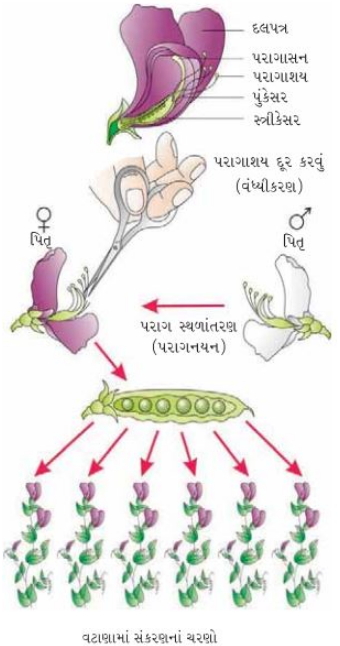
(N/A) Mendel selected two pea plants,one with a tall stem and the other with a dwarf stem. These plants were considered parent plants $(P)$,which were true-breeding (maintaining purity of traits over several generations).
In the female parent plant,the stamens were removed from the immature flower. This flower was covered with a small paper bag until it matured. Then,pollen grains collected from the male dwarf plant were dusted onto its stigma.
Pea flowers are bisexual. In this method,one plant is treated as male and the other as female.
The stamens of the plant designated as female are removed at the juvenile (immature) stage. This process is called emasculation,which is done to prevent self-pollination.
The emasculated flower is covered with a bag to prevent unwanted cross-pollination. This is called bagging.
Mature pollen grains from the male plant are collected and dusted onto the stigma of the emasculated flower.
The seeds from this plant are collected,sown,and grown into a new generation of plants.
This generation is called the first filial generation ($F_1$ generation).
In the female parent plant,the stamens were removed from the immature flower. This flower was covered with a small paper bag until it matured. Then,pollen grains collected from the male dwarf plant were dusted onto its stigma.
Pea flowers are bisexual. In this method,one plant is treated as male and the other as female.
The stamens of the plant designated as female are removed at the juvenile (immature) stage. This process is called emasculation,which is done to prevent self-pollination.
The emasculated flower is covered with a bag to prevent unwanted cross-pollination. This is called bagging.
Mature pollen grains from the male plant are collected and dusted onto the stigma of the emasculated flower.
The seeds from this plant are collected,sown,and grown into a new generation of plants.
This generation is called the first filial generation ($F_1$ generation).
0 likes
View Solution206
Medium
Based on Mendel's experiments,explain the concepts of factors,dominant/recessive traits,genotype,and phenotype.
Solution
(N/A) Mendel proposed that something was being passed down unchanged from parents to offspring through the gametes over successive generations. He called these things 'factors'. Today,we call them 'genes'. Therefore,genes are the units of inheritance.
Genes that code for a pair of contrasting traits are known as alleles.
In alphabetical symbols,capital letters are used for the trait expressed in the $F_1$ generation,and small letters are used for the other trait. For example,$T$ is used for tallness and $t$ for dwarfness. Now,$T$ and $t$ are alleles of each other,which can be expressed as $TT, Tt,$ or $tt$.
If both alleles are identical,the organism is homozygous ($TT$ or $tt$).
$TT$ and $tt$ represent the genotype of the plants,while the terms 'tall' and 'dwarf' represent the phenotype.
In a pair of dissimilar alleles,one dominates the other and is expressed in the $F_1$ generation. This is called the dominant factor,and the one that is not expressed is called the recessive factor.
In a homozygous condition,the alleles are identical ($TT$ or $tt$),but in a heterozygous condition,they are dissimilar,such as $Tt$. Crosses between $Tt$ and $tt$ are known as monohybrid experiments.
Genes that code for a pair of contrasting traits are known as alleles.
In alphabetical symbols,capital letters are used for the trait expressed in the $F_1$ generation,and small letters are used for the other trait. For example,$T$ is used for tallness and $t$ for dwarfness. Now,$T$ and $t$ are alleles of each other,which can be expressed as $TT, Tt,$ or $tt$.
If both alleles are identical,the organism is homozygous ($TT$ or $tt$).
$TT$ and $tt$ represent the genotype of the plants,while the terms 'tall' and 'dwarf' represent the phenotype.
In a pair of dissimilar alleles,one dominates the other and is expressed in the $F_1$ generation. This is called the dominant factor,and the one that is not expressed is called the recessive factor.
In a homozygous condition,the alleles are identical ($TT$ or $tt$),but in a heterozygous condition,they are dissimilar,such as $Tt$. Crosses between $Tt$ and $tt$ are known as monohybrid experiments.
0 likes
View Solution207
MediumMCQ
How can the results obtained in a Punnett square be expressed mathematically?
A
Binomial expansion $(ax + by)^2$
B
Linear expansion $(ax + by)$
C
Trinomial expansion $(ax + by + cz)^2$
D
None of the above
Solution
(A) The results obtained in a Punnett square,such as the $TT : Tt : tt$ ratio of $1 : 2 : 1$,can be expressed mathematically by the binomial expansion $(ax + by)^2$.
In this case,the gametes $T$ and $t$ are present in equal frequencies of $1/2$ each.
Therefore,the expression is $(1/2T + 1/2t)^2 = (1/2T + 1/2t) \times (1/2T + 1/2t) = 1/4TT + 1/2Tt + 1/4tt$.
In this case,the gametes $T$ and $t$ are present in equal frequencies of $1/2$ each.
Therefore,the expression is $(1/2T + 1/2t)^2 = (1/2T + 1/2t) \times (1/2T + 1/2t) = 1/4TT + 1/2Tt + 1/4tt$.
0 likes
View Solution208
Medium
Describe test cross. Why is it necessary?
Solution
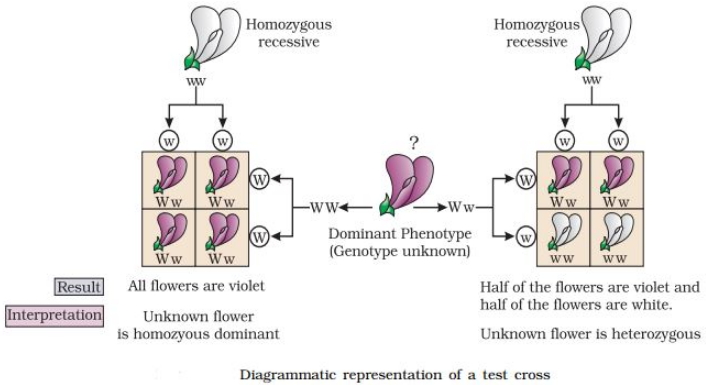
(N/A) test cross is a genetic cross between an individual exhibiting a dominant phenotype (but with an unknown genotype) and an individual that is homozygous recessive for the trait.
It is necessary because,while genotypic ratios can be calculated using mathematical probability,it is not possible to determine the exact genotypic composition (homozygous dominant or heterozygous) simply by observing the phenotype of a dominant trait.
For example,it is impossible to distinguish between a tall plant with a $TT$ genotype and one with a $Tt$ genotype just by looking at it.
To solve this,Mendel devised the test cross.
$A$ back cross is defined as a cross of $F_{1}$ progeny back to one of their parents.
$A$ special type of back cross,where the $F_{1}$ progeny is crossed with the recessive parent,is known as a test cross.
This method allows us to determine if the dominant phenotype is homozygous or heterozygous.
For instance,in a monohybrid cross between a violet-flowered plant $(W)$ and a white-flowered plant $(w)$,the $F_{1}$ hybrid is a violet-flowered plant.
If all $F_{1}$ progeny are violet,the dominant parent is homozygous $(WW)$. If the progeny appear in a $1:1$ ratio of violet to white,the dominant parent is heterozygous $(Ww)$.
In the case of a dihybrid cross,such as a heterozygous violet and axial flower $(WwAa)$ crossed with a double recessive white and terminal flower $(wwaa)$,the resulting ratio will be $1:1:1:1$.
It is necessary because,while genotypic ratios can be calculated using mathematical probability,it is not possible to determine the exact genotypic composition (homozygous dominant or heterozygous) simply by observing the phenotype of a dominant trait.
For example,it is impossible to distinguish between a tall plant with a $TT$ genotype and one with a $Tt$ genotype just by looking at it.
To solve this,Mendel devised the test cross.
$A$ back cross is defined as a cross of $F_{1}$ progeny back to one of their parents.
$A$ special type of back cross,where the $F_{1}$ progeny is crossed with the recessive parent,is known as a test cross.
This method allows us to determine if the dominant phenotype is homozygous or heterozygous.
For instance,in a monohybrid cross between a violet-flowered plant $(W)$ and a white-flowered plant $(w)$,the $F_{1}$ hybrid is a violet-flowered plant.
If all $F_{1}$ progeny are violet,the dominant parent is homozygous $(WW)$. If the progeny appear in a $1:1$ ratio of violet to white,the dominant parent is heterozygous $(Ww)$.
In the case of a dihybrid cross,such as a heterozygous violet and axial flower $(WwAa)$ crossed with a double recessive white and terminal flower $(wwaa)$,the resulting ratio will be $1:1:1:1$.
0 likes
View Solution209
Medium
How can the concept of dominance be explained?
Solution
(A) To understand dominance,we must consider how genes function. $A$ gene contains the information required to express a particular trait.
In diploid organisms,each gene exists as a pair of alleles. These alleles may not always be identical; they can be heterozygous. $A$ variation in one allele often arises from a mutation that modifies the information it carries.
Consider a gene that codes for an enzyme. The two alleles of this gene are its two forms. The normal allele produces the enzyme required for the transformation of a substrate '$S$'.
The modified allele could be responsible for: $(i)$ a normal or less efficient enzyme,$(ii)$ a non-functional enzyme,or $(iii)$ the absence of the enzyme.
In the first case,the modified allele is equivalent to the unmodified allele,resulting in the same phenotype. Thus,the transformation of substrate '$S$' occurs normally.
However,if the modified allele produces a non-functional enzyme or no enzyme at all,the phenotype may be affected. The phenotype depends on the functioning of the unmodified allele.
The allele that produces the functional enzyme,which determines the original phenotype,is considered 'dominant',while the modified allele is considered 'recessive'.
In diploid organisms,each gene exists as a pair of alleles. These alleles may not always be identical; they can be heterozygous. $A$ variation in one allele often arises from a mutation that modifies the information it carries.
Consider a gene that codes for an enzyme. The two alleles of this gene are its two forms. The normal allele produces the enzyme required for the transformation of a substrate '$S$'.
The modified allele could be responsible for: $(i)$ a normal or less efficient enzyme,$(ii)$ a non-functional enzyme,or $(iii)$ the absence of the enzyme.
In the first case,the modified allele is equivalent to the unmodified allele,resulting in the same phenotype. Thus,the transformation of substrate '$S$' occurs normally.
However,if the modified allele produces a non-functional enzyme or no enzyme at all,the phenotype may be affected. The phenotype depends on the functioning of the unmodified allele.
The allele that produces the functional enzyme,which determines the original phenotype,is considered 'dominant',while the modified allele is considered 'recessive'.
0 likes
View Solution210
Medium
Distinguish between: Test Cross and Back Cross.
Solution
(N/A)
| Test Cross | Back Cross |
|---|---|
| $1$. It is a cross between an $F_1$ hybrid and a homozygous recessive parent. | $1$. It is a cross between an $F_1$ hybrid and any of its parents (either dominant or recessive). |
| $2$. It is used to determine the genotype of an organism showing a dominant phenotype. | $2$. It is used to improve the traits of a specific variety by introducing genes from a parent. |
| $3$. All test crosses are back crosses. | $3$. All back crosses are not necessarily test crosses. |
0 likes
View Solution211
EasyMCQ
The reason for Mendel's success was his choice of pea plants for his experiments.
A
True
B
False
C
Partially True
D
Cannot be determined
Solution
(A) Mendel's success was primarily due to his choice of the garden pea plant ($Pisum$ $sativum$) for his experiments.
Key reasons include:
- The pea plant has several clearly defined,contrasting traits.
- It is easy to grow and has a short life cycle.
- It typically undergoes self-pollination,which allows for the production of pure-breeding lines.
- Cross-pollination can be easily performed artificially.
- It produces a large number of offspring,which makes statistical analysis reliable.
Key reasons include:
- The pea plant has several clearly defined,contrasting traits.
- It is easy to grow and has a short life cycle.
- It typically undergoes self-pollination,which allows for the production of pure-breeding lines.
- Cross-pollination can be easily performed artificially.
- It produces a large number of offspring,which makes statistical analysis reliable.
0 likes
View Solution212
Easy
Provide definitions/explanations for the following terms:
$1.$ Genetics
$2.$ Heredity
$1.$ Genetics
$2.$ Heredity
Solution
(N/A) Genetics is the branch of biology that deals with the study of inheritance and variation. It scientifically addresses questions regarding why offspring resemble their parents or show differences in their characteristics,and why siblings may look similar or different.
Inheritance is the process by which characters are passed on from parent to progeny. It is the basis of heredity,which refers to the transmission of genetic traits from parents to offspring.
Inheritance is the process by which characters are passed on from parent to progeny. It is the basis of heredity,which refers to the transmission of genetic traits from parents to offspring.
0 likes
View Solution213
Easy
Define/Explain the following terms:
$1.$ Offspring
$2.$ Phenotype
$1.$ Offspring
$2.$ Phenotype
Solution
(N/A) $1.$ Offspring: The organisms produced as a result of sexual reproduction are known as offspring.
$2.$ Phenotype: The observable physical or biochemical characteristics of an organism,as determined by both genetic makeup and environmental influences,are known as phenotype.
$2.$ Phenotype: The observable physical or biochemical characteristics of an organism,as determined by both genetic makeup and environmental influences,are known as phenotype.
0 likes
View Solution214
Easy
Differentiate between Dominance and Recessive traits.
Solution
(N/A) $1$. Dominant trait: It is the trait that expresses itself in the $F_1$ generation even in the presence of a contrasting allele. It masks the expression of the recessive allele.
$2$. Recessive trait: It is the trait that remains hidden or suppressed in the $F_1$ generation and only expresses itself in the homozygous condition (e.g.,$tt$ or $aa$).
$2$. Recessive trait: It is the trait that remains hidden or suppressed in the $F_1$ generation and only expresses itself in the homozygous condition (e.g.,$tt$ or $aa$).
0 likes
View Solution215
Easy
Differentiate between homozygous and heterozygous.
Solution
(N/A) $1$. Homozygous: An individual is said to be homozygous for a trait if it possesses two identical alleles for that specific gene (e.g.,$TT$ or $tt$). These individuals are often referred to as true-breeding or pure-breeding lines.
$2$. Heterozygous: An individual is said to be heterozygous for a trait if it possesses two different alleles for that specific gene (e.g.,$Tt$). These individuals are often referred to as hybrids.
$3$. In summary,homozygous organisms produce gametes with identical alleles,whereas heterozygous organisms produce gametes with different alleles.
$2$. Heterozygous: An individual is said to be heterozygous for a trait if it possesses two different alleles for that specific gene (e.g.,$Tt$). These individuals are often referred to as hybrids.
$3$. In summary,homozygous organisms produce gametes with identical alleles,whereas heterozygous organisms produce gametes with different alleles.
0 likes
View Solution216
Easy
State the contributions of the following scientists: Gregor Mendel and Reginald $C$. Punnett.
Solution
(N/A) Gregor Mendel: He formulated the laws of inheritance through various experiments on pea plants.
Reginald $C$. Punnett: He developed the Punnett square,a graphical representation used to predict the genotypes and phenotypes of offspring in a genetic cross.
Reginald $C$. Punnett: He developed the Punnett square,a graphical representation used to predict the genotypes and phenotypes of offspring in a genetic cross.
0 likes
View Solution217
EasyMCQ
Identify the contribution of the following scientists: Hugo de Vries,Carl Correns,and Erich von Tschermak.
A
Discovery of $DNA$ structure
B
Rediscovery of Mendel's laws of inheritance
C
Formulation of the Chromosomal Theory of Inheritance
D
Discovery of linkage and recombination
Solution
(B) In $1900$,Hugo de Vries,Carl Correns,and Erich von Tschermak independently rediscovered Mendel's laws of inheritance. They conducted experiments on plant hybridization and realized that Mendel's work,which had been overlooked for decades,provided the fundamental principles for understanding the transmission of traits from parents to offspring.
0 likes
View Solution218
MediumMCQ
$A$ person has to perform crosses for the purpose of studying the inheritance of a few traits/characters. What should be the criteria for selecting the organisms?
A
Long life span and small number of progeny
B
Shorter life span,large number of progeny,and clear differentiation of traits
C
Complex genetic makeup and no hereditary variations
D
Difficulty in breeding and lack of pure lines
Solution
(B) The criteria for selecting an organism for genetic studies are as follows:
$(i)$ Shorter life span of the organism,which allows for studying multiple generations in a short time.
$(ii)$ They should produce a large number of progeny to facilitate statistical analysis.
$(iii)$ Clear differentiation of sex and traits,making them easily identifiable.
$(iv)$ Presence of many types of hereditary variations.
$(v)$ Availability of pure breeding lines.
$(i)$ Shorter life span of the organism,which allows for studying multiple generations in a short time.
$(ii)$ They should produce a large number of progeny to facilitate statistical analysis.
$(iii)$ Clear differentiation of sex and traits,making them easily identifiable.
$(iv)$ Presence of many types of hereditary variations.
$(v)$ Availability of pure breeding lines.
0 likes
View Solution219
MediumMCQ
$F_1$ generation Mendel pollinated a pure-breeding tall plant with a pure-breeding dwarf plant. But for getting the $F_2$ generation,he simply self-pollinated the tall $F_1$ plants. Why?
A
To maintain the purity of the tall trait.
B
To observe the segregation of alleles and the reappearance of the recessive trait.
C
Because cross-pollination was not possible for the $F_2$ generation.
D
To produce more seeds for the experiment.
Solution
(B) Mendel performed self-pollination (selfing) among the $F_1$ tall hybrids $(Tt)$ to allow the segregation of alleles.
According to the Law of Segregation,the alleles of a gene pair separate from each other during gamete formation.
By self-pollinating the $F_1$ plants,Mendel allowed the recessive alleles to pair up again,which resulted in the reappearance of the dwarf phenotype in the $F_2$ generation in a $3:1$ phenotypic ratio.
According to the Law of Segregation,the alleles of a gene pair separate from each other during gamete formation.
By self-pollinating the $F_1$ plants,Mendel allowed the recessive alleles to pair up again,which resulted in the reappearance of the dwarf phenotype in the $F_2$ generation in a $3:1$ phenotypic ratio.
0 likes
View Solution220
Medium
In a monohybrid cross of plants with red and white flowered plants,Mendel got only red flowered plants. On self-pollinating these $F_1$ plants,he got both red and white flowered plants in a $3:1$ ratio. Explain the basis of using $RR$ and $rr$ symbols to represent the genotype of plants of the parental generation.
Solution
(A) When crossing red and white flowered plants,only red-flowered plants appeared in the $F_1$ generation. However,white-flowered plants reappeared in the $F_2$ generation,which was derived from self-pollinating the $F_1$ individuals.
Mendel reasoned that there is a 'factor' (now called a gene) for every character. Accordingly,there must be one factor $(R)$ for the red flower trait and another factor $(r)$ for the white flower trait.
If an organism possessed only one copy of the gene,the reappearance of the white flower trait in the $F_2$ generation would be impossible. Furthermore,the observed phenotypic ratio of $3:1$ (red to white) indicates that each organism must possess two copies of a particular gene,which segregate during gamete formation. This observation forms the basis of Mendel's Law of Segregation and the Law of Dominance.
Mendel reasoned that there is a 'factor' (now called a gene) for every character. Accordingly,there must be one factor $(R)$ for the red flower trait and another factor $(r)$ for the white flower trait.
If an organism possessed only one copy of the gene,the reappearance of the white flower trait in the $F_2$ generation would be impossible. Furthermore,the observed phenotypic ratio of $3:1$ (red to white) indicates that each organism must possess two copies of a particular gene,which segregate during gamete formation. This observation forms the basis of Mendel's Law of Segregation and the Law of Dominance.
0 likes
View Solution221
Medium
Discuss the genetic basis of the wrinkled phenotype of pea seed.
Solution
(N/A) The wrinkled phenotype of pea seeds is determined by the recessive allele $(w)$.
In the homozygous recessive condition $(ww)$,the starch branching enzyme is defective.
This leads to the production of less branched starch,which results in a lower osmotic pressure within the developing seed.
Consequently,the seed loses water during maturation and shrinks,resulting in the wrinkled appearance.
In the homozygous recessive condition $(ww)$,the starch branching enzyme is defective.
This leads to the production of less branched starch,which results in a lower osmotic pressure within the developing seed.
Consequently,the seed loses water during maturation and shrinks,resulting in the wrinkled appearance.
0 likes
View Solution222
MediumMCQ
What are the characteristic features of a true-breeding line?
A
It shows variation in traits over generations.
B
It is produced by cross-pollination.
C
It shows stability in the inheritance of the trait for several generations.
D
It is always heterozygous for the trait.
Solution
(C) true-breeding line for a trait is one that has undergone continuous self-pollination or brother-sister mating.
It shows stability in the inheritance of the trait for several generations.
This means that the offspring produced are identical to the parents for that specific trait.
It shows stability in the inheritance of the trait for several generations.
This means that the offspring produced are identical to the parents for that specific trait.
0 likes
View Solution223
MediumMCQ
State the reasons for Mendel's success.
A
He chose pea plants with many contrasting traits.
B
He used statistical analysis and mathematical logic.
C
He studied only one trait at a time.
D
All of the above.
Solution
(D) Mendel's success was due to several factors:
$(i)$ He chose the garden pea plant ($Pisum$ $sativum$),which has a short life cycle and distinct contrasting traits.
$(ii)$ He maintained accurate records of all observations and used statistical analysis and mathematical logic to explain his results.
$(iii)$ He focused on one or two traits at a time,which simplified the analysis of inheritance patterns.
$(iv)$ He performed cross-pollination experiments carefully to ensure pure-breeding lines.
$(v)$ He studied multiple generations $(F_1, F_2, F_3)$ to confirm the consistency of his findings.
$(i)$ He chose the garden pea plant ($Pisum$ $sativum$),which has a short life cycle and distinct contrasting traits.
$(ii)$ He maintained accurate records of all observations and used statistical analysis and mathematical logic to explain his results.
$(iii)$ He focused on one or two traits at a time,which simplified the analysis of inheritance patterns.
$(iv)$ He performed cross-pollination experiments carefully to ensure pure-breeding lines.
$(v)$ He studied multiple generations $(F_1, F_2, F_3)$ to confirm the consistency of his findings.
0 likes
View Solution224
EasyMCQ
How many true-breeding pea plant varieties did Mendel select as pairs,which were similar except in one character with contrasting traits?
A
$8$
B
$4$
C
$2$
D
$14$
Solution
(D) Gregor Mendel selected $14$ true-breeding pea plant varieties.
These varieties were chosen as pairs that were similar in all aspects except for one character with contrasting traits.
These $14$ varieties represented $7$ pairs of contrasting traits (e.g.,tall/dwarf,violet/white flowers,etc.).
These varieties were chosen as pairs that were similar in all aspects except for one character with contrasting traits.
These $14$ varieties represented $7$ pairs of contrasting traits (e.g.,tall/dwarf,violet/white flowers,etc.).
0 likes
View Solution225
MediumMCQ
How many pairs of true-breeding pea plant varieties were selected by Mendel,which were identical except for one character with contrasting traits?
A
$4$
B
$2$
C
$14$
D
$7$
Solution
(C) Gregor Mendel selected $14$ true-breeding pea plant varieties (lines) as pairs which were similar except for one character with contrasting traits.
These $14$ varieties represented $7$ pairs of contrasting traits (e.g.,tall/dwarf,violet/white flowers,etc.).
Therefore,the total number of true-breeding varieties selected was $14$.
These $14$ varieties represented $7$ pairs of contrasting traits (e.g.,tall/dwarf,violet/white flowers,etc.).
Therefore,the total number of true-breeding varieties selected was $14$.
0 likes
View Solution226
Medium
Give scientific reasons: The Mendelian experiments cannot be carried out in human beings.
Solution
(N/A) Mendelian experiments involve controlled breeding and the study of multiple generations to observe inheritance patterns. These experiments cannot be performed on humans for the following reasons:
$1$. The generation time in humans is very long,making it difficult to study multiple generations within a reasonable timeframe.
$2$. The number of offspring produced by a human couple is very small,which is insufficient for statistical analysis of Mendelian ratios.
$3$. Controlled breeding or experimental crosses are ethically and socially unacceptable in human populations.
$1$. The generation time in humans is very long,making it difficult to study multiple generations within a reasonable timeframe.
$2$. The number of offspring produced by a human couple is very small,which is insufficient for statistical analysis of Mendelian ratios.
$3$. Controlled breeding or experimental crosses are ethically and socially unacceptable in human populations.
0 likes
View Solution227
Easy
Define / Explain: $True \ breeding \ line$.
Solution
(N/A) $True \ breeding \ line$ is one that has undergone continuous self-pollination,showing stable trait inheritance and expression for several generations.
0 likes
View Solution228
Easy
Define/Explain: $F_2$ generation.
Solution
(N/A) The offspring produced by the self-pollination or self-crossing of $F_1$ individuals are known as $F_2$ individuals. This generation represents the second filial generation in a genetic cross.
0 likes
View Solution229
Easy
Define the term 'Factors' in the context of Mendelian genetics.
Solution
(N/A) Mendel proposed that something was being stably passed down unchanged from parent to offspring through the gametes over successive generations. He called these units of inheritance 'factors'. In modern genetics,these 'factors' are known as 'genes'.
0 likes
View Solution230
Easy
Define the following terms: $Genes$ and $Alleles$.
Solution
(N/A) $Genes$ are the fundamental units of inheritance. They consist of specific segments of $DNA$ that contain the genetic information required to express a particular trait in an organism.
$Alleles$ are slightly different forms of the same gene. They arise due to mutations and are responsible for the variations in a specific trait,such as tall or dwarf height in pea plants.
$Alleles$ are slightly different forms of the same gene. They arise due to mutations and are responsible for the variations in a specific trait,such as tall or dwarf height in pea plants.
0 likes
View Solution231
Easy
Define the following terms: Dominant gene and Recessive gene.
Solution
(N/A) $1$. Dominant gene: The allele that expresses its phenotypic effect in both homozygous and heterozygous conditions is called a dominant gene.
$2$. Recessive gene: The allele that expresses its phenotypic effect only in the homozygous condition and remains masked in the presence of a dominant allele is called a recessive gene.
$2$. Recessive gene: The allele that expresses its phenotypic effect only in the homozygous condition and remains masked in the presence of a dominant allele is called a recessive gene.
0 likes
View Solution232
Easy
Define the term: Phenotype.
Solution
(N/A) Phenotype refers to the observable physical or biochemical characteristics of an organism,as determined by both genetic makeup and environmental influences. It is the apparent expression seen due to the combination of genes. For example,in pea plants,'tall' and 'dwarf' are phenotypic expressions of the underlying genotypes.
0 likes
View Solution233
Easy
Define/Explain: Genotype.
Solution
(N/A) Genotype refers to the genetic constitution of an organism,which determines the specific traits or characters expressed. It represents the set of alleles present in an individual for a particular trait. For example,in pea plants,the genotypes for height can be $TT$ (homozygous dominant),$Tt$ (heterozygous),or $tt$ (homozygous recessive).
0 likes
View Solution234
Easy
Define the term: Homozygous.
Solution
(N/A) Homozygous refers to a condition in an organism where both alleles for a specific gene are identical.
For example,in a diploid organism,the genotypes $TT$ (homozygous dominant) or $tt$ (homozygous recessive) represent the homozygous condition.
For example,in a diploid organism,the genotypes $TT$ (homozygous dominant) or $tt$ (homozygous recessive) represent the homozygous condition.
0 likes
View Solution235
Easy
Define/Explain: Heterozygous.
Solution
(N/A) Heterozygous is a genetic condition in which an individual possesses two different alleles for a specific gene or character.
For example,in a pea plant,the genotype $Tt$ represents a heterozygous condition for height,where $T$ is the allele for tallness and $t$ is the allele for dwarfness.
For example,in a pea plant,the genotype $Tt$ represents a heterozygous condition for height,where $T$ is the allele for tallness and $t$ is the allele for dwarfness.
0 likes
View Solution236
Easy
Define the term: Punnett square.
Solution
(N/A) Punnett square is a graphical representation used to calculate the probability of all possible genotypes of offspring resulting from a genetic cross. It was developed by the British geneticist Reginald $C$. Punnett. It helps in visualizing the segregation of alleles and the random fertilization of gametes.
0 likes
View Solution237
Easy
Define/Explain: Test cross.
Solution
(N/A) test cross is a genetic cross between an individual with a dominant phenotype (whose genotype is unknown) and an individual that is homozygous recessive for the trait.
This cross is performed to determine the genotype of the organism showing the dominant phenotype.
If the offspring show a $1:1$ ratio of dominant to recessive phenotypes,the parent is heterozygous.
If all offspring show the dominant phenotype,the parent is homozygous dominant.
This cross is performed to determine the genotype of the organism showing the dominant phenotype.
If the offspring show a $1:1$ ratio of dominant to recessive phenotypes,the parent is heterozygous.
If all offspring show the dominant phenotype,the parent is homozygous dominant.
0 likes
View Solution238
Easy
What is the cross between the progeny of $F_{1}$ and the homozygous recessive parent called? How is it useful?
Solution
(N/A) The cross between the progeny of $F_{1}$ and the homozygous recessive parent is called a $Test$ $cross$.
It is useful in determining the genotype of an organism showing a dominant phenotype.
By performing this cross,we can identify whether the individual is homozygous dominant or heterozygous for a particular trait.
It is useful in determining the genotype of an organism showing a dominant phenotype.
By performing this cross,we can identify whether the individual is homozygous dominant or heterozygous for a particular trait.
0 likes
View Solution239
EasyMCQ
Who coined the term 'Genetics'?
A
Mendel
B
Bateson
C
$T. H.$ Morgan
D
Bridges
Solution
(B) The term 'Genetics' was coined by William Bateson in $1905$.
Gregor Mendel is known as the 'Father of Genetics' for his experiments on pea plants,but he did not coin the term itself.
$T. H.$ Morgan is famous for his work on linkage and crossing over in Drosophila.
Therefore,the correct answer is Bateson.
Gregor Mendel is known as the 'Father of Genetics' for his experiments on pea plants,but he did not coin the term itself.
$T. H.$ Morgan is famous for his work on linkage and crossing over in Drosophila.
Therefore,the correct answer is Bateson.
0 likes
View Solution240
EasyMCQ
How many pairs of contrasting traits did Mendel select for his experiments (in $pairs$)?
A
$14$
B
$7$
C
$4$
D
$28$
Solution
(B) Gregor Mendel conducted his hybridization experiments on garden peas $(Pisum \text{ } sativum)$.
He selected $7$ pairs of contrasting traits for his study.
These traits include stem height (tall/dwarf), flower color (violet/white), flower position (axial/terminal), pod shape (inflated/constricted), pod color (green/yellow), seed shape (round/wrinkled), and seed color (yellow/green).
Therefore, the correct answer is $7$ pairs.
He selected $7$ pairs of contrasting traits for his study.
These traits include stem height (tall/dwarf), flower color (violet/white), flower position (axial/terminal), pod shape (inflated/constricted), pod color (green/yellow), seed shape (round/wrinkled), and seed color (yellow/green).
Therefore, the correct answer is $7$ pairs.
0 likes
View Solution241
MediumMCQ
Which of the following traits selected by Mendel shows a recessive expression in pea plants?
A
Tall plant
B
Green pod
C
Yellow seed
D
Terminal flower
Solution
(D) Mendel studied seven pairs of contrasting traits in pea plants.
In these traits,one is dominant and the other is recessive.
$1$. Height: Tall (dominant) vs. Dwarf (recessive).
$2$. Pod color: Green (dominant) vs. Yellow (recessive).
$3$. Seed color: Yellow (dominant) vs. Green (recessive).
$4$. Flower position: Axial (dominant) vs. Terminal (recessive).
Comparing the options:
- Tall plant is dominant.
- Green pod is dominant.
- Yellow seed is dominant.
- Terminal flower is recessive.
Therefore,the correct option is $D$.
In these traits,one is dominant and the other is recessive.
$1$. Height: Tall (dominant) vs. Dwarf (recessive).
$2$. Pod color: Green (dominant) vs. Yellow (recessive).
$3$. Seed color: Yellow (dominant) vs. Green (recessive).
$4$. Flower position: Axial (dominant) vs. Terminal (recessive).
Comparing the options:
- Tall plant is dominant.
- Green pod is dominant.
- Yellow seed is dominant.
- Terminal flower is recessive.
Therefore,the correct option is $D$.
0 likes
View Solution242
MediumMCQ
What term did Mendel use for the factors that determine the traits he studied?
A
Alleles
B
Alternative factors
C
Factors
D
Genes
Solution
(C) Gregor Mendel,in his experiments on pea plants,proposed that something was being stably passed down,unchanged,from parent to offspring through the gametes over successive generations. He called these entities 'factors'. In modern genetics,these factors are now referred to as 'genes'. Therefore,the correct term used by Mendel for these units of inheritance is 'factors'.
0 likes
View Solution243
EasyMCQ
What are the genes that code for a pair of contrasting traits called?
A
Alleles
B
Factors
C
Genes
D
Chromosomes
Solution
(A) The genes that code for a pair of contrasting traits are known as $Alleles$ (or $Allelomorphs$).
$Alleles$ are slightly different forms of the same gene that occupy the same locus on homologous chromosomes.
For example,in pea plants,the gene for height has two $Alleles$: one for tallness $(T)$ and one for dwarfness $(t)$.
$Alleles$ are slightly different forms of the same gene that occupy the same locus on homologous chromosomes.
For example,in pea plants,the gene for height has two $Alleles$: one for tallness $(T)$ and one for dwarfness $(t)$.
0 likes
View Solution244
MediumMCQ
What is the primary purpose of a test cross?
A
To determine the phenotype of the parent generation
B
To determine the genotype of a dominant phenotype individual
C
To identify the phenotype of tall plants
D
To fertilize pure tall and pure dwarf plants
Solution
(B) test cross is a genetic cross between an individual with a dominant phenotype (but unknown genotype) and a homozygous recessive individual.
Its primary purpose is to determine the genotype of the individual displaying the dominant trait.
If the offspring show a $1:1$ ratio of dominant to recessive phenotypes,the parent is heterozygous.
If all offspring show the dominant phenotype,the parent is homozygous dominant.
Its primary purpose is to determine the genotype of the individual displaying the dominant trait.
If the offspring show a $1:1$ ratio of dominant to recessive phenotypes,the parent is heterozygous.
If all offspring show the dominant phenotype,the parent is homozygous dominant.
0 likes
View Solution245
MediumMCQ
In pea plants,if the $Bb$ gene is present in a heterozygous condition for starch grain synthesis,what type of inheritance does the round seed shape exhibit?
A
Dominance
B
Incomplete dominance
C
Codominance
D
None of these
Solution
(A) In pea plants,the gene $B$ controls starch synthesis and seed shape.
$BB$ homozygotes produce large starch grains and round seeds.
$bb$ homozygotes produce small starch grains and wrinkled seeds.
In the heterozygous condition $(Bb)$,the starch grains are of intermediate size,which suggests incomplete dominance for starch grain size.
However,the phenotype of the seed shape in $Bb$ individuals is round,which is identical to the $BB$ phenotype.
Therefore,with respect to the seed shape,the $B$ allele shows complete dominance over the $b$ allele.
$BB$ homozygotes produce large starch grains and round seeds.
$bb$ homozygotes produce small starch grains and wrinkled seeds.
In the heterozygous condition $(Bb)$,the starch grains are of intermediate size,which suggests incomplete dominance for starch grain size.
However,the phenotype of the seed shape in $Bb$ individuals is round,which is identical to the $BB$ phenotype.
Therefore,with respect to the seed shape,the $B$ allele shows complete dominance over the $b$ allele.
0 likes
View Solution246
MediumMCQ
Determine the number of possible gametes produced by an organism with the genotype $AaBbCc$.
A
$4$
B
$8$
C
$16$
D
$20$
Solution
(B) The number of different types of gametes produced by an organism with a given genotype can be calculated using the formula $2^n$,where $n$ is the number of heterozygous gene pairs.
In the genotype $AaBbCc$,there are $3$ heterozygous gene pairs ($Aa$,$Bb$,and $Cc$).
Therefore,$n = 3$.
Number of gametes = $2^n = 2^3 = 2 \times 2 \times 2 = 8$.
Thus,the organism will produce $8$ different types of gametes.
In the genotype $AaBbCc$,there are $3$ heterozygous gene pairs ($Aa$,$Bb$,and $Cc$).
Therefore,$n = 3$.
Number of gametes = $2^n = 2^3 = 2 \times 2 \times 2 = 8$.
Thus,the organism will produce $8$ different types of gametes.
0 likes
View Solution247
MediumMCQ
Which scientists rediscovered Mendel's work?
A
Sutton and Boveri
B
Bateson and Punnett
C
$T.H.$ Morgan
D
Correns,de Vries,and Tschermak
Solution
(D) Gregor Mendel's work on the laws of inheritance remained unrecognized for many years. In $1900$,three scientists independently rediscovered Mendel's results: Hugo de Vries (from the Netherlands),Carl Correns (from Germany),and Erich von Tschermak (from Austria). These scientists confirmed Mendel's findings on the inheritance of traits in plants.
0 likes
View Solution248
MediumMCQ
Why was Mendel's work not accepted during his time?
A
Due to the mathematical approach used in analyzing biological phenomena.
B
Mendel could not provide physical proof for the existence of factors.
C
He could not explain what the alleles,which do not blend with each other,were made of.
D
All of the above.
Solution
(D) Mendel's work remained unrecognized for several years due to the following reasons:
$1$. Communication was not easy in those days,and his work could not be widely publicized.
$2$. His concept of 'factors' (genes) as stable and discrete units that control the expression of traits and do not 'blend' with each other was not accepted by his contemporaries,as they were looking for continuous variation.
$3$. Mendel's approach of using mathematics and statistics to explain biological phenomena was entirely new and unacceptable to the biologists of that time.
$4$. He could not provide any physical proof for the existence of factors (i.e.,what they were made of or where they were located).
$1$. Communication was not easy in those days,and his work could not be widely publicized.
$2$. His concept of 'factors' (genes) as stable and discrete units that control the expression of traits and do not 'blend' with each other was not accepted by his contemporaries,as they were looking for continuous variation.
$3$. Mendel's approach of using mathematics and statistics to explain biological phenomena was entirely new and unacceptable to the biologists of that time.
$4$. He could not provide any physical proof for the existence of factors (i.e.,what they were made of or where they were located).
0 likes
View Solution249
MediumMCQ
Which cross is used to determine the genotype of the $F_1$ generation?
A
$F_1 \times F_1$
B
$F_1$ and homozygous recessive
C
$F_1$ and homozygous dominant
D
$P_1 \times F_1$
Solution
(B) test cross is defined as a cross between an individual of unknown genotype (usually $F_1$ generation) and a homozygous recessive individual.
This cross is used to determine whether the dominant phenotype is homozygous or heterozygous.
If the offspring show a $1:1$ phenotypic ratio,the $F_1$ individual is heterozygous.
If all offspring show the dominant trait,the $F_1$ individual is homozygous dominant.
This cross is used to determine whether the dominant phenotype is homozygous or heterozygous.
If the offspring show a $1:1$ phenotypic ratio,the $F_1$ individual is heterozygous.
If all offspring show the dominant trait,the $F_1$ individual is homozygous dominant.
0 likes
View Solution250
MediumMCQ
When a homozygous tall plant is crossed with a homozygous dwarf plant,what is the percentage of dwarf progeny obtained in the $F_1$ generation by Mendel (in $\%$)?
A
$25$
B
$50$
C
$0$
D
$100$
Solution
(C) According to Mendel's law of dominance,when a homozygous tall plant $(TT)$ is crossed with a homozygous dwarf plant $(tt)$,all the offspring in the $F_1$ generation will be heterozygous tall $(Tt)$.
Since the allele for tallness $(T)$ is dominant over the allele for dwarfness $(t)$,the phenotype of all $F_1$ individuals will be tall.
Therefore,the percentage of dwarf progeny in the $F_1$ generation is $0 \%$.
Since the allele for tallness $(T)$ is dominant over the allele for dwarfness $(t)$,the phenotype of all $F_1$ individuals will be tall.
Therefore,the percentage of dwarf progeny in the $F_1$ generation is $0 \%$.
0 likes
View SolutionPrinciples of Inheritance and Variation — Mendelism · Frequently Asked Questions
1Are these Principles of Inheritance and Variation questions useful for JEE and NEET?
Yes. All questions in this section are mapped to JEE Main and NEET exam patterns. Previous year questions from JEE Main, NEET, GUJCET and state-level exams are included with full solutions.
2Can I switch to Hindi or Gujarati for these questions?
Yes. Use the language tabs in the hero section or the sidebar to view the same questions and solutions in English, Hindi or Gujarati.
3How do I generate a question paper from this subtopic?
Use the Vedclass Exam Paper Generator — select the chapter and subtopic, set difficulty, and generate Sets A, B, C, D automatically. First 3 chapters of every subject are free.
Vedclass Products
For Students
Vedclass Test Series
Mock tests in real JEE/NEET style with performance analysis. 5-day free trial.
Start Free TrialFor Teachers
Exam Paper Generator
Generate Set A/B/C/D papers from this chapter in 2 minutes. 3 chapters free.
Try FreeFor Institutes
Online Exam Module
Live online exams with unlimited students, 360° analytics & white-label branding.
See DemoFor Teachers & Institutes
Generate a Principles of Inheritance and Variation Exam Paper in 2 Minutes
Select subtopic & difficulty — Sets A, B, C, D auto-generated with No Repeat logic.
First 3 chapters of every subject are free — no payment required.