
A English
Mendelism Questions in English
Class 12 Biology · Principles of Inheritance and Variation · Mendelism
354+
Questions
English
Language
100%
With Solutions
Showing 50 of 354 questions in English
251
MediumMCQ
According to Mendel, which of the following traits represents a recessive character?
A
Violet flower color
B
Round seed shape
C
Yellow pod color
D
Terminal flower position
Solution
(D) Mendel studied seven pairs of contrasting traits in pea plants $(Pisum \text{ } sativum)$.
In the case of flower position, the axial position is dominant, while the terminal position is recessive.
Violet flower color, round seed shape, and green pod color are all dominant traits.
Therefore, the terminal flower position is the correct recessive trait among the given options.
In the case of flower position, the axial position is dominant, while the terminal position is recessive.
Violet flower color, round seed shape, and green pod color are all dominant traits.
Therefore, the terminal flower position is the correct recessive trait among the given options.
0 likes
View Solution252
MediumMCQ
Which of the following traits was $NOT$ selected by Mendel in his pea plant experiments?
A
Seed color
B
Seed shape
C
Flower shape
D
Flower position
Solution
(C) Gregor Mendel selected $7$ pairs of contrasting traits in pea plants ($Pisum$ $sativum$) for his experiments. These traits are:
$1$. Stem height (Tall/Dwarf)
$2$. Flower color (Violet/White)
$3$. Flower position (Axial/Terminal)
$4$. Pod shape (Inflated/Constricted)
$5$. Pod color (Green/Yellow)
$6$. Seed shape (Round/Wrinkled)
$7$. Seed color (Yellow/Green)
Flower shape is not among the traits studied by Mendel. Therefore,the correct option is $C$.
$1$. Stem height (Tall/Dwarf)
$2$. Flower color (Violet/White)
$3$. Flower position (Axial/Terminal)
$4$. Pod shape (Inflated/Constricted)
$5$. Pod color (Green/Yellow)
$6$. Seed shape (Round/Wrinkled)
$7$. Seed color (Yellow/Green)
Flower shape is not among the traits studied by Mendel. Therefore,the correct option is $C$.
0 likes
View Solution253
MediumMCQ
What is a recessive gene?
A
Its effect remains unexpressed in the heterozygous condition.
B
It expresses its effect only in the absence of a dominant gene.
C
It can only be expressed in the homozygous condition.
D
All of the above.
Solution
(D) recessive gene is a type of allele that does not produce a trait at the phenotypic level when present in a heterozygous condition (i.e.,paired with a dominant allele).
$1$. In a heterozygous state $(Aa)$,the dominant allele $(A)$ masks the expression of the recessive allele $(a)$.
$2$. The recessive trait is only expressed phenotypically when the organism is homozygous for the recessive allele $(aa)$.
$3$. Therefore,statements $A$,$B$,and $C$ are all correct descriptions of a recessive gene.
$1$. In a heterozygous state $(Aa)$,the dominant allele $(A)$ masks the expression of the recessive allele $(a)$.
$2$. The recessive trait is only expressed phenotypically when the organism is homozygous for the recessive allele $(aa)$.
$3$. Therefore,statements $A$,$B$,and $C$ are all correct descriptions of a recessive gene.
0 likes
View Solution254
EasyMCQ
$A$ gene that expresses itself in a heterozygous condition and shows its characteristic is called a...
A
Recessive gene
B
Dominant gene
C
Minor gene
D
Heterozygous gene
Solution
(B) In genetics, a gene that expresses its phenotype even in the heterozygous condition (where two different alleles are present) is known as a $Dominant$ gene.
Conversely, a $Recessive$ gene is one that only expresses its phenotype when it is in a homozygous condition (where both alleles are identical).
Therefore, the correct answer is $B$.
Conversely, a $Recessive$ gene is one that only expresses its phenotype when it is in a homozygous condition (where both alleles are identical).
Therefore, the correct answer is $B$.
0 likes
View Solution255
MediumMCQ
Which of the following methods can be considered to determine the genotype of an organism?
A
Test cross
B
Monohybrid cross
C
Dihybrid cross
D
Incomplete dominance
Solution
(A) $Test \ cross$ is a genetic cross between an individual with an unknown genotype and a homozygous recessive individual.
It is specifically used to determine whether an individual exhibiting a dominant phenotype is homozygous dominant or heterozygous.
If the offspring show a $1:1$ phenotypic ratio,the parent is heterozygous.
If all offspring show the dominant phenotype,the parent is homozygous dominant.
It is specifically used to determine whether an individual exhibiting a dominant phenotype is homozygous dominant or heterozygous.
If the offspring show a $1:1$ phenotypic ratio,the parent is heterozygous.
If all offspring show the dominant phenotype,the parent is homozygous dominant.
0 likes
View Solution256
MediumMCQ
Considering the four chromosomes in Pisum sativum, how many traits did Mendel identify for his experiments?
A
$7$ pairs
B
$4$ pairs
C
$2$ pairs
D
$1$ pair
Solution
(A) Gregor Mendel selected $7$ pairs of contrasting traits in pea plants $(Pisum \text{ } sativum)$.
Although the pea plant has $7$ pairs of chromosomes, Mendel's $7$ traits were located on $4$ different chromosomes.
Specifically, these traits are distributed across chromosomes $1, 4, 5,$ and $7$.
Although the pea plant has $7$ pairs of chromosomes, Mendel's $7$ traits were located on $4$ different chromosomes.
Specifically, these traits are distributed across chromosomes $1, 4, 5,$ and $7$.
0 likes
View Solution257
MediumMCQ
When a recessive plant with red flowers is crossed with a dominant plant with white flowers,what color will be produced in the $F_1$ generation?
A
Red
B
White
C
Pink
D
None of these
Solution
(B) In genetics,the trait that expresses itself in the $F_1$ generation is called the dominant trait.
Given that the plant with white flowers is the dominant one,the alleles for white color will mask the expression of the alleles for red color.
Therefore,all offspring in the $F_1$ generation will exhibit the dominant phenotype.
Since white is the dominant color,the $F_1$ generation will have white flowers.
Given that the plant with white flowers is the dominant one,the alleles for white color will mask the expression of the alleles for red color.
Therefore,all offspring in the $F_1$ generation will exhibit the dominant phenotype.
Since white is the dominant color,the $F_1$ generation will have white flowers.
0 likes
View Solution258
EasyMCQ
According to Mendel,the alternative forms of a gene are called .........
A
Alleles
B
Chromosomes
C
Factors
D
All of the above
Solution
(C) According to Gregor Mendel,the units of inheritance are called 'factors'.
These factors exist in alternative forms that control the expression of a trait.
In modern genetics,these alternative forms of a gene are known as 'alleles' or 'allelomorphs'.
Therefore,the term used by Mendel for these alternative forms was 'factors'.
These factors exist in alternative forms that control the expression of a trait.
In modern genetics,these alternative forms of a gene are known as 'alleles' or 'allelomorphs'.
Therefore,the term used by Mendel for these alternative forms was 'factors'.
0 likes
View Solution259
MediumMCQ
If a dwarf plant is treated with a growth hormone and then crossed with a dwarf plant,what will be the phenotype of the $F_1$ generation?
A
All dwarf
B
All tall
C
$50\%$ tall and $50\%$ dwarf
D
Cannot be determined
Solution
(A) The phenotype of an organism is determined by its genotype and the environment.
Growth hormones (like gibberellins) can induce temporary phenotypic changes in a plant,making a genetically dwarf plant appear tall.
However,these changes are purely physiological and do not alter the genetic makeup (genotype) of the plant.
The genotype of the dwarf plant remains homozygous recessive $(tt)$.
When this treated dwarf plant $(tt)$ is crossed with another dwarf plant $(tt)$,all offspring in the $F_1$ generation will have the genotype $tt$.
Therefore,all offspring will be phenotypically dwarf.
Growth hormones (like gibberellins) can induce temporary phenotypic changes in a plant,making a genetically dwarf plant appear tall.
However,these changes are purely physiological and do not alter the genetic makeup (genotype) of the plant.
The genotype of the dwarf plant remains homozygous recessive $(tt)$.
When this treated dwarf plant $(tt)$ is crossed with another dwarf plant $(tt)$,all offspring in the $F_1$ generation will have the genotype $tt$.
Therefore,all offspring will be phenotypically dwarf.
0 likes
View Solution260
MediumMCQ
Which of the following can be used to determine the genotype of an offspring with a dominant phenotype?
A
Test cross
B
Monohybrid cross
C
Dihybrid cross
D
Law of dominance
Solution
(A) $Test \ cross$ is a genetic cross between an individual of unknown genotype (showing a dominant trait) and a homozygous recessive individual.
This method is used to determine whether the individual with the dominant phenotype is homozygous dominant or heterozygous.
If the offspring show both dominant and recessive traits, the parent is heterozygous.
If all offspring show the dominant trait, the parent is homozygous dominant.
This method is used to determine whether the individual with the dominant phenotype is homozygous dominant or heterozygous.
If the offspring show both dominant and recessive traits, the parent is heterozygous.
If all offspring show the dominant trait, the parent is homozygous dominant.
0 likes
View Solution261
MediumMCQ
Out of the $7$ pairs of contrasting traits selected by Mendel,how many traits were related to the pea pod?
A
$7$
B
$3$
C
$2$
D
$1$
Solution
(C) Mendel selected $7$ pairs of contrasting traits in pea plants. These traits were:
$1$. Stem height (Tall/Dwarf)
$2$. Flower color (Violet/White)
$3$. Flower position (Axial/Terminal)
$4$. Pod shape (Inflated/Constricted)
$5$. Pod color (Green/Yellow)
$6$. Seed shape (Round/Wrinkled)
$7$. Seed color (Yellow/Green)
Out of these,the traits related to the pea pod are Pod shape and Pod color. Therefore,there are $2$ traits related to the pea pod.
$1$. Stem height (Tall/Dwarf)
$2$. Flower color (Violet/White)
$3$. Flower position (Axial/Terminal)
$4$. Pod shape (Inflated/Constricted)
$5$. Pod color (Green/Yellow)
$6$. Seed shape (Round/Wrinkled)
$7$. Seed color (Yellow/Green)
Out of these,the traits related to the pea pod are Pod shape and Pod color. Therefore,there are $2$ traits related to the pea pod.
0 likes
View Solution262
MediumMCQ
Which of the following characteristics does not occur in pairs?
A
Chromosomes
B
Genes
C
Gametes
D
All of the above
Solution
(C) In diploid organisms,chromosomes exist in homologous pairs.
Genes (alleles) also exist in pairs within the somatic cells of diploid organisms.
However,gametes are haploid $(n)$ cells produced through meiosis.
During gametogenesis,the homologous chromosomes and alleles segregate,resulting in gametes that contain only one set of chromosomes and one allele for each trait.
Therefore,gametes do not contain characteristics in pairs.
Genes (alleles) also exist in pairs within the somatic cells of diploid organisms.
However,gametes are haploid $(n)$ cells produced through meiosis.
During gametogenesis,the homologous chromosomes and alleles segregate,resulting in gametes that contain only one set of chromosomes and one allele for each trait.
Therefore,gametes do not contain characteristics in pairs.
0 likes
View Solution263
MediumMCQ
On which type of plants are Mendel's laws of inheritance not applicable?
A
Plants showing vegetative propagation
B
Plants showing asexual reproduction
C
Plants showing sexual reproduction
D
Both $A$ and $B$
Solution
(D) Mendel's laws of inheritance are based on the principles of segregation and independent assortment,which occur during the formation of gametes in sexual reproduction.
Vegetative propagation and asexual reproduction involve the production of offspring from a single parent without the fusion of gametes or genetic recombination.
Therefore,in plants that reproduce exclusively through vegetative or asexual means,the genetic variation and segregation patterns described by Mendel do not occur.
Thus,Mendel's laws are not applicable to plants showing vegetative propagation or asexual reproduction.
Vegetative propagation and asexual reproduction involve the production of offspring from a single parent without the fusion of gametes or genetic recombination.
Therefore,in plants that reproduce exclusively through vegetative or asexual means,the genetic variation and segregation patterns described by Mendel do not occur.
Thus,Mendel's laws are not applicable to plants showing vegetative propagation or asexual reproduction.
0 likes
View Solution264
MediumMCQ
If a normal enzyme is produced by a modified allele,what will be the effect on the phenotype?
A
The phenotype will change.
B
The phenotype will be different.
C
The phenotype will remain unchanged.
D
None of the above.
Solution
(C) In genetics,a gene contains the information to produce a specific enzyme. If a modified allele produces a normal enzyme,it functions exactly like the original wild-type allele. Since the enzyme produced is normal and functional,it will catalyze the same biochemical reaction as the original enzyme. Consequently,the trait expressed by the organism will be the same as the wild-type,meaning the phenotype will remain unchanged.
0 likes
View Solution265
MediumMCQ
What are the genes that are expressed only in the homozygous condition called?
A
Dominant gene
B
Allele
C
Recessive gene
D
All of the above
Solution
(C) In genetics,a gene that expresses its phenotype only when present in a homozygous condition (e.g.,$aa$) is known as a recessive gene.
Dominant genes are expressed in both homozygous $(AA)$ and heterozygous $(Aa)$ conditions.
Therefore,the correct answer is the recessive gene.
Dominant genes are expressed in both homozygous $(AA)$ and heterozygous $(Aa)$ conditions.
Therefore,the correct answer is the recessive gene.
0 likes
View Solution266
MediumMCQ
What is the probability of a couple having four sons?
A
$1/16$
B
$1/8$
C
$1/32$
D
$1/4$
Solution
(A) The probability of having a boy or a girl in a single birth is $1/2$ each.
Since the gender of each child is an independent event,the probability of having four sons in a row is calculated by multiplying the individual probabilities.
Probability = $(1/2) \times (1/2) \times (1/2) \times (1/2) = 1/16$.
Therefore,the probability of a couple having four sons is $1/16$.
Since the gender of each child is an independent event,the probability of having four sons in a row is calculated by multiplying the individual probabilities.
Probability = $(1/2) \times (1/2) \times (1/2) \times (1/2) = 1/16$.
Therefore,the probability of a couple having four sons is $1/16$.
0 likes
View Solution267
EasyMCQ
Which scientist termed Mendelian factors as genes?
A
Bateson
B
Mendel
C
Punnett
D
Johannsen
Solution
(D) The term 'gene' was coined by the Danish botanist $W.L. Johannsen$ in $1909$.
He used this term to replace the word 'factor' used by Gregor Mendel to describe the units of heredity.
Therefore,Johannsen is credited with introducing the term 'gene' to represent Mendelian factors.
He used this term to replace the word 'factor' used by Gregor Mendel to describe the units of heredity.
Therefore,Johannsen is credited with introducing the term 'gene' to represent Mendelian factors.
0 likes
View Solution268
EasyMCQ
Which of the following is the functional unit of inheritance?
A
Gene
B
$RNA$
C
Protein
D
All of the above
Solution
(A) The gene is defined as the functional unit of inheritance. It is a segment of $DNA$ that codes for a specific polypeptide or functional $RNA$ molecule. While $DNA$ is the genetic material,the gene represents the specific sequence that carries the instructions for biological traits.
0 likes
View Solution269
MediumMCQ
Who reported that factors are inherited and affect the phenotype?
A
Mendel
B
Darwin
C
Lamarck
D
Hardy
Solution
(A) Gregor Mendel,through his experiments on pea plants,proposed that characters are controlled by discrete units called 'factors' (now known as genes). He demonstrated that these factors are inherited from parents to offspring and determine the physical appearance or phenotype of the organism.
0 likes
View Solution270
EasyMCQ
The number of contrasting characters studied by Mendel for his experiments was
A
$7$
B
$14$
C
$4$
D
$2$
Solution
(A) Gregor Mendel selected $7$ pairs of contrasting characters in the garden pea plant ($Pisum$ $sativum$) for his hybridization experiments.
These characters include stem height,flower color,flower position,pod shape,pod color,seed shape,and seed color.
These characters include stem height,flower color,flower position,pod shape,pod color,seed shape,and seed color.
0 likes
View Solution271
MediumMCQ
The $1/4 : 1/2 : 1/4$ ratio of $TT : Tt : tt$ can be depicted mathematically by the binomial expression (ideally):
A
$(ax + by)^2$
B
$(ax + by)^3$
C
$(ax + by)^4$
D
$ax + by$
Solution
(A) The genotypic ratio of a monohybrid cross is $1:2:1$ for $TT, Tt,$ and $tt$ genotypes.
This ratio corresponds to the expansion of the binomial expression $(ax + by)^n$,where $n$ represents the number of gene pairs involved.
For a monohybrid cross,$n = 2$ (as it involves one pair of alleles,$T$ and $t$,resulting in $1TT : 2Tt : 1tt$).
Therefore,the expression is $(ax + by)^2 = a^2x^2 + 2abxy + b^2y^2$,which mathematically represents the $1:2:1$ ratio.
This ratio corresponds to the expansion of the binomial expression $(ax + by)^n$,where $n$ represents the number of gene pairs involved.
For a monohybrid cross,$n = 2$ (as it involves one pair of alleles,$T$ and $t$,resulting in $1TT : 2Tt : 1tt$).
Therefore,the expression is $(ax + by)^2 = a^2x^2 + 2abxy + b^2y^2$,which mathematically represents the $1:2:1$ ratio.
0 likes
View Solution272
MediumMCQ
Mendel obtained recessive character in $F_{2}$ by ...$A$... the ...$B$... plants. Here $A$ and $B$ refer to
A
$A-$self-pollinating; $B-F_{1}$
B
$A-$self-pollinating; $B -F_{2}$
C
$A-$cross-pollinating; $B -F_{1}$
D
$A-$cross-pollinating; $B -F_{2}$
Solution
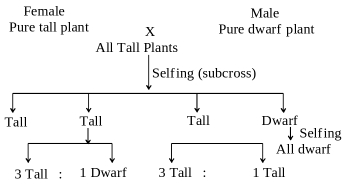
(A) Mendel obtained the recessive character in the $F_{2}$ generation by self-pollinating the $F_{1}$ plants.
Mendel cross-pollinated a pure tall pea plant and a pure dwarf pea plant. He called them the parental generation,denoted by the symbol $P$.
This hybridization is popularly called a monohybrid cross.
In the $F_{1}$ generation,all plants are tall. When these $F_{1}$ plants are self-pollinated,they produce the $F_{2}$ generation.
In the $F_{2}$ generation,the phenotypic ratio is $3:1$ (three tall and one dwarf). Thus,the recessive dwarf character reappears in the $F_{2}$ generation due to the self-pollination of $F_{1}$ hybrids.
Mendel cross-pollinated a pure tall pea plant and a pure dwarf pea plant. He called them the parental generation,denoted by the symbol $P$.
This hybridization is popularly called a monohybrid cross.
In the $F_{1}$ generation,all plants are tall. When these $F_{1}$ plants are self-pollinated,they produce the $F_{2}$ generation.
In the $F_{2}$ generation,the phenotypic ratio is $3:1$ (three tall and one dwarf). Thus,the recessive dwarf character reappears in the $F_{2}$ generation due to the self-pollination of $F_{1}$ hybrids.
0 likes
View Solution273
MediumMCQ
Gametes produced by a homozygous individual is/are of .... types.
A
$1$
B
$2$
C
$3$
D
Many
Solution
(A) homozygous individual possesses identical alleles for a particular trait (e.g.,$AA$ or $aa$).
Since both alleles are the same,the individual can only produce one type of gamete (either $A$ or $a$).
Therefore,the number of types of gametes produced by a homozygous individual is $1$.
Since both alleles are the same,the individual can only produce one type of gamete (either $A$ or $a$).
Therefore,the number of types of gametes produced by a homozygous individual is $1$.
0 likes
View Solution274
MediumMCQ
Dominant alleles are expressed in
A
Second generation
B
Homozygous condition
C
Heterozygous condition
D
Both $(b)$ and $(c)$
Solution
(D) Dominant alleles are expressed in both homozygous and heterozygous conditions.
According to the Principle of Dominance:
In heterozygous individuals or hybrids,a character is represented by two contrasting factors called alleles or allelomorphs. Out of the two contrasting alleles,only one is able to express its effect in the individual. It is called the dominant factor or dominant allele.
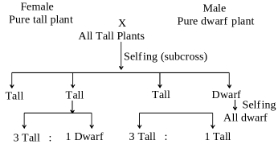
The other allele,which does not show its effect in the heterozygous individual,is called the recessive factor or recessive allele. The cross between a pure tall and a pure dwarf plant gives all progeny $(F_{1})$ as tall.
The character shown by the $F_{1}$ generation is called the dominant character.
According to the Principle of Dominance:
In heterozygous individuals or hybrids,a character is represented by two contrasting factors called alleles or allelomorphs. Out of the two contrasting alleles,only one is able to express its effect in the individual. It is called the dominant factor or dominant allele.
The other allele,which does not show its effect in the heterozygous individual,is called the recessive factor or recessive allele. The cross between a pure tall and a pure dwarf plant gives all progeny $(F_{1})$ as tall.
The character shown by the $F_{1}$ generation is called the dominant character.
0 likes
View Solution275
MediumMCQ
Which of the following is incorrect regarding Mendelism?
A
Works on garden pea
B
Law of segregation proved by monohybrid cross
C
Discovered linkage
D
All of the above
Solution
(C) Mendel worked on garden pea $(Pisum \text{ } sativum)$ and formulated the laws of inheritance, including the Law of Segregation, which is demonstrated by a monohybrid cross.
However, Mendel did not discover linkage; in fact, he failed to observe it because the genes he studied were either far apart or on different chromosomes.
The phenomenon of linkage was discovered and fully explained as a theory by $T. H. Morgan$ in $1911$.
However, Mendel did not discover linkage; in fact, he failed to observe it because the genes he studied were either far apart or on different chromosomes.
The phenomenon of linkage was discovered and fully explained as a theory by $T. H. Morgan$ in $1911$.
0 likes
View Solution276
EasyMCQ
Mendelism was rediscovered by:
$I.$ Morgan
$II.$ De Vries
$III.$ Correns
$IV.$ Tschermark
Choose the correct option.
$I.$ Morgan
$II.$ De Vries
$III.$ Correns
$IV.$ Tschermark
Choose the correct option.
A
$I, III$ and $IV$
B
$I, II, III$ and $IV$
C
$II, III$ and $IV$
D
$I, II$ and $III$
Solution
(C) Gregor Mendel died in $1884$,long before his work was recognized by the scientific community.
In $1900$,three scientists independently rediscovered the principles of heredity that had already been established by Mendel.
These three scientists were:
$1.$ Hugo de Vries (Holland)
$2.$ Carl Correns (Germany)
$3.$ Erich von Tschermak (Austria)
Therefore,the correct individuals are $II, III,$ and $IV$.
In $1900$,three scientists independently rediscovered the principles of heredity that had already been established by Mendel.
These three scientists were:
$1.$ Hugo de Vries (Holland)
$2.$ Carl Correns (Germany)
$3.$ Erich von Tschermak (Austria)
Therefore,the correct individuals are $II, III,$ and $IV$.
0 likes
View Solution277
MediumMCQ
Test cross is
A
Homozygous recessive offspring $\times$ Homozygous dominant parent
B
Homozygous dominant offspring $\times$ Homozygous dominant parent
C
Heterozygous dominant offspring $\times$ Homozygous recessive parent
D
Dominant plant crosses with heterozygous parent plants
Solution
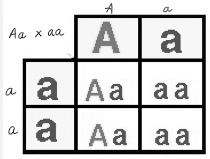
(C) test cross is a genetic cross between an individual with a dominant phenotype (whose genotype is unknown,i.e.,either homozygous dominant or heterozygous) and a homozygous recessive individual.
This cross is used to determine the genotype of the dominant individual.
If the dominant individual is heterozygous $(Aa)$,the test cross with a homozygous recessive parent $(aa)$ results in a $1:1$ phenotypic ratio of dominant to recessive offspring.
If the dominant individual is homozygous dominant $(AA)$,all offspring will exhibit the dominant phenotype.
This cross is used to determine the genotype of the dominant individual.
If the dominant individual is heterozygous $(Aa)$,the test cross with a homozygous recessive parent $(aa)$ results in a $1:1$ phenotypic ratio of dominant to recessive offspring.
If the dominant individual is homozygous dominant $(AA)$,all offspring will exhibit the dominant phenotype.
0 likes
View Solution278
MediumMCQ
Out of $7$ contrasting trait pairs selected by Mendel,how many traits were dominant and recessive?
A
$7$ and $7$
B
$8$ and $6$
C
$6$ and $8$
D
$5$ and $9$
Solution
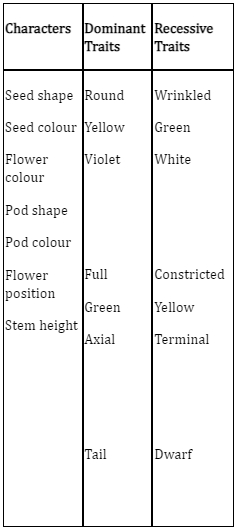
(A) Gregor Mendel selected $7$ pairs of contrasting traits in pea plants for his experiments.
Each pair consists of one dominant trait and one recessive trait.
Therefore,there are $7$ dominant traits and $7$ recessive traits in total.
Each pair consists of one dominant trait and one recessive trait.
Therefore,there are $7$ dominant traits and $7$ recessive traits in total.
0 likes
View Solution279
EasyMCQ
The term 'gene' was coined by
A
Avery
B
Bateson
C
Johanssen
D
Mendel
Solution
(C) The term 'gene' was coined by the Danish botanist Wilhelm Johanssen in $1909$. He introduced this term to replace the term 'factor' used by Gregor Mendel to describe the unit of heredity.
0 likes
View Solution280
MediumMCQ
Mendel's contribution to genetic inheritance was
A
The idea that genes are found on chromosomes
B
Providing a mechanism that explains patterns of inheritance
C
Describing how genes are influenced by the environment
D
Determining that the information contained in $DNA$ codes for proteins
Solution
(B) Gregor Mendel is known as the father of genetics. His primary contribution was the formulation of the laws of inheritance (Law of Dominance,Law of Segregation,and Law of Independent Assortment). These laws provide a clear mechanism that explains the patterns of inheritance observed in living organisms,specifically how traits are passed from parents to offspring.
0 likes
View Solution281
EasyMCQ
The character that is expressed in the $F_{1}$-generation is called the
A
Recessive character
B
Dominant character
C
Codominant character
D
None of these
Solution
(B) The correct answer is the Dominant character.
According to the Law of Dominance:
In heterozygous individuals or hybrids,a character is represented by two contrasting factors called alleles or allelomorphs.
Out of these two contrasting alleles,only one is able to express its effect in the individual. This is called the dominant factor or dominant allele.
The other allele,which does not show its effect in the heterozygous individual,is called the recessive factor or recessive allele.
For example,a cross between a pure tall plant and a pure dwarf plant results in all progeny in the $F_{1}$-generation being tall,as the tall trait is dominant over the dwarf trait.
According to the Law of Dominance:
In heterozygous individuals or hybrids,a character is represented by two contrasting factors called alleles or allelomorphs.
Out of these two contrasting alleles,only one is able to express its effect in the individual. This is called the dominant factor or dominant allele.
The other allele,which does not show its effect in the heterozygous individual,is called the recessive factor or recessive allele.
For example,a cross between a pure tall plant and a pure dwarf plant results in all progeny in the $F_{1}$-generation being tall,as the tall trait is dominant over the dwarf trait.
0 likes
View Solution282
EasyMCQ
Which type of pollination method was adopted by Mendel in his experiment?
A
Artificial
B
Cross pollination
C
Natural
D
Both $(A)$ and $(B)$
Solution
(D) Mendel performed experiments on pea plants by manually transferring pollen grains from the anther of one flower to the stigma of another flower. This process is known as artificial pollination or cross-pollination. By using true-breeding lines (e.g.,$TT$ and $tt$),he ensured controlled hybridization to study the inheritance of traits.
0 likes
View Solution283
MediumMCQ
Which one of the following was the rediscoverer of Mendel's work?
A
Muller
B
Morgan
C
Correns
D
Bridge
Solution
(C) Mendel's work was rediscovered independently in $1900$ by three scientists: Hugo de Vries (Dutch),Carl Correns (German),and Erich von Tschermak (Austrian). Among the given options,Carl Correns is one of the rediscoverers.
0 likes
View Solution284
EasyMCQ
The principles or laws of inheritance were enunciated by:
A
Mendel
B
Morgan
C
Bateson
D
Punnett
Solution
(A) The principles or laws of inheritance were enunciated by $Gregor \text{ } Mendel$. He proposed these laws based on his experiments with garden peas $(Pisum \text{ } sativum)$.
There are three main laws of inheritance:
$1.$ $\text{Law of Dominance}$: In a heterozygote, one allele masks the presence of another allele for the same character.
$2.$ $\text{Law of Segregation}$: Alleles of a gene pair segregate from each other during gamete formation so that each gamete carries only one allele.
$3.$ $\text{Law of Independent Assortment}$: The alleles of different genes assort independently of one another during gamete formation.
There are three main laws of inheritance:
$1.$ $\text{Law of Dominance}$: In a heterozygote, one allele masks the presence of another allele for the same character.
$2.$ $\text{Law of Segregation}$: Alleles of a gene pair segregate from each other during gamete formation so that each gamete carries only one allele.
$3.$ $\text{Law of Independent Assortment}$: The alleles of different genes assort independently of one another during gamete formation.
0 likes
View Solution285
MediumMCQ
The person famous for experimental genetics is:
A
$TH$ Morgan
B
Sutton
C
Boveri
D
Robert Hooke
Solution
(A) The father of experimental genetics is $TH$ Morgan.
He is also known as the 'fly man of genetics' because he selected the fruit fly ($Drosophila$ $melanogaster$) as his primary research material for his experiments in genetics.
He is also known as the 'fly man of genetics' because he selected the fruit fly ($Drosophila$ $melanogaster$) as his primary research material for his experiments in genetics.
0 likes
View Solution286
MediumMCQ
Punnett square was developed by
A
$RC$ Punnett
B
$RB$ Punnett
C
$RD$ Punnett
D
$RE$ Punnett
Solution
(A) Punnett square was developed by the British geneticist Reginald $C.$ Punnett.
It is a graphical representation used to calculate the probability of all possible genotypes of offspring in a genetic cross.
It is a graphical representation used to calculate the probability of all possible genotypes of offspring in a genetic cross.
0 likes
View Solution287
MediumMCQ
Which contributed to Mendel's success?
$I.$ Selection of pea plant
$II.$ Knowledge of history
$III.$ One character at one time
$IV.$ His statistical knowledge
Choose the correct option.
$I.$ Selection of pea plant
$II.$ Knowledge of history
$III.$ One character at one time
$IV.$ His statistical knowledge
Choose the correct option.
A
$I, II, III$ and $IV$
B
$II$ and $III$
C
$I, III$ and $IV$
D
$IV, III$ and $II$
Solution
(C) Mendel's success was due to several key factors:
$(i)$ Selection of the pea plant ($Pisum$ $sativum$),which is easy to grow and has distinct contrasting traits.
$(ii)$ He studied one or two characters at a time,which simplified the analysis of inheritance patterns.
$(iii)$ He maintained a complete and systematic record of every cross and generation.
$(iv)$ He applied statistical methods and laws of probability to analyze his data,which was a novel approach at the time.
Knowledge of history $(II)$ did not contribute to his success in genetics. Therefore,factors $I, III,$ and $IV$ are correct.
$(i)$ Selection of the pea plant ($Pisum$ $sativum$),which is easy to grow and has distinct contrasting traits.
$(ii)$ He studied one or two characters at a time,which simplified the analysis of inheritance patterns.
$(iii)$ He maintained a complete and systematic record of every cross and generation.
$(iv)$ He applied statistical methods and laws of probability to analyze his data,which was a novel approach at the time.
Knowledge of history $(II)$ did not contribute to his success in genetics. Therefore,factors $I, III,$ and $IV$ are correct.
0 likes
View Solution288
MediumMCQ
To determine the heterozygosity of an organism,one has to perform:
A
Back cross
B
Reciprocal cross
C
Test cross
D
Any of these
Solution
(C) When an $F_{1}$ hybrid is crossed with its recessive parent,it is called a test cross.
By performing a test cross,the heterozygosity and homozygosity of an organism can be determined.
The test cross ratio in a monohybrid cross is $1:1$,and in a dihybrid cross,the ratio is $1:1:1:1$.
By performing a test cross,the heterozygosity and homozygosity of an organism can be determined.
The test cross ratio in a monohybrid cross is $1:1$,and in a dihybrid cross,the ratio is $1:1:1:1$.
0 likes
View Solution289
MediumMCQ
Mendel conducted his hybridization experiments for how many years?
A
$7\, years$
B
$6\, years$
C
$5\, years$
D
$4\, years$
Solution
(A) Gregor Johann Mendel conducted his hybridization experiments on garden pea $(Pisum\, sativum)$ for $7\, years$, specifically from $1856$ to $1863$.
0 likes
View Solution290
MediumMCQ
Mendel crossed tall and dwarf plants. In the $F_{2}$-generation,the observed ratio was $3: 1$ (tall: short). From this result,he deduced:
$I.$ Law of dominance
$II.$ Law of independent assortment
$III.$ Law of segregation
$IV.$ Incomplete dominance
Choose the correct option.
$I.$ Law of dominance
$II.$ Law of independent assortment
$III.$ Law of segregation
$IV.$ Incomplete dominance
Choose the correct option.
A
$I, II, III$ and $IV$
B
$I$ and $III$
C
$II, III$ and $IV$
D
$I, II$ and $III$
Solution
(B) Mendel's monohybrid cross between tall and dwarf plants resulted in a $3: 1$ phenotypic ratio in the $F_{2}$-generation.
$1$. Law of Dominance: This law explains that in a heterozygous condition,one allele expresses itself (dominant) while the other remains masked (recessive). The $3: 1$ ratio supports this.
$2$. Law of Segregation: This law states that alleles separate during gamete formation so that each gamete carries only one allele for a trait. This is the basis for the $3: 1$ ratio.
$3$. Law of Independent Assortment: This is deduced from dihybrid crosses,not monohybrid crosses.
$4$. Incomplete Dominance: This is a deviation from Mendelian inheritance where the $F_{1}$ phenotype is intermediate,not dominant.
Therefore,only $I$ and $III$ are deduced from this specific result.
$1$. Law of Dominance: This law explains that in a heterozygous condition,one allele expresses itself (dominant) while the other remains masked (recessive). The $3: 1$ ratio supports this.
$2$. Law of Segregation: This law states that alleles separate during gamete formation so that each gamete carries only one allele for a trait. This is the basis for the $3: 1$ ratio.
$3$. Law of Independent Assortment: This is deduced from dihybrid crosses,not monohybrid crosses.
$4$. Incomplete Dominance: This is a deviation from Mendelian inheritance where the $F_{1}$ phenotype is intermediate,not dominant.
Therefore,only $I$ and $III$ are deduced from this specific result.
0 likes
View Solution291
EasyMCQ
Mendel's experimental material was
A
Pisum sativum
B
Lathyrus odoratus
C
Oryza sativa
D
Mirabilis jalappa
Solution
(A) Gregor Johann Mendel,known as the father of genetics,conducted his hybridization experiments on the garden pea plant.
The scientific name of the garden pea is $Pisum \ sativum$.
He chose this plant because it has several contrasting traits,a short life cycle,and is easy to cultivate.
The scientific name of the garden pea is $Pisum \ sativum$.
He chose this plant because it has several contrasting traits,a short life cycle,and is easy to cultivate.
0 likes
View Solution292
MediumMCQ
Which of the following terms represents a pair of contrasting characters?
A
Homozygous
B
Heterozygous
C
Allelomorphs
D
Codominant genes
Solution
(C) Allelomorphs,or simply called alleles,represent a pair of contrasting characters. An allele is one of two or more alternative forms of a gene that arise by mutation and are found at the same place on a chromosome.
0 likes
View Solution293
MediumMCQ
Mendel performed a test cross to determine the:
A
Genotype of $F_{1}$
B
Phenotype of $F_{1}$
C
Genotype of parents
D
Phenotype of $F_{2}$
Solution
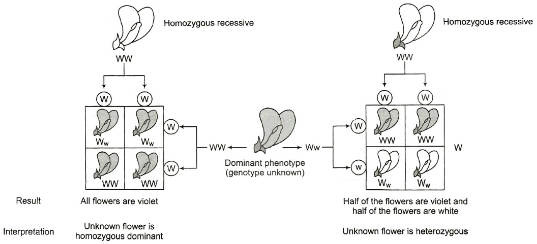
(A) test cross is performed to determine the genotype of an organism showing a dominant phenotype.
In a test cross,an organism with an unknown genotype (exhibiting a dominant trait) is crossed with a homozygous recessive individual.
If the unknown organism is homozygous dominant,all offspring will show the dominant phenotype.
If the unknown organism is heterozygous,the offspring will show a $1:1$ ratio of dominant and recessive phenotypes.
Therefore,Mendel used the test cross to identify the genotype of $F_{1}$ individuals.
In a test cross,an organism with an unknown genotype (exhibiting a dominant trait) is crossed with a homozygous recessive individual.
If the unknown organism is homozygous dominant,all offspring will show the dominant phenotype.
If the unknown organism is heterozygous,the offspring will show a $1:1$ ratio of dominant and recessive phenotypes.
Therefore,Mendel used the test cross to identify the genotype of $F_{1}$ individuals.
0 likes
View Solution294
EasyMCQ
If the genotype of an individual consists of only one type of alleles at the same locus,it is called:
A
Homozygous
B
Heterozygous
C
Monoallelic
D
Uniallelic
Solution
(A) The condition in which the alleles at a given locus are identical is called homozygous.
In a homozygous condition,an organism possesses two similar alleles for a particular character on homologous chromosomes,$e.g., TT$ or $tt$.
Conversely,an organism containing two different alleles for a particular character,$e.g., Tt$,is known as heterozygous.
In a homozygous condition,an organism possesses two similar alleles for a particular character on homologous chromosomes,$e.g., TT$ or $tt$.
Conversely,an organism containing two different alleles for a particular character,$e.g., Tt$,is known as heterozygous.
0 likes
View Solution295
MediumMCQ
Which of these is a dominant factor?
A
Rh factor
B
Haemophilia
C
Albinism
D
Colour blindness
Solution
(A) The $Rh$ factor is a protein found on the surface of red blood cells. The presence of the $Rh$ factor is determined by a dominant allele. Individuals who possess the $Rh$ factor are classified as $Rh^+$ (Rh-positive),while those who lack it are $Rh^-$ (Rh-negative). The $Rh^+$ allele is dominant over the $Rh^-$ allele,meaning that even a single copy of the $Rh^+$ allele results in the expression of the $Rh$ factor. In contrast,Haemophilia,Albinism,and Colour blindness are all recessive genetic traits.
0 likes
View Solution296
MediumMCQ
How many pairs of contrasting characters in pea plants were chosen by Mendel for his experiments?
A
$3$
B
$5$
C
$7$
D
$9$
Solution
(C) Gregor Mendel selected $7$ pairs of contrasting characters in pea plants ($Pisum$ $sativum$) for his hybridization experiments.
These characters include: $(1)$ Stem height,$(2)$ Flower colour,$(3)$ Flower position,$(4)$ Pod shape,$(5)$ Pod colour,$(6)$ Seed shape,and $(7)$ Seed colour.
Therefore,the total number of contrasting character pairs studied by Mendel is $7$.
These characters include: $(1)$ Stem height,$(2)$ Flower colour,$(3)$ Flower position,$(4)$ Pod shape,$(5)$ Pod colour,$(6)$ Seed shape,and $(7)$ Seed colour.
Therefore,the total number of contrasting character pairs studied by Mendel is $7$.
0 likes
View Solution297
MediumMCQ
Mendel crossed true-breeding tall and dwarf plant varieties in his experiment. The tall character was dominant and the dwarf character was recessive. The recessive character appeared in:
A
$F_{1}$
B
$F_{2}$
C
$F_{3}$
D
$F_{2}$ and $F_{3}$
Solution
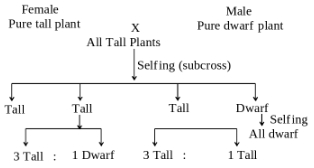
(B) In Mendel's monohybrid cross,the recessive trait (dwarfness) is masked in the $F_{1}$ generation because all offspring are heterozygous tall.
The recessive trait first reappears in the $F_{2}$ generation,where the phenotypic ratio is $3$ tall : $1$ dwarf.
In the $F_{3}$ generation,the dwarf plants from the $F_{2}$ generation,when self-pollinated,continue to produce only dwarf plants (breeding true),while the tall plants from the $F_{2}$ generation show mixed results (some breed true as tall,others produce both tall and dwarf offspring).
Therefore,the recessive character is expressed in both the $F_{2}$ and $F_{3}$ generations,but it is first observed in the $F_{2}$ generation. Given the options,the most accurate description of where the recessive character appears is the $F_{2}$ generation.
The recessive trait first reappears in the $F_{2}$ generation,where the phenotypic ratio is $3$ tall : $1$ dwarf.
In the $F_{3}$ generation,the dwarf plants from the $F_{2}$ generation,when self-pollinated,continue to produce only dwarf plants (breeding true),while the tall plants from the $F_{2}$ generation show mixed results (some breed true as tall,others produce both tall and dwarf offspring).
Therefore,the recessive character is expressed in both the $F_{2}$ and $F_{3}$ generations,but it is first observed in the $F_{2}$ generation. Given the options,the most accurate description of where the recessive character appears is the $F_{2}$ generation.
0 likes
View Solution298
MediumMCQ
Mendel's work remained unrecognized for a long time due to:
$I.$ Communication was not easy.
$II.$ The concept of factors which did not blend was not accepted.
$III.$ The use of mathematics to explain biological problems was unacceptable.
$IV.$ He could not provide any physical proof for the existence of factors.
Choose the right combination.
$I.$ Communication was not easy.
$II.$ The concept of factors which did not blend was not accepted.
$III.$ The use of mathematics to explain biological problems was unacceptable.
$IV.$ He could not provide any physical proof for the existence of factors.
Choose the right combination.
A
$I$ and $II$
B
$II$ and $III$
C
$III$ and $IV$
D
All of these
Solution
(D) Mendel's work remained unrecognized for a long time due to several reasons:
$(i)$ Communication was not easy at that time,so his work could not be widely publicized.
$(ii)$ The concept of factors (genes) as stable and discrete units that did not blend was not accepted by his contemporaries,who believed in the 'blending inheritance' theory.
$(iii)$ The use of mathematics and statistics to explain biological phenomena was a completely new approach and was largely unacceptable to the biologists of that era.
$(iv)$ He could not provide any physical proof for the existence of factors,as the concept of chromosomes and $DNA$ was not known at that time.
Therefore,all the given statements are correct.
$(i)$ Communication was not easy at that time,so his work could not be widely publicized.
$(ii)$ The concept of factors (genes) as stable and discrete units that did not blend was not accepted by his contemporaries,who believed in the 'blending inheritance' theory.
$(iii)$ The use of mathematics and statistics to explain biological phenomena was a completely new approach and was largely unacceptable to the biologists of that era.
$(iv)$ He could not provide any physical proof for the existence of factors,as the concept of chromosomes and $DNA$ was not known at that time.
Therefore,all the given statements are correct.
0 likes
View Solution299
MediumMCQ
Mark the odd one (w.r.t. true breeding line).
A
Shows the stable trait inheritance.
B
Shows expression for few generations only.
C
Undergone continuous self-pollination.
D
Both $(A)$ and $(C)$.
Solution
(B) true breeding line is one that,having undergone continuous self-pollination,shows the stable trait inheritance and expression for several generations.
Option $(B)$ is incorrect because a true breeding line maintains the expression of traits for many generations,not just a few.
Option $(B)$ is incorrect because a true breeding line maintains the expression of traits for many generations,not just a few.
0 likes
View Solution300
MediumMCQ
Which of the following is not a dominant trait in edible pea?
A
Axial flower
B
Inflated pod
C
Green seed colour
D
Green pod
Solution
(C) In $Pisum$ $sativum$ (edible pea),Mendel identified seven pairs of contrasting traits.
$1$. Seed colour: Yellow is dominant,while Green is recessive.
$2$. Flower position: Axial is dominant,while Terminal is recessive.
$3$. Pod shape: Inflated is dominant,while Constricted is recessive.
$4$. Pod colour: Green is dominant,while Yellow is recessive.
Therefore,Green seed colour is a recessive trait,not a dominant one.
$1$. Seed colour: Yellow is dominant,while Green is recessive.
$2$. Flower position: Axial is dominant,while Terminal is recessive.
$3$. Pod shape: Inflated is dominant,while Constricted is recessive.
$4$. Pod colour: Green is dominant,while Yellow is recessive.
Therefore,Green seed colour is a recessive trait,not a dominant one.
0 likes
View SolutionPrinciples of Inheritance and Variation — Mendelism · Frequently Asked Questions
1Are these Principles of Inheritance and Variation questions useful for JEE and NEET?
Yes. All questions in this section are mapped to JEE Main and NEET exam patterns. Previous year questions from JEE Main, NEET, GUJCET and state-level exams are included with full solutions.
2Can I switch to Hindi or Gujarati for these questions?
Yes. Use the language tabs in the hero section or the sidebar to view the same questions and solutions in English, Hindi or Gujarati.
3How do I generate a question paper from this subtopic?
Use the Vedclass Exam Paper Generator — select the chapter and subtopic, set difficulty, and generate Sets A, B, C, D automatically. First 3 chapters of every subject are free.
Vedclass Products
For Students
Vedclass Test Series
Mock tests in real JEE/NEET style with performance analysis. 5-day free trial.
Start Free TrialFor Teachers
Exam Paper Generator
Generate Set A/B/C/D papers from this chapter in 2 minutes. 3 chapters free.
Try FreeFor Institutes
Online Exam Module
Live online exams with unlimited students, 360° analytics & white-label branding.
See DemoFor Teachers & Institutes
Generate a Principles of Inheritance and Variation Exam Paper in 2 Minutes
Select subtopic & difficulty — Sets A, B, C, D auto-generated with No Repeat logic.
First 3 chapters of every subject are free — no payment required.