
A English
Interaction of gene and cytoplasmic inheritance Questions in English
Class 12 Biology · Principles of Inheritance and Variation · Interaction of gene and cytoplasmic inheritance
82+
Questions
English
Language
100%
With Solutions
Showing 30 of 82 questions in English
51
EasyMCQ
The scientist who first discovered cytoplasmic inheritance was.....
A
Correns
B
Rhoades
C
Mendel
D
Morgan
Solution
(A) Cytoplasmic inheritance (also known as extranuclear inheritance) refers to the transmission of genes located in cytoplasmic organelles such as mitochondria or chloroplasts.
Carl Correns was the scientist who first discovered cytoplasmic inheritance in $1909$ while working on the inheritance of leaf variegation in the plant $Mirabilis \, jalapa$ (Four O'clock plant).
He observed that the inheritance of leaf color was determined by the plastids present in the cytoplasm of the egg cell, rather than by nuclear genes following Mendelian patterns.
Carl Correns was the scientist who first discovered cytoplasmic inheritance in $1909$ while working on the inheritance of leaf variegation in the plant $Mirabilis \, jalapa$ (Four O'clock plant).
He observed that the inheritance of leaf color was determined by the plastids present in the cytoplasm of the egg cell, rather than by nuclear genes following Mendelian patterns.
0 likes
View Solution52
MediumMCQ
The antibiotic commonly used to induce mutations in cytoplasmic genes is.....
A
Tetramycin
B
Streptomycin
C
Tetracycline
D
Cyclosporin
Solution
(B) Streptomycin is an aminoglycoside antibiotic that binds to the $30S$ ribosomal subunit of bacteria. In eukaryotic cells,it can interfere with the protein synthesis machinery of organelles like mitochondria and chloroplasts,which possess their own $DNA$ (cytoplasmic genes). By disrupting the translation process in these organelles,it can lead to mutations or the loss of cytoplasmic genetic information. Therefore,it is commonly used in research to induce mutations in cytoplasmic genes.
0 likes
View Solution53
MediumMCQ
Fruit colour in squash is an example of
A
recessive epistasis
B
dominant epistasis
C
complementary genes
D
inhibitory genes.
Solution
(B) : $A$ dominant epistatic allele suppresses the expression of a non-allelic gene, whether the latter is dominant or recessive.
The gene that suppresses the expression of a non-allelic gene is known as an epistatic gene.
The gene or locus that is suppressed by the presence of a non-allelic gene is termed as a hypostatic gene.
In summer squash or $Cucurbita \text{ } pepo$, there are three types of fruit colour: white, yellow, and green.
White colour is dominant over other colours, while yellow is dominant over green.
Yellow colour is formed only when the dominant epistatic gene is represented by its recessive allele $(w)$.
When the hypostatic gene is also recessive $(y)$, the colour of the fruit is green.
Thus, the inheritance pattern is:
$W-Y- \text{ or } W-yy \rightarrow \text{White}$
$wwY- \rightarrow \text{Yellow}$
$wwyy \rightarrow \text{Green}$
The gene that suppresses the expression of a non-allelic gene is known as an epistatic gene.
The gene or locus that is suppressed by the presence of a non-allelic gene is termed as a hypostatic gene.
In summer squash or $Cucurbita \text{ } pepo$, there are three types of fruit colour: white, yellow, and green.
White colour is dominant over other colours, while yellow is dominant over green.
Yellow colour is formed only when the dominant epistatic gene is represented by its recessive allele $(w)$.
When the hypostatic gene is also recessive $(y)$, the colour of the fruit is green.
Thus, the inheritance pattern is:
$W-Y- \text{ or } W-yy \rightarrow \text{White}$
$wwY- \rightarrow \text{Yellow}$
$wwyy \rightarrow \text{Green}$
0 likes
View Solution54
MediumMCQ
Extranuclear inheritance is observed in .......... .
A
Killer strains of Paramecium
B
Color blindness
C
Phenylketonuria
D
Tay-Sachs disease
Solution
(A) Extranuclear inheritance,also known as cytoplasmic inheritance,refers to the transmission of genes located outside the nucleus,typically in mitochondria or chloroplasts,or through cytoplasmic particles.
In $Paramecium$,the presence of 'kappa particles' in the cytoplasm is a classic example of extranuclear inheritance.
These particles are responsible for the 'killer' trait,where individuals containing them can kill sensitive strains.
Color blindness,Phenylketonuria,and Tay-Sachs disease are all examples of nuclear (Mendelian) genetic disorders.
In $Paramecium$,the presence of 'kappa particles' in the cytoplasm is a classic example of extranuclear inheritance.
These particles are responsible for the 'killer' trait,where individuals containing them can kill sensitive strains.
Color blindness,Phenylketonuria,and Tay-Sachs disease are all examples of nuclear (Mendelian) genetic disorders.
0 likes
View Solution55
MediumMCQ
Extranuclear inheritance is the result of the presence of genes in ........
A
Mitochondria and chloroplasts
B
Endoplasmic reticulum and mitochondria
C
Ribosomes and chloroplasts
D
Lysosomes and ribosomes
Solution
(A) Extranuclear inheritance,also known as cytoplasmic inheritance,refers to the transmission of genes that are located outside the nucleus.
In eukaryotic cells,the organelles that contain their own $DNA$ (extranuclear $DNA$) are the mitochondria and the chloroplasts.
These organelles possess their own genome,which is inherited independently of the nuclear chromosomes,typically through the cytoplasm of the egg cell.
Therefore,the presence of genes in mitochondria and chloroplasts is responsible for extranuclear inheritance.
In eukaryotic cells,the organelles that contain their own $DNA$ (extranuclear $DNA$) are the mitochondria and the chloroplasts.
These organelles possess their own genome,which is inherited independently of the nuclear chromosomes,typically through the cytoplasm of the egg cell.
Therefore,the presence of genes in mitochondria and chloroplasts is responsible for extranuclear inheritance.
0 likes
View Solution56
MediumMCQ
When one pair of genes suppresses the effect of another pair,the phenomenon is known as:
A
Epistasis
B
Dominance
C
Mutation
D
None of the above
Solution
(A) Epistasis is a genetic interaction where the expression of one gene is modified or masked by the presence of one or more other genes.
In this phenomenon,the gene that suppresses the effect of another gene is called the epistatic gene,and the gene whose effect is suppressed is called the hypostatic gene.
Unlike dominance,which involves the interaction between alleles of the same gene,epistasis involves the interaction between different gene loci.
In this phenomenon,the gene that suppresses the effect of another gene is called the epistatic gene,and the gene whose effect is suppressed is called the hypostatic gene.
Unlike dominance,which involves the interaction between alleles of the same gene,epistasis involves the interaction between different gene loci.
0 likes
View Solution57
MediumMCQ
When a trait is inherited only from the female parent,it primarily indicates:
A
Polygenic inheritance
B
Cytoplasmic inheritance
C
Incomplete dominance
D
Mendelian nuclear inheritance
Solution
(B) Cytoplasmic inheritance,also known as extranuclear inheritance,refers to the transmission of genes present in cytoplasmic organelles like mitochondria or chloroplasts.
Since the zygote receives the majority of its cytoplasm from the egg cell (ovum) during fertilization,traits controlled by these organellar genes are inherited exclusively from the female parent.
This phenomenon is also known as maternal inheritance.
Since the zygote receives the majority of its cytoplasm from the egg cell (ovum) during fertilization,traits controlled by these organellar genes are inherited exclusively from the female parent.
This phenomenon is also known as maternal inheritance.
0 likes
View Solution58
MediumMCQ
After crossing two plants,the male progeny is found to be sterile. This phenomenon is inherited maternally,and the cause lies in genes located in the ...
A
Nucleus
B
Chloroplast
C
Mitochondria
D
Cytoplasm
Solution
(C) The phenomenon where a trait is inherited exclusively from the mother is known as cytoplasmic inheritance or maternal inheritance.
In plants,male sterility is often associated with genes located in the mitochondrial $DNA$.
This is known as Cytoplasmic Male Sterility $(CMS)$.
Since mitochondria are inherited through the egg cytoplasm during fertilization,the trait follows maternal inheritance patterns.
Therefore,the correct option is $C$.
In plants,male sterility is often associated with genes located in the mitochondrial $DNA$.
This is known as Cytoplasmic Male Sterility $(CMS)$.
Since mitochondria are inherited through the egg cytoplasm during fertilization,the trait follows maternal inheritance patterns.
Therefore,the correct option is $C$.
0 likes
View Solution59
MediumMCQ
The phenotypic ratio of complementary genes is ................
A
$9 : 7$
B
$12 : 3 : 1$
C
$9 : 3 : 4$
D
$9 : 3 : 3 : 1$
Solution
(A) Complementary genes are two independent pairs of genes that interact to produce a single trait,where each gene is required for the expression of the other.
In the $F_2$ generation of a dihybrid cross involving complementary genes,the phenotypic ratio is modified from the standard $9 : 3 : 3 : 1$ to $9 : 7$.
This occurs because the presence of at least one dominant allele at both loci $(A-B-)$ results in one phenotype (ratio $9$),while any other combination (where one or both genes are homozygous recessive) results in the alternative phenotype (ratio $3+3+1 = 7$).
In the $F_2$ generation of a dihybrid cross involving complementary genes,the phenotypic ratio is modified from the standard $9 : 3 : 3 : 1$ to $9 : 7$.
This occurs because the presence of at least one dominant allele at both loci $(A-B-)$ results in one phenotype (ratio $9$),while any other combination (where one or both genes are homozygous recessive) results in the alternative phenotype (ratio $3+3+1 = 7$).
0 likes
View Solution60
MediumMCQ
When two non-allelic genes produce a new phenotype when present together, but fail to do so independently, what is this phenomenon called?
A
Epistasis
B
Polygenic inheritance
C
Non-complementary genes
D
Complementary genes
Solution
(D) Complementary genes are two non-allelic genes that interact to produce a specific phenotype, which neither gene can produce on its own. For example, in the sweet pea $(Lathyrus \, odoratus)$, the production of purple flower color requires the presence of two dominant genes ($C$ and $P$). If either gene is absent (e.g., $ccPP$ or $Ccpp$), the flower remains white. Thus, these genes complement each other to express the trait.
0 likes
View Solution61
MediumMCQ
Extranuclear inheritance occurs in ...... .
A
Killer Paramecium
B
Killer Amoeba
C
Euglena
D
Hydra
Solution
$(A)$ Extranuclear inheritance, also known as cytoplasmic inheritance, refers to the transmission of genes present in cytoplasmic organelles like mitochondria or chloroplasts, or other cytoplasmic factors.
In $Paramecium$, the 'killer' trait is determined by cytoplasmic particles called $\kappa$ particles.
These $\kappa$ particles contain $DNA$ and are capable of self-replication, which is a classic example of extranuclear or cytoplasmic inheritance.
Therefore, the correct option is $A$.
In $Paramecium$, the 'killer' trait is determined by cytoplasmic particles called $\kappa$ particles.
These $\kappa$ particles contain $DNA$ and are capable of self-replication, which is a classic example of extranuclear or cytoplasmic inheritance.
Therefore, the correct option is $A$.
0 likes
View Solution62
MediumMCQ
Where are the cytoplasmic genes for male sterility typically located?
A
Nuclear genome
B
Cytosol
C
Chloroplast genome
D
Mitochondrial genome
Solution
(D) Cytoplasmic male sterility $(CMS)$ is a condition in plants where the plant is unable to produce functional pollen.
This trait is inherited through the cytoplasm,specifically through the extranuclear $DNA$.
In most cases,the genes responsible for $CMS$ are located in the mitochondrial genome rather than the nuclear or chloroplast genome.
Therefore,the correct option is $D$.
This trait is inherited through the cytoplasm,specifically through the extranuclear $DNA$.
In most cases,the genes responsible for $CMS$ are located in the mitochondrial genome rather than the nuclear or chloroplast genome.
Therefore,the correct option is $D$.
0 likes
View Solution63
MediumMCQ
In a cross,one parent has a mutation in its mitochondria. In this case,this parent is taken as the male. During analysis,in which offspring is this mutation observed in the $F_2$ generation?
A
In $\frac{1}{3}$ of the offspring
B
Not observed in any offspring
C
In all offspring
D
In $50\%$ of the offspring
Solution
(B) Mitochondrial $DNA$ is inherited exclusively through the cytoplasm of the egg cell (maternal inheritance).
Since the parent with the mitochondrial mutation is used as the male,the sperm contributes only nuclear $DNA$ and virtually no cytoplasm to the zygote.
Therefore,the mitochondrial mutation is not transmitted to the $F_1$ generation,and consequently,it will not be present in the $F_2$ generation.
Thus,the mutation is not observed in any offspring.
Since the parent with the mitochondrial mutation is used as the male,the sperm contributes only nuclear $DNA$ and virtually no cytoplasm to the zygote.
Therefore,the mitochondrial mutation is not transmitted to the $F_1$ generation,and consequently,it will not be present in the $F_2$ generation.
Thus,the mutation is not observed in any offspring.
0 likes
View Solution64
MediumMCQ
Extranuclear inheritance is observed in ................
A
Mitochondria and Chloroplasts
B
Endoplasmic Reticulum and Mitochondria
C
Ribosomes and Chloroplasts
D
Lysosomes and Ribosomes
Solution
(A) Extranuclear inheritance,also known as cytoplasmic inheritance,refers to the transmission of genes that are located outside the nucleus.
In eukaryotic cells,organelles such as mitochondria and chloroplasts contain their own circular $DNA$,which is independent of the nuclear genome.
This $DNA$ is inherited through the cytoplasm,typically from the maternal parent,and is responsible for extranuclear inheritance.
Therefore,the correct option is $A$.
In eukaryotic cells,organelles such as mitochondria and chloroplasts contain their own circular $DNA$,which is independent of the nuclear genome.
This $DNA$ is inherited through the cytoplasm,typically from the maternal parent,and is responsible for extranuclear inheritance.
Therefore,the correct option is $A$.
0 likes
View Solution65
MediumMCQ
In which type of inheritance would you expect a maternal effect in more offspring?
A
Autosomal
B
Cytoplasmic
C
$Y$-linked
D
$X$-linked
Solution
(B) Cytoplasmic inheritance (also known as extranuclear or organellar inheritance) is the transmission of genes located in the cytoplasm,specifically within organelles like mitochondria or chloroplasts.
In most sexually reproducing organisms,the zygote receives the vast majority of its cytoplasm from the egg cell (ovum),while the sperm contributes little to no cytoplasm.
Therefore,traits governed by genes in the mitochondria or chloroplasts are almost exclusively inherited from the mother to all her offspring,regardless of their sex.
This results in a strong maternal effect observed in the progeny.
In most sexually reproducing organisms,the zygote receives the vast majority of its cytoplasm from the egg cell (ovum),while the sperm contributes little to no cytoplasm.
Therefore,traits governed by genes in the mitochondria or chloroplasts are almost exclusively inherited from the mother to all her offspring,regardless of their sex.
This results in a strong maternal effect observed in the progeny.
0 likes
View Solution66
Medium
Define / Explain: Complementary Gene.
Solution
(N/A) Complementary genes are two pairs of non-allelic dominant genes that interact to produce a single phenotypic trait. However,neither gene can produce the trait on its own; the presence of both dominant genes is required for the expression of the phenotype.
0 likes
View Solution67
Medium
Define/Explain: Epistatic Gene or Inhibitory Gene.
Solution
(N/A) Epistasis is a form of gene interaction where one non-allelic gene masks or suppresses the phenotypic expression of another non-allelic gene. The gene that suppresses the other is known as the epistatic gene,while the gene whose expression is masked is called the hypostatic gene. This interaction is a deviation from standard Mendelian inheritance patterns.
0 likes
View Solution68
MediumMCQ
Study the given pedigree chart and identify the nature of the trait.
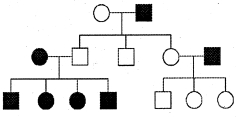
A
$X$-linked recessive
B
Paternal inheritance
C
Autosomal recessive
D
Maternal inheritance
Solution
(D) $1$. In the pedigree,the trait is present in every generation,which suggests it is a dominant trait.
$2$. The trait is observed in both males and females.
$3$. $A$ key observation is that an affected father passes the trait to his daughters,and an affected mother passes it to all her children (both sons and daughters).
$4$. This pattern of inheritance,where the trait is passed from an affected mother to all her offspring,is characteristic of mitochondrial or maternal inheritance.
$2$. The trait is observed in both males and females.
$3$. $A$ key observation is that an affected father passes the trait to his daughters,and an affected mother passes it to all her children (both sons and daughters).
$4$. This pattern of inheritance,where the trait is passed from an affected mother to all her offspring,is characteristic of mitochondrial or maternal inheritance.
0 likes
View Solution69
MediumMCQ
$A$ gene that suppresses the expression of another non-allelic gene,where the suppressed gene is not located on the same homologous chromosome pair,is known as what?
A
Epistatic gene
B
Dominant gene
C
Hypostatic gene
D
Recessive gene
Solution
(C) In genetics,$Epistasis$ is a phenomenon where the effect of one gene is dependent on the presence of one or more 'modifier' genes.
$1$. The gene that suppresses or masks the expression of another gene is called the $Epistatic$ gene.
$2$. The gene whose expression is suppressed or masked by the epistatic gene is known as the $Hypostatic$ gene.
$3$. Since the question asks for the name of the gene whose expression is not occurring (the one being suppressed),the correct term is $Hypostatic$ gene.
$1$. The gene that suppresses or masks the expression of another gene is called the $Epistatic$ gene.
$2$. The gene whose expression is suppressed or masked by the epistatic gene is known as the $Hypostatic$ gene.
$3$. Since the question asks for the name of the gene whose expression is not occurring (the one being suppressed),the correct term is $Hypostatic$ gene.
0 likes
View Solution70
MediumMCQ
How can dominance be distinguished from epistasis?
A
Dominant genes are never suppressed in their expression.
B
$A$ dominant gene suppresses the expression of another non-allelic gene.
C
Epistasis is a characteristic of recessive traits,while dominance applies to all organisms.
D
Poultry breeds that show epistasis also show dominance.
Solution
(B) Dominance refers to the interaction between two alleles of the same gene,where one allele masks the expression of the other in a heterozygote.
Epistasis refers to the interaction between two or more different (non-allelic) genes,where one gene masks or modifies the phenotypic expression of another gene.
Therefore,the key difference is that dominance involves alleles of the same locus,whereas epistasis involves the interaction between different loci.
Epistasis refers to the interaction between two or more different (non-allelic) genes,where one gene masks or modifies the phenotypic expression of another gene.
Therefore,the key difference is that dominance involves alleles of the same locus,whereas epistasis involves the interaction between different loci.
0 likes
View Solution71
MediumMCQ
Which of the following organisms exhibit the phenomenon of epistasis?
A
Poultry breeds
B
Mouse breeds
C
Squash
D
All of the above
Solution
(D) Epistasis is a genetic interaction where one gene masks or interferes with the expression of another gene.
$1$. In poultry,the white plumage color is often due to a dominant epistatic gene $(I)$ that inhibits the expression of color genes.
$2$. In mice,coat color inheritance often involves epistatic interactions where one gene determines the presence of pigment and another determines the color.
$3$. In summer squash,fruit color inheritance (white,yellow,and green) is a classic example of dominant epistasis.
Since all these organisms exhibit various forms of epistasis,the correct answer is $D$.
$1$. In poultry,the white plumage color is often due to a dominant epistatic gene $(I)$ that inhibits the expression of color genes.
$2$. In mice,coat color inheritance often involves epistatic interactions where one gene determines the presence of pigment and another determines the color.
$3$. In summer squash,fruit color inheritance (white,yellow,and green) is a classic example of dominant epistasis.
Since all these organisms exhibit various forms of epistasis,the correct answer is $D$.
0 likes
View Solution72
EasyMCQ
What is the collective term for all the cytoplasmic genes present in the cytoplasm?
A
Plasmon
B
Cytogene
C
Nuclear gene
D
All of the above
Solution
(A) The collective term for all the cytoplasmic genes present in the cytoplasm of a cell is known as the $Plasmon$.
Cytoplasmic inheritance refers to the transmission of genes located in the cytoplasm (specifically in organelles like mitochondria and chloroplasts) rather than the nucleus.
These genes are collectively referred to as the $Plasmon$.
Cytoplasmic inheritance refers to the transmission of genes located in the cytoplasm (specifically in organelles like mitochondria and chloroplasts) rather than the nucleus.
These genes are collectively referred to as the $Plasmon$.
0 likes
View Solution73
MediumMCQ
The inheritance of cytoplasmic genes in organisms is possible through:
A
Male
B
Female
C
Both
D
Nuclear $DNA$
Solution
(B) Cytoplasmic inheritance,also known as extranuclear inheritance,refers to the transmission of genes located in organelles like mitochondria or chloroplasts.
In most sexually reproducing organisms,the zygote receives the majority of its cytoplasm from the egg cell (ovum),while the sperm contributes primarily its nucleus.
Therefore,cytoplasmic genes are inherited through the female parent (maternal inheritance).
Thus,the correct option is $B$.
In most sexually reproducing organisms,the zygote receives the majority of its cytoplasm from the egg cell (ovum),while the sperm contributes primarily its nucleus.
Therefore,cytoplasmic genes are inherited through the female parent (maternal inheritance).
Thus,the correct option is $B$.
0 likes
View Solution74
MediumMCQ
What is the inheritance of cytoplasmic genes known as?
A
Paternal inheritance
B
Maternal inheritance
C
Nuclear inheritance
D
Both $A$ and $B$
Solution
(B) Cytoplasmic inheritance,also known as extranuclear inheritance,refers to the transmission of genes located in organelles like mitochondria or chloroplasts. In most organisms,these organelles are inherited from the mother through the egg cell,as the sperm contributes very little or no cytoplasm to the zygote. Therefore,cytoplasmic inheritance is commonly referred to as maternal inheritance. Since it is not passed through the father,it is not paternal inheritance.
0 likes
View Solution75
MediumMCQ
In plants,where are the genes for cytoplasmic inheritance located?
A
Golgi apparatus
B
Mitochondria
C
Chloroplast
D
None of these
Solution
(C) Cytoplasmic inheritance (also known as extranuclear inheritance) refers to the transmission of genes located outside the nucleus. In plants,these genes are primarily found in the $DNA$ of organelles such as mitochondria and chloroplasts. Since chloroplasts are the most prominent site for such inheritance in photosynthetic plants,option $C$ is the most appropriate answer.
0 likes
View Solution76
MediumMCQ
Cytoplasmic inheritance always shows
A
Paternal characters
B
Maternal characters
C
Parental characters
D
Little paternal and more maternal characters
Solution
(B) Cytoplasmic inheritance,also known as extranuclear inheritance,involves the transmission of genes located in organelles like mitochondria or chloroplasts. Since the zygote receives the majority of its cytoplasm from the egg cell (ovum) and very little or none from the sperm,the traits governed by these cytoplasmic genes are inherited exclusively from the mother. Therefore,cytoplasmic inheritance always shows maternal characters.
0 likes
View Solution77
MediumMCQ
In which one of the following, complementary gene interaction ratio of $9: 7$ is observed?
A
Fruit shape in Shepherd's purse
B
Coat colour in mouse
C
Feather colour in fowl
D
Flower colour in pea
Solution
(D) $W. Bateson$ and $R. C. Punnett$ observed complementary gene interaction for flower colour in sweet pea $(Lathyrus \text{ } odoratus)$.
In complementary interaction, two separate pairs of genes interact to produce the phenotype in such a way that neither of the dominant genes is expressive unless the other one is present.
In $F_{2}$ generation, complementary genes produce a ratio of $9: 7$.
In complementary interaction, two separate pairs of genes interact to produce the phenotype in such a way that neither of the dominant genes is expressive unless the other one is present.
In $F_{2}$ generation, complementary genes produce a ratio of $9: 7$.
0 likes
View Solution78
MediumMCQ
The progenies are found to be male sterile after crossing two plants. This is due to some genes,which are present in
A
Mitochondria
B
Cytoplasm
C
Nucleus
D
Chloroplast
Solution
(A) Cytoplasmic male sterility $(CMS)$ is a condition in plants where the plant is unable to produce functional pollen.
This trait is inherited maternally because the genes responsible for $CMS$ are located in the mitochondrial genome.
Since mitochondria are inherited through the egg cytoplasm,the progeny exhibit the male sterile phenotype.
Therefore,the genes responsible for this phenomenon reside in the mitochondria.
This trait is inherited maternally because the genes responsible for $CMS$ are located in the mitochondrial genome.
Since mitochondria are inherited through the egg cytoplasm,the progeny exhibit the male sterile phenotype.
Therefore,the genes responsible for this phenomenon reside in the mitochondria.
0 likes
View Solution79
MediumMCQ
If an agouti mice $(CcAa)$ is crossed with an albino mice $(ccAA)$,then how many albino mice are produced in the resulting progeny?
A
$1$
B
$2$
C
$3$
D
$4$
Solution
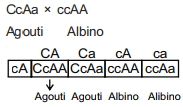
(B) The cross is between $CcAa$ (agouti) and $ccAA$ (albino).
The gametes produced by $CcAa$ are $CA, Ca, cA, ca$.
The gametes produced by $ccAA$ are $cA$.
Performing the Punnett square cross:
$1$. $CA \times cA = CcAA$ (Agouti)
$2$. $Ca \times cA = CcAa$ (Agouti)
$3$. $cA \times cA = ccAA$ (Albino)
$4$. $ca \times cA = ccAa$ (Albino)
In the resulting progeny,there are $2$ albino mice ($ccAA$ and $ccAa$) out of $4$ total offspring. Therefore,the number of albino mice produced is $2$.
The gametes produced by $CcAa$ are $CA, Ca, cA, ca$.
The gametes produced by $ccAA$ are $cA$.
Performing the Punnett square cross:
$1$. $CA \times cA = CcAA$ (Agouti)
$2$. $Ca \times cA = CcAa$ (Agouti)
$3$. $cA \times cA = ccAA$ (Albino)
$4$. $ca \times cA = ccAa$ (Albino)
In the resulting progeny,there are $2$ albino mice ($ccAA$ and $ccAa$) out of $4$ total offspring. Therefore,the number of albino mice produced is $2$.
0 likes
View Solution80
MediumMCQ
Epistasis and dominance are respectively
A
Intragenic,Intergenic
B
Non-allelic,Extra-allelic
C
Non-allelic,Interallelic
D
Intergenic,Non-allelic
Solution
(C) Dominance is an interaction between two alleles of the same gene (intra-allelic or intragenic interaction),where one allele masks the expression of the other.
Epistasis is an interaction between two different genes where one gene masks or modifies the expression of another gene (intergenic or non-allelic interaction).
Therefore,epistasis is non-allelic (intergenic) and dominance is interallelic (intragenic).
Epistasis is an interaction between two different genes where one gene masks or modifies the expression of another gene (intergenic or non-allelic interaction).
Therefore,epistasis is non-allelic (intergenic) and dominance is interallelic (intragenic).
0 likes
View SolutionPrinciples of Inheritance and Variation — Interaction of gene and cytoplasmic inheritance · Frequently Asked Questions
1Are these Principles of Inheritance and Variation questions useful for JEE and NEET?
Yes. All questions in this section are mapped to JEE Main and NEET exam patterns. Previous year questions from JEE Main, NEET, GUJCET and state-level exams are included with full solutions.
2Can I switch to Hindi or Gujarati for these questions?
Yes. Use the language tabs in the hero section or the sidebar to view the same questions and solutions in English, Hindi or Gujarati.
3How do I generate a question paper from this subtopic?
Use the Vedclass Exam Paper Generator — select the chapter and subtopic, set difficulty, and generate Sets A, B, C, D automatically. First 3 chapters of every subject are free.
Vedclass Products
For Students
Vedclass Test Series
Mock tests in real JEE/NEET style with performance analysis. 5-day free trial.
Start Free TrialFor Teachers
Exam Paper Generator
Generate Set A/B/C/D papers from this chapter in 2 minutes. 3 chapters free.
Try FreeFor Institutes
Online Exam Module
Live online exams with unlimited students, 360° analytics & white-label branding.
See DemoFor Teachers & Institutes
Generate a Principles of Inheritance and Variation Exam Paper in 2 Minutes
Select subtopic & difficulty — Sets A, B, C, D auto-generated with No Repeat logic.
First 3 chapters of every subject are free — no payment required.