
A English
Inheritance of one gene Questions in English
Class 12 Biology · Principles of Inheritance and Variation · Inheritance of one gene
127+
Questions
English
Language
100%
With Solutions
Showing 27 of 127 questions in English
101
MediumMCQ
Find out the percentage of dominant phenotype in a cross between $Pp$ and $Pp$. ($P$ = dominant,$p$ = recessive) (in $, \%$)
A
$25$
B
$50$
C
$75$
D
$100$
Solution
(C) In a cross between $Pp$ and $Pp$,the gametes produced are $P$ and $p$ from both parents.
Using a Punnett square:
The resulting genotypes are $1$ $PP$,$2$ $Pp$,and $1$ $pp$.
$PP$ and $Pp$ exhibit the dominant phenotype,while $pp$ exhibits the recessive phenotype.
Out of $4$ total offspring,$3$ show the dominant phenotype $(PP, Pp, Pp)$.
Therefore,the percentage of the dominant phenotype is $(3/4) \times 100 = 75\, \%$.
Using a Punnett square:
| Gametes | $P$ | $p$ |
| $P$ | $PP$ | $Pp$ |
| $p$ | $Pp$ | $pp$ |
The resulting genotypes are $1$ $PP$,$2$ $Pp$,and $1$ $pp$.
$PP$ and $Pp$ exhibit the dominant phenotype,while $pp$ exhibits the recessive phenotype.
Out of $4$ total offspring,$3$ show the dominant phenotype $(PP, Pp, Pp)$.
Therefore,the percentage of the dominant phenotype is $(3/4) \times 100 = 75\, \%$.
0 likes
View Solution102
MediumMCQ
What is the proportion of dwarf and tall plants in the $F_{2}$-generation of Mendel's experiment?
A
$\frac{1}{4}^{th}$ and $\frac{3}{4}^{th}$
B
$\frac{3}{4}^{th}$ and $\frac{1}{4}^{th}$
C
$\frac{2}{3}^{rd}$ and $\frac{1}{3}^{rd}$
D
$\frac{1}{3}^{rd}$ and $\frac{4}{3}^{rd}$
Solution
(A) The correct proportion is $\frac{1}{4}^{th}$ dwarf and $\frac{3}{4}^{th}$ tall plants.
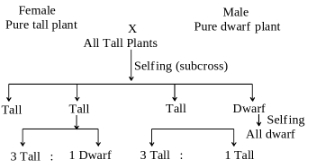
Mendel performed a monohybrid cross between a pure tall pea plant and a pure dwarf pea plant. The parental generation is denoted as $P$.
In the $F_{1}$-generation,all plants were tall because the tall trait is dominant over the dwarf trait.
When $F_{1}$ plants were self-pollinated,they produced the $F_{2}$-generation. In this generation,the phenotypic ratio of tall to dwarf plants is $3:1$.
This means that out of every $4$ plants,$3$ are tall and $1$ is dwarf. Therefore,the proportion of dwarf plants is $\frac{1}{4}$ and the proportion of tall plants is $\frac{3}{4}$.
Mendel performed a monohybrid cross between a pure tall pea plant and a pure dwarf pea plant. The parental generation is denoted as $P$.
In the $F_{1}$-generation,all plants were tall because the tall trait is dominant over the dwarf trait.
When $F_{1}$ plants were self-pollinated,they produced the $F_{2}$-generation. In this generation,the phenotypic ratio of tall to dwarf plants is $3:1$.
This means that out of every $4$ plants,$3$ are tall and $1$ is dwarf. Therefore,the proportion of dwarf plants is $\frac{1}{4}$ and the proportion of tall plants is $\frac{3}{4}$.
0 likes
View Solution103
EasyMCQ
When different alleles of the same gene are present in an individual,the individual is a
A
Heterozygous
B
Diploid
C
Homozygous
D
Mosaic
Solution
(A) When a gene pair (allele) contains two different alleles for a specific trait in an organism,the organism is considered heterozygous for that particular character. For example,if an individual has the genotype $Tt$,they are heterozygous because they possess two different forms of the gene.
0 likes
View Solution104
MediumMCQ
Two pea plants were subjected to cross-pollination. Of the $183$ plants produced in the next generation,$94$ plants were found to be tall and $89$ plants were found to be dwarf. The genotypes of the two parental plants are likely to be
A
$TT$ and $tt$
B
$Tt$ and $Tt$
C
$Tt$ and $tt$
D
$TT$ and $TT$
Solution
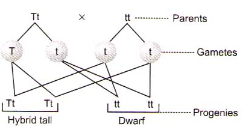
(C) In the given cross,the phenotypic ratio of the offspring is $94$ tall : $89$ dwarf,which is approximately $1:1$.
This $1:1$ ratio is characteristic of a test cross,which occurs between a heterozygous individual $(Tt)$ and a homozygous recessive individual $(tt)$.
The cross $Tt \times tt$ produces $50\%$ heterozygous tall $(Tt)$ and $50\%$ homozygous recessive dwarf $(tt)$ offspring.
Therefore,the genotypes of the parental plants are $Tt$ and $tt$.
This $1:1$ ratio is characteristic of a test cross,which occurs between a heterozygous individual $(Tt)$ and a homozygous recessive individual $(tt)$.
The cross $Tt \times tt$ produces $50\%$ heterozygous tall $(Tt)$ and $50\%$ homozygous recessive dwarf $(tt)$ offspring.
Therefore,the genotypes of the parental plants are $Tt$ and $tt$.
0 likes
View Solution105
MediumMCQ
The genotypic ratio of a monohybrid cross in $F_{2}$-generation is
A
$3: 1$
B
$1: 2: 1$
C
$2: 1: 1$
D
$9: 3: 3: 1$
Solution
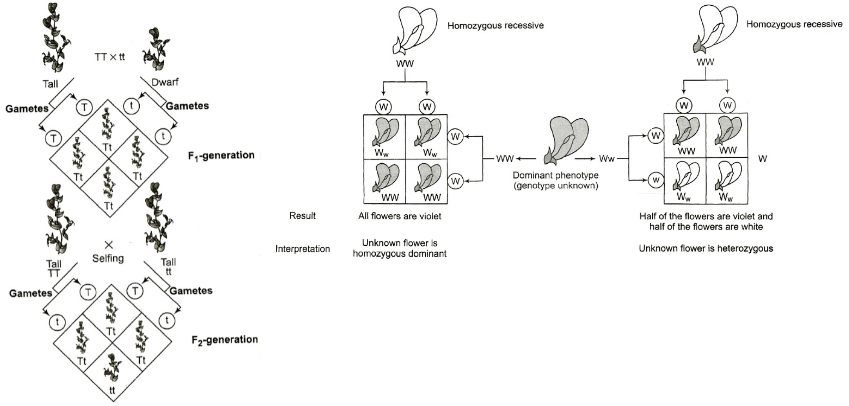
(B) In a monohybrid cross,Mendel crossed true-breeding tall plants $(TT)$ with true-breeding dwarf plants $(tt)$.
The $F_{1}$-generation consists of all heterozygous tall plants $(Tt)$.
When $F_{1}$ plants are self-pollinated to produce the $F_{2}$-generation,the Punnett square yields the following genotypes: $TT$,$Tt$,$Tt$,and $tt$.
Thus,the genotypic ratio is $1 (TT) : 2 (Tt) : 1 (tt)$,which is $1: 2: 1$.
The $F_{1}$-generation consists of all heterozygous tall plants $(Tt)$.
When $F_{1}$ plants are self-pollinated to produce the $F_{2}$-generation,the Punnett square yields the following genotypes: $TT$,$Tt$,$Tt$,and $tt$.
Thus,the genotypic ratio is $1 (TT) : 2 (Tt) : 1 (tt)$,which is $1: 2: 1$.
0 likes
View Solution106
MediumMCQ
What is the percentage of the recessive phenotype in a cross between $pp$ and $Pp$,where $P$ is dominant and $p$ is recessive (in $, \%$)?
A
$25$
B
$50$
C
$35$
D
$100$
Solution
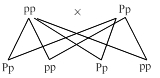
(B) To determine the phenotypic ratio,we perform a test cross between a homozygous recessive individual $(pp)$ and a heterozygous individual $(Pp)$.
The cross is as follows:
$pp \times Pp \rightarrow Pp, pp, Pp, pp$.
The resulting offspring genotypes are $50\, \% Pp$ (dominant phenotype) and $50\, \% pp$ (recessive phenotype).
Therefore,the percentage of the recessive phenotype is $50\, \%$.
The cross is as follows:
$pp \times Pp \rightarrow Pp, pp, Pp, pp$.
The resulting offspring genotypes are $50\, \% Pp$ (dominant phenotype) and $50\, \% pp$ (recessive phenotype).
Therefore,the percentage of the recessive phenotype is $50\, \%$.
0 likes
View Solution107
MediumMCQ
$A$ true-breeding plant producing red flowers is crossed with a pure-breeding plant producing white flowers. The allele for the red color of the flower is dominant. After selfing the plants of the first filial $(F_1)$ generation, the proportion of plants producing red and white flowers in the progeny would be:
A
$9: 3: 3: 1$
B
$3: 1$
C
$9: 3: 4$
D
$9: 6: 1$
Solution
(B) The question describes a simple Mendelian monohybrid cross where red flower color is dominant over white flower color.
Let $R$ be the allele for red flowers and $r$ be the allele for white flowers.
The cross is $RR$ (red) $\times$ $rr$ (white).
The $F_1$ generation plants are all $Rr$ (red).
Selfing the $F_1$ generation $(Rr \times Rr)$ results in an $F_2$ generation with the genotypic ratio $1 RR : 2 Rr : 1 rr$.
The phenotypic ratio is $3$ red : $1$ white.
Therefore, the proportion of plants producing red and white flowers is $3: 1$.
Let $R$ be the allele for red flowers and $r$ be the allele for white flowers.
The cross is $RR$ (red) $\times$ $rr$ (white).
The $F_1$ generation plants are all $Rr$ (red).
Selfing the $F_1$ generation $(Rr \times Rr)$ results in an $F_2$ generation with the genotypic ratio $1 RR : 2 Rr : 1 rr$.
The phenotypic ratio is $3$ red : $1$ white.
Therefore, the proportion of plants producing red and white flowers is $3: 1$.
0 likes
View Solution108
MediumMCQ
In $Drosophila$, the allele for a normal grey body colour $G$ is dominant to ebony body $g$. The following table summarises the results of several crosses:
Which strains both have the genotype $Gg$?
| $S.No$ | Cross | Result |
| $I.$ Strain $1 \times gg$ | All wild type | |
| $II.$ Strain $2 \times gg$ | $1$ wild type $: 1$ ebony | |
| $III.$ Strain $3 \times gg$ | All ebony | |
| $IV.$ Strain $4 \times Gg$ | $3$ wild type $: 1$ ebony |
Which strains both have the genotype $Gg$?
A
$I$ and $III$
B
$I$ and $IV$
C
$II$ and $III$
D
$II$ and $IV$
Solution
(D) To determine the genotype of the strains, we analyze the test cross results:
$1.$ Strain $1 \times gg$ results in all wild type $(G-)$. This indicates Strain $1$ must be homozygous dominant $(GG)$.
$2.$ Strain $2 \times gg$ results in $1$ wild type $(Gg)$ $: 1$ ebony $(gg)$. This is a test cross, indicating Strain $2$ is heterozygous $(Gg)$.
$3.$ Strain $3 \times gg$ results in all ebony $(gg)$. This indicates Strain $3$ must be homozygous recessive $(gg)$.
$4.$ Strain $4 \times Gg$ results in $3$ wild type $: 1$ ebony. This is a monohybrid cross between two heterozygotes $(Gg \times Gg)$, indicating Strain $4$ is heterozygous $(Gg)$.
Therefore, both Strain $2$ and Strain $4$ have the genotype $Gg$.
$1.$ Strain $1 \times gg$ results in all wild type $(G-)$. This indicates Strain $1$ must be homozygous dominant $(GG)$.
$2.$ Strain $2 \times gg$ results in $1$ wild type $(Gg)$ $: 1$ ebony $(gg)$. This is a test cross, indicating Strain $2$ is heterozygous $(Gg)$.
$3.$ Strain $3 \times gg$ results in all ebony $(gg)$. This indicates Strain $3$ must be homozygous recessive $(gg)$.
$4.$ Strain $4 \times Gg$ results in $3$ wild type $: 1$ ebony. This is a monohybrid cross between two heterozygotes $(Gg \times Gg)$, indicating Strain $4$ is heterozygous $(Gg)$.
Therefore, both Strain $2$ and Strain $4$ have the genotype $Gg$.
0 likes
View Solution109
MediumMCQ
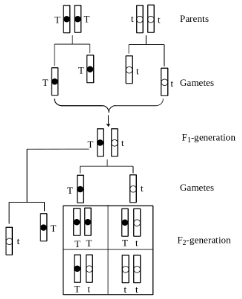
What does this diagram indicate?
A
Law of dominance interpreted on the basis of genes
B
Law of segregation interpreted on the basis of genes
C
Law of independent assortment interpreted on the basis of genes
D
Simply gamete genes
Solution
(B) The provided diagram illustrates the inheritance of a single trait (monohybrid cross) involving alleles $T$ and $t$ located on homologous chromosomes.
It demonstrates how alleles segregate during meiosis to form gametes,which then combine to produce the $F_1$ and $F_2$ generations.
This process is the chromosomal basis of Mendel's Law of Segregation,which states that the two alleles of a gene pair segregate from each other during the formation of gametes,such that each gamete receives only one of the two alleles.
It demonstrates how alleles segregate during meiosis to form gametes,which then combine to produce the $F_1$ and $F_2$ generations.
This process is the chromosomal basis of Mendel's Law of Segregation,which states that the two alleles of a gene pair segregate from each other during the formation of gametes,such that each gamete receives only one of the two alleles.
0 likes
View Solution110
Medium
Describe one gene inheritance.
Solution
(N/A) The study of inheritance of a single pair of alleles or factors of a trait at a time (monohybrid cross) is called one gene inheritance.
Based on his observations on monohybrid crosses,Mendel proposed two general rules to consolidate his understanding of inheritance.
These rules are called the principles or laws of inheritance:
$1$. Law of Dominance (First Law): $(i)$ Characters are controlled by discrete units called factors. $(ii)$ Factors occur in pairs. $(iii)$ In a dissimilar pair of factors,one member of the pair is dominant while the other is recessive.
This law explains the expression of only one of the parental characters in the $F_{1}$ generation and the expression of both in the $F_{2}$ generation,accounting for the $3:1$ phenotypic ratio.
$2$. Law of Segregation (Second Law): This law states that although parents contain two alleles,during gamete formation,the factors or alleles of a pair segregate from each other,such that each gamete receives only one of the two factors. Hence,the alleles do not show any blending,and both characters are recovered in the $F_{2}$ generation.
Based on his observations on monohybrid crosses,Mendel proposed two general rules to consolidate his understanding of inheritance.
These rules are called the principles or laws of inheritance:
$1$. Law of Dominance (First Law): $(i)$ Characters are controlled by discrete units called factors. $(ii)$ Factors occur in pairs. $(iii)$ In a dissimilar pair of factors,one member of the pair is dominant while the other is recessive.
This law explains the expression of only one of the parental characters in the $F_{1}$ generation and the expression of both in the $F_{2}$ generation,accounting for the $3:1$ phenotypic ratio.
$2$. Law of Segregation (Second Law): This law states that although parents contain two alleles,during gamete formation,the factors or alleles of a pair segregate from each other,such that each gamete receives only one of the two factors. Hence,the alleles do not show any blending,and both characters are recovered in the $F_{2}$ generation.
0 likes
View Solution111
MediumMCQ
What kind of offspring will be produced when a heterozygous tall plant is crossed with a dwarf plant?
A
$100\, \%$ tall plants
B
$50\, \%$ tall plants and $50\, \%$ dwarf plants
C
$100\, \%$ dwarf plants
D
$75\, \%$ tall plants and $25\, \%$ dwarf plants
Solution
(B) heterozygous tall plant has the genotype $Tt$. $A$ dwarf plant is always homozygous recessive with the genotype $tt$.
When these are crossed $(Tt \times tt)$,the gametes produced are $T$ and $t$ from the tall plant,and $t$ from the dwarf plant.
The resulting offspring genotypes are $Tt$ (tall) and $tt$ (dwarf) in a $1:1$ ratio.
Therefore,$50\, \%$ of the offspring will be tall and $50\, \%$ will be dwarf.
When these are crossed $(Tt \times tt)$,the gametes produced are $T$ and $t$ from the tall plant,and $t$ from the dwarf plant.
The resulting offspring genotypes are $Tt$ (tall) and $tt$ (dwarf) in a $1:1$ ratio.
Therefore,$50\, \%$ of the offspring will be tall and $50\, \%$ will be dwarf.
0 likes
View Solution112
MediumMCQ
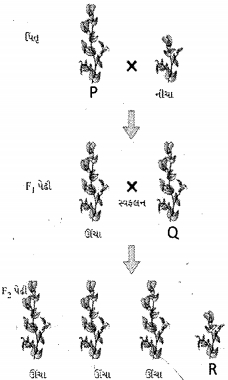
The diagram below shows a monohybrid cross. What are the genotypes for height in plants $P, Q$,and $R$?
A
$TT, TT, Tt$
B
$Tt, Tt, tt$
C
$TT, TT, tt$
D
$TT, Tt, tt$
Solution
(D) In a monohybrid cross for height in pea plants:
$1$. $P$ represents the tall parent,which is homozygous dominant $(TT)$.
$2$. The $F_1$ generation is produced by crossing $TT$ with $tt$ (dwarf parent),resulting in all tall plants with genotype $Tt$. Thus,$Q$ represents the $F_1$ tall plant with genotype $Tt$.
$3$. Selfing the $F_1$ $(Tt \times Tt)$ produces the $F_2$ generation with a phenotypic ratio of $3:1$ (tall:dwarf) and a genotypic ratio of $1:2:1$ $(TT:Tt:tt)$.
$4$. $R$ represents the dwarf plant in the $F_2$ generation,which must be homozygous recessive $(tt)$.
Therefore,the genotypes are $P = TT, Q = Tt, R = tt$.
$1$. $P$ represents the tall parent,which is homozygous dominant $(TT)$.
$2$. The $F_1$ generation is produced by crossing $TT$ with $tt$ (dwarf parent),resulting in all tall plants with genotype $Tt$. Thus,$Q$ represents the $F_1$ tall plant with genotype $Tt$.
$3$. Selfing the $F_1$ $(Tt \times Tt)$ produces the $F_2$ generation with a phenotypic ratio of $3:1$ (tall:dwarf) and a genotypic ratio of $1:2:1$ $(TT:Tt:tt)$.
$4$. $R$ represents the dwarf plant in the $F_2$ generation,which must be homozygous recessive $(tt)$.
Therefore,the genotypes are $P = TT, Q = Tt, R = tt$.
0 likes
View Solution113
MediumMCQ
In Mendel's monohybrid cross experiment,the phenotypic ratio is $P$ and the genotypic ratio is $Q$. Select the correct option for $P$ and $Q$.
$\quad \quad \quad P \quad \quad \quad Q$
$\quad \quad \quad P \quad \quad \quad Q$
A
$1: 2: 1 \quad 3: 1$
B
$1: 2: 1 \quad 1: 2: 1$
C
$3: 1 \quad 3: 1$
D
$3: 1 \quad 1: 2: 1$
Solution
(D) In a monohybrid cross,Mendel crossed two pure-breeding plants (e.g.,tall $TT$ and dwarf $tt$).
The $F_1$ generation resulted in all tall plants $(Tt)$.
Selfing the $F_1$ plants $(Tt \times Tt)$ resulted in an $F_2$ generation with a phenotypic ratio of $3$ (tall) $: 1$ (dwarf).
The genotypic ratio in the $F_2$ generation is $1$ $(TT)$ $: 2$ $(Tt)$ $: 1$ $(tt)$.
Therefore,$P$ (phenotypic ratio) is $3:1$ and $Q$ (genotypic ratio) is $1:2:1$.
The $F_1$ generation resulted in all tall plants $(Tt)$.
Selfing the $F_1$ plants $(Tt \times Tt)$ resulted in an $F_2$ generation with a phenotypic ratio of $3$ (tall) $: 1$ (dwarf).
The genotypic ratio in the $F_2$ generation is $1$ $(TT)$ $: 2$ $(Tt)$ $: 1$ $(tt)$.
Therefore,$P$ (phenotypic ratio) is $3:1$ and $Q$ (genotypic ratio) is $1:2:1$.
0 likes
View Solution114
MediumMCQ
$A$ test cross of an unknown yellow seed with a green seed produces $50\%$ green seeds and $50\%$ yellow seeds. What is the genotype of the unknown yellow seed?
A
Homozygous yellow
B
Heterozygous yellow
C
Homozygous or heterozygous yellow
D
None of these
Solution
(B) In pea plants,yellow seed color $(Y)$ is dominant over green seed color $(y)$.
Let the genotype of the unknown yellow seed be $Y?$.
The green seed must have the genotype $yy$ because green is the recessive trait.
The cross is $Y? \times yy$.
If the unknown seed were homozygous yellow $(YY)$,the offspring would all be yellow $(Yy)$.
Since the offspring are $50\%$ yellow $(Yy)$ and $50\%$ green $(yy)$,the unknown yellow seed must be heterozygous $(Yy)$.
The cross is $Yy \times yy \rightarrow 1 Yy : 1 yy$.
Let the genotype of the unknown yellow seed be $Y?$.
The green seed must have the genotype $yy$ because green is the recessive trait.
The cross is $Y? \times yy$.
If the unknown seed were homozygous yellow $(YY)$,the offspring would all be yellow $(Yy)$.
Since the offspring are $50\%$ yellow $(Yy)$ and $50\%$ green $(yy)$,the unknown yellow seed must be heterozygous $(Yy)$.
The cross is $Yy \times yy \rightarrow 1 Yy : 1 yy$.
0 likes
View Solution115
MediumMCQ
How many types of gametes can an organism with the genotype $aabbCc$ produce?
A
$8$
B
$2$
C
$6$
D
$4$
Solution
(B) To determine the number of different types of gametes produced by an organism,we use the formula $2^n$,where $n$ represents the number of heterozygous gene pairs.
In the given genotype $aabbCc$:
- The gene pair $aa$ is homozygous.
- The gene pair $bb$ is homozygous.
- The gene pair $Cc$ is heterozygous.
Therefore,the number of heterozygous pairs $(n)$ is $1$.
Using the formula: $2^n = 2^1 = 2$.
The possible gametes are $abC$ and $abc$.
In the given genotype $aabbCc$:
- The gene pair $aa$ is homozygous.
- The gene pair $bb$ is homozygous.
- The gene pair $Cc$ is heterozygous.
Therefore,the number of heterozygous pairs $(n)$ is $1$.
Using the formula: $2^n = 2^1 = 2$.
The possible gametes are $abC$ and $abc$.
1 likes
View Solution116
MediumMCQ
How many types of gametes are produced by a plant with the genotype $Rryy$?
A
$1$
B
$2$
C
$3$
D
$4$
Solution
(B) The number of different types of gametes produced by an organism can be calculated using the formula $2^n$,where $n$ is the number of heterozygous gene pairs.
In the genotype $Rryy$:
- The gene pair $Rr$ is heterozygous $(n=1)$.
- The gene pair $yy$ is homozygous $(n=0)$.
Therefore,the total number of heterozygous pairs $n = 1$.
Using the formula $2^n = 2^1 = 2$.
The two types of gametes produced are $Ry$ and $ry$.
In the genotype $Rryy$:
- The gene pair $Rr$ is heterozygous $(n=1)$.
- The gene pair $yy$ is homozygous $(n=0)$.
Therefore,the total number of heterozygous pairs $n = 1$.
Using the formula $2^n = 2^1 = 2$.
The two types of gametes produced are $Ry$ and $ry$.
0 likes
View Solution117
MediumMCQ
In a plant,black seed color $(BB / Bb)$ is dominant over white seed color $(bb)$. In order to find out the genotype of the black seed plant,with which of the following genotype will you cross it?
A
$bb$
B
$Bb$
C
$BB / Bb$
D
$BB$
Solution
(A) To determine the unknown genotype of a dominant phenotype (black seed),a test cross is performed.
$A$ test cross involves crossing the individual with the dominant phenotype with a homozygous recessive individual.
Since white seed color $(bb)$ is recessive,crossing the black seed plant with a plant having the $bb$ genotype will reveal whether the black seed plant is homozygous $(BB)$ or heterozygous $(Bb)$.
$A$ test cross involves crossing the individual with the dominant phenotype with a homozygous recessive individual.
Since white seed color $(bb)$ is recessive,crossing the black seed plant with a plant having the $bb$ genotype will reveal whether the black seed plant is homozygous $(BB)$ or heterozygous $(Bb)$.
0 likes
View Solution118
MediumMCQ
The proportion of plants that were dwarf and tall,respectively,in the $F_2$-generation of Mendel's experiment was?
A
$1/4$ and $3/4$
B
$3/4$ and $1/4$
C
$2/3$ and $1/3$
D
$1/3$ and $4/3$
Solution
(A) In Mendel's monohybrid cross,the $F_1$ generation consists of all tall plants $(Tt)$.
When $F_1$ plants are self-pollinated,the $F_2$ generation is produced.
The genotypic ratio of the $F_2$ generation is $1 TT : 2 Tt : 1 tt$.
The phenotypic ratio is $3$ tall plants $(TT, Tt)$ to $1$ dwarf plant $(tt)$.
Therefore,the proportion of tall plants is $3/4$ and the proportion of dwarf plants is $1/4$.
The question asks for the proportion of dwarf and tall plants,respectively.
Thus,the ratio is $1/4$ for dwarf and $3/4$ for tall.
When $F_1$ plants are self-pollinated,the $F_2$ generation is produced.
The genotypic ratio of the $F_2$ generation is $1 TT : 2 Tt : 1 tt$.
The phenotypic ratio is $3$ tall plants $(TT, Tt)$ to $1$ dwarf plant $(tt)$.
Therefore,the proportion of tall plants is $3/4$ and the proportion of dwarf plants is $1/4$.
The question asks for the proportion of dwarf and tall plants,respectively.
Thus,the ratio is $1/4$ for dwarf and $3/4$ for tall.
0 likes
View Solution119
EasyMCQ
The phenotypic ratio of a Mendelian monohybrid cross is $-$
A
$1: 1: 1: 1$
B
$1: 1$
C
$3: 1$
D
$9: 3: 3: 1$
Solution
(C) monohybrid cross involves the inheritance of a single pair of contrasting traits.
According to Mendel's law of dominance,when a homozygous tall plant $(TT)$ is crossed with a homozygous dwarf plant $(tt)$,the $F_1$ generation consists of all heterozygous tall plants $(Tt)$.
When these $F_1$ plants are self-pollinated,the $F_2$ generation is produced.
The phenotypic ratio of the $F_2$ generation is $3$ tall plants to $1$ dwarf plant,which is expressed as $3: 1$.
According to Mendel's law of dominance,when a homozygous tall plant $(TT)$ is crossed with a homozygous dwarf plant $(tt)$,the $F_1$ generation consists of all heterozygous tall plants $(Tt)$.
When these $F_1$ plants are self-pollinated,the $F_2$ generation is produced.
The phenotypic ratio of the $F_2$ generation is $3$ tall plants to $1$ dwarf plant,which is expressed as $3: 1$.
0 likes
View Solution120
EasyMCQ
In a cross between homozygous tall and dwarf pea plant,$F_2$ generation will show . . . . . . phenotypes.
A
all homozygous tall
B
all dwarf
C
$3$ tall and $1$ dwarf
D
all heterozygous tall
Solution
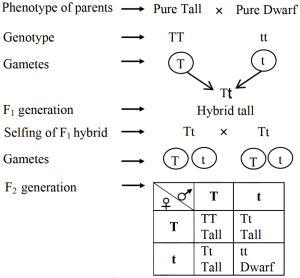
(C) When a homozygous tall $(TT)$ plant is crossed with a homozygous dwarf $(tt)$ plant,the $F_1$ generation consists of all heterozygous tall $(Tt)$ plants.
When these $F_1$ plants are self-pollinated $(Tt \times Tt)$,the $F_2$ generation is produced.
According to the Punnett square,the genotypes obtained are $TT$,$Tt$,$Tt$,and $tt$.
Phenotypically,$TT$,$Tt$,and $Tt$ appear tall,while $tt$ appears dwarf.
Thus,the phenotypic ratio is $3$ tall : $1$ dwarf.
When these $F_1$ plants are self-pollinated $(Tt \times Tt)$,the $F_2$ generation is produced.
According to the Punnett square,the genotypes obtained are $TT$,$Tt$,$Tt$,and $tt$.
Phenotypically,$TT$,$Tt$,and $Tt$ appear tall,while $tt$ appears dwarf.
Thus,the phenotypic ratio is $3$ tall : $1$ dwarf.
0 likes
View Solution121
EasyMCQ
In the $F_2$ generation of a Mendelian monohybrid cross,how many individuals retain the parental genotypes (in $\%$)?
A
$100$
B
$25$
C
$50$
D
$75$
Solution
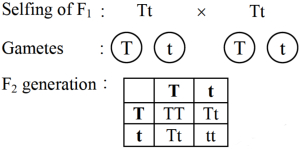
(C) In a Mendelian monohybrid cross,the $F_1$ generation consists of heterozygous individuals $(Tt)$.
When these $F_1$ individuals are self-crossed $(Tt \times Tt)$,the resulting $F_2$ generation genotypes are $TT$,$Tt$,$Tt$,and $tt$ in a ratio of $1:2:1$.
The parental genotypes are the homozygous dominant $(TT)$ and homozygous recessive $(tt)$.
Out of the four possible combinations in the Punnett square,two individuals ($TT$ and $tt$) possess the parental genotypes.
Therefore,the percentage of individuals retaining the parental genotypes is $(2/4) \times 100 = 50\%$.
When these $F_1$ individuals are self-crossed $(Tt \times Tt)$,the resulting $F_2$ generation genotypes are $TT$,$Tt$,$Tt$,and $tt$ in a ratio of $1:2:1$.
The parental genotypes are the homozygous dominant $(TT)$ and homozygous recessive $(tt)$.
Out of the four possible combinations in the Punnett square,two individuals ($TT$ and $tt$) possess the parental genotypes.
Therefore,the percentage of individuals retaining the parental genotypes is $(2/4) \times 100 = 50\%$.
0 likes
View Solution122
EasyMCQ
$A$ heterozygous tall pea plant was crossed with a dwarf pea plant. The progeny of the cross shows . . . . . . .
A
$1$ Tall: $1$ dwarf
B
$3$ Tall: $1$ dwarf
C
$1$ Tall: $3$ dwarf
D
$4$ Tall: $2$ dwarf
Solution
(A) In pea plants,the allele for tallness $(T)$ is dominant over the allele for dwarfness $(t)$.
$A$ heterozygous tall plant has the genotype $Tt$.
$A$ dwarf plant must have the homozygous recessive genotype $tt$.
When performing a test cross between $Tt$ and $tt$:
$Tt \times tt \rightarrow$ Gametes produced are $T, t$ from the heterozygous parent and $t$ from the dwarf parent.
The resulting offspring genotypes are $Tt$ (tall) and $tt$ (dwarf) in a ratio of $1:1$.
Therefore,the progeny shows $1$ Tall : $1$ dwarf.
$A$ heterozygous tall plant has the genotype $Tt$.
$A$ dwarf plant must have the homozygous recessive genotype $tt$.
When performing a test cross between $Tt$ and $tt$:
$Tt \times tt \rightarrow$ Gametes produced are $T, t$ from the heterozygous parent and $t$ from the dwarf parent.
The resulting offspring genotypes are $Tt$ (tall) and $tt$ (dwarf) in a ratio of $1:1$.
Therefore,the progeny shows $1$ Tall : $1$ dwarf.
0 likes
View Solution123
EasyMCQ
How many types of gametes can be produced by an individual with the genotype $AAbb$?
A
One
B
Two
C
Three
D
Four
Solution
(A) The number of types of gametes produced by an individual is determined by the formula $2^n$,where $n$ is the number of heterozygous gene pairs.
For the genotype $AAbb$,the gene pairs are $AA$ (homozygous dominant) and $bb$ (homozygous recessive).
Since there are no heterozygous pairs,$n = 0$.
Therefore,the number of types of gametes $= 2^0 = 1$.
The only gamete produced is $Ab$.
For the genotype $AAbb$,the gene pairs are $AA$ (homozygous dominant) and $bb$ (homozygous recessive).
Since there are no heterozygous pairs,$n = 0$.
Therefore,the number of types of gametes $= 2^0 = 1$.
The only gamete produced is $Ab$.
0 likes
View Solution124
EasyMCQ
In one of the hybridisation experiments,a homozygous dominant parent and a homozygous recessive parent are crossed for a trait. (Plant shows Mendelian inheritance pattern)
A
Dominant parent trait appears in $F_2$ generation and recessive parent trait appears only in $F_1$ generation.
B
Dominant parent trait appears in $F_1$ generation and recessive parent trait appears in $F_2$ generation.
C
Dominant parent trait appears in both $F_1$ and $F_2$ generations and recessive parent trait appears in only $F_2$ generations.
D
Dominant parent trait appears in $F_1$ generation and recessive parent trait appears in $F_1$ and $F_2$ generations.
Solution
(C) In a Mendelian cross between a homozygous dominant parent $(AA)$ and a homozygous recessive parent $(aa)$,the $F_1$ generation consists of all heterozygous individuals $(Aa)$ expressing the dominant trait.
When $F_1$ individuals are self-crossed $(Aa \times Aa)$,the $F_2$ generation shows a phenotypic ratio of $3:1$ (dominant to recessive).
Therefore,the dominant trait is expressed in both $F_1$ and $F_2$ generations,while the recessive trait is masked in $F_1$ and only reappears in the $F_2$ generation.
When $F_1$ individuals are self-crossed $(Aa \times Aa)$,the $F_2$ generation shows a phenotypic ratio of $3:1$ (dominant to recessive).
Therefore,the dominant trait is expressed in both $F_1$ and $F_2$ generations,while the recessive trait is masked in $F_1$ and only reappears in the $F_2$ generation.
0 likes
View Solution125
EasyMCQ
$A$ true-breeding plant producing red flowers is crossed with a pure plant producing white flowers. The allele for the red color of the flower is dominant. After selfing the plants of the first filial $(F_1)$ generation,what would be the proportion of plants producing white flowers in the progeny?
A
$1$/$3$
B
$1$/$2$
C
$3$/$4$
D
$1$/$4$
Solution
(D) Let the allele for red flowers be $R$ and the allele for white flowers be $r$. Since red is dominant,the genotype of the red-flowered parent is $RR$ and the white-flowered parent is $rr$.
When these are crossed,the $F_1$ generation plants have the genotype $Rr$ (all red flowers).
When $F_1$ plants are selfed $(Rr \times Rr)$,the resulting $F_2$ generation genotypes are $RR$,$Rr$,$Rr$,and $rr$ in a $1:2:1$ ratio.
The phenotypic ratio is $3$ red-flowered plants to $1$ white-flowered plant.
Therefore,the proportion of plants producing white flowers is $1/4$.
When these are crossed,the $F_1$ generation plants have the genotype $Rr$ (all red flowers).
When $F_1$ plants are selfed $(Rr \times Rr)$,the resulting $F_2$ generation genotypes are $RR$,$Rr$,$Rr$,and $rr$ in a $1:2:1$ ratio.
The phenotypic ratio is $3$ red-flowered plants to $1$ white-flowered plant.
Therefore,the proportion of plants producing white flowers is $1/4$.
0 likes
View Solution126
EasyMCQ
In a dihybrid cross between a true-breeding round yellow-seeded and a true-breeding wrinkled green-seeded pea plant,the ratio of segregation of round and wrinkled seed traits in $F_2$ is:
A
$9$:$1$
B
$3$:$1$
C
$9$:$3$
D
$3$:$3$
Solution
(B) In a dihybrid cross,the inheritance of two traits is independent of each other according to the Law of Independent Assortment.
For the seed shape trait,the cross is between round $(RR)$ and wrinkled $(rr)$.
The $F_1$ generation is heterozygous round $(Rr)$.
Selfing the $F_1$ generation $(Rr \times Rr)$ results in an $F_2$ phenotypic ratio of $3$ round : $1$ wrinkled.
Therefore,the segregation ratio for the seed shape trait is $3:1$.
For the seed shape trait,the cross is between round $(RR)$ and wrinkled $(rr)$.
The $F_1$ generation is heterozygous round $(Rr)$.
Selfing the $F_1$ generation $(Rr \times Rr)$ results in an $F_2$ phenotypic ratio of $3$ round : $1$ wrinkled.
Therefore,the segregation ratio for the seed shape trait is $3:1$.
0 likes
View Solution127
EasyMCQ
In garden pea,round shape of seeds is dominant over wrinkled shape. $A$ pea plant heterozygous for round shape of seed is selfed and $1600$ seeds produced during the cross are subsequently germinated. How many seedlings would have the parental phenotype?
A
$400$
B
$1600$
C
$1200$
D
$800$
Solution
(C) The genotype of the heterozygous parent is $Rr$.
When this plant is selfed $(Rr \times Rr)$,the resulting progeny genotypes are $RR, Rr, Rr, rr$.
The phenotypic ratio is $3$ round : $1$ wrinkled.
The parental phenotype is 'round' (since the parent is heterozygous for round seeds).
Out of the total $1600$ seeds,the number of round-seeded plants is $\frac{3}{4} \times 1600 = 1200$.
Therefore,$1200$ seedlings will exhibit the parental phenotype.
When this plant is selfed $(Rr \times Rr)$,the resulting progeny genotypes are $RR, Rr, Rr, rr$.
The phenotypic ratio is $3$ round : $1$ wrinkled.
The parental phenotype is 'round' (since the parent is heterozygous for round seeds).
Out of the total $1600$ seeds,the number of round-seeded plants is $\frac{3}{4} \times 1600 = 1200$.
Therefore,$1200$ seedlings will exhibit the parental phenotype.
0 likes
View SolutionPrinciples of Inheritance and Variation — Inheritance of one gene · Frequently Asked Questions
1Are these Principles of Inheritance and Variation questions useful for JEE and NEET?
Yes. All questions in this section are mapped to JEE Main and NEET exam patterns. Previous year questions from JEE Main, NEET, GUJCET and state-level exams are included with full solutions.
2Can I switch to Hindi or Gujarati for these questions?
Yes. Use the language tabs in the hero section or the sidebar to view the same questions and solutions in English, Hindi or Gujarati.
3How do I generate a question paper from this subtopic?
Use the Vedclass Exam Paper Generator — select the chapter and subtopic, set difficulty, and generate Sets A, B, C, D automatically. First 3 chapters of every subject are free.
Vedclass Products
For Students
Vedclass Test Series
Mock tests in real JEE/NEET style with performance analysis. 5-day free trial.
Start Free TrialFor Teachers
Exam Paper Generator
Generate Set A/B/C/D papers from this chapter in 2 minutes. 3 chapters free.
Try FreeFor Institutes
Online Exam Module
Live online exams with unlimited students, 360° analytics & white-label branding.
See DemoFor Teachers & Institutes
Generate a Principles of Inheritance and Variation Exam Paper in 2 Minutes
Select subtopic & difficulty — Sets A, B, C, D auto-generated with No Repeat logic.
First 3 chapters of every subject are free — no payment required.