
A English
Inheritance of one gene Questions in English
Class 12 Biology · Principles of Inheritance and Variation · Inheritance of one gene
127+
Questions
English
Language
100%
With Solutions
Showing 50 of 127 questions in English
51
DifficultMCQ
$A$ cross between $AaBB$ and $aaBB$ produces which type of genotype?
A
$1 AaBB : 1 aaBB$
B
$1 AaBB : 3 aaBB$
C
$3 AaBB : 1 aaBB$
D
All of these
Solution
(A) To determine the offspring of the cross $AaBB \times aaBB$,we analyze the gametes produced by each parent.
Parent $1$ $(AaBB)$ produces two types of gametes: $AB$ and $aB$.
Parent $2$ $(aaBB)$ produces only one type of gamete: $aB$.
By performing a Punnett square:
- $AB \times aB = AaBB$
- $aB \times aB = aaBB$
Thus,the resulting offspring are $AaBB$ and $aaBB$ in a ratio of $1:1$.
Parent $1$ $(AaBB)$ produces two types of gametes: $AB$ and $aB$.
Parent $2$ $(aaBB)$ produces only one type of gamete: $aB$.
By performing a Punnett square:
- $AB \times aB = AaBB$
- $aB \times aB = aaBB$
Thus,the resulting offspring are $AaBB$ and $aaBB$ in a ratio of $1:1$.
1 likes
View Solution52
MediumMCQ
An $F_1$ plant has the genotype $AABbCC$. What is the phenotypic ratio of the $F_2$ generation after selfing this plant?
A
$3 : 1$
B
$1 : 1$
C
$9 : 3 : 3 : 1$
D
$27 : 9 : 9 : 9 : 3 : 3 : 3 : 1$
Solution
(A) The given genotype is $AABbCC$.
When this plant undergoes selfing $(AABbCC \times AABbCC)$,the genes $AA$ and $CC$ are homozygous and will produce only one type of gamete for these loci ($A$ and $C$ respectively).
Only the $Bb$ locus is heterozygous.
Selfing a heterozygous $Bb$ plant results in a monohybrid cross ratio of $3:1$ for the phenotype.
Since $AA$ and $CC$ are homozygous,they will express the dominant phenotype in all offspring.
Therefore,the phenotypic ratio remains $3:1$.
When this plant undergoes selfing $(AABbCC \times AABbCC)$,the genes $AA$ and $CC$ are homozygous and will produce only one type of gamete for these loci ($A$ and $C$ respectively).
Only the $Bb$ locus is heterozygous.
Selfing a heterozygous $Bb$ plant results in a monohybrid cross ratio of $3:1$ for the phenotype.
Since $AA$ and $CC$ are homozygous,they will express the dominant phenotype in all offspring.
Therefore,the phenotypic ratio remains $3:1$.
0 likes
View Solution53
EasyMCQ
Mendel proposed the Law of Purity of Gametes based on:
A
Dihybrid cross
B
Monohybrid cross
C
Reciprocal cross
D
Test cross
Solution
(B) The Law of Purity of Gametes, also known as the Law of Segregation, states that during the formation of gametes, the two alleles of a gene pair separate from each other so that each gamete receives only one of the two alleles. This law was derived by Mendel based on his observations from the $Monohybrid \text{ } cross$.
0 likes
View Solution54
MediumMCQ
$A$ cross was made between a pure tall and a pure dwarf pea plant to produce progeny. The progeny was self-pollinated. Find the ratio of the resulting true-breeding tall and dwarf plants.
A
$1:1$
B
$3:1$
C
$2:1$
D
$1:2:1$
Solution
(A) $1$. The cross between pure tall $(TT)$ and pure dwarf $(tt)$ plants results in an $F_1$ generation where all plants are heterozygous tall $(Tt)$.
$2$. When $F_1$ plants $(Tt)$ are self-pollinated,the $F_2$ generation is produced with the genotype ratio $TT:Tt:tt$ as $1:2:1$.
$3$. Among these,the true-breeding (homozygous) plants are $TT$ (tall) and $tt$ (dwarf).
$4$. The ratio of true-breeding tall $(TT)$ to true-breeding dwarf $(tt)$ plants is $1:1$.
$2$. When $F_1$ plants $(Tt)$ are self-pollinated,the $F_2$ generation is produced with the genotype ratio $TT:Tt:tt$ as $1:2:1$.
$3$. Among these,the true-breeding (homozygous) plants are $TT$ (tall) and $tt$ (dwarf).
$4$. The ratio of true-breeding tall $(TT)$ to true-breeding dwarf $(tt)$ plants is $1:1$.
0 likes
View Solution55
MediumMCQ
If two individuals with genotype $Bb$ are crossed and they produce two offspring,what is the probability that the second offspring will show the recessive trait,given that the first offspring shows the dominant trait?
A
$1/4$
B
$100$
C
Zero
D
$3/4$
Solution
(A) In a monohybrid cross between two heterozygous individuals $(Bb \times Bb)$,the phenotypic ratio of the offspring is $3:1$ (dominant to recessive).
For any single offspring,the probability of showing the dominant trait is $3/4$ and the probability of showing the recessive trait is $1/4$.
Since the birth of each offspring is an independent event,the outcome of the first offspring does not influence the outcome of the second offspring.
Therefore,the probability that the second offspring will show the recessive trait remains $1/4$.
For any single offspring,the probability of showing the dominant trait is $3/4$ and the probability of showing the recessive trait is $1/4$.
Since the birth of each offspring is an independent event,the outcome of the first offspring does not influence the outcome of the second offspring.
Therefore,the probability that the second offspring will show the recessive trait remains $1/4$.
0 likes
View Solution56
MediumMCQ
Which of the following is not observed in a monohybrid cross?
A
In the $F_1$ generation,no blended trait is expressed other than the dominant parental trait.
B
In the $F_2$ generation,no blended trait is expressed other than the recessive parental trait.
C
In the $F_2$ generation,dominance explains the $3:1$ ratio.
D
The genotypic ratio is $1:2:1$.
Solution
(B) monohybrid cross involves the inheritance of a single gene. According to Mendel's Law of Dominance,in the $F_1$ generation,only the dominant trait is expressed,and no blending of traits occurs. In the $F_2$ generation,both parental traits reappear in a phenotypic ratio of $3:1$ (dominant:recessive) and a genotypic ratio of $1:2:1$ (homozygous dominant:heterozygous:homozygous recessive). The concept of 'blending inheritance' was a pre-Mendelian theory that was disproven by Mendel's experiments,as traits remain discrete and do not mix or blend.
0 likes
View Solution57
DifficultMCQ
$A$ heterozygous tobacco plant for albinism is self-pollinated,and $1200$ seeds are subsequently germinated. How many of the offspring will have the parental genotype?
A
$900$
B
$600$
C
$1200$
D
$300$
Solution
(B) Let the dominant allele be $A$ and the recessive allele for albinism be $a$.
The genotype of the heterozygous parent is $Aa$.
When $Aa$ is self-pollinated $(Aa \times Aa)$,the offspring genotypes are $AA$ (homozygous dominant),$Aa$ (heterozygous),and $aa$ (homozygous recessive) in a ratio of $1:2:1$.
The parental genotype is $Aa$.
In the $F_1$ generation,the proportion of heterozygous offspring $(Aa)$ is $2/4$ or $1/2$.
Given that $1200$ seeds are germinated,the number of offspring with the parental genotype $(Aa)$ is $1200 \times (1/2) = 600$.
The genotype of the heterozygous parent is $Aa$.
When $Aa$ is self-pollinated $(Aa \times Aa)$,the offspring genotypes are $AA$ (homozygous dominant),$Aa$ (heterozygous),and $aa$ (homozygous recessive) in a ratio of $1:2:1$.
The parental genotype is $Aa$.
In the $F_1$ generation,the proportion of heterozygous offspring $(Aa)$ is $2/4$ or $1/2$.
Given that $1200$ seeds are germinated,the number of offspring with the parental genotype $(Aa)$ is $1200 \times (1/2) = 600$.
0 likes
View Solution58
EasyMCQ
What is the phenotypic and genotypic ratio in a monohybrid test cross?
A
$1:1$
B
$1:2$
C
$3:1$
D
$1:2:1$
Solution
(A) monohybrid test cross is performed between a heterozygous individual $(Tt)$ and a homozygous recessive individual $(tt)$.
When we cross $Tt \times tt$,the resulting offspring are $Tt$ (heterozygous dominant) and $tt$ (homozygous recessive).
The phenotypic ratio is $1$ (tall) : $1$ (dwarf).
The genotypic ratio is $1$ $(Tt)$ : $1$ $(tt)$.
Therefore,both the phenotypic and genotypic ratios in a monohybrid test cross are $1:1$.
When we cross $Tt \times tt$,the resulting offspring are $Tt$ (heterozygous dominant) and $tt$ (homozygous recessive).
The phenotypic ratio is $1$ (tall) : $1$ (dwarf).
The genotypic ratio is $1$ $(Tt)$ : $1$ $(tt)$.
Therefore,both the phenotypic and genotypic ratios in a monohybrid test cross are $1:1$.
0 likes
View Solution59
MediumMCQ
When a homozygous red-flowered pea plant is crossed with a white-flowered plant, what color will be produced in the $F_1$ generation?
A
Red
B
White
C
Pink
D
Red + White
Solution
(A) In pea plants $(Pisum \text{ } sativum)$, the trait for red flower color is dominant over the trait for white flower color.
When a homozygous red-flowered plant $(RR)$ is crossed with a white-flowered plant $(rr)$, all offspring in the $F_1$ generation will have the genotype $Rr$.
Since red is dominant, the phenotype of all $F_1$ individuals will be red.
When a homozygous red-flowered plant $(RR)$ is crossed with a white-flowered plant $(rr)$, all offspring in the $F_1$ generation will have the genotype $Rr$.
Since red is dominant, the phenotype of all $F_1$ individuals will be red.
0 likes
View Solution60
MediumMCQ
The phenotypic ratio of a monohybrid cross in Mendelian genetics is .....
A
$1:2:1$
B
$3:1$
C
$9:3:1$
D
$9:3:4$
Solution
(B) In a monohybrid cross,Mendel crossed two plants differing in only one trait (e.g.,tall vs. dwarf).
In the $F_1$ generation,all plants were tall (heterozygous).
When $F_1$ plants were self-pollinated,the $F_2$ generation showed a phenotypic ratio of $3$ tall plants to $1$ dwarf plant.
Therefore,the phenotypic ratio is $3:1$.
In the $F_1$ generation,all plants were tall (heterozygous).
When $F_1$ plants were self-pollinated,the $F_2$ generation showed a phenotypic ratio of $3$ tall plants to $1$ dwarf plant.
Therefore,the phenotypic ratio is $3:1$.
0 likes
View Solution61
MediumMCQ
What will be the nature of a hybrid plant produced from two alternative alleles?
A
Heterozygous
B
Polyhybrid
C
Dihybrid
D
Polyploid
Solution
(A) When an organism possesses two different alleles for a specific trait (e.g.,$Tt$),it is referred to as heterozygous. $A$ hybrid plant produced from two alternative alleles (e.g.,crossing a homozygous dominant $TT$ with a homozygous recessive $tt$) results in an $F_1$ generation that is heterozygous $(Tt)$. Therefore,the correct term for this condition is heterozygous.
0 likes
View Solution62
MediumMCQ
$A$ tall true-breeding garden pea plant is crossed with a dwarf true-breeding garden pea plant. When the $F_1$ plants were selfed,the resulting genotypes were in the ratio of:
A
$3 : 1$ (Tall : Dwarf)
B
$3 : 1$ (Dwarf : Tall)
C
$1 : 2 : 1$ (Tall homozygous : Tall heterozygous : Dwarf)
D
$1 : 2 : 1$ (Tall heterozygous : Tall homozygous : Dwarf)
Solution
(C) When a tall true-breeding plant $(TT)$ is crossed with a dwarf true-breeding plant $(tt)$,the $F_1$ generation consists of all tall heterozygous plants $(Tt)$.
When $F_1$ plants $(Tt)$ are selfed $(Tt \times Tt)$,the resulting genotypes in the $F_2$ generation are:
$TT$ (Tall homozygous) : $Tt$ (Tall heterozygous) : $tt$ (Dwarf).
The ratio is $1 : 2 : 1$.
When $F_1$ plants $(Tt)$ are selfed $(Tt \times Tt)$,the resulting genotypes in the $F_2$ generation are:
$TT$ (Tall homozygous) : $Tt$ (Tall heterozygous) : $tt$ (Dwarf).
The ratio is $1 : 2 : 1$.
0 likes
View Solution63
MediumMCQ
In pea plants,yellow seeds are dominant to green. If a heterozygous yellow seeded plant is crossed with a green seeded plant,what ratio of yellow and green seeded plants would you expect in $F_1$ generation?
A
$9 : 1$
B
$1 : 3$
C
$3 : 1$
D
$50 : 50$
Solution
(D) In pea plants,yellow seed color $(Y)$ is dominant over green seed color $(y)$.
$A$ heterozygous yellow seeded plant has the genotype $(Yy)$.
$A$ green seeded plant must have the homozygous recessive genotype $(yy)$.
When these two are crossed: $(Yy) \times (yy)$.
The gametes produced by the $(Yy)$ parent are $(Y)$ and $(y)$,while the $(yy)$ parent produces only $(y)$ gametes.
The resulting offspring genotypes are $(Yy)$ (yellow) and $(yy)$ (green) in a $1:1$ ratio.
Therefore,the ratio of yellow to green seeded plants in the $F_1$ generation is $50:50$ (or $1:1$).
$A$ heterozygous yellow seeded plant has the genotype $(Yy)$.
$A$ green seeded plant must have the homozygous recessive genotype $(yy)$.
When these two are crossed: $(Yy) \times (yy)$.
The gametes produced by the $(Yy)$ parent are $(Y)$ and $(y)$,while the $(yy)$ parent produces only $(y)$ gametes.
The resulting offspring genotypes are $(Yy)$ (yellow) and $(yy)$ (green) in a $1:1$ ratio.
Therefore,the ratio of yellow to green seeded plants in the $F_1$ generation is $50:50$ (or $1:1$).
0 likes
View Solution64
MediumMCQ
How many different kinds of gametes will be produced by a plant having the genotype $AABbCC$?
A
Two
B
Three
C
Four
D
Nine
Solution
(A) The number of different types of gametes produced by an organism can be calculated using the formula $2^n$,where $n$ represents the number of heterozygous gene pairs.
For the genotype $AABbCC$:
- $AA$ is homozygous.
- $Bb$ is heterozygous $(n=1)$.
- $CC$ is homozygous.
Thus,$n = 1$.
Number of gametes = $2^1 = 2$.
The two types of gametes produced are $ABC$ and $AbC$.
For the genotype $AABbCC$:
- $AA$ is homozygous.
- $Bb$ is heterozygous $(n=1)$.
- $CC$ is homozygous.
Thus,$n = 1$.
Number of gametes = $2^1 = 2$.
The two types of gametes produced are $ABC$ and $AbC$.
0 likes
View Solution65
MediumMCQ
The genotypic ratio of a monohybrid cross will be
A
$3:1$
B
$1:1$
C
$1:2:1$
D
$2:1$
Solution
(C) In a monohybrid cross,we study the inheritance of a single pair of contrasting traits.
According to Mendel's law of segregation,the $F_1$ generation produces gametes that result in an $F_2$ generation with a phenotypic ratio of $3:1$ (dominant to recessive).
However,the genotypic ratio is determined by the combination of alleles: $1$ homozygous dominant $(TT)$,$2$ heterozygous $(Tt)$,and $1$ homozygous recessive $(tt)$.
Therefore,the genotypic ratio is $1:2:1$.
According to Mendel's law of segregation,the $F_1$ generation produces gametes that result in an $F_2$ generation with a phenotypic ratio of $3:1$ (dominant to recessive).
However,the genotypic ratio is determined by the combination of alleles: $1$ homozygous dominant $(TT)$,$2$ heterozygous $(Tt)$,and $1$ homozygous recessive $(tt)$.
Therefore,the genotypic ratio is $1:2:1$.
0 likes
View Solution66
MediumMCQ
$A$ single heterozygous yellow wrinkled seeded pea plant shall produce gametes.
A
$YR$
B
$Yr$
C
$Yr$ and $yr$
D
$YR$ and $yR$
Solution
(C) The genotype of a yellow wrinkled seeded pea plant that is heterozygous for seed color (yellow) and homozygous for seed shape (wrinkled) is $Yy rr$.
During gametogenesis,the alleles segregate according to Mendel's Law of Segregation.
The genotype $Yy rr$ produces two types of gametes: $Yr$ and $yr$.
During gametogenesis,the alleles segregate according to Mendel's Law of Segregation.
The genotype $Yy rr$ produces two types of gametes: $Yr$ and $yr$.
0 likes
View Solution67
MediumMCQ
In Mendel's experiment,he crossed tall and dwarf pea plants to study the inheritance of one.....
A
Gene
B
$DNA$
C
Chromosomes
D
None
Solution
(A) Gregor Mendel performed monohybrid crosses by crossing tall and dwarf pea plants to study the inheritance of a single trait.
This experiment demonstrated the principles of dominance and segregation.
The trait being studied is controlled by a single unit of inheritance,which Mendel called a 'factor',now known as a 'gene'.
Therefore,the correct answer is $A$ (Gene).
This experiment demonstrated the principles of dominance and segregation.
The trait being studied is controlled by a single unit of inheritance,which Mendel called a 'factor',now known as a 'gene'.
Therefore,the correct answer is $A$ (Gene).
0 likes
View Solution68
MediumMCQ
$A$ cross between one tall plant and one dwarf plant resulted in offspring having tall plants. What would be the genotype of offsprings?
A
$TT$
B
$Tt$
C
$tt$
D
All of the above
Solution
(B) In Mendel's experiments,the tall trait $(T)$ is dominant over the dwarf trait $(t)$.
When a homozygous tall plant $(TT)$ is crossed with a homozygous dwarf plant $(tt)$,all offspring in the $F_1$ generation are heterozygous tall $(Tt)$.
Since the question states that the offspring are tall,they must possess the dominant allele $(T)$.
Therefore,the genotype of the $F_1$ offspring is $Tt$.
When a homozygous tall plant $(TT)$ is crossed with a homozygous dwarf plant $(tt)$,all offspring in the $F_1$ generation are heterozygous tall $(Tt)$.
Since the question states that the offspring are tall,they must possess the dominant allele $(T)$.
Therefore,the genotype of the $F_1$ offspring is $Tt$.
0 likes
View Solution69
MediumMCQ
In a monohybrid cross,if you get a $3:1$ ratio,it denotes that:
A
Not show any blending
B
Both traits were expressed
C
$1/4^{th}$ of the $F_2$ plants were dwarf,while $3/4^{th}$ of the $F_2$ plants were tall
D
All of the above
Solution
(D) In a monohybrid cross,the $3:1$ phenotypic ratio in the $F_2$ generation indicates the following:
$1$. The traits do not show any blending,meaning the dominant trait masks the recessive trait in the $F_1$ generation,but the recessive trait reappears in the $F_2$ generation.
$2$. Both traits (tall and dwarf) are expressed in the $F_2$ generation.
$3$. Statistically,$1/4^{th}$ of the $F_2$ plants exhibit the recessive phenotype (dwarf),and $3/4^{th}$ of the $F_2$ plants exhibit the dominant phenotype (tall).
Therefore,all the given statements are correct.
$1$. The traits do not show any blending,meaning the dominant trait masks the recessive trait in the $F_1$ generation,but the recessive trait reappears in the $F_2$ generation.
$2$. Both traits (tall and dwarf) are expressed in the $F_2$ generation.
$3$. Statistically,$1/4^{th}$ of the $F_2$ plants exhibit the recessive phenotype (dwarf),and $3/4^{th}$ of the $F_2$ plants exhibit the dominant phenotype (tall).
Therefore,all the given statements are correct.
0 likes
View Solution70
MediumMCQ
Blue eye color is recessive to brown eye color. $A$ brown-eyed man whose mother was blue-eyed marries a blue-eyed woman. What will be the phenotypes of their children?
A
Both blue-eyed and brown-eyed in $1:1$ ratio
B
All brown-eyed
C
All blue-eyed
D
Blue-eyed and brown-eyed in $3:1$ ratio
Solution
(A) Let the allele for brown eyes be $B$ (dominant) and the allele for blue eyes be $b$ (recessive).
Since the man has brown eyes but his mother was blue-eyed $(bb)$,he must have inherited one $b$ allele from her. Thus,his genotype is $Bb$.
The woman is blue-eyed,so her genotype must be $bb$.
When we cross the man $(Bb)$ with the woman $(bb)$:
$Bb \times bb \rightarrow Bb, Bb, bb, bb$.
This results in $50\%$ brown-eyed $(Bb)$ and $50\%$ blue-eyed $(bb)$ children,which is a ratio of $1:1$.
Since the man has brown eyes but his mother was blue-eyed $(bb)$,he must have inherited one $b$ allele from her. Thus,his genotype is $Bb$.
The woman is blue-eyed,so her genotype must be $bb$.
When we cross the man $(Bb)$ with the woman $(bb)$:
$Bb \times bb \rightarrow Bb, Bb, bb, bb$.
This results in $50\%$ brown-eyed $(Bb)$ and $50\%$ blue-eyed $(bb)$ children,which is a ratio of $1:1$.
0 likes
View Solution71
MediumMCQ
How many types of genetically different gametes will be produced by a heterozygous plant with the genotype $AABbcc$?
A
$4$
B
$2$
C
$6$
D
$8$
Solution
(B) To determine the number of different types of gametes produced by an organism,we use the formula $2^n$,where $n$ is the number of heterozygous gene pairs.
In the given genotype $AABbcc$:
- $AA$ is homozygous (not heterozygous).
- $Bb$ is heterozygous.
- $cc$ is homozygous (not heterozygous).
Therefore,the number of heterozygous gene pairs $(n)$ is $1$ (only $Bb$).
Using the formula: $2^n = 2^1 = 2$.
The two types of gametes produced will be $ABc$ and $Abc$.
In the given genotype $AABbcc$:
- $AA$ is homozygous (not heterozygous).
- $Bb$ is heterozygous.
- $cc$ is homozygous (not heterozygous).
Therefore,the number of heterozygous gene pairs $(n)$ is $1$ (only $Bb$).
Using the formula: $2^n = 2^1 = 2$.
The two types of gametes produced will be $ABc$ and $Abc$.
0 likes
View Solution72
MediumMCQ
What will be the phenotypic ratio of the offspring produced from the cross $Tt \times tt$?
A
$1 : 1$
B
$1 : 2 : 1$
C
$1 : 2$
D
$4 : 1$
Solution
(A) The cross $Tt \times tt$ is a test cross between a heterozygous dominant individual and a homozygous recessive individual.
When we perform the Punnett square for this cross:
- The gametes produced by $Tt$ are $T$ and $t$.
- The gametes produced by $tt$ are $t$ and $t$.
The resulting genotypes are $Tt, Tt, tt, tt$.
This results in $2$ tall $(Tt)$ and $2$ dwarf $(tt)$ offspring.
Therefore,the phenotypic ratio is $2 : 2$,which simplifies to $1 : 1$.
When we perform the Punnett square for this cross:
- The gametes produced by $Tt$ are $T$ and $t$.
- The gametes produced by $tt$ are $t$ and $t$.
The resulting genotypes are $Tt, Tt, tt, tt$.
This results in $2$ tall $(Tt)$ and $2$ dwarf $(tt)$ offspring.
Therefore,the phenotypic ratio is $2 : 2$,which simplifies to $1 : 1$.
0 likes
View Solution73
MediumMCQ
In a plant,the genotype of the $F_1$ generation is $AABbCC$. Upon self-pollination of this plant,the phenotypic ratio in the $F_2$ generation will be:
A
$3 : 1$
B
$1 : 1$
C
$9 : 3 : 3 : 1$
D
$27 : 9 : 9 : 9 : 3 : 3 : 3 : 1$
Solution
(A) The given genotype is $AABbCC$.
Self-pollination means the cross is $AABbCC \times AABbCC$.
We can analyze the inheritance of each gene pair independently:
$1$. For gene $A$: $AA \times AA$ results in all $AA$ offspring (monomorphic).
$2$. For gene $B$: $Bb \times Bb$ results in a phenotypic ratio of $3:1$ (dominant:recessive).
$3$. For gene $C$: $CC \times CC$ results in all $CC$ offspring (monomorphic).
Since genes $A$ and $C$ are homozygous,they do not contribute to phenotypic variation.
Therefore,the overall phenotypic ratio is determined solely by the $Bb$ gene pair,which is $3:1$.
Self-pollination means the cross is $AABbCC \times AABbCC$.
We can analyze the inheritance of each gene pair independently:
$1$. For gene $A$: $AA \times AA$ results in all $AA$ offspring (monomorphic).
$2$. For gene $B$: $Bb \times Bb$ results in a phenotypic ratio of $3:1$ (dominant:recessive).
$3$. For gene $C$: $CC \times CC$ results in all $CC$ offspring (monomorphic).
Since genes $A$ and $C$ are homozygous,they do not contribute to phenotypic variation.
Therefore,the overall phenotypic ratio is determined solely by the $Bb$ gene pair,which is $3:1$.
0 likes
View Solution74
MediumMCQ
How many different types of gametes will be produced by a plant with the genotype $AABbCC$?
A
Three
B
Four
C
Nine
D
Two
Solution
(D) To determine the number of different types of gametes produced by a genotype,we use the formula $2^n$,where $n$ represents the number of heterozygous gene pairs.
In the genotype $AABbCC$:
- $AA$ is homozygous (not heterozygous).
- $Bb$ is heterozygous (one pair).
- $CC$ is homozygous (not heterozygous).
Therefore,the number of heterozygous pairs $(n)$ = $1$.
The number of different types of gametes = $2^n = 2^1 = 2$.
The possible gametes are $ABC$ and $AbC$.
In the genotype $AABbCC$:
- $AA$ is homozygous (not heterozygous).
- $Bb$ is heterozygous (one pair).
- $CC$ is homozygous (not heterozygous).
Therefore,the number of heterozygous pairs $(n)$ = $1$.
The number of different types of gametes = $2^n = 2^1 = 2$.
The possible gametes are $ABC$ and $AbC$.
0 likes
View Solution75
MediumMCQ
$A$ pure tall garden pea plant is crossed with a pure dwarf garden pea plant. When the $F_1$ generation plants are self-pollinated,the resulting genotypic ratio is:
A
$1:2:1 ::$ Tall heterozygous : Tall homozygous : Dwarf
B
$3:1 ::$ Tall : Dwarf
C
$1:1 ::$ Dwarf : Tall
D
$1:2:1 ::$ Tall homozygous : Tall heterozygous : Dwarf
Solution
(D) $1$. Let the tall trait be represented by $TT$ and the dwarf trait by $tt$.
$2$. The cross between pure tall $(TT)$ and pure dwarf $(tt)$ produces $F_1$ generation plants with the genotype $Tt$ (all tall).
$3$. When $F_1$ plants $(Tt)$ are self-pollinated $(Tt \times Tt)$,the resulting $F_2$ generation genotypes are $TT$,$Tt$,$Tt$,and $tt$.
$4$. The genotypic ratio is $1(TT) : 2(Tt) : 1(tt)$.
$5$. Here,$TT$ is homozygous tall,$Tt$ is heterozygous tall,and $tt$ is homozygous dwarf.
$6$. Therefore,the ratio is $1:2:1$ for Tall homozygous : Tall heterozygous : Dwarf.
$2$. The cross between pure tall $(TT)$ and pure dwarf $(tt)$ produces $F_1$ generation plants with the genotype $Tt$ (all tall).
$3$. When $F_1$ plants $(Tt)$ are self-pollinated $(Tt \times Tt)$,the resulting $F_2$ generation genotypes are $TT$,$Tt$,$Tt$,and $tt$.
$4$. The genotypic ratio is $1(TT) : 2(Tt) : 1(tt)$.
$5$. Here,$TT$ is homozygous tall,$Tt$ is heterozygous tall,and $tt$ is homozygous dwarf.
$6$. Therefore,the ratio is $1:2:1$ for Tall homozygous : Tall heterozygous : Dwarf.
0 likes
View Solution76
Difficult
Explain the Law of Dominance using a monohybrid cross.
Solution
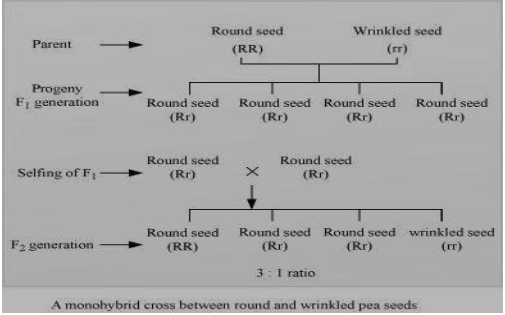
(N/A) Mendel's Law of Dominance states that in a heterozygous condition,the dominant allele expresses its phenotype,while the recessive allele remains masked. The recessive allele is not lost but remains hidden in the $F_{1}$ generation and reappears in the $F_{2}$ generation.
For example,when pea plants with round seeds $(RR)$ are crossed with plants with wrinkled seeds $(rr)$,all seeds in the $F_{1}$ generation are found to be round $(Rr)$. This demonstrates that the round trait is dominant over the wrinkled trait.
When these $F_{1}$ round seeds $(Rr)$ are self-fertilized,both round and wrinkled seeds appear in the $F_{2}$ generation in a $3:1$ phenotypic ratio. This confirms that the recessive trait (wrinkled seeds) was present but suppressed in the $F_{1}$ generation and reappeared in the $F_{2}$ generation.
For example,when pea plants with round seeds $(RR)$ are crossed with plants with wrinkled seeds $(rr)$,all seeds in the $F_{1}$ generation are found to be round $(Rr)$. This demonstrates that the round trait is dominant over the wrinkled trait.
When these $F_{1}$ round seeds $(Rr)$ are self-fertilized,both round and wrinkled seeds appear in the $F_{2}$ generation in a $3:1$ phenotypic ratio. This confirms that the recessive trait (wrinkled seeds) was present but suppressed in the $F_{1}$ generation and reappeared in the $F_{2}$ generation.
0 likes
View Solution77
Difficult
Using a Punnett square,work out the distribution of phenotypic features in the first filial generation after a cross between a homozygous female and a heterozygous male for a single locus.
Solution
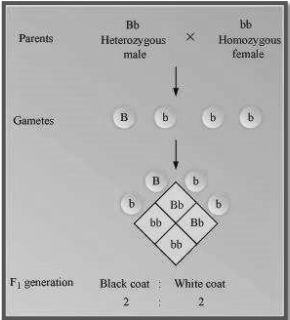
(N/A) To determine the phenotypic distribution,we consider a cross between a heterozygous male (genotype $Bb$) and a homozygous recessive female (genotype $bb$).
$1$. The male produces two types of gametes: $B$ and $b$.
$2$. The female produces only one type of gamete: $b$.
$3$. Using a Punnett square:
| Gametes | $b$ |
| :--- | :--- |
| $B$ | $Bb$ |
| $b$ | $bb$ |
Resulting genotypes in the $F_{1}$ generation are $Bb$ (heterozygous) and $bb$ (homozygous recessive) in a $1:1$ ratio.
Phenotypically,this results in $50\%$ individuals showing the dominant trait and $50\%$ individuals showing the recessive trait,giving a phenotypic ratio of $1:1$.
$1$. The male produces two types of gametes: $B$ and $b$.
$2$. The female produces only one type of gamete: $b$.
$3$. Using a Punnett square:
| Gametes | $b$ |
| :--- | :--- |
| $B$ | $Bb$ |
| $b$ | $bb$ |
Resulting genotypes in the $F_{1}$ generation are $Bb$ (heterozygous) and $bb$ (homozygous recessive) in a $1:1$ ratio.
Phenotypically,this results in $50\%$ individuals showing the dominant trait and $50\%$ individuals showing the recessive trait,giving a phenotypic ratio of $1:1$.
0 likes
View Solution78
Medium
Describe Mendel's Monohybrid experiment.
Solution
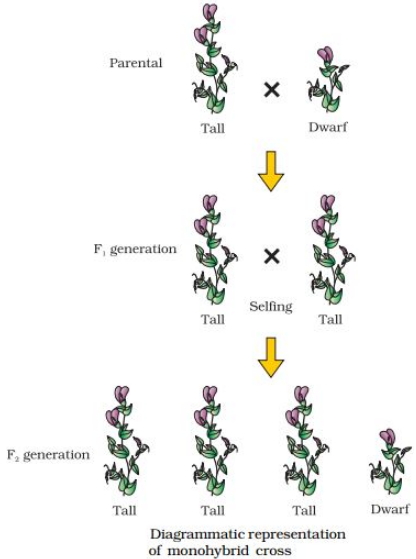
(N/A) Mendel's monohybrid experiment involves crossing two pea plants that differ in only one character (e.g.,height).
$1$. If we use alphabetical symbols for each gene,the capital letter is used for the trait expressed at the $F_{1}$ stage,and the small alphabet is used for the other trait.
$2$. For example,for the character of height,'$T$' is used for the 'Tall' trait and '$t$' for the 'dwarf' trait. '$T$' and '$t$' are alleles of each other.
$3$. In plants,the pair of alleles for height would be $TT$,$Tt$,or $tt$.
$4$. Mendel proposed that in a true-breeding tall or dwarf pea variety,the allelic pair of genes for height are identical or homozygous,$TT$ and $tt$ respectively.
$5$. $TT$ and $tt$ are called the genotype of the plant,while the descriptive terms 'tall' and 'dwarf' are the phenotypes.
$6$. As Mendel found the phenotype of the $F_{1}$ heterozygote $(Tt)$ to be exactly like the $TT$ parent in appearance,he proposed that in a pair of dissimilar factors,one dominates the other (as in the $F_{1}$ generation) and is called the dominant factor,while the other is the recessive factor.
$1$. If we use alphabetical symbols for each gene,the capital letter is used for the trait expressed at the $F_{1}$ stage,and the small alphabet is used for the other trait.
$2$. For example,for the character of height,'$T$' is used for the 'Tall' trait and '$t$' for the 'dwarf' trait. '$T$' and '$t$' are alleles of each other.
$3$. In plants,the pair of alleles for height would be $TT$,$Tt$,or $tt$.
$4$. Mendel proposed that in a true-breeding tall or dwarf pea variety,the allelic pair of genes for height are identical or homozygous,$TT$ and $tt$ respectively.
$5$. $TT$ and $tt$ are called the genotype of the plant,while the descriptive terms 'tall' and 'dwarf' are the phenotypes.
$6$. As Mendel found the phenotype of the $F_{1}$ heterozygote $(Tt)$ to be exactly like the $TT$ parent in appearance,he proposed that in a pair of dissimilar factors,one dominates the other (as in the $F_{1}$ generation) and is called the dominant factor,while the other is the recessive factor.
0 likes
View Solution79
Medium
With the help of a Punnett square,describe a monohybrid experiment.
Solution
(N/A) Punnett square was developed by a British geneticist,Reginald $C$. Punnett.
It is a graphical representation used to calculate the probability of all possible genotypes of offspring in a genetic cross.
The possible gametes are written on two sides,usually the top row and left columns.
All possible combinations are represented in the boxes below,which generates a square output form.
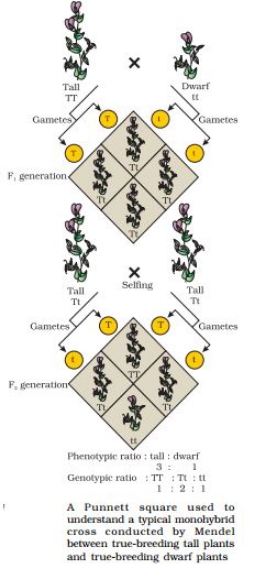
The Punnett square shows the parental tall $TT$ (male) and dwarf $tt$ (female) plants,the gametes produced by them,and the $F_{1}$ '$Tt$' progeny.
The $F_{1}$ plants of genotype $Tt$ are self-pollinated.
The symbols $female$ and $male$ are used to denote the female (eggs) and male (pollen) of the $F_{1}$ generation,respectively.
The $F_{1}$ plant of the genotype $Tt$,when self-pollinated,produces gametes of the genotype '$T$' and '$t$' in equal proportion.
When fertilisation takes place,the pollen grains of genotype '$T$' have a $50$ percent chance to pollinate eggs of the genotype '$T$' as well as of genotype '$t$'.
Also,pollen grains of genotype '$t$' have a $50$ percent chance of pollinating eggs of genotype '$T$' as well as of genotype '$t$'.
As a result of random fertilisation,the resultant zygote can be of the genotypes $TT$,$Tt$,or $tt$.
From the Punnett square,it is easily seen that $1/4$ of the random fertilisation leads to $TT$,$1/2$ leads to $Tt$,and $1/4$ leads to $tt$.
Though the $F_{1}$ has a genotype of $Tt$,the phenotypic character seen is 'tall'.
At $F_{2}$,$3/4$ of the plants are tall,where some of them are $TT$ while others are $Tt$.
Externally,it is not possible to distinguish between the plants with the genotypes '$TT$' and $Tt$.
Hence,within the genotypic pair '$Tt$',only one character '$T$' (tall) is expressed.
Therefore,the character '$T$' or 'tall' is said to dominate over the other allele '$t$' or the dwarf character.
It is a graphical representation used to calculate the probability of all possible genotypes of offspring in a genetic cross.
The possible gametes are written on two sides,usually the top row and left columns.
All possible combinations are represented in the boxes below,which generates a square output form.
The Punnett square shows the parental tall $TT$ (male) and dwarf $tt$ (female) plants,the gametes produced by them,and the $F_{1}$ '$Tt$' progeny.
The $F_{1}$ plants of genotype $Tt$ are self-pollinated.
The symbols $female$ and $male$ are used to denote the female (eggs) and male (pollen) of the $F_{1}$ generation,respectively.
The $F_{1}$ plant of the genotype $Tt$,when self-pollinated,produces gametes of the genotype '$T$' and '$t$' in equal proportion.
When fertilisation takes place,the pollen grains of genotype '$T$' have a $50$ percent chance to pollinate eggs of the genotype '$T$' as well as of genotype '$t$'.
Also,pollen grains of genotype '$t$' have a $50$ percent chance of pollinating eggs of genotype '$T$' as well as of genotype '$t$'.
As a result of random fertilisation,the resultant zygote can be of the genotypes $TT$,$Tt$,or $tt$.
From the Punnett square,it is easily seen that $1/4$ of the random fertilisation leads to $TT$,$1/2$ leads to $Tt$,and $1/4$ leads to $tt$.
Though the $F_{1}$ has a genotype of $Tt$,the phenotypic character seen is 'tall'.
At $F_{2}$,$3/4$ of the plants are tall,where some of them are $TT$ while others are $Tt$.
Externally,it is not possible to distinguish between the plants with the genotypes '$TT$' and $Tt$.
Hence,within the genotypic pair '$Tt$',only one character '$T$' (tall) is expressed.
Therefore,the character '$T$' or 'tall' is said to dominate over the other allele '$t$' or the dwarf character.
0 likes
View Solution80
MediumMCQ
Show the phenotypic and genotypic ratios obtained from a Punnett square for a monohybrid cross.
A
Phenotypic ratio $3:1$,Genotypic ratio $1:2:1$
B
Phenotypic ratio $1:2:1$,Genotypic ratio $3:1$
C
Phenotypic ratio $9:3:3:1$,Genotypic ratio $1:2:1:2:4:2:1:2:1$
D
Phenotypic ratio $1:1$,Genotypic ratio $1:1$
Solution
(A) In a monohybrid cross between two heterozygous individuals $(Tt \times Tt)$,the Punnett square results in the following genotypes: $\frac{1}{4} TT$,$\frac{1}{2} Tt$,and $\frac{1}{4} tt$.
This results in a genotypic ratio of $1:2:1$ $(1 TT : 2 Tt : 1 tt)$.
Phenotypically,both $TT$ and $Tt$ express the dominant trait (tall),while $tt$ expresses the recessive trait (dwarf).
Therefore,the phenotypic ratio is $3$ tall : $1$ dwarf,which is $3:1$.
This results in a genotypic ratio of $1:2:1$ $(1 TT : 2 Tt : 1 tt)$.
Phenotypically,both $TT$ and $Tt$ express the dominant trait (tall),while $tt$ expresses the recessive trait (dwarf).
Therefore,the phenotypic ratio is $3$ tall : $1$ dwarf,which is $3:1$.
0 likes
View Solution81
Medium
How does inheritance of one gene take place?
Solution
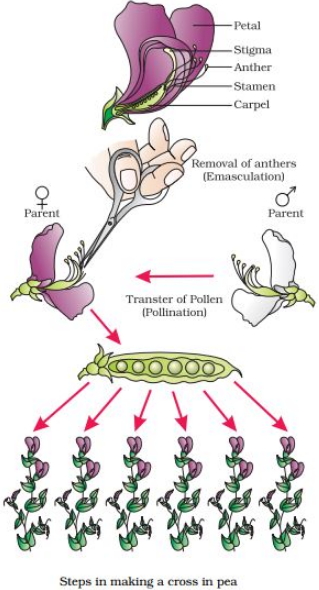
(N/A) Inheritance of one gene can be studied by a hybridization experiment carried out by Mendel,where he crossed tall and dwarf pea plants to study the inheritance of one gene.
He collected the seeds produced as a result of this cross and grew them to generate plants of the first hybrid generation.
This generation is also called the filial $1$ progeny or the $F_{1}$ generation.
- Mendel observed that all the $F_{1}$ progeny plants were tall like one of its parents; none were dwarf.
- He made similar observations for the other pairs of traits; he found that the $F_{1}$ always resembled either one of the parents and that the trait of the other parent was not seen in them.
Mendel then self-pollinated the tall $F_{1}$ plants and,to his surprise,found that in the filial $2$ $(F_{2})$ generation,some of the offspring were dwarf. The character that was not seen in the $F_{1}$ generation was now expressed.
The proportion of plants that were dwarf was $1/4$ of the $F_{2}$ plants,while $3/4$ of the $F_{2}$ plants were tall.
The tall and dwarf traits were identical to their parental type and did not show any blending; that is,all the offspring were either tall or dwarf,and none were of intermediate height.
He collected the seeds produced as a result of this cross and grew them to generate plants of the first hybrid generation.
This generation is also called the filial $1$ progeny or the $F_{1}$ generation.
- Mendel observed that all the $F_{1}$ progeny plants were tall like one of its parents; none were dwarf.
- He made similar observations for the other pairs of traits; he found that the $F_{1}$ always resembled either one of the parents and that the trait of the other parent was not seen in them.
Mendel then self-pollinated the tall $F_{1}$ plants and,to his surprise,found that in the filial $2$ $(F_{2})$ generation,some of the offspring were dwarf. The character that was not seen in the $F_{1}$ generation was now expressed.
The proportion of plants that were dwarf was $1/4$ of the $F_{2}$ plants,while $3/4$ of the $F_{2}$ plants were tall.
The tall and dwarf traits were identical to their parental type and did not show any blending; that is,all the offspring were either tall or dwarf,and none were of intermediate height.
0 likes
View Solution82
EasyMCQ
Define the term: Filial progeny / $F_{1}$ generation.
A
The offspring produced from the crossing of two parents.
B
The second generation of offspring.
C
The genetic makeup of an organism.
D
The physical appearance of an organism.
Solution
(A) The offspring of the first generation produced from the parent generation are referred to as $F_{1}$ individuals.
They represent the first filial generation.
They represent the first filial generation.
0 likes
View Solution83
Easy
Define the following terms: Monohybrid experiment and Dihybrid experiment.
Solution
(N/A) $1$. Monohybrid experiment: $A$ cross between two organisms that differ in only one pair of contrasting characters is called a monohybrid experiment. It is used to study the inheritance of a single gene.
$2$. Dihybrid experiment: $A$ cross between two organisms that differ in two pairs of contrasting characters is called a dihybrid experiment. It is used to study the inheritance of two genes simultaneously.
$2$. Dihybrid experiment: $A$ cross between two organisms that differ in two pairs of contrasting characters is called a dihybrid experiment. It is used to study the inheritance of two genes simultaneously.
0 likes
View Solution84
MediumMCQ
What was the phenotypic ratio of the progeny obtained in the $F_2$ generation in Mendel's monohybrid cross experiment?
A
$1 : 2 : 1$
B
$3 : 1$
C
$1 : 1$
D
Both $A$ and $B$
Solution
(B) In Mendel's monohybrid cross,he crossed true-breeding tall plants $(TT)$ with true-breeding dwarf plants $(tt)$.
In the $F_1$ generation,all plants were tall $(Tt)$.
When $F_1$ plants were self-pollinated,the $F_2$ generation showed a phenotypic ratio of $3$ tall plants to $1$ dwarf plant $(3:1)$.
The genotypic ratio in the $F_2$ generation was $1:2:1$ ($1$ homozygous tall : $2$ heterozygous tall : $1$ homozygous dwarf).
Therefore,the phenotypic ratio is $3:1$.
In the $F_1$ generation,all plants were tall $(Tt)$.
When $F_1$ plants were self-pollinated,the $F_2$ generation showed a phenotypic ratio of $3$ tall plants to $1$ dwarf plant $(3:1)$.
The genotypic ratio in the $F_2$ generation was $1:2:1$ ($1$ homozygous tall : $2$ heterozygous tall : $1$ homozygous dwarf).
Therefore,the phenotypic ratio is $3:1$.
0 likes
View Solution85
EasyMCQ
What is the genotypic ratio of Mendel's monohybrid cross?
A
$1 : 2 : 1$
B
$3 : 1$
C
$1 : 1$
D
Both $A$ and $B$
Solution
(A) In Mendel's monohybrid cross,the $F_1$ generation (heterozygous,$Tt$) is self-pollinated to produce the $F_2$ generation.
According to the law of segregation,the gametes produced are $T$ and $t$ in equal proportions.
The resulting $F_2$ generation genotypes are $TT$ (homozygous dominant),$Tt$ (heterozygous),and $tt$ (homozygous recessive) in the ratio of $1 : 2 : 1$.
Therefore,the genotypic ratio is $1 : 2 : 1$.
According to the law of segregation,the gametes produced are $T$ and $t$ in equal proportions.
The resulting $F_2$ generation genotypes are $TT$ (homozygous dominant),$Tt$ (heterozygous),and $tt$ (homozygous recessive) in the ratio of $1 : 2 : 1$.
Therefore,the genotypic ratio is $1 : 2 : 1$.
0 likes
View Solution86
MediumMCQ
In Mendel's monohybrid cross experiment,what was the percentage of heterozygous genotypes in the $F_2$ generation?
A
$25 \%$
B
$50 \%$
C
$75 \%$
D
None of these
Solution
(B) In Mendel's monohybrid cross,the $F_1$ generation consists of heterozygous individuals $(Tt)$.
When $F_1$ individuals are self-pollinated $(Tt \times Tt)$,the resulting $F_2$ generation genotypes are $TT$ (homozygous dominant),$Tt$ (heterozygous),and $tt$ (homozygous recessive) in a ratio of $1:2:1$.
Out of the total $4$ parts,$2$ parts are heterozygous $(Tt)$.
Therefore,the percentage of heterozygous genotypes is $(2/4) \times 100 = 50 \%$.
When $F_1$ individuals are self-pollinated $(Tt \times Tt)$,the resulting $F_2$ generation genotypes are $TT$ (homozygous dominant),$Tt$ (heterozygous),and $tt$ (homozygous recessive) in a ratio of $1:2:1$.
Out of the total $4$ parts,$2$ parts are heterozygous $(Tt)$.
Therefore,the percentage of heterozygous genotypes is $(2/4) \times 100 = 50 \%$.
0 likes
View Solution87
MediumMCQ
What is the phenotypic ratio obtained from a test cross of $F_1$ progeny in a monohybrid cross?
A
$1 : 1$
B
$1 : 2$
C
$2 : 1$
D
$1 : 2 : 1$
Solution
(A) test cross is defined as the cross between an individual of unknown genotype (usually $F_1$ hybrid) and a homozygous recessive parent.
In a monohybrid cross,the $F_1$ hybrid has the genotype $Tt$.
The homozygous recessive parent has the genotype $tt$.
The cross is represented as: $Tt \times tt$.
The resulting offspring are $Tt$ (tall) and $tt$ (dwarf) in a ratio of $1 : 1$.
Therefore,the phenotypic ratio obtained from a test cross of $F_1$ progeny is $1 : 1$.
In a monohybrid cross,the $F_1$ hybrid has the genotype $Tt$.
The homozygous recessive parent has the genotype $tt$.
The cross is represented as: $Tt \times tt$.
The resulting offspring are $Tt$ (tall) and $tt$ (dwarf) in a ratio of $1 : 1$.
Therefore,the phenotypic ratio obtained from a test cross of $F_1$ progeny is $1 : 1$.
0 likes
View Solution88
MediumMCQ
If the genotype of an offspring is $TT$,determine the number of possible gamete types produced by it.
A
$1$
B
$2$
C
$4$
D
None of these
Solution
(A) The genotype of the organism is $TT$,which is a homozygous dominant condition.
During gametogenesis,the alleles segregate such that each gamete receives only one allele.
Since both alleles are identical ($T$ and $T$),all gametes produced will carry the same allele $T$.
Therefore,only $1$ type of gamete is produced by an organism with the genotype $TT$.
During gametogenesis,the alleles segregate such that each gamete receives only one allele.
Since both alleles are identical ($T$ and $T$),all gametes produced will carry the same allele $T$.
Therefore,only $1$ type of gamete is produced by an organism with the genotype $TT$.
0 likes
View Solution89
MediumMCQ
Determine the number of possible types of gametes produced by an organism with the genotype $AABBCC$.
A
$1$
B
$2$
C
$4$
D
$8$
Solution
(A) The number of different types of gametes produced by an organism can be calculated using the formula $2^n$,where $n$ is the number of heterozygous gene pairs.
In the given genotype $AABBCC$,all gene pairs are homozygous ($AA$,$BB$,$CC$).
Therefore,the number of heterozygous gene pairs $n = 0$.
Using the formula: $2^0 = 1$.
The only type of gamete produced will be $ABC$.
In the given genotype $AABBCC$,all gene pairs are homozygous ($AA$,$BB$,$CC$).
Therefore,the number of heterozygous gene pairs $n = 0$.
Using the formula: $2^0 = 1$.
The only type of gamete produced will be $ABC$.
0 likes
View Solution90
MediumMCQ
Based on which experiment was the Law of Purity of Gametes given by Mendel?
A
Monohybrid cross
B
Dihybrid cross
C
Test cross
D
Both $A$ and $B$
Solution
(A) The Law of Purity of Gametes,also known as the Law of Segregation,states that during the formation of gametes,the two alleles of a gene pair separate from each other so that each gamete receives only one of the two alleles.
This law is based on the observations made by Gregor Mendel during his monohybrid cross experiments,where he observed that the recessive trait,which disappears in the $F_1$ generation,reappears in the $F_2$ generation.
Since the segregation of alleles is a fundamental process observed in the inheritance of a single gene,the monohybrid cross is the basis for this law.
This law is based on the observations made by Gregor Mendel during his monohybrid cross experiments,where he observed that the recessive trait,which disappears in the $F_1$ generation,reappears in the $F_2$ generation.
Since the segregation of alleles is a fundamental process observed in the inheritance of a single gene,the monohybrid cross is the basis for this law.
0 likes
View Solution91
MediumMCQ
When a heterozygous tall plant is crossed with a homozygous dwarf plant,what will be the proportion of dwarf progeny in the next generation (in $\%$)?
A
$25$
B
$50$
C
$0$
D
$100$
Solution
(B) heterozygous tall plant has the genotype $Tt$.
$A$ homozygous dwarf plant has the genotype $tt$.
When these are crossed $(Tt \times tt)$,the Punnett square yields:
- $Tt$ (Tall)
- $Tt$ (Tall)
- $tt$ (Dwarf)
- $tt$ (Dwarf)
Thus,the offspring ratio is $50 \%$ tall and $50 \%$ dwarf.
Therefore,the proportion of dwarf progeny is $50 \%$.
$A$ homozygous dwarf plant has the genotype $tt$.
When these are crossed $(Tt \times tt)$,the Punnett square yields:
- $Tt$ (Tall)
- $Tt$ (Tall)
- $tt$ (Dwarf)
- $tt$ (Dwarf)
Thus,the offspring ratio is $50 \%$ tall and $50 \%$ dwarf.
Therefore,the proportion of dwarf progeny is $50 \%$.
0 likes
View Solution92
MediumMCQ
What will be the phenotypic ratio obtained from the selfing of a plant with the genotype $AABb$?
A
$1:1$
B
$1:2:1$
C
$1:1:1:2$
D
None of these
Solution
(D) The genotype of the plant is $AABb$.
When this plant undergoes selfing,the cross is $AABb \times AABb$.
We can analyze the inheritance of each gene pair independently:
$1$. For the $AA$ gene pair: $AA \times AA$ results in all $AA$ offspring (homozygous dominant).
$2$. For the $Bb$ gene pair: $Bb \times Bb$ results in a phenotypic ratio of $3:1$ ($3$ dominant : $1$ recessive).
Combining these results:
Since the $AA$ trait is uniform,the phenotypic ratio of the offspring will be determined solely by the $Bb$ trait.
Therefore,the phenotypic ratio is $3:1$.
As $3:1$ is not among the given options,the correct answer is $D$ (None of these).
When this plant undergoes selfing,the cross is $AABb \times AABb$.
We can analyze the inheritance of each gene pair independently:
$1$. For the $AA$ gene pair: $AA \times AA$ results in all $AA$ offspring (homozygous dominant).
$2$. For the $Bb$ gene pair: $Bb \times Bb$ results in a phenotypic ratio of $3:1$ ($3$ dominant : $1$ recessive).
Combining these results:
Since the $AA$ trait is uniform,the phenotypic ratio of the offspring will be determined solely by the $Bb$ trait.
Therefore,the phenotypic ratio is $3:1$.
As $3:1$ is not among the given options,the correct answer is $D$ (None of these).
0 likes
View Solution93
MediumMCQ
How many types of gametes will be produced by an organism with the genotype $AABbCCDD$?
A
$4$
B
$8$
C
$2$
D
$16$
Solution
(C) To determine the number of different types of gametes produced by an organism,we use the formula $2^n$,where $n$ represents the number of heterozygous gene pairs.
In the given genotype $AABbCCDD$:
- $AA$ is homozygous (not heterozygous).
- $Bb$ is heterozygous (one pair).
- $CC$ is homozygous.
- $DD$ is homozygous.
Thus,the number of heterozygous pairs $n = 1$.
Using the formula: $2^n = 2^1 = 2$.
The two types of gametes produced will be $ABC D$ and $AbCD$.
In the given genotype $AABbCCDD$:
- $AA$ is homozygous (not heterozygous).
- $Bb$ is heterozygous (one pair).
- $CC$ is homozygous.
- $DD$ is homozygous.
Thus,the number of heterozygous pairs $n = 1$.
Using the formula: $2^n = 2^1 = 2$.
The two types of gametes produced will be $ABC D$ and $AbCD$.
0 likes
View Solution94
MediumMCQ
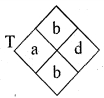
Observe the given Punnett square carefully and answer the following question.
What is the genotype of the homozygous offspring produced in box $d$ of the given Punnett square?
What is the genotype of the homozygous offspring produced in box $d$ of the given Punnett square?
A
$TT$
B
$Tt$
C
$tt$
D
Both $A$ and $B$
Solution
(C) In a standard monohybrid cross involving a heterozygous parent $(Tt)$ self-pollinated,the gametes produced are $T$ and $t$.
Based on the provided Punnett square image:
- The left side shows $T$ and $t$ (implied by the structure of the cross).
- The top side shows $T$ and $t$.
- Box $a$ is $T \times T = TT$.
- Box $b$ is $T \times t = Tt$.
- Box $b$ is $T \times t = Tt$.
- Box $d$ is $t \times t = tt$.
Therefore,the genotype in box $d$ is $tt$,which is a homozygous recessive genotype.
Based on the provided Punnett square image:
- The left side shows $T$ and $t$ (implied by the structure of the cross).
- The top side shows $T$ and $t$.
- Box $a$ is $T \times T = TT$.
- Box $b$ is $T \times t = Tt$.
- Box $b$ is $T \times t = Tt$.
- Box $d$ is $t \times t = tt$.
Therefore,the genotype in box $d$ is $tt$,which is a homozygous recessive genotype.
0 likes
View Solution95
MediumMCQ
When a pure tall plant is crossed with a pure dwarf plant,and the resulting hybrid plants are self-pollinated,what will be the phenotypic ratio of the offspring in the $F_2$ generation?
A
All tall plants
B
All dwarf plants
C
$75 \%$ tall and $25 \%$ dwarf
D
$50 \%$ tall and $50 \%$ dwarf
Solution
(C) $1$. The cross between a pure tall $(TT)$ and a pure dwarf $(tt)$ plant results in $F_1$ generation plants that are all heterozygous tall $(Tt)$.
$2$. When these $F_1$ hybrid plants $(Tt)$ are self-pollinated $(Tt \times Tt)$,the $F_2$ generation is produced.
$3$. According to the Punnett square,the genotypes obtained are $TT$ (tall),$Tt$ (tall),$Tt$ (tall),and $tt$ (dwarf).
$4$. This results in a phenotypic ratio of $3:1$,which corresponds to $75 \%$ tall plants and $25 \%$ dwarf plants.
$2$. When these $F_1$ hybrid plants $(Tt)$ are self-pollinated $(Tt \times Tt)$,the $F_2$ generation is produced.
$3$. According to the Punnett square,the genotypes obtained are $TT$ (tall),$Tt$ (tall),$Tt$ (tall),and $tt$ (dwarf).
$4$. This results in a phenotypic ratio of $3:1$,which corresponds to $75 \%$ tall plants and $25 \%$ dwarf plants.
0 likes
View Solution96
MediumMCQ
In a cross between $AaBB$ and $aaBB$,what will be the ratio of the genotypes $AaBB$ and $aaBB$ in the progeny?
A
$1:1$
B
$1:3$
C
$3:1$
D
$1:2:1$
Solution
(A) To determine the genotypic ratio of the cross $AaBB \times aaBB$,we can use the Punnett square method or analyze the segregation of alleles.
$1$. The cross involves two genes,but the second gene is homozygous $(BB)$ in both parents.
$2$. The cross can be broken down into two independent monohybrid crosses:
- Gene $A$: $Aa \times aa$ results in $Aa$ and $aa$ in a $1:1$ ratio.
- Gene $B$: $BB \times BB$ results in $BB$ ($100$%).
$3$. Combining these results,the offspring will be $AaBB$ and $aaBB$ in a ratio of $1:1$.
$1$. The cross involves two genes,but the second gene is homozygous $(BB)$ in both parents.
$2$. The cross can be broken down into two independent monohybrid crosses:
- Gene $A$: $Aa \times aa$ results in $Aa$ and $aa$ in a $1:1$ ratio.
- Gene $B$: $BB \times BB$ results in $BB$ ($100$%).
$3$. Combining these results,the offspring will be $AaBB$ and $aaBB$ in a ratio of $1:1$.
0 likes
View Solution97
MediumMCQ
In a cross,$75$ tall plants and $25$ dwarf plants are obtained. What would be the genotype of the parents?
A
Homozygous and Heterozygous
B
Both Homozygous
C
Both Heterozygous
D
Any of the above
Solution
(C) The obtained result of $75$ tall and $25$ dwarf plants represents a ratio of $75:25$,which simplifies to $3:1$.
According to Mendel's monohybrid cross experiment,when two heterozygous $(Tt)$ parents are crossed,the $F_1$ generation produces a phenotypic ratio of $3:1$ (tall : dwarf).
Therefore,both parents must be heterozygous $(Tt)$.
According to Mendel's monohybrid cross experiment,when two heterozygous $(Tt)$ parents are crossed,the $F_1$ generation produces a phenotypic ratio of $3:1$ (tall : dwarf).
Therefore,both parents must be heterozygous $(Tt)$.
0 likes
View Solution98
MediumMCQ
When a cross is made between a pure tall plant and a pure dwarf plant,what will be the characteristics of the $F_1$ generation?
A
Phenotypically pure dwarf and homozygous.
B
Phenotypically pure tall and homozygous.
C
Phenotypically tall and heterozygous.
D
Phenotypically dwarf and heterozygous.
Solution
(C) According to Mendel's Law of Dominance,when a pure tall plant $(TT)$ is crossed with a pure dwarf plant $(tt)$,the $F_1$ generation offspring will have the genotype $Tt$.
Since the allele for tallness $(T)$ is dominant over the allele for dwarfness $(t)$,all $F_1$ plants will be phenotypically tall.
Because the genotype $Tt$ consists of two different alleles for the same trait,the plants are heterozygous.
Since the allele for tallness $(T)$ is dominant over the allele for dwarfness $(t)$,all $F_1$ plants will be phenotypically tall.
Because the genotype $Tt$ consists of two different alleles for the same trait,the plants are heterozygous.
0 likes
View Solution99
MediumMCQ
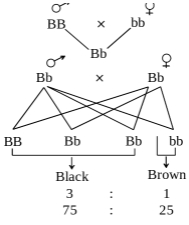
$BB =$ alleles for black coat colour
$bb =$ alleles for brown coat colour
If the offspring of a cross between a black mouse $(BB)$ and a brown mouse $(bb)$ are allowed to interbreed,find the percentage of black-coated mice in the $F_2$ generation.
$bb =$ alleles for brown coat colour
If the offspring of a cross between a black mouse $(BB)$ and a brown mouse $(bb)$ are allowed to interbreed,find the percentage of black-coated mice in the $F_2$ generation.
A
$75\, \%$
B
$50\, \%$
C
Cross is not possible because black and brown mice are different species
D
$100\, \%$
Solution
(A) $1$. Parental generation $(P)$: $BB$ (Black) $\times$ $bb$ (Brown).
$2$. $F_1$ generation: All offspring are $Bb$ (Heterozygous black).
$3$. Interbreeding $F_1$ generation: $Bb \times Bb$.
$4$. $F_2$ generation genotypes: $1 BB : 2 Bb : 1 bb$.
$5$. Phenotypic ratio: $3$ Black $(BB, Bb)$ : $1$ Brown $(bb)$.
$6$. Therefore,the percentage of black-coated mice is $(3/4) \times 100 = 75\, \%$.
$2$. $F_1$ generation: All offspring are $Bb$ (Heterozygous black).
$3$. Interbreeding $F_1$ generation: $Bb \times Bb$.
$4$. $F_2$ generation genotypes: $1 BB : 2 Bb : 1 bb$.
$5$. Phenotypic ratio: $3$ Black $(BB, Bb)$ : $1$ Brown $(bb)$.
$6$. Therefore,the percentage of black-coated mice is $(3/4) \times 100 = 75\, \%$.
0 likes
View Solution100
MediumMCQ
If a cross between two individuals produces offspring with $50\;\%$ dominant character $(A)$ and $50\;\%$ recessive character $(a),$ then the genotypes of the parents are:
A
$AA \; \& \; aa$
B
$Aa \; \& \; aa$
C
$AA \; \& \; Aa$
D
$Aa \; \& \; Aa$
Solution
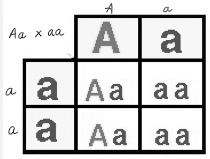
(B) To obtain a $1:1$ ratio of dominant to recessive phenotypes in the offspring,one parent must be heterozygous $(Aa)$ and the other must be homozygous recessive $(aa)$.
This specific type of cross is known as a test cross.
The Punnett square for the cross $Aa \times aa$ is as follows:
- Gametes from $Aa$ parent: $A, a$
- Gametes from $aa$ parent: $a, a$
- Offspring genotypes: $Aa, Aa, aa, aa$
- Phenotypic ratio: $50\;\%$ dominant $(Aa)$ and $50\;\%$ recessive $(aa)$.
This specific type of cross is known as a test cross.
The Punnett square for the cross $Aa \times aa$ is as follows:
- Gametes from $Aa$ parent: $A, a$
- Gametes from $aa$ parent: $a, a$
- Offspring genotypes: $Aa, Aa, aa, aa$
- Phenotypic ratio: $50\;\%$ dominant $(Aa)$ and $50\;\%$ recessive $(aa)$.
0 likes
View SolutionPrinciples of Inheritance and Variation — Inheritance of one gene · Frequently Asked Questions
1Are these Principles of Inheritance and Variation questions useful for JEE and NEET?
Yes. All questions in this section are mapped to JEE Main and NEET exam patterns. Previous year questions from JEE Main, NEET, GUJCET and state-level exams are included with full solutions.
2Can I switch to Hindi or Gujarati for these questions?
Yes. Use the language tabs in the hero section or the sidebar to view the same questions and solutions in English, Hindi or Gujarati.
3How do I generate a question paper from this subtopic?
Use the Vedclass Exam Paper Generator — select the chapter and subtopic, set difficulty, and generate Sets A, B, C, D automatically. First 3 chapters of every subject are free.
Vedclass Products
For Students
Vedclass Test Series
Mock tests in real JEE/NEET style with performance analysis. 5-day free trial.
Start Free TrialFor Teachers
Exam Paper Generator
Generate Set A/B/C/D papers from this chapter in 2 minutes. 3 chapters free.
Try FreeFor Institutes
Online Exam Module
Live online exams with unlimited students, 360° analytics & white-label branding.
See DemoFor Teachers & Institutes
Generate a Principles of Inheritance and Variation Exam Paper in 2 Minutes
Select subtopic & difficulty — Sets A, B, C, D auto-generated with No Repeat logic.
First 3 chapters of every subject are free — no payment required.