
A English
The Search for Genetic Material Questions in English
Class 12 Biology · Molecular Basis of Inheritance · The Search for Genetic Material
178+
Questions
English
Language
100%
With Solutions
Showing 28 of 178 questions in English
151
MediumMCQ
What is the main conclusion of Griffith's transformation experiment?
A
Protein is the genetic material.
B
Dead bacteria transfer some material to living bacteria.
C
Heat destroys the disease-causing ability of bacteria.
D
All of the above.
Solution
(B) Frederick Griffith conducted an experiment with $Streptococcus \text{ } pneumoniae$ using two strains: $S$-strain (virulent) and $R$-strain (non-virulent).
He observed that when heat-killed $S$-strain bacteria were mixed with live $R$-strain bacteria and injected into mice, the mice died.
He recovered live $S$-strain bacteria from the dead mice.
This led to the conclusion that some 'transforming principle' was transferred from the heat-killed $S$-strain to the live $R$-strain, which transformed the $R$-strain into the virulent $S$-strain.
Therefore, the main conclusion is that dead bacteria transfer some material to living bacteria, causing them to change their characteristics.
He observed that when heat-killed $S$-strain bacteria were mixed with live $R$-strain bacteria and injected into mice, the mice died.
He recovered live $S$-strain bacteria from the dead mice.
This led to the conclusion that some 'transforming principle' was transferred from the heat-killed $S$-strain to the live $R$-strain, which transformed the $R$-strain into the virulent $S$-strain.
Therefore, the main conclusion is that dead bacteria transfer some material to living bacteria, causing them to change their characteristics.
0 likes
View Solution152
EasyMCQ
In the Hershey and Chase experiment,proteins and $DNA$ can be labeled with which of the following respectively?
A
$^{34}S$ and $^{30}P$
B
$^{35}S$ and $^{30}P$
C
$^{35}S$ and $^{32}P$
D
$^{34}S$ and $^{32}P$
Solution
(C) Alfred Hershey and Martha Chase conducted experiments on bacteriophages to prove that $DNA$ is the genetic material.
They used radioactive isotopes to label the components of the bacteriophage.
Proteins contain sulfur but not phosphorus,so they were labeled with radioactive sulfur $(^{35}S)$.
$DNA$ contains phosphorus but not sulfur,so it was labeled with radioactive phosphorus $(^{32}P)$.
Therefore,proteins and $DNA$ are labeled with $^{35}S$ and $^{32}P$ respectively.
They used radioactive isotopes to label the components of the bacteriophage.
Proteins contain sulfur but not phosphorus,so they were labeled with radioactive sulfur $(^{35}S)$.
$DNA$ contains phosphorus but not sulfur,so it was labeled with radioactive phosphorus $(^{32}P)$.
Therefore,proteins and $DNA$ are labeled with $^{35}S$ and $^{32}P$ respectively.
0 likes
View Solution153
EasyMCQ
Select the correct option for the $R$ strain of bacteria.
A
Smooth and virulent
B
Rough and virulent
C
Smooth and non-virulent
D
Rough and non-virulent
Solution
(D) In Frederick Griffith's transformation experiment,two strains of Streptococcus pneumoniae were used:
$1$. $S$ strain (Smooth): These bacteria have a mucous (polysaccharide) coat and are virulent,meaning they cause pneumonia.
$2$. $R$ strain (Rough): These bacteria lack the mucous coat and are non-virulent,meaning they do not cause pneumonia.
Therefore,the $R$ strain is characterized as rough and non-virulent.
$1$. $S$ strain (Smooth): These bacteria have a mucous (polysaccharide) coat and are virulent,meaning they cause pneumonia.
$2$. $R$ strain (Rough): These bacteria lack the mucous coat and are non-virulent,meaning they do not cause pneumonia.
Therefore,the $R$ strain is characterized as rough and non-virulent.
0 likes
View Solution154
MediumMCQ
Analyze the following experimental steps performed by Frederick Griffith:
$I - R$ strain $\rightarrow$ injected into mice
$II - S$ strain $\rightarrow$ injected into mice
$III - S$ strain (heat-killed) $\rightarrow$ injected into mice
$IV - S$ strain (heat-killed) $+ R$ strain (live) $\rightarrow$ injected into mice
In which of the above stages will the mice remain alive?
$I - R$ strain $\rightarrow$ injected into mice
$II - S$ strain $\rightarrow$ injected into mice
$III - S$ strain (heat-killed) $\rightarrow$ injected into mice
$IV - S$ strain (heat-killed) $+ R$ strain (live) $\rightarrow$ injected into mice
In which of the above stages will the mice remain alive?
A
$II, IV$
B
$I, III$
C
$I, III, IV$
D
$I$
Solution
(B) Frederick Griffith conducted experiments on Streptococcus pneumoniae to identify the transforming principle.
$1$. $R$ strain (Rough) is non-virulent; therefore,mice injected with $R$ strain survive.
$2$. $S$ strain (Smooth) is virulent; therefore,mice injected with $S$ strain die.
$3$. $S$ strain (heat-killed) is non-virulent because the heat kills the bacteria; therefore,mice injected with heat-killed $S$ strain survive.
$4$. $S$ strain (heat-killed) $+ R$ strain (live) results in the transformation of $R$ strain into $S$ strain,making it virulent; therefore,mice injected with this mixture die.
Thus,the mice remain alive in stages $I$ and $III$.
$1$. $R$ strain (Rough) is non-virulent; therefore,mice injected with $R$ strain survive.
$2$. $S$ strain (Smooth) is virulent; therefore,mice injected with $S$ strain die.
$3$. $S$ strain (heat-killed) is non-virulent because the heat kills the bacteria; therefore,mice injected with heat-killed $S$ strain survive.
$4$. $S$ strain (heat-killed) $+ R$ strain (live) results in the transformation of $R$ strain into $S$ strain,making it virulent; therefore,mice injected with this mixture die.
Thus,the mice remain alive in stages $I$ and $III$.
0 likes
View Solution155
EasyMCQ
$P$ is the stable genetic material,whereas $Q$ performs active roles like messenger and adapter. Identify $P$ and $Q$.
$\quad\quad P \quad \quad \quad Q$
$\quad\quad P \quad \quad \quad Q$
A
$RNA \quad RNA$
B
$DNA \quad DNA$
C
$RNA \quad DNA$
D
$DNA \quad RNA$
Solution
(D) $DNA$ acts as the genetic material in most organisms and is chemically more stable due to the presence of $2'-OH$ group absence and thymine instead of uracil.
$RNA$ performs various active roles such as being a messenger $(mRNA)$,adapter $(tRNA)$,and structural/catalytic molecule $(rRNA)$.
$RNA$ performs various active roles such as being a messenger $(mRNA)$,adapter $(tRNA)$,and structural/catalytic molecule $(rRNA)$.
0 likes
View Solution156
EasyMCQ
If $DNA$ contained sulphur instead of phosphorus and proteins contained phosphorus instead of sulfur,what would have been the outcome of Hershey and Chase experiment?
A
No radioactive sulfur in bacterial cells
B
Both radioactive sulfur and phosphorus in bacterial cells
C
Radioactive sulfur in bacterial cells
D
Radioactive phosphorus in bacterial cells
Solution
(C) In the original Hershey and Chase experiment,they used radioactive phosphorus $(^{32}P)$ to label $DNA$ and radioactive sulfur $(^{35}S)$ to label proteins.
Since $DNA$ enters the bacterial cell during infection by bacteriophages and proteins do not,they observed radioactive phosphorus inside the bacterial cells,proving $DNA$ is the genetic material.
If the composition were swapped,$DNA$ would contain sulfur and proteins would contain phosphorus.
Upon infection,the $DNA$ (now containing radioactive sulfur) would enter the bacterial cells.
Therefore,radioactive sulfur would be detected inside the bacterial cells,while radioactive phosphorus would remain outside with the protein coat.
Since $DNA$ enters the bacterial cell during infection by bacteriophages and proteins do not,they observed radioactive phosphorus inside the bacterial cells,proving $DNA$ is the genetic material.
If the composition were swapped,$DNA$ would contain sulfur and proteins would contain phosphorus.
Upon infection,the $DNA$ (now containing radioactive sulfur) would enter the bacterial cells.
Therefore,radioactive sulfur would be detected inside the bacterial cells,while radioactive phosphorus would remain outside with the protein coat.
0 likes
View Solution157
MediumMCQ
Unequivocal proof that $DNA$ is the genetic material was first proposed by
A
Wilkins and Franklin
B
Frederick Griffith
C
Alfred Hershey and Martha Chase
D
Avery,Macleod and McCarty
Solution
(C) The unequivocal proof that $DNA$ is the genetic material came from the experiment conducted by Alfred Hershey and Martha Chase in $1952$ using bacteriophages.
Frederick Griffith conducted the transformation experiments using $Streptococcus \text{ } pneumoniae$ (Pneumococcus).
Avery,Macleod,and McCarty provided the biochemical characterization of the 'Transforming Principle' identified by Griffith.
Wilkins and Franklin produced the $X$-ray diffraction data of $DNA$ structure.
Frederick Griffith conducted the transformation experiments using $Streptococcus \text{ } pneumoniae$ (Pneumococcus).
Avery,Macleod,and McCarty provided the biochemical characterization of the 'Transforming Principle' identified by Griffith.
Wilkins and Franklin produced the $X$-ray diffraction data of $DNA$ structure.
0 likes
View Solution158
MediumMCQ
Heavy $\text{DNA}$ can be differentiated from normal $\text{DNA}$ by which centrifugation technique?
A
$\text{AgCl}$ density gradient
B
$\text{CaSO}_4$ density gradient
C
$\text{CsCl}$ density gradient
D
$\text{KCl}$ density gradient
Solution
(C) Heavy $\text{DNA}$ (containing $^{15}\text{N}$) can be differentiated from normal $\text{DNA}$ (containing $^{14}\text{N}$) using density gradient centrifugation.
This technique utilizes a $\text{CsCl}$ (Cesium Chloride) density gradient.
This method was famously used by Meselson and Stahl in their experiment to prove the semi-conservative mode of $\text{DNA}$ replication.
This technique utilizes a $\text{CsCl}$ (Cesium Chloride) density gradient.
This method was famously used by Meselson and Stahl in their experiment to prove the semi-conservative mode of $\text{DNA}$ replication.
0 likes
View Solution159
MediumMCQ
The isotopes used by Hershey and Chase were $:-$
A
$^{32}P$ and $^{35}S$
B
$^{35}P$ and $^{32}S$
C
$^{34}P$ and $^{31}S$
D
$^{30}P$ and $^{32}S$
Solution
(A) Alfred Hershey and Martha Chase conducted experiments in $1952$ using bacteriophages to prove that $DNA$ is the genetic material.
They grew some bacteriophages in a medium containing radioactive phosphorus $(^{32}P)$ to label the $DNA$,as phosphorus is present in $DNA$ but not in proteins.
They grew other bacteriophages in a medium containing radioactive sulfur $(^{35}S)$ to label the proteins,as sulfur is present in amino acids (proteins) but not in $DNA$.
By tracking these isotopes,they demonstrated that only the $DNA$ entered the bacterial cell,confirming it as the genetic material.
They grew some bacteriophages in a medium containing radioactive phosphorus $(^{32}P)$ to label the $DNA$,as phosphorus is present in $DNA$ but not in proteins.
They grew other bacteriophages in a medium containing radioactive sulfur $(^{35}S)$ to label the proteins,as sulfur is present in amino acids (proteins) but not in $DNA$.
By tracking these isotopes,they demonstrated that only the $DNA$ entered the bacterial cell,confirming it as the genetic material.
0 likes
View Solution160
MediumMCQ
Which of the following statements about Griffith's experiment are correct?
$I.$ $S$-strain have mucus (polysaccharide) coat.
$II.$ $S$-strain are virulent and cause pneumonia infection,while $R$-strain do not.
$III.$ Transforming principle is associated with genetic material of $R$-strain.
$IV.$ Transformation of $R$-strain into $S$-strain can take place in a test tube.
$I.$ $S$-strain have mucus (polysaccharide) coat.
$II.$ $S$-strain are virulent and cause pneumonia infection,while $R$-strain do not.
$III.$ Transforming principle is associated with genetic material of $R$-strain.
$IV.$ Transformation of $R$-strain into $S$-strain can take place in a test tube.
A
$I$ and $III$
B
$III$ and $IV$
C
$I, II$ and $IV$
D
$II, III$ and $IV$
Solution
(C) Frederick Griffith's experiment $(1928)$ demonstrated bacterial transformation.
Statement $I$ is correct: $S$-strain (Smooth) bacteria possess a polysaccharide coat (mucus),which makes them appear smooth.
Statement $II$ is correct: $S$-strain is virulent (pathogenic) and causes pneumonia,whereas $R$-strain (Rough) lacks the coat and is non-virulent.
Statement $III$ is incorrect: The transforming principle is associated with the genetic material of the $S$-strain,not the $R$-strain.
Statement $IV$ is correct: Transformation can occur in vitro (in a test tube) when heat-killed $S$-strain is mixed with live $R$-strain.
Therefore,statements $I, II,$ and $IV$ are correct.
Statement $I$ is correct: $S$-strain (Smooth) bacteria possess a polysaccharide coat (mucus),which makes them appear smooth.
Statement $II$ is correct: $S$-strain is virulent (pathogenic) and causes pneumonia,whereas $R$-strain (Rough) lacks the coat and is non-virulent.
Statement $III$ is incorrect: The transforming principle is associated with the genetic material of the $S$-strain,not the $R$-strain.
Statement $IV$ is correct: Transformation can occur in vitro (in a test tube) when heat-killed $S$-strain is mixed with live $R$-strain.
Therefore,statements $I, II,$ and $IV$ are correct.
0 likes
View Solution161
MediumMCQ
During Meselson and Stahl's experiment,after $40$ min,which option is correct?
A
B
C
D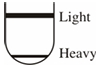
Solution
(C) In the Meselson and Stahl experiment,$E. coli$ was grown in a medium containing $^{15}N$ (heavy isotope) for many generations,resulting in $DNA$ that was heavy $(^{15}N-^{15}N)$.
When these bacteria were transferred to a medium containing $^{14}N$ (light isotope),the first generation (after $20$ min) showed only hybrid $DNA$ $(^{15}N-^{14}N)$.
After the second generation (after $40$ min),the $DNA$ consisted of $50\%$ hybrid $(^{15}N-^{14}N)$ and $50\%$ light $(^{14}N-^{14}N)$ $DNA$.
Therefore,the test tube would show two bands: one light band at the top and one hybrid band at the bottom. This corresponds to option $C$.
When these bacteria were transferred to a medium containing $^{14}N$ (light isotope),the first generation (after $20$ min) showed only hybrid $DNA$ $(^{15}N-^{14}N)$.
After the second generation (after $40$ min),the $DNA$ consisted of $50\%$ hybrid $(^{15}N-^{14}N)$ and $50\%$ light $(^{14}N-^{14}N)$ $DNA$.
Therefore,the test tube would show two bands: one light band at the top and one hybrid band at the bottom. This corresponds to option $C$.
0 likes
View Solution162
MediumMCQ
Hershey and Chase grew some viruses on a medium that contained radioactive $.........$ and some others on medium that contained radioactive $.........$
A
Nitrogen $;$ carbon
B
Nitrogen $;$ phosphorus
C
Phosphorus $;$ sulfur
D
Phosphorus $;$ nitrogen
Solution
(C) Hershey and Chase conducted experiments using bacteriophages to prove that $DNA$ is the genetic material.
They grew some viruses on a medium containing radioactive phosphorus $(^{32}P)$ to label the $DNA$,as $DNA$ contains phosphorus but not sulfur.
They grew other viruses on a medium containing radioactive sulfur $(^{35}S)$ to label the proteins,as proteins contain sulfur (in amino acids like methionine and cysteine) but not phosphorus.
Therefore,the correct radioactive elements used were phosphorus and sulfur.
They grew some viruses on a medium containing radioactive phosphorus $(^{32}P)$ to label the $DNA$,as $DNA$ contains phosphorus but not sulfur.
They grew other viruses on a medium containing radioactive sulfur $(^{35}S)$ to label the proteins,as proteins contain sulfur (in amino acids like methionine and cysteine) but not phosphorus.
Therefore,the correct radioactive elements used were phosphorus and sulfur.
0 likes
View Solution163
MediumMCQ
The relationship between genes and $\text{DNA}$ is best understood by $.........$ ?
A
Genetic code studies
B
Mutation studies
C
Chromosomal studies
D
$\text{RNA}$ studies
Solution
(B) The relationship between genes and $\text{DNA}$ is best understood through mutation studies.
Mutation studies,such as those conducted by Beadle and Tatum,demonstrated that specific changes in $\text{DNA}$ (mutations) lead to specific changes in the phenotype (e.g.,loss of a specific enzyme function).
This provided the foundation for the 'one gene-one enzyme' hypothesis,establishing that a gene is a segment of $\text{DNA}$ that codes for a specific functional product.
Mutation studies,such as those conducted by Beadle and Tatum,demonstrated that specific changes in $\text{DNA}$ (mutations) lead to specific changes in the phenotype (e.g.,loss of a specific enzyme function).
This provided the foundation for the 'one gene-one enzyme' hypothesis,establishing that a gene is a segment of $\text{DNA}$ that codes for a specific functional product.
0 likes
View Solution164
EasyMCQ
Identify the $INCORRECT$ statement regarding nuclein.
A
It has high phosphorus content.
B
It shows acidic properties.
C
It is a mixture of lipids and nucleic acids.
D
It was isolated from white blood cells in the pus.
Solution
(C) Nuclein was the term coined by Friedrich Miescher for the substance he isolated from the nuclei of white blood cells found in pus. It is chemically a mixture of nucleic acids and proteins,not lipids. Therefore,the statement that it is a mixture of lipids and nucleic acids is incorrect.
0 likes
View Solution165
EasyMCQ
Which of the following statements is $NOT$ true for the Hershey and Chase experiment performed for the confirmation of genetic material?
A
They worked with bacteriophages and $E. coli$ bacteria.
B
They used radioactive elements like phosphorus $^{32}P$ and sulfur $^{35}S$.
C
Only radioactive phosphorus was found inside the infected $E. coli$ cells.
D
Their experiment proved that $DNA$ is the genetic material.
Solution
(B) In the Hershey and Chase experiment,they used radioactive phosphorus $(^{32}P)$ to label $DNA$ and radioactive sulfur $(^{35}S)$ to label proteins. The statement in option $B$ is incorrect because it incorrectly assigns the isotopes: phosphorus is $^{32}P$ and sulfur is $^{35}S$,whereas the option states $^{35}P$ and $^{32}S$.
0 likes
View Solution166
EasyMCQ
The present concept of central dogma in retrovirus is given by . . . . . . in $1970$.
A
Meselson and Stahl
B
Temin and Baltimore
C
Nirenberg and Matthaei
D
Dr. Har Gobind Khorana
Solution
(B) The central dogma of molecular biology states that genetic information flows from $DNA \rightarrow RNA \rightarrow \text{Protein}$.
However, in retroviruses, the flow of information is reversed, where $RNA$ is converted into $DNA$ by the enzyme reverse transcriptase.
This process is known as reverse transcription.
This concept was independently discovered and proposed by Howard Temin and David Baltimore in $1970$.
However, in retroviruses, the flow of information is reversed, where $RNA$ is converted into $DNA$ by the enzyme reverse transcriptase.
This process is known as reverse transcription.
This concept was independently discovered and proposed by Howard Temin and David Baltimore in $1970$.
0 likes
View Solution167
EasyMCQ
$DNA$ was first isolated from the nuclei of pus cells by $I$ and named as $II$ .
A
$I - \text{Miescher}, II - \text{nuclein}$
B
$I - \text{Watson}, II - \text{nuclein}$
C
$I - \text{Crick}, II - \text{nucleic acid}$
D
$I - \text{Kornberg}, II - \text{nucleic acid}$
Solution
(A) In $1869$, Friedrich Miescher first identified $DNA$. He isolated a substance from the nuclei of pus cells (leukocytes) and named it 'nuclein'. Later, due to its acidic nature, it was renamed 'nucleic acid'.
0 likes
View Solution168
EasyMCQ
Transforming principle in bacteria is $DNA$. This was first proved through experiments performed by . . . . . . .
A
Frederick Griffith
B
Hershey and Chase
C
Avery,McCarty and MacLeod
D
Meselson and Stahl
Solution
(C) The transforming principle was first identified by Frederick Griffith in $1928$,but he could not determine its biochemical nature.
Oswald Avery,Colin MacLeod,and Maclyn McCarty conducted experiments in $1944$ to determine the biochemical nature of the transforming principle.
They purified biochemicals (proteins,$DNA$,$RNA$,etc.) from the heat-killed $S$ strain bacteria and observed that only $DNA$ caused the transformation of $R$ strain bacteria into $S$ strain bacteria.
They also discovered that protein-digesting enzymes (proteases) and $RNA$-digesting enzymes (RNases) did not affect transformation,whereas $DNA$-digesting enzymes (DNases) inhibited it.
Thus,they concluded that $DNA$ is the hereditary material.
Oswald Avery,Colin MacLeod,and Maclyn McCarty conducted experiments in $1944$ to determine the biochemical nature of the transforming principle.
They purified biochemicals (proteins,$DNA$,$RNA$,etc.) from the heat-killed $S$ strain bacteria and observed that only $DNA$ caused the transformation of $R$ strain bacteria into $S$ strain bacteria.
They also discovered that protein-digesting enzymes (proteases) and $RNA$-digesting enzymes (RNases) did not affect transformation,whereas $DNA$-digesting enzymes (DNases) inhibited it.
Thus,they concluded that $DNA$ is the hereditary material.
0 likes
View Solution169
EasyMCQ
Nucleic acid was first discovered from . . . . . . .
A
red blood cells
B
bacteriophages
C
white blood cells
D
Streptococcus pneumoniae
Solution
(C) Nucleic acid was first discovered by $Friedrich \ Miescher$ in $1869$.
He isolated a substance from the nuclei of pus cells (which are primarily $white \ blood \ cells$ or leukocytes) and named it 'nuclein'.
Later, it was identified as nucleic acid.
He isolated a substance from the nuclei of pus cells (which are primarily $white \ blood \ cells$ or leukocytes) and named it 'nuclein'.
Later, it was identified as nucleic acid.
0 likes
View Solution170
EasyMCQ
In Griffith's experiment,the conversion of $R$-type to $S$-type of Streptococcus pneumoniae when mixed with heat killed $S$-type is called
A
mutation
B
transduction
C
transfection
D
transformation
Solution
(D) In $1928$,Frederick Griffith performed an experiment with $Streptococcus$ $pneumoniae$ bacteria.
He observed that when non-virulent rough $(R)$ strain bacteria were mixed with heat-killed virulent smooth $(S)$ strain bacteria and injected into mice,the mice died.
He recovered living $S$-type bacteria from the dead mice.
This phenomenon,where the genetic material from the heat-killed $S$-strain was taken up by the $R$-strain,thereby changing its phenotype to $S$-type,is known as transformation.
He observed that when non-virulent rough $(R)$ strain bacteria were mixed with heat-killed virulent smooth $(S)$ strain bacteria and injected into mice,the mice died.
He recovered living $S$-type bacteria from the dead mice.
This phenomenon,where the genetic material from the heat-killed $S$-strain was taken up by the $R$-strain,thereby changing its phenotype to $S$-type,is known as transformation.
0 likes
View Solution171
EasyMCQ
What was the correct sequence of steps in the Hershey and Chase experiment to prove that $DNA$ is the genetic material?
A
Infection - Centrifugation - Blending
B
Centrifugation - Blending - Infection
C
Centrifugation - Infection - Blending
D
Infection - Blending - Centrifugation
Solution
(D) The Hershey and Chase experiment involved three main steps to demonstrate that $DNA$ is the genetic material:
$1$. $Infection$: Bacteriophages were allowed to attach to $E. coli$ bacteria and inject their genetic material.
$2$. $Blending$: The culture was agitated in a blender to separate the viral protein coats (ghosts) from the bacterial cells.
$3$. $Centrifugation$: The mixture was centrifuged to separate the heavier bacterial cells (pellet) from the lighter viral protein coats (supernatant).
Therefore,the correct sequence is $Infection - Blending - Centrifugation$.
$1$. $Infection$: Bacteriophages were allowed to attach to $E. coli$ bacteria and inject their genetic material.
$2$. $Blending$: The culture was agitated in a blender to separate the viral protein coats (ghosts) from the bacterial cells.
$3$. $Centrifugation$: The mixture was centrifuged to separate the heavier bacterial cells (pellet) from the lighter viral protein coats (supernatant).
Therefore,the correct sequence is $Infection - Blending - Centrifugation$.
0 likes
View Solution172
EasyMCQ
Choose the correct option for the conclusion of the Hershey-Chase experiment.
A
Experiment - Bacteriophage,Radioactive $^{32}S$ labelled protein capsule; Conclusion - Radioactive $^{32}S$ detected in cells + No radioactivity detected in supernatant.
B
Experiment - Radioactive $^{32}P$ labelled $DNA$; Conclusion - No radioactivity detected in cells + Radioactive $^{32}P$ detected in supernatant.
C
Experiment - Bacteriophage,Radioactive $^{35}S$ labelled protein capsule; Conclusion - No radioactive $^{35}S$ detected in cells + Radioactive $^{35}S$ detected in supernatant.
D
Experiment - Radioactive $^{32}P$ labelled $DNA$; Conclusion - Radioactive $^{35}P$ detected in cells + No radioactivity detected in supernatant.
Solution
(C) The Hershey-Chase experiment $(1952)$ was designed to determine whether $DNA$ or protein is the genetic material.
$1$. They grew some bacteriophages on a medium containing radioactive phosphorus $(^{32}P)$ to label their $DNA$,and others on a medium containing radioactive sulfur $(^{35}S)$ to label their protein coats.
$2$. When the phages labelled with $^{35}S$ (protein) infected bacteria,the radioactivity remained in the supernatant after centrifugation,indicating that the protein did not enter the cell.
$3$. When the phages labelled with $^{32}P$ $(DNA)$ infected bacteria,the radioactivity was detected inside the bacterial cells,proving that $DNA$ is the genetic material.
$4$. Option $C$ correctly describes the result for the $^{35}S$ experiment: the radioactive protein coat remains outside the cell in the supernatant.
$1$. They grew some bacteriophages on a medium containing radioactive phosphorus $(^{32}P)$ to label their $DNA$,and others on a medium containing radioactive sulfur $(^{35}S)$ to label their protein coats.
$2$. When the phages labelled with $^{35}S$ (protein) infected bacteria,the radioactivity remained in the supernatant after centrifugation,indicating that the protein did not enter the cell.
$3$. When the phages labelled with $^{32}P$ $(DNA)$ infected bacteria,the radioactivity was detected inside the bacterial cells,proving that $DNA$ is the genetic material.
$4$. Option $C$ correctly describes the result for the $^{35}S$ experiment: the radioactive protein coat remains outside the cell in the supernatant.
0 likes
View Solution173
EasyMCQ
The unequivocal proof that $DNA$ is the genetic material was given by whom?
A
Mathew Meselson and Franklin Stahl
B
Watson and Crick
C
Colin Macleod and Maclyn-McCarty
D
Alfred Hershey and Martha Chase
Solution
(D) The unequivocal proof that $DNA$ is the genetic material came from the experiments of Alfred Hershey and Martha Chase in $1952$.
They worked with bacteriophages,which are viruses that infect bacteria.
By using radioactive isotopes ($^{32}P$ to label $DNA$ and $^{35}S$ to label proteins),they demonstrated that only the $DNA$ entered the bacterial cell,while the protein coat remained outside.
This confirmed that $DNA$ is the hereditary material that carries genetic information.
They worked with bacteriophages,which are viruses that infect bacteria.
By using radioactive isotopes ($^{32}P$ to label $DNA$ and $^{35}S$ to label proteins),they demonstrated that only the $DNA$ entered the bacterial cell,while the protein coat remained outside.
This confirmed that $DNA$ is the hereditary material that carries genetic information.
0 likes
View Solution174
EasyMCQ
$A$ series of experiments were conducted by Frederick Griffith in $1928$,on the transforming principle with:
A
Salmonella typhimurium
B
Escherichia coli
C
Streptococcus pneumoniae
D
Bacillus thuringiensis
Solution
(C) The correct answer is $C$.
In $1928$,Frederick Griffith performed a series of experiments using the bacterium $Streptococcus$ $pneumoniae$ (the bacterium responsible for pneumonia).
He observed that a non-virulent strain of bacteria could be transformed into a virulent strain by a 'transforming principle' present in heat-killed virulent bacteria.
This experiment provided the first evidence that genetic material could be transferred between organisms.
In $1928$,Frederick Griffith performed a series of experiments using the bacterium $Streptococcus$ $pneumoniae$ (the bacterium responsible for pneumonia).
He observed that a non-virulent strain of bacteria could be transformed into a virulent strain by a 'transforming principle' present in heat-killed virulent bacteria.
This experiment provided the first evidence that genetic material could be transferred between organisms.
0 likes
View Solution175
EasyMCQ
Following representations $P$,$Q$ and $R$ denote few steps of the Griffith Experiment. Identify the correct one$(s)$:
$P. R$ strain $\rightarrow$ Inject into mice $\rightarrow$ Mice die
$Q. S$ strain (Heat killed) $\rightarrow$ Inject into mice $\rightarrow$ Mice die
$R. R$ strain $\rightarrow$ Inject into mice $\rightarrow$ Mice live
$P. R$ strain $\rightarrow$ Inject into mice $\rightarrow$ Mice die
$Q. S$ strain (Heat killed) $\rightarrow$ Inject into mice $\rightarrow$ Mice die
$R. R$ strain $\rightarrow$ Inject into mice $\rightarrow$ Mice live
A
$P$ only
B
$R$ only
C
$P$ and $R$
D
$Q$ and $R$
Solution
(B) The correct option is $R$ only.
In the Griffith experiment:
$P$: $R$ strain is non-virulent (rough),so mice injected with it survive. The statement says they die,which is incorrect.
$Q$: $S$ strain (Heat-killed) is non-virulent because the heat kills the bacteria,so mice injected with it survive. The statement says they die,which is incorrect.
$R$: $R$ strain is non-virulent,so mice injected with it survive. This statement is correct.
In the Griffith experiment:
$P$: $R$ strain is non-virulent (rough),so mice injected with it survive. The statement says they die,which is incorrect.
$Q$: $S$ strain (Heat-killed) is non-virulent because the heat kills the bacteria,so mice injected with it survive. The statement says they die,which is incorrect.
$R$: $R$ strain is non-virulent,so mice injected with it survive. This statement is correct.
0 likes
View Solution176
EasyMCQ
$DNA$,present in the nucleus,was named as 'Nuclein' by
A
James Watson and Crick
B
Friedrich Miescher
C
Maurice Wilkins
D
Rosalind Franklin
Solution
(B) In $1869$,the Swiss physiological chemist $Friedrich \ Miescher$ isolated a substance from the nuclei of pus cells (leukocytes) obtained from discarded surgical bandages.
He named this substance 'Nuclein' because it was found specifically in the nucleus.
Later,this substance was identified as $DNA$ (Deoxyribonucleic acid).
Therefore,the correct answer is $Friedrich \ Miescher$.
He named this substance 'Nuclein' because it was found specifically in the nucleus.
Later,this substance was identified as $DNA$ (Deoxyribonucleic acid).
Therefore,the correct answer is $Friedrich \ Miescher$.
0 likes
View Solution177
EasyMCQ
The result of which of the following reaction experiments carried out by Avery et al. on $Streptococcus \text{ } pneumoniae$ has proved conclusively that $DNA$ is the genetic material?
A
Live '$R$' strain + $DNA$ from '$S$' strain + $RNAase$
B
Live '$R$' strain + $DNA$ from '$S$' strain + $DNAase$
C
Live '$R$' strain + Denatured $DNA$ of '$S$' strain + protease
D
Heat killed '$R$' strain + $DNA$ from '$S$' strain + $DNAase$
Solution
(A) The correct answer is $A$.
Oswald Avery, Colin MacLeod, and Maclyn McCarty worked to determine the biochemical nature of the 'transforming principle' in Griffith's experiment.
They purified biochemicals (proteins, $DNA$, $RNA$) from the heat-killed '$S$' cells to see which ones could transform live '$R$' cells into '$S$' cells.
They discovered that digestion with $proteases$ and $RNAases$ did not affect transformation, meaning neither protein nor $RNA$ was the genetic material.
However, digestion with $DNAase$ inhibited the transformation, proving that $DNA$ is the substance that causes the transformation of '$R$' strain into '$S$' strain.
Therefore, the experiment that conclusively proved $DNA$ is the genetic material involved the addition of $DNAase$ to the mixture, which prevented the transformation.
Oswald Avery, Colin MacLeod, and Maclyn McCarty worked to determine the biochemical nature of the 'transforming principle' in Griffith's experiment.
They purified biochemicals (proteins, $DNA$, $RNA$) from the heat-killed '$S$' cells to see which ones could transform live '$R$' cells into '$S$' cells.
They discovered that digestion with $proteases$ and $RNAases$ did not affect transformation, meaning neither protein nor $RNA$ was the genetic material.
However, digestion with $DNAase$ inhibited the transformation, proving that $DNA$ is the substance that causes the transformation of '$R$' strain into '$S$' strain.
Therefore, the experiment that conclusively proved $DNA$ is the genetic material involved the addition of $DNAase$ to the mixture, which prevented the transformation.
0 likes
View Solution178
EasyMCQ
The term,genetic $RNA$ refers to
A
genetic material of $RNA$ viruses
B
$RNA$ that carries genetic message
C
$RNA$ that helps gene regulation in lac-operon
D
$RNA$ present in mitochondria
Solution
(A) genetic material of $RNA$ viruses.
In $RNA$ viruses,genetic $RNA$ refers to the $RNA$ that encodes the virus's genetic information,allowing it to replicate and produce new viral particles.
This $RNA$ acts as the virus's genetic blueprint,serving the same function as $DNA$ does in other organisms.
In $RNA$ viruses,genetic $RNA$ refers to the $RNA$ that encodes the virus's genetic information,allowing it to replicate and produce new viral particles.
This $RNA$ acts as the virus's genetic blueprint,serving the same function as $DNA$ does in other organisms.
0 likes
View SolutionMolecular Basis of Inheritance — The Search for Genetic Material · Frequently Asked Questions
1Are these Molecular Basis of Inheritance questions useful for JEE and NEET?
Yes. All questions in this section are mapped to JEE Main and NEET exam patterns. Previous year questions from JEE Main, NEET, GUJCET and state-level exams are included with full solutions.
2Can I switch to Hindi or Gujarati for these questions?
Yes. Use the language tabs in the hero section or the sidebar to view the same questions and solutions in English, Hindi or Gujarati.
3How do I generate a question paper from this subtopic?
Use the Vedclass Exam Paper Generator — select the chapter and subtopic, set difficulty, and generate Sets A, B, C, D automatically. First 3 chapters of every subject are free.
Vedclass Products
For Students
Vedclass Test Series
Mock tests in real JEE/NEET style with performance analysis. 5-day free trial.
Start Free TrialFor Teachers
Exam Paper Generator
Generate Set A/B/C/D papers from this chapter in 2 minutes. 3 chapters free.
Try FreeFor Institutes
Online Exam Module
Live online exams with unlimited students, 360° analytics & white-label branding.
See DemoFor Teachers & Institutes
Generate a Molecular Basis of Inheritance Exam Paper in 2 Minutes
Select subtopic & difficulty — Sets A, B, C, D auto-generated with No Repeat logic.
First 3 chapters of every subject are free — no payment required.