
A English
The Search for Genetic Material Questions in English
Class 12 Biology · Molecular Basis of Inheritance · The Search for Genetic Material
178+
Questions
English
Language
100%
With Solutions
Showing 50 of 178 questions in English
101
MediumMCQ
What happens if heat-killed $R$-strain and live $S$-strain bacteria are injected into a mouse?
A
The mouse remains alive.
B
The mouse dies.
C
The mouse develops pneumonia but does not die.
D
$50\%$ of mice die.
Solution
(B) In Frederick Griffith's transformation experiment,the $S$-strain (smooth strain) is virulent and causes pneumonia,while the $R$-strain (rough strain) is non-virulent. When live $S$-strain bacteria are injected into a mouse,the mouse develops pneumonia and dies. Even if heat-killed $R$-strain is added,the presence of the live $S$-strain is sufficient to cause the death of the mouse. Therefore,the mouse dies.
0 likes
View Solution102
MediumMCQ
Which of the following processes occurs in Griffith's transformation experiment?
A
$S$-strain is transformed into $R$-strain.
B
$R$-strain is transformed into $S$-strain.
C
No transformation occurs.
D
Both $A$ and $B$.
Solution
(B) In Frederick Griffith's experiment,he used two strains of Streptococcus pneumoniae: the $S$-strain (smooth,virulent) and the $R$-strain (rough,non-virulent).
When heat-killed $S$-strain bacteria were mixed with live $R$-strain bacteria and injected into mice,the mice died.
Griffith observed that the live $R$-strain bacteria had been transformed into virulent $S$-strain bacteria.
This process,where the genetic material from the heat-killed $S$-strain was taken up by the live $R$-strain,is known as bacterial transformation.
When heat-killed $S$-strain bacteria were mixed with live $R$-strain bacteria and injected into mice,the mice died.
Griffith observed that the live $R$-strain bacteria had been transformed into virulent $S$-strain bacteria.
This process,where the genetic material from the heat-killed $S$-strain was taken up by the live $R$-strain,is known as bacterial transformation.
0 likes
View Solution103
MediumMCQ
If the transforming principle is transferred to the $R$-strain,what characteristics will the $R$-strain acquire?
$(i)$ Formation of a smooth polysaccharide coat
$(ii)$ Becomes non-virulent
$(iii)$ Becomes virulent
$(iv)$ Does not form a smooth polysaccharide coat
$(i)$ Formation of a smooth polysaccharide coat
$(ii)$ Becomes non-virulent
$(iii)$ Becomes virulent
$(iv)$ Does not form a smooth polysaccharide coat
A
$(ii)$ and $(iv)$
B
$(iii)$ and $(iv)$
C
$(i)$ and $(iii)$
D
$(i)$ and $(ii)$
Solution
(C) In Griffith's transformation experiment,the $S$-strain (Smooth) bacteria possess a polysaccharide coat that makes them virulent (pathogenic).
The $R$-strain (Rough) bacteria lack this coat and are non-virulent.
When the transforming principle $(DNA)$ from heat-killed $S$-strain is transferred to the $R$-strain,the $R$-strain gets transformed into the $S$-strain.
As a result,the transformed $R$-strain acquires the ability to form a smooth polysaccharide coat $(i)$ and becomes virulent $(iii)$.
The $R$-strain (Rough) bacteria lack this coat and are non-virulent.
When the transforming principle $(DNA)$ from heat-killed $S$-strain is transferred to the $R$-strain,the $R$-strain gets transformed into the $S$-strain.
As a result,the transformed $R$-strain acquires the ability to form a smooth polysaccharide coat $(i)$ and becomes virulent $(iii)$.
0 likes
View Solution104
MediumMCQ
What could not be determined from Griffith's experiment?
A
The chemical nature of the genetic material
B
The cause of the mouse's death
C
The reason for the mouse's survival
D
Bacterial transformation
Solution
(A) Frederick Griffith's experiment in $1928$ demonstrated the phenomenon of bacterial transformation,where the $S$-strain (virulent) bacteria transformed the $R$-strain (non-virulent) bacteria into virulent ones.
However,Griffith could not determine the biochemical nature of the 'transforming principle' that caused this change.
It was later identified by Avery,MacLeod,and McCarty as $DNA$.
However,Griffith could not determine the biochemical nature of the 'transforming principle' that caused this change.
It was later identified by Avery,MacLeod,and McCarty as $DNA$.
0 likes
View Solution105
MediumMCQ
Which characteristics are possessed by the $S$ strain of $Streptococcus$ $pneumoniae$?
A
Polysaccharide coat
B
Virulence
C
Non-virulent
D
Both $A$ and $B$
Solution
(D) The $S$ strain (Smooth strain) of $Streptococcus$ $pneumoniae$ is characterized by the presence of a polysaccharide coat (mucous coat).
This polysaccharide coat protects the bacteria from the host's immune system,making the $S$ strain virulent (pathogenic),meaning it causes pneumonia.
In contrast,the $R$ strain (Rough strain) lacks this coat and is non-virulent.
Therefore,the $S$ strain possesses both a polysaccharide coat and virulence.
This polysaccharide coat protects the bacteria from the host's immune system,making the $S$ strain virulent (pathogenic),meaning it causes pneumonia.
In contrast,the $R$ strain (Rough strain) lacks this coat and is non-virulent.
Therefore,the $S$ strain possesses both a polysaccharide coat and virulence.
0 likes
View Solution106
MediumMCQ
What happens if a live $S$ strain of Streptococcus pneumoniae is injected into a mouse?
A
The mouse remains alive.
B
The mouse dies due to pneumonia.
C
The mouse dies due to malaria.
D
The mouse dies due to typhoid.
Solution
(B) In Frederick Griffith's transformation experiment,the $S$ strain (smooth strain) of Streptococcus pneumoniae is virulent because it possesses a polysaccharide coat (capsule) that protects it from the host's immune system. When a live $S$ strain is injected into a mouse,it causes the development of pneumonia,leading to the death of the mouse. Conversely,the $R$ strain (rough strain) lacks this capsule and is non-virulent.
1 likes
View Solution107
EasyMCQ
Who proposed the transforming principle?
A
Avery
B
MacLeod
C
McCarty
D
Griffith
Solution
(D) Frederick Griffith conducted a series of experiments with $Streptococcus$ $\text{pneumoniae}$ in $1928$. He observed that a non-virulent strain of bacteria could be transformed into a virulent strain when mixed with heat-killed virulent bacteria. He called this phenomenon the 'transforming principle'. Although he could not identify the biochemical nature of the transforming substance, his work laid the foundation for the discovery of $DNA$ as the genetic material.
0 likes
View Solution108
MediumMCQ
Before the work of Avery,MacLeod,and McCarty,what was considered to be the genetic material?
A
Protein
B
Carbohydrate
C
$RNA$
D
$DNA$
Solution
(A) Before the experiments conducted by Oswald Avery,Colin MacLeod,and Maclyn McCarty in $1944$,the scientific community widely believed that proteins were the genetic material. This was because proteins are more complex,diverse,and abundant in cells compared to nucleic acids. It was only after their experiments,which demonstrated that $DNA$ is the transforming principle,that the scientific consensus shifted toward $DNA$ being the genetic material.
0 likes
View Solution109
MediumMCQ
Which of the following was responsible for the transformation of $R$ cells into $S$ cells?
A
Polysaccharide
B
Polypeptide
C
Ribonucleic acid
D
Deoxyribonucleic acid
Solution
(D) The transformation of $R$ cells into $S$ cells was demonstrated by Oswald Avery,Colin MacLeod,and Maclyn McCarty.
They purified biochemicals (proteins,$DNA$,$RNA$) from the heat-killed $S$ cells to see which one could transform live $R$ cells into $S$ cells.
They discovered that $DNA$ alone from $S$ bacteria caused $R$ bacteria to become transformed.
They also discovered that protein-digesting enzymes (proteases) and $RNA$-digesting enzymes (RNases) did not affect transformation,so the transforming substance was not a protein or $RNA$.
Digestion with DNase did inhibit transformation,suggesting that the $DNA$ caused the transformation.
They purified biochemicals (proteins,$DNA$,$RNA$) from the heat-killed $S$ cells to see which one could transform live $R$ cells into $S$ cells.
They discovered that $DNA$ alone from $S$ bacteria caused $R$ bacteria to become transformed.
They also discovered that protein-digesting enzymes (proteases) and $RNA$-digesting enzymes (RNases) did not affect transformation,so the transforming substance was not a protein or $RNA$.
Digestion with DNase did inhibit transformation,suggesting that the $DNA$ caused the transformation.
0 likes
View Solution110
MediumMCQ
Which enzyme does not affect bacterial transformation?
A
Protease
B
Ribonuclease
C
Lipase
D
All of the above
Solution
(D) In the classic experiment conducted by Avery,MacLeod,and McCarty,they purified biochemicals (proteins,$DNA$,$RNA$) from the heat-killed $S$ strain of Streptococcus pneumoniae to see which one could transform live $R$ strain bacteria into $S$ strain.
They discovered that digestion with protein-digesting enzymes (Proteases) and $RNA$-digesting enzymes (RNases) did not affect transformation,meaning the transforming substance was not a protein or $RNA$.
Digestion with $DNA$-digesting enzymes (DNases) inhibited transformation,proving that $DNA$ is the genetic material.
Since Proteases,RNases,and Lipases do not affect the transformation process,the correct answer is $D$.
They discovered that digestion with protein-digesting enzymes (Proteases) and $RNA$-digesting enzymes (RNases) did not affect transformation,meaning the transforming substance was not a protein or $RNA$.
Digestion with $DNA$-digesting enzymes (DNases) inhibited transformation,proving that $DNA$ is the genetic material.
Since Proteases,RNases,and Lipases do not affect the transformation process,the correct answer is $D$.
0 likes
View Solution111
MediumMCQ
Which enzyme inhibits the process of transformation?
A
$RNase$
B
Proteases
C
$DNase$
D
Lipases
Solution
(C) In the experiment conducted by Avery,MacLeod,and McCarty,they purified biochemicals (proteins,$DNA$,$RNA$,etc.) from the heat-killed $S$ strain bacteria to see which one could transform live $R$ strain bacteria into $S$ strain bacteria.
They discovered that digestion with proteinases and $RNase$ did not affect transformation,meaning the transforming substance was not a protein or $RNA$.
However,digestion with $DNase$ inhibited the process of transformation,suggesting that the $DNA$ caused the transformation.
They discovered that digestion with proteinases and $RNase$ did not affect transformation,meaning the transforming substance was not a protein or $RNA$.
However,digestion with $DNase$ inhibited the process of transformation,suggesting that the $DNA$ caused the transformation.
0 likes
View Solution112
MediumMCQ
What did Avery,MacLeod,and McCarty conclude from their experiment?
A
$DNA$ is the genetic material.
B
$DNA$ is not the genetic material.
C
$RNA$ is the genetic material.
D
Protein is the genetic material.
Solution
(A) Oswald Avery,Colin MacLeod,and Maclyn McCarty worked to determine the biochemical nature of the 'transforming principle' identified by Frederick Griffith.
They purified biochemicals (proteins,$DNA$,and $RNA$) from the heat-killed $S$ strain of Streptococcus pneumoniae.
They discovered that proteases and RNases did not affect transformation,meaning protein and $RNA$ were not the transforming agents.
However,digestion with DNase inhibited transformation.
Therefore,they concluded that $DNA$ is the hereditary material that causes transformation.
They purified biochemicals (proteins,$DNA$,and $RNA$) from the heat-killed $S$ strain of Streptococcus pneumoniae.
They discovered that proteases and RNases did not affect transformation,meaning protein and $RNA$ were not the transforming agents.
However,digestion with DNase inhibited transformation.
Therefore,they concluded that $DNA$ is the hereditary material that causes transformation.
0 likes
View Solution113
EasyMCQ
Whose experiment clearly proved that $DNA$ is the genetic material?
A
Griffith
B
Hershey and Chase
C
Avery,MacLeod,and McCarty
D
Meselson and Stahl
Solution
(B) The experiment conducted by Alfred Hershey and Martha Chase in $1952$ provided unequivocal proof that $DNA$ is the genetic material.
They worked with bacteriophages,which are viruses that infect bacteria.
By using radioactive isotopes ($^{32}P$ to label $DNA$ and $^{35}S$ to label proteins),they demonstrated that only $DNA$ entered the bacterial cell during infection,while the protein coat remained outside.
This confirmed that $DNA$ is the molecule responsible for carrying genetic information.
They worked with bacteriophages,which are viruses that infect bacteria.
By using radioactive isotopes ($^{32}P$ to label $DNA$ and $^{35}S$ to label proteins),they demonstrated that only $DNA$ entered the bacterial cell during infection,while the protein coat remained outside.
This confirmed that $DNA$ is the molecule responsible for carrying genetic information.
0 likes
View Solution114
MediumMCQ
In which media did Hershey and Chase grow the viruses?
A
Radioactive phosphorus
B
Radioactive sulfur
C
Radioactive carbon
D
Both $A$ and $B$
Solution
(D) Alfred Hershey and Martha Chase conducted experiments on bacteriophages to prove that $DNA$ is the genetic material.
They grew some viruses in a medium containing radioactive phosphorus $(^{32}P)$ to label the $DNA$,as $DNA$ contains phosphorus but not sulfur.
They grew other viruses in a medium containing radioactive sulfur $(^{35}S)$ to label the proteins,as proteins contain sulfur (in amino acids like methionine and cysteine) but not phosphorus.
Therefore,they used both radioactive phosphorus and radioactive sulfur to distinguish between $DNA$ and proteins.
They grew some viruses in a medium containing radioactive phosphorus $(^{32}P)$ to label the $DNA$,as $DNA$ contains phosphorus but not sulfur.
They grew other viruses in a medium containing radioactive sulfur $(^{35}S)$ to label the proteins,as proteins contain sulfur (in amino acids like methionine and cysteine) but not phosphorus.
Therefore,they used both radioactive phosphorus and radioactive sulfur to distinguish between $DNA$ and proteins.
0 likes
View Solution115
MediumMCQ
In which medium should viruses be cultured to obtain radioactive $DNA$?
A
Radioactive potassium
B
Radioactive iodine
C
Radioactive phosphorus
D
Radioactive sulfur
Solution
(C) The $DNA$ molecule contains a sugar-phosphate backbone,where phosphorus is a key component.
Proteins,on the other hand,contain sulfur (in amino acids like methionine and cysteine) but lack phosphorus.
By culturing viruses in a medium containing radioactive phosphorus $(^{32}P)$,the virus incorporates this isotope into its $DNA$.
Conversely,culturing viruses in a medium containing radioactive sulfur $(^{35}S)$ labels the viral proteins.
Therefore,to obtain radioactive $DNA$,the virus must be cultured in a medium containing radioactive phosphorus.
Proteins,on the other hand,contain sulfur (in amino acids like methionine and cysteine) but lack phosphorus.
By culturing viruses in a medium containing radioactive phosphorus $(^{32}P)$,the virus incorporates this isotope into its $DNA$.
Conversely,culturing viruses in a medium containing radioactive sulfur $(^{35}S)$ labels the viral proteins.
Therefore,to obtain radioactive $DNA$,the virus must be cultured in a medium containing radioactive phosphorus.
0 likes
View Solution116
MediumMCQ
If a virus is grown in a medium containing radioactive sulfur,which of the following will become radioactive?
A
$DNA$
B
$RNA$
C
Carbohydrates
D
Protein
Solution
(D) $1$. Viruses are composed of genetic material ($DNA$ or $RNA$) and a protein coat.
$2$. Radioactive sulfur $(^{35}S)$ is incorporated into amino acids containing sulfur,such as methionine and cysteine.
$3$. These amino acids are building blocks of proteins.
$4$. Since $DNA$ and $RNA$ do not contain sulfur,they will not become radioactive.
$5$. Therefore,the protein coat of the virus will become radioactive when grown in a medium containing radioactive sulfur.
$2$. Radioactive sulfur $(^{35}S)$ is incorporated into amino acids containing sulfur,such as methionine and cysteine.
$3$. These amino acids are building blocks of proteins.
$4$. Since $DNA$ and $RNA$ do not contain sulfur,they will not become radioactive.
$5$. Therefore,the protein coat of the virus will become radioactive when grown in a medium containing radioactive sulfur.
0 likes
View Solution117
MediumMCQ
In which bacteria did Hershey and Chase perform the infection of bacteriophages?
A
$E$. coli
B
Bacillus
C
Pseudomonas
D
Salmonella
Solution
(A) Alfred Hershey and Martha Chase $(1952)$ conducted experiments using bacteriophages to prove that $DNA$ is the genetic material.
They allowed bacteriophages to infect the bacterium $E. coli$ (Escherichia coli).
By labeling the viral $DNA$ with radioactive phosphorus $(^{32}P)$ and the viral protein coat with radioactive sulfur $(^{35}S)$,they observed that only radioactive $DNA$ entered the bacterial cells,confirming $DNA$ as the genetic material.
They allowed bacteriophages to infect the bacterium $E. coli$ (Escherichia coli).
By labeling the viral $DNA$ with radioactive phosphorus $(^{32}P)$ and the viral protein coat with radioactive sulfur $(^{35}S)$,they observed that only radioactive $DNA$ entered the bacterial cells,confirming $DNA$ as the genetic material.
0 likes
View Solution118
MediumMCQ
By which process is the viral coat (capsid) separated from the surface of the bacteria?
A
Infection
B
Centrifugation
C
Blending
D
All of the above
Solution
(C) In the Hershey-Chase experiment,bacteriophages were allowed to infect $E. coli$ bacteria.
After the infection process,the viral coat (capsid) remains attached to the outer surface of the bacterial cell.
To separate these viral coats from the bacterial surface,the mixture is subjected to a process called 'blending' in a blender.
Following this,centrifugation is used to separate the heavier bacterial cells from the lighter viral particles.
After the infection process,the viral coat (capsid) remains attached to the outer surface of the bacterial cell.
To separate these viral coats from the bacterial surface,the mixture is subjected to a process called 'blending' in a blender.
Following this,centrifugation is used to separate the heavier bacterial cells from the lighter viral particles.
0 likes
View Solution119
MediumMCQ
In which medium were the viruses grown so that the infected bacteria became radioactive?
A
Radioactive Boron
B
Radioactive Phosphorus
C
Radioactive Sulfur
D
Radioactive Potassium
Solution
(B) In the Hershey-Chase experiment,they used $T2$ bacteriophages to determine whether $DNA$ or protein is the genetic material.
They grew some viruses in a medium containing radioactive phosphorus $(^{32}P)$ to label the $DNA$,as $DNA$ contains phosphorus but not sulfur.
They grew other viruses in a medium containing radioactive sulfur $(^{35}S)$ to label the protein coat,as proteins contain sulfur but not phosphorus.
When the viruses grown in the radioactive phosphorus $(^{32}P)$ medium infected the bacteria,the bacteria became radioactive because the viral $DNA$ (which was radioactive) entered the bacterial cells.
Therefore,the correct medium is radioactive phosphorus.
They grew some viruses in a medium containing radioactive phosphorus $(^{32}P)$ to label the $DNA$,as $DNA$ contains phosphorus but not sulfur.
They grew other viruses in a medium containing radioactive sulfur $(^{35}S)$ to label the protein coat,as proteins contain sulfur but not phosphorus.
When the viruses grown in the radioactive phosphorus $(^{32}P)$ medium infected the bacteria,the bacteria became radioactive because the viral $DNA$ (which was radioactive) entered the bacterial cells.
Therefore,the correct medium is radioactive phosphorus.
0 likes
View Solution120
MediumMCQ
What is the correct sequence of steps performed in the Hershey and Chase experiment?
A
Centrifugation $\rightarrow$ Blending $\rightarrow$ Infection
B
Blending $\rightarrow$ Centrifugation $\rightarrow$ Infection
C
Infection $\rightarrow$ Blending $\rightarrow$ Centrifugation
D
Infection $\rightarrow$ Centrifugation $\rightarrow$ Blending
Solution
(C) The Hershey and Chase experiment $(1952)$ was conducted to prove that $DNA$ is the genetic material.
The steps followed in their experiment were:
$1$. Infection: Bacteriophages were allowed to infect $E. coli$ bacteria.
$2$. Blending: The viral coats were removed from the bacteria by agitating them in a blender.
$3$. Centrifugation: The mixture was centrifuged to separate the heavier bacterial cells (pellet) from the lighter viral coats (supernatant).
Therefore,the correct sequence is Infection $\rightarrow$ Blending $\rightarrow$ Centrifugation.
The steps followed in their experiment were:
$1$. Infection: Bacteriophages were allowed to infect $E. coli$ bacteria.
$2$. Blending: The viral coats were removed from the bacteria by agitating them in a blender.
$3$. Centrifugation: The mixture was centrifuged to separate the heavier bacterial cells (pellet) from the lighter viral coats (supernatant).
Therefore,the correct sequence is Infection $\rightarrow$ Blending $\rightarrow$ Centrifugation.
0 likes
View Solution121
MediumMCQ
In the Hershey and Chase experiment,what entered the bacteria from the virus?
A
$DNA$
B
$RNA$
C
Protein
D
Carbohydrate
Solution
(A) Alfred Hershey and Martha Chase conducted experiments using bacteriophages to prove that $DNA$ is the genetic material.
They grew some viruses on a medium that contained radioactive phosphorus $(^{32}P)$ and some on a medium that contained radioactive sulfur $(^{35}S)$.
Viruses grown in the presence of radioactive phosphorus contained radioactive $DNA$ but not radioactive protein because $DNA$ contains phosphorus while protein does not.
Similarly,viruses grown on radioactive sulfur contained radioactive protein but not radioactive $DNA$.
When these radioactive bacteriophages were allowed to infect $E. coli$ bacteria,it was observed that only the radioactive $DNA$ entered the bacterial cells,while the radioactive protein remained outside.
Thus,it was concluded that $DNA$ is the genetic material that is transferred from the virus to the bacteria.
They grew some viruses on a medium that contained radioactive phosphorus $(^{32}P)$ and some on a medium that contained radioactive sulfur $(^{35}S)$.
Viruses grown in the presence of radioactive phosphorus contained radioactive $DNA$ but not radioactive protein because $DNA$ contains phosphorus while protein does not.
Similarly,viruses grown on radioactive sulfur contained radioactive protein but not radioactive $DNA$.
When these radioactive bacteriophages were allowed to infect $E. coli$ bacteria,it was observed that only the radioactive $DNA$ entered the bacterial cells,while the radioactive protein remained outside.
Thus,it was concluded that $DNA$ is the genetic material that is transferred from the virus to the bacteria.
0 likes
View Solution122
MediumMCQ
Which of the following molecules was the subject of debate regarding the genetic material?
A
Carbohydrates $-$ Proteins
B
$RNA$ $-$ Proteins
C
Proteins $-$ $DNA$
D
$DNA$ $-$ Carbohydrates
Solution
(C) Before the definitive experiments of Hershey and Chase,there was significant debate in the scientific community regarding whether $DNA$ or proteins acted as the genetic material. Proteins were initially considered more likely candidates due to their structural complexity and diversity compared to the seemingly simpler $DNA$ molecule. This debate was finally settled by the Hershey-Chase experiment,which provided evidence that $DNA$ is the genetic material.
0 likes
View Solution123
MediumMCQ
The controversy regarding the genetic material was resolved after the experiments of which scientists?
A
Meselson and Stahl
B
Avery,MacLeod,and McCarty
C
Griffith
D
Hershey and Chase
Solution
(D) The experiments conducted by Alfred Hershey and Martha Chase in $1952$ provided unequivocal evidence that $DNA$ is the genetic material.
They worked with bacteriophages,which are viruses that infect bacteria.
They grew some viruses in a medium containing radioactive phosphorus $(^{32}P)$ to label $DNA$ and others in a medium containing radioactive sulfur $(^{35}S)$ to label proteins.
After allowing the phages to infect $E. coli$ bacteria,they agitated the mixture in a blender and centrifuged it to separate the viral coats from the bacterial cells.
They found that radioactive phosphorus $(^{32}P)$ was present inside the bacterial cells,indicating that $DNA$ had entered the bacteria,while radioactive sulfur $(^{35}S)$ remained in the supernatant,indicating that proteins did not enter.
This experiment finally resolved the long-standing debate about whether $DNA$ or protein was the genetic material.
They worked with bacteriophages,which are viruses that infect bacteria.
They grew some viruses in a medium containing radioactive phosphorus $(^{32}P)$ to label $DNA$ and others in a medium containing radioactive sulfur $(^{35}S)$ to label proteins.
After allowing the phages to infect $E. coli$ bacteria,they agitated the mixture in a blender and centrifuged it to separate the viral coats from the bacterial cells.
They found that radioactive phosphorus $(^{32}P)$ was present inside the bacterial cells,indicating that $DNA$ had entered the bacteria,while radioactive sulfur $(^{35}S)$ remained in the supernatant,indicating that proteins did not enter.
This experiment finally resolved the long-standing debate about whether $DNA$ or protein was the genetic material.
0 likes
View Solution124
MediumMCQ
Which of the following viruses contains $RNA$ as its genetic material?
A
$\lambda - $ phage
B
$QB$ bacteriophage
C
$\phi \times 174$ phage
D
$M-13$ phage
Solution
(B) The genetic material in viruses can be either $DNA$ or $RNA$.
$1$. $\lambda - $ phage contains double-stranded $DNA$.
$2$. $QB$ bacteriophage is a well-known example of a virus that contains $RNA$ as its genetic material.
$3$. $\phi \times 174$ phage contains single-stranded $DNA$.
$4$. $M-13$ phage also contains single-stranded $DNA$.
Therefore,the correct option is $B$.
$1$. $\lambda - $ phage contains double-stranded $DNA$.
$2$. $QB$ bacteriophage is a well-known example of a virus that contains $RNA$ as its genetic material.
$3$. $\phi \times 174$ phage contains single-stranded $DNA$.
$4$. $M-13$ phage also contains single-stranded $DNA$.
Therefore,the correct option is $B$.
0 likes
View Solution125
MediumMCQ
Which molecule cannot act as a genetic material?
A
$A$ molecule that is able to generate its replication.
B
$A$ molecule that can express itself in the form of Mendelian characters.
C
$A$ molecule that provides the scope for slow changes that are required for evolution.
D
$A$ molecule that is chemically and structurally unstable.
Solution
(D) For a molecule to act as a genetic material,it must fulfill certain criteria:
$1$. It should be able to generate its replication ($i.e.$,replication).
$2$. It should be chemically and structurally stable.
$3$. It should provide the scope for slow changes (mutation) that are required for evolution.
$4$. It should be able to express itself in the form of Mendelian characters.
Since a genetic material must be stable to store and transmit information accurately across generations,a molecule that is chemically and structurally unstable cannot function as a genetic material. Therefore,option $D$ is the correct answer.
$1$. It should be able to generate its replication ($i.e.$,replication).
$2$. It should be chemically and structurally stable.
$3$. It should provide the scope for slow changes (mutation) that are required for evolution.
$4$. It should be able to express itself in the form of Mendelian characters.
Since a genetic material must be stable to store and transmit information accurately across generations,a molecule that is chemically and structurally unstable cannot function as a genetic material. Therefore,option $D$ is the correct answer.
0 likes
View Solution126
MediumMCQ
Select the incorrect statement.
A
$DNA$ is a better genetic material.
B
Both $DNA$ and $RNA$ can undergo mutation.
C
$DNA$ is dependent on $RNA$ for protein synthesis.
D
Viruses having $DNA$ as a genome undergo mutation at a faster rate.
Solution
(D) The correct answer is $D$.
$DNA$ is more stable than $RNA$ because it lacks the $2'-OH$ group and contains thymine instead of uracil.
Because $DNA$ is more stable,it is less prone to mutations compared to $RNA$.
Viruses with $RNA$ genomes mutate faster than those with $DNA$ genomes.
Therefore,the statement that $DNA$ genome viruses mutate at a faster rate is incorrect.
$DNA$ is more stable than $RNA$ because it lacks the $2'-OH$ group and contains thymine instead of uracil.
Because $DNA$ is more stable,it is less prone to mutations compared to $RNA$.
Viruses with $RNA$ genomes mutate faster than those with $DNA$ genomes.
Therefore,the statement that $DNA$ genome viruses mutate at a faster rate is incorrect.
0 likes
View Solution127
MediumMCQ
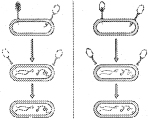
The given figure represents the experiment of which scientists?
A
Griffith
B
Avery,MacLeod and McCarty
C
Alec Jeffreys
D
Hershey and Chase
Solution
(D) The given figure illustrates the Hershey and Chase experiment $(1952)$.
They worked with bacteriophages that infect $E. coli$ bacteria.
They used radioactive isotopes to label the $DNA$ $(^{32}P)$ and proteins $(^{35}S)$ of the bacteriophages to determine which component enters the bacterial cell to cause infection.
Their results confirmed that $DNA$ is the genetic material,not protein.
They worked with bacteriophages that infect $E. coli$ bacteria.
They used radioactive isotopes to label the $DNA$ $(^{32}P)$ and proteins $(^{35}S)$ of the bacteriophages to determine which component enters the bacterial cell to cause infection.
Their results confirmed that $DNA$ is the genetic material,not protein.
0 likes
View Solution128
EasyMCQ
The term 'Nuclein' for the genetic material was used by:
A
Mendel
B
Franklin
C
Meischer
D
Chargaff
Solution
(C) The term 'Nuclein' was coined by the Swiss biochemist Friedrich Miescher in $1869$. He isolated this substance from the nuclei of pus cells (leukocytes) and identified it as an acidic substance, which he named 'Nuclein'. Later, this substance was identified as $DNA$.
0 likes
View Solution129
MediumMCQ
In some viruses, $RNA$ is present instead of $DNA$, indicating that:
A
their nucleic acid must combine with host $DNA$ before replication.
B
they cannot replicate.
C
there is no hereditary information.
D
$RNA$ can transfer hereditary material.
Solution
(D) Viruses are defined as infectious nucleoproteins. A complete virus particle is called a virion, whose main function is to deliver its $DNA$ or $RNA$ genome into the host cell so that the genome can be expressed by the host cell.
In a particular virus, either $DNA$ or $RNA$ is the genetic material; both are never present in the same virus.
This confirms that $RNA$ can act as the genetic material and transfer hereditary information.
Examples include:
$(i)$ Double-stranded $DNA$ $(dsDNA)$: Hepatitis $B$ virus.
$(ii)$ Single-stranded $DNA$ $(ssDNA)$: Coliphage $\phi X174$.
$(iii)$ Double-stranded $RNA$ $(dsRNA)$: Reovirus, Wound tumor virus.
$(iv)$ Single-stranded $RNA$ $(ssRNA)$: Tobacco mosaic virus $(TMV)$.
In a particular virus, either $DNA$ or $RNA$ is the genetic material; both are never present in the same virus.
This confirms that $RNA$ can act as the genetic material and transfer hereditary information.
Examples include:
$(i)$ Double-stranded $DNA$ $(dsDNA)$: Hepatitis $B$ virus.
$(ii)$ Single-stranded $DNA$ $(ssDNA)$: Coliphage $\phi X174$.
$(iii)$ Double-stranded $RNA$ $(dsRNA)$: Reovirus, Wound tumor virus.
$(iv)$ Single-stranded $RNA$ $(ssRNA)$: Tobacco mosaic virus $(TMV)$.
0 likes
View Solution130
MediumMCQ
$A :$ DNase can inhibit the process of transformation.
$R :$ Transformation is the absorption of a $DNA$ segment from the surrounding medium by a living bacterium.
$R :$ Transformation is the absorption of a $DNA$ segment from the surrounding medium by a living bacterium.
A
Assertion and Reason both are correct and Reason is the correct explanation of Assertion.
B
Assertion and Reason both are correct but Reason is not the correct explanation of Assertion.
C
Assertion is correct,but Reason is incorrect.
D
Both Assertion and Reason are incorrect.
Solution
(A) The Assertion $(A)$ is correct because $DNase$ is an enzyme that degrades $DNA$. Since transformation involves the uptake of naked $DNA$ from the environment,the presence of $DNase$ breaks down this $DNA$,thereby inhibiting the transformation process.
The Reason $(R)$ is also correct as it accurately defines transformation as the process where a living bacterium takes up $DNA$ fragments from its surrounding medium.
Therefore,both $(A)$ and $(R)$ are correct,and $(R)$ provides the correct explanation for $(A)$.
The Reason $(R)$ is also correct as it accurately defines transformation as the process where a living bacterium takes up $DNA$ fragments from its surrounding medium.
Therefore,both $(A)$ and $(R)$ are correct,and $(R)$ provides the correct explanation for $(A)$.
0 likes
View Solution131
MediumMCQ
In $Streptococcus$ $pneumoniae$,which of the following statements is correct?
A
The virulent form is smooth.
B
The virulent form is rough.
C
The nonvirulent form is capsulated.
D
All forms are rough.
Solution
(A) Frederick Griffith $(1928)$ conducted experiments on $Streptococcus$ $pneumoniae$ to study bacterial transformation.
He observed two strains of this bacterium: the $S$ strain (smooth) and the $R$ strain (rough).
The $S$ strain possesses a polysaccharide capsule,which makes it virulent (pathogenic) and capable of causing pneumonia in mice.
The $R$ strain lacks this capsule,making it nonvirulent (non-pathogenic).
He observed two strains of this bacterium: the $S$ strain (smooth) and the $R$ strain (rough).
The $S$ strain possesses a polysaccharide capsule,which makes it virulent (pathogenic) and capable of causing pneumonia in mice.
The $R$ strain lacks this capsule,making it nonvirulent (non-pathogenic).
0 likes
View Solution132
MediumMCQ
The scientists involved in the discovery of $DNA$ as the chemical basis of heredity were:
A
Hershey and Chase
B
Griffith and Avery
C
Avery,MacLeod and McCarty
D
Watson and Crick
Solution
(C) The scientists who discovered that $DNA$ is the chemical basis of heredity were Oswald Avery,Colin MacLeod,and Maclyn McCarty. They built upon the work of Frederick Griffith regarding the process of bacterial transformation. By purifying biochemicals (proteins,$DNA$,$RNA$) from heat-killed $S$ cells,they demonstrated that only $DNA$ caused the transformation of non-virulent $R$ cells into virulent $S$ cells,thereby proving that $DNA$ is the genetic material.
0 likes
View Solution133
MediumMCQ
During infection of $E. coli$ cells by bacteriophage $T2$,
A
proteins are the only phage components that actually enter the infected cell.
B
both proteins and nucleic acids enter the cell.
C
only proteins from the infecting phage can also be detected in progeny phage.
D
only nucleic acids enter the cell.
Solution
(D) The experiment conducted by Hershey and Chase proved that $DNA$ is the genetic material.
During the infection of $E. coli$ cells by bacteriophage $T2$, only the viral nucleic acid $(DNA)$ enters the bacterial cell.
The protein coat (capsid) of the phage remains outside the bacterium, often referred to as a "ghost".
Therefore, the correct statement is that only nucleic acids enter the cell.
During the infection of $E. coli$ cells by bacteriophage $T2$, only the viral nucleic acid $(DNA)$ enters the bacterial cell.
The protein coat (capsid) of the phage remains outside the bacterium, often referred to as a "ghost".
Therefore, the correct statement is that only nucleic acids enter the cell.
0 likes
View Solution134
MediumMCQ
$A$ bacterium grown on a medium containing radioactive Sulphur incorporates the radioactivity into:
A
carbohydrates
B
proteins
C
$DNA$
D
$RNA$
Solution
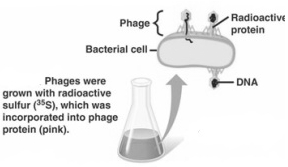
(B) Sulphur is a key component of certain amino acids,specifically cysteine and methionine,which are the building blocks of proteins. $DNA$ and $RNA$ do not contain sulphur. When bacteria or bacteriophages are grown in a medium containing radioactive sulphur $(^{35}S)$,this isotope is incorporated into the cysteine and methionine residues during protein synthesis. Consequently,the resulting proteins become radioactive. This principle was famously used in the Hershey-Chase experiment to distinguish between protein and $DNA$ as the genetic material.
0 likes
View Solution135
MediumMCQ
Who proved that $DNA$ is the genetic material?
A
Mendel
B
Watson
C
Boveri and Sutton
D
Hershey and Chase
Solution
(D) Hershey and Chase $(1952)$ conducted experiments using bacteriophages that infect $E. coli$ bacteria. They grew some viruses in a medium containing radioactive phosphorus $(^{32}P)$ to label $DNA$ and others in a medium containing radioactive sulphur $(^{35}S)$ to label proteins. After allowing the viruses to infect the bacteria,they observed that only radioactive phosphorus was found inside the bacterial cells,while radioactive sulphur remained outside. This provided unequivocal proof that $DNA$,not protein,is the genetic material.
0 likes
View Solution136
MediumMCQ
Which of the following radioactive isotopes were utilized for labeling protein and $DNA$ in the transduction experiment,respectively?
A
$^{32}P, ^{35}S$
B
$^{35}S, ^{35}P$
C
$^{35}S, ^{32}P$
D
$^{32}S, ^{32}P$
Solution
(C) In the Hershey-Chase experiment (transduction experiment),radioactive isotopes were used to distinguish between protein and $DNA$ as genetic material.
$1.$ Proteins contain sulfur but not phosphorus. Therefore,the bacteriophages were grown in a medium containing radioactive sulfur $(^{35}S)$ to label the protein coat.
$2.$ $DNA$ contains phosphorus but not sulfur. Therefore,the bacteriophages were grown in a medium containing radioactive phosphorus $(^{32}P)$ to label the $DNA$.
Thus,the correct isotopes for protein and $DNA$ are $^{35}S$ and $^{32}P$,respectively.
$1.$ Proteins contain sulfur but not phosphorus. Therefore,the bacteriophages were grown in a medium containing radioactive sulfur $(^{35}S)$ to label the protein coat.
$2.$ $DNA$ contains phosphorus but not sulfur. Therefore,the bacteriophages were grown in a medium containing radioactive phosphorus $(^{32}P)$ to label the $DNA$.
Thus,the correct isotopes for protein and $DNA$ are $^{35}S$ and $^{32}P$,respectively.
0 likes
View Solution137
MediumMCQ
Which of the following radioisotopes is not suitable for $DNA$ labeling-based studies?
A
$H^{3}$
B
$P^{32}$
C
$N^{15}$
D
$S^{35}$
Solution
(D) $S^{35}$ radioisotope is not suitable for $DNA$ labeling-based studies because $DNA$ does not contain sulfur.
$S^{35}$ is primarily used for protein labeling-based studies because proteins contain sulfur-containing amino acids like methionine and cysteine.
$S^{35}$ is primarily used for protein labeling-based studies because proteins contain sulfur-containing amino acids like methionine and cysteine.
0 likes
View Solution138
EasyMCQ
Which of the following is the genetic material?
A
Lipid
B
$DNA$
C
Protein
D
Carbohydrate
Solution
(B) Genetic material is the substance that carries biological information from one generation to the next. In almost all living organisms,$DNA$ (Deoxyribonucleic acid) serves as the primary genetic material. It contains the instructions needed for an organism to develop,survive,and reproduce. While proteins,lipids,and carbohydrates are essential biomolecules for cellular structure and function,they do not function as the primary hereditary material.
0 likes
View Solution139
EasyMCQ
Which of the following acts as genetic material?
A
$DNA$
B
$RNA$
C
Protein
D
Both $A$ and $B$
Solution
(D) Genetic material is a substance that carries biological information from one generation to the next.
In most living organisms, $DNA$ (Deoxyribonucleic acid) serves as the primary genetic material.
In some viruses (e.g., Tobacco Mosaic Virus, $Q\beta$ bacteriophage), $RNA$ (Ribonucleic acid) acts as the genetic material.
Therefore, both $DNA$ and $RNA$ can function as genetic material in different biological systems.
In most living organisms, $DNA$ (Deoxyribonucleic acid) serves as the primary genetic material.
In some viruses (e.g., Tobacco Mosaic Virus, $Q\beta$ bacteriophage), $RNA$ (Ribonucleic acid) acts as the genetic material.
Therefore, both $DNA$ and $RNA$ can function as genetic material in different biological systems.
0 likes
View Solution140
EasyMCQ
What is the genetic material in most organisms?
A
$RNA$
B
$DNA$
C
Protein
D
Both $A$ and $B$
Solution
(B) In most living organisms,$DNA$ (Deoxyribonucleic acid) serves as the primary genetic material.
It carries the genetic instructions for the development,functioning,growth,and reproduction of all known organisms and many viruses.
While some viruses use $RNA$ as their genetic material,$DNA$ is the universal genetic material for the vast majority of life forms due to its chemical stability and ability to store complex information.
It carries the genetic instructions for the development,functioning,growth,and reproduction of all known organisms and many viruses.
While some viruses use $RNA$ as their genetic material,$DNA$ is the universal genetic material for the vast majority of life forms due to its chemical stability and ability to store complex information.
0 likes
View Solution141
MediumMCQ
Which of the following does not follow the central dogma of molecular biology?
A
Humans
B
Retroviruses
C
Bacteria
D
Fungi
Solution
(B) The central dogma of molecular biology states that genetic information flows from $DNA \rightarrow RNA \rightarrow \text{Protein}$.
Retroviruses, such as $HIV$, do not follow this unidirectional flow because they contain an enzyme called reverse transcriptase.
This enzyme allows them to synthesize $DNA$ from an $RNA$ template, a process known as reverse transcription $(RNA \rightarrow DNA)$.
Therefore, retroviruses are an exception to the standard central dogma.
Retroviruses, such as $HIV$, do not follow this unidirectional flow because they contain an enzyme called reverse transcriptase.
This enzyme allows them to synthesize $DNA$ from an $RNA$ template, a process known as reverse transcription $(RNA \rightarrow DNA)$.
Therefore, retroviruses are an exception to the standard central dogma.
0 likes
View Solution142
EasyMCQ
The transforming principle was proposed by ...... .
A
Friedrich Miescher
B
Alfred Hershey and Martha Chase
C
Frederick Griffith
D
James Watson and Francis Crick
Solution
(C) The transforming principle was proposed by Frederick Griffith in $1928$ through his experiments with $Streptococcus$ $pneumoniae$.
He observed that a non-virulent strain of bacteria could be transformed into a virulent strain when mixed with heat-killed virulent bacteria, suggesting the transfer of a 'transforming principle'.
He observed that a non-virulent strain of bacteria could be transformed into a virulent strain when mixed with heat-killed virulent bacteria, suggesting the transfer of a 'transforming principle'.
0 likes
View Solution143
MediumMCQ
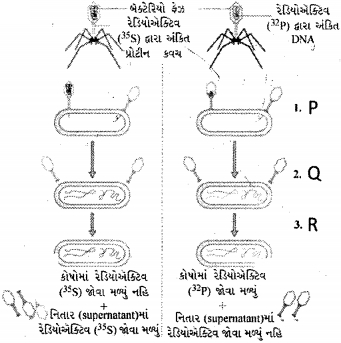
The Hershey and Chase experiment is given below. What are the processes $P, Q,$ and $R$?
$\quad\quad \quad P \quad\quad\quad Q \quad \quad\quad R$
$\quad\quad \quad P \quad\quad\quad Q \quad \quad\quad R$
A
Infection $\quad$ Blending $\quad$ Centrifugation
B
Blending $\quad$ Infection $\quad$ Centrifugation
C
Centrifugation $\quad$ Infection $\quad$ Blending
D
Centrifugation $\quad$ Blending $\quad$ Infection
Solution
(A) The Hershey and Chase experiment $(1952)$ used bacteriophages to prove that $DNA$ is the genetic material.
$1$. $P$ represents Infection: The bacteriophage attaches to the bacterial cell wall and injects its genetic material into the host cell.
$2$. $Q$ represents Blending: The viral coats are removed from the bacteria by agitating them in a blender.
$3$. $R$ represents Centrifugation: The mixture is centrifuged to separate the heavier bacterial cells (pellet) from the lighter viral coats (supernatant).
Therefore,the correct sequence is $P = \text{Infection}, Q = \text{Blending}, R = \text{Centrifugation}$.
$1$. $P$ represents Infection: The bacteriophage attaches to the bacterial cell wall and injects its genetic material into the host cell.
$2$. $Q$ represents Blending: The viral coats are removed from the bacteria by agitating them in a blender.
$3$. $R$ represents Centrifugation: The mixture is centrifuged to separate the heavier bacterial cells (pellet) from the lighter viral coats (supernatant).
Therefore,the correct sequence is $P = \text{Infection}, Q = \text{Blending}, R = \text{Centrifugation}$.
0 likes
View Solution144
MediumMCQ
How many of the following organisms have $RNA$ as their genetic material?
$TMV$,Humans,Bacteria,$Q\beta$ bacteriophage,Bacteriophage $\lambda$,Yeast,Maize,$\phi \times 174$ bacteriophage,Retroviruses.
$TMV$,Humans,Bacteria,$Q\beta$ bacteriophage,Bacteriophage $\lambda$,Yeast,Maize,$\phi \times 174$ bacteriophage,Retroviruses.
A
$1$
B
$2$
C
$3$
D
$4$
Solution
(C) To determine which organisms have $RNA$ as their genetic material,let's analyze each one:
$1$. $TMV$ (Tobacco Mosaic Virus): Contains $RNA$ as genetic material.
$2$. Humans: Contain $DNA$ as genetic material.
$3$. Bacteria: Contain $DNA$ as genetic material.
$4$. $Q\beta$ bacteriophage: Contains $RNA$ as genetic material.
$5$. Bacteriophage $\lambda$: Contains $DNA$ as genetic material.
$6$. Yeast: Contains $DNA$ as genetic material.
$7$. Maize: Contains $DNA$ as genetic material.
$8$. $\phi \times 174$ bacteriophage: Contains $DNA$ as genetic material.
$9$. Retroviruses: Contain $RNA$ as genetic material.
The organisms with $RNA$ as genetic material are $TMV$,$Q\beta$ bacteriophage,and Retroviruses. The total count is $3$.
$1$. $TMV$ (Tobacco Mosaic Virus): Contains $RNA$ as genetic material.
$2$. Humans: Contain $DNA$ as genetic material.
$3$. Bacteria: Contain $DNA$ as genetic material.
$4$. $Q\beta$ bacteriophage: Contains $RNA$ as genetic material.
$5$. Bacteriophage $\lambda$: Contains $DNA$ as genetic material.
$6$. Yeast: Contains $DNA$ as genetic material.
$7$. Maize: Contains $DNA$ as genetic material.
$8$. $\phi \times 174$ bacteriophage: Contains $DNA$ as genetic material.
$9$. Retroviruses: Contain $RNA$ as genetic material.
The organisms with $RNA$ as genetic material are $TMV$,$Q\beta$ bacteriophage,and Retroviruses. The total count is $3$.
0 likes
View Solution145
MediumMCQ
Which enzyme stops the process of transformation?
A
$RNAase$
B
Lipase
C
Protease
D
$DNAase$
Solution
(D) In the transformation experiment conducted by Avery,MacLeod,and McCarty,it was proven that $DNA$ is the genetic material. When the enzyme $DNAase$ is added,it digests the $DNA$,which stops the process of transformation. Therefore,the correct answer is $DNAase$.
0 likes
View Solution146
MediumMCQ
Select the correct statement for the transformation experiment.
$S$-strain (heat-killed) + $R$-strain (live) $\rightarrow$ (injection into mouse) $\rightarrow$ ?
$S$-strain (heat-killed) + $R$-strain (live) $\rightarrow$ (injection into mouse) $\rightarrow$ ?
A
Mouse gets sick
B
Mouse remains alive
C
Mouse dies
D
None of these
Solution
(C) In Griffith's transformation experiment,when heat-killed $S$-strain (virulent) bacteria were mixed with live $R$-strain (non-virulent) bacteria and injected into a mouse,the mouse died.
This occurred because the live $R$-strain bacteria were transformed into virulent $S$-strain bacteria by the genetic material released from the heat-killed $S$-strain bacteria.
Therefore,the mouse dies due to the development of pneumonia.
This occurred because the live $R$-strain bacteria were transformed into virulent $S$-strain bacteria by the genetic material released from the heat-killed $S$-strain bacteria.
Therefore,the mouse dies due to the development of pneumonia.
0 likes
View Solution147
MediumMCQ
In Griffith's experiment,which new bacteria were recovered from the dead mice?
A
Live $S$-strain
B
Live $R$-strain
C
Dead $S$-strain
D
Dead $R$-strain
Solution
(A) In Frederick Griffith's transformation experiment,he injected mice with a mixture of heat-killed $S$-strain (virulent) and live $R$-strain (non-virulent) bacteria.
Although the $S$-strain was heat-killed and the $R$-strain was non-virulent,the mice died.
Upon examination of the dead mice,Griffith recovered live $S$-strain bacteria.
This led to the conclusion that the $R$-strain bacteria had been 'transformed' by the heat-killed $S$-strain bacteria,acquiring the virulence trait.
Although the $S$-strain was heat-killed and the $R$-strain was non-virulent,the mice died.
Upon examination of the dead mice,Griffith recovered live $S$-strain bacteria.
This led to the conclusion that the $R$-strain bacteria had been 'transformed' by the heat-killed $S$-strain bacteria,acquiring the virulence trait.
0 likes
View Solution148
MediumMCQ
What is the function of blending in the Hershey-Chase experiment?
A
To allow bacteriophages to inject their $DNA$ into bacteria.
B
To separate the viral coats from the bacterial cells.
C
To make the bacteriophages radioactive.
D
All of the above.
Solution
(B) In the Hershey-Chase experiment,the 'blending' step involves agitating the mixture of bacteria and bacteriophages in a blender.
This mechanical process is essential to detach the empty viral protein coats (capsids) that remain attached to the outer surface of the bacterial cell wall after the viral $DNA$ has been injected into the host cell.
By separating these coats,researchers could confirm that only the $DNA$ entered the bacteria,while the protein remained outside.
This mechanical process is essential to detach the empty viral protein coats (capsids) that remain attached to the outer surface of the bacterial cell wall after the viral $DNA$ has been injected into the host cell.
By separating these coats,researchers could confirm that only the $DNA$ entered the bacteria,while the protein remained outside.
0 likes
View Solution149
EasyMCQ
What was proven by the Hershey and Chase experiment?
A
$RNA$ is the genetic material.
B
Protein is the genetic material.
C
$RNA$ and $DNA$ are genetic materials.
D
$DNA$ is the genetic material.
Solution
(D) The Hershey and Chase experiment $(1952)$ used bacteriophages to determine whether $DNA$ or protein is the genetic material.
They labeled the $DNA$ of the bacteriophage with radioactive phosphorus $(^{32}P)$ and the protein coat with radioactive sulfur $(^{35}S)$.
After allowing the bacteriophages to infect $E. coli$ bacteria,they observed that only the radioactive phosphorus $(^{32}P)$ was found inside the bacterial cells,while the radioactive sulfur $(^{35}S)$ remained outside.
This confirmed that $DNA$ is the genetic material that enters the host cell,not the protein.
They labeled the $DNA$ of the bacteriophage with radioactive phosphorus $(^{32}P)$ and the protein coat with radioactive sulfur $(^{35}S)$.
After allowing the bacteriophages to infect $E. coli$ bacteria,they observed that only the radioactive phosphorus $(^{32}P)$ was found inside the bacterial cells,while the radioactive sulfur $(^{35}S)$ remained outside.
This confirmed that $DNA$ is the genetic material that enters the host cell,not the protein.
0 likes
View Solution150
MediumMCQ
What is a bacteriophage?
A
$A$ virus that infects bacteria
B
$A$ bacterium that uses viruses as food
C
The genetic material of all organisms
D
$E. coli$
Solution
(A) bacteriophage is a type of virus that specifically infects and replicates within bacteria.
These viruses attach to the surface of a bacterial cell and inject their genetic material ($DNA$ or $RNA$) into the host.
Bacteriophages were famously used in the Hershey-Chase experiment to prove that $DNA$ is the genetic material.
These viruses attach to the surface of a bacterial cell and inject their genetic material ($DNA$ or $RNA$) into the host.
Bacteriophages were famously used in the Hershey-Chase experiment to prove that $DNA$ is the genetic material.
0 likes
View SolutionMolecular Basis of Inheritance — The Search for Genetic Material · Frequently Asked Questions
1Are these Molecular Basis of Inheritance questions useful for JEE and NEET?
Yes. All questions in this section are mapped to JEE Main and NEET exam patterns. Previous year questions from JEE Main, NEET, GUJCET and state-level exams are included with full solutions.
2Can I switch to Hindi or Gujarati for these questions?
Yes. Use the language tabs in the hero section or the sidebar to view the same questions and solutions in English, Hindi or Gujarati.
3How do I generate a question paper from this subtopic?
Use the Vedclass Exam Paper Generator — select the chapter and subtopic, set difficulty, and generate Sets A, B, C, D automatically. First 3 chapters of every subject are free.
Vedclass Products
For Students
Vedclass Test Series
Mock tests in real JEE/NEET style with performance analysis. 5-day free trial.
Start Free TrialFor Teachers
Exam Paper Generator
Generate Set A/B/C/D papers from this chapter in 2 minutes. 3 chapters free.
Try FreeFor Institutes
Online Exam Module
Live online exams with unlimited students, 360° analytics & white-label branding.
See DemoFor Teachers & Institutes
Generate a Molecular Basis of Inheritance Exam Paper in 2 Minutes
Select subtopic & difficulty — Sets A, B, C, D auto-generated with No Repeat logic.
First 3 chapters of every subject are free — no payment required.