
A English
The Search for Genetic Material Questions in English
Class 12 Biology · Molecular Basis of Inheritance · The Search for Genetic Material
178+
Questions
English
Language
100%
With Solutions
Showing 50 of 178 questions in English
51
MediumMCQ
Which one of the following does not follow the central dogma of molecular biology?
A
Pea
B
Mucor
C
Chlamydomonas
D
$HIV$
Solution
(D) The central dogma of molecular biology,proposed by $F.H.C.$ Crick in $1958$,describes the unidirectional flow of genetic information from $DNA$ to $mRNA$ and then to protein.
However,$H.$ Temin and $D.$ Baltimore discovered that in certain retroviruses,such as $HIV$,genetic information can flow from $RNA$ to $DNA$.
This process is known as reverse transcription or Teminism.
It is catalyzed by the enzyme reverse transcriptase.
Therefore,$HIV$ does not follow the standard central dogma of molecular biology.
However,$H.$ Temin and $D.$ Baltimore discovered that in certain retroviruses,such as $HIV$,genetic information can flow from $RNA$ to $DNA$.
This process is known as reverse transcription or Teminism.
It is catalyzed by the enzyme reverse transcriptase.
Therefore,$HIV$ does not follow the standard central dogma of molecular biology.
0 likes
View Solution52
MediumMCQ
Which enzymes were used by Avery,MacLeod,and McCarty in their experiment to determine the transforming principle?
A
Proteases,RNases,DNase
B
Proteases,RNases,Lipases
C
Proteases,DNase,Lipases
D
RNases,DNase,Lipases
Solution
(A) Avery,MacLeod,and McCarty purified biochemicals (proteins,$DNA$,$RNA$,etc.) from the heat-killed $S$ cells to see which ones could transform live $R$ cells into $S$ cells.
They discovered that $DNA$ alone from $S$ bacteria caused $R$ bacteria to become transformed.
They also used specific enzymes to digest these molecules:
$1$. Proteases (which digest proteins) did not affect transformation.
$2$. RNases (which digest $RNA$) did not affect transformation.
$3$. DNase (which digests $DNA$) inhibited transformation.
Therefore,they concluded that $DNA$ is the hereditary material.
They discovered that $DNA$ alone from $S$ bacteria caused $R$ bacteria to become transformed.
They also used specific enzymes to digest these molecules:
$1$. Proteases (which digest proteins) did not affect transformation.
$2$. RNases (which digest $RNA$) did not affect transformation.
$3$. DNase (which digests $DNA$) inhibited transformation.
Therefore,they concluded that $DNA$ is the hereditary material.
0 likes
View Solution53
MediumMCQ
Which of the following is incorrect for the Hershey-Chase experiment?
A
Infection
B
Blending
C
Centrifugation
D
$PCR$
Solution
(D) The Hershey-Chase experiment,conducted in $1952$ by Alfred Hershey and Martha Chase,proved that $DNA$ is the genetic material.
The experiment involved three main steps:
$1$. Infection: Bacteriophages were allowed to infect $E. coli$ bacteria.
$2$. Blending: The viral coats were removed from the bacteria by agitating them in a blender.
$3$. Centrifugation: The virus-infected bacteria were separated from the lighter viral particles using a centrifuge.
$PCR$ (Polymerase Chain Reaction) is a technique used to amplify $DNA$ segments and was not part of the Hershey-Chase experiment.
The experiment involved three main steps:
$1$. Infection: Bacteriophages were allowed to infect $E. coli$ bacteria.
$2$. Blending: The viral coats were removed from the bacteria by agitating them in a blender.
$3$. Centrifugation: The virus-infected bacteria were separated from the lighter viral particles using a centrifuge.
$PCR$ (Polymerase Chain Reaction) is a technique used to amplify $DNA$ segments and was not part of the Hershey-Chase experiment.
0 likes
View Solution54
MediumMCQ
Which of the following is not correct for a molecule acting as genetic material?
A
It should be able to generate its replica
B
It should be structurally stable
C
It should be able to express itself in the form of Mendelian characters
D
It should be heat resistant
Solution
(D) molecule that acts as genetic material must fulfill the following criteria:
$1$. It should be able to generate its replica (replication).
$2$. It should be chemically and structurally stable.
$3$. It should provide the scope for slow changes (mutation) that are required for evolution.
$4$. It should be able to express itself in the form of Mendelian characters.
Heat resistance is not a mandatory requirement for a molecule to act as genetic material. Therefore,the statement 'It should be heat resistant' is not correct.
$1$. It should be able to generate its replica (replication).
$2$. It should be chemically and structurally stable.
$3$. It should provide the scope for slow changes (mutation) that are required for evolution.
$4$. It should be able to express itself in the form of Mendelian characters.
Heat resistance is not a mandatory requirement for a molecule to act as genetic material. Therefore,the statement 'It should be heat resistant' is not correct.
0 likes
View Solution55
MediumMCQ
Frederick Griffith performed a series of experiments on which of the following organisms?
A
Pneumococcus
B
Bacillus
C
Vibrio bacteria
D
Spirillum bacteria
Solution
(A) Frederick Griffith performed a series of experiments in $1928$ using the bacterium $Streptococcus \text{ } pneumoniae$ (also known as $Pneumococcus$).
He used two strains of this bacterium: $S$-strain (virulent, smooth, encapsulated) and $R$-strain (non-virulent, rough, non-encapsulated).
Through his experiments on mice, he observed the phenomenon of bacterial transformation, where the $R$-strain bacteria were transformed into $S$-strain bacteria by a 'transforming principle' released from heat-killed $S$-strain bacteria.
Therefore, the correct organism used in his experiments was $Pneumococcus$.
He used two strains of this bacterium: $S$-strain (virulent, smooth, encapsulated) and $R$-strain (non-virulent, rough, non-encapsulated).
Through his experiments on mice, he observed the phenomenon of bacterial transformation, where the $R$-strain bacteria were transformed into $S$-strain bacteria by a 'transforming principle' released from heat-killed $S$-strain bacteria.
Therefore, the correct organism used in his experiments was $Pneumococcus$.
0 likes
View Solution56
MediumMCQ
$DNA$ is considered the genetic material because:
A
$DNA$ is chemically and structurally stable.
B
It possesses the characteristic of self-replication.
C
It is expressed in the form of Mendelian characters.
D
All of the above.
Solution
(D) For a molecule to act as genetic material,it must fulfill certain criteria:
$1$. It should be able to generate its replica ($DNA$ replication).
$2$. It should be chemically and structurally stable.
$3$. It should provide the scope for slow changes (mutation) that are required for evolution.
$4$. It should be able to express itself in the form of Mendelian characters.
Since $DNA$ satisfies all these criteria,it is the primary genetic material in most organisms.
$1$. It should be able to generate its replica ($DNA$ replication).
$2$. It should be chemically and structurally stable.
$3$. It should provide the scope for slow changes (mutation) that are required for evolution.
$4$. It should be able to express itself in the form of Mendelian characters.
Since $DNA$ satisfies all these criteria,it is the primary genetic material in most organisms.
0 likes
View Solution57
MediumMCQ
The experiment shown below represents:
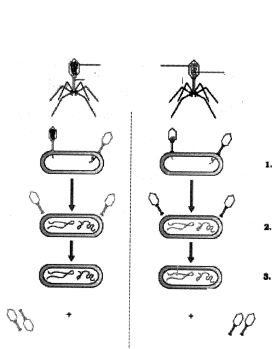
A
Reproduction in bacteria
B
Reproduction in viruses
C
Entry of viral genetic material into the bacteria.
D
Entry of viral capsid into the bacteria.
Solution
(C) The provided image illustrates the Hershey-Chase experiment,which was conducted to prove that $DNA$ is the genetic material.
In this experiment,bacteriophages (viruses that infect bacteria) were used.
The diagram shows the process of infection where the bacteriophage attaches to the bacterial cell surface and injects its genetic material $(DNA)$ into the host cell.
The protein coat (capsid) remains outside the bacterial cell.
Therefore,the experiment demonstrates the entry of viral genetic material into the bacteria.
In this experiment,bacteriophages (viruses that infect bacteria) were used.
The diagram shows the process of infection where the bacteriophage attaches to the bacterial cell surface and injects its genetic material $(DNA)$ into the host cell.
The protein coat (capsid) remains outside the bacterial cell.
Therefore,the experiment demonstrates the entry of viral genetic material into the bacteria.
0 likes
View Solution58
MediumMCQ
$RNA$ acts as the genetic material in:
A
$TMV$ (Tobacco Mosaic Virus)
B
Cyanobacteria
C
Cladophora
D
Sieve cells
Solution
(A) In most organisms,$DNA$ acts as the genetic material,while $RNA$ primarily functions as a messenger.
However,in certain viruses,$RNA$ serves as the genetic material.
$TMV$ (Tobacco Mosaic Virus) is a well-known example of a virus where the genetic material is $RNA$.
Cyanobacteria,Cladophora,and Sieve cells are cellular organisms that contain $DNA$ as their genetic material.
However,in certain viruses,$RNA$ serves as the genetic material.
$TMV$ (Tobacco Mosaic Virus) is a well-known example of a virus where the genetic material is $RNA$.
Cyanobacteria,Cladophora,and Sieve cells are cellular organisms that contain $DNA$ as their genetic material.
0 likes
View Solution59
MediumMCQ
$A$ molecule that can act as a genetic material must possess which of the following characteristics?
A
It should provide the scope for slow changes (mutation) that are required for evolution.
B
It should not be able to generate its replica.
C
It should not be chemically and structurally stable.
D
All of the above
Solution
(A) For a molecule to act as a genetic material,it must fulfill several criteria:
$1$. It should be able to generate its replica (replication).
$2$. It should be chemically and structurally stable.
$3$. It should provide the scope for slow changes (mutation) that are required for evolution.
$4$. It should be able to express itself in the form of Mendelian characters.
Option $A$ correctly identifies the requirement for mutation,while options $B$ and $C$ contradict the necessary criteria for a genetic material. Therefore,the correct characteristic is that it must allow for mutation.
$1$. It should be able to generate its replica (replication).
$2$. It should be chemically and structurally stable.
$3$. It should provide the scope for slow changes (mutation) that are required for evolution.
$4$. It should be able to express itself in the form of Mendelian characters.
Option $A$ correctly identifies the requirement for mutation,while options $B$ and $C$ contradict the necessary criteria for a genetic material. Therefore,the correct characteristic is that it must allow for mutation.
0 likes
View Solution60
EasyMCQ
The $RNA$ can be removed by treatment with ................... whereas proteins can be removed by treatment with ................ in isolation of $DNA$ from cell.
A
Ribonuclease,ligase
B
Ribonuclease,Protease
C
Protease,Lipase
D
Ribonuclease,Lipase
Solution
(B) During the isolation of $DNA$ from a cell,various impurities such as $RNA$,proteins,and lipids must be removed to obtain pure $DNA$.
$1$. $RNA$ is removed by treating the mixture with the enzyme $Ribonuclease$ $(RNase)$,which degrades $RNA$.
$2$. Proteins are removed by treating the mixture with the enzyme $Protease$,which breaks down proteins into amino acids.
Therefore,the correct sequence of enzymes is $Ribonuclease$ and $Protease$.
$1$. $RNA$ is removed by treating the mixture with the enzyme $Ribonuclease$ $(RNase)$,which degrades $RNA$.
$2$. Proteins are removed by treating the mixture with the enzyme $Protease$,which breaks down proteins into amino acids.
Therefore,the correct sequence of enzymes is $Ribonuclease$ and $Protease$.
0 likes
View Solution61
MediumMCQ
What was the transforming principle identified by Avery,MacLeod,and McCarty in Pneumococcus?
A
$m.RNA$
B
$DNA$
C
Protein
D
Polysaccharide
Solution
(B) Oswald Avery,Colin MacLeod,and Maclyn McCarty worked to determine the biochemical nature of the 'transforming principle' in Griffith's experiment.
They purified biochemicals (proteins,$DNA$,$RNA$,etc.) from the heat-killed $S$ strain of Streptococcus pneumoniae.
They discovered that $DNA$ alone from the heat-killed $S$ strain caused the transformation of non-virulent $R$ strain bacteria into virulent $S$ strain bacteria.
They also observed that protein-digesting enzymes (proteases) and $RNA$-digesting enzymes (RNases) did not affect transformation,whereas $DNA$-digesting enzymes (DNases) inhibited the process.
Thus,they concluded that the genetic material is $DNA$.
They purified biochemicals (proteins,$DNA$,$RNA$,etc.) from the heat-killed $S$ strain of Streptococcus pneumoniae.
They discovered that $DNA$ alone from the heat-killed $S$ strain caused the transformation of non-virulent $R$ strain bacteria into virulent $S$ strain bacteria.
They also observed that protein-digesting enzymes (proteases) and $RNA$-digesting enzymes (RNases) did not affect transformation,whereas $DNA$-digesting enzymes (DNases) inhibited the process.
Thus,they concluded that the genetic material is $DNA$.
0 likes
View Solution62
EasyMCQ
Who proved that $DNA$ is the genetic material?
A
Griffith
B
Watson
C
Boveri and Sutton
D
Hershey and Chase
Solution
(D) Alfred Hershey and Martha Chase $(1952)$ conducted experiments using bacteriophages. They grew some phages in a medium containing radioactive phosphorus $(^{32}P)$ to label $DNA$ and others in a medium containing radioactive sulfur $(^{35}S)$ to label proteins. They allowed these phages to infect $E. coli$ bacteria. After agitation and centrifugation,they observed that radioactive phosphorus $(^{32}P)$ was found inside the bacterial cells,while radioactive sulfur $(^{35}S)$ remained in the supernatant. This proved that $DNA$,not protein,entered the bacteria and acted as the genetic material.
0 likes
View Solution63
MediumMCQ
The pneumococcus experiment proves that...
A
$DNA$ is the genetic material.
B
$RNA$ sometimes regulates the synthesis of $DNA$ and proteins.
C
Bacteria undergo binary fission.
D
Bacteria do not undergo sexual reproduction.
Solution
(A) The pneumococcus experiment,famously known as Griffith's transformation experiment,demonstrated that a 'transforming principle' from heat-killed virulent $S$-strain bacteria could transform non-virulent $R$-strain bacteria into virulent $S$-strain bacteria. Later,Avery,MacLeod,and McCarty identified this 'transforming principle' as $DNA$. This experiment provided the first strong evidence that $DNA$ is the genetic material.
0 likes
View Solution64
EasyMCQ
Who discovered transformation?
A
Meselson and Stahl
B
Hershey and Chase
C
Griffith
D
Watson and Crick
Solution
(C) Frederick Griffith discovered the phenomenon of transformation in $1928$ while working with $Streptococcus$ $\text{pneumoniae}$.
He observed that heat-killed virulent bacteria could transform live non-virulent bacteria into virulent ones.
This experiment provided the first evidence that there is a 'transforming principle' capable of changing the genetic characteristics of an organism.
He observed that heat-killed virulent bacteria could transform live non-virulent bacteria into virulent ones.
This experiment provided the first evidence that there is a 'transforming principle' capable of changing the genetic characteristics of an organism.
0 likes
View Solution65
MediumMCQ
$A$ molecule that acts as genetic material must fulfill the following criteria,$EXCEPT$:
A
It should be able to generate its replica.
B
It should be stable chemically and structurally.
C
It should provide the scope for slow changes (mutation) that are required for evolution.
D
It should be able to express itself in the form of Mendelian characters.
Solution
(NONE) The criteria for a molecule to act as genetic material are as follows:
$1$. It should be able to generate its replica (replication).
$2$. It should be stable chemically and structurally.
$3$. It should provide the scope for slow changes (mutation) that are required for evolution.
$4$. It should be able to express itself in the form of Mendelian characters.
All the given options are standard criteria for genetic material. However,in the context of this question,if we look for an exception,all options provided are actually correct criteria. If the question implies which is $NOT$ a criterion,all are valid. Given the standard nature of this question,it is often asked to identify the correct criteria. Since all are correct,the question is technically flawed as an '$EXCEPT$' question. Assuming the question asks for the criteria,all are correct.
$1$. It should be able to generate its replica (replication).
$2$. It should be stable chemically and structurally.
$3$. It should provide the scope for slow changes (mutation) that are required for evolution.
$4$. It should be able to express itself in the form of Mendelian characters.
All the given options are standard criteria for genetic material. However,in the context of this question,if we look for an exception,all options provided are actually correct criteria. If the question implies which is $NOT$ a criterion,all are valid. Given the standard nature of this question,it is often asked to identify the correct criteria. Since all are correct,the question is technically flawed as an '$EXCEPT$' question. Assuming the question asks for the criteria,all are correct.
0 likes
View Solution66
MediumMCQ
$DNA$ is the genetic material. The final proof for this came from the experiments of:
A
Griffith
B
Hershey and Chase
C
Avery,MacLeod and McCarty
D
Har Gobind Khorana
Solution
(B) The unequivocal proof that $DNA$ is the genetic material came from the experiments of Alfred Hershey and Martha Chase $(1952)$.
They worked with bacteriophages,which are viruses that infect bacteria.
They grew some viruses on a medium that contained radioactive phosphorus $(^{32}P)$ and some on a medium that contained radioactive sulfur $(^{35}S)$.
Viruses grown in the presence of radioactive phosphorus contained radioactive $DNA$ but not radioactive protein because $DNA$ contains phosphorus but protein does not.
Similarly,viruses grown on radioactive sulfur contained radioactive protein but not radioactive $DNA$ because $DNA$ does not contain sulfur.
When these radioactive phages were allowed to infect $E. coli$ bacteria,it was observed that only the radioactive phosphorus $(^{32}P)$ entered the bacterial cells,indicating that $DNA$ is the genetic material that is transferred from the virus to the bacteria.
They worked with bacteriophages,which are viruses that infect bacteria.
They grew some viruses on a medium that contained radioactive phosphorus $(^{32}P)$ and some on a medium that contained radioactive sulfur $(^{35}S)$.
Viruses grown in the presence of radioactive phosphorus contained radioactive $DNA$ but not radioactive protein because $DNA$ contains phosphorus but protein does not.
Similarly,viruses grown on radioactive sulfur contained radioactive protein but not radioactive $DNA$ because $DNA$ does not contain sulfur.
When these radioactive phages were allowed to infect $E. coli$ bacteria,it was observed that only the radioactive phosphorus $(^{32}P)$ entered the bacterial cells,indicating that $DNA$ is the genetic material that is transferred from the virus to the bacteria.
0 likes
View Solution67
MediumMCQ
Which scientist experimentally proved that $DNA$ is the sole genetic material in bacteriophage?
A
Beadle and Tatum
B
Meselson and Stahl
C
Hershey and Chase
D
Jacob and Monod
Solution
(C) Alfred Hershey and Martha Chase $(1952)$ conducted experiments using bacteriophages that infect $E. coli$ bacteria.
They grew some viruses in a medium containing radioactive phosphorus $(^{32}P)$ to label $DNA$ and others in a medium containing radioactive sulfur $(^{35}S)$ to label proteins.
After allowing the viruses to infect the bacteria,they used a blender to separate the viral coats from the bacterial cells and then centrifuged the mixture.
They observed that radioactive phosphorus $(^{32}P)$ was found inside the bacterial cells,while radioactive sulfur $(^{35}S)$ remained in the supernatant (viral coats).
This proved that $DNA$ is the genetic material that enters the bacteria,not the protein.
They grew some viruses in a medium containing radioactive phosphorus $(^{32}P)$ to label $DNA$ and others in a medium containing radioactive sulfur $(^{35}S)$ to label proteins.
After allowing the viruses to infect the bacteria,they used a blender to separate the viral coats from the bacterial cells and then centrifuged the mixture.
They observed that radioactive phosphorus $(^{32}P)$ was found inside the bacterial cells,while radioactive sulfur $(^{35}S)$ remained in the supernatant (viral coats).
This proved that $DNA$ is the genetic material that enters the bacteria,not the protein.
0 likes
View Solution68
Medium
How did Hershey and Chase differentiate between $DNA$ and protein in their experiment while proving that $DNA$ is the genetic material?
Solution
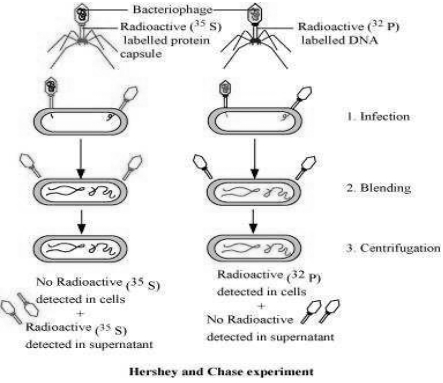
(N/A) Hershey and Chase worked with bacteriophages and $E. coli$ to prove that $DNA$ is the genetic material. They used different radioactive isotopes to label the $DNA$ and the protein coat of the bacteriophage.
They grew some bacteriophages on a medium containing radioactive phosphorus $(^{32}P)$ to label the $DNA$ and some on a medium containing radioactive sulphur $(^{35}S)$ to label the protein.
Then,these radioactively labelled phages were allowed to infect $E. coli$ bacteria. After infection,the protein coat of the bacteriophage was separated from the bacterial cell by blending and then subjected to the process of centrifugation.
Since the protein coat was lighter,it was found in the supernatant,while the infected bacteria settled at the bottom of the centrifuge tube.
It was observed that radioactive $(^{32}P)$ was present in the bacterial cells,while radioactive $(^{35}S)$ was found in the supernatant. Hence,it was proved that $DNA$ is the genetic material as it was transferred from the virus to the bacteria.
They grew some bacteriophages on a medium containing radioactive phosphorus $(^{32}P)$ to label the $DNA$ and some on a medium containing radioactive sulphur $(^{35}S)$ to label the protein.
Then,these radioactively labelled phages were allowed to infect $E. coli$ bacteria. After infection,the protein coat of the bacteriophage was separated from the bacterial cell by blending and then subjected to the process of centrifugation.
Since the protein coat was lighter,it was found in the supernatant,while the infected bacteria settled at the bottom of the centrifuge tube.
It was observed that radioactive $(^{32}P)$ was present in the bacterial cells,while radioactive $(^{35}S)$ was found in the supernatant. Hence,it was proved that $DNA$ is the genetic material as it was transferred from the virus to the bacteria.
0 likes
View Solution69
Medium
Provide information about nucleic acids as genetic material.
Solution
(N/A) Offspring exhibit traits similar to their parents. Most organisms originate from a zygote formed by the fusion of male and female gametes.
Initially,there was no clarity regarding the material responsible for genetic traits.
Mendel described these genetic materials as 'factors'. About a hundred years later,it was understood that this genetic material exists in the form of chromosomes.
Chromosomes primarily consist of nucleoproteins. Nucleoproteins have two components: $(1)$ Nucleic acids and $(2)$ Proteins.
Modern research in molecular biology has proven that the nucleic acid present in chromosomes is responsible for the transmission of hereditary traits.
Two types of nucleic acids are found in biological systems,namely Deoxyribonucleic acid $(DNA)$ and Ribonucleic acid $(RNA)$.
In most organisms,$DNA$ acts as the genetic material,but in some viruses,$RNA$ serves as the genetic material.
$RNA$ mostly functions as a messenger. $RNA$ also performs other functions; it acts as an adapter,a structural molecule,and in some cases,as a catalytic molecule.
Initially,there was no clarity regarding the material responsible for genetic traits.
Mendel described these genetic materials as 'factors'. About a hundred years later,it was understood that this genetic material exists in the form of chromosomes.
Chromosomes primarily consist of nucleoproteins. Nucleoproteins have two components: $(1)$ Nucleic acids and $(2)$ Proteins.
Modern research in molecular biology has proven that the nucleic acid present in chromosomes is responsible for the transmission of hereditary traits.
Two types of nucleic acids are found in biological systems,namely Deoxyribonucleic acid $(DNA)$ and Ribonucleic acid $(RNA)$.
In most organisms,$DNA$ acts as the genetic material,but in some viruses,$RNA$ serves as the genetic material.
$RNA$ mostly functions as a messenger. $RNA$ also performs other functions; it acts as an adapter,a structural molecule,and in some cases,as a catalytic molecule.
0 likes
View Solution70
Medium
Describe in detail Griffith's experiment on bacterial transformation.
Solution
(N/A) Based on the earlier discoveries of Gregor Mendel,Sutton,Morgan,and other scientists,it was clear that chromosomes in the nucleus carry genetic information,but the nature of the genetic material remained unclear.
The search for the mechanism of genetic inheritance reached the molecular level by $1926$.
In $1928$,Frederick Griffith performed a series of experiments with Streptococcus pneumoniae (pneumococcus) bacteria.
When Streptococcus pneumoniae bacteria are grown on a culture plate,some produce smooth,shiny colonies ($S$ strain),while others produce rough colonies ($R$ strain). This is because $S$ strain bacteria have a mucous (polysaccharide) coat,whereas $R$ strain bacteria do not. When mice were infected with the $S$ strain (virulent),they died from pneumonia infection. However,when mice were infected with the $R$ strain,they did not develop pneumonia.
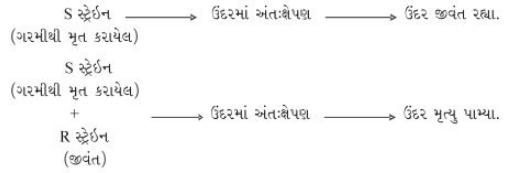
$S$ strain $\longrightarrow$ Injection into mice $\longrightarrow$ Mice died.
$R$ strain $\longrightarrow$ Injection into mice $\longrightarrow$ Mice lived.
Griffith killed the bacteria by heating them. He observed that injecting heat-killed $S$ strain bacteria into mice did not cause death. When he injected a mixture of heat-killed $S$ strain and live $R$ strain into mice,the mice died. Furthermore,he recovered live $S$ bacteria from these dead mice.
$S$ strain (heat-killed) $\longrightarrow$ Injection into mice $\longrightarrow$ Mice lived.
$S$ strain (heat-killed) $+$ $R$ strain (live) $\longrightarrow$ Injection into mice $\longrightarrow$ Mice died.
Griffith concluded that the $R$ strain bacteria were transformed by the heat-killed $S$ strain bacteria.
Transformation Principle: Some transforming principle transferred from the heat-killed $S$ strain to the $R$ strain,causing the $R$ strain to develop a smooth polysaccharide coat,which made it virulent. This suggested that the genetic material itself had been transformed.
The search for the mechanism of genetic inheritance reached the molecular level by $1926$.
In $1928$,Frederick Griffith performed a series of experiments with Streptococcus pneumoniae (pneumococcus) bacteria.
When Streptococcus pneumoniae bacteria are grown on a culture plate,some produce smooth,shiny colonies ($S$ strain),while others produce rough colonies ($R$ strain). This is because $S$ strain bacteria have a mucous (polysaccharide) coat,whereas $R$ strain bacteria do not. When mice were infected with the $S$ strain (virulent),they died from pneumonia infection. However,when mice were infected with the $R$ strain,they did not develop pneumonia.
$S$ strain $\longrightarrow$ Injection into mice $\longrightarrow$ Mice died.
$R$ strain $\longrightarrow$ Injection into mice $\longrightarrow$ Mice lived.
Griffith killed the bacteria by heating them. He observed that injecting heat-killed $S$ strain bacteria into mice did not cause death. When he injected a mixture of heat-killed $S$ strain and live $R$ strain into mice,the mice died. Furthermore,he recovered live $S$ bacteria from these dead mice.
$S$ strain (heat-killed) $\longrightarrow$ Injection into mice $\longrightarrow$ Mice lived.
$S$ strain (heat-killed) $+$ $R$ strain (live) $\longrightarrow$ Injection into mice $\longrightarrow$ Mice died.
Griffith concluded that the $R$ strain bacteria were transformed by the heat-killed $S$ strain bacteria.
Transformation Principle: Some transforming principle transferred from the heat-killed $S$ strain to the $R$ strain,causing the $R$ strain to develop a smooth polysaccharide coat,which made it virulent. This suggested that the genetic material itself had been transformed.
0 likes
View Solution71
Medium
Explain the biochemical characterization of the transforming principle.
Solution
(N/A) Before the work of Avery,MacLeod,and McCarty $(1944)$,it was believed that protein was the genetic material.
These scientists worked to determine the biochemical nature of the 'transforming principle' observed in Griffith's experiment.
They purified biochemicals ($DNA, RNA,$ and proteins) from heat-killed $S$ cells to see which one could transform live $R$ cells into $S$ cells.
They discovered that $DNA$ from the $S$ bacteria was the only substance that caused the transformation of $R$ bacteria.
They observed that digestion with protein-digesting enzymes (proteases) or $RNA$-digesting enzymes $(RNases)$ did not affect the transformation,proving that the transforming substance was neither protein nor $RNA$.
However,digestion with $DNase$ inhibited the transformation process. This confirmed that $DNA$ is the genetic material responsible for transformation.
These scientists worked to determine the biochemical nature of the 'transforming principle' observed in Griffith's experiment.
They purified biochemicals ($DNA, RNA,$ and proteins) from heat-killed $S$ cells to see which one could transform live $R$ cells into $S$ cells.
They discovered that $DNA$ from the $S$ bacteria was the only substance that caused the transformation of $R$ bacteria.
They observed that digestion with protein-digesting enzymes (proteases) or $RNA$-digesting enzymes $(RNases)$ did not affect the transformation,proving that the transforming substance was neither protein nor $RNA$.
However,digestion with $DNase$ inhibited the transformation process. This confirmed that $DNA$ is the genetic material responsible for transformation.
0 likes
View Solution72
Medium
Describe the experiment of Hershey and Chase that proved $DNA$ is the genetic material.
Solution
(N/A) The proof that $DNA$ is the genetic material came from the experiments of Alfred Hershey and Martha Chase $(1952)$. They worked on viruses that infect bacteria,called bacteriophages.
Bacteriophages attach to bacteria and inject their genetic material into the host cell. The bacteria then treat the viral genetic material as if it were its own and subsequently manufacture more virus particles.
Hershey and Chase conducted experiments to determine whether it was $DNA$ or protein that entered the bacteria from the virus.
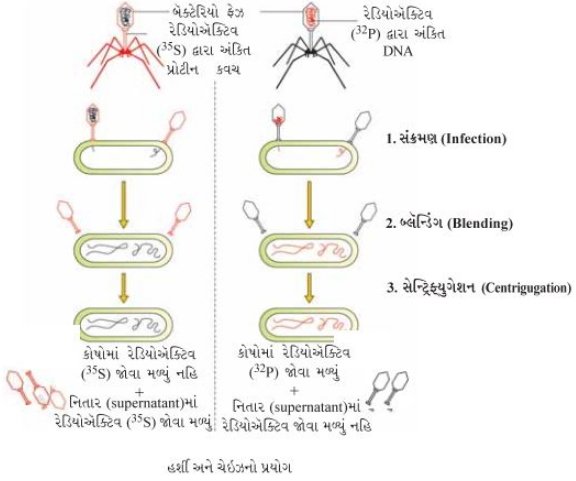
They grew some viruses in a medium containing radioactive phosphorus $(^{32}P)$ and others in a medium containing radioactive sulfur $(^{35}S)$. Viruses grown in the presence of radioactive phosphorus contained radioactive $DNA$ but not radioactive protein because $DNA$ contains phosphorus,while proteins do not.
Similarly,viruses grown in radioactive sulfur contained radioactive protein but not radioactive $DNA$ because $DNA$ does not contain sulfur.
These radioactive bacteriophages were then allowed to infect $E. coli$ bacteria. As the infection proceeded,the viral coats were removed from the bacteria by agitating them in a blender. The virus particles were then separated from the bacteria by spinning them in a centrifuge. The bacteria that were infected with viruses that had radioactive $DNA$ were radioactive,indicating that $DNA$ was the material that passed from the virus to the bacteria. Bacteria that were infected with viruses that had radioactive proteins were not radioactive,indicating that protein did not enter the bacteria.
Bacteriophages attach to bacteria and inject their genetic material into the host cell. The bacteria then treat the viral genetic material as if it were its own and subsequently manufacture more virus particles.
Hershey and Chase conducted experiments to determine whether it was $DNA$ or protein that entered the bacteria from the virus.
They grew some viruses in a medium containing radioactive phosphorus $(^{32}P)$ and others in a medium containing radioactive sulfur $(^{35}S)$. Viruses grown in the presence of radioactive phosphorus contained radioactive $DNA$ but not radioactive protein because $DNA$ contains phosphorus,while proteins do not.
Similarly,viruses grown in radioactive sulfur contained radioactive protein but not radioactive $DNA$ because $DNA$ does not contain sulfur.
These radioactive bacteriophages were then allowed to infect $E. coli$ bacteria. As the infection proceeded,the viral coats were removed from the bacteria by agitating them in a blender. The virus particles were then separated from the bacteria by spinning them in a centrifuge. The bacteria that were infected with viruses that had radioactive $DNA$ were radioactive,indicating that $DNA$ was the material that passed from the virus to the bacteria. Bacteria that were infected with viruses that had radioactive proteins were not radioactive,indicating that protein did not enter the bacteria.
0 likes
View Solution73
Medium
State the criteria that a molecule must fulfill to act as a genetic material.
Solution
(N/A) molecule must fulfill the following criteria to act as a genetic material:
$(i)$ It should be able to generate its replica (replication).
$(ii)$ It should be chemically and structurally stable.
$(iii)$ It should provide the scope for slow changes (mutation) that are required for evolution.
$(iv)$ It should be able to express itself in the form of 'Mendelian characters'.
If one examines the criteria of base pairing and complementarity,it is evident that both nucleic acids ($DNA$ and $RNA$) have the ability to direct their duplications. Other molecules in the living system,such as proteins,fail to fulfill these criteria.
$(i)$ It should be able to generate its replica (replication).
$(ii)$ It should be chemically and structurally stable.
$(iii)$ It should provide the scope for slow changes (mutation) that are required for evolution.
$(iv)$ It should be able to express itself in the form of 'Mendelian characters'.
If one examines the criteria of base pairing and complementarity,it is evident that both nucleic acids ($DNA$ and $RNA$) have the ability to direct their duplications. Other molecules in the living system,such as proteins,fail to fulfill these criteria.
0 likes
View Solution74
Medium
Define/Explain the following:
$1.$ Transformation
$2.$ Messenger $\text{RNA}$ $(m\text{RNA})$
$1.$ Transformation
$2.$ Messenger $\text{RNA}$ $(m\text{RNA})$
Solution
(N/A) $1.$ Transformation: The phenomenon in which the genetic characteristics of an organism are altered due to the incorporation of foreign genetic material $(DNA)$ is known as transformation.
$2.$ Messenger $\text{RNA}$ $(m\text{RNA})$: It carries the genetic information transcribed from $DNA$ to the site of protein synthesis (ribosomes) to direct the assembly of amino acids.
$2.$ Messenger $\text{RNA}$ $(m\text{RNA})$: It carries the genetic information transcribed from $DNA$ to the site of protein synthesis (ribosomes) to direct the assembly of amino acids.
0 likes
View Solution75
Easy
Explain the role of the following scientists in the discovery of $DNA$:
$1.$ Friedrich Miescher $(1869)$
$2.$ Maurice Wilkins and Rosalind Franklin
$1.$ Friedrich Miescher $(1869)$
$2.$ Maurice Wilkins and Rosalind Franklin
Solution
(N/A) $1.$ Friedrich Miescher identified $DNA$ as an acidic substance present in the nucleus in $1869$. He named it 'Nuclein'.
$2.$ Maurice Wilkins and Rosalind Franklin produced the $X$-ray diffraction data for $DNA$, which was crucial for understanding its structure.
$2.$ Maurice Wilkins and Rosalind Franklin produced the $X$-ray diffraction data for $DNA$, which was crucial for understanding its structure.
0 likes
View Solution76
Medium
Explain the role of the following scientists in the field of genetics:
$1.$ Francis Crick
$2.$ Frederick Griffith $(1928)$
$1.$ Francis Crick
$2.$ Frederick Griffith $(1928)$
Solution
(N/A) Francis Crick proposed the Central Dogma in molecular biology, which states that genetic information flows from $DNA \rightarrow RNA \rightarrow \text{Protein}$.
Frederick Griffith, in his experiment with $Streptococcus \text{ } pneumoniae$, concluded that the $R$-strain bacteria had been 'transformed' by the heat-killed $S$-strain bacteria. He suggested that some 'transforming principle' was transferred from the heat-killed $S$-strain to the $R$-strain, enabling the $R$-strain to synthesize a smooth polysaccharide coat and become virulent.
Frederick Griffith, in his experiment with $Streptococcus \text{ } pneumoniae$, concluded that the $R$-strain bacteria had been 'transformed' by the heat-killed $S$-strain bacteria. He suggested that some 'transforming principle' was transferred from the heat-killed $S$-strain to the $R$-strain, enabling the $R$-strain to synthesize a smooth polysaccharide coat and become virulent.
0 likes
View Solution77
Medium
Define transformation in Griffith's experiment. Discuss how it helps in the identification of $DNA$ as the genetic material.
Solution
(A) In $1928$,Frederick Griffith,in a series of experiments with $Streptococcus$ $pneumoniae$ (the bacterium responsible for pneumonia),witnessed a miraculous transformation in the bacteria. During his experiment,a living organism (bacteria) changed its physical form.
When $Streptococcus$ $pneumoniae$ bacteria are grown on a culture plate,some produce smooth shiny colonies $(S)$ while others produce rough colonies $(R)$.
This is because the $S$ strain bacteria have a mucous (polysaccharide) coat,while the $R$ strain does not. Mice infected with the $S$ strain (virulent) die from pneumonia,but mice infected with the $R$ strain do not.
$S$ strain $\rightarrow$ Inject into mice $\rightarrow$ Mice die
$R$ strain $\rightarrow$ Inject into mice $\rightarrow$ Mice live
Griffith killed the bacteria by heating them. He observed that heat-killed $S$ strain bacteria injected into mice did not kill them.
$S$ strain (heat-killed) $\rightarrow$ Inject into mice $\rightarrow$ Mice live
When he injected a mixture of heat-killed $S$ and live $R$ bacteria,the mice died. Moreover,he recovered living $S$ bacteria from the dead mice.
$S$ strain (heat-killed) $+$ $R$ strain (live) $\rightarrow$ Inject into mice $\rightarrow$ Mice die
He concluded that the $R$ strain bacteria had been transformed by the heat-killed $S$ strain bacteria. Some 'transforming principle',transferred from the heat-killed $S$ strain,enabled the $R$ strain to synthesize a smooth polysaccharide coat and become virulent. This indicated the transfer of genetic material,although the biochemical nature of this material was not defined by his experiments.
When $Streptococcus$ $pneumoniae$ bacteria are grown on a culture plate,some produce smooth shiny colonies $(S)$ while others produce rough colonies $(R)$.
This is because the $S$ strain bacteria have a mucous (polysaccharide) coat,while the $R$ strain does not. Mice infected with the $S$ strain (virulent) die from pneumonia,but mice infected with the $R$ strain do not.
$S$ strain $\rightarrow$ Inject into mice $\rightarrow$ Mice die
$R$ strain $\rightarrow$ Inject into mice $\rightarrow$ Mice live
Griffith killed the bacteria by heating them. He observed that heat-killed $S$ strain bacteria injected into mice did not kill them.
$S$ strain (heat-killed) $\rightarrow$ Inject into mice $\rightarrow$ Mice live
When he injected a mixture of heat-killed $S$ and live $R$ bacteria,the mice died. Moreover,he recovered living $S$ bacteria from the dead mice.
$S$ strain (heat-killed) $+$ $R$ strain (live) $\rightarrow$ Inject into mice $\rightarrow$ Mice die
He concluded that the $R$ strain bacteria had been transformed by the heat-killed $S$ strain bacteria. Some 'transforming principle',transferred from the heat-killed $S$ strain,enabled the $R$ strain to synthesize a smooth polysaccharide coat and become virulent. This indicated the transfer of genetic material,although the biochemical nature of this material was not defined by his experiments.
0 likes
View Solution78
Easy
Who revealed the biochemical nature of the transforming principle? How was it done?
Solution
(N/A) Oswald Avery,Colin MacLeod,and Maclyn McCarty ($1933$-$1944$) worked to determine the biochemical nature of the 'transforming principle' in Griffith's experiment.
They purified biochemicals such as proteins,$DNA$,and $RNA$ from heat-killed $S$ cells to observe which of these could transform live $R$ cells into $S$ cells.
They discovered that $DNA$ alone from $S$ bacteria caused $R$ bacteria to become transformed.
They also discovered that protein-digesting enzymes (proteases) and $RNA$-digesting enzymes $(RNases)$ did not affect transformation,indicating that the transforming substance was neither a protein nor $RNA$.
Digestion with $DNase$ inhibited the transformation,confirming that $DNA$ was the molecule responsible for the transformation.
They concluded that $DNA$ is the hereditary material,although not all biologists were convinced at that time.
They purified biochemicals such as proteins,$DNA$,and $RNA$ from heat-killed $S$ cells to observe which of these could transform live $R$ cells into $S$ cells.
They discovered that $DNA$ alone from $S$ bacteria caused $R$ bacteria to become transformed.
They also discovered that protein-digesting enzymes (proteases) and $RNA$-digesting enzymes $(RNases)$ did not affect transformation,indicating that the transforming substance was neither a protein nor $RNA$.
Digestion with $DNase$ inhibited the transformation,confirming that $DNA$ was the molecule responsible for the transformation.
They concluded that $DNA$ is the hereditary material,although not all biologists were convinced at that time.
0 likes
View Solution79
Medium
Retroviruses do not follow the central dogma. Comment.
Solution
(N/A) The genetic material of a retrovirus is $RNA$.
At the time of protein synthesis, the $RNA$ is first 'reverse transcribed' into its complementary $DNA$ using the enzyme reverse transcriptase.
This process is the reverse of the flow of information described in the central dogma $(DNA \rightarrow RNA \rightarrow \text{Protein})$.
Therefore, retroviruses are not considered to follow the central dogma.
At the time of protein synthesis, the $RNA$ is first 'reverse transcribed' into its complementary $DNA$ using the enzyme reverse transcriptase.
This process is the reverse of the flow of information described in the central dogma $(DNA \rightarrow RNA \rightarrow \text{Protein})$.
Therefore, retroviruses are not considered to follow the central dogma.
0 likes
View Solution80
Medium
Recall the experiments done by Frederick Griffith,Avery,MacLeod,and McCarty,where $DNA$ was speculated to be the genetic material. If $RNA$,instead of $DNA$,was the genetic material,would the heat-killed strain of $Pneumococcus$ have transformed the $R$-strain into a virulent strain? Explain.
Solution
(N/A) $RNA$ is chemically more labile and prone to degradation compared to $DNA$ due to the presence of the $2'-OH$ group in its ribose sugar.
Furthermore,$RNA$ is highly susceptible to enzymatic degradation by ribonucleases,which are ubiquitous in the environment.
Therefore,if $RNA$ were the genetic material,the heat-killed $S$-strain would likely have been degraded during the experimental process and would not have retained its ability to transform the $R$-strain into a virulent form.
Furthermore,$RNA$ is highly susceptible to enzymatic degradation by ribonucleases,which are ubiquitous in the environment.
Therefore,if $RNA$ were the genetic material,the heat-killed $S$-strain would likely have been degraded during the experimental process and would not have retained its ability to transform the $R$-strain into a virulent form.
0 likes
View Solution81
MediumMCQ
You are repeating the Hershey-Chase experiment and are provided with two isotopes: $^{32}P$ and $^{15}N$ (in place of $^{35}S$ in the original experiment). How do you expect your results to be different?
A
The results will be identical because both are isotopes.
B
The results will be inconclusive because $^{15}N$ is incorporated into both $DNA$ and proteins.
C
The results will be more accurate because $^{15}N$ is a radioactive isotope.
D
The results will show that proteins are the genetic material.
Solution
(B) The use of $^{15}N$ is inappropriate because the detection methods for $^{32}P$ and $^{15}N$ differ. $^{32}P$ is a radioactive isotope,whereas $^{15}N$ is a stable,heavier isotope of nitrogen,not a radioactive one.
Even if $^{15}N$ were radioactive,it would not provide conclusive results because nitrogen is a fundamental component of both $DNA$ (in nitrogenous bases) and proteins (in the amino groups of amino acids).
Therefore,if $^{15}N$ were used,it would be detected in both the bacterial cell pellet and the supernatant,making it impossible to distinguish whether the genetic material transferred was $DNA$ or protein.
Even if $^{15}N$ were radioactive,it would not provide conclusive results because nitrogen is a fundamental component of both $DNA$ (in nitrogenous bases) and proteins (in the amino groups of amino acids).
Therefore,if $^{15}N$ were used,it would be detected in both the bacterial cell pellet and the supernatant,making it impossible to distinguish whether the genetic material transferred was $DNA$ or protein.
0 likes
View Solution82
Medium
Give an account of the Hershey and Chase experiment. What did it conclusively prove? If both $DNA$ and proteins contained phosphorus and sulphur,do you think the result would have been the same?
Solution
(N/A) The unequivocal proof that $DNA$ is the genetic material came from the experiments of Alfred Hershey and Martha Chase $(1952)$. They worked with viruses that infect bacteria,called bacteriophages.
$1$. Experimental Setup: They grew some viruses on a medium containing radioactive phosphorus $(^{32}P)$ and others on a medium containing radioactive sulfur $(^{35}S)$. Since $DNA$ contains phosphorus but not sulfur,viruses grown in radioactive phosphorus had radioactive $DNA$. Conversely,since proteins contain sulfur but not phosphorus,viruses grown in radioactive sulfur had radioactive proteins.
$2$. Infection and Blending: These radioactive phages were allowed to infect $E. coli$ bacteria. After infection,the viral coats were removed from the bacterial surface by agitating them in a blender.
$3$. Centrifugation: The virus particles were separated from the bacteria by spinning them in a centrifuge. The heavier bacterial cells formed a pellet,while the lighter viral coats remained in the supernatant.
$4$. Conclusion: Bacteria infected with viruses containing radioactive $DNA$ $(^{32}P)$ were found to be radioactive,whereas bacteria infected with viruses containing radioactive proteins $(^{35}S)$ were not. This conclusively proved that $DNA$,not protein,is the genetic material that enters the bacteria.
$5$. Hypothetical Scenario: If both $DNA$ and proteins contained both phosphorus and sulfur,the experiment would not have been able to distinguish between the two. The radioactivity would have been present in both the pellet and the supernatant regardless of which molecule entered the cell,making it impossible to conclude which one was the genetic material.
$1$. Experimental Setup: They grew some viruses on a medium containing radioactive phosphorus $(^{32}P)$ and others on a medium containing radioactive sulfur $(^{35}S)$. Since $DNA$ contains phosphorus but not sulfur,viruses grown in radioactive phosphorus had radioactive $DNA$. Conversely,since proteins contain sulfur but not phosphorus,viruses grown in radioactive sulfur had radioactive proteins.
$2$. Infection and Blending: These radioactive phages were allowed to infect $E. coli$ bacteria. After infection,the viral coats were removed from the bacterial surface by agitating them in a blender.
$3$. Centrifugation: The virus particles were separated from the bacteria by spinning them in a centrifuge. The heavier bacterial cells formed a pellet,while the lighter viral coats remained in the supernatant.
$4$. Conclusion: Bacteria infected with viruses containing radioactive $DNA$ $(^{32}P)$ were found to be radioactive,whereas bacteria infected with viruses containing radioactive proteins $(^{35}S)$ were not. This conclusively proved that $DNA$,not protein,is the genetic material that enters the bacteria.
$5$. Hypothetical Scenario: If both $DNA$ and proteins contained both phosphorus and sulfur,the experiment would not have been able to distinguish between the two. The radioactivity would have been present in both the pellet and the supernatant regardless of which molecule entered the cell,making it impossible to conclude which one was the genetic material.
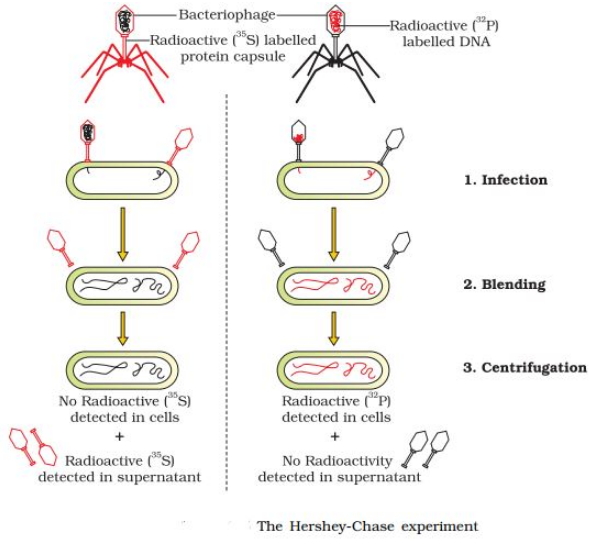
0 likes
View Solution83
Medium
During the course of evolution,why was $DNA$ chosen over $RNA$ as the genetic material? Provide reasons by first discussing the desired criteria for a molecule to act as genetic material and by analyzing the biochemical differences between $DNA$ and $RNA$.
Solution
(A) molecule that acts as genetic material must fulfill the following criteria:
$(i)$ Ability to replicate: Due to base pairing and complementarity,both $DNA$ and $RNA$ can direct their own duplication. Proteins fail to meet this criterion.
$(ii)$ Chemical and structural stability: Genetic material must remain stable across different life stages,ages,and physiological changes. $DNA$ is more stable than $RNA$ because the $2'-OH$ group present in every nucleotide of $RNA$ makes it reactive and easily degradable. Additionally,$RNA$ is catalytic,whereas $DNA$ is less reactive. The presence of thymine instead of uracil in $DNA$ also provides additional stability.
$(iii)$ Scope for slow mutation: Both $DNA$ and $RNA$ can mutate. $RNA$ is unstable and mutates at a faster rate,which is beneficial for viruses with short life spans but less ideal for long-term storage of genetic information.
$(iv)$ Expression as Mendelian characters: $RNA$ can directly code for protein synthesis,while $DNA$ depends on $RNA$. However,because $DNA$ is more stable,it is preferred for the storage of genetic information,while $RNA$ is better suited for the transmission of information and protein synthesis. Thus,$DNA$ evolved from $RNA$ with chemical modifications to enhance stability.
$(i)$ Ability to replicate: Due to base pairing and complementarity,both $DNA$ and $RNA$ can direct their own duplication. Proteins fail to meet this criterion.
$(ii)$ Chemical and structural stability: Genetic material must remain stable across different life stages,ages,and physiological changes. $DNA$ is more stable than $RNA$ because the $2'-OH$ group present in every nucleotide of $RNA$ makes it reactive and easily degradable. Additionally,$RNA$ is catalytic,whereas $DNA$ is less reactive. The presence of thymine instead of uracil in $DNA$ also provides additional stability.
$(iii)$ Scope for slow mutation: Both $DNA$ and $RNA$ can mutate. $RNA$ is unstable and mutates at a faster rate,which is beneficial for viruses with short life spans but less ideal for long-term storage of genetic information.
$(iv)$ Expression as Mendelian characters: $RNA$ can directly code for protein synthesis,while $DNA$ depends on $RNA$. However,because $DNA$ is more stable,it is preferred for the storage of genetic information,while $RNA$ is better suited for the transmission of information and protein synthesis. Thus,$DNA$ evolved from $RNA$ with chemical modifications to enhance stability.
0 likes
View Solution84
Medium
State the criteria that a molecule must fulfill to act as a genetic material.
Solution
(N/A) molecule must fulfill the following criteria to act as a genetic material:
$(i)$ It should be able to generate its replica (replication).
$(ii)$ It should be chemically and structurally stable.
$(iii)$ It should provide the scope for slow changes (mutation) that are required for evolution.
$(iv)$ It should be able to express itself in the form of 'Mendelian characters'.
If one examines each requirement one by one,because of the rule of base pairing and complementarity,both nucleic acids ($DNA$ and $RNA$) have the ability to direct their duplications. Other molecules in the living system,such as proteins,fail to fulfill these criteria.
$(i)$ It should be able to generate its replica (replication).
$(ii)$ It should be chemically and structurally stable.
$(iii)$ It should provide the scope for slow changes (mutation) that are required for evolution.
$(iv)$ It should be able to express itself in the form of 'Mendelian characters'.
If one examines each requirement one by one,because of the rule of base pairing and complementarity,both nucleic acids ($DNA$ and $RNA$) have the ability to direct their duplications. Other molecules in the living system,such as proteins,fail to fulfill these criteria.
0 likes
View Solution85
Easy
What is genetic material?
Solution
(N/A) Genetic material is the substance that carries biological information from one generation to the next.
At the time of Mendel,the nature of 'factors' regulating the pattern of inheritance was not clear.
Over the next hundred years,the nature of the putative genetic material was investigated,culminating in the realization that $DNA$ (deoxyribonucleic acid) is the primary genetic material.
Nucleic acids are polymers of nucleotides.
$DNA$ and $RNA$ (ribonucleic acid) are the two types of nucleic acids found in living systems.
$DNA$ acts as the genetic material in most organisms.
$RNA$,although it acts as genetic material in some viruses,mostly functions as a messenger $(mRNA)$.
$RNA$ also has additional roles,functioning as an adapter $(tRNA)$,a structural component $(rRNA)$,and in some cases,as a catalytic molecule (ribozyme).
At the time of Mendel,the nature of 'factors' regulating the pattern of inheritance was not clear.
Over the next hundred years,the nature of the putative genetic material was investigated,culminating in the realization that $DNA$ (deoxyribonucleic acid) is the primary genetic material.
Nucleic acids are polymers of nucleotides.
$DNA$ and $RNA$ (ribonucleic acid) are the two types of nucleic acids found in living systems.
$DNA$ acts as the genetic material in most organisms.
$RNA$,although it acts as genetic material in some viruses,mostly functions as a messenger $(mRNA)$.
$RNA$ also has additional roles,functioning as an adapter $(tRNA)$,a structural component $(rRNA)$,and in some cases,as a catalytic molecule (ribozyme).
0 likes
View Solution86
Easy
What are the properties of genetic material $(DNA/RNA)$?
Solution
(N/A) Following are the criteria that a molecule must fulfill to act as a genetic material:
$(i)$ It should be able to replicate itself.
$(ii)$ It should be stable both chemically and structurally.
$(iii)$ It should provide the scope for slow changes (mutation) which are required for evolution.
$(iv)$ It should be able to express itself in the form of 'Mendelian Characters'.
According to these criteria,both $DNA$ and $RNA$ have the ability to direct their duplication (because of the rule of base pairing) and complementarity using specific processes,whereas other molecules in the living system fail to fulfill the first criterion itself,e.g.,proteins.
$(i)$ It should be able to replicate itself.
$(ii)$ It should be stable both chemically and structurally.
$(iii)$ It should provide the scope for slow changes (mutation) which are required for evolution.
$(iv)$ It should be able to express itself in the form of 'Mendelian Characters'.
According to these criteria,both $DNA$ and $RNA$ have the ability to direct their duplication (because of the rule of base pairing) and complementarity using specific processes,whereas other molecules in the living system fail to fulfill the first criterion itself,e.g.,proteins.
0 likes
View Solution87
Medium
How was it proved that $DNA$ is the genetic material?
Solution
(N/A) Although the discovery of nuclein by Meischer and the proposition of the principles of inheritance by Mendel occurred around the same time,it took a long time to discover and prove that $DNA$ acts as the genetic material.
By $1926$,the quest to determine the mechanism for genetic inheritance had reached the molecular level.
Previous discoveries by Gregor Mendel,Walter Sutton,Thomas Hunt Morgan,and numerous other scientists had narrowed the search to the chromosomes located in the nucleus of most cells.
Transforming Principle: In $1928$,Frederick Griffith,in a series of experiments with $Streptococcus$ $pneumoniae$ (the bacterium responsible for pneumonia),witnessed a miraculous transformation in the bacteria.
During his experiment,a living organism (bacteria) changed its physical form. When $Streptococcus$ $pneumoniae$ bacteria are grown on a culture plate,some produce smooth,shiny colonies $(S)$ while others produce rough colonies $(R)$.
This is because the $S$ strain bacteria have a mucous (polysaccharide) coat,while the $R$ strain does not.
Mice infected with the $S$ strain (virulent) die from pneumonia,but mice infected with the $R$ strain do not develop pneumonia.
$S$ strain $\longrightarrow$ Inject into mice $\longrightarrow$ mice die
$R$ strain $\longrightarrow$ Inject into mice $\longrightarrow$ mice live
Griffith was able to kill bacteria by heating them.
He observed that heat-killed $S$ strain bacteria injected into mice did not kill them.
$S$ strain (heat-killed) $\longrightarrow$ Inject into mice $\longrightarrow$ mice live
$S$ strain (heat-killed) $+ R$ strain (live) $\longrightarrow$ Inject into mice $\longrightarrow$ mice die
When he injected a mixture of heat-killed $S$ and live $R$ bacteria,the mice died. Moreover,he recovered living $S$ bacteria from the dead mice.
He concluded that the $R$ strain bacteria had somehow been transformed by the heat-killed $S$ strain bacteria. Some 'transforming principle' transferred from the heat-killed $S$ strain enabled the $R$ strain to synthesize a smooth polysaccharide coat and become virulent.
This must be due to the transfer of the genetic material. However,the biochemical nature of the genetic material was not defined by his experiments.
By $1926$,the quest to determine the mechanism for genetic inheritance had reached the molecular level.
Previous discoveries by Gregor Mendel,Walter Sutton,Thomas Hunt Morgan,and numerous other scientists had narrowed the search to the chromosomes located in the nucleus of most cells.
Transforming Principle: In $1928$,Frederick Griffith,in a series of experiments with $Streptococcus$ $pneumoniae$ (the bacterium responsible for pneumonia),witnessed a miraculous transformation in the bacteria.
During his experiment,a living organism (bacteria) changed its physical form. When $Streptococcus$ $pneumoniae$ bacteria are grown on a culture plate,some produce smooth,shiny colonies $(S)$ while others produce rough colonies $(R)$.
This is because the $S$ strain bacteria have a mucous (polysaccharide) coat,while the $R$ strain does not.
Mice infected with the $S$ strain (virulent) die from pneumonia,but mice infected with the $R$ strain do not develop pneumonia.
$S$ strain $\longrightarrow$ Inject into mice $\longrightarrow$ mice die
$R$ strain $\longrightarrow$ Inject into mice $\longrightarrow$ mice live
Griffith was able to kill bacteria by heating them.
He observed that heat-killed $S$ strain bacteria injected into mice did not kill them.
$S$ strain (heat-killed) $\longrightarrow$ Inject into mice $\longrightarrow$ mice live
$S$ strain (heat-killed) $+ R$ strain (live) $\longrightarrow$ Inject into mice $\longrightarrow$ mice die
When he injected a mixture of heat-killed $S$ and live $R$ bacteria,the mice died. Moreover,he recovered living $S$ bacteria from the dead mice.
He concluded that the $R$ strain bacteria had somehow been transformed by the heat-killed $S$ strain bacteria. Some 'transforming principle' transferred from the heat-killed $S$ strain enabled the $R$ strain to synthesize a smooth polysaccharide coat and become virulent.
This must be due to the transfer of the genetic material. However,the biochemical nature of the genetic material was not defined by his experiments.
0 likes
View Solution88
Medium
Describe the different experiments which prove that $DNA$ is a genetic material.
Solution
(A) Even though the discovery of nuclein by Meischer and the proposition for principles of inheritance by Mendel were almost at the same time,the fact that $DNA$ acts as a genetic material took a long time to be discovered and proven.
By $1926$,the quest to determine the mechanism for genetic inheritance had reached the molecular level.
Previous discoveries by Gregor Mendel,Walter Sutton,Thomas Hunt Morgan,and numerous other scientists had narrowed the search to the chromosomes located in the nucleus of most cells.
$1$. Transforming Principle: In $1928$,Frederick Griffith,in a series of experiments with $Streptococcus$ $pneumoniae$ (bacterium responsible for pneumonia),witnessed a miraculous transformation in the bacteria.
During the course of his experiment,a living organism (bacteria) changed in physical form. When $Streptococcus$ $pneumoniae$ bacteria are grown on a culture plate,some produce smooth shiny colonies $(S)$ while others produce rough colonies $(R)$.
This is because the $S$ strain bacteria have a mucous (polysaccharide) coat,while the $R$ strain does not.
Mice infected with the $S$ strain (virulent) die from pneumonia infection,but mice infected with the $R$ strain do not develop pneumonia.
$S$ strain $\rightarrow$ Inject into mice $\rightarrow$ mice die
$R$ strain $\rightarrow$ Inject into mice $\rightarrow$ mice live
Griffith was able to kill bacteria by heating them.
He observed that heat-killed $S$ strain bacteria injected into mice did not kill them.
$S$ strain (heat-killed) $\rightarrow$ Inject into mice $\rightarrow$ mice live
$S$ strain (heat-killed) $+$ $R$ strain (live) $\rightarrow$ Inject into mice $\rightarrow$ mice die
When he injected a mixture of heat-killed $S$ and live $R$ bacteria,the mice died. Moreover,he recovered living $S$ bacteria from the dead mice.
He concluded that the $R$ strain bacteria had somehow been transformed by the heat-killed $S$ strain bacteria. Some 'transforming principle' transferred from the heat-killed $S$ strain had enabled the $R$ strain to synthesize a smooth polysaccharide coat and become virulent. This must be due to the transfer of the genetic material. However,the biochemical nature of the genetic material was not defined from his experiments.
By $1926$,the quest to determine the mechanism for genetic inheritance had reached the molecular level.
Previous discoveries by Gregor Mendel,Walter Sutton,Thomas Hunt Morgan,and numerous other scientists had narrowed the search to the chromosomes located in the nucleus of most cells.
$1$. Transforming Principle: In $1928$,Frederick Griffith,in a series of experiments with $Streptococcus$ $pneumoniae$ (bacterium responsible for pneumonia),witnessed a miraculous transformation in the bacteria.
During the course of his experiment,a living organism (bacteria) changed in physical form. When $Streptococcus$ $pneumoniae$ bacteria are grown on a culture plate,some produce smooth shiny colonies $(S)$ while others produce rough colonies $(R)$.
This is because the $S$ strain bacteria have a mucous (polysaccharide) coat,while the $R$ strain does not.
Mice infected with the $S$ strain (virulent) die from pneumonia infection,but mice infected with the $R$ strain do not develop pneumonia.
$S$ strain $\rightarrow$ Inject into mice $\rightarrow$ mice die
$R$ strain $\rightarrow$ Inject into mice $\rightarrow$ mice live
Griffith was able to kill bacteria by heating them.
He observed that heat-killed $S$ strain bacteria injected into mice did not kill them.
$S$ strain (heat-killed) $\rightarrow$ Inject into mice $\rightarrow$ mice live
$S$ strain (heat-killed) $+$ $R$ strain (live) $\rightarrow$ Inject into mice $\rightarrow$ mice die
When he injected a mixture of heat-killed $S$ and live $R$ bacteria,the mice died. Moreover,he recovered living $S$ bacteria from the dead mice.
He concluded that the $R$ strain bacteria had somehow been transformed by the heat-killed $S$ strain bacteria. Some 'transforming principle' transferred from the heat-killed $S$ strain had enabled the $R$ strain to synthesize a smooth polysaccharide coat and become virulent. This must be due to the transfer of the genetic material. However,the biochemical nature of the genetic material was not defined from his experiments.
0 likes
View Solution89
Medium
Write a short note on the biochemical characterization of the Transforming Principle.
Solution
(N/A) Prior to the work of Oswald Avery,Colin MacLeod,and Maclyn McCarty ($1933$-$1944$),the genetic material was thought to be a protein.
They worked to determine the biochemical nature of the 'transforming principle' in Griffith's experiment.
They purified biochemicals (proteins,$DNA$,$RNA$,etc.) from the heat-killed $S$ cells to see which ones could transform live $R$ cells into $S$ cells.
They discovered that $DNA$ alone from $S$ bacteria caused $R$ bacteria to become transformed.
They also discovered that protein-digesting enzymes (proteases) and $RNA$-digesting enzymes $(RNases)$ did not affect transformation,so the transforming substance was not a protein or $RNA$.
Digestion with $DNase$ did inhibit transformation,suggesting that the $DNA$ caused the transformation.
They concluded that $DNA$ is the hereditary material,but not all biologists were convinced.
They worked to determine the biochemical nature of the 'transforming principle' in Griffith's experiment.
They purified biochemicals (proteins,$DNA$,$RNA$,etc.) from the heat-killed $S$ cells to see which ones could transform live $R$ cells into $S$ cells.
They discovered that $DNA$ alone from $S$ bacteria caused $R$ bacteria to become transformed.
They also discovered that protein-digesting enzymes (proteases) and $RNA$-digesting enzymes $(RNases)$ did not affect transformation,so the transforming substance was not a protein or $RNA$.
Digestion with $DNase$ did inhibit transformation,suggesting that the $DNA$ caused the transformation.
They concluded that $DNA$ is the hereditary material,but not all biologists were convinced.
0 likes
View Solution90
Medium
Describe the Hershey-Chase experiment. How was it proved that $DNA$ is the genetic material?
Solution
(N/A) The unequivocal proof that $DNA$ is the genetic material came from the experiments of Alfred Hershey and Martha Chase $(1952)$.
They worked with viruses that infect bacteria,called bacteriophages.
$\Rightarrow$ The bacteriophage attaches to the bacteria,and its genetic material enters the bacterial cell.
The bacterial cell treats the viral genetic material as its own and subsequently manufactures more virus particles.
Hershey and Chase worked to discover whether it was protein or $DNA$ from the viruses that entered the bacteria.
They grew some viruses on a medium that contained radioactive phosphorus $(^{32}P)$ and others on a medium that contained radioactive sulfur $(^{35}S)$.
Viruses grown in the presence of radioactive phosphorus contained radioactive $DNA$ but not radioactive protein,because $DNA$ contains phosphorus while proteins do not.
Similarly,viruses grown on radioactive sulfur contained radioactive protein but not radioactive $DNA$,because $DNA$ does not contain sulfur.
Radioactive phages were allowed to attach to $E. coli$ bacteria.
Then,as the infection proceeded,the viral coats were removed from the bacteria by agitating them in a blender.
The virus particles were separated from the bacteria by spinning them in a centrifuge.
Bacteria infected with viruses that had radioactive $DNA$ were found to be radioactive,indicating that $DNA$ was the material that passed from the virus to the bacteria.
Bacteria infected with viruses that had radioactive proteins were not radioactive. This indicates that proteins did not enter the bacteria from the viruses.
They worked with viruses that infect bacteria,called bacteriophages.
$\Rightarrow$ The bacteriophage attaches to the bacteria,and its genetic material enters the bacterial cell.
The bacterial cell treats the viral genetic material as its own and subsequently manufactures more virus particles.
Hershey and Chase worked to discover whether it was protein or $DNA$ from the viruses that entered the bacteria.
They grew some viruses on a medium that contained radioactive phosphorus $(^{32}P)$ and others on a medium that contained radioactive sulfur $(^{35}S)$.
Viruses grown in the presence of radioactive phosphorus contained radioactive $DNA$ but not radioactive protein,because $DNA$ contains phosphorus while proteins do not.
Similarly,viruses grown on radioactive sulfur contained radioactive protein but not radioactive $DNA$,because $DNA$ does not contain sulfur.
Radioactive phages were allowed to attach to $E. coli$ bacteria.
Then,as the infection proceeded,the viral coats were removed from the bacteria by agitating them in a blender.
The virus particles were separated from the bacteria by spinning them in a centrifuge.
Bacteria infected with viruses that had radioactive $DNA$ were found to be radioactive,indicating that $DNA$ was the material that passed from the virus to the bacteria.
Bacteria infected with viruses that had radioactive proteins were not radioactive. This indicates that proteins did not enter the bacteria from the viruses.
0 likes
View Solution91
Medium
Give scientific reasons: $DNA$ and not $RNA$ is the genetic material in the majority of organisms.
Solution
(N/A) The $2'-OH$ group present at every nucleotide in $RNA$ makes it chemically reactive and structurally unstable. This makes $RNA$ prone to degradation and catalytic activity. In contrast,$DNA$ lacks this $2'-OH$ group,making it chemically less reactive and structurally more stable. Furthermore,the presence of thymine instead of uracil in $DNA$ provides additional stability. Due to these factors,$DNA$ is better suited for the storage of genetic information,making it the preferred genetic material in the majority of organisms.
0 likes
View Solution92
MediumMCQ
Which scientist discovered $DNA$?
A
Watson
B
Crick
C
Friedrich Miescher
D
Maurice Wilkins
Solution
(C) In $1869$,the Swiss chemist $Friedrich$ $Miescher$ first identified $DNA$ in the nuclei of human white blood cells. He called this substance 'nuclein'. Later,it was renamed as $DNA$ (Deoxyribonucleic acid).
0 likes
View Solution93
MediumMCQ
What name did Friedrich Miescher give to the substance he identified as $DNA$?
A
Nucleoid
B
Nuclein
C
Nucleus
D
Nucleoprotein
Solution
(B) In $1869$,Friedrich Miescher identified a substance from the nuclei of pus cells (leukocytes) and named it 'Nuclein'.
Later,due to its acidic nature,it was renamed as nucleic acid,which we now know as $DNA$.
Later,due to its acidic nature,it was renamed as nucleic acid,which we now know as $DNA$.
0 likes
View Solution94
MediumMCQ
In which of the following is $DNA$ the genetic material?
A
All viruses,eukaryotes,and prokaryotes
B
Eukaryotes and prokaryotes
C
Eukaryotes only
D
Eukaryotes,prokaryotes,and some viruses
Solution
(D) In all living organisms,including eukaryotes and prokaryotes,$DNA$ serves as the genetic material.
However,in the case of viruses,the genetic material can be either $DNA$ or $RNA$.
For example,bacteriophages like $\phi \times 174$ contain $DNA$,while viruses like Tobacco Mosaic Virus $(TMV)$ and $Q\beta$ bacteriophage contain $RNA$ as their genetic material.
Therefore,$DNA$ is the genetic material in eukaryotes,prokaryotes,and some viruses.
However,in the case of viruses,the genetic material can be either $DNA$ or $RNA$.
For example,bacteriophages like $\phi \times 174$ contain $DNA$,while viruses like Tobacco Mosaic Virus $(TMV)$ and $Q\beta$ bacteriophage contain $RNA$ as their genetic material.
Therefore,$DNA$ is the genetic material in eukaryotes,prokaryotes,and some viruses.
0 likes
View Solution95
MediumMCQ
Which bacteria did Frederick Griffith use to conduct a series of experiments?
A
Bacillus thuringiensis
B
Streptococcus mitis
C
Streptococcus pneumoniae
D
Streptococcus patholopis
Solution
(C) Frederick Griffith conducted a series of experiments in $1928$ using the bacterium $Streptococcus$ $pneumoniae$ (also known as $Diplococcus$ $pneumoniae$).
He observed the phenomenon of bacterial transformation,where a non-virulent strain of bacteria was transformed into a virulent strain by a 'transforming principle' derived from heat-killed virulent bacteria.
This experiment provided the first evidence that $DNA$ could be the genetic material.
He observed the phenomenon of bacterial transformation,where a non-virulent strain of bacteria was transformed into a virulent strain by a 'transforming principle' derived from heat-killed virulent bacteria.
This experiment provided the first evidence that $DNA$ could be the genetic material.
0 likes
View Solution96
MediumMCQ
When did Frederick Griffith conduct a series of experiments using bacteria?
A
$1928$
B
$1828$
C
$1929$
D
$1829$
Solution
(A) Frederick Griffith conducted his famous transformation experiments using the bacterium $Streptococcus \text{ } pneumoniae$ in the year $1928$.
In these experiments, he observed that a non-virulent strain of bacteria could be transformed into a virulent strain by a 'transforming principle' derived from heat-killed virulent bacteria.
In these experiments, he observed that a non-virulent strain of bacteria could be transformed into a virulent strain by a 'transforming principle' derived from heat-killed virulent bacteria.
0 likes
View Solution97
MediumMCQ
How many strains of bacteria were used in Griffith's experiment?
A
$1$
B
$2$
C
$3$
D
$4$
Solution
(B) In $1928$,Frederick Griffith performed a series of experiments with $Streptococcus$ $pneumoniae$ (the bacterium responsible for pneumonia).
He used two strains of this bacterium:
$1$. $S$-strain (Smooth): These bacteria have a polysaccharide coat (mucous) and are virulent (cause disease).
$2$. $R$-strain (Rough): These bacteria lack the polysaccharide coat and are non-virulent (do not cause disease).
Therefore,a total of $2$ strains were used in his experiment.
He used two strains of this bacterium:
$1$. $S$-strain (Smooth): These bacteria have a polysaccharide coat (mucous) and are virulent (cause disease).
$2$. $R$-strain (Rough): These bacteria lack the polysaccharide coat and are non-virulent (do not cause disease).
Therefore,a total of $2$ strains were used in his experiment.
0 likes
View Solution98
MediumMCQ
Which strain of bacteria possesses a mucous (polysaccharide) coat?
A
$S$ strain
B
$R$ strain
C
$M$ strain
D
$P$ strain
Solution
(A) In the experiment conducted by Frederick Griffith on Streptococcus pneumoniae,two strains were identified:
$1$. The $S$ strain (Smooth),which possesses a mucous polysaccharide coat. This coat makes the bacteria virulent and capable of causing pneumonia in mice.
$2$. The $R$ strain (Rough),which lacks this mucous coat and is non-virulent.
Therefore,the correct answer is the $S$ strain.
$1$. The $S$ strain (Smooth),which possesses a mucous polysaccharide coat. This coat makes the bacteria virulent and capable of causing pneumonia in mice.
$2$. The $R$ strain (Rough),which lacks this mucous coat and is non-virulent.
Therefore,the correct answer is the $S$ strain.
0 likes
View Solution99
MediumMCQ
Which strain of bacteria formed rough colonies?
A
$S$ strain
B
$R$ strain
C
$P$ strain
D
$M$ strain
Solution
(B) In Frederick Griffith's transformation experiment,he used two strains of Streptococcus pneumoniae:
$1$. The $S$ strain (Smooth),which has a polysaccharide coat and is virulent,forming smooth colonies.
$2$. The $R$ strain (Rough),which lacks the polysaccharide coat and is non-virulent,forming rough colonies.
Therefore,the $R$ strain is responsible for forming rough colonies.
$1$. The $S$ strain (Smooth),which has a polysaccharide coat and is virulent,forming smooth colonies.
$2$. The $R$ strain (Rough),which lacks the polysaccharide coat and is non-virulent,forming rough colonies.
Therefore,the $R$ strain is responsible for forming rough colonies.
0 likes
View Solution100
MediumMCQ
What is the composition of the capsule in $S$-strain bacteria?
A
Protein
B
Polynucleotide
C
Polypeptide
D
Polysaccharide
Solution
(D) In the experiment conducted by $Frederick \ Griffith$ on $Streptococcus \ pneumoniae$,he identified two strains: $S$-strain (smooth) and $R$-strain (rough).
The $S$-strain bacteria are virulent because they possess a mucous coat or capsule made of polysaccharides.
This polysaccharide capsule protects the bacteria from the host's immune system,allowing them to cause disease (pneumonia).
The $R$-strain lacks this capsule and is therefore non-virulent.
The $S$-strain bacteria are virulent because they possess a mucous coat or capsule made of polysaccharides.
This polysaccharide capsule protects the bacteria from the host's immune system,allowing them to cause disease (pneumonia).
The $R$-strain lacks this capsule and is therefore non-virulent.
0 likes
View SolutionMolecular Basis of Inheritance — The Search for Genetic Material · Frequently Asked Questions
1Are these Molecular Basis of Inheritance questions useful for JEE and NEET?
Yes. All questions in this section are mapped to JEE Main and NEET exam patterns. Previous year questions from JEE Main, NEET, GUJCET and state-level exams are included with full solutions.
2Can I switch to Hindi or Gujarati for these questions?
Yes. Use the language tabs in the hero section or the sidebar to view the same questions and solutions in English, Hindi or Gujarati.
3How do I generate a question paper from this subtopic?
Use the Vedclass Exam Paper Generator — select the chapter and subtopic, set difficulty, and generate Sets A, B, C, D automatically. First 3 chapters of every subject are free.
Vedclass Products
For Students
Vedclass Test Series
Mock tests in real JEE/NEET style with performance analysis. 5-day free trial.
Start Free TrialFor Teachers
Exam Paper Generator
Generate Set A/B/C/D papers from this chapter in 2 minutes. 3 chapters free.
Try FreeFor Institutes
Online Exam Module
Live online exams with unlimited students, 360° analytics & white-label branding.
See DemoFor Teachers & Institutes
Generate a Molecular Basis of Inheritance Exam Paper in 2 Minutes
Select subtopic & difficulty — Sets A, B, C, D auto-generated with No Repeat logic.
First 3 chapters of every subject are free — no payment required.