
A English
The DNA Questions in English
Class 12 Biology · Molecular Basis of Inheritance · The DNA
632+
Questions
English
Language
100%
With Solutions
Showing 49 of 632 questions in English
351
MediumMCQ
What does the binding of histone $H_1$ with nucleosomes indicate?
A
Transcription is occurring.
B
$DNA$ replication is occurring.
C
$DNA$ is condensed into chromatin fibers.
D
$DNA$ double helix is expressed.
Solution
(C) nucleosome is a structure composed of $DNA$ wrapped around a histone octamer. The binding of the linker histone $H_1$ to the nucleosome facilitates the folding and compaction of the $DNA$ into higher-order chromatin structures. Therefore,the presence of $H_1$ indicates that the $DNA$ is being condensed into chromatin fibers,which is essential for packaging the genetic material within the cell nucleus.
0 likes
View Solution352
MediumMCQ
In the double-helical structure of $DNA$,the two strands of $DNA$ are:
A
coiled around a common axis.
B
coiled around each other.
C
coiled differently.
D
coiled around a protein coat.
Solution
(A) The $DNA$ double helix model,proposed by $Watson$ and $Crick$,describes the structure of $DNA$ as two polynucleotide chains that are coiled around a common axis in a right-handed fashion. The strands are antiparallel and held together by hydrogen bonds between complementary nitrogenous bases. Therefore,the two strands are coiled around a common axis.
0 likes
View Solution353
EasyMCQ
$RNA$ does not contain which of the following?
A
Uracil
B
Thymine
C
Adenine
D
Cytosine
Solution
(B) $RNA$ (Ribonucleic Acid) is a nucleic acid composed of nucleotides containing a ribose sugar,a phosphate group,and one of four nitrogenous bases: Adenine $(A)$,Guanine $(G)$,Cytosine $(C)$,and Uracil $(U)$.
Thymine $(T)$ is a nitrogenous base found in $DNA$ but is replaced by Uracil in $RNA$.
Therefore,$RNA$ does not contain Thymine.
Thymine $(T)$ is a nitrogenous base found in $DNA$ but is replaced by Uracil in $RNA$.
Therefore,$RNA$ does not contain Thymine.
0 likes
View Solution354
MediumMCQ
Which of the following is $NOT$ true for the double-helical structure of $DNA$?
A
$A = T, C = G$
B
The density of $DNA$ decreases due to heat.
C
The ratio $(A + T) / (C + G)$ is not constant.
D
Both $(a)$ and $(b)$
Solution
(A) According to Chargaff's rules for $DNA$,the amount of adenine $(A)$ is equal to thymine $(T)$,and the amount of cytosine $(C)$ is equal to guanine $(G)$. Thus,$A = T$ and $C = G$.
Option $(a)$ states $A = T, C = A$,which is incorrect because $C$ should equal $G$,not $A$.
Option $(b)$ is true because heating $DNA$ causes denaturation,which increases the volume and decreases the density.
Option $(c)$ is true because the ratio $(A + T) / (C + G)$ is species-specific and not a universal constant.
Since the question asks for what is $NOT$ true,and option $(a)$ contains an incorrect statement,it is the correct choice.
Option $(a)$ states $A = T, C = A$,which is incorrect because $C$ should equal $G$,not $A$.
Option $(b)$ is true because heating $DNA$ causes denaturation,which increases the volume and decreases the density.
Option $(c)$ is true because the ratio $(A + T) / (C + G)$ is species-specific and not a universal constant.
Since the question asks for what is $NOT$ true,and option $(a)$ contains an incorrect statement,it is the correct choice.
0 likes
View Solution355
MediumMCQ
$A$ $DNA$ fragment contains $120$ adenine and $120$ cytosine bases. What is the total number of nucleotides present in this fragment?
A
$120$
B
$240$
C
$480$
D
$60$
Solution
(C) According to Chargaff's rule for $DNA$,the amount of adenine $(A)$ is equal to the amount of thymine $(T)$,and the amount of cytosine $(C)$ is equal to the amount of guanine $(G)$.
Given: $A = 120$,therefore $T = 120$.
Given: $C = 120$,therefore $G = 120$.
The total number of nitrogenous bases is $A + T + C + G = 120 + 120 + 120 + 120 = 480$.
Since each nitrogenous base is attached to a sugar and a phosphate group to form a nucleotide,the total number of nucleotides in the $DNA$ fragment is equal to the total number of nitrogenous bases,which is $480$.
Given: $A = 120$,therefore $T = 120$.
Given: $C = 120$,therefore $G = 120$.
The total number of nitrogenous bases is $A + T + C + G = 120 + 120 + 120 + 120 = 480$.
Since each nitrogenous base is attached to a sugar and a phosphate group to form a nucleotide,the total number of nucleotides in the $DNA$ fragment is equal to the total number of nitrogenous bases,which is $480$.
0 likes
View Solution356
EasyMCQ
The structure of $DNA$ is formed by the repetition of which units?
A
Ribonucleosides
B
Deoxyribonucleosides
C
Ribonucleotides
D
Deoxyribonucleotides
Solution
(D) $DNA$ $(Deoxyribonucleic acid)$ is a polymer of $Deoxyribonucleotides$.
Each $Deoxyribonucleotide$ consists of three components: a nitrogenous base, a pentose sugar $(Deoxyribose)$, and a phosphate group.
These units link together via phosphodiester bonds to form the long polynucleotide chains that constitute the $DNA$ double helix.
Each $Deoxyribonucleotide$ consists of three components: a nitrogenous base, a pentose sugar $(Deoxyribose)$, and a phosphate group.
These units link together via phosphodiester bonds to form the long polynucleotide chains that constitute the $DNA$ double helix.
0 likes
View Solution357
MediumMCQ
Which of the following sequences contains four pyrimidine bases?
A
$GATCAATGC$
B
$GCUAGACAA$
C
$UAGCGGUAA$
D
$TGCCTAACG$
Solution
(A) In nucleic acids, the pyrimidine bases are Cytosine $(C)$, Thymine $(T)$, and Uracil $(U)$. Purine bases are Adenine $(A)$ and Guanine $(G)$.
We need to count the number of pyrimidines $(C, T, U)$ in each sequence:
$A$: $GATCAATGC$ $\rightarrow$ $T, C, T, C$ (Total $4$ pyrimidines).
$B$: $GCUAGACAA$ $\rightarrow$ $C, U, C$ (Total $3$ pyrimidines).
$C$: $UAGCGGUAA$ $\rightarrow$ $U, C, C$ (Total $3$ pyrimidines).
$D$: $TGCCTAACG$ $\rightarrow$ $T, C, C, T, C$ (Total $5$ pyrimidines).
Therefore, the sequence containing exactly four pyrimidine bases is $GATCAATGC$.
We need to count the number of pyrimidines $(C, T, U)$ in each sequence:
$A$: $GATCAATGC$ $\rightarrow$ $T, C, T, C$ (Total $4$ pyrimidines).
$B$: $GCUAGACAA$ $\rightarrow$ $C, U, C$ (Total $3$ pyrimidines).
$C$: $UAGCGGUAA$ $\rightarrow$ $U, C, C$ (Total $3$ pyrimidines).
$D$: $TGCCTAACG$ $\rightarrow$ $T, C, C, T, C$ (Total $5$ pyrimidines).
Therefore, the sequence containing exactly four pyrimidine bases is $GATCAATGC$.
0 likes
View Solution358
MediumMCQ
Which nitrogenous base is present in $RNA$ but not in $DNA$?
A
Cytosine
B
Thymine
C
Guanine
D
Uracil
Solution
(D) $DNA$ and $RNA$ are nucleic acids composed of nucleotides.
Both contain the nitrogenous bases Adenine $(A)$,Guanine $(G)$,and Cytosine $(C)$.
However,$DNA$ contains Thymine $(T)$ as its fourth base,whereas $RNA$ contains Uracil $(U)$ instead of Thymine.
Therefore,Uracil is the nitrogenous base present in $RNA$ but not in $DNA$.
Both contain the nitrogenous bases Adenine $(A)$,Guanine $(G)$,and Cytosine $(C)$.
However,$DNA$ contains Thymine $(T)$ as its fourth base,whereas $RNA$ contains Uracil $(U)$ instead of Thymine.
Therefore,Uracil is the nitrogenous base present in $RNA$ but not in $DNA$.
0 likes
View Solution359
MediumMCQ
Which radioactive isotope is required for the precise measurement of $DNA$ synthesis?
A
Uracil
B
Adenine
C
Thymine
D
Deoxyribose sugar
Solution
(C) To measure $DNA$ synthesis precisely,scientists use radioactive labeling of nucleotides that are specifically incorporated into $DNA$ strands.
$DNA$ contains the nitrogenous base $Thymine$,whereas $RNA$ contains $Uracil$.
Therefore,radioactive $Thymine$ (often labeled as $^3H-Thymine$) is used to specifically track $DNA$ synthesis without interference from $RNA$ synthesis.
This technique is commonly used in experiments like the pulse-chase labeling to study the cell cycle and replication.
$DNA$ contains the nitrogenous base $Thymine$,whereas $RNA$ contains $Uracil$.
Therefore,radioactive $Thymine$ (often labeled as $^3H-Thymine$) is used to specifically track $DNA$ synthesis without interference from $RNA$ synthesis.
This technique is commonly used in experiments like the pulse-chase labeling to study the cell cycle and replication.
0 likes
View Solution360
MediumMCQ
Which of the following is a common feature between $DNA$ and $RNA$?
A
Polymers of nucleotides
B
Ability to replicate
C
Contain the same sugar
D
Contain the same pyrimidines
Solution
(A) Both $DNA$ $(Deoxyribonucleic \text{ acid})$ and $RNA$ $(Ribonucleic \text{ acid})$ are nucleic acids.
They are both polymers of nucleotides, which consist of a nitrogenous base, a pentose sugar, and a phosphate group.
$DNA$ contains deoxyribose sugar, while $RNA$ contains ribose sugar.
$DNA$ contains thymine as a pyrimidine, whereas $RNA$ contains uracil.
Therefore, the common feature is that both are polymers of nucleotides.
They are both polymers of nucleotides, which consist of a nitrogenous base, a pentose sugar, and a phosphate group.
$DNA$ contains deoxyribose sugar, while $RNA$ contains ribose sugar.
$DNA$ contains thymine as a pyrimidine, whereas $RNA$ contains uracil.
Therefore, the common feature is that both are polymers of nucleotides.
0 likes
View Solution361
MediumMCQ
In a $DNA$ molecule,the antiparallel strands mean that:
A
The two strands of $DNA$ have phosphate groups at their ends in the same position.
B
The two strands of $DNA$ run in opposite directions,with phosphate groups at opposite ends.
C
One strand rotates in a clockwise direction.
D
One strand rotates in an anti-clockwise direction.
Solution
(B) The $DNA$ double helix consists of two polynucleotide chains that are antiparallel to each other.
This means that one strand runs in the $5' \rightarrow 3'$ direction,while the other runs in the $3' \rightarrow 5'$ direction.
Consequently,the phosphate group at the $5'$ end of one strand is positioned opposite to the $3'$ hydroxyl group of the other strand,meaning they run in opposite directions.
This means that one strand runs in the $5' \rightarrow 3'$ direction,while the other runs in the $3' \rightarrow 5'$ direction.
Consequently,the phosphate group at the $5'$ end of one strand is positioned opposite to the $3'$ hydroxyl group of the other strand,meaning they run in opposite directions.
0 likes
View Solution362
MediumMCQ
What is the length of one full turn of the helix in $\beta-DNA$ (in $, nm$)?
A
$3.4$
B
$2$
C
$0.34$
D
$20$
Solution
(A) In the structure of $\beta-DNA$ (Watson-Crick model),the helix makes a complete turn every $3.4 \, nm$ (or $34 \, \mathring{A}$).
Each turn consists of $10$ base pairs.
The distance between two adjacent base pairs is $0.34 \, nm$ (or $3.4 \, \mathring{A}$).
Therefore,the length of one full turn is $10 \times 0.34 \, nm = 3.4 \, nm$.
Each turn consists of $10$ base pairs.
The distance between two adjacent base pairs is $0.34 \, nm$ (or $3.4 \, \mathring{A}$).
Therefore,the length of one full turn is $10 \times 0.34 \, nm = 3.4 \, nm$.
0 likes
View Solution363
MediumMCQ
In $DNA$,the two polynucleotide chains are . . . . . . .
A
Parallel
B
Discontinuous
C
Antiparallel
D
Semi-conservative
Solution
(C) The $DNA$ double helix model,proposed by $Watson$ and $Crick$,states that the two polynucleotide chains run in opposite directions.
One strand runs in the $5' \rightarrow 3'$ direction,while the other runs in the $3' \rightarrow 5'$ direction.
This orientation is referred to as antiparallel.
One strand runs in the $5' \rightarrow 3'$ direction,while the other runs in the $3' \rightarrow 5'$ direction.
This orientation is referred to as antiparallel.
0 likes
View Solution364
MediumMCQ
In a $DNA$ molecule,.................
A
The total number of purine and pyrimidine nucleotides is not always equal.
B
There are two strands that run parallel in the $5' \rightarrow 3'$ direction.
C
The ratio of adenine and thymine varies among different organisms.
D
There are two strands that are antiparallel; one runs in the $5' \rightarrow 3'$ direction and the other in the $3' \rightarrow 5'$ direction.
Solution
(D) According to the $Watson-Crick$ model of $DNA$ structure:
$1$. $DNA$ consists of two polynucleotide chains that form a double helix.
$2$. These two strands are antiparallel,meaning they run in opposite directions. One strand runs in the $5' \rightarrow 3'$ direction,while the other runs in the $3' \rightarrow 5'$ direction.
$3$. According to $Chargaff's$ rule,the amount of adenine $(A)$ is equal to thymine $(T)$,and the amount of guanine $(G)$ is equal to cytosine $(C)$. Therefore,the total amount of purines $(A+G)$ equals the total amount of pyrimidines $(T+C)$.
$4$. Option $D$ correctly describes the antiparallel nature of the $DNA$ strands.
$1$. $DNA$ consists of two polynucleotide chains that form a double helix.
$2$. These two strands are antiparallel,meaning they run in opposite directions. One strand runs in the $5' \rightarrow 3'$ direction,while the other runs in the $3' \rightarrow 5'$ direction.
$3$. According to $Chargaff's$ rule,the amount of adenine $(A)$ is equal to thymine $(T)$,and the amount of guanine $(G)$ is equal to cytosine $(C)$. Therefore,the total amount of purines $(A+G)$ equals the total amount of pyrimidines $(T+C)$.
$4$. Option $D$ correctly describes the antiparallel nature of the $DNA$ strands.
0 likes
View Solution365
MediumMCQ
Which of the following sequences is used to determine phylogenetic history?
A
$m-RNA$
B
$r-RNA$
C
$t-RNA$
D
$DNA$
Solution
(B) Phylogenetic history or evolutionary relationships are best determined by comparing sequences of $r-RNA$ (ribosomal $RNA$).
$r-RNA$ genes,particularly the $16S$ $r-RNA$ in prokaryotes and $18S$ $r-RNA$ in eukaryotes,are highly conserved across all living organisms.
Because these sequences change very slowly over evolutionary time,they serve as a 'molecular clock' to trace the ancestry and divergence of different species.
$m-RNA$ and $t-RNA$ are less suitable for this purpose due to their rapid turnover and functional constraints.
$r-RNA$ genes,particularly the $16S$ $r-RNA$ in prokaryotes and $18S$ $r-RNA$ in eukaryotes,are highly conserved across all living organisms.
Because these sequences change very slowly over evolutionary time,they serve as a 'molecular clock' to trace the ancestry and divergence of different species.
$m-RNA$ and $t-RNA$ are less suitable for this purpose due to their rapid turnover and functional constraints.
0 likes
View Solution366
MediumMCQ
The following is a sample segment of a $DNA$ strand. What does the sequence of bases on the opposite strand show? Is there anything special about it?
$5' -GAATTC -3'$
$3' -CTTAAG -5'$
$5' -GAATTC -3'$
$3' -CTTAAG -5'$
A
Replication is complete.
B
Deleted from mutation.
C
Initiation of signals at the $5'$ end.
D
Palindromic sequence of base pairs.
Solution
(D) The given sequence is $5'-GAATTC-3'$ and $3'-CTTAAG-5'$.
When read in the $5' \rightarrow 3'$ direction,both strands have the same sequence: $GAATTC$.
This type of sequence is known as a palindromic nucleotide sequence.
Palindromic sequences are recognized by restriction endonucleases,which cut the $DNA$ at specific sites.
Therefore,the correct option is $D$.
When read in the $5' \rightarrow 3'$ direction,both strands have the same sequence: $GAATTC$.
This type of sequence is known as a palindromic nucleotide sequence.
Palindromic sequences are recognized by restriction endonucleases,which cut the $DNA$ at specific sites.
Therefore,the correct option is $D$.
0 likes
View Solution367
MediumMCQ
Purines found both in $DNA$ and $RNA$ are
A
Adenine and thymine
B
Adenine and guanine
C
Guanine and cytosine
D
Cytosine and thymine
Solution
(B) Nitrogenous bases are classified into two types: Purines and Pyrimidines.
Purines are double-ring structures,which include Adenine $(A)$ and Guanine $(G)$.
Pyrimidines are single-ring structures,which include Cytosine $(C)$,Thymine $(T)$,and Uracil $(U)$.
$DNA$ contains Adenine,Guanine,Cytosine,and Thymine.
$RNA$ contains Adenine,Guanine,Cytosine,and Uracil.
Therefore,the purines present in both $DNA$ and $RNA$ are Adenine and Guanine.
Purines are double-ring structures,which include Adenine $(A)$ and Guanine $(G)$.
Pyrimidines are single-ring structures,which include Cytosine $(C)$,Thymine $(T)$,and Uracil $(U)$.
$DNA$ contains Adenine,Guanine,Cytosine,and Thymine.
$RNA$ contains Adenine,Guanine,Cytosine,and Uracil.
Therefore,the purines present in both $DNA$ and $RNA$ are Adenine and Guanine.
0 likes
View Solution368
EasyMCQ
Assertion: In a $DNA$ molecule,$A-T$ rich parts melt before $G-C$ rich parts.
Reason: In between $A$ and $T$ there are three $H-$ bonds,whereas in between $G$ and $C$ there are two $H-$ bonds.
Reason: In between $A$ and $T$ there are three $H-$ bonds,whereas in between $G$ and $C$ there are two $H-$ bonds.
A
If both Assertion and Reason are correct and the Reason is a correct explanation of the Assertion.
B
If both Assertion and Reason are correct but Reason is not a correct explanation of the Assertion.
C
If the Assertion is correct but Reason is incorrect.
D
If both the Assertion and Reason are incorrect.
Solution
(C) The Assertion is correct because $A-T$ base pairs are held together by two hydrogen bonds,while $G-C$ base pairs are held together by three hydrogen bonds.
Because $G-C$ pairs have more hydrogen bonds,they are more stable and require more energy to break (melt) compared to $A-T$ pairs.
The Reason provided is incorrect because it states the number of hydrogen bonds in reverse: $A$ and $T$ have two hydrogen bonds,while $G$ and $C$ have three hydrogen bonds.
Because $G-C$ pairs have more hydrogen bonds,they are more stable and require more energy to break (melt) compared to $A-T$ pairs.
The Reason provided is incorrect because it states the number of hydrogen bonds in reverse: $A$ and $T$ have two hydrogen bonds,while $G$ and $C$ have three hydrogen bonds.
0 likes
View Solution369
MediumMCQ
Thirty percent of the bases in a sample of $DNA$ extracted from eukaryotic cells is adenine. What percentage of cytosine is present in this $DNA$ (in $\%$)?
A
$10$
B
$20$
C
$30$
D
$40$
Solution
(B) According to Chargaff's rule,the amount of adenine $(A)$ is equal to the amount of thymine $(T)$,and the amount of guanine $(G)$ is equal to the amount of cytosine $(C)$.
Given that adenine is $30\%$,then thymine must also be $30\%$.
The total percentage of $A + T$ is $30\% + 30\% = 60\%$.
The remaining percentage for $G + C$ is $100\% - 60\% = 40\%$.
Since $G = C$,the percentage of cytosine is $40\% / 2 = 20\%$.
Given that adenine is $30\%$,then thymine must also be $30\%$.
The total percentage of $A + T$ is $30\% + 30\% = 60\%$.
The remaining percentage for $G + C$ is $100\% - 60\% = 40\%$.
Since $G = C$,the percentage of cytosine is $40\% / 2 = 20\%$.
0 likes
View Solution370
DifficultMCQ
Assertion : $DNA$ is associated with proteins.
Reason : $DNA$ binds around histone proteins that form a pool and the entire structure is called a nucleosome.
Reason : $DNA$ binds around histone proteins that form a pool and the entire structure is called a nucleosome.
A
If both Assertion and Reason are correct and the Reason is a correct explanation of the Assertion.
B
If both Assertion and Reason are correct but Reason is not a correct explanation of the Assertion.
C
If the Assertion is correct but Reason is incorrect.
D
If both the Assertion and Reason are incorrect.
Solution
(C) The Assertion is correct because $DNA$ is negatively charged and is associated with positively charged basic proteins called histones.
The Reason is incorrect because the histone proteins form an octamer (a core of $8$ histone molecules: $2$ each of $H_2A, H_2B, H_3,$ and $H_4$),not a 'pool'. The $DNA$ wraps around this histone octamer to form a nucleosome.
The Reason is incorrect because the histone proteins form an octamer (a core of $8$ histone molecules: $2$ each of $H_2A, H_2B, H_3,$ and $H_4$),not a 'pool'. The $DNA$ wraps around this histone octamer to form a nucleosome.
0 likes
View Solution371
MediumMCQ
Assertion : In a $DNA$ molecule,$A-T$ rich parts melt before $G-C$ rich parts.
Reason : In between $A$ and $T$ there are three $H-$ bonds,whereas in between $G$ and $C$ there are two $H-$ bonds.
Reason : In between $A$ and $T$ there are three $H-$ bonds,whereas in between $G$ and $C$ there are two $H-$ bonds.
A
If both Assertion and Reason are correct and the Reason is a correct explanation of the Assertion.
B
If both Assertion and Reason are correct but Reason is not a correct explanation of the Assertion.
C
If the Assertion is correct but Reason is incorrect.
D
If both the Assertion and Reason are incorrect.
Solution
(C) In a $DNA$ molecule,the nitrogenous bases are held together by hydrogen bonds.
$A$ (Adenine) pairs with $T$ (Thymine) via two hydrogen bonds,while $G$ (Guanine) pairs with $C$ (Cytosine) via three hydrogen bonds.
Because $G-C$ pairs have three hydrogen bonds,they are more stable and require more energy to break compared to $A-T$ pairs,which have only two hydrogen bonds.
Therefore,$A-T$ rich regions melt at lower temperatures than $G-C$ rich regions.
The Assertion is correct,but the Reason is incorrect because it states the number of hydrogen bonds in reverse.
$A$ (Adenine) pairs with $T$ (Thymine) via two hydrogen bonds,while $G$ (Guanine) pairs with $C$ (Cytosine) via three hydrogen bonds.
Because $G-C$ pairs have three hydrogen bonds,they are more stable and require more energy to break compared to $A-T$ pairs,which have only two hydrogen bonds.
Therefore,$A-T$ rich regions melt at lower temperatures than $G-C$ rich regions.
The Assertion is correct,but the Reason is incorrect because it states the number of hydrogen bonds in reverse.
0 likes
View Solution372
Easy
Give the differences between $DNA$ and $RNA$.
Solution
(N/A)
| $DNA$ | $RNA$ |
| $(1)$ It is a double-stranded polynucleotide chain. | $(1)$ It is a single-stranded polynucleotide chain. |
| $(2)$ It contains $A, C, G,$ and $T$ nitrogenous bases. | $(2)$ It contains $A, C, G,$ and $U$ nitrogenous bases. |
| $(3)$ It is primarily present in the nucleus,chloroplasts,and mitochondria. | $(3)$ It is present in the nucleus and cytoplasm. |
| $(4)$ It stores and transmits genetic information across generations. | $(4)$ It regulates the expression of genetic information through protein synthesis. |
0 likes
View Solution373
MediumMCQ
If a double stranded $DNA$ has $20$ percent of cytosine,calculate the percent of adenine in the $DNA$. (in $\%$)
A
$20$
B
$30$
C
$40$
D
$60$
Solution
(B) According to Chargaff's rule,in a double-stranded $DNA$ molecule,the amount of purines is equal to the amount of pyrimidines.
Specifically,the amount of adenine $(A)$ equals the amount of thymine $(T)$,and the amount of guanine $(G)$ equals the amount of cytosine $(C)$.
Given that cytosine $(C)$ is $20 \%$,then guanine $(G)$ must also be $20 \%$.
Therefore,the total percentage of $G + C$ is $20 \% + 20 \% = 40 \%$.
The remaining percentage for $A + T$ is $100 \% - 40 \% = 60 \%$.
Since $A = T$,the percentage of adenine $(A)$ is $60 \% / 2 = 30 \%$.
Specifically,the amount of adenine $(A)$ equals the amount of thymine $(T)$,and the amount of guanine $(G)$ equals the amount of cytosine $(C)$.
Given that cytosine $(C)$ is $20 \%$,then guanine $(G)$ must also be $20 \%$.
Therefore,the total percentage of $G + C$ is $20 \% + 20 \% = 40 \%$.
The remaining percentage for $A + T$ is $100 \% - 40 \% = 60 \%$.
Since $A = T$,the percentage of adenine $(A)$ is $60 \% / 2 = 30 \%$.
0 likes
View Solution374
Medium
If the sequence of one strand of $DNA$ is written as follows:
$5'- ATGCATGCATGCATGCATGCATGCATGC-3'$
Write down the sequence of the complementary strand in the $5' \rightarrow 3'$ direction.
$5'- ATGCATGCATGCATGCATGCATGCATGC-3'$
Write down the sequence of the complementary strand in the $5' \rightarrow 3'$ direction.
Solution
(D) The $DNA$ strands are complementary to each other due to base pairing rules ($A$ pairs with $T$,$G$ pairs with $C$).
Given strand $(5' \rightarrow 3')$: $5'- ATGCATGCATGCATGCATGCATGCATGC-3'$
The complementary strand runs in the opposite direction $(3' \rightarrow 5')$:
$3'- TACGTACGTACGTACGTACGTACGTACG-5'$
To write this sequence in the $5' \rightarrow 3'$ direction,we reverse the order of the complementary strand:
$5'- GCATGCATGCATGCATGCATGCATGCAT-3'$
Given strand $(5' \rightarrow 3')$: $5'- ATGCATGCATGCATGCATGCATGCATGC-3'$
The complementary strand runs in the opposite direction $(3' \rightarrow 5')$:
$3'- TACGTACGTACGTACGTACGTACGTACG-5'$
To write this sequence in the $5' \rightarrow 3'$ direction,we reverse the order of the complementary strand:
$5'- GCATGCATGCATGCATGCATGCATGCAT-3'$
0 likes
View Solution375
MediumMCQ
State the characteristic feature of $DNA$ in organisms.
A
It is a short polymer of nucleotides.
B
It is a long polymer of deoxyribonucleotides.
C
It is a long polymer of ribonucleotides.
D
It is a short polymer of ribonucleotides.
Solution
(B) $DNA$ (Deoxyribonucleic acid) is a long polymer of deoxyribonucleotides.
The length of $DNA$ is usually defined as the number of nucleotides (or a pair of nucleotides referred to as base pairs) present in it.
This is a characteristic feature of each organism.
For example:
$1$. $\phi \times 174$ bacteriophage has $5386$ nucleotides.
$2$. Bacteriophage $\lambda$ has $48502$ base pairs $(bp)$.
$3$. $Escherichia \ coli$ $(E. \ coli)$ has $4.6 \times 10^6$ base pairs $(bp)$.
$4$. Human ($haploid$ content) has $3.3 \times 10^9$ base pairs $(bp)$.
The length of $DNA$ is usually defined as the number of nucleotides (or a pair of nucleotides referred to as base pairs) present in it.
This is a characteristic feature of each organism.
For example:
$1$. $\phi \times 174$ bacteriophage has $5386$ nucleotides.
$2$. Bacteriophage $\lambda$ has $48502$ base pairs $(bp)$.
$3$. $Escherichia \ coli$ $(E. \ coli)$ has $4.6 \times 10^6$ base pairs $(bp)$.
$4$. Human ($haploid$ content) has $3.3 \times 10^9$ base pairs $(bp)$.
0 likes
View Solution376
Medium
Describe the structure of a polynucleotide chain of $DNA$ or $RNA$.
Solution
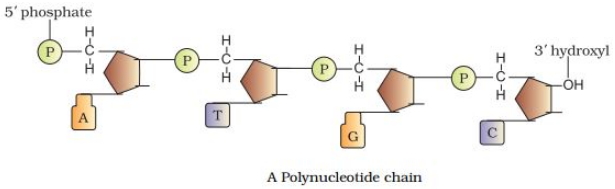
(N/A) nucleotide is composed of a nitrogenous base,a pentose sugar,and a phosphate group.
Pentose Sugar: Two types of sugar are present as given below: $(a)$ Ribose (in case of $RNA$) $(b)$ Deoxyribose (in case of $DNA$).
Nitrogenous Base: It is a nitrogen-containing organic molecule having physical properties similar to a base.
There are two types of nitrogenous bases: $(a)$ Purines (Adenine and Guanine). $(b)$ Pyrimidines (Cytosine,Uracil,and Thymine). Out of the pyrimidines,Cytosine is common for both $DNA$ and $RNA$,while Thymine is present in $DNA$ and Uracil is present in $RNA$.
$A$ nitrogenous base is linked to the pentose sugar through an $N$-glycosidic linkage to form a nucleoside,such as adenosine or deoxyadenosine,guanosine or deoxyguanosine,cytidine or deoxycytidine,and uridine or deoxythymidine.
When a phosphate group is linked to the $5^{\prime}-OH$ of a nucleoside through a phosphoester linkage,a corresponding nucleotide (or deoxynucleotide depending upon the type of sugar present) is formed.
Two nucleotides are linked through a $3^{\prime}-5^{\prime}$ phosphodiester linkage to form a dinucleotide.
More nucleotides can be joined in such a manner to form a polynucleotide chain.
$A$ polymer thus formed has at one end a free phosphate moiety at the $5^{\prime}$-end of the ribose sugar,which is referred to as the $5^{\prime}$-end of the polynucleotide chain.
Similarly,at the other end of the polymer,the ribose has a free $3^{\prime}-OH$ group which is referred to as the $3^{\prime}$-end of the polynucleotide chain.
The backbone in a polynucleotide chain is formed due to sugar and phosphate.
The nitrogenous bases linked to the sugar moiety project from the backbone.
In $RNA$,every nucleotide residue has an additional $-OH$ group present at the $2^{\prime}$-position in the ribose.
Also,in $RNA$,the uracil is found in place of thymine ($5$-methyl uracil,another chemical name for thymine).
Pentose Sugar: Two types of sugar are present as given below: $(a)$ Ribose (in case of $RNA$) $(b)$ Deoxyribose (in case of $DNA$).
Nitrogenous Base: It is a nitrogen-containing organic molecule having physical properties similar to a base.
There are two types of nitrogenous bases: $(a)$ Purines (Adenine and Guanine). $(b)$ Pyrimidines (Cytosine,Uracil,and Thymine). Out of the pyrimidines,Cytosine is common for both $DNA$ and $RNA$,while Thymine is present in $DNA$ and Uracil is present in $RNA$.
$A$ nitrogenous base is linked to the pentose sugar through an $N$-glycosidic linkage to form a nucleoside,such as adenosine or deoxyadenosine,guanosine or deoxyguanosine,cytidine or deoxycytidine,and uridine or deoxythymidine.
When a phosphate group is linked to the $5^{\prime}-OH$ of a nucleoside through a phosphoester linkage,a corresponding nucleotide (or deoxynucleotide depending upon the type of sugar present) is formed.
Two nucleotides are linked through a $3^{\prime}-5^{\prime}$ phosphodiester linkage to form a dinucleotide.
More nucleotides can be joined in such a manner to form a polynucleotide chain.
$A$ polymer thus formed has at one end a free phosphate moiety at the $5^{\prime}$-end of the ribose sugar,which is referred to as the $5^{\prime}$-end of the polynucleotide chain.
Similarly,at the other end of the polymer,the ribose has a free $3^{\prime}-OH$ group which is referred to as the $3^{\prime}$-end of the polynucleotide chain.
The backbone in a polynucleotide chain is formed due to sugar and phosphate.
The nitrogenous bases linked to the sugar moiety project from the backbone.
In $RNA$,every nucleotide residue has an additional $-OH$ group present at the $2^{\prime}$-position in the ribose.
Also,in $RNA$,the uracil is found in place of thymine ($5$-methyl uracil,another chemical name for thymine).
0 likes
View Solution377
Medium
Describe the structure of $DNA$ as proposed by Watson and Crick.
Solution
(N/A) The structure of $DNA$ was proposed by James Watson and Francis Crick in $1953$ based on $X$-ray diffraction data produced by Maurice Wilkins and Rosalind Franklin.
Key features of the double helix model include:
$1$. $DNA$ consists of two polynucleotide chains where the backbone is constituted by sugar-phosphate,and the bases project inside.
$2$. The two chains have anti-parallel polarity. If one chain has the polarity $5' \rightarrow 3'$,the other has $3' \rightarrow 5'$.
$3$. The bases in two strands are paired through hydrogen bonds forming base pairs $(bp)$. Adenine $(A)$ forms two hydrogen bonds with Thymine $(T)$,and Guanine $(G)$ forms three hydrogen bonds with Cytosine $(C)$.
$4$. The two chains are coiled in a right-handed fashion. The pitch of the helix is $3.4 \ nm$ $(34 \ \mathring{A})$,and there are roughly $10$ base pairs in each turn.
$5$. The plane of one base pair stacks over the other in a double helix,which confers stability to the helical structure.
Key features of the double helix model include:
$1$. $DNA$ consists of two polynucleotide chains where the backbone is constituted by sugar-phosphate,and the bases project inside.
$2$. The two chains have anti-parallel polarity. If one chain has the polarity $5' \rightarrow 3'$,the other has $3' \rightarrow 5'$.
$3$. The bases in two strands are paired through hydrogen bonds forming base pairs $(bp)$. Adenine $(A)$ forms two hydrogen bonds with Thymine $(T)$,and Guanine $(G)$ forms three hydrogen bonds with Cytosine $(C)$.
$4$. The two chains are coiled in a right-handed fashion. The pitch of the helix is $3.4 \ nm$ $(34 \ \mathring{A})$,and there are roughly $10$ base pairs in each turn.
$5$. The plane of one base pair stacks over the other in a double helix,which confers stability to the helical structure.
0 likes
View Solution378
Easy
Explain the genetic implication of the structure of $DNA$.
Solution
(N/A) The base pairing confers a unique property to the polynucleotide chains.
Both polynucleotide chains are complementary to each other. Therefore,if the sequence of bases in one strand is known,the sequence of bases in the other strand can be predicted.
If each strand of $DNA$ (parent $DNA$) acts as a template for the synthesis of a new strand,the two double-stranded $DNA$ molecules (daughter $DNA$) produced would be identical to the parent $DNA$ molecule.
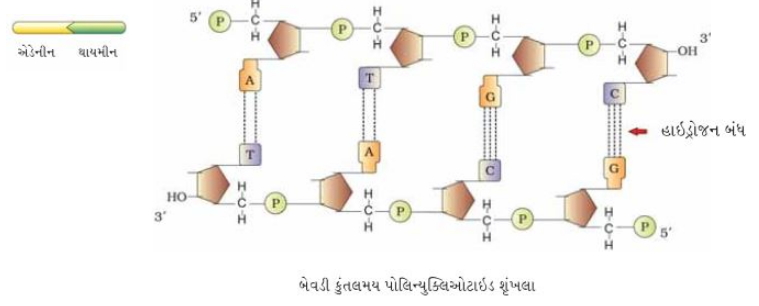
The main features of the double-helical structure of $DNA$ are as follows:
$(1)$ $DNA$ is made of two polynucleotide chains. Its backbone is constituted by sugar-phosphate,and the nitrogenous bases project inside.
$(2)$ The two chains have anti-parallel polarity. It means,if one chain has the polarity $5' \rightarrow 3'$,the other has $3' \rightarrow 5'$.
$(3)$ The nitrogenous bases in the two strands are paired through hydrogen bonds forming base pairs. Adenine forms two hydrogen bonds with Thymine from the opposite strand and vice-versa. Similarly,Guanine is bonded with Cytosine by three hydrogen bonds.
$A = T, G \equiv C$
This results in a uniform distance between the two strands.
$(4)$ The two chains are coiled in a right-handed fashion. The pitch of the helix is $3.4 \ nm$ (a nanometre is $10^{-9} \ m$) and there are roughly $10 \ bp$ in each turn. Consequently,the distance between a base pair in a helix is approximately $0.34 \ nm$.
Both polynucleotide chains are complementary to each other. Therefore,if the sequence of bases in one strand is known,the sequence of bases in the other strand can be predicted.
If each strand of $DNA$ (parent $DNA$) acts as a template for the synthesis of a new strand,the two double-stranded $DNA$ molecules (daughter $DNA$) produced would be identical to the parent $DNA$ molecule.
The main features of the double-helical structure of $DNA$ are as follows:
$(1)$ $DNA$ is made of two polynucleotide chains. Its backbone is constituted by sugar-phosphate,and the nitrogenous bases project inside.
$(2)$ The two chains have anti-parallel polarity. It means,if one chain has the polarity $5' \rightarrow 3'$,the other has $3' \rightarrow 5'$.
$(3)$ The nitrogenous bases in the two strands are paired through hydrogen bonds forming base pairs. Adenine forms two hydrogen bonds with Thymine from the opposite strand and vice-versa. Similarly,Guanine is bonded with Cytosine by three hydrogen bonds.
$A = T, G \equiv C$
This results in a uniform distance between the two strands.
$(4)$ The two chains are coiled in a right-handed fashion. The pitch of the helix is $3.4 \ nm$ (a nanometre is $10^{-9} \ m$) and there are roughly $10 \ bp$ in each turn. Consequently,the distance between a base pair in a helix is approximately $0.34 \ nm$.
0 likes
View Solution379
Medium
How is the chromosome structured through the packaging of the $DNA$ helix? Describe in detail.
Solution
(N/A) Taking the distance between two consecutive base pairs as $0.34 \, nm$ $(0.34 \times 10^{-9} \, m)$,if we calculate the length of $DNA$ in a typical mammalian cell with a double-helical structure by multiplying the total number of base pairs by the distance between two adjacent pairs,i.e.,$6.6 \times 10^9 \, bp \times 0.34 \times 10^{-9} \, m/bp$,it is approximately $2.2 \, m$. This length is much greater than the dimensions of a typical nucleus (approximately $10^{-6} \, m$).
In $Escherichia \, coli$ $(E. \, coli)$,the length of $DNA$ is $1.36 \, mm$ with $4 \times 10^6 \, bp$.
Although $E. \, coli$ lacks a well-defined nucleus,the $DNA$ is not scattered throughout the cell. The negatively charged $DNA$ is held in a specific region with the help of some positively charged proteins,which is called the nucleoid.
In the nucleoid,$DNA$ is organized in large loops held by proteins.
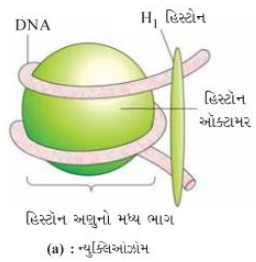
In eukaryotes,this organization is much more complex. It involves a set of positively charged proteins called histones.
Proteins acquire their charge based on the abundance of amino acids with charged side chains.
Histone proteins are rich in the basic amino acids lysine and arginine,both of which carry a positive charge in their side chains.
An organized unit of eight histone molecules is called a histone octamer. The negatively charged $DNA$ wraps around the positively charged histone octamer to form a structure called a nucleosome.
Nucleosomes constitute the repeating unit of a structure in the nucleus called chromatin,which appears as 'beads-on-string' under an electron microscope.
In $Escherichia \, coli$ $(E. \, coli)$,the length of $DNA$ is $1.36 \, mm$ with $4 \times 10^6 \, bp$.
Although $E. \, coli$ lacks a well-defined nucleus,the $DNA$ is not scattered throughout the cell. The negatively charged $DNA$ is held in a specific region with the help of some positively charged proteins,which is called the nucleoid.
In the nucleoid,$DNA$ is organized in large loops held by proteins.
In eukaryotes,this organization is much more complex. It involves a set of positively charged proteins called histones.
Proteins acquire their charge based on the abundance of amino acids with charged side chains.
Histone proteins are rich in the basic amino acids lysine and arginine,both of which carry a positive charge in their side chains.
An organized unit of eight histone molecules is called a histone octamer. The negatively charged $DNA$ wraps around the positively charged histone octamer to form a structure called a nucleosome.
Nucleosomes constitute the repeating unit of a structure in the nucleus called chromatin,which appears as 'beads-on-string' under an electron microscope.
0 likes
View Solution380
Medium
Explain why $DNA$ is more stable than $RNA$ as a genetic material.
Solution
(A) $DNA$ is the predominant genetic material,as established by the Hershey-Chase experiments.
For a molecule to act as a genetic material,it must fulfill the following criteria:
$(i)$ It should be able to generate its replica (replication).
$(ii)$ It should be chemically and structurally stable.
$(iii)$ It should provide the scope for slow changes (mutation) that are required for evolution.
$(iv)$ It should be able to express itself in the form of 'Mendelian characters'.
If we consider the principle of base pairing and complementarity,both $DNA$ and $RNA$ can replicate. Proteins fail to fulfill this criterion.
The stability of genetic material is essential,as it should not change with different stages of the life cycle,age,or changes in the physiology of the organism.
This stability is evident from Griffith's 'Transforming Principle',where heating the bacteria did not destroy the properties of the genetic material.
Even if the two strands of $DNA$ are separated by heating,they can come together under appropriate conditions.
In $RNA$,every nucleotide has a $2'-OH$ group present as a reactive group,which makes $RNA$ unstable and easily degradable.
Compared to $RNA$,$DNA$ is chemically less reactive and structurally more stable. Thus,$DNA$ is a better genetic material.
$DNA$ also gains additional stability due to the presence of thymine instead of uracil.
Both $DNA$ and $RNA$ can mutate,but $RNA$ is unstable and mutates at a faster rate. Consequently,viruses with $RNA$ genomes,having shorter life spans,mutate and evolve faster.
$RNA$ can directly code for protein synthesis and can easily express characters,whereas $DNA$ is dependent on $RNA$ for protein synthesis.
Thus,while both $RNA$ and $DNA$ can function as genetic material,$DNA$ is more stable and preferred for the storage of genetic information,while $RNA$ is better suited for the transmission of genetic information.
For a molecule to act as a genetic material,it must fulfill the following criteria:
$(i)$ It should be able to generate its replica (replication).
$(ii)$ It should be chemically and structurally stable.
$(iii)$ It should provide the scope for slow changes (mutation) that are required for evolution.
$(iv)$ It should be able to express itself in the form of 'Mendelian characters'.
If we consider the principle of base pairing and complementarity,both $DNA$ and $RNA$ can replicate. Proteins fail to fulfill this criterion.
The stability of genetic material is essential,as it should not change with different stages of the life cycle,age,or changes in the physiology of the organism.
This stability is evident from Griffith's 'Transforming Principle',where heating the bacteria did not destroy the properties of the genetic material.
Even if the two strands of $DNA$ are separated by heating,they can come together under appropriate conditions.
In $RNA$,every nucleotide has a $2'-OH$ group present as a reactive group,which makes $RNA$ unstable and easily degradable.
Compared to $RNA$,$DNA$ is chemically less reactive and structurally more stable. Thus,$DNA$ is a better genetic material.
$DNA$ also gains additional stability due to the presence of thymine instead of uracil.
Both $DNA$ and $RNA$ can mutate,but $RNA$ is unstable and mutates at a faster rate. Consequently,viruses with $RNA$ genomes,having shorter life spans,mutate and evolve faster.
$RNA$ can directly code for protein synthesis and can easily express characters,whereas $DNA$ is dependent on $RNA$ for protein synthesis.
Thus,while both $RNA$ and $DNA$ can function as genetic material,$DNA$ is more stable and preferred for the storage of genetic information,while $RNA$ is better suited for the transmission of genetic information.
0 likes
View Solution381
Medium
What is a gene? Explain its structure and function.
Solution
(N/A) gene is defined as the functional unit of inheritance. It is a segment of $DNA$ that codes for a polypeptide.
$1$. $A$ gene is also defined by the $DNA$ sequence that codes for $t-RNA$ or $r-RNA$ molecules.
$2$. The $DNA$ segment within a transcription unit that codes for a polypeptide is called a cistron. In eukaryotes,genes are monocistronic,whereas in prokaryotes,they can be polycistronic.
$3$. Eukaryotic genes are 'split genes' containing interrupted coding sequences. The coding or expressed sequences are called exons.
$4$. Exons appear in mature or processed $RNA$ and are interrupted by introns. Introns do not appear in mature or processed $RNA$.
$5$. The inheritance of a character is also affected by promoter and regulatory sequences of a gene. Regulatory sequences do not code for any $RNA$ or protein but control the expression of structural genes.
$1$. $A$ gene is also defined by the $DNA$ sequence that codes for $t-RNA$ or $r-RNA$ molecules.
$2$. The $DNA$ segment within a transcription unit that codes for a polypeptide is called a cistron. In eukaryotes,genes are monocistronic,whereas in prokaryotes,they can be polycistronic.
$3$. Eukaryotic genes are 'split genes' containing interrupted coding sequences. The coding or expressed sequences are called exons.
$4$. Exons appear in mature or processed $RNA$ and are interrupted by introns. Introns do not appear in mature or processed $RNA$.
$5$. The inheritance of a character is also affected by promoter and regulatory sequences of a gene. Regulatory sequences do not code for any $RNA$ or protein but control the expression of structural genes.
0 likes
View Solution382
EasyMCQ
What is the approximate molar concentration of $DNA$ in a human cell?
A
$2 \, mg/mL$
B
$5 \, mg/mL$
C
$10 \, mg/mL$
D
$1 \, mg/mL$
Solution
(A) The concentration of $DNA$ in a human cell is approximately $2 \, mg/mL$ of cell extract. This value is often cited in laboratory protocols for $DNA$ isolation from human cells.
0 likes
View Solution383
Easy
Nucleic acids exhibit secondary structure. Describe through the Watson-Crick model.
Solution
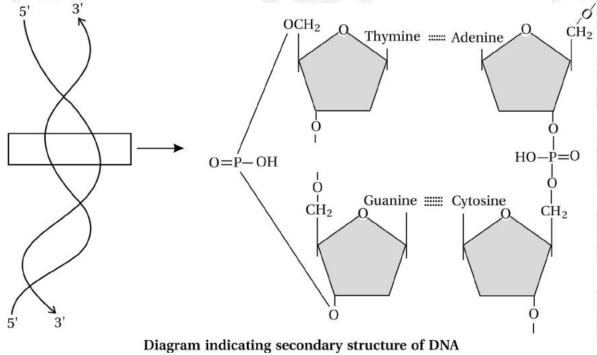
(N/A) The Watson-Crick model of $DNA$ describes its secondary structure as a double helix.
Key features of the model include:
$1$. $DNA$ consists of two polynucleotide chains that run in an anti-parallel direction, meaning one chain runs in the $5' \rightarrow 3'$ direction and the other in the $3' \rightarrow 5'$ direction.
$2$. The backbone is formed by sugar-phosphate linkages. $A$ phosphate moiety links the $3'$-carbon of one sugar to the $5'$-carbon of the sugar of the succeeding nucleotide via phosphodiester bonds.
$3$. The two chains are held together by hydrogen bonds between nitrogenous bases. Adenine $(A)$ pairs with Thymine $(T)$ via two hydrogen bonds, and Guanine $(G)$ pairs with Cytosine $(C)$ via three hydrogen bonds.
$4$. The helix is right-handed. One full turn of the helical strand involves $10$ base pairs.
$5$. The pitch of the helix is $3.4 \text{ nm}$ $(34 \text{ Å})$, and the distance between two successive base pairs is $0.34 \text{ nm}$ $(3.4 \text{ Å})$.
$6$. This specific form of $DNA$ is known as $B-DNA$.
Key features of the model include:
$1$. $DNA$ consists of two polynucleotide chains that run in an anti-parallel direction, meaning one chain runs in the $5' \rightarrow 3'$ direction and the other in the $3' \rightarrow 5'$ direction.
$2$. The backbone is formed by sugar-phosphate linkages. $A$ phosphate moiety links the $3'$-carbon of one sugar to the $5'$-carbon of the sugar of the succeeding nucleotide via phosphodiester bonds.
$3$. The two chains are held together by hydrogen bonds between nitrogenous bases. Adenine $(A)$ pairs with Thymine $(T)$ via two hydrogen bonds, and Guanine $(G)$ pairs with Cytosine $(C)$ via three hydrogen bonds.
$4$. The helix is right-handed. One full turn of the helical strand involves $10$ base pairs.
$5$. The pitch of the helix is $3.4 \text{ nm}$ $(34 \text{ Å})$, and the distance between two successive base pairs is $0.34 \text{ nm}$ $(3.4 \text{ Å})$.
$6$. This specific form of $DNA$ is known as $B-DNA$.
0 likes
View Solution384
MediumMCQ
The bond between the phosphate group and the hydroxyl group of the sugar is known as a/an:
A
Glycosidic bond
B
Ester bond
C
Peptide bond
D
Hydrogen bond
Solution
(B) In a nucleotide,the phosphate group is linked to the $5'$-hydroxyl group of the sugar (nucleoside) through a phosphodiester bond,which is a type of ester bond. Specifically,the reaction between the phosphoric acid and the hydroxyl group of the sugar forms an ester linkage.
0 likes
View Solution385
Medium
Give differences between $DNA$ and $RNA$.
Solution
(N/A)
| $DNA$ | $RNA$ |
|---|---|
| $(1)$ It is double-stranded,with the exception of some viruses. | $(1)$ It is generally single-stranded. |
| $(2)$ It is the genetic material in all living organisms. | $(2)$ It is the genetic material in some viruses only. |
| $(3)$ The sugar present is deoxyribose. | $(3)$ The sugar present is ribose. |
| $(4)$ Nitrogenous bases present are adenine,guanine,thymine,and cytosine. | $(4)$ Nitrogenous bases present are adenine,guanine,cytosine,and uracil. |
| $(5)$ It is less reactive,and chemically and structurally more stable. | $(5)$ It is more reactive,and chemically and structurally less stable. |
| $(6)$ It usually occurs inside the nucleus and in some cell organelles. | $(6)$ Very little $RNA$ occurs inside the nucleus; most of it is found in the cytoplasm. |
0 likes
View Solution386
Medium
Distinguish between: Repetitive $DNA$ and Satellite $DNA$.
Solution
(N/A)
| Repetitive $DNA$ | Satellite $DNA$ |
|---|---|
| $(1)$ It consists of non-coding $DNA$ sequences that are present in multiple copies,either in tandem or interspersed. | $(1)$ It consists of non-coding $DNA$ sequences that are present in tandem repeats. |
| $(2)$ The length of the repeat unit can range from a few base pairs to thousands of base pairs. | $(2)$ These are typically short repeat sequences (up to $60$ base pairs). |
| $(3)$ It forms lighter bands in a cesium chloride density gradient. | $(3)$ It forms small,distinct dark bands (satellite peaks) in a cesium chloride density gradient. |
0 likes
View Solution387
Medium
Provide definitions/explanations for the following terms: $Nucleosome$ and $Euchromatin$.
Solution
(N/A) $Nucleosome$ is a structural unit of a eukaryotic chromosome,consisting of a length of $DNA$ coiled around a core of histones. The negatively charged $DNA$ is wrapped around the positively charged histone octamer to form this structure.
$Euchromatin$ refers to a region of chromatin that is loosely packed and stains lightly during interphase. It is transcriptionally active,meaning the $DNA$ within these regions is more accessible for gene expression.
$Euchromatin$ refers to a region of chromatin that is loosely packed and stains lightly during interphase. It is transcriptionally active,meaning the $DNA$ within these regions is more accessible for gene expression.
0 likes
View Solution388
Easy
Provide the full forms of the following:
$1.$ $\text{DNA}$
$2.$ $\text{RNA}$
$3.$ $\text{hnRNA}$
$4.$ $\text{UTR}$
$1.$ $\text{DNA}$
$2.$ $\text{RNA}$
$3.$ $\text{hnRNA}$
$4.$ $\text{UTR}$
Solution
(N/A) $1.$ $\text{DNA}$: $\text{Deoxyribonucleic acid}$
$2.$ $\text{RNA}$: $\text{Ribonucleic acid}$
$3.$ $\text{hnRNA}$: $\text{Heterogeneous nuclear RNA}$
$4.$ $\text{UTR}$: $\text{Untranslated region}$
$2.$ $\text{RNA}$: $\text{Ribonucleic acid}$
$3.$ $\text{hnRNA}$: $\text{Heterogeneous nuclear RNA}$
$4.$ $\text{UTR}$: $\text{Untranslated region}$
0 likes
View Solution389
Medium
Explain the role of the following scientists in the discovery of the structure of $DNA$:
$1.$ Watson and Crick $(1953)$
$2.$ Erwin Chargaff
$1.$ Watson and Crick $(1953)$
$2.$ Erwin Chargaff
Solution
(N/A) $1.$ Watson and Crick $(1953)$ proposed a very simple but famous $\text{Double Helix}$ model for the structure of $DNA$ based on $X$-ray diffraction data.
$2.$ Erwin Chargaff observed that for a double-stranded $DNA$ molecule,the ratios between $\text{Adenine}$ and $\text{Thymine}$ and between $\text{Guanine}$ and $\text{Cytosine}$ are constant and equal to one,i.e.,$A = T$ and $G = C$.
$2.$ Erwin Chargaff observed that for a double-stranded $DNA$ molecule,the ratios between $\text{Adenine}$ and $\text{Thymine}$ and between $\text{Guanine}$ and $\text{Cytosine}$ are constant and equal to one,i.e.,$A = T$ and $G = C$.
0 likes
View Solution390
MediumMCQ
What is the function of histones in $DNA$ packaging?
A
To protect $DNA$ from damage
B
To facilitate $DNA$ replication
C
To organize $DNA$ into compact structures called nucleosomes
D
To catalyze $DNA$ transcription
Solution
(C) Histones are basic proteins that are rich in the positively charged amino acids,arginine and lysine.
Histones form an octamer,which consists of eight histone molecules.
Negatively charged $DNA$ wraps around this positively charged histone octamer to form a structure called a nucleosome.
This process is essential for the packaging of $DNA$ into the compact chromatin structure within the eukaryotic nucleus.
Histones form an octamer,which consists of eight histone molecules.
Negatively charged $DNA$ wraps around this positively charged histone octamer to form a structure called a nucleosome.
This process is essential for the packaging of $DNA$ into the compact chromatin structure within the eukaryotic nucleus.
0 likes
View Solution391
Easy
Distinguish between heterochromatin and euchromatin. Which of the two is transcriptionally active?
Solution
(N/A) Euchromatin:
$(i)$ Loosely packed.
$(ii)$ Stains light.
$(iii)$ Transcriptionally active.
Heterochromatin:
$(i)$ Densely packed.
$(ii)$ Stains dark.
$(iii)$ Transcriptionally inactive.
Euchromatin is the transcriptionally active form of chromatin.
$(i)$ Loosely packed.
$(ii)$ Stains light.
$(iii)$ Transcriptionally active.
Heterochromatin:
$(i)$ Densely packed.
$(ii)$ Stains dark.
$(iii)$ Transcriptionally inactive.
Euchromatin is the transcriptionally active form of chromatin.
0 likes
View Solution392
MediumMCQ
In an experiment,$DNA$ is treated with a compound that intercalates between the stacks of nitrogenous base pairs. As a result,the distance between two consecutive base pairs increases from $0.34 \, nm$ to $0.44 \, nm$. Calculate the length of the $DNA$ double helix (which has $2 \times 10^9 \, bp$) in the presence of a saturating amount of this compound. (in $m$)
A
$0.44$
B
$0.88$
C
$0.68$
D
$1.32$
Solution
(B) The total length of the $DNA$ double helix is calculated by multiplying the total number of base pairs $(bp)$ by the distance between two consecutive base pairs.
Given:
Total number of base pairs = $2 \times 10^9 \, bp$
New distance between base pairs = $0.44 \, nm = 0.44 \times 10^{-9} \, m$
Calculation:
Length = $(2 \times 10^9 \, bp) \times (0.44 \times 10^{-9} \, m/bp)$
Length = $2 \times 0.44 \times 10^0 \, m$
Length = $0.88 \, m$
Therefore,the length of the $DNA$ double helix is $0.88 \, m$.
Given:
Total number of base pairs = $2 \times 10^9 \, bp$
New distance between base pairs = $0.44 \, nm = 0.44 \times 10^{-9} \, m$
Calculation:
Length = $(2 \times 10^9 \, bp) \times (0.44 \times 10^{-9} \, m/bp)$
Length = $2 \times 0.44 \times 10^0 \, m$
Length = $0.88 \, m$
Therefore,the length of the $DNA$ double helix is $0.88 \, m$.
0 likes
View Solution393
MediumMCQ
What would happen if histones were to be mutated and made rich in acidic amino acids such as aspartic acid and glutamic acid in place of basic amino acids such as lysine and arginine?
A
$DNA$ would become more tightly coiled.
B
$DNA$ packaging would not occur.
C
Transcription would increase significantly.
D
Histones would bind more strongly to $DNA$.
Solution
(B) Histones are basic proteins rich in positively charged amino acids like lysine and arginine.
These positive charges allow histones to interact with the negatively charged phosphate backbone of $DNA$.
If histones were mutated to be rich in acidic amino acids (like aspartic acid and glutamic acid),they would become negatively charged.
Since $DNA$ is also negatively charged,electrostatic repulsion would occur between the mutated histones and $DNA$.
Consequently,the packaging of $DNA$ into nucleosomes would not occur,and chromatin fibers would not be formed.
These positive charges allow histones to interact with the negatively charged phosphate backbone of $DNA$.
If histones were mutated to be rich in acidic amino acids (like aspartic acid and glutamic acid),they would become negatively charged.
Since $DNA$ is also negatively charged,electrostatic repulsion would occur between the mutated histones and $DNA$.
Consequently,the packaging of $DNA$ into nucleosomes would not occur,and chromatin fibers would not be formed.
0 likes
View Solution394
Medium
What background information did Watson and Crick have available for developing a model of $DNA$? What was their contribution?
Solution
(N/A) Watson and Crick utilized the following information to develop the double-helical model of $DNA$:
$(i)$ Chargaff's rules,which state that the ratios of adenine to thymine and guanine to cytosine are equal ($A=T$ and $C=G$).
$(ii)$ $X$-ray diffraction data produced by Maurice Wilkins and Rosalind Franklin,which provided insights into the physical structure of $DNA$.
$(iii)$ Their contribution included: $(a)$ Proposing the double-helical structure where complementary bases pair via hydrogen bonds,$(b)$ Suggesting a mechanism for semi-conservative replication,and $(c)$ Proposing that mutations could occur through tautomeric shifts in nitrogenous bases.
$(i)$ Chargaff's rules,which state that the ratios of adenine to thymine and guanine to cytosine are equal ($A=T$ and $C=G$).
$(ii)$ $X$-ray diffraction data produced by Maurice Wilkins and Rosalind Franklin,which provided insights into the physical structure of $DNA$.
$(iii)$ Their contribution included: $(a)$ Proposing the double-helical structure where complementary bases pair via hydrogen bonds,$(b)$ Suggesting a mechanism for semi-conservative replication,and $(c)$ Proposing that mutations could occur through tautomeric shifts in nitrogenous bases.
0 likes
View Solution395
Easy
State the physical structure of $DNA$.
Solution
(N/A) $DNA$ is a long polymer of deoxyribonucleotides.
$\Rightarrow$ The length of $DNA$ is usually defined as the number of nucleotides (or a pair of nucleotides referred to as base pairs) present in it.
This is also a characteristic feature of an organism.
For example,a bacteriophage known as $\phi \times 174$ has $5386$ nucleotides,Bacteriophage lambda has $48502$ base pairs $(bp)$,Escherichia coli has $4.6 \times 10^{6} \ bp$,and the haploid content of human $DNA$ is $3.3 \times 10^{9} \ bp$.
$\Rightarrow$ The length of $DNA$ is usually defined as the number of nucleotides (or a pair of nucleotides referred to as base pairs) present in it.
This is also a characteristic feature of an organism.
For example,a bacteriophage known as $\phi \times 174$ has $5386$ nucleotides,Bacteriophage lambda has $48502$ base pairs $(bp)$,Escherichia coli has $4.6 \times 10^{6} \ bp$,and the haploid content of human $DNA$ is $3.3 \times 10^{9} \ bp$.
0 likes
View Solution396
Medium
Give the historical background of $DNA$.
Solution
(N/A) $DNA$ as an acidic substance present in the nucleus was first identified by Friedrich Miescher in $1869$. He named it as 'Nuclein'.
Due to technical limitations in isolating such a long polymer intact,the elucidation of the structure of $DNA$ remained elusive for a very long period of time.
It was only in $1953$ that James Watson and Francis Crick,based on the $X$-ray diffraction data produced by Maurice Wilkins and Rosalind Franklin,proposed a very simple but famous Double Helix model for the structure of $DNA$.
One of the hallmarks of their proposition was also based on the observation of Erwin Chargaff that for a double-stranded $DNA$,the ratio between Adenine and Thymine and Guanine and Cytosine are constant and equal to one.
Due to technical limitations in isolating such a long polymer intact,the elucidation of the structure of $DNA$ remained elusive for a very long period of time.
It was only in $1953$ that James Watson and Francis Crick,based on the $X$-ray diffraction data produced by Maurice Wilkins and Rosalind Franklin,proposed a very simple but famous Double Helix model for the structure of $DNA$.
One of the hallmarks of their proposition was also based on the observation of Erwin Chargaff that for a double-stranded $DNA$,the ratio between Adenine and Thymine and Guanine and Cytosine are constant and equal to one.
0 likes
View Solution397
Medium
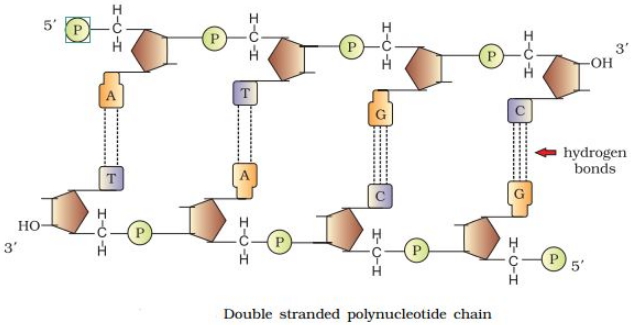
Describe the double helix structure of $DNA$ and explain how the sequences of the other strand are predicted.
Solution
(N/A) The base pairing confers a very unique property to the polynucleotide chains.
They are said to be complementary to each other,and therefore,if the sequence of bases in one strand is known,then the sequence in the other strand can be predicted.
Also,if each strand from $DNA$ acts as a template for the synthesis of a new strand,the two double-stranded $DNA$ (daughter $DNA$) molecules thus produced would be identical to the parental $DNA$ molecule. Because of this,the genetic implications of the structure of $DNA$ become very clear.
The salient features of the double helix structure of $DNA$ are as follows:
$(i)$ It is made of two polynucleotide chains where the backbone is constituted by sugar-phosphate and bases project inside.
$(ii)$ The two chains have anti-parallel polarity. It means,if one chain has the polarity $5^{\prime} \rightarrow 3^{\prime}$,the other has $3^{\prime} \rightarrow 5^{\prime}$.
$(iii)$ The bases in two strands are paired through hydrogen bonds ($H$-bonds) forming base pairs $[bp]$. Adenine $(A)$ forms two hydrogen bonds with Thymine $(T)$ from the opposite strand and vice-versa,while Guanine $(G)$ forms three hydrogen bonds with Cytosine $(C)$ and vice-versa.
They are said to be complementary to each other,and therefore,if the sequence of bases in one strand is known,then the sequence in the other strand can be predicted.
Also,if each strand from $DNA$ acts as a template for the synthesis of a new strand,the two double-stranded $DNA$ (daughter $DNA$) molecules thus produced would be identical to the parental $DNA$ molecule. Because of this,the genetic implications of the structure of $DNA$ become very clear.
The salient features of the double helix structure of $DNA$ are as follows:
$(i)$ It is made of two polynucleotide chains where the backbone is constituted by sugar-phosphate and bases project inside.
$(ii)$ The two chains have anti-parallel polarity. It means,if one chain has the polarity $5^{\prime} \rightarrow 3^{\prime}$,the other has $3^{\prime} \rightarrow 5^{\prime}$.
$(iii)$ The bases in two strands are paired through hydrogen bonds ($H$-bonds) forming base pairs $[bp]$. Adenine $(A)$ forms two hydrogen bonds with Thymine $(T)$ from the opposite strand and vice-versa,while Guanine $(G)$ forms three hydrogen bonds with Cytosine $(C)$ and vice-versa.
0 likes
View Solution398
EasyMCQ
Which of the following statements is correct?
A
Adenine does not pair with thymine
B
Adenine pairs with thymine through two $H$-bonds
C
Adenine pairs with thymine through one $H$-bond
D
Adenine pairs with thymine through three $H$-bonds
Solution
(B) In the structure of $DNA$,adenine $(A)$ is a purine that specifically pairs with thymine $(T)$,which is a pyrimidine.
This pairing is stabilized by two hydrogen $(H)$ bonds between the nitrogenous bases.
Therefore,the statement that adenine pairs with thymine through two $H$-bonds is correct.
This pairing is stabilized by two hydrogen $(H)$ bonds between the nitrogenous bases.
Therefore,the statement that adenine pairs with thymine through two $H$-bonds is correct.
0 likes
View Solution399
EasyMCQ
If the distance between two consecutive base pairs is $0.34 \, nm$ and the total number of base pairs of a $DNA$ double helix in a typical mammalian cell is $6.6 \times 10^{9} \, bp$,then the length of the $DNA$ is approximately:
A
$2.7 \, meters$
B
$2.0 \, meters$
C
$2.5 \, meters$
D
$2.2 \, meters$
Solution
(D) The length of $DNA$ is calculated by multiplying the distance between two consecutive base pairs by the total number of base pairs.
Given:
Distance between two base pairs = $0.34 \, nm = 0.34 \times 10^{-9} \, m$.
Total number of base pairs = $6.6 \times 10^{9} \, bp$.
Length of $DNA$ = $(\text{Distance between two base pairs}) \times (\text{Total number of base pairs})$.
Length of $DNA$ = $(0.34 \times 10^{-9} \, m) \times (6.6 \times 10^{9} \, bp)$.
Length of $DNA$ = $0.34 \times 6.6 \, m = 2.244 \, m$.
Therefore,the length of the $DNA$ is approximately $2.2 \, meters$.
Given:
Distance between two base pairs = $0.34 \, nm = 0.34 \times 10^{-9} \, m$.
Total number of base pairs = $6.6 \times 10^{9} \, bp$.
Length of $DNA$ = $(\text{Distance between two base pairs}) \times (\text{Total number of base pairs})$.
Length of $DNA$ = $(0.34 \times 10^{-9} \, m) \times (6.6 \times 10^{9} \, bp)$.
Length of $DNA$ = $0.34 \times 6.6 \, m = 2.244 \, m$.
Therefore,the length of the $DNA$ is approximately $2.2 \, meters$.
0 likes
View SolutionMolecular Basis of Inheritance — The DNA · Frequently Asked Questions
1Are these Molecular Basis of Inheritance questions useful for JEE and NEET?
Yes. All questions in this section are mapped to JEE Main and NEET exam patterns. Previous year questions from JEE Main, NEET, GUJCET and state-level exams are included with full solutions.
2Can I switch to Hindi or Gujarati for these questions?
Yes. Use the language tabs in the hero section or the sidebar to view the same questions and solutions in English, Hindi or Gujarati.
3How do I generate a question paper from this subtopic?
Use the Vedclass Exam Paper Generator — select the chapter and subtopic, set difficulty, and generate Sets A, B, C, D automatically. First 3 chapters of every subject are free.
Vedclass Products
For Students
Vedclass Test Series
Mock tests in real JEE/NEET style with performance analysis. 5-day free trial.
Start Free TrialFor Teachers
Exam Paper Generator
Generate Set A/B/C/D papers from this chapter in 2 minutes. 3 chapters free.
Try FreeFor Institutes
Online Exam Module
Live online exams with unlimited students, 360° analytics & white-label branding.
See DemoFor Teachers & Institutes
Generate a Molecular Basis of Inheritance Exam Paper in 2 Minutes
Select subtopic & difficulty — Sets A, B, C, D auto-generated with No Repeat logic.
First 3 chapters of every subject are free — no payment required.