
A English
The DNA Questions in English
Class 12 Biology · Molecular Basis of Inheritance · The DNA
632+
Questions
English
Language
100%
With Solutions
Showing 50 of 632 questions in English
251
MediumMCQ
How does $DNA$ differ from $RNA$?
A
Only based on the nature of the sugar.
B
Only based on the nature of the purine.
C
Based on the nature of the sugar and the pyrimidine.
D
None of the above.
Solution
(C) $DNA$ (Deoxyribonucleic acid) and $RNA$ (Ribonucleic acid) differ in two primary ways regarding their chemical composition:
$1$. Sugar: $DNA$ contains $2'$-deoxyribose sugar,whereas $RNA$ contains ribose sugar.
$2$. Pyrimidine: $DNA$ contains thymine $(T)$ as a pyrimidine base,whereas $RNA$ contains uracil $(U)$ instead of thymine.
$1$. Sugar: $DNA$ contains $2'$-deoxyribose sugar,whereas $RNA$ contains ribose sugar.
$2$. Pyrimidine: $DNA$ contains thymine $(T)$ as a pyrimidine base,whereas $RNA$ contains uracil $(U)$ instead of thymine.
0 likes
View Solution252
MediumMCQ
What is the similarity between $DNA$ and $RNA$?
A
Both consist of double helices.
B
Both contain the same type of sugar.
C
Both are polymers of nucleotides.
D
Both contain the same pyrimidines.
Solution
(C) Both $DNA$ $(Deoxyribonucleic \text{ acid})$ and $RNA$ $(Ribonucleic \text{ acid})$ are nucleic acids.
Nucleic acids are long-chain polymers of nucleotides.
$A$ nucleotide consists of three components: a nitrogenous base, a pentose sugar, and a phosphate group.
Therefore, the fundamental structural similarity is that both are polymers of nucleotides.
Nucleic acids are long-chain polymers of nucleotides.
$A$ nucleotide consists of three components: a nitrogenous base, a pentose sugar, and a phosphate group.
Therefore, the fundamental structural similarity is that both are polymers of nucleotides.
0 likes
View Solution253
EasyMCQ
How is $DNA$ chemically different from $RNA$?
A
$DNA$ contains deoxyribose,whereas $RNA$ contains ribose.
B
$DNA$ and $RNA$ both contain thymine.
C
$DNA$ contains ribose and thymine,while $RNA$ contains deoxyribose and uracil.
D
$DNA$ contains ribose and thymine,while $RNA$ contains deoxyribose and cytosine.
Solution
(A) $DNA$ (Deoxyribonucleic acid) and $RNA$ (Ribonucleic acid) are nucleic acids that differ in their chemical composition:
$1$. Sugar component: $DNA$ contains $2'$-deoxyribose sugar,while $RNA$ contains ribose sugar.
$2$. Nitrogenous bases: $DNA$ contains adenine,guanine,cytosine,and thymine. $RNA$ contains adenine,guanine,cytosine,and uracil (thymine is replaced by uracil in $RNA$).
Therefore,the correct chemical difference is that $DNA$ contains deoxyribose sugar and $RNA$ contains ribose sugar.
$1$. Sugar component: $DNA$ contains $2'$-deoxyribose sugar,while $RNA$ contains ribose sugar.
$2$. Nitrogenous bases: $DNA$ contains adenine,guanine,cytosine,and thymine. $RNA$ contains adenine,guanine,cytosine,and uracil (thymine is replaced by uracil in $RNA$).
Therefore,the correct chemical difference is that $DNA$ contains deoxyribose sugar and $RNA$ contains ribose sugar.
0 likes
View Solution254
MediumMCQ
Which of the following ratios remains constant for the $DNA$ of every species?
A
$(A + T) / (C + G)$
B
$(A + C) / (T + G)$
C
$(A + U) / (C + G)$
D
$(A + G) / (C + T)$
Solution
(D) According to Chargaff's rules for $DNA$ base pairing,the amount of Adenine $(A)$ is equal to Thymine $(T)$,and the amount of Guanine $(G)$ is equal to Cytosine $(C)$.
Therefore,$A = T$ and $G = C$.
This implies that the sum of purines $(A + G)$ is equal to the sum of pyrimidines $(C + T)$.
Thus,the ratio $(A + G) / (C + T)$ is always equal to $1$,which is a constant value for the $DNA$ of every species.
Therefore,$A = T$ and $G = C$.
This implies that the sum of purines $(A + G)$ is equal to the sum of pyrimidines $(C + T)$.
Thus,the ratio $(A + G) / (C + T)$ is always equal to $1$,which is a constant value for the $DNA$ of every species.
0 likes
View Solution255
MediumMCQ
What is the reason for the anti-parallel nature of $DNA$ strands?
A
Hydrogen bonds
B
Disulfide bonds
C
Phosphodiester bonds
D
None of the above
Solution
(D) The $DNA$ double helix consists of two polynucleotide chains that run in opposite directions,a property known as anti-parallelism.
This orientation is primarily determined by the chemical structure of the sugar-phosphate backbone,where the $5'$ end of one strand is aligned with the $3'$ end of the other.
While hydrogen bonds hold the nitrogenous bases together,they do not dictate the anti-parallel orientation itself.
Phosphodiester bonds link the nucleotides within a single strand,but the anti-parallel arrangement is a structural consequence of the polarity of the deoxyribose sugar and the specific orientation of the phosphodiester linkages between the $3'$ and $5'$ carbons.
Therefore,none of the provided bond types are the direct cause of the anti-parallel nature; it is a result of the molecular geometry of the nucleotides.
This orientation is primarily determined by the chemical structure of the sugar-phosphate backbone,where the $5'$ end of one strand is aligned with the $3'$ end of the other.
While hydrogen bonds hold the nitrogenous bases together,they do not dictate the anti-parallel orientation itself.
Phosphodiester bonds link the nucleotides within a single strand,but the anti-parallel arrangement is a structural consequence of the polarity of the deoxyribose sugar and the specific orientation of the phosphodiester linkages between the $3'$ and $5'$ carbons.
Therefore,none of the provided bond types are the direct cause of the anti-parallel nature; it is a result of the molecular geometry of the nucleotides.
0 likes
View Solution256
MediumMCQ
In the structure of a nucleotide, the phosphate group is attached to which carbon of the sugar (in $5'$)?
A
$5'$
B
$4'$
C
$1'$
D
$2'$
Solution
(A) A nucleotide consists of three components: a nitrogenous base, a pentose sugar, and a phosphate group.
In a nucleotide, the nitrogenous base is attached to the $1'$ carbon of the pentose sugar.
The phosphate group is attached to the $5'$ carbon of the pentose sugar through a phosphoester linkage.
Therefore, the correct carbon position for the phosphate attachment is the $5'$ carbon.
In a nucleotide, the nitrogenous base is attached to the $1'$ carbon of the pentose sugar.
The phosphate group is attached to the $5'$ carbon of the pentose sugar through a phosphoester linkage.
Therefore, the correct carbon position for the phosphate attachment is the $5'$ carbon.
0 likes
View Solution257
EasyMCQ
Statement $P$: Uracil is not present in the structure of $DNA$.
Statement $Q$: $A-T$ complementary base pairing is present in the structure of $DNA$.
Statement $Q$: $A-T$ complementary base pairing is present in the structure of $DNA$.
A
Both statements $P$ and $Q$ are incorrect.
B
Both statements $P$ and $Q$ are correct. Statement $P$ is the correct explanation of statement $Q$.
C
Both statements $P$ and $Q$ are correct. Statement $Q$ is the correct explanation of statement $P$.
D
Both statements $P$ and $Q$ are correct.
Solution
(D) Statement $P$ is correct because $DNA$ contains the nitrogenous base thymine instead of uracil,which is found in $RNA$.
Statement $Q$ is correct because $DNA$ follows Chargaff's rule,where adenine $(A)$ pairs with thymine $(T)$ via two hydrogen bonds.
While both statements are scientifically accurate,statement $P$ (the absence of uracil) does not directly explain why $A-T$ pairing occurs (which is due to the specific chemical structure and hydrogen bonding capacity of these bases). Therefore,both statements are correct,but $P$ is not the explanation for $Q$.
Statement $Q$ is correct because $DNA$ follows Chargaff's rule,where adenine $(A)$ pairs with thymine $(T)$ via two hydrogen bonds.
While both statements are scientifically accurate,statement $P$ (the absence of uracil) does not directly explain why $A-T$ pairing occurs (which is due to the specific chemical structure and hydrogen bonding capacity of these bases). Therefore,both statements are correct,but $P$ is not the explanation for $Q$.
0 likes
View Solution258
EasyMCQ
Identify the pair of nucleotides in $DNA$ that are linked by three hydrogen bonds.
A
$T, G$
B
$A, C$
C
$C, G$
D
$A, G$
Solution
(C) In $DNA$ structure, nitrogenous bases follow Chargaff's rule of base pairing.
$Adenine$ $(A)$ pairs with $Thymine$ $(T)$ via two hydrogen bonds.
$Cytosine$ $(C)$ pairs with $Guanine$ $(G)$ via three hydrogen bonds.
Therefore, the pair linked by three hydrogen bonds is $C$ and $G$.
$Adenine$ $(A)$ pairs with $Thymine$ $(T)$ via two hydrogen bonds.
$Cytosine$ $(C)$ pairs with $Guanine$ $(G)$ via three hydrogen bonds.
Therefore, the pair linked by three hydrogen bonds is $C$ and $G$.
0 likes
View Solution259
EasyMCQ
In $DNA$,how are the nucleotides linked together?
A
Hydrogen bonds
B
Phosphodiester bonds
C
Van der Waals forces
D
Ionic bonds
Solution
(B) In a $DNA$ molecule,the nucleotides are linked together by $3'-5'$ phosphodiester bonds.
These bonds form the sugar-phosphate backbone of the $DNA$ strand.
Hydrogen bonds are responsible for pairing the nitrogenous bases between the two complementary strands,but the nucleotides within a single strand are linked by phosphodiester bonds.
These bonds form the sugar-phosphate backbone of the $DNA$ strand.
Hydrogen bonds are responsible for pairing the nitrogenous bases between the two complementary strands,but the nucleotides within a single strand are linked by phosphodiester bonds.
0 likes
View Solution260
MediumMCQ
Which of the following statements is false?
A
Iodine is a trace element.
B
$ATP$ is a coenzyme.
C
Every enzyme is active only at a specific $pH$.
D
The length of one complete turn of $DNA$ is $34 \ \mathring{A}$.
Solution
(B) $1$. Iodine is a trace element (micronutrient) required by the body,which is a true statement.
$2$. $ATP$ (Adenosine Triphosphate) is an energy currency molecule,not a coenzyme. Coenzymes are organic non-protein compounds that bind to enzymes to facilitate catalysis (e.g.,$NAD^+$,$FAD$). Therefore,this statement is false.
$3$. Enzymes are highly sensitive to $pH$ and exhibit maximum activity at an optimum $pH$ level,which is a true statement.
$4$. According to the Watson-Crick model,one full turn of the $DNA$ double helix measures $34 \ \mathring{A}$ and contains $10$ base pairs,which is a true statement.
$2$. $ATP$ (Adenosine Triphosphate) is an energy currency molecule,not a coenzyme. Coenzymes are organic non-protein compounds that bind to enzymes to facilitate catalysis (e.g.,$NAD^+$,$FAD$). Therefore,this statement is false.
$3$. Enzymes are highly sensitive to $pH$ and exhibit maximum activity at an optimum $pH$ level,which is a true statement.
$4$. According to the Watson-Crick model,one full turn of the $DNA$ double helix measures $34 \ \mathring{A}$ and contains $10$ base pairs,which is a true statement.
1 likes
View Solution261
MediumMCQ
Identify the complementary nitrogenous base for the adenine nitrogenous base in the structure of $DNA$.
A
Guanine
B
Thymine
C
Uracil
D
Cytosine
Solution
(B) According to the base-pairing rules established by Watson and Crick for $DNA$ structure,adenine $(A)$ always pairs with thymine $(T)$ via two hydrogen bonds.
Similarly,guanine $(G)$ pairs with cytosine $(C)$ via three hydrogen bonds.
Therefore,the complementary nitrogenous base for adenine in $DNA$ is thymine.
Similarly,guanine $(G)$ pairs with cytosine $(C)$ via three hydrogen bonds.
Therefore,the complementary nitrogenous base for adenine in $DNA$ is thymine.
0 likes
View Solution262
MediumMCQ
What is the ratio of purine to pyrimidine bases in each molecule of $DNA$?
A
$0.5$
B
$1$
C
$1.5$
D
$2$
Solution
(B) According to Chargaff's rules for double-stranded $DNA$,the amount of adenine $(A)$ is equal to the amount of thymine $(T)$,and the amount of guanine $(G)$ is equal to the amount of cytosine $(C)$.
Since $A = T$ and $G = C$,the total amount of purines $(A + G)$ is equal to the total amount of pyrimidines $(T + C)$.
Therefore,the ratio of purines to pyrimidines is $\frac{A + G}{T + C} = 1$.
Since $A = T$ and $G = C$,the total amount of purines $(A + G)$ is equal to the total amount of pyrimidines $(T + C)$.
Therefore,the ratio of purines to pyrimidines is $\frac{A + G}{T + C} = 1$.
0 likes
View Solution263
MediumMCQ
Which molecule is removed when an adenine nitrogenous base attaches to the first carbon of a ribose pentose sugar?
A
$H$
B
$OH$
C
$H_2O$
D
$N$
Solution
(C) When a nitrogenous base (like adenine) attaches to the $1'$ carbon of a pentose sugar (ribose or deoxyribose) to form a nucleoside,a condensation reaction occurs.
In this reaction,the hydroxyl group $(-OH)$ attached to the $1'$ carbon of the sugar and a hydrogen atom $(-H)$ from the nitrogenous base are removed.
This results in the elimination of a water molecule $(H_2O)$ and the formation of an $N$-glycosidic linkage between the sugar and the base.
In this reaction,the hydroxyl group $(-OH)$ attached to the $1'$ carbon of the sugar and a hydrogen atom $(-H)$ from the nitrogenous base are removed.
This results in the elimination of a water molecule $(H_2O)$ and the formation of an $N$-glycosidic linkage between the sugar and the base.
0 likes
View Solution264
MediumMCQ
$A$: The $DNA$ molecule consists of two polynucleotide chains that run antiparallel to each other.
$R$: The $DNA$ molecular model was proposed by scientists $Watson$ and $Crick$.
$R$: The $DNA$ molecular model was proposed by scientists $Watson$ and $Crick$.
A
$A$ and $R$ are both true and $R$ is the correct explanation of $A$.
B
$A$ and $R$ are both true,but $R$ is not the correct explanation of $A$.
C
$A$ is true and $R$ is false.
D
$A$ is false and $R$ is true.
Solution
(B) Assertion $(A)$ is true because $DNA$ is a double-stranded helix where the two polynucleotide chains run in opposite directions ($5' \rightarrow 3'$ and $3' \rightarrow 5'$),which is known as an antiparallel orientation.
Reason $(R)$ is also true as the double-helix model of $DNA$ was indeed proposed by James $Watson$ and Francis $Crick$ in $1953$.
However,the fact that $Watson$ and $Crick$ proposed the model is a historical fact and does not explain why the chains are antiparallel (which is due to the chemical structure of the deoxyribose sugar and the phosphate backbone). Therefore,$R$ is not the correct explanation of $A$.
Reason $(R)$ is also true as the double-helix model of $DNA$ was indeed proposed by James $Watson$ and Francis $Crick$ in $1953$.
However,the fact that $Watson$ and $Crick$ proposed the model is a historical fact and does not explain why the chains are antiparallel (which is due to the chemical structure of the deoxyribose sugar and the phosphate backbone). Therefore,$R$ is not the correct explanation of $A$.
0 likes
View Solution265
MediumMCQ
$A$: In a $DNA$ molecule,the proportion of purine and pyrimidine bases is equal.
$R$: In $DNA$,two purines or two pyrimidines do not pair opposite each other.
$R$: In $DNA$,two purines or two pyrimidines do not pair opposite each other.
A
$A$ and $R$ are both true and $R$ is the correct explanation of $A$.
B
$A$ and $R$ are both true,but $R$ is not the correct explanation of $A$.
C
$A$ is true and $R$ is false.
D
$A$ is false and $R$ is true.
Solution
(A) According to Chargaff's rule,in a double-stranded $DNA$ molecule,the amount of purine $(A+G)$ is equal to the amount of pyrimidine $(T+C)$.
This is because,in the $DNA$ double helix,a purine always pairs with a pyrimidine ($A$ pairs with $T$,and $G$ pairs with $C$) due to the specific spatial constraints of the sugar-phosphate backbone.
If two purines were to pair,the distance between the strands would be too wide,and if two pyrimidines were to pair,the distance would be too narrow.
Therefore,$A$ is true,$R$ is true,and $R$ is the correct explanation for $A$.
This is because,in the $DNA$ double helix,a purine always pairs with a pyrimidine ($A$ pairs with $T$,and $G$ pairs with $C$) due to the specific spatial constraints of the sugar-phosphate backbone.
If two purines were to pair,the distance between the strands would be too wide,and if two pyrimidines were to pair,the distance would be too narrow.
Therefore,$A$ is true,$R$ is true,and $R$ is the correct explanation for $A$.
0 likes
View Solution266
EasyMCQ
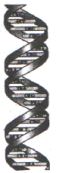
What structure is shown in the given figure?
A
Helical structure of $RNA$
B
Helical structure of protein
C
Structure of $ATP$
D
Double helical structure of $DNA$
Solution
(D) The provided image displays a double-stranded,twisted ladder-like structure known as the double helix.
This is the characteristic structure of $DNA$ (Deoxyribonucleic acid),as proposed by Watson and Crick.
The two strands are antiparallel and held together by hydrogen bonds between complementary nitrogenous bases.
This is the characteristic structure of $DNA$ (Deoxyribonucleic acid),as proposed by Watson and Crick.
The two strands are antiparallel and held together by hydrogen bonds between complementary nitrogenous bases.
0 likes
View Solution267
EasyMCQ
Which of the following statements is true for $DNA$?
A
It contains more purines and fewer pyrimidines.
B
It contains more pyrimidines and fewer purines.
C
The amount of purines is equal to the amount of pyrimidines.
D
It contains half as many pyrimidines as purines.
Solution
(C) According to $Chargaff's$ rule,in a double-stranded $DNA$ molecule,the total amount of purines $(Adenine + Guanine)$ is always equal to the total amount of pyrimidines $(Thymine + Cytosine)$.
This is because $Adenine$ $(A)$ always pairs with $Thymine$ $(T)$ and $Guanine$ $(G)$ always pairs with $Cytosine$ $(C)$.
Therefore,the ratio of purines to pyrimidines is $1:1$.
This is because $Adenine$ $(A)$ always pairs with $Thymine$ $(T)$ and $Guanine$ $(G)$ always pairs with $Cytosine$ $(C)$.
Therefore,the ratio of purines to pyrimidines is $1:1$.
0 likes
View Solution268
MediumMCQ
What is the ratio of purines to pyrimidines in a $DNA$ molecule containing $77$ nucleotides?
A
Purines are more and pyrimidines are less.
B
Pyrimidines are more and purines are less.
C
The amount of purines and pyrimidines is equal.
D
Purines are half the amount of pyrimidines.
Solution
(C) According to $Chargaff's$ rule,in a double-stranded $DNA$ molecule,the amount of purines $(Adenine + Guanine)$ is always equal to the amount of pyrimidines $(Thymine + Cytosine)$.
This is because $Adenine$ always pairs with $Thymine$ and $Guanine$ always pairs with $Cytosine$ through hydrogen bonds.
Therefore,the ratio of purines to pyrimidines is always $1:1$,regardless of the total number of nucleotides ($77$ in this case).
This is because $Adenine$ always pairs with $Thymine$ and $Guanine$ always pairs with $Cytosine$ through hydrogen bonds.
Therefore,the ratio of purines to pyrimidines is always $1:1$,regardless of the total number of nucleotides ($77$ in this case).
0 likes
View Solution269
EasyMCQ
In a $DNA$ molecule consisting of $28$ nucleotides,what is the number of purine nitrogenous bases?
A
$28$
B
$14$
C
$56$
D
$7$
Solution
(B) According to $Chargaff's$ rule,in a double-stranded $DNA$ molecule,the amount of purines $(Adenine + Guanine)$ is equal to the amount of pyrimidines $(Thymine + Cytosine)$.
In any $DNA$ molecule,the total number of nitrogenous bases is equal to the total number of nucleotides.
Since the total number of nucleotides is $28$,the total number of nitrogenous bases is also $28$.
Because purines and pyrimidines are present in equal proportions ($50\%$ each),the number of purines is calculated as $28 / 2 = 14$.
Therefore,the correct answer is $14$.
In any $DNA$ molecule,the total number of nitrogenous bases is equal to the total number of nucleotides.
Since the total number of nucleotides is $28$,the total number of nitrogenous bases is also $28$.
Because purines and pyrimidines are present in equal proportions ($50\%$ each),the number of purines is calculated as $28 / 2 = 14$.
Therefore,the correct answer is $14$.
0 likes
View Solution270
EasyMCQ
In a $DNA$ fragment containing $6$ adenine nitrogen bases,what is the number of thymine nitrogen bases?
A
$12$
B
$6$
C
$3$
D
$24$
Solution
(B) According to Chargaff's rule of $DNA$ base pairing,the amount of adenine $(A)$ is always equal to the amount of thymine $(T)$ in a double-stranded $DNA$ molecule $(A = T)$.
Given that the number of adenine bases is $6$,the number of thymine bases must also be $6$ to maintain the base pairing rule.
Therefore,the correct option is $B$.
Given that the number of adenine bases is $6$,the number of thymine bases must also be $6$ to maintain the base pairing rule.
Therefore,the correct option is $B$.
0 likes
View Solution271
MediumMCQ
What is the number of hydrogen bonds in a $DNA$ fragment containing only $5$ guanine nitrogen bases?
A
$5$
B
$10$
C
$15$
D
$25$
Solution
(C) In a $DNA$ molecule,guanine $(G)$ always pairs with cytosine $(C)$ via $3$ hydrogen bonds.
Since the fragment contains $5$ guanine bases,there must be $5$ cytosine bases to form complementary base pairs.
Total number of hydrogen bonds = (Number of $G-C$ pairs) $\times$ $3$.
Total number of hydrogen bonds = $5 \times 3 = 15$.
Since the fragment contains $5$ guanine bases,there must be $5$ cytosine bases to form complementary base pairs.
Total number of hydrogen bonds = (Number of $G-C$ pairs) $\times$ $3$.
Total number of hydrogen bonds = $5 \times 3 = 15$.
0 likes
View Solution272
MediumMCQ
What is the number of phosphodiester bonds in a $DNA$ molecule containing $10$ base pairs?
A
$10$
B
$18$
C
$20$
D
$5$
Solution
(B) $DNA$ molecule consists of two antiparallel strands.
In a single strand of $DNA$ with $n$ nucleotides,there are $(n-1)$ phosphodiester bonds.
For $10$ base pairs,each strand contains $10$ nucleotides.
Number of phosphodiester bonds in one strand = $10 - 1 = 9$.
Since there are two strands in a $DNA$ molecule,the total number of phosphodiester bonds = $9 + 9 = 18$.
In a single strand of $DNA$ with $n$ nucleotides,there are $(n-1)$ phosphodiester bonds.
For $10$ base pairs,each strand contains $10$ nucleotides.
Number of phosphodiester bonds in one strand = $10 - 1 = 9$.
Since there are two strands in a $DNA$ molecule,the total number of phosphodiester bonds = $9 + 9 = 18$.
0 likes
View Solution273
EasyMCQ
$A$ $DNA$ fragment contains $12$ nucleotides. What is the ratio of purine and pyrimidine nitrogenous bases in it?
A
Purine = $12$,Pyrimidine = $12$
B
Purine = $6$,Pyrimidine = $6$
C
Purine = $24$,Pyrimidine = $24$
D
The number of purines and pyrimidines is not fixed.
Solution
(B) According to $Chargaff's$ rule,in a double-stranded $DNA$ molecule,the amount of purines is equal to the amount of pyrimidines.
Since the $DNA$ fragment has $12$ nucleotides,it consists of $6$ base pairs.
In a double-stranded $DNA$ structure,each base pair consists of one purine and one pyrimidine.
Therefore,the total number of purines is $6$ and the total number of pyrimidines is $6$.
Since the $DNA$ fragment has $12$ nucleotides,it consists of $6$ base pairs.
In a double-stranded $DNA$ structure,each base pair consists of one purine and one pyrimidine.
Therefore,the total number of purines is $6$ and the total number of pyrimidines is $6$.
0 likes
View Solution274
MediumMCQ
What is the number of uracil nitrogen bases in a $DNA$ fragment containing $8$ adenine bases?
A
$4$
B
$8$
C
$1$
D
Zero
Solution
(D) $DNA$ (Deoxyribonucleic acid) is a nucleic acid that contains the nitrogenous bases adenine $(A)$,guanine $(G)$,cytosine $(C)$,and thymine $(T)$.
Uracil $(U)$ is a nitrogenous base found exclusively in $RNA$ (Ribonucleic acid) and replaces thymine in $RNA$ molecules.
Since the given molecule is a $DNA$ fragment,it does not contain uracil.
Therefore,the number of uracil bases in any $DNA$ fragment is $0$.
Uracil $(U)$ is a nitrogenous base found exclusively in $RNA$ (Ribonucleic acid) and replaces thymine in $RNA$ molecules.
Since the given molecule is a $DNA$ fragment,it does not contain uracil.
Therefore,the number of uracil bases in any $DNA$ fragment is $0$.
0 likes
View Solution275
EasyMCQ
What is the number of $H$-bonds in a $DNA$ fragment containing only $10$ thymine bases?
A
$10$
B
$20$
C
$30$
D
$5$
Solution
(B) In a $DNA$ double helix,adenine $(A)$ pairs with thymine $(T)$ via $2$ hydrogen bonds $(A=T)$.
Given that the $DNA$ fragment contains $10$ thymine $(T)$ bases,and assuming it is a double-stranded $DNA$ molecule where each $T$ is paired with an $A$,there will be $10$ adenine bases as well.
Since each $A-T$ base pair consists of $2$ hydrogen bonds,the total number of hydrogen bonds for $10$ $A-T$ pairs is $10 \times 2 = 20$.
Therefore,the correct answer is $20$.
Given that the $DNA$ fragment contains $10$ thymine $(T)$ bases,and assuming it is a double-stranded $DNA$ molecule where each $T$ is paired with an $A$,there will be $10$ adenine bases as well.
Since each $A-T$ base pair consists of $2$ hydrogen bonds,the total number of hydrogen bonds for $10$ $A-T$ pairs is $10 \times 2 = 20$.
Therefore,the correct answer is $20$.
0 likes
View Solution276
MediumMCQ
What is the length of a $DNA$ molecule consisting of three turns?
A
$34 \ \mathring A$
B
$68 \ \mathring A$
C
$102 \ \mathring A$
D
$3.4 \ \mathring A$
Solution
(C) In a $DNA$ double helix,one full turn (pitch) consists of $10$ base pairs and measures approximately $34 \ \mathring A$ in length.
Given that the $DNA$ molecule has three turns,the total length can be calculated as:
$\text{Total length} = \text{Number of turns} \times \text{Length per turn}$
$\text{Total length} = 3 \times 34 \ \mathring A = 102 \ \mathring A$.
Therefore,the correct option is $C$.
Given that the $DNA$ molecule has three turns,the total length can be calculated as:
$\text{Total length} = \text{Number of turns} \times \text{Length per turn}$
$\text{Total length} = 3 \times 34 \ \mathring A = 102 \ \mathring A$.
Therefore,the correct option is $C$.
0 likes
View Solution277
DifficultMCQ
What is the width of a $DNA$ molecule having five turns?
A
$34\,\mathring{A}$
B
$170\,\mathring{A}$
C
$100\,\mathring{A}$
D
$20\,\mathring{A}$
Solution
(D) The width (diameter) of a standard $B-DNA$ double helix is constant regardless of the number of turns.
In a $B-DNA$ molecule,the distance between the two strands is approximately $20\,\mathring{A}$ $(2\,\text{nm})$.
Since the width is a structural property of the helix diameter and not dependent on the length (number of turns),the width remains $20\,\mathring{A}$ for any number of turns.
In a $B-DNA$ molecule,the distance between the two strands is approximately $20\,\mathring{A}$ $(2\,\text{nm})$.
Since the width is a structural property of the helix diameter and not dependent on the length (number of turns),the width remains $20\,\mathring{A}$ for any number of turns.
0 likes
View Solution278
MediumMCQ
$DNA$ differs from $RNA$ because:
A
They have different sugars.
B
They have different nitrogenous bases.
C
They have a different number of polynucleotide chains.
D
All of the above.
Solution
(D) $DNA$ (Deoxyribonucleic acid) and $RNA$ (Ribonucleic acid) differ in the following ways:
$1$. Sugar: $DNA$ contains $2'$-deoxyribose sugar,while $RNA$ contains ribose sugar.
$2$. Nitrogenous bases: $DNA$ contains adenine,guanine,cytosine,and thymine. $RNA$ contains adenine,guanine,cytosine,and uracil (uracil replaces thymine).
$3$. Structure: $DNA$ is typically double-stranded (two polynucleotide chains),whereas $RNA$ is typically single-stranded (one polynucleotide chain).
Therefore,all the given statements are correct.
$1$. Sugar: $DNA$ contains $2'$-deoxyribose sugar,while $RNA$ contains ribose sugar.
$2$. Nitrogenous bases: $DNA$ contains adenine,guanine,cytosine,and thymine. $RNA$ contains adenine,guanine,cytosine,and uracil (uracil replaces thymine).
$3$. Structure: $DNA$ is typically double-stranded (two polynucleotide chains),whereas $RNA$ is typically single-stranded (one polynucleotide chain).
Therefore,all the given statements are correct.
0 likes
View Solution279
EasyMCQ
Which of the following statements is $NOT$ associated with $DNA$?
A
It is the unit of adaptation.
B
It is composed of nucleic acids.
C
It contains a coded script to produce chemicals necessary for performing functions like the parent.
D
The $DNA$ molecules produced by parents are inherited by the offspring.
Solution
(A) $DNA$ (Deoxyribonucleic acid) is the genetic material that carries information in living organisms. Option $A$ is incorrect because $DNA$ is the unit of heredity,not adaptation. Adaptation is the result of environmental factors and evolutionary processes. Options $B, C$,and $D$ correctly describe the properties and functions of $DNA$.
0 likes
View Solution280
EasyMCQ
Which of the following molecules is inherited by living organisms?
A
$DNA$
B
$NADP$
C
$FAD$
D
$ATP$
Solution
(A) $DNA$ $(Deoxyribonucleic Acid)$ is the primary genetic material in almost all living organisms.
It carries the genetic instructions for the development,functioning,growth,and reproduction of organisms.
During reproduction,$DNA$ is replicated and passed from parents to offspring,making it the molecule of inheritance.
$NADP$,$FAD$,and $ATP$ are involved in metabolic processes like photosynthesis and cellular respiration,but they do not serve as the hereditary material.
It carries the genetic instructions for the development,functioning,growth,and reproduction of organisms.
During reproduction,$DNA$ is replicated and passed from parents to offspring,making it the molecule of inheritance.
$NADP$,$FAD$,and $ATP$ are involved in metabolic processes like photosynthesis and cellular respiration,but they do not serve as the hereditary material.
0 likes
View Solution281
EasyMCQ
What preserves heredity? Which structure is known as the unit of inheritance?
A
$DNA$,$RNA$
B
$DNA$,Gene
C
Gene,Genetic code
D
$DNA$,Genetic code
Solution
(B) $1$. $DNA$ (Deoxyribonucleic acid) is the primary genetic material in most organisms that preserves and transmits hereditary information from one generation to the next.
$2$. $A$ gene is defined as the functional unit of inheritance. It is a specific segment of $DNA$ that codes for a functional product (protein or $RNA$) and is responsible for the expression of a trait.
$2$. $A$ gene is defined as the functional unit of inheritance. It is a specific segment of $DNA$ that codes for a functional product (protein or $RNA$) and is responsible for the expression of a trait.
0 likes
View Solution282
EasyMCQ
Which structure contains the coded information required to produce the chemicals necessary for performing parental functions?
A
Protein
B
Gene
C
Enzyme
D
All of the above
Solution
(B) $Gene$ is a specific segment of $DNA$ that contains the coded instructions (genetic information) required to synthesize specific proteins or functional $RNA$ molecules. These proteins, often acting as enzymes or structural components, are essential for carrying out the various biological and physiological functions of an organism. Therefore, the $Gene$ acts as the fundamental unit of heredity and the blueprint for cellular activity.
0 likes
View Solution283
EasyMCQ
Continuity of life from generation to generation in organisms is maintained by which of the following?
A
$DNA$
B
Organelles
C
$RNA$
D
Cells
Solution
(A) The continuity of life across generations is maintained by the genetic material,which is $DNA$ (Deoxyribonucleic acid).
$DNA$ carries the hereditary information from parents to offspring.
During reproduction,$DNA$ is replicated and passed on to the next generation,ensuring that the characteristics of the species are preserved and continued.
$DNA$ carries the hereditary information from parents to offspring.
During reproduction,$DNA$ is replicated and passed on to the next generation,ensuring that the characteristics of the species are preserved and continued.
0 likes
View Solution284
EasyMCQ
Which structure preserves the heredity of an organism?
A
$RNA$
B
$DNA$
C
$ATP$
D
$GTP$
Solution
(B) The heredity of an organism is preserved by $DNA$ (Deoxyribonucleic acid).
$DNA$ acts as the genetic material in almost all living organisms.
It contains the biological instructions that make each species unique and is responsible for the transmission of genetic information from one generation to the next.
$DNA$ acts as the genetic material in almost all living organisms.
It contains the biological instructions that make each species unique and is responsible for the transmission of genetic information from one generation to the next.
0 likes
View Solution285
EasyMCQ
Which molecule is inherited by the offspring produced by parents?
A
Protein
B
Carbohydrate
C
$DNA$
D
Lipid
Solution
(C) The molecule that carries genetic information from parents to offspring is $DNA$ (Deoxyribonucleic acid).
$DNA$ acts as the hereditary material in almost all living organisms.
During reproduction,$DNA$ is replicated and passed on to the next generation,ensuring the transmission of genetic traits.
$DNA$ acts as the hereditary material in almost all living organisms.
During reproduction,$DNA$ is replicated and passed on to the next generation,ensuring the transmission of genetic traits.
0 likes
View Solution286
EasyMCQ
Which molecule contains the coded information required to produce the chemicals necessary for the organism to function like its parents?
A
$RNA$
B
$DNA$
C
Amino acids
D
Triglyceride
Solution
(B) $DNA$ (Deoxyribonucleic acid) acts as the hereditary material in most organisms. It contains the genetic code in the form of specific sequences of nitrogenous bases. This coded information provides the instructions for synthesizing proteins and other molecules required for the growth,development,and functioning of an organism,ensuring that traits are passed from parents to offspring.
0 likes
View Solution287
MediumMCQ
$S$ Statement: $DNA$ is inherited by organisms produced by parents.
$R$ Reason: $DNA$ acts as a gene.
$(a)$ Both $S$ and $R$ are true,and $R$ is the correct explanation of $S$.
$(b)$ Both $S$ and $R$ are true,but $R$ is not the correct explanation of $S$.
$(c)$ $S$ is true and $R$ is false.
$(d)$ $S$ is false and $R$ is true.
$(e)$ Both $S$ and $R$ are false.
$R$ Reason: $DNA$ acts as a gene.
$(a)$ Both $S$ and $R$ are true,and $R$ is the correct explanation of $S$.
$(b)$ Both $S$ and $R$ are true,but $R$ is not the correct explanation of $S$.
$(c)$ $S$ is true and $R$ is false.
$(d)$ $S$ is false and $R$ is true.
$(e)$ Both $S$ and $R$ are false.
A
$a$
B
$b$
C
$c$
D
$d$
Solution
(A) $S$ Statement: $DNA$ is the genetic material that is passed from parents to offspring during reproduction. This is the fundamental basis of heredity.
$R$ Reason: $DNA$ contains the instructions (genes) that determine the traits of an organism. $A$ gene is a segment of $DNA$ that codes for a specific protein or functional $RNA$.
Since $DNA$ is the molecule that carries genetic information and is inherited,it acts as the physical basis of heredity. Therefore,$R$ correctly explains why $DNA$ is inherited by offspring.
Thus,both $S$ and $R$ are true,and $R$ is the correct explanation of $S$.
$R$ Reason: $DNA$ contains the instructions (genes) that determine the traits of an organism. $A$ gene is a segment of $DNA$ that codes for a specific protein or functional $RNA$.
Since $DNA$ is the molecule that carries genetic information and is inherited,it acts as the physical basis of heredity. Therefore,$R$ correctly explains why $DNA$ is inherited by offspring.
Thus,both $S$ and $R$ are true,and $R$ is the correct explanation of $S$.
0 likes
View Solution288
EasyMCQ
The unit of inheritance is.
A
Organism
B
Nucleic acid
C
Gene
D
Chromosome
Solution
(C) The unit of inheritance is the $Gene$.
Genes are segments of $DNA$ that contain the instructions for building proteins,which determine the traits of an organism.
They are passed from parents to offspring during reproduction,making them the fundamental units of heredity.
Genes are segments of $DNA$ that contain the instructions for building proteins,which determine the traits of an organism.
They are passed from parents to offspring during reproduction,making them the fundamental units of heredity.
0 likes
View Solution289
MediumMCQ
How is the $DNA$ molecule useful to higher organisms?
A
In sex determination
B
In genetic engineering
C
In the preservation of heredity
D
In organ transplantation
Solution
(C) The primary function of $DNA$ in all living organisms,including higher organisms,is to store and transmit genetic information from one generation to the next. This process is known as the preservation of heredity or inheritance. While $DNA$ is involved in other processes like protein synthesis and regulation,its fundamental role in maintaining the continuity of life through the inheritance of traits makes it essential for the survival and evolution of species.
0 likes
View Solution290
MediumMCQ
Which of the following statements is inconsistent with $DNA$?
A
It is the unit of adaptation.
B
It is composed of nucleic acid.
C
It contains a coded script for producing chemicals necessary for performing functions like the parent.
D
It is inherited by the organism produced by the parent.
Solution
(A) $DNA$ (Deoxyribonucleic acid) is the genetic material that carries hereditary information from parents to offspring.
$1$. It is composed of nucleic acids (nucleotides),which is a correct statement.
$2$. It contains the genetic code (coded script) required for protein synthesis and cellular functions,which is a correct statement.
$3$. It is passed down from parents to offspring during reproduction,which is a correct statement.
$4$. $DNA$ is the unit of inheritance,not the unit of adaptation. Adaptation is a phenotypic or behavioral change that occurs over time due to environmental pressures,not a direct function of $DNA$ structure itself. Therefore,the statement that it is the unit of adaptation is inconsistent.
$1$. It is composed of nucleic acids (nucleotides),which is a correct statement.
$2$. It contains the genetic code (coded script) required for protein synthesis and cellular functions,which is a correct statement.
$3$. It is passed down from parents to offspring during reproduction,which is a correct statement.
$4$. $DNA$ is the unit of inheritance,not the unit of adaptation. Adaptation is a phenotypic or behavioral change that occurs over time due to environmental pressures,not a direct function of $DNA$ structure itself. Therefore,the statement that it is the unit of adaptation is inconsistent.
0 likes
View Solution291
EasyMCQ
Which molecule is responsible for maintaining continuity between generations in living organisms?
A
$DNA$
B
Organelles
C
$RNA$
D
Cells
Solution
(A) The continuity of life between generations is maintained by the genetic material,which is $DNA$ (Deoxyribonucleic acid).
$DNA$ acts as the hereditary material that carries genetic information from parents to offspring.
Through the process of replication,$DNA$ is copied and passed on to the next generation,ensuring the preservation of genetic traits and biological continuity.
$DNA$ acts as the hereditary material that carries genetic information from parents to offspring.
Through the process of replication,$DNA$ is copied and passed on to the next generation,ensuring the preservation of genetic traits and biological continuity.
0 likes
View Solution292
MediumMCQ
Which of the following $RNAs$ should be most abundant in an animal cell?
A
$tRNA$
B
$mRNA$
C
$miRNA$
D
$rRNA$
Solution
(D) $rRNA$ (ribosomal $RNA$) is the most abundant of all types of $RNA$ $(70-80\%)$.
Hence,it is present in the highest amount in an animal cell.
The percentage of $tRNA$ is approximately $15\%$,and $mRNA$ is approximately $2-5\%$.
$miRNA$ (micro $RNA$) are short $21-22 \ bp$ long $RNA$ molecules that regulate gene expression by causing the degradation of specific $mRNA$ molecules.
Hence,it is present in the highest amount in an animal cell.
The percentage of $tRNA$ is approximately $15\%$,and $mRNA$ is approximately $2-5\%$.
$miRNA$ (micro $RNA$) are short $21-22 \ bp$ long $RNA$ molecules that regulate gene expression by causing the degradation of specific $mRNA$ molecules.
0 likes
View Solution293
MediumMCQ
The association of histone $H_1$ with a nucleosome indicates that
A
$DNA$ replication is occurring
B
the $DNA$ is condensed into a chromatin fibre
C
the $DNA$ double helix is exposed
D
transcription is occurring.
Solution
(B) $H_1$ histone is associated with the linker $DNA$ that connects adjacent nucleosomes. This binding facilitates the folding and compaction of the nucleosome chain into a higher-order structure known as the $30 \ nm$ chromatin fibre. Therefore,the presence of $H_1$ indicates that the $DNA$ is being condensed into a chromatin fibre.
0 likes
View Solution294
MediumMCQ
Which one of the following is not applicable to $RNA$?
A
Heterocyclic nitrogenous bases
B
Chargaff's rule
C
Complementary base pairing
D
$5'$ phosphoryl and $3'$ hydroxyl ends
Solution
(B) : Chargaff's rules are applicable only for double-stranded $DNA$ molecules.
These are not applicable for single-stranded $DNA$ or $RNA$ molecules.
Chargaff's rules state that $DNA$ helices contain equal molar ratios of $A$ and $T$,and $G$ and $C$.
This is because in a double-stranded $DNA$ molecule,complementary base pairing occurs between $A$ and $T$,and $C$ and $G$ base pairs.
This specific complementary base pairing is not possible in the case of a single-stranded $RNA$ molecule.
Thus,Chargaff's rules are not applicable to $RNA$.
These are not applicable for single-stranded $DNA$ or $RNA$ molecules.
Chargaff's rules state that $DNA$ helices contain equal molar ratios of $A$ and $T$,and $G$ and $C$.
This is because in a double-stranded $DNA$ molecule,complementary base pairing occurs between $A$ and $T$,and $C$ and $G$ base pairs.
This specific complementary base pairing is not possible in the case of a single-stranded $RNA$ molecule.
Thus,Chargaff's rules are not applicable to $RNA$.
0 likes
View Solution295
MediumMCQ
Identify the correct order of organisation of genetic material from largest to smallest.
A
Genome,chromosome,gene,nucleotide
B
Chromosome,genome,nucleotide,gene
C
Chromosome,gene,genome,nucleotide
D
Genome,chromosome,nucleotide,gene
Solution
(A) The correct order from largest to smallest is: Genome > Chromosome > Gene > Nucleotide.
$1$. Genome: The entire set of genetic instructions found in an organism.
$2$. Chromosome: $A$ thread-like structure of nucleic acids and protein found in the nucleus,carrying genetic information in the form of $DNA$.
$3$. Gene: $A$ specific segment of $DNA$ located on a chromosome that codes for a functional product (protein or $RNA$).
$4$. Nucleotide: The basic structural unit of $DNA$,consisting of a pentose sugar,a phosphate group,and a nitrogenous base.
Therefore,option $A$ is correct.
$1$. Genome: The entire set of genetic instructions found in an organism.
$2$. Chromosome: $A$ thread-like structure of nucleic acids and protein found in the nucleus,carrying genetic information in the form of $DNA$.
$3$. Gene: $A$ specific segment of $DNA$ located on a chromosome that codes for a functional product (protein or $RNA$).
$4$. Nucleotide: The basic structural unit of $DNA$,consisting of a pentose sugar,a phosphate group,and a nitrogenous base.
Therefore,option $A$ is correct.
0 likes
View Solution296
MediumMCQ
In sea urchin $DNA$,which is double stranded,$17\%$ of the bases were shown to be cytosine. The percentages of the other three bases expected to be present in this $DNA$ are
A
$G\ 17\%, A\ 33\%, T\ 33\%$
B
$G\ 8.5\%, A\ 50\%, T\ 24.5\%$
C
$G\ 34\%, A\ 24.5\%, T\ 24.5\%$
D
$G\ 17\%, A\ 16.5\%, T\ 32.5\%$
Solution
(A) According to Chargaff's rule,for double-stranded $DNA$,the amount of adenine $(A)$ is equal to thymine $(T)$,and the amount of guanine $(G)$ is equal to cytosine $(C)$,i.e.,$A = T$ and $G = C$.
Given that cytosine $(C)$ is $17\%$,therefore,guanine $(G)$ must also be $17\%$.
The total percentage of all four bases is $100\%$.
So,$A + T + G + C = 100\%$.
Substituting the known values: $A + T + 17\% + 17\% = 100\%$.
$A + T + 34\% = 100\%$.
$A + T = 100\% - 34\% = 66\%$.
Since $A = T$,the percentage of adenine $(A)$ is $66\% / 2 = 33\%$ and the percentage of thymine $(T)$ is $66\% / 2 = 33\%$.
Thus,the percentages are $G = 17\%, A = 33\%, T = 33\%$.
Given that cytosine $(C)$ is $17\%$,therefore,guanine $(G)$ must also be $17\%$.
The total percentage of all four bases is $100\%$.
So,$A + T + G + C = 100\%$.
Substituting the known values: $A + T + 17\% + 17\% = 100\%$.
$A + T + 34\% = 100\%$.
$A + T = 100\% - 34\% = 66\%$.
Since $A = T$,the percentage of adenine $(A)$ is $66\% / 2 = 33\%$ and the percentage of thymine $(T)$ is $66\% / 2 = 33\%$.
Thus,the percentages are $G = 17\%, A = 33\%, T = 33\%$.
0 likes
View Solution297
MediumMCQ
What are the structures called that give an appearance as 'beads-on-string' in the chromosomes when viewed under an electron microscope?
A
Genes
B
Nucleotides
C
Nucleosomes
D
Base pairs
Solution
(C) : Nucleosomes appear as 'beads-on-string' in the chromosome when viewed under an electron microscope.
The beads in the 'beads-on-string' arrangement are complexes of histones and $DNA$.
The bead plus the connecting $DNA$ that leads to the next bead forms the nucleosome.
Nucleosome is the fundamental unit of organization on which the higher-order packaging of chromatin is built.
The bead of each nucleosome contains eight histone molecules in which two copies each of $H_2A, H_2B, H_3$ and $H_4$ are found.
The beads in the 'beads-on-string' arrangement are complexes of histones and $DNA$.
The bead plus the connecting $DNA$ that leads to the next bead forms the nucleosome.
Nucleosome is the fundamental unit of organization on which the higher-order packaging of chromatin is built.
The bead of each nucleosome contains eight histone molecules in which two copies each of $H_2A, H_2B, H_3$ and $H_4$ are found.
0 likes
View Solution298
MediumMCQ
The $3' \rightarrow 5'$ phosphodiester linkages inside a polynucleotide chain serve to join
A
one $DNA$ strand with the other $DNA$ strand
B
one nucleoside with another nucleoside
C
one nucleotide with another nucleotide
D
one nitrogenous base with pentose sugar
Solution
(C) The $3' \rightarrow 5'$ phosphodiester bond is formed between the phosphate group,which is attached to the $5'$ carbon of the sugar residue of one nucleotide,and the $3'$ hydroxyl group of the sugar residue of the adjacent nucleotide.
This linkage creates the sugar-phosphate backbone of the polynucleotide chain.
Therefore,it serves to join one nucleotide with another nucleotide.
This linkage creates the sugar-phosphate backbone of the polynucleotide chain.
Therefore,it serves to join one nucleotide with another nucleotide.
0 likes
View Solution299
MediumMCQ
In the $DNA$ molecule,
A
the proportion of adenine in relation to thymine varies with the organism
B
there are two strands which run antiparallel; one in $5' \to 3'$ direction and other in $3' \to 5'$
C
the total amount of purine nucleotides and pyrimidine nucleotides is not always equal
D
there are two strands which run parallel in the $5' \to 3'$ direction.
Solution
(B) : $A$ $DNA$ molecule consists of two unbranched complementary strands that are spirally coiled.
These two chains are antiparallel,meaning they run parallel to each other but in opposite directions.
One chain has a polarity of $5' \to 3'$,while the other has a polarity of $3' \to 5'$.
Both strands are held together by hydrogen bonds between their nitrogenous bases,specifically $A=T$ and $G \equiv C$.
According to Chargaff's rule,the amount of adenine is equal to thymine,and the amount of guanine is equal to cytosine.
The base ratio $(A+T)/(G+C)$ may vary between different species but remains constant for a given species.
The total amount of purines $(A+G)$ is always equal to the total amount of pyrimidines $(T+C)$.
These two chains are antiparallel,meaning they run parallel to each other but in opposite directions.
One chain has a polarity of $5' \to 3'$,while the other has a polarity of $3' \to 5'$.
Both strands are held together by hydrogen bonds between their nitrogenous bases,specifically $A=T$ and $G \equiv C$.
According to Chargaff's rule,the amount of adenine is equal to thymine,and the amount of guanine is equal to cytosine.
The base ratio $(A+T)/(G+C)$ may vary between different species but remains constant for a given species.
The total amount of purines $(A+G)$ is always equal to the total amount of pyrimidines $(T+C)$.
0 likes
View Solution300
MediumMCQ
Which one of the following pairs of nitrogenous bases of nucleic acids is wrongly matched with the category mentioned against it?
A
Guanine,Adenine - Purines
B
Adenine,Thymine - Purines
C
Thymine,Uracil - Pyrimidines
D
Uracil,Cytosine - Pyrimidines
Solution
(B) : Nitrogenous bases are classified into two categories: Purines and Pyrimidines.
Purines include Adenine $(A)$ and Guanine $(G)$,which are double-ring structures.
Pyrimidines include Cytosine $(C)$,Thymine $(T)$,and Uracil $(U)$,which are single-ring structures.
In option $(b)$,Adenine is a purine,but Thymine is a pyrimidine. Therefore,the pair 'Adenine,Thymine - Purines' is incorrectly matched.
Purines include Adenine $(A)$ and Guanine $(G)$,which are double-ring structures.
Pyrimidines include Cytosine $(C)$,Thymine $(T)$,and Uracil $(U)$,which are single-ring structures.
In option $(b)$,Adenine is a purine,but Thymine is a pyrimidine. Therefore,the pair 'Adenine,Thymine - Purines' is incorrectly matched.
0 likes
View SolutionMolecular Basis of Inheritance — The DNA · Frequently Asked Questions
1Are these Molecular Basis of Inheritance questions useful for JEE and NEET?
Yes. All questions in this section are mapped to JEE Main and NEET exam patterns. Previous year questions from JEE Main, NEET, GUJCET and state-level exams are included with full solutions.
2Can I switch to Hindi or Gujarati for these questions?
Yes. Use the language tabs in the hero section or the sidebar to view the same questions and solutions in English, Hindi or Gujarati.
3How do I generate a question paper from this subtopic?
Use the Vedclass Exam Paper Generator — select the chapter and subtopic, set difficulty, and generate Sets A, B, C, D automatically. First 3 chapters of every subject are free.
Vedclass Products
For Students
Vedclass Test Series
Mock tests in real JEE/NEET style with performance analysis. 5-day free trial.
Start Free TrialFor Teachers
Exam Paper Generator
Generate Set A/B/C/D papers from this chapter in 2 minutes. 3 chapters free.
Try FreeFor Institutes
Online Exam Module
Live online exams with unlimited students, 360° analytics & white-label branding.
See DemoFor Teachers & Institutes
Generate a Molecular Basis of Inheritance Exam Paper in 2 Minutes
Select subtopic & difficulty — Sets A, B, C, D auto-generated with No Repeat logic.
First 3 chapters of every subject are free — no payment required.